Secure with Securitisation: Global Volumes Expected to Rise in 2025

-Dayita Kanodia (finserv@vinodkothari.com)

Despite global macroeconomic challenges, including persistent inflation, securitization volumes and ratings across most structured finance asset classes demonstrated remarkable stability in FY 2024. Strong housing markets bolstered credit performance in sectors like U.S. and Australian RMBS, while European housing markets faced concerns of overvaluation. 

Overall, the performance of the securitisation market in FY 2024 was considered to be stable with a few exceptions of leveraged lending and collateralized loan obligations (CLOs) which remained in focus for numerous reasons, including their elevated exposures to lower-rated obligors.1

This article delves into the securitization trends observed in FY 2025, analyzing the market’s performance and offering insights into future projections.

Global Securitisation Volumes for FY 2025

US 

As of December 2024, the total US Structured Finance issuance reached USD 770 Billion. In this, the total RMBS issuance accounted for USD 137.9 Billion (17.9% of the total structured finance issuance). It may be noted that total RMBS issuance for FY 2023 amounted to USD 78 Billion, therefore leading to an increase of roughly 76% in the current fiscal year. Securitisation of Credit Card receivables accounted for about USD 20.6 Billion while auto loans accounted for USD 126.4 Billion.2

As per S&P Global, the total credit card ABS issuance will be about $33 billion in 2025 thus leading to a 60% increase from the previous year. It also estimates the total RMBS issuance to reach USD 160 Billion supported by home price appreciation and low unemployment rates. 

The below chart shows structured finance issuances by sub-sector:

Traditionally, US data has excluded agency-backed transactions (the data above, therefore, would mostly be non-qualifying residential mortgage loans). SIFMA data shows that agency and non-agency RMBS issuance added to USD 1.592 trillion, registering an increase of 21%. This includes an increase of 119% in non-agency RMBS, and about 19% in agency-RMBS.

Yet another segment which is typically boosted by the benign credit conditions is CMBS. US CMBS volumes touched USD 103 billion [S&P data]. This is over 2.5 X of the volume seen last year.

European Market

European securitisation issuance in 2024 reached USD 142 billion, reflecting an over 50% increase compared to 2023.While fewer outstanding transactions in the European securitisation market are anticipated to hit their call dates in 2025, typically a factor that negatively impacts volumes; improvements in underlying credit originations offer a positive outlook3.

A highlight of 2024 was the record-setting bank-originated securitisations, which soared to a 12-year high of over USD 36 billion. Additionally, sustainable-labelled securitisation rebounded strongly, with issuances exceeding USD 5 billion during the year. RMBS volumes in Europe rose by approximately 60% to USD 46 billion, a trend likely to persist into 2025.

The below chart shows the RMBS and ABS issuance over last 3 years in the European market:

China 

In China, new securitization issuances grew by 4.8% year-on-year to USD 200 billion during 1Q-3Q 2024. Issuances of consumer loan ABS and account receivables ABS saw noticeable growth and MSE loan ABS issuances surged by 76%. However, the issuance of certain major asset classes, such as auto loan ABS declined significantly (Auto loan ABS issuance fell 39% in 1Q-3Q 2024 to USD 11.83 billion. The number of transactions issued during the period dropped to 22 from 29 a year earlier).4

Consultation on Securitisation

A highpoint  of the EU securitisation market in 2024 is the consultation by the  European Commission to mend the regulatory framework for securitisation. This exercise was prompted by several positive noises about securitisation at a policy-makers’ level. Enrico Letta, former Italian Prime Minister, in his report to the EU, made a strong case for securitisation. He said: “Securitization acts as a unique link between credit and capital markets. In this sense, the securitization market offers significant potential. Increasing its utilization brings two key benefits: i) broadening and diversifying the pool of assets available for investment, and ii) unlocking banks’ balance sheet capacity to facilitate additional financing. Moreover, the adoption of green securitization, whether through securitizing green assets or directing securitization proceeds towards green financing, holds promise as a significant contributor to the transition towards sustainability. Therefore, we advocate for reforms in the European securitization framework to enhance its accessibility and effectiveness”5 In addition, comments by Noyer and those by Mario Draghi favoured changes in securitisation framework. Thus, in October, 2024, the Eurpean Commission began a targeted consultation on several aspects of securitisation market. The responses from the consultation are currently available on the Commission’s website

Surge in CLO market

One of the notable developments in 2024 was the surge in CLO volumes. US CDO/CLO issuance, as per SIFMA statistics, recorded an issuance volume of USD 85 billion, which is 195% higher than the issuance last year. European CLO volume registered a volume of Euro 46 billion, substantially higher than last year. One report, citing a BofA research, states that the global outstanding CLO volume reached nearly USD 1.2 trillion. 

The growth in the CLO market is a direct result of the activity in the leveraged loan market, as the feedstock of CLOs primarily is leveraged loans. Leveraged loans, a term that is rather understood than defined, is mostly low-rated loans to entities that are already carrying significant leverage. The US leveraged loan market adds to upwards of USD 1.2 trillion, and that in Europe stood at about Euro 280 billion. Most of these leveraged loans tend to “syndicated” or downsold in pieces to various participating banks – which may number from a dozen to even 200, and hence, reflecting the extent of lender participation, this market is called “broadly syndicated loan” or BSL market.

While private credit financiers are increasingly making inroads into the space, a lot of capital in the leveraged loan market comes from CLOs. 

Another interesting development in the US CLO market has been the growth of CLO ETFs. A report by S&P says that CLO ETFs’ AUM rose from USD 120 million in 2020 to USD 19 billion in Nov., 2024.

Regulatory updates

UK enacted the Securitisation Regulations, 2024, which replaced the earlier 2017 Regulations. Pursuant to the Regulations, the Financial Conduct Authority has framed the set of rules called Securitisation Sourcebook. The rules lay particular emphasis on the Simple, transparent and standardised (STS criteria) of securitisation transactions, and by way of amendments made later in the year, bar the domiciling of SPVs in certain high risk jurisdictions.

Growth in synthetic securitisation

Synthetic securitisation, also sometimes known as synthetic risk transfer or significant risk transfer (SRT) transactions, were mostly limited to Europe and SE Asia jurisdictions, due to lack of clarity on regulatory capital treatment in the USA. In Sept., 2023, the Federal Reserve board clarified that capital relief will be applicable in case of synthetic transactions. Since the clarification, US share in global synthetic securitisations grew to over 30%, from a small fraction earlier. The IMF Global Financial Stability Report of October, 2024 states that globally, more than $1.1 trillion in assets have been synthetically securitized since 2016, of which almost two-thirds were in Europe.

The said IMF report highlights several risks of SRT transactions. First of all, it states, basis anecdotal evidence, that banks are providing funding to credit funds for buying tranches of SRT deals of other banks, thereby implying that the risks are eventually within the banking system. It also states that SRTs may “mask banks’ degree of resilience because they may increase a bank’s regulatory capital ratio while its overall capital level remains unchanged.” Furthermore, overreliance on SRTs exposes banks to business challenges should liquidity from the SRT market dry up. Financial innovation may lead to securitization of riskier asset pools, challenging banks with less sophisticated tools for risk management, because some more complex products make the identity of the ultimate risk holder less clear. Finally, although lower capital charges at a bank level are reasonable, given the risk transfer, cross-sector regulatory arbitrage may reduce capital buffers in the broad financial system while overall risks remain largely unchanged. 

Sustainable-labelled Securitisation

The European market saw an issuance exceeding USD 5 Billion during 2024 with first time issuances in solar ABS sectors. 

In the U.S., government-sponsored enterprises are purchasing mortgage pools targeting low-carbon buildings and refinancing these assets in the mortgage-backed securities market to finance energy and water efficiency programmes6. For instance, in September 2024, Fannie Mae a GSE came up with a single family green bond framework. Under this framework, loans which conform to the eligibility requirements are acquired from lenders and are securitised into Fannie Mae MBS which are either delivered to the lenders or sold to investors. Here, only projects achieving certain environmental performance standards such as Solar Loans and water efficiency loans are eligible7

Indian Securitisation Market8 

Securitisation volumes surged about 27% on-year to Rs 1.78 lakh crore in the first nine months of FY 24-25, supported by large issuances from private sector banks. In the third quarter alone, issuances touched Rs 63,000 crore with private sector banks contributing to 28% of this (HDFC bank alone securitised new car loans by issuing PTCs valued at just over Rs 12,700 crore). However, originations by NBFCs were only up by 5%. The market also saw 15 first time NBFC issuers, bringing the total number of originators to 152, compared with 136 in the last financial year. 

Among asset classes, vehicle loans (including commercial vehicles and two-wheelers) accounted for 48% of securitisation volume (vs 40% in the corresponding period last fiscal).

Mortgage-backed loans accounted for about 23% of securitisation volume (vs 20% in the corresponding period last fiscal). 

Overall, the Indian Securitisation Market volume is expected to reach Rs 2.4 trillion by the end of FY2025. 

On the regulatory front, SEBI, in its board meeting dated December 18, 2024, approved amendments to the framework for the issuance and listing of Securitised Debt Instruments (SDIs). These amendments aim to expand the SDI market and align the regulations with the current securitisation norms prescribed for RBI-regulated entities.

This growth trajectory is expected to persist into FY26, fueled by strong securitization volumes and the expanding involvement of private sector banks. With evolving market dynamics and growing investor confidence, the securitization market is poised for sustained momentum for years to come.

Related articles: 

  1. India securitisation volumes 2024: Has co-lending taken the sheen?
  2. Indian securitisation enters a new phase: Banks originate with a bang
  3. Securitisation: Indian market grows amidst global volume contraction
  1.  https://www.spglobal.com/_assets/documents/ratings/research/101591938.pdf
    ↩︎
  2.  https://www.spglobal.com/_assets/documents/ratings/research/101610419.pdf
    ↩︎
  3.  https://www.spglobal.com/ratings/en/research/pdf-articles/easset_upload_file78691_3234527_e.pdf
    ↩︎
  4.  https://www.spglobal.com/_assets/documents/ratings/research/101607929.pdf
    ↩︎
  5.  https://www.consilium.europa.eu/media/ny3j24sm/much-more-than-a-market-report-by-enrico-letta.pdf
    ↩︎
  6.  https://www.spglobal.com/_assets/documents/ratings/research/101604403.pdf ↩︎
  7.  https://capitalmarkets.fanniemae.com/media/20626/display
    ↩︎
  8. Source – https://www.crisilratings.com/en/home/newsroom/press-releases/2025/01/securitisation-volume-up-27percent-in-nine-months-of-this-fiscal.html
    ↩︎
Can CICs invest in AIFs? A Regulatory Paradox

-Anshika Agarwal (finserv@vinodkothari.com)

Core Investment Companies (CIC) and Alternative Investment Funds (AIF) are two very common modes to channelise investments in the Indian market. Both are regulated by different regulators; while CICs are regulated by the RBI, AIFs are regulated by the SEBI. Under their respective regulatory frameworks, both are technically permitted to invest in one another. However, this permissibility introduces an intriguing paradox, especially for a CIC, which is allowed to invest in group companies. It points out that this approach effectively creates two investment pools—one directly under the CICs and another through the AIFs. This dual-pool structure complicates what could otherwise be a straightforward process, introducing unnecessary layers of complexity, thus deviating from the primary purpose of CICs to hold and manage investments efficiently within group companies. 

The following article examines the implications of Paragraph 26(a)1 of the Master Direction – Core Investment Companies (Reserve Bank) Directions, 2016 (“CIC Master Directions”), but before delving into the specifics, it may be worthwhile to discuss in brief the concepts of AIF and CIC. 

What are AIFs (Alternative Investment Funds)?

AIFs have gained prominence as a pivotal part of the financial ecosystem, providing investors with access to diverse and innovative investment opportunities. The key features of an AIF are as follows:

  1. An AIF is a privately pooled investment vehicle, therefore, it cannot raise money from public at large through a public issue of units;
  2. The investors could be Indian or foreign – there is no bar on the nature of the investor who can invest.
  3. The investments made by the fund should be in accordance with the investment policy.
  4. There are three categories of AIFs, depending on the kind of investments they make, and each category is regulated differently:
    1. Category 1 which invests in start up or early stage ventures or social ventures or SMEs or infrastructure or other sectors or areas which the government or regulators consider as socially or economically desirable and shall include venture capital funds, SME Funds, social venture funds, infrastructure funds and such other Alternative Investment Funds as may be specified.
    2. Category 2 which does not fall in Category I and III and which does not undertake leverage or borrowing other than to meet day to day operational requirements and as permitted in these regulations. It includes private equity funds or debt funds for which no specific incentives or concessions are given by the government or any other regulator shall be included.
    3. Category 3 which employs diverse or complex trading strategies and may employ leverage including through investment in listed or unlisted derivatives.

What are Core Investment Companies (CICs)?

CICs are a specialized subset of Non-Banking Financial Companies (NBFCs) established with the primary purpose of holding and managing investments in group companies. CICs do not engage in traditional financial intermediation but play a vital role in maintaining financial stability within the ‘group companies’. CICs are governed under the CIC Master Directions to ensure that their activities align with regulatory standards. 

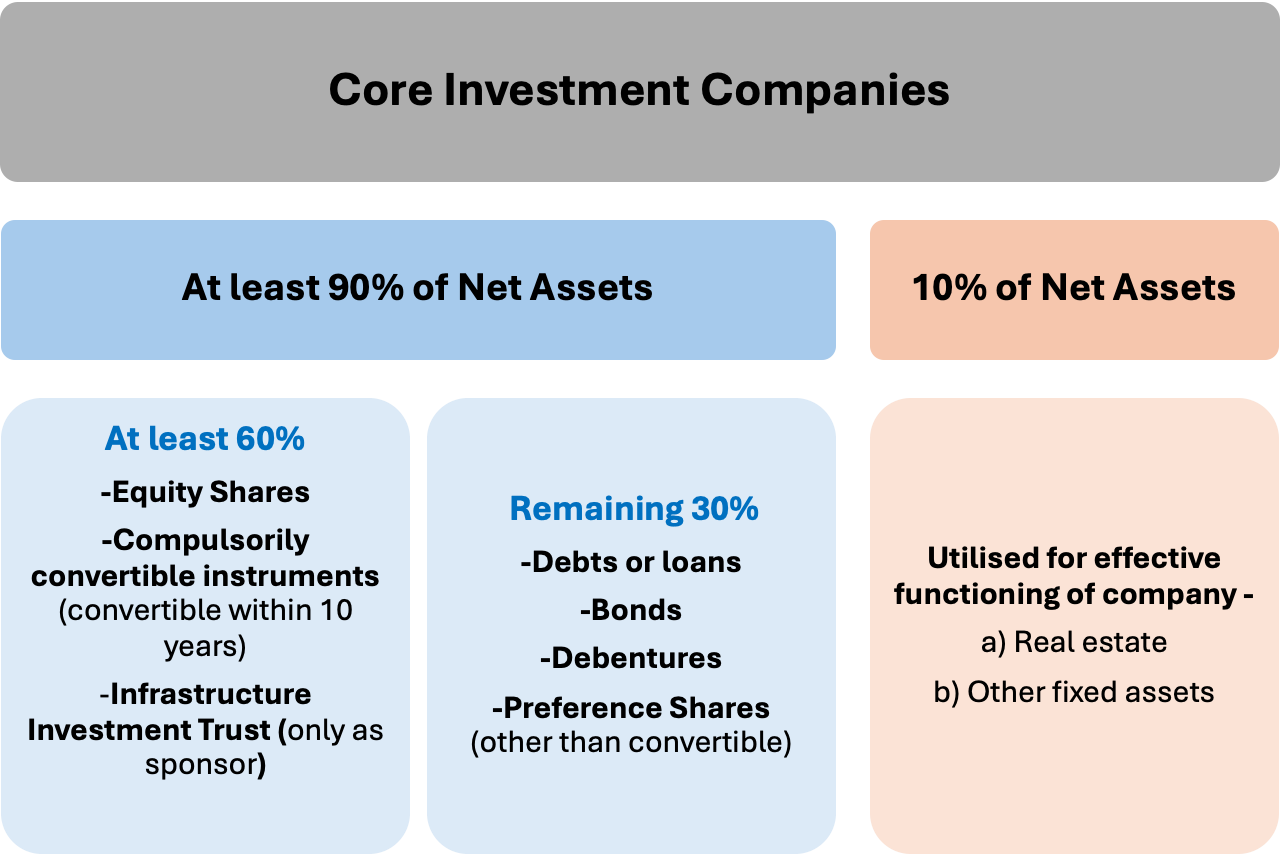
Below given graph explains the regulatory permissibility of the kind of investments a CIC can make:

In addition with the aforesaid, it may further be noted that CICs are permitted to carry out the following financial activities only:

  1. investment in-
    1. bank deposits,
    2. money market instruments, including money market mutual funds that make investments in debt/money market instruments with a maturity of up to 1 year.
    3. government securities, and
    4. bonds or debentures issued by group companies,
  2. granting of loans to group companies and
  3. issuing guarantees on behalf of group companies. 

It may be noted that the RBI’s FAQs on Core Investment Companies, particularly Question 92 has clarified about the 10% of Net Asset – 

What items are included in the 10% of Net assets which CIC/CIC’s-ND-SI can hold outside the group?

Ans: These would include real estate or other fixed assets which are required for effective functioning of a company, but should not include other financial investments/loans in non group companies.

Who are included in Group Companies?

The term “group companies” is defined under Para 3(1)(v) of the CIC Master Directions. It refers to an arrangement involving two or more entities that are related to each other through any of the following relationships:

Subsidiary – Parent (as defined under AS 21),
Joint Venture (as defined under AS 27),
Associate (as defined under AS 23),
Promoter-Promotee (as per the SEBI [Acquisition of Shares and Takeover] Regulations, 1997 for listed companies),
Related Party (as defined under AS 18),
Entities sharing a Common Brand Name, or
Entities with an investment in equity shares of 20% or more

The Issue with Paragraph 26(a): The paradox

Para 26A of the CIC Master Directions deals with Investments in AIFs. The language of the provisions suggest that CICs are permitted to invest in AIFs. However, this provision introduces a significant legal contradiction that undermines the regulatory framework governing CICs. According to the Doctrine of Colorable Legislation, a legal principle ensuring legislative consistency, what cannot be achieved directly cannot be permitted indirectly. By allowing CICs to invest in AIFs, Para 26(a) effectively circumvents the explicit restriction on investments outside group companies. This indirect allowance is inconsistent with the foundational objectives of the CIC Master Directions and creates substantial legal and operational confusion.

Can there be an AIF which in turn invests in the group only? 

Under the SEBI (Alternative Investment Funds) Regulations, 2012, the primary objective of an Alternative Investment Fund (AIF) is to pool funds from investors and allocate them across diverse investment opportunities. However, structuring an AIF to invest predominantly or exclusively in entities within the same group raises concerns regarding compliance with SEBI’s regulatory framework, particularly its diversification. SEBI imposes strict investment concentration limits, as outlined in one of its Circular3

For Category I and II AIFs, no more than 25% of their investable funds can be allocated to a single investee company, while Category III AIFs are restricted to 10%. These regulations inherently prevent AIFs from focusing solely on group entities unless the investment structure strictly adheres to these limits. For CICs intending to invest in AIFs, these restrictions pose significant limitations if the goal is to channel funds primarily into group companies. 

Can AIFs be a Group Entity in a CIC’s Group Structure?

Technically, the answer is affirmative—AIFs can be part of a group entity within a group if it satisfies any of the conditions mentioned in the definition. However, if CICs invest in AIFs within the same group structure, it fails to resolve the underlying issue. AIFs often invest outside the group companies, exposing CICs indirectly to entities external to the group. This contradicts the core purpose of CICs, which is to focus investments within their own group companies. Such a structure not only undermines the original intent of CICs but also raises compliance concerns. The RBI adopts a pass-through approach in these cases and is likely to view such practices as non-compliant. 

Conclusion

The regulatory paradox of allowing CICs to invest in AIFs under Para 26(a) of the CICs Master Direction raises important questions about the practicality and purpose of this provision. At its core, CICs are meant to simplify and streamline the management of investments within their group companies. However, the inclusion of AIFs creates an unnecessary layer of complexity, dividing investments into dual investment pools and making it harder to track, manage, and maintain transparency.

This arrangement doesn’t just complicate operations, it also moves CICs away from their original purpose. By routing investments through AIFs, CICs are exposed to entities outside their group, which can lead to compliance risks, regulatory confusion, and inefficiencies. Even from a taxation perspective, the setup offers no real benefits, adding financial burdens without meaningful gains. Paragraph 26(a) of the CICs Master Direction has been taken from the SBR Master Direction, which is applicable to NBFCs. However, including it in the CICs Master Direction, which provided regulation specifically for CICs NBFC does not appear to serve any purpose. Even if it were to be amended, its relevance of stating the same for CICs NBFC would still remain questionable.

  1.  Reserve Bank of India, Master Direction – Core Investment Companies (Reserve Bank) Directions, 2016. Available at:https://www.lawrbit.com/wp-content/uploads/2021/05/Master-Direction-Core-Investment-Companies-Reserve-Bank-Directions-2016.pdf (Accessed: 19 January 2025). ↩︎
  2. FAQs on Core Investment Companies, available at: https://www.rbi.org.in/commonman/english/scripts/FAQs.aspx?Id=836 (Accessed: 19 January 2025). ↩︎
  3.  SEBI (Alternative Investment Funds) Regulations, 2012 available at: https://www.sebi.gov.in/legal/regulations/apr-2017/sebi-alternative-investment-funds-regulations-2012-last-amended-on-march-6-2017-_34694.html ↩︎

Securitisation Resource Centre

Securitisation is a cornerstone of modern financial markets, driving liquidity, risk distribution, and innovative funding solutions. This page consolidates all our articles on securitisation, offering insights into regulatory developments, market practices, and evolving structures.

Date of PublicationTitleAuthor/SpeakerLink
15.07.2025More Than Enough: Overcollateralisation as credit enhancement in Securitisations Vinod Kothari, Dayita Kanodia and Archisman Bhattacharjeehttps://vinodkothari.com/2025/07/more-than-enough-overcollateralisation-as-credit-enhancement-in-securitisations/
27.11.2024Securitisation of MSME receivables in IndiaVinod Kotharihttps://vinodkothari.com/2024/11/securitisation-of-msme-receivables-in-india/
07.10.2024Simple, Transparent and Comparable (STC) securitisation: Discrepancy in risk weights needing urgent remedyTeam Finservhttps://vinodkothari.com/2024/10/simple-transparent-and-comparable-stc-securitisation-discrepancy-in-risk-weights-needing-urgent-remedy/
30.09.2024Indian securitisation enters a new phase: Banks originate with a bangAbhirup Ghoshhttps://vinodkothari.com/2024/09/indian-securitisation-enters-a-new-phase-banks-originate-with-a-bang/
04.09.2024Sustainable Securitisation – the next in filling sustainable finance gap in IndiaVinod Kothari and Payal Agarwalhttps://vinodkothari.com/2024/09/sustainable-securitisation-the-next-in-filling-sustainable-finance-gap-in-india/
28.06.2024Representation for Regulatory Amendments to Promote Securitisation in IndiaTeam Finservhttps://vinodkothari.com/2024/06/representation-for-regulatory-amendments-to-promote-securitisation-in-india/
27.05.2024Vikas Path: The Securitised Path to Financial Inclusionhttps://vinodkothari.com/2024/05/vikas-path-the-securitised-path-to-financial-inclusion/
22.05.2024Key Takeaways – 12th Securitisation Summit, 2024Team Finservhttps://vinodkothari.com/2024/05/key-takeaways-12th-securitisation-summit-2024/
16.04.2024India securitisation volumes 2024: Has co-lending taken the sheen?Team Finservhttps://vinodkothari.com/2024/04/india-securitisation-volumes-2024-has-co-lending-taken-the-sheen/
04.03.2024The Promise of Predictability: Regulation and Taxation of Future Flow SecuritizationDayita Kanodiahttps://vinodkothari.com/2024/03/the-promise-of-predictability-regulation-and-taxation-of-future-flow-securitization/
26.02.2024Securing the Beat: Tuning into Music Royalty SecuritizationDayita Kanodiahttps://vinodkothari.com/2024/02/securing-the-beat-tuning-into-music-royalty-securitization/
01.05.2023Security Interest: Meaning, forms, registration, enforcement, and effects of non-registrationTeam vinod Kothari and Companyhttps://vinodkothari.com/2023/05/security-interest-meaning-forms-registration-enforcement-and-effects-ofnon-registration/
17.04.2023Taxation in Securitisation: A judicial overviewAnirudh Groverhttps://vinodkothari.com/2023/04/taxation-in-securitisation-a-judicial-overview/
13.04.2023Securitisation: Indian market grows amidst global volume contractionTimothy Lopeshttps://vinodkothari.com/2023/04/securitisation-indian-market-grows-amidst-global-volume-contraction/
31.01.2023Securitisation of stressed loans: Opportunities and structuresTimothy Lopeshttps://vinodkothari.com/2023/01/securitisation-of-stressed-loans-opportunities-and-structures/

Full Day Workshop on Securitisation,Transfer of Loans and Co-lending

Seats Full, Registration Closed.

However, don’t worry we are announcing a repeat workshop on 21st May, 2025

Register here for the Repeat Workshop: https://forms.gle/TGQBkVXgzX8Ho5ts8

Limited Time Offer!!

Get two of our premium books worth ₹7,500 for just ₹3,000 when you register to attend the Workshop Avail the offer benefit now!

Loader Loading…
EAD Logo Taking too long?

Reload Reload document
| Open Open in new tab

Download as PDF [336.44 KB]

Our resources on new Securitisation and Transfer of Loan Directions

Full Day Workshop on Securitisation,Transfer of Loans and Co-lending

Register here:
https://forms.gle/kbjwwAmayAWKJwZr5

Loader Loading…
EAD Logo Taking too long?

Reload Reload document
| Open Open in new tab

Download as PDF [616.58 KB]

Our resources on new Securitisation and Transfer of Loan Directions

Closure and Scaling Down of Business

Refer our related resources:

FAQs on Buyback

Section 53: Liquidation

Affixing Vicarious Liability on Directors: See a Breakthrough

Introduction:

It is well established that a company, being an artificial legal entity, conducts its day-to-day operations through a collective body of individuals known as the Board of Directors. This body bears direct responsibility for the company’s functioning and decision-making. Consequently, in instances of default, both the company and its directors are often held accountable. Under Section 2(60) of the Companies Act, 2013 (hereinafter referred to as “the Act”), directors can be designated as “officers who are in default,” thereby making them personally liable in specific situations.

Despite its artificial nature, a company is recognized as a separate legal entity under the law. Therefore, for any offence committed by a company, it is primarily the company itself that is liable to face legal consequences. However, this fundamental principle is sometimes overlooked, and directors are held accountable for the corporation’s adverse actions. This stems from the perception that directors act as the “mind” of the company and control its operations.

Recently, the Supreme Court of India, in Sanjay Dutt & ORS. v. State of Haryana & ANR (Criminal Appeal No. 11 of 2025), reaffirmed the distinction between the company’s liability and that of its directors. This decision underscores the importance of adhering to the principle of separate legal personality, ensuring that directors are not unfairly held liable unless their personal involvement or negligence in the offence is established.

Brief facts of the Case: 

The case under discussion revolves around a complaint lodged under the Punjab Land Preservation Act, 1900 (PLPA) against three directors of a company, alleging environmental damage caused by uprooting trees using machinery in a notified area. The appellants (directors of Tata Realty and related entities) sought to quash the complaint, asserting that the alleged actions were conducted by the company and not attributable to them personally. The complaint, however, excluded the company as a party and focused on the directors’ liability under Section 4 read with Section 19 of the PLPA.

Key observations by the Supreme Court:

  1. Primary Liability of the Company: The Court emphasized that the company itself, as the licensee and beneficiary of the land, was primarily liable for any violations. Excluding the company from the complaint undermined the case’s premise.
  1. Vicarious Liability Not Automatic: The Court reiterated that directors cannot be automatically held vicariously liable unless the statute explicitly provides for such liability or there is evidence of their personal involvement in the offence.
  1. Lack of Specific Allegations: The complaint failed to attribute specific actions or responsibilities to the directors. It merely assumed liability based on their official positions, which is insufficient for criminal prosecution.
  1. Legal Fiction Requires Explicit Provision: Vicarious liability in criminal matters requires clear statutory backing. The PLPA contains no provisions imposing vicarious liability on directors for offences committed by the company.

Understanding the Concept of Vicarious Liability:

The concept of vicarious liability allows courts to hold one person accountable for the actions of another. This principle is rooted in the idea that a person may bear responsibility for the acts carried out by someone under their authority or on their behalf. In the corporate context, this doctrine extends to holding companies liable for the actions of their employees, agents, or representatives.

Initially developed within the framework of tort law, the doctrine of vicarious liability later found application in criminal law, particularly in cases involving offences of absolute liability. This marked a departure from the once-prevailing notion that corporations, as artificial entities, could not commit crimes. Modern legal interpretations now recognize that a corporation may be held criminally liable if its human agents, acting within the scope of their employment, engage in unlawful conduct.

Doctrine of Attribution:

Currently, a company does not have the immunity to safeguard itself under the blanket of laxity of mens rea, an important component for the constitution of a criminal intent. It was established that corporations are  liable for  criminal and civil wrongdoings if the offences were committed through the corporation’s ‘directing mind and will’. This attribution of liability to the corporations is known as the ‘Doctrine of Attribution’

‘Doctrine of Attribution’ says that in the event of an act or omission leading to violation of criminal law, the mens rea i.e. intention of committing the act is attributed to those who are the ‘directing mind and will’ of the corporations. It can be said that Doctrine of Attribution is a subset of Principle of Vicarious Liability wherein a corporation can be held responsible even in case of a criminal liability.

The landmark judgment in H.L. Bolton (Engineering) Co. Ltd. v. T.J. Graham & Sons Ltd., (1957 1 QB 159) provided a foundational understanding of corporate liability. The court compared a corporation with a human body, with its directors and managers representing the “mind and will” of the organization. These individuals dictate the company’s actions and decisions, and their state of mind is legally treated as that of the corporation itself. Employees or agents, by contrast, are viewed as the “hands” that execute tasks but do not represent the company’s intent or direction.

This conceptual framework underscores that while corporations are artificial entities, they can be held criminally liable when those who embody their directing mind commit offences. The recognition of corporate criminal liability has since evolved, balancing the need for accountability with the distinction between the roles of employees and the decision-makers within an organization.

You can read more about the corporate criminal liability here.

Analyzing the Sanjay Dutt Judgment:

  1. Liability must be expressly mentioned

In the present case, the Court underscored the principle that vicarious liability cannot be imposed on directors or office-bearers of a company unless explicitly provided by statute. This was reiterated in Sunil Bharti Mittal v. Central Bureau of Investigation, (AIR 2015 SC 923) where it was held that individual liability for an offence must be clearly established through direct evidence of involvement or by a specific statutory provision. Without such statutory backing, directors cannot be presumed vicariously liable for a company’s actions.

The Court further emphasized that statutes must clearly define the scope of liability and the persons to whom it applies. This clarity is essential to prevent ambiguity and ensure that only those genuinely responsible for the offence are held accountable.

  1. Personal involvement of Directors :

The Court reaffirmed that corporate liability does not inherently extend to directors unless supported by statutory provisions or evidence of personal involvement. In Pharmaceuticals Ltd. v. Neeta Bhalla and Anr. (AIR 2005 SC 3512), it was held that directors are not automatically vicariously liable for offences committed by the company. Only those who were directly in charge of and responsible for the conduct of the company’s business at the time of the offence may be held liable.

The judgment further emphasized that liability must stem from personal involvement or actions beyond routine corporate duties. Routine oversight or general authorization does not suffice to establish criminal liability unless it can be shown that the director personally engaged in, or negligently facilitated, the unlawful act.

  1.  In charge of’ and ‘responsible to

In K.K. Ahuja vs V.K. Vora & Anr. (2009 10 SCC 48), the Supreme Court analysed the two terms often used in vicarious liability provisions, i.e., ‘in charge of’ and ‘responsible to’. It was held that the ‘in-charge’ principle presents a factual test and the ‘responsible to’ principle presents a legal test. 

A person ‘responsible to’ the company might not be ‘in charge’ of the operations of the company and so in order to be vicariously liable for the act, both the principles must satisfy. It stated as, “Section 141 (of the Negotiable Instrument Act, 1881), uses the words “was in charge of, and was responsible to the company for the conduct of the business of the company”. There may be many directors and secretaries who are not in charge of the business of the company at all.

  1. The Complainant’s Burden of Proof:

Under Section 104 of the Bharatiya Sakshya Adhiniyam, 2023, the burden of proof lies on the complainant. It is the complainant’s responsibility to make specific allegations that directly link a director’s conduct to the offence in question. This principle was reiterated in Maksud Saiyed v. State of Gujarat (AIR 2007 SC 332), where the Court held that vague or generalized accusations against directors are insufficient.

A valid complaint must include:

  1. Clear and specific allegations detailing the director’s role in the offence.
  2. Evidence linking the director’s actions to the company’s criminal liability.
  3. Statutory provisions or legal grounds for attributing vicarious liability.

Referring to Susela Padmavathy Amma and M/s Bharti Airtel Limited (Special Leave Petition (Criminal) No.12390-12391 of 2022), wherein it was reaffirmed by the Supreme Court that even when statutes explicitly provide for vicarious liability, merely holding the position of a director does not automatically render an individual liable for the company’s offences.

To establish a director’s liability, the Court emphasized the need for specific and detailed allegations that clearly demonstrate the director’s involvement in the offence. It must be shown how and in what manner the director was responsible for the company’s actions.

The Court further clarified that there is no universal rule assigning responsibility for a company’s day-to-day operations to every director. Vicarious liability can only be attributed to a director if it is proven that they were directly in charge of and responsible for the day-to-day affairs of the company at the time the offence occurred.

  1. MCA Directive to RD and ROCs: Circular Dated March 2, 2020:

It’s noteworthy that, even MCA, vide its General Circular no. 1/2020 dated 2nd March, 2020, directed Regional Directors and Registrar of Companies that at the time of serving notices relating to non-compliances, necessary documents may be sought so as to ascertain the involvement of the concerned officers of the company.

  1. Duties of Directors under the Companies Act, 2013

Section 166 of the Act lists down duties of directors of a company. To summarise, directors must adhere to the company’s articles, act in good faith for members’ benefit, exercise due care and independent judgment, avoid conflicts of interest, undue gain. However, of note, it does not mention that a director shall be responsible for all the affairs of a company. 

In addition to the above case, the following related judgements are also noteworthy:

  1. Pooja Ravinder Devidasani vs. State of Maharashtra and another, (2014) 16 SCC 1: In this case, the Court asserted that, only those persons who were in-charge of and responsible for the conduct of the business of the Company at the time of commission of an offence will be liable for criminal action.
  1. S.M.S. Pharmaceuticals Ltd. vs Neeta Bhalla and another, (2005) 8 SCC 89: the Court considered the definition of the word “director” as defined in Section 2(13) of the Companies Act, 1956. It held that “…There is nothing which suggests that simply by being a director in a company, one is supposed to discharge particular functions on behalf of a company. It happens that a person may be a director in a company but he may not know anything about the day-to-day functioning of the company…”.
  1. SEBI vs. Gaurav Varshney, (2016) 14 SCC 430: The Court held that even a person without any official title or designation such as “director” in a company may still be liable, if they fulfill the main requirement of being in charge of and responsible for the conduct of business at the relevant time. Liability is contingent upon the role one plays in the affairs of a company, rather than their formal designation or status.
  1. Maharashtra State Electricity Distribution Company Limited and Anr., v. Datar Switchgear Limited and Ors., (10 SCC 479): The Supreme court held that wherever by a legal fiction the principle of vicarious liability is attracted and a person who is otherwise not personally involved in the commission of an offence is made liable for the same, it has to be specifically provided in the statute concerned and it is necessary for the the complainant to specifically aver the role of each of the accused in the complaint.

Vicarious liability must be explicitly provided for in the statute and supported by clear evidence of personal involvement and criminal intent. Also, it is necessary for the complainants to make specific averments in the complaints.  

Conclusion:

The above judgments reinforces the principle that corporate and individual liabilities are distinct. Vicarious liability of directors is not presumed and can only be imposed with statutory backing or compelling evidence of personal involvement. By placing the burden of proof on the complainant, the judiciary ensures fairness and prevents misuse of the legal system to harass directors without substantive evidence. This balanced approach safeguards both corporate governance and individual accountability.

You can read more about this subject here.

Can NBFCs “outsource” internal audit functions to external auditors? 

– Anshika Agarwal (finserv@vinodkothari.com)

The Reserve Bank of India (RBI) has consistently emphasized the significance of robust internal control systems; where gaps are found by the supervisor, it has penalised  regulated entities for non-compliance. Recently, the RBI imposed a penalty on an NBFC for outsourcing one of its core management functions, i.e., internal audit to an external auditor, thereby raising doubts as to whether internal audit for NBFCs can be conducted by external auditors. Does the very fact that internal audit is being conducted not internally but by an external chartered accountancy firm amount to “outsourcing” of core management function?  This article examines outsourcing in the context of internal audit function,  and the conditions subject to which internal audit may be conducted by external agencies. 

Understanding the concept of ‘Outsourcing’

Outsourcing is defined under the Basel 2005 document1 as “a regulated entity’s use of a third party (either an affiliated entity within a corporate group or an entity that is external to the corporate group) to perform activities on a continuing basis that would normally be undertaken by the regulated entity, now or in the future.” Similarly, the IOSCO Consultation Paper2 refers to outsourcing as “a business practice in which a regulated entity uses a service provider to perform tasks, functions, processes, or activities that could otherwise be undertaken by the regulated entity itself.

NBFCs, especially those with asset-light models or limited resources, opt for outsourcing to manage financial as well as non-financial functions. Outsourcing by NBFCs typically involves delegating tasks such as loan application processing, collection of documents, data processing, IT support, customer service, and back-office operations to third-party providers. While outsourcing boosts operational efficiency, they also carry risks, particularly when core management functions are outsourced. Notably, outsourcing is distinct from availing professional services like legal, audit, consulting, or property management, which are ancillary to the NBFC’s core business. In case of outsourcing of financial functions by regulated entities, there are specific guidelines issued by the RBI to regulate the arrangements. Clear regulatory oversight is crucial to strike a balance between leveraging external expertise and maintaining ethical, efficient practices in the financial services sector.

Regulatory Framework: The RBI’s Perspective

The RBI guidelines are specifically aimed at managing risks related to outsourcing of financial services. Master Direction – Reserve Bank of India (Non-Banking Financial Company – Scale Based Regulation) Directions, 2023 (‘SBR Directions’)3, particularly Annexure 13 on Instructions on Managing Risks and Code of Conduct in Outsourcing of Financial Services by NBFCs (‘Outsourcing Guidelines’), Para 2 lays down stringent conditions for outsourcing to ensure compliance, accountability, and effective risk management. While outsourcing can support operational efficiency, core management functions must remain under the direct control of the regulated entity.

Core Management Functions: Non-Negotiable Responsibilities 

The Outsourcing Guidelines explicitly prohibits NBFCs from outsourcing core management functions vital to governance, decision-making, and risk management. The core management functions are those that are vital and crucial for the existence as well as operations of the entity. These have been defined to include:

These functions are critical for ensuring the organization’s stability and operational integrity. For example, internal audit functions identify risks, ensure regulatory compliance, and assess control effectiveness. Entrusting such functions to external entities could compromise decision-making and erode organizational trust.

Contractual Engagement for Internal Audit

While the internal audit function itself is a core management process, the Outsourcing Guidelines in the same lines allows regulated entities to engage internal auditors on a contractual basis. This means external professionals can be brought in to execute internal audits, provided their engagement adheres to regulatory standards, independence is maintained, and the entity retains oversight and control rather than putting all the responsibility on a third party. 

For example, an entity may handle several operational tasks related to an audit, such as preparing documentation, organizing records, or conducting initial reviews. However, the ultimate responsibility for decision-making, oversight, and ensuring compliance with regulations rests with the audit committee or the entity’s senior management. This approach ensures that the internal management retains control over key aspects of the audit process, even while delegating specific tasks or availing expertise support. In contrast, the action of outsourcing shifts the entire responsibility for the audit to a third-party. This means the external firm is accountable for managing and executing all aspects of the audit, from operational tasks to final implementation. Such an outsourcing may reduce the internal workload, however, it also transfers control and accountability to an external entity, which may not align entirely with the entity’s internal objectives and strategic priorities. 

In other words, what is permitted is to avail the expertise services of a third party for carrying out the internal audit function but not the transfer of the entire responsibility of carrying out internal audit to a third party.

ICAI Standards: Expertise and Independence in Internal Audits

The Institute of Chartered Accountants of India (ICAI) Standards on Internal Audit4 states that “Where the Internal Auditor lacks certain expertise, he shall procure the required skills either though in-house experts or through the services of an outside expert, provided independence is not compromised”. 

The aforesaid guidance from the ICAI emphasizes maintaining expertise and independence. While not explicitly addressing outsourcing, these standards recognize that internal auditors may lack certain specialized skills. In such scenarios, they encourage engaging in-house or external experts while safeguarding independence.

The standards indirectly allow for outsourcing when:

  • Specific expertise is unavailable in-house,
  • Independence remains uncompromised

By availing the services of experts ensures that internal audit teams possess the necessary skills to perform effective reviews, while the entity retains oversight and accountability.

Companies Act, 2013: Flexibility in Internal Audit Assignments

Section 138 of the Companies Act, 2013 (‘CA 2013’)5, specifies the requirement for internal audits for certain classes of companies. It allows the appointment of internal auditors, which may include chartered accountants, cost accountants, or other professionals, as decided by the Board. Explanation of Rule 13 of the Companies (Accounts) Rules, 2014, states that “the internal auditor may or may not be an employee of the company”.

The aforesaid provision also enables companies to engage external auditors to perform internal audits, even if they are not part of the organization. While the CA 2013 does not explicitly prohibit outsourcing of internal audit functions, it places the ultimate responsibility for conducting and reporting on internal audits with the Board. This also clarifies that companies may utilize external expertise while maintaining oversight and control of the audit process.

Conclusion

In conclusion, the RBI’s recent penalties underscore the importance for regulated entities to maintain strict compliance with outsourcing regulations, particularly regarding core management functions. While the Outsourcing Guidelines as well as the provisions of CA 2013 permit engaging external auditors on a contractual basis to perform operational tasks related to audits, accountability and strategic control such as having audit plan approved by the audit committee, regular reporting to the audit committee, discussion of the board and audit committee on the conduct of audit,implementing remedial measure on the oversight of the audit committee or senior management must remain firmly within the organization. Adherence to these principles will help maintain the fine distinction between outsourcing the internal audit function and appointing external auditors as internal auditors, specifically in the context of internal audits.

Read our other related resources –

  1. UNDERSTANDING THE CONCEPT OF OUTSOURCING- ENVISAGING A TOUGH ROAD AHEAD FOR THE SERVICE PROVIDERS
  2. Draft framework for Financial Services Outsourcing

  1.   https://www.bis.org/publ/joint12.pdf (last accessed in November 2024) ↩︎
  2.   https://www.iosco.org/library/pubdocs/pdf/IOSCOPD654.pdf (last accessed in November 2024) ↩︎
  3.  Reserve Bank of India, Master Direction – Scale Based Regulation (SBR): A Revised Regulatory Framework for NBFCs, October 22, 2021. Available at: https://rbi.org.in/Scripts/BS_ViewMasDirections.aspx?id=12550 ↩︎
  4.  Institute of Chartered Accountants of India, Standard on Internal Audit (SIA) 2: Basic Principles Governing Internal Audit. Available at: https://resource.cdn.icai.org/52727iasb-basicprinciples-3.pdf ↩︎
  5.  The Companies Act, 2013, Ministry of Corporate Affairs, Government of India. Available at: https://www.mca.gov.in/. ↩︎

Shastrartha 13 – DPDP Rules for Lenders

In this edition of Shastrath, we address key concerns and considerations for lenders in light of the Draft DPDP Rules published on January 03, 2025, and discuss steps to take in order to ensure readiness and compliance. 


Register your interest here: https://docs.google.com/forms/d/e/1FAIpQLSf0uZidJDf8oqK0GfGygo0BmuCKRg9wMo2bXRtwRMIra7Zx5Q/viewform

Credit Information Reporting: Actionables under the New Directions

– Anshika Agarwal (finserv@vinodkothari.com)

Loader Loading…
EAD Logo Taking too long?

Reload Reload document
| Open Open in new tab

Download as PDF [170.48 KB]