Referral or Representation? The Fine Line Between LSP, DSA and Referral Partner

Simrat Singh & Sakshi Patil | finserv@vinodkothari.com

India’s lending landscape is evolving from traditional, branch-led lending to digital and now “phygital” models, involving multiple intermediaries connecting borrowers and lenders. For regulated entities (REs), three different terms referring to loan intermediaries are commonly seen: Lending Service Providers (LSPs), Direct Selling Agents (DSAs) and Referral Partners. 

At first glance, these roles may appear similar since all “bring in business.” But as far as the RBI is concerned, the difference determines how much regulatory oversight the lender must exercise over these participants. This article attempts to answer who’s who in this lending chain, and more importantly, where a simple referral ends and a regulated lending function begins.

The Lending Trio: LSPs, DSAs and Referral Partners

LSPs: The digital lending backbone

In the digital lending framework, the most central participant is the LSP who are engaged by the REs to carry out some functions of RE in connection with its functions on digital platforms. These LSPs may be engaged in customer acquisition, underwriting support, recovery of loan, etc. The RBI’s Digital Lending Directions, 2025 define an LSP as:

An agent of a RE (including another RE) who carries out one or more of the RE’s digital lending functions, or part thereof, in customer acquisition, services incidental to underwriting and pricing, servicing, monitoring, or recovery of specific loans or loan portfolios on behalf of the RE, in conformity with the extant outsourcing guidelines issued by the Reserve Bank.”

The emphasis on the term “agent” is crucial since being an agent becomes a precondition to becoming an LSP. An agent is a person employed to act for another; to represent another in dealings with third persons within the overall authority granted and can legally bind the principal by their actions (more discussion on agency later). This distinguishes an agent from a mere vendor or service provider who delivers a contracted service but has no authority to affect the principal’s relationship with third parties and neither is subjected to a degree of control from the principal.

DSAs: The traditional middle ground

DSAs, though not formally defined by the RBI, their appointment, conduct and RE’s oversight on them is governed by Annex XIII of the SBR Directions (Instructions on Managing Risks and Code of Conduct in Outsourcing of Financial Services by NBFCs) for NBFCs and by Guidelines on Managing Risks and Code of Conduct in Outsourcing of Financial Services by Banks for Banks. DSAs operate largely in physical or “phygital” lending models, focusing on loan sourcing. They represent the lender while dealing with potential borrowers. However, their functions are narrower than those of an LSP. A DSA’s role typically ends with lead generation and preliminary documentation, without involvement in underwriting, servicing or recovery. While the DSA is an agent, it plays a more limited role in the lending value chain and has minimal borrower-facing obligations post origination.

Referral Partners: The nudge before negotiation

Referral Partners perform the most limited role. They simply share leads or basic borrower information with the lender and have no authority to represent or bind the lender. Their role is confined to referral i.e. the providing the first nudge to the lender. They are treated as independent contractors or service providers, not agents and operate under commercial referral agreements. The RE does not exercise control over their operations, nor is it responsible for their actions beyond the agreed referral activity. The distinction lies not in what they do (introducing borrowers) but in what they cannot do i.e. represent the lender or perform any of its lending functions.

Referral ≠ Representation: The Agency Test

The most important question then arises “How does one determine whether a person is an LSP, DSA, or a referral partner?”. All three may assist in borrower acquisition, but the answer might lie in distinguishing referring from representing. To be classified as an LSP (or even a DSA), the person must first be the agent of the RE, not just a vendor or service provider. The test of agency has been laid down in the Supreme Court’s decision in Bharti Cellular Ltd. v. Commissioner of Income Tax1. The Court, in para 8, observed that the existence of a principal–agent relationship depends on the following elements:

  1. The authority of one party to alter the legal relationship of the other with third parties;
  2. The degree of control exercised by the principal over the agent’s conduct (less than that over a servant, but more than over an independent contractor);
  3. The existence of a fiduciary relationship, where the agent acts on behalf of and under the guidance of the principal;
  4. The obligation to render accounts to the principal, and the entitlement to remuneration for services rendered.

Further, the Court clarified in para 9 that the substance of the relationship, not just its form, determines whether agency exists. If a person is neither authorised to affect the principal’s relationship with third parties nor under its control, and owes no fiduciary obligation, the person is not an agent, regardless of what the contract calls them. 

Similarly, in Bhopal Sugar Industries v. Sales Tax Officer2, the Supreme Court had observed that the mere word ‘agent’ or ‘agency’ is not sufficient to lead to the inference that parties intended the conferment of principal-agent status on each other. Mere formal description of a person as an agent is not conclusive to show existence of agency unless the parties intend it so hence, “the true relationship of the parties in such a case has to be gathered from the nature of the contract, its terms and conditions, and the terminology used by the parties is not decisive of the said relationship.”

On the aspect of supervision and control, the Supreme Court in para 40 of the Bharti Cellular ruling stated:

An independent contractor is free from control on the part of his employer, and is only subject to the terms of his contract. But an agent is not completely free from control, and the relationship to the extent of tasks entrusted by the principal to the agent are fiduciary….The distinction is that independent contractors work for themselves, even when they are employed for the purpose of creating contractual relations with the third persons. An independent contractor is not required to render accounts of the business, as it belongs to him and not his employee.

In lending transactions, therefore, the relevant considerations to determine whether an agency exists or not may be:

  1. Does the agency have the authority, under a contract with the principal, to represent the principal to create any relationship with the borrower?;
  2. Does the agency have the authority to approach potential borrowers, representing that the agency can source a loan from the RE?;
  3. What is the role of the agency in the loan contract – is the loan contract established between the lender and the borrower through the agent?;
  4. Does the agency agreement control/regulate the manner of the agent’s dealings with the borrowers?;
  5. Effectively, is the agency the interface between the RE and the borrowers?

Paanwala and the Poster: Not everyone who sells a loan lead is an LSP

To illustrate the difference between LSP/DSA and Referral Partner, consider a simple example. You stop at your neighbourhood paanwala for your regular paan or pack of mints. Between the faded ads for mobile recharges and UPI QR codes, one new poster catches your eye “Need a personal loan? Look No Further ! Fast approvals”. Curious, you ask if the shopkeeper has joined the finance world. Smiling, he replies, “Arre nahi sahib, I just share numbers! You give me your name and phone number, I’ll send it to my guy. If your loan gets approved, I get a small tip!” No exchange of KYC documents, no app, no credit score. Now, does this make the paanwala an LSP under the Digital Lending Directions? He may appear as performing a part of the customer acquisition function of the lender so should he now comply with outsourcing norms, data protection protocols and grievance redressal requirements? Of course not.

The paanwala is a pure referral partner. His role ends with introducing a potential borrower to a contact connected to a lender. He does not represent the lender, verify or collect documents, underwrite, service, or recover loans, nor can he legally bind the lender through his actions. Mere referral, without agency and without performing a lending function, does not make one an LSP. Passing a phone number over a cup of chai does not amount to digital intermediation.

BasisReferral PartnerLSP
Scope of activityLimited to sharing leads with the lenderPerforms one or more of the lenders functions w.r.t in customer acquisition, services incidental to underwriting and pricing, servicing, monitoring, recovery
Access to prospective customer’s information and documentsOnly basic contact information necessary for the lender to approach the customer for the loan is sharedTo the extent relevant for carrying out its functions
RepresentationDoes not represent the RERepresents the RE
Agency & PrincipalNot an agentAppointed as an agent
DLGCannot provideCan provide (in case of Digital Lending and Co-lending)
Applicability of Outsourcing GuidelinesNot applicableApplicable
Mandatory due diligence  before appointmentNot applicableApplicable
Appointment of GRONo such requirementLSP having interface with borrower needs to appoint a GRO
Right to auditNo right of RERE has a right
Disclosure on the website of the lenderNot applicableApplicable

Table 1: Distinction between Referral Partner and LSP

Conclusion

As digital lending continues to expand in India, ensuring that every intermediary’s role aligns with its true legal character is essential. The key in determining the true nature of the relationship would ultimately rest on the contractual terms that must reflect the true nature of the relationship. Misclassifying these entities can expose lenders to compliance risks under RBI’s outsourcing and digital lending guidelines.

  1. [2024] 2 S.C.R. 1001 : 2024 INSC 148 ↩︎
  2. 1977 AIR 1275 ↩︎

Our resources on the same:

  1. Lending Service Providers for digital lenders: Distinguishing agency contracts and principal-to-principal contracts
  2. Principles of Neutrality for Multi-Lender Platforms
  3. Multi-lender LSPs – Compliance & Considerations
  4. Outsourcing (Direct Selling Agent) v. Business Correspondent route
  5. Resources on Digital Lending

India FSAP 2025: Key Takeaways and Policy Recommendations

– Chirag Agarwal, Assistant Manager | chirag@vinodkothari.com

A joint World Bank-IMF team visited India in 2024 to update the findings of the Financial Sector Assessment Program (FSAP), which took place in 2017. World Bank on October 30, 2025 released the report1 which summarises the main findings of the mission, identifies key financial development issues, and provides policy recommendations.

We were in touch with the FSA team for our recommendations on certain aspects. The FSA recommendation on leasing (discussed below) is based on our feedback.

This article discusses in brief the key takeaways from the FSA Report.

Key Takeaways:

  1. Stronger and More Diversified Financial System: As per the report, India’s financial system has become more resilient, inclusive, and diversified since the previous 2017 assessment. Non-bank financial institutions (NBFIs) and market financing (other than from banks) now account for 44% of total financial assets—up from 35% in 2017—reflecting deeper financial intermediation beyond banks.
  2. Reforms Critical for India’s 2047 Growth Vision: The report suggests that to achieve the target of a USD 30 trillion economy by 2047, India must modernize its financial architecture to channel both domestic and foreign savings into productive investment, deepen capital markets, and attract long-term infrastructure and green financing2.
  3. Macroprudential Tools: The assessment highlights rising systemic risks due to financial diversification and interlinkages. It recommends expanding data collection and deploying macroprudential tools—including introducing Debt Service to Income (DSTI) limits across banks and NBFCs and building counter-cyclical capital buffers (CCyBs) for banks to manage liquidity, intersectoral contagion, household credit risks, and climate-related financial risks
  4. Regulatory and Supervisory Enhancements: While India’s regulatory oversight framework for banks, insurers, and markets is broadly sound, lingering issues include state influence on regulators, limited powers over governance of state-owned entities, and gaps in conglomerate and climate-risk supervision. The report suggests that efforts should be made to ensure better coordination between regulators and extending the scope of the regulatory and supervisory frameworks.
  5. Banking and NBFC Reforms: The report stresses adoption of IFRS 9, enforcing Pillar 2 capital add-ons, and elimination of prudential exemptions for state-owned NBFCs. It also suggests considering additional liquidity requirements tailored to different business models.
  6. Tax  treatment of leasing: The report suggests that to diversify MSME finance the tax treatment of leasing should be reviewed to ensure an equal treatment between lease and debt transactions. At present, interest on loans is exempted under the GST laws and hence, there is no GST levied on the loan repayments, however, the entire rentals are subject to GST in case of financial leases.
  7. Transfer of oversight function of NHB to RBI: While regulation of HFCs moved to RBI in 2019, supervision still rests with NHB, which follows a limited, compliance-based approach. Shifting supervision to RBI would strengthen oversight and remove the conflict of interest since NHB also acts as promoter and refinancer for HFCs.
  8. MSME Finance: The report recommends integrating TReDs with the e-invoicing portal for automatic invoice uploads. It also suggests incentivizing large buyers and mandating state-owned enterprises to upload invoices to improve cash flow for MSMEs. Further, the report also mentions that SIDBI’s funding support to NBFCs, including NBFC factors, should be increased, along with developing credit enhancement and guarantee facilities for NBFC bonds and MSME loan securitizations.
  1. https://documents1.worldbank.org/curated/en/099103025110514063/pdf/BOSIB-606133f7-2e00-4696-9b41-57f3737d140d.pdf
    ↩︎
  2. See our resources on sustainable financing: https://vinodkothari.com/resources-on-sustainability-finance/  ↩︎

Upfronting Uprooted: RBI puts an end to early profit booking in Co-lending

Simrat Singh | Finserv@vinodkothari.com

Co-lending is an arrangement where two or more regulated entities (REs) jointly extend credit to a borrower under a pre-agreed Co-Lending Agreement (CLA). The CLA, signed before origination, defines borrower selection criteria, product lines, operational responsibilities, servicing terms and the proportion in which each lender will fund and share the loan. The aim is to combine the origination strength of a RE with the lower cost of funds of another RE, thereby expanding credit outreach.

Before the issuance of the RBI (Co-Lending Arrangements) Directions, 2025 (‘Directions’), there was no formal co-lending framework for non-PSL loans and for PSL loans, the CLM-2 ‘originate-and-transfer’ model was the most common structure. Under this model, the originating RE would book 100% of the loan in its books and, within a stipulated period, selectively transfer a portion to the funding partner. This post-origination discretion enabled ‘cherry-picking’ of loans. CLM-2 mirrored a loan sale under TLE framework but without any minimum holding period restrictions, making it a preferred route. It offered the economic and accounting benefits of transfer, including derecognition and upfront gain recognition without waiting for loan seasoning.  

Upon transfer, the originating RE would derecognise the transferred portion and book ‘upfront gains’. The upfront gain arose from the excess spread between the interest rate charged to the borrower and the yield at which the loan pool was transferred to the funding partner. For example, if the originating RE extended loans at 24% and sold down 80% of the pool at 18%, the 6% differential represented the excess spread. This spread, which would otherwise have been earned over the life of the loan, was discounted to present value and recognised as gain on transfer upfront, at the time of derecognition. This led to the originating RE recognising profits immediately despite not receiving any actual cash on the co-lent loans. This practice allowed originating REs to show higher profits upfront, even though no cash had actually been received on the co-lent loans.

The Directions fundamentally alter this framework as well as the prevalent market practice. They move away from originate-and-transfer and institute a pure co-origination model. It has been expressly stated that The CLA must now be executed before origination, with borrower selection and product parameters agreed ex ante. The funding partner must give an irrevocable commitment to take its share on a back-to-back basis as loans are originated. Importantly, the 15-day window provided under the Directions is only for operational formalities such as fund transfers, data exchange and accounting. It is not for evaluating or selecting loans after origination. If the transfer does not occur within 15 days due to inability, not discretion, the originating RE must retain the loan or transfer it under the securitisation route or as per Transfer of Loan Exposure framework. In short, post-origination cherry-picking is no longer permitted.

This change has direct accounting consequences. Under Ind AS 109, a financial asset is recognised only when the entity becomes a party to the contractual provisions and has enforceable rights to the underlying cash flows (see para 3.1.1 and B3.1.1). In a co-lending transaction under the Directions where co-origination is a must, each lender should recognise only its respective share of the loan at origination. The originating partner should not recognise the funding partner’s share at any stage, except as a temporary receivable if it disburses on behalf of the funding partner. Since the originating partner never recognises the funding partner’s share (except as a servicer), there is no recognition and therefore, there is no question of any subsequent derecognition and booking of any gain on sale. Income, if any, is limited to servicing fees or mutually agreed charges, not upfront profit.

By eliminating post-origination discretion, RBI has closed the upfronting route. Co-lending is now truly co-origination, joint funding from day one, with proportionate recognition and no accounting arbitrage.  The practice that once allowed REs to accelerate income has been uprooted.

Click here to see our other resources on co-lending

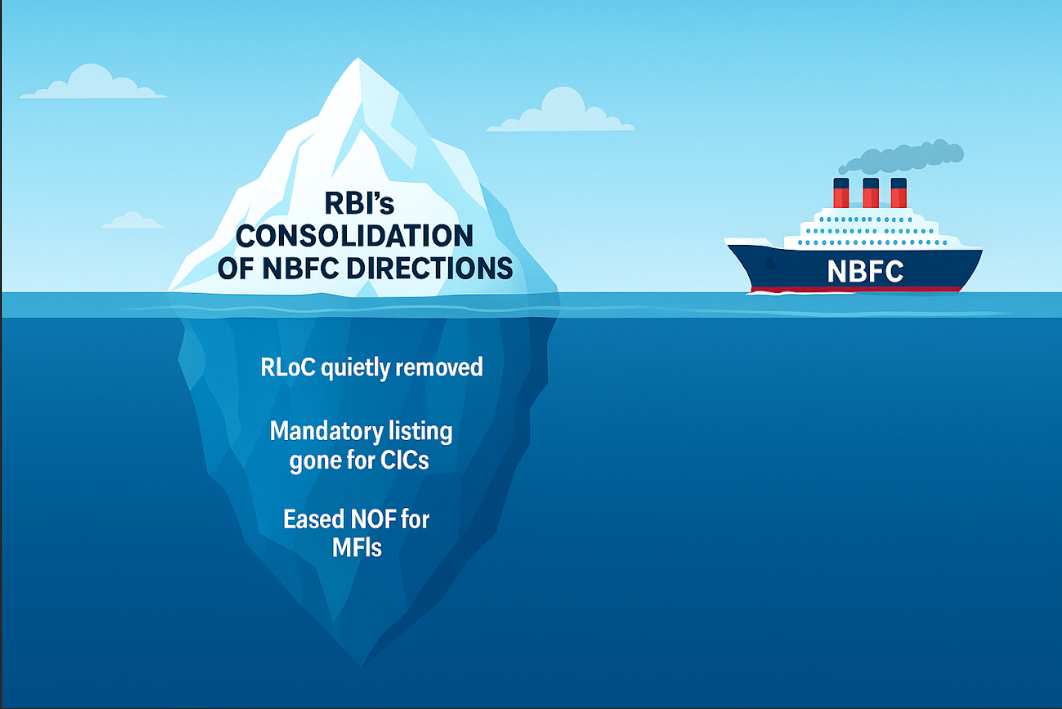
The Great Consolidation: RBI’s subtle shifts; big impacts on NBFCs

Team Finserv | finserv@vinodkothari.com

In its recent consolidation exercise of the Master Directions applicable to NBFCs, the RBI has done a lot of clause shifting, reshuffling, reorganisation, replication for different regulated entities, pruning of redundancies, etc. However, there are certain places where subtle changes or glimpses of mindset may have a lot of impact on NBFCs. Here are some:

Read more

ECL Framework for Banks: Key Highlights

-Team Finserv (finserv@vinodkothari.com)

Loader Loading…
EAD Logo Taking too long?

Reload Reload document
| Open Open in new tab

Download as PDF [180.08 KB]

Other Resources:

Rules of Restraint: RBI proposes revised norms on Related Party Lending and Contracting

– Team Finserv, finserv@vinodkothari.com

In its current hectic phase of revamping regulations, the RBI has issued Draft Directions for lending and contracting with related parties. Separate sets have been issued for commercial banks, other banks, NBFCs and financial institutions. 

The definition of “related party” is more rationalised and improvised over the existing definitions in Companies Act or LODR Regulations. Loans above a “materiality threshold” [which is scaled based on capital in case of banks, and based on base/middle/upper layer status in case of NBFCs] will require board approval, and nevertheless, will require regulatory reporting as well as disclosure in financial statements. In case of contracts or arrangements with related parties, with the scope of the term derived from sec 188 (1) of the Companies Act, there are no approval processes, but disclosure norms will apply. In the case of banks, trustees  of funds set up by banks are also brought within the ambit of “related persons”.

Read more

Budget, Bazaars and Bank Rate: Understanding inflation, GDP, Repo Rate etc.

Access the Youtube video at https://www.youtube.com/watch?v=EXH6Nt1fXdg

See our other resources on this topic:

  1. https://vinodkothari.com/2025/02/union-budget-2025/
  2. https://vinodkothari.com/2022/08/hike-in-repo-rate-how-to-modify-loan-instalments/
  3. https://vinodkothari.com/2023/08/rbi-streamlines-floating-rate-reset-for-emi-based-personal-loans/

Round-Tripping Reined: RBI Rolls Out Relaxed Rules for Investments in AIFs

-Sikha Bansal, Senior Associate & Harshita Malik, Executive | finserv@vinodkothari.com

Background

The RBI’s regulatory approach to investments by Regulated Entities (REs) in Alternate Investment Funds (AIFs) has undergone a remarkable transformation over the past two years. Initially, the RBI responded to the risks of “evergreening”, where banks and NBFCs could mask bad loans by routing fresh funds to existing debtor companies via AIF structures, by issuing stringent circulars in December 20231 and March 20242 (collectively known as ‘Previous Circulars’). The December 2023 circular imposed a blanket ban on RE investments in AIFs that had downstream exposures to debtor companies, while the March 2024 clarification excluded pure equity investments (not hybrid ones) from this restriction. This stance aimed to strengthen asset quality but quickly highlighted significant operational and market challenges for institutional investors and the AIF ecosystem. Many leading banks took significant provisioning losses, as the Circulars required lenders to dispose off the AIF investments; clearly, there was no such secondary market. 

In response to the feedback from the financial sector, as well as evolving oversight by other regulators like SEBI, the RBI undertook a comprehensive review of its framework and issued Draft Directions- Investment by Regulated Entities in Alternate Investment Funds (‘Draft Directions’) on May 19, 20253. The Draft Directions have now been finalised as Reserve Bank of India (Investment in AIF) Directions, 2025 (‘Final Directions’) on 29th May, 2025. The Final Directions shift away from outright prohibitions and instead introduce a carefully balanced regime of prudential limits, targeted provisioning requirements, and enhanced governance standards. 

Comparison at a Glance

A compressed comparison between Previous Circulars and Final Directions is as follows –

ParticularsPrevious CircularsFinal DirectionsIntent/Implication
Blanket BanBlanket ban on RE investments in AIFs lending to debtor companies (except equity)No outright ban; investments allowed with limits, provisioning, and other prudential controlsMove from a complete prohibition to a limit-based regime. Max. Exposures as defined (see below) taken as prudential limits
Definition of debtor companyOnly equity shares excluded for the purpose of reckoning “investment” exposure of RE in the debtor companyEquity shares, CCPSs, CCDs (collectively, equity instruments) excluded Therefore, if RE has made investments in convertible equity, it will be considered as an investment exposure in the counterparty – thereby, the directions become inapplicable in all such cases.
Individual Investment Limit in any AIF schemeNot applicable (ban in place)Max 10% of AIF corpus by a single RE, subject to a max. of 5% in case of an AIF, which has downstream investments in a debtor company of RE.Controls individual exposure risk. Lower threshold in cases where AIF has downstream investments.
Collective Investment Limit by all REs in any AIF schemeNot applicableMax 20%4 of AIF corpus across all REsWould require monitoring at the scheme level itself.
Downstream investments by AIF in the nature of equity or convertible equityEquity shares were excluded, but hybrid instruments were not. All equity instruments Exclusions from downstream investments widened to include convertible equity as well. Therefore, if the scheme has invested in any equity instruments of the debtor company, the Circular does not hit the RE.
Provisioning100% provisioning to the extent of investment by the RE in the AIF scheme which is further invested by the AIF in the debtor company, and not on the entire investment of the RE in the AIF scheme or 30-day liquidation, if breachIf >5% in AIF with exposure to debtor, 100% provision on look-through exposure, capped at RE’s direct exposure5 (see illustrations below)No impact vis-a-vis Previous Circulars. 
For provisioning requirements, see illustrations later. 
Subordinated Units/CapitalEqual Tier I/II deduction for subordinated units with a priority distribution modelEntire investment deducted proportionately from Tier 1 and Tier 2 capital proportionatelyAdjustments from Tier I and II, now to be done proportionately, instead of equally. 
Investment PolicyNot emphasizedMandatory board-approved6 investment policy for AIF investmentsOne of the actionables on the part of REs – their investment policies should now have suitable provisions around investments in AIFs keeping in view provisions of these Directions
ExemptionsNo specific exemption. However, Investments by REs in AIFs through intermediaries such as fund of funds or mutual funds were excluded from the scope of circulars. Prior RBI-approved investments exempt; Government notified AIFs may be exempt
Provides operational flexibility and recognizes pre-approved or strategic investments.No specific mention of investments through MFs/FoFs – however, given the nature of these funds, we are of the view that such exclusion would continue.
Transition/Legacy TreatmentNot applicableLegacy investments may choose to follow old or new rulesSee discussion later.

Key Takeaways: 

Detailed analysis on certain aspects of the Final Directions is as follows:

Prudential Limits 

Under the Previous Circulars, any downstream exposure by an AIF to a regulated entity’s debtor company, regardless of size, triggered a blanket prohibition on RE investments. The Final Directions replace this blanket ban with prudential limits:

  • 10% Individual Limit: No single RE can invest more than 10% of any AIF scheme’s corpus.
  • 20% Collective Limit: All REs combined cannot exceed 20% of any AIF scheme’s corpus; and
  • 5% Specific Limit: Special provisioning requirements apply when an RE’s investment exceeds 5% of an AIF’s corpus, which has made downstream investments in a debtor company.

Therefore, if an AIF has existing investments in a debtor company (which has loan/investment exposures from an RE), the RE cannot invest more than 5% in the scheme. But what happens in a scenario where RE already has a 10% exposure in an AIF and the AIF does a downstream investment (in forms other than equity instruments) in a debtor company? Practically speaking, AIF cannot ask every time it invests in a company whether a particular RE has exposure to that company or not. In such a case, as a consequence of such downstream investment, RE may either have to liquidate its investments, or make provisioning in accordance with the Final Directions. Hence, in practice, given the complexities involved, it appears that REs will have to conservatively keep AIF stakes at or below 5% to avoid the consequences as above. 

Now, consider a scenario – where the investee AIF invests in a company (which is not a debtor company of RE), which in turn, invests in the debtor company. Will the restrictions still apply? In our view, it is a well-established principle that substance prevails over form. If a clear nexus could be established between two transactions – first being investment by AIF in the intermediate company, and second being routing of funds from intermediate company to debtor company, it would clearly tantamount to circumventing the provisions. Hence, the provisioning norms would still kick-in. 

Provisioning Requirements

Coming to the provisioning part, the Final Directions require REs to make 100 per cent provision to the extent of its proportionate investment in the debtor company through the AIF Scheme, subject to a maximum of its direct loan and/ or investment exposure to the debtor company, if the REs exposure to an AIF exceeds 5% and that AIF has exposure to its debtor company. The requirement is quite obvious – RE cannot be required to create provisioning in its books more than the exposure on the debtor company as it stands in the RE’s books. 

The provisioning requirements can be understood with the help of the following illustrations:

ScenarioIllustrationExtent of provisioning required
Existing investment of RE in AIF Scheme (direct loan and/or investment exposure exists as on date or in the past 12 months)For example, an RE has a loan exposure of 10 cr on a debtor company and the RE makes an investment of 60 cr in an AIF (which has a corpus of 800 cr), the RE’s share in the corpus of the AIF turns out to be 7.5%. The AIF further invested 200 cr in the debtor company of the RE. The proportionate share of the RE in the investment of AIF in the debtor company comes out to be 15 cr (7.5% of 200 cr). However, the RE’s loan exposure is 10 crores only. Therefore, provisioning is required to the extent of Rs. 10 crores.
Existing investment of RE in AIF Scheme (direct loan and/or investment exposure does not exist as on date or in the past 12 months)Facts being same as above, in such a scenario, the provisioning requirement shall be minimum of the following two:-15 cr(full provisioning of the proportionate exposure); or-0 (full provisioning subject to the REs direct loan exposure in the debtor company)Therefore, if direct exposure=0, then the minimum=0 and hence no requirement to create provision.

Some possible measures which REs can adopt to ensure compliance are as follows: 

  1. Maintain an up-to-date, board-approved AIF investment policy aligned with both RBI and SEBI rules;
  2. Implement robust internal systems for real-time tracking of all AIF investments and debtor exposures (including the 12-month history);
  3. Require regular, detailed portfolio disclosures from AIF managers;
  4. appropriate monitoring and automated alerts for nearing the 5%/10%/20% thresholds; and
  5. Establish suitable escalation procedures for potential breaches or ambiguities.

Further, it shall be noted that the intent is NOT to bar REs from ever investing more than 5% in AIFs. The cap is soft, provisioning is only required if there is a debtor company overlap. But the practical effect is, unless AIFs develop robust real-time reporting/disclosure and REs set up systems to track (and predict) debtor overlap, 5% becomes a limit for specifically the large-scale REs for practical purposes. 

Investment Policy

The Final Directions call for framing and implementing an investment policy (amending if already exists) which shall have suitable provisions governing its investments in an AIF Scheme, compliant with extant law and regulations. Para 5 of the Final Directions does not mandate board approval of that policy, however, Para 29 of the RBI’s Master Directions on Scale Based Regulations stipulates that any investment policy must be formally approved by the Board. In light of this broader governance requirement, it is our view that an RE’s AIF investment policy should similarly receive Board approval. Below is a tentative list of key elements to be included in the investment policy:

  • Limits: 10% individual, 20% collective, with 5% threshold alerts;
  • Provision for real-time 12-month debtor-exposure monitoring and pre-investment checks;
  • Clear provisioning methodology: 100% look-through at >5%, capped by direct exposure; proportional Tier-1/Tier-2 deduction for subordinated units; and
  • Approval procedures for making/continuing with AIF investments; decision-making process
  • Applicability of the provisions of these Directions on investments made pursuant to commitments existing on or before the effective date of these Directions.

Subordinated Units Treatment

Under the Final Directions, investments by REs in the subordinated units7 of any AIF scheme must now be fully deducted from their capital funds, proportionately from Tier I and Tier II as against equal deduction under the Previous Circulars. While the March 2024 Circular clarified that reference to investment in subordinated units of AIF Scheme includes all forms of subordinated exposures, including investment in the nature of sponsor units; the same has not been clarified under the Final Directions. However, the scope remains the same in our view.

What happens to positions that already exist when the Final Directions arrive?

As regards effective date, Final Directions shall come into effect from January 1, 2026 or any such earlier date as may be decided as per their internal policy by the REs. 

Although, under the Final Directions, the Previous Circulars are formally repealed, the Final Directions has prescribed the following transition mechanism:

Time of making Investments by RE in AIFPermissible treatment under Final Directions
New commitments (post-effective date)Must comply with the new directions; no grandfathering or mixed approaches allowed
Existing InvestmentsWhere past commitments fully honoured: Continue under old circulars
Partially drawn commitments: One-time choice between old and new regimes

Closing Remarks

The RBI’s evolution from blanket prohibitions to calibrated risk-based oversight in AIF investments represents a mature regulatory approach that balances systemic stability with market development, and provides for enhanced governance standards while maintaining robust safeguards against evergreening and regulatory arbitrage. 

Of course, there would be certain unavoidable side-effects, e.g. significant operational and compliance burdens on REs, requiring sophisticated real-time monitoring systems, comprehensive debtor exposure tracking, board-approved investment policies, and enhanced coordination with AIF managers. Hence, there can be some challenges to practical implementation.  Further, the success of this recalibrated regime will largely depend on the operational readiness of both REs and AIFs to develop transparent monitoring systems and proactive compliance frameworks. 

  1.  https://vinodkothari.com/2023/12/rbi-bars-lenders-investments-in-aifs-investing-in-their-borrowers/ 
    ↩︎
  2.  https://vinodkothari.com/2024/03/some-relief-in-rbi-stance-on-lenders-round-tripping-investments-in-aifs/ 
    ↩︎
  3.  https://vinodkothari.com/2025/05/capital-subject-to-caps-rbi-relaxes-norms-for-investment-by-res-in-aifs-subject-to-threshold-limits/ ↩︎
  4.  The limit was 15% in the Draft Directions, the Final Directions increased the limit by 5 percentage points.
    ↩︎
  5.  This cap at RE’s direct loan and/or investment exposure has been introduced in the Final Directions.
    ↩︎
  6.  Para 29 of the RBI’s Master Directions on Scale Based Regulations stipulates that any investment policy must be formally approved by the Board. 
    ↩︎
  7. SEBI, vide Master Circular for AIFs, had put restrictions on priority distribution model. Later, pursuant to Fifth Amendment to SEBI (AIF) Regulations, 2024, SEBI issued a Circular dated December 13, 2024 wherein certain exemptions were allowed and differential rights were allowed subject to certain conditions. See our article here. ↩︎

Let them pledge but don’t make it count: RBI’s clarification on voluntary pledge

Harshita Malik | finserv@vinodkothari.com

The Banking Puzzle

I was giving a collateral-free loan only, but the borrower didn’t agree – he voluntarily came and pledged family gold and silver jewellery! 

This is perhaps the way Banks will be reacting after the RBI Clarificatory circular on Voluntary Pledge of Gold (‘Voluntary Pledge Circular’). The Voluntary Pledge Circular dated July 11, 2025 which addresses all Scheduled Commercial Banks (including RRBs & SFBs), State Co-operative Banks, District Central Co-operative Banks states that a a voluntary pledge of gold or silver as collateral by a borrower for an agricultural or MSME loan shall not amount to a violation of the Reserve Bank of India (Lending Against Gold and Silver Collateral) Directions, 2025 (‘Gold Lending Directions’), provided that the sanctioned amount is within the collateral-free limit laid down in the earlier RBI guidelines. 

It may be noted that as per separate RBI circulars dated December 6, 2024 and July 24, 2017 farm lending upto Rs. 2 lacs and MSE lending upto Rs. 10 lacs shall be done without collateral.

This clarification by the regulator may enable lenders to circumvent the regulations by categorizing collateral as a voluntary pledge for loans within the collateral-free caps, whereas in reality, the borrower may have been directly or indirectly compelled to offer such collateral.

Further, the circular also makes reference to the Gold Lending Directions. A question may arise if the Gold Lending Directions will apply even in the case of voluntary pledge of gold. 

The Gold Lending Directions should apply in all such cases of voluntary pledges to avoid a situation of regulatory arbitrage, where lenders could potentially bypass regulatory guidelines merely by categorizing the pledge as voluntary.

Our resources on the topic- 

  1. Bank-NBFC Partnerships for Priority Sector Lending: Impact of New Directions – Vinod Kothari Consultants
  2. RBI revises Priority Sector Lending Norms
  3. Meeting priority sector lending shortfalls: One more option
  4. PSL guidelines reviewed for wider credit penetration
  5. The new PSL Master Direction and its Impact on NBFCs

Overview of RBI (Project Finance) Directions, 2025

Link to the YouTube video – https://www.youtube.com/watch?v=uCbe66Amk9w

Our article on the RBI (Project Finance) Directions, 2025