SEBI amends framework for Large Value Funds

CS Prapti Kanakia, Manager and Samarth Batta, Executive | corplaw@vinodkothari.com

Background

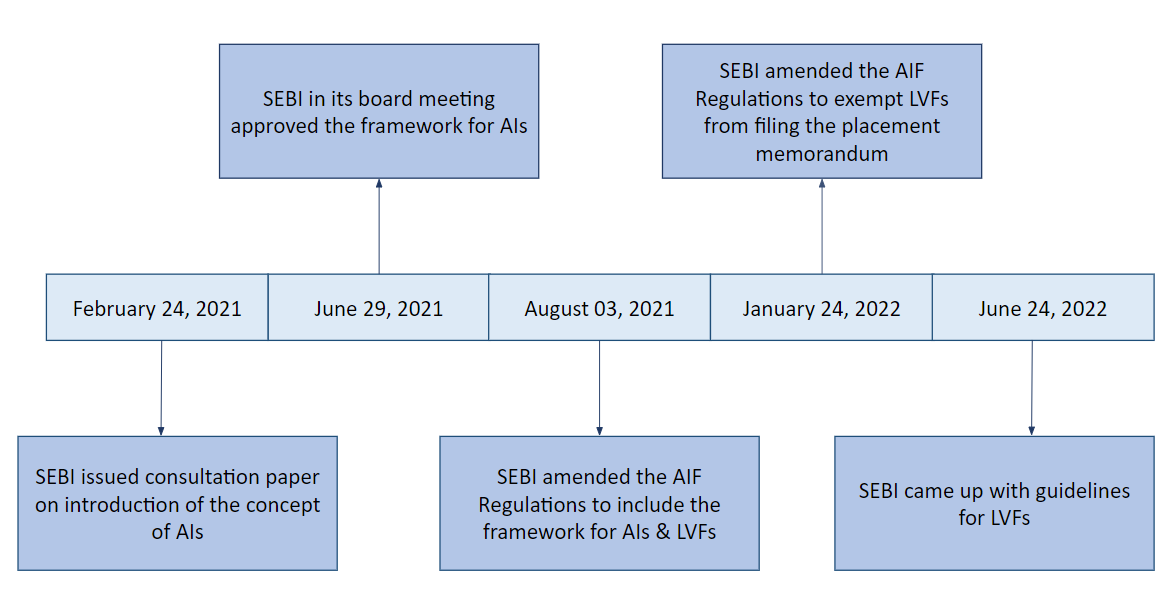
In a recent Circular[1], SEBI has come up with the Guidelines for Large Value Funds for Accredited Investors (LVFs) and requirement for appointment of compliance officer for managers to Alternative Investment Funds[2] (AIFs). SEBI had introduced the concept of LVFs alongwith the concept of Accredited Investors (AIs) in August, 2021. A brief timeline showing the evolution of the framework of AIs in India is as follows:
AI also known as qualified investor/professional investor/ experienced investor are a class of investors who have in-depth market knowledge and high risk bearing capacity to take an informed investment decision. Since, these AIs are well informed investors, therefore, the intermediaries providing services to these investors are given regulation-light regime i.e. less regulatory oversight & relaxed compliance requirement by SEBI.

Read more

Applicability of Provisions of the Companies Act on LLPs & Reporting requirements: Recent changes

– Pammy Jaiswal, Partner and Neha Malu, Executive | corplaw@vinodkothari.com

SEBI: Insider trading norms should apply to fund managers

Additionally invites comments on the applicability in case of units of pooled investment vehicle

Vinita Nair | Senior Partner, M/s Vinod Kothari & Company

Comments on IBBI Discussion Paper on Streamlining the Liquidation Process

Team Resolution | resolution@vinodkothari.com

The Insolvency and Bankruptcy Board of India (‘IBBI’/ ‘Board’) issued Discussion Paper on Corporate Liquidation Process, dated 14th June, 2022 [1](‘Discussion Paper’) which envisages -(a) Streamlining the constitution of SCC (b) Expanding power of SCC; (c) Relinquishment of security interest by the Secured Financial Creditors; (d) Reduction of timeline of compromise or arrangement process; (e) Clarification regarding submission of progress reports to Board; (f) Event based timelines of Auction; (g) timeline for successive auction, (h) treatment of avoidance application before closure of liquidation process, and (i) consideration of claims submitted during CIRP, and the Board has solicited comments of the same.

Following are our general and specific comments on the proposals made in the Discussion Paper and other aspects of liquidation processes –

A.    General Comments

The following are our general comments/suggestions on the proposals made in the Discussion Paper:

1. The general suggestions with respect to various issues faced by liquidators and suggested solutions are as listed below:

1.1. Lightening litigation burden

1.1.1. Infrastructure issues – NCLTs need to be strengthened in terms of benches and bench members;

1.1.2 Continuing engagement with professionals as quite often there are serious gaps in alignment

1.1.3. NCLT members to have strong incentive for better time management

1.1.4. De-clogging NCLTs

a. Remove operational creditors’ claim beyond a hard timeline

b. Move extension application or other matters not requiring adjudication from the domain of NCLTs

c. Create expert advisory cell in IBBI/IPA (similar to informal guidance scheme of SEBI), which the IPs can approach for clarifications/interpretations pertaining to law

d. Identify other non-adjudicative matters, not need exercise of judicial discretion, and move them out of NCLTs

Read more

The Law of Co-lending

Financial Services Division | finserv@vinodkothari.com

Loader Loading…
EAD Logo Taking too long?

Reload Reload document
| Open Open in new tab

Download as PDF [376.18 KB]

Our write-ups on related topics may be viewed here –

The future of Loan-loaded Prepaid Payment Instruments

Financial Services Division | finserv@vinodkothari.com

The latest communication from the Reserve Bank of India (‘RBI’), barring issuers of prepaid payment instruments (PPIs) from having the same loaded by credit lines, has created a substantial flutter in the financial sector, particularly among the Fintech lenders. Based on the feedback received from market participants it seems that the RBI has been trying to remove any regulatory arbitrage that a non-bank PPI issuer may have as compared to a bank. Considering the gravity of the matter even the Payment Council of India has approached the Government of India to intervene in this matter[1]. There are reports[2] that many of the issuers of PPIs have reportedly stopped issuing PPIs post receiving the RBI circular.

The trigger for all this is a June 20, 2022 communication from the RBI, addressed to certain NBFCs and Fintech lenders, who have been extending credit facilities for loading prepaid cards, stating that prepaid payment instruments (PPIs) must not be loaded through credit lines. The aforesaid communication has raised questions on the existing business model of several fintech entities and threatens their existence. The relevant extract of the said communication states that:

“A reference is invited to the provisions contained in the paragraph 7.5 of the Master Direction on PPI (PPI-MD) dated August 27, 2021 (updated as on November 12, 2021) – “PPIs shall be permitted to be loaded /reloaded by cash debit to a bank account, credit and debit cards, PPIs (as permitted from time to time) and other payment instruments issued by regulated entities in India and shall be in INR only”

The PPI-MD does not permit loading of PPIs from credit lines. Such practices, if followed, should be stopped immediately. Any non-compliance in this regard may attract penal action under provisions contained in the Payment and Settlement Systems Act, 2007

Read more

Pledge as transfer: Several SEBI Regulations may require review post SC Ruling

– Vinita Nair | Senior Partner, Vinod Kothari & Co. | corplaw@vinodkothari.com

Hon’ble Supreme Court, in the matter of PTC India Financial Services Limited v. Venkateshwar Kari and Another (PTC India ruling), brought out a very important distinction between the meaning of beneficial owner under the Depository law, and the right of the pledgee/ pawnee/ security interest holder) to cause the sale of goods pledged by pledgor/ pawnor in terms of the rights arising under the pledge[1]. The PTC India ruling inter-alia holds that “beneficial ownership” in the context of the Depositories Act should not be confused with beneficial ownership in law. Getting registered as a “beneficial owner” in terms of Section 10 of Depositories Act, 1996 read with Regulation 58 (8) of the SEBI (Depositories and the Participants) Regulations, 1996[2] (‘Depository law’) does not amount to any transfer of title to the pawnee – it is merely a procedural precondition to sale by the pawnee. It further stipulates that there is no concept of ‘sale to self’ by the pledgee and that the pledgee is bound by the two options provided under Section 176 of the Indian Contract Act, 1872 (‘ICA, 1872’), viz., right to bring a suit against the pawnor and retain the goods pledged as collateral security, or sell the thing pledged on giving reasonable notice to the pawnor and sue for the balance, if any. This ruling triggers the need to review current practice followed by companies and also validity of orders pronounced by Securities Appellate Tribunal (‘SAT’) and SEBI from time to time w.r.t. pledge.

The Apex Court referred to the decision of Securities Appellate Tribunal (‘SAT’) in the matter of Liquid Holdings Private Limited v. The Securities Exchange Board of India[3] where SAT held that the banks being recorded as beneficial owners of the shares pursuant to invocation of pledge became the members of the target company and subsequent transfer of the said shares by the banks back to the appellants resulted in purchase by the appellants attracting the open offer obligations under SEBI (Substantial Acquisition and Takeovers) Regulations, 1997 [Repealed by SEBI (Substantial Acquisition and Takeovers) Regulations, 2011] (‘Takeover Code’). The Apex Court observed that SEBI should examine the provisions of Depository law and the Takeover Code to avoid discord or ambiguity resulting in  instability or confusion especially on applicability of Takeover Code when the pawnee exercises his right to be recorded as a ‘beneficial owner’, while reserving his right to sell the pledge. Additionally, in the author’s view, there is an equal need to examine the applicability of SEBI (Prohibition of Insider Trading) Regulations, 2015 (‘PIT Regulations’) in the context of pledges[4], for reasons discussed in the latter part of this article.

Read more

Broken Pledge? Apex Court reviews the law on pledges

By Vinod Kothari, Managing Partner, Sikha Bansal, Partner and Shraddha Shivani, Executive | corplaw@vinodkothari.com

The Supreme Court ruling in  PTC India Financial Services Limited v. Venkateshwar Kari and Another is significant in many ways – not that it categorically rewrites the law of pledges which is settled with 150 years of the statute[1] and even longer history of rulings, but it surely refreshes one of the predicaments of a pledge. Importantly, since most of the pledges of securities currently are in the dematerialised format, it brings out a very important distinction between the meaning of beneficial owner under the Depository law, and the right of the pledgee (a.k.a. pawnee or security interest holder) to cause the sale in terms of the rights arising under the pledge. Also, very importantly, the SC dwells upon the essential principle of equity of redemption in pledges and renders void any provision in the pledge agreement which allows the pledgee to make a sale of the pledged article without notice to the pledgor, or to forfeit the pledged article and convert the same as pledgee’s own property. There are also observations in the ruling that seem to give an indefinite time to the pledgee for the sale of the pledged property – this is a point that this article discusses at some length.

Read more

Law of pledges in India

– Vrinda Bagaria | corplaw@vinodkothari.com

This article seeks to broadly explain the principle of a pledge and deals primarily with use of ‘pledge’ as a mode of creation of security on shares of a company to secure liabilities of the company.

  1. PLEDGE – MEANING
  • Definition

A ‘pawn’ or a ‘pledge’ is a bailment of personal property as a security for some debt or engagement. Under the Indian Contract Act, 1872[1] (“Contract Act”), pledge has been defined as:

“the bailment of goods as security for the payment of a debt or performance of a promise is called pledge”.

Further, the definition of bailment as provided in Section 148 of the Contract Act reads as:

“the delivery of goods by one person to another for some purpose upon a contract that they shall, when the purpose is accomplished, be returned or otherwise disposed of according to the directions of the person delivering them”.

Thus, a pledge constitutes the delivery of goods by the pawnor to the pawnee as a security under a contractual obligation that the goods shall be returned or disposed off as per pawnor’s direction on the debt being discharged or the fulfilment of the obligation.

Read more