India’s “green growth”: is the green skin-deep?

– Payal Agarwal, Deputy Manager | corplaw@vinodkothari.com

Talking about green growth may seem like rhetoric. From policy-makers to economists, from corporate governance experts to environmentalists, everyone seems to be having “green growth” on the top of the agenda.

The Economic Survey dedicated a full chapter to climate change and related issues. The Budget also has green growth as one of the seven saptarishis, to guide the FM’s plans for our financial future.

Need of the hour

India has been taking small steps towards reaching its commitment to the net-zero emissions goal by 2070, as compared to a majority of countries committing to reach the net-zero targets by 2050. While the country contributes to a very low percentage of global emissions (only 4% of the cumulative global emissions from the period 1850-2019[1]), the global nature of the problem of climate change is what makes the country equally vulnerable to the problem, if not more. Further, given its long coastline, monsoon-dependent agriculture, and large agrarian economy, India is considered to be one of the most vulnerable countries to the climate change issue[2].

Read more

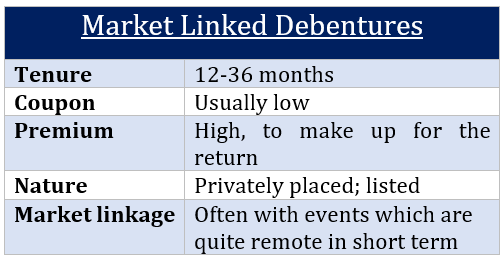
Market-linked debentures: Is it the end of the market for them?

– Aanchal Kaur Nagpal, Manager | finserv@vinodkothari.com

Tax proposal to tax gains on MLDs as short-term capital gains

The Budget proposes that the capital gains on market linked debentures (MLDs) will be taxed as short term capital gain.

Presently, MLDs are mostly listed, and as listed securities they have 2 advantages:

  • First , there are exempt from withholding tax. This is one of the carve-outs in sec. 193
  • Secondly, the holding period for capital gain purposes is 12 months,  as opposed to 36 months in case of normal capital assets. This comes from sec. 2 (42A) of the Act. Therefore, if a listed security is held for at least 12 months, and transferred or redeemed thereafter, the gain will be taxed as long term capital gain, with a rate as low as 10%.

Market linked debentures is a concept that prevails world-over, with different names such as equity-linked bonds, index-linked bonds, etc. However, in India, the issuance of MLDs was being exploited as a regulatory and tax arbitrage device.

Read more

Securitisation of stressed loans: Opportunities and structures

Comments on RBI’s Discussion Paper on Securitisation of Stressed Assets Framework (SSAF) dated January 25, 2023

Timothy Lopes, Manager | Vinod Kothari Consultants Pvt. Ltd.

finserv@vinodkothari.com

Background

At present, in India, there exists a framework for securitisation of standard assets only. in September, 2021 the RBI issued the ‘Master Direction – Reserve Bank of India (Securitisation of Standard Assets) Directions, 2021’ (‘SSA Directions’)[1], which deals with standard asset securitisation. Under the SSA Directions, the definition of standard assets does not include non-performing loans, i.e., only those assets with a delinquency up to 89 days, would qualify for securitisation under the SSA directions.

For assets that turn non-performing, i.e., 89+ days-past-due (‘DPD’), including those that retain the classification as the borrower has not been able to clear all his past arrears, the  same can, at present, be sold under the Master Direction – Reserve Bank of India (Transfer of Loan Exposures) Directions, 2021 (‘TLE Directions’)[2], which has a framework for sale of stressed assets (which includes non-performing assets).  Technically, there is a process of “securitisation” of non-performing loans (‘NPLs’), by issuing “security receipts” (‘SRs’) against the same; however, the framework for issue and investing in SRs is quite different, and is normally not captured as a part of securitisation in the industry parlance[3].

Assets sold through the TLE route require a complete arm’s length sale, without any credit support from the seller and there is typically no tranching. This results in substantial haircuts on these stressed loan pools. Further, most of the NPLs that face a problem in the current scenario are retail loans or re-performing loans (see discussion on re-performing loans later). These retail pools are not normally sold under the ARC route since ARCs lack the capability in this specific asset class and are more suited towards wholesale transactions.

Read more

External Commercial Borrowings

– Vinita Nair, Senior Partner | corplaw@vinodkothari.com

Loader Loading…
EAD Logo Taking too long?

Reload Reload document
| Open Open in new tab

Download as PDF [562.15 KB]

Related Resources

  1. Revised ODI Norms: A step towards greater clarity & liberalization?
  2. Regulatory framework for Overseas Investments
  3. Lost in Layers: lower threshold for subsidiaries under ODI norms raises concern
  4. Ministry of Finance notifies FEM (Non-Debt Instruments) (Amendment) Rules, 2022

Tweezing out for dormancy: RBI intends to intensify regulatory audits of NBFCs

  • By CS Anita Baid, Vice President, Vinod Kothari Consultants P. Ltd.

As per reports available on public domain[1], the RBI intends to intensify regulatory audits of non-banking finance companies, to find dormancy, non-compliance, non clarity of business models, or other risks that the regulator may wish to check. The intent seems to be weed out the truant ones out of the crowd of over 9000 NBFCs that exist. It is a fact that in the recent years, the RBI has been granting lesser new registrations, and canceling more of existing registrations, causing the number to come down. It is also important to note that if the number of NBFCs looks overwhelming, it is not because so many companies are into real operation: it is because the regulations currently define a company investing its owned capital into financial investments, with absolutely no access to either public funds or customer interface, as an NBFC, by imputing the public interest that actually does not exist. The number would have been a lot lesser had the regulator had the realisation that if there are no public funds, no customer interface and investment of owned funds being done, there is no reason for the regulator to interfere, as the intent of the country’s Central Bank cannot be to regulate investment activity that one does with one’s own money.

While this issue remains to be advocated for a potential reform, in the meantime, it is important for NBFCs to brace up for the RBI’s inquisitorial interest.

This article is intended to help NBFCs to be better prepared for such regulatory interface.

Read more

Highlights of MCA Discussion Paper on changes considered to IBC

– Vinod Kothari & Sikha Bansal | resolution@vinodkothari.com

Loader Loading…
EAD Logo Taking too long?

Reload Reload document
| Open Open in new tab

Download as PDF [645.53 KB]

MCA rationalizes 52 ROC e-Forms for V3 portal

– Prapti Kanakia, Manager | prapti@vinodkothari.com

Loader Loading…
EAD Logo Taking too long?

Reload Reload document
| Open Open in new tab

Download as PDF [152.59 KB]

Read our related resources

  1. Directors to declare on personal disqualifications too in DIR-8

NCLT’s powers to rectify register of members restricted in case of breach of securities laws

– Sharon Pinto, Manager | sharon@vinodkothari.com

Introduction

A recent judgment by the Supreme Court in Ifb Agro Industries Limited vs Sicgil India Limited, has put to rest the concerns regarding rectificatory jurisdiction of NCLT u/s 59 of Companies Act, 2013 (section 111A of the erstwhile Companies Act, 1956). The ruling has shed light on the scope of NCLT jurisdiction in case of rectification of the register of members, in cases where there are violations of specific laws and the facts of the case are such that the same requires proper enquiry, adjudication under the specific statute. The two major questions addressed by Hon’ble Supreme Court are as follows:

  • What is the scope and ambit of Section 111A of the Companies Act, 1956 (‘Act, 1956’) / Section 59 of the Companies Act, 2013 (‘Act, 2013’), to rectify the register of members?
  • Which is the appropriate forum for adjudication and determination of violations and consequent actions under the SEBI (Substantial Acquisition of Shares and Takeover) Regulations 1997 (‘SEBI SAST Regulations’) and the SEBI (Prohibition of Insider Trading) Regulations 1992 (‘SEBI PIT Regulations’)?
Read more

Directors to declare on personal disqualifications too in DIR-8

– Prapti Kanakia, Manager | prapti@vinodkothari.com

Loader Loading…
EAD Logo Taking too long?

Reload Reload document
| Open Open in new tab

Download as PDF [166.84 KB]

Stewardship Responsibilities of Institutional Investors in India: Global perspectives and the Way Ahead

– Sikha Bansal, Partner & Neha Malu, Senior Executive | corplaw@vinodkothari.com

“Stewardship” literally means the act of protecting the rights of the person to whom it is acting as a steward. In the context of shareholders’ governance and capital markets, the institutional investors play the stewardship role for their clients/ beneficiaries as the funds invested by the institutional investors in the companies actually belong to the large pool of diversified investors who had invested in the institutional investors and hence it will not be wrong to say that the institutional investors are the “stewards” and not the “owners” of the funds invested by them.  As defined by UK Stewardship Code (2020)[1], “Stewardship is the responsible allocation, management and oversight of capital to create long-term value for clients and beneficiaries leading to sustainable benefits for the economy, the environment and society”.

Read more