SEBI notifies amendments to all modes of Buy-back
– Sanya Agrawal, Executive | executive@vinodkothari.com
 Loading…

– Sanya Agrawal, Executive | executive@vinodkothari.com
Loading…
– Shreya Salampuria, Executive | corplaw@vinodkothari.com
Loading…
Read our comments to SEBI on the said consultation paper:
– Vinita Nair, Senior Partner | vinita@vinodkothari.com
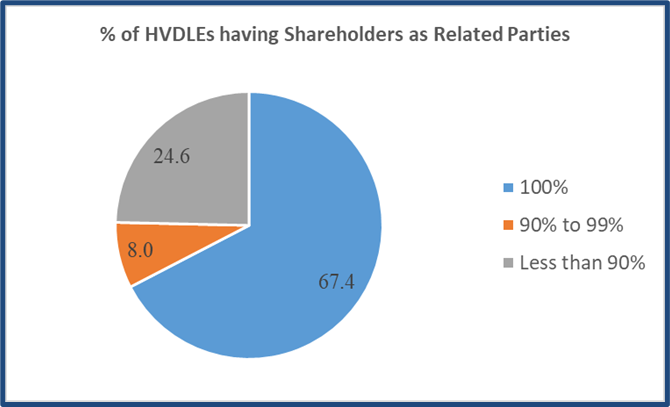
SEBI continues to tighten the regulatory regime for debt listed entities as it aims to promote corporate bond market. After equating debt listed entities with outstanding value of listed non-convertible debt securities of Rs. 500 crore and above with equity listed entities for the purpose of corporate governance norms, SEBI proposes a stricter approval regime for Related Party Transactions (‘RPTs’) under Reg. 23 of SEBI (Listing Obligations and Disclosure Requirements) Regulations, 2015 (‘LODR’) vide Consultation paper on review of Corporate Governance norms for a High Value Debt Listed Entity (‘HVDLE’)[1]. This has been rolled out just before the corporate governance provisions become applicable on a mandatory basis effective from April 1, 2023. The composition of 138 HVDLEs, in terms of shareholding pattern, as on March 31, 2022 was as under:
Click here to register for the workshop: https://forms.gle/V8SRUpDpsSMYraBx9
Loading…
– Team Resolution, Vinod Kothari and Company | resolution@vinodkothari.com
The Ministry of Corporate Affairs (‘MCA’) issued a Discussion Paper on 18th January, 2023 on changes being considered to the Insolvency and Bankruptcy Code, 2016 (‘Discussion Paper’). Since the very inception of the Insolvency and Bankruptcy Code, 2016 (‘IBC’), it has undergone six amendments besides, several amendments in the respective regulations. However, the proposals in this Discussion Paper seem to be the most comprehensive one – covering all major aspects of the law.
Broadly speaking, the amendments proposed in the Discussion Paper can be categorized as follows:
Register to our premium section to access the full Report

Sample Report
Loading…
Team Finserv | finserv@vinodkothari.com
Which law to follow? – Listing Regulations or laws applicable to subsidiaries?
– Aisha Begum Ansari, Manager | aisha@vinodkothari.com
The RPT provisions under the SEBI Listing Regulations were substantially amended by SEBI on November 9, 2021. Pursuant to the amendment, the definitions of related party, RPT, material RPT, requirements of obtaining audit committee, and shareholders’ approval were changed.
The definition of ‘RPT’ was amended to include cross RPTs. Earlier, only transactions between the listed entity and its related parties were covered, but now, the following transactions are also covered:
– Ajay Ramanathan, Executive | ajay@vinodkothari.com
Loading…
Anita Baid, Vice President | finserv@vinodkothari.com
The regulations for conducting customer identification and due diligence by financial sector entities have been laid down by RBI and SEBI, in accordance with the provisions of Prevention of Money Laundering Act and Rules. Under the current regime, the KYC process extends from physical KYC to digital and video-based KYC as well. The physical process of collecting KYC documents and verifying the same involves a lot of paperwork. On the other hand, the Digital KYC Process is a facility that allows lenders to undertake the KYC of customers via an authenticated application, specifically developed for this purpose, hence making it a paperless process. The Digital KYC process, however, also requires physical interaction. Video-based KYC is both paperless and without any physical intervention.
Read more →Anirudh Grover, Executive | finserv@vinodkothari.com
The International Financial Services Centre (“IFSC”) situated in the GIFT city is deemed to be a quasi-foreign territory from the lens of Foreign Exchange Management Act, 1999 however a domestic area under the tax regime. The objective of setting up specified territory lies in the benefits an IFSC jurisdiction provides in the form of free flow of foreign transactions and investor confidence; this setting up is commonly termed as onshoring the offshore.
In order to materialize the underlying objective, a specific regulatory framework has been designed which includes the incorporation of the following major entities:
Apart from these entities there are other entities as well which are running their businesses from IFSC GIFT City which includes Fintech Entities, Capital Market Intermediaries and Insurance Intermediaries. The Union Budget of 2022 paved the way for bringing fundamental changes in the IFSC jurisdiction which resulted in the establishment of a regulatory framework namely IFSCA (Setting up and Operation of International Branch Campuses and Offshore Education Centres) Regulations, 2022. By virtue of these regulations now Foreign Universities have been allowed to set up their base in IFSC. Further the Union Budget 2022 also laid the ground for establishment of an Arbitration Centre which would allow disputes to be resolved in record time.
Albeit these announcements came out to be a key in evincing interest in the IFSC jurisdiction however it is perceived that there are certain pivotal areas of law which require further modifications/clarifications which is expected to be a part of the Union Budget of 2023.
Read more →
 Reload document
  Open in new tab