Interest Imbalance: Will the disproportionate interest Split in Loan Transfers be liable to withholding tax?

ITAT Ruling Clarifies Taxation on Disproportionate Interest share in Loan Transfers

– Dayita Kanodia | Finserv@vinodkothari.com

Direct Assignment of a loan or transfer of loan exposures refers to the process where financial institutions, such as banks, purchase a pool of loans or assets from other entities, typically NBFCs, without the involvement of a third-party intermediary. In this arrangement, the buying institution directly acquires the ownership of the loans or assets and the associated rights, including the right to receive future payments from the borrowers. This method allows the selling NBFC to offload its loans, thereby freeing up capital, while the purchasing institution gains the opportunity to enhance its loan portfolio and earn interest income from the acquired loans. This Direct Assignment is essentially what is popularly known as the transfer of loan exposure.

The RBI issued the transfer of loan exposures directions in 2021 regulating all transactions among regulated entities involving transfer of loan exposures.

Interest sharing and servicing after the transfer

Pursuant to a transfer of loan, it is not necessary that the future interest income arising from the loans would be shared in the same proportion as that of the transfer. For instance, if an NBFC assigns 90% of the loan portfolio to a bank, there is no mandate that all interest income received in the future would be shared in the same proportion of 90:10. Generally, the borrower is not made aware of the transfer and therefore it is important that the NBFC continues to service the loan. In such cases it is only fair that the NBFC gets a higher proportion of interest. Accordingly, it is quite common in direct assignment transactions to have a disproportionate interest share. 

The question which now arises is whether this excess interest income retained by the NBFC would be taxable under the provisions of the income tax act. 

ITAT Ruling and taxation on disproportionate interest share in loan transfers

A recent ITAT ruling of May 7, 2024 clarifies the taxation treatment for disproportionate interest share in case of loan transfers. In this case, NBFC assigned 90% of the loan portfolio to a bank via the direct assignment route. However, the bank was not receiving the entire interest on the 90% loan assigned but was only entitled to a fixed percentage of share while the NBFC retained the excess interest. Accordingly, the revenue department was of the view that the assessee was responsible to deduct TDS on the excess interest allowed to be retained by the NBFC under section 194A of the Income Tax Act. 

The revenue department further raised the question on deduction of TDS under SEction 194J and 194H of the Income Tax Act. 

Interest Retained not a result of money borrowed or debt incurred by the transferee

For the deciding the fate of the NBFC under section 194A of the Income Tax Act, the following was observed by the ITAT:

  1. For TDS to be deducted under section 194A of the Income Tax Act, the crucial aspect to be satisfied was whether the part interest allowed to be retained by the originating NBFC by the bank is payment in the nature of interest to the NBFC for any money borrowed or debt incurred by the bank.
  1. It was acknowledged that the 90% of the loan portfolio was assigned to the bank and consequently any default among the assigned loans would result in loss to the bank. 
  1. Any amount collected from the borrowers was initially getting deposited in an escrow account and was subsequently distributed between the NBFC and the bank in accordance with the agreement entered into by the entities. 
  1. It could not be shown that the interest allowed to be retained with the NBFC was a result of any money borrowed or debt incurred by the bank from the NBFC. 
  2. Accordingly, the assessee was under no obligation to deduct TDS on the excess interest retained by the NBFC under section 194A. 

Interest retained not in the nature of fees for any professional / technical services rendered by the transferor

The next issue which was adjudicated in the case was whether the interest allowed to be retained with the NBFC was a consideration for rendering professional / technical services by the transferor NBFC to the transferee bank. 

As per section 194J of the Act, any person, not being an individual or HUF, who is responsible for paying to a resident any sum, inter alia, by way of fees for professional services or fees for technical services shall at the time of credit of such sum to the account of payee deduct tax at source.

For this purpose the ITAT observed the following:

  1. The NBFC and the Bank entered into a tripartite service agreement pursuant to which the originating NBFC was appointed as servicer for the loans. The NBFC was therefore responsible for managing, collecting and receiving payment of the receivable and depositing the same in the ‘Collection and Payout Account’ to enable the distribution of the payout therefrom and providing certain other services.
  1. As per the service agreement, a one time service fee of Rs.1 Lakh was agreed to be payable by the bank to the NBFC as consideration for the services rendered.
  1. The ITAT brushed aside the contention of the revenue department that service fee of Rs 1L was inadequate and the excess interest allowed to be retained by the NBFC should in fact be considered as fee for rendering the services by the transferor NBFC. 
  1. There was a separate tripartite Deed of Assignment of receivables entered into by the parties according to which the bank paid the entire principal amount equivalent to 90% of the entire pool to the NBFC upfront. However, it was observed that the transfer being an independent commercial transaction cannot be on a cost to cost basis without there being any markup.
  1. Accordingly, the bank opted to pay the consideration for the loans assigned partially by way of an upfront payment equivalent to the principal amount of the loan assigned to it and partly by agreeing to earn a lower rate of interest on its portion of assigned loans and allowing the NBFC to retain the part interest received from the borrower.
  1. Therefore the liability under section 194J of the Income Tax Act was only for the service fee of Rs.1 L and cannot be extended to the excess interest share retained by the NBFC.
  1. Accordingly, the assessee was under no obligation to deduct TDS on the excess interest share retained by the NBFC under section 194J of the Income Tax Act. 

Interest retained not in the nature of commission / brokerage

The last issue in this case to be decided before the ITAT was whether the retained interest would fall in the category of commission or brokerage and was liable to TDS under section 194H of the Income Tax Act. 

As per section 194H of the Act, any person, not being an individual or HUF, who is responsible for paying to a resident, any income by way of commission or brokerage, shall at the time of credit of such income to the account of the payee deduct tax.

For determining the tax treatment under this section, the ITAT observed the following:

  1. It could not be said that the loans originated by the NBFC were on behalf of the bank.
  1. For the services rendered by the NBFC, it was observed that the same was pursuant to a separate service agreement which provides for payment of separate service fees in lieu of such services.
  1. Accordingly, it cannot be contended that the transferor NBFC was acting as an agent of the transferee bank.
  1. Accordingly, the liability to deduct TDS on the excess interest retained by the NBFC under section 194H of the Income Tax Act does not arise. 

Concluding Remarks 

In conclusion, the recent ITAT ruling has provided significant clarity on the taxation treatment of disproportionate interest shares in loan transfers, particularly in the context of Direct Assignment transactions. 

In this case, the ITAT emphasized that the interest retained by the NBFC was not a result of any money borrowed or debt incurred by the bank. Additionally, it was clarified that the interest retained did not constitute fees for professional or technical services rendered by the transferor NBFC, nor did it fall within the ambit of commission or brokerage.

As the financial landscape continues to evolve, such judicial pronouncements play a crucial role in fostering transparency, compliance, and fairness in taxation.

Online workshop on Verification of Market Rumour by listed entities and other related amendments

Register here
Loader Loading…
EAD Logo Taking too long?

Reload Reload document
| Open Open in new tab

Download as PDF [912.01 KB]

Other resources on the amendment:

  1. YouTube video on aforesaid amendment: https://www.youtube.com/watch?v=-BvHsUtR4TI&feature=youtu.be
  2. Article on Top companies forced to respond to rumours on big price spikes: Changes in Listing Regulations relate rumour responses to “material price movement”
  3. Snippet summarizing the amendment: https://lnkd.in/gSJM-YUj

SEBI notifies rumour verification requirements, application of market cap based provisions etc

Ankit Singh Mehar, Senior Executive and Khushi Hariyani, Executive | corplaw@vinodkothari.com

Loader Loading…
EAD Logo Taking too long?

Reload Reload document
| Open Open in new tab

Download as PDF [206.09 KB]

Also see our related resources:

  1. FAQs on Verification of Market rumour by Listed Entities
  2. Presentation on Verification of Market Rumour by listed entities and other related amendments
  3. Top companies forced to respond to rumours on big price spikes: Changes in Listing Regulations relate rumour responses to “material price movement”
  4. Silence no more golden: New regulatory regime forces top listed companies to respond to rumours
  5. Getting material on “material” events and information: SEBI notifies amendments to Listing Regulations
  6. Demystifying rumour verification by listed entities

Capital Treatment, Loan Loss Provisioning and Accounting for Default Loss Guarantees

Vinod Kothari (finserv@vinodkothari.com)

The FinTech sector is booming and is a market disruptor as well as facilitator, based on the report published by Inc42, the estimated market opportunity in India fintech is around $2.1 Tn+ and currently there are 23 FinTech “unicorns” with combined valuation of $74 Bn+ and 34 FinTech “soonicorns” with combined valuation of $12.7Bn+.

The unprecedented growth of the fintech sector has transformed guarantees specifically First Loss Default Guarantees (FLDG) into a commonly employed tool for emerging players like fintechs. They leverage these guarantees to take exposures on loan transactions using low-cost funding from established entities such as large NBFCs and Banks. Fintechs issue guarantees that enable them to garner trust from prominent lenders, facilitating the origination of new loans through their digital platforms. 

One of the crucial concerns in DLG arrangements is navigating the complexities surrounding capital treatment and NPA accounting covering both lenders and guarantors. In this article, we delve into an in-depth exploration of these crucial issues.

Capital Treatment 

We organise this section into the following parts:

  • Capital treatment for the lender availing the guarantee
  • Capital treatment for the guarantor 
  • Expected credit loss treatment for the lender availing the guarantee
  • Expected credit loss treatment for the guarantor
  • Provisioning requirement for the lender availing the guarantee
  • Provisioning requirement for the guarantor

Capital Treatment for Lenders: 

Capital requirement is linked with the credit risk on the exposure: hence, before getting into the regulatory prescription, let us examine what is impact on the credit risk of the lender. For capital rules, a guarantee is regarded as a case of credit risk mitigation, provided the guarantee satisfies several conditions (e.g., it should be explicit, enforceable, guarantor’s financial resources adequate, etc). The lender, on the basis of the guarantee, shifts the risk of the first (or subsequent, as may be the nature of the guarantee) layer of the losses to the guarantor. Thus, there is a substitution of risk from the borrowers in the pool to the guarantor. The remaining exposure remains unprotected – hence, to that extent, there is no credit risk transfer. Therefore, if the risk weight of the guarantor is lesser than the risk weight of the underlying pool, there was a case to expect a reduction in the capital requirements.

The regulatory prescription is as follows: DLG Guidelines states that for the purpose of capital computation, i.e., computation of exposure and application of Credit Risk Mitigation benefits on individual loan assets in the portfolio shall continue to be governed by the extant norms. The “extant norms” for this purpose would be the norms on credit risk mitigation. These norms are applicable in case of banks [see part 7 of the Basel III  Master circular ] However, in case of NBFCs, there is no equivalent.

However, FLDG is expected to be backed by either a cash deposit, or a bank guarantee. If it is backed by cash deposit, cash is to be assigned 0 risk weight. Similarly, if it is backed by a bank guarantee, the risk shifts to the bank, and therefore, a 20% risk weight as applicable to banks may be assigned by the NBFC. Note that the above risk weights are only for the part backed by the guarantee. That is, if there is a 5% FLDG, the 5% of the loan pool will be risk weighted as above, and the remaining 95% will attract the risk weight applicable to the borrower pool.

Capital Treatment for the guarantor 

When we talk about capital treatment, the same would depend on the capital rules applicable to the guarantor entity. If the guarantor entity is an RBI regulated lender, it will be covered by the capital rules. If the guarantor not a regulated lender, it is unlikely to have any capital rules.

We discussed above the nature of a structured default loss guarantee. A structured DLG (first loss, second loss, or subsequent loss) integrates the risk of a pool of loans and then strips the same into multiple tranches. Therefore, it becomes a case of structured risk transfer.

The generic rule in case of any structured risk transfer is that the acquirer of the first loss tranche acquires the risk of the entire pool. Therefore, a first loss default guarantor is required to keep capital on the pool size (and not the size of the guarantee). However, the size of the guarantee is the loss limit of the guarantor – therefore, the capital requirement, computed by applying the risk weight to the pool size, will be limited to the size of the guarantee. We discuss this further below. 

First Loss

If the guarantee is first loss in nature, then, as the principle goes, the RE will have to maintain capital on the entire pool, since, it is exposed to all the risks associated with all loan accounts individually, subject to a ceiling on the the amount of guarantee it has provided. 

For instance, if the guarantor provides a 5% FLDG for a pool of loans aggregating to Rs. 100 crores, and the regulatory capital requirement of the guarantor is 15%, then the capital required to be maintained against such pool is:

Lower of

  • 15% of Rs. 100 crores * 100% (Assuming 100% is the applicable risk weight of such loans)
  • 5% of Rs. 100 crores

= Rs. 5 crores.

As per the RBI FAQs, RE providing DLG shall deduct “the full amount of the DLG which is outstanding” from its capital. The above is in line with the RBI FAQs on the subject.

This prescription should be taken as applicable in case of first loss guarantees.

Further, the apparent question that arises here is in what proportion should the capital be reduced from Tier I and Tier II. In absence of any specifications in this regard in the regulations or the FAQs, it is only logical to deduct the capital from the Tier I and Tier II in their respective ratios. That is, if the Tier I is 10% and Tier II is 5%, then the capital reduction should also happen in the ratio of 2:1.

Second Loss

If the guarantee is second loss in nature, then, the losses will start piling up on the guarantor only once the first loss support is exhausted. Unlike the other case, here, the guarantor is not exposed to all the risks associated with all loan accounts individually. Therefore, the capital will have to be maintained on the amount of guarantee provided instead of the entire pool. 

Using the same example, as used in the earlier case, the capital requirement for the RE will be:

Rs. 100 crores * 5% * 15% = Rs. 0.75 crores.

Of course, this is applicable only where the first loss guarantee is sufficient to absorb losses upto a level sufficient to absorb a certain multiple of “expected losses”. Usually, the multiple should be sufficient so as to render the second loss facility to achieve an investment grade rating.

Expected credit loss for the recipient of the guarantee

Expected credit losses are for the potential for the loan or pool of loans to result in credit losses. If the lender has the benefit of first loss guarantee, the situation is that to the extent of the FLDG, the lender has exposure on the guarantor, and for the remaining pool size, the lender has exposure on the borrowers.

As regards a potential credit loss on the guaranteed amount, the RBI rules require the guarantee to be either fully backed by cash, or backed by a bank guarantee. Hence, the question of any credit loss on the same does not arise.

Hence, the lender will be exposed to losses only on so much of the expected credit losses as exceed the FLDG cover. For instance, if the FLDG is 5%, and the ECL estimated by the lender is 6.8%, the lender may create ECL provision only for 1.8%.

Note that ECL for any pool is a dynamic number – while estimations of the default probabilities and the exposure change over time, there are also changes due to unwinding of the discounting factor applied in computing present value of the ECL. Therefore, ECL estimation is bound to change every reporting period. For that matter, FLDG will remain fixed as 5% of the originated pool, but this number will also be dynamic as the loan pool matures – partly due to amortisation of the pool, and partly due to utilisation of the guarantee. Therefore, on an ongoing basis, the lender may compare the ECL with the percentage of FLDG still available, and create ECL for the differential amount.

Expected credit loss for the guarantor

If the guarantor is covered by ECL requirements, the guarantor needs to estimate the losses likely to be caused to the guarantor. As against the guarantee, the payoff of the guarantor may be (a) fixed guarantee fees (b) right to get a variable fee, usually linked with the excess spreads from the pool. 

Note that ECL computation is required not only for loans, but also for financial guarantees. Therefore, the guarantor will need to compute the expected credit losses from the underlying loans using exactly the same basis as if the loans were on the books of the guarantor. Of course, the maximum ECL will be the limit of the guarantee.

Provisioning for the recipient of the guarantee

In this regard, the RBI has clearly specified that no benefit will be given for provisioning requirements – that is, the regulatory provisioning will continue irrespective of the guarantee.

Provisioning for the guarantor

As regards the guarantor, while a financial guarantee is regarded as a direct credit substitute, however, there are no explicit provisioning requirements. To the extent the guarantee has already been utilised, it will be taken as a loss (even though recovery may happen subsequently, but it will be contingent). 

Accounting

Given that the recoveries are against an outstanding asset, receipts from DLG invocation should not be treated as income. The recoveries made from the accounts, for which the lender has already invoked DLG, in our view,should be recorded as a liability. This is because any recoveries from borrowers after receiving DLG payout would be liable to be remitted back to the DLG provider, and the lender will only hold it in trust. Hence creating a back to back obligation on the RE. It is important to note that, in general, a lender may not relinquish their legal right to recover a loan, even after the loan has been written off. Consequently, the obligation to pass on the recoveries from the borrower may also persist indefinitely. 

To support this perspective, we suggest that the lender establish a timeline in agreement with the DLG provider. This timeline should specify the duration during which any recoveries from loans, for which DLG payouts were made, will be passed on to the DLG provider. After the specified period, the lender will no longer be obligated to transfer such recoveries. Consequently, upon completion of the agreed period, the RE can write off the liability associated with the credit protection payouts received.

Treatment of an NPA account in case the guarantee is invoked.

Through the DLG Guidelines RBI has stated that the NPA classification would be the responsibility of the RE and would be as per the extant asset classification and provisioning norms irrespective of any DLG cover available at the portfolio level [para 7 of the DLG Guidelines]. The amount invoked by the DLG cannot be set off against the underlying individual loans and thus, asset classification and provisioning would not be affected by any DLG cover. However, any future recovery by the RE from the loans on which the DLG cover was invoked and realised can be shared with the DLG provider in terms of their contractual arrangements.

Since the guarantee invoked cannot be set off against the loan, how would the guarantee amount be shown in the books of the RE?

Accounting-wise, if the amount has been recovered, it is set off from the outstanding pool However, there is a departure here between accounting treatment and the NPA/capital requirements, as the RBI expects the NPA recognition to be continued in the books of the lender. 

Similarly, capital requirements will also remain unaffected. However,  it will be wrong to show the amount recovered from the guarantor as a liability as it is not a liability – though there may be an understanding that any recovery from the loans will be paid back to the guarantor. It is also wrong to treat the amount received from the guarantor as income, as the payment consists of both interest and principal.

Invocation of DLG will not affect NPA classification of borrower

It shall be noted that despite the FLDG being invoked against the borrowers outstanding amount, the capital requirements and asset classification remain unaffected. Further, reporting to CIC and NESL pertains to the borrowers performance, and therefore, the invocation of FLDG shall not influence these reporting. Repayment as well as defaults of the borrower should continue to be reported without any impact from FLDG invocation. Therefore, the borrowes account will continue to be classified as NPA and reported accordingly to the CIC and other relevant reporting entities.

Related Articles – 

FAQs on Default Loss Guarantee in Digital Lending

Lend, Recover, Replenish: A guide to revolving lines of credit

Risk Management Function of NBFCs – A Need to Integrate Operational Risk Management & Resilience 

An examination of the RBI Guidance Note on Operational Risk Management and Resilience

Subhojit Shome & Archisman Bhattacharjee | finserv@vinodkothari.com

Loader Loading…
EAD Logo Taking too long?

Reload Reload document
| Open Open in new tab

Download as PDF [238.77 KB]

Related articles –

12th Securitisation Summit

The who’s who of structured finance is joining the 12th edition of our flagship event, the Securitisation Summit on May 15, 2024, in Mumbai. Be shoulder-to-shoulder with leading originators, investors, lawyers, rating agencies, consultants, regulators, mediators, market makers, and everyone else who matters.

For details of the event and to book your seat, please visit our Summit page – HERE

Agenda – 12th Securitisation Summit | May 15, 2024

Summit home page can be viewed here: https://vinodkothari.com/secsummit/

Loader Loading…
EAD Logo Taking too long?

Reload Reload document
| Open Open in new tab

Download as PDF [50.27 KB]

Relinquishment of source of profit in favour of an RP: also an RPT

– Mahak Agarwal | corplaw@vinodkothari.com

Updated on December 13, 2025

The broad spectrum of the definition of Related Party Transactions (RPTs) under the Listing Regulation, continues to be an error prone area in terms of compliance. A recent SEBI ruling1 has further strengthens this aspect where the phrase ‘transfer of resources, services or obligations’ has been explained in an extremely new dimension with a commendable insight from the authorities which again shows that the regulators can no more be restricted by the imaginary boundaries placed by the corporates when it comes tightening the loose ends of corporate governance.

This article delves into the basis which the Regulators considered for concluding a mutual understanding and agreement between related parties to be an RPT notwithstanding the  contention of the company. The essential question of law involved in this case was whether the allocation of certain products and geographic areas between RPs constitutes an RPT. The article contains our analysis of SEBI’s order and highlights the recent order passed by the SAT upon appeal  in the matter, reaffirming the said stand.

Read more

Trust, but verify: AIFs cannot be used as regulatory arbitrage

SEBI mandates ongoing due diligence for investors and investments made by AIFs

-Vinita Nair, Senior Partner and Lavanya Tandon, Executive | corplaw@vinodkothari.com

May 03, 2024 (updated on October 9, 2024)

Background

SEBI had raised concerns relating to evergreening of loans, circumvention of FEMA norms, QIB regulations and other concerns on regulatory arbitrage by Alternative Investment Funds (‘AIFs’) in its Consultation Paper issued in January, 2024. SEBI also recorded 40+ cases wherein the structure of AIF had been abused and used to circumvent extant financial sector regulations. Read our analysis in the article ‘AIFs ail SEBI: Cannot be used for regulatory breach’ dated January 31, 2024. Further, RBI had also barred all regulated entities (REs) with respect to their investments in AIFs, discussed in our article.

Subsequent to receipt of public comments, the proposal to mandate due-diligence (‘DD’) of investors and each of the investments made by the AIF was approved in the SEBI Board meeting held on March 15, 2024. SEBI notified SEBI (Alternative Investment Funds) (Second Amendment) Regulations, 2024 effective from April 25, 2024 amending Reg. 20 of the SEBI (Alternative Investment Funds) Regulations, 2012 (‘AIF Regulations’) dealing with general obligations thereby requiring every a. AIF, b. investment manager of the AIF, c. KMP of the AIF, and d. KMP of the investment manager, to exercise specific DD with respect to their investors and investments in order to prevent facilitation of circumvention of such laws as may be specified by SEBI from time to time. 

The list of laws, thresholds and conditions for DD, reporting requirements etc. has been provided in  SEBI circular dated Oct 8, 2024 (‘SEBI Circular’). DD is required to be carried out prior to making of investments as per implementation standards formulated by Standard Setting Forum for AIFs (‘SFA’)  and published on websites of the industry associations which are part of the SFA, i.e., Indian Venture  and  Alternate  Capital  Association (‘IVCA’), PE VC CFO Association and Trustee Association of India. 

Scope of laws covered under the ambit of due diligence

The list of laws provided in the SEBI Circular comprises of the following: 

  • Provisions of SEBI (Issue of Capital and Disclosure Requirements) Regulations, 2018 (‘ICDR Regulations’), and other regulations of SEBI wherein benefits or relaxations have been provided to entities designated as Qualified Institutional Buyers (‘QIBs’).
  • Provisions of the Securitisation and Reconstruction of Financial Assets and Enforcement of Security Interest Act, 2002 (‘SARFAESI Act’) wherein benefits are provided to entities designated as Qualified Buyers (‘QBs’).
  • Prudential norms specified by RBI for regulated lenders with respect to Income Recognition, Asset Classification, Provisioning and restructuring of stressed assets;
  • Rule 6 of FEMA (Non-Debt Instruments) Rules, 2019 (NDI Rules) for investment from countries sharing land border with India ( read with Press Note 3 dated April 17, 2020 of FDI Policy 2020)

Timing, thresholds for DD, reporting requirements

Pursuant to the SEBI Circular, the due diligence for various investors and investments is required to be carried out by a. AIF, b. investment manager of the AIF, c. KMP of the AIF, and d. KMP of the investment manager in accordance with the Implementation Standards. The table below indicates in brief the criteria, checkpoints and timelines for conducting due diligence along with the consequences of the outcome. 

Sr. NoObjective intended to be achieved by investors  through investments in AIF schemeRegulations/ Directions/ Norms applicableApplicability of requirement of DD for every scheme of AIF (refer Note 1)Checkpoints for manager for specific DD Timing of DD Consequence of outcome of DD & reporting requirements, if any
1Benefits designated for QIBs ICDR and other SEBI RegulationsIf an investor, or investors belonging  to the same group, contribute(s)50% or more to the corpus of the scheme.Manager to check if such if investor/ investors of the same group is/are:(i) QIBs themselves or,(ii) Entities established, owned or controlled by the Central Government or a State Government or the Government of a foreign country, including central banks and sovereign wealth funds.Note: Where such investor is an AIF or fund set up in IFSC or outside India, above check to be carried out on a look through basis.Prior to availing benefits available to QIBs 
Refer Note 2 below for existing investments & Note 3 for proposed investments.Manager to provide confirmation to SE or lead manager or merchant banker on this.
2Benefits designated for QBsUnder SARFAESI ActIf an investor, or investors belonging  to the same group, contribute(s)50% or more to the corpus of the scheme.Same as abovePrior to making any investments or availing benefits Refer Note 2 below for existing investments & Note 3 for proposed investments.
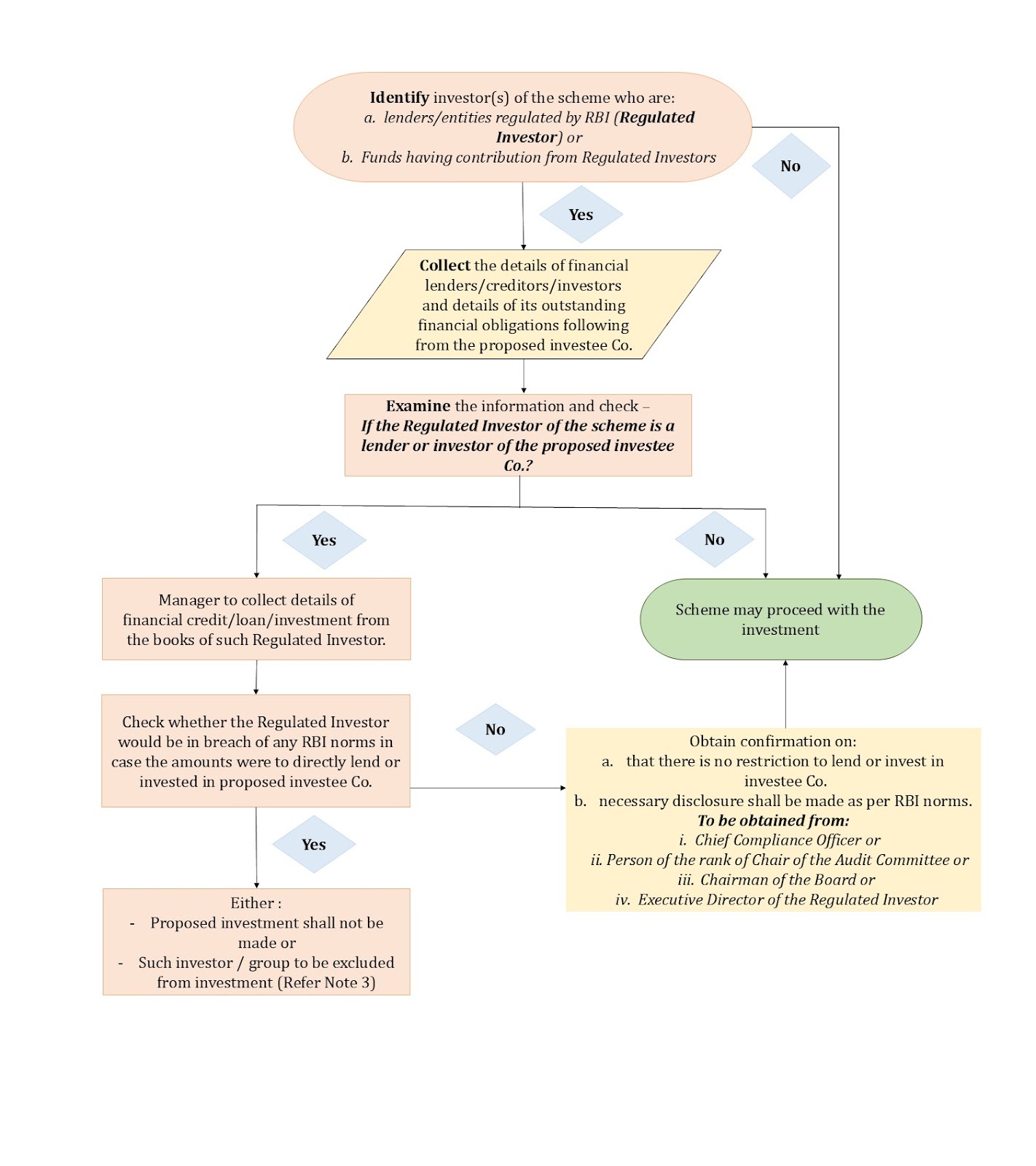
3RBI regulated lenders/ entities ever-greening their stressed loans/ assets & circumventing RBI normsRBI norms on Income    Recognition,    Asset    Classification, Provisioning and Restructuring of stressed loans/ assets(a)whose manager or sponsor is an entity regulated by RBI; or,(b)that has investor(s)regulated by RBI who:(i)individually or   along   with   investors   of the same   group contribute(s) 25% or more to the corpus of the scheme; or(ii) is an associate of the manager/ sponsor of the AIF;(iii) has majority or veto power [by itself, or through its representatives/ nominees] in voting over  decisions of the investment  committee  set up  by   the manager to approve investment decisions of the scheme.Note: where investor is an AIF or fund set up in IFSC or outside India, criteria check to be carried out on a look through basis.Refer Note 4.Prior to making any investments, to avoid indirect investment by RBI regulated lender/ entity.Refer Note 2 below for existing investments & Note 3 for proposed investments.
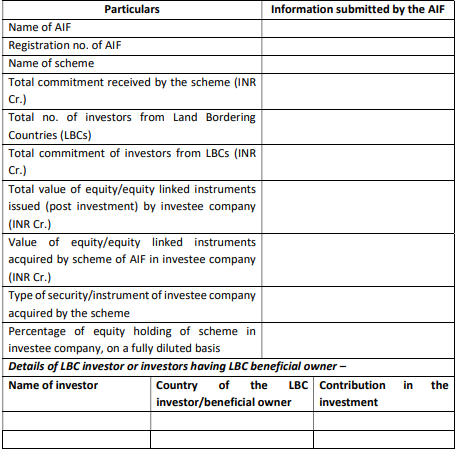
4Investment from countries sharing land border with IndiaFEMA (NDI) Rules, 2019Where 50% or more of the corpus of the scheme is contributed by investors (a)who are citizens of/are from/are situated in a country which shares land border with India; or(b)whose beneficial owners, as determined  in  terms  of  Rule  9 (3)  of  the  PMLA (Maintenance  of Records)  Rules,  2005, are citizens  of/are from/are situated in a country which shares a land border with India.If the proposed investment would result in the scheme holding           10 % or more of equity/equity-linked securities issued by the company (on a fully-diluted basis), the manager to check details stated in the previous column, by collecting information on the country of investors and their beneficial owners.Prior to making any investmentRefer Note 2 below for existing investments & Note 5 for proposed investments.

Note 1: same group’ shall mean ‘related parties’  and  ‘relatives’ as  defined  in  SEBI  (Listing  Obligations  and  Disclosure Requirements) Regulations, 2015.

Note 2

For Sr nos 1 to 3: DD requirement is applicable for existing investments too, held by AIF schemes as on October 8, 2024:

  • If DD check not satisfactory – details of investment to be reported to AIF’s custodian on or before April 07, 2025, in the format as per Annexure 1 of the circular;
  • If DD check satisfactory – AIF manager to submit an undertaking to AIF’s custodian on or before April 07, 2025.

For Sr no. 4: Reporting is required to be made for existing investments held by AIF schemes as on October 8, 2024 if the scheme holds 10% or more of equity/ equity-linked securities on a fully-diluted basis,  to AIF’s custodian on or before April 07, 2025 in the format prescribed by SFA.

Note 3

Consequence of not satisfying requirements of DD checks specified by SFA for proposed investments in case of Sr nos 1 to 3:

  • Such investor or investor group to be excluded along with necessary disclosure in the private placement memorandum (PPM); or 
  • Investment cannot be made.

Note 4: 

Note 5: Details of investment, which would result in the scheme holding 10% or more of equity/ equity-linked securities on a fully-diluted basis, to be reported to the custodian within 30 days of investment, in the below format specified by SFA.

DD requirement – one-time or ongoing?

As discussed in the SEBI BM Agenda, the  purpose  of  the  due-diligence  check  is  to  prevent  facilitation of any circumvention of provisions of financial sector regulators, which cannot be a time specific check. An entity who intends to circumvent can design the structure in such a way that, at a later date post investment, it acquires the units  of  AIFs  post  investment,  such  as  buying  the  units  of  an  existing investor or by acquiring control over the existing investor entity, as per prior arrangement.  Accordingly, it has been indicated that due diligence around investors and investments will be an ongoing one.

Applicability of DD – prospective or retrospective?

As per the SEBI circular this is applicable for existing and prospective investments. Refer Note 2 above.

Obligations of Custodian to the AIF

  • Information received from AIFs under Note 2 to be furnished to SEBI on or before May 7, 2025.
  • Information received from AIFs in terms of Note 4 above on a monthly basis to be compiled and reported to SEBI within 10 working days from month end.

Power of AIF to exclude an investor

As per SEBI Circular, in cases where the outcome of DD is not satisfactory, in that case the AIF will either have to exclude the investor or investor group or abstain from making the proposed investment. 

Dealing with power to exclude an investor, in April  2023 SEBI had issued ‘Guidelines with respect to excusing or excluding an investor from an investment of AIF that empowered an AIF to excuse its investor from participating in a particular investment in the following circumstances:

Figure 1: Circumstances to excuse an investor of AIF

Conclusion

The present amendment and SEBI Circular lays an onerous burden on the AIF, manager and KMP of the AIF and the manager. The DD requirement has become effective from October 8, 2024 and applies to existing investments as well. The AIFs have an actionable of evaluating the existing investments in the scheme in the light of the present amendment and ensure reporting in next 6 months. The obligation of on-going due diligence will result in a compliance burden, but is justified given the intent of law as “quando aliquid prohibetur ex directo, prohibetur et per obliquum” i.e. things that cannot be done directly should not be done indirectly either. AIFs will continue ‘trust, but verify’ using the DD standards for due diligence. The trustee/ sponsor of the AIF is required to ensure that compliance status of this amendment is reported to SEBI in the ‘Compliance Test Report’ prepared by the manager in terms of Chapter 15 of Master Circular for AIFs.

Our other resources:

  1. FAQs on Specific Due Diligence of investors & investments of AIFs
  2. AIFs ail SEBI: Cannot be used for regulatory breach
  3. RBI bars lenders’ investments in AIFs investing in their borrowers
  4. Some relief in RBI stance on lenders’ round tripping investments in AIFs

Proposals approved in SEBI Board Meeting held on April 30, 2024

– Laveena Gajwani and Garima Chugh | corplaw@vinodkothari.com

Loader Loading…
EAD Logo Taking too long?

Reload Reload document
| Open Open in new tab

Download as PDF [149.20 KB]

Lend, Recover, Replenish: A guide to revolving lines of credit

“Chivalry is like a line of credit. You can get plenty of it when you do not need it.”

— Nellie L. McClung

Dayita Kanodia | Finserv@vinodkothari.com

In the realm of financial management, having access to a flexible and readily available source of funds can be a game-changer for individuals and businesses alike. One such financial tool that offers this flexibility is a revolving line of credit. Often misunderstood or overlooked, revolving lines of credit are versatile financial instruments that can provide quick access to funds when needed.

A revolving line of credit is a type of loan arrangement that provides borrowers with access to a predetermined amount of funds, which they can borrow, repay, and borrow again as needed. Unlike traditional term loans, where you receive a lump sum upfront and repay it over a set period with fixed payments, a revolving line of credit offers ongoing access to funds that can be drawn upon at any time, up to the credit limit.

Revolving line of credits has been defined as a committed loan facility allowing a borrower to borrow (up to a limit), repay, and re-borrow loans.These are also known as revolving credit facilities, replenshing loans, revolving loans,  or just revolver. 

How Does it Work?

When one opens a revolving line of credit, there is an approval for a certain credit limit based on factors such as creditworthiness, income, and other financial obligations. Once approved, funds can be accessed from the credit line as needed, either by writing checks, using a debit card, making online transfers, or withdrawing cash, depending on the terms of the agreement.

The line of credit is drawn down as disbursements occur. However, the limit is reinstated to the extent repayment is made by the borrower. Obviously, the borrower is free to repay the whole or a part of the limit anytime, and there is no question of any prepayment charge. 

It is not as though a revolving line of credit will continue to revolve all the time – the lender may set a renewal date, and if the facility is not renewed, the lender may convert it into either an instalment credit, or one payable in one or more tranches at a defined time. During the period the facility remains revolving, the borrower services interest.

It is also important to note that during such time, and for such amount, the facility is not used not used fully, the lender still keeps a commitment to lend alive, which has both liquidity burden as well as regulatory capital charge for the lender. Therefore, it is perfectly okay for a lender to provide for a commitment charge for the unutilised facility amount. 

Features of Revolving Lines of Credit

  • Revolving Nature: Unlike traditional term loans, revolving lines of credit allow borrowers to repeatedly borrow and repay funds without the need to reapply for a new loan each time.
  • Interest on Utilized Amount: Interest is typically charged only on the amount of credit actually used, rather than on the entire credit limit. This can result in lower interest costs for borrowers who do not fully utilize their credit line.
  • Variable Interest Rates: Interest rates on revolving lines of credit may be variable, meaning they can fluctuate over time based on market conditions. This can be advantageous if rates decrease but may pose risks if rates rise.
  • No Fixed Repayment Schedule: Unlike term loans with fixed monthly payments, revolving lines of credit typically have no fixed repayment schedule. Borrowers can repay the borrowed amount on their own timeline, as long as they make at least the minimum required payments.
  • Credit Renewal: As long as the borrower meets the terms and conditions of the credit agreement, revolving lines of credit can be renewed indefinitely, providing ongoing access to funds.

Lines of credit and its types

The US Federal Reserve has distinguished between revolving and non-revolving lines of credit. It says, 

“Revolving credit plans may be unsecured or secured by collateral and allow a consumer to borrow up to a prearranged limit and repay the debt in one or more installments. Credit card loans comprise most of revolving consumer credit measured in the G.19, but other types, such as prearranged overdraft plans, are also included. Nonrevolving credit is closed-end credit extended to consumers that is repaid on a prearranged repayment schedule and may be secured or unsecured. To borrow additional funds, the consumer must enter into an additional contract with the lender.”

Credit can be classified as:

Revolving Credit: A fixed line of credit is determined from where draw down take place. The line of credit then gets reinstated on repayment by the borrower.

Non-Revolving Credit: They provide borrowers with access to funds up to a predetermined credit limit which does not get reinstated on repayments being made. To borrow additional funds, a new contract has to be entered into.

Installment Credit: Installment credit involves borrowing a specific amount of money upfront and repaying it over a set period in equal installments, typically including both principal and interest.

Non-installment Credit: In case of non-installment credit, repayment does not happen in equal installments over a period of time but there is generally a bullet repayment made by the borrower.

Types of revolving lines of credit

Revolving lines of credit come in various types, each tailored to meet specific needs and circumstances:

Personal Revolving Line of Credit: 

This type of credit is designed for individual consumers and can be used for various personal expenses, such as home renovations, unexpected medical bills, or debt consolidation. Personal revolving lines of credit offer flexibility in borrowing and repayment, allowing individuals to access funds as needed.

Working Capital Revolving Line of Credit: 

Businesses often use this type of credit to manage cash flow, finance day-to-day operations, purchase inventory, or cover short-term expenses. Working capital revolving lines of credit provide flexibility for businesses to access funds when needed and repay them as cash flow allows, helping to smooth out fluctuations in revenue and expenses.

Secured and Unsecured Revolving Line of Credit: 

Secured lines of credit require collateral, such as real estate, inventory, or equipment, to secure the credit line. Because the lender has the security of collateral, secured lines of credit typically offer lower interest rates and higher credit limits compared to unsecured lines of credit.

Unsecured lines of credit do not require collateral. Instead, the creditworthiness of the borrower determines the credit limit and terms of the line of credit. Interest rates for unsecured lines of credit may be higher, and credit limits lower, compared to secured lines, but they offer the advantage of not requiring collateral.

Home Equity Line of Credit (HELOC): 

A HELOC is a revolving line of credit that is secured by the equity in a borrower’s home. Homeowners can borrow against the equity in their home up to a certain limit, using the home as collateral. HELOCs often have lower interest rates compared to other forms of credit and may offer tax benefits, but they carry the risk of foreclosure if payments are not made.

Revolving Credit Cards: 

Credit cards are a common form of revolving line of credit. They allow cardholders to make purchases up to a certain credit limit, repay the balance, and then borrow again up to the credit limit. Revolving credit cards typically have variable interest rates and may offer rewards or cashback incentives.

Maintenance of Regulatory Capital

According to para 5.9.3 of the Basel III Master Circular, revolving lines of credit can be considered as retail claims for regulatory capital purposes and included in a regulatory retail portfolio if they meet certain conditions. :

However, it is important to understand that a revolving facitliy has a drawn amount (and therefore, on-balance sheet exposure), and the undrawn amount (which is off balance sheet exposure). 

Para 5.15.2 (iv) of the Basel III Circular states that, 

“Where the non-market related off-balance sheet item is an undrawn or partially undrawn fund-based facility, the amount of undrawn commitment to be included in calculating the off-balance sheet non-market related credit exposures is the maximum unused portion of the commitment that could be drawn during the remaining period to maturity. Any drawn portion of a commitment forms a part of bank’s on-balance sheet credit exposure.”

Accordingly, say there is a credit facility for Rs.100 lakh (which is not unconditionally cancellable) where the drawn portion is Rs. 60 lakh, the undrawn portion of Rs. 40 lakh will attract a Credit Conversion Factor of 20 per cent. 

The credit equivalent amount of Rs. 8 lakh (20% of Rs.40 lakh) will be assigned the appropriate risk weight as applicable to the counterparty/rating to arrive at the risk weighted asset for the undrawn portion. The drawn portion (Rs. 60 lakh) which forms a part of the bank’s on-balance sheet credit exposure will attract a risk weight as applicable to the counterparty/rating.

Liquidity Risk 

According to para 131 of the Basel III: The Liquidity Coverage Ratio and liquidity risk monitoring

tools any contractual loan drawdowns from committed facilities and estimated drawdowns from revocable facilities within the 30-day period should be fully reflected as outflows. 

In case of committed credit facilities to retail and small business customers, banks have to assume a 5% drawdown of the undrawn portion whereas in case of non-financial corporates, drawdown has to be assumed for 10% of the undrawn amount.

Can revolving lines of credit be Transferred or Securitised ?

Transfer of Revolving Lines of Credit:

In case of a revolving line of credit, there is typically an undrawn amount. Accordingly, the transfer can only happen for the amount already drawn. However, in terms of the RBI Master Direction – Reserve Bank of India (Transfer of Loan Exposures) Directions, 2021 (‘TLE Directions’), the requirement of Minimum Holding Period (‘MHP’) needs to be fulfilled. This MHP requirement is of 3 months for loans having tenure of upto 2 years. Therefore, for loans having very short tenure, it may not be possible to fullfill the same. 

Accordingly, although there is no express prohibition from transferring the line of credit exposure, it may not be practical to do so. 

Securitisation of revolving lines of credit:

As per para 6(d) of the Master Direction – Reserve Bank of India (Securitisation of Standard Assets) Directions, 2021 (‘SSA Directions’) securitisation of revolving credit facilities is not permitted. Accordingly, revolving lines of credit cannot be securitised. 

Obtaining Default Loss Guarantee for Revolving Lines of Credit

Default Loss Guarantee(DLG) can only be obtained for digital loans. Since, revolving credit facilities (say, credit cards) may be offered through digital means it is important to discuss if DLG can be obtained for revolving lines of credit. The RBI FAQs (FAQ No.10) on Default Loss Guarantee (‘DLG FAQs) have prohibited REs from entering into DLG arrangements with respect to revolving lines of credit. 

For other non-digital revolving lines of credit provided, the bar on synthetic securitisation continues to apply and therefore, no default loss guarantee can be obtained. 

Conclusion

In a world where financial needs can arise unexpectedly, having access to a revolving line of credit can be invaluable. However, it’s essential for lenders to understand the regulatory requirements and implications associated with these credit facilities to ensure compliance and mitigate risks effectively.

Related Articles – 

Personal revolving lines of credit by NBFCs: nuances and issues

The Credit Card Business for NBFCs

FAQs on Default Loss Guarantee in Digital Lending