Rights for wrongs: Potential deprivation of shareholders property rights using mandatory demat rule

– Vinod Kothari and Payal Agarwal | corplaw@vinodkothari.com

The mandatory dematerialisation provisions under the Companies Act, 2013 requires companies to issue their securities and facilitate transfer requests in dematerialised form only. For private companies, the mandate has become effective since 30th June 2025, hence, every private company (barring a small company) is now required to issue securities in dematerialised form only. Not only do new securities need to be in demat format, the shareholders having existing shareholding in physical form are deprived of their shareholding rights in the form of participation in further rights issue, bonus issue etc. The purpose of mandatory demat rule is to bring shareholders and shareholding in companies in a transparent, tractable domain. However, can it be contended that every person who has not dematerialised his holdings is a non existing persona, or deserves to have his property rights defeated and redistributed to other shareholders? Can such a person be compelled to lose his rights entitlement in further issuance brought by the private company? Even more stark, can such a shareholder lose his rights to the accumulated surplus piled up in the company if the board of directors of the company suddenly decides to issue bonus shares? In simple words, can the mandate of dematerialisation, that is applicable on a company, be interpreted for deprivation of shareholders’ property rights? 

It is not that Rule 9B is new – since its original notification in October 2023, the applicability of the provisions was deferred from the original applicability date of 30th September, 2024 to 30th June, 2025. However, we need to understand that when it comes to private companies, there are lots of minority shareholders who have not converted their shareholdings into demat form. Reasons could be internal family issues, some issues with respect to holdings, or pure lethargy. Let no one make the mistake of assuming that private companies are small companies – private companies may be sitting with hundreds of crores of wealth – these may be family holding companies, JV companies, or even large companies with a restricted shareholding base. If the company is an old legacy company, for sure, the shares would have been in physical form, and may not have been demated. Now, suddenly, finding the law that has come into force, if the board of directors decides to come out with a bonus, the minority holding shares in physical form will be deprived of their right – which would mean, their share of wealth piled up over the years goes to the other shareholders. 

Mandatory dematerialisation prior to subscription to securities 

Sub-rule (4) of Rule 9B puts a condition on the securities holders to have the entire holding in demat form prior to subscription to the securities. The relevant extracts are as below: 

(4) Every holder of securities of the private company referred to in sub-rule (2),- 

XXX

(b) who subscribes to any securities of the concerned private company whether by way of private placement or bonus shares or rights offer on or after the date when the company is required to comply with this rule shall ensure that all his securities are held in dematerialised form before such subscription

The provision thus explicitly forbids a shareholder from participation in a rights issue or bonus issue – corporate actions that are very much a part of the pre-emptive rights of a person as an existing shareholder. 

Seeking mandatory dematerialisation: powers under section 29 of the Act

Note that Rule 9B has been issued in accordance with the powers contained in Section 29 of CA, 2013. The title of section 29 reads as “Public Offer of Securities to be in Dematerialised Form”, indicating the regulator’s intent of requiring mandatory dematerialisation of ‘public offers’. Sub-section (1)(b) of the said section originally referred to ‘public’ companies, however, the term ‘public’ was subsequently omitted, and sub-section (1A) introduced, so as to require the notified classes of unlisted companies to ‘hold’ and ‘transfer’ securities in dematerialised form only. The amendment was brought in 2019, thus, enabling the Government to bring private companies too within the ambit of mandatory dematerialisation. 

Bonus issue and the unfair treatment to physical shareholders

Rule 9B(4) explicitly refers to ‘bonus issue’, and states that physical shareholders are ineligible to ‘subscribe to the bonus issue’. First of all, the language of the provision is flawed in the sense that bonus issue is mere capitalisation of profits of the company – there is no ‘offer’ on the part of the issuer, and no ‘subscription’ on the part of the shareholder. The same is proportionally available to all shareholders in the ratio of their existing shareholding. 

Since bonus issue leads to capitalisation of profits, there is an effective distribution of profits to the shareholders, though the company does not incur any cash outflow. Depriving a shareholder of his right to bonus issue does not only result in non-distribution of the profits to such shareholder, but also, redistribution of his share of profits to other shareholders. There is a disproportionate distribution of profits, and the physical shareholders stand at a loss. 

Unclaimed dividend: why should the treatment not be the same?

A parallel reference may be drawn from the provisions applicable to payment of dividend, through which distribution of profit occurs, with an immediate cash outflow. Section 124 of CA, 2013 requires that any unclaimed/ unpaid dividend be transferred to a separate escrow account, and the details of the shareholders be placed on the website to provide notice to the shareholders for claiming the same. Even if the same is not claimed by the shareholders during the specified period, the same can still not be re-distributed amongst the other shareholders, rather, gets transferred to the Investor Education and Protection Fund, and may still be claimed by the shareholders. 

The concept of bonus issue, being much similar to that of dividend, the rights of the physical shareholders should not be compromised and the bonus shares should ideally be set aside in a separate suspense account with any DP. Before keeping such shares in the suspense account the issuer company should send intimation letters to such shareholders at their latest known address.

Listed shares and Suspense Escrow Demat Account

Pending dematerialisation of holdings of a shareholder, any corporate benefits accruing on such securities are credited to the Suspense Escrow Demat Account, and may be claimed by the shareholder. Reg 39 read with Schedule VI of LODR Regulations require all such corporate benefits to be credited to such demat suspense account or unclaimed suspense account, as applicable for a period of seven years and thereafter transferred to the IEPF in accordance with the provisions of section 124 of CA, 2013 read with the rules made thereunder. 

How physical shareholders are deprived of their rights to proportionate holding?

Under rights issue, an opportunity is given to the existing shareholders, in proportion to their existing shareholding, to subscribe to the further issue of shares by the company. Thus, any dilution in the voting rights and towards the value of the company is avoided. The alternative to rights issue is through preferential allotment, where the securities may be offered to any person – whether an existing shareholder or otherwise, in any proportion. Since this may lead to a dilution in the rights of the existing shareholders – the same requires: (a) approval of the shareholders through a special resolution and (b) a valuation report from the registered valuer. 

Both of the aforesaid are meant to protect the interests of the existing shareholders. On the other hand, in case of rights issue – neither shareholders’ approval nor a fair valuation requirement applies – on the premise that there is no dilution of rights of the existing shareholders. 

In fact, rights issue of shares can be, and in practice, are fairly underpriced, since there is no mandatory valuation requirement under the Companies Act, and while there are contradicting judgments on whether or not section 56(2)(x) of the Income Tax Act applies on dis-proportionate allotment under rights issue, the valuation under Rule 11UA may be based on historical values – and hence, may not reflect the fair value of the shares. 

Not being entitled to rights is like losing the proportional wealth in a company, resulting in re-distributing the property of the physical shareholders to the demat shareholders. This effectively steals a physical shareholder of his existing holding in the company, that gets diluted to the extent of the disproportionate allotment, and a loss in value on account of the underpriced share issuance.

Listed companies and the approach followed for rights issue 

For listed entities, there is no blanket prohibition on subscription of shares by physical shareholders, rather, necessary provisions are created to facilitate subscription to the rights issue by such shareholders as well [Chapter II of ICDR Master Circular read with Annexure I]. 

  • Where the demat account details are not available or is frozen, the REs are required to be credited in a suspense escrow demat account of the Company and an intimation to this effect is sent to such shareholder. 
  • Physical shareholders are required to provide their demat account details to the Issuer/ Registrar for credit of Rights Entitlements (REs), at least 2 working days prior to the issue closing date. 
  • The REs lapse in case the demat account related information is not made available within the specified time. 

Thus, there is no automatic deprivation of the rights of the physical shareholders to apply in a rights issue, rather, a systematic process is given to facilitate dematerialisation and subscription of shares. 

The problem is bigger for private companies: necessitating additional measures 

A listed entity has a large number of retail shareholders, however, with very small individual holdings. In contrast is a private company, where the number of shareholders are small and each shareholder would be holding a rather significant share. The larger the share of an individual shareholder, the more he is impacted by the nuisance of depriving participation in a rights issue. 

The technical requirement of securities being dealt with in dematerialised form only, cannot give a private company the right to arbitrarily bring up corporate actions to deprive the existing physical shareholders from their rights over the company. 

An ideal approach towards preventing companies from taking an unfair advantage of the non-dematerialised holdings of some shareholders vis-a-vis dematerialised holdings of other shareholders would be by requiring them to keep the corporate actions attributable to the physical shareholders in abeyance, pending dematerialisation of securities. 

Therefore, for instance, in case of rights issue, along with the circulation of offer letter to the shareholders, a dematerialisation request form may be circulated, requiring the shareholders holding shares physically to apply for such dematerialisation. Pending dematerialisation of the securities, shares may be held in a suspense account or may be reserved for the shareholders in any form, and may be credited to the demat account of such shareholders, once the same is available. 

In the absence of any measures for protection of interest of the physical shareholders, the disproportionate treatment to such shareholders pursuant to a corporate action, may be looked upon as the use of law with a mala fide intent, one done with the intent of differentiating between shareholders of the same class – which could not have been possible otherwise, if the shares were held in demat form. 

Thus, one may contend that the ‘right’ is used for a ‘wrong’, thus challenging the constitutional validity of such law.  

Deprivation of property rights require authority of law

Article 300A of the Constitution of India provides for the right to property, stating that “No person shall be deprived of his property save by authority of law”. The Article has been subject to various judicial precedents, although primarily in the context of land acquisition related matters. The Supreme Court, in the matter of K.T. Plantation Pvt. Ltd. vs State Of Karnataka, AIR 2011 SC 3430, has considered ‘public purpose’ as a condition precedent for invoking Article 300A, in depriving a person of his property. 

117. Deprivation of property within the meaning of Art.300A, generally speaking, must take place for public purpose or public interest. The concept of eminent domain which applies when a person is deprived of his property postulates that the purpose must be primarily public and not primarily of private interest and merely incidentally beneficial to the public. Any law, which deprives a person of his private property for private interest, will be unlawful and unfair and undermines the rule of law and can be subjected to judicial review. But the question as to whether the purpose is primarily public or private, has to be decided by the legislature, which of course should be made known. The concept of public purpose has been  given fairly expansive meaning which has to be justified upon the purpose and object of statute and the policy of the legislation. Public purpose is, therefore, a condition precedent, for invoking Article 300A.

Failure to dematerialise: can there be genuine reasons or mere lethargy? 

One may argue that the shareholders have the responsibility to ensure their holding is dematerialised, and hence, a physical shareholder rightfully suffers the consequences of its own lethargic attitude. However, that should not be considered reason enough to deprive one of its rights to the property legally owned and held by it. 

Practically speaking, there may be various reasons for which a shareholder may not be able to dematerialise its existing shareholding in a company, thus becoming ineligible for participation in rights/ bonus issues. For instance, the title of a shareholder might be in dispute, pending which, dematerialisation would not be possible. Another practical issue might be due to loss of share certificates, and the investee company, pending issuance of duplicate share certificates and dematerialisation thereof, may come up with a bonus issue.  

Concluding Remarks:

The dematerialisation provisions, brought to do away with bogus shareholders, might be used to steal away the rights of validly existing shareholders, on the pretext of non-fulfilment of a technical requirement. In view of the mandatory issuance in demat form, a physical shareholder might not be able to ‘hold’ the shares pending dematerialisation, however, the same does not snatch away the ‘entitlement’ of the shareholder to such rights, and cannot, at all, be re-distributed to other shareholders. This cannot, and does not, seem to have been the intent of law, however, in the absence of clear provisions requiring the company to hold such rights in abeyance for the physical shareholders, may lead to inefficacy.

Read More:
Diktat of demat for private companies 

FAQs on mandatory demat of securities by private companies

Supreme Court Mandates Digital Accessibility: Action Points for Banks and NBFCs

– Harshita Malik | finserv@vinodkothari.com

Introduction

On April 30, 2025, the Supreme Court of India delivered a landmark judgment in Pragya Prasun & Ors. v. Union of India, declaring digital access as an intrinsic component of the fundamental right to life under Article 21. The Court issued comprehensive directions to make digital KYC processes accessible to persons with disabilities, particularly acid attack survivors and visually impaired individuals.

This judgment fundamentally transforms how banks and NBFCs must approach customer onboarding through digital means, with immediate compliance requirements and potential legal consequences for non-adherence.

Pursuant to the directives issued by the Supreme Court, the RBI has amended the Master Direction – Know Your Customer (KYC) Direction, 2016 (‘KYC Directions’) vide Reserve Bank of India (Know Your Customer (KYC)) (2nd Amendment) Directions, 2025 (‘KYC 2nd Amendment’).

Background: The Catalyst Case

The Petitioners’ Struggle

The petitioners in these cases highlight significant barriers faced by persons with disabilities in accessing digital KYC processes. WP(C) No. 289 of 2024 involved acid attack survivors who were unable to complete digital KYC, while WP(C) No. 49 of 2025 involves a visually impaired individual facing similar difficulties. A notable incident involved Pragya Prasun, who was denied the opening of a bank account  due to her inability to perform the blinking required for liveness verification. These cases are grounded in the protections afforded by the Rights of Persons with Disabilities Act, 2016, and the fundamental right to life and personal liberty under Article 21 of the Constitution.

Current KYC Barriers Identified

The Court recognized that existing digital KYC processes create obstacles for persons with disabilities:

Barrier TypeSpecific IssuesAffected Population
Liveness DetectionMandatory blinking, head movements, reading displayed codesAcid attack survivors, visually impaired
Screen CompatibilityLack of screen reader support, unlabeled form fieldsVisually impaired persons
Visual DependenciesSelfie capture, document alignment, front/back identificationPersons with visual impairments
Signature VerificationNon-acceptance of thumb impressions in digital platformsPersons unable to sign consistently

Legal Framework and Constitutional Mandate

Supreme Court’s Key Declarations

“Digital access is no longer merely a matter of policy discretion but has become a constitutional imperative to secure a life of dignity, autonomy and equal participation in public life.”

– Justice R. Mahadevan

The Supreme Court has firmly declared that digital access is no longer just a policy choice but a constitutional necessity to ensure individuals’ dignity, autonomy, and equal participation in society. This constitutional and legal mandate is grounded in several provisions: Article 21 guarantees the right to life with dignity, requiring digital services to be accessible to everyone; Section 3 of the Rights of Persons with Disabilities (RPwD) Act, 2016, ensures equality and prohibits discrimination against persons with disabilities; Section 40 mandates that all digital platforms adhere to established accessibility standards and Section 46 sets a two-year timeline within which service providers must achieve compliance with these accessibility requirements.

Supreme Court Directives: Banks & NBFCs Action Matrix

The Supreme Court issued twenty directives in the said judgement to ensure that services are not denied based on disability and digital services are accessible to all the citizens irrespective of the impairments. Most of these are for the regulators, while a few are for regulated entities.

Following is the list of actionables arising out of the directives for banks and NBFCs:

  1. Undergo mandatory periodic accessibility audits by certified professional[1], may involve PwD in user testing of apps/websites (SC directive ii);
  2. Procure or design devices or websites / applications / software in compliance of accessibility standards for ICT Products and Services as notified by Bureau of Indian Standards. This mandate applies to a broad spectrum of digital products and services, including :
    1. Websites and web applications;
    2. Mobile apps;
    3. KYC/e-KYC/video-KYC modules;
    4. Digital documents and electronic forms; and
    5. Hardware touchpoints (ATMs, self-service machines). (SC directive xi)
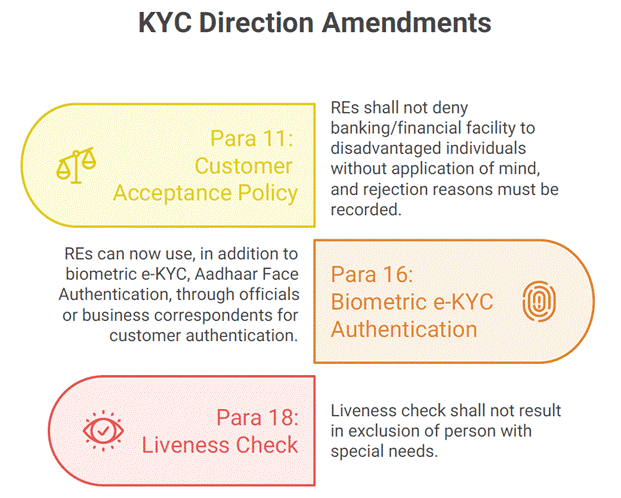
  3. Cannot reject PwD applications without proper human consideration, must record reasons for rejection. Banks and NBFCs may appoint a designated officer who shall be empowered to override automated rejections and approve applications on a case-by-case basis (SC directive xvi and KYC 2nd Amendment to Para 11 of the KYC Directions).
  4. In the process of customer due diligence, REs can accept Aadhaar Face Authentication as valid method for Authentication ( KYC 2nd Amendment to Para 16 of the KYC Directions).
  5. During the V-CIP process, REs cannot rely solely on eye-blinking for liveness verification. They must ensure liveness checks do not exclude persons with special needs. For this purpose, the officials of banks or NBFCs may ask varied questions to establish the liveness of the customer (KYC 2nd Amendment to Para 18(b)(i)).

Changes to the KYC Directions

Changes have been introduced in the KYC Directions via the KYC 2nd Amendment as a result of the SC verdict, these are captured in the diagram:

Implementation Plan

Based on the Supreme Court directive in Pragya Prasun & Ors. vs Union of India and the subsequent RBI notification, here is a comprehensive stage-wise action plan for implementing digital accessibility requirements for banks and NBFCs:

Phase 1: Immediate Compliance and Assessment

Actionables for REs under phase 1 are listed below:

  1. Stage 1.1: Current State Assessment
    1. Inventory all client facing platforms like digital platforms, mobile apps, websites, and KYC systems;
    2. Document current accessibility barriers and non-compliant features and identify high-risk areas requiring immediate attention.
  2. Stage 1.2: Policy Framework Development
    1. Amend the KYC Policy  to incorporate accessibility clauses for PwD;
    2. Update existing KYC Policy to incorporate paper based KYC other than video based KYC (provided such verification methods shall not result in any discomfort to the applicant); and
    3. Make necessary changes to internal documents and SOPs to include disability-inclusive customer service protocols.

Phase 2: Technical Foundation and Alternative Methods

Actionables for REs under phase 2 are listed below:

  1. Stage 2.1: Alternative KYC Methods Implementation
    1. Implement alternative means of liveness detection other than blinking of an eye such as:
      1. Gesture-based verification (beyond eye blinking);
      2. Facial movement detection;
      3. Audio-based liveness checks; or
      4. Any other method feasible to the RE
    2. Provide notices regarding the alternative methods of KYC that the RE supports/provides to PwD
    3. In case of biometric based e-KYC verification, accept thumb impressions or AADHAAR face authentication or any other biometric alternatives.
    4. In case of paper-based KYC, strengthen offline processes as accessible alternatives in such a manner that the same shall not cause any discomfort to the applicant.
    5. Remove mandatory blinking requirements in video KYC.
  2. Stage 2.2: Technical Infrastructure Updates
    1. Ensure that all digital platforms of the RE meet the accessibility standards for ICT Products and Services as notified by Bureau of Indian Standards
    2. Ensure that assistive technology is integrated into the current systems such as screen reader compatibility, voice navigation, etc.
  3. Stage 2.3: Data Capture Enhancements
    1. Modify KYC templates in such a way to add disability fields(type and percentage) to be able to serve better to the applicants
    2. Update database to capture disability-related information (including preferred communication and customer authentication methods) for appropriate service delivery

Phase 3: Process Redesign and Human Support

Actionables for REs under phase 3 are listed below:

  1. Stage 3.1: Human-Assisted Channels
    1. Establish dedicated helpline for PwD offering step-by-step assistance in completing the KYC process through voice or video support;
    2. Conduct staff sensitization and disability awareness programs across all offices/branches
    3. Authorise/allow support from nominated guardians/family members to assist in the KYC process
    4. In case of persons dependent on sign languages, video calling service with certified interpreters shall be provided
  2. Stage 3.2: Grievance Mechanism Setup
    1. May develop dedicated accessibility complaints system for disability-related issues
    2. Ensure manual assessment of rejected KYC applications
    3. Establish clear timelines and accountability for redressal of grievances
  3. Stage 3.3: Alternative Service Delivery
    1. Train BCs/agents for disability-inclusive KYC assistance
    2. Doorstep customer authentication for severely disabled applicants, provided that such facility shall not cause any discomfort to the applicant

Phase 4: Testing and Validation

Actionables for REs under phase 4 are listed below:

  1. Stage 4.1: User Acceptance Testing
    1. May involve PwD in testing phases
    2. Ensure a diverse disability testing- cover visual, hearing, physical, and cognitive impairments
    3. Ensure testing the complete customer journey from onboarding to service access
    4. Document and address all accessibility issues through feedback integration
  2. Stage 4.2: Third-Party Validation
    1. Engage an IAAP certified professional for conducting the accessibility audit
    2. Conduct security assessment of alternative authentication methods

Phase 5: Training and Capacity Building

Actionables for REs under phase 5 are listed below:

  1. Stage 5.1: Staff Development Programs
    1. Create comprehensive training modules for disability awareness and sensitivity, alternative KYC procedures, assistive technology usage, customer service best practices, etc.
    2. Conduct customized programs for different staff categories and ongoing skill development
  2. Stage 5.2: Vendor and Partner Training
    1. Ensure external partners such as BCs, tech-cendors, third-party service providers, etc. understand accessibility requirements

Phase 6 : Continuous Improvement and Compliance

Actionables for REs under phase 6 are listed below:

  1. Define the frequency of the accessibility audit and ensure that the audit is conducted on a regular basis (as per the decided frequency)
  2. Submit compliance status/plan of implementation to RBI as and when required

Closing Remarks

The Supreme Court’s judgment in the Pragya Prasun case elevates digital accessibility from a moral imperative to a constitutional mandate. Banks and NBFCs must view this not as a burden but as an opportunity to transform compliance into competitive advantage by becoming an accessibility leader.


[1] List of Empanelled Web Accessibility Auditors with Department of Empowerment of Persons with Disabilities, Ministry of Social Justice & Empowerment, Govt. of India.

Read More: Resources on KYC

Presentation on IBC Amendment Bill, 2025

YouTube Recording of Discussion on Bill: https://youtube.com/live/jAvKP7U5qKY

Read More:

IBC for a makeover: bold and beautiful! Quick highlights of the IBC Amendment Bill, 2025

Done, dented, damaged: The IBC edifice, even before it’s 10

Supreme Court’s Judgment in Bhushan Power and Steel Ltd.: a wake up call for the Resolution Professionals and Committee of Creditors

RBI rationalises Guarantee regulations

Introduces principle-based regulatory approach and reporting requirements

– Vinita Nair & Harshita Malik | corplaw@vinodkothari.com

Updated on January 13, 2026

Effective January 10, 2026, FEMA (Guarantees) Regulations, 2026 (‘Regulations, 2026’) came into force repealing the 26-year-old FEMA (Guarantees) Regulations, 2000 (‘Erstwhile Regulations’), moving to principle based requirements and introducing comprehensive reporting of all requirements for all guarantees .  Regulations, 2026 apply to guarantee arrangements involving a surety (person who gives the guarantee), a principal debtor (a person in respect of whose default the guarantee is given) and a creditor (means a person to whom the guarantee is given) where the Person Resident In India (‘PRII’) provides/ avails guarantee to/ from a Person Resident Outside India (‘PROI’). The meaning of guarantee1  includes counter guarantees and (based on stakeholders feedback) also a guarantee for securing a portfolio of debt, obligations or other liabilities.
Regulations, 2026 comprises of 8 regulations covering the general Prohibition (Reg 3), Exemptions for certain transactions by AD Bank and (based on stakeholders feedback) guarantees extended in terms of overseas investment regulations (Reg 4), Permission to act as a surety or a principal debtor (Reg 5), Permission to obtain a guarantee as a creditor (Reg 6), Reporting Requirements (Reg 7) and Late Submission fee for delayed reporting (Reg.8).  These have been notified based on the feedback received on the Draft FEMA (Guarantees) Regulations, 2025 (‘Draft Regulations’) issued in August 2025.

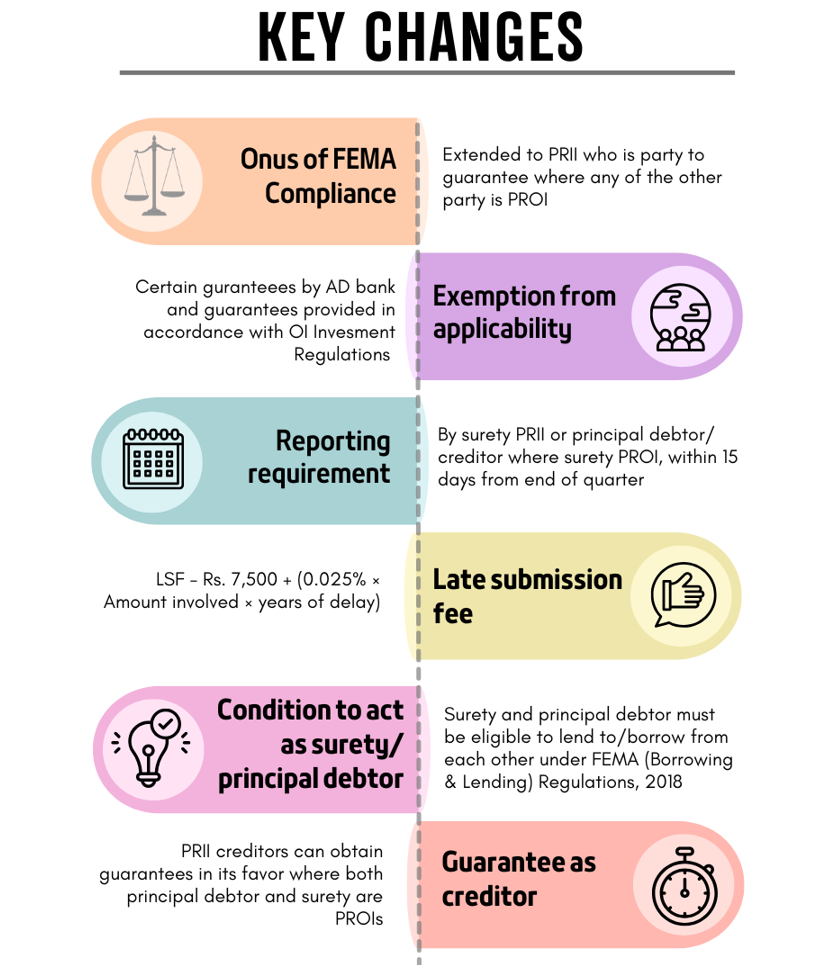
Onus of compliance [Reg. 3]

The Erstwhile Regulations placed the onus on the PRII giving a guarantee or a surety in relation to a debt, obligation or other liability owed to or undertaken by PROI. Regulations, 2026 additionally extends the onus even to a PRII who is the party to a guarantee (surety or creditor or a principal debtor) where any of the other party is a PROI. 

Exemptions under Regulations, 2026 [ Reg 4]

  1. Guarantees by AD Bank’s branch outside India or in IFSC (based on stakeholders feedback),  unless any of the other parties to guarantee is a PRII;
  2. Guarantees by AD Bank in the nature of Irrevocable Payment Commitment (IPC) issued as a custodian bank for a registered FPI on behalf of an authorised central counterparty in India, considering the same is treated as a financial guarantee in terms of RBI prudential norms for commercial banks.
  3. Guarantees provided in accordance with FEMA (Overseas Investment) Regulations 2022 (based on stakeholders feedback) – considering those are governed and reported under a separate framework altogether. 

Conditions to act as Surety/ Principal Debtor [Reg. 5]

A PRII can give a guarantee or be the principal debtor if the following two conditions are met:

  • Condition 1: The underlying transaction for which the guarantee is being given or arranged is NOT prohibited under FEMA; and
  • Condition 2: Surety and principal debtor must be eligible to lend to and borrow from each other under FEMA (Borrowing & Lending) Regulations, 2018 (clause earlier referred to ‘resultant transaction’ and has been modified based on stakeholders feedback). It is intended that at the time of issuance of guarantee itself, the surety and the principal debtor shall ensure that they are eligible to lend and borrow to each other as per Foreign Exchange Management (Borrowing and Lending) Regulations, 2018. Compliance with other attendant conditions, such as cost, maturity, etc. for borrowing and lending is not envisaged.

However, Condition 2 provides for three exceptions (listed below in the table):

Nature of guaranteeGiven byIn favor of Condition for exemption
Guarantees by AD bank backed by counter guarantee or collateral (based on stakeholders feedbackAD BankPROICovered by counter-guarantee OR 100% cash collateral in the form of deposit from PROI
Guarantee by agents of foreign Shipping/Airline companyAgent in IndiaForeign Shipping/Airline Co.In connection with its obligation/ liability owed to statutory/Government authority in India 
Both Indian PartiesPRIIPRIIBoth surety & principal debtor are PRIIs

Further, the prohibition added in the Draft Regulations in line with RBI Circular of March 13, 2018 disallowing AD Bank from giving a Letter of Comfort or a Letter of Undertaking is not expressly covered in Regulations, 2026. However, the circular of March 2018 does not seem to have been repealed by RBI either. Accordingly, the prohibition seems to continue. 

Permission to obtain guarantee as a creditor [Reg. 6]

Explicit permission given to PRII creditors to obtain guarantees in its favor where both principal debtor and surety are PROIs, where the underlying transaction is not prohibited under the FEMA.

Reporting requirements [Reg. 7 and 8]

The Erstwhile Regulations did not provide for any reporting requirements. Guarantees provided as part of ECB or in favor of overseas subsidiaries were covered under the reporting made under respective regulations. Regulations, 2026 provide for detailed reporting requirements, with RBI having the right to put the information in public domain.

Who is to report: Regulations, 2026 mandate reporting of guarantees through the AD Banks. Reporting is required to be made by the 

a) Resident surety; or 

b) Principal debtor who arranged the guarantee, where surety is PROI; or 

c) Creditor – where both surety and principal debtor are PROI or where the creditor has arranged the guarantee. 

In case of more than one surety/ principal debtor/ creditor to the same guarantee, any of them can be designated to report that guarantee (based on stakeholders feedback). 

To whom: To the AD Bank

What is to be reported: Guarantees covered in Regulations, 2026 –  (a) issuance of guarantee, (b) any subsequent change in guarantee terms, namely – guarantee amount, extension of period or pre-closure, and (c) invocation of guarantee, if any, 

Format: Form GRN (format provided at Annex to the Regulations, 2026).

One of the instructions for filing form GRN states that change of guarantees issued prior to coming into effect of these regulations i.e. January 10, 2026 shall be reported as a fresh issuance of guarantee from the date of modification. This seems to indicate that guarantees outstanding as on January 10, 2026 need not be reported unless there is a modification. In that case, an invocation of an existing guarantee may also not be required to be reported unless there is any modification which has been reported to the AD Bank under Regulations, 2026.

Further, quarterly reporting on issuance of guarantee for Trade Credit is being discontinued from quarter ending March 2026.

Periodicity and timeline: On a quarterly basis, within 15 days from the end of the respective quarter (revised to periodic basis from ‘as and when basis’ based on stakeholders feedback). Draft regulations provided for reporting within7 days from the date of issuance/ aforementioned change/ invocation of such guarantee

Further, AD Bank to onward report to RBI within 30 days from end of quarter. 

Late Submission fee:  Rs. 7,500 + (0.025% × A × n) rounded up to nearest hundred, where:

  • A = amount involved in the delayed reporting in INR; and
  • n = years of delay rounded-upwards to the nearest month and expressed up to 2 decimal points.

Amendments to ECB Master Directions

Deletion of Para 17.2 of the Master Direction – External Commercial Borrowings, Trade Credits and Structured Obligations (ECB Master Directions) dealing with the quarterly reporting requirement on data on bank guarantees for trade credits furnished by AD Bank.

Deletion of guarantee related provisions in Part III dealing with Structured Obligations: Para 19 dealing with terms and conditions for Non-resident guarantee for domestic fund based and non-fund based facilities and Para 20 dealing with terms and conditions for Facility of Credit Enhancement by eligible non-resident entities to domestic debt raised through issue of capital market instruments.

Amendments to other Master Directions

Master Directions – Export of Goods and Services, Master Directions – Import of Goods and Services , Master Direction – Other Remittance Facilities – Deletion of provision relating to issue of various guarantee in relation to export, import transactions covered under Erstwhile Regulations as Regulations, 2026 move to a principal based regime.

Master Direction – Reporting under Foreign Exchange Management Act, 1999 inserting Form GRN in relation to reporting of guarantees .

Conclusion

The Regulations, 2026 is certainly a welcome change, introducing principle-driven framework, expanded scope (counter-guarantees, portfolio guarantees), and simplified quarterly reporting. Specific requirements provided under ECB norms, ODI rules, Borrowing and lending regulations etc. shall continue to be complied while undertaking the transaction and the existing arrangements should be reviewed for new quarterly reporting obligations in case of modifications.


You may read more at our Resource centre on FEMA

  1. including a ‘counter guarantee’ means a contract, by whatever name called, to perform the promise, or discharge a debt, obligation or other liability (including a portfolio of debts, obligations or other liabilities), in case of default by the principal debtor ↩︎

FAQs on profit computation under section 198 of the Companies Act, 2013

Ankit Singh Mehar, Assistant Manager | corplaw@vinodkothari.com


Refer our resources on CSR below:

Setu-ing the Standard: NPCI’s New Path to Aadhaar e-KYC

Archisman Bhattacharjee | finserv@vinodkothari.com

Introduction

The National Payments Corporation of India (NPCI), vide its notification NPCI/2024-25/e-KYC/003 dated 10 March 2025, formally introduced the e-KYC Setu facility. As outlined on NPCI’s official platform, e-KYC Setu enables Aadhaar-based e-KYC authentication under the Aadhaar (Targeted Delivery of Financial and Other Subsidies, Benefits and Services) Act, 2016 (Aadhaar Act), without disclosing the individual’s Aadhaar number to the requesting (verification-seeking) entity.

Designed as a one-stop onboarding solution for regulated financial-sector entities, e-KYC Setu leverages Aadhaar-based e-KYC services while ensuring compliance with privacy safeguards under the Aadhaar Act. A key feature and a significant compliance advantage is that regulated entities using e-KYC Setu are not required to obtain a separate notification under Section 11A of the Prevention of Money-laundering Act, 2002 (PMLA). This allows financial sector regulator entities to conduct Aadhaar-based authentication without directly collecting Aadhaar numbers or integrating with UIDAI as a licensed AUA/KUA, thereby reducing both operational complexity and regulatory burden.

In this article, we examine the regulatory implications for RBI-regulated entities, the legal permissibility for non-AUA/KUA entities to conduct authentication through e-KYC Setu, process how e-KYC setu operatives and the operational and business benefits of adopting this framework.

Read more

Discussion on IBC Amendment Bill, 2025

Register here: https://forms.gle/czHgAXfWi8gn6DDX6

Read more:

IBC for a makeover: bold and beautiful! Quick highlights of the IBC Amendment Bill, 2025

Done, dented, damaged: The IBC edifice, even before it’s 10

Supreme Court’s Judgment in Bhushan Power and Steel Ltd.: a wake up call for the Resolution Professionals and Committee of Creditors

IBC for a makeover: bold and beautiful! Quick highlights of the IBC Amendment Bill, 2025

– Team Resolution | resolution@vinodkothari.com

Far reaching changes, several strategic initiatives, bold moves to overcome impact of jurisprudence that did not seem to serve the policy framework – these few words may just approximately describe the IBC Amendment Bill. The Bill has been put to a Select Committee of the Parliament, and may hopefully come back in the Winter Session. However, the mind of the Government is clear: if a bold legal reform has faced implementation challenges, the Government will clear the roadblocks. Some extremely crucial amendments might soon see the light of day, providing much-required clarity on priority of creditors, role of AA, group insolvency, among others.

Read more

Exclusivity Club: Light-touch regulations for AIFs with accredited investors

– SEBI notifies light-touch regulations for AIFs in which only Accredited Investors are investors and flexibilities for Large Value Funds (LVFs)

– Payal Agarwal, Partner | corplaw@vinodkothari.com

This version: 20th November, 2025

Since its introduction in 2021, the concept of Accredited Investors (AIs) has been through some changes. A Consultation Paper was published on 17th June, 2025 to provide for certain flexibilities in the accreditation framework. Another Consultation Paper dated 8th August 2025 (‘AI CP’) proposed to bring light-touch regulations for AIF schemes seeking investments from only AIs, including extension of various exemptions to such schemes, that are currently available to Large Value Funds (LVFs).

Further, vide another Consultation Paper (‘LVF CP’), some relaxations were also proposed to be extended to Large Value Funds (LVFs) for AIs. Note that the LVFs are available only for AIs, and hence, the Amendment Regulations define the AIs-only schemes to include LVF.

The SEBI (Alternative Investment Funds) (Third Amendment) Regulations, 2025 has been notified on 18th November, 2025, thus introducing the concept of AI-only schemes in the regulatory framework. Note that, vide the 2nd Amendment Regulations, the angel funds have also been exclusively restricted to Accredited Investors only. See an article on the Angel Funds 2.0: Navigating the New Regulatory Landscape.

Accredited Investors – who are they?

An AI is considered as an investor having professional expertise and experience of making riskier investments. Reg 2(1)(ab) of AIF Regulations defines an accredited investor as any person who is granted a certificate of accreditation by an accreditation agency, and specifies eligibility criteria. The eligibility criteria is as follows:

Further, certain categories of investors are deemed to be AIs, that is, certificate of accreditation is not required, such as, Central and State Governments, developmental agencies set up under the aegis of the Central Government or the State Governments, sovereign wealth funds and multilateral agencies, funds set up by the Government, Category I foreign portfolio investors, qualified institutional buyers, etc.

‘Accreditation’ as a measure of risk sophistication

AIFs are investment vehicles pooling funds of sophisticated investors, and not for soliciting money from retail investors. The measure of sophistication, as specified in the AIF Regulations currently, is in the form of the ‘minimum commitment threshold’. Reg 10(c) of the Regulations require a minimum investment of Rs. 1 crore, except in case of investors who are employees or directors of the AIF or of the Manager.

There are certain shortcomings of considering the minimum commitment threshold as the metric of risk sophistication of an investor, such as:

  • May not necessarily lead to an actual draw-down, thus exposing to the risk of onboarding investors with inflated commitments. As per the data available on SEBI’s website, out of the total commitment of Rs. 13 lac crores for the quarter ended 31st March 2024, only about Rs. 5 lac crores worth of funds were actually drawn down. Similarly, for the quarter ended 31st March 2025, the value of commitment vis-a-vis funds raised
  • Does not consider the investor’s financial health (income, net worth etc), hence, a potential risk of the investor putting majority of its wealth in AIFs, a riskier investment class.

The concept of AIs, as proposed in February 2021, was to introduce a  class  of investors  who have  an understanding of various  financial products and the risks and returns associated with them and therefore, are able to take informed  decisions  regarding their investments. Accreditation of investors is a way of ensuring that investors are capable of assessing risk responsibly.

The June 2025 CP indicated that it is being examined to move AIFs gradually in an exclusively for AIs approach, starting with investments in angel funds and in framework for co-investing in unlisted securities of investee companies of AIFs. Accordingly, the present CP has proposed a gradual and consultative transition from ‘minimum commitment threshold’ to ‘accreditation status’ as a metric of risk sophistication of an investor.

Flexibility for AIs-only schemes vis-a-vis other AIFs

The accreditation status is to  be ensured at the time of onboarding of investors only. Therefore, if an investor subsequently loses the status of AI in interim, the same shall still be considered as an AI for the AI only scheme, once on-boarded. The following relaxations have been extended to AIs-only schemes, in order to provide for a light-touch regulatory framework, from investor protection viewpoint, considering that the AIs have the necessary knowledge and means to understand the features including risks involved in such investment products:

TopicRegulatory requirement  for other AIFsOur Comments
Differential rights of investors [reg 20(22)]Shall be pari-passu, differential rights may be offered to select investors, without affecting the interest of other investors of the scheme in compliance with SEBI Circular dated 13th Dec, 2024 r/w Implementation StandardsThis facilitates differential rights to different classes of investors within a scheme.
Extension of tenure of close-ended funds [reg 13(5)]up to two years subject to approval of two-thirds of the unit holders by value of their investment in AIFThis facilitates a longer tenure extension to an existing close-ended scheme, if suited to investors.

However, it is further clarified that the maximum extension permissible to such AI only schemes, inclusive of any tenure extension prior to such conversion, shall be 5 years. 
Certification criteria for key investment team of Manager [reg 4(g)(i)]Atleast one key personnel with relevant NISM certificationThe investors, being accredited, the reliance on key investment team of the Manager is comparatively low.

Further, in case of AIs-only Funds, the responsibilities of Trustee as specified in Reg 20 r/w the Fourth Schedule shall be fulfilled by the Manager itself. This is based on the premise that, the investors, being accredited, the reliance on Trustee for investor protection is comparatively low.

Large Value Funds: a sub-category of AIs only scheme

The concept of LVF was also introduced in 2021, along with the concept of AIs. An LVF, in fact, is an AIs only fund, with a minimum investment threshold. Reg 2(1)(pa) of the AIF Regulations defines LVF as:

“large value fund for accredited investors” means an Alternative Investment Fund or scheme of an Alternative Investment Fund in which each investor (other than the Manager, Sponsor, employees or directors of the Alternative Investment Fund or employees or directors of the Manager) is an accredited investor and invests not less than seventy crore rupees.

Since an LVF is included within the meaning of an AIs-only scheme, all exemptions as available to an AIs only scheme, are naturally available with an LVF, although the converse is not true.

Additional Exemptions available to LVFs (other than as available to AIs only scheme)

In addition to the relaxations extended to an AIs only scheme, there are additional exemptions available to an LVF. These are:

Regulatory referenceTopicExemption for LVF
Reg 12(2)Filing of placement memorandum through merchant bankerNot applicable
Reg 12(3)Comments of SEBI on PPM through merchant bankerNot applicable, only filing with SEBI required
Reg 15(1)(c)Investment concentration for Cat I and Cat II AIFs – cannot invest more than 25% of investable funds in an investee company, directly or through units of other AIFsMay invest upto 50% of investable funds in an investee company, directly or through units of other AIFs
Reg 15(1)(d)Investment concentration for Cat III AIFs – cannot invest more than 10% of investable funds in an investee company, directly or through units of other AIFsMay invest upto 25% of investable funds in an investee company, directly or through units of other AIFs

Reduction in minimum investment size for LVFs

The minimum investment threshold for investors in LVF has been reduced from Rs. 70 crores to Rs. 25 crores, based on the recommendations of SEBI’s Alternative Investment Policy Advisory Committee (AIPAC). The rationale is to lower entry barriers to facilitate improved fund raising, without compromising on the level of investor sophistication. The reduction of investment thresholds would also facilitate investments by regulated entities having a strict exposure limit, such as insurance companies.

Exemptions from requiring specific waivers for certain provisions 

The extant regulations permitted that the responsibilities of the Investment Committee may be waived by the investors (other than the Manager, Sponsor, and employees/ directors of Manager and AIF), if they have a commitment of at least Rs. 70 crores (USD 10 billion or other equivalent currency), by providing an undertaking to such effect, in the format as provided under Annexure 11 of the AIF Master Circular, including a confirmation that they have the independent ability and mechanism to carry out due diligence of the investments.

The requirement of specific waiver has been omitted for LVFs considering that AIs are already required to provide an undertaking for the purpose of availing benefits of ‘accreditation’. The undertaking, as per the format given in Annexure 8 of the AIF Master Circular states the following:

(i) The prospective investor ‘consents’ to avail benefits under the AI framework.

(ii) The prospective investor has the necessary knowledge and means to understand the features of the investment Product/service eligible for AIs, including the risks associated with the investment.

(iii) The prospective investor is aware that investments by AIs may not be subject to the same regulatory oversight as applicable to investment by other investors.

(iv) The prospective investor has the ability to bear the financial risks associated with the investment.

Similarly, LVFs have been exempt from following the standard PPM template without the requirement of obtaining specific waiver from investors.

Migration of existing eligible AIFs

One of the proposals of the LVF CP is to permit eligible AIFs, not formed as an LVF, to convert themselves into an LVF and avail the benefits available to LVF schemes. The conversion shall be subject to obtaining positive consent from all the investors. Following the same, the modalities for such migration has been specified by SEBI vide circular dated 8th December, 2025

Pursuant to such migration, the AIF manager shall ensure that:

  • Name of the converted scheme contains ‘AI only fund’ or ‘LVF’ as the case may be
  • Such conversion and change in name to be reported to SEBI within 15 days through dedicated email ID
  • Such change in name to be reported to depositories within 15 days of conversion

Limit on maximum number of investors

Reg 10(f) puts a cap on the maximum number of investors in a scheme. Pursuant to the Amendment Regulations, the cap of 1000 investors shall not include the AIs.

In practice, the number of investors in an AIF is much lower than 1000, and hence, the amendment may not have much of a practical relevance. 

Conclusion

The amendments are a step towards providing a lighter regulatory regime for AIFs, meant for sophisticated investors, capable of making well-informed decisions. The move is expected to witness more schemes focussed on AIs only, and thus, bring an AIs only regime for AIFs. In order to differentiate an AIs only scheme or an LVF from other AIF schemes, it is mandatory for the newly launched schemes henceforth to have the words ‘AI only fund’ or ‘LVF’ as the case maybe.

Our resources on the topic-

  1. Understanding the Governance & Compliance Framework for AIFs
  2. Round-Tripping Reined: RBI Rolls Out Relaxed Rules for Investments in AIF
  3. Regulatory landscape for AIFs: what’s new?
  4. FAQs on Specific Due Diligence of investors & investments of AIFs
  5. Angel Funds 2.0: Navigating the New Regulatory Landscape.

Wholly controlled, but not wholly owned

– Payal Agarwal, Partner and Saloni Khant, Executive | corplaw@vinodkothari.com

Do preference shares matter for wholly-owned subsidiary status?

Preference shares are a much preferred means of raising funds from third party investors by Indian startups. The reasons for such popularity may be accorded to the priority of payment over the equity shares, thus providing a layer of protection, flexibility in exit as compared to the permanent equity capital, ease of structuring and various other factors. Very often, this may lead to the total preference share capital holding a higher proportion as against the equity share capital of the company.

This brings a very interesting question to the fore – whether a company having preference share capital held by third parties,  may still be considered to be a “Wholly Owned Subsidiary” (WOS), if such company has a sole equity shareholder, as its holding company. The question becomes particularly relevant in view of the exemptions provided to a company/ its group with respect to the WOS.

Compliance haven provided to a WOS

The Indian laws provide a myriad of relaxations in statutory requirements – a compliance haven to wholly owned subsidiaries.

Some of these have been tabulated below:

Sr. NoLawSection / Rule/ RegulationExemption
 1.CA, 2013  Section 185 The prohibitions/ restrictions u/s 185 does not apply with respect to the loans given by the holding company to its WOS or security or guarantee provided in respect of loans to its WOS.
 2.CA, 2013Section 186The limits on loan, guarantee, security, investments etc by holding company is not applicable in case of WOS.
 3.CA, 2013Section 177(4)(iv) and 188Transactions between a holding company and its WOS are exempt from the approval of the Audit Committee, except in some cases. Further, RPTs specified under section 188 are exempt from shareholders’ approval.  Our article on RPTs with WOS may be accessed here.
 4.SEBI Listing Regulations, 2015Regulation 23Exemption from AC and shareholders’ approval for RPTs with a WOS or between two WOS of the listed holding company.
 5.CA, 2013  Section 149(4), 177 and 178 read with Rule 4 of the Companies (Appointment and Qualification of Directors) Rules, 2014 and Rule 6 of Companies (Meetings of Board and its Powers) Rules, 2014The following requirements do not apply: Appointment of independent directors Constitution of Audit Committee Constitution of Nomination and Remuneration Committee
 6.CA, 2013  Section 2(87) r/w Rule 2(1) of the Companies (Restriction on Number of Layers) Rules, 2017A layer consisting entirely of 1 or more WOS is not  considered as a layer for the prohibition on having only 2 layers of subsidiaries.  Our article on the restrictions w.r.t. layers of subsidiaries may be read here.
 7.CA, 2013  Section 29 read with Rule 9A(11) of the Companies (Prospectus and Allotment of Securities) Rules, 2017A public company that is a WOS is exempt from the requirement of mandatory dematerialisation of securities. Read our article on mandatory dematerialisation of shares here.
 8.CA, 2013Section 233Fast track Merger is permitted between a holding company and its WOS. See our article on the procedure of fast track merger here.
 9.SEBI Listing Regulations, 2015Regulation 37The requirement of obtaining a No-Objection Letter from the Stock exchange is dispensed for a scheme of arrangement between a listed holding company and its WOS.
 10.SEBI Listing Regulations, 2015Regulation 37AThe requirement of shareholders’ approval for sale, lease or disposal of an undertaking, outside a scheme of arrangement, is exempt if made to the WOS.
 11.The Indian Stamp Act, 1899Articles 23 and 62 of Schedule I, Circular issued in 1937Stamp duty on mergers is remitted if the merger is between a parent company and subsidiary company (parent company holding beneficial ownership of at least 90% of its share capital) or2 subsidiary companies (Common parent company is holding the beneficial ownership of at least 90% of the share capital of both the companies). Our article on the same may be accessed here

The exemptions follow primarily an enterprise level approach, as against, entity level – thus, considering the WOS as nothing but an extended arm of the holding company. The Listing Regulations further uses the expression: whose accounts are consolidated with such listed entity, thus, signifying the relevance of ‘control’ while availing exemptions w.r.t. a WOS. 

Thus, the position and rights of the preference shareholders need to be analysed in reference to whether the same provides any sort of ‘ownership’ or ‘control’ to such shareholders.

Preference shareholder as a member of the company

Section 2(55) of the CA, 2013 defines the term ‘member’ in the following manner:

(i) the subscriber to the memorandum of the company who shall be deemed to have agreed to become member of the company, and on its registration, shall be entered as member in its register of members;

(ii) every other person who agrees in writing to become a member of the company and whose name is entered in the register of members of the company;

(iii) every person holding shares of the company and whose name is entered as a beneficial owner in the records of a depository;

The definition covers every person whose name is entered in the register of members, as well as every person holding ‘shares’ in the company having their name recorded with the depository. The term ‘shares’ covers both equity and preference shares [Section 2(84) read with Section 43]. Further, in terms of  section 88, the details of preference shareholders shall also be entered in the register of members. Thus, it is beyond doubt that the preference shareholders, too, are members of the company.

Preference shares: equivalent to ‘debt’ or considered as ‘capital’

In accounting parlance, preference shares are more likely to be classified as ‘debt’ than ‘equity’, depending on the terms of redemption or conversion. However, legally, the position of preference shareholder is not considered equivalent to a ‘creditor’, as has been a matter of jurisprudence in various cases.

The Hon’ble Bombay High Court held the following in the case of Aditya Prakash Entertainment Pvt. Ltd vs Magikwand Media Pvt. Ltd :

“The shareholders of redeemable preference shares of the company do not become creditors of the company in case their shares are not redeemed by the company at the appropriate time. They continue to be shareholders, no doubt subject to certain preferential rights mentioned in Section 85 of the Companies Act, 1956.”

The Bombay High Court cited references to Hindustan Gas and Industries Ltd. v. Commissioner of Income-tax, West Bengal-II, as also “Company Law” by Robert R. Pennington, 2nd edn. and noted from the said judgment that:

“ . . .  we cannot persuade ourselves to accept the contentions of the assessee and hold that when a company issues redeemable preference shares it is in fact obtaining a loan as it could by issuing debentures. There is a fundamental difference between the capital made available to a company by issue of a share and money obtained by a company under a loan or a debenture. Respective incidences and consequences of issuing a share and borrowing money on loan or on a debenture are different and distinctive. A debenture-holder as a creditor has a right to sue the company, whereas a shareholder has no such right. Apart from that the scheme of the Companies Act and in particular the forms and contents of its balance-sheets are extremely rigid and, in our view, by reason of the specific compartments in such accounts it is not possible to convert an item of capital into an item of loan as has been suggested on behalf of the assesse.”

In the context of assigning a vote to the preference shareholders in a meeting of creditors, the Hon’ble Bombay High Court held the following in the case of State Bank Of India vs Alstom Power Boilers Ltd :

“A preference share is not a debt instrument. Preference share amount is a capital and not a debt. Thus, in the meeting of the creditors, it would not be possible to assign a value to the vote of a holder of preference share. If we were to hold that the preference shareholders who are not paid dividend for more than two years are also entitled to attend the meeting of the creditors under Section 391 of the Act and to vote thereat, then it would be impossible to determine what would be the value to their votes vis-a-vis the value of votes of creditors. It would be wrong to contend that preference shareholders have a right to vote but, valuation of their vote is unascertainable. We are therefore of the view that preference shareholders are not entitled to attend and vote at the meeting of the creditors convened under Section 391 of the Act even though dividend on the preference shares have remained unpaid for more than 2 years.

In Globe United Engineering & Foundry Co. Ltd, the Hon’ble Delhi High Court, while dealing with the question pertaining to the rights of the preference shareholders over arrears of dividend, observed the following:

“(15) The outside investor may be induced to subscribe for preference rather than ordinary shares by reason of the bargain offered; such investor has usually little knowledge of the company’s business, has no wish to participate in the company’s management and is keen only on his promised return. It may also happen that if the companies want to raise new capital when their existing shares are worth less than the nominal value the only direct way of raising new capital. apart from borrowings and debentures, will be to issue new class of shares with preferential rights over the existing ones. The preference shares are really part of the company share capital: they are not loans.

The question of whether a failed redemption of preference shares constitute a contractual debt, has been a matter of jurisprudence, primarily in the context of maintainability of an application under IBC. See an article on the same here. The Hon’ble NCLAT, in a very recent judgement in the matter of EPC Constructions India Limited v. M/S Matix Fertiliser and Chemicals Limited, pertaining to the maintainability of an application by the preference shareholders under section 7 of IBC, held the following:

“…the Appellant who is holder CRPS is holder of shares which is in the nature of equity in capital, which is part of preferential share capital as defined in Section 43. Preferential shares being part of the preferential share capital of the Company shall not transfer any debt so as to initiate any Section 7 proceeding. Further, the Company having not earned any profit nor any dividend having been declared, no redemption was permissible by the statutory provision, hence, no debt was due on basis of which Section 7 application could be filed by the Appellant. There is also no material that any proceeds of a fresh issue of shares made for the Company Appeal (AT) (Insolvency) No. 1424 of 2023 purpose of such redemption was available. We, thus, fully endorse the finding of the Adjudicating Authority that there did not exist any default.”

Rights of the Preference Shareholders

Based on the various rulings discussed above, it is amply clear that preference shareholders are not creditors of the company, rather, shareholders. However, these are not equity shares, and cannot be treated at par with the equity shareholders. Murray A Pickering, in a scholarly analysis [The Problem of the Preference Share, Vol. 26 (1963) Modem Law Review], regards three principles as basically established and quotes from three decisions :

(1) The rights inter se of preference and ordinary shareholders must depend on the terms of the instrument which contains the bargain that they have made with the company and each other (a question of construction, vide Lord Simonds in Scottish Insurance Corporation, Limited v. Wilsons & Clyde Coal Company Limited, 1949 A.C. 462);

(2) where the articles set out the rights attached to a class of shares to participate in profits while the company is a going concern or to share in the property of the company in liquidation; prima facie, the rights so set out are in each case exhaustive (vide Wynn Parry, J. in re The Isle of Thenet Electricity Supply Co. Ltd., (1950) Ch. 161) and

(3) In the absence of specific provisions the rights of all shareholders are deemed to be the same (vide Lord Macnaghten in Birch v. Cooper and others, (1889) 14 A.C. 525)- case not referred (page 500 of Pickcring’s Article).

Thus, the rights of preference shareholders are based on the terms of the instrument and the Articles of the company. In the absence of any specific provisions, the rights of all shareholders are deemed to be the same.

Under the Companies Act, 2013, the rights of the preference shareholders are briefly contained in section 43 and section 47. Further, where a right is available to equity shareholders only, the same is stated expressly under the relevant provision. For instance, section 62 of the Act explicitly recognises only equity shareholders to be eligible for participating in a rights issue.

  • Economic rights of preference shareholders

Certain rights are available to preference shareholders, by definition. This includes preferential rights with respect to:

  • Payment of dividend, either as a fixed amount or a fixed rate
  • Repayment of capital, at the time of winding up or otherwise

Depending on the terms of issue, this may further include the participating rights with respect to surplus dividend or capital repayment.

  • Voting rights of preference shareholders

Section 47(2) of CA, 2013 limits the preference shareholders’ right to vote in a company on the following resolutions only in the same proportion as the paid-up capital in respect of the preference shares bears to the paid-up capital in respect of the equity capital:

  1. Resolutions which directly affect the rights attached to their preference shares.
  2. Resolution for winding up of the company.
  3. Resolution for the repayment or reduction of its equity or preference share capital.

However, pursuant to the second proviso to the said section, the preference shareholders acquire a right to vote on all the resolutions of the company where the dividend in respect of that particular class of preference shares has not been paid for a period of 2 years or more. Thus, the preference shareholders are not completely devoid of voting rights, they too have the right to vote on some matters or in specified conditions.

Preference shareholders, thus, may be compared with a sleeping monster. As long as the dividend is paid, the monster remains sleeping. But if the company defaults in the payment of their dividend for a period of 2 years, the monster awakens and is entitled to equal voting rights in the company as the equity shareholders. Once the default is made good by the company, that is to say, dividend is paid to the preference shareholders, whether the additional voting rights of such preference shareholders are revoked and they assume their erstwhile status or the voting rights assume permanence is not clearly laid down under the current provisions of CA, 2013. The question has been discussed in our article titled Voting Rights on Preference Shares: An Unclear Provision?. Companies putting off the payment of dividend on preference shares risk waking up the monster who might never go back to sleep again.

Further, pursuant to MCA notification no. GSR 464 (E) dated 5th June, 2015, certain exemptions were given to private companies. The notification, amongst others, provides exemption from the applicability of section 43 and section 47 to a private company where memorandum or articles of association of the private company so provides.

Hence, flexibility is provided to a private company to structure its share capital, including the voting rights therein, in the manner as may be required by such company, by providing for the same in the MoA or AoA of the company.

Thus, the voting rights on preference shares are not only in accordance with section 47 of the Act, but are also dependent on the terms of issue. In fact, companies which have issued compulsorily convertible preference shares (CCPS) often determine their total voting power on ‘as if converted’ basis.

  • Rights as a member of the company

In addition to the rights specific to preference shares, other rights that are available to any member of a company are also available to a preference shareholder. These rights inter alia include:

  • Right to receive annual reports and financial statements of the company  [section 136]
  • Right to receive notice and attend general meetings of the company [section 101]
  • Right to inspect the registers and records of the company [section 94]
  • Right to give special notice for removing directors [section 115]
  • Right to give consent to or object to any proposed variation of shareholders’ rights [section 48]
  • Right to apply to the Tribunal for relief in case of oppression & mismanagement [section 244]

Meaning of ‘subsidiary’: based on shares or voting rights?

Wholly owned subsidiary is basically a ‘subsidiary’ that is ‘wholly owned’ by a shareholder. The term ‘Wholly Owned Subsidiary’ has not been defined under the CA, 2013 or the SEBI Listing Regulations, 2015. However, reference may be drawn from the definition of ‘subsidiary company’ as defined in section 2(87) of the CA, 2013. The definition reads as:

‘A company in which the holding company controls the composition of the Board of Directors or exercises or controls more than one-half of the total voting power either at its own or together with one or more of its subsidiary companies.’

Note that a subsidiary is defined with reference to ‘voting powers’ and not ‘shareholding’. Therefore, the non-voting share capital of a company is not required to be considered in the determination of a company as a ‘subsidiary’.

The shift from ‘total share capital’ to ‘total voting power’ was based on the recommendations of the Company Law Committee, which considered the alignment of the meaning of subsidiary with consolidation principles in accounting. The CLC deliberated as follows:

During the deliberations, it was noted that by virtue of the present definition, a company in which the preference share capital was greater than its equity share capital, could become a subsidiary of an entity that holds the preference shares, even though it might not have control, or any voting rights in such a company. Further, inclusion of the preference share capital in the total share capital could create confusion about ownership of the company. Further, such companies could be shown as subsidiaries, but would not be considered for consolidation purposes, as per the applicable Accounting Standards.

Thus, preference shareholding would generally not be considered for the purpose of determining a holding-subsidiary relationship, unless such preference shares carry voting rights. Further, in view of the rationale provided by the CLC, it is clear that the voting rights need to be in the nature of ‘decision-making’ rights, and not merely affirmative or protective rights.

Wholly-owned subsidiary: is control the only factor?

While the determination of a subsidiary is based on voting powers, can it be said that it is only the equity shareholders that ‘own’ a company? In other words, whether the preference shareholders do not have any ‘ownership’ rights over the company?

In the context of incorporating a WoS outside India, the erstwhile Foreign Exchange Management (Transfer or Issue of Any Foreign Security) Regulations, 2000, further amended in 2004defined the term Wholly Owned Subsidiary as “A foreign entity formed, registered or incorporated in accordance with the laws and regulations of the host country, whose entire capital is held by the Indian party.” In the absence of any specific exclusions from the meaning of ‘capital’, the same would cover both equity and preference share capital.

Though this definition is no longer in force, the same hints on the intent of the regulator in considering the entire share capital holding as a criteria for considering a company as WoS.

WOS in the Global Context

That the determination of ‘subsidiary’ is a control-based approach, whereas a WoS is based on the entire shareholding and not merely voting rights is very clearly laid down in section 1159 of the Companies Act, 2006 of the United Kingdom. The section defines both ‘subsidiary’ and ‘wholly owned subsidiary’, in the following manner: 

SubsidiaryWholly owned subsidiary
A company is a “subsidiary” of another company, its “holding company”, if that other company—   (a)holds a majority of the voting rights in it, or   (b)is a member of it and has the right to appoint or remove a majority of its board of directors, or   (c)is a member of it and controls alone, pursuant to an agreement with other members, a majority of the voting rights in it,   or if it is a subsidiary of a company that is itself a subsidiary of that other company.A company is a “wholly-owned subsidiary” of another company if it has no members except that other and that other’s wholly-owned subsidiaries or persons acting on behalf of that other or its wholly-owned subsidiaries.

Thus, while a ‘subsidiary’ is based on majority voting rights or such other rights that leads to ‘control’, the test of ‘wholly owned subsidiary’ is dependent on the sole membership, and is not restricted to just voting rights.

The Companies Act, 2006 of Singapore also defines subsidiary and wholly owned subsidiary in a similar fashion:

SubsidiaryWholly owned Subsidiary
5.—(1)  For the purposes of this Act, a corporation shall, subject to subsection (3), be deemed to be a subsidiary of another corporation, if — that other corporation — (i) controls the composition of the board of directors of the first-mentioned corporation; (ii) controls more than half of the voting power of the first-mentioned corporation; or (iii) holds more than half of the issued share capital of the first-mentioned corporation (excluding any part thereof which consists of preference shares and treasury shares); or the first-mentioned corporation is a subsidiary of any corporation which is that other corporation’s subsidiary.5B.  For the purposes of this Act, a corporation is a wholly owned subsidiary of another corporation if none of the members of the first-mentioned corporation is a person other than — that other corporation;a nominee of that other corporation;a subsidiary of that other corporation being a subsidiary none of the members of which is a person other than that other corporation or a nominee of that other corporation; ora nominee of such subsidiary.

Thus, while preference shares are explicitly excluded from the definition of ‘subsidiary’, no similar approach is followed in defining a wholly owned subsidiary.

15 U.S. Code § 80a-2 defines the term WoS in reference to ‘voting securities’. Thus, WoS is defined as:  “a company 95 per centum or more of the outstanding voting securities of which are owned by such person, or by a company which, within the meaning of this paragraph, is a Wholly Owned Subsidiary of such person”. ‘Voting securities’, as defined in the said Code means “any security presently entitling the owner or holder thereof to vote for the election of directors of a company. This may also include the preference shares, given the 12 U.S. Code § 51b entitles preference shareholders to such voting rights as may be provided for in the Articles of Association of the company.

Conclusion

Preference shareholders, though having certain rights distinct from equity shareholders, are still members of the company. Voting rights may be assigned to them either as a part of the terms of issue or upon non-payment of dividend. These preference shares may either be redeemable or convertible, and in case of the latter, becomes a part of equity share capital upon conversion. Wholly owned subsidiary should indicate complete ownership, in the form of 100% shareholding, and hence, even non-voting shares should be considered for the purpose of identification of an entity as such.

Where the preference shares are held by a person other than the holding company, the company should not be entitled to the benefits of being a wholly owned subsidiary.