
RBI rationalises Guarantee regulations
Introduces principle-based regulatory approach and reporting requirements
– Vinita Nair & Harshita Malik | corplaw@vinodkothari.com
– Updated on January 13, 2026
Effective January 10, 2026, FEMA (Guarantees) Regulations, 2026 (‘Regulations, 2026’) came into force repealing the 26-year-old FEMA (Guarantees) Regulations, 2000 (‘Erstwhile Regulations’), moving to principle based requirements and introducing comprehensive reporting of all requirements for all guarantees . Regulations, 2026 apply to guarantee arrangements involving a surety (person who gives the guarantee), a principal debtor (a person in respect of whose default the guarantee is given) and a creditor (means a person to whom the guarantee is given) where the Person Resident In India (‘PRII’) provides/ avails guarantee to/ from a Person Resident Outside India (‘PROI’). The meaning of guarantee1 includes counter guarantees and (based on stakeholders feedback) also a guarantee for securing a portfolio of debt, obligations or other liabilities.
Regulations, 2026 comprises of 8 regulations covering the general Prohibition (Reg 3), Exemptions for certain transactions by AD Bank and (based on stakeholders feedback) guarantees extended in terms of overseas investment regulations (Reg 4), Permission to act as a surety or a principal debtor (Reg 5), Permission to obtain a guarantee as a creditor (Reg 6), Reporting Requirements (Reg 7) and Late Submission fee for delayed reporting (Reg.8). These have been notified based on the feedback received on the Draft FEMA (Guarantees) Regulations, 2025 (‘Draft Regulations’) issued in August 2025.
Onus of compliance [Reg. 3]
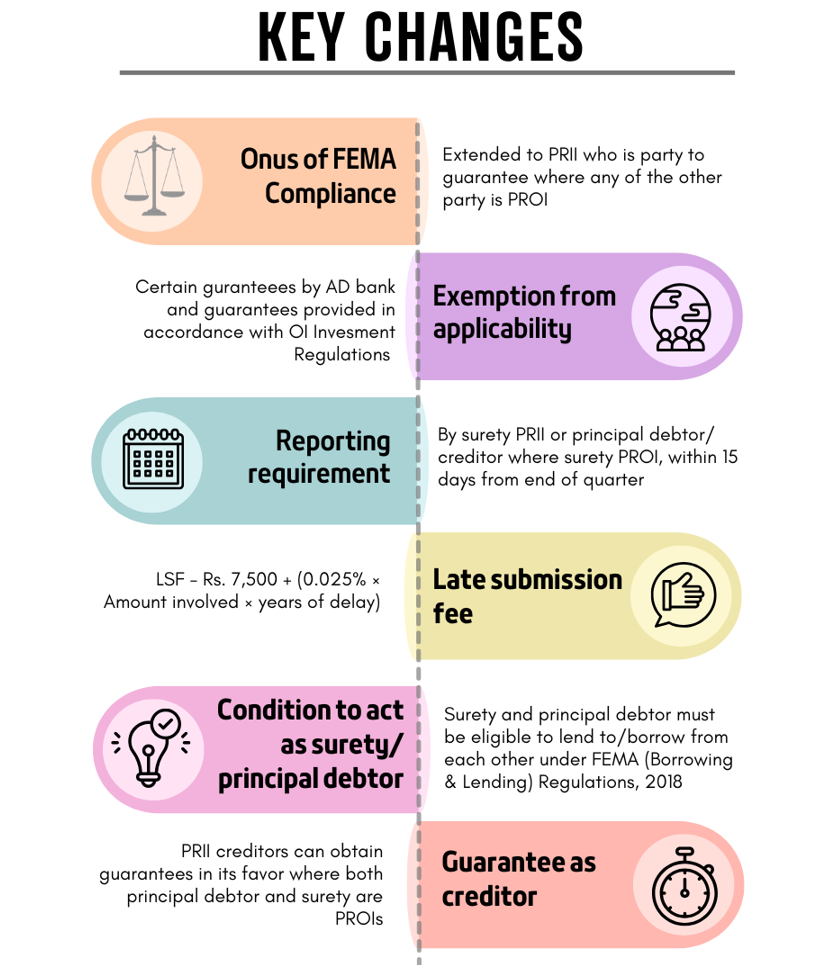
The Erstwhile Regulations placed the onus on the PRII giving a guarantee or a surety in relation to a debt, obligation or other liability owed to or undertaken by PROI. Regulations, 2026 additionally extends the onus even to a PRII who is the party to a guarantee (surety or creditor or a principal debtor) where any of the other party is a PROI.
Exemptions under Regulations, 2026 [ Reg 4]
- Guarantees by AD Bank’s branch outside India or in IFSC (based on stakeholders feedback), unless any of the other parties to guarantee is a PRII;
- Guarantees by AD Bank in the nature of Irrevocable Payment Commitment (IPC) issued as a custodian bank for a registered FPI on behalf of an authorised central counterparty in India, considering the same is treated as a financial guarantee in terms of RBI prudential norms for commercial banks.
- Guarantees provided in accordance with FEMA (Overseas Investment) Regulations 2022 (based on stakeholders feedback) – considering those are governed and reported under a separate framework altogether.
Conditions to act as Surety/ Principal Debtor [Reg. 5]
A PRII can give a guarantee or be the principal debtor if the following two conditions are met:
- Condition 1: The underlying transaction for which the guarantee is being given or arranged is NOT prohibited under FEMA; and
- Condition 2: Surety and principal debtor must be eligible to lend to and borrow from each other under FEMA (Borrowing & Lending) Regulations, 2018 (clause earlier referred to ‘resultant transaction’ and has been modified based on stakeholders feedback). It is intended that at the time of issuance of guarantee itself, the surety and the principal debtor shall ensure that they are eligible to lend and borrow to each other as per Foreign Exchange Management (Borrowing and Lending) Regulations, 2018. Compliance with other attendant conditions, such as cost, maturity, etc. for borrowing and lending is not envisaged.
However, Condition 2 provides for three exceptions (listed below in the table):
| Nature of guarantee | Given by | In favor of | Condition for exemption |
|---|---|---|---|
| Guarantees by AD bank backed by counter guarantee or collateral (based on stakeholders feedback) | AD Bank | PROI | Covered by counter-guarantee OR 100% cash collateral in the form of deposit from PROI |
| Guarantee by agents of foreign Shipping/Airline company | Agent in India | Foreign Shipping/Airline Co. | In connection with its obligation/ liability owed to statutory/Government authority in India |
| Both Indian Parties | PRII | PRII | Both surety & principal debtor are PRIIs |
Further, the prohibition added in the Draft Regulations in line with RBI Circular of March 13, 2018 disallowing AD Bank from giving a Letter of Comfort or a Letter of Undertaking is not expressly covered in Regulations, 2026. However, the circular of March 2018 does not seem to have been repealed by RBI either. Accordingly, the prohibition seems to continue.
Permission to obtain guarantee as a creditor [Reg. 6]
Explicit permission given to PRII creditors to obtain guarantees in its favor where both principal debtor and surety are PROIs, where the underlying transaction is not prohibited under the FEMA.
Reporting requirements [Reg. 7 and 8]
The Erstwhile Regulations did not provide for any reporting requirements. Guarantees provided as part of ECB or in favor of overseas subsidiaries were covered under the reporting made under respective regulations. Regulations, 2026 provide for detailed reporting requirements, with RBI having the right to put the information in public domain.
Who is to report: Regulations, 2026 mandate reporting of guarantees through the AD Banks. Reporting is required to be made by the
a) Resident surety; or
b) Principal debtor who arranged the guarantee, where surety is PROI; or
c) Creditor – where both surety and principal debtor are PROI or where the creditor has arranged the guarantee.
In case of more than one surety/ principal debtor/ creditor to the same guarantee, any of them can be designated to report that guarantee (based on stakeholders feedback).
To whom: To the AD Bank
What is to be reported: Guarantees covered in Regulations, 2026 – (a) issuance of guarantee, (b) any subsequent change in guarantee terms, namely – guarantee amount, extension of period or pre-closure, and (c) invocation of guarantee, if any,
Format: Form GRN (format provided at Annex to the Regulations, 2026).
One of the instructions for filing form GRN states that change of guarantees issued prior to coming into effect of these regulations i.e. January 10, 2026 shall be reported as a fresh issuance of guarantee from the date of modification. This seems to indicate that guarantees outstanding as on January 10, 2026 need not be reported unless there is a modification. In that case, an invocation of an existing guarantee may also not be required to be reported unless there is any modification which has been reported to the AD Bank under Regulations, 2026.
Further, quarterly reporting on issuance of guarantee for Trade Credit is being discontinued from quarter ending March 2026.
Periodicity and timeline: On a quarterly basis, within 15 days from the end of the respective quarter (revised to periodic basis from ‘as and when basis’ based on stakeholders feedback). Draft regulations provided for reporting within7 days from the date of issuance/ aforementioned change/ invocation of such guarantee
Further, AD Bank to onward report to RBI within 30 days from end of quarter.
Late Submission fee: Rs. 7,500 + (0.025% × A × n) rounded up to nearest hundred, where:
- A = amount involved in the delayed reporting in INR; and
- n = years of delay rounded-upwards to the nearest month and expressed up to 2 decimal points.
Amendments to ECB Master Directions
Deletion of Para 17.2 of the Master Direction – External Commercial Borrowings, Trade Credits and Structured Obligations (ECB Master Directions) dealing with the quarterly reporting requirement on data on bank guarantees for trade credits furnished by AD Bank.
Deletion of guarantee related provisions in Part III dealing with Structured Obligations: Para 19 dealing with terms and conditions for Non-resident guarantee for domestic fund based and non-fund based facilities and Para 20 dealing with terms and conditions for Facility of Credit Enhancement by eligible non-resident entities to domestic debt raised through issue of capital market instruments.
Amendments to other Master Directions
Master Directions – Export of Goods and Services, Master Directions – Import of Goods and Services , Master Direction – Other Remittance Facilities – Deletion of provision relating to issue of various guarantee in relation to export, import transactions covered under Erstwhile Regulations as Regulations, 2026 move to a principal based regime.
Master Direction – Reporting under Foreign Exchange Management Act, 1999 inserting Form GRN in relation to reporting of guarantees .
Conclusion
The Regulations, 2026 is certainly a welcome change, introducing principle-driven framework, expanded scope (counter-guarantees, portfolio guarantees), and simplified quarterly reporting. Specific requirements provided under ECB norms, ODI rules, Borrowing and lending regulations etc. shall continue to be complied while undertaking the transaction and the existing arrangements should be reviewed for new quarterly reporting obligations in case of modifications.
You may read more at our Resource centre on FEMA
- including a ‘counter guarantee’ means a contract, by whatever name called, to perform the promise, or discharge a debt, obligation or other liability (including a portfolio of debts, obligations or other liabilities), in case of default by the principal debtor ↩︎

Leave a Reply
Want to join the discussion?Feel free to contribute!