Succession planning: failing to plan is planning to fail

-Anushka Vohra | Manager | anushka@vinodkothari.com

The article was also published in the CRA E-Bulletin and can be viewed here

Background

Passing the torch, lighting the way – an expression that can be used to refer to succession planning. Be it a household, business organization or institution, succession planning is needed everywhere. In a household, as the family possessions and culture are passed on, it is simply termed as continuing the legacy. In an HUF, according to HUF laws, after the Karta (head of the HUF) dies, the senior most coparcener becomes the head of the HUF. In corporates, the larger the scale and complexity of business, the need for succession planning becomes much more important. Unlike in the case of a household, corporates involve the livelihood and interests of thousands of people,  i.e., the shareholders, vendors, customers and other stakeholders. The intent of succession planning is not to oust the leader from his / her position but to prepare the next generation to become the future leaders. Succession planning is required to ensure smooth running of business. The torch bearer (leader here), has to groom his / her successor to take over his role.

In an organization, succession planning is an important element of corporate governance. In this write-up, the author has tried to emphasize on the need and importance of succession planning.

Read more

Publications | 11th Securitisation Summit

11th Securitisation Summit, 2023 home page – https://vinodkothari.com/secsummit

Glimpses of the Summit can be viewed and downloaded from this link – https://drive.google.com/drive/folders/1bVJM8vqysqDtXqQhmSkIzWSdjCBFh5DD?usp=sharing
Loader Loading…
EAD Logo Taking too long?

Reload Reload document
| Open Open in new tab

Download as PDF [4.69 MB]

Whitepaper on Co-lending

Whitepaper on Green Securitisation in India

Whitepaper on Securitisation of Infrastructure Assets in India

Compendium of legal articles on Structured Finance

Presentation used by Mr. Mark Adelson during the Summit

Presentation used by Mr. RV Verma during the Summit

Profile of Speaker | 11th Securitisation Summit, 2023

Summit home page – https://vinodkothari.com/secsummit/

Loader Loading…
EAD Logo Taking too long?

Reload Reload document
| Open Open in new tab

Download as PDF [683.93 KB]

Fast Track Merger- finally on a faster track

– Barsha Dikshit, Partner | resolution@vinodkothari.com

The objective of promoting ‘ease of doing business in India’ had made the Ministries introduce some really momentous concepts and corresponding changes in law. One of such moves taken by the Ministry of Corporate affairs (‘MCA’), was introduction of section 233 of the Companies Act, 2013 (‘Act’) dealing with “Merger and amalgamation of certain types of companies” vide notification dated 7th December, 2016, [1] thereby offering an alternative mode to certain classes of companies for entering into scheme of merger or amalgamation. The idea was to process the scheme of arrangements involving wholly owned subsidiaries or small companies in a cost effective and comparatively swift way. However, upon the practical implementation of the provision, it was seen that the time taken by the authorities for disposal of such applications and issuing confirmation orders to the schemes was longer than expected and therefore, the provision was losing its relevance.

It is in the backdrop of such delays, MCA, vide notification dated 15th May, 2023 (yet to be published in e-gazette) has introduced certain amendments in the Companies (Compromise, Arrangements, and Amalgamations) Rules, 2015 (‘CAA Rules’) ensuring faster disposal of applications u/s 233 of the Act. The amendments shall be effective w.e.f. 15th June, 2023.

This article intends to discuss the amendments introduced by MCA and to gauge the effectiveness of the same.

Read more

Shorn of tax benefit, MLDs now face tax deduction on payouts

Dayita Kanodia | Executive

finserv@vinodkothari.com

Background

The Finance Bill, 2023[1], has quite nearly caused the demise of the so-called “Market-Linked Debentures” (MLDs)[2]. The changes made pursuant to the Finance Bill, 2023, took away what seemed to be a strong reason for popularity of MLDs, i.e., the tax arbitrage.

Prior to the change, listed MLDs had the advantage of being exempt from the withholding tax under section 193 of the Income Tax Act, 1961, as well as being taxed at 10% as Long Term Capital Gains (LTCG) tax, if held for at least 12 months.

Finance Bill, 2023 inserts a new section 50AA to the Income Tax Act, 1961, which makes MLDs to be taxed at slab rates as a short term capital asset in all cases at the time of  transfer or redemption on maturity, irrespective of the period of holding, therefore losing out on the earlier lower LTCG rate of 10%.

In addition, the earlier exemption from withholding tax on listed debentures has now been removed pursuant to an amendment in section 193, which means that interest paid on listed debentures would now be subject to withholding tax with effect from April 01, 2023[3].

Read more

A poem on the problem of climate change, environment and clean energy

किसी पेड़ ने उस पंछी को अब तक नहीं उड़ाया है
जिसने शाखें नहीं उजाड़ी केवल फल को खाया है

चिड़ी चोंच भर ले जाती है नदी नीर क्या कम होता?
प्यास बुझाकर प्यासे की कब कम होता जल का सोता
शिशु को दूध पिला कर किस माता की घटती काया है?

जब तक सीमाकरण न होगा पर्यावरण बचेगा क्या?
कोटि दुयोधन हाथ, द्रौपदी का आभरण बचेगा क्या?
मोह सँवरण नहीं, प्रकृति का कल्पवृक्ष बच पाया है ?

अगर प्रश्न है जठर अग्नि का जल के कितने स्रोत रखे
कोई ऐसा पेय नहीं जो काम अग्नि को बुझा सके
संयति के दृढ़ तीर न होंगे कब सागर रुक पाया है ?

प्रश्न यह नहीं इस वाहन को कैसी शक्ति चलायेगी
जब तक गति पर रोक न होगी बात वहीं रह जाएगी
सुविधा के गमले में कब शिव का बरगद उग पाया है

Agenda – 11th Securitisation Summit | May 19, 2023

Summit home page can be viewed here: https://vinodkothari.com/secsummit/

Loader Loading…
EAD Logo Taking too long?

Reload Reload document
| Open Open in new tab

Download as PDF [76.03 KB]

Need for strategic vision in CSR spending by companies

– Pammy Jaiswal, Partner | corplaw@vinodkothari.com

The article was also published in the CRA E-Bulletin and can be viewed here

Background

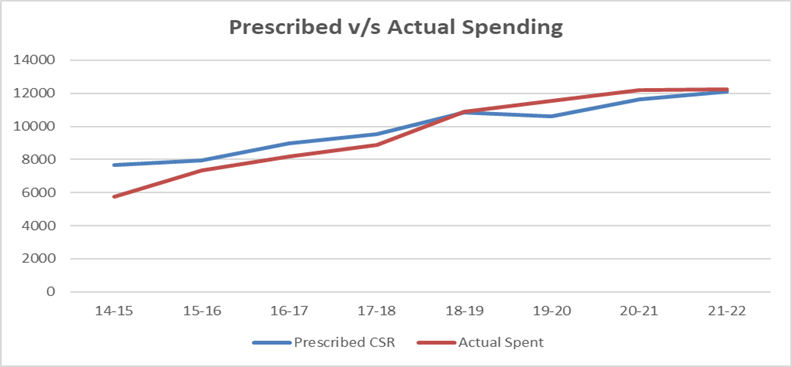
While the sense of ‘Corporate Social Responsibility’ (‘CSR’) might have been the result of the statute, first on a “comply or explain” basis, and later, as a mandate, it is heartening to note that companies are now not looking at CSR as a mere compulsion, but are seeing this as an instrument for social bridge-building. As is well known, the provisions were introduced, arguably as a unique case globally, in 2014 under the Companies Act, 2013 (‘Act’). From that year till FY 2021-2022, companies have spent approximately INR 1,39,202 crores[1] on CSR activities. In fact, it is pleasantly surprising to note that companies have been targeting to spend their minimum obligations; the gap between the prescribed spending and the actual spending has consistently been narrowing as can be seen from the graph given below.  With the introduction of the Companies Corporate Social Responsibility Policy (Amendment) Rules, 2021[2], read with the changes under section 135 of the Act pursuant to the Companies (Amendment) Act, 2019[3], an element of penalty for not doing the needful has been added, at the same time permitting companies to overspend their obligation and claim a set off within the next 3 years, there are several companies which are spending more than their targets.

   Data Source: India CSR Outlook Reports

Having said that, it will be important to discuss whether spending itself will help attain the motive for which the CSR framework was introduced? CSR is a part of a larger business responsibility and sustainability.  If companies confine their CSR ideologies to simply adding up to a requirement of spending amount, will the society get back what it ought to be getting back form a responsible business?  Should companies look at CSR beyond mere spending, and construct a CSR vision based on the negative footprints created by their activities, if any, or otherwise, create social impact relevant to their businesses?

Read more

Financing transition from “brown” to “green”

SEBI prescribes additional requirements for transition bonds

– Mahak Agarwal, Executive | corplaw@vinodkothari.com

Need for transition finance

As climate change and its impacts continue to remain one of the major concerns of any economy, transition finance is a step towards effectively transforming carbon emissions and combating climate change.

‘Transition Bonds’, as the word speaks for itself, are debt instruments that facilitate transition of a carbon-intensive business into decarbonizing business and eventually achieving the Net Zero emissions targets.

While it is true that change is the only constant, it cannot be denied that the same can often be challenging. Similar is the case with enterprises looking to metamorphosize their activities into a sustainable form. A huge amount of finance is required for carbon-intensive sectors to decarbonize and it is here that transition bonds find their application.

Read more

Amendments to KYC Directions including non- face-to-face KYC

Anita Baid in conversation with Vinod Kothari

Evince your interest here – https://forms.gle/JLaVk6n1mBHdsw4h9

Live on YouTube – https://www.youtube.com/channel/UCgzB-ZviIMcuA_1uv6jATbg/videos

Loader Loading…
EAD Logo Taking too long?

Reload Reload document
| Open Open in new tab

Download as PDF [745.13 KB]