RBI amends mode of payment and remittance norms for units of Investment vehicles

Permits FPIs and FVCIs to use Special Non-Resident Rupee (SNRR) account 

CS Burhanuddin Dohadwala| Manager, Aanchal Kaur Nagpal| Executive

corplaw@vinodkothari.com

The Reserve Bank of India (‘RBI’) vide notification dated October 17, 2019 had  notified the Foreign Exchange Management (Mode of Payment and Reporting of Non-Debt instrument) Regulations, 2019[1] (‘the Regulations’) governing the mode of payment and reporting of non-debt instruments consequent to the Foreign Exchange Management (Non-Debt Instrument) Rules, 2019[2] framed by the Ministry of Finance, Central Government.

RBI has recently vide its notification dated June 15, 2020 notified Foreign Exchange Management (Mode of Payment and Reporting of Non-Debt Instruments) (Amendment) Regulations, 2020[3] amending Reg. 3.1 dealing with Mode of Payment and Remittance of sale proceeds in case of investment in investment vehicles.

Let us discuss few terms to understand the recent amendments to the Regulations.

Investment Vehicles under FEMA:

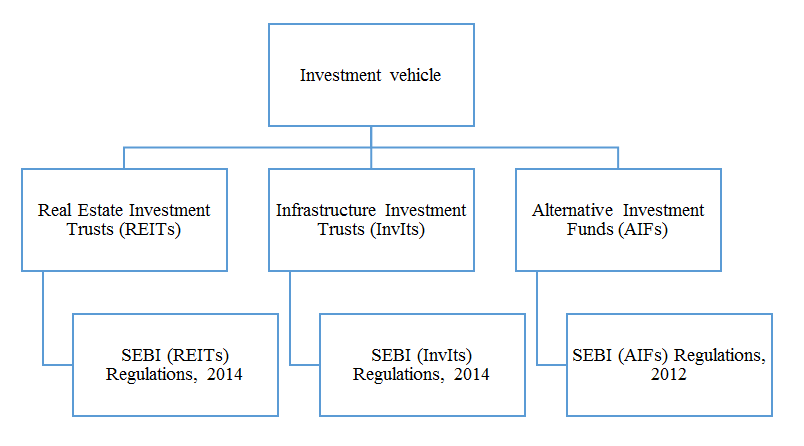
According to FEMA (Non-Debt Instruments) Rules, 2019, investment vehicles mean:
Different types of account available under FEMA (Deposit) Regulations, 2016[1] (‘Deposit Regulations’)

The following are the major accounts that can be opened in India by a non-resident:

Particulars Eligible Person
Non-Resident (External) Rupee Account Scheme-NRE Account

Non-resident Indians (NRIs) and Person of Indian Origin (PIOs)

Foreign currency (Non-Resident) account (Banks) scheme – FCNR (B) account
Non-Resident ordinary rupee account scheme-NRO account

Any person resident outside India.

Special Non-Resident Rupee Account – SNRR account

Any person resident outside India.

A significant advantage of SNRR over NRO is that the former is a repatriable account while the latter is non-repatriable.

What is Special Non-Resident Rupee (‘SNRR’) Account?

Any person resident outside India, having a business interest in India, may open SNRR account with an authorised dealer for the purpose of putting through bona fide transactions in rupees. The  business  interest,  apart  from  generic  business  interest,  shall  include the  following INR transactions, namely:-

  • Investments made  in  India  in  accordance  with  Foreign  Exchange  Management  (Non-debt Instruments)  Rules,  2019  dated  October  17,  2019  and  Foreign  Exchange  Management  (Debt  Instruments)
  • Import of  goods  and  services  in  accordance  with  Section  5  of  the  Foreign  Exchange  Management  Act  1999 Regulations,   2019;
  • Export of  goods  and  services  in  accordance  with  Section  7  of  the  Foreign  Exchange  Management  Act  1999;
  • Trade credit   transactions   and   lending   under   External   Commercial   Borrowings   (ECB)   framework;
  • Business related  transactions  outside  International  Financial  Service  Centre  (IFSC)  by  IFSC  units  at  GIFT  city  like  administrative  expenses  in  INR  outside  IFSC,  INR  amount  from  sale  of  scrap,  government  incentives  in  INR,  etc;

Rationale behind the amendment:

Position under Master Direction – Foreign Investment in India by RBI

According to Annex 8 of Master Direction – Foreign Investment in India by RBI, investment made by a PROI was permitted with effect from 13th September, 2016. The provisions specify that the amount of consideration of the units of an investment vehicle should be paid out of funds held in NRE or FCNR(B) account maintained in accordance with the Deposit Regulations as one of the modes of payment.

Further it also specifies that the sale/ maturity proceeds of the units may be remitted outside India or credited to the NRE or FCNR(B) account of the person concerned.

Position under the erstwhile provisions of the Regulations

Schedule II of the Regulations (Investments by FPIs) stated earlier that of units of investment vehicles other than domestic mutual fund may be remitted outside India.

However, balances in SNRR account were permitted to be used for making investment only in units of domestic mutual fund and not in Investment Vehicles.

As discussed above, the NRO account is a non-repatriable account while the SNRR account is a repatriable account. Due to the above provisions, investment in Investment Vehicles could not be transferred to the SNRR account for repatriation resulting in ambiguity.

Owing to the above and to increase the inflow of foreign investment, the Government has amended the said provision and allowed FPIs & FVCI to invest in listed or to be listed units of Investment vehicle.

Brief comparison of the pre and post amendment is covered in our Annexure I.

Annexure-I

Comparison of the pre and post amendment

Schedule Post amendment Prior to amendment Remarks
Schedule II w.r.t Investments by Foreign Portfolio Investors A.     Mode of payment

1.       The  amount  of  consideration  shall  be  paid  as  inward  remittance  from  abroad through banking channels or out of funds held in a foreign currency account and/ or a Special Non-Resident Rupee (SNRR) account maintained in accordance with the Foreign Exchange Management (Deposit) Regulations, 2016.


2.       Unless otherwise  specified in these regulations or the  relevant Schedules, the foreign  currency  account  and  SNRR  account  shall  be  used  only  and  exclusively for transactions under this Schedule.


A.     Mode of payment

1.       The amount of consideration shall be paid as inward remittance from abroad through banking channels or out of funds held in a foreign currency account and/ or a Special Non-Resident Rupee (SNRR) account maintained in accordance with the Foreign Exchange Management (Deposit) Regulations, 2016.

Provided balances in SNRR account shall not be used for making investment in units of Investment Vehicles other than the units of domestic mutual fund.

2.       The foreign currency account and SNRR account shall be used only and exclusively for transactions under this Schedule.


The erstwhile provisions restricted use of SNRR account balance for making investments in investment vehicles other than mutual funds.

As a result FPIs could not use their SNRR account and had to resort to other types of accounts for investment in investment vehicles such as REITs, and InViTs. The recent amendment has removed this restriction.

The amendment has been made to provide for the amendment made in Schedule VIII dealing with Investment     by     a     person resident outside India in an Investment Vehicle.

B.     Remittance of sale proceeds

The sale proceeds (net of taxes) of equity instruments and units of REITs, InViTs and domestic mutual fund may be remitted outside India or credited to the foreign currency account or a SNRR account of the FPI.

B.     Remittance of sale proceeds

The sale proceeds (net of taxes) of equity instruments and units of domestic mutual fund may be remitted outside India or credited to the foreign currency account or a SNRR account of the FPI.

The sale proceeds (net of taxes) of units of investment vehicles other than domestic mutual fund may be remitted outside India.

To align with the amendment made in Schedule VIII dealing with Investment     by     a     person resident outside India in an Investment Vehicle.
Schedule VII w.r.t Investment by a Foreign Venture Capital Investor (FVCI) For Para A(2):

Unless otherwise specified in these regulations or the relevant Schedules, the foreign currency account and SNRR account shall be used only and exclusively for transactions under this Schedule.

For Para A(2):

The foreign currency account and SNRR account shall be used only and exclusively for transactions under this Schedule.


The insertion has been made to align with the amendments proposed in Schedule VIII dealing with Investment     by     a     person resident outside India in an Investment Vehicle.

Schedule VIII w.r.t Investment     by     a     person resident  outside  India  in  an Investment Vehicle A.     Mode of payment:

The  amount  of  consideration  shall  be  paid  as  inward  remittance  from  abroad through  banking  channels  or  by  way  of  swap  of  shares  of  a  Special  Purpose Vehicle   or   out   of   funds   held   in   NRE   or   FCNR(B)   account   maintained   in accordance with the Foreign Exchange Management (Deposit) Regulations, 2016.

Further,  for  an  FPI  or  FVCI,  amount  of  consideration  may  be  paid  out  of  their SNRR  account  for  trading  in  units  of  Investment  Vehicle  listed  or  to  be  listed (primary issuance) on the stock exchanges in India.

A.     Mode of payment:

The amount of consideration shall be paid as inward remittance from abroad through banking channels or by way of swap of shares of a Special Purpose Vehicle or out of funds held in NRE or FCNR(B) account maintained in accordance with the Foreign Exchange Management (Deposit) Regulations, 2016.


Further, it is clarified that the SNRR account may be used for trading in units of listed as well as to be listed units of investment vehicles and the sale/ maturity proceeds can be credited to the said account.

B.     Remittance of Sale/maturity proceeds:

The  sale/  maturity  proceeds  (net  of  taxes)  of  the  units  may  be  remitted  outside India or may be credited to the NRE or FCNR(B) or SNRR account, as applicable of the person concerned.

B.     Remittance of sale/maturity proceeds

The sale/maturity proceeds (net of taxes) of the units may be remitted outside India or may be credited to the NRE or FCNR(B) account of the person concerned.


Link to our other articles:

Introduction to FEMA (NDI) Rules, 2019 and recent amendments:

https://vinodkothari.com/2020/04/introduction-to-fema-ndi-rules-2019-and-recent-amendments/

RBI rationalises operation of Special Non-Resident Rupee A/c:

https://vinodkothari.com/wp-content/uploads/2019/11/RBI-rationalises-operation-of-SNRR-Account.pdf


[1] https://vinodkothari.com/wp-content/uploads/2019/11/RBI-rationalises-operation-of-SNRR-Account.pdf

[1] http://egazette.nic.in/WriteReadData/2019/213318.pdf
[2] http://egazette.nic.in/WriteReadData/2019/213332.pdf

[3] http://egazette.nic.in/WriteReadData/2020/220016.pdf

Extension of FPC on lending through digital platforms

A new requirement or reiteration by the RBI?

– Anita Baid (finserv@vinodkothari.com)

Ever since its evolution, the basic need for fintech entities has been the use of electronic platforms for entering into financial transactions. The financial sector has already witnessed a shift from transactions involving huge amount of paper-work to paperless transactions[1]. With the digitalization of transactions, the need for service providers has also seen a rise. There is a need for various kinds of service providers at different stages including sourcing, customer identification, disbursal of loan, servicing and maintenance of customer data. Usually the services are being provided by a single platform entity enabling them to execute the entire transaction digitally on the platform or application, without requiring any physical interaction between the parties to the transaction.

The digital application/platform based lending model in India works as a partnership between a tech platform entity and an NBFC. The technology platform entity or fintech entity manages the working of the application or website through the use of advanced technology to undertake credit appraisals, while the financial entity, such as a bank or NBFC, assumes the credit risk on its balance sheet by lending to the customers who use the digital platform[2].

In recent times many digital platforms have emerged in the financial sector who are being engaged by banks and NBFCs to provide loans to their customers. Most of these platforms are not registered as P2P lending platform since they assist only banks, NBFCs and other regulated AIFIs to identify borrowers[3]. Accordingly, electronic platforms serving as Direct Service Agents (DSA)/ Business Correspondents for banks and/or NBFCs fall outside the purview of the NBFC-P2P Directions. Banks and NBFCs have th following options to lend-

  1. By direct physical interface or
  2. Through their own digital platforms or
  3. Through a digital lending platform under an outsourcing arrangement.

The digitalization of credit intermediation process though is beneficial for both borrowers as well as lenders however, concerns were raised due to non-transparency of transactions and violation of extant guidelines on outsourcing of financial services and Fair Practices Code[4]. The RBI has also been receiving several complaints against the lending platforms which primarily relate to exorbitant interest rates, non-transparent methods to calculate interest, harsh recovery measures, unauthorised use of personal data and bad behavior. The existing outsourcing guidelines issued by RBI for banks and NBFCs clearly state that the outsourcing of any activity by NBFC does not diminish its obligations, and those of its Board and senior management, who have the ultimate responsibility for the outsourced activity. Considering the same, the RBI has again emphasized on the need to comply with the regulatory instructions on outsourcing, FPC and IT services[5].

We have discussed the instructions laid down by RBI and the implications herein below-

Disclosure of platform as agent

The RBI requires banks and NBFCs to disclose the names of digital lending platforms engaged as agents on their respective website. This is to ensure that the customers are aware that the lender may approach them through these lending platforms or the customer may approach the lender through them.

However, there are arrangements wherein the platform is not appointed as an agent as such. This is quite common in case of e-commerce website who provide an option to the borrower at the time of check out to avail funding from the listed banks or NBFCs. This may actually not be regarded as outsourcing per se since once the customer selects the option to avail finance through a particular financial entity, they are redirected to the website or application of the respective lender. The e-commerce platform is not involved in the entire process of the financial transaction between the borrower and the lender. In our view, such an arrangement may not be required to be disclosed as an agent of the lender.

Disclosure of lender’s name

Just like the lender is required to disclose the name of the agent, the agent should also disclose the name of the actual lender. RBI has directed the digital lending platforms engaged as agents to disclose upfront to the customer, the name of the bank or NBFC on whose behalf they are interacting with them.

Several fintech platforms are involved in balance sheet lending. Here, the lending happens from the balance sheet of the lender however, the fintech entity is the one assuming the risk associated with the transaction. Lender’s money is used to lend to customers which shows up as an asset on the balance sheet of the lending entity. However, the borrower may not be aware about who the actual lender is and sees the platform as the interface for providing the facility.

Considering the risk of incomplete disclosure of facts the RBI mandates the disclosure of the lender’s name to the borrower. In this regard, the loan agreement or the GTC must clearly specify the name of the actual lender and in case of multiple lender, the name along with the loan proportion must be specified.

Issuance of sanction letter

Another requirement prescribed by the RBI is that immediately after sanction but before execution of the loan agreement, a sanction letter should be issued to the borrower on the letter head of the bank/ NBFC concerned.

Issue a sanction letter to the borrower on the letterhead of the NBFC may seem illogical since the lending happens on the online platform. The sanction letter may be shared either through email or vide an in-app notification or otherwise. Such sanction letter shall be issued on the platform itself immediately after sanction but before execution of the loan agreement.

Further, the FPC requires lender NBFCs to display annualised interest rates in all their communications with the borrowers. However, most of the NBFCs show monthly interest rates in the name of their ‘marketing strategy’. This practice though have not been highlighted by the RBI must be taken seriously.

Sharing of loan agreement

The FPC laid down by RBI requires that a copy of the loan agreement along with a copy each of all enclosures quoted in the loan agreement must be furnished to all borrowers at the time of sanction/ disbursement of loans. However, in case of lending done over electronic platforms there is no physical loan agreement that is executed.

Given that e-agreements are generally held as valid and enforceable in the courts, there is no such insistence on execution of physical agreements. The electronic execution versions are more feasible in terms of cost and time involved. In fact in most of the cases, the loan agreements are mere General Terms and Conditions (GTC) in the form of click wrap agreements.

Usually, the terms and conditions of the loan or the GTC is displayed on the platform wherein the acceptance of the borrower is recorded. In such a circumstance, necessary arrangements should be made for the borrower to peruse the loan agreement at any time. The loan agreement may also be in the form of a mail containing detailed terms and conditions, along with an option for the borrower to accept the same.

The requirement from compliance perspective is to ensure that the borrower has access to the executed loan agreement and all the terms and conditions pertaining to the loan are captured therein.

Monitoring by the lender

Effective oversight and monitoring should be ensured over the digital lending platforms engaged by the banks/ NBFCs. As RBI does not regulate the platform entities, hence the only way to regulate the transaction is though the lenders behind these platforms.

The outsourcing guidelines require the retention of ultimate control of the outsourced activity with the lender. Further, the platform should not impede or interfere with the ability of the NBFC to effectively oversee and manage its activities nor shall it impede the RBI in carrying out its supervisory functions and objectives. These should be captured in the servicing agreement as well as be implemented practically.

Grievance Redressal Mechanism (GRM)

Much of the new-age lending is enabled by automated lending platforms of fintech companies. The fintech company is the sourcing partner, and the NBFC is the funding partner. However, the grievance of the customer may range from issue with the usage of platform to the non-disclosure of the terms of loan.

A challenge that may arise is to segregate the grievance on the basis of who is responsible for the same- the platform or the lender. There must be proper mechanism to ensure such segregation and adequate efforts shall be made towards creation of awareness about the grievance redressal mechanism.

[1] Read our detailed write up here- https://vinodkothari.com/2020/03/moving-to-contactless-lending/

[2] Read our detailed write up here- https://vinodkothari.com/2020/03/fintech-regulatory-responses-to-finnovation/

[3] RBI’s FAQs on P2P lending platform- https://www.rbi.org.in/Scripts/FAQView.aspx?Id=124

[4] Read our detailed write up here- https://vinodkothari.com/2019/09/the-cult-of-easy-borrowing/

[5] https://www.rbi.org.in/Scripts/NotificationUser.aspx?Id=11920&Mode=0


Fifty years of global securitisation – list of chapters

List of chapters for the anthology on fifty years of global securitisation –

Go back to fifty years of securitisation page.

Read more

Limits on creeping acquisition by promoters increased during COVID-19 crises

Shaifali Sharma | Vinod Kothari and Company

Introduction

SEBI has been taking several proactive measures to relax fund raising norms and thereby making it easier for companies to raise capital amid the COVID-19 pandemic. With a view to further facilitate fund raising by the companies, SEBI vide its notification dated June 16, 2020[1], has relaxed the obligation for making open offer for creeping acquisition under Regulation 3(2) of the Securities and Exchange Board of India (Substantial Acquisition of Shares and Takeovers) Regulations, 2011 (Takeover Code).

The relaxation allows creeping acquisition upto 10% instead of the existing 5%, for acquisition by promoters of a listed company for the financial year 2020-21. The relaxation is specific and limited to acquisition by way of a preferential issue of equity shares and therefore excludes acquisitions through transfers, block and bulk deals etc. Also recently, SEBI in its Board Meeting[2] held on June 25, 2020 has proposed to provide an additional option to the existing pricing methodology for preferential issue under which the minimum price for allotment of shares will be volume weighted average of weekly highs and low for twelve weeks or two weeks, whichever is higher.However, this new rule shall apply till December 31, 2020 with 3 years lock-in condition for allotted shares. Further, by way of the same notification, SEBI has also relaxed the provisions of voluntary open offer where an acquirer together with PAC will be eligible to make voluntary offer irrespective of any acquisition in the previous 52 weeks from the date of voluntary offer, this will promote investments into various companies in future.

This article tries to discuss on whether the relaxation given by SEBI to the promoters are as encouraging as it seems to be, when connected with the pricing norms for preferential issue under the SEBI (Issue of Capital and Disclosures Requirement) Regulations, 2018 (‘ICDR Regulations’) and how the new pricing methodology proposed by SEBI can leverage the situation.

What is Creeping Acquisition?

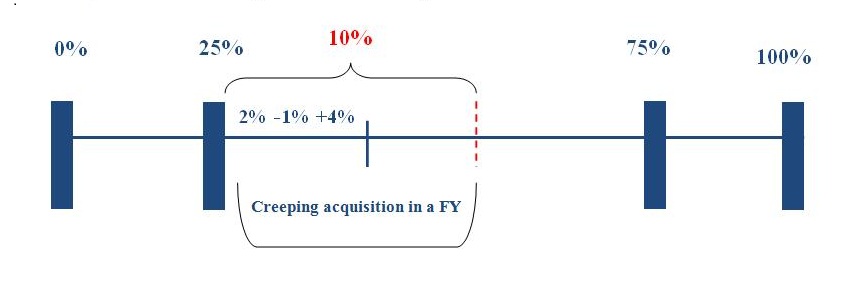
Creeping acquisition, governed by Regulation 3(2) of the Takeover Code, refers to the process through which the acquirer together with PAC holding more than 25% but less than 75%, to gradually increase their stake in the target company by buying up to 5% of the voting rights of the company in one financial year. Any acquisition of further shares or voting rights beyond 5% shall require the acquirer to make an open offer. Further, for the purpose of creeping acquisition, SEBI considers gross acquisitions only notwithstanding any intermittent fall. The same is projected in Figure 1 below. Also, in all cases, the increase in shareholding or voting rights is permitted only till the 75% non-public shareholding limit.

Figure 1: Creeping acquisition limit increased from 5% to 10%

Rationale for easing the norms of Creeping Acquisition

While the companies are currently struggling to manage their cash flows due to the financial challenges faced on account of COVID-19, the amendment will allow companies to raise funds from promoters to tide over their difficulties for the financial year 2020-21. This revision will also boost the sagging stock market and help sustain the stock prices of the company.

Promoters, on the other hand, owning 25% or more of the shares or voting rights in a company will be able to increase their shareholdings up to 10% in a year versus the previously allowed threshold limit of 5%.

Permutations and Combinations of Creeping Acquisition during FY 2020-21

Since the enhanced 10% limit applies only in case of acquisition under preferential issue, the total acquisition of 10% may be achieved by any of the following combinations:

Option 1: Acquire upto 5% shares via open-market purchase or any other form and the remaining 5% shares can be acquired through subscribing to a preferential issue.

Option 2:Acquire 10% shares through preferential issue

Accordingly, in a block of 12 months of financial year 2020-21, if the promoterwants to acquire share through open market, bulk deals, block deals or in any other form, the 5% threshold shall remain in force and additional 5% can be acquired through preferential issue.

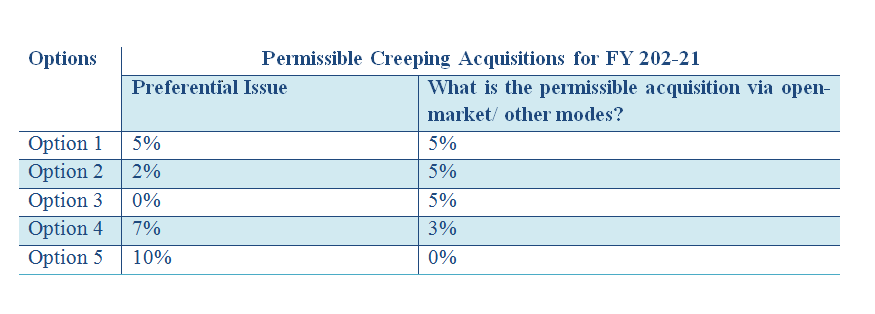
Identified below are the permitted acquisitions through open market, transfers or other forms in case promoter opts for preferential issue:

Whether the relaxation in open offer is actually encouraging when read with the pricing norms under ICDR Regulations?

As stated above, the relaxation can be availed only in the cases where the investments are done undera preferential issue. Regulation 164 of the SEBI (Issue of Capital and Disclosures Requirement) Regulations, 2018 (‘ICDR Regulations’) deals with the pricing norms under preferential issue. It provides that the issue price in cases where the shares have been listed for more than 26 weeks on a recognized stock exchange as on the relevant date, the issue price has to be higher of the following:

  1. the average of the weekly high and low of the volume weighted average price of the related equity shares quoted on the recognized stock exchange during the twenty six weeks preceding the relevant date; or
  2. the average of the weekly high and low of the volume weighted average prices of the related equity shares quoted on a recognized stock exchange during the two weeks preceding the relevant date.

The computation of the prices as per the above stated regulation will lead to a wide gap between the pricing at the beginning of the twenty-six week period and the current price when the company raises funds.

During this time of stock market crises, the stock prices of many companies have dropped sharply from their respective all-time high values recorded 6 months back. Further, in the cases where the market price is lower than the minimum price calculated as per ICDR Regulations for preferential issue, the promoters will be discouraged to acquire shares under preferential allotment as they will end up paying higher values.

Due to the challenges faced by the economy in view of COVID-19, the trading prices of the listed companies have gone down sharply. Accordingly, the price determined under ICDR Regulations may not be a motivating factor for the promoters to subscribe to the additional shares though, elimination of the costs involved in a public offer may compensate the same.

However, to curb the above situation, SEBI in its Board meeting held on June 25, 2020, has proposed an additional option to the existing pricing methodology for preferential issuance as under:

In case of frequently traded shares, the price of the equity shares to be allotted pursuant to the preferential issue shall be not less than higher of the following:

  1. the average of the weekly high and low of the volume weighted average price of the related equity shares quoted on the recognized stock exchange during the twelve weeks preceding the relevant date; or
  2. the average of the weekly high and low of the volume weighted average prices of the related equity shares quoted on a recognized stock exchange during the two weeks preceding the relevant date.

The new option will consider the weighted average price of equity shares preceding 12 weeks instead of the preceding 26 weeks and therefore reflect the accurate price during the pandemic period.  This may prove to be the solution to above crises,making fundraising through preferential issue easier for the corporates and simultaneously encouraging the promoters as well to infuse funds.

Compliances for preferential issue to promoters under PIT Regulations

Considering the fact that promoter is one of the designated person as per the SEBI (Prohibition of Insider Trading) Regulations, 2015 (‘PIT Regulations’), the companies, in addition to the procedural requirements for preferential issue prescribed under the Companies Act, 2013, ICDR Regulations and other applicable laws, shall also comply with the provisions of PIT Regulations.

Closure of trading window in case of preferential allotment

Designated persons and their immediate relatives shall not trade in securities when the trading window is closed. The trading restriction period shall apply from the end of every quarter till 48 hours after the declaration of financial results.

Further, the trading window shall also be closed when the compliance officer determines that a designated person (DP) or class of designated persons can reasonably be expected to have possession of unpublished price sensitive information (UPSI). Therefore, the trading window shall be closed and communicated to all DPs as soon as the date/notice of board meeting to approve issue of share via preferential allotment is finalized upto 2nd trading day after communication of the decision of the Board to the Stock Exchanges.

Accordingly, promoter/ class of promoters acquiring shares under preferential issue shall conduct all their dealings in the securities of the company only in a valid trading window i.e. once the trading widow is open subject to the pre-clearance norms prescribed under PIT Regulations and the Code of Conduct for prevention of insider trading of the Company.

Concluding Remarks

Given the lack of liquidity in the market, the proposed amendments maybe seen as an opportunity for target companies to raise capital from its promoters. Further, promoters can also infuse funds through equity issuance and will be able to increase their shareholding in the target company without the formalities of making the open offer.

Having said that since the market might take some time to recover, this relaxation provides a gateway for promoters to avoid open offer requirements which would otherwise have involved compliance burden on the promoter. However, the pricing factor may seem to be the only hindrance or a demotivation for actually availing this relaxation which seems to be resolved through the new pricing method proposed by SEBI in its Board meeting.

[1]To view the notification, click here

[2]https://www.sebi.gov.in/media/press-releases/jun-2020/sebi-board-meeting_46929.html

Other reading materials on the similar topic:

  1. ‘SEBI revisits Takeover Code’ can be viewed here
  2. ‘Takeover Code 2011’ can be viewed here
  3. ‘Decoding Takeover Code’ can be viewed here
  4. Our other articles on various topics can be read at: https://vinodkothari.com/

Email id for further queries: corplaw@vinodkothari.com

Our website: www.vinodkothari.com

Our Youtube Channel: https://www.youtube.com/channel/UCgzB-ZviIMcuA_1uv6jATbg

Fifty years of global securitization

Vinod Kothari

Some people love it; some love to hate it, and some just live it. No matter which one of the clubs one belongs to, but there is no doubt that securitization is a major financial phenomenon.

Year 2020 marks 50 years of the inaugural mortgage-backed pass-through transaction done in 1970 by Ginnie Mae. Securitization has turned fifty.

The world is not in exactly right environment to do either a champagne party or otherwise – however, one should not gloss over the massive change that securitization has made, to the financial landscape of the world, over these five decades. Irrespective of the jury verdict on whether it was responsible for the Global Financial Crisis, the fact is that it had such a major impact that its short-lived absence from the scene could put world’s financial system into doldrums. And now, there are regulators’ reports looking at this very instrument with optimism to lead the recovery out of the COVID disruption.

To commemorate 50 years of securitization, we propose to bring an anthology of write-ups by senior securitization professionals, particularly those who have seen its boom and bust. The write-ups may be along the following lines:

  • Historical write-ups, recounting the development of early MBS by the agencies, the way it was perceived then and major economists’ remarks about this instrument
  • Contribution of securitization to mortgage markets globally, particularly in mortgage availability and affordability
  • Contribution of securitization to financial inclusion, making smaller and community lenders reach out to capital markets through larger intermediaries
  • Securitization and emerging markets
  • Lessons learnt from the GFC and how regulatory systems have evolved thereafter
  • Legal robustness of securitization – has it proved itself over decades of crises?
  • Off-balance securitization – development of accounting standards over the years, and does off-balance sheet securitization have any relevance left?
  • Significant risk transfers and capital relief
  • Market reports from major countries.

List of Chapters

For a work-in-progress list of Chapters, see here.

Publication details

The anthology is proposed to be a compilation in e-book form. We will be in touch with some publishers to seek interest in publication.

Structure of the Chapters

The anthology will be collaborative effort of several leading authors, experts, researchers and practitioners from all over the world. Each of the contributors are leading luminaries in their own field. So while substantial discretion will be used by the contributors, some pointers for contributors are as follows:

  • This e-book will hopefully have a very long shelf-life. Hence, the stance of the write-ups is not contemporaneous state of the market. Rather, the write-ups trace developments over time, to identify trends. The contributors deploy their wisdom to think of the trends that will continue, wither away, or strengthen. The commemorative is all about continuity and change.
  • We are wanting to minimise current market data or statistics, for reasons discussed above.
  • Each of the write-ups may provide a larger, macro view before narrowing down on micro aspects.
  • One of our very important objectives is to have the contribution of securitization to development of financial markets, financial inclusion, stability and robustness of systems, etc. It is not merely a historical account, but an important document on lessons to be learnt, and to provide a place from where one may look at the decades to come.
  • For scholars/practitioners who have been watching the industry grow over the years, if there are details of one’s personal association with the industry – as to how it developed and changed over time – that may of interest to readers. This may be added with generalisation of the market.

Invitation for contributions

Needless to say, it is a massive project – it has to be collaborative. We need the support of scholars, authors, stakeholders – those who have been practising, teaching, consulting or regulating securitization over the years. Hence, if you are one such contributor, or you know one who may be such a contributor, your contribution/assistance is most welcome.

For interest in contribution to the anthology, please do write to timothy@vinodkothari.com. Please indicate your background, proposed contents, length of the article, etc. After hearing from us positively, you may start writing your article, for submissions by end of August, 2020.

Sponsoring/advertising opportunities

From our side, this project is completely non-pecuniary. We just felt that we can steer this effort which may be valuable for a long time.

However, this project will involve massive research effort, editing, and production. Hence, there may be substantial expense.

If you want to sponsor in any manner, or want to put up a befitting advertisement about your company/products, the same is welcome. Please feel free to discuss with finserv@vinodkothari.com.

Timeline for publication

Tentatively, we may put the e-publication in public domain by November, 2020.

Comparison between the proposed and existing regulatory framework for HFCs

– Henil Shah and Harshil Matalia (finserv@vinodkothari.com)

The Finance Act, 2019 amended the provisions of National Housing Bank, 1987  w.e.f August 09, 2019 thereby shifting the power to govern Housing finance Companies (HFCs) from National Housing Bank (NHB) to the Reserve Bank of India (RBI). Later, the RBI in its press release dated August 13, 2019 stated that HFCs shall be considered as a separate category of NBFCs.

A regulatory framework governing HFCs was long awaited. With a view to bring uniformity in the regulatory framework for HFCs and NBFCs, the RBI on 17th June, 2020 issued the report containing proposed changes in the regulatory framework for HFCs. The same is open for public opinions till 15th July,2020.

We have compared the proposed guidelines for HFCs with the existing guidelines.

Sr. No. Current Provisions Applicable to HFCs Proposed Provisions Remarks
Defining the phrase ‘providing finance for housing’ or ‘housing finance’
1 The NHB Directions defined the term “housing finance company” as a company incorporated under the Companies Act, 1956 which primarily transacts or has as one of its principal objects, the transacting of the business of providing finance for housing, whether directly or indirectly. However, the term ‘providing finance for housing’ or ‘housing finance’ was not formally defined.

There was a NHB Circular dated September 26, 2011 which provided an illustrative list of loans which can be classified as housing/ non housing loans-

1. Loans to individuals or group of individuals including co-operative societies for construction/ purchase of new dwelling units.
2. Loans for purchase of old dwelling units.
3. Loans to individuals for purchasing old/new dwelling units by mortgaging existing dwelling units.
4. Loans for purchase of plots for construction of residential dwelling units provided a declaration is obtained from the borrower that he intends to construct a house on the said plot, with the help of bank/HFC finance or otherwise, within a period of three years from the availment of the said loan.
5. Loans for renovation/ reconstruction of existing dwelling units.
6. Lending to professional builders for construction of residential
dwelling units.
7. Lending to public agencies including state housing boards for construction residential dwelling units.
8. Loans to corporates/ Government (through loans for employee housing)
9. Loans for construction of educational, health, social, cultural or other institutions/ centers, which are part of a housing project and which are necessary for the development of settlements or townships;
10. Loans for shopping complexes, mar~ets· and such other centers catering to the day to day needs of the residents of the housing colonies and forming part ofa housing project;
11. Loans for construction meant for improving the conditions in slum areas for which credit may be extended directly to the slum-dwellers on the guarantee of the Government, or indirectly to them through the State Governments;
12. Loans given for slum improvement schemes to be implemented by Slum Clearance Boards and other public agencies;
13. Loans provided to the bodies constituted for undertaking repairs to houses;
14.Investment in the guarantee/non-guaranteed bonds and debentures of NHB/HUDCO in the primary market, provided investment in non-guaranteed bonds is made only if guaranteed bonds are not available

It has been proposed to define ‘Housing Finance” or “providing finance for housing” to mean financing, for purchase/ construction/ reconstruction/ renovation/ repairs of residential dwelling units, which includes:

a. Loans to individuals or group of individuals including co-operative societies for construction/ purchase of new dwelling units.
b. Loans to individuals for purchase of old dwelling units.
c. Loans to individuals for purchasing old/ new dwelling units by mortgaging existing dwelling units.
d. Loans to individuals for purchase of plots for construction of residential dwelling units provided a declaration is obtained from the borrower that he intends to construct a house on the plot within a period of three years from the date of availing of the loan.
e. Loans to individuals for renovation/ reconstruction of existing dwelling units.
f. Lending to public agencies including state housing boards for construction of residential dwelling units.
g. Loans to corporates/ Government agencies (through loans for employee housing).
h. Loans for construction of educational, health, social, cultural or other institutions/centres, which are part of housing project in the same complex and which are necessary for the development of settlements or townships;
i. Loans for construction of houses and related infrastructure within the same area, meant for improving the conditions in slum areas for which credit may be extended directly to the slum-dwellers on the guarantee of the Government, or indirectly to them through the State Governments;
j. Loans given for slum improvement schemes to be implemented by Slum Clearance Boards and other public agencies;
k. Lending to builders for construction of residential dwelling units.

The proposed list is largely similar to the illustrative list prescribed by NHB earlier. However, the list prescribed as ‘qualifying asset’ for HFCs seems to focus more on individual borrowers. It has also excluded the following-
a. Loans for shopping complexes, markets and such other centers catering to the day to day needs of the residents of the housing colonies and forming part of a housing project
b. Loans provided to the bodies constituted for undertaking repairs to houses;
c. Investment in the guarantee/non-guaranteed bonds and debentures of NHB/HUDCO in the primary market, provided investment in non-guaranteed bonds is made only if guaranteed bonds are not availableThe idea behind laying out the periphery of ‘housing loans’ is to ensure consistency and certainty in ‘principality’ of business of the HFCs. Only such loans, which “qualify” as “housing loans” would be treated as “qualifying assets” for the purpose of determining “principality” of business of the entity, as we see below.

Specifically, loans given for furnishing dwelling units, loans given against mortgage of property for any purpose other than buying/ construction of a new dwelling unit/s or renovation of the existing dwelling unit/s, have been regarded as non-housing loans.

An entity which falls short of such qualifying assets below 50% cannot be regarded as HFC. This provision is also expected to minimise the practice of giving mortgage loans (LAP-type loans) by HFCs, which would often be granted to meet working capital requirements, etc. of other entities and not for housing purposes; thereby restricting the portfolio deviations of the HFC.

Defining ‘principal business’ and ‘qualifying assets’ for HFCs
2 The term ‘principal business’ was not referred in NHB Act prior to the amendment vide Finance Act . Further, for the purposes of registration, NHB was recognizing companies as HFCs if such company has, as one of its principal objects, transacting of the business of providing finance for housing (directly or indirectly) The principality test for HFCs has been proposed as follows (both these tests are required to be satisfied as the determinant factor for principal business):
(a) Not less than 50% of net assets are in the nature of ‘qualifying assets’ of which at least 75% should be towards individual housing loans as prescribed. Here, net assets shall mean total assets other than cash and bank balances and money market instruments
(b) Not less than 50% of the gross income is income from financial assetsQualifying Assets refer to ‘housing finance’ or ‘providing finance for housing’ as mentioned above
With the amendment to NHB Act, there was a need to define the term ‘principal business’ for HFCs. The concept of ‘qualifying asset’ is similar to that in case of NBFC-MFIs wherein they are specifically focused on micro lending. Though in spirit the HFCs would primarily focus on housing loans only however, the HFCs offering home loans along with other related products would now be required to maintain the principality of individual housing loans.

The requirement of minimum concentration towards ‘individuals’ is a new concept and possibly to protect the HFCs from systemic exposures. Further, principality is to be differentiated from ‘ordinary’ – that is, the guidelines do not prohibit the HFCs from providing non-housing loans- it limits the same. The remaining 50% can be extended in the form of non-housing loans, including LAP. An HFC which falls short of such qualifying asset criteria has to get registration as NBFC-ICC – consequentially, all laws applicable to such NBFC-ICC shall apply to the HFC.

Classification of HFCs as Systemically Important and Non-systemically Important entities
3 As per the current scenario a common set of regulations are applicable for all HFCs irrespective of asset size and ownership In order to introduced a graded approach as applicable to NBFCs in general the proposed changes tend to classify HFCs if following categories:

1. All deposit taking HFCs (HFCs-D) irrespective of asset size and all non-deposit HFCs (HFCs-ND) with asset size of over INR 500 crores as systemically important HFCs;
2. All Non-deposit taking HFCs with asset size of less than INR 500 crores as non-sytemically important (HFCs-non-SI).

The existing regulations for HFCs are similar to NBFCs. The larger HFCs may continue with existing regulations under NHB regulations or be harmonised with NBFC-SI regulations. However, there are separate regulations for deposit taking NBFCs which might become applicable on deposit taking HFCs as well. For the non-systemically important HFCs, it is proposed to bring the regulations at par with Master Directions for NBFC-ND-non-SI
Minimum Net Owned Fund Requirement
4 For a company to commence or carry a principal business of housing finance it shall have a minimum net owned fund of INR 10 Crore. Minimum net owned fund (NOF) requirement is proposed to be increased from 10 Crore to 20 crore.

Existing HFC shall be given a time period of 1 year to reach NOF of INR 15 Crore and another 1 year to reach INR 20 Cr minimum NOF mark

The increased capital requirement is to strengthen the capital base of the HFCs.

However, as compared to an NBFC the NOF requirement is very high. The registration requirement for both NBFC-ICC and HFC will also be the same- they will have to apply to the RBI.

An important question that will arise here is that why should an entity register as an HFC- given the fact that even an NBFC-ICC can extend housing loan, one would have to consider the various factors to carry on housing finance as a principle activity under an HFC or non principal activity under an NBFC-ICC. As per the provisions of section 29A and 2(d) of the NHB Act read along with the RBI guidelines issued in this regard, an HFC will have to satisfy the principality of 50% housing loans as well as 75% loans to individuals.

Harmonising definitions of Capital (Tier I & Tier II) with that of NBFCs
5 Tier- I Capital is defined under Para 2(1)(zf) of HFCs Master Directions as:
“Tier-I capital” means owned fund as reduced by investment in shares of other housing finance companies and in shares, debenture, bonds, outstanding loans and advances including hire purchase and lease finance made to and deposits with subsidiaries and companies in the same group exceeding, in aggregate, ten percent of the owned fund;Tier- I Capital is defined under Para 2(1)(zg) of HFCs Master Directions as:
“Tier-II capital” includes the following:-
(i) preference shares (other than those compulsorily convertible into equity);
(ii) revaluation reserves at discounted rate of fifty five percent;
(iii) 10[general provisions (including that for standard assets) and loss reserves to the extent these are not attributable to actual diminution in value or identifiable potential loss in any specific asset and are available to meet unexpected losses, to the extent of one and one fourth percent of risk weighted assets];
(iv) hybrid debt;
(v) subordinated debt
to the extent the aggregate does not exceed Tier-I capital;
As per Para 3 (xxxii) and 3 (xxxiii) of Master Directions for NBFC-ND-SI

“Tier I Capital” means owned fund as reduced by investment in shares of other non-banking financial companies and in shares, debentures, bonds, outstanding loans and advances including hire purchase and lease finance made to and deposits with subsidiaries and companies in the same group exceeding, in aggregate, ten per cent of the owned fund; and perpetual debt instruments issued by a non-deposit taking non-banking financial company in each year to the extent it does not exceed 15% of the aggregate Tier I Capital of such company as on March 31 of the previous accounting year;

“Tier II capital” includes the following: (a) preference shares other than those which are compulsorily convertible into equity; (b) revaluation reserves at discounted rate of fifty five percent; (c) General provisions (including that for Standard Assets) and loss reserves to the extent these are not attributable to actual diminution in value or identifiable potential loss in any specific asset and are available to meet unexpected losses, to the extent of one and one fourth percent of risk weighted assets; (d) hybrid debt capital instruments; (e) subordinated debt; and (f) perpetual debt instruments issued by a non-deposit taking non-banking financial company which is in excess of what qualifies for Tier I Capital, to the extent the aggregate does not exceed Tier I capital.

It is proposed to align the definitions of capital (both Tier I and Tier II) of HFCs with that of NBFC, specifically PDIs shall form part of HFCs capital (both Tier I and Tier II) component on the same lines as NBFCs. However, with the following differences-

1.PDIs shall be treated as Tier I/ Tier II capital only by HFCs-ND-SI
2. PDIs or any other debt capital instrument in the nature of PDIs already issued by HFCs-D and HFCs-non-SI shall be reckoned as Tier I/Tier II for a period not exceeding 3 years

Public Deposits
6 Public deposits is defined under Para 2(1)(y) of the NHB Directions, 2010 Subject to alignment of Public deposit provisions of HFC with NBFC following shall be:
Additions to the existing exemptions from public deposits:
1. Rehabilitation Industries Corporation of India Ltd.
2. Corporation established by or under any Statute; or a cooperative society registered under the Cooperative Societies Act of any StateDeletion from the list of exemptions applicable to HFCs
1. Japan Bank for International Cooperation (JBIC)
2. Kreditanstalt fur Wiederaufbau (KfW)

In addition to changes pursuant to the alignment, any amount received by the HFCs from NHB or any public housing agency shall be exempted

There are no major changes arising from the alignment of definitions of public deposits, however it seems that at the time of alignment this may be taken care off.
Liquidity Risk framework and LCR
7 Under the present scenario HFCs are required to follow Guideline for Asset Liability Management System issued by NHB via Policy Circular No. 35 dated 11th October, 2011 Guidelines for Liquidity risk management framework (LRM) and liquidity coverage ratio (LCR) as notified by the RBI on 04th November, 2019 applicable to NBFCs shall be extended to HFCs-ND with asset size of more than 100 crores and all HFCs-D subject to supervisory review of internal controls required to put in place by HFCs (Refer our presentation on LRM here- https://vinodkothari.com/2019/11/liquidity-risk-framework/) Actionable from the Liquidity Risk Management Framework:

1. HFCs will be required to edit the current ALM policy or adopt a new LRM framework.
2. Risk management Committee of the HFCs shall consist of CEO/ MD and heads of various risk verticals
3. Change in composition of Asset Liability Management Committee (ALCO) so as to CEO/MD or Executive Director shall head the committee.
4. Constitute an ALM support group reporting directly to ALCO.

However question arises in relation to the applicability of LCR as same is applicable in NBFCs-D and NBFC-ND-SI with asset size of 5000 crore or more whereas the its proposed to extended the guidelines in case of HFCs to all the HFCs-D and HFCs-ND-SI with asset Size of INR 100 crore or more. RBI may look into difference in applicability criteria while notifying the same.

Group entities Engaged in real estate business
8 Current provisions applicable to HFC does not contain any restrictions relating to double financing. HFCs exposure to the below mentioned activity shall be mutually exclusive:
1. Group company in real estate business or
2. Lend to retail individual home buyers in the project of group entitiesAny direct or indirect exposure in group entity shall be limited 15% of owned funds for a single entity in the group and 25% of owned fund for all such group entities.

As regards to extending of loans to individuals, who chose to buy housing units from entities in the group, Arm’s length principle shall be followed in letter and spirit

The proposition is that HFC can either undertake an exposure on the group company in real estate business or lend to retail individual home buyers in the projects of group entities, but not do both. The laguage of the notification is not very clear that it is referrring to internal group or external group as well- our view is that the restriction should not be just for internal group but also for external group.

Further, the limit on ‘Group Exposure’ seems to include both housing and non-housing loans to such group entity. Also, the limits are more stringent than the existing concentration norms, which provide the limit for lending and investment of upto 25% of the owned fund to a single party and 40% of its owned fund to a single group of parties.

There is an exemption in the existing concentration norms for investment and lending to group comanies to the extent it has been reduced from the owned funds. Hence, the limit of 15% and 25% may not be relvant if the HFC has already knocked off the exposure from its owned funds. This must be clarified by the RBI.

Since, the intent is to stop double finance that is to say ongoing exposure should not be there on both- in case funding has been extended to the builder then already the flat is funded, however, after construction once the loan is repaid by the builder, the individual may be given loan for the flat- this should not be regarded as double financing.

In case of loans to individual, the HFC must satisfy the arms’ length requirement for retail loans to group’s customers. This mutual exclusion clause does not seems to apply to companies outside group and their retail customers – but in case the intent is to bar double financing, the external group companies must also be included.

Monitoring of frauds
9 Applicable as per NHB policy circular No. 92 dated February 05, 2019 Applicable as per Master Direction – Monitoring of Frauds in NBFCs (Reserve Bank) Directions, 2016. HFCs should comply with the master directions for monitoring of frauds, however all reports in the formats given in Master Directions may continue to be forwarded to NHB, New Delhi.
10 Chapter IV para 2 – Frauds committed by unscrupulous borrowers:
Frauds committed by unscrupulous borrowers including companies, partnership firms/proprietary concerns and/or their directors/partners, Group of Associations, Trusts etc. by various methods including the following:
(a) Diversion of funds outside the borrowing units,
(b) lack of interest or criminal neglect on the part of borrowers, their partners, etc.,
(c) due to managerial failure leading to the unit becoming sick and due to laxity in effective supervision over the operations in borrowal accounts on the part of the HFC functionaries rendering the advance difficult of recovery.
As per Master Directions:
Frauds committed by unscrupulous borrowers including companies, partnership firms/proprietary concerns and/or their directors/partners by various methods including the following:
(a) Fraudulent discount of instruments;
(b) Fraudulent removal of pledged stocks/disposing of hypothecated stocks without the NBFCs knowledge/inflating the value of stocks in the stock statement and drawing excess finance;
(c) Diversion of funds outside the borrowing units, lack of interest or criminal neglect on the part of borrowers, their partners, etc. and also due to managerial failure leading to the unit becoming sick and due to laxity in effective supervision over the operations in borrowal accounts on the part of the NBFC functionaries rendering the advance difficult of recovery.
Same as earlier. However, additionally the following 2 points would be henceforth applicable:
(a) Fraudulent discount of instruments;
(b) Fraudulent removal of pledged stocks/disposing of hypothecated stocks without the NBFCs knowledge/inflating the value of stocks in the stock statement and drawing excess finance.
11 Chapter VI para 2(iii) – Quarterly Review of Frauds:
All the frauds involving an amount of INR. 50 lakh and above should be monitored and reviewed by the Audit Committee of the Board of HFCs. The periodicity of the meetings of the Committee may be decided according to the number of cases involved. However, the Committee should meet and review as and when a fraud involving an amount of INR. 50 lakh and above comes to light.
As per Master Directions:

All the frauds involving an amount of INR 1 crore and above should be monitored and reviewed by the Audit Committee of the Board (ACB) of NBFCs. The periodicity of the meetings of the Committee may be decided according to the number of cases involved. However, the Committee should meet and review as and when a fraud involving an amount of INR 1 crore and above comes to light.

Limit of INR 50 lakh would be increased to INR 1 crore as per Master Directions.
12 Chapter – VII – Provisioning Pertaining to Fraud Accounts No such provisioning requirement under master directions. The Master directions as applicable to NBFCs do not provide for any specific provisioning requirement pertaining to the account classifed as fruad.
Information Technology Framework
14 As per NHB policy circular No. 90 dated June 15, 2018:
Information Technology framework for HFCs is categorised into 2 parts:
Section A – For public deposit accepting HFCs and HFCs not accepting public deposit with asset size INR 100 crore and above;
Section B – HFCs not accepting public deposit with asset size below INR 100 crore.
As provided under Master Direction – Information Technology Framework for the NBFC Sector where:

Section A would apply to Systemically important HFCs;
Section B would apply to Non-Systemically important HFCs.

Currently applicability of IT framework for HFCs is segregated based on asset size of INR 100 crores. However, henceforth the applicability would be based on asset size of INR 500 crores, i.e. by segregating HFCs into systemically and non-systemically important category.
15 Para 5.4 – Periodicity of IS Audit:
The periodicity of IS audit should ideally be based on the size and operations of the HFC but may be conducted at least once in two years.
As per Master Directions – The periodicity of IS audit should ideally be based on the size and operations of the HFC but may be conducted at least once in a year. All HFCs would be required to conduct IS audit at least once in a year as per Master Directions. This however is recomendatory.
Securitization
16 No guidelines prescribe by NHB Provisions of Annex XXII of NBFC-ND-SI Directions, 2016 shall be extended to cover the HFCs In the absence of any specific guidelines, the HFCs were already complying with the RBI guidelines on securitization and direct assignment. This would avoid any confusion in terms of the applicability of the securitisation guidelines. However, the existing RBI guidelines are also proposed to undergo amendments
Lending against Shares
17 Under the current ambit of HFC provisions there are no guidelines in place for lending against the security of shares by HFCs Provisions as specified in Para 22 of NBFC-ND-SI Directions, 2016 shall mutatis mutandis be applicable to the HFCs HFCs would be required to comply with the following while lending against shares:
1. Maintain Loan to Value (LTV) ratio of 50% at all times. Any shortfall would require to be made good within 7 working days.
2. In case where lending is being done for investment in capital markets, accept only Group 1 securities as collateral for loans of value more than INR 5 lakh.
3. Report on-line to stock exchanges on a quarterly basis, information on the shares pledged in their favour, by borrowers for availing loans in format as given in Annex V of Master Directions..
Managing Risks and Code of Conduct in Outsourcing of Financial Services
18 There are no guidelines have been prescribed for HFCs with regard to outsourcing of Financial Services Provisions of Annex XXV of NBFC-ND-SI Directions, 2016 shall be extended to cover the HFCs HFCs will have to comply with the guidelines for outsourcing of financial services
Foreclosure charges
19 As per NHB policy circular No. 36 dated October 18, 2010 and NHB policy circular No. 43 dated October 19, 2011

HFCs should not charge pay-payment levy or penalty on pre-closure of housing loans under the following situations.

1. Where the housing loan is on floating interest rate basis and the loan is preclosed through any source.
2. Where the housing loans is on fixed interest rate basis and the loan is foreclosed by the borrower out of their own sources.

No foreclosure charges/prepayment penalties shall be levied on any floating rate term loan sanctioned for purposes other than business to individual borrowers with or without co-obligants. It is proposed to extend these instructions to HFCs. There are no regulations prescribed for HFCs for not levying the foreclosure charge for non-housing loans such as in case of term loans availed for other than business purpose. Hence, it is proposed to extend these instructions to HFCs as well. This would ensure uniformity with regard to repayment of various term loans by borrowers. Though the language is not very clear and hence, it seems that the foreclosure charges shall be waived off for all floating rate term loans to individual borrowers, including housing loans as well.
Implementation of Indian Accounting Standards
20 NBFCs as covered in rule 4 of the Companies (Indian Accounting Standards) Rules, 2015 are required to comply with IndAS.

As per the Rule 2(1)(g) of the above mentioned rules, all the HFCs are covered under the definition of NBFCs thereby required to comply with IndAS.

The RBI has also provided guidance on implementation of Indian Accounting Standards by NBFCs (including HFCs).

RBI instructions issued vide circular dated 13th March, 2020 on implementation of IndAS to be extended to HFCs The RBI circular was applicable to NBFCs as covered in rule 4 of the Companies (Indian Accounting Standards) Rules, 2015 which already includes HFCs under the definition of NBFCs.

However, there was confusion wrt its applicability on HFCs. The proposed change further clarifies the applicability of the said RBI circular to HFCs.

Our write-up on implementation of IndAs for NBFCs may alos be refereed herehttps://vinodkothari.com/2020/03/guidance-on-implementation-of-ind-as-by-nbfcs/

Our other write-ups may be viewed here:


High Level Forum (EU) makes recommendations to further boost securitisation market

Data shows that the European securitisation market never rebounded after the 2008 crisis, even after the implementation of STS framework. Securitisation however, plays a key role in boosting the capital markets. This role has been recognised by the High Level Forum (EU) in its final report released on 10th June, 2019.

Seven recommendations were made by the HLF with respect to securitisation. The intent is to ultimately boost securitisation markets and help it pick up in the years to come.

In this write up, the author attempts to explain in brief the recommendations with respect to securitisation of the High Level Forum.

Read more

Webinar on RBI discussion paper on Governance in Commercial Banks in India

Date: 22nd June, 2020 at 05:00 pm, India time. Will run for about 90 mins.

Speaker: FCS Vinita Nair, Senior Partner, Vinod Kothari & Company

Background:

Effective Corporate Governance practices at banks plays a significant role in the banking sector and the economy as a whole. The banking industry in India witnessed governance failures in the past which seems to have triggered the need for the regulator to re-look at the governance guidelines for commercial banks in India.

RBI on 11th June, 2020 issued a discussion paper on the guidelines for Governance in Commercial Banks in India.

Scope of the webinar:

We intend to discuss the proposals put forth in the discussion paper in this webinar (expected duration around 90 mins) and comparing the proposed requirements with the existing ones.

  • Scope and applicability;
  • Overall responsibilities of the Board of Directors;
  • Duties of director;
  • Understanding and managing Conflict of Interest for banks;
  • Structure, composition and role of Board Committees;
  • Risk Governance Framework – The three lines of defence;
  • Separation of ownership from Management;
  • Whistle-blower mechanism.

Where:

On the internet, via Google Meet / Zoom Meeting

Please note that the webinar has a maximum capacity of 50, including the host, and entry is on first-come-first-enter basis.

Whether interactive:

Yes. Participants may post queries, either in advance or at the time of webinar. Participants may, based on feasibility, also be allowed to speak.

For registration:

Kindly mail with relevant details on – shaifali@vinodkothari.com.

Knowledge Resources:

  1. RBI Discussion paper on Governance in Commercial Banks in India
  2. Report of the Basel Committee on Banking Supervision
  3. RBI circular on Calendar of Reviews – Audit Committee of the Board of Directors
  4. Recommendations of the Banks Board Bureau