Ensuring Board Continuity and Balance of Capabilities

Ensuring Board Continuity and Balance of Capabilities

Other ‘I am the best’ presentations can be viewed here

Our other related articles –

  1. https://vinodkothari.com/2021/08/faqs-recent-amendments-listing-regulations/
  2. https://vinodkothari.com/2021/07/independent-directors-the-global-perspective/
  3. https://vinodkothari.com/2021/06/re-appointment-of-independent-directors-an-analysis/
  4. https://vinodkothari.com/2021/04/corporate-governance-norms-banks/

Increase in FDI Limit in Insurance Companies

Corplaw Team | corplaw@vinodkothari.com

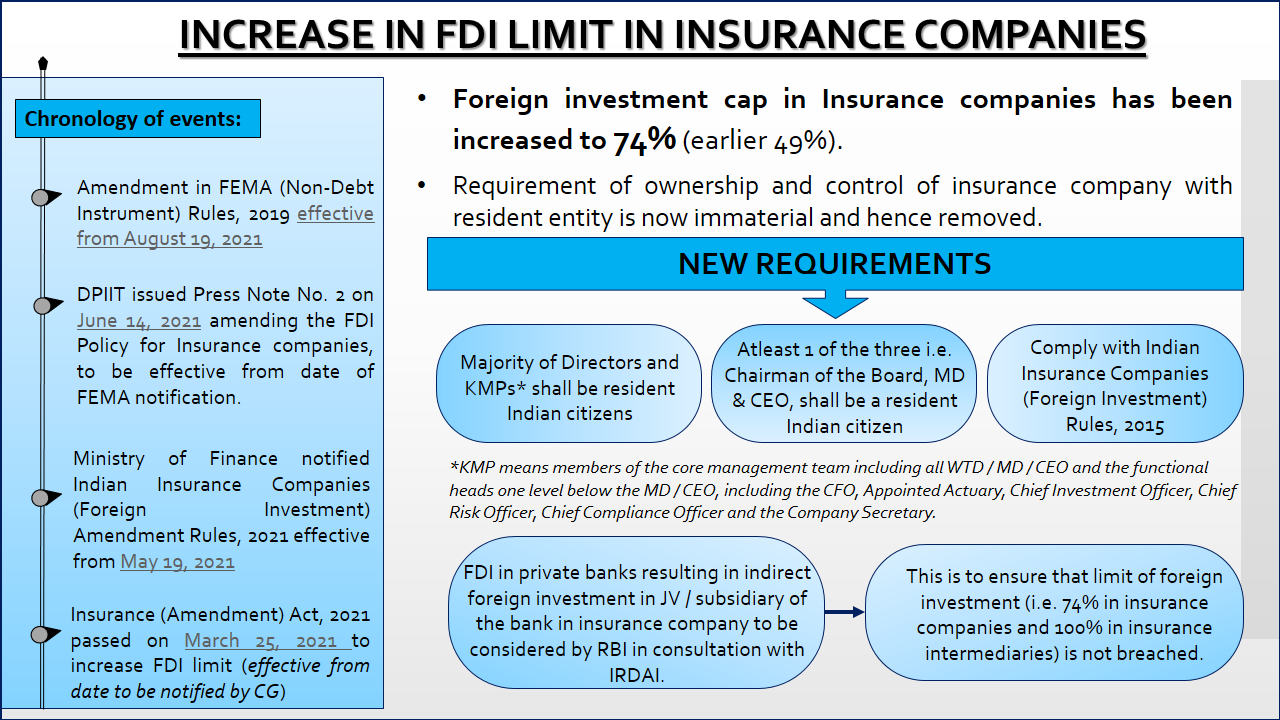
Amendment in Foreign Exchange Management (NDI) Rules, 2019 effective August 19, 2021- https://egazette.nic.in/WriteReadData/2021/229165.pdf

DPIIT Press Note on June 14, 2021 amending the FDI Policy for Insurance companies which shall be effective from date of FEMA notification – https://dpiit.gov.in/sites/default/files/pn2-2021.pdf

Consequential amendment in Indian Insurance Companies (Foreign Investment) Rules, 2015 are on May 19, 2021 – https://financialservices.gov.in/sites/default/files/Indian%20Insurance%20Companies%20(Foreign%20Investment%20)(amendment)%20Rules,%202021.pdf

Insurance (Amendment) Act, 2021 is passed on March 25, 2021 to increase FDI limit – https://financialservices.gov.in/sites/default/files/Insurance%20(Amendment)%20Act%202021%2025_3_2021.pdf

Special Purpose Acquisition Company

Special Purpose Acquisition Company

Other ‘I am the best’ presentations can be viewed here

Our other resources on related topics –

  1. https://vinodkothari.com/wp-content/uploads/2021/03/An-overview-of-SPACs-and-related-concerns-in-India.pdf
  2. https://vinodkothari.com/2021/08/spacs-value-proposition-regulatory-framework/
  3. https://vinodkothari.com/2021/08/regulatory-eco-system-for-spacs/

OCI and its treatment in law

OCI-and-its-treatment-in-law

Other ‘I am the best’ presentations can be viewed here

Our other resources on related topics –

  1. https://vinodkothari.com/2018/11/comprehending-other-comprehensive-income-oci-from-nbfcs-perspective/

XaaSing of assets: Understanding essential differences between subscription and lease

-Vinod Kothari and Sikha Bansal (finserv@vinodkothari.com)

Just as you may subscribe to digital content, cellphone services, or software-as-a-service, you may subscribe to a car, or home durables. The business of availing equipment as a subscription is growing monotonic and steep, and currently, in the realm of passenger vehicles, it is already a rage. A report by BCG estimates that the subscription market for passenger vehicles may achieve a penetration of 15% of new car sales, and volumes of about USD 30 to 40 billion, by 2030[1].

This article seeks to touch upon the fundamental understanding of subscription and how it is different (or not different?) from a lease. There are several other similar contracts – which may be looking elusively similar – asset capacity sharing contracts, asset timeshare contracts, etc. Each of these might have shades of difference; however, our present write-up focuses on subscription services for assets, versus lease transactions.

What is “subscription”?

It is difficult to find a legal definition of the word “subscription” as the word is used in widely different contexts. “To subscribe” may mean to write your name or put your signature under a written document, (common example is ‘subscribing’ to a memorandum of a company). However, in the present context, the following dictionary  meaning of ‘subscription’ would become relevant: “A written contract by which one engages to contribute a sum of money for a designated purpose, either gratuitously, as in the case of subscribing to a charity, or in consideration of an equivalent to be rendered, as a subscription to a periodical, a forthcoming book, a series of entertainments, or the like.”[2]  Hence, a ‘subscriber’ is “a person who agrees to receive something on a regular basis, e.g. a newsletter, a newspaper, a delivery of goods, a subscriber to a mailing list.”

The context of this article is subscription to equipment – hence, the definition below from an Indiana law may be relevant: “‘subscription program’ means a subscription service that, for a recurring fee and for a limited period of time, allows a participating person exclusive use of a motor vehicle owned by an entity that controls or contracts with the subscription service. The term does not include leases, short term motor vehicle rentals, or services that allow short term sharing of a motor vehicle”. See, IND. CODE § 9-32-11-20(e) (2019)[3].

Under a vehicle subscription, a customer typically pays a “joining fee” plus a monthly subscription fee to have the right to use a vehicle from the company’s fleet of vehicles and to swap the vehicle for a different type of vehicle. Depending on the pricing tier, a customer may have unlimited swaps or may be limited to a certain number of swaps. A customer can initiate an exchange through the company’s mobile application, and the company will deliver the new vehicle and retrieve the vehicle currently in the customer’s possession. The company provides insurance coverage and access to roadside assistance and performs routine maintenance and repairs on the vehicles. See, House Bill, 537 (Northern California)[4] defining “vehicle subscription” for the purpose of applicability of alternative highway use tax.

Hence, one may define a subscription as follows:

A subscription contract is a contract where a subscriber avails a service, whether with or without a related asset, equipment or property, tangible or intangible, for a charge known as subscription fee, where the service provider agrees to provide, for a specified period, generally renewable at the option of the subscriber, a specific service. If an asset or equipment is put in the possession of the subscriber as a part of the service, the subscriber’s control over the same will be limited to the terms of the service, and generally, the service-provider shall have the ability to replace the same, whether for the purpose of a more effective service or otherwise.

Lease vs. subscription

The words lease, rent or hire mean the same thing – that is, transferring the right to use an asset. The act of ‘transferring’ right of use would mean that the lessee would have the exclusive right to use the asset and for that the asset as well as the control of the asset moves from the lessor to the lessee for the period of lease.

As one wonders, all of these would also happen in case of ‘subscription’ as discussed above; however, a fundamental difference is that, the customer’s intent in case of lease, is to have the ‘asset’ while in case of subscription, it is to have the ‘experience’ of the asset. Former is an ‘asset-oriented’ transaction, while the latter is a ‘service oriented’ transaction. Further, another important distinction lies in “commitment” to “an asset”. In a lease, the parties are committed to a particular asset identified at the beginning of the contract – replacements would only occur is the asset gets damaged or otherwise goes into an unusable state; however, inherent idea of ‘subscriptions’ is ‘choice’ and ‘flexibility’[5].

Hence, leases are different – differences are being tabulated below:

Point of Comparison Lease Subscription
Subject matter of the contract Transfer of right to use of an asset Provision of a service
Description of parties Lessor, lessee or renter Service Provider, Subscriber
Consideration Lease rentals or hire charges Subscription fee
Typical period Normally long enough to serve as an alternative mode of acquisition of an asset Normally short and flexible, such it is an alternative to acquisition itself. It focuses on experience, rather than acquisition
Identification of the asset Specifically identified Generically identified – such as a car of a particular type or category or class.
Ownership of the asset Throughout the term, remains with the lessor. EoT options may include an option to buy A subscription contract moves completely from the domain of asset acquisition – asset acquisition becomes irrelevant for a subscriber, as the subscriber continues to avail the service on a continuing/recurring basis
Provision of asset-related services by the owner Usually limited; however wet leases are also there Usually, the bundle of service makes it a service contract.
Control over the asset Remains with the lessee during the lease term Remains with the owner/service provider. Subscriber’s control is limited to what is required for the enjoyment of the service
Vehicle registration Normally, in the name of the lessee, with endorsement in the name of the lessor Normally, in the name of the lessor, under a rental contract
Vehicle number plate As in case of a private use vehicle, black colour in white background Commercial use- hence, black colour on yellow background
GST applicability A lease, being a transfer of right to use goods, is taxable at the same rate as applicable to the sale of the goods A subscription service, not involving a transfer of right to use, being a service, is taxable at the residual rate, viz., 18%
Asset recognition by customer Yes, as under the accounting standards No

Legal Implications

Legal classification of a transaction is important as the same would impact the legal rights and obligations of the parties.

Since a subscription is a bundle of services, it may also have elements of lease. A subscription is essentially a package; hence, the use of an asset is also embodied in a subscription. Hence, to the extent a subscription entails a right of using an asset, there is a bailment contract in a subscription too. Hence, bailment is a common feature of both leases and subscription contracts. Therefore, the rights and obligations of the bailor and bailee as per law of contracts may be applicable in case of subscription too.

Thus, from a broader perspective, both a lease and a subscription are forms of bailment contracts only as the possession passes to the customer. Hence, general contractual rules as are applicable to bailment contracts would apply in both the cases. Besides, from a legal perspective, the following may be noted  –

  • The supplier is the owner in both the cases, the customer only gets certain rights. In case of a lease, the customer is a conveyee of the right to use to the asset; however, in subscription, the customer only gets the right to use the service on payment of subscription fee. As such, supplier’s control on the asset in a subscription is higher than in a lease. Hence, vis-a-vis, the asset, the customer will have ‘better’ rights in a lease than in a ‘subscription’.
  • With respect to risk and rewards, as a lease transfers a right to use, a part of the risks and rewards (if not substantial) associated with the asset is transferred to the lessee. However, in a subscription, the risks and rewards would remain with the supplier, except that the contract would provide for normal liabilities in case of accidents, negligence, rash driving, unlawful use of the vehicle, etc.
  • Besides, there can be differences with respect to service and maintenance obligations. A subscription contract comes with bundled services; however, in lease, the obligations may pass to the lessee.

Note that due to the features as discussed above, in India, a subscription service may get covered under Rent a Cab Scheme, 1989. Thus, as under the Motor Vehicles Act and rules thereunder, the vehicle would be registered in the name of subscription provider and the number plate of the vehicle shall bear yellow alpha-numerals with black background registration mark. However, in case of leases, the vehicle would generally be registered in the name of the lessee, and shall bear black colour in white background.

Accounting perspective

For accounting purposes, does a subscription of an asset amount to a lease? If it does, the accounting standard on leases IFRS 16/ Ind AS 116 applies. The standard will require on-balance sheet treatment of the non-cancellable lease rentals in the books of the subscriber in most cases. Hence, the characterisation of the transaction as a “lease” for the purpose of the accounting standard becomes critical.

Ind AS 116 provides guidance on assessing whether a contract is a lease. A lease is defined in Para 9 as follows: “A contract is, or contains, a lease if the contract conveys the right to control the use of an identified asset for a period of time in exchange for consideration” Therefore, there has to be a conveyance of the right to use an asset, which implies an identified asset.

In order for the contract to be a contract of lease:

  • there must be an identified asset;
  • the customer must have the right to direct use of the asset – where the supplier has substantive substitution rights (a combination of practical ability + economic benefits), the customer’s right to use is curtailed – see

It is notable that accounting standards quite often deviate from the legal form of the contract – hence, even if the legal form of the contract is a subscription, the accounting standards may still treat the contract as a lease. For example, IndAS 116, para B14 provides for the supplier to have substantive rights of substitution, that further, such right to be economically beneficial to the supplier.

Hence, for the purposes of accounting standards:

  • If the right of substitution or swapping the asset is with the subscriber, and not with the provider, such right is disregarded. That is to say, subject to other conditions, the transaction is still regarded as a lease.
  • If the right is right with the provider, that right has to be (i) substantive and practically implementable; (ii) The exercise of the right should be beneficial to the provider; (iii) the right should be available throughout the term of the lease; (iv) the substitution right should not be pertaining to such contingencies as the vehicle being under repairs, etc. As regards the economic benefits of the substitution rights, the economic benefits should be demonstrable without reference to uncertain future events. Further, since the vehicle is in possession of the subscriber, the provider will incur costs to replace the same – therefore, it should be clear that the benefits will outweigh such costs.
  • Assuming the conditions of substantive substitution rights as above are not satisfied, the contract may be regarded as one of lease, deviating from its legal nature. However, if the lease is within a term of 12 months, the provisions as to capitalisation of an RoU asset and OTP liability are not applicable to short term leases.

Hence, a typical subscription contract, which enables the subscription provider to provide service to the customer by using different vehicles (which belong to the preferred class/category chosen by the customer), it may be contended that the customer’s right to use is not perfected in such contracts. Further, given that the customer can ‘swap’ vehicles during the subscription period, it can be said that a subscription contract does not have an ‘identified asset’, per se.

Notably, accounting standards emphasise on substance over form. Hence, a pure subscription contract may not fall under Ind AS 116 (for reasons as above).

GST Implications

The GST law has different rates for motor vehicles. There are broadly 4 classes:

  • Hiring services (normally meaning the vehicle is under control of the hire vendor, and the hire vendor is running the asset on hire):
    • Transport of passengers by any motor vehicle designed to carry passengers where the cost of fuel is included in the consideration charged from the service recipient- GST rate is 5% (provided no ITC is availed by the supplier)
    • Transport of passengers by any motor vehicle designed to carry passengers where the cost of fuel is included in the consideration charged from the service recipient- GST Rate is 12%
  • Leasing or Rental services – indicating short term rentals: GST Rate is 18%
  • Transfer of right to use, that is, a service equivalent to sale of the same goods: Same GST rate as in case of sale of the goods with transfer of ownership [Refer, Notification No. 11/2017- dated 28th June, 2017[6]]

The GST rate on the various subscription models prevalent in the market varies and depends on the nature of transaction between the dealer and the end user. In our view, the subscription-based model is close to a rental service, and therefore, the rate will be 18%. Alternatively, if it is taken as an independent service the rate of tax is still 18%. On the question whether such a subscription service may be regarded as a ‘composite supply’, the tax rate on the principal supply shall determine the tax rate on the conjugate services. However, since the principle supply is still a lease or rental and not a transfer of right to use akin to purchase of the asset, the rate would still stand as 18%.

Closing remarks

It is not that subscription contracts per se  are a technological innovation, but the idea of an asset being converted into a subscription service is quite new, relative to the idea of leasing or hiring. Hence, the first predicament for one trying to state the law of subscription vs. lease is that there is no authoritative definition of a subscription, as compared to a lease.

The discussion is an attempt to identify key differentiators between lease and subscription. Essentially, a subscription contract is ‘service’ based while a lease is ‘asset’ based. However, classification of a particular contract would depend on the substance of the transaction rather than the form. A contract may be a subscription by name, but may have predominantly lease-type features. However, merely because a contract has some lease-type features would not lead to its classification as lease. Hence, one will have to assess what is the predominant flavour of the contract and of course, intent of the parties to the transaction to determine whether the contract is a lease or a subscription.

[1] https://www.bcg.com/en-in/publications/2021/how-car-subscriptions-impact-auto-sales

[2] https://dictionary.thelaw.com/subscription/

[3] https://law.justia.com/codes/indiana/2019/title-9/article-32/chapter-11/section-9-32-11-20/

[4] https://dashboard.ncleg.gov/api/Services/BillSummary/2019/H537-SMSV-44(e4)-v-2

[5] See an article titled “Insurers are Teaming up with Car Subscriptions”, published in CBInsights (2018). Per Porsche North America CEO Klaus Zellmer, younger people “do not want to engage with a commitment for three years. They want to change their phones; they want to change their TV channels. It’s all about subscriptions.”

[6] https://www.cbic.gov.in/resources//htdocs-cbec/gst/Notification11-CGST.pd


Our other articles on leasing:

https://vinodkothari.com/leasing/

https://vinodkothari.com/leashome/

https://vinodkothari.com/staff-publications-leasing/

Sale and leaseback transactions: Walking once again on Achilles’ Heels

Vinod Kothari ( finserv@vinodkothari.com)

Sale and leaseback (SLB) transactions are one of the most innovative, and in the past history of lease transactions, one of the most maligned transaction types. All over the world, there have been hundreds of rulings where SLB transactions have been challenged; in many cases, there were upheld and their sanctity was preserved, in many other cases, they have been treated either as no valid lease transactions, or pure financing transactions.

Motivations

There may be various motivations for a lessee to get into an SLB:

  • Liquidity – while normal lease transactions do not lead to cash in the hands of the lessee, SLBs do, SLBs extend leasing to a device of unlocking of investment. The  money raised by SLBs is like general purpose corporate funding – it may be used for any purpose as the lessee may choose.
  • Putting assets off the books – A selling lessee may put the asset being sold off the books, if the SLB is properly structured as a sale and operating leaseback.
  • Financial restructuring – if the money raised by an SLB is used to pay off on-balance sheet liability, the SLB may have twin effects on the balance sheet. By putting fixed assets off the books, it reduces operating leverage, and by reducing liabilities, it reduces financial leverage.
  • Capturing revaluation gains – assume there are assets where the carrying values as per books are significantly lower as compared to the fair market value. In such cases, if the SLB is properly structured as operating leaseback (other conditions also need to be satisfied), the gain on the sale of the asset may be booked as realized gain (not just a revaluation surplus), and may be taken to shareholders’ equity.
  • Tax benefits – many SLBs, such as those of cars, furniture, etc., may be designed to accelerate the tax write off of the lessee by moving from depreciation to rental write off.
  • Acceleration of VAT set off – an entity having substantial amount of carry forward of input tax credit may accelerate the set off by making a sale of capital assets.

Why SLBs walk on Achilles’ heels:

An SLB transaction has the apparent looks of a financial transaction. There is only a transfer of legal title over the asset. The asset stays with the lessee. In practice, parties may take quite callous approach evaluating the asset, and may take a purely lessee exposure, in which case, most often lessor may not bother about valuation of the asset. In many cases in the past, assets have been found not even to be existing.

Besides, in many cases, lessees in SLBs have been motivated either by a funding motive, or one of booking profits on the sale of the asset. Therefore, lessees may have aggressively overvalued assets.

In India, one of the ill-famed example of SLBs has been the SLB of electric meters by state electricity boards (SEBs). SEBs, starved of funding, were advised to use the innovative funding device of leasing back electric meters that were installed in consumers’ premises. Leasing companies (and in fact, many entities not in leasing business at all), starved of tax benefits, were easily attracted to this option, as it was contended that electric meters qualify for 100% depreciation. Many SLB transactions of electric meters happened around 1996-1997. Many of these cases have already traveled long routes of litigation. Some High courts have challenged them as being pure financing devices. Some have respected them, merely based on the legal nature of the contract.

In one of the recent rulings before the Madras High court, electric meters were shown to have been bought on 30th March – hence, used for just one day. In fact, meters actually bought by the selling SEB only a few months back were heavily revalued too. Despite such glaring facts, the Madras High court still went by the legal form, and upheld the lessor’s claim to depreciation.

Electric meters is not the only thing – many weird assets such as glass bottles, gas cylinders, tools, jigs, and so on have been sold and taken back on lease. In recent past, we have noticed transactions structured to give lessees a rental write off – hence, SLBs of sanitary fittings, office fitouts, office interiors, wall panels, false ceilings, etc have commonly been done.

As most of these transactions are factually very weak, SLB transactions continue to look like money lending transactions.

Types of SLBs:

First of all, the most essential distinction will  be on – is it a new asset or old asset? Since it is SLB, sure enough, it is not a new asset being acquired by the lessee, but the moot question is – has the asset been subject to use for a long period? There are cases where lessees might have recently bought assets, and may now want to get them off the books. Needless to say, older the asset, more serious the concerns, as the chances of overvaluation, or sale of decrepit assets purely with financial motives, etc., go up.

From accounting viewpoint, SLBs may be sale and financial leasebacks, and sale and operating leasebacks. We discuss the implications under the caption accounting issues.

Note that the following is not a case of sale and leaseback – X has leased an asset to Y, and X now sells the leased asset to Z, such that now the lease continues between Z and Y.

Lease and leasebacks are also not sale and leasebacks. A lease and leaseback transaction may be structured from variety of viewpoints – longer lease out, and shorter leaseback, or financial lease out and operating leaseback, etc.

Legal issues

First key question is – is an SLB legally valid as a lease? US Supreme Court discussed the legal validity of SLBs in the famous ruling of Frank Lyon and Company. The questions on the legal validity of an SLB are in fact questions which are germane to the validity of any lease. By way of a quick check (each of the factors below are negatives):

  • The asset being sold might have become an immovable property.
  • The asset being sold may have become inseparable part of another asset.
  • The lessor may not have done anything to indicate that the lessor is really interested in the asset, or that the asset is a genuine purchase of an asset. Facts may indicate that the lessor merely went by the financials of the lessee.
  • The asset may have been subject matter of third party rights. For example, the asset might already have been leased to a third party, in which case, it cannot be sold without the concurrence of the third party. The asset might have been encumbered, and so on.
  • In  not-so-extreme cases, the asset may not at all exist, or may have outlived its life.

If facts are strong, there is nothing to challenge the legal validity of an SLB, merely because it is an SLB and not a lease of a new asset. Of course, the lessor must do everything that a prudent man would do, if really buying an asset for good value.

Income Tax issues

In case of assets which have already been depreciated by the lessee prior to their sale, income-tax law has an explanation below section 43 (1) whereby the tax WDV in the hands of the lessor will be the tax WDV in the hands of the selling lessee. That is to say, the actul sale price of the asset will be ignored, and the seller’s WDV will become the WDV of the acquiring lessor. Obvious enough, if the asset has not been depreciated by the seller, the provision does not apply. If the asset has been sold in the same financial year in which it is acquired, the seller does not claim tax depreciation.

Other than the above specific SLB-directed provision, in actual practice, tax officers question eligibility of financial lease transactions to depreciation for the lessor or rental write off for the lessee. The real culprit for tax purposes is not a financial lease, but such a lease which is a disguised financial transaction, particularly transactions containing options to buy at bargain prices. SLB transactions may especially be targeted as engineered to produce an artificial tax shelter – for example, a sale of office furniture which is taken back on lease.

VAT issues

VAT is one of the least understood implications – in fact, for VAT purposes, SLBs are no different from any other sales. Where capital assets are sold by the selling lessee, the sale is a taxable sale (assuming the seller is in some business where he generates taxable sales). Presumably, when the asset was acquired, it might have been acquired either under CST, or it might have been imported, or might have been acquired under some state VAT law (that is, the asset was acquired after introduction of VAT laws in the country). If the asset had suffered VAT at the time of its purchase, such VAT might have been eligible for set off (assuming the capital asset was not one of the negative-listed capital asset). If the asset was bought under CST or was an imported asset, the question of any VAT set off at the time of acquisition would not arise at all.

In any case, the sale of the asset would certainly be a local sale. The question of an SLB being an inter-state sale does not arise at all. The local sale will be chargeable to VAT. Of course, if the selling lessee has carry forward of input tax credit, the same can be claimed against the VAT on the sale of the capital asset.

As the asset is taken back on lease, there is clearly a VAT on lease rentals. This is also off-settable by lessee.

In the hands of the lessor, the VAT paid on the purchase of the asset is off-settable in the same manner as any other VAT.

Accounting standards

Accounting standards distinguish between SLB where the leaseback is financial, and SLB where the leaseback is operating.

If the leaseback is financial, the fact of sale of the asset is completely disregarded. No profit is booked on the sale of the asset, as there is no accounting sale of the asset at all. The amount of funding raised by the sale of the asset appears as a liability on the books of the lessee.

If the leaseback is operating lease, the asset goes off the books, and the funding realized does not come as a liability, Any gain or loss on the sale of the asset is a realized gain, and is taken to profit and loss. In fact, there is something even further: if the sale price is not fair market value of the asset, profits are recognized based on the fair market value of the asset.

Creating regulatory eco-system for SPACs in India

– Ajay Kumar KV, Manager & Himanshu Dubey, Executive

[corplaw@vinodothari.com]

From a little-known word and a preserve of a select few finance professionals, the term Special Purpose Acquisition Companies (SPACs) is today a buzzword. The regulators across the globe are taking necessary actions to enable SPACs to raise money from investors – jurisdictions like the US, UK and Malaysia lead from the front. Having a sound regulatory framework is important because if investors are keen towards SPACs, and the regulators do not enable it, it is quite likely that the country will not be a friendly destination for SPACs. Hence, India’s securities regulator SEBI has recently constituted an Expert Group for examining the feasibility of SPACs in India, and the International Financial Services Center Authority (IFSCA) has issued IFSCA (Issuance and Listing of Securities) Regulations, 2021[1] which provides a regulatory framework for listing of SPACs within its jurisdiction.

In this write up, the authors take a look at the global legislative measures, and also outline the various changes in the regulations that may be needed in India to enable to make India a SPAC-friendly jurisdiction.

Contents

Introduction. 2

Important regulatory concerns. 3

  1. Sponsor’s contribution. 4
  2. Safekeeping of IPO proceeds. 4
  3. Acquisition Process. 4
  4. Managing conflict of interest 5
  5. Exit mechanism… 5
  6. Speculation on shares. 5
  7. Celebrity endorsements. 6

Regulatory framework in India. 6

Issues under the Act 6

Regulatory framework for SPACs as per the IFSCA (Issuance and Listing of Securities) Regulations, 2021. 9

Exploring some scenarios and the concomitant regulatory ramifications. 13

Regulatory framework on SPACs abroad. 16

  1. Malaysia. 16
  2. Canada. 18
  3. United Kingdom (UK). 19
  4. United States of America (USA). 21

Conclusion. 24

Read more

Proposed framework for overseas Investments by entities and individuals

Proposes segregation of regulatory and the operational part in rules and regulations respectively

FCS Vinita Nair |Senior Partner, Vinod Kothari & Company

Investments by Indian entities outside India is a very common phenomenon and several companies have presence outside India by virtue of forming a Joint Venture (‘JV’) and Wholly Owned Subsidiaries (‘WOS’)

With the enforcement of amendment proposed in Finance Act, 2015 in October, 2019[1] powers vested with Central Government (CG) and Reserve Bank of India (RBI) with respect to permissible Capital Account Transaction were revisited. Power to frame rules relating to Non-Debt instruments (‘NDI’) were vested with CG and to frame regulations relating to debt instruments were vested with RBI. The scope of NDI inter alia covers all investment in equity instruments in incorporated entities: public, private, listed and unlisted; acquisition, sale or dealing directly in immoveable property.

RBI intends to combine erstwhile FEMA (Transfer or Issue of Foreign Security) Regulations, 2004[2] (‘erstwhile ODI regulations’) and FEMA (Acquisition and Transfer of immoveable property outside India) Regulations, 2015[3] into FEMA (Non-debt Instruments – Overseas Investment) Rules, 2021[4] (‘NDI Rules’) and FEMA (Overseas Investment) Regulations, 2021[5] (‘OI Regulations’) and has rolled out the draft regulations for public comments to be sent by August 23, 2021[6].

NDI Rules v/s OI Regulations

NDI Rules will provide the regulatory framework for making of overseas investment covering the permissions, conditions for making overseas investment, restrictions from making Overseas Direct Investment (‘ODI’), pricing guidelines, transfer, liquidation and restructuring of ODI. While the NDI Rules will be framed by CG, however, the same will be administered by the RBI.

OI Regulations, on the other hand, will provide only the operational part covering conditions for undertaking Financial Commitment (‘FC’), other than investment in equity capital, consideration in case of acquisition or transfer of equity capital of a Foreign Entity (‘FE’), mode of payment, obligations of Persons Resident in India (‘PRII’), reporting requirements, consequence of delay in reporting and restrictions on further FC/ transfer.

Components of Overseas Investment

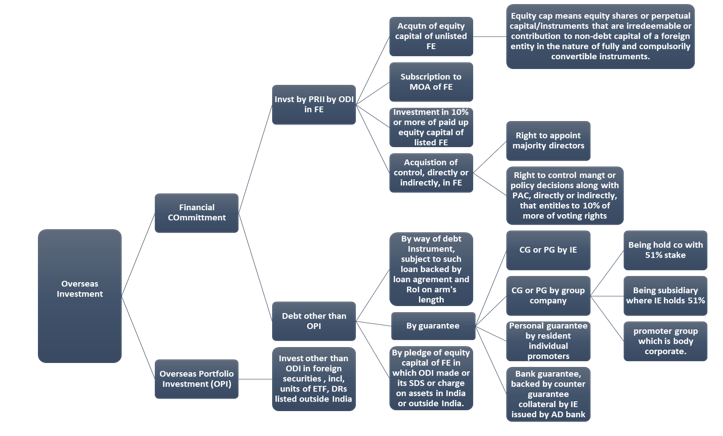
Under the erstwhile ODI regulations, currently in force, there is a concept of direct investment outside India in JV and WOS that excludes portfolio investment and FC. NDI Rules combine the two to define FC and separately defines the term Overseas Portfolio Investment (‘OPI’).  Overseas Investment (‘OI’) is FC + OPI.

The classification as ODI depends on the nature of instruments in which investment is made, the nature of the entity in which investment is made and whether control has been acquired or not.

The diagram below provides a snapshot of the same.

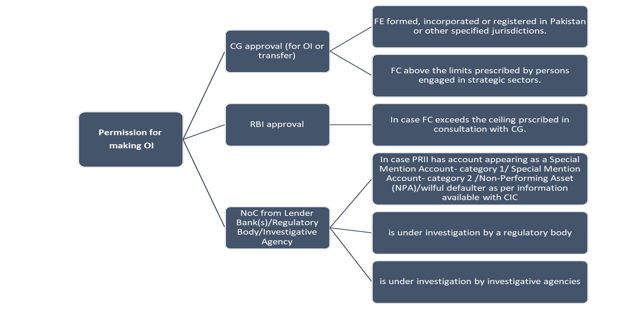
Approval requirement proposed

The NDI Rules provides investments that require prior approval of Central Government, RBI and NOC from lender banks/ regulatory body etc. The Erstwhile ODI Regulations only mandated prior approval of RBI in case eligibility conditions stipulated were not met by the Indian party or resident individual.

Other amendments proposed

  • ODI in technology ventures through an Overseas Technology Fund (OTF) permitted for listed IE with minimum net worth of Rs. 500 crore, for the purpose of investing in overseas technology startups engaged in an activity which is in alignment with the core business of such IE.
  • Limit of FC upto 400% of networth will not apply to FC made by “Maharatna” PSUs or “Navratna” PSUs or subsidiaries of such PSUs in foreign entities outside India engaged in strategic sectors. Strategic sectors defined to include energy and natural resources sectors such as Oil, Gas, Coal and Mineral Ores or any other sector that may be advised by CG.
  • Definition of net worth to be aligned with Companies Act, 2013.
  • Sub-limits for determination of FC (50% of performance guarantee, 100% of corporate guarantee) is proposed to be done away with.
  • Applicability of provisions in case of investments made in or by units in IFSC clarified.
  • Bona fide activity defined to mean such business activities legally permissible both in India and host jurisdiction.
  • Permissible range of 5% of the fair value arrived on an arm’s length basis as per any internationally accepted pricing methodology for valuation duly certified by a registered valuer as per the Companies Act 2013; or similar valuer registered with the regulatory authority in the host jurisdiction to the satisfaction of the AD bank provided along with period of validity of valuation certificate upto 6 months before the date of the transaction.
  • Reporting of FC and OPI to be done in distinct forms.
  • Prohibition on further FC to continue until any delay in reporting is regularized. The erstwhile ODI regulations restricted only in case of non-filing of Form APR.
  • Restriction on acquisition of immoveable property outside India will not apply in case the same is acquired on lease by PRII for a period not exceeding 5 years. Manner of transfer of immoveable properties also prescribed.
  • Source of funds for acquiring immoveable property outside India to include limit under Liberalised Remittance Scheme (LRS) and out of income/ sale proceeds of the assets, other than ODI.


Our other videos and write-ups may be accessed below:

YouTube:

https://www.youtube.com/channel/UCgzB-ZviIMcuA_1uv6jATbg 

Other write-up relating to corporate laws:

https://vinodkothari.com/category/corporate-laws/fema/


[1] https://egazette.nic.in/WriteReadData/2019/213265.pdf

[2] https://www.rbi.org.in/Scripts/NotificationUser.aspx?Id=2126&Mode=0

[3] https://www.rbi.org.in/Scripts/NotificationUser.aspx?Id=10257&Mode=0

[4] https://www.rbi.org.in/scripts/bs_viewcontent.aspx?Id=4024

[5] https://www.rbi.org.in/scripts/bs_viewcontent.aspx?Id=4023

[6] https://rbi.org.in/Scripts/BS_PressReleaseDisplay.aspx?prid=52026

SPACs – Value Proposition & Regulatory Framework

– Megha Mittal

[mittal@vinodkothari.com]

The concept of Special Purpose Acquisition Companies (‘SPACs’) has gained significant attention and importance in India in recent times – from a subject preserved to select classes, the surge in transactions over 2020, has made it pave its way to every investor’s dictionary. And with all the spotlight that SPACs have attracted, the numbers seem to only lend to the hype. To begin with, the global SPAC IPO proceeds in 2020 alone is estimated to be $83 billion USD[1] with a total of 251 listings. This figure is further projected to grow to a massive 711 listings in 2021 with an average IPO size of USD 294.5 Million as on 15th August, 2021[2].

Globally, SPACs have become the investment vehicle of choice, more-so by startups looking for funding; and the US has been the flag bearer of the SPAC industry, leading from the front. Following shortly behind are economies like UK, Malaysia and Canada; and while India is playing catch-up, it seems to be speeding up quick enough, at least on the regulatory front.

For the uninitiated, a SPAC, often referred to as a Blank-check Company or a Shell Company, is a non-operating company with the admitted intent (read: special purpose) of acquiring of a potential target within a stipulated timeline[3].

In this article, while dealing with the basic regulatory framework via-a-vis SPACs, the author seeks to analyse the motivation(s) behind such transactions from all perspectives – the acquirer’s, the acquiree’s and the investors’.

Read more