Checklist for issuance of listed debt securities on private placement basis


Non-convertible debentures issued on private placement basis are one of the most practiced ways of raising finance by the companies in India. Considering the notification of SEBI (Issue and Listing of Non-Convertible Securities) Regulations, 2021, effective from 16th August, 2021, the companies may be under a perplexity of how to comply with the requirements of the newly notified regulations. We have summarised the procedure into a checklist below for reference.

Checklist for issuance of  listed and unsecured NCDs on Private Placement Basis
Serial No. Particulars  Relevant provisions  Remarks
Eligibility conditions:
A. Eligibility requirements under the Companies Act, 2013:
1. Offer can be made to a maximum of 200 persons
2. No advertisement can be made in the newspapers
3. The Company shall not make a fresh offer or invitation unless the allotment with respect to any offer or invitation made earlier have been completed, or withdrawn or abandoned by the Company.
B. Eligibility requirements under SEBI (Issue and Listing of Non-Convertible Securities) Regulations, 2021
No issuer shall make an issue of non-convertible securities if as on the date of filing of draft offer document or offer document:
(a) the issuer, any of its promoters, promoter group or directors are debarred from accessing the securities market or dealing in securities by the Board;
(b) any of the promoters or directors of the issuer is a promoter or director of another company which is debarred from accessing the securities market or dealing in securities by the Board;
(c) any of its promoters or directors is a fugitive economic offender; or
(d) any fine or penalties levied by the Board /Stock Exchanges is pending to be paid by the issuer at the time of filing the offer document:
1 Convening of a Board Meeting:
i. To consider and approve issue of debentures including the terms and conditions of issue for the entire FY ;
ii. To authorise the Board Borrowing Committee/ other relevant committee [Optional] for the following:
a. Appointment of RTA and execute tripartite agreement [Reg 9]
b. Appointment of Credit Rating Agency and obtain Credit Rating. [Reg 10]
c. Opening of Separate Bank Account with Schedule Bank [Proviso to Section 42(6)].
d. To identify group of persons to whom Debentures are proposed to be issued [Section 42(2)]
e. To approve Private Placement offer letter
f.Appointment of Depository [Reg 7]
g. For allotment of NCDs
h. other matters relevant to the issue of NCDs
i.To appoint a debenture trustee before the issue of letter of offer for subscription of the debentures [Reg 8]
j. To obtain in-principle approval from stock exchanges [Reg 6]
Section 179(3) of CA
Section 42, 71 & SS-1
2 Approval of shareholders Sec. 71, 42, Rule 14(1) of Companies (PAS) Rules,2014, Rule 18 of SHA Rules not required if blanket approval already taken and issue is within the limit as per  second proviso to Rule 2 of Companies (Prospectus and Allotment of Securities) Rules, 2016
3 Filing of MGT-14  Rule 14(1) of Companies (PAS) Rules, 2014 Within 30 days of passing of the Board Resolution/ Shareholders resolution
4 a. Preparation and finalisation of Disclosure Document;
b. Preparation and finalisation of DTD, DTA/ Debenture Subscription Agreement.
5 Obtain consent from Trustee Before issue of offer document
6 To convene Board Borrowing Committee/ other relevant committee meeting for the following:                                                                                                                         a. Approval of draft offer document/ Disclosure Document/ Information Memorandum, Debenture Trust Deed, Debenture Trustee Agreement,Application Form
b. Identification of RTA
c. Approval of List of proposed Allotees
d. Approval for opening of Escrow Account (if already opened then noting of the same)
e. All other matter as delgated by the Board as mentioned in Point 1 above.
Section 42(3) of CA with Rule 14 (3) of Companies (Prospectus and allotment of Securities) Rules, 2014 In terms of Rule 18(1)(c) & (5) of the Companies (Share Capital and Debentures) Rules, 2014 [Section 71(5)], the debenture trustee shall be appointed and DTD shal be executed at any time within 60 days of allotment of debentures. Accordingly, this may be done after the allotment of NCDs also.
7 Creation of debenture redemption reserve Section 71(4) read with Rule 18 (7)(b)(iv)(B) The value of debenture redemption reserve shall be 10% of the value of outstanding debentures.

DRR shall not be required in case of NBFCs [Rule 18 (7) (iv)(A) of Deposit Rules

8 Creation of recovery expense fund Reg 11 read with SEBI Circular https://www.sebi.gov.in/web/?file=https://www.sebi.gov.in/sebi_data/attachdocs/oct-2020/1603361431987.pdf#page=1&zoom=page-width,-16,792 deposit an amount equal to 0.01% of the issue size with designated stock exchange upto  a maximum of Rs. 25 lakhs.
9 Obtain credit rating Reg 10
10 Agreement with depository for dematerialisation Reg 7
11 Private placement offer-cum-application shall be sent to the identified investors Sec. 42 of CA 13
12 Maintain a complete record of persons to whom the Private Placement offer letter is sent in form PAS-5. Rule 14(4) of PAS Rules
13 Receipt of application money Section 42 of CA
14 Filing of Master Creation form with NSDL/CDSL -for demat issuance
15 Filing of listing application with stock exchanges and debenture trustees –
(a) Placement Memorandum;
(b) Memorandum of Association and Articles of Association;
(c) Copy of the requisite board/ committee resolutions authorizing the borrowing and list of authorised signatories for the allotment of securities;
(d) Copy of last three years Annual Reports;
(e) Statement containing particulars of, dates of, and parties to all material contracts and agreements;
(f) An undertaking from the issuer stating that the necessary documents for creation of the charge, wherever applicable, including the Trust Deed has been executed within the time frame prescribed in the relevant regulations/Act/rules etc. and the same would be uploaded on the website of the designated stock exchange, where such securities have been proposed to be listed;
(g) In case of debt securities, an undertaking that permission / consent from the prior creditor for a second or pari passu charge being created, wherever applicable, in favour of the debenture trustee to the proposed issue has been obtained; and
(h) Any other particulars or documents that the recognized stock exchange may call for as it deems fit:
Reg 44
16 Allotment of NCDs after holding a meeting of Borrowing Committee/ other relevant committee Section 42 of CA
17 Filing of PAS-3 with ROC Section 42(8) read with Rule 14(6) of Companies Prospectus and allotment of securities) Rules, 2014
18 Payment of fees to stock exchanges Reg 13(2) at the time of listing

This is a general checklist for companies desiring to list its debt securities. For NBFCs and HFCs, the requirements may differ depending upon their specifically applicable regulations.

Further, you may read our article on the NCS Regulations here.

A comparison of the NCS Regulations from erstwhile ILDS Regulations can be accessed here.

A presentation on the various structures of debt securities can be viewed here – https://vinodkothari.com/2021/09/structuring-of-debt-instruments/

Use of dual recourse instruments for SME finance: The Making of European Secured Notes

– Vinod Kothari and Abhirup Ghosh (finserv@vinodkothari.com)

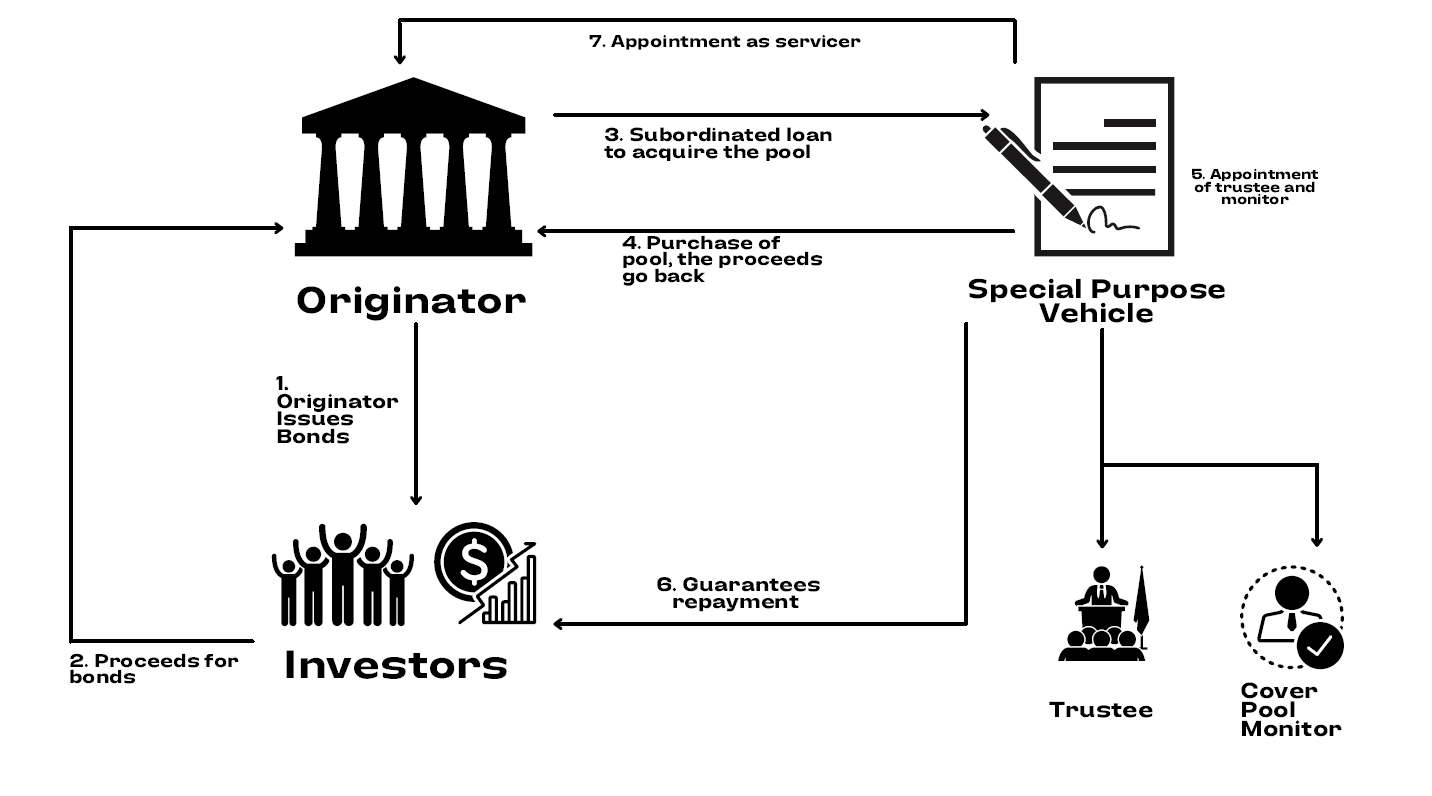
The European financial regulators are working on a new funding instrument whereby banks and primary lenders can raise refinance against their portfolio of SME loans, by issuing a bond which is directly linked with such portfolios, called European Secured Notes (ESNs). ESNs are a dual recourse instrument, following the time-tested structure of covered bonds.

Covered bonds, developed more than 250 years ago in Europe, use dual recourse structure. The first recourse, against the issuer, is prone to the risk of bankruptcy of the issuer. In that situation, the investors have recourse against the assets of the issuer, and that recourse is made immune from other bankruptcy claims or priorities. This ring-fencing is granted either by explicit legislation, or by use of contract law flexibility. Covered bonds are currently used, to an overwhelming extent, for prime residential mortgage loans. Given their bankruptcy-protected asset backing, covered bonds allow the issuer to get a rating higher than the issuer’s own default rating. This phenomenon, called “notching up”, may cause the ratings on the bonds to go up over the rating of the issues by some 6 to 9 notches.

European regulators are trying to build on the methodology of covered bonds to see if a similar instrument can be used by banks to refinance their SME loan pools.

Development of European Secured Notes:

There have been past instances, sporadically, of dual recourse bonds, on lines similar to ESNs,. A notable instance was Commerzbank’s SME-backed structured covered bond programme established in 2013 but fully repaid in 2018[1]. Besides this, there were several issuances in France, though they are no longer used.

There has been a multi-issuer platform called French “Euro secured Note issuer” (ESNI), established in 2014 and supported by the Banque de France. Though the programme was open to all French and European Banks, only four French banks opted for this. There were around 20 issuances totalling to over Euro 10 Bn. Banque de France acted as the monitor for the asset quality of the SME loans. It used its internal rating model to examine the assets and score them. The scoring, in combination with haircuts on such assets established the minimum over-collateralisation level.

The Italian regulators also proposed to come up with an enabling regulatory framework to permit domestic issuers to issue Obbligazioni Bancarie Collateralizzate (OBC);  however, this seems to have been stranded into oblivion.

Similar efforts were made by the Spanish regulators when they amended the covered bonds framework in 2015.

The work done all this while might have been the inspiration for the European Commission when it proposed the use of ESN as a financial instrument backed by SME loans and infrastructure loans, to be used by banks, as a part of the Capital Markets Union proposals in 2017[2].

Subsequently, the Commission requested a report from the European Banking Authority to set out probable structures of ESNs, which was issued in July 2018[3].

It was originally meant to be kept on the backburner until 2024, however, with the COVID 19 pandemic, the European Parliament asked the European Commission to accelerate the introduction of ESNs to help financing the recovery from the pandemic.

In April 2021, the ESN Task Force, that is, ECBC along with EMF, issued the ESN Blueprint[4]. It appears that ESNs may be rolled out ahead of the original implementation schedule.

Structure of ESNs

Originally, at the time of conceptualisation, there were two structures which were contemplated:

  1. A structure that mirrors the structure of covered bonds,
  2. A structure that mirrors the structure of ABS

However, EBA suggested the first structure in its report.

The key recommendations of the EBA on the structure are as follows:

  1. Dual recourse – The bond must grant the investor a claim on the covered bond issuer, and if it fails to pay, a priority claim on the cover pool limited to the fulfilment of the payment obligations. Further, if the cover pool turns to be insufficient to fulfil the payments, the investor shall have recourse back to the insolvency estate of the issuer, which shall rank pari passu with the claims of the unsecured creditors.
  2. Segregation of cover assets – The next important suggestion was with respect to the segregation of cover assets. The segregation of assets could be either be achieved through registration of the cover pool into a cover register or by transferring them to a special purpose vehicle (SPV). Note that registration of covered bonds is required by several European jurisdictions, as well as Canada.
  3. Bankruptcy-remoteness of the covered bond: The legal/ regulatory framework should facilitate the bankruptcy-remoteness by not requiring acceleration of payments in case of issuer default.
  4. Administration of the covered bond programme after the issuer’s insolvency or resolution: The legal/regulatory covered bond framework should provide that upon issuer’s default or resolution the covered bond programme is managed in an independent way and in the preferential interest of the covered bond investor.
  5. Composition of cover pool: The cover pool should comprise of non-defaulted SME loan and leasing exposures. Further, the pool should be dynamic. Given the high risk associated with SME loans, the EBA recommended incorporating strict eligibility criteria at both loan and pool levels in the form of:
    • selected SME exposures
    • sufficient granularity,
    • concentration limit,
    • quality standards.
  6. Coverage principles and legal/regulatory overcollateralization: The claims against the cover pool should not exceed the receivables arising out of the cover pool. Further, the EBA considered a minimum over-collateralisation must be prescribed for SME ESNs. In this regard, the EBA recommended a minimum over-collateralisation of 30%.

Use of capital market instruments for refinancing SME loans:

“SMEs are important actors in economic growth and transformation, creating positive value for the economy and contributing towards sustainable and balanced economic growth, employment and social stability”[5]. The use of capital market instruments for refinancing SME loans has been engaging the attention of policymakers and regulators alike. The extent of penetration of bank finance to SMEs is far from optimal, and additionally, there are gaping differences across geographies.

Direct access of SMEs to capital markets for debt funding is quite limited, since most of the SMEs do not have the size to be able to attract the attention of institutional investors in the capital market. An OECD-World Bank report notes that “individual SMEs issuances do not easily align with the risk appetite and prudential requirements of institutional investors.”[6] On the other hand, institutional investors may easily participate in bonds or similar instruments which refinance or repackage SME lenders’ loan portfolios. The aforesaid OECD-World Bank report envisages 4 types of capital market instruments for SME refinancing –corporate bonds issued by SME lenders, securitisation of SME loans, SME covered bonds, and SME loan & bond funds, as collective investment schemes.

Issuance of bonds by banks, for on-lending to SMEs or refinancing SME loan portfolios, is quite common in many countries. Such bonds are, however, linked with the performance and rating of the issuer bank.

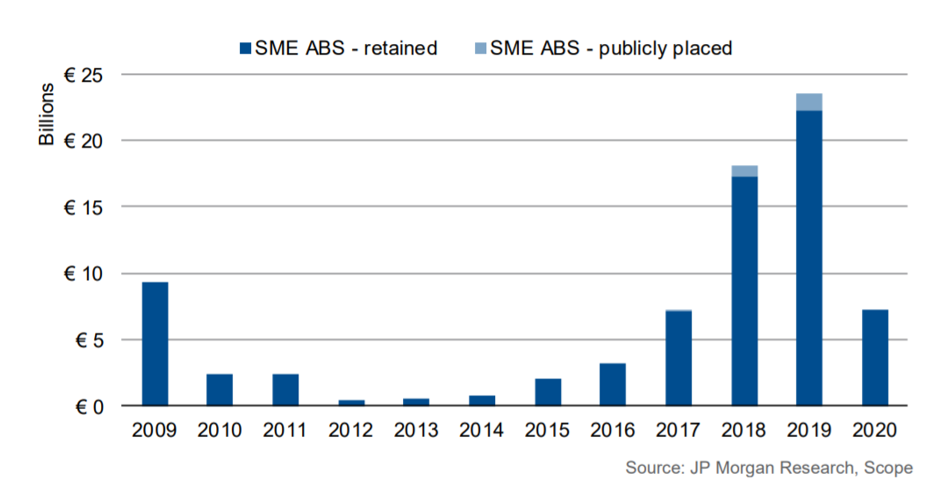
As for securitisation of SME loans, the overall contribution of SME loans as an asset class in the global securitisation volumes will be in the region of 2%, which obviously dwarfs in comparison to popular asset classes such as residential mortgage loans. Post the GFC, several European jurisdictions have used securitisation of SME loans, but looking at the huge proportion of retained securitisations (see Graph below), it is quite evident that such activity was motivated by the objective of refinancing by ECB. This low volume is despite the fact that  asset backed securitisation is the most natural choice to fund SME loans through capital market, as they provide three benefits:

  1. Provide funding to the banks
  2. The assets move off the books of the originator, depending on the structure
  3. Can be tailor made to the specifications of the investor
  4. Regulatory capital relief

In the recent times, SME ABS issuances in Europe peaked in 2019, of which almost 97% were issued in retained format.

Source: Scope Ratings[7]

Outside of Europe, Korea and India have seen several securitisations of SME loan pools.

Relevance of dual recourse instrument for SME funding

Covered bonds are mostly supported by legislation to provide bankruptcy protection in European jurisdictions. In several other jurisdictions, the flexibility of the common law structure is utilised for providing bankruptcy protection. However, the essential premise in either case is the same –which is the ability of the cover pool to be a backstop for redemption of the bonds, in the event of failure of the issuer to pay them. Therefore, the pool of assets have to be liquid and robust to be able to pay off the bondholders.

There is substantial difference between mortgage pools backing up covered bonds, and SME loans. SME loans have lesser granularity, heterogeneity, and higher historical default rates. The servicing of SME loans from the viewpoint of ongoing collections is also not as easy as in case of mortgage loans. However, these will be ultimately be the factors that would have to be borne in mind by the rating agencies while sizing up the level of over-collateraliation and fixing the level of rating notch-ups for SME-loan-backed covered bonds. As a matter of principle, if there is a market for securitisation of SME loans as demonstrated by recent global transactions, a covered bond structure only tries to marry the benefits of securitisation and corporate bonds. Hence, introducing covered bonds backed by SME loans may be the right idea.

The robustness of covered bond with a history of over 250 years is explained, other than by the legislative protection, by the good quality of the cover pool. The transparency of loan-level performance data of SME loans is much lesser than mortgage loans. Even more importantly, the question is the ability and liquidity of the cover pool, given the insolvency of the issuer, to redeem the bonds. SME loans do not have as liquid secondary market, and the migration of servicing to an alternate servicer makes the liquidity of such loan pools even more difficult. The layering of a credit guarantee support by credit guarantee schemes, which exist practically in every jurisdiction in the world, could also be considered as a credit support.

Should there be a legislative bankruptcy protection, which removes these loan pools completely from the bankruptcy estate and makes the same available to covered bond investors only? This question becomes a complicated one, involving inter-creditor rights. Insolvency for other creditors becomes deeper if there are more bankruptcy-protected instruments.

The urgency for ESNs is also a part of the post-Covid worries of regulators all over the world, and clearly, SMEs are seen as a huge agent of post-Covid revival. However, the need for availability of more liquidity for SMEs has always been crucial. Therefore, the introduction of SME-loan-backed covered bonds may be an agenda items for countries outside of Europe too.

[1] https://www.scoperatings.com/ScopeRatingsApi/api/downloadstudy?id=dfa74ad6-f1ca-4860-a916-bc0638846bb1

[2] https://eur-lex.europa.eu/legal-content/EN/TXT/?uri=CELEX:52017DC0292

[3] https://www.eba.europa.eu/sites/default/documents/files/documents/10180/2087449/6fe04a31-ec0b-4ea1-9508-258ad2cf72d8/EBA%20Final%20report%20on%20ESNs.pdf

[4] https://hypo.org/app/uploads/sites/3/2017/05/ECBC-ESN-Blueprint-April-2021.pdf

[5] IOSCO Report, 2015, titled SME Financing Through Capital Markets, at https://www.iosco.org/library/pubdocs/pdf/IOSCOPD493.pdf

[6] https://www.oecd.org/g20/topics/development/WB-IMF-OECD-report-Capital-Markets-Instruments-for-Infrastructure-and-SME-Financing.pdf, page 46

[7] https://www.scoperatings.com/ScopeRatingsApi/api/downloadstudy?id=dfa74ad6-f1ca-4860-a916-bc0638846bb1

Our other resources on Covered Bonds:

https://vinodkothari.com/2021/07/covered-bonds-the-story-of-the-indianised-version-of-a-global-instrument/ 

https://vinodkothari.com/covered_bonds-2/ 

https://www.youtube.com/watch?v=XyoPcuzbys4

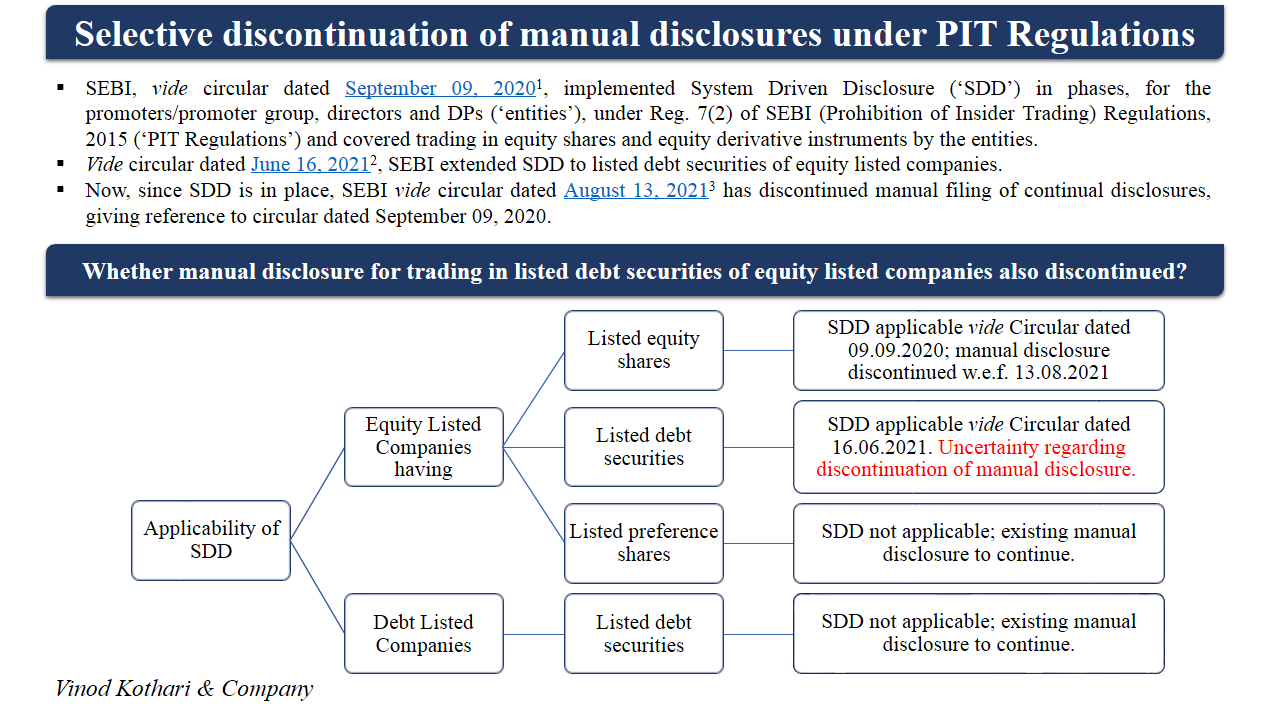
Discontinuation of manual disclosures under PIT Regulations

corplaw@vinodkothari.com


September 09, 2020 Circular: https://www.sebi.gov.in/legal/circulars/sep-2020/automation-of-continual-disclosures-under-regulation-7-2-of-sebi-prohibition-of-insider-trading-regulations-2015-system-driven-disclosures_47523.html

June 16, 2021 Circularhttps://www.sebi.gov.in/legal/circulars/jun-2021/automation-of-continual-disclosures-under-regulation-7-2-of-sebi-prohibition-of-insider-trading-regulations-2015-system-driven-disclosures-for-inclusion-of-listed-debt-securities_50572.html 

August 13, 2021 Circular:https://www.sebi.gov.in/legal/circulars/aug-2021/automation-of-continual-disclosures-under-regulation-7-2-of-sebi-prohibition-of-insider-trading-regulations-2015-system-driven-disclosures-ease-of-doing-business_51848.html


SEBI eases disclosure requirements under SAST Regulations

corplaw@vinodkothari.com

August 13, 2021 notification: https://egazette.nic.in/WriteReadData/2021/228973.pdf

Adjudication order: https://www.sebi.gov.in/enforcement/orders/mar-2020/adjudication-order-in-respect-of-two-entities-in-the-matter-of-yes-bank-ltd-_46477.html

NCS Regulations versus ILDS Regulations

Comparitive between consolidate framework and erstwhile provisions relating to private placement.

Henil Shah | Assistant Manager and Parth Ved | Executive corplaw@vinodkothari.com

SEBI vide its notification dated August 09, 2021 introduced SEBI (Issue and Listing of Non-Convertible Securities) Regulations, 2021 (‘NCS Regulations’), NCS Regulations have merged the provisions of SEBI (Issue and Listing of Debt Securities) Regulations, 2008 (‘ILDS Regulations’), and SEBI (Issue and Listing of Non-Convertible Redeemable Preference Shares) Regulations, 2013 (‘NCRPS Regulations’). The notified regulations in ambits covers framework pertaining to issue of non-convertible debentures (‘NCDs’), non-convertible preference shares (‘NCPS’), perpetual debt securities (‘PDIs’), and listed commercial paper.

The NCS regulations shall be effective from 7th day from the date of their publication in the official gazette i.e. 16th August, 2021.

In this article, we present a comparison between the erstwhile ILDS regulations and NCS Regulations from the point of view of a private placement of NCDs.

NCS Regulations v/s ILDS Regulations

Sr.No NCS Regulations ILDS Regulations Our Remarks  
 1 Reg. 5: Eligible Issuer 

(1)   No issuer shall make an issue of non-convertible securities if as on the date of filing of draft offer document or offer document:

a.       the issuer, any of its promoters, promoter group or directors are debarred from accessing the securities market or dealing in securities by the Board;

b.      any of the promoters or directors of the issuer is a promoter or director of another company which is debarred from accessing the securities market or dealing in securities by the Board

c.       the issuer or any of its promoters or directors is a wilful defaulter;

d.      any of the promoters or whole-time directors of the issuer is a promoter or whole-time director of another company which is a wilful defaulter

e.       any of its promoters or directors is a fugitive economic offender; or

f.        any fine or penalties levied by the Board /Stock Exchanges is pending to be paid by the issuer at the time of filing the offer document:

g.       Provide that the:

(i)    restrictions mentioned at (b) and (d) above shall not be applicable in case of a person who was appointed as a director only by virtue of nomination by a debenture trustee in other company.

(ii)  restrictions mentioned in (a) and (b) above shall not be applicable if the period of debarment is over as on date of filing of the draft offer document with the Board.

(iii)   restrictions mentioned at (c) and (d) shall not be applicable in case of private placement of non-convertible securities

(2)    No issuer shall make a public issue of non-convertible securities if as on the date of filing of draft offer document or offer document, the issuer is in default of payment of interest or repayment of principal amount in respect of non-convertible securities, if any, for a period of more than six months.


  ILDS Regulations didn’t laid out any specific eligibility criteria for the issue to list its NCDs issued on private placement basis.

Under the NCS Regulations, the condition that the issuer shall not be debarred from accessing the securities market or dealing in securities has been extended to promoter group entity as well. Further, certain additional conditions such as the promoter or WTD shall not be a promoter or WTD of a company which is a wilful defaulter, no promoters or directors shall be fugitive economic offenders or no fines or penalties are pending at the time of filing of offer document have been inserted.

Associating payment of fines and penalties with listing might not be a feasible idea; as there might be situations where the issuer may have raised disputes/concerns on liability to pay such fines/penalties.

2 Reg. 6: In-principal approval

The issuer shall make an application to one or more stock exchange(s) and obtain an in-principle approval for listing of its non-convertible securities from the stock exchange(s) where such securities are proposed to be listed:

Provided that where the application is made to more than one stock exchange, the issuer shall choose one among them as the designated stock exchange.


Reg. 19(3): Mandatory listing

Where the issuer has disclosed the intention to seek listing of debt securities issued on private placement basis, the issuer shall forward the listing application along with the disclosures specified in Schedule I to the recognized stock exchange within fifteen days from the date of allotment of such debt securities.

Under ILDS Regulations there was no specific requirement to obtain in-principal approval form stock exchange for listing, an application along with disclosure specified in the regulations did the trick.

However, moving forward the issuers will be required to obtain a prior in-principal approval for listing.

Actionable: Going forward issuers will be required to obtain in-principal approval.

 3 Reg. 8: Debenture Trustee


The issuer shall appoint a debenture trustee in case of an issue of debt securities.

There was no clarity under ILDS w.r.t appointment of debenture trustee for private placement of debt securities. Notification of NCS regulations brings clarity on appointment of debenture trustee.
4 Reg. 12: Electronic Issuances

An issuer proposing to issue non-convertible securities through the on-line system of the stock exchange(s) and depositories shall comply with the relevant applicable requirements as may be specified by the Board.

Applicability of issuance through EBP platform in case of private placement comes from SEBI circular dated. Considering the benefits of EBP platform SEBI in its Consultation Paper, proposed to reduce the limit from 200 Crores to 100 Crores. Accordingly, changes are being carried out under para  of Operational Circular for issue and listing of Non-Convertible (NCS) Securitised Debt Instruments (SDI) Security Receipts (SR), Municipal Debt Securities and Commercial Paper (CP) dated August 10, 2021 (‘Operational Circular’)
5 Reg. 15: Rights to recall or redeem prior to maturity


Framework for right to recall and right to redemption prior to maturity.


ILDS Regulations, provided framework for right to recall (i.e. Call Option) and right of redemption (i.e. Put Option) prior to maturity, in case of public issue of NCDs. In case of private placement of NCDs, the same was entirely guided by the terms of issue.

However, the NCS regulations have now stipulated that provisions relating to call and put option shall equally apply in case of public issuances as well as private placement.

This seems to take away the flexibility that issuers enjoyed in certain cases for issuers of privately placed debentures for example, where an interest rate in case of delay on part of the issuer could be avoided or kept at a minimal rate, the same will be charged at 15% interest rate.

Aside, also note that put option is a feature only applicable in case of NCDs and not NCPs.

6 Reg. 18(1): Trust Deed


The issuer and the debenture trustee shall execute the trust deed within such timelines as may be specified by the Board.


Timeline and format for execution of debenture trust deed was not expressly mentioned for private placement in the ILDS.

The NCS Regulations have aligned with requirement for SEBI circular dated November 03, 2021.

It may be noted that reg.59(3) of NCS Regulations save all the circulars, etc. issued under previous regulations as if the same were issued under NCS Regulations.

7 Reg. 23(3): Obligations of the Issuer  

The issuer shall apply for Securities and Exchange Board of India Complaints Redress System (SCORES) authentication in the format specified by the Board and shall use the same for all issuance of non-convertible securities.

The requirement was not specifically mentioned in the ILDS Regulations, however the requirement of registering on SCORES also comes from SEBI (Listing Obligation and Disclosure Requirement), 2015.
8 Reg. 43(2): Creation of Security

The charge created in respect of the secured debt securities shall be disclosed in the offer document along with an undertaking that the assets on which charge or security has been created to meet the hundred percent security cover is free from any encumbrances and in case the assets are encumbered, the permissions or consent to create first, second or pari passu charge on the assets has been obtained from the existing creditors to whom the assets are charged, prior to creation of the charge:

Provided that sub regulation (2) shall not apply if the charge is created on additional assets other than the assets comprising of hundred percent security cover.


Reg. 21B: Creation of Security 


The issuer shall give an undertaking in the Information Memorandum that the assets on which charge is created are free from any encumbrances and in cases where the assets are already charged to secure a debt, the permission or consent to create a second or pari-passu charge on the assets of the issuer has been obtained from the earlier creditor.

The regulations provide that in case of additional security cover (that is, beyond 100%), sub-reg (2) shall not apply. it may imply that the issuer need not give an undertaking with respect to the additional security cover being free of encumbrances or the issuer having obtained prior consents.

However, it must be noted that where additional security cover so provided is a subject asset under any other financing agreements entered into with any other person or lenders, the agreement may provide for obtaining prior consent of such lender

In that case, it might be impractical (and also, not in accordance with law) to say that the issuer can proceed to create encumbrance without obtaining consent of the lender therefore, irrespective of whether any undertaking is given in the offer document, the issuer would need to comply with any contractual covenants wrt to such “additional” security cover


9 Reg. 44(1): Listing Application

The  issuer  shall  forward  the  listing application along with the disclosures as per this regulation to the stock exchange(s) within such days as may be specified by the Board from the date of closure of the issue:

Reg. 19(3): Mandatory Listing 


Where the issuer has disclosed the intention to seek listing of debt securities issued on private placement basis, the issuer shall forward the listing application along with the disclosures specified in Schedule I to the recognized stock exchange within fifteen days from the date of allotment of such debt securities.

The provision in the NCS regulation is aligned with timelines for listing notified via SEBI circular dated October 05, 2020 now subsumed into Operational Circular.
10 Reg. 44(3) & (4):  Due diligence

(3) Debenture trustee shall submit a due diligence certificate to the stock exchange in the format as specified in Schedule IV of these regulations.

(4) The stock exchange(s) shall list the debt securities only upon receipt of the due diligence certificate from the debenture trustee as per format specified by the Board.

Regulation 44 provides for:

  1. The issuer has made adequate provisions for and/or has taken steps to provide for adequate security for the debt securities to be issued.
  2. The issuer has obtained the permissions / consents necessary for creating security on the said property (ies).
  3. The issuer has made all the relevant disclosures about the security and also its continued obligations towards the holders of debt securities.
  4. All disclosures made in the offer document with respect to the debt securities are true, fair and adequate to enable the investors to make a well informed decision as to the investment in the proposed issue.


  1. The format of Schedule IV provides for format of due diligence certificate to be given by the debenture trustee before opening of the issue.
  2. This certification was not specifically present under ILDS Regulations for private placements; however, in case of November 03, 2020 circular due diligence required due diligence to be undertaken by the debenture trustee in case of issuance of secured debentures. Therefore, NCS Regulations now have a specific clause for due diligence in case of private placement also. 
  3. Similar requirement was applicable for public issues under reg. 6(8) of ILDS Regulations.
  4. This certification is required to be given at the time of filing of private placement memorandum/ information memorandum/ before opening of the issue and at the time of filing of listing application by issuer  in case of private placement; however, for public issues, this certificate is given at the time of at the time of filing the draft offer document with the stock exchange(s) and prior to opening of the public issue of debt securities.


11 Reg. 47(2): Filing of shelf placement memorandum

 The shelf placement memorandum shall indicate a period not exceeding one year as the period of validity of such memorandum which shall commence from the date of opening of the first offer of debt securities under that memorandum, and in respect of a second or subsequent offer of such debt securities issued during the period of validity of that memorandum, no further placement memorandum is required.

Reg. 21A(2): Filing of Shelf Disclosure Document

An issuer filing a Shelf Disclosure Document under sub-regulation (1), shall not be required to file disclosure document, while making subsequent private placement of debt securities for a period of 180 days from the date of filing of the shelf disclosure document.

The time validity of shelf prospectus in case of private placement of debt securities has been increased from 180 days to 1 year.


This is a welcome move, as this will eliminate hassles for frequent issuers to file shelf prospectus multiple times.


Disclosure Requirements:

The NCS Regulations provides for a separate sets of disclosure requirements in case of both public issue and private placement. Template for disclosure required to be made in case of private placement of NCS are provided in the schedule of the NCS regulations. Following is a comparison of disclosure required to be made in terms of NCS Regulations vs ILDS Regulations and NCRPs Regulations. In general the NCS widens the purview of information to be disclosed for the purpose of enhancing disclosure being made further streamlining aligning the same.   

Sr. No NCS Regulation (Schedule II) ILDS Regulations (Schedule I) NCRPS Regulations

(Schedule I)

1 1. Instructions

Following general instructions for preparation of draft offer document are specified:

  1. All information shall be relevant and updated as on the date of the offer document.
  2. Source of all statements & claims shall be disclosed.
  3. Terms such as “market leader”, “leading player”, etc. shall be used only if these can be substantiated by citing a proper source.
  4. Use simple English and technical terms if any, w.r.t. business shall be clarified in simple terms.
  5. There shall be no forward-looking statements that cannot be substantiated.
  6. Consistency shall be maintained in the style of disclosures.
  7. For currency of presentation, only one standard financial unit shall be used.
There were no such specific instructions. There were no such specific instructions.
Para 2.2: The front page shall contain:

  1. Name, logo, CIN, PAN, date and place of incorporation, registration number issued by any regulatory authority, address of registered and corporate offices, telephone number, website, email.
  2. Name, telephone number, email of compliance officer, CS, CFO and Promoters.
  3. Name, addresses, logo, telephone number, email and contact person of debenture trustee, CRA,
  4. Name, logo, address of Registrar to the issue (RTA) along with its telephone number, fax number, website and email address.
  5. Date and type of placement memorandum.
  6. Nature, number, price and amount of securities offered and issue size (base issue or green shoe),
  7. Aggregate amount proposed to be raised through all the stages of offers of NCS through shelf placement memorandum
  8. Issue schedule – Date of opening, closing, earliest closing (if any) of issue.
  9. Credit rating (along with cross reference of press release) and all ratings obtained for the private placement.
  10. Name of stock exchange where securities are proposed to be listed.
  11. Details about eligible investors.
  12. Coupon / dividend rate and payment frequency, redemption date and amount and details of debenture trustee.
  13. Nature and issue size, base issue and green shoe option, if any, shelf or tranche size, each as may be applicable.
  14. Details about underwriting including amount underwritten.
  15. Inclusion of compliance clause w.r.t. EBP platform, if applicable.
There was no specific requirement to state the following information on front page.

Para 3.A.a: However, following disclosures were to be made where relevant:

Name and address of the following:

  1. Registered and corporate office of issuer;
  2. Compliance officer, CFO of issuer;
  3. Arrangers, if any;
  4. Trustee of the issue;
  5. RTA;
  6. Credit Rating Agency(ies) of the issue;
  7. Auditors of the issuer.
Para II.A: A prominent disclosure in bold writing on the cover page of offer document stating the following:

“Instruments offered through the offer document are non-convertible redeemable preference shares and not debentures/bonds. They are riskier than debentures / bonds and may not carry any guaranteed coupon and can be redeemed only out of the distributable profits of the company or out of the proceeds of a fresh issue of shares made, if any, by the company for the purposes of the redemption”


Para II.B.i: However, following disclosures were to be made where relevant:

Name and address of the following:

  1. Registered and corporate office of issuer;
  2. Compliance officer, CFO of issuer;
  3. Arrangers, if any;
  4. Trustee of the issue;
  5. RTA;
  6. Credit Rating Agency(ies) of the issue;
  7. Auditors of the issuer.
2 Para 2.3.1: Insertion of clause relating to Issuer’s Absolute Responsibility as per the text provided in Schedule II. There was no such clause specified in the regulations but issuer generally put a disclaimer clause. There was no such clause specified in the regulations but issuer generally put a disclaimer clause.
3 Para 2.3.2: Details of Promoters of the Issuer:

A complete profile of all the promoters, including their name, date of birth, age, personal addresses, educational qualifications, experience in the business or employment, positions/posts held in the past, directorships held, other ventures of each promoter, special achievements, their business and financial activities, photograph, PAN.

A declaration confirming that the PAN, Aadhaar Number, Driving License Number, Bank Account Number(s) and Passport Number of the promoters and PAN of directors have been submitted to the stock exchanges on which the non-convertible securities are proposed to be listed, at the time of filing the draft offer document.

Para 3.A.h: Earlier, only promoter holding as on the latest quarter end was required to be disclosed.

Declaration confirming submission of information pertaining  to personal details of promoters/ directors of promoters to SEs is a new requirement.

Para II.B.viii: Earlier, only promoter holding as on the latest quarter end was required to be disclosed.

Declaration confirming submission of information pertaining  to personal details of promoters/ directors of promoters to SEs is a new requirement.

4 Para 2.3.4: Name(s) and in-principle approval of the stock exchange(s) where the NCS are proposed to be listed and in case of more than one stock exchange, specify the designated stock exchange.

The issuer shall specify the stock exchange where the recovery expense fund is being/has been created as specified by SEBI.

Para 3.A.p: Names of all the recognised stock exchanges where the debt securities are proposed to be listed clearly indicating the designated stock exchange. Para II.B.xii: Names of all the recognized stock exchanges where NCRPS are proposed to be listed clearly indicating the designated stock exchange
5 Para 2.3.6: Name, logo, address, website, email, telephone number and contact person of debenture trustee, CRA, RTA, Statutory Auditor, legal counsel, Guarantor, arranger, if any. Para 3.A.a: Earlier, details w.r.t. Legal counsel and Guarantor was not included in the regulation.

Further, the requirement of putting a logo, though not expressly mentioned, was anyways followed.

Para II.B.i: Earlier, details w.r.t. Legal counsel and Guarantor was not included in the regulation.

Further, the requirement of putting a logo, though not expressly mentioned, was anyways followed.

6 Para 2.3.8 Financial Information 

A columnar representation of the audited financial statements on a standalone and consolidated basis for a period of 3 completed years.

Combined financial statements need to be disclosed for the periods when such historical financial statements are not available if the issuer being a listed REIT/listed InvIT has been in existence for a period less than three completed years.

Issuers (other than unlisted REITs / InvITs) who are in existence for less than 3 years may disclose financial statements subject to the following conditions:

i. The issue is made on the EBP platform irrespective of the issue size; and

ii. The issue is open for subscription only to QIB.

Listed issuers may disclose unaudited financial information for the stub period instead of audited financial statements in the format as prescribed in LODR Regulations with limited review report, subject to necessary disclosures in the placement memorandum.

7 Para 2.3.10.c: Equity share capital history for the last three years:

  1. Date of allotment
  2. No. of equity shares
  3. Face value
  4. Issue price
  5. Consideration (Cash, other than cash, etc)
  6. Nature of allotment
  7. Cumulative no. of equity shares, equity capital and equity share premium
  8. Remarks
Para 3.A.c.iii: Equity share capital history for the last five years:

  1. Date of allotment
  2. No. of equity shares
  3. Face value
  4. Issue price
  5. Consideration (Cash, other than cash, etc)
  6. Nature of allotment
  7. Cumulative no. of equity shares, equity capital and equity share premium
  8. Remarks
Para II.B.iii.3:Equity share capital history for the last five years:

  1. Date of allotment
  2. No. of equity shares
  3. Face value
  4. Issue price
  5. Consideration (Cash, other than cash, etc)
  6. Nature of allotment
  7. Cumulative no. of equity shares, equity capital and equity share premium
  8. Remarks
8 Para 2.3.10.f: Details of the shareholding of the Company as at the latest quarter end, as per the format specified under LODR regulations. Para 3.A.d.i:Details of the shareholding of the Company as on the latest quarter end was to be provided as per format specified in the Schedule. Para II.B.iv.1: Details of the shareholding of the Company as on the latest quarter end was to be provided as per format specified in the Schedule.
9 Para 2.3.10.g: % comparison of top 10 holders of NCS with total NCS outstanding to be disclosed along with name, total no. of equity shares and no. of shares in demat form.. Para 3.A.g.iv: Only the name of the top 10 debenture holders and their holding amount was required to be disclosed. Para II.B.iv.2: Only the name of the top 10 debenture holders and their holding amount was required to be disclosed.
10 Requirement of providing the amount of corporate guarantee issued by the Issuer along with name of the counterparty (like name of the subsidiary, JV entity, group company, etc) on behalf of whom it has been issued has been omitted. Para 3.A.g.v: The amount of corporate guarantee issued by the Issuer along with name of the counterparty (like name of the subsidiary, JV entity, group company, etc) on behalf of whom it has been issued was required to be specified. Para II.B.vii.4: The amount of corporate guarantee issued by the Issuer along with name of the counterparty (like name of the subsidiary, JV entity, group company, etc) on behalf of whom it has been issued was required to be specified.
11 Para 2.3.13.e: ISIN of outstanding Commercial Paper needs to be disclosed along with maturity date and amount. Para 3.A.g.vi: Only outstanding amount and maturity dates of Commercial Paper were required to be disclosed. Para II.B.vii.5: Only outstanding amount and maturity dates of Commercial Paper were required to be disclosed.
12 Para 2.3.15: Where the issuer is a NBFC or HFC additional disclosures on Asset Liability Management (ALM) shall be provided for the latest audited financials:

  1. Details w.r.t. lending done out of the issue proceeds of earlier issuances of debt securities (whether public issue or private placement) by NBFC.
  2. Portfolio Summary of borrowings made by NBFC.
  3. Quantum and percentage of Secured vs. Unsecured borrowings.
  4. Any change in promoters holding in NBFC during last FY beyond the threshold prescribed by RBI.
  5. Segment wise break up and Type of loans.
  6. Geographical location wise details of borrowers.
  7. Segment wise details of Gross NPA.
  8. Residual maturity profile wise details of assets and liabilities into several bucket.
  9. Disclosure of latest ALM statements to stock exchange.
13 Para 2.3.25: Risk factors 

Risk factors shall be disclosed in the descending order of materiality.

It should include but not limited to:

  1. Risks in relation to NCS.
  2. Risks in relation to the security created in relation to the debt securities, if any.
  3. Refusal of listing of any security of the issuer during last three years by any of the stock exchanges in India or abroad.
  4. Limited or sporadic trading of NCS of the issuer on the stock exchanges.
  5. In case of outstanding debt instruments or deposits or borrowings, any default in compliance with the material covenants such as creation of security as per terms agreed, default in payment of interest, default in redemption or repayment, non-creation of DRR, default in payment of penal interest wherever applicable.
  6. If secured, any risks in relation to maintenance of security cover or full recovery of the security in case of enforcement.
Disclosure of risk factors is required to be  provided in terms of summary sheet however, no specific pointers were pointed out. Reg.23(5): The banks were required to disclose relevant risk factors in case of issue of Perpetual Non-Cumulative Preference Shares and Perpetual Debt Instruments.


You may also refer to our following articles on related subjects

  • Consolidation of SEBI regulations on non-convertible securities

https://vinodkothari.com/2021/08/consolidation-sebi-non-convertible-securities/ 

  • Presentation on Corporate Bonds and Debentures

https://vinodkothari.com/2021/03/presentation-corporate-bonds-debentures/

  • SEBI’s stringent norms for secured debentures

https://vinodkothari.com/2020/11/sebis-stringent-norms-for-secured-debentures/

  • Market-Linked Debentures – Real or Illusory?

https://vinodkothari.com/2021/01/market-linked-debentures-real-or-illusory/

  • FAQs on Commercial Paper

https://vinodkothari.com/2019/11/faqs-on-commercial-paper/

Our  our Book on Law and Practice Relating to Corporate Bonds and Debentures, authored by Ms. Vinita Nair Dedhia, Senior Partner and Mr. Abhirup Ghosh, Partner can be ordered though the below link:

https://www.taxmann.com/bookstore/product/6330-law-and-practice-relating-to-debentures-and-corporate-bonds


Making Corporate Governance IPO-ready

By Harsh Juneja | Executive ( corplaw@vinodkothari.com)

IPO Market Heating up

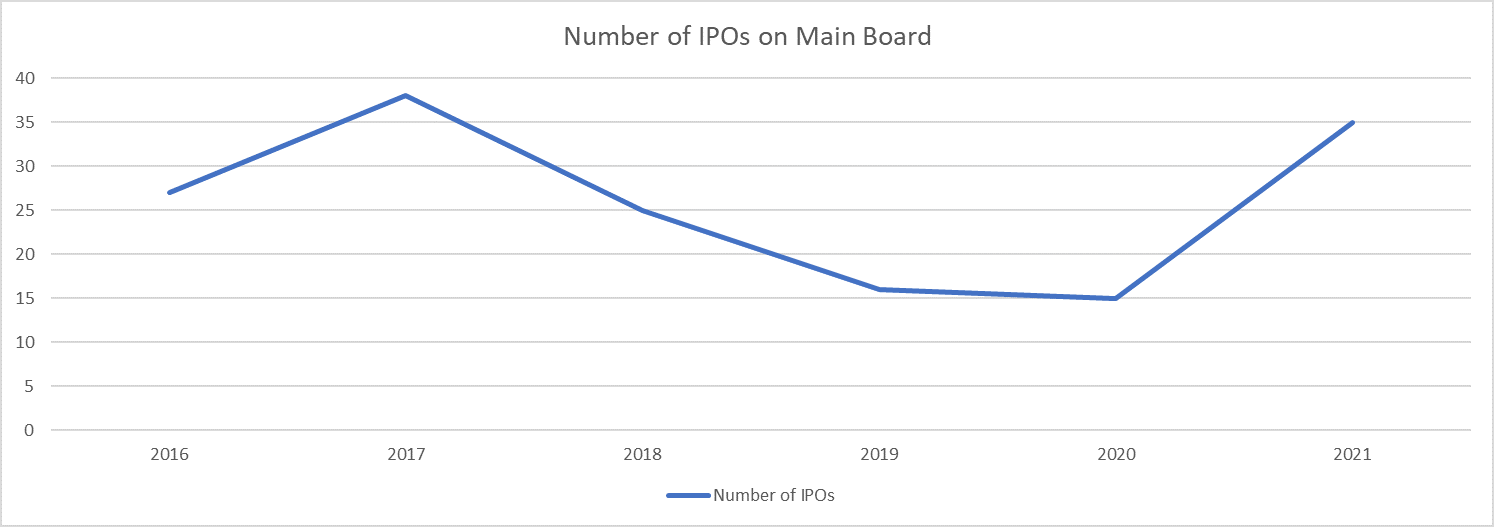
After facing economic crisis owing to the Covid-19 pandemic in March, 2020, a thunderstorm of IPOs strikes India’s Primary Markets. Since July 2020, a total of 48 Initial Public Offers (IPOs) have been issued which includes companies like Burger King, Zomato and Indigo Paints. Draft Red Herring Prospectus (DHRP) has also been filed by various unicorns like One 97 Communication (Paytm), Policy Bazaar Insurance and Nykaa for stepping their toes in the Indian Primary Market.

The above table indicates that even though the economy was not at its best pace in 2020, but still the number of IPOs had increased. Moreover, for 2021, even though the year has not completed yet, but the number of IPOs goes on increasing.

Post Pandemic Recovery

At the time of complete nationwide lockdown, stock market had hit rock bottom. But every cloud has a silver lining. Foreign Direct Investments (FDI) into country rose 15% on year-to-year to $39.9 billion (₹29,400 crore), according to a [1]report by CARE Ratings. Due to surge in foreign investments in the Indian market, it started healing itself. During these hard times, ‘Route Mobile Limited’ came up with an IPO which was a blockbuster in the capital market, as it was listed with a premium of 102.28%. Since then, capital market has been very receptive towards investments. This reception has made people more optimistic towards investment in primary markets.

Preparation in this IPO wave

As we have discussed above, the people feel optimistic towards the Market, many companies which want to raise funds want to just swim along this wave. Companies feel that this is the best time to raise funds through stock market since they will be able to draw maximum premium for their shares. Potential companies need to ensure that mere compliance of SEBI (Issue of Capital and Disclosure Requirements) Regulations, 2018 (‘SEBI (ICDR) Regulations’), is not sufficient as pursuant to listing, a plethora of compliances fall on the back of a company. Schedule VI of the SEBI (ICDR) Regulations, which deals with disclosures to be given in the Abridged Prospectus also requires a company to disclose that it has complied with the Corporate Governance provisions as specified under the SEBI (Listing Obligations and Disclosure Requirements) Regulations, 2015 (‘the Listing Regulations’). Prospective issuers are also required to disclose the details of its committees along with a list of their members and detailed ‘Terms of References’ of such committees. These companies need to be prepared with compliances of the aforesaid provisions, along with some other compliances, beforehand to ensure that transitioning from an unlisted to listed company goes smoothly.

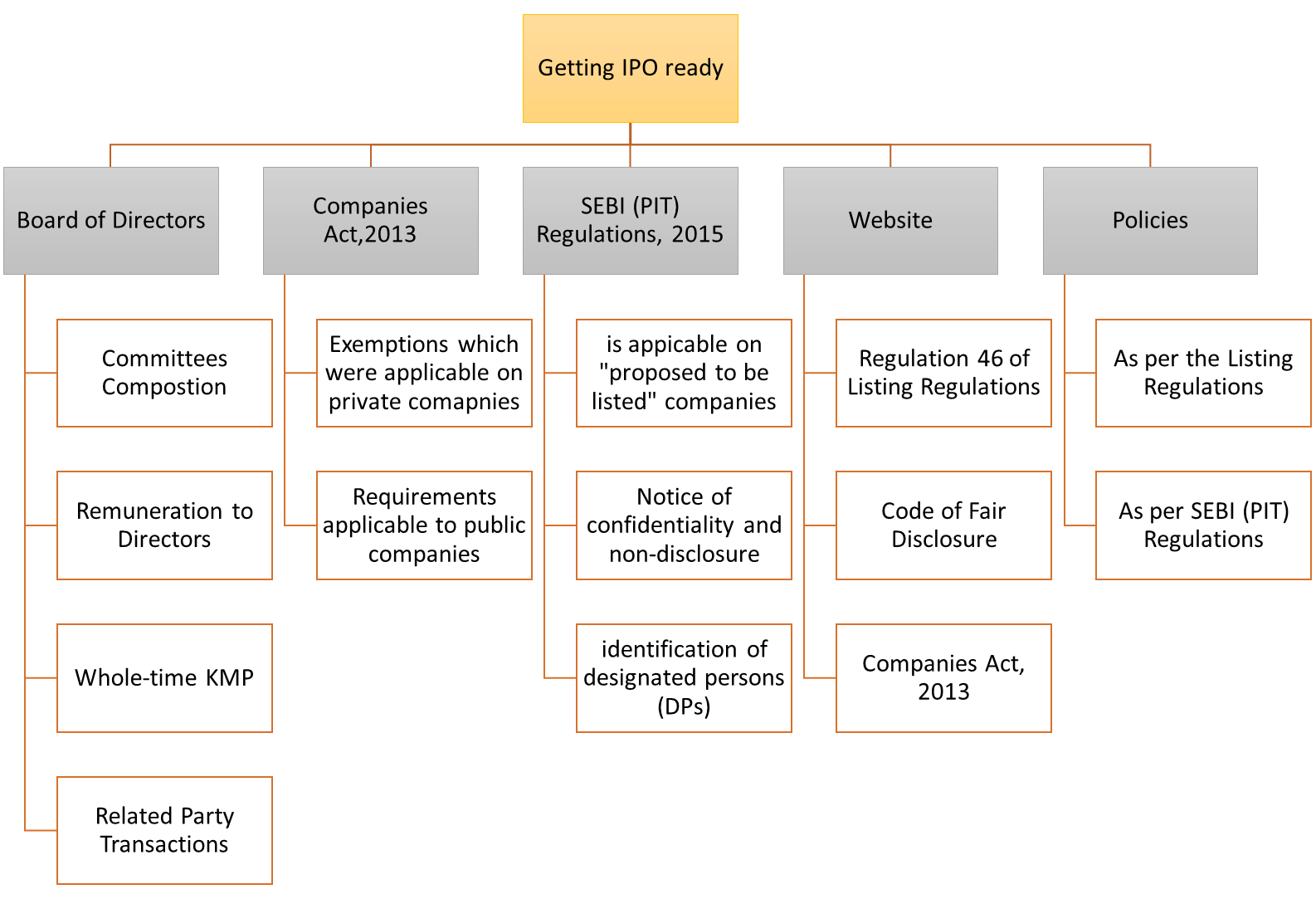
A snap shot of compliances one is required to be adhere to as a part of prepping up for an IPO can be seen below:

Board of Directors

Starting from the composition of the Board to the remuneration of the managerial personnel and requirement of Whole-time Key Managerial Person to review of all existing and probable related party transactions, all of these needs a reconsideration from the transition from a closely held company to a listed company.

Composition

The Board shall comprise of at least one woman director. At least 50% of total directors shall be non-executive directors (NEDs). The requirement of appointment of independent directors (IDs) shall also be adhered to as per the Listing Regulations.

Committees

·         Audit Committee

Audit Committee shall have at least 3 members out of which at least 2/3rd members shall be IDs. The Chairperson of this Committee shall also be an ID and CS of the Company shall be the Secretary of the Committee.

·         Nomination and Remuneration Committee (NRC)

NRC shall have at least 3 directors. Only NEDs can become members of NRC. At least 2/3rd members of NRC shall be IDs. The Chairperson of NRC shall be an ID only and chairperson of the Company, whether ED or NED, may become a member of NRC but shall not chair such committee.

·         Stakeholders Relationship Committee (SRC)

SRC shall constitute of at least 3 directors, with at least one being an ID. The Chairperson of SRC shall be a NED.

  • Risk Management Committee (RMC)

As of now, requirement of constitution of RMC is applicable only on top 1000 listed companies. RMC shall consist of at least 3 members, majority of which shall member of the Board, with at least one being an ID.

Related Party Transactions

The ambit of related party shall be widened as it is not limited only to section 2(76) of the Companies Act, 2013 (‘the Act’), but also includes related parties as per Ind AS-24. All related party transactions shall be approved by only those members of the Audit Committee, who are IDs. All ‘material related party transactions’, as defined under Regulation 23 of the Listing Regulations, shall require approval of the shareholders and no related party shall vote to approve such resolution.

Whole-time Key Managerial Personnel (‘KMP’)

Pursuant to section 203 of the Act, read with Rule 8 of the Companies (Appointment and Remuneration of Managerial Personnel) Rules, 2014, every listed company shall ensure it shall have the following Whole-time KMP:

  • Managing Director, or Chief Executive Officer or Manager and in their absence, a Whole-time Director;
  • Company secretary; and
  • Chief Financial Officer.

Managerial Remuneration

Pursuant to listing, section 197 of the Act shall become applicable on a company. Therefore, it must ensure that the remuneration to managerial personnel is as per the limits prescribed under this section, before coming with an IPO. The Company is also required to pass a special resolution in case-

  • Remuneration payable to a NED exceeds 50% of the total remuneration payable to all NEDs; and
  • Remuneration payable to EDs who are promoters or a part of promoter group, which is exceeding the limits prescribed under Regulation 17(6)(e) of the Listing Regulations.

Provisions of Companies Act, 2013 applicable on listed entities

A company which is closely held is entitled to certain exemptions under the Act. However, pursuant to listing, the veil of all these exemptions gets lifted in the following manner:

  • Pursuant to [2]MCA Notification dated June 05, 2015, private companies are exempt from compliances with various provisions of the Act like section 160, 162 and 180 etc. But due to listing, all these exempted provisions become applicable; and
  • Various provisions like section 152(6) and 196 of the Act, which are only applicable on public companies, shall also become applicable on a private company post-listing. Therefore, the Company should ensure that provisions of these sections are complied with before an IPO.

SEBI (Prohibition of Insider Trading) Regulations, 2015 (‘the PIT Regulations’)

The PIT Regulations, 2015 defines ‘proposed to be listed’ company as an unlisted company, whose securities are getting listed pursuant to filing of offer documents or other documents or pursuant to any merger or amalgamation. Prevention of Insider Trading in a company becomes inevitable in case its securities get listed. Therefore, the PIT Regulations also requires a company, even if it is proposed to be listed, to comply with its provisions. There are also few compliances which a company should be prepared with before coming up with an IPO:

  • The Board should formulate and publish on its official website, a code of practices and procedures for fair disclosure of unpublished price sensitive information that it would follow in order to adhere to each of the principles set out in Schedule A to the PIT Regulations. A policy for determination of ‘legitimate purposes’ shall also form a part of this Code;
  • Any person in receipt of UPSI pursuant to a “legitimate purpose” shall be considered an “insider” and due notice shall be given to such persons to maintain confidentiality of such unpublished price sensitive information in compliance with these regulations; and
  • Before listing, the Company should identify its ‘designated persons’ who shall be governed by the Company’s Code of Conduct on Insider Trading.

Website

Companies Act, 2013 does not mandate a company to create a website. However, pursuant to listing, Regulation 46 of the Listing Regulations gets triggered which mandates it to maintain a functional website and upload various information on it as mentioned under Regulation 46(2). We discussed above about the Code of Fair Disclosure which companies are required to make under the PIT Regulations. This Code is also required to be disseminated on the website of the Company. Companies Act, 2013, requires following information to be disclosed on the website of a company, in case it maintains, –

  • Details of business
  • Invitation of Deposits
  • Closure of books
  • Statement for unpaid Dividend Account
  • Corporate Social Responsibility
  • Consolidated Financial Statements
  • Terms and conditions of appointment of IDs
  • Notice of candidature for directorship
  • Notice of resignation from directorship
  • NRC Policy

Policies

The Listing Regulations and PIT Regulations require a listed company to prepare various policies. As launching an IPO is itself a cumbersome process and requires a lot of other compliances to be fulfilled a prospective issuer should prepare these policies beforehand. The following policies required to be made are: –

Conclusion

As we have discussed, there are many companies which have been raising funds through IPOs this year and mere compliance of checklist of ICDR Regulations is not sufficient for a company from transition from an unlisted to a listed company. Potential issuers must bear in mind that pursuant to listing, the money of retail individual investors also vests with a company and thus requires good corporate governance practices.

[1] https://www.careratings.com/upload/NewsFiles/SplAnalysis/FDI%20Update%20-%20H1%20FY21.pdf

[2] https://www.mca.gov.in/Ministry/pdf/Exemptions_to_private_companies_05062015.pdf

You may also refer to our video on Appraising post-IPO governance requirements – https://www.youtube.com/watch?v=CXh3tiISxxY

Concerns on Going Concern Sale under IBC – To be or not to be ?

Parth Ved, Executive

[resolution@vinodkothari.com]

 The Standing Committee on Finance (“Standing Committee”), on 3rd August, 2021, issued its Report on Implementation of Insolvency and Bankruptcy Code – Pitfalls and Solutions[1] wherein it has recommended the deletion of and suitable amendment in Regulation 32(e) and Regulation 32(f) of the Insolvency and Bankruptcy Board of India (Liquidation Process) Regulations, 2016 (“Liquidation Process Regulations”) respectively, which deal with sale of the corporate debtor or its business as a going concern.

The said recommendation comes in light of the mismatch of sorts between the Code and the Liquidation Regulation w.r.t. closure of business vide going concern. In this article, we discuss and analyse the recommendations made by the Standing Committee, and present our case as to why such recommendation may not be in the interest of the Code and its stakeholders.

Background:

Before delving further into the rationale of the said recommendation, and whether such recommendations ought to be implemented, it is important to understand what is a going-concern – suggestive of its name, a ‘going concern’ indicates continuity or the ability of the business to be carried out as is. Hence, in simple terms a ‘Going Concern sale’ (GCS) means the sale of all the assets, tangibles or intangibles and resources, needed to continue to operate independently a business activity which may be whole or a part of the business of the corporate debtor, without values being assigned to the individual asset or resource.

Interestingly, in a GCS, the legal entity of the company also forms part of the ‘property’ being transferred. Hence, the sale of an entity as a going concern implies that the entity would be functional as it would have been prior to initiation of sale, retaining the same name and style[2].

The power to sell the assets of the corporate debtor as a going concern was added to Regulation 32 of the Liquidation Process Regulations vide amendment dated October 22, 2018. Consequently, Regulation 32 was substituted with the following:

“32. Sale of Asset etc. –

The liquidator may sell –

(a) an asset on a standalone basis;

(b) the assets in a slump sale;

(c) a set of assets collectively;

(d) the assets in parcels;

(e) the corporate debtor as a going concern; or

(f) the business(s) of the corporate debtor as a going concern:

Provided that where an asset is subject to security interest, it shall not be sold under any of the clauses (a) to (f) unless the security interest therein has been relinquished to the liquidation estate.”

Rationale given by the Standing Committee:

The Standing Committee has proposed to delete clause (e) and consequently amend clause (f) stated above in light of the stand taken by the Hon’ble Principal Bench of NCLT in the matter of Invest Assets Securitisation & Reconstruction Pvt. Ltd vs. Mohan Gems & Jewels Pvt. Ltd.[3] stating that liquidation requires dissolution under the Insolvency and Bankruptcy Code, 2016 (IBC) and hence regulations that provide for liquidation as a going concern are ultra-vires the provisions of the Code and that the legislation has created further uncertainty. The said order, as well as the recommendation of the Standing Committee crops from the supposed reason that a liquidation process shall mandatorily end by dissolution.

With this pretext, the Author humbly deviates from the views put forth by the Standing Committee, and suggests that ruling out the option of a going-concern, merely on grounds of non-alignment in the extant provisions would be disproportionate, and hence, undesirable.

Below we discuss several grounds / reasons which further prove a good case for a going-concern sale under liquidation.

Reasons backing Going-concern Sales in liquidation:

  1. Value Maximisation

It is a common economic understanding that sum of parts is better than sum of the parts; and it is by virtue of such principle that going-concern values are generally in excess of value of individual assets. The various assets, stitched together as one, constitute a much greater value than the same assets in isolation.

As such, selling assets on a piece-meal basis might not be lucrative for the buyers due to the loss of synergic benefit arising from purchasing a going concern leading to an ultimate loss to the creditors of the corporate debtor. This is in addition to the fact of loss of jobs of several employees of the corporate debtor which might have been saved in case of sale as a going concern.

Recognising this, various Adjudicating Authorities have, in the past, allowed the sale of the corporate debtor as a going concern for value maximisation.  In the matter of M/s. Gujarat NRE Coke Limited[4], the Hon’ble NCLT, Kolkata Bench held:

“The Liquidator shall try to dispose of the Corporate Debtor company as a going concern after publication of notice in newspaper with the reserve price which shall be equal to the total debt amount including interest and maximum period applicable for trying the sale of the Corporate Debtor as a going concern will be only three month from the date of the order if the process of sale as a going concern is failed during this period, then process of the sale of the assets of the company will be according to the provisions of sale of asset of the Corporate Debtor prescribed under section 33, Chapter VI of the Insolvency & Bankruptcy Board of India (Liquidation Process) Regulations, 2016. In case it is not concluded within this period, the order of this Court directing the sale of the company as a going concern shall stand set aside and corporate debtor to be liquidated in the manner as laid down in Chapter III of the Liquidation process provided in Insolvency & Bankruptcy Code.”

Further, it is commonly observed that NCLTs across jurisdictions have followed the practice of directing liquidators to endeavor a GCS prior to other modes of sales envisaged under the Liquidation Process Regulations.

  1. Maintaining Timeliness

A liquidator may find it difficult to complete the sale of all the assets of the corporate debtor (piece by piece) in the stipulated 1 year period, to finally make an application of dissolution as provided under Section 54. This may result in failure in fulfilment of one of the key objectives of enacting IBC, that is, timely completion of the proceedings.

Allowing the liquidator to sell the corporate debtor as a going concern proves to be time and cost effective, as well as saves the effort of the liquidator to find multiple buyers for multiple assets of the corporate debtor; hence, resulting in faster realisation for the creditors which is the ultimate aim of this entire exercise.

While relying on Regulation 32(e) of the Liquidation Process Regulations, the Hon’ble Supreme Court in the matter of Arcelor Mittal India Private Limited Vs. Satish Kumar Gupta & Ors[5] observed that:

“The only reasonable construction of the Code is the balance to be maintained between timely completion of the corporate insolvency resolution process, and the corporate debtor otherwise being put into liquidation. We must not forget that the corporate debtor consists of several employees and workmen whose daily bread is dependent on the outcome of the corporate insolvency resolution process. If there is a resolution applicant who can continue to run the corporate debtor as a going concern, every effort must be made to try and see that this is made possible.” (emphasis supplied)

  1. Ouster of Going-concern sales due to language of law – A Disproportional Approach

Another key objective of IBC is to provide a painless revival mechanism for entities. Hence, a technical gap in the wordings of the IBC and Liquidation Process Regulations, which is easily fixable, should not act as a hindrance for fulfilment of this objective. Such an ouster would be in contravention to the doctrine of proportionality.

The Bankruptcy Law Reforms Committee (BLRC), in its Report[6], had also recognised GCS as an effective method of realization of assets and stated that from the viewpoint of creditors, a good realisation can generally be obtained if the firm is sold as a going concern[7].

The approach of BLRC was well-found and well-reasoned. Removing such enabling clauses from regulations merely due to lack of clear language in law would thus be disproportional and against the objective for which the provisions were first inserted.

  1. Is dissolution the only result of liquidation?

Unlike winding-up, where the aim is to dissolve the entity, liquidation implies liquidating the entity and the main objective is to sell-off the asset(s) at a maximum value for realization and not necessarily kill the entity. In line with this objective, various Adjudicating Authorities have, in the past, allowed GCS in liquidation process.

In Gaurav Jain v. Sanjay Gupta, Liquidator of Topworth Pipes and Tubes Pvt. Ltd.[8], the Adjudicating Authority noted that even though there is no specific provision in IBC for “sale of the Company as a going concern”, the Liquidation Process Regulations provide guiding principles in dealing with the case. It held that “going concern” sale, in normal parlance, is transfer of assets along with the liabilities. However, as far as the ‘going concern’ sale in liquidation is concerned, there is a clear difference that only assets are transferred and the liabilities of the corporate debtor has to be settled in accordance with Section 53 of IBC and hence the purchaser of the assets takes over the assets without any encumbrance or charge and free from the action of the creditors. The legal entity of the corporate debtor survives and the assets with claims, limitations, licenses, permits or business authorisations remain with the corporate debtor. Only the ownership of the corporate debtor is acquired by the successful bidder and all creditors of the corporate debtor get discharged.

In Y. Shivram Prasad v S. Dhanapal & Ors.[9], the Appellate Authority ordered:

“…during the liquidation process, step required to be taken for its revival and continuance of the ‘Corporate Debtor’ by protecting the ‘Corporate Debtor’ from its management and from a death by liquidation. Thus, the steps which are required to be taken are as follows:

  1. By compromise or arrangement with the creditors, or class of creditors or members or class of members in terms of Section 230 of the Companies Act, 2013.
  2. On failure, the liquidator is required to take step to sell the business of the ‘Corporate Debtor’ as going concern in its totality along with the employees.
  3. The last stage will be death of the ‘Corporate Debtor’ by liquidation, which should be avoided.”

The Discussion Paper on Corporate Liquidation Process dated April 27, 2019[10] also recognized that the corporate debtor may continue to exist with or without business on completion of the process in case of a GCS. Even if an order under Section 33 of IBC has been passed for liquidation of a corporate debtor, on completion of GCS under IBC, the corporate debtor may not be liquidated or dissolved.

  1. Facts and figures

According to the Quarterly Newsletter of the Insolvency and Bankruptcy Board of India Vol.18[11], till March 31, 2021, out of a total of 138 cases of closure of liquidation proceedings, 128 liquidations (i.e. 92.75%) closed by dissolution, 6 (i.e. 4.35%) by going concern sale and 4 (i.e. 2.90%) by compromise /arrangement. The cases of closure by going concern sale had claims amounting to Rs. 4325.16 crore, as against the liquidation value of Rs. 290.03 crore. The liquidators in these cases realised Rs. 336.76 crore and companies were rescued. Therefore, it can be rightly said that going forward, going concern sale can be an important tool of value preservation.

  1. Whether retaining GCS has any negative implications

Notably, GCS is only an option of ‘sale’. No harm accrues to the stakeholders if the entire entity can be sold as going concern. While it might be relevant to reconsider the regulations which mandate the liquidator to first attempt a GCS. It must be totally left to the wisdom of the liquidator to attempt or not to attempt a GCS, depending upon the market, investor interest, status of the assets, etc. Recognizing this, the Insolvency Law Committee (ILC) in its Report (2020)[12] noted that the liquidator is best placed to decide whether a going concern sale should be attempted, after assessing relevant factors such as the commercial viability of the business of the corporate debtor, and consulting the relevant stakeholders of the corporate debtor to ensure that it would generate a greater value than the other modes of liquidation. The Committee also agreed that GCS should not be mandated during liquidation and that the liquidator, in consultation with the relevant stakeholders of the corporate debtor, should be permitted to decide if a going concern sale should be attempted.

Addressing the incompatibility between Schemes of Arrangement under Section 230 of the Companies Act, 2013 and the liquidation as envisaged under IBC, the ILC stated that repeatedly attempting revival, through schemes of arrangement or otherwise, even where the business is not economically viable is likely to result in value destructive delays, and was identified as a key reason for the failure of the regime under the SICA, by the BLRC in its Interim Report. Indeed, where the business of the corporate debtor is still viable, the liquidator would have recourse to a going concern sale of the business to ensure that the liquidation process remains value maximizing. We, in our earlier article too, had questioned the need of a scheme under Section 230 of the Companies Act, 2013 in IBC which can be accessed here.

Having discussed the above, a possible counter-view that may be taken is that if sale as a going concern is allowed, the resolution applicant may prefer to wait for initiation of liquidation proceedings to buy the corporate debtor at a discounted value since liquidation value will always be lower than the value he would have had to shell out in insolvency resolution stage.

However, this may not be a well-backed stance because of the following reasons:

  • The insolvency resolution process is a very competitive stage consisting of multiple applicants waiting for an opportunity to get an entity at a reasonable value. Should an applicant choose to wait till the liquidation proceedings, offer of a competitor applicant may get selected in the insolvency resolution itself. Hence, there would be a substantial risk of losing out the asset.
  • Resolution Plans further prove to be more commercially attractive since the repayment schedule can be spread over multiple years as per the resolution plan while in liquidation the entire amount will have to be paid upfront.

Order of Hon’ble NCLAT, Principal Bench

The Hon’ble NCLAT, Principal Bench, vide its order dated August 24, 2021[13], has upheld the validity of a GCS during liquidation by dismissing the order given by the Hon’ble NCLT, Principal bench in Invest Asset Securitisations & Reconstruction Pvt. Ltd (supra), based on which the Standing Committee had recommended the removal of clause pertaining to the sale of corporate debtor as a going concern. The NCLAT, in its order, stated the following:

  • The Tribunal can only ascertain whether the procedures provided for under the Code / Companies Act, 2013 are being followed or not and cannot look into the legality and propriety of any Regulation / Notification / Rules / Act.
  • The Supreme Court has in a catena of judgements observed that liquidation should be the last resort only if the Resolution Plan submitted is not up to the mark and even in liquidation, the liquidator can sell the business of the corporate debtor as a ‘going concern’.
  • The Appellate Authority and the Adjudicating Authority, too, in many recent decisions, have directed the liquidators to make efforts to sell the corporate debtor as a going concern. It helps in realisation of higher value, value preservation, and rescuing a viable business.

By allowing the sale of corporate debtor as a going concern in liquidator, the NCLAT has made it clear that it is not disproportional to the Code and dissolution need not be the only outcome of liquidation.

Concluding remarks

It is pertinent to note that the Code does not prevent the closure of liquidation process in the instance the corporate debtor is sold as a going concern pursuant to Regulation 32(e) following the final closure report filed under Regulation 45(3)(a) of the Liquidation Process Regulations. It would, therefore, be contradictory to observe that closure of Liquidation Proceedings cannot be done and only dissolution is provided for under the Code. This would demolish the very spirit and objective of the Code.

Thus, it is once again emphasized that ouster of a widely acknowledged mode of sale, merely on account of a disparity in law would not be in favour of the Code and its stakeholders. In this pretext, it will be interesting to see the fate of this recommendation of the Standing Committee. Further, removal of the provision for going-concern for want of alignment would create a vacuum which could be potentially prejudicial for the Code and its stakeholders.

[1] https://www.ibbi.gov.in/uploads/whatsnew/fc8fd95f0816acc5b6ab9e64c0a892ac.pdf

[2] See detailed analysis on sale of legal entity of a corporate debtor at –https://vinodkothari.com/2020/11/sale-of-legal-entity-as-an-asset/

[3] https://nclt.gov.in/sites/default/files/Interim-order-pdf/Invest%20Assets%20Securitisation%20%26%20Reconstruction%20Pvt%20Ltd%20Vs.%20Mohan%20Germs%20%26%20Jewels%20Pvt%20Ltd._1.pdf

[4] http://164.100.158.181/Publication/Kolkata_Bench/2018/Others/13.pdf

[5]https://www.ibbi.gov.in/webadmin/pdf/whatsnew/2018/Oct/33945_2018_Judgement_04-Oct-2018_2018-10-04%2018:02:45.pdf

[6] https://ibbi.gov.in/BLRCReportVol1_04112015.pdf

[7] Page 15

[8] http://primusresolutions.in/pdf/Order-by-NCLT-for-successful-sale-as-Going-Concern.pdf

[9] https://nclat.nic.in/Useradmin/upload/212469115c8a433965360.pdf

[10] https://ibbi.gov.in/Discussion%20paper%20LIQUIDATION.pdf

[11] https://ibbi.gov.in/uploads/publication/2021-05-29-204331-atxcy-3363461de858b06bfa1afdbf13151b90.pdf

[12] https://www.mca.gov.in/Ministry/pdf/ICLReport_05032020.pdf

[13] https://ibbi.gov.in//uploads/order/ed29b92ace06f136a9060e3964e27ad8.pdf

Consolidation of SEBI regulations on non-convertible securities

SEBI measure may ease out issuance of debt securities

Introduction –

By a 9th August, 2021 Notification, SEBI has consolidated the regulatory framework pertaining to issue of non-convertible debentures (‘NCDs’), non-convertible preference shares (‘NCPS’), perpetual debt securities (‘PDIs’), and listed commercial paper. Along with the consolidation exercise, SEBI has also tried to iron out some of the difficulties being faced in respect of debt issuance by companies. Accordingly, the new SEBI (Issue and Listing of Non-Convertible Securities) Regulations, 2021 (‘NCS Regulations’), notified on 9th August, 2021, have the effect of merging (and consequently, repealing) the SEBI (Issue & Listing of Debt Securities) Regulations, 2008 (‘ILDS Regulations’) and SEBI (Issue & Listing of Non-Convertible Redeemable Preference Shares) Regulations, 2013 (‘NCRPS Regulations’)

The NCS regulations have been introduced in line with the Draft Consultation Paper[1] (‘Consultation Paper’) issued by SEBI on the subject on 19th May, 2021.

In this article, we discuss and highlight the important changes incorporated in the NCS Regulations as compared to the ILDS Regulations and NCRPS Regulations.

Effective date and prospective applicability

The regulations shall be effective on the 7th day from the date of their publication in the Official Gazette i.e. 16th August, 2021.

As to whether NCS Regulations are applicable on issuances done before the effective date, it is evident from a reading of regulation 4(2) that NCS Regulations are to be satisfied by the issuer as on the date of filing draft offer document/offer document with SEBI, stock exchanges and RoC. This indicates that securities which are already floating in the market pursuant to issuances done before 16th August, 2021, NCS Regulations should not make a difference. Hence, the new regulations shall be applicable only to new issuances or new listing applications made on or after August 16, 2021.

The view is further substantiated by the fact that –

  • There is no grandfathering clause in the NCS Regulations, and
  • The provisions pertaining to ‘repeal and savings’ provide for continuation of “right, privilege, obligation or liability acquired, accrued or incurred under the repealed regulations” as if the repealed regulations have never been repealed – see discussion later.

Rationale behind the fused regulations–

Debentures, specifically non-convertible debentures, are purely debt instruments. However, NCRPS are hybrid instruments combining characteristics of both debt and equity thereby being ‘quasi-debt instruments’. Due to this reason, the NCRPS regulations were mostly modelled based on the ILDS regulations providing similar provisions on eligibility conditions, disclosure requirements, etc. Therefore, merging the two regulations would only be reasonable. The move to merge both these regulations may not be a complete solution to the regulatory chaos, but is definitely in the direction to combat multiplicity of laws. Further, the NCS Regulations also aim to –

  • Harmonise provisions of the Companies Act, Rules made thereunder and SEBI Regulations
  • Align various circulars, guidelines issued by SEBI
  • Identify policy changes in line with the present market practices for ease of doing business
  • Merge all the existing circulars into a single operational circular

Repeal of existing regulations –

The NCS regulations shall repeal the existing ILDS Regulations and NCRPS Regulations from the effective date. Reference to any provision under these regulations shall be deemed to make reference to corresponding provisions in the NCS regulations.

Applicability of the NCS Regulations-

The following have been covered by the NCS Regulations:
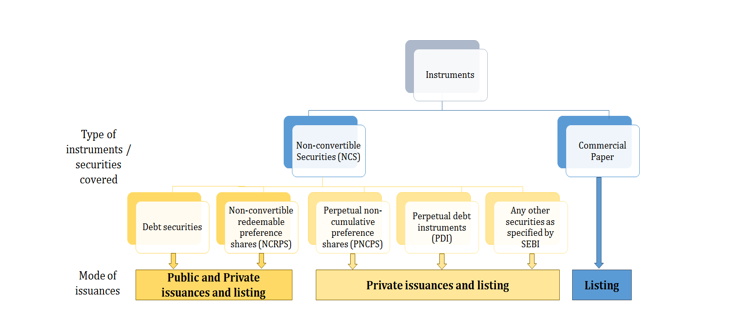
Definition of Debt securities –
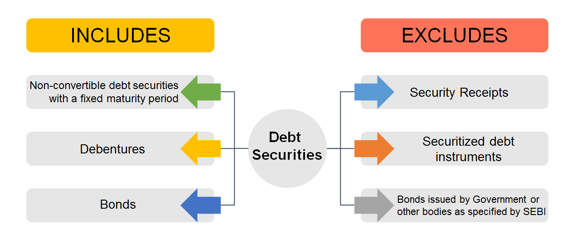
 

 Listing of Commercial Paper

Another important point to note is that the NCS Regulations only deal with listing of CP and issuance thereof shall not be covered. The NCS Regulations have adopted the earlier SEBI Circular on Listing of CPs with respect to provisions on the said subject. The caveats relating to eligibility, mode of issuance, etc. shall still be governed by the provisions of RBI read with FIMMDA operational guidelines.

Only additional caveats arising from the NCS regulation for the issuer is that they shall be required to register on SCORES Platform. In case the entity has its NCDs or NCRPs listed they are already required to register on SCORES Platform in terms of SEBI (Listing Obligation and Disclosure Requirements) Regulations, 201 (‘LODR Regulations’).

Issuers covered under the NCS regulations
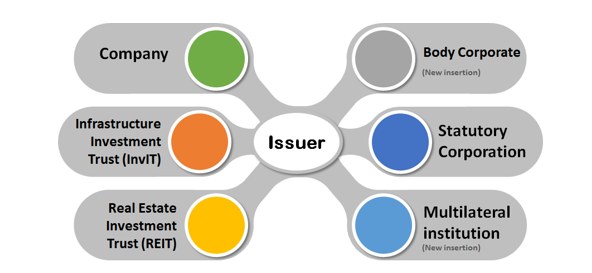
 

Point at which conditions are to be satisfied

There are several conditions in the NCS Regulations which the issuer needs to fulfil as on the date of filing draft offer documents/offer documents – see, regulation 4(2). For instance, as on the date of filing of draft offer document or offer document, neither the issuer its promoters, promoter group or directors should be debarred from accessing the securities market or dealing in securities by SEBI, none of the promoters or whole-time directors of the issuer shall be promoter or whole-time director of another company which is a wilful defaulter. Therefore, if this condition is, say, breached after the securities are listed, the issuer shall not be seen as in breach of the regulations.

While most of the requirements have been retained from the erstwhile regulations, the NCS regulations also additionally prohibit any issuer from making an issue if as on the date of filing of the draft offer letter, if any of its promoters or whole-time directors are a promoter or whole-time director of another company which is a wilful defaulter.

Whether LLPs can issue debentures?

Key highlight of the definition of “issuer” under the NCS Regulations is inclusion of the term “body corporate”. The erstwhile definition of “issuer” under the ILDS Regulations did not include body corporates. Several rulings have established that an LLP is, in fact, a body corporate. Accordingly, this exclusion raised a question on the permissibility of listed debt issuances by an LLP. It was always, therefore, deemed that LLPs could only issue unlisted debt securities while listed debt securities by LLPs was not permitted by the ILDS Regulations. The said inclusion of “body corporate” in the definition of “issuer” will, therefore, enable LLPs to issue listed debt securities as well as NCRPS, thereby making way for further raising of funds.

However, the same shall be subject to any conditions in the LLP Act, 2008. The Company Law Committee Report[2] for decriminalization of LLP Act also discussed on raising of funds through issuance of secured non-convertible debentures to bodies corporate or trusts regulated by SEBI or RBI with certain fetters and suggested inclusion of new section in the LLP Act, 2008 for the same.

Highlights

1)      Appointment of Debenture Trustee for all issues of debt security

The ILDS Regulations provided for appointment of a Debenture Trustee (’DT’) for public issuance of debt securities. While there was no explicit requirement for the appointment of debenture trustee for private placement of debt securities in the ILDS Regulations, in terms of Companies Act, 2013 (‘CA, 2013’) and SEBI Circular dated November 03, 2020, security was required to be created in the favour of a DT. Accordingly, there was no clarity as to the appointment of debenture trustee in case of issuance of unsecured NCDs through private placement.  The NCS regulations now provide for mandatory appointment of DTs in case of all issuances of debt securities (Regulation 8 of the NCS Regulations).

Our Comments –

The same is a welcome change as it provides the required clarity on appointment of DTs. Considering the increasing relevance and importance of DTs in case of debt issuances, appointment of DTs in case of all debt securities becomes all the more important.

2)      Widened applicability of EBP platform

The EBP platform is presently applicable to private placements of debentures amounting to Rs. 200 crores and above in a financial year.  SEBI, in its Consultation Paper, proposed to reduce such limit to Rs.100 crores or above and making EBP mandatory for issues breaching the said limit.  The same was proposed considering the benefits of the EBP platform and need for further increased participation from issuers and investors.

The said change did not reflect either in the draft or the final regulations. The revision in the limits may be made in the EBP Circular by SEBI.

Our Comments –

The concept of the EBP was introduced by SEBI with a view to make participation in the privately-placed bond market more inclusive. Electronic bidding platforms are there in several other markets – however, in most cases, these are private bidding engines, and are optional.

The private placement market in India is completely bespoke in nature, and issuances are almost completely OTC negotiations. In order to remove the veil of opacity, and allow a larger base of investors to participate, the EBP mechanism was introduced.

However, various market participants are averse to the EBP platform. Lengthy procedures delay the process for issuers which may not be suitable for a sensitive debt market. Different EBP platforms have different procedures thereby causing confusion. Most issuers still continue to negotiate on OTC basis and place the offer on EBP or make use of regulatory arbitrage methods such as market-linked debentures (‘MLDs’).

Therefore, increasing the scope of applicability of EBP may not be conducive to the Indian bond market. SEBI may consider making the EBP optional rather than mandatory. Where the issuer desires a wider audience for its proposed issue, the issuer may put the offer on the bidding platform. However, where an OTC deal is done, the issuer should be allowed to go ahead with the private placement straightaway. A potential investor wanting to invest therein will still have the chance to participate in the secondary market.

3)      Private Placement Requirements

The NCS Regulations [regulation 44(2)] clarify the ambiguity regarding issuance of debt securities on private placement basis by a company in existence for less than three years. The requirement to provide annual reports for previous three years while making an application for listing presumed the requirement for a company to be in existence for at least three years to list its privately placed debentures. However, the proviso to regulation 44(2) resolves the above by specifying that ‘provided that issuers desirous of issuing debt securities on private placement basis who are in existence for less than three years may provide Annual Reports pertaining to the years of existence.

4)      Exercise of Call or Put Option (Right to recall or redeem prior to maturity date) 

The erstwhile provisions for issuance of non-convertible debt securities, provided framework for right to recall (i.e. Call Option) and right of redemption (i.e. Put Option) prior to maturity, in case of public issue of NCDs. In case of private placement of NCDs, the same was entirely guided by the terms of issue.

However, the NCS regulations have now stipulated that provisions relating to call and put option shall equally apply in case of public issuances as well as private placement.

This seems to take away the flexibility that issuers enjoyed in certain cases for issuers of privately placed debentures for example, where an interest rate in case of delay on part of the issuer could be avoided or kept at a minimal rate, the same will be charged at 15% interest rate.

It may be noted here that there is an apparent change in the language – while regulation 15 of NCS Regulations uses “shall”, regulation 17A of ILDS Regulations used “may”. However, this change in language does not change the law – it is still a ‘right’ in the hands of the issuer to “recall” the securities using a “call option” or “provide a right” to investors to “redeem” the securities using a “put option”. As it is a matter of right to the issuer, the right can still be exercised (or not exercised) by suitably providing for the same in the terms of issue.

Also, regulation 15 itself specifies that the issuer shall have a right to provide such right of redemption of debt securities prior to the maturity date (put option) to all the investors or only to retail investors.

The NCS Regulations do not state the time period for payment of interest, which was specified as 15 days from the day from which such right could be exercised under the erstwhile provisions.

Our Comments –

Since the Call and Put Option are exercised in accordance with the terms of issue and detailed disclosure made in this regard in the offer document, the issuers of privately placed debt securities issued prior to the NCS Regulations can provide these options after the expiry of one year from date of issue and only if it was disclosed in the offer document.

Further, it must be noted that the ‘call option’ feature would be relevant for debt securities as well as NCPS; however, ‘put’ option feature will only be relevant for debt securities. This is because a ‘put option’ enables the investor to exercise a ‘right’ to sell the securities to the issuer. Redemption of preference shares can either be done out of profits of the company or out of fresh issue of shares, as per Section 55 (2) (a) of Companies Act. In case the put option is exercised, the company will be under obligation to redeem and this may result in violation of section 55 in case the issuer is not able to redeem in the prescribed manner. Hence, while clause (a) of regulation 15(1) applies to all non-convertible securities (debt + NCPS), clause (b) applies only to debt securities.

5)      Exemption from restriction of use of proceeds

Issuers of non-convertible securities are prohibited from using proceeds from issuances of such securities for providing loans to or acquisition of shares of entities under their promoter group or group companies. The erstwhile laws failed to distinguish between a financial entity and non-financial entity as regards to the nature of business.  Therefore, the said restriction was applicable in case of all listed entities alike.

The NCS regulations provide the much needed relaxation from the said clenching restriction in case of a Non-Banking Finance Company (‘NBFC’), Housing Finance Company (‘HFC’)  and a Public Financial Institution.

Our Comments –

The intent behind the restriction was to discourage using public money for funding group entities. However, providing loans or acquiring securities aren’t peculiar transactions in case of NBFCs and HFCs since they are ordinarily in such business.

6)      Validity of shelf prospectus:

In case of Public Issue of debt securities:

The ILDS Regulations provide that not more than four issuances can be made under a single shelf prospectus while there is no such restriction under the Companies Act. To enable issuers to raise funds quickly without filing a separate prospectus each time, this restriction has been removed from NCS Regulations.

In case of private placement of debt securities:

The time validity of shelf prospectus in case of private placement of debt securities has been increased from 180 days to 1 year.

Our Comments –

This is a welcome move, as this will eliminate hassles for frequent issuers to file shelf prospectus multiple times.

7)      Criteria of eligible issuer

Under the NCS Regulations, the condition that the issuer shall not be debarred from accessing the securities market or dealing in securities has been extended to promoter group entity as well. Further, certain additional conditions such as the promoter or WTD shall not be a promoter or WTD of a company which is a wilful defaulter, no promoters or directors shall be fugitive economic offenders or no fines or penalties are pending at the time of filing of offer document have been inserted.

Our Comments –

Associating payment of fines and penalties with listing might not be a feasible idea; as there might be situations where the issuer may have raised disputes/concerns on liability to pay such fines/penalties.

8)      Additional Disclosures for NBFCs

In case the issuer is an NBFC/HFC additional disclosures on asset liability management are required to be provided pertaining to the latest audited financials. The same was not required under the ILDS Regulations. The disclosures also include details of contingent liabilities specifying the nature and amount of such liabilities.

9)      Companies existing for less than 3 years – Annual report submission provision

As per the NCS Regulations in case an issuer who has been in existence for less than 3 years is desirous of issuing debt securities, annual reports pertaining to years of existence have been permitted to be provided.

10)  Creation of Recovery Expense Fund – Whether applicable in case of NCPS?

Under the NCPs regulations requirement of maintenance is included under the general conditions applicable in case of public issuance of debt securities and NCPs and private placement of NCS. However, due regard must be given to SEBI circular dated October 22, 2020[3] which provides the manner and mode for creation and maintenance of recovery expense fund, specifically restricts the requirement only in case of issue of debt securities. Moreover, it may be noted that preference shares can be redeemed only out of profits and out of proceeds of new issuances (as provided for under section 55) and are thus, inherently different from debt securities. Hence, this requirement of recovery expense fund should not apply in case of NCPS.

11)  Minimum subscription in case of public issue of Debt Securities

The ILDS Regulations gave the option to the issuer to identify the minimum subscription, however the NCS Regulations has straight away set a bar of 75% of the base issue size. This might take away the flexibility from the issuers.

The requirement of minimum subscription is however not applicable in the case of issuance of tax free bonds as specified by the Central Board of Direct Taxes.

12)  Creation of Security

As per the ILDS Regulations, in case of secured debentures, the assets offered as collateral are required to be unencumbered provided that if the same are already charged to secure a debt, relevant permission to create a pari passu or a second charge will be taken from the existing chargeholders. This requirement was applicable to the total security cover in case of a debt issuance i.e. even in case of over-collaterisation.

However, the NCS regulations have eased out the said stipulation providing that the same shall apply on assets to the extent of 100% security cover. Thus, assets over and above the 100% security cover may be encumbered and the same may be provided as security without obtaining relevant permissions from the existing chargeholders.

For instance, if an issue of debentures is secured to the extent of 125% of the issue size – earlier the assets securing the entire 125% charge were required to be unencumbered, now only assets constituting 100% charge of the issue will be required to be unencumbered.

13)  Due Diligence

The requirement of undertaking due diligence in case of public issue of NCDs was already there in the ILDS Regulations Additionally, SEBI vide its circular dated November 03, 2020, also required DTs to undertake due diligence w.r.t creation of security, irrespective of the debentures being issued publicly or on a private placement basis. The NCS Regulations now provide for due diligence in case of private placement as well, before filing of the offer document.

Overall, it seems that the Regulations are on a positive note. The discussion above is a quick compilation of the important points which come out of the NCS Regulations. We shall be continuously updating the list above on the basis of further observations.


You may also refer to our following articles on related subjects-

  • Presentation on Corporate Bonds and Debentures

https://vinodkothari.com/2021/03/presentation-corporate-bonds-debentures/

  • SEBI’s stringent norms for secured debentures

https://vinodkothari.com/2020/11/sebis-stringent-norms-for-secured-debentures/

  • Market-Linked Debentures – Real or Illusory?

https://vinodkothari.com/2021/01/market-linked-debentures-real-or-illusory/

  • FAQs on Commercial Paper

https://vinodkothari.com/2019/11/faqs-on-commercial-paper/

Our  our Book on Law and Practice Relating to Corporate Bonds and Debentures, authored by Ms. Vinita Nair Dedhia, Senior Partner and Mr. Abhirup Ghosh, Partner can be ordered though the below link:

https://www.taxmann.com/bookstore/product/6330-law-and-practice-relating-to-debentures-and-corporate-bonds

Our presentation on the structuring of debt securities can be viewed here – https://vinodkothari.com/2021/09/structuring-of-debt-instruments/

[1] https://www.sebi.gov.in/reports-and-statistics/reports/may-2021/consultation-paper-review-and-merger-of-sebi-issue-and-listing-of-debt-securities-regulations-2008-and-sebi-issue-and-listing-of-non-convertible-redeemable-preference-shares-regulations-2013-i-_50192.html

[2] https://www.mca.gov.in/Ministry/pdf/Report%20of%20the%20Company%20Law%20Committee%20on%20Decriminalization%20of%20The%20Limited%20Liability%20Partnership%20Act,%202008.pdf

[3] https://www.sebi.gov.in/legal/circulars/oct-2020/contribution-by-issuers-of-listed-or-proposed-to-be-listed-debt-securities-towards-creation-of-recovery-expense-fund-_47939.html