India FSAP 2025: Key Takeaways and Policy Recommendations

– Chirag Agarwal, Assistant Manager | chirag@vinodkothari.com

A joint World Bank-IMF team visited India in 2024 to update the findings of the Financial Sector Assessment Program (FSAP), which took place in 2017. World Bank on October 30, 2025 released the report1 which summarises the main findings of the mission, identifies key financial development issues, and provides policy recommendations.

We were in touch with the FSA team for our recommendations on certain aspects. The FSA recommendation on leasing (discussed below) is based on our feedback.

This article discusses in brief the key takeaways from the FSA Report.

Key Takeaways:

  1. Stronger and More Diversified Financial System: As per the report, India’s financial system has become more resilient, inclusive, and diversified since the previous 2017 assessment. Non-bank financial institutions (NBFIs) and market financing (other than from banks) now account for 44% of total financial assets—up from 35% in 2017—reflecting deeper financial intermediation beyond banks.
  2. Reforms Critical for India’s 2047 Growth Vision: The report suggests that to achieve the target of a USD 30 trillion economy by 2047, India must modernize its financial architecture to channel both domestic and foreign savings into productive investment, deepen capital markets, and attract long-term infrastructure and green financing2.
  3. Macroprudential Tools: The assessment highlights rising systemic risks due to financial diversification and interlinkages. It recommends expanding data collection and deploying macroprudential tools—including introducing Debt Service to Income (DSTI) limits across banks and NBFCs and building counter-cyclical capital buffers (CCyBs) for banks to manage liquidity, intersectoral contagion, household credit risks, and climate-related financial risks
  4. Regulatory and Supervisory Enhancements: While India’s regulatory oversight framework for banks, insurers, and markets is broadly sound, lingering issues include state influence on regulators, limited powers over governance of state-owned entities, and gaps in conglomerate and climate-risk supervision. The report suggests that efforts should be made to ensure better coordination between regulators and extending the scope of the regulatory and supervisory frameworks.
  5. Banking and NBFC Reforms: The report stresses adoption of IFRS 9, enforcing Pillar 2 capital add-ons, and elimination of prudential exemptions for state-owned NBFCs. It also suggests considering additional liquidity requirements tailored to different business models.
  6. Tax  treatment of leasing: The report suggests that to diversify MSME finance the tax treatment of leasing should be reviewed to ensure an equal treatment between lease and debt transactions. At present, interest on loans is exempted under the GST laws and hence, there is no GST levied on the loan repayments, however, the entire rentals are subject to GST in case of financial leases.
  7. Transfer of oversight function of NHB to RBI: While regulation of HFCs moved to RBI in 2019, supervision still rests with NHB, which follows a limited, compliance-based approach. Shifting supervision to RBI would strengthen oversight and remove the conflict of interest since NHB also acts as promoter and refinancer for HFCs.
  8. MSME Finance: The report recommends integrating TReDs with the e-invoicing portal for automatic invoice uploads. It also suggests incentivizing large buyers and mandating state-owned enterprises to upload invoices to improve cash flow for MSMEs. Further, the report also mentions that SIDBI’s funding support to NBFCs, including NBFC factors, should be increased, along with developing credit enhancement and guarantee facilities for NBFC bonds and MSME loan securitizations.
  1. https://documents1.worldbank.org/curated/en/099103025110514063/pdf/BOSIB-606133f7-2e00-4696-9b41-57f3737d140d.pdf
    ↩︎
  2. See our resources on sustainable financing: https://vinodkothari.com/resources-on-sustainability-finance/  ↩︎

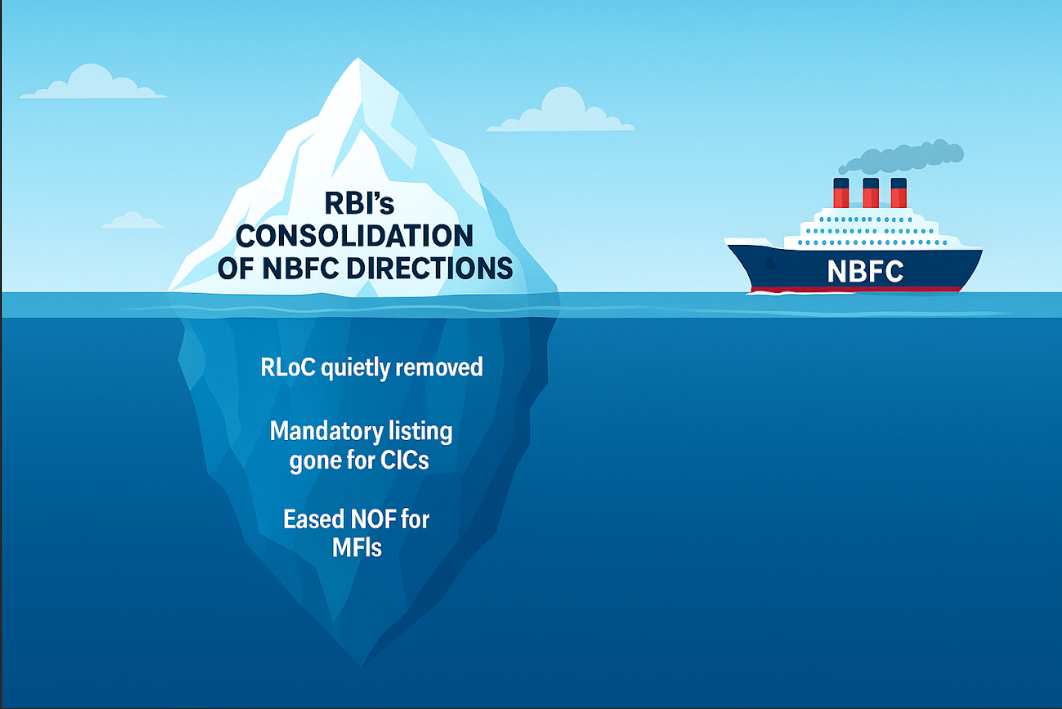
The Great Consolidation: RBI’s subtle shifts; big impacts on NBFCs

Team Finserv | finserv@vinodkothari.com

In its recent consolidation exercise of the Master Directions applicable to NBFCs, the RBI has done a lot of clause shifting, reshuffling, reorganisation, replication for different regulated entities, pruning of redundancies, etc. However, there are certain places where subtle changes or glimpses of mindset may have a lot of impact on NBFCs. Here are some:

Read more

Old Rules, New Book: RBI consolidates Regulatory Framework

Team Finserv | finserv@vinodkothari.com


Read our related resources:

Expected to bleed: ECL framework to cause ₹60,000 Cr. hole to Bank Profits

Dayita Kanodia and Chirag Agarwal | finserv@vinodkothari.com

The proposed ECL framework marks a major regulatory shift for India’s banking sector; it is long overdue, and therefore, there is no case that the RBI should have deferred it further. However, it comes coupled with regulatory floors for provisions, which would cause a major increase in provisioning requirements over the present requirements. Our assessment, on a very conservative basis, is that the first hit to Bank P/Ls will be at least Rs 60000 crores in the aggregate. 

RBI came up with a draft framework on ECL pursuant to the Statement on Developmental and Regulatory Policies, wherein it indicated its intention to replace the extant framework based on incurred loss with an ECL approach. The highlights can be accessed here.

A major impact that the draft directions will have on the Banking sector is the need to maintain increased provisioning pursuant to a shift from an incurred loss framework to the ECL framework. Under the existing framework, banks make provisions only after a loss has been incurred, i.e., when loans actually turn non-performing. The proposed ECL model, however, requires banks to anticipate potential credit losses and set aside provisions for such anticipated losses. 

Banks presently classify an asset as SMA1 when it hits 30 DPD, and SMA2 when it turns 60. Both these, however, are standard assets, which currently call for 0.4% provision. Under ECL norms, both these will be treated as Stage 2 assets, which calls for a lifetime probability of loss, with a regulatory floor of 5%. Thus, the differential provision here becomes 4.6%.

Once an asset turns NPA, the present regulatory requirement is a 15% provision; the ECL framework puts these assets under Stage 3, where the regulatory minimum provision, depending on the collateral and ageing, may range from 25% to 100%. Our Table below gives more granular comparison.

Type of assetAsset classificationExisting requirement Proposed requirementDifference
Farm Credit, Loan to Small and Micro EnterprisesSMA 00.25%0.25%
SMA 10.25%5%4.75%
SMA 20.25%5%4.75%
NPA15%25%-100% based on Vintage10%-85% based on Vintage
Commercial real estate loansSMA 01%Construction Phase -1.25%

Operational Phase – 1%
Construction Phase -0.25%

Operational Phase – Nil
SMA 11%Construction Phase -1.8125%

Operational Phase – 1.5625%
Construction Phase -0.8125%

Operational Phase – 0.5625%
SMA 21%Construction Phase -1.8125%

Operational Phase – 1.5625%
Construction Phase -0.8125%

Operational Phase – 0.5625%
NPA15%25%-100% based on Vintage10%-85% based on Vintage
Secured retail loans, Corporate Loan, Loan to Medium EnterprisesSMA 00.4%0.4%
SMA 10.4%5%4.6%
SMA 20.4%5%4.6%
NPA15%25%-100% based on Vintage10%-85% based on Vintage
Home LoansSMA 00.25%0.40%0.15%
SMA 10.25%1.5%1.25%
SMA 20.25%1.5%1.25%
NPA15%10%-100% based on Vintage(-)5% – 85% based on Vintage
LAPSMA 00.4%0.4%
SMA 10.4%1.5%1.1%
SMA 20.4%1.5%1.1%
NPA15%10%-100% based on Vintage (-)5% – 85% based on Vintage
Unsecured Retail loanSMA 00.4%1%0.6%
SMA 10.4%5%4.6%
SMA 20.4%5%4.6%
NPA25%25%-100% based on Vintage0%-75% based on Vintage

The actual impact of such additional provisioning will be a hit of more than 3% to the profit of banks1. Based on the RBI Financial Stability Report of FY 24-252, the current level of SMA and NPA is estimated to be ₹3,78,000 crores (2%) and ₹4,28,000 crores (2.3%), respectively. 


Accordingly, an additional provision of approximately₹ 18,000 crores (4.6% of SMA volume) and ₹ 42,000 crores (10% of NPA volume) will be required for SMA and NPA respectively, leading to a total impact of at least ₹60,000 crores. This estimate has been arrived at by considering the % of NPAs and SMA-1 & SMA-2 portfolios of banks. The actual impact may be higher, as lot of loans may be unsecured, and may have ageing exceeding 1 year, in which case the differential provision may be higher.

It may be noted that while the draft directions allow Banks to add back the excess ECL provisioning to the CET 1 capital, it does not neutralize the immediate profitability impact, as the additional provisions would still flow through the profit and loss account.

How do we expect banks to smoothen this hit that may affect the FY 27-28 P/L statements? We hold the view that it will be prudent for banks, who have system capabilities, to estimate their ECL differential, and create an additional provision in FY 25-26, or do technical write-offs.

Other Resources

  1. The total Net profit of SCBs is ₹ 23.50 Lakh Crore for FY 24. (https://ddnews.gov.in/en/indian-scbs-post-record-net-profit-of-%E2%82%B923-50-lakh-crore-in-fy24-reduce-npas/ )
    ↩︎
  2.  Based on our rough estimate of the data available here: https://www.rbi.org.in/Scripts/PublicationReportDetails.aspx?UrlPage=&ID=1300 ↩︎

AIF Regulatory framework evolves from light-touch to right-hold

Simrat Singh | Finserv@vinodkothari.com

When AIF Regulations were formally introduced in 2012, the regulatory approach was deliberately light. The framework targeted sophisticated investors, allowing flexibility with limited oversight. Over the years, however, AIFs have become significant participants in capital markets. Market practices over the decade exposed regulatory loopholes and arbitrages. For example, some investors who did not individually qualify as QIBs accessed preferential benefits indirectly through AIF structures and investors who were restricted to invest in certain companies started investing through AIF making AIF an investment facade. There were concerns regarding circumvention of FEMA norms as well1. In the credit space, regulated entities such as banks and NBFCs started channeling funds through AIFs to refinance their stressed borrowers, raising concerns around loan evergreening2. These developments prompted regulatory response. RBI first issued two circulars, one in 2023 and the other in 2024. Finally, in 2025 formal directions governing investments by regulated entities in AIFs were also issued3. These Directions introduced exposure caps and provisioning requirements.4 

While the RBI addressed prudential risks arising from regulated entities’ participation in AIFs, SEBI focused on investor protection, governance within the AIF ecosystem and curbing the regulatory arbitrages. First it mandated on-going due diligence by AIF Managers5. It then mandated specific due diligence6 of investors and investments of AIF to prevent indirect access to regulatory benefits. Fiduciary duties of sponsors and investment managers and reporting obligations were progressively codified through circulars. Managers were expected to maintain transparency vis-a-vis their investment decisions, maintain written policies including ones to deal with conflict of interest with unitholders and submit accurate information to the Trustee. What were once broad, principle-based expectations have evolved into detailed, enforceable rules. Regulatory tightening has been matched by a more assertive enforcement approach. SEBI’s recent settlement order7 against an AIF underscores its increasing scrutiny of governance lapses, mismanagement of conflicts and inaccurate reporting. This clearly signals that any compliance gaps will no longer be overlooked and are likely to attract regulatory action. In a separate adjudication order, SEBI imposed penalties on both the Trustee and the Manager for the delayed winding-up of the scheme, underscoring that accountability within an AIF structure extends to all key parties and is not limited to the Manager alone.  

However, SEBI’s approach has not been solely restrictive. Alongside regulatory tightening, it has also sought to preserve commercial flexibility and respond to market needs. Examples include the introduction of the co-investment framework8 for AIFs, framework for offering differential rights to select investors and a revamp for angel funds9.

Together, these measures are reshaping the regulatory landscape for AIFs and their managers. Investors can no longer rely on AIF structures to indirectly obtain regulatory advantages otherwise unavailable to them. As AIFs have grown in scale and importance, what is emerging is a more transparent, prudentially sound and closely supervised regulatory regime designed to align investor protection and commercial flexibility.

  1. See SEBI’s Consultation paper on proposal to enhance trust in the AIF ecosystem ↩︎
  2. See our write-up on AIFs being used for regulatory arbitrages here. ↩︎
  3.  RBI (Investment In AIF) Directions, 2025 ↩︎
  4. See our detailed analysis of the Directions here. ↩︎
  5. See our write-up on ongoing due diligence for AIFs here ↩︎
  6. See our FAQs on specific due diligence of investors and investments of AIFs here. ↩︎
  7. See the complete order here ↩︎
  8. See our write-up on co-investments here. ↩︎
  9. See our write-up on changes w.r.t Angel Funds here ↩︎

ECL Framework for Banks: Key Highlights

-Team Finserv (finserv@vinodkothari.com)

Loader Loading…
EAD Logo Taking too long?

Reload Reload document
| Open Open in new tab

Download as PDF [180.08 KB]

Other Resources:

Rules of Restraint: RBI proposes revised norms on Related Party Lending and Contracting

– Team Finserv, finserv@vinodkothari.com

In its current hectic phase of revamping regulations, the RBI has issued Draft Directions for lending and contracting with related parties. Separate sets have been issued for commercial banks, other banks, NBFCs and financial institutions. 

The definition of “related party” is more rationalised and improvised over the existing definitions in Companies Act or LODR Regulations. Loans above a “materiality threshold” [which is scaled based on capital in case of banks, and based on base/middle/upper layer status in case of NBFCs] will require board approval, and nevertheless, will require regulatory reporting as well as disclosure in financial statements. In case of contracts or arrangements with related parties, with the scope of the term derived from sec 188 (1) of the Companies Act, there are no approval processes, but disclosure norms will apply. In the case of banks, trustees  of funds set up by banks are also brought within the ambit of “related persons”.

Read more

CIV-ilizing Co-investments: SEBI’s new framework for Co-investments under AIF Regulations

Payal Agarwal, Partner and Simrat Singh, Senior Executive | Finserv@vinodkothari.com

Background

Within an AIF structure, funds are committed by the investors and the AIF in turn, through its Investment Manager, makes investments in investee entities in line with the fund’s strategy. Situations may arise where an investee company of the AIF may require additional capital, that the Investment Manager may not be willing to provide out of the fund’s corpus possibly due to multiple reasons such as over-exposure, non-alignment with funding strategy, capital constraints etc. 

In such cases, the Manager may encourage investors to commit further funds directly into the investee. This gives rise to what is known as ‘co-investment’ an investment by limited partners (LPs or investors) in a specific investee alongside, but distinct from, the flagship fund. Globally, these are also called ‘Sidecar’ funds or ‘parallel’ funds.1

Benefits of co-investments 

Investors benefit from co-investments primarily in terms of cost efficiency, in the following ways: 

  • No or lower management fees and a reduced rate of carried interest.2
  • Reducing/ removing operational and administrative expenses such as in due diligence process & deal sourcing
  • Where management and incentive fees are directly charged on co-investments, they are usually capped and lower than when investing directly into the PE Fund.3
  • Not only are headline rates4 typically lower, but management fees are often charged on invested rather than committed capital, reducing fee drag and mitigating the J-Curve.5 

For Managers co-investment offers the following advantages:

  • Provide access to expanded capital; 
  • Enables it to pursue larger transactions without over extending the main fund

A Preqin study6 found that 80% of LPs reported better performance from equity co-investments than traditional fund structures.

Fig 2: Investor’s perceived benefits of co-investment

Source:A&0 Shearman

Fig 2: Manager’s perceived benefits of offering co-investments. 

Source: A&0 Shearman

Regulating Co-investments by AIFs in India

Co-investments by AIF investors in the investees of AIF were primarily offered in accordance with the SEBI (Portfolio Managers) Regulations, 2020 (“PM Regulations”). In 2021, PM Regulations were amended to regulate AIF Managers offering co-investments by acting as a portfolio manager of the investors (see need for regulating the co-investment structure below). The AIF Regulations, in turn, required the investment manager to be registered under PM Regulations, for providing co-investment related services. 

Keeping in view the rising demand for co-investments, SEBI, based on  a recent Consultation Paper issued on 9th May 2025, has amended the AIF Regulations, vide notification dated 9th September, 2025 and issued a circular in September 2025 introducing a dedicated framework for co-investments within the AIF regime itself. Note that the recently introduced framework is in addition to and does not completely replace the co-investment framework through PM as provided in the PM Regulations. 

The newly introduced framework refers to co-investments as an affiliate scheme within the main scheme of the fund, in the form of a Co-investment Vehicle Scheme (CIV) and does not require a separate registration by the Investment Manager in the form of Portfolio Manager under PM Regulations. 

Interestingly, in May 2025, IFSCA also issued a Circular specifying operational aspects for co-investments by venture capital funds and restricted schemes operating in the IFSC. In this article, we discuss the new framework vis-a-vis the existing PMS route.

Need for regulating co-investments

  • Conflicts of interest
    • Especially around the timing of exit. Main fund vs. co-investors may have different preferences.
  • Voting rights alignment
    • Misalignment can fragment decision-making.
  • Risk concentration for investors
    • Exposure to a single company rather than a diversified portfolio.
  • Disclosure and transparency obligations for managers
    • Other fund investors need clarity on why the deal was structured as a co-investment.
    • Questions may arise on whether the main fund had sufficient capacity to invest.
    • Risk of concerns about preferential treatment of select investors.
  • Operational issues:
    • Warehousing: main fund may initially acquire the investment until co-investment vehicle is ready; requires proper compensation to the fund for interim costs.
    • Expense allocation: management costs must be fairly shared between the fund and the co-investment vehicle.

Co-investment through PMS Route – the existing framework 

Under the PMS Route, the AIF Manager intending to offer co-investment opportunities to its investors shall first register itself as a ‘Co-investment Portfolio Manager’ (see reg. 2(1)(fa) of PM Regulations) post which it can invest the funds of investors subject to the following conditions:

  1. 100% of AUM shall be invested in unlisted securities [see reg. 24(4B)];
  2. Only a manager of a Cat I & II AIF is allowed to offer co-investment;
  3. The terms of co-investment in an investee company by a co-investor, shall not be more favourable than the terms of investment of the AIF [see proviso to reg. 22(2)]:
  4. Terms relating to exit of co-investors shall be identical to that of exit of AIF [see proviso to reg. 22(2)];
  5. Early termination/withdrawal of funds by co-investor shall not be allowed. [see reg. 24(2)(a)]

The AIF Manager, registered as a Co-investment Portfolio Manager, is subject to all the compliances as required under the PM Regulations, read with the circulars issued thereunder, except the following: 

  1. The minimum investment limit of Rs. 50 Lac per investor in case of PMS will not apply [see reg. 23(2)];
  2. Min. net worth criteria of Rs. 5 Crore shall not apply to such a PM [see reg. 11(e)];
  3. Appointment of a custodian is not required. (see reg. 26)
  4. Roles and responsibilities of the compliance officer can be discharged by the principal officer of the Manager. [see reg. 34(1)]
ParticularsDiscretionaryNon-discretionaryCo-investment
No. of clients1,92,5486,733609
AUM (Rs. Crores)33,05,9583,18,6854,674

Table 1: No. of co-investment clients and their total AUM as on 31.07.2025.

As per Table 1, it is evident that co-investment under the PMS Regulations has not taken off yet. One of the major reasons is the additional registration & compliance burden associated with this route.

Co-investment through CIV : the recently approved framework

A formal regulatory framework for co-investment has been introduced in the AIF Regulations vide SEBI (Alternative Investment Funds) (Second Amendment) Regulations, 2025. The Amendment Regulations define “co-investment” as: 

“Co-investment” means investment made by a Manager or Sponsor or investor of a Category I or II Alternative Investment Fund in unlisted securities of investee companies where such a Category I or Category II Alternative Investment Fund makes investment;”

The framework is restricted to “unlisted securities” only, for the following reasons: 

  1. There is a greater information symmetry in case of unlisted securities;
  2. In case of investment in listed securities, it is difficult to establish whether an investor’s decision to invest is driven by the fund manager’s  advice or based on the investor’s own independent assessment;
  3. Co-investments are typically undertaken in unlisted entities.

Reg 2(1)(fa) defines co-investment scheme as: 

“Co-investment scheme” means a scheme of a Category I or Category II Alternative Investment Fund, which facilitates co-investment to investors of a particular scheme of an Alternative Investment Fund, in unlisted securities of an investee company where the scheme of the Alternative Investment Fund is making investment or has invested;”

The conditions for co-investment through the AIF route is prescribed through the newly inserted Reg 17A to the AIF Regulations read with the Circular dated September 09, 2025. Additionally, the Circular also refers to the implementation standards, if any, formulated by SFA with regard to offering of the co-investment schemes by the AIFs. Since the CIV operates as an affiliate AIF, in order  to make it operationally feasible, a CIV has been granted the following exemptions under the AIF Regulations [See reg. 17A(10) of AIF Regulations]:

  • No minimum corpus of ₹20 Cr.
  • No continuing sponsor/manager interest (2.5%/₹5 Cr).
  • Exempt from Placement Memorandum contents, filing modalities, tenure requirement.
  • Exempt from 25% single-investee company concentration limit

Investment via PMS vs Investment via CIV of an AIF

Post the AIF Amendment, investors have a choice for investing either through the PMS Route or through the CIV route under AIF Regulations. A comparison between the 2 routes is listed below:

AspectsInvesting through CIVInvesting through PMS
Regulatory frameworkSEBI (Alternative Investment Funds) Regulations, 2012SEBI (Portfolio Managers) Regulations, 2020
Limit on investment by each investorUpto 3 times of investment made by such investor in the investee company through AIF. No limit
Registration requirement for ManagerNo separate registration required Co-investment Portfolio Manager license mandatory. 
Kind of securities only in unlisted securitiesonly in unlisted securities
Mode of investmentThrough and in the name of the CIV schemeDirectly in the securities of the investee company.
Co-terminus exitTiming of exit of CIV = Timing of exit of AIF Scheme from such investee company.Co-terminus exit
Eligibility of investorOnly Accredited InvestorsAny investor
No regulatory bypassCIV cannot:
– Give indirect exposure to such investees where direct exposure is not permitted to the investors;
– Create situations needing additional disclosures;
– Channel funds where investors are otherwise restricted.
Considered as direct investment by the investor.
Ineligibility of investors Defaulting, excused, or excluded investors of AIF cannot participate in CIV.No such exclusion. This seems like a regulatory loophole.
Operational burdenCIV aggregates co-investors’ exposure; hence, only the Scheme appears on the capital table;
Unified voting and simplification of compliance requirements for investees as well
Multiple co-investors appear directly on the investee company’s cap table.
Closing times may be different, and operationally difficult for investors and investees to exercise voting rights and ensure compliances at each investor’s level. 
Scope for co-investmentManagers can extend co-investment services to investors of any AIF managed by them (Sponsor may be same or different)A Co-investment Portfolio Manager can serve only his own AIF’s investors, and others only if managed by him with the same sponsor
Ring-fencing of funds and investmentsSeparate bank & demat accounts for each CIVBank & demat account of investor
Leverage restrictionsCIV cannot undertake any leverage.The PM cannot undertake leverage and invest.
TaxationTax pass through granted to Cat I & II AIFs make the investors directly liable to tax except on business income of the AIFCapital gain and DDT payable by investor directly
Filing a shelf PMManagers are required to file a separate Shelf PM for each CIV Scheme.No such requirement

Conclusion

Much of the future trajectory of co-investments in India will depend on how both investors and managers weigh the relative merits of the PMS and CIV routes. While the PMS framework comes with higher compliance costs and additional registration requirements, the absence of a maximum cap on investments by the co-investors may still serve as a motivational factor for continued usage of the same. By contrast, the CIV framework seeks to simplify execution and preserve alignment with the parent AIF, although the 3 times’ cap on the co-investor’s share may be a hindrance for investors, thus making the CIV structure less attractive. Recently RBI had also issued Directions for regulated entities investing in AIFs with a view to curb evergreening and excessing investing in AIF structures (see our article on the same). The AIF Manager shall be cognizant of these restrictions in order to ensure there is no bypass through CIV. 

Large institutional investors, sovereign funds and pension funds are likely to be the early adopters of CIV structures, given their scale, accredited investor status, and preference for alignment with fund managers. High-net-worth individuals (HNIs) and family offices, on the other hand, may still prefer the PMS route owing to its flexibility and direct exposure. Over time, the regulatory tweaking of these frameworks, if any and the appetite of investors for concentrated exposure will determine how the Indian co-investment landscape unfolds.

  1. Financing Business Innovation: World Bank ↩︎
  2. Goldman Sachs: The Case for Co-investments, Strategic Investment Funds: World Bank ↩︎
  3. Structuring Co-investments in Private Equity: American Bar Association ↩︎
  4. In private equity, the headline rate (e.g., 2% management fee, 20% carry) is what’s stated in the PPM, but the effective rate investors actually pay is usually lower. This depends on factors like fees on committed vs. invested capital, negotiated discounts or preferential terms, and lifecycle adjustments such as fee step-downs post-investment period. ↩︎
  5. The J Curve represents the tendency of private equity funds to post negative returns in the initial years and then post increasing returns in later years when the investments mature. The negative returns at the onset of investments may result from investment costs, management fees, an investment portfolio that is yet to mature, and underperforming portfolios that are written off in their early days: Corporate Finance Institute ↩︎
  6. Private Equity Co-Investment Outlook: Preqin ↩︎

See our other resources on AIFs:

Budget, Bazaars and Bank Rate: Understanding inflation, GDP, Repo Rate etc.

Access the Youtube video at https://www.youtube.com/watch?v=EXH6Nt1fXdg

See our other resources on this topic:

  1. https://vinodkothari.com/2025/02/union-budget-2025/
  2. https://vinodkothari.com/2022/08/hike-in-repo-rate-how-to-modify-loan-instalments/
  3. https://vinodkothari.com/2023/08/rbi-streamlines-floating-rate-reset-for-emi-based-personal-loans/

Exclusivity Club: Light-touch regulations for AIFs with accredited investors

– SEBI notifies light-touch regulations for AIFs in which only Accredited Investors are investors and flexibilities for Large Value Funds (LVFs)

– Payal Agarwal, Partner | corplaw@vinodkothari.com

This version: 20th November, 2025

Since its introduction in 2021, the concept of Accredited Investors (AIs) has been through some changes. A Consultation Paper was published on 17th June, 2025 to provide for certain flexibilities in the accreditation framework. Another Consultation Paper dated 8th August 2025 (‘AI CP’) proposed to bring light-touch regulations for AIF schemes seeking investments from only AIs, including extension of various exemptions to such schemes, that are currently available to Large Value Funds (LVFs).

Further, vide another Consultation Paper (‘LVF CP’), some relaxations were also proposed to be extended to Large Value Funds (LVFs) for AIs. Note that the LVFs are available only for AIs, and hence, the Amendment Regulations define the AIs-only schemes to include LVF.

The SEBI (Alternative Investment Funds) (Third Amendment) Regulations, 2025 has been notified on 18th November, 2025, thus introducing the concept of AI-only schemes in the regulatory framework. Note that, vide the 2nd Amendment Regulations, the angel funds have also been exclusively restricted to Accredited Investors only. See an article on the Angel Funds 2.0: Navigating the New Regulatory Landscape.

Accredited Investors – who are they?

An AI is considered as an investor having professional expertise and experience of making riskier investments. Reg 2(1)(ab) of AIF Regulations defines an accredited investor as any person who is granted a certificate of accreditation by an accreditation agency, and specifies eligibility criteria. The eligibility criteria is as follows:

Further, certain categories of investors are deemed to be AIs, that is, certificate of accreditation is not required, such as, Central and State Governments, developmental agencies set up under the aegis of the Central Government or the State Governments, sovereign wealth funds and multilateral agencies, funds set up by the Government, Category I foreign portfolio investors, qualified institutional buyers, etc.

‘Accreditation’ as a measure of risk sophistication

AIFs are investment vehicles pooling funds of sophisticated investors, and not for soliciting money from retail investors. The measure of sophistication, as specified in the AIF Regulations currently, is in the form of the ‘minimum commitment threshold’. Reg 10(c) of the Regulations require a minimum investment of Rs. 1 crore, except in case of investors who are employees or directors of the AIF or of the Manager.

There are certain shortcomings of considering the minimum commitment threshold as the metric of risk sophistication of an investor, such as:

  • May not necessarily lead to an actual draw-down, thus exposing to the risk of onboarding investors with inflated commitments. As per the data available on SEBI’s website, out of the total commitment of Rs. 13 lac crores for the quarter ended 31st March 2024, only about Rs. 5 lac crores worth of funds were actually drawn down. Similarly, for the quarter ended 31st March 2025, the value of commitment vis-a-vis funds raised
  • Does not consider the investor’s financial health (income, net worth etc), hence, a potential risk of the investor putting majority of its wealth in AIFs, a riskier investment class.

The concept of AIs, as proposed in February 2021, was to introduce a  class  of investors  who have  an understanding of various  financial products and the risks and returns associated with them and therefore, are able to take informed  decisions  regarding their investments. Accreditation of investors is a way of ensuring that investors are capable of assessing risk responsibly.

The June 2025 CP indicated that it is being examined to move AIFs gradually in an exclusively for AIs approach, starting with investments in angel funds and in framework for co-investing in unlisted securities of investee companies of AIFs. Accordingly, the present CP has proposed a gradual and consultative transition from ‘minimum commitment threshold’ to ‘accreditation status’ as a metric of risk sophistication of an investor.

Flexibility for AIs-only schemes vis-a-vis other AIFs

The accreditation status is to  be ensured at the time of onboarding of investors only. Therefore, if an investor subsequently loses the status of AI in interim, the same shall still be considered as an AI for the AI only scheme, once on-boarded. The following relaxations have been extended to AIs-only schemes, in order to provide for a light-touch regulatory framework, from investor protection viewpoint, considering that the AIs have the necessary knowledge and means to understand the features including risks involved in such investment products:

TopicRegulatory requirement  for other AIFsOur Comments
Differential rights of investors [reg 20(22)]Shall be pari-passu, differential rights may be offered to select investors, without affecting the interest of other investors of the scheme in compliance with SEBI Circular dated 13th Dec, 2024 r/w Implementation StandardsThis facilitates differential rights to different classes of investors within a scheme.
Extension of tenure of close-ended funds [reg 13(5)]up to two years subject to approval of two-thirds of the unit holders by value of their investment in AIFThis facilitates a longer tenure extension to an existing close-ended scheme, if suited to investors.

However, it is further clarified that the maximum extension permissible to such AI only schemes, inclusive of any tenure extension prior to such conversion, shall be 5 years. 
Certification criteria for key investment team of Manager [reg 4(g)(i)]Atleast one key personnel with relevant NISM certificationThe investors, being accredited, the reliance on key investment team of the Manager is comparatively low.

Further, in case of AIs-only Funds, the responsibilities of Trustee as specified in Reg 20 r/w the Fourth Schedule shall be fulfilled by the Manager itself. This is based on the premise that, the investors, being accredited, the reliance on Trustee for investor protection is comparatively low.

Large Value Funds: a sub-category of AIs only scheme

The concept of LVF was also introduced in 2021, along with the concept of AIs. An LVF, in fact, is an AIs only fund, with a minimum investment threshold. Reg 2(1)(pa) of the AIF Regulations defines LVF as:

“large value fund for accredited investors” means an Alternative Investment Fund or scheme of an Alternative Investment Fund in which each investor (other than the Manager, Sponsor, employees or directors of the Alternative Investment Fund or employees or directors of the Manager) is an accredited investor and invests not less than seventy crore rupees.

Since an LVF is included within the meaning of an AIs-only scheme, all exemptions as available to an AIs only scheme, are naturally available with an LVF, although the converse is not true.

Additional Exemptions available to LVFs (other than as available to AIs only scheme)

In addition to the relaxations extended to an AIs only scheme, there are additional exemptions available to an LVF. These are:

Regulatory referenceTopicExemption for LVF
Reg 12(2)Filing of placement memorandum through merchant bankerNot applicable
Reg 12(3)Comments of SEBI on PPM through merchant bankerNot applicable, only filing with SEBI required
Reg 15(1)(c)Investment concentration for Cat I and Cat II AIFs – cannot invest more than 25% of investable funds in an investee company, directly or through units of other AIFsMay invest upto 50% of investable funds in an investee company, directly or through units of other AIFs
Reg 15(1)(d)Investment concentration for Cat III AIFs – cannot invest more than 10% of investable funds in an investee company, directly or through units of other AIFsMay invest upto 25% of investable funds in an investee company, directly or through units of other AIFs

Reduction in minimum investment size for LVFs

The minimum investment threshold for investors in LVF has been reduced from Rs. 70 crores to Rs. 25 crores, based on the recommendations of SEBI’s Alternative Investment Policy Advisory Committee (AIPAC). The rationale is to lower entry barriers to facilitate improved fund raising, without compromising on the level of investor sophistication. The reduction of investment thresholds would also facilitate investments by regulated entities having a strict exposure limit, such as insurance companies.

Exemptions from requiring specific waivers for certain provisions 

The extant regulations permitted that the responsibilities of the Investment Committee may be waived by the investors (other than the Manager, Sponsor, and employees/ directors of Manager and AIF), if they have a commitment of at least Rs. 70 crores (USD 10 billion or other equivalent currency), by providing an undertaking to such effect, in the format as provided under Annexure 11 of the AIF Master Circular, including a confirmation that they have the independent ability and mechanism to carry out due diligence of the investments.

The requirement of specific waiver has been omitted for LVFs considering that AIs are already required to provide an undertaking for the purpose of availing benefits of ‘accreditation’. The undertaking, as per the format given in Annexure 8 of the AIF Master Circular states the following:

(i) The prospective investor ‘consents’ to avail benefits under the AI framework.

(ii) The prospective investor has the necessary knowledge and means to understand the features of the investment Product/service eligible for AIs, including the risks associated with the investment.

(iii) The prospective investor is aware that investments by AIs may not be subject to the same regulatory oversight as applicable to investment by other investors.

(iv) The prospective investor has the ability to bear the financial risks associated with the investment.

Similarly, LVFs have been exempt from following the standard PPM template without the requirement of obtaining specific waiver from investors.

Migration of existing eligible AIFs

One of the proposals of the LVF CP is to permit eligible AIFs, not formed as an LVF, to convert themselves into an LVF and avail the benefits available to LVF schemes. The conversion shall be subject to obtaining positive consent from all the investors. Following the same, the modalities for such migration has been specified by SEBI vide circular dated 8th December, 2025

Pursuant to such migration, the AIF manager shall ensure that:

  • Name of the converted scheme contains ‘AI only fund’ or ‘LVF’ as the case may be
  • Such conversion and change in name to be reported to SEBI within 15 days through dedicated email ID
  • Such change in name to be reported to depositories within 15 days of conversion

Limit on maximum number of investors

Reg 10(f) puts a cap on the maximum number of investors in a scheme. Pursuant to the Amendment Regulations, the cap of 1000 investors shall not include the AIs.

In practice, the number of investors in an AIF is much lower than 1000, and hence, the amendment may not have much of a practical relevance. 

Conclusion

The amendments are a step towards providing a lighter regulatory regime for AIFs, meant for sophisticated investors, capable of making well-informed decisions. The move is expected to witness more schemes focussed on AIs only, and thus, bring an AIs only regime for AIFs. In order to differentiate an AIs only scheme or an LVF from other AIF schemes, it is mandatory for the newly launched schemes henceforth to have the words ‘AI only fund’ or ‘LVF’ as the case maybe.

Our resources on the topic-

  1. Understanding the Governance & Compliance Framework for AIFs
  2. Round-Tripping Reined: RBI Rolls Out Relaxed Rules for Investments in AIF
  3. Regulatory landscape for AIFs: what’s new?
  4. FAQs on Specific Due Diligence of investors & investments of AIFs
  5. Angel Funds 2.0: Navigating the New Regulatory Landscape.