
RBI’s Regulatory Shelf gets a Pre-Diwali Dusting
RBI releases plethora of draft regulations to consolidate existing regulations
Manisha Ghosh & Sakshi Patil | finserv@vinodkothari.com
In 2021, RBI had set up an expert committee with the ideal objective of consolidating the multitude of separate notifications, Directions, circulars, and regulations applicable to various regulated entities. The aim was to create a comprehensive repository that such REs could easily refer to, streamlining compliance and reducing ambiguity.
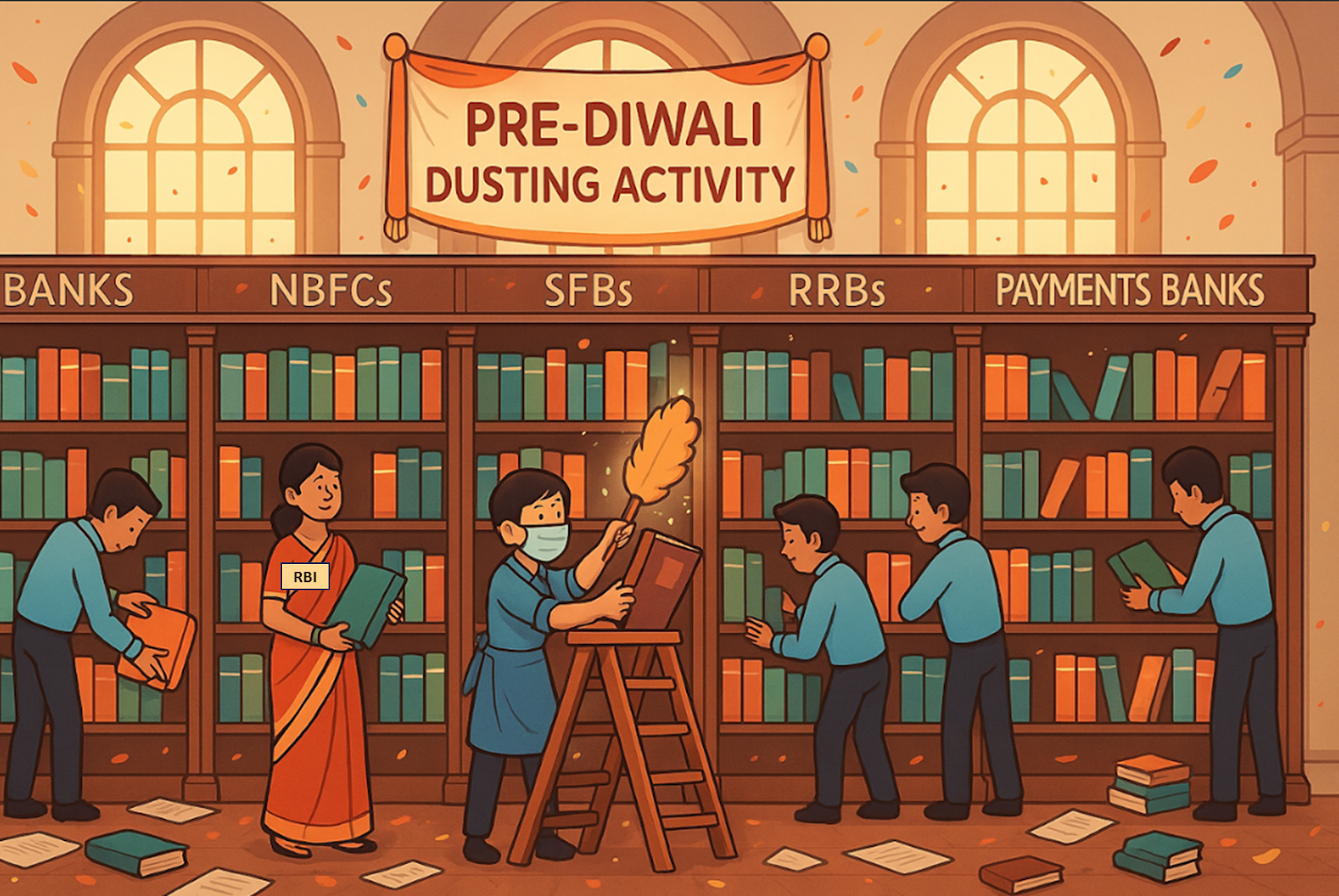
This consolidation exercise builds upon the groundwork laid by the Regulations Review Authority, which was tasked with reviewing regulations, circulars, and reporting requirements based on feedback from the public, banks and financial institutions, as highlighted in the press release dated April 15, 2021.
Ever since RBI was entrusted with the powers to regulate the financial sector entities, the RBI’s regulatory framework has steadily expanded, issuing numerous Directions under its statutory powers. While such evolution is natural, overlapping jurisdictions and a lack of clear supersession of older instructions have added complexity to the regulatory landscape.
In line with the above, the RBI has carried out a thorough consolidation of the regulatory instructions currently overseen by the Department of Regulation. On a prima facie review, it seems that this exercise has been carried out on an ‘as-is’ basis, with only minor editorial updates to clarify language or update terminology. There has been no substantive review of the instructions as such for any revisions or new additions.
Under the consolidation exercise, more than 9000 circulars and Directions issued up to October 9, 2025, have been streamlined into 238 Master Directions, covering 11 specific categories of regulated entities across up to 30 functional areas. As a result, all these existing circulars, including various Master Circulars and Master Directions, administered by the Department of Regulation are proposed to be repealed.
Previously, a single circular often applied to multiple entities, with provisions scattered across different sections. This sometimes led to some confusion- for example, under the KYC Directions, 2016, reference to “opening a small account” applied to banks, however, it created ambiguity about whether this shall be applicable to a borrower taking a loan in the case of NBFCs.
It has been proposed that the regulatory framework shall be divided amongst regulated entities like commercial banks, payments banks, All India financial institutions, NBFCs, etc. Additionally, within each entity the provisions shall be separated into key areas such as, prudential requirements, interest on advances, asset liability management, valuation of investments, concentration risks, credit reporting, outsourcing, disclosures, etc. The aim is to ease out the compliance process by simplifying and arranging the regulations into identified key operational areas applicable to a particular RE
While the intent of the consolidation exercise was refinement of the regulatory provisions and clarify any existing ambiguities, however, the segregation exercise requires a thorough review before being notified. Various provisions that were once uniformly applicable across all regulated entities have now been segregated based on the construct of respective REs, however, in ironing out one ambiguity, other creases may have surfaced! This underscores the need for a critical analysis of the implications of these provisions on individual regulated entities.
Drafts of these Master Directions have been circulated for comments to enable stakeholders to provide their views on this step taken towards ease of compliance. There could be uncertainties that would still persist post the streamlining process, and hence, warrants thorough review.
Read our detailed analysis of the consolidated regulations through here: Old Rules, New Book: RBI consolidates Regulatory Framework
For reference, RBI has made available on its website the following draft documents for public comments, with a focus on their completeness and accuracy:
- Drafts of the 238 consolidated Master Directions / Guidelines
- List of circulars proposed to be repealed
Leave a Reply
Want to join the discussion?Feel free to contribute!