Sangraha – December, 2021
Earlier editions are available at: https://vinodkothari.com/sangraha/
– Team Finserv | finserv@vinodkothari.com
RBI Notification dated December 14, 2021 – https://www.rbi.org.in/Scripts/NotificationUser.aspx?Id=12208&Mode=0
Our recent write-ups around the financial services sector – https://vinodkothari.com/category/financial-services/
IPO Financing, as the name suggests, is providing finance for the purpose of subscribing to initial public offers done by companies. In case of IPO Financing, the exposure is based on the borrower, and the securities/ shares, if allotted, are taken as collateral for securing the obligations under the loan. The investor will realise the shares so allotted in the IPO and pay-off the loan taken from the Banks/NBFCs.
How does IPO Financing work?
IPO Financing is widely used by High Networth Individuals (HNIs) as a tool to leverage the funds available with an intent to make profits from the IPO allotment price and the price at the time of listing. Typically, the lender would provide a short-term loan to the borrower at a certain interest rate, till the shares are listed. The transaction forces the investor to sell the shares once listed. Out of the proceeds, the lender would retain the repayment of loan and payment of interest plus other charges, as may be levied; and the balance is taken home by the investor as profits. Hence, the idea is not to “invest” in an IPO and eventually earn investment rewards; rather, the intent usually is to “enter” and “exit” by booking possible gains in the shortest time span.
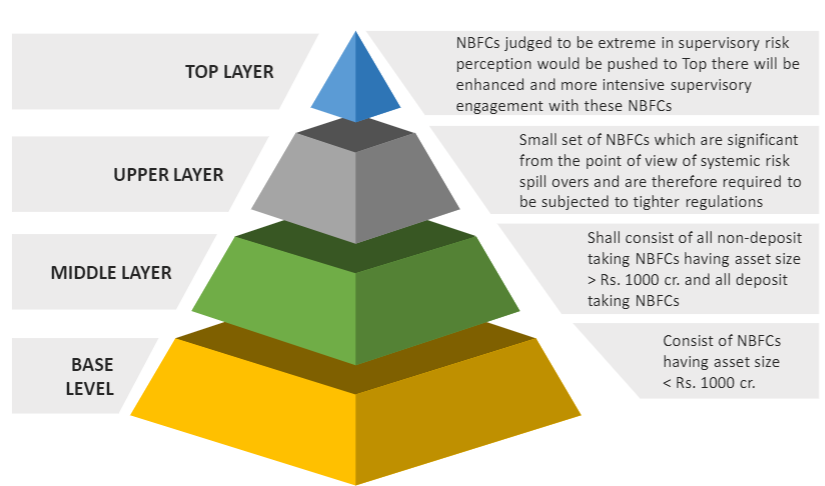
Recently, the RBI has released Scale Based Regulation (SBR): A Revised Regulatory Framework for NBFCs (SBR) on October 22, 2021. While the SBR provides for broad contours of the revised framework, concrete regulations in the form of ‘Directions’ are awaited from RBI. SBR fixes a ceiling of Rs. 1 crore per borrower in case of IPO financing by any NBFC.
We have tried to figure out the probable questions arising out of the aforesaid proposal and respond to the same in the form of these FAQs. However, these are subject to final directions yet to be issued by RBI in this regard. We shall update this FAQ once there are clear directions in this regard. These FAQs shall be read accordingly.
brochure-Training-on-KYC-1-1Registeration for the workshop have been closed. You may register your interest for a repeat workshop here here: https://forms.gle/RmwXa13DjuLBqhMU9
-By Vinod Kothari (vinod@vinodkothari.com)
Securitisation is all about bankruptcy remoteness, and the common saying about bankruptcy remoteness is that it works as long as the entities are not in bankruptcy! The fact that any major bankruptcy has put bankruptcy remoteness to challenge is known world-over. In fact, the Global Financial Crisis itself put several never-before questions to legality of securitisation, some of them going into the very basics of insolvency law[1]. There have been spate of rulings in the USA pertaining to transfer of mortgages, disclosures in offer documents, law suits against trustee, etc.
The Indian securitisation market has faced taxation challenges, regulatory changes, etc. However, it has so far been immune from any questions at the very basics of either securitisability of assets, or the structure of securitisation transactions, or issues such as commingling of cashflows, servicer transition, etc. However, sitting at the very doorstep of defaults by some major originators, and facing the spectrum of serious servicer downgrades, the Indian securitisation market clearly faces the risk of being shaken at its basics, in not too distant future.
Before we get into these challenges, it may be useful to note that the Indian securitisation market saw an over-100% growth in FY 2019 with volumes catapulting to INR 1000 billion. In terms of global market statistics, Indian market may now be regarded as 2nd largest in ex-Japan Asia, only after China.
Since the blowing up of the ILFS crisis in the month of September 2018, securitisation has been almost the only way of liquidity for NBFCs. Based on the Budget proposal, the Govt of India launched, in Partial Credit Guarantee Scheme, a scheme for partial sovereign guarantee for AA-rated NBFC pools. That scheme seems to be going very well as a liquidity breather for NBFCs. Excluding the volumes under the partial credit enhancement scheme, securitisation volumes in first half of the year have already crossed INR 1000 billion.
In the midst of these fast rising volumes, the challenges on the horizon seem multiple, and some of them really very very hard. This write up looks at some of these emerging developments.
In an interim order of the Bombay High court in Edelweiss AMC vs Dewan Housing Finance Corporation Limited[2], the Bombay High court has made certain observations that may hit at the very securitisability of receivables. Based on an issue being raised by the plaintiff, the High Court has directed the company DHFL to provide under affidavit details of all those securitisation transactions where receivables subject to pari passu charge of the debentureholders have been assigned, whether with or without the sanction of the trustee for the debentureholders.
The practice of pari passu floating charge on receivables is quite commonly used for securing issuance of debentures. Usually, the charge of the trustees is on a blanket, unspecific common pool, based on which multiple issuances of debentures are covered. The charge is usually all pervasive, covering all the receivables of the company. In that sense, the charge is what is classically called a “floating charge”.
These are the very receivables that are sold or assigned when a securitisation transaction is done. The issue is, given the floating nature of the charge, a receivable originated automatically becomes subject to the floating charge, and a receivable realised or sold automatically goes out of the purview of the charge. The charge document typically requires a no-objection confirmation of the chargeholder for transactions which are not in ordinary course of business. But for an NBFC or an HFC, a securitisation transaction is a mode of take-out and very much a part of ordinary course of business, as realisation of receivables is.
If the chargeholder’s asset cover is still sufficient, is it open for the chargeholder to refuse to give the no-objection confirmation to another mode of financing? If that was the case, any chargeholder may just bring the business of an NBFC to a grinding halt by refusing to give a no-objection.
The whole concept of a floating charge and its priority in the event of bankruptcy has been subject matter of intensive discussion in several UK rulings[3]. There have been discussions on whether the floating charge concept, a judge-made product of UK courts, can be eliminated altogether from the insolvency law[4].
In India, the so-called security interest on receivables is not really intended to be a security device – it is merely a regulatory compliance with company law rules under which unsecured debentures are treated as “deposits”[5]. The real intent of the so-called debenture trust document is maintenance of an asset cover, which may be expressed as a covenant, even otherwise, in case of an unsecured debenture issuance. The fact is that over the years, the Indian bond issuance market has not been able to come out of the clutches of this practice of secured debenture issuance.
While bond issuance practices surely need re-examination, the burning issue for securitisation transactions is – if the DHFL interim ruling results into some final observations of the court about need for the bond trustee’s NOC for every securitisation transaction, all existing securitisation transactions may also face similar challenges.
Rating agencies have recently downgraded two notches from AAA ratings several pass-through certificate transactions of a leading NBFC. The rationale given in the downgrade action, among other things, cites servicer risks, on the ground that the originator has not been able to obtain continuous funding support from banks. While absence of continuing funding support may affect new business by an NBFC, how does it affect servicing capabilities of existing transactions, is a curious question. However, it seems that in addition to the liquidity issue, which is all pervasive, the rating action in the present case may have been inspired by some internal scheme of arrangement proposed by the NBFC in question.
This particular downgrades may, therefore, not have a sectoral relevance. However, what is important is that the downgrades are muddying the transition history of securitisation ratings. From the classic notion that securitisation ratings are not susceptible to originator-ratings, the dependence of securitisation transactions to pure originator entity risks such as internal funding strengths or scheme of arrangement puts a risk which is usually not considered by securitisation investors. In fact, the flight to securitisation and direct assignments after ILFS crisis was based on the general notion that entity risks are escaped by securitisation transactions.
The biggest jolt may be a forced servicer transition. In something like RMBS transactions, outsourcing of collection function is still easy, and, in many cases, several activities are indeed outsourced. However, if it comes to more complicated assets requiring country-wide presence, borrower franchise and regular interaction, if servicer transition has to be forced, the transaction will be worse than originator bankruptcy.
The market has been leaning substantially on the “direct assignment” route. Most of the direct assignments are seen by the investors are look-alikes and feel-alikes of a loan to the originator, save and except for the true-sale opinion. Investors have been linking their rates of return to their MCLR. Investors have been viewing the excess spread as a virtual credit support, which is actually not allowed as per RBI regulations. Pari-passu sharing of principal and interest is rarely followed by the market transactions.
If the truth of the sale in most of the direct assignment transactions is questioned in cases such as those before the Bombay High court, it will not be surprising to see the court recharacterise the so-called direct assignments as nothing but disguised loans. If that was to happen in one case of a failed NBFC, not only will the investors lose the very bankruptcy-remoteness they were hoping for, the RBI will be chasing the originators for flouting the norms of direct assignment which may have hitherto been ignored by the supervisor. The irony is – supervisors become super stringent in stressful times, which is exactly where supervisor’s understanding is required more than reprimand.
NBFCs are passing through a very strenuous time. Delicate handling of the situation with deep understanding and sense of support is required from all stakeholders. Any abrupt strong action may exacerbate the problem beyond proportion and make it completely out of control. As for securitisation practitioners, it is high time to strengthen practices and realise that the truth of the sale is not in merely getting a true sale opinion.
Government credit enhancement for NBFC pools: A Guide to Rating agencies
[1] For example, in a Lehman-related UK litigation called Perpetual Trustees vs BNY Corporate Trustee Services, the typical clause in a synthetic securitisation diverting the benefit of funding from the protection buyer (originator – who is now in bankruptcy) to the investors, was challenged under the anti-deprivation rule of insolvency law. Ultimately, UK Supreme Court ruled in favour of securitisation transactions.
[2] https://www.livelaw.in/pdf_upload/pdf_upload-365465.pdf. Similar observations have been made by the same court in Reliance Nippon Life AMC vs DHFL.
[3] One of the leading UK rulings is Spectrum Plus Limited, https://www.bailii.org/uk/cases/UKHL/2005/41.html. This ruling reviews whole lot of UK rulings on floating charges and their priorities.
[4] See, for example, R M Goode, The Case for Abolition of the Floating Charge, in Fundamental Concepts of Commercial Law (50 years of Reflection, by Goode)
[5] Or partly, the device may involve creation of a mortgage on a queer inconsequential piece of land to qualify as “mortgage debentures” and therefore, avail of stamp duty relaxation.
-Rahul Maharshi and Kanakprabha Jethani
(finserv@vinodkothari.com)
“यावज्जीवेत्सुखं जीवेत् ऋणं कृत्वा घृतं पिबेत् |
भस्मीभूतस्य देहस्य पुनरागमनं कुतः ||”
The ancient couplet from the Charvak Darshan, in Indian mythology is popularly known as the philosophy of life. There are various interpretations of the above, in general, the meaning of the above couplet gives us a saying that “One should live luxuriously, as long as he is alive, and to attain the same, one may even live on credit and in debt. Because once you are dead and cremated, it is foolish to think about afterlife and rebirth.”
It is seen today that the financial services industry is taking the above couplet too seriously and making the borrowers flooded with opportunities and facilities to burden them with debt in one click. Even the person who is unwilling to enter into a debt trap is somewhat lured by the “instant loan” facilities given by numerous NBFCs these days.
Whilst the Indian economy facing a slowdown and banks in India showing significant falls in their lending volumes, the NBFCs engaged in e-lending are displaying an inverse relation to the trend. The NBFCs have been showing extravagant growth in their lending volumes. On one hand banks are tightening the lending norms considering the current state of the economy, NBFCs seem to be doing reckless lending and reporting exceptionally high lending volumes. The financial market seems to be showing a transition from secured lending to unsecured lending, from corporate finance to personal finance, from paperwork to digitisation. This transition is the reason behind such a drastic shift of lending volumes.
NBFCs are crossing milestones, making new records everyday. A leading NBFC reported disbursal of Rs. 550 crores in 3,50,000 loan transactions and has been consistently disbursing loans over Rs. 80 crores every month[1]. Another NBFC reported an existing customer base of 1.1 million. An app-based lender NBFC has 100 million downloads of its app and has disbursed around Rs. 700 crores in FY 19 with an expectation of increasing the amount of disbursals to Rs. 2,000 crores in FY 20[2].
On the contrary, banks are showing a completely opposite picture. Under the 59-minute loan scheme introduced by the Prime Minister for small entities (having turnover upto Rs. 25 crores) to avail loans of amount upto Rs. 5 crores from banks within an hour, only 50,706 loans were given approval in the FY 19. The growth rates in the banking sector are lowering. The growth in retail loans fell down to 15.7% in April 2019 as compared to 19.1% in April 2018. The growth rate in credit card loans has also shown a decline of 8.8%[3].
NBFCs do unsecured lending of small-ticket size loans, usually personal in nature. The market tends to be more inclined towards obtaining finance from such NBFCs. The basic features of loans provided by NBFCs can be understood through following points:
The operational structures of such loans are in defiance of many requirements of the RBI Directions. One can see disparity from the RBI Directions in many ways. Following are the areas where most of the NBFCs take their own sweet ways:
The borrowers face several risks under such loan transactions, ranging from personal to financial such as:
Even in existence of such high interest rates, why is a borrower more attracted to loans from NBFCs? The only answer one finds to this is the ease and the fact that they are instant. In an era where everyone wants everything in a jiffy, be it food or health solutions, being attracted to instant loans is a very natural thing.
For example you meet an accident and don’t have money for treatment to be done, take a loan. You are shopping and suddenly realise you forgot your purse, take a loan.
The most crucial thing is that these NBFCs do not monitor the end use of the loan amounts disbursed. So a borrower may specify any purpose for the loan, which he might not actually use the loan for. Moreover, the high interest rates are not noticed by the borrowers as most of the NBFCs show monthly interest rates rather than the yearly rates in their communications on the app or the website.
Many borrowers usually don’t read the entire set of terms and conditions and end up granting these NBFCs access to their personal information. Information trading is yet another business that the NBFCs may secretly engage into posing a threat to borrowers’ information.
The NBFCs are rightly playing the psychology game by becoming a friend in need for the borrowers. No matter how high the interest rates maybe or how risky the transaction maybe, it is a handy help whenever needed.
Furthermore, the advertisements made by these NBFCs are so catchy that they may lure a person who might not really be in need of finance. The catchy phrases like “make your dream wedding come true”, “let the wanderlust in you come alive” create a “need” for the customer to become a borrower. Marriage functions, travel and luxuries things are the Indian way of showing richness and the abovementioned philosophy wraps people in a comfortable blanket of justification to remain under debt-burden.
While lending to businesses results in more capital formation and growth of the economy. Personal lending mostly results in wasteful expenditure. Further, the interest rates being so high, many a times the borrowers obtain another loan to pay the previous loan and gets trapped into the vicious circle of obtaining and repaying loans. The increasing lending volumes are not an indication of overall growth of the economy. Most of the purposes for which such loans are availed are consumption-based and have no value-addition. All the money taken on loan is being used in consumption-based expenditure and not in value-addition activities and thus even after such high lending volumes, the growth of the economy is just disappearing into the black hole.
While on one hand, such loans are helping us in need, on the other hand they are luring us to take unnecessary debt burden. The lender NBFCs are under the risk of regulatory action by the regulators since many of them are in non-compliance with regulatory requirements. The borrowers are under the risk of pressing themselves under unnecessary debt burden and huge interest costs. The recovery procedures of these NBFCs are very lenient but due to the high interest costs, the cost of funds is readily recovered by the lender NBFC. Even when banks have tried to provide quick loans under 59-minutes loan scheme, they have failed to do away with the procedural requirements such as document submission and are still regarded as “slow-loans” considering the super-fast loans being provided by NBFCs within 5 minutes.
Though immensely helpful, these loans have a potential to impact the economy in such a manner that it seems to be beneficial while it’s actually not. The borrowers are happily floating in the bubble of “instant loans” which is definitely going to burst in no time.
[1] Source: Economic Times
[2] Source: CNBC
[3] Source: Business Standard
Vinod Kothari Consultants P Ltd (finserv@vinodkothari.com)
The partial credit enhancement (PCE) Scheme of the Government[1], for purchase by public sector banks (PSBs) of NBFC/HFC pools, has been discussed in our earlier write-ups, which can be viewed here and here.
This document briefly puts the potential approach of the rating agencies for rating of the pools for the purpose of qualifying for the Scheme.
The data required for the analysis will be same as data required for securitisation of a static pool.
[1] http://pib.gov.in/newsite/PrintRelease.aspx?relid=192618
Vinod Kothari (vinod@vinodkothari.com)
The so-called partial credit enhancement (PCE) for purchase of NBFC/HFC pools by public sector banks (PSBs) may, if meaningfully implemented, be a win-win for all. The three primary players in the PCE scheme are NBFCs/HFCs (let us collectively called them Originators), the purchasing PSBs, and the Government of India (GoI). The Scheme has the potential to infuse liquidity into NBFCs while at the same time giving them advantage in terms of financing costs, allow PSBs to earn spreads while enjoying the benefit of sovereign guarantee, and allow the GoI to earn a spread of 25 bps virtually carrying no risks at all. This brief write-ups seeks to make this point.
The details of the Scheme with our elaborate questions and answers have been provided elsewhere.
Broadly, the way we envisage the Scheme working is as follows:
If the structure works as above, it is a win-win for all:
The overall benefits for the system are immense. There is release of liquidity from the banking system to the economy. Depending on the type of pools Originators will be selling, there may be asset creation in form of home loans, or working capital loans (LAP loans may effectively be that), or loans for transport vehicles. If the GoI objective of buying pools upto Rs 100000 crores gets materialised, as much funding moves from banks to NBFCs, which is obviously already deployed in form of assets. The GoI makes an income of Rs 250 crores for effectively no risk.
In fact, if the GoI gains experience with the Scheme, there may be very good reason for lowering the rating threshold to A level, particularly in case of home loans.
To make the Scheme really achieve its objectives, there are several preparations that may have to come soon enough:
Whoever takes the first transaction to market will have to obviously do a lot of educating – PSBs, rating agencies, law firms, SIDBI, and of course, DFS. However, the exercise is worth it, and it may not take 6 months as envisaged for the GoI to reach the target of Rs 1 lakh crores.