Posts

Understanding “Undertaking” in the Context of Investment Demergers

– Barsha Dikshit and Sourish Kundu | corplaw@vinodkothari.com

The meaning of “undertaking” has been one of the most debated issues under Indian company law and tax law, particularly when it comes to shares/investments to be treated as an “undertaking”. While the term intuitively refers to a business or division carried on as a going concern, its application becomes complex when the company’s business primarily consists of holding investments in shares of other entities. This complexity raises important questions about whether such passive investment portfolios can be considered independent undertakings capable of being demerged under Section 2(19AA) of the Income-tax Act, 1961 (now section 2(35) of the Income-tax Act, 2025). 

This article examines  the statutory framework, relevant judicial precedents, and the practical implications of treating investment division as “undertaking” for companies with diverse investment portfolios.

Meaning of ‘Undertaking’

Section 180(1)(a) of the Companies Act, 2013 restricts the Board of a company from selling, leasing, or otherwise disposing of the whole or substantially the whole of an undertaking without shareholders’ approval by way of special resolution. While the provision does not offer a definitional explanation of what constitutes an “undertaking,” it does lay down quantitative thresholds: 

  • An undertaking is one where investment exceeds 20% of net worth or contributes 20% of total income in the preceding financial year.
  • Disposal of “substantially the whole” of such undertaking means disposal of 20% or more of its value.

This numerical test, merely sets quantitative thresholds to determine when shareholders’ approval is required for the disposal of such an asset. 

To understand what constitutes an “undertaking” and, in particular, whether a passive investment division, essentially a portfolio of shares, can independently qualify as an undertaking, reference can be drawn to the definition of “undertaking” provided under the Income-tax Act, 1961 as well as relevant judicial precedents. 

Under the Income-tax Act, 1961, Section 2(19AA) defines the term “demerger”, which requires the transfer of one or more undertakings from the demerged company to the resulting company, such that at least one undertaking remains with the demerged company. The meaning of “undertaking” for this purpose is explained in the Explanation to Section 2(19AA) (now renumbered as Section 2(35) under the Income-tax Act, 2025), as–

“Explanation-1: For the purposes of this clause, “undertaking” shall include any part of an undertaking, or a unit or division of an undertaking or a business activity taken as a whole, but does not include individual assets or liabilities or any combination thereof not constituting a business activity.”

This definition emphasizes the need for functional and operational coherence in what is considered an undertaking, ruling out passive asset transfers that lack an identifiable business character. 

The meaning of the term ‘undertaking’ has also been clarified in several judicial precedents. For instance, in the landmark decision of Rustom Cavasjee Cooper v. Union of India [[1970] AIR 564], Hon’ble Supreme Court explained that “‘undertaking’ clearly means a going concern with all its rights, liabilities and assets as distinct from the various rights and assets which compose it… is an amalgam of all ingredients of property and are not capable of being dismembered. That would destroy the essence and innate character of the undertaking. In reality the undertaking is a complete and complex weft and the various types of business and assets are threads which cannot be taken apart from the weft.” 

The Court thus highlighted the holistic nature of an undertaking that it is not a disjointed collection of parts, but a complete and functional enterprise. [See also, P.S. Offshore Inter Land Services Pvt. Ltd. v. Bombay Offshore Suppliers and Services Ltd. [[1992] 75 Comp Cas 583 (Bom)].

This brings us to a significant  question: Can a portfolio of shares, held in a company’s books, be regarded as a separate segment or ‘undertaking’? 

This question assumes particular relevance in the context of schemes of arrangement, particularly those involving demergers, where a portfolio of investments is proposed to be transferred to a resulting company. In such schemes, the tax neutrality of the transaction often hinges on whether the transferred segment qualifies as an “undertaking” under the applicable tax laws.

For a unit to be regarded as an undertaking, and for the demerger to be treated as tax-neutral, both the demerged and remaining undertaking must possess the characteristics of a going concern, i.e., each must be capable of independent and sustainable commercial operations with the objective of earning profits. [See: Yallamma Cotton, Woollen and Silk Mills Co. Ltd., In re [[1970] 40 Comp Cas 466]]

This criteria becomes particularly nuanced when the subject of demerger is a mere pool of passive investments, rather than an operational business unit. The key consideration is whether such a portfolio, in itself, demonstrates the organisational integrity, continuity of activity, and profit-making intent sufficient to satisfy the definition of an “undertaking”.

One of the most notable rulings on this issue is the decision of the Income Tax Appellate Tribunal (ITAT) in the case of Grasim Investments Ltd. v. ACIT, wherein the Tribunal was called upon to examine whether a division engaged primarily in holding and managing investments in shares could be treated as an undertaking for the purposes of a tax-neutral demerger under Section 2(19AA) of the Income-tax Act, 1961.

The ITAT held that a mere pool of passive investments does not, by itself, constitute an undertaking. To qualify as an undertaking, the investment division must be more than a collection of financial assets; it must constitute a distinct business activity carried on with a certain degree of autonomy. The Tribunal emphasized factors such as, presence of separate books of account, an identifiable organizational structure, and the existence of management and decision-making functions related specifically to the investment activity and the capability of generating independent business income, to consider a division as an ‘undertaking.

In one of the recent rulings in the matter of Reckitt Benckiser Healthcare India Private Limited v DCIT, 2025 171, dated 18th February, 2025, Ahmedabad ITAT reiterated the principles governing tax neutral merger. 

In this case, the assessee transferred only a portfolio of investments (constituting the so-called “Treasury Segment”) to the resulting company, while retaining the associated liabilities. The assessee attempted to justify this by arguing that the liabilities pertained to other business divisions and not to the Treasury Segment. However, the Tribunal rejected this explanation, holding that such selective transfer is contrary to the statutory mandate. The Tribunal emphasized that for a transaction to qualify as a tax-neutral demerger, it must strictly comply with the conditions prescribed under Section 2(19AA) of the Act. One of the key requirements of which is that all the assets and liabilities pertaining to the transferred undertaking must be transferred to the resulting company.

Treating block of investments as separate undertakings

The real difficulty lies in the case of investment companies, or companies holding multiple blocks of shares in different entities. Can each such block of investments be regarded as a separate undertaking for purposes of demerger?

Here it becomes important to differentiate between active investments and passive investments. For instance, holdings in group companies, such as subsidiaries or associates, may be classified as active investments, given the element of strategic control or influence. On the other hand, investments in mutual funds, debt instruments, or derivatives are typically treated as passive investments, lacking operational involvement.

While judicial decisions have considered active investments as a separate undertaking, investment in mutual funds, securities, or similar financial instruments, when held passively, are typically regarded as individual assets forming part of a company’s investment portfolio , majorly on the ground that they do not, by themselves, represent a business or functional unit capable of independent operation. 

In CIT v. UTV Software Communication Ltd. the Bombay High Court drew a sharp distinction between transfer of shares and transfer of an undertaking. The Court held that a mere transfer of shareholding, even to the extent of 49%, does not amount to a transfer of an “undertaking” under Section 2(42C) of the Income-tax Act, 1961 (now Section 2(103) of the 2025 Act). Relying on the Supreme Court’s rulings in Vodafone International Holdings and Bacha F. Guzdar, it concluded that passive shareholding does not confer ownership of the underlying business and cannot constitute an undertaking for tax or restructuring purposes.

However, the author humbly differs from the view expressed by the Bombay High Court. In the author’s opinion, such matters must be examined in light of the prevailing corporate structures wherein large business groups operate distinct business verticals through separate legal entities, including subsidiaries, joint ventures, and associates. In such cases, transfer of shares in a subsidiary or associate company may, in substance, result in divestment of an entire business segment.

Moreover, as discussed above, section 180(1)(a) of the Companies Act, 2013 provides a quantitative definition of ‘undertaking’ and mandates shareholders’ approval by special resolution for the sale, lease, or disposal of a company’s undertaking. In this context, treating the transfer of shareholding, as a mere transfer of shares and not an undertaking, may arguably be a  narrow interpretation, particularly when the transaction has the effect of transferring operational control and revenue-generating capabilities.

The author’s view also finds support in jurisprudence such as the Grasim Industries Ltd. ruling (Supra), where a financial services division, primarily holding investments in shares and securities, was accepted as a valid “undertaking” for the purposes of demerger under Section 2(19AA) of the Act. 

Conclusion

The concept of “undertaking” in Indian law is broader than a mere division of physical assets; it captures the idea of a self-sustaining business activity. In the context of investments, while passive shareholding may not qualify, an organised investment division with identifiable assets, liabilities, and management can constitute an undertaking capable of demerger. Thus, companies holding multiple investment portfolios may, subject to careful structuring, demerge them into resulting companies under sections 230-232 of the Companies Act and section 2(19AA) of the Income-tax Act.

Read More:

Stricter framework for sale, lease or disposal of undertaking by a listed entity

Can companies donate out all their assets?

Chapter 2: Valuation requirements under Income Tax Act

For a complete index of chapters, visit here.

Loader Loading…
EAD Logo Taking too long?

Reload Reload document
| Open Open in new tab

Download as PDF [939.72 KB]

For a detailed brochure outlining the range of valuation services offered by us, click here.

FAQs on Share Buybacks

-Team Corplaw | corplaw@vinodkothari.com

Our other resources on the topic :

  1. Bye bye to Share Buybacks
  2. SEBI’s revised framework brings relaxation under buy-back norms

Interest Imbalance: Will the disproportionate interest Split in Loan Transfers be liable to withholding tax?

ITAT Ruling Clarifies Taxation on Disproportionate Interest share in Loan Transfers

– Dayita Kanodia | Finserv@vinodkothari.com

Direct Assignment of a loan or transfer of loan exposures refers to the process where financial institutions, such as banks, purchase a pool of loans or assets from other entities, typically NBFCs, without the involvement of a third-party intermediary. In this arrangement, the buying institution directly acquires the ownership of the loans or assets and the associated rights, including the right to receive future payments from the borrowers. This method allows the selling NBFC to offload its loans, thereby freeing up capital, while the purchasing institution gains the opportunity to enhance its loan portfolio and earn interest income from the acquired loans. This Direct Assignment is essentially what is popularly known as the transfer of loan exposure.

The RBI issued the transfer of loan exposures directions in 2021 regulating all transactions among regulated entities involving transfer of loan exposures.

Interest sharing and servicing after the transfer

Pursuant to a transfer of loan, it is not necessary that the future interest income arising from the loans would be shared in the same proportion as that of the transfer. For instance, if an NBFC assigns 90% of the loan portfolio to a bank, there is no mandate that all interest income received in the future would be shared in the same proportion of 90:10. Generally, the borrower is not made aware of the transfer and therefore it is important that the NBFC continues to service the loan. In such cases it is only fair that the NBFC gets a higher proportion of interest. Accordingly, it is quite common in direct assignment transactions to have a disproportionate interest share. 

The question which now arises is whether this excess interest income retained by the NBFC would be taxable under the provisions of the income tax act. 

ITAT Ruling and taxation on disproportionate interest share in loan transfers

A recent ITAT ruling of May 7, 2024 clarifies the taxation treatment for disproportionate interest share in case of loan transfers. In this case, NBFC assigned 90% of the loan portfolio to a bank via the direct assignment route. However, the bank was not receiving the entire interest on the 90% loan assigned but was only entitled to a fixed percentage of share while the NBFC retained the excess interest. Accordingly, the revenue department was of the view that the assessee was responsible to deduct TDS on the excess interest allowed to be retained by the NBFC under section 194A of the Income Tax Act. 

The revenue department further raised the question on deduction of TDS under SEction 194J and 194H of the Income Tax Act. 

Interest Retained not a result of money borrowed or debt incurred by the transferee

For the deciding the fate of the NBFC under section 194A of the Income Tax Act, the following was observed by the ITAT:

  1. For TDS to be deducted under section 194A of the Income Tax Act, the crucial aspect to be satisfied was whether the part interest allowed to be retained by the originating NBFC by the bank is payment in the nature of interest to the NBFC for any money borrowed or debt incurred by the bank.
  1. It was acknowledged that the 90% of the loan portfolio was assigned to the bank and consequently any default among the assigned loans would result in loss to the bank. 
  1. Any amount collected from the borrowers was initially getting deposited in an escrow account and was subsequently distributed between the NBFC and the bank in accordance with the agreement entered into by the entities. 
  1. It could not be shown that the interest allowed to be retained with the NBFC was a result of any money borrowed or debt incurred by the bank from the NBFC. 
  2. Accordingly, the assessee was under no obligation to deduct TDS on the excess interest retained by the NBFC under section 194A. 

Interest retained not in the nature of fees for any professional / technical services rendered by the transferor

The next issue which was adjudicated in the case was whether the interest allowed to be retained with the NBFC was a consideration for rendering professional / technical services by the transferor NBFC to the transferee bank. 

As per section 194J of the Act, any person, not being an individual or HUF, who is responsible for paying to a resident any sum, inter alia, by way of fees for professional services or fees for technical services shall at the time of credit of such sum to the account of payee deduct tax at source.

For this purpose the ITAT observed the following:

  1. The NBFC and the Bank entered into a tripartite service agreement pursuant to which the originating NBFC was appointed as servicer for the loans. The NBFC was therefore responsible for managing, collecting and receiving payment of the receivable and depositing the same in the ‘Collection and Payout Account’ to enable the distribution of the payout therefrom and providing certain other services.
  1. As per the service agreement, a one time service fee of Rs.1 Lakh was agreed to be payable by the bank to the NBFC as consideration for the services rendered.
  1. The ITAT brushed aside the contention of the revenue department that service fee of Rs 1L was inadequate and the excess interest allowed to be retained by the NBFC should in fact be considered as fee for rendering the services by the transferor NBFC. 
  1. There was a separate tripartite Deed of Assignment of receivables entered into by the parties according to which the bank paid the entire principal amount equivalent to 90% of the entire pool to the NBFC upfront. However, it was observed that the transfer being an independent commercial transaction cannot be on a cost to cost basis without there being any markup.
  1. Accordingly, the bank opted to pay the consideration for the loans assigned partially by way of an upfront payment equivalent to the principal amount of the loan assigned to it and partly by agreeing to earn a lower rate of interest on its portion of assigned loans and allowing the NBFC to retain the part interest received from the borrower.
  1. Therefore the liability under section 194J of the Income Tax Act was only for the service fee of Rs.1 L and cannot be extended to the excess interest share retained by the NBFC.
  1. Accordingly, the assessee was under no obligation to deduct TDS on the excess interest share retained by the NBFC under section 194J of the Income Tax Act. 

Interest retained not in the nature of commission / brokerage

The last issue in this case to be decided before the ITAT was whether the retained interest would fall in the category of commission or brokerage and was liable to TDS under section 194H of the Income Tax Act. 

As per section 194H of the Act, any person, not being an individual or HUF, who is responsible for paying to a resident, any income by way of commission or brokerage, shall at the time of credit of such income to the account of the payee deduct tax.

For determining the tax treatment under this section, the ITAT observed the following:

  1. It could not be said that the loans originated by the NBFC were on behalf of the bank.
  1. For the services rendered by the NBFC, it was observed that the same was pursuant to a separate service agreement which provides for payment of separate service fees in lieu of such services.
  1. Accordingly, it cannot be contended that the transferor NBFC was acting as an agent of the transferee bank.
  1. Accordingly, the liability to deduct TDS on the excess interest retained by the NBFC under section 194H of the Income Tax Act does not arise. 

Concluding Remarks 

In conclusion, the recent ITAT ruling has provided significant clarity on the taxation treatment of disproportionate interest shares in loan transfers, particularly in the context of Direct Assignment transactions. 

In this case, the ITAT emphasized that the interest retained by the NBFC was not a result of any money borrowed or debt incurred by the bank. Additionally, it was clarified that the interest retained did not constitute fees for professional or technical services rendered by the transferor NBFC, nor did it fall within the ambit of commission or brokerage.

As the financial landscape continues to evolve, such judicial pronouncements play a crucial role in fostering transparency, compliance, and fairness in taxation.

Securing the Beat: Tuning into Music Royalty Securitization

Dayita Kanodia | finserv@vinodkothari.com

“Music can change the world”

Ludwig van Beethoven

This quote by Beethoven remains relevant today, not only within the music industry but also in the realm of finance. In the continually evolving landscape of finance, innovative strategies emerge to monetize various assets. One such groundbreaking concept gaining traction in recent years is music royalty securitization. This financial mechanism offers investors a unique opportunity to access the lucrative world of music royalties while providing artists and rights holders with upfront capital.

The roots of this innovative financing technique can be traced back to the 1990s when musician David Bowie made history by becoming the first artist to securitize his future earnings through what became known as ‘Bowie Bonds’. This move not only garnered attention but also paved the way for other artists to follow suit. Bowie Bonds marked a significant shift in how music royalties are bought, sold, and traded.

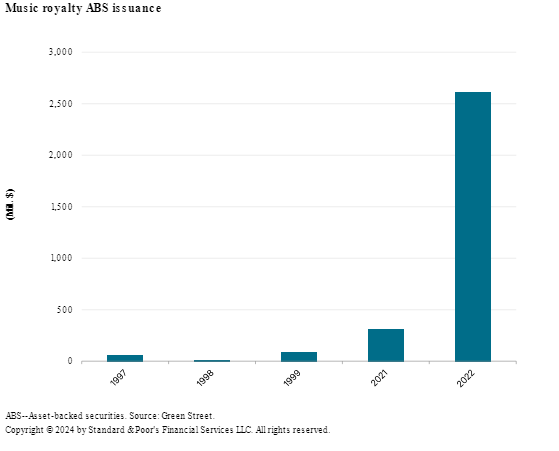
As per the S&P Global Ratings[1], the issuance of securities backed by music royalties totaled nearly $3 billion over the two-year span 2021-22. The graph below shows a recent surge in issuance of securities backed by music royalties.

Data showing the growth of Music Royalty Securitization

This article discusses music royalty securitization, its mechanics, benefits, challenges along with implications for the music industry.

Understanding Music Royalties:

Before exploring music royalty securitization, it’s essential to understand the concept of music royalties. In the music industry, artists and rights holders earn royalties whenever their music is played, streamed, downloaded, or licensed for use. These royalties are generated through various channels, including digital platforms, radio, TV broadcasts, live performances, and synchronization licenses for commercials, movies, and TV shows. However, it’s important to note that artists only earn royalties when their music is utilized, whether through sales, streaming, broadcasting, or live performances.

As a result, the cash flows from these royalties being uncertain are received over time and continue to be received for an extended period. Consequently, artists experience a delay in receiving substantial amounts from these royalties, sometimes waiting for several years before seeing significant income.

The Birth of Music Royalty Securitization:

Securitization involves pooling and repackaging financial assets into securities, which are then sold to investors. The idea is to transform illiquid assets, such as mortgage loans or in our case, music royalties, into tradable securities. Music royalty securitization follows a similar principle, where the future income generated from music royalties is bundled together and sold to investors in the form of bonds or other financial instruments.

Future Flows Securitization:

Music royalty securitization is a constituent of future flows securitization and therefore before discussing the constituent, it is important to discuss the broader concept of future flows securitization.

Future flows securitization involves the securitization of future cash flows derived from specific revenue-generating assets or income streams. These assets can encompass a wide range of future revenue sources, including export receivables, toll revenues, franchise fees, and other contractual payments, even future sales. By bundling these future cash flows into tradable securities, issuers can raise capital upfront, effectively monetizing their future income. Future flows securitization differs from the traditional asset backed securitization by their very nature as while the latter relates to assets that exist, the former relates to assets that are expected to exist. There is a source, a business or infrastructure which already exists and which will have to be worked upon to generate the income. Thus, in future flows securitization the income has not been originated at the time of securitization. The same can be summed up as: In future flow securitization, the asset being transferred by the originator is not an existing claim against existing obligors, but a future claim against future obligors.

Mechanics of Music Royalty Securitization:

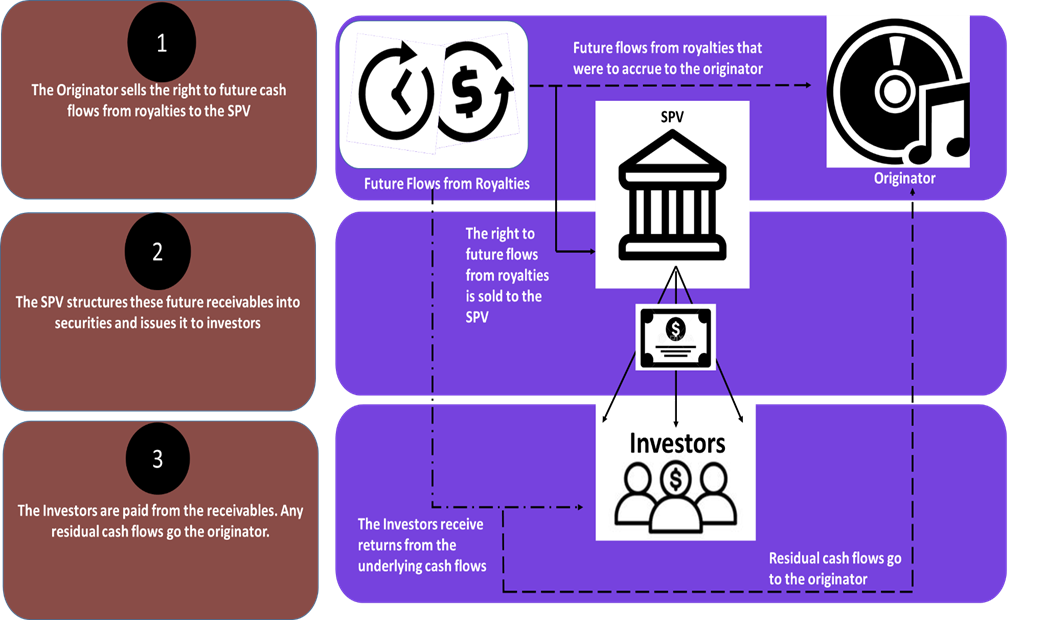
Music royalty securitization involves packaging the future income streams generated by music royalties into tradable financial instruments. The process begins with the identification of income-generating assets, which are then bundled into a special purpose vehicle (SPV). The SPV issues securities backed by these assets, which are sold to investors. The revenue generated from the underlying music royalties serves as collateral for the securities, providing investors with a stream of income over a specified period.

The process of music royalty securitization typically involves several key steps:

Asset Identification: Rights holders, such as artists, record labels, or music publishers, identify their future royalty streams eligible for securitization.

Valuation: A valuation is conducted to estimate the present value of the anticipated royalty income streams. Factors such as historical performance, market trends, and artist popularity are taken into account.

Selling the future flows: The future flows from royalties are then sold off to the Special Purpose Vehicle (SPV) to make them bankruptcy remote. The sale entitles the trust to all the revenues that are generated by the assets throughout the term of the transaction, thus protecting against credit risk and sovereign risk as discussed later in this article.

Structuring the Securities: These future cash flows are then structured into securities. This may involve creating different tranches with varying levels of risk and return.

Issuance: The securities are then issued and sold to investors through public offerings or private placements. The proceeds from the sale provide upfront capital to the rights holders.

Revenue Collection and Distribution: The entity responsible for managing the securitized royalties collects the revenue from various sources which is then distributed to the investors according to the terms of the securities.

Importance of Over-collateralization:

Over-collateralization is an important element in music royalty securitization. In music royalty securitization and in all future flows transactions in general, the extent of over-collateralization as compared to asset backed transactions is much higher. The same is to protect the investors against performance risk, that is the risk of not generating sufficient royalty incomes. Over-collateralization becomes even more important since subordination structures generally do not work for future flow securitizations. This is because the rating here will generally be capped at the entity rating of the originator.

Why go for securitization ?

Now the question may arise as to why an artist or a right holder of a royalty has to go for securitization of his music royalties in order to secure funding. Why cant he simply opt for a traditional source of funding ? The answer to this question is two folds: 

Firstly, the originator in the present case generally has no collateral to leverage and hardly there will be a lender willing to advance a loan based on assets that are yet to exist. 

Secondly even if they are able to obtain funding it will be at a very high cost due to high risk the lender perceives with the lending. 

Music royalty securitization, could be his chance to borrow at a lower cost. The cost of borrowing is related to the risks associated with the transaction, that is, the risk the lender takes on the borrower. Now, this risk includes performance risk, that is the risk that the work of the originator does not generate enough cash flows. While this risk holds good in case of securitization as well, it however takes away two major risks – credit risk and sovereign risk. 

Credit risk, as divested from the performance risk would basically mean that the originator has sufficient cash flows but does not pay it to the lender. This risk can be removed in case of a securitization by giving the SPV a legal right over the cash flow. 

Sovereign risk on the other hand emanates only in case of cross-border lending. This risk arises when an external lender gives a loan to a borrower whose sovereign later on in the event of an exchange crises either imposes a moratorium on payments to external lenders or may redirect foreign exchange earnings. This problem is again solved by giving the SPV a legal right over the cash flows from the royalties arising in countries other than the originator’s, therefore trapping cash flow before it comes under the control of the sovereign. 

The lack of these two types of risks might reduce the cost of borrowing for the originator; thus making music royalty securitization a lucrative option.   

Accounting Treatment:

As discussed, there is no existing asset in a music royalty transaction. In terms Ind AS 39, an entity may derecognize an asset only when either the contractual rights to the cash flows from the financial asset have expired or if it transfers the financial asset. However, here asset means an existing asset and a future right to receive does not qualify as an asset in terms of the definition under Ind AS 32.

Accordingly, the funding obtained through the securitization of music royalties should be shown as a liability in books as the same cannot qualify as an off-balance sheet funding.               

Regulatory Framework in India:

It is crucial to discuss the applicable regulatory framework on securitization currently prevalent in India and whether music royalty securitization would fall under any of these:

  1. Master Direction – Reserve Bank of India (Securitization of Standard Assets) Directions, 2021(‘SSA Master Directions)
  2. SEBI (Issue and Listing of Securitised Debt Instruments and Security Receipts) Regulations, 2008 (SDI Framework)    
  3. Securitisation and Reconstruction of Financial Assets and Enforcement of Security Interest Act, 2002  

While the SSA Master Directions primarily pertain to financial sector entities, and will not directly apply to this domain; however, there exists a possibility that the securitization of music royalties could fall under the purview of SEBI’s SDI Framework.

The same has been discussed in detail in the artcile- The Promise of Predictability: Regulation and Taxation of Future Flow Securitization                                                                                                                                                           

Benefits of Music Royalty Securitization:

Music royalty securitization offers a range of benefits for both investors and rights holders:

Diversification: Investors gain exposure to a diversified portfolio of music royalties, potentially reducing risk compared to investing in individual songs or artists.

Steady Income Stream: Music royalties often provide a stable and predictable income stream, making them attractive to income-oriented investors, such as pension funds and insurance companies.

Liquidity: By securitizing music royalties, rights holders can access immediate capital without having to wait for future royalty payments, providing liquidity for new projects or business expansion.

Risk Mitigation: Securitization allows rights holders to transfer the risk of fluctuating royalty income to investors, providing a hedge against market uncertainties and industry disruptions.

Challenges and Considerations:

While music royalty securitization presents compelling opportunities, it also poses certain challenges and considerations:

Market Volatility: The music industry is subject to shifts in consumer preferences, technological disruptions, and regulatory changes, which can impact the value of music royalties.

Due Diligence: Thorough due diligence is essential to assess the quality and value of music assets, including considerations such as copyright ownership, market demand, and revenue potential.

Potential Risks:

  • Market Risk: Changes in consumer behavior, technological advancements, or regulatory developments could impact the value of music royalties.
  • Legal Risk: Disputes over ownership rights, copyright infringement, or licensing agreements could lead to litigation and financial losses.
  • Concentration Risk: Investing in a single music catalog or genre exposes investors to concentration risk if the popularity of that catalog or genre declines.
  • Cash Flow Variability: While music royalties can provide steady income, fluctuations in streaming revenues or changes in licensing agreements may affect cash flow stability.
  • Reputation Risk: The success of music royalty securitization depends on the ongoing popularity and commercial success of the underlying music assets. Negative publicity, controversies, or declining relevance can adversely affect investor confidence and returns.

Implications for the Music Industry:

While music royalty securitization presents exciting opportunities, it also raises certain considerations for the music industry:

Artist Empowerment: Securitization can empower artists by providing them with alternative financing options and greater control over their financial destiny.

Industry Evolution: The emergence of music royalty securitization could reshape the traditional music business model, fostering innovation and collaboration between artists, labels, and investors.

Way Forward

Music royalty securitization offers a compelling investment opportunity for investors seeking exposure to the lucrative music industry. By securitizing future royalty streams, music rights owners can unlock liquidity while providing investors with access to a diversified portfolio of music assets.

As the music industry continues to evolve, music royalty securitization is likely to play an increasingly prominent role in the financial landscape, providing new avenues for capital deployment and revenue generation. It has the potential to transform the rhythm of creativity into the melody of investment opportunity.

See also our article on:

  1. Securitization of future flows
  2. Bowie Bonds: A leap into future by a 20th century singer

[1] https://www.spglobal.com/ratings/en/research/articles/240220-abs-frontiers-music-royalty-securitizations-are-getting-the-band-back-together-13003585

[2] https://incometaxindia.gov.in/Pages/acts/income-tax-act.aspx

[3] https://www.rbi.org.in/scripts/bs_viewmasdirections.aspx?id=12165

[4] https://www.sebi.gov.in/sebiweb/home/HomeAction.do?doListingAll=yes&search=Securitised%20Debt%20Instruments

[5] https://www.indiacode.nic.in/bitstream/123456789/2006/1/A2002-54.pdf

Income tax issues in IBC

-Vinod Kothari and Sikha Bansal | finserv@vinodkothari.com

Loader Loading…
EAD Logo Taking too long?

Reload Reload document
| Open Open in new tab

Download as PDF [1.99 MB]

A shocker for the bond markets: Withholding tax to apply on listed bonds, without grandfathering 

Team Financial Services | finserv@vinodkothari.com

Section 193 of the Income Tax Act[1] provides for TDS payment in case of interest on securities. Currently listed debentures are exempt from TDS without any limit. The exemption comes way of clause (ix) of the proviso to sec. 193.

The said clause is now sought to be deleted. The deletion, if affirmed by the statute, will be effective from 1st April, 2023, thereby meaning that any interest paid by companies on listed bonds will now be subject to tax.

The amendment has a retroactive effect, as it applies even to bonds that may have already been issued. If the issuer and the investor have both entered into a securities transaction on the strength of the law then existing, and the bondholder suddenly comes under the purview of deduction of tax at source, this will be like acquiring a security with no safe harbor. It is notable that certainty of tax treatment for capital market transactions is an essential mainstay for the healthy growth of capital markets.

Read more

Corporate Restructuring- Corporate Law, Accounting and Tax Perspective

Resolution Division 

(resolution@vinodkothari.com)

Restructuring is the process of redesigning one or more aspects of a company, and is considered as a key driver of corporate existence. Depending upon the ultimate objective, a company may choose to restructure by several modes, viz. mergers, de-mergers, buy-backs and/ or other forms of internal reorganisation, or a combination of two or more such methods.

However, while drafting a restructuring plan, it is important to take into consideration several aspects viz. requirements under the Companies Act, SEBI Regulations, Competition Act, Stamp duty implications, Accounting methods (AS/ Ind-AS), and last but not the least, taxation provisions.

In this presentation, we bring to you a compilation of the various modes of restructuring and the applicable corporate law provisions, accounting standards and taxation provisions.

https://vinodkothari.com/wp-content/uploads/2020/11/Corprorate-Restructuring-Corporate-Law-Accounting-Taxation-Perspective.pdf

Important Rulings -Section 56 (2) (viia), 56 (2) (x) and 56 (2) (viib) of Income Tax Act 1961

– Qasim Saif and Mahesh Jethani

finserv@vinodkothari.com

Section 56(2) (viia)

  • When shares of closely held company received without consideration or for inadequate consideration
  • Where shortfall in consideration as compared to Fair Market Value (FMV) exceeded Rs. 50,000
  • Recipient is:

(a) Firm

(b) closely held company

  • Then, FMV of such shares exceeding Rs. 50,000/- after reducing the value of consideration paid, if any, was considered as – Income from other Sources.

Section 56(2) (x)

Section 56(2)(vii)/(viia) is inoperative with effect from 1-4-2017

Clause (x) is inserted in section 56(2) to provide that the specified receipts [same as provided in Sec. 56(2)(vii)] will be taxable as income in the hands of any person, under the head ‘Income from Other Sources’

Sub-Clause (c) of Clause (x) of Section 56-Taxation of any property other than Money and Immovable Property: –

  • If received without consideration, the aggregate fair market value of which exceeds fifty thousand rupees, the whole of the aggregate fair market value of such property shall be considered Income from Other Source
  • If there is inadequate consideration whereby the difference between FMV and consideration exceeds Rs.50,000/- then difference in FMV and consideration will be considered as IFOS

Property means the following capital asset of the assessee –

(i) immovable property being land or building or both;

(ii) share and securities;

(iii) jewellery;

(iv) archaeological collections;

(v) drawings;

(vi) paintings;

(vii) sculptures; or

(viii) any work of art.

(ix) Bullion

Reason for amendments

The Memorandum to the section explains the following-

“The existing definition of property for the purpose of this section includes immovable property, jewellery, shares, paintings, etc. These anti-abuse provisions are currently applicable only in case of individual or HUF and firm or company in certain cases. Therefore, receipt of sum of money or property without consideration or for inadequate consideration does not attract these anti-abuse provisions in cases of other assessee.”

Thus, it appears that through insertion of new provision, the scope of the existing anti-abuse provision is widened to make it applicable to all assessee and also clubbing section 56(2)(vii) & section 56(2) (viia).


Important Rulings on Section 56(2) (viia) and 56(2) (x)


Taxability of the credit to the general reserve by the amalgamated company

Aamby Valley Ltd vs. ACIT (ITAT Delhi)

Date: 22nd February 2019.

Background:

Section 56(2) (viia) is an anti-abuse provision which applies only to cases of bogus capital building and money laundering. It does not apply to an amalgamation where shares are allotted at alleged undervaluation.

Increase in general reserves due to recording of assets of amalgamating company at FMV not give rise to any real income to the assessee. It is capital in nature

Judgement and conclusion:

This is an important judgement by Tribunal which deals with the taxability of the credit to the general reserve by the amalgamated company of the fair valuation of the assets received under the scheme of amalgamation. The Tribunal held that the transaction does not give rise to real income to the assessee and it thus cannot be treated as a business profit.

Provisions of Section 56 (2) (viia) will not be applicable if fair value of the shares received was not higher than the sacrifice suffered by taxpayer under the composition reorganisation scheme, as there is no incremental benefit to the shareholder.

Reserve directly credited to general reserve and not in P&L cannot be subjected to MAT.

Raising of Tax related Objection by RD when Income Tax Authority did not raise the same.

Casby Cfs Private Limited vs Casby Logistics Private Limited (Bombay High Court)

Date: 19th March 2015

Background:

In the instant case the question of law is that whether the RD could raise tax-related objections to the scheme of amalgamation though the ITA raised no objections? Whether the scheme was liable to be rejected based on the RD’s aforesaid objections?

One of the issue that was pointed out that the scheme was devised to evade capital gain tax by virtue of using the device of beneficial ownership and scheme, transferee is acquiring shares without consideration which will attract section 56 (2) (viia)

Judgement and conclusion:

Since the court was required to ensure that the scheme did not contravene any Act, the RD was not only entitled to, but was duty-bound, to bring to the HC’s notice any provision in the scheme that contravened any law. This included the Income tax law and aimed to ensure that the company did not use the HC sanction as a shield to protect itself from consequences of contravention of the law

That the ITA did not object did not prevent the RD from raising objections or making such observations with regard to the scheme as he/ she deemed fit, including those pertaining to tax laws

The HC has held that the RD is entitled to raise objections pertaining to income tax in a merger scheme, even though no objections were raised by the tax authorities.

Application of Section 56(2)(viia)/56 (2) (x) in case of Buy Back

Vora Financial Services P. Ltd vs. ACIT (ITAT Mumbai)

Date:29th June 2018

Background:

Section is a counter evasion mechanism to prevent laundering of unaccounted income under the garb of gifts. The primary condition for invoking the section is that the asset gifted should become a “capital asset” and property in the hands of recipient. If the assessee-company has purchased shares under a buyback scheme and the said shares are extinguished by writing down the share capital, the shares do not become capital asset of the assessee-company and hence s. 56(2) (viia) cannot be invoked in the hands of the assessee company

Judgement and conclusion:

A combined reading of the provisions of sec. 56(2)(viia) and the memorandum explaining the provisions show that the provisions of sec. 56(2)(viia) would be attracted when “a firm or company (not being a company in which public are substantially interested) “receives a property”, being shares in a company (not being a company in which public are substantially interested)”.

Therefore, it follows the shares should become “property” of recipient company and in that case, it should be shares of any other company and could not be its own shares. Because own shares cannot be become property of the recipient company.

Accordingly, Tribunal was of the view was that the provisions of sec. 56(2) (viia) should be applicable only in cases where the receipt of shares become property in the hands of recipient and the shares shall become property of the recipient only if it is “shares of any other company”. In the instant case, the assessee herein has purchased its own shares under buyback scheme and the same has been extinguished by reducing the capital and hence the tests of “becoming property” and also “shares of any other company” fail in this case.

The tax authorities are not justified in invoking the provisions of sec. 56(2) (viia) for buyback of own shares.

Valuation of Share to be done as per Rule 11UA

Minda SM Technocast Pvt. Ltd vs. ACIT (ITAT Delhi)

Date: 7th March 2018

Background:

Section 56(2)(viia) read with Rule 11UA, The “Fair Market Value” of shares acquired has to be determined by using the values of the underlying assets and not their market values

In the present case, the assessee has acquired shares of TEPL at Rs.5 per shares. The assessee claimed to have valued the shares of TEPL as per the provisions of Rule 11UA of the Rules. AO was of the view that the assets are to be valued at the fair market value which will increase the value of shares to 45.72 and difference Rs. 40.72 being subjected to tax.

Judgement and conclusion:

“Fair Market Value” of a property, other than an immovable property, means the value determined in accordance with the method as may be prescribed”

On the plain reading of Rule 11UA, it is revealed that while valuing the shares the book value of the assets and liabilities declared by the TEPL should be taken into consideration. There is no whisper under the provision of 11UA of the Rules to refer the Fair Market Value of the land as taken by the Assessing Officer as applicable to the year under consideration. Therefore, ITAT was of the view that the share price calculated by the assessee of TEPL for Rs. 5 per shares has been determined in accordance with the provision of Rule 11UA.

Applicability of section in case of “Gift” by one company to another.

Gagan Infraenergy Ltd vs. DCIT (ITAT Delhi)

Date: 15th May 2018

Background:

Huge volume of shares in a company were transferred by assessee to another company without any consideration and without any proper documentation being executed as per law, giving it name of “Gift”.

Question raised: Will the said transaction be covered by section 56(2)(viia) or is exempt from tax u/s 47(iii) of the Income Tax Act, 1961 (the Act)

Judgement and conclusion:

After considering all the facts and circumstances of the case, it is held that the AO has correctly observed that gift by a corporation to another corporation is a strange transaction as there cannot be a gift between artificial entities/persons. The submissions filed by the Appellant are considered and not found to be tenable.

The assessee has to establish to the hilt, the factum, genuineness and validity of the transaction, the right to enter into such transaction especially when, revenue challenges its genuineness. There is no agreement/document that has been executed between group companies forming part of family realignment. To postulate that a company can give away its assets free to another even orally, can only be aiding dubious attempts at avoidance of tax payable under the Act unless it is supported by documentary evidence

It has been vehemently contested by authorities. CIT (DR) contented that transaction has been effectuated for avoiding payment of tax and to get out of the ambit of section 56 (2) (viia) of the Act. Hence benefit of exemption under section 47 (iii) can not be granted.


Application of Section in case of Bonus Issue

Commissioner of Income-Tax vs Dalmia Investment Co. Ltd (Supreme Court)

Date:13th March 1964

Background

There has been a constant flip flop by the CBDT on the issue that whether the provisions of the given section would apply on fresh issue of shares. As the ambiguity prevails the highly celebrated case can be referred for determining applicability of section on Bonus Issue.

Judgement and Conclusion

The apex court in the given case while adjudicating the issue of taxability on transfer of shares held that the Bonus shares were acquired “Without Payment of price and not without consideration” hence it can be implied that Section 56(2) (viia) would not apply in case of bonus issue.

Whether it is valid in law to assess the difference between the value of the shares allotted to the taxpayer and the consideration paid by it, as the taxpayer’s income?

Sudhir Menon HUF vs. ACIT (ITAT Mumbai)

Date: 12th March 2014

Background:

Section 56(2)(vii) (c) (ii) provides that where an individual or a HUF receives any property for a consideration which is less than the FMV of the property, the difference shall be assessed as income of the recipient. The section does not apply to the issue of bonus shares because there is a mere capitalization of profit by the issuing-company and there is neither any increase nor decrease in the wealth of the shareholder as his percentage holding remains constant. Similar view can be taken while considering rights issue as well.

Judgement and conclusion:

Since Right Shares are allotted on the basis of original holding, it cannot be said that same have been allotted at a price less than the fair market value without consideration. Therefore, provisions of Section 56(2)(x) of the Act are not applicable. Moreover, in view of specific provisions of Section 55(2)(aa)(iii) cost of acquisition of these shares will be taken to be the actual price paid by the shareholder and same is not to be adjusted by the amount of deemed income in terms of section 49(4) of the Act, applicability of provisions of section 56(2)(x) is not intended. However it shall be noted that in case the right is assigned to a person the given section would apply.

Valuation of share can be done only on basis of FMV and Not Market Value:

DCIT Mumbai vs Ozoneland Agro Pvt Ltd (ITAT Mumbai)

Date: 2nd May 2018

Background

A.O. observed that two persons transferred their shares to the assessee at Rs.75.49 per share whereas, on the same day all the other shareholders transferred their shareholdings to the assessee at Re.1 per share. He observed that when the market rate is Rs.75.49/share, the assessee has purchased the shares at less than the market price i.e., Re.1 per share and therefore, the transactions attract provisions of section 56(2) (viia) of the I.T. Act.

The assessee however argued that under section 56(2)(viia) FMV as calculated under Rule 11U is to be considered and not market price. And FMV of the shares were negative and hence the section has no applicability in the given case.

Judgement and Conclusion

The Tribunal on due consideration ruled that the action of AO was outside the ambit of law and only FMV under Rule 11U can be considered and not Market price. Hence dismissing appeal by the AO.

Application of Section on acquisition of shares before 1st July 2010.

M/S Nathoo Ram Nityanand Timber vs Department of Income Tax (ITAT Lucknow)

Date: 30th August 2016

Background

In the given case the assessee had acquired shares prior to notification of section 56(2) (viia), that is before 1st July 2010 however the said case came into consideration after the notification of said section the Assessing officer, reassessed the income of assessee giving impact of section 56 (2)(viia). Which was challenged by the assessee

Judgement and Conclusion

The ITAT upheld the argument forwarded by the assessee and ruled that in case transaction had been undertaken before the notification that is to say before 1st July 2020 that income would not be readjusted based on provisions of section 56(2)(viia).

Section 56 (2) (viib)

Where a company, not being a company in which the public are substantially interested, receives, in any previous year, from any person being a resident, any consideration for issue of shares that exceeds the face value of such shares, the aggregate consideration received for such shares as exceeds the fair market value of the shares:

Explanation. – For the purposes of this clause,—

(a)  the fair market value of the shares shall be the value—

(i)  as may be determined in accordance with such method as may be prescribed; or

(ii)  as may be substantiated by the company to the satisfaction of the Assessing Officer, based on the value, on the date of issue of shares, of its assets, including intangible assets being goodwill, know-how, patents, copyrights, trademarks, licences, franchises or any other business or commercial rights of similar nature,

whichever is higher

Important Ruling on Section 56(2) (viib)


Discretion of Assessee to choose method of Valuation

Cinestaan Entertainment P. Ltd vs. ITO (ITAT Delhi)

Date: June 27, 2019 

Background:

The assessee has the option under Rule 11UA (2) to determine the FMV by either the ‘DCF Method’ or the ‘NAV Method’. The AO has no jurisdiction to tinker with the valuation and to substitute his own value or to reject the valuation. He also cannot question the commercial wisdom of the assessee and its investors.

Judgement and Conclusion:

It is a well settled position of law with regard to the valuation, that valuation is not an exact science and can never be done with arithmetic precision.

Also, an important angle to view such cases, is that, here the shares have not been subscribed by any sister concern or closely related person, but by an outside investors like, Anand Mahindra, Rakesh Jhunjhunwala, and Radhakishan Damani who are one of the top investors and businessman of the country and if they have seen certain potential and accepted this valuation, then how AO or Ld. CIT(A) can question their wisdom.

Read our related write ups on the subject –