FAQs on recent amendments under the Listing Regulations

Loader Loading…
EAD Logo Taking too long?

Reload Reload document
| Open Open in new tab

Download as PDF [768.95 KB]

Other write-ups on the subject matter:

1.Recent amendments relating to independent directors

2.SEBI notifies substantial amendments in Listing Regulations

3.New year brings stricter norms for appointment of IDs

4. LODR changes on Independent Directors – Things to do before 1st Jan., 2022

Moving towards sustainable finance through sustainable bonds

SLBs awe-inspiring issuers and investors ! Payal Agarwal, Executive (payal@vinodkothari.com) ESG or Environmental, Social and Governance concerns are been on a high focus in recent times. The issues are not only been addressed by the environmentalists, but the corporate world is also becoming more and more attentive towards the ESG concerns and devising various ways and means to collate them with their operational activities. One of the various such treads in this regard is the issuance of ESG focussed bonds, which is gradually becoming a popular trend in the global economy, India being no exception. These bonds give a boost to sustainable finance, helping issuers raise finance and investors ensuring their investments fulfil their sustainability goals.

Legal framework in India

In India, the green bonds[1] are one of the most popular and legally recognised means of raising sustainable finance. SEBI, vide its circular dated May 30, 2017 has issued “Disclosure Requirements for Issuance and Listing of Green Debt Securities” which are in addition to the general requirements under the SEBI (Issue and Listing of Debt Securities) Regulations, 2008. Amidst the constant push towards business sustainability and responsibility conduct through reporting for listed entities[2], India also recognised the need for such ESG debt securities in the Consultation Paper released on draft International Financial Service Centres Authority (Issuance and Listing of Securities) Regulations. The said consultation paper provides for a framework for issuance and listing of securities, including ESG debt securities in the stock exchanges under the IFSC region in India. Now, the International Financial Service Centres Authority (Issuance and Listing of Securities) Regulations, 2021 (“IFSC Regulations”) provide a framework for listing of “ESG debt securities”. In this article, we will discuss the internationally recognised means of raising sustainable finance and the present and potential capacities of India in raising such sustainable finance by means of ESG debt securities.

Meaning and types

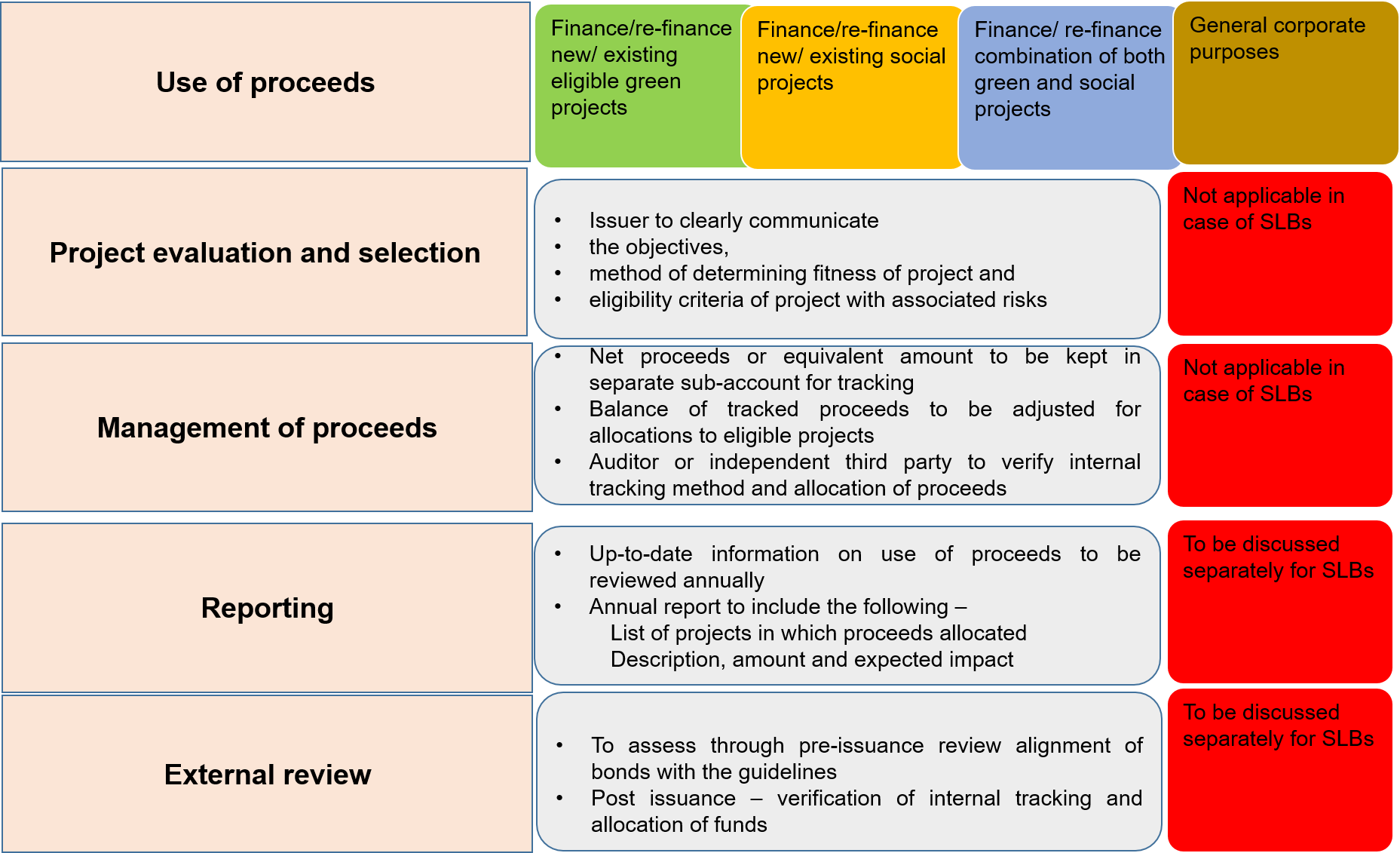
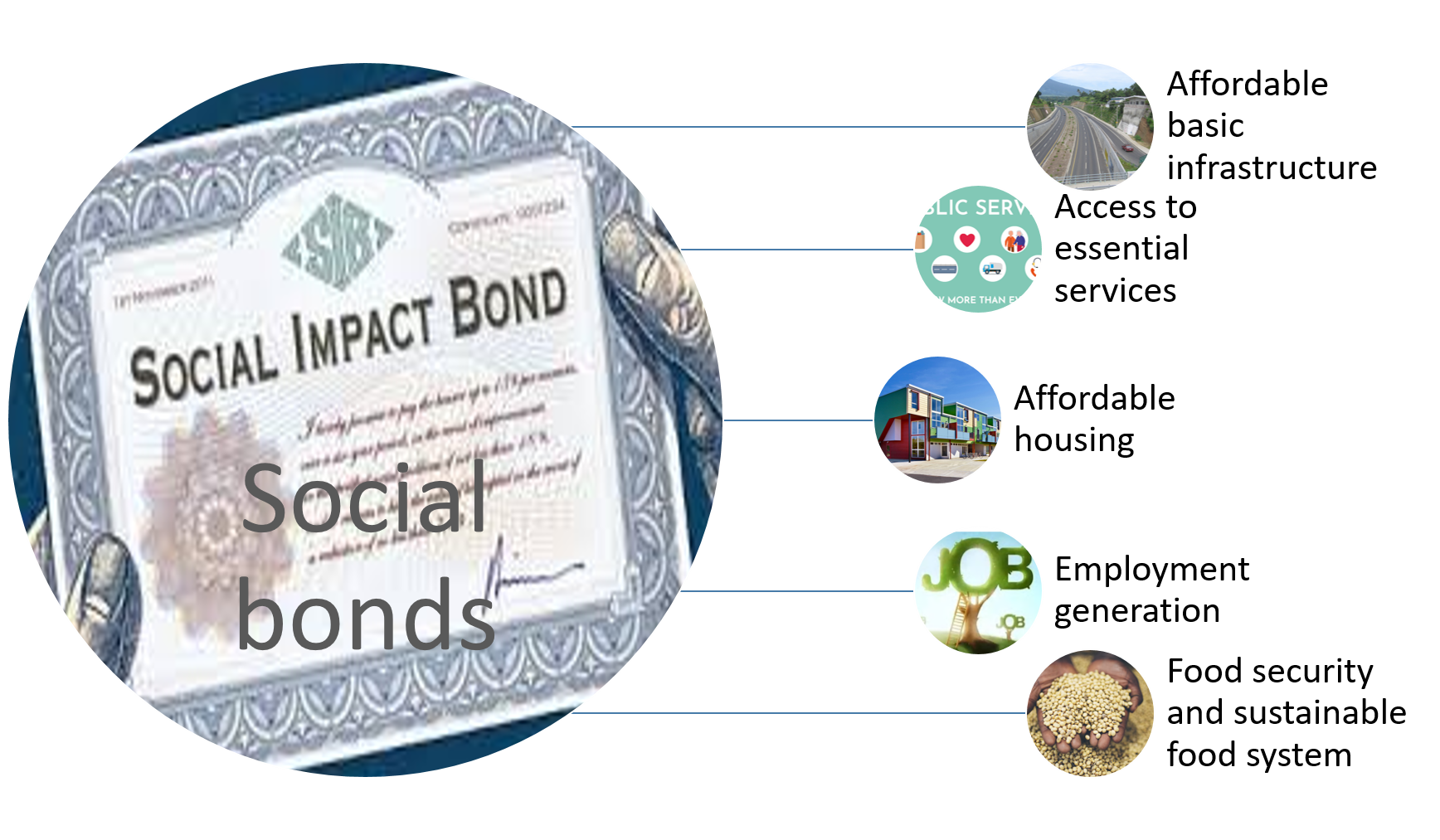
As the name suggests, ESG bonds or debt securities are debt instruments that are linked to or contribute to the development of ESG concepts in some way or the other. The International Capital Market Association (ICMA) recognises 4 types of bonds that are interested in sustainable financing – Further separate guidelines[3] have been issued by ICMA in respect of each of these bonds. A snapshot showing comparative between these 4 types of bonds is as follows – A study of these guidelines show that the SLBs are quite different from other sources of sustainable finance, being “general corporate funds” instead of “use of proceeds” funds. Therefore, the same has been discussed separately in later parts of this article. Further, the categories of projects in which proceeds of green bonds, social bonds, and sustainable bonds can be used have been listed below (the list is illustrative) – Similar standards have been issued by the Climate Bonds Standard Board that recognises only green bonds, Association of South East Asian Nations (ASEAN) having set different standards for green bonds, social bonds and sustainable bonds. Similar standards have also been issued by the European Union for green bonds and social bonds. It is noteworthy that all these standards are voluntary in nature and aligned with the ICMA Guidelines with some modifications of their own. The IFSC Regulations also recognise all the 4 types of bonds as ESG debt securities, issued as under any of the aforesaid guidelines.

Sustainability-linked bonds (SLBs) – where lies the uniqueness?

As discussed above, internationally there are four types of recognised ESG bonds, which are also proposed to be imbibed in the legal framework in India. While the first three being in the nature of “use-of-proceeds” bonds, the Sustainability-linked bonds or SLBs have distinguishing features. The SLBs rests on five key pillars, as follows – The SLBs require companies to frame key performance indicators and Sustainability Performance Targets. To give an example, a company may frame its sustainability performance target to reduce its greenhouse gas (GHG) emissions by 20% compared to that of the year 2018 as baseline. In this case, the key performance indicators can be reduction of CO2 emissions, reduction of carbon footprint etc.

Growth of ESG bonds

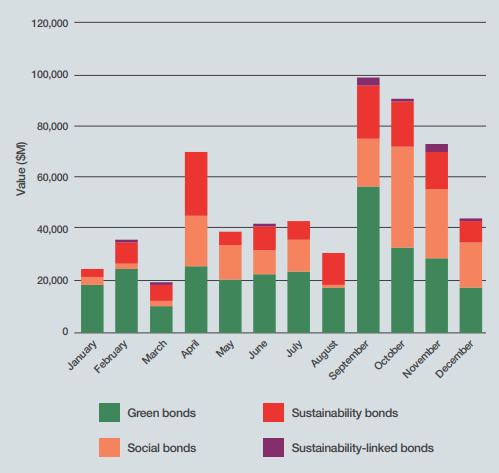
The Environmental Finance – Sustainable Bonds Insight, 2021 provides data analytics in respect of the various types of sustainable bonds issued during the year 2020. The data shows high volume of green and social bonds issued during the year as compared to sustainable bonds and SLBs, which are relatively new and evolving concept. While the figures show a comparative between different types of ESG bonds issuance, it also provides an insight on the increasing volume of the ESG bonds being issued in the Covid era (an increase in the bonds issuance in the months of September, October and November).  

Present position v/s potential growth

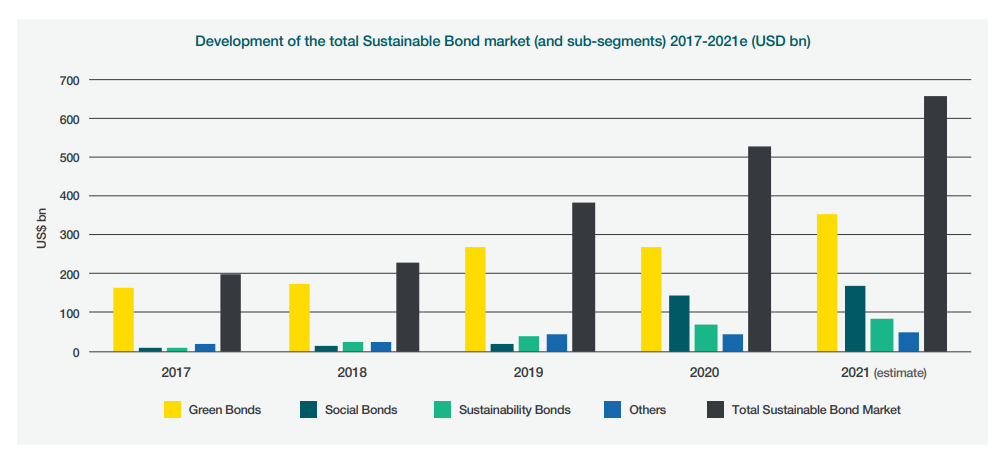
The Report shows a comparison of the development of sustainable bond market in the recent years and an estimate of what is expected in the current year 2021. It demonstrates clearly that the sustainable bond market is expected to rise further in the upcoming areas.

Growth of ESG bond market in India in recent times

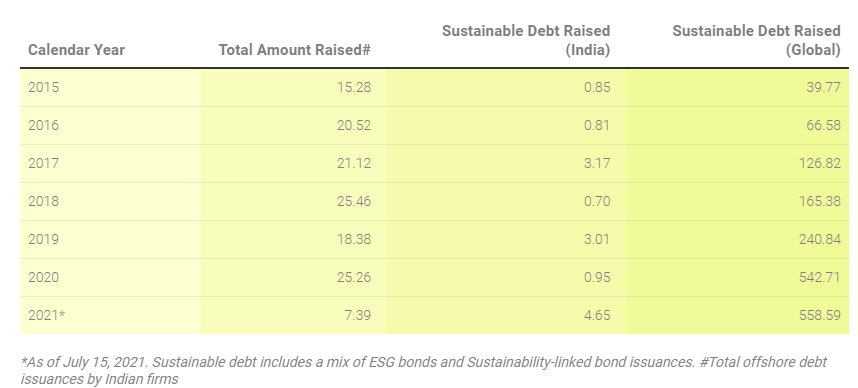
In India, the ESG bonds issuance is witnessing an evident upshot. However, the same has not found much investors’ interest in the country. Nevertheless, the Indian issuer companies have still been able to raise much funds from the issuance of ESG bonds from global investors. The below chart clearly demonstrates the increase in funds raised by way of issue of ESG bonds[4]. Some of the big Indian issuers of ESG focussed bonds include GreenCo, JSW Hydro Energy, Shriram Transport Finance Company, India Green Power Holdings, ReNew Power, Ultratech Cement Ltd etc. Sustainability linked bonds or SLBs, as discussed, is relatively new and innovative concept in the podium of ESG bonds in the world. India has made a remarkable entry in this field with Ultratech Cement Limited[5], issuing SLBs, thereby, being the first company in India and second in Asia to issue SLBs. The company has raised a total of 400 million USD equivalent to Rs. 2900 crores by way of issuance of such SLBs. The same has been listed in the Singapore Exchange Securities Trading Limited[6].

ESG Bonds – Motivations for the Issuer and Investor

Issuer’s perspective

  • Cost advantage due to yield reduction – The yield payment in respect of ESG bonds are relatively lower than that of other conventional bonds[7]. A reason for such lower yields is increase in demand with limited supply of such bonds. An example may be the issuance of green bonds by Italian Government[8], which was oversubscribed by 10 times.
  • Role as corporate citizens – The ESG bonds contribute to demonstrating the role of issuers as responsible corporate citizens, spending the proceeds generally on sourcing of renewable energy, pollution reduction, climate change initiatives.
  • Attracts responsible investors – The ESG bonds align with social development goals (SDGs) and principles of responsible investing (PRI) thereby attracting socially responsible investors whose investment decisions are more of impact-oriented than yield-based.
  • Seen as ethical companies – The companies issuing ESG bonds are looked upon as ethical companies by the stakeholders thereby helping in demonstrating a good corporate image.

Some additional advantages motivation lies for issuance of SLBs

  • Flexibility of designing structure – The main feature of SLB is that it gives a flexibility to the issuers to design their issued bonds in their own way.
  • Flexibility with regard to use of proceeds – Another flexibility is with regard to the use of issue proceeds which need not necessarily be towards promoting green projects, social projects or the like. Therefore, the companies are free to use the proceeds for their operational activities without giving a second thought on whether the same qualifies as a green project or social project.
  • Motivation for fulfilment of ESG targets – The SLBs put a “step-up” on the coupon rate of the bonds in case the issuer misses its ESG target. Therefore, it gives an additional economic interest for the issuers to fulfil their ESG targets.

Investor’s perspective

It is said that behind the investors’ growing interest in ESG bonds lies two reasons – (i) values-driven and (ii) value-driven. While the investors, as part of their responsibility towards the society and environment, consider ESG in their investment analysis, that is not the only reason investors are investing in ESG bonds. Another reason that drives the investors in supporting ESG concerns and investing in ESG bonds is the long term perspective and the expectation of deriving great value from their investment portfolio. The investors believe that a company that invests in the ESG concerns and addresses the ESG issues properly, are more likely to earn profits in the long term. Therefore, while the investors are demonstrating their values and responsible behaviour by choosing ESG focussed bonds, they are also booking adequate profits for themselves in the long run. Now, with the new SLBs coming into picture, the investors are likely to get more benefits out of their investment in the ESG bonds in the form of SLBs. The terms of SLBs are designed as such that the investors get a “step-up” or hike in the coupon rates as and when the issuer misses a pre-defined target (identified as SPTs).

Sustainability-linked bonds (SLBs) – investors always at the winning end

The concept of SLBs comes with a very interesting feature – where investor benefits on the issuer missing its ESG target. Since the investor is making profits on the cost of compromise in ESG responsibilities by issuer, therefore it is controversial that how can an investor show his ESG responsibility at a time when it is making profits on failure to reach ESG targets? However, that is not the case. Another viewpoint towards the case maybe that the investors are motivating their issuers in reaching their ESG targets, and where they fail to do, the investors cast a penalty on the issuer. Whatever the case may be, in both the scenarios, investors are the one who are at the winning side. A recent interesting case of issue of ESG bonds in the form of SLBs may be discussed here. A Japanese firm, Nomura Research Institute Ltd, has issued ESG bonds with the “variable bond characteristics” as below –

  1. Where the issuer reaches target – early redemption of debts
  2. Where the issuer misses target – extra yield to investors

In both the cases, the investors will be benefitted. In the first case, the investor will earn return on their investments early, so they will be in possession of their funds again at a shorter span of time. On the contrary, in the second case, though the funds of the investors will be locked for a longer time, the same will bring them higher yield. So, the investors, are very well in a win-win position in all probable cases.

Requirements for listing of ESG debt securities in India

The Ministry of Finance has notified the IFSCA (Issuance and Listing of Securities) Regulations, 2021 or the IFSC Regulations.  It is a unified framework for various kinds of securities and is framed with the main intent of consolidating the regulatory requirements in order to access the global capital with more ease and less complexity. The concept of ESG bonds have been specifically recognized and captured under Chapter X of the said Regulations. However, it has to be noted that these IFSC regulations are applicable only for the IFSC-listed companies. No specific framework is provided for ESG bonds for other domestic companies in India outside the scope of IFSC Regulations. The same can still be taken as a guidance for other domestic issuances. While the requirements for issuance and listing of ESG bonds are given in Chapter X, the same is in addition to those under Chapter IX of the Regulations. Please note that, Chapter IX lays down the requirements for issuance and listing of debt securities. By “debt securities” is meant the non-convertible debt securities, as is clear from the definition of “debt securities” under Regulation 2(e) of the Regulations. The additional requirements for the ESG bonds are as follows –

  • An independent external review is required to be obtained in order to satisfy that the issue of ESG bonds are in line with internationally recognised standards set for ESG bonds, the principles of ICMA being one of them.
    • Review may be in the form of verification, certification, second party opinion, or scoring/rating.
  • The most important requirement under ESG investing is disclosure and reporting The same is being discussed here under a separate head.
  • Impact report is important in order to measure the actual impact of the projects in which the ESG funds have been spent.

Disclosure and reporting

As also envisaged by the Sustainability-linked bond principles of ICMA, disclosure is a main pillar of ESG investing. The IFSCA Regulations also focusses on the disclosure requirements. Under the IFSCA Regulations, the following disclosures are required to be made –

  • The objectives of the issue of debt securities
  • The process followed for selection and evaluation of projects
  • The system employed for tracking deployment of issue proceeds
  • Intended vs actual utilisation of issue proceeds
  • Specific projects to which the issue proceeds have been disbursed/ allocated.

Further, in case of SLBs, the reporting guidance as under the ICMA Guidelines shall apply.

Applicability to other listed entities not covered under IFSC Regulations

The IFSC Regulations are not applicable to companies other than those listed under the jurisdiction of IFSC Authority. However, the IFSC Regulations are in alignment with other internationally-recognised principles in this regard. We have taken examples of some Indian companies like JSW Steel, Ultratech Cement, Adani Energy, Shriram Transport Finance Co. Ltd, Ultratech Cement etc which provides disclosures and follow the requirements of external review in line with the ICMA Guidelines and IFSC Regulations, which re-iterate requirements of ICMA and other internationally recognised guidelines.

Conclusion

As the world has approached the twentieth century, a shift has become apparent towards more grounded aspects of life – rather than just profit earning. Earlier, it was believed that the corporate world has only one motive – the profit earning motive. However, the focus has now been modified to include various other aspects as well. With instruments like ESG bonds, the efforts are being made to include sustainability in the economy, so that both can progress side-by-side. As the statistics above suggest, India is nowhere lagging behind in the ESG investing. This may be seen as one of the probable cause that IFSCA has included ESG bonds as a specified security in its Listing Regulations.  The IFSCA Regulations do not introduce the ESG bonds in India for the first time, rather it just seeks to regulate issuance of the same by means of express regulations in this regard.

Our resource center on Business Responsibility and Sustainable Reporting can be accessed here –

[1] Our article on the same can be read here [2] Read our articles on the same here [3] Green Bond Principles Social Bond Principles Sustainability Bond Guidelines Sustainability-linked Bond Principles [4] https://www.refinitiv.com/ [5] See Page 4 of the Annual Report here [6] Listing confirmation can be accessed here [7] Asian Development Outlook – 2021 [8] Read this here Our other related resources –

  1. https://vinodkothari.com/2014/03/prospects-green-bonds-rise/
  2. https://vinodkothari.com/2017/05/guidelines-for-issuance-of-green-bonds/
  3. https://vinodkothari.com/wp-content/uploads/2017/03/India_plans_to_tap_Green_Bonds-1.pdf
  4. https://vinodkothari.com/2020/08/cartload-of-details-in-brsr-a-challenge-ahead-for-elaborate-reporting/
  5. https://vinodkothari.com/2020/08/brr-in-process-to-become-a-fully-loaded-electronic-form/
  6. https://vinodkothari.com/2021/03/esg-concerns-on-corporate-governance-in-india/
  7. https://vinodkothari.com/2021/07/corporate-responsibility-towards-climate-change-uk-leads-regulatory-measures/

A Regulatory Affair: Fair Value Discovery in Preferential Share Issues

Payal Agarwal, Vinod Kothari and Company ( payal@vinodkothari.com )

The recent cases of intervention by the stock market regulator and stock exchanges in preferential allotment of listed companies have brought to fore an important but fundamental point. That is,  with a price band fixed under the SEBI (Issue of Capital and Disclosure Requirements) Regulations, 2018 (‘ICDR Regulations’), and considering the liquidity in listed (and frequently traded) shares, whether there is a need for an independent valuation report, has become a question of great interest. Since the issue is currently under litigation will want to say that it will be interesting to see the evolution of jurisprudence on this important issue. While the issue is of relevance to minority shareholders, but it also touches a key issue in valuation as to whether there is a fair value beyond the quoted value of a company whose shares are not infrequently traded.

Further, there might be scenario, where a preferential allotment triggers an open offer under SEBI (Substantial Acquisition of Shares and Disclosure Requirements) Regulations, 2011 (“SAST Regulations”).  The SAST Regulations provides formula for determining offer price, which establish a clear nexus between the price of shares offered under preferential allotment and price of shares under open offer as per SAST Regulations. Given that the pricing of open offer is influenced by the pricing under preferential allotment, should the price under the ICDR Regulations be accepted or fair valuation of shares should be sought in order to ensure fair compensation to shareholders?

At this stage of discussion, it becomes important to look into the relevant provisions and the meaning of “fair value” and understand how fair it is to have a preferential allotment without ascertainment of such fair value by an independent valuer.


Regulatory provisions with respect to preferential allotment

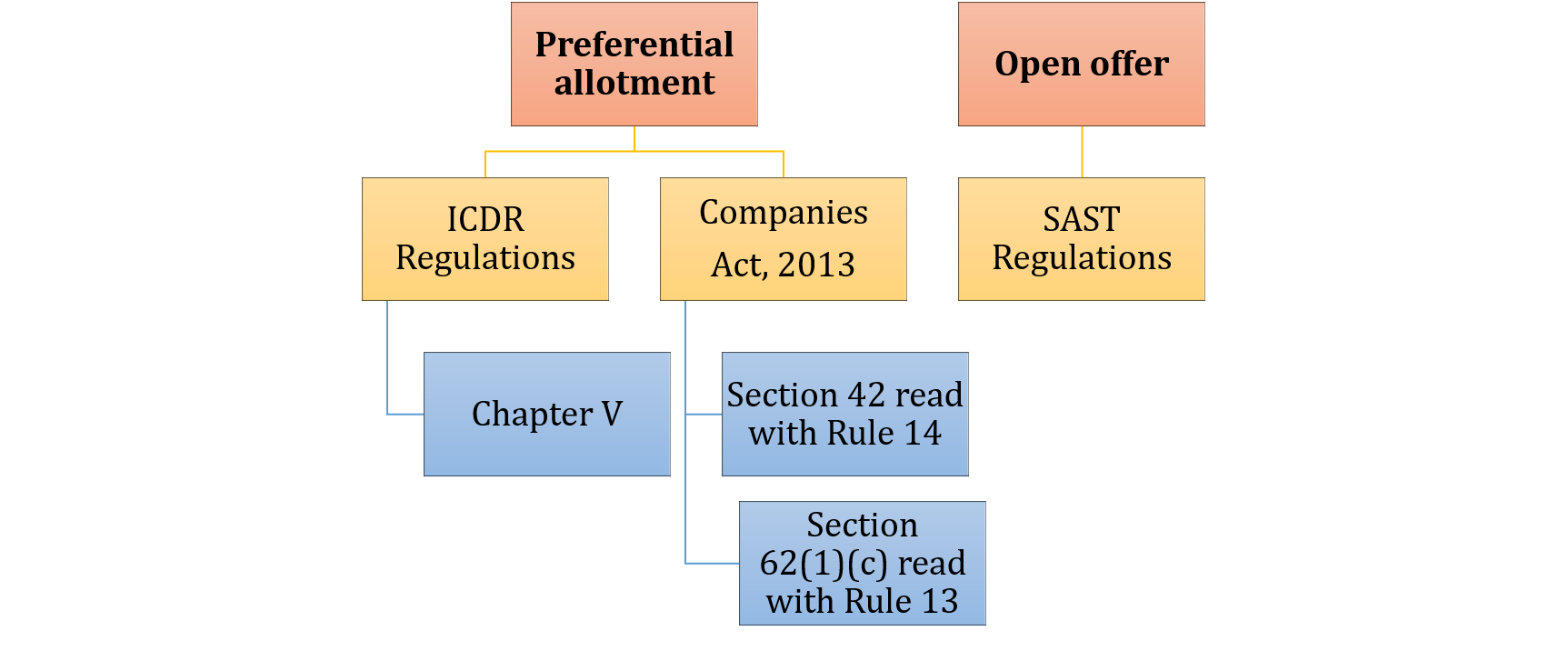
Preferential allotment in listed companies are governed by the following provisions –

  • Section 42 of the Companies Act, 2013 [“Companies Act”], read with Rule 14 of Companies (Prospectus and Allotment of Securities) Rules, 2014
  • Section 62(1)(c) of the Companies Act. read with Rule 13 of Companies (Share Capital and Debentures) Rules, 2014
  • Chapter V of ICDR (Regulation 164)

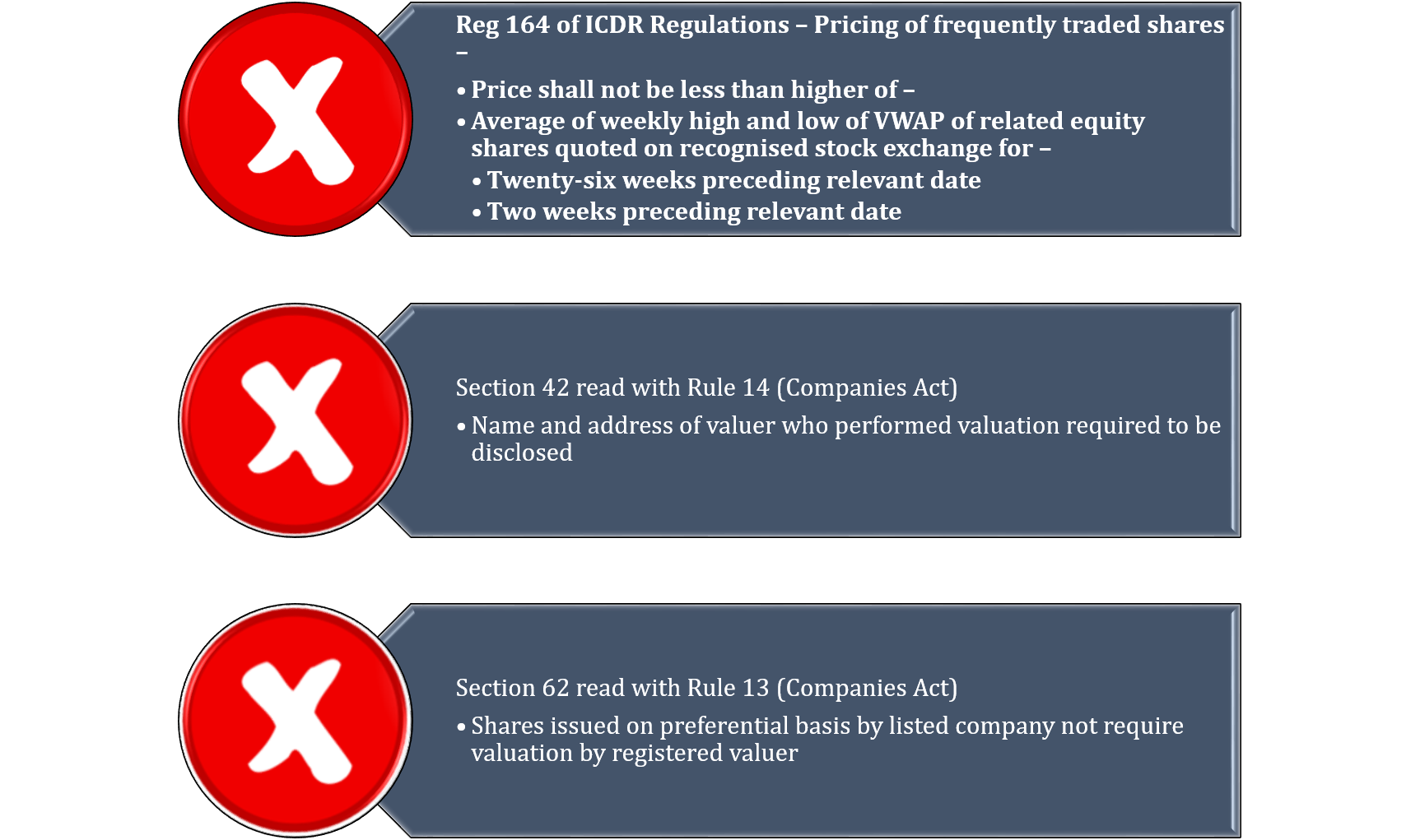
Preferential offers under section 62(1)(c) can be made to any person, if so authorised by a special resolution passed in general meeting if the price of such shares is determined by way of a valuation report of a registered valuer. However, if one goes through allied Rule 13 of SCD Rules, it becomes clear that the companies whose shares are listed on a stock exchange are not required to obtain a valuation report from a registered valuer. The said rules clearly bring out a distinction between preferential offers made by a listed company versus those made by unlisted companies. Sub-rule (2) specifically states that for companies whose shares are listed on a recognised stock exchange, the requirements under the relevant SEBI regulations (ICDR Regulations) will apply, while the unlisted companies will be governed by the provisions of the Companies Act; and sub-rule (3) states that the price under the preferential allotment shall not be less than the price determined on the basis of valuation report of registered valuer. Hence, it becomes clear that in case of a listed company, as per section 62 and rule 13, there is no requirement of a valuation report, per se. Instead, the legislature has left it to be regulated by SEBI regulations. Therefore, one will have to look for what ICDR says.

Reg. 164 of ICDR lays the floor limit of the price, which is to be calculated as the higher of average of weekly high and low of volume weighted average price of related equity shares quoted on a recognised stock exchange for –

  1. 26 weeks preceding the relevant date
  2. 2 weeks preceding the relevant date

The Regulation does not call for an independent valuation report. This must be read in contradistinction to regulation 165, which deals with pricing of infrequently traded shares. Reg. 165 rather specifically requires an independent valuation.

Requirement of independent valuation under regulatory provisions


The above clearly demonstrates that the regulations have consciously exempted listed entities from seeking an independent valuation where listed shares are frequently traded. The regulations, in fact, draw a timeframe to extract weighted averages of the market prices to ensure that the fluctuations in prices, if any, are ironed out and the resultant price is the even price at which the market has transacted during that period. This, admittedly and reasonably too, is based on the assumption that ‘market’ is the best reflection of a fair price which a willing seller and a willing investor are ready to deal in. This view can also be substantiated with similar stipulations in other laws and valuation standards.

Meaning of fair valuation under various applicable laws

Meaning of fair value under applicable accounting standards –


Ind AS 113 deals with the fair valuation of equity shares.  This Ind AS defines fair value as the price that would be received to sell an asset or paid to transfer a liability in an orderly transaction between market participants at the measurement date, and thus considers fair value to be “a market based measurement and not an entity specific measurement.”

Clause 18 of the Ind AS 113 provides, “If there is a principal market for the asset or liability, the fair value measurement shall represent the price in that market.”

Meaning of fair value under the Income Tax Rules

Rule 11UA (1)(c) of the Income Tax Rules provides for the fair value of shares listed in a stock exchange.

It renders the transaction value of such shares to be the fair value in case the transaction has been done through stock exchange. Otherwise, the fair market value of such shares are taken to be –

“(a)the lowest price of such shares and securities quoted on any recognized stock exchange on the valuation date, and

(b)the lowest price of such shares and securities on any recognized stock exchange on a date immediately preceding the valuation date when such shares and securities were traded on such stock exchange, in cases where on the valuation date there is no trading in such shares and securities on any recognized stock exchange”

Meaning of fair value under the Valuation Standards

Rule 18 of the Companies (Registered Valuers and Valuation) Rules, 2017 requires the registered valuer to follow such valuation standards as prescribed by the Central Government. For valuation with effect from 01st July, 2018, all registered valuers are mandatorily required to apply the ICAI Valuation Standards in their valuation assignments for the purposes of the Companies Act, 2013.

The definition of ‘fair value’ under ICAI Valuation Standard (101) is the same as that in IndAS 113, that is, fair value is the price that would be received to sell an asset or paid to transfer a liability in an orderly transaction between market participants at the valuation date. IVS 101 further states that fair value assumes that the price is negotiated in a free market. The ICAI Valuation Standards recognises three approaches for valuation, being – market approach,  income approach, and cost approach.

Where the assets to be valued are traded in active market, the market approach is followed for valuation purposes.

Paragraphs 18-20 gives guidance over the valuation as follows –

“18. A valuer shall consider the traded price observed over a reasonable period while valuing assets which are traded in the active market.

  1. A valuer shall also consider the market where the trading volume of asset is the highest when such asset is traded in more than one active market.
  2. A valuer shall use average price of the asset over a reasonable period. The valuer should consider using weighted average or volume weighted average to reduce the impact of volatility or any one time event in the asset.”

The stipulations as above clearly reflect that for quoted shares, fair valuation is based on quoted prices only. Given that IVS too refers to ‘traded prices’, a registered valuer would rely on such traded prices to arrive at a fair value. It may be reiterated that ICDR uses a ‘range’ of time so as to spread out the fluctuations in prices, which has been similarly captured in the IVS.

One may argue that the price of a company’s shares can be tampered with, by the company as per its whims and wishes. However, for a listed company, whose every information is readily available on public domain, does such an argument hold good? In view of the strict regulatory surveillance constantly placed by SEBI and stock exchanges on listed companies, this does not seem to be a possible scenario.

Valuation in respect of infrequently traded shares

The aforesaid logic and arguments may not hold good in case of shares that are infrequently traded or are unlisted. As indicated above, the applicable rules/regulations and standards prescribe a different methodology to arrive at fair values of such shares. For instance, regulation 165 of ICDR requires the minimum price in case of infrequently traded shares to be determined on the basis of valuation as per applicable parameters. Also, the SAST Regulations requires the offer price in case of infrequently traded shares to be determined by way of valuation taking into account various valuation parameters such as comparable trading multiples, book value and such others.

To reiterate, such distinction made out between frequently traded and infrequently traded shares clearly buttresses the views here.

Conclusion

The chances of a listed company acquiring a fair deal without falling into the formalities of fair valuation does not seem to be a scarce event. Listed companies are well governed under the provisions of ICDR Regulations as regards pricing of shares under preferential allotment. To ensure shareholder protection, ICDR already prescribes a minimum threshold based on average quoted prices. The prices depend on the market price of related equity shares quoted and traded on stock exchanges. Further, fair value of equity shares depend on market value of such shares and there does not seem to be chances of much disparity among the price under ICDR versus that as determined by way of fair valuation.


Understanding Silent Period for listed entities

By CS Aisha Begum Ansari (aisha@vinodkothari.com)

Introduction

When you go silent, you may be doing a soul searching, as for example, in meditational techniques. However, in case of listed entities, silent period is a period just before declaration of financial results, to ensure that there is no accidental leakage of confidential information. Silent period is different from “trading window closure” that most corporate professionals in India are familiar with. However, this article discusses the relevance of silent period, as a subset of the trading window closure, and its relevance to listed entities in India. While exploring the topic, the author also makes a study of the global laws around silent period.

Why silent period?

Insider trading is a ‘white collar’ crime that seeks to exploit the unpublished, non-democratic information (that is, what is not available in public domain) to the advantage of a select few, and to the disadvantage of the market in general. Since, it is a fraud upon the market in general, it has always been a significant topic for the securities market regulators around the globe. In India, Securities and Exchange Board of India (‘SEBI’) has framed the regulatory framework to curb the insider trading called as SEBI (Prohibition of Insider Trading) Regulations, 2015 (‘PIT Regulations’).

The material inside information is generally accessed by the top executives and employees of the company. To avoid the exploitation of such information, the company prohibits them from trading in its securities while having access to such information.  The preventive framework of insider trading does not just end by prohibiting the employees from trading; it also needs to ensure that such material inside information is not leaked outside the organization. There are many ways used by the insiders to leak such information such as sharing the same on social media, sharing of information during analyst or institutional investor meets, etc.

Silent period is different from trading window closure. Silent period is when the company’s top executives, say that CEO, CFO etc. will refrain from doing public communications altogether. The intent is to ensure that there is no interaction with investors or public at large, so as to avoid unintended slippage of information. Currently, SEBI regulations do not require companies to mandatorily observe a silent period; therefore, companies may choose to adopt this practice by way of their Code of Fair Disclosure.

What is silent period?

A silent period (also known as quiet period) is a stipulated time during which a company’s senior management and investor relation officers do not interact with the institutional investors, analysts and the media. The purpose of the silent period is to preserve the objectivity and avoid the appearance of the company providing insider information to select investors. During the silent period, the company does not make any announcements that can cause a normal investor to change their position on the company’s securities.

Is it different from trading window closure?

Trading window closure period (also known as blackout period or closed period) refers to the period during which the employees of the company who have access to material inside information are prohibited from trading in the securities of the company. In some of the developed countries, the securities market regulators give a freehand to the companies to decide the period during which the trading window shall be closed. In India, the PIT Regulations provide that the companies shall close the trading window from the end of the closure of the financial period for which results are to be announced till 48 hours after the disclosure of financial results to the stock exchanges. For any other material inside information, SEBI has given the responsibility to the compliance officers of the companies to close the trading window when the employees can reasonably be expected to have possession of inside information.

Silent period differs from the trading window closure in such a way that trading window closure prohibits the employees to trade in the securities of the company while having access to material inside information and silent period prohibits or restricts the company’s spokespersons to interact with the institutional investors or analysts. The purpose of trading window closure is to prohibit trading on the basis of inside information and the purpose of silent period is to prohibit communication of inside information illegitimately.

Duration of silent period

The PIT Regulations or any other regulatory framework in India do not provide for the requirements of silent period. So, the duration of silent period differs from company to company. Some companies specify the silent period as 20-30 days before the declaration of financial results till the date of disclosure and some companies align the silent period with the trading window closure period. The following table gives the synopsis of the practice followed by the Indian listed entities regarding silent period:

Name of the Company Practice followed
Mahindra & Mahindra Limited Silent period commences from 20 days before the declaration of financial results till the date of disclosure of results
Tata Consultancy Services Limited Quiet period starts 20 days before the declaration of financial results till the date of disclosure of results
HCL Technologies Limited Silent period is same as trading window closure period
Asian Paints Limited Silent period is observed between the end of the period and the publishing of the stock exchange release for that period
Wipro Limited Quiet period commences from 16th day of the last month of the quarter and ends with 48 hours after earnings release.
Infosys Limited Silent period is observed between the 16th day prior to the last day of the financial period for which results are required to be announced till the earnings release day.

Thus, it can be concluded that the silent period is smaller than the trading window closure period.

Analysts/ investors meets during silent period

Analysts/ investors meets can be a medium of leak of material inside information, therefore, the companies avoid interaction with them during trading window closure period. So, does it mean that companies completely abstain from interacting with the analysts and investors? While the answer may differ from company to company and the policies adopted by them for communication with analysts and investors. Some companies completely refrain from the analysts/ investors meets while some companies interact with them and discuss the past and historical information which is already available in public domain and general future prospects of the company, dodging the specific questions relating to the material inside information.

Guidelines for Investor Relations for Listed Central Public Sector Enterprises[1]

While the regulations framed by SEBI are silent about the silent period, the Guidelines for Investor Relations for Listed Central Public Sector Enterprises issued by the Department of Disinvestment, Ministry of Finance, Government of India, provides for the duration of silent period and obligations of the public sector enterprises in this regard. The Guidelines advise that the silent period should commence 15 days prior to the date of Board meeting in which financial results are considered and end 24 hours after the financial results are made public. The Guidelines requires the companies to abstain from meeting the analysts and investors and not communicate with them unless such communication would relate to the factual clarifications of previously disclosed information.

International practice with respect to silent period

Country Trading window closure period Silent period Analyst meet during silent period
United States of America (USA)[2] USA laws do not provide any specific timeline for trading window closure period. Thus, the companies are free to determine it There are two types of silent period prevalent in USA:

1.    When the company makes an Initial Public Offering (‘IPO’) – the Securities Exchange Commission (‘SEC’) mandates such companies to maintain a silent period from the date of registration with SEC which lasts till 40 days after the securities begin to trade on the stock exchanges. Such silent period is heavily regulated by the SEC.

2.    During finalization of quarterly results – the silent period is not clearly defined by SEC.

During the silent period, the interaction with the analysts and investors is reduced. The companies either go completely silent or they speak about only past and historical information.
United Kingdom (UK)[3] Unlike USA, the UK laws prescribe the trading window closure period. Article 19.11 of Market Abuse Regulations specifies the period of trading window closure starting from 30 calendar days before the announcement of an interim financial report or a year-end report till the second trading day after announcement of financial report. UK laws do not comment anything about the silent period. Thus, the companies determine the silent period as per their own discretion.


Since UK laws do not provide for silent period, the companies, as per their discretion, avoid interactions with the analysts and investors during such period.


Canada[4] Para 6.10 of National Policy on Disclosure Standards (‘Policy’) discusses about blackout period. It states that the company’s insider trading policy should specify the period which may mirror the quiet period. Para 6.9 of the Policy talks about quiet period. While the Policy does not prescribe the duration of quiet period, it states that the period should run between the end of the quarter and the release of a quarterly earnings announcement. The Policy states that the company need not completely stop communicating with the analysts and investors during the quiet period, but the communication should be limited to responding to inquiries concerning publicly available or non-material information.

Conclusion

After discussing the practices followed by the Indian listed companies and the regulatory framework of other developed countries, it can be concluded that the concept of silent period is not something new, though unregulated. Some companies align the silent period with the trading window closure period while some provide for lesser duration for silent period. Some companies completely abstain from interacting with the analysts and the institutional investors during the silent period whereas some prefer discussing the generally available information only.

[1]https://www.dipam.gov.in/dipam/downloadFile?fileUrl=resources/pdf/capital-market-regulation/IR_Guidelines_website.doc

[2] https://www.irmagazine.com/reporting/six-commonly-asked-questions-and-answers-about-quiet-periods

[3] https://eur-lex.europa.eu/legal-content/EN/TXT/PDF/?uri=CELEX:32014R0596&from=EN

[4] http://ccmr-ocrmc.ca/wp-content/uploads/51-201_np_en.pdf

Other relevant materials of interest can be read here –

https://vinodkothari.com/2021/07/step-by-step-guide-for-disclosure-for-analysts-investors-meet/

https://vinodkothari.com/2021/05/sebi_defines_investors_meet/

https://vinodkothari.com/2020/11/sebi-proposes-enhanced-disclosures-for-meetings-with-analyst-investors-etc/

Independent Directors: The Global Perspective

Ajay Kumar KV, Manager and Himanshu Dubey, Executive  (corplaw@vinodkothari.com)

Introduction

The role or failure of independent directors in preventing corporate scandals became one of the central themes in corporate governance in India, and when SEBI issued a Consultation paper proposing a dual approval process for the appointment of independent directors, there was a substantial concern among leading companies in the country. Following discussions, the SEBI board has eventually decided to drop the proposal for dual approval, and instead, go for approval by a special majority. The decision of SEBI to not implement dual approval has not been appreciated by several commentators including Mr. Umakanth Varottil. Therefore, there is a sizzling controversy on the mode of appointment of independent directors.

In this article, we have made a comparison of the legislative framework for independent directors, especially the process of appointment, across various jurisdictions.  While we note that some countries have moved to a dual approval process, the concept such as a database of IDs and a proficiency test remains an Indian aberration.

Independent Directors – Evolution in India

In India, the idea, or rather the need of having Independent Directors on the board of companies (especially those involving public interest) was acknowledged in the early 2000s through the SEBI Listing Agreement. Therefrom, the concept found a concrete legislative recognition in late 2013 as the Companies Act, 2013 took shape and character covering unlisted companies as well.

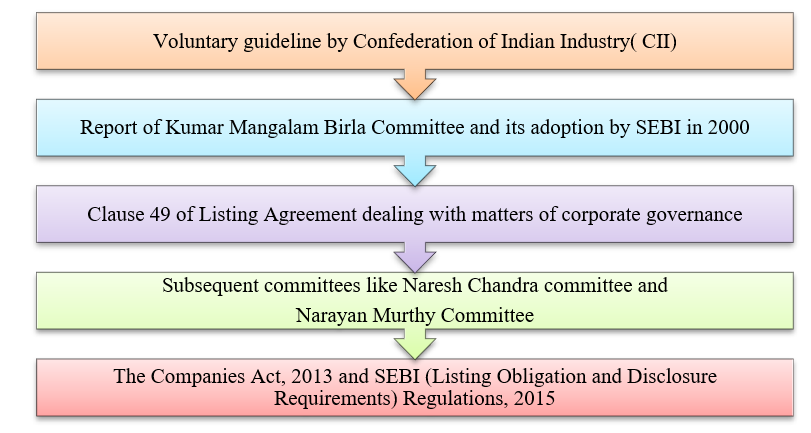
A snapshot of the concept’s evolution through guidelines and report to the Companies Act and SEBI (Listing Obligations and Disclosure Requirements) Regulations, 2015 is given below –
As compared to India, the western world was way ahead in the race- the concept of Independent Directors traces its inception as long back as in the 1950s when the murmurs of representation of small shareholders surrounded the corporate world. However, like in India, it took a long time for countries in Europe and North America to bring the concept within the regulatory framework. In the USA, the concept of Independent Director received regulatory recognition under the Sarbanes-Oxley Act, 2002. Thereafter the regulations issued by various stock exchanges took the lead.

Who is an Independent Director – The Indian Viewpoint

With all the hullabaloo about Independent Director, the natural question was ‘who is an independent director’; while the terminology was largely suggestive of the answer – “someone who is capable of putting forth an independent view about the business of the company”, it was crucial to define the term.

The definition of Independent Director from Section 149 of the Companies Act, 2013 (‘Act’) and Regulation 16 of the SEBI (Listing Obligations and Disclosure Requirements) Regulations, 2015 (‘LODR’). While unlisted companies are required to adhere to the requirement under section 149 of the Act; listed companies or those intending to be listed are required to abide by LODR too.

On the same lines as discussed above, LODR identifies an independent director as someone who is not related to the company, either as a promoter or director of the company, its group companies, who do not have a material pecuniary relationship with the company or its group, as well as someone who does not or has not been related to the company in any manner in the recent position, such that s/he could influence the decisions/ business of the company.

The aforesaid is provided in Regulation 16 of LODR[1], which defines “Independent Director” as “a non-executive director, other than a nominee director of the listed entity, who:

  • who, in the opinion of the board of directors, is a person of integrity and possesses relevant expertise and experience;
  • who is or was not a promoter of the listed entity or its holding, subsidiary or associate company or member of the promoter group of the listed entity;
  • who is not related to promoters or directors in the listed entity, its holding, subsidiary, or associate company;
  • who, apart from receiving director’s remuneration, has or had no material pecuniary relationship with the listed entity, its holding, subsidiary or associate company, or their promoters, or directors, during the  [three]*  immediately preceding financial years or during the current financial year
  • none of whose relatives ;

[(A) is holding securities of or interest in the listed entity, its holding, subsidiary or associate company during the three immediately preceding financial years or during the current financial year of face value in excess of fifty lakh rupees or two percent of the paid-up capital of the listed entity, its holding, subsidiary or associate company, respectively, or such higher sum as may be specified;

(B) is indebted to the listed entity, its holding, subsidiary or associate company or their promoters or directors, in excess of such amount as may be specified during the three immediately preceding financial years or during the current financial year;

(C) has given a guarantee or provided any security in connection with the indebtedness of any third person to the listed entity, its holding, subsidiary or associate company or their promoters or directors, for such amount as may be specified during the three immediately preceding financial years or during the current financial year; or

(D) has any other pecuniary transaction or relationship with the listed entity, its holding, subsidiary or associate company amounting to two percent or more of its gross turnover or total income:

Provided that the pecuniary relationship or transaction with the listed entity, its holding, subsidiary or associate company or their promoters, or directors in relation to points (A) to (D) above shall not exceed two percent of its gross turnover or total income or fifty lakh rupees or such higher amount as may be specified from time to time, whichever is lower;]*

  • who, neither himself/herself nor whose relative(s) —
  • holds or has held the position of a key managerial personnel or is or has been an employee of the listed entity or its holding, subsidiary, or associate company [or any company belonging to the promoter group of the listed entity]* in any of the three financial years immediately preceding the financial year in which he is proposed to be appointed;

[Provided that in case of a relative, who is an employee other than key managerial personnel, the restriction under this clause shall not apply for his / her employment.]*

  • is or has been an employee or proprietor or a partner, in any of the three financial years immediately preceding the financial year in which he is proposed to be appointed, of —
    • a firm of auditors or company secretaries in practice or cost auditors of the listed entity or its holding, subsidiary, or associate company; or
    • any legal or a consulting firm that has or had any transaction with the listed entity, its holding, subsidiary, or associate company amounting to ten percent or more of the gross turnover of such firm;
    • holds together with his relatives two percent or more of the total voting power of the listed entity; or
    • is a chief executive or director, by whatever name called, of any non-profit organisation that receives twenty-five percent or more of its receipts or corpus from the listed entity, any of its promoters, directors or its holding, subsidiary or associate company or that holds two percent or more of the total voting power of the listed entity;
    • is a material supplier, service provider or customer or a lessor or lessee of the listed entity;
  • who is not less than 21 years of age.
  • who is not a non-independent director of another company on the board of which any non-independent director of the listed entity is an independent director

Evidently, the definition in India is very comprehensive compared to other major jurisdictions. Below we discuss and compare some major provisions in the definition of IDs in India, the USA and the UK –

Basis India USA[2] UK[3]
Material relationship The director shall, apart from receiving director’s remuneration, has or had no material pecuniary relationship with the listed entity, its holding, subsidiary or associate company, or their promoters, or directors, during the three immediately preceding financial years or during the current financial year;


None of the director’s relatives

[(A)is holding securities of or interest in the listed entity, its holding, subsidiary or associate company during the three immediately preceding financial years or during the current financial year of face value in excess of fifty lakh rupees or two percent of the paid-up capital of the listed entity, its holding, subsidiary or associate company, respectively, or such higher sum as may be specified;


(B) is indebted to the listed entity, its holding, subsidiary or associate company or their promoters or directors, in excess of such amount as may be specified during the three immediately preceding financial years or during the current financial year;


(C) has given a guarantee or provided any security in connection with the indebtedness of any third person to the listed entity, its holding, subsidiary or associate company or their promoters or directors, for such amount as may be specified during the three immediately preceding financial years or during the current financial year; or


(D) has any other pecuniary transaction or relationship with the listed entity, its holding, subsidiary or associate company amounting to two percent or more of its gross turnover or total income:


Provided that the pecuniary relationship or transaction with the listed entity, its holding, subsidiary or associate company or their promoters, or directors in relation to points (A) to (D) above shall not exceed two percent of its gross turnover or total income or fifty lakh rupees or such higher amount as may be specified from time to time, whichever is lower;]*

The director qualifies as “independent” unless the board of directors affirmatively determines that the director has no material relationship with the listed company (either directly or as a partner, shareholder, or officer of an organization that has a relationship with the company).

The references to “listed company” would include any parent or subsidiary in a consolidated group with the listed company

The director has, or had within the last three years, no material business relationship with the company, either directly or as a partner, shareholder, director or senior employee of a body that has such a relationship with the company;


The director has not received or receives additional remuneration from the company apart from a director’s fee, participates in the company’s share option or a performance-related pay scheme, or is a member of the company’s pension scheme

Employment The director neither himself/herself nor his relatives hold or has held the position of a key managerial personnel or is or has been an employee of the listed entity or its holding, subsidiary or associate company, [or any company belonging to the promoter group of the listed entity]* in any of the three financial years immediately preceding the financial year in which he is proposed to be appointed.


[Provided that in case of a relative, who is an employee other than key managerial personnel, the restriction under this clause shall not apply for his / her employment]*


The director is not independent if the director is, or has been within the last three years, an employee of the listed company or an immediate family member is, or has been within the last three years, an executive officer, of the listed company.

The director has received or has an immediate family member who has received, during any twelve-month period within the last three years, more than $120,000 indirect compensation from the listed company, other than director and committee fees and pension or other forms of deferred compensation for prior service (provided such compensation is not contingent in any way on continued service).

The director neither is or has been an employee of the company or group within the last five years
Promoter/director or related to them The director is or was not a promoter of the listed entity or its holding, subsidiary or associate company or member of the promoter group of the listed entity;


Who is not related to promoters or directors in the listed entity, its holding, subsidiary, or associate company;


No director qualifies as “independent” unless the board of directors affirmatively determines that the director has no material relationship with the listed company either directly or as a partner, shareholder, or officer of an organization that has a relationship with the company. The director has close family ties with any of the company’s advisers, directors, or senior employees.
Cross-directorship The director is not a non-independent director of another company on the board of which any non-independent director of the listed entity is an independent director


The director or an immediate family member is or has been with the last three years, employed as an executive officer of another company where any of the listed company’s present executive officers at the same time serves or served on that company’s compensation committee. The director holds cross-directorships or has significant links with other directors through involvement in other companies or bodies


One may find many similarities in the definition of IDs in foreign jurisdictions with that in India but as already mentioned above, the definition in India is one of the most comprehensive and meticulous ones.

Appointment/reappointment process of IDs in different jurisdictions

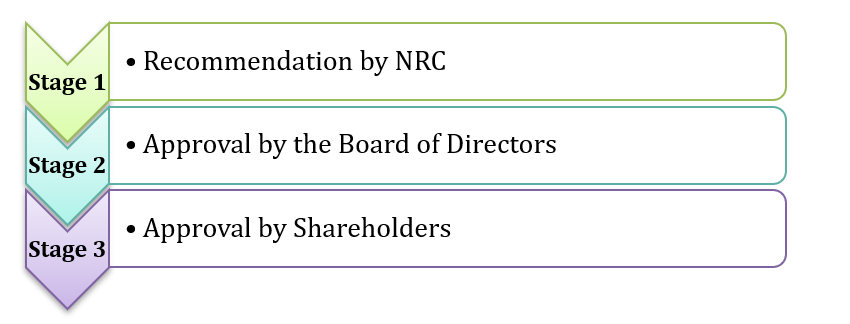
In India, the extant provisions require ordinary resolution to be passed by the shareholders for the appointment of IDs and a special resolution in case of re-appointment, based on the recommendation of the Nomination and Remuneration Committee (NRC) and the approval of the Board.

Earlier, SEBI had released a consultation paper w.r.t. regulatory provisions for Independent Directors which warranted a ‘dual approval’ for such appointment/ re-appointment as follows:

  • An ordinary resolution by shareholders (Special Resolution in case of re-appointment) and
  • A resolution by “majority of minority”

(Note: The Paper defined minority shareholders to mean shareholders other than the promoter and promoter group.)

However, owing to the response received thereafter, SEBI, in its Board Meeting held on June 29, 2021[4] (SEBI Board Meeting), disregarded the earlier proposal of a dual approval and instead decided that the approval of shareholders would be required by way of special resolution for both appointment and re-appointment

[SEBI, vide (Listing Obligations and Disclosure Requirements) (Third Amendment) Regulations, 2021 ( ‘Amendments’) notified on August 4, 2021, have amended the Regulation 25 providing that the appointment, re-appointment or removal of an independent director of a listed entity, shall be subject to the approval of shareholders by way of a special resolution. Thus, listed entities henceforth shall have to obtain the approval of members via a special resolution for the appointment as well.]*
In the USA, the NASDAQ Listing Rules provide that, where shareholders’ approval is required, the minimum vote that will constitute shareholder approval shall be a majority of the total votes cast on the proposal.

Akin to the NRC in India, the UK Corporate Governance Code of 2018 requires that the Board should establish a Nomination Committee, composed of majority independent non-executive directors, to lead the process for the appointment of all directors. Any appointment must be approved by the Board and shareholders of the company by way of an ordinary resolution.

However, as per the UK Listing Rules, the appointment of IDs is dependent on the existence of a controlling shareholding[5]. A snapshot of the manner of appointment is given below

Hence, approval is required from both the set of shareholders. If the company still proposes to appoint the same person as an independent director despite failing to receive the dual nod as discussed above, it can propose another resolution to elect the same person, but after 90 days from the date when the previous proposal was put to vote. This time the resolution will only require approval by the shareholders of the company[6].

Databank of Independent Directors & the Online Proficiency Test

One of the prerequisites to become an Independent Director in India is the inclusion of their name in the Databank of Independent Directors (‘Databank’) and passing an Online Proficiency Test (‘Test’) within a period of two years from the date of inclusion of name in the databank as per Section 150 of the Act, read with Rule 6 of the Companies (Appointment and Qualification of Directors) Rules, 2014. However, certain categories of persons have been exempted[7] from the requirement of passing the Test who possess requisite experience and expertise as prescribed;

The question, however, is whether such arduous and tedious criteria required for an appointment really ensure board independence and good governance practices. It is understood that the tenet behind such steps was quality control – it was to ensure that only persons with a certain minimum level of expertise & experience are appointed as Independent Directors.

Further, some previous instances of celebrity directorships were also to be discouraged since the role of IDs is to ensure good governance practices and upholding the interest of all the stakeholders as a whole including minority stakeholders. Therefore, it should not merely be used as a tool of publicity.

However, keeping in mind the seniority of the position of directors in companies as well as lack of precedent, the requirement of passing the test seems rather odd and brings anomalies in the IDs’ regulatory regime in India vis-à-vis the rest of the world.

Constituted Body for selection of candidates for the role of IDs

As per the extant laws in India, the NRC recommends the persons to be appointed as IDs on the board of the company. This committee oversees the functions of formulation and recommendation of remuneration of the directors and the senior management. It has been decided in the SEBI Board Meeting that the process to be followed by NRC while selecting candidates for appointment as IDs, shall be elaborated and be made more transparent including enhanced disclosures regarding the skills required for appointment as an ID and how the proposed candidate fits into that skillset.

[SEBI, via the Amendments, has added a new sub-clause after sub-clause (1) in Para A in Part D of Schedule II for implementing its decision on an elobaroted and transparent selection oricess of IDs.

The NRC of every listed entities shall, for every appointment of IDs,

  • evaluate the balance of skills, knowledge and experience on the Board and on the basis of such evaluation
  • prepare a description of the role and capabilities required of IDs.
  • ensure that the person recommended to the Board for appointment as an ID has the capabilities identified in such description.

For the purpose of identifying suitable candidates, the Committee may:

  1. use the services of an external agencies, if required;
  2. consider candidates from a wide range of backgrounds, having due regard to diversity; and
  3. consider the time commitments of the candidates

Thus, the NRCs of every listed company henceforth has to first formulate the description of the role of an ID after considering the skill sets and knowledge and experience required for acting as an ID of the company. This has also widened the scope of NRC as well as the responsibility for finding the right candidate for the position of an ID. The extant practice was to give disclosures in Corporate Governance Report and the Board report that forms part of the Annual Report of the Company.]*

Just like the NRC in India, companies in the USA have to constitute Compensation Committee as per the NASDAQ Stock Market LLC Rules [5605. Board of Directors and Committees] “Each Company must have, and certify that it has and will continue to have, a compensation committee of at least two members. Each committee member must be an Independent Director as defined under Rule 5605(a) (2).”

As per the NASDAQ Rules, director nominees must either be selected, or recommended for the Board’s selection, either by:

  1. Independent Directors constituting a majority of the Board’s Independent Directors in a vote in which only Independent Directors participate, or
  2. a nominations committee composed solely of Independent Directors.

The New York Stock Exchange Listed Company Manual (‘NYSE Manual’) vests on the nominating/corporate governance committee, the sole authority to retain and/or terminate any search firm to be used to identify director candidates, including sole authority to approve the search firm’s fees and other retention terms.

The UK Corporate Governance Code, 2018 states that the board should establish a remuneration committee of independent non-executive directors, with a minimum membership of three, or in the case of smaller companies, two. In addition, the chair of the board can only be a member if they were independent on appointment and cannot chair the committee. Before appointment as chair of the remuneration committee, the appointee should have served on a remuneration committee for at least 12 months.

Tenure and re-appointment of IDs

In India, one term of appointment of IDs is for a maximum of 5 years and can be re-appointed for another term. Such re-appointment has to be made by way of passing a special resolution. Further, the performance of Independent Directors is to be evaluated every year based on which the NRC recommends whether the said director shall be re-appointed or not. However, the question of such recommendation only comes when the tenure of the director comes to its end.

Furthermore, the UK Corporate Governance Code provides that all directors should be subject to annual re-election.  The code also considers the presence of an ID for more than nine years on the Board of a company as a threat to his independence.

In Singapore, Rule 720(5) of the SGX Listing Rules (Mainboard) / Rule 720(4) of the SGX Listing Rules (Catalist)[8] requires all directors to submit themselves for re-nomination and re-election at least once every three years.

The rule requires a re-nomination & re-election of all directors of the company at least once in 3 years and it helps to ensure that the assessment of independence happens once in every 3 years by members.

Cooling-off Period for appointment/reappointment of IDs

In India, a cooling-off period of 2 years is required in case of any material pecuniary transactions between a person or his/her relative and the listed entity or its holding, subsidiary, or associate company. The LODR has prescribed a cooling-off period of three years for Key Managerial Personnel (and their relatives) or employees of the promoter group companies, for appointment as an ID in the listed entity. However, relatives of employees of the company, its holding, subsidiary, or associate company have been permitted to become IDs, without the requirement of a cooling-off period, in line with the Companies Act, 2013.

[SEBI via Amendments has provided that an ID who resigns from a listed entity, shall not be appointed as an executive / whole time director  on the board of the listed entity, its holding, subsidiary or associate company or on the board of a company belonging to its promoter group, unless one year has elapsed from the date of resignation.]*

The NASDAQ Stock Market LLC Rules[9] (‘NASDAQ Rules’) have prescribed a cooling-off period of 3 years for the appointment of an independent director where such person has a relationship with the company as prescribed under the rule.

UK Corporate Governance Code, 2018[10] (‘UK Code’) provides that a person who has or had within the last three years, a material business relationship with the company, either directly or as a partner, shareholder, director, or senior employee of a body that has such a relationship with the company shall not be appointed as an Independent Director.

The Singapore Code of Corporate Governance, 2018[11] prescribes a cooling-off period of 3 years for the appointment of an independent director where such person has a relationship with the company.

Remuneration of Independent Directors

In India, offering stock options to Independent Directors is prohibited. On the contrary, as per the New York Stock Exchange Listed Company Manual (‘NYSE Manual’), Independent directors must not accept any consulting, advisory, or other compensatory fees from the Company other than for board service.

Further, the UK Corporate Governance Code 2018 provides that remuneration for all non-executive directors should not include share options or other performance-related elements. Independent directors shall not be a member of the company’s pension scheme.

The Singapore Code of Corporate Governance 2018 the Remuneration Committee should also consider implementing schemes to encourage non-executive directors (NEDs) to hold shares in the company so as to better align the interests of such NEDs with the interests of shareholders. However, NEDs should not be over-compensated to the extent that their independence may be compromised.

Fees payable to non-executive directors shall be by a fixed sum, and not by a commission on or a percentage of profits or turnover. (Appendix 2.2 Articles of Association)

Important determinants of Independence across jurisdictions

Determinants of Independence India USA UK Singapore
Present or past employment relationship Yes Yes Yes Yes
Relationship of close family members Yes Yes Yes Yes
Pecuniary relationship with company* Yes Yes Yes Yes
Cooling-off period Yes Yes Yes Yes
Restriction on Stock options Yes Yes Yes No
ID databank & Proficiency test Yes No No No

* Subject to specific monetary limits

Conclusion

The regulatory framework for Independent Directors in India has a lot of things in common with other jurisdictions around the world. However, the requirement of passing an online test for becoming eligible to be appointed as an Independent Director is something peculiar to India. The regulators across jurisdictions have been proactive in bringing changes to the Independent Director regime, to strengthen the corporate governance in listed companies. One may expect some of the above discussed benchmark practices in different foreign jurisdictions may soon be adopted in India as well.

Related presentation – https://vinodkothari.com/2021/08/ensuring-board-continuity-and-balance-of-capabilities/

[1] https://www.sebi.gov.in/legal/regulations/sep-2015/securities-and-exchange-board-of-india-listing-obligations-and-disclosure-requirement-regulations-2015-last-amended-on-may-5-2021-_37269.html

[2]  https://nyse.wolterskluwer.cloud/listed-company-manual

[3]https://www.frc.org.uk/getattachment/88bd8c45-50ea-4841-95b0-d2f4f48069a2/2018-UK-Corporate-Governance-Code-FINAL.PDF

[4] https://www.sebi.gov.in/media/press-releases/jun-2021/sebi-board-meeting_50771.html

[5] A company is said to have controlling shareholder(s) if a shareholder/ an entity/ a group holds more than 30% voting power in the company

[6] https://www.mondaq.com/uk/acquisition-financelbosmbos/315598/new-dual-process-for-appointing-independent-directors-amendments-to-articles-of-association

[7] https://www.independentdirectorsdatabank.in/pdf/databank-rules/FifthAmdtRules_18122020.pdf

[8] https://rulebook.sgx.com/rulebook/board-matters-1

[9] https://listingcenter.nasdaq.com/rulebook/nasdaq/rules

[10] https://www.frc.org.uk/getattachment/88bd8c45-50ea-4841-95b0-d2f4f48069a2/2018-UK-Corporate-Governance-Code-FINAL.PD

[11] https://www.mas.gov.sg/-/media/MAS/Regulations-and-Financial-Stability/Regulatory-and-Supervisory-Framework/Corporate-Governance-of-Listed-Companies/Code-of-Corporate-Governance-6-Aug-2018.pdf

*[ The changes are applicable with effect from 1st January, 2022].

Corporate responsibility towards climate change: UK leads regulatory measures

  • Other countries may follow Task Force on Climate-related Financial Disclosures

Payal Agarwal and Aanchal Kaur Nagpal ( corplaw@vinodkothari.com)

 Introduction

It will be ironic to the extent of being harsh to say that the Covid outbreak is a brutal reminder that mankind needs to ensure a balance between economic growth and environmental conservation. Environmental, Social and Governance (“ESG”) concerns have sharply risen globally, underscoring the financial relevance of various non-financial elements impacting business in several ways. In this scenario, one of the key areas of concern has been climate change. The United Kingdom (“UK”) recently proposed[1] significant changes in the regulatory framework in order to include mandatory climate-related financial disclosures in the regulatory regime. This article discusses the legislative measures proposed in the UK, and takes a look at what other countries are doing in this regard.

Introduction to TCFD

Task Force on Climate-related Financial Disclosures or (“TCFD”), as the name suggests, was established in 2015 with the main aim of providing recommendations as to how the climate-related disclosures can be brought to the mainstream financial reports. Established by the former Chairman of the Bank of England, UK, it is an internationally recognised body. It published its recommendations in the year 2017 highlighting what all should be included in the climate-related financial disclosures and how the companies and other corporate organisations can approach the climate related disclosures in its financial reports.

Climate change and economies:

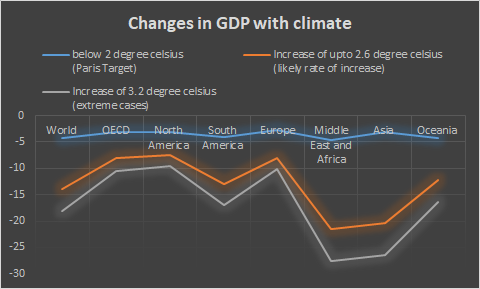
Studies have shown that global temperature rises will negatively impact GDP in all regions by 2050 whereas economies in southeast Asia (ASEAN) countries would be hit hardest. If climate risks are not properly managed, the Intergovernmental Panel on Climate Change estimates $69 trillion in global financial losses by 2100 from a 2-degree warming scenario. The Paris Agreement of 2016 was the first integrated approach towards recognizing the impact of climatic change and the need for taking an ambitious approach towards combating its ill effects. It is a legally binding international treaty on climate change adopted by 196 signatory countries around the world, India being one of them. Achieving targets set under the Agreement may prevent a significant global GDP loss while crossing these limits may drag the global economy to a doom. The below table shows the significant impact of global temperatures on global GDP.

Source of data

Where countries around the world have a rather limited approach to climate disclosure, UK[2] has gone one step further, proposing mandatory reporting by companies on climate changes and becoming the first country to do so. It won’t be long before market regulators across the globe, including India, take steps to adopt the same in their homeland. In this background, let us understand the scope of reporting proposed by the UK, compared to the scope of climatic disclosures covered by India’s BRSR and the global reporting framework.

Background of the UK Proposal

The Consultation Paper with respect to climatic disclosures are based on the recommendations of the Global Task Force on Climate-related Financial Disclosure (TCFD), which recommended economy-wide mandatory climate-related financial disclosure. These recommendations are based on four basic pillars, which have also been proposed under the UK Consultation Paper as well. The financial impact of climatic changes may not be apparent but their implications on financial performance are far and wide. It is important that companies ensure to include the potential impact of climate change in its major decisions. It is essential that climate-induced behaviours are embedded into the company’s culture so that climate change is considered at all levels of an organisation, which these disclosures intend to capture.

Dual disclosure approach –

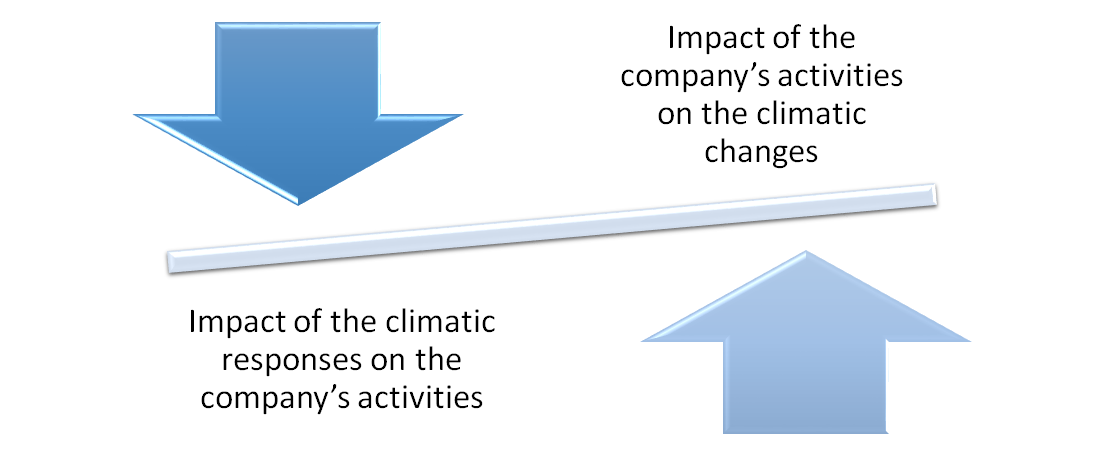
The most peculiar feature of the UK Consultation Paper is that apart from the obvious impact company operations have on the environment, it recognizes that climate change would also bring about various risks (and opportunities) on company operations too. For doing so, the Consultation Paper seeks impact of climatic responses on the company as well, thereby giving rise to dual disclosure format.

Companies requiring mandatory disclosure

The UK Government released a roadmap aiming to mandate climate-related disclosures throughout the UK economy by 2025 in a gradual manner. The consultation paper was developed to bring the TCFD’s recommendations based climatic disclosures within the purview of the regulatory obligations by the end of 2021 to come into effect from the year 2022 onwards for large companies and LLPs such as –

  • Publicly traded companies
  • Large private companies
  • Large LLPs

Note – Large private companies and LLPs mean one having more than 500 employees and turnover being more than 500 million dollars. However, entities in the UK, like the Bank of England, have already started implementing such disclosures as per their Annual Report for 2021, thereby setting a benchmark for reporting by other companies. Large corporates have been targeted as it is likely that the larger the company or LLP, the greater their impact on the environment and subsequent climate risk. Further, larger corporates are also interconnected with various other companies and stakeholders. It becomes all the more important that climate risk is well understood and disclosed by them to avoid systemic risks due to climate changes.

Aim behind such climatic disclosures

The need for climatic disclosures has been motivated by the aim of transitioning to a net-zero emissions economy. Net-zero emissions refers to an overall balance between the green-house gases (GHG) emitted and absorbed so that the net effect of such emissions is ultimately zero or nil. This can be achieved by either reducing the GHG emissions or taking steps that help in absorption of such GHG emissions. Owing to the above, the UK Government intends to ensure that companies with a material economic or environmental impact or exposure assess, disclose and ultimately take actions against climate-related risks and opportunities. This will not only induce companies to take action but also provide investors with the needed information to adequately understand and manage climate-related financial risks. The disclosures aim to achieve the following –

  • Encourage more informed pricing and capital allocation by companies to manage material financial risks and opportunities due to climate change
  • Support investment decisions of Companies for aligning with our transition to a low-carbon economy.
  • Influence behaviours of companies and their stakeholders
  • Investors will be better equipped to incorporate climate-related risks and opportunities into their investment and business decisions,
  • Greater information to other stakeholders for relevant decisions.
  • Help companies think about what they need to do to address climate change as an important risk and opportunity for their organisation, operations and people.

The idea behind the mandatory disclosures was also put forth by the Chancellor[3], ‘this new chapter means putting the full weight of private sector innovation, expertise and capital behind the critical global effort to tackle climate change and protect the environment. We’re announcing the UK’s intention to mandate climate disclosures by large companies and financial institutions across our economy, by 2025. Going further than recommended by the Taskforce on Climate-related Financial Disclosures. And the first G20 country to do so.

 Climatic disclosures made by the Bank of England

The Bank of England has become the first entity in the world to publish climate disclosures in its Annual Report in June, 2020, continuing the legacy in this year as well. These disclosures may act as a guidance to other entities in the UK as well in other countries to report on TCFD’s recommendations.

Development of climatic-related disclosures – How UK takes a lead?

The development of climate-related financial disclosures and contribution of the UK in same can be presented by the following timelines –

Regulatory measures in India:

 In India, SEBI has recently released the Business Responsibility and Sustainability Reporting (BRSR) framework, applicable on the selected listed companies[4] of the country, which includes of various environment related disclosures covering aspects such as resource usage (energy and water), air pollutant emissions, green-house (GHG) emissions, transitioning to circular economy, waste generated and waste management practices, bio-diversity etc. In India, the BRSR is currently the only sustainability report in force by means of regulatory provisions. The BRSR is required to be disclosed in the Annual Report of listed companies. A detailed analysis of the same can be referred to in our article.

What disclosures are covered under the BRSR with respect to climate change?

The BRSR requires the companies to give the following disclosures with regards to climate-

  1. Details of GHG emissions –
    1. current year v/s past year classified into Scope 1 and Scope 2
    2. Emission intensity per rupee of turnover
    3. Total emission intensity
  2. Details of independent assessment/valuation etc if any by an external agency
  3. Details of projects, if any, relating to reduction of GHG emissions

The above disclosures are mainly quantitative providing merely metrics and only cover the impact of companies on climate changes.

Comparison of BRSR disclosures with the UK Consultation Paper (TCFD recommendations)

Pillars of disclosure Under the UK Consultation Paper (TCFD recommendations)   Under BRSR
Governance a.       Broad oversight of climate related risks and opportunities   b.      management’s role in assessing and managing climate-related risks and opportunities. a.       Details of the highest authority responsible for implementation and oversight of the Business Responsibility policy.   b.      Statement by director responsible for the business responsibility report, highlighting ESG related challenges, targets and achievements   c.       Details of specified board committee,, if any responsible for decision making on sustainability related issues.  
Strategy a.       climate-related risks and opportunities that the organization has identified over the short, medium, and long term.   b.      impact of climate related risks and opportunities on the organization’s businesses, strategy, and financial planning.   c.       resilience of the organization’s strategy, taking into consideration different climate-related scenarios, including a 2°C or lower scenario.   BRSR does not require any specific disclosure with respect to the strategy followed by the companies towards its environmental commitments.
Risk Management a.       processes for identifying and assessing climate-related risks   b.      processes for managing climate-related risks.   c.       Integration of the same into the overall risk management strategy of the organisation. Overview of the entity’s material responsible business conduct issues.   It requires the business to indicate material responsible business conduct and sustainability issues pertaining to environmental and social matters that present a risk or an opportunity to your business, rationale for identifying the same, approach to adapt or mitigate the risk along-with its financial implications.  
Metrics and targets a.       Disclose the metrics used by the organization to assess climate related risks and opportunities in line with its strategy and risk management process   b.      Disclose Scope 1, Scope 2, and, if appropriate, Scope 3 greenhouse gas (GHG) emissions, and the related risks   c.       the targets used by the organization to manage climate-related risks and opportunities and performance against targets. a.       Details of GHG emissions – i. current year v/s past year classified into Scope 1 and Scope 2 ii. Emission intensity per rupee of turnover iii. Total emission intensity   b.      Details of independent assessment/valuation etc if any by an external agency   c.       Details of projects, if any, relating to reduction of GHG emissions

It has to be noted here that while BRSR requires some mandatory disclosures in relation to GHG emissions, these are only quantitative metrics. The other pillars, being governance, risk management and strategy towards climate change have not been specifically catered to under climate change. Rather these fall under the general purview where a company may conveniently skip to address some environmental issues, such as climatic change.

India’s stand towards net-zero emissions

Though India is one of the signatories to the Paris Agreement, proposing, amongst other things, net-zero emissions as a goal, India has not shown a supportive view towards achieving net zero emissions in the country. As per a press release, India is not ruling out the possibility of achieving the net zero emissions mission, however, it does not want to extend an international commitment at the present time. Unlike the UK, India is a developing country and GHG emissions, mainly carbon prints, are indispensable considering the continuing need for development. Moreover, the cost of countering its CHG emissions are also very high. In the given scenario, therefore, India is not in a position to commit to the cause of net-zero emissions. However, the same does not imply that India is not taking any action for reduction of emissions. The metrics required under the BRSR report serve as evidence to the same.

Global framework

An overview[5] of the climatic change responses of various countries as on 2017 are presented below – The above presentation clearly demonstrates that no major country in the world has made disclosures pertaining to climate risk mandatory and the situation is still the same. Most countries have, however, urged companies to disclose such information voluntarily. Below, we have discussed the current position of climatic change reporting in some countries.

Brazil –

One of the signatories to the Paris Agreement, Brazil has at present no governmental emission trading schemes[6]. The Brazilian Stock Exchange (“B3”) maintains an index of shares of 100 companies (50 till 2020), called Carbon Efficient Index[7] (“ICO2”), that agree to adopt transparency practices regarding greenhouse gas (GHG) emissions. B3 follows a “report or explain” approach towards GHG emissions reporting[8] and compensates for its GHG emissions to make the effect neutral.

 Canada –

In Canada, the TSX (stock exchange) requires issuers to disclose certain environment information as per National Instrument 51-102 Continuous Disclosure Obligations (NI 51-102), National Instrument 58-101 Disclosure of Corporate Governance Practices (NI 58-101) and National Instrument 52-110 Audit Committees (NI 52-110). A guidance note with respect to same was released in 2010[9] followed by another in furtherance to the same in 2019[10], which refers to the TCFD’s recommendations but does not mandate the same.

European Union (EU)

The Climate Disclosure Standards Board (CDSB) of European Union did a research[11] on the climatic change related reporting by the companies of the country and found that whilst 68% of company disclosures had made some reference to TCFD, the vast majority have still only partially adopted the recommended disclosures. Much lagging was found in adoption of practices such as scenario analysis and risk time horizons. The CDSB even made recommendations to the regulator to imbibe the climate related disclosures in line with the TCFD recommendations into the Directives[12] to ensure reporting in line with the same. The Directives mainly deal with GHG emissions and decarbonisation, although specific reference to TCFD has not been made part of such Directives till date.

Japan

Recently, in October, 2020, the President of Japan committed[13] to the target of reaching net-zero emissions by 2020.  The TCFD Status Report, 2020 also presents a picture of how Japan is devoted to the cause of climatic change and is supporting the TCFD Recommendations. As of 2020, TCFD has the highest number of supporters from Japan. It has to be noted that while the Japanese Government has decided to put the commitment of net-zero emissions into law, till date there is no mandatory reporting requirement on the same. However, the companies take voluntary stands against climate change and give voluntary disclosures on the same.

USA

USA, once a signatory to the Paris Agreement, had pulled out of the same under the leadership of former President Mr. Donald Trump. However, with effect from 19th February, 2021, USA has re-entered into the Paris Agreement under Joe Biden, the current President of the United States. On May 20, 2021, he signed an executive order directing federal financial regulators to take a broad range of actions to assess and respond to climate-related financial risks, including enhancing the disclosure of climate-related financial risks. Consequently, a bill has been placed to pass the Climate Risk Disclosure Act, however the same has not been passed as on date.

Making a move towards mandatory disclosures

A study of major countries in the world shows one considerable trend, gradually moving towards mandating climatic disclosures. While some companies have already taken a voluntary move towards such reporting, the reporting is mostly restricted to the present metrics and future targets, the qualitative parts remain untouched. With the regulators mandating such disclosures as part of a legal framework, the companies will be left with no alternative other than reporting. This will help in identifying the gaps, risks and opportunities, and stimulate working in a strategic way to reduce impact of climatic changes. While disclosure by companies is essential to ensure climate risk is appropriately measured, it is also important that companies move towards recognizing climate change as an important risk and opportunity to their organization.

Our resource center on Business Responsibility and Sustainable Reporting can be accessed here –

[1]https://assets.publishing.service.gov.uk/government/uploads/system/uploads/attachment_data/file/972422/Consultation_on_BEIS_mandatory_climate-related_disclosure_requirements.pdf [2] Consultation Paper – https://assets.publishing.service.gov.uk/government/uploads/system/uploads/attachment_data/file/972422/Consultation_on_BEIS_mandatory_climate-related_disclosure_requirements.pdf [3] https://www.gov.uk/government/speeches/chancellor-statement-to-the-house-financial-services [4] Reporting as per BRSR is currently made applicable to the top 1000 listed entities based on market capitalization [5] Source:  https://www.unpri.org/climate-change/tcfd-recommendations-country-reviews/278.article [6] https://iclg.com/practice-areas/environment-and-climate-change-laws-and-regulations/brazil [7]http://www.b3.com.br/en_us/market-data-and-indices/indices/sustainability-indices/carbon-efficient-index-ico2.htm [8] http://www.b3.com.br/en_us/b3/sustainability/at-b3/transparency/ [9] https://www.osc.ca/sites/default/files/pdfs/irps/csa_20101027_51-333_environmental-reporting.pdf [10]https://www.osc.ca/sites/default/files/pdfs/irps/csa_20190801_51-358_reporting-of-climate-change-related-risks.pdf [11] https://www.cdsb.net/sites/default/files/nfrd2020_briefing_tcfd_climate.pdf [12] https://eur-lex.europa.eu/legal-content/EN/TXT/?uri=CELEX:32020R1818 [13] https://japan.kantei.go.jp/99_suga/statement/202010/_00006.html   Read our other articles on related topics –

  1. https://vinodkothari.com/2021/06/brsr-reporting-actions-and-disclosures-required-for-business-sustainability/
  2. https://vinodkothari.com/2021/03/esg-concerns-on-corporate-governance-in-india/
  3. https://vinodkothari.com/2020/01/expanding-brr-outreach/

Step-by-step guide for disclosure for Analysts/Investors Meet

Do’s and don’ts to be ensured by listed companies

Updated as on September 28, 2023 , pursuant to the SEBI LODR (Second Amendment) Regulations, 2023

Brief Background

In order to disseminate information regarding performance of the company, its future prospects etc. listed companies usually conduct gatherings of analysts/investors after dissemination of quarterly results or atleast once in a year. Such meets generally include conference calls or meeting with group of investors or one-to-one meet or calls with investors or analysts, including those in the nature of walk-in. The idea behind conducting such meets is to provide transparency for the company’s performance figures, to address the queries of the analysts/investors and to ensure that the company’s information is available to the stakeholders. However, the risk of information asymmetry in such meets or gatherings is very inherent.

While the regulatory framework of SEBI i.e. SEBI (Listing Obligations and Disclosure Requirements) Regulations, 2015 (‘Listing Regulations’) provided for disclosure of adequate and timely information to enable investors to track the performance of a company including the information pertaining to occurrence of investors meet/conference call with analysts, however, several inconsistencies were observed in the disclosures made by the companies. For instance, some entities were not divulging the details of what transpired in such investors’ meetings and were merely disclosing the limited presentations w.r.t. the meetings. As such, minority shareholders, who did not attend these meetings, were not privy to the information shared with a select group of investors, thereby creating information asymmetry among different classes of shareholders.

Realizing this, SEBI, on November 20, 2020, came up with the Consultation Paper and recommended enhanced disclosure requirements w.r.t. post earning calls and one-to-one meets. Our write-up analyzing the said consultation paper can be viewed here.

Later, vide notification dated May 05, 2021, SEBI enhanced the disclosure requirements w.r.t. Investors’/ Analysts’ meet. In this article, the author has made an attempt to discuss the changes made in the disclosure requirements w.r.t. analyst meet step by step.

Post amendment in Listing Regulations

On May 05, 2021, SEBI amended the Listing Regulations which inter alia, covered analyst meet. Pursuant to the said amendment, the companies are required to include enhanced disclosure requirements with respect to analyst/ investors meets so as to avoid selective disclosure and information asymmetry and to ensure market integrity and to safeguard the interest of investors. The said amendments were voluntary for FY 2021-22, and became mandatory from FY 2022-23. The synopsis of the amendment is provided below:

Figure 1: Disclosure requirement for analyst meet

Regulatory requirements in case of one-to-one meet

In respect of one-to-one meet, there are no explicit disclosure requirements as such. However, considering the intent of the Listing Regulations and SEBI (Prohibition of Insider Trading) Regulations, 2015 (‘PIT Regulations’), the following things are explicitly clear:

  • One-to-one meets, even though unregulated, should be discouraged looking at the high possibility of leakage of UPSI; and
  • Even if the entity has one-to-one meet, it cannot share any UPSI.

Regulation 8 of PIT Regulations mandates every listed company to frame a code of practices and procedures for fair disclosure of UPSI in line with the principles set out in Schedule A to PIT Regulations. Para 6 of Schedule A requires the company to ensure that information shared with analysts and research personnel is not UPSI. Para 7 provides for developing best practices to make transcripts or records of proceedings of meetings with analysts and other investor relations conferences on the official website to ensure official confirmation and documentation of disclosures made.

The PIT Regulations do not distinguish between group meets and one-to-one meets. It requires the company to record such meets and develop best practices to disclose the same on its website. The practice of recording the meet also safeguards the company officials participating in the meeting from any possible allegation of having divulged UPSI.

Whether sharing of UPSI is allowed in a group meet or one-to-one meet?

The PIT Regulations prohibit sharing of UPSI in any manner to any person including analysts/ investors and require the companies to take all required steps to ensure the same. Considering the same, the fact whether it is a group meet/ call or otherwise or whether such meet/ call was organized by the company itself or not, becomes irrelevant and the prohibition shall apply in all cases.

Therefore, there is a remote chance of sharing such UPSI until and unless the same is as per the provisions of code of fair disclosure framed by the company. Accordingly, if any UPSI is shared, legitimately in terms of the said code or otherwise, the entity will have to disclose the audio/ video recordings or the transcripts of such meeting to the stock exchange promptly.

Guidance Note of Analyst/ Institutional investors’ meet

The amendment in the Listing Regulations came up with various interpretations and ambiguities w.r.t. disclosure requirements. We have discussed such anomalies in our previous article which can be viewed here.

In order to clear the ambiguities w.r.t the disclosure requirements, BSE, vide circular dated 29th June, 2021 and July 29, 2022, provided further clarifications and recommendations. In this article, we have tried to provide step-by-step guide for disclosure on analyst meets and post earning calls. Further, we have also provided the do’s and don’ts to be ensured by the companies.

Disclosure requirements w.r.t. Analyst meets

In order to comply with the provisions of Listing Regulations in letter and spirit, the companies are required to ensure that it makes timely disclosure to stock exchanges and on their own website. The compliance requirement as per the amended provisions w.r.t. analysts/ investors meet are jotted down below:

Sr. No.CasesDisclose what?By When?Other Points to be ensured
 1.Post earning calls/ Quarterly calls, by whatever name called (after disclosure of quarterly financial results)Schedule of such meetingAtleast 2 working days in advance (excluding the date of intimation and date of the meet).Mandatory only for group meets.         
 Presentation and the audio/ video recordings of such meetingBefore the next trading day or within 24 hours from the conclusion of the meet, whichever is earlier.Mandatory for both group meets and one to one meets.To be disclosed whether conducted by a company or any other entity.To be hosted on the website of the company for minimum 5 years and thereafter as per the archival policy of the company. To be disclosed simultaneously to the stock exchange.          
 Transcripts of such meetingWithin 5 working days of conclusion of the meet.Mandatory for both group meets and one-to-one meets.To be disclosed whether conducted by a company or any other entity.To be hosted on the website of the company and preserved permanently.To be disclosed simultaneously to the stock exchange.
 2.Other Analysts/ Investors meetsSchedule of such meetingAtleast 2 working days in advance (excluding the date of intimation and date of the meet)Mandatory only for group meets.
 Presentation made in such meetingBefore the next trading day or within 24 hours from the conclusion of the meet, whichever is earlier..Mandatory only for group meets.To be disclosed on the website of the company, whether conducted by company or any other entity.To be disclosed simultaneously to the stock exchange.
 In case any UPSI is sharedAudio/video recordings or transcripts of such meetingPromptlyApplicable to both group as well as one-to-one meets.To be disclosed on the website of the company, whether conducted by a company or any other entity.To be disclosed simultaneously to the stock exchange. 

Best practices that may be adopted by companies

Disclosure of schedule of meet/ call

While making disclosure of schedules, the company may also provide the details pertaining to the meet/ call, mode of attending, details pertaining to registrations, disclaimers/ note to complete/ ease registration/ attending the call, details regarding specific platform requirements, if any, inclusions/ exclusions of audience/ participants if any, etc.

Further, a disclaimer or a confirmation may be added in the intimation stating that ‘Company will be referring to publicly available documents for discussions’ or ‘No UPSI is proposed to be shared during the meeting / call’. This will create confidence amongst the investors and will maintain sanctity of the meet / call.

Disclosure of transcripts of the meet/ call

While disclosing the transcripts of the meet/ call, the companies may also consider providing the list of attendees and record the dialogues, Q&As and assents and dissents of the analysts/ investors. Further, a confirmation may be added in the disclosure that no unpublished price sensitive information was shared/ discussed in the meeting / call.

Do’s and Don’ts to be ensured by the companies

The companies will be required to observe some crucial points while scheduling or attending analysts’/ investors’ meet, conference calls, post earning calls etc.  Briefly, the following are the do’s and don’ts:

Sr. No.Do’sDon’ts
 1.Always conduct scheduled meets.Avoid unscheduled meets.
 2.Always schedule group meets.Avoid scheduling one-to-one meet.
 3.Upload the schedule of group meets/ calls on the website atleast 2 working days in advance (excluding the date of intimation and date of the meet) and also simultaneously submit the same with the stock exchange.Do not forget to upload and send the schedule on the website and to the stock exchanges, respectively beyond the prescribed time.
 4.Upload the presentation made to analysts/ investors in the scheduled group meet on the website promptly before the next trading day or within 24 hours from the conclusion of the meet, whichever is earlier and also simultaneously submit the same with the stock exchange.Do not forget to upload and send the schedule on the website and to SE, respectively beyond the prescribed time.
 5.Ensure to make audio and video recording of the post earnings/ quarterly calls, whether conducted physically or through digital means, either conducted by company or any other entity including one- to-one meets.Do not avoid making audio/video recording of such calls irrespective the same was conducted by the company itself or by any other entity.
 6.Ensure transcripts of the post earnings/quarterly calls, whether conducted physically or through digital means, either conducted by company or any other entity including one-to-one meets.Do not avoid making transcripts of the proceedings of such calls irrespective the same was conducted by the company itself or by any other entity.
 7.Ensure that the information shared with the investors is already available in the public domain.Do not share UPSI with the investors.
 8.Maintain a silence period, if any, as provided in the code of fair disclosure framed by the entity.Discourage any sort of meets either group meet or one-to-one meets (including walk-in investors) during silence period.
 9.Upload all audio/video recordings and presentation of the post earning/ quarterly calls on the website of the company within 24 hours of conclusion of such calls or next trading day, whichever is earlier.Avoid uploading audio/video recording beyond the prescribed time.
 10.Upload all transcripts of the post earning/ quarterly calls on the website of the Company within 5 working days of conclusion of such calls.Avoid uploading transcripts of the post earning/ quarterly calls on the website of the company after 5 working days of conclusion of calls.
 11.Simultaneous to uploading audio/video recording and transcripts on the website of the company, submit the same to the recognized stock exchange.Do not forget to send audio/video recording and transcripts of the meets to the recognized stock exchange
 12.Preserve the disclosures made on the website of the Company (a)        Audio/video recording- for minimum 5 years and thereafter as per archival policy of the company; (b)   Transcripts: permanentlyDo not avoid preserving of audio/video recording and transcripts of the meets

Conclusion

The amendment in Listing Regulations and guidance note by the stock exchanges give us the clear view that the companies are required to make timely disclosure of audio/ video recordings, transcripts of post earning calls and only presentations of analyst meet to the stock exchange. Even though this seems to be the compliance burden on part of the listed companies which are already pressed with various disclosure requirements, this step is surely a welcome move as it will help the watchdog of capital markets to curb insider trading and information asymmetry.


Our other article on similar topics can be read here – https://vinodkothari.com/2020/11/sebi-proposes-enhanced-disclosures-for-meetings-with-analyst-investors-etc/

Our Podcast on the topic: https://open.spotify.com/episode/2oVRo2iEOV7cVVqYwcqb2c?si=b860b48d6f924ad6&nd=1

Our Resource Centre on LODR:

Re-appointment of Independent Directors: An Analysis

Sharon Pinto, Manager, corplaw@vinodkothari.com

Introduction

Proxy advisors are entities that undertake research on corporate governance norms and practices followed across different corporates. They formulate their policies based on their research and appropriately established benchmarks. The proxy advisory firms play a role in strengthening the corporate governance as investor clients access the reports and recommendation of the said advisory firms while forming their opinions. As investors due to their vast shareholding may not be privy to the working of the company, they may rely on the analysis done by the proxy advisors and their recommendations. We have discussed the scope of guidelines issued by proxy advisors in a separate article[1].

While such reports and guidelines as mentioned above can act as a guidance for the investors to take a sound decision, the legal standing of the report can be considered a hiccup in the said process as the same does not obtain regulatory approval. We have discussed the scope and legal validity of such guidelines in a separate article.[2]

One such guideline has been issued w.r.t. re-appointment of Independent Directors under Section 149 (10) of the Companies Act, 2013 (‘the Act’). The said contention has been a question of interpretation with different practices being followed by various companies. In this article we have discussed the interpretation of the said provision while stating the process of re-appointment of Independent Directors (‘IDs’).

Pre-requisites for appointment of IDs

Section 149 (6) of the Act read with Rule 5 of the Companies (Appointment & Qualification of Director) Rules, 2014 states the criteria that shall determine the independence of the director proposed to be appointed. In case of an entity with its specified securities listed on the stock exchange, the conditions set forth by Regulation 16 (1) (b) of SEBI (Listing Obligation and Disclosure Requirements) Regulations (‘SEBI Regulations’) shall also be fulfilled in order to be eligible for appointment as an ID. The said provisions under the Act and SEBI Regulations entail certain pecuniary limits which are necessary to ascertain any monetary relationship of the director with the company, which may affect their independence. As the given criteria is a pre-requisite at the time of appointment of a director, it shall also be mandatory to be fulfilled at the time of re-appointment. Thus, if an ID continues to be eligible as per the said conditions, they shall be proposed to be re-appointed for a second term in the company.

Pursuant to the SEBI (Listing Obligation and Disclosure Requirements), 2021 (Third Amendment Regulations), the criteria of independence prescribed under Regulation 16 (1) (b) has been revised aligning the same with the provisions of the Act. However, while the Act provides for the period of 2 immediately preceding financial years for determining whether the person or his relatives have any material pecuniary relationship with the company, the revised SEBI Regulations now prescribe for a period of 3 immediately preceding financial years for determination of the same.

Further, the conditions prescribed under the Act relating to holding of any interest or security, indebtedness, any guarantee or security provided in connection to indebtedness of a third person or any other pecuniary relationship with the company or its holding or subsidiary or associate company have also been inserted in the SEBI Regulations, which provide for stricter period of compliance of the said conditions. While, the relatives may be employees in the entities stated above, they are prohibited from holding the position of a KMP. As the criteria of independence is to be observed even in the case of re-appointment, these conditions will ensure the independence of the ID.

In addition to the criteria of independence, the existing IDs of the company are required to abide by the code of conduct prescribed under Schedule IV of the Act. Any breach of the code by the directors shall make them ineligible for continuing in the position of ID of the company.

Performance Evaluation

The re-appointment of an existing director for a second term, in addition with the establishment of their independence shall also be subject to performance evaluation. The Act under Section 178 (2) states that the Nomination and Remuneration Committee (‘NRC’) of the company shall formulate a criteria for determining the qualifications, positive attributes, independence for appointment of a director. Further the committee shall also establish a criteria for the evaluation of performance of the Board as well as individual directors. Thus on the basis of such performance evaluation and establishment of independence and possession of requisite skills by the director, the NRC shall recommend the appointment or in case of an existing director, re-appointment of the said director to the Board.

SEBI[3] has detailed an elaborated process to be followed by NRC for selection of ID, including more transparent and enhanced disclosures regarding  the  skills  required  for  appointment  as  an  ID  and  how  the proposed candidate fits into that skillset. As per the Third Amendment Regulations, the said additional disclosures stating the skills and capabilities required for the role and the manner in which the proposed person meets the requirements, will be required to be provided in the notice in the case of re-appointment of an ID. Thus, NRC of the company will be required to undertake an assessment determining whether the person proposed to be re-appointed as the ID possesses the skills required for the position in addition to performance evaluation even in the case of re-appointment.

SEBI under Regulation 17 (10) of the SEBI Regulations has stated that the performance evaluation of the IDs shall be done by the entire Board of Directors where the concerned ID shall not participate in the said discussion. The Board shall consider performance of the director in addition to fulfilment of independence criteria similar to the provisions stipulated under Companies Act, 2013 as discussed above. Thus the director proposed to be re-appointed has to satisfy the afore-mentioned dual conditions.

Process of re-appointment

Section 149 (10) of the Act has specified the process of reappointment of an ID. It states that a director shall be eligible for re-appointment by passing of a special resolution. Thus we may infer that in order to be re-appointed as an ID, a special resolution is required to be passed. Regulation 17 (11) of SEBI Regulations provides for stating recommendation of the Board for every for every special item of business in the explanatory statement annexed to the notice. As discussed above, Board on the basis of performance evaluation carried out and the recommendation of the NRC shall recommend the re-appointment of the ID. Criteria of independence being a pre-requisite for such re-appointment as established herein, the director shall be considered as an additional independent director until approval of shareholders is obtained at the general meeting of the Company.

Further, SEBI vide its consultation paper on Independent Directors[4] had proposed prior approval of shareholders for appointment and re-appointment of IDs, while stating that the existing procedure entails proposal of candidate by the NRC and appointment/re-appointment by Board which is subsequently approved by shareholders by an ordinary resolution in case of appointment whereas special resolution in case of re-appointment. Accordingly, seeking prior approval of shareholders is not a pre-requisite at present.

After end of first tenure of the ID, the office of director shall cease. Accordingly, Board will approve appointment as additional director till ensuing AGM and propose re-appointment as an ID for second term of upto 5 consecutive years.

As discussed above, re-appointment after the end of the tenure is required to be considered akin to fresh appointment of the person, thereby necessitating the confirmation with criteria of independence, assessment of skills and capabilities and the manner in which such appointee continues to meet the requirements of the company. Therefore, the Board has a power to appoint the person as an additional ID, whose appointment shall thereafter be approved at the general meeting.

Timeline for re-appointment

In order to understand the timeline in the case of re-appointment, we will have to consider the revised Regulation 17(1C) SEBI Regulations. Regulation 17 (1C) provides for approval of appointment of a person as a director of the company to be done within the next general meeting or 3 months, whichever is earlier. Since, re-appointment on account of end of term results into fresh appointment, the same shall also apply in case of re-appointment of an ID. Further, Regulation 25 (2A) has now provided for a special resolution to be obtained in case of appointment as well as re-appointment. The same prescribes for the mode of obtaining approval but is silent on the timeline, to be followed, requiring reference to Regulation 17 (1C). For a better understanding of the same, let us look at the following cases.

Case 1: Re-appointment of a person as an ID before the end of his/her tenure:

  1. The NRC of the company will be required to follow the due process for evaluation of the person for re-appointment as stipulated under the revised provisions and recommend the same to the Board.
  2. The Board will thereafter confirm on the skills and capabilities as required for the position and that the proposed appointee possesses the same and provide disclosure of the same to the shareholders in the notice for re-appointment.
  3. At the ensuing general meeting the company may re-appoint the person as ID for a second term by passing a special resolution with effect from the date immediately following the last day of the current tenure.

Case 2: Re-appointment of a person as an ID post the end of tenure:

  1. Since the tenure of the ID has been terminated, the office of the ID will stand vacated and the Board will be required to appoint the person as an Additional Director (Non-executive, ID category).
  2. The process as mentioned under points a & b above in relation to assessment of the candidate and requisite disclosures to be done will be required to be followed.
  3. As per Regulation 17(1C), shareholder approval for the re-appointment will be required to be obtained within 3 months of appointment by the Board as an additional ID or next general meeting, whichever is earlier.

Effect of re-appointment by the Board

The provisions of the Act mandate the shareholders to approve appointment of IDs at general meeting but does not mandate appointment from the date of general meeting. ‘Independent Director’ is the nature of directorship and ‘Additional Director, Non-Executive’ is the category of directorship. It cannot be inferred that the said director was not independent from the date of Board resolution appointing him as Additional Director till the date of general meeting. Therefore, the effective date of appointment can be considered from the date of Board resolution or any subsequent date prescribed by the Board.

The recent changes in the provisions as stated above will result in reducing the gap between appointment of an ID on the Board of the company and approval of the said appointment by shareholders. While it is seen that some companies take up the re-appointment of the IDs by way of postal ballot before the end of tenure in case there exists a gap between the AGM and the end of term, the same shall be construed as a good governance practice, as prior approval of shareholders has not been mandated by law on account of the same not being specifically stated. Thus in case of re-appointment post end of tenure, the same cannot be viewed as a violation of provisions.

Conclusion

The ambit of proxy advisors in India is as prescribed under SEBI regulations and guidelines issued in this regard. While they may issue guidelines based on the best governance practices as established by them and recommend the same to the investors, there is a need to incorporate a check for discerning the nature and scope of such guidelines, so the investor may have a clear view of the propositions put forth. With the process of appointment of IDs being enhanced in the manner specified above, in addition to the newly inserted disclosure requirements, will make the appointment/re-appointment process of IDs more transparent and effective while ensuring greater conformity of their independence.


Related presentation – https://vinodkothari.com/2021/08/ensuring-board-continuity-and-balance-of-capabilities/

[1] https://vinodkothari.com/2021/06/scope-of-proxy-advisors-to-issue-general-voting-guidelines/

[2] https://vinodkothari.com/2021/07/proxy-advisors-corporate-decision-making/

[3] https://www.sebi.gov.in/media/press-releases/jun-2021/sebi-board-meeting_50771.html

[4]https://www.sebi.gov.in/reports-and-statistics/reports/mar-2021/consultation-paper-on-review-of-regulatory-provisions-related-to-independent-directors_49336.html