Assessing the Viability of a Gold Spot Exchange in India

-Megha Mittal 

(mittal@vinodkothari.com)

The Securities and Exchange Board of India (‘SEBI’) has issued a consultation paper dated 19th May, 2021, on proposed framework for Gold Exchange in India and draft SEBI (Vault Managers) Regulations, 2021 (‘Consultation Paper’), thereby seeking public comments on the framework for operationalising gold exchange and the regulation of intermediaries inter-alia Vault Managers.

While the idea of setting up a regulated gold exchange was highlighted in the Union Budget 2018-19 as well as in the Budget 2021-22, the Consultation Paper comes as the first concrete step towards bringing into operation a gold exchange for the Indian market. This comes in the backdrop of the fact that despite being the second largest consumer and importer of gold, India continues to be a price-taker – India does not play any significant role in influencing the global price-setting for the commodity. As such, the Consultation Paper envisages an entire ecosystem of trading and physical delivery of gold so as to create a transparent and robust market which paves the way for India to become a global price setter.

That being said, before delving into the procedural aspect, it is important to understand the fundamentals as to what are the objectives being aimed, what would the target market look like, and if at all the proposed framework would put the investors, the parties and the nation in a better place that is today.

Read more

List of Disclosures Requirements Applicable to NBFCs


Srl No Particular Clause Reference Remarks
List of Disclosure in Annual Report – As per RBI Direction
1 NBFCs shall disclose in their annual reports the details of the auctions conducted during the financial year including the number of loan accounts, outstanding amounts, value fetched and whether any of its sister concerns participated in the auction. Para 27(4) (d)-Loans against security of single product – gold jewellery Applicable for Gold loan business
2
Non-deposit taking NBFC with asset size of ₹ 500 crore and above issuing PDI, shall make suitable disclosures in their Annual Report about : Annex XVII
(i) Amount of funds raised through PDI during the year and outstanding at the close of the financial year;
(ii) Percentage of the amount of PDI of the amount of its Tier I Capital;
(iii) Mention the financial year in which interest on PDI has not been paid in accordance with clause 1(viii) above.
Terms and Conditions Applicable to Perpetual Debt Instruments (PDI) for Being Eligible for Inclusion in Tier I capital Applicable for NBFCs issuing PDIs
2A Details of all material transactions with related parties shall be disclosed in the annual report along with policy on dealing with Annual Report Para 4.3 – Annex IV, Master Directions
2B (i) Remunerarion of Directors (Para 4.5)
(ii) a Management Discussion and Analysis report
Para 4.3 – Annex IV, Master Directions
Disclosure in Financial Statements- as per RBI Direction
3
Disclosure in the balance sheet
The provision towards standard assets need not be netted from gross advances but shall be shown separately as ‘Contingent Provisions against Standard Assets’ in the balance sheet. Master Directions Para 14
Every applicable NBFCshall separately disclose in its balance sheet the provisions made as per these Directions without netting them from the income or against the value of assets.

The provisions shall be distinctly indicated under separate heads of account as under:-
(i) provisions for bad and doubtful debts; and
(ii) provisions for depreciation in investments.

Master Direction Para 17 (1) and (2)
In addition to the above every applicable NBFCshall disclose the following particulars in its Balance Sheet:
(i) Capital to Risk Assets Ratio (CRAR);
(ii) Exposure to real estate sector, both direct and indirect; and
(iii) Maturity pattern of assets and liabilities.
Master Direction Para 17 (5)
4 Indicative List of Balance Sheet Disclosure for non-deposit taking NBFCs with Asset Size ₹500 Crore and Above and Deposit Taking NBFCs (hereinafter called as Applicable NBFCs) Annex XIV Please refer Annex XIV
5
Disclosures to be made by the Originator in Notes to Annual Accounts Guidelines on Securitisation Transactions
The Notes to Annual Accounts of the originating NBFCs shall indicate the outstanding amount of securitised assets as per books of the SPVs sponsored by the NBFC and total amount of exposures retained by the NBFC as on the date of balance sheet to comply with the MRR. These figures shall be based on the information duly certified by the SPV’s auditors obtained by the originating NBFC from the SPV. These disclosures shall be made in the format given in Appendix 2.
6
LRM Framework
An NBFC shall publicly disclose information (Appendix I) on a quarterly basis on the official website of the company and in the annual financial statement as notes to account that enables market participants to make an informed judgment about the soundness of its liquidity risk management framework and liquidity position. Guidelines on Liquidity Risk Management Please refer Appendix I
7
LCR Disclosure Standards
NBFCs in their annual financial statements under Notes to Accounts, starting with the financial year ending March 31, 2021, shall disclose information on LCR for all the four quarters of the relevant financial year. The disclosure format is given in the Appendix I. Data must be presented as simple averages of monthly observations over the previous quarter (i.e., the average is calculated over a period of 90 days). However, with effect from the financial year ending March 31, 2022, the simple average shall be calculated on daily observations.
NBFCs should provide sufficient qualitative discussion (in their annual financial statements under Notes to Accounts) around the LCR to facilitate understanding of the results and data provided. Please refer Appendix I (Part B)
8
Schedule to the balance sheet Master Direction Clause 19
Every applicable NBFC shall append to its balance sheet prescribed under the Companies Act, 2013, the particulars in the schedule as set out in Annex IV.
9
Participation in Currency Options Master Direction Clause 83
Disclosures shall be made in the balance sheet regarding transactions undertaken, in accordance with the guidelines issued by SEBI.
10
Participation in Currency Futures Master Direction Clause 94
Disclosures shall be made in the balance sheet relating to transactions undertaken in the currency futures market, in accordance with the guidelines issued by SEBI.
11
Disclosure for Restructured Accounts Master Direction Annex VII
With effect from the financial year ending March 2014 NBFCs shall disclose in their published annual Balance Sheets, under “Notes on Accounts”, information relating to number and amount of advances restructured, and the amount of diminution in the fair value of the restructured advances as per the format given in Appendix – 4
12 Disclosures relating to fraud in terms of the notification issued by Reserve Bank of India
14
Moratorium Circular
The lending institutions shall suitably disclose the following in the ‘Notes to Accounts’ while preparing their financial statements for the half year ending September 30, 2020 as well as the financial years 2019-20 and 2020-2021:

(i) Respective amounts in SMA/overdue categories, where the moratorium/deferment was extended, in terms of paragraph 2 and 3;

(ii) Respective amount where asset classification benefits is extended.

(iii) Provisions made during the Q4FY2020 and Q1FY2021 in terms of paragraph 5;

(iv) Provisions adjusted during the respective accounting periods against slippages and the residual provisions in terms of paragraph 6.

Para 10 COVID19 Regulatory Package – Asset Classification and Provisioning
15
Disclosure under sector – Restructuring of Advances, Circular
NBFCs shall make appropriate disclosures in their financial statements, under ‘Notes on Accounts’, relating to the MSME accounts restructured under these instructions as per the following format:

No. of accounts restructured Amount (₹ in million)

Micro, Small and Medium Enterprises (MSME) sector – Restructuring of Advances
16
Lending institutions publishing quarterly statements shall, at the minimum, make disclosures as per the format prescribed in Format-A Para 52 of Resolution Framework for COVID-19-related Stress In the financial statements for the quarters ending March 31, 2021, June 30, 2021 and September 30, 2021
16A (i) registration/ licence/ authorisation, by whatever name called, obtained from other financial sector regulators;
(ii) ratings assigned by credit rating agencies and migration of ratings during the year;
(iii) penalties, if any, levied by any regulator;
(iv) information namely, area, country of operation and joint venture partners with regard to joint ventures and overseas subsidiaries and
(v) Asset-Liability profile, extent of financing of parent company products, NPAs and movement of NPAs, details of all off-balance sheet exposures, structured products issued by them as also securitization/ assignment transactions and other disclosures
Para 73 – Master Directions (Ref. Annexure XIV)
Other Disclosure
17 Report on-line to stock exchanges on a quarterly basis, information on the shares pledged against LAS, in their favour, by borrowers for availing loans 22 of Master Directions In format as given in Annex V for Master Direction.
18 Quarterly statement to RBI on change of directors, and a certificate from the Managing Director of the applicable NBFC that fit and proper criteria in selection of the directors has been followed 72 of Master Direction The statement must be sent 15 days of the close of the respective quarter. The statement for the quarter ending March 31, shall be certified by the auditors
19 On a quarterly basis, NBFCs shall report “total exposure” in all cases where they have assumed exposures against borrowers in excess of the normal single / group exposure limits due to the credit protections obtained by them through CDS, guarantees or any other permitted instruments of credit risk transfer Para 8 of Guidelines for Credit Default Swaps – NBFCs as users
Website Disclosure
20
Public disclosure
An NBFC shall publicly disclose information (Appendix I) on a quarterly basis on the official website of the company that enables market participants to make an informed judgment about the soundness of its liquidity risk management framework and liquidity position. Guidelines on Liquidity Risk Management Please refer Appendix I
21 NBFCs are required to disclose information on their LCR every quarter Para 6 LCR Framework To be made on website
Additional Disclosures w.r.t. COVID-19
22 Lending institutions publishing quarterly financial statements shall, at the minimum, shall make disclosures in their financial statements for the quarters ending September 30, 2021 and December 31, 2021. The resolution plans implemented in terms of Part A of this framework should also be included in the continuous disclosures required as per Format-B prescribed in the Resolution Framework – 1.0. As per format prescribed in Format-X
23 The number of borrower accounts where modifications were sanctioned and implemented in terms of Clause 22 above, and the aggregate exposure of the lending institution to such borrowers may also be disclosed on a quarterly basis,
24 The credit reporting by the lending institutions in respect of borrowers where the resolution plan is implemented under Part A of this window shall reflect the “restructured due to COVID-19” status of the account

MCA circular on excess spent done by contribution to PM-Cares

-raises more questions than it settles.

Nitu Poddar, Senior Associate ( corplaw@vinodkothari.com )

Setting off excess-spent on CSR

Pursuant to Rule 7(3) of the CSR Rules, 2014, a company is allowed to take benefit of the excess amount (more than the requirement under section 135(5) spent by it on CSR activities upto three succeeding financial years. This provision has come into effect from January 22, 2021.

Accordingly, the common view that has formed is that only amount that is spent in excess on and from January 22, 2021 can be set off against the CSR obligations of three succeeding year. However, the second view, and the more appropriate one is, even amount spent in excess before Jan 22, 2021 may also be set-off against the CSR obligations of a year, subject to such excess spent is done within three years of taking such set-off. That is to say, any excess spent done in FY 2019-20, 2018-19, 2017-18 could have been set-off in FY 2020-21.

The reason for the second view is that, all that the provisions of Rule 7(3) allows is “setting off “the excess spent, which is being done post January 22, 2021. 

Clarification Circular by MCA:

MCA, on May 20, 2021, has issued a Circular, purportedly clarifying the following:

  1. Any amount spent in excess during FY 2019-20;
  2. On March 31, 2020;
  3. By contribution to the PM-Cares

may be set off against the CSR obligation for FY 2020-21 (only) subject to the following conditions:

  1. Unspent amount, if any, of the previous years, should have been factored;
  2. CFO and statutory auditor to certify that such amount was
    1. contributed on 31.03.2020;
    2. pursuant to the appeal by the MCA.
  3. Details of such contribution to be disclosed separately in the CSR Report and Board’s Report. 

Issues arising from the Circular

The MCA Circular rather raises several questions and leave then unanswered:

  1. What about the contribution done prior to 31.03.2020?;
  2. What about the excess spent done in any other activity as mentioned in schedule vii?;
  3. What about the excess spent done in FY 2018-19 and 2017-18?
  4. Why a certificate from statutory auditor? This is not required for any other excess spent done neither is this part of Rule 7(3).

The Circular seems to support the view of the ICSI, as mentioned in Q-47 of the FAQ released on April, 29, 2020, which says that only excess spent done after January, 22, 2021 may be allowed to set-off in subsequent years. However, taking such view would may not be the correct interpretation of the applicability of the provisions.


Our other resources on CSR can be accessed at : https://vinodkothari.com/csr/

‘Material Subsidiary’ under LODR Regulations: Understanding the metrics of materiality

Barsha Dikshit | corplaw@vinodkothari.com

Himanshu Dubey | corplaw@vinodkothari.com

The term ‘subsidiary’ or ‘subsidiary company’ as defined under the Companies Act, 2013[1] (‘Act’) refer to a company in which a holding company controls the composition of the Board of directors or may exercise at least 51% of the total voting power either on  its own or together with one or more of its subsidiaries. A company may have a number of subsidiaries; however, all of them may or may not have a material impact on the holding company or on the group at a consolidated level. Therefore, regulations sometimes require identification of such subsidiaries which may have a material impact on the overall performance of the holding company/group.

Though SEBI (Listing Obligations and Disclosure Requirement) Regulations, 2015 (‘SEBI LODR’), define the term ‘Material Subsidiary’ as a subsidiary, whose income or net worth exceeds ten percent (10%) of the consolidated income or net worth, respectively, of the listed entity and its subsidiaries in the immediately preceding accounting year, however, there remains confusion w.r.t. the criteria provided for determining the materiality of a subsidiary. For instance, whether a subsidiary having negative net worth exceeding 10% of the consolidated net worth of the listed company will be qualified as a material subsidiary? Or say if the net worth at the group level is negative, however the net worth of the subsidiary is positive, will that subsidiary be treated as a material subsidiary, etc.

Through this article the author has made an attempt to decode some of these puzzling issues relating to determination of materiality of a subsidiary.

The Concept of ‘Material Subsidiary’

In present day corporate world, operating through a network of subsidiaries and associates is quite common. Sometimes, it is a matter of corporate structuring discretion, and sometimes, it is purely a product of regulation – for example, overseas direct investment can be made only through subsidiaries or joint venture entities. While the listed subsidiaries are always under the observation of SEBI, an appropriate level of review and oversight is required by the board of the listed entity over its unlisted subsidiaries for protection of interests of public shareholders. The board of directors of a holding company cannot take a tunnel view and limit their perspective only to the company on whose board they are sitting. After all, subsidiaries operate with the resources of the parent, and therefore, what happens at subsidiaries and associates is of immediate relevance to the holding company.  Accordingly, the obligation of the board of a listed entity with respect to its subsidiaries has been increased vide SEBI LODR Amendment Regulations, 2018 dated 9th May, 2018[2], thereby reducing the threshold for determining materiality of a subsidiary to 10% (as opposed to the previous limit of 20%) of the consolidated income or net worth respectively, of the listed entity and its subsidiaries, in the immediately preceding accounting year.

Since the material subsidiaries have a considerable role in the overall performance of the holding company or the group as a whole, it is important to arrive at the correct interpretation of the term in line with the intent and purpose of the definition as well as the compliance requirements following it.

In terms of the definition provided under Regulation 16(1)(c) of SEBI LODR the triggers for determining materiality of a subsidiary are- Net Worth [3]and Turnover. That is to say, the pre-requisites for determining materiality of a subsidiary are:

  1. It has to be a subsidiary, in terms of the definition provided under Act, 2013; and
  2. Its income/net worth in the immediately preceding financial year exceeds 10% of the consolidated net worth of the listed company.

It is pertinent to note that the definition of material subsidiary currently provides for 10% or more impact on the consolidated turnover or net worth of the listed company/group, however, it does not specify whether the said impact has to be in positive or negative. It just says that the impact has to be 10% of the overall income/net worth. Since the turnover of a company cannot be negative, the focus has to be made on the later.

A parent company is required to prepare consolidated financial statement taking into account the performance of its subsidiaries. While a subsidiary, with a good performance and positive net worth/income can add on the overall growth of the group, the same can affect the overall performance of the group with its negative net worth, and if the said impact exceeds 10% of the income/net worth of the consolidated performance of the group, the said subsidiary will become material and shall require special attention of the parent company. Therefore, for the purpose of determining the ‘materiality’, one has to drop the minus sign of the net worth of the subsidiary or group and has to see the absolute term and the overall impact it has on the group. In other words, if a subsidiary is big enough to shake the performance of its holding company, it shall be qualified as a ‘material subsidiary’.

Let us take some illustrations to understand the definition provided under Reg. 16 (1) (c) of SEBI LODR:

Illustration 1:

XYZ Limited is a subsidiary of ABC Limited. In the FY 2019-20, the net worth of XYZ Limited was Rs. 50 Crs. and the consolidated net worth of ABC Limited company was Rs. 400 Crs., Whether XYZ Limited be considered as a material subsidiary of ABC Limited?

Yes. The contribution of XYZ Limited towards the consolidated net worth of ABC Limited is more than 10%, therefore XYZ Limited shall be consolidated as a ‘material subsidiary’ of ABC Limited.

Illustration 2:

Net worth of XYZ Limited in FY 2019-20 was Rs. (50) Crs., however, the consolidated net worth of ABC Limited was Rs. 400 Crs, will XYZ Ltd. be considered as a material subsidiary of ABC Ltd?

Yes. Irrespective of having a negative net worth, since XYZ Limited contributes more than 10% of the consolidated net worth of ABC Limited, XYZ Limited shall be considered as a ‘material subsidiary’ of ABC limited.

Illustration 3:

Net worth of XYZ Limited in FY 2019-20 was Rs. (50) crores, and the consolidated net worth of ABC Limited was Rs. (400) Crs., will XYZ Limited be considered as a material subsidiary of ABC Limited?

Yes. Even if the net worth at the subsidiary level and the consolidated level are negative, however, one has to see as to how much contribution the subsidiary has in the consolidated net worth of the holding company. Therefore, irrespective of having negative net worth, XYZ Limited shall be considered as a ‘material subsidiary’ of ABC limited.

Illustration 4:

Net worth of XYZ Limited in FY 2019-20 was Rs. 50 crores and the consolidated net worth of ABC Limited was Rs. (400) Crs., will that subsidiary be considered as a material subsidiary of ABC Limited?

Yes. In the given case, because of the positive net worth of the subsidiary the net worth of the holding company has contributed to reduce the negative net worth of the holding company by more than 10%. Therefore, the subsidiary, viz. XYZ Limited shall be considered as a material subsidiary of ABC Limited.

Illustration 5:

Net worth of XYZ Limited in FY 2019-20 was Rs. 30 Crs. and the consolidated net worth of ABC Limited was  Rs. (400) Crs., will that subsidiary be considered as a material subsidiary of ABC Limited?

No. Even though the positive net worth of the subsidiary is contributing to reduce the negative consolidated net worth of the holding company, however, that contribution is less than 10%, therefore in this case, XYZ Limited shall not be considered as a ‘material subsidiary’ of ABC Limited.

Thus, for determining ‘materiality’ of a subsidiary, the emphasis should not be on whether net worth is positive or negative, rather the impact of its net worth or income on the overall consolidated performance of the listed entity is to be seen.

Special Situation in case of Regulation 24 (1)

 In the SEBI LODR, the term ‘Material Subsidiary’ has been defined twice, i.e under regulation 16 (1)(c) and under regulation 24 (1). While the threshold for determining ‘materiality’ provided under regulation 16 (1) (c) is 10%, the one provided under reg. 24 (1) is 20%. The reason behind the said increase in the threshold is the higher level of impact the said subsidiary can make on the performance of the listed company/group. That is to say, when a subsidiary is ‘material’ it requires attention of the parent company, however when it becomes significantly material, such that it can give shock to the parent company with its performance, it requires higher attention. Therefore regulation 24 (1) requires those significantly material subsidiaries to have on independent director of the parent company in its board.

The need for an independent director can be established by the fact that they are expected to be ‘independent’ from the management and act as the fiduciary of shareholders. This implies that they are obligated to be fully aware of the conduct which is going on in the organizations and also to take a stand as and when necessary, on relevant issues.

The requirement of appointing independent director is applicable only in case of significantly material subsidiary (unlisted), whether incorporated in India or not, and not in case of material subsidiary. 

Obligation of the Listed Entity with respect to its Material Subsidiary(ies)

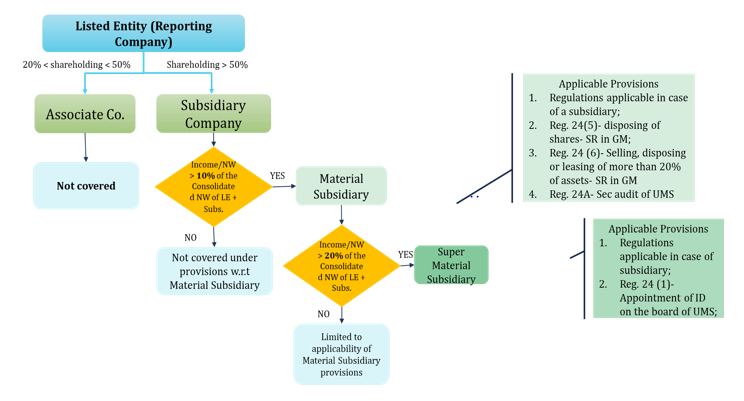
Other than the obligations provided under Reg. 24 of SEBI LODR for the listed companies w.r.t. their subsidiaries, the following additional obligations are applicable in case of material subsidiaries:

  • Formulating Policy– The listed entity is required to formulate a policy for determining materiality of its subsidiaries, and shall disseminate the same on its website.
  • Appointment of Independent Director– Pursuant to Regulation 24(1) of the LODR, at least one (1) independent director of the listed entity is required to be a director on the board of an unlisted material subsidiary (with respect to this provision, material subsidiary has been defined with a threshold of 20% of the consolidated income or net worth).
  • Disposing of shares in Material Subsidiary – A listed company shall not dispose of shares in its material subsidiary resulting in reduction of its overall shareholding to less than 50% or cease to exercise control over subsidiary without passing special resolution in general meeting except in case where such divestment is made under a scheme of arrangement (duly approved by the Tribunal/ Court) or in case of resolution plan duly approved in terms of section 31 of IBC, 2016.
  • Selling, disposing and leasing of assets – Pursuant to Regulation 24(6) of the LODR, the sale or disposal or leasing of assets amounting to more than 20% of the assets of a material subsidiary (on an aggregate basis during a financial year), subject to certain exceptions, requires prior approval of the shareholders of the listed holding company by way of a special resolution.
  • Secretarial Audit: Pursuant to Regulation 24A of the LODR, all listed entities and their Indian unlisted   material   subsidiaries   are   required   to   undertake   a secretarial audit and annex such reports to the annual report of the listed entity.

The discussion above can be summarised in the presentation below:
Role of Policy on determining Materiality of Subsidiary

The definition of ‘material subsidiary’ under regulation 16(1)(c) defines a subsidiary that is material to the listed entity and the explanation to the aforesaid provision allows the listed entity to formulate a policy for the same, i.e., a listed entity can develop criteria that is stricter than what has been provided in the Regulations. However, nothing has been provided regarding the contents of the Policy in the SEBI LODR. Therefore, the Policy is nothing but a replica of what has already been provided in the law, as in order to ensure compliance of the law, listed entities frames policy for determining materiality of subsidiaries based on the contents of the regulations. Thus, the requirement of the policy is limited to ensure compliance of the law.

Can a section 8 company be treated as ‘Material Subsidiary’?

Section 8 Company, as defines in the Act, 2013 are companies that are formed with an object of promoting commerce, art, science, sports, education, research, social welfare, religion, charity, protection of environment or any such other object. These companies are required to apply their profit, if any or other income in promoting their objects and are prohibited from payment of any dividend to its members. Whereas, the benchmark for satisfying the definition of ‘material subsidiary’ is contribution towards consolidated income or net worth of the holding company.

When we consolidate the holding company with a Section 8 company, it will however depict a wrong picture of the wealth of the holding company, as the holding company can never claim any right over the profits of a Section 8 Company. Therefore, the question of consolidation of section 8 with that the holding company does not arise.

Given that the income of a section 8 company cannot be consolidated with that of the listed company or can say that since the performance of a section 8 company has no role to play on the overall performance of the listed company, a section 8 company cannot be treated as a ‘material subsidiary’. 

Concluding Remarks

The term “material subsidiary” has been prioritized over the years because of the impact it may have over the consolidated performance of the listed entity. The principle behind emphasizing absolute numbers of the net worth is the impact of the same on the consolidated figures. Any changes in the income/net worth of these material subsidiaries will be reflected proportionally on the listed entity since the net worth derived from the said material subsidiaries constitutes an integral part of the consolidated net worth of the listed entity. Accordingly, the listed entities should determine the materiality of its subsidiaries wisely and comply with the requirements of SEBI LODR as are applicable on the material subsidiaries.

Our other videos and write-ups may be accessed below:

YouTube:

https://www.youtube.com/channel/UCgzB-ZviIMcuA_1uv6jATbg

Other write-up relating to corporate laws:

https://vinodkothari.com/category/corporate-laws/

Our article on similar topics –

  1. https://vinodkothari.com/wp-content/uploads/2019/04/Final_PPT_on_SEBI_LODR_Amendment_Regulations_2018.pdf
  2. https://vinodkothari.com/2019/02/decoding-large-number-in-case-of-group-governance-policy-under-lodr/


[1] Section 2 (87) of the Act

[2] https://www.sebi.gov.in/legal/regulations/may-2018/sebi-listing-obligations-and-disclosure-requirement-amendment-regulations-2018_38898.html

[3] Section 2 (57) of the Act defines net worth as:

“Net worth” means aggregate value of the paid up share capital and all reserves created out of the profits and securities premium account, after deducting the aggregate value of the accumulated losses, deferred expenditure and miscellaneous expenditure not written off, as per the audited balance sheet, but does not include reserves created out of revaluation of assets, write-back of depreciation and amalgamation



AIF Second Amendment Regulations, 2021 – Regulated Steps towards Liberalised Investment

-Megha Mittal  (mittal@vinodkothari.com)

Amidst the various concerns addressed in the Board Meeting dated 25th March, 2021,[1] the Securities and Exchange of Board of India (‘SEBI’) extensively dealt with several issues identified with respect to Alternative Investment Funds (‘AIFs’), inter-alia a green signal to AIFs for investing in units of other AIFs; ambiguity regarding the scope of the term ‘start-up’; and the need for a code of conduct laying down guiding principles on accountability of AIFs, their managers and personnel, towards the various stakeholders including investors, investee companies and regulators.

Thus, with a view to target the issues in consideration, the Board proposed that the following amendments be introduced in the SEBI (Alternative Investment Funds) Regulation, 2012 (‘AIF Regulations’/ ‘Principal Regulations’)[2]

  • provide a framework for Alternative Investment Funds (AIFs) to invest simultaneously in units of other AIFs and directly in securities of investee companies;
  • provide a definition of ‘start-up’ as provided by Government of India and to clarify the criteria for investment by Angel Funds in start-ups
  • prescribe a Code of Conduct for AIFs, key management personnel of AIFs, trustee, trustee company, directors of the trustee company, designated partners or directors of AIFs, as the case may be, Managers of AIFs and their key management personnel and members of Investment Committees and bring clarity in the responsibilities cast on members of Investment Committees; and
  • remove the negative list from the definition of venture capital undertaking.

 The aforesaid proposals, put to the fore in view of the suggestions and requests received from several stakeholder groups like the domestic AIFs, global investors, and the regulatory bodies, have now been notified vide notification dated 5th May, 2021, via the SEBI (Alternative Investment Funds) (Second Amendment) Regulations, 2021[3] (‘Amendment Regulations’). A key takeaway from the Amendment Regulations is the flexibility granted w.r.t. indirect investments by AIFs for investment in units of another AIF, however with some riders and possible gaps, as discussed below.

Below we summarise and discuss the amendments introduced vide the Amendment Regulations, and analyse its impact

Read more

Failed Redemption of Preference Shares: Whether a Contractual Debt?

– Sikha Bansal, Partner and Megha Mittal, Associate (resolution@vinodkothari.com)

Preference shares, as the nomenclature suggests, represent that part of a Company’s capital which carries ‘preference´ vis-à-vis equity shares, with respect to payment of dividend and repayment of capital in case of winding up. However, the real position of preference shares may be quite baffling, given that the instrument, by its very nature, is sandwiched between equity capital and debt instruments.  Although envisaged as a superior class of shares, preference shareholders enjoy neither the voting powers vested with the equity shareholders (true shareholders) nor the advantages vested with debenture-holders (true creditors). As such, the preference shareholders find themselves suspended midway between true creditors and true shareholders – hence facing the worst of both worlds[1].

The ambivalence associated with preference shares is adequately reflected in the manner various laws deal with such shares – a preference share is a part of ‘share-capital’ by legal classification[2], but can be a ‘debt’ as per accounting classification[3]; similarly, while a compulsorily convertible preference share is classified as an ‘equity instrument’[4], any other preference share constitutes external commercial borrowing[5] under foreign exchange laws. Needless to say, the divergent treatment is owed to the objective which each legislation assumes.

Read more

Funding through crowdfunding platform: whether qualifies to be CSR?

-Platforms different from implementing agency

-Pammy Jaiswal, Partner and Sachin Sharma, Executive (corplaw@vinodkothari.com)

Crowdfunding Platforms

Crowdfunding platforms are digital platforms which solicit funds for various ventures. They pave way for easy accessibility to a vast network of people through social media. Individuals, charities or companies can create a campaign for specific causes for contribution from anyone, either a corporate, or an association, or an individual. Two broad classes of crowdfunding platforms are: investment-based, which consists of stocks, royalties, and loans, where the funders are investors in a campaign and can obtain monetary benefits. The other is donation-based, where funders do not expect monetary compensation. They fund a campaign because they support its cause. For understanding the concept on crowdfunding in detail, kindly refer to our article here.

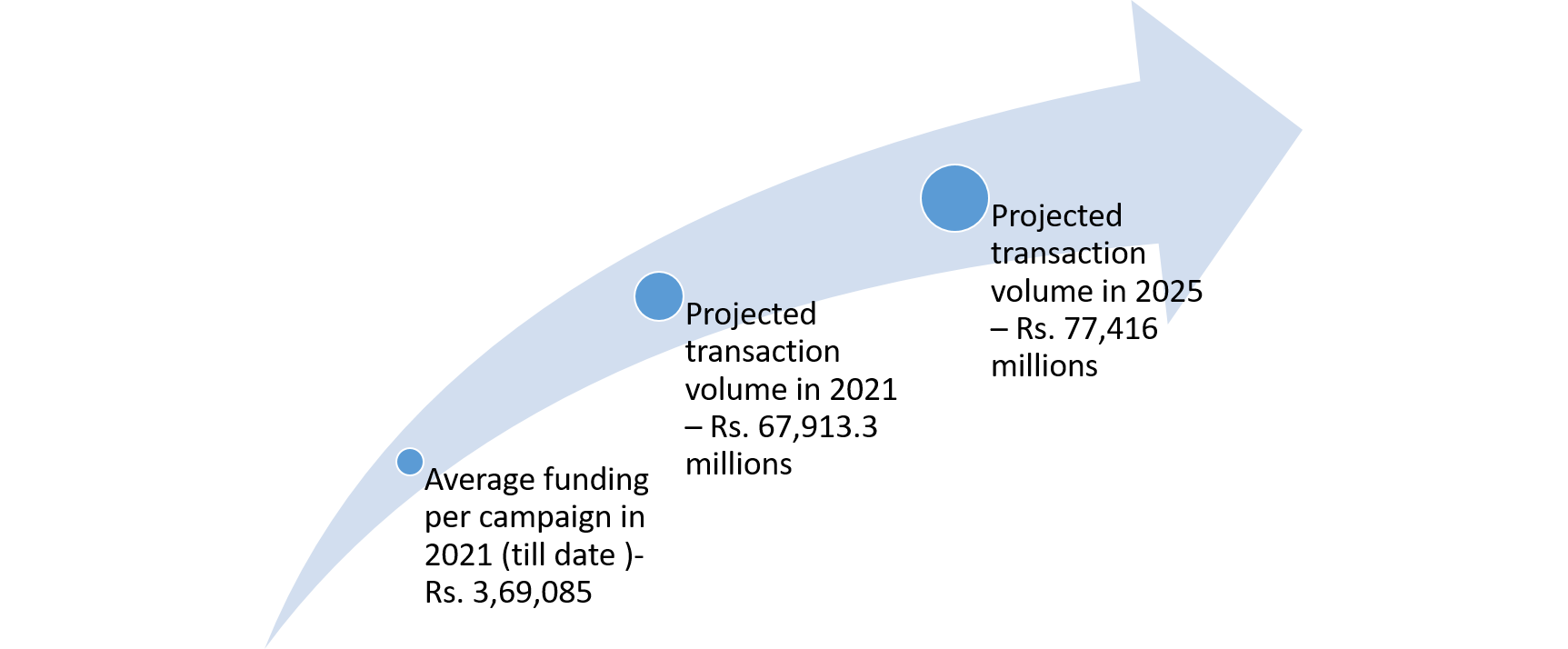
Crowd sourcing has become an important aspect for carrying out CSR activities[1]. Around 27% of the crowdfunding campaigns are initiated to cover medical expenses. Several crowdfunding platforms are running parallelly across India as well as the world. Some of the Indian crowdfunding platforms include Impactguru, Milaap, Ketto, etc. As the world is under the grip of COVID- 19, these platforms are playing their remarkable role in sourcing funds for COVID-19 relief through several campaigns. Till now, Ketto has raised ₹324.60cr for its COVID relief campaigns whereas Milaap has raised ₹182.47Cr and Impact Guru has raised ₹61.46cr for their COVID relief campaigns. Further, crowdfunding platforms are not only popular in India but also across the world. Several global platforms are also working to raise funds for various projects/ campaigns. Global Giving collection in its Coronavirus Relief Fund has moved to $13,363,987.

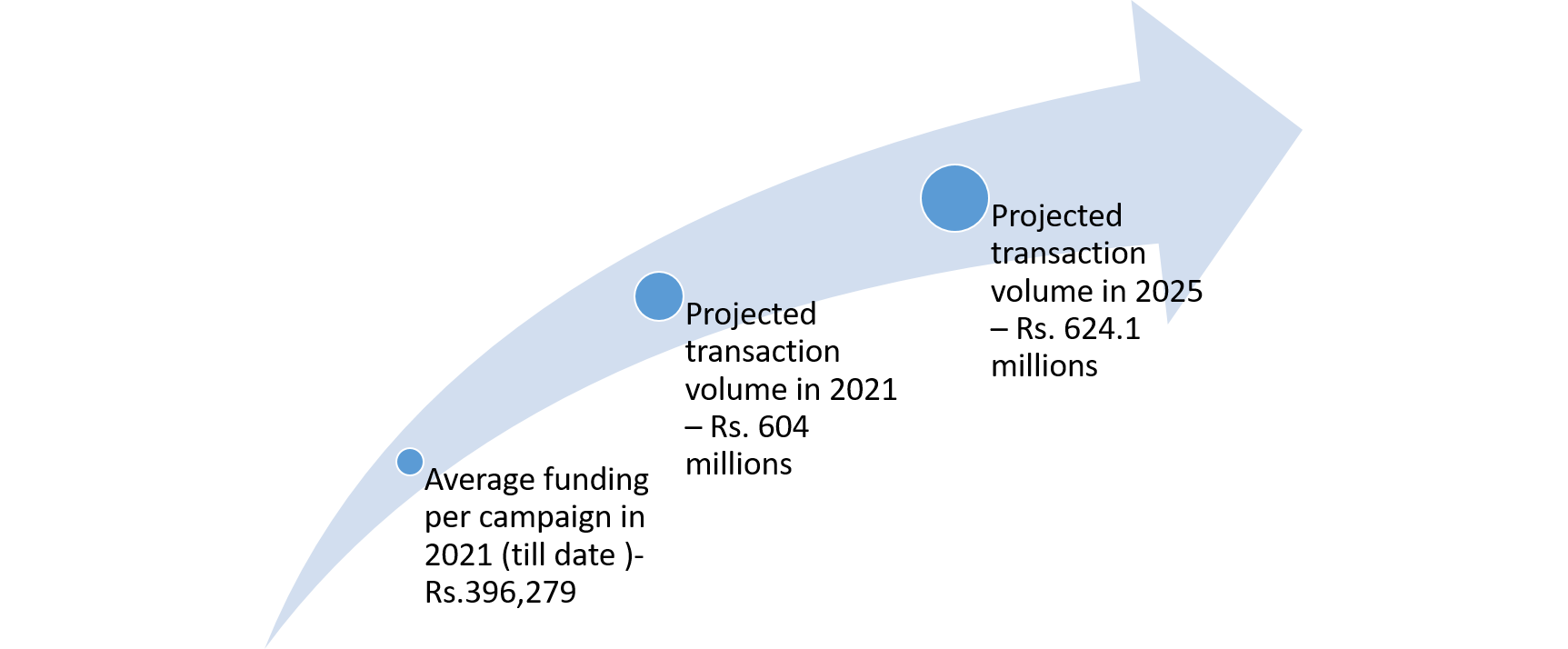
 Growth in transactions of crowdfunding platforms

The crowdfunding platforms have attained greater visibility and importance in India as well as globally as per the statistics[2] given below-


The first figure corresponds to the Indian position and the second figure pertains to global statistics.

What is an ‘Implementing Agency’ (IA)

The term IA has not been defined under the CSR provisions (section 135 of the Companies Act, 2013 as well as the rules made thereunder), however, the report on CSR activities uses the term IA for carrying out CSR indirectly.

IA, as the name suggests is an implementation tool for the entity to carry out its CSR activities. As per Rule-4(1) of the Companies (Corporate Social Responsibility Policy) Rules, 2014, section 8 companies, registered public trusts, and registered societies (collectively, called ‘entities’) can be referred to as IAs. The nature or activities of an IA can be distinguished from that of a beneficiary through a very thin line. Our article containing the detailed discussion on the same can be read here.

While carrying out CSR activities through an IA, there are several things that a company needs to consider after the amendment under the CSR provisions have been notified on 22nd January, 2021. They include:

  • IA which includes a section 8 company, public charitable trusts, or a society either formed by the company or otherwise needs to be registered under section 12A and 80G of the IT Act;
  • All IAs, are required to register themselves with MCA by filing e-form CSR-1; and
  • IAs which include a section 8 company, public charitable trusts, or a society not formed by the company require a track record of three years in carrying out similar CSR projects.

Crowdfunding platform working as a connecting point

Crowdfunding Platforms simply acts as connecting point between CSR contributors and CSR opportunities. It neither gets into implementation nor acts as agent for implementation, it acts merely as a connection point.

Deprived of the crowd sourcing mechanism, each company would have to look for its own sources for their CSR activity which will be a very inefficient way for carrying out CSR. India is a vast country and therefore huge number of CSR opportunities are present where each company would like to carry out its CSR obligations strategically so as to fulfil their CSR objectives. Crowdfunding platforms have filled up the information asymmetry and plays a role of an information bridge similar to what media does. Since it does not go into the implementation role at all, there is nothing wrong in routing/ using such platforms for carrying out CSR activities.

How is a crowdfunding platform different from being an IA?

An IA is regarded to work as an extended arm of the company in carrying out CSR activities. The whole purpose of involving an IA is to relieve the company from using its time to identify reliable projects and programs wherein the funds may be used or allocated. Another reason to involve an IA for carrying out CSR is that the company may not have the requisite expertise and experience to shortlist the authentic activities or entities where the money can be spent.

Having said that, on the other hand, a crowdfunding platform does not work as an extended arm of the company, rather, it is a voluntary body which acts a connecting point between the IA/ beneficiary and the company. It does not have the liberty to allocate the money in the project of its own choice, rather, the fund giver chooses the exact project or IA where it wants the money to be used.

Further, to be eligible to carry out CSR activities as an IA, registration with the MCA and under IT Act (except for govt entities and those set up under an Act of Parliament or State Legislature) is necessary while crowdfunding platforms may be relieved from such mandatory requirement considering its role as a connecting point between the fund raiser and the fund giver. Therefore, crowdfunding platforms cannot be regarded as IA.

The third point of difference between the two is when a CSR activity is routed through the IA, monitoring and utilisation report is required to be supplied by such IA to the Company. Whereas, when funds are contributed through crowdfunding platform, the ultimate beneficiary or IA which takes the funding, is liable to provide a utilisation report to the fund giver.

Features of the crowdfunding platform which distinguishes it from an IA

As discussed above, a crowdfunding platform acts as a medium to connect the contributor and the contribute. If it also relevant to understand the extent these crowdfunding platforms differ from an IA.

We have gone through the websites of several crowdfunding platforms and have presented a tabular presentation of areas where they are different from becoming an IA.

Basis Ketto[1] ImpactGuru[2] Milaap[3] Role of IAs
Accountability It shall not in any manner be responsible or held accountable for any transaction between the Users. No obligation to become involved in disputes between any Users, or between Users and any third party arising in connection with the use of the Site Assume no responsibility to verify whether the Donations are used in accordance with any applicable laws, and such responsibility rests solely with the Champion or Charity, as applicable Accountable to the companies donating the funds.
Utilisation of funds It is merely an intermediary and does not interfere in the transaction between Donors / Contributors and Campaigner Not responsible in any way whatsoever towards the end utilization of funds Facilitates the Donation transaction between Champions and Donors, but is not a party to any agreement between a Champion and a Donor, or between any user and a Charity. It decides the areas and entities where funds are to be allocated
Obligations or liabilities wrt funds collected Does not hold any right, title or interest over the funds or rewards or have any obligations or liabilities in respect of such providing the same to the Donor / Contributor Does not take any responsibility for making sure that the project for which the funds are raised through its Site is completed and made available to the Funders No control over the conduct of, or any information provided by a Champion or a Charity, and Milaap hereby disclaims all liability in this regard Liable if the same remains unspent or not spent within the permitted activities. Utilisation reports have to be shared signifying the utilisation of funds for permitted activities
Liability for correctness of information on the platform Not liable Not liable Not liable Liable
Responsibility for success/ outcome of the project Not liable Not liable Not Liable Liable
Verification whether funds are used as per applicable laws or fund-raising purpose Responsibility on the Campaigner Responsibility on the Campaigner Responsibility on the Campaigner Responsibility on the IA

Safeguards/ points of consideration in funding through the platform

  1. Funds are going to the beneficiary directly:

The fund is put directly from the crowdfunding platform to the beneficiary’s account and no third party is involved here. In this, it becomes a case of direct CSR activity. Utilisation report is required.

  1. Funds are going to another IA (registered):

Where the funds raised by crowdfunding platform goes to an entity registered as an IA with MCA, monitoring as well as utilization report will be required

  1. Funds are going to another IA (registered) which itself carries out CSR activities:

Where the fund raiser is a registered IA, however, carries out the CSR activities itself, it will be a case of direct CSR and not through an IA.

Conclusion

 Crowdfunding platforms are emerging as promising sources for business houses to fulfil their CSR goals. These platforms should be expected and at the same time be bound by the mandatory registration provisions with the MCA since their role is not be act as an IA but a mere platform where fund raisers and fund givers can meet.

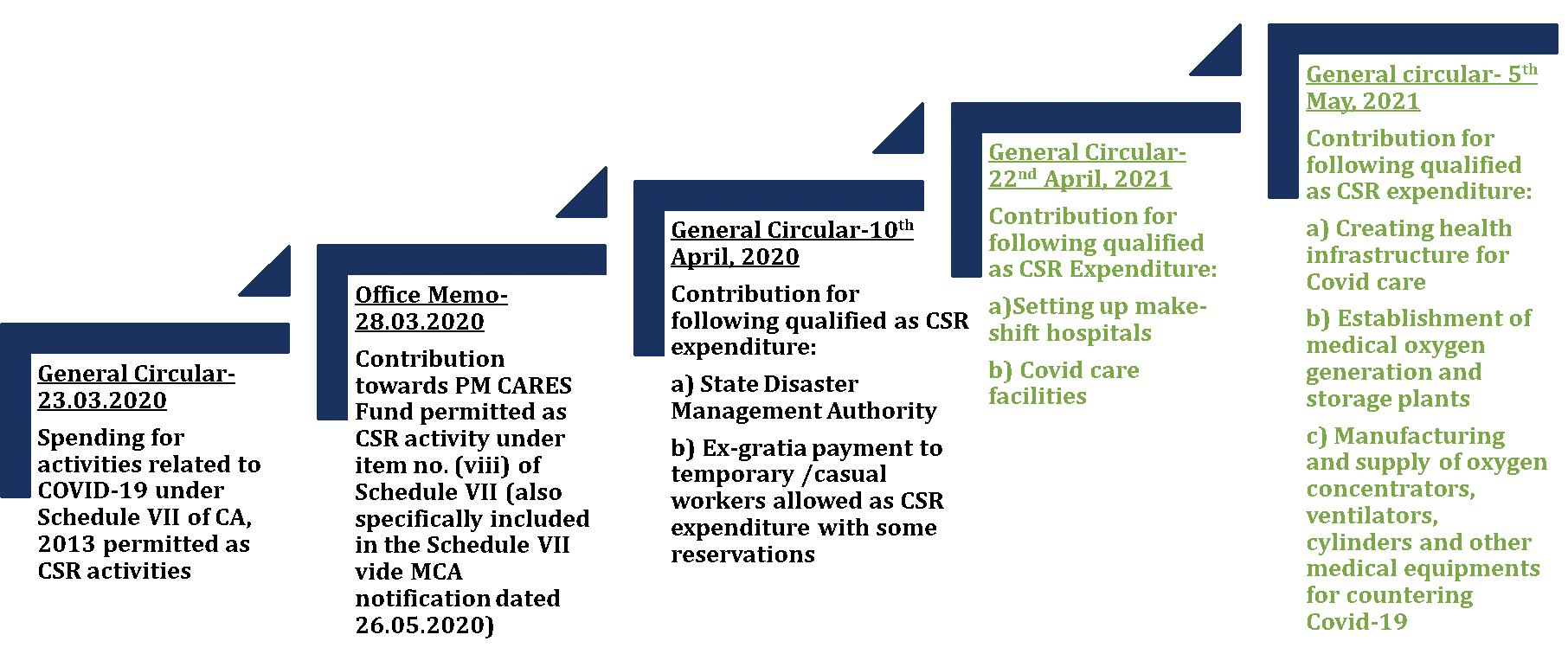
Ministry of Corporate Affairs (MCA) vide several circulars have brought several relaxations and broad based the activities under Schedule VII in relation to COVID-19 and health care.

Looking at the ongoing era of the pandemic, it has become very common for several digital platforms to come forward and act as source of link between the agencies/ beneficiaries and the corporates for several activities which are also covered under Schedule VII of the Companies Act, 2013.

Our other resources on CSR can be read here

[1] Read more here

[2] https://www.statista.com/outlook/dmo/fintech/alternative-financing/crowdfunding/worldwide?currency=INR

[1] https://www.ketto.org/terms-of-use.php

[2] https://www.impactguru.com/terms-of-use

[3] https://milaap.org/about-us/terms-and-conditions

Social Stock Exchanges – Enabling funding for social enterprises the regulated way

By Sharon Pinto & Sachin Sharma, Corplaw division, Vinod Kothari & Company  (corplaw@vinodkothari.com) 

Background

The inception of the idea of Social Stock Exchanges (SSEs) in India can be traced to the mention of the formation of an SSE under the regulatory purview of Securities and Exchange Board of India (SEBI) for listing and raising of capital by social enterprises and voluntary organisations, in the 2019-20 Budget Speech of the Finance Minister. Consequently, SEBI constituted a working group on SSEs under the Chairmanship of Shri Ishaat Hussain on September 19, 2019[1]. The report of the Working Group (WG) set forth the framework on SSEs, shed light on the concept of social enterprises as well as the nature of instruments that can be raised under such framework and uniform reporting procedures. For further deliberations and refining of the process, SEBI set up a Technical Group (TG) under the Chairmanship of Dr. Harsh Kumar Bhanwala (Ex-Chairman, NABARD) on September 21, 2020[2]. The report, made public on May 6, 2021[3], of the TG entails qualifying criteria as well as the exhaustive ecosystem in which such an SSE would function.

In this article we have analysed the framework set forth by the reports of the committees with the globally established practices.

Concept of SSEs

As per the report of the WG dated June 1, 2020[4], SSE is not only a place where securities or other funding structures are “listed” but also a set of procedures that act as a filter, selecting-in only those entities that are creating measurable social impact and reporting such impact. Further the SSE shall be a separate segment under the existing stock exchanges. Thus, an SSE provides the infrastructure for listing and disclosure of information of listed social enterprises.

Such a framework has been implemented in various countries and an analysis of the same can be set forth as follows:

A. United Kingdom

  • The Social Stock Exchange (SSX) was formed in June 2013 on the recommendation of the report of Social Investment Taskforce. The exchange does not yet facilitate share trading, but instead serves as a directory of companies that have passed a ‘social impact test’. It thus provides a detailed database of companies which have social businesses. It facilitates as a research service for potential social impact investors.
  • Further, companies that are trading publically in the main board stock exchange, may list their securities on SSX, thus only for-profit companies can list on the SSX[5] It works with the support of the London Stock Exchange and is a standalone body not regulated by any official entity.
  • Social and environment impact is the core aim of SSX. To satisfy the same, companies are required to submit a Social Impact Report for review by the independent Admissions Panel composed of 11 finance and impact investing experts.
  • The disclosure framework comprises adherence to UK Corporate Governance Guidelines and Filing Annual Social Impact Reports determine the continuation of listing in SSX.

B. Canada

  • Social Venture Connection (SVX)[6] was launched in 2013. Like SSX, SVX is not an actual trading platform but it is a private investment platform built to connect impact ventures, funds, and investors. It is open only for institutional investors[7].
  • The platform facilitates listing of for-profit business, NPO, or cooperatives categorized as, Social Impact Issuers and Environment Impact Issuers. These entities are required to be incorporated in Ontario for at least 2 years and have audited financial statements available.
  • For listing, a for-profit business must obtain satisfactory company ratings through GIIRS, a privately administered rating system.
  • Issuer must conform to the SVX Issuer Manual. In addition to this reporting of expenditure and other financial transactions shall be done once capital is raised. Further the issuers are required to file financial statements annually in accepted accounting methods and shall not have any misleading information. Ratings are required to be obtained, however the provisions are silent on the periodicity of revision of ratings.

C. Singapore

  • Singapore has established Impact Exchange (IX) which is operated by Stock Exchange of Mauritius and regulated by the Financial Service Commission of Mauritius.
  • IX is the only SSE that is an actual public exchange. It is thus a public trading platform dedicated to connecting social enterprise with mission-aligned investment. Social enterprises, both for-profits and non-profits, are permitted to list their project. NGOs are allowed as issuers of debt securities (such as bonds).
  • Listing requirements on the exchange are enumerated into social and financial categories. Following comprise the social criteria for listing:
  1. Specify social or economic impact as the reason for their primary existence.
  2. Articulate the purpose and intent of the company in the form of a theory of change- basis for demonstrating social performance.
  3. Commit to ongoing monitoring and evaluation of impact performance assessment and reporting.
  4. Minimum 1 year of impact reports prepared as per IX reporting principles.
  5. Certification of impact reports by an independent rating body 12 months prior listing.

Further the financial criteria entails the need for a fixed limit of minimum market capitalization, publication of financial statements and use of market-based approach for achieving its purpose.

D. South Africa

  • The ‘South Africa Social Exchange’ or SASIX[8], offers ethical investors a platform to buy shares in social projects according to two classifications: by sector and by province[9]. Guidelines for listing prescribe compliance with SASIX’s good practice norms for each sector.
  • In order to get listed, entities have to achieve a measurable social impact. The platform acts as a tool of research, evaluation and match-making to facilitate investments into social development projects
  • NGOs can also list their social projects on the exchange. Value of the projects is assessed and then divided into shares. Following project implementation, investors are given access to financial and social reports.
  • While social enterprises are required to have a social purpose as their primary aim, they are also expected to have a financially sustainable business model. The SASIX ceased functioning in 2017[10].

Key ingredients for a social enterprise

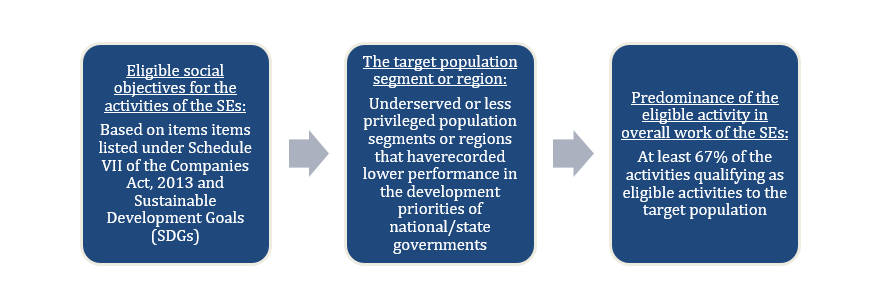
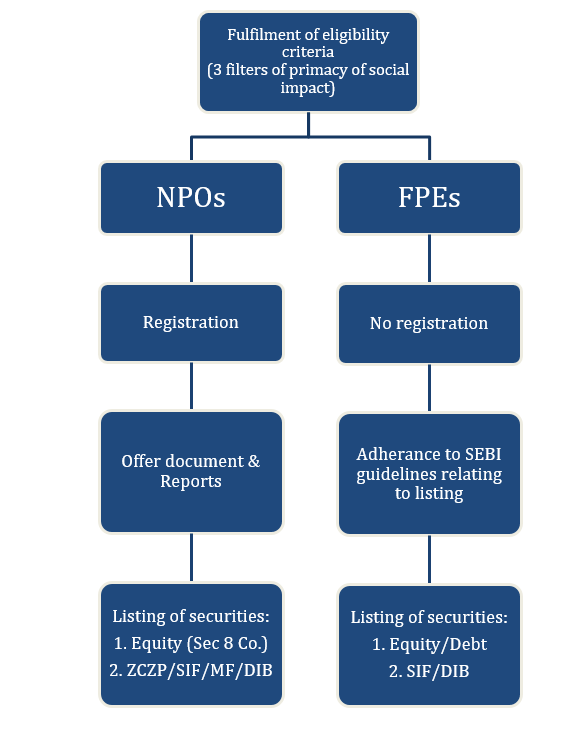
  • The report of the TG[11] has categorised social enterprises into For Profit Enterprise (FPEs) and Not for Profit Organisation (NPOs). In order to qualify as a social enterprise the entities shall establish primacy of social impact which shall be determined by application of the following 3 filters:

  • On establishment of the primacy of social impact through the three filters as stated above, the entity shall be eligible to qualify for on-boarding the SSE and access to the SSE for fund-raising upon submitting a declaration as prescribed.

Qualifying criteria and process for onboarding

As per TG recommendation, an NPO is required to register on any of the Social Stock Exchange and thereafter, it may choose to list or not. However, an FPE can proceed directly for listing, provided it is a company registered under Companies Act and complies with the requirements in terms of SEBI Regulations for issuance and listing of equity or debt securities.

Further, the TG has recommended a set of mandatory criteria as mentioned below that NPOs shall meet in order to register.

A. Legal Requirements:

  • Entity is legally registered as an NPO (Charitable Trust/ Society/Section-8 Co’s).
  • Shall have governing documents (MoA & AoA/ Trust Deed/ Bye-laws/ Constitution) & Disclose whether owned and/or controlled by government or private.
  • Shall have Registration Certificate under 12A/12AA/12AB under Income Tax.
  • Shall have a valid IT PAN.
  • Shall have a Registration Certificate of minimum 3 years of its existence.
  • Shall have valid 80G registration under Income-Tax.

B. Minimum Fund Flows:

In order to ensure that the NPO wishing to register has an adequate track-record of operations.

  • Receipts or payments from Audited accounts/ Fund Flow Statement in the last financial year must be at least Rs. 50 lakhs.
  • Receipts from Audited accounts/ Fund Flow Statement in the last financial year must be at least Rs. 10 lakhs.

Framework for listing

Post establishment of the eligibility for listing and the additional registration criteria in case of NPOs, the social enterprises may list their securities in the manner discussed further. The listing procedures vary for NPOs and FPEs and is set forth as follows:

A. NPOs

  • NPO shall be required to provide audited financial statements for the previous 3 years and social impact statements in the format prescribed. Further the offer document shall comprise of ‘differentiators’ which shall help the potential investors to assess the NPOs being listed and form a sound and well-informed investment decision. A list of 11 such differentiators has been provided in the report of the TG.
  • Further in case of program-specific or project-specific listings, the NPO shall have to provide a greater level of detail in the listing document about its track record and impact created in the program target segment.
  • All the information submitted as part of pre-listing and post-listing requirements, shall be duly displayed on the website of the NPO.

B. FPEs

  • In case of an FPE, existing regulatory guidelines under various SEBI Regulations for listing securities such as equity, debt shall be complied with.
  • The differentiators will be in addition to requirements as mandated in SEBI Regulations in respect of raising funds through equity or debt.
  • Further, FPEs have been granted an option to list their securities on the appropriate existing boards. Thus the issuer may at their discretion list their debt securities on the main boards, while equity securities may be listed on the main boards, or on the SME or IGP.

Types of instruments 

Depending on the type of organisation, SSEs shall allow a variety of financing instruments for NPOs and FPEs. As FPEs have already well-established instruments, these securities are permitted to be listed on the Main Board/IGP/SME, however visibility shall be given to such entities by identifying them as For Profit Social Enterprise (FPSE) on the respective stock exchanges.

Modes available for fundraising for NPOs shall be Equity (Section 8 Co’s.), Zero Coupon Zero Principal (ZCZP) bonds [this will have to be notified as a security under Securities Contracts (Regulation) Act, 1956 (SCRA)], Development Impact Bonds (DIB), Social Impact Fund (SIF) (currently known as Social Venture Fund) with 100% grants-in grants out provision and funding by investors through Mutual Funds. On the other hand, FPEs shall be able to raise funds through equity, debt, DIBs and SIFs.

While SVF is an existing model for fund-raising, the TG has proposed various changes in order to incentivise investors and philanthropists to invest in such instruments. In addition to change in nomenclature from SVF to SIF, minimum corpus size is proposed to be reduced from Rs. 20 Cr to Rs. 5 Cr. Further, minimum subscription shall stand at Rs. 2L from the current Rs. 1 Cr. The amendments shall also allow corporates to invest CSR funds into SVFs with a 100% grants-in, grants out model.

Disclosure and Reporting norms

Once the FPE or the NPO (registered/listed) has been demarcated by the exchange to be an SE, it needs to comply with a set of minimum disclosure and reporting requirements to continue to remain listed/registered. The disclosure requirements can be enlisted as follows:

For NPO:

  • NPO’s (either registered or listed) will have to disclose on general, governance and financial aspects on an annual basis.
  • The disclosures will include vision, mission, activities, scale of operations, board and management, related party transactions, remuneration policies, stakeholder redressal, balance sheet, income statement, program-wise fund utilization for the year, auditors report etc.
  • NPO’s will have to report within 7 days any event that might have a material impact on the planned achievement of their outputs or outcomes, to the exchange in which they are registered/listed. This disclosure will include details of the event, the potential impact and what the NPO is doing to overcome the impact.
  • NPO”s that have listed its securities will have to disclose Social Impact Report covering aspects such as strategic intent and planning, approach, impact score card etc. on annual basis.

For FPE:

FPE’s having listed equity/debt will have to disclose Social Impact Report on annual basis and comply with the disclosure requirements as per the applicable segment such as main board, SME, IGP etc.

Other factors of the SSE ecosystem

a. Capacity Building Fund

As per the recommendation of the WG, constitution of a Capacity Building Fund (CBF) has been proposed. The said fund shall be housed under NABARD and funded by Stock Exchanges, other developmental agencies such as SIDBI, other financial institutions, and donors (CSRs). The fund shall have a corpus of Rs. 100 Cr and shall be an entity registered under 80G, which shall make it eligible for receiving CSR donations pursuant to changes to Section 135/Schedule VII of Companies Act 2013. The role of the fund shall encompass facilitating NPOs for registration and listing procedures as well as proper reporting framework. These functions shall be carried out in the form awareness programs.

b. Social Auditors

Social audit of the enterprises shall compose of two components – financial audit and non-financial audit, which shall be carried out by financial or non-financial auditors. In addition to holding a certificate of practice from the Institute of Chartered Accountants of India (ICAI), the auditors will be required to have attended a course at the National Institute of Securities Markets (NISM) and received a certificate of completion after successfully passing the course examination. The SRO shall prepare the criteria and list of firms/institutions for the first phase soon after the formation of SSEs, and those firms/institutions shall register with the SRO.

c. Information Repositories

The platform shall function as a research tool for the various social enterprises to be listed, thus Information Repository (IR) forms an important component of the framework. It functions as an aggregator of information on NGOs, and provides a searchable electronic database in a comparable form. Thus it shall provide accurate, timely, reliable information required by the potential investors to make well informed decisions.

Conclusion  

The social sector in India is getting increasingly powerful – this was evident during Covid-crisis based on the wonderful work done by several NGOs. Of course, all social work requires funding, and being able to crowd source funding in a legitimate and transparent manner is quintessential for the social sector. We find the report of the TG to be raising and addressing relevant issues. We are hoping that SEBI will now find it easy to come out with the needed regulatory platform to allow social enterprises to get funding through SSEs.

Our other article on the similar topic can be read here – https://vinodkothari.com/2019/09/social-stock-exchange-a-guide/

[1] https://www.sebi.gov.in/media/press-releases/sep-2019/sebi-constitutes-working-group-on-social-stock-exchanges-sse-_44311.html

[2] https://www.sebi.gov.in/media/press-releases/sep-2020/sebi-constitutes-technical-group-on-social-stock-exchange_47607.html

[3] https://www.sebi.gov.in/reports-and-statistics/reports/may-2021/technical-group-report-on-social-stock-exchange_50071.html

[4] https://www.sebi.gov.in/reports-and-statistics/reports/jun-2020/report-of-the-working-group-on-social-stock-exchange_46852.html

[5] https://scholarship.law.upenn.edu/cgi/viewcontent.cgi?article=1906&context=jil&httpsredir=1&referer=

[6] https://www.svx.ca/faq

[7] https://ssir.org/articles/entry/the_rise_of_social_stock_exchanges

[8] https://www.sasix.co.za/

[9] https://ssir.org/articles/entry/the_rise_of_social_stock_exchanges

[10] https://www.samhita.org/wp-content/uploads/2021/03/India-SSE-report-final.pdf

[11] https://www.sebi.gov.in/reports-and-statistics/reports/may-2021/technical-group-report-on-social-stock-exchange_50071.html