

 Reload document
  Open in new tab
 Share-hawkers of digital era: Legality of platforms offering unlisted shares
– SEBI cautions investors from transacting in securities of unlisted public companies on electronic platforms
– Burhanuddin Kholiya (corplaw@vinodkothari.com)
From rental rooms to cabs to domestic furniture, almost everything is made available using technological aggregators. But the moment one tries to sell securities on public platforms, the chances of potential investors being duped by dream merchants increase – something which regulators have very carefully barred over the years. Hence, unless it is a recognised stock exchange, making securities available on public platforms constitutes “offer for sale”. Sometimes, people look at the number of investors as less than 200 and tend to argue that is not a deemed public offer, but it is important to understand that if the offer has gone to people in general, the actual number of investors who bite the bait does not matter.
Many platforms encourage investments in unlisted or pre-IPO stocks. At times bunching either securities or investors. SEBI, in its press release dated December 9, 2024, warned investors against transacting on such platforms, emphasizing the risks involved and clarifying that these platforms operate outside SEBI’s regulatory framework.
Regulatory framework for platforms:
On the intermediaries front, stock brokers are permitted to deal only on recognised stock exchanges and are prohibited from facilitating trading outside these exchanges. In 2022, SEBI extended its regulatory framework to Online Bond Platform Providers (‘OBPP’) by mandating them to register as stock brokers in the debt segment and restricted their offerings to listed debt securities or debt proposed to be listed through a public offering. Only recognized stock exchanges are authorised to provide a platform for fund raising and trading in securities of “to be listed” and “listed” companies.
Apart from above, today, numerous platforms have emerged offering unlisted securities to the public at large. However, being unregulated, it poses significant risks to investors. While SEBI’s mandate may not extend to unlisted securities, it continues to caution investors about platforms dealing with such securities. Recognizing the potential risks and lack of oversight, SEBI and the Registrar of Companies (ROC) have issued several orders against platforms offering unlisted securities to the public. These actions aim to protect investors from being misled and address violations of private placement & public issue related provisions under the Companies Act, 2013.
Modus Operandi of unlisted share brokers
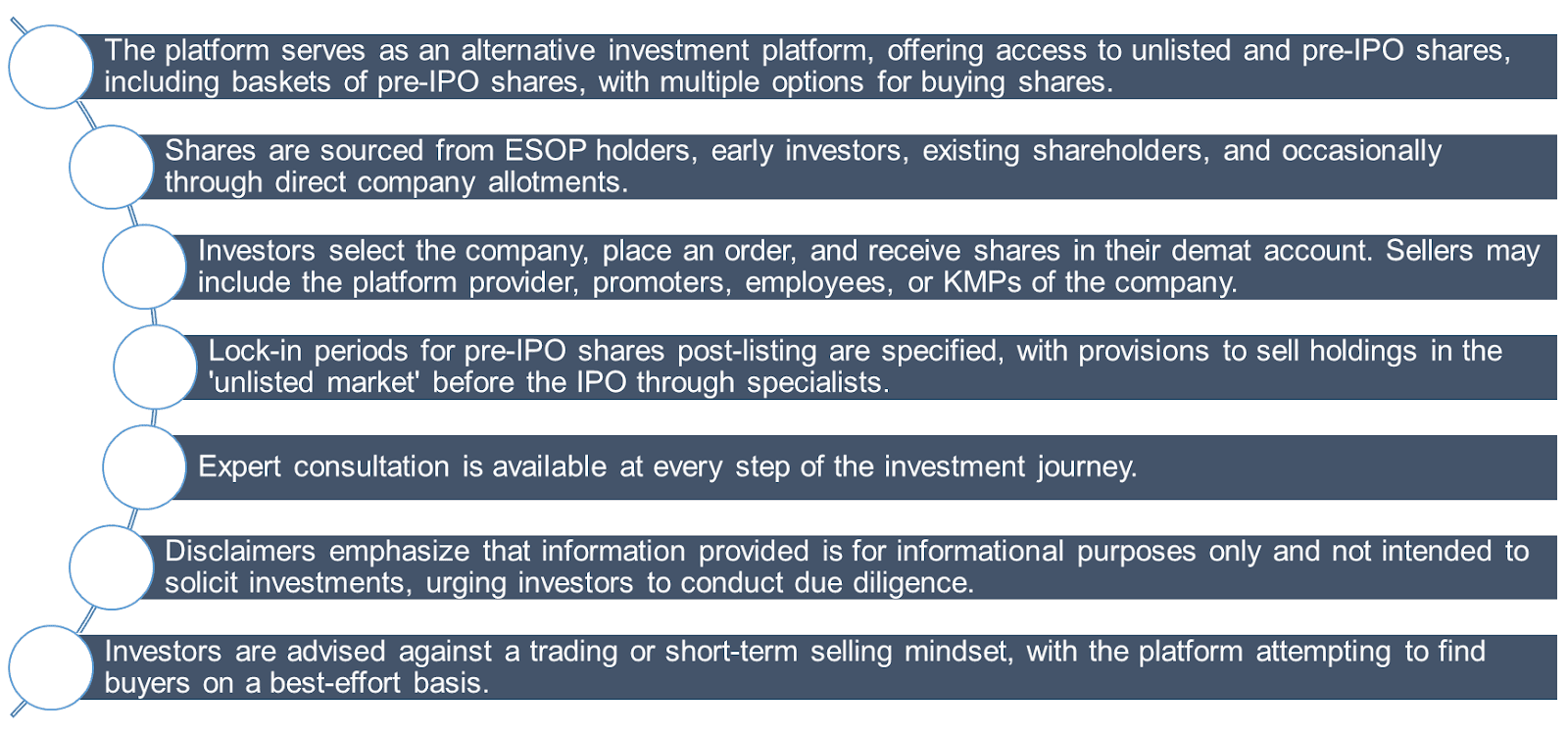
Unlisted securities are primarily traded by way of a transfer. Traditionally, the transfer of securities is a private arrangement between two identified parties, namely the transferor and the transferee, who explicitly agree on the sale and purchase of a fixed number of securities.
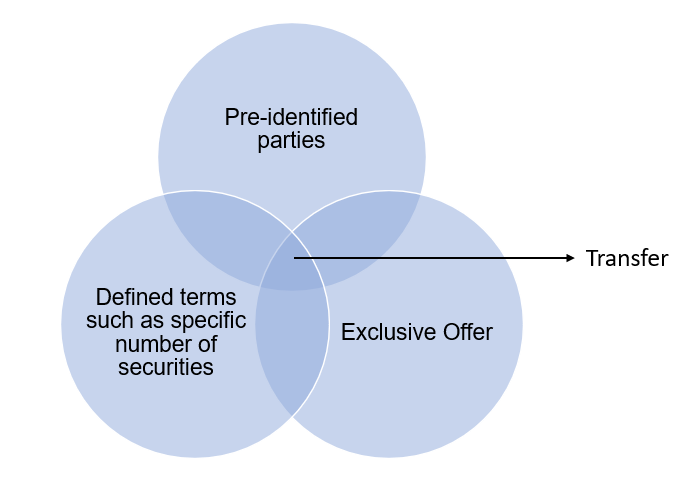
The key distinction between transfer of securities and public offer of securities lies in the pre-identification of parties, exclusive offer and defined terms.
Therefore, when securities are offered for sale to unidentified persons without limiting the number of purchasers, this could effectively constitute an indirect public offer (which also includes an offer for sale).
As pointed out above, many unregistered platforms offering unlisted securities have emerged. These platforms often target unidentified persons and provide no limit on the number of purchasers, effectively transforming such offers into indirect public offers in the form of “offer for sale”.
Listing securities for sale on a publicly accessible platform may, intentionally or unintentionally, transform a private arrangement into an offer resembling a public offer. Unlike private transfers, public offers are subject to stringent regulatory requirements, such as issuing prospectus, detailed disclosures, and continuous regulatory oversight. Failing to adhere to these requirements could undermine investor protection and market integrity.
Structuring of Transactions as “Secondary Sale”
The practice of structuring transactions as secondary sales is an innovative strategy employed by fintech platforms to broaden market access while navigating regulatory challenges. However, this approach raises significant concerns about compliance, investor protection, and market integrity. Striking a balance between innovation and regulatory compliance is essential to establish a transparent, fair, and robust investment ecosystem.
In this model, a fintech platform, operating through its legal entity, subscribes to securities offered via private placement by a company. Often, these platforms are the sole or principal investors in such placements. Once the securities are acquired, the platform lists them on its portal as available for investment by way of transfers from itself to individual investors, presenting them as secondary market transactions ostensibly outside the scope of public offer regulations. The interface almost resembles a broking app, where one can click and ‘buy 1 share’ instantly.
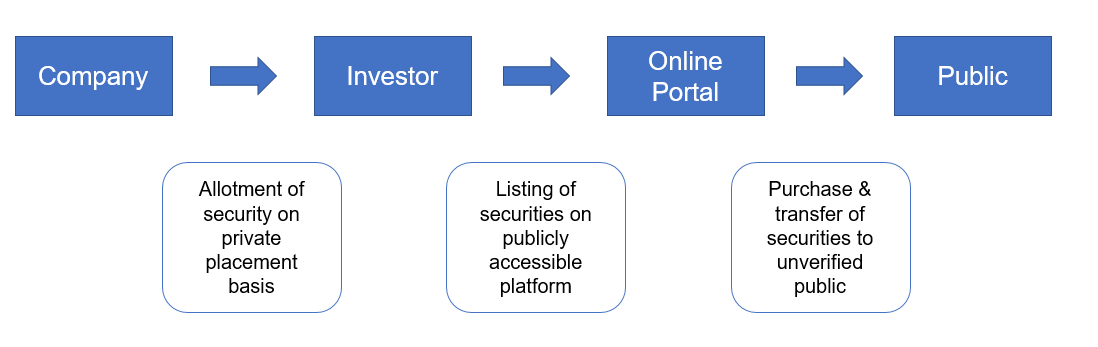
In some cases, the platform and the warehousing entity are separate. Additionally, some platforms claim that the transferors comprise of promoters, employees, KMPs of those enlisted public companies.
Motivations behind structuring as Secondary Sale are twofold:
1. Avoiding Public Offer Regulations:
Public offers of securities are subject to extensive regulatory oversight, including stringent disclosure requirements and mandatory listing. By structuring transactions as secondary sale, platforms consider to bypass these regulations.
2. Enabling Retail Investor Access:
Structuring investments as secondary sale allows platforms to make securities available to retail investors who might otherwise be ineligible to participate in private placements.
Making securities available to large number of unverified investors
As discussed earlier, an offer that can be accepted by anyone effectively qualifies as a public offer, regardless of how it is officially labeled. In contrast, private placements are designed for a limited, pre-identified group of investors and are subject to stricter regulatory controls to maintain their exclusivity.
Fintech platforms, however, challenge this distinction by leveraging technology to make securities accessible to a broad audience of unverified users, thereby creating a regulatory gray area. By listing securities on their portals—accessible to anyone who registers—these platforms effectively transform private placements into publicly available investment opportunities.
Moreover, these platforms often lack stringent verification processes to ensure that users meet the criteria for accredited or eligible investors. Instead, they use digital advertising, user-friendly applications, and social media campaigns to promote investment opportunities, indirectly engaging in general solicitation. This practice, while sometimes technically compliant, directly conflicts with the principles governing private placements, which prohibit public solicitation.
These practices raise significant concerns regarding investor protection and compliance with the existing regulatory framework. By making securities easily accessible to a wide, largely unverified audience, fintech platforms blur the line between private and public offerings. This not only undermines the purpose of private placement regulations but also exposes retail investors to potential risks without the safeguards typically associated with public offers.
While fintech platforms argue that their practices promote financial inclusion and innovation, they also highlight the urgent need for regulatory clarity. Striking a balance between fostering innovation and ensuring compliance is critical to maintain market integrity and protect investors.
Pricing Mechanism: Misalignment with Market Practices
Fintech platforms often claim that the pricing of unlisted shares is driven by demand and supply, similar to listed securities. However, this approach diverges significantly from standard practices for valuing privately placed securities, which typically rely on Fair Market Value (FMV) mechanisms.
Unlisted securities, being inherently illiquid and less transparent, are usually valued based on financial fundamentals, such as earnings, book value, or discounted cash flows, rather than speculative demand and supply dynamics. The reliance on a demand-supply pricing mechanism for illiquid securities can result in significant price distortions. Prices may be artificially inflated or deflated, often without any material change in the underlying company’s fundamentals.
This speculative approach to pricing can mislead investors into believing that the listed price represents a fair valuation of the security. In reality, such pricing mechanisms expose investors to risks of overvaluation or mispricing, especially in the absence of robust valuation methodologies.
Furthermore, the process for investors seeking to liquidate their unlisted shares on these platforms is often vague and lacks the transparency necessary for informed decision-making. Without clear guidelines on how prices are determined or how liquidity is managed, investors may face challenges in accurately assessing the risks and returns associated with their investments.
Violation of private placement & public issue norms
The aforementioned two modes of issuance differs from each other on various parameters:
| Parameters | Private Placement | Public Offer |
| Meaning | Offer or invitation to a select group of persons to subscribe to securities, excluding the general public. | Includes IPO or FPO of securities to the public or an offer for sale of securities by an existing shareholder through issue of prospectus. |
| Who can invest? | Restricted to pre-identified investors addressed in the private placement offer-cum-application letter. | Open to the public at large. |
| Maximum number of investors | 200 persons in a financial year, excluding QIBs and employees offered securities pursuant to ESOP scheme under Section 62 (1) (b) of CA, 2013. | No maximum limit on number of investors. |
| Offer Communication | Communicated directly to the identified investor; cannot be advertised to the general public. | Communicated via advertisements, circulars, or a prospectus to the public. |
| Process | Conducted via a private placement offer-cum-application, adhering to specific conditions outlined in Section 42 of Act. | Requires a prospectus with mandatory disclosures and regulatory oversight, governed by SEBI (ICDR) Regulations, 2018 |
In terms of Section 25(2) of CA, 2013 a private placement will be considered as securities being offered for sale to the public if it is shown that an offer of the securities or any of them was made within 6 months after the allotment or agreement to allot; or on the date when offer was made, the consideration was not received by the company in respect of the securities. Therefore, subscribing to private placement merely with the intent to warehouse temporarily and downsell to the public will attract the public issue norms. Penal provisions for flouting private placement norms, not following public issue norms are quite stringent.
Conclusion
While securities of public companies are freely transferable, it cannot be traded on unregulated platforms. The fintech platform’s current modus operandi raises concerns about pricing practices, process transparency, and regulatory compliance. SEBI’s advisory underscores the need for vigilance, as these platforms often lack regulatory oversight, investor safeguards, and transparency. Unlike public issues, which ensure grievance redressal mechanisms like SCORES and SMART ODR transactions on these platforms leave investors without formal recourse. The numerous platforms offering unlisted equity shares need to revisit in view of SEBI’s caution letter.
Technical hiccups in payments: Is it a default and impact the credit rating?
SEBI Circular prescribes uniform approach to be ensured by CRAs
Vinita Nair, Senior Partner & Palak Jaiswani, Manager | corplaw@vinodkothari.com
Default in payment of interest or redemption amounts has far reaching repercussions for an issuer of debt securities. A delay of 1 day even of 1 rupee (of principal or interest) from the scheduled repayment date is considered as default in terms of SEBI Master Circular for Credit Rating Agencies (CRAs) and the same triggers an immediate downgrade of the rating of the issuer. After a default is cured and the payments are regularized, the CRA would generally upgrade the rating from default to non-investment grade after a period of 90 days based on the satisfactory performance by the company during this period.
Inability on the part of the issuer to ensure payment in case of incorrect bank details or dormant a/c of the debenture holders resulting in bounce back of the amounts intended to be credited is a common phenomenon experienced by issuers especially in case of servicing publicly issued debentures involving retail investors. Till date, these were considered as technical default and dealt with by the CRAs in accordance with the policies framed by it. Unlike a financial default, where the issuer fails to make payments due to insufficient funds, technical defaults occur despite the issuer having sufficient funds to fulfill its payment obligations.
SEBI Circular dated November 18, 2024 issued in line with the recommendations of the working group for CRAs for EoDB provides guidance on the manner of identification of technical default and verification and disclosures to be ensured by CRAs thereafter. In terms of the SEBI Circular, failure to remit payment due to absence of correct information or due to incorrect or dormant investor account furnished by the investor(s) or due to notice/ instruction received from a government authority to freeze the account of investor(s) will be considered as technical default.
Is technical default a default?
According to SEBI Listing Regulations, a “default” occurs when there is non-payment of interest, dividend, or principal amount on the pre-agreed date, recognized at the first instance of delay. Default is triggered when the issuer fails to pay due to insufficient funds. In contrast, a technical default happens when payment is delayed due to factors like incorrect bank account details or frozen accounts, despite the issuer having adequate funds. The Working Group also highlighted in the SEBI Circular, that instances mentioned above (as technical default) arise where the non-payment is due to reasons beyond the control of the issuer.
It is also to be considered that similar technical issues arise in case of payment of dividends, wherein the Company is unable to credit the amount in the bank account of the members due to incorrect account details provided by them. However, such cases are not treated as default.
While the term used the word ‘default’, it is actually a case of technical delay
Impact on credit ratings
CRA Master Circular requires CRAs to closely monitor the servicing of debt obligations by the issuer and review the ratings, through various modes:
- stock exchange intimations made by the issuer- Regulation 57 of Listing Regulations requires issuers to inform stock exchanges on the status of payment (interest/redemption) within one working day from the due date;
- payment status intimated by the debenture trustees (para 3 of Chapter VIII of DT Master Circular and para 28.2.1 of CRA Master Circular);
- no default statements submitted by issuer on a monthly basis (para 9.3.1 of CRA master Circular)
Credit ratings reflect the creditworthiness of an issuer. Defaults trigger a downgrade to the default grade, significantly affecting the issuer’s reputation. For issuers having multiple ISINs, there may be numerous instances of technical delays, but the same does not indicate financial distress on the part of the issuer. Treating technical delays as default will lead to unjustified rating downgrades and have a negative impact on the issuer’s reputation. Technical delays, caused by factors like incorrect account details or frozen accounts, do not reflect the issuer’s financial health and cannot be treated at par with financial default.
The SEBI Circular omits the term “technical default” from the scope of policy in respect of the upgrade of default rating to investment grade rating framed by CRAs and highlights the instances of non-payment due to reasons beyond the issuer’s control.
Steps to be followed by CRAs for technical defaults:
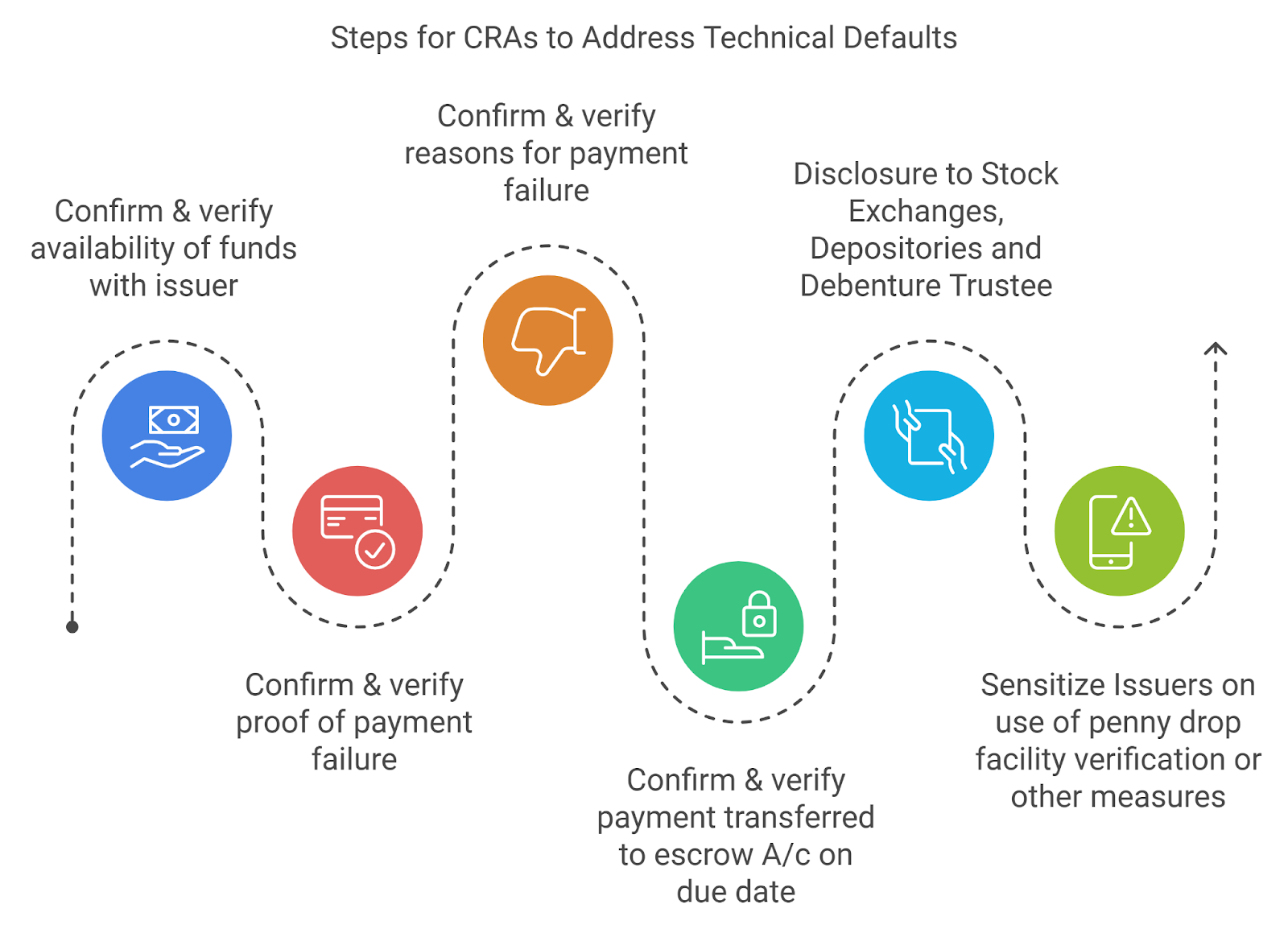
Conclusion:
While the SEBI Circular gives clarity on the treatment of technical defaults and obligations of the CRA in this regard, clear actionable on the part of the issuer has not been specified. Therefore, in those instances, the issuer should provide the above details to the CRA for onward disclosure. Further, the details to be provided under Reg. 57 inter alia requires providing ‘reasons for non-payment/ delay in payment’. The feasibility of reporting the same in case of technical defaults is not clear as several times the issuer becomes aware of the failure to credit the amount after 1-2 days.
Our related resources:
Bond issuers set to become Market Maker to enhance liquidity
Issuer to provide Liquidity Window facility to eligible investors effective from Nov 1, 2024
Vinita Nair & Palak Jaiswani | corplaw@vinodkothari.com
August 18, 2024 (Updated October 22, 2024)
While SEBI took numerous measures to deepen the bond market and increase transparency and participation viz., Electronic Book Building Platform (‘EBP) for issue above Rs. 50 cr., Request for Quote (‘RFQ’) platform, reduction in face value of privately placed bonds, online bond platform (‘OBP’), corporate bond repo system etc, illiquidity in bond market continued to remain one of the major concerns for SEBI. To address the issue of liquidity mainly for retail investors, SEBI vide its consultation paper dated August 16, 2024, had proposed the introduction of Liquidity Window facility, a unique concept in bond market. SEBI notified this facility vide circular dated October 16, 2024 effective from November 01, 2024.
What is the proposed Liquidity Window Facility (‘LWF’):
LWF, at the issuer’s discretion, allows eligible investors to exercise a put option on NCDs on predetermined dates. This enables investors to sell their securities back to the issuer, removing the need to find prospective buyers in the market. In this setup, the issuer assumes the role of market maker, a concept that has not yet been fully implemented in the bond market.
Key Features of LWF:
- Issuer’s discretion: It is optional for the issuer to provide LWF.
- Nature of issuance: Issuers can provide this facility for prospective bond issuances through public issues as well as on a private placement (proposed to be listed) at the ISIN level.
- Quantum of LWF: Minimum 10%[1] of final issue size. Aggregate limits and sub-limits (in no. of securities) for put option that can be exercised in each window to be disclosed in the offer document.
- Timing: LWF to commence after the expiry of 1 year from date of issuance. Facility may be operated on a monthly or quarterly basis at issuer’s discretion, as indicated in the offer document upfront.
- Eligible Investors: The issuer will determine which investors are eligible, with a particular focus on retail investors. Investors need to hold securities in demat form to avail this benefit. If put options exercised during the period exceed sub-limits, acceptance will be on a proportionate basis.
- Pricing of bonds under LWF:
- Date of valuation: ‘T-1’day where T is the first day of the LWF[2].
- Manner of Valuation: as per chapter 9 of SEBI Master Circular on mutual funds.
- Issuers can provide a maximum discount of 1% on the valuation arrived. Price plus accrued interest payable.
- Display valuation on the website of the issuer and SE during the liquidity window period.
- Option with the issuer for bonds purchased under LWF: Within 45 days of closure of LWF or before the end of quarter, whichever is earlier:
- sell on debt segment of SE; or
- sell on RFQ platform, if eligible to access; or
- sell through an online bond platform provider; or
- extinguish the NCDs.
- In case of sale, amount realized will be added back to the aggregate limit and will replenish any past usage of the limit.
- Restriction on re-issuance[3]: Re-issuance is not allowed under ISINs in which LWF is offered
- Exemption in ISIN capping[4]: ISI.Ns in which LWF is offered are exempted from computation of ISIN limits as per Chapter VIII of NCS Master Circular.
- Operational Guidelines: Stock exchange, in consultation with clearing corporations and depositories, will issue detailed guidelines on how to use the LWF, including the process for exercising the put option.

Other Conditions:
- Authorisation and Implementation
- Prior approval of BOD.
- Monitoring of implementation & outcome SRC or BOD (in case there is no SRC).
- Transparent, non-discretionary and non-discriminatory within the class of investors.
- Does not compromise market integrity or risk management.
- Liquidity Window Period:
- Duration: Open for 3 working days.
- Intimation of proposed schedule: To be provided 5 working days before the start of the financial year in which facility it is to be given via SMS/WhatsApp.
- Mode and manner of availing:
- Put options can be exercised by blocking the securities in demat a/c during trading hours and using the specified mechanism to intimate issuer w.r.t. the exercise of put option.
- Investors may modify or withdraw bids during the window period[5].
- Submissions received during window period (during trading hours) will only be considered valid
- Further guidelines to be provided by SE
- Settlement[6]: T+4 days
- Reporting and disclosure requirements:
- Submit report to SE – within 3 WD from closure of window; and
- Inform the depositories and DT regarding NCDs to be extinguished – within 3 WD from end of 45 days from the closure of window (timeline to sell/ extinguish purchased securities)[7]
- Website disclosure:
- By: SE, depositories, DT, and Issuers
- When: Disclose on website upon issuance of each ISIN in which facility is provided. Details to be maintained and updated at all times.
- Details: List of ISINs for option is available, o/s amount, credit rating, coupon rate, maturity date, valuation details and other relevant information (as per para 6.11 of circular)
- Issuer to submit above details to SE, depositories and DT to disclose on their website
- In case of change: Issuer to intimate SE, depositories and DT within 24 hrs of change. SE, DT and depositories to update their website within 1WD of such intimation.
[1] Minimum 15% was proposed in the CP.
[2] CP proposed the date of valuation as the day of closure of liquidity window.
[3] Not proposed in the CP earlier.
[4] Not proposed in the CP earlier.
[5] Not proposed in the CP earlier.
[6] Not proposed in the CP earlier.
[7] CP proposed the timeline of 3 working days from the date of window closure
Other resources related to the topic:
Mandatory bond issuance by Large Corporates: FAQs on revised framework
Framework for voluntary delisting of debt securities notified
– Sharon Pinto, Senior Manager & Palak Jaiswani, Asst. Manager | corplaw@vinodkothari.com
 Loading…
Our resources related to the topic:-
- Mandatory listing for further bond issues
- Bond market needs a friend, not parent
- Recent amendments relating to Corporate Bonds
- SEBI proposes rationalising Large Corporate Borrower Framework
- SEBI amends NCS Regulations – DT nominated director | Green Debt Securities | Public issue offer period
Our YouTube Videos on the related topics:
SEBI rationalizes the framework for Large Corporates
Increased threshold, new incentive-disincentive framework instead of penalty
Sharon Pinto, Senior Manager & Palak Jaiswani, Asst. Manager (corplaw@vindokothari.com)
Updated on October 26, 2023
Background
With an intent to promote the Corporate Bond market, SEBI had introduced the framework for borrowing by Large Corporates (‘LCs’) framework with effect from April 1, 2019 by way of circular issued on November 26, 2018. Under the said framework, certain listed entities[1] who satisfied the prescribed criteria with respect to their long term borrowings, were mandated to raise 25% of their incremental borrowings by way of issuance of debt securities. Incremental borrowings were defined to include borrowings of original maturity of more than 1 year excluding external commercial borrowings and inter-corporate borrowings between a parent and subsidiary(ies). This portion of incremental borrowings was required to be raised by way of debt securities on an annual basis For FY2020 and FY2021 and over a block of 2 years which was then extended to 3 years from FY 2022 onwards. Failure to meet the same would attract a penalty of 0.2% of the shortfall amount.
Around 1/3rd of the eligible LCs were unable to raise the required amount through debt securities in FY 21-22 on account of:
- raising of debt becoming costlier due to tightening liquidity and hike in the benchmark rate;
- non-availability of interest subsidy benefits from Central and State Governments in case of certain issuers and the resultant impact on viability of the projects undertaken;
- cost of debt resulting in higher tariff rates to the ultimate consumers in case of power sector entities, etc.
On the other hand, the investors like insurers, pension, and provident funds are required to invest a particular percentage of their incremental receipts in corporate bonds and therefore, continuous issuance of debt securities was necessary.
Recently, SEBI amended the SEBI (Issue and Listing of Non-Convertible Debt Securities) Regulations, 2021 (‘NCS Regulations’) introducing Chapter V B effective from July 06, 2023 that provides the requirement for LCs under Reg. 50B to comply with requirements stipulated by SEBI.
While it has been more than 4 years since the introduction of the concept of LCs, issuers are still struggling to comply with the mandatory requirements. Therefore, SEBI decided to review the LCs framework and issued a Consultation Paper dated August 10, 2023, for public comments. Thereafter, basis the comments received from the public and suggestions of the Corporate Bond and Securitisation Advisory Committee (‘CoBoSAC’), SEBI approved the revised framework, as detailed herein in its Board meeting held on September 21, 2023 (‘SEBI BM’).
Revised framework as per the Present Circular
The revised framework has been notified by SEBI vide Circular dated October 19, 2023 (‘Present Circular’) and is applicable w.e.f. April 1, 2024 for LCs (criteria for identification discussed in the latter part) following April-March as their financial year and from January 1, 2024 for entities following January-December as their financial year. Thus, the revised framework is applicable for entities which would be identified as LCs as on March 31, 2024 or December 31, 2023, as the case may be.
Key features of the revised framework are as follows:
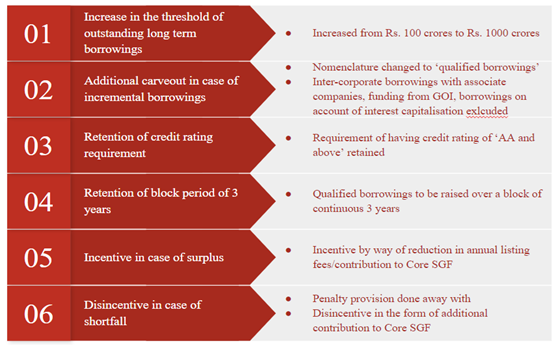
Key features of the revised framework[2]
This article discusses the amendments made in the LCs framework by way of the Present Circular including the rationale provided in the CP, relevant points discussed in the SEBI Board meeting in this regard and transition related requirement for ongoing block of 3 years for existing LCs.
Increase in the threshold of outstanding long-term borrowings
| Existing Provisions | Proposed Changes in CP | SEBI’s rationale for proposed change |
| Outstanding long-term borrowings[3] of Rs. 100 crore or above | Outstanding long-term borrowing of Rs. 500 crore or above. | To align the criteria for LCs with the ‘High Value Debt Listed Entity’ or ‘HVDLEs’ as provided under the Listing Regulations. |
Brief of public comments received and SEBI’s response:
While a major portion of public comments were in favour of the increase in the limit to Rs. 500 crore, a common remark raised by the public suggested applying the LC framework based on outstanding listed debt instead of outstanding long-term borrowings. SEBI disagreed as it will increase the burden for entities that have already tapped the debt market and will not help in reducing the burden on the banking system. There were few comments seeking exemption from the applicability in case of loss making companies and NBFCs, which was also dismissed by SEBI indicating that it has no nexus with profit or loss made by an entity and that NBFCs being the largest borrowers cannot be excluded.
SEBI BM decision
Increase the limit from existing Rs. 100 crores to Rs. 1000 crores, basis which, around 170 entities would qualify as LCs (as opposed to 482 entities in case of limit of Rs. 500 crore proposed).
Provisions under the Present Circular
The threshold limit of outstanding long term borrowings has been increased to Rs. 1000 crores.
Our Remarks
Classification as an HVDLE is on account of outstanding listed debt securities. On the contrary, an entity may not have any of its debt securities listed but may still be classified as an LC if it has its equity listed and borrowing from banks/ financial institutions exceeding the prescribed threshold. Increase of limit to Rs. 1000 crore is a welcome change.
Scope of outstanding long-term borrowings and incremental borrowings
| Existing Provisions | Proposed Changes in CP | SEBI’s rationale for proposed change |
| Includes: any outstanding borrowing with an original maturity of more than 1 year Excludes: (i) External Commercial Borrowings (ii) Inter-corporate borrowings between a holding and subsidiary | Term ‘incremental borrowings’ to be replaced with ‘qualified borrowings’. Includes: any outstanding borrowing with an original maturity of more than 1 year Excludes: (i) External Commercial Borrowings (ii) Inter-Corporate Borrowings between its holding and/or subsidiary and /or associate companies; (iii) Grants, deposits, or any other funds received as per the guidelines or directions of the Government of India (‘GOI’); (iv) Borrowings arising on account of interest capitalization | To cover associate companies, on which the holding company has significant influenceThe end use of grants received from the Government is restricted to the purposes specified by Government and cannot be deviated fromInterest capitalized on the loan amount cannot be considered as borrowings. |
Brief of public comments received and SEBI’s response:
All the public comments were in favor of the proposal. Few comments were received to additionally exclude borrowings for the purpose of refinancing which was not accepted by SEBI as it would defeat the intent of the framework. The suggestion to exclude borrowings made for mergers, acquisitions and takeovers was accepted by SEBI given those are not routine occurrences in the life-cycle of an entity.
SEBI BM decision
Incremental borrowings to be termed as qualified borrowings. Borrowings for mergers, acquisitions and takeovers to be further excluded from the scope of qualified borrowings.
Provisions under the Present Circular
The nomenclature ‘incremental borrowings’ has been revised to ‘qualified borrowings’ and the exclusions proposed in the CP i.e. inter-corporate borrowings involving associate companies, any funding received from the GOI, borrowings on account of interest capitalisation have been given effect to. Additionally, as per the public comments received, borrowings for the purpose of scheme of arrangement as stated above have also been excluded.
Retention of credit rating requirement as a criterion for LC identification
| Existing Provisions | Proposed Changes in CP | SEBI’s rationale for proposed change |
| Have a credit rating of “AA and above” | Remove the requirement. | Entities with long-term outstanding borrowings of Rs. 500 Cr or above would generally fall under the bracket of credit rating of ‘AA and above’ |
Brief of public comments received and SEBI’s response:
Most of the public comments were against the proposal as entities with low rated debt may not find investors at all, which was accepted by SEBI.
SEBI BM decision
The criteria of a minimum credit rating to be retained as per existing norm.
Provisions under the Present Circular
SEBI has retained the existing requirement prescribing a minimum credit rating of “AA”/“AA+”/AAA under the revised framework.
Our Remarks
The proposal in the CP to drop the requirement altogether was inappropriate. An outstanding borrowing of Rs. 500 crore may not be necessarily indicative of the credit quality of the borrower. While regulations may force or incentivize the issuers to come up with debt issuance pursuant to this framework, however, it cannot force the investors to invest. An investor in debt security will rely on the credit quality which is fairly indicated through the credit rating of the debt security. The requirement of having a credit rating is one of the prerequisites for listing a debt security under NCS Regulations (Reg. 10). Even for determining the list of eligible issuers of debt securities for the purpose of contribution to Core Settlement Guarantee Fund (‘Core SGF’), the issuer should have long term debt rating of the eligible securities of AAA, AA+, AA and AA- (excluding AA- with negative outlook). Decision to retain the erstwhile requirement is a welcome move.
Retention of block period of three years
| Existing Provisions | Proposed Changes in CP | SEBI’s rationale for proposed change |
| FY 2020 & FY 2021 – On an annual basis FY 2022 onwards – On a block of 3 years | On an annual basis | To simplify the process of raising debt securities and to eliminate the complex process of tracking all the issuances during the block years. |
Brief of public comments received and SEBI’s response:
Most of the public comments were against the proposal, which was accepted by SEBI.
SEBI BM decision
SEBI to retain the requirement of the continuous block of 3 years in the framework.
Provisions under the Present Circular
It has been prescribed that atleast 25% of the qualified borrowings will be required to be raised by way of issuance of debt securities over a continuous block of 3 years.
Since, the framework is applicable w.e.f. FY 2025, entities identified as LCs as on the last day of ‘T-1’ [i.e. March 31, 2024 / December 31, 2023, as the case may be], will be required to raise the requisite quantum of qualified borrowings of FY ‘T’ [FY 2025] through issuance of debt over a block of 3 years i.e. over ‘T’ [FY 2025], ‘T+1’ [FY 2026] and ‘T+2’ [FY 2027].
Our Remarks
The proposal in the CP to make it an annual requirement was inappropriate. For the purpose of this framework, the interest of such issuers who do not issue debt securities frequently is also to be kept in mind. While frequent issuers of debt securities may not find it difficult to borrow funds by issuance of further debt securities, it may not be feasible for non-frequent issuers to raise the entire quantum of prescribed incremental borrowings within a period of 1 year. Issuers are to be given certain flexibility and the timelines need not be made more stringent. Decision to retain the erstwhile requirement is a welcome move.
Incentive for exceeding the mandatory limit
| Existing Provisions | Proposed Changes | SEBI’s rationale for proposed change |
| – | In case of a surplus, a certain quantum of the annual listing fees to be reduced; Reduction in the contribution to be made to the core SGF. | To promote ease of doing business and to encourage LCs to raise funds by incentivizing them. |
Brief of public comments received and SEBI’s response:
All public comments were in favour of the proposal. One of the recommendations was to provide incentive in the form of reduction in the contribution to be made to the Recovery Expense Fund[4], which was not approved by SEBI given it is a refundable deposit and meant to meet recovery expenses in case of any default.
SEBI BM decision
SEBI decided to introduce the incentive structure. With respect to the proposal for reduced contribution to Core SGF, SEBI approved to permit carry forward of incentive till utilisation or set off within 6 years of obtaining the incentive.
Provisions under the Present Circular
The incentive scheme proposed has been notified. A benefit of reduction in the annual listing fees pertaining to listed debt securities or non-convertible redeemable preference shares ranging between 2% to 10% computed in the following manner would be available in case of surplus borrowings raised through issuance of debt:
| Sr. No. | % of surplus borrowing as on last day of FY “T+2” for the block starting FY “T” | % of reduction in annual listing fees payable to the Stock Exchanges by the LCs for FY “T+2” |
| 1 | 0-15% | 2% of annual listing fees |
| 2 | 15.01% – 30% | 4% of annual listing fees |
| 3 | 30.01% – 50% | 6% of annual listing fees |
| 4 | 50.01% – 75% | 8% of annual listing fees |
| 5 | Above 75% | 10% of annual listing fees |
Further, a credit in the form of reduction in the contribution to be made to the Core SGF of LPCC would also be available in the following manner:
| Sr. No. | % of surplus borrowing for the block starting FY “T” as on last day of FY “T+2” | Quantum of Credit |
| 1 | 0-15% | 0.01% |
| 2 | 15.01% – 30% | 0.02% |
| 3 | 30.01% – 50% | 0.03% |
| 4 | 50.01% – 75% | 0.04% |
| 5 | Above 75% | 0.05% |
The Present Circular further mentions that in case of entities classified as ‘eligible issuers’ by the LPCC, the incentive would be permissible to be carried forward for a period of 6 years of obtaining the same as approved in the SEBI BM. Further, in case of an entity which is not an eligible issuer, the incentive may be carried forward until it is classified as an eligible issuer. Thereafter, the incentive would be available for the purpose of utilisation for a period of 6 years from year of such classification.
Manner of computation
Let us consider the following example to understand the computation of credit:
Company ‘X’ is identified as an eligible issuer requiring to contribute Rs. 2 crores to the Core SGF. It has complied with the requirements of raising the requisite qualified borrowings in the following manner:
| Sr. No. | Particulars | Amount (in Rs. Cr) |
| 1 | Borrowings that should have been made from the debt market by the LC for FY “T” (A) | 200 |
| 2 | Actual borrowings in “Block of three years” (B) | 250 |
| 3 | Surplus borrowings (B-A) (C) | 50 |
| 4 | % of surplus borrowing (C/A*100) | 25% |
| 5 | Quantum of credit (% of quantum of credit as per the table above*C) | 0.01 (i.e. 50*0.02%) |
| 6 | Actual contribution required to be made to the SGF [Actual contribution required to be made – Quantum of credit] | 1.99 (i.e. 2-0.01) |
Our Remarks
Contribution to Core SGF:
The benefit of reduced listing fee can be availed by the listed entity for listed debt securities or non-convertible redeemable preference shares. However, the relaxation in the form of reduced contribution to Core SGF will be an incentive only to an ‘eligible issuer’ as per the list rolled out annually by AMC Repo Clearing Limited (‘ARCL’), recognised as Limited Purpose Clearing Corporation (‘LPCC’) by SEBI, on the basis of prescribed parameters. In case of an LC which has not been identified as an ‘eligible issuer’, the credit in contribution to the Core SGF would not serve as an incentive and may get lapsed. It may even be the case for an issuer identified as ‘eligible issuer’ in year 1 however, not identified in the subsequent year. ARCL vide Circular dated September 29, 2023 rolled out a list of 125 eligible issuers who will be required to contribute to Core SGF for the eligible issuance as per the eligible list issued on or after 01st October 2023 till 30th September, 2024. In the light of this, SEBI’s decision to allow carrying it forward till 6 years is a welcome change.
Mandatory Listing:
In case an LC which is a debt listed entity and raises further debt pursuant to the LC framework post January 1, 2024, it will be mandatorily required to list every such issuance pursuant to Reg. 62A of the SEBI Listing Regulations, inserted vide the SEBI (Listing Obligations and Disclosure Requirements) (Fourth Amendment) Regulations, 2023. On the other hand, in case an LC is not a debt listed entity, however, lists any particular issuance of debt securities issued pursuant to the LCB framework any time post January 1, 2024, as per the afore-mentioned provision, it will be mandatorily required to list all issuances done post January 1, 2024 within a period of 3 months from the date of listing.
As a result of such mandatory listing, the LCs may cross the threshold of having outstanding listed debt securities amounting to Rs. 500 crores, thereby classifying the entities as a ‘High Value Debt Listed Entity’ or an ‘HVDLE’. Consequently, the entity will be required to comply with the corporate governance provisions stipulated under Reg. 16 to Reg. 27 of the SEBI Listing Regulations. We have further analysed the same in our article which can be accessed here.
Disincentive for not meeting the mandatory limit
| Existing Provisions | Nature of amendment proposed | Proposed Changes | SEBI’s rationale for the proposed change |
| Monetary penalty/ fine of 0.2% of the shortfall in the borrowed amount is levied in case of shortfall | Doing away with the penalty and introducing an incentive/ disincentive structure | In case of a shortfall, an amount equivalent to 0.5 basis points of such shortfall shall be made by the LC to the core Settlement Guarantee Fund (‘SGF’) as set up by the Limited Purpose Clearing Corporation (LPCC). | To promote ease of doing business and to encourage LCs to raise funds by incentivizing them. |
Brief of public comments received and SEBI’s response:
While majority of the comments were in favour of the proposal, it was recommended that:
(a) the disincentive should be applicable if there is a non-compliance for a continuous block of 2/3 years;
(b) further reduction in the quantum; and
(c) applicability only to entities required to contribute to Core SGF.
SEBI BM decision
SEBI confirmed (a) and disagreed for (b). In case of (c). SEBI clarified that Core SGF requirement will be made applicable to all issuers to ensure uniformity.
Provisions under the Present Circular
SEBI has done away with the penalty provision and notified the disincentive structure. The said structure will apply in case of shortfall in raising the requisite quantum at the end of the block of 3 years, i.e. as on the last day of ‘T+2’. The disincentive scheme is in the form of additional contribution to be made to the Core SGF in the following manner:
| Sr. No. | % of surplus borrowing for the block starting FY “T” as on last day of FY “T+2” | Quantum of additional contribution |
| 1 | 0-15% | 0.015% |
| 2 | 15.01% – 30% | 0.025% |
| 3 | 30.01% – 50% | 0.035% |
| 4 | 50.01% – 75% | 0.045% |
| 5 | Above 75% | 0.055% |
Manner of computation
Let us consider the following example to understand the computation of disincentive:
Company ‘X’ is identified as an eligible issuer requiring to contribute Rs. 2 crores to the Core SGF. It has complied with the requirements of raising the requisite qualified borrowings in the following manner:
| Sr. No. | Particulars | Amount (in Rs. Cr) |
| 1 | Borrowings that should have been made from the debt market by the LC for FY “T” (A) | 200 |
| 2 | Actual borrowings in “Block of three years” (B) | 150 |
| 3 | Shortfall in borrowings (X-Y) (C) | 50 |
| 4 | % of shortfall in borrowing (C/A*100) | 25% |
| 5 | Quantum of additional borrowing (% of quantum of additional borrowing as per the table above*C) | 0.0125 (i.e. 50*0.025%) |
| 6 | Actual contribution required to be made to the SGF [Actual contribution required to be made + Quantum of additional borrowing] | 2.0125 (i.e. 2+0.0125) |
Dispensation for LCs identified basis erstwhile criteria
The entities which have been identified as LCs under the erstwhile LC framework are required to comply with the requirement over a block of 3 years in the following manner:
| FY in which the entity was identified as LC i.e. ‘T-1’ | Block of 3 years over which the LC was required to raise the requisite quantum of long term borrowings i.e. ‘T’, ‘T+1’, ‘T+2’ | Remaining period of the block as on March 31, 2023 prior to Present Circular | Remaining period as per the Present Circular |
| FY 2021 | FY 2022, FY 2023, FY 2024 | 1 year i.e. FY 2024 | 1 year i.e. FY 2024 |
| FY 2022 | FY 2023, FY 2024, FY 2025 | 2 years i.e. FY 2024 & FY 2025 | 1 year i.e. FY 2024 |
| FY 2023 | FY 2024, FY 2025, FY 2026 | 3 years from FY 2024 to FY 2026 | 1 year i.e. FY 2024 |
The erstwhile LCs are required to endeavour to comply with the requirement of raising 25% of their incremental borrowings done during FY 2022, FY 2023 and FY 2024 respectively by way of issuance of debt securities till March 31, 2024, failing which, such LCs are required to provide a one-time explanation in their Annual Report for FY 2024.
The Present Circular additionally amends the Chapter XII of NCS Master Circular to the following effect:
- Deletion of penalty related provision in Clause 2.2(d) of Chapter XII; and
- Deletion of format of annual disclosure to be submitted within 45 days from end of the financial year by an identified LC providing details of incremental borrowing and mandatory borrowing, as provided in Clause 3.1 (b) of Chapter XII.
Conclusion
The changes in the framework vide the Present Circular attempt to tackle the hindrances which are being faced by entities classified as LCs, including removal of the penal provisions on shortfall, etc. Thus, these changes seem positive and would help LCs in complying with the LCs framework. However, while the framework aims to deepen the bond market by mandating debt issuance, one cannot disregard the other recent amendments in the legal framework governing debt securities, which seem to be a deterrent for companies from approaching the capital markets, for instance, provisions relating to mandatory listing of debt securities, requirement to obtain approval of all holders in case of voluntary delisting, etc. While the framework would be relevant for entities who have already tested the equity markets and wish to enter the debt market, the recent amendments relating to mandatory listing, no selective delisting etc. would impact issuers who intend to list their debt securities.
[1] Criteria under the erstwhile framework was as follows and was applicable to all listed entities except Scheduled Commercial Banks:
- having listed specified securities or debt or non-convertible redeemable preference shares on a recognised stock exchange; and
- having outstanding long term borrowing of Rs. 100 crore or above; and
- having a credit rating of ‘AA and above’.
[2] About Core SGF: In terms of SEBI Circular SEBI/HO/DDHS/DDHS-RACPOD1/CIR/P/2023/56 dated April 13, 2023, eligible issuers are required to contribute 0.5 basis points (0.005%) of the issuance value of debt securities per annum based on the maturity of debt securities. The issuers need to make full contribution upfront prior to the listing of debt securities.The Core SGF contribution is applicable for all public issue or private placement of debt securities under the SEBI (Issue and Listing of Non-convertible Securities) Regulations, 2021 of eligible issuer except for a) Tier I & Tier II bonds issued by Banks, NBFCs & other institutions; b) Perpetual Debt; c) Floating rate bonds; d) Market linked bonds; e) Convertible bonds (Optional or Compulsorily); f) Securities other than long term debt rating of the eligible securities shall be AAA, AA+, AA and AA- (excluding AA- with negative outlook).
[3] Outstanding long term borrowings indicate borrowings which have original maturity of more than 1 year with certain exclusions as detailed further herein.
[4] Recovery Expense Fund is a refundable fund to be deposited with the stock exchanges at the time of listing. The purpose of the fund is recovery in case of default.
Mandatory listing for further bond issues
“Listed once, always go for listing” to apply for new bond issues; optional for existing unlisted issuances
Vinita Nair | Vinod Kothari & Company | corplaw@vinodkothari.com
June 29, 2023 (updated on September 21, 2023)
Background
SEBI approved the proposal for mandatory listing of debentures/ NCDs, in its Board meeting held on June 28, 2023, for all listed entities having outstanding listed NCDs as on December 31, 2023. Effective Jan. 1, 2024, such listed entities will have to now mandatorily list each of its subsequent issuance of NCDs on the stock exchanges.
Aimed at better information flow and liquidity considerations, the move is said to be inspired by data analysis carried out by SEBI, as discussed in its Consultation Paper dated February 09, 2023, basis the information obtained from the depositories. Succinctly, the snapshot of unlisted bond issues by listed companies (it seems that the data of unlisted bond issuances by unlisted companies is not available), as on January 31, 2023, is as follows:
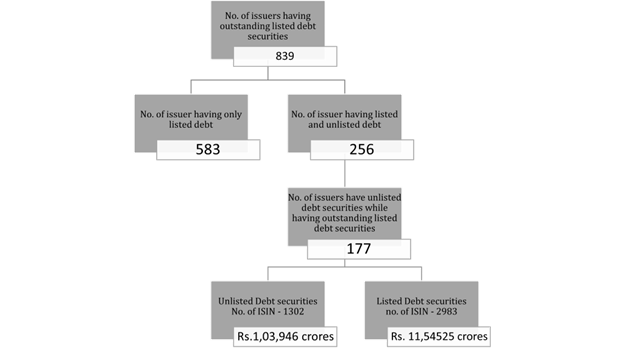
This would mean roughly 8% of all bond issuances by listed companies are outstanding, excluding bond issues by completely unlisted entities, which may be insignificant for the purpose of analysis.
Read more →Financing transition from “brown” to “green”
SEBI prescribes additional requirements for transition bonds
– Mahak Agarwal, Executive | corplaw@vinodkothari.com
Need for transition finance
As climate change and its impacts continue to remain one of the major concerns of any economy, transition finance is a step towards effectively transforming carbon emissions and combating climate change.
‘Transition Bonds’, as the word speaks for itself, are debt instruments that facilitate transition of a carbon-intensive business into decarbonizing business and eventually achieving the Net Zero emissions targets.
While it is true that change is the only constant, it cannot be denied that the same can often be challenging. Similar is the case with enterprises looking to metamorphosize their activities into a sustainable form. A huge amount of finance is required for carbon-intensive sectors to decarbonize and it is here that transition bonds find their application.
Read more →Bond market needs a friend, not parent
Policies seem to be working at cross-purposes
Vinita Nair, Senior Partner | corplaw@vinodkothari.com
The need to promote bond markets is almost cliched, and does not require elaboration. However, when one observes the regulatory and fiscal developments concerning bond markets in recent times, one wonders whether there is a clear and unified sense of direction. The role of policymaker may be supporting, reformative, protective, promotional, etc. Sometimes, protective regulation may also be intended to play a promotional role – for example, if investors’ interest is better protected, it may promote investor confidence and hence, appetite. However, it is hard to see a clear theme in the spate of changes concerning bond markets in the recent past.
Fiscal measures:
As regards fiscal measures, there are several changes in the Budget 2023 that may be directly or indirectly affecting the bond markets. The Budget saw market-linked debentures[1], a bit controversial development, as a case of fiscal arbitrage, and killed the same, resulting in the death of the instrument. The exemption from withholding tax exemption in case of listed bonds was taken away – which will be difficult to understand as the theoretical justification for withholding tax is the possibility of tax leakage in case of destination-based tax. The case for the leakage is difficult to make, as listed bonds are issued in demat format, and hence, all transactions take place through regular banking channels. If the intent of policymakers was to promote retail investment in bonds, this is certainly antithetical to that objective.
Another fiscal change, which may have a long-term negative impact, is the denial of long-term capital gain treatment to investment in debt mutual funds[2]. Debt mutual funds were also responsible for the demand-side of corporate bonds. Mutual fund’s share in the outstanding corporate bonds as at the end of FY 2022 stood at 15.85%[3]
Read more →