SEBI proposes to regulate private debt platforms

Proposals include stock broker registration, 6 months lock-in after allotment by an issuer

finserv@vinodkothari.com

Background

Growth of investor interest in fixed income investment options is a sign of maturity of a market. Indian investors have traditionally been looking at securities markets for equity-type returns and use mutual funds, bank deposits etc. for fixed returns. However, in recent years, the avenues for fixed income investing in corporate bonds, P2P lending platforms, various types of collective investment schemes such as property shares[1], etc. have flourished. Hence, as investors become active and aware, they no longer limit themselves to mutual funds. Investors are now moving to debt trading platforms, which is the subject matter of SEBI’s Consultation Paper on Online Bond Trading Platforms[2] (‘Paper’). Due to stringent requirements for debt listing, the number of issuances, the number of listed debt issuances to the public is relatively low. Considering the growing investor interest, the lack of volumes of public issuances and limitations of trading of bonds through electronic bond platforms, several platforms started offering listed and unlisted debt securities to investors. This is what we are referring to as “debt trading platforms” here.

Read more

Liquidation: Liquidator’s role, functions and distributive justice under section 53

Loader Loading…
EAD Logo Taking too long?

Reload Reload document
| Open Open in new tab

Download as PDF [960.16 KB]

Distributive justice between workmen’s dues and secured creditors rights, w.r.t sec. 52 and 53 of the Code

Loader Loading…
EAD Logo Taking too long?

Reload Reload document
| Open Open in new tab

Download as PDF [760.48 KB]

Mortgage on movable property –  whether another lucrative option for lenders?

– Sikha Bansal, Partner & Shraddha Shivani, Executive | corplaw@vinodkothari.com

Introduction

Pledge[1], hypothecation, mortgage – these are all forms of security interest[2], albeit with different features. Although the common objective of any form of security interest is to create a right in rem[3] (rather than in personam[4]) in favour of the lender, the effectiveness of the security interest would depend on the extent of overarching rights created by such security interest in favour of the lender. In another article[5], we have drawn a quick snapshot of the characteristics of each form of security interest. For instance, in hypothecation, the lender does not have any right of possession or any beneficial interest in the property, and the lender’s rights are limited to cause a sale on default; on the other hand, a mortgage (depending upon the type) may have far better rights – including the right to have the title, beneficial interest, etc. In fact, as we discuss elaborately in this article, a mortgage has several motivations for the lender.

However, a conventional notion around mortgages has been that the concept of ‘mortgage’ is only applicable to immovable property. This common view arises in view of explicit provisions under the Transfer of Property Act, 1882 (‘TP Act’). On the other hand, there are no written/codified provisions on mortgage of movable property. It is not that the Courts have not discussed and debated on the same. There have been ample opportunities before the Courts (as this article highlights), wherein Courts have upheld mortgages of movable properties as well. As such, it  cannot be said that there has not been any decisive jurisprudence around the subject, however, the recent ruling of Supreme Court in PTC India Financial Services Limited v. Venkateshwar Kari and Another strongly revives the discussion and reinforces the argument that ‘mortgage of movables’ is perfectly possible, although not exactly in terms of the Contract Act; however, under common law principles of equity and natural justice. In fact, in his book Securitisation, Asset Reconstruction and Enforcement of Security Interests, Vinod Kothari, has discussed about ‘chattel mortgages’.

Here, it is important to understand the relevance of this discussion. As we discuss below, a mortgage is seen as the strongest form of security interest – a pledge or a hypothecation create much lesser rights in favour of the secured lender. Hence, from a lender’s perspective, it is always beneficial to have ‘better’ rights in terms of beneficial interest and control. Also, mortgages can be of various kinds (as discussed below), hence, the parties may have the flexibility to structure and opt for a suitable form of security interest.

The article thus, studies the jurisprudence around mortgage of movable property, and the principles which must be followed in order to effect the same. The article also studies how the PTC India ruling has revived the discussion around mortgage of movables.  However, before we do so, it would be extremely important to understand the features of a mortgage and how a mortgage can be used as a superior tool of security interest.

Read more

Summary of Supreme Court Judgements on IBC

Resolution Team | resolution@vinodkothari.com

Our compilation of older SC rulings relating to IBC can be read here

Our compilation of NCLAT rulings relating to IBC part -1 can be read here

SEBI amends framework for Large Value Funds

CS Prapti Kanakia, Manager and Samarth Batta, Executive | corplaw@vinodkothari.com

Background

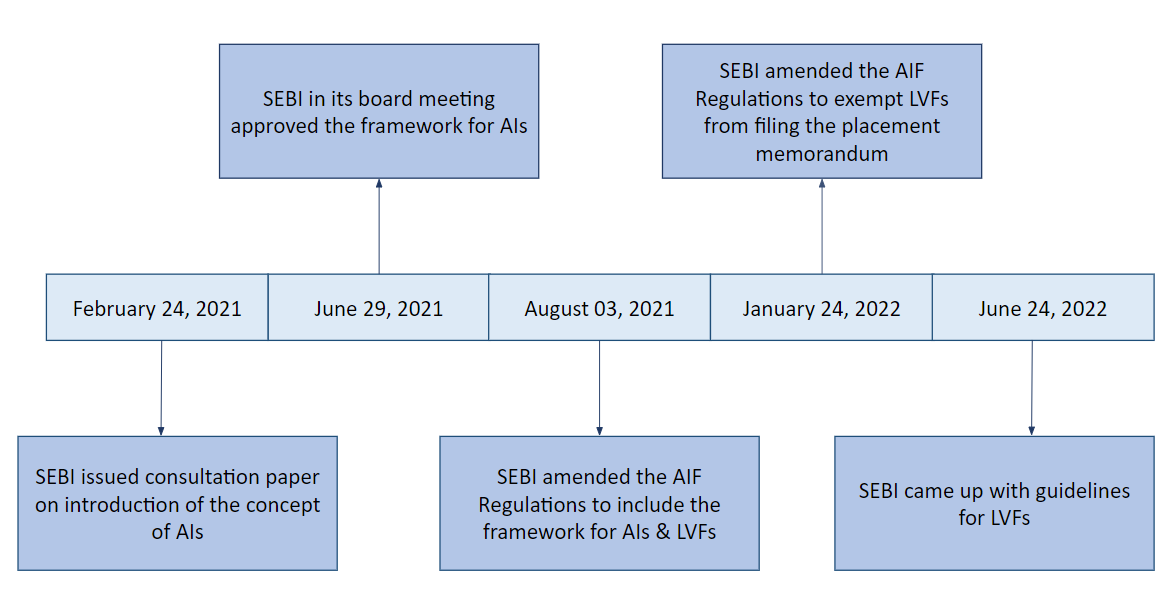
In a recent Circular[1], SEBI has come up with the Guidelines for Large Value Funds for Accredited Investors (LVFs) and requirement for appointment of compliance officer for managers to Alternative Investment Funds[2] (AIFs). SEBI had introduced the concept of LVFs alongwith the concept of Accredited Investors (AIs) in August, 2021. A brief timeline showing the evolution of the framework of AIs in India is as follows:

AI also known as qualified investor/professional investor/ experienced investor are a class of investors who have in-depth market knowledge and high risk bearing capacity to take an informed investment decision. Since, these AIs are well informed investors, therefore, the intermediaries providing services to these investors are given regulation-light regime i.e. less regulatory oversight & relaxed compliance requirement by SEBI.

Read more

Applicability of Provisions of the Companies Act on LLPs & Reporting requirements: Recent changes

– Pammy Jaiswal, Partner and Neha Malu, Executive | corplaw@vinodkothari.com

SEBI: Insider trading norms should apply to fund managers

Additionally invites comments on the applicability in case of units of pooled investment vehicle

Vinita Nair | Senior Partner, M/s Vinod Kothari & Company

Comments on IBBI Discussion Paper on Streamlining the Liquidation Process

Team Resolution | resolution@vinodkothari.com

The Insolvency and Bankruptcy Board of India (‘IBBI’/ ‘Board’) issued Discussion Paper on Corporate Liquidation Process, dated 14th June, 2022 [1](‘Discussion Paper’) which envisages -(a) Streamlining the constitution of SCC (b) Expanding power of SCC; (c) Relinquishment of security interest by the Secured Financial Creditors; (d) Reduction of timeline of compromise or arrangement process; (e) Clarification regarding submission of progress reports to Board; (f) Event based timelines of Auction; (g) timeline for successive auction, (h) treatment of avoidance application before closure of liquidation process, and (i) consideration of claims submitted during CIRP, and the Board has solicited comments of the same.

Following are our general and specific comments on the proposals made in the Discussion Paper and other aspects of liquidation processes –

A.    General Comments

The following are our general comments/suggestions on the proposals made in the Discussion Paper:

1. The general suggestions with respect to various issues faced by liquidators and suggested solutions are as listed below:

1.1. Lightening litigation burden

1.1.1. Infrastructure issues – NCLTs need to be strengthened in terms of benches and bench members;

1.1.2 Continuing engagement with professionals as quite often there are serious gaps in alignment

1.1.3. NCLT members to have strong incentive for better time management

1.1.4. De-clogging NCLTs

a. Remove operational creditors’ claim beyond a hard timeline

b. Move extension application or other matters not requiring adjudication from the domain of NCLTs

c. Create expert advisory cell in IBBI/IPA (similar to informal guidance scheme of SEBI), which the IPs can approach for clarifications/interpretations pertaining to law

d. Identify other non-adjudicative matters, not need exercise of judicial discretion, and move them out of NCLTs

Read more

The Law of Co-lending

Financial Services Division | finserv@vinodkothari.com

Loader Loading…
EAD Logo Taking too long?

Reload Reload document
| Open Open in new tab

Download as PDF [376.18 KB]

Our write-ups on related topics may be viewed here –