Posts

Case Study I – Related Party Transactions – [Case 1]

In our series of case studies on corporate laws, we present to you our first case study on Related Party Transactions. Readers and viewers are invited to share their views and solutions in the comment section below –

Case Study 1- Related Party Transactions

Dividend restrictions on NBFCs

– Financial Services Division (finserv@vinodkothari.com)

Background

The Reserve Bank of India (RBI) vide a notification dated 24th June, 2021[1] imposed restrictions on distribution of dividends by non-banking financial companies (‘Notification’). The restrictions cover both systemically important NBFCs as well non-systemically important ones. The guidelines have been issued in line with the draft guidelines for the declaration of dividends by NBFC issued in December 2020. Restrictions on dividend payout essentially force financial sector entities to plough back a minimal part of their profits, and therefore, result in creation of a profit conservation. Such restrictions are common in case of financial institutions world-over, and are also imbibed as a part of Basel III capital adequacy requirements. Similar restrictions exist in case of banking entities[2]. In case of NBFCs, such restrictions were proposed by the RBI vide Draft Circular on Declaration of Dividend by NBFCs dated December 9, 2020[3]. Dividend Payout Ratio (DP Ratio) is an important policy measure for companies for shareholder wealth maximisation. A conservative dividend distribution policy ensures churning of profits thereby ensuring organic growth of the net worth, and assisted by leverage, a return on shareholders’ funds higher than what the shareholders can fetch on distributed money. On the other hand, aggressive dividend distribution policy entails that profits be returned to the shareholders as there are less business investment opportunities, thus wealth of shareholders be returned. The foregoing arguments does not encompass stictict dividend payout criteria, but a broad policy objective which organisations seek to achieve. However, in the case of financial institutions like Banks and NBFCs  the motivation of regulators to limit the dividend payout is from the perspective of prudential regulation. The limit on dividend distribution allows regulators to ensure that adequate capital conservation buffers are maintained at all times by the financial institutions. Most NBFCs follow very conservative dividend policies, and based on publicly available data, the DP Ratios of some of the NBFCs for FY 2019-20 are as follows:
  1. Manappuram- 18.86%
  2. Cholamandalam- 12.78%
  3. Bajaj Finserv- 11.93%
  4. Muthoot Finance- 19.91%
  5. Tata Capital Financial Services- 32.96%
  6. DCM Shriram- 17.19%

Applicability

Who all are covered? The opening statement of the Notification provides that the Notification is applicable on all NBFCs regulated by RBI. Further, reference is made to the term ‘Applicable NBFCs’  as defined under the respective RBI Master Directions on NBFC-ND-SI and NBFC-ND-NSI. The concept of Applicable NBFC is relevant to determine the applicability of the provisions of the aforesaid RBI Master Directions. Accordingly, it can be understood that, along with the ‘Applicable NBFCs’, the following categories of NBFCs shall be covered under the ambit of the Notification-
  1. Housing Finance Companies (HFCs),
  2. Core Investment Companies (CICs),
  3. Government NBFCs,
  4. Mortgage Guarantee Companies,
  5. Standalone Primary Dealers (SPDs),
  6. NBFC-Peer to Peer Lending Platform (NBFC-P2P)
  7. NBFC- Account Aggregator (NBFC-AA).
  8. NBFC-D (deposit taking NBFCs)
  9. NBFCs-ND (non-deposit taking NBFCs) (both SI and NSI)
  10. NBFC-Factor (both SI and NSI)
  11. NBFC-MFI (both SI and NSI)
  12. NBFC-IFC (both SI and NSI)
  13. IDF-NBFC
However, it is to be noted that For NBFCs that do not accept public funds and do not have any customer interface no limit has been imposed with regards to the dividend payout ratio. Effective from which financial year? Effective for declaration of dividend from the profits of the financial year ending March 31, 2022 and onwards. Which all dividends are covered? Proposed dividend shall include both dividend on equity shares and compulsorily convertible preference shares. However, other than CCPS, dividends declared on preference shares are not included under the Notification. Note that the issue of bonus shares is, in essence, capitalisation of profits, and therefore, is not affected by the present requirement.

Computation of dividend payout ratio:

Besides the upfront conditionalities such as capital adequacy ratio, leverage ratio, etc., the stance of the present Notification is limitation on dividend payout ratio. Hence, the meaning of the DP ratio becomes important. The Notification defines the same as : ‘the ratio between the amount of the dividend payable in a year and the net profit as per the audited financial statements for the financial year for which the dividend is proposed.’ As we discussed elsewhere, the word “dividend” shall be restricted to only equity and CCPS dividend. Hence, dividend on redeemable preference shares shall be excluded. Also note that the word “profit for the year” refers to profits after tax. There is no question of adding the brought forward profits of earlier years, whether parked in reserves or retained as surplus in the profit and loss account. In case of companies adopting IndAS, there are always questions on what constitutes distributable profits – whether the gains or losses on fair valuation, taken to P/L are a part of the distributable profits or not. The relevant provisions of the Companies Act, viz., proviso to sec. 123 (1) shall have to be borne in mind.

Eligibility Requirement and Quantum Restrictions

Category Eligibility Requirement Quantum*
NBFCs (including SDPs) meeting prudential requirements ●  Complies with applicable regulatory capital adequacy requirements/leverage restrictions/Adjusted net-worth for each of the last three financial years including the financial year for which the dividend is proposed

○ For SPDs, minimum CRAR of 20% to be maintained for the financial year for which dividend is proposed.

● Net NPA ratio shall be less than 6% in each of the last three years, including as at the close of the financial year for which dividend is proposed to be declared.

○ Calculation of NNPA

● Complies with the provisions of Section 45 IC of the RBI Act/ Section 29 C of the NHB Act, as the case may be, that is to say, has transferred 20% of its net profits to the regulatory reserve fund ● No explicit restrictions placed by the regulator on declaration of dividend
●  Type I NBFCs- No limit●  CICs and SPDs- 60% ●  Other NBFCs- 50%
NBFCs (other than SPDs) not meeting prudential requirements ● Complies with the applicable capital adequacy requirements/ leverage restrictions in the financial year for which dividend is proposed to be paid● Has net NPA of less than 4% as at the close of the financial year. 10%
As regards NBFC-ND-NSI, the applicable regulatory capital requirement, as mentioned in Annex I[4] of the Notification,  seems to suggest that if there is a breach of leverage ratio at any time since 2015, the NBFC is disqualified. This however, does not seem to be the intent of the regulator. The meaning of the aforesaid restriction should be that the provision became applicable from 2015; however, it should not be leading to a conclusion that a dividend distribution will ensure that there is no breach of leverage ratio at any time in the history of the said NBFC. We are of the view that each of the ratios (CRAR or Leverage of Adjusted Net worth, as the case may be) need to be observed ideally at the time of distribution (last three FYs including the year for which dividend is declared), and even conservatively, during the year in question. *The Notification has prescribed the same limits on quantum for a certain class of NBFCs, however, the draft guidelines had prescribed the limits based on the CRAR or adjusted net-worth of the NBFCs. (Refer Annex I of draft guidelines)

Reporting Requirements

NBFC-D, NBFC-ND-SIs, HFCs & CICs declaring dividend shall report details of dividend declared during the financial year as per the prescribed format within a fortnight after declaration of dividend to the Regional Office of the RBI/Department of Supervision of NHB, as the case may be. There seems to be a lack of clarity w.r.t. the disclosure requirement for NBFC-MFIs and NBFC-IDFs. Though they are covered under the definition of ‘Applicable NBFCs’ under the RBI Master Directions, however, they are not generally classified as NBFC-ND-SI. Hence, whether the disclosure requirement is applicable to them or not seems to create confusion. In our view, going by prudence, this must be adhered to by such systemically important MFI and IDFs as well. Accordingly, it can be inferred that the disclosure requirements shall not be applicable to following:
  • Mortgage Guarantee Companies,
  • Standalone Primary Dealers (SPDs),
  • NBFC-Peer to Peer Lending Platform (NBFC-P2P)
  • NBFC- Account Aggregator (NBFC-AA).
  • NBFCs-ND-NSIs

Comparison with the dividend regulations on Banks

Criteria Bank NBFCs
Eligibility Only those banks would be eligible to declare dividends who have a CRAR of at least 9% for preceding two completed financial years and the accounting year for which it proposes to declare dividend and Net NPA less than 7% NBFC-ND-NSI with leverage upto 7 times and NBFC-ND-SI with a CRAR of not less than 15% for last three years (including the FY for which dividend is declared) and Net NPA less than 6% in each of the last three years
In case not meeting eligibility In case any bank does not meet the above CRAR norm, but has a CRAR of at least 9% for the accounting year for which it proposes to declare dividend, it would be eligible to declare dividend provided its Net NPA ratio is less than 5% In case any NBFC does not meet the above eligibility criteria for each of the previous three FY, but meets the capital adequacy for the accounting year, for which it proposes to declare dividend and has a Net NPA ratio of less than 4% at the close of the FY, it shall be allowed to declare dividend, subject to a maximum of 10% on the DP ratio.
Quantum Dividend payout ratio shall not exceed 40 % and shall be as per the prescribed matrix CIC’s and SPDs shall ensure the maximum dividend payout ratio does not exceed 60%, while the other NBFCs shall not exceed 50% of the DP ratio. For Type I NBFCs there is no limit.
Reporting All banks declaring dividends should report details of dividend declared during the accounting year as per the proforma furnished by RBI NBFC-Ds, NBFC-ND-SIs, HFCs & CICs declaring dividend should report the details of dividend within a fortnight after declaration of dividend to RBI/NHB, as may be applicable.

Immediate Actionables

NBFCs, who already have a Dividend Distribution Policy in place, may have to amend the policy in line with the Notification. As per SEBI LODR Regulations, top 1000 listed companies are mandatorily required to have a dividend distribution policy.  Further, NBFCs may also have voluntarily adopted a policy. The dividend distribution policy includes the following parameters:
  • the circumstances under which the shareholders may or may not expect dividend;
  • the financial parameters that shall be considered while declaring dividend;
  • internal and external factors that shall be considered for declaration of dividend;
  • policy as to how the retained earnings shall be utilized; and
  • parameters that shall be adopted with regard to various classes of shares
The eligibility requirements and limits on quantum of dividend, as provided in the Notification,  may be additional criterias for such NBFCs to declare dividend. In such a case, the existing dividend distribution policy shall be required to be amended in order to include the additional parameters. It is noteworthy here that, as per regulation 43A of the LODR, if a listed entity proposes to amend its dividend distribution policy, it shall disclose the changes along with the rationale for the same in its annual report and on its website. [1] https://www.rbi.org.in/Scripts/NotificationUser.aspx?Id=12118&Mode=0 [2] https://www.rbi.org.in/scripts/FS_Notification.aspx?Id=2240&fn=2&Mode=0 and other associated circulars [3] https://rbi.org.in/Scripts/BS_PressReleaseDisplay.aspx?prid=50777 [4] https://rbidocs.rbi.org.in/rdocs/content/pdfs/NBFCS24062021_A1.pdf Our related write-ups: Our presentation on dividends – https://vinodkothari.com/2021/09/an-overview-of-the-regulatory-framework-of-dividends/ Watch our YouTube video on Restrictions on dividend distribution on NBFCs

RBI Guidelines at odds with the Companies Act on appointment of Auditor

A comparative analysis between the Companies Act, SEBI Guidelines and SEBI Circular dated 18th Oct. 2019

– Ajay Kumar K V | Manager (corplaw@vinodkothari.com)

Introduction

The Reserve Bank of India has issued Guidelines[1] for Appointment of Statutory Central Auditors (SCAs)/Statutory Auditors (SAs) of Commercial Banks (excluding RRBs), UCBs and NBFCs (including HFCs) under Section 30(1A) of the Banking Regulation Act, 1949, Section 10(1) of the Banking Companies (Acquisition and Transfer of Undertakings) Act, 1970/1980 and Section 41(1) of SBI Act, 1955; and under provisions of Chapter IIIB of RBI Act, 1934 for NBFCs, on 27th April 2021.

The Guidelines provide for appointment of SCAs/SAs, the number of auditors, their eligibility criteria, tenure and rotation as well as norms for ensuring the independence of auditors.

However certain provisions of these Guidelines are either completely different or stringent as compared to the provisions of the Companies Act, 2013 (Act). Further, in case of listed entities the question would arise whether the SEBI circular CIR/CFD/CMD1/114/2019[2] dated 18th October 2019 shall be applicable, where the existing auditor is ineligible to continue as the auditor of the company and a new auditor is to be appointed.

In this write up, we have discussed the requirements under both RBI Guidelines as well as the Act.

Read more

Easing Delisting of Equity Shares

-Shreya Masalia and Anushka Vohra

corplaw@vinodkothari.com

In order to make the existing delisting Regulations robust, efficient, transparent and investorfriendly, the Securities Exchange Board of India (‘SEBI’) has issued the SEBI (Delisting of Equity Shares) Regulations, 2021[1] (‘Delisting Regulations, 2021’) on June 11, 2021, thereby superseding the erstwhile SEBI (Delisting of Equity Shares) Regulations, 2009[2] (‘Erstwhile Regulations’). The Erstwhile Regulations were notified on June 10, 2009. Thereafter, several amendments have been carried out in the delisting regulations according to the changing need and developments in the securities market. Thus, to further streamline and strengthen the process to be followed for delisting, the Delisting Regulations have been introduced.

In India, a large number of entities are listed on regional stock exchanges, serving no public interest at all. In fact, over the years, most of them have become non-compliant. However, given the cumbersome process of delisting, these companies have chosen to remain listed. The Delisting Regulation, 2021 has made the path of exit for these entities comparatively easier.

In this article, the authors have made an attempt to discuss the changes in the delisting procedure as introduced vide the Delisting Regulations, 2021.

Background

Listing of shares at stock exchanges provides for free transferability and ready marketability to the shares of a company. In contrast to that, when a public company chooses to go private, it has to delist from the stock exchanges – which means that the shares of that company will no longer be available for trading on the platform provided by the stock exchange.

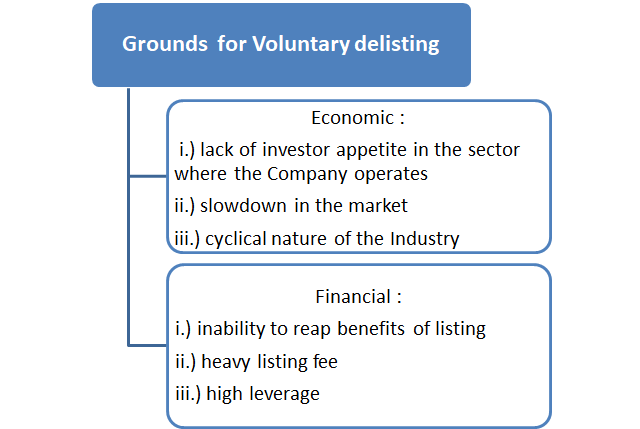
The Companies choose to list themselves to grab the advantages of listing viz; lower cost of capital, greater shareholder base, liquidity in trading of shares, prestige etc. But the companies need to be contended that the benefits of listing outweigh the listing costs, the compliance requirements do not overburden the companies and do not expose them to disciplinary actions.

Initially, there existed 21 regional stock exchanges (‘RSE’) in India of which 20 such RSEs have shut down over the years due course due to their lack of financial viability, exchanges becoming defunct, usage of archaic technology and subsequent derecognition of the exchanges by SEBI. The lone-standing regional stock exchange is the Calcutta Stock Exchange (‘CSE’), which is also at its verge of getting shut. Various companies continue to be listed on CSE, however the economic viability of the same is still questionable. The Delisting Regulations provide for an easy exit opportunity to these companies by significantly reducing the time-period of the delisting process and streamlining the same.

Also with the relisting bar of 5 years in case of voluntary delisting having been reduced to 3 years will now allow the companies to relist in a comparatively lesser period of time and raise funds for their new venture.

Why do companies opt for delisting?

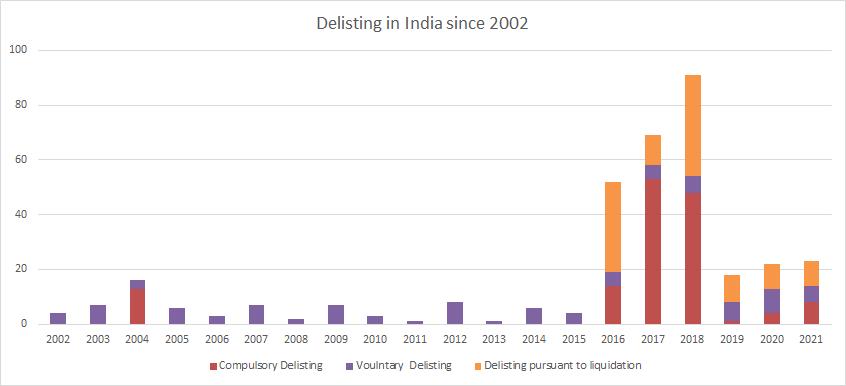
The statistics given below show that there has been a tremendous increase in the number of companies being delisted from the stock exchange. Delisting from the stock exchanges could either be undertaken voluntarily, or compulsory delisting by the Stock Exchanges or delisting pursuant to liquidation.

(Source: NSE)

Understanding compulsory and voluntary delisting

Compulsory delisting generally, is caused due to procedural and compliance lapses by the companies. Amongst other causes, the major causes for compulsory delisting include non-payment of listing fee, reduction in public shareholding and failure to meet the same, unfair trade practices at the behest of the management/promoters etc.

While compulsory delisting is at the precept of the Stock Exchanges, companies opt to voluntarily delist themselves.

The most common rationale for companies to opt for voluntary delisting in the recent time has been;

  1. To obtain full ownership of the company by the promoter & promoter group which will in turn provide increased financial flexibility to support the Company’s business and financial needs;
  2. To explore new financing structures including financial support from the Promoter Group;
  3. To help in cost savings and allow the management to dedicate more time and focus on the core business;
  4. To provide easy exit to shareholders because of thin trading volume.

Modes of Exit via Delisting

The Delisting Regulations, as laid down by SEBI provides two modes of delisting of equity shares viz; (a) Compulsory and (b) Voluntary:

Further, in the case of voluntary delisting, companies have the following options:

  1. delisting from all the recognised stock exchanges ;
  2. delisting from any but not all the recognised stock exchanges, including delisting from Stock Exchange having nationwide trading terminal;
  3. delisting from any but not all the recognised stock exchanges, while remaining listed on the Recognised Stock Exchange having nationwide trading terminal.

In the case of 1 and 2 above, the companies have an obligation to provide an exit opportunity to the existing shareholders.

While the process in case of iii. above remains the same, changes have been brought about in the way a company has to manage the delisting offer pursuant to provision of exit opportunity. The gist of the changes introduced by the Delisting Regulations have been discussed below.

Overview of the Key Changes

  1. Disclosure by the Acquirer / Promoter[3]

 In the Erstwhile Regulations, the process flow was that the acquirer used to intimate their intention to delist the Company to the Board and the Board would then intimate the same to the Stock Exchanges before granting its approval.

Now the Delisting Regulations, 2021, cast an obligation on the acquirer to intimate to the Stock Exchanges, their intention to delist the Company first and within one working day of its intimation shall also inform the Company at its Registered Office, this is termed as the Initial Public Announcement.

Comments: An intention to delist a company is a price sensitive event and can have a major impact on the market. Hence, its immediate disclosure to the public is warranted. Therefore, to fill the lacunae on information being made available to the public, intimation by the acquirer has been made mandatory.

2.Time-bound mechanism

The delisting procedure involves intricacies requiring approvals at various stages.Unlike the t new regulations specify the timelines for the entire process, making it less cumbersome and time-bound, as shown in the table below:

Event / complianceExisting TimelineRevised Timeline
Board resolutionNone specifiedWithin 21 days from the date the acquirer expresses his intention
Special resolutionNone specifiedWithin 45 days from the date of approval of the board
Escrow AccountBefore making public announcementNot later than 7 working days from the date of obtaining the shareholder’s approval.
In-principle approvalNone specifiedWithin 15 working days from the date of obtaining shareholders approval or receipt of any statutory or regulatory approval; whichever is later.
Outcome of Reverse Book Building (‘RBB’)None specifiedTo be announced within 2 hours from the closure of the bidding period. The same is also required to be published in the same newspapers as the newspapers in which the detailed public announcement was made within 2 working days from closure of the tendering period.
Release of shares in case of failure of offerWithin 10 working days from the closure of the offer, where bids were not acceptedIn case of failure due to

90% of the shares are not tendered: on the date of disclosure of the outcome of the RBB process


Discovered price being rejected by acquirer: on the date of making public announcement for the failure of the delisting

Payment on successful delistingWithin 10 working days from closure of offerDiscovered price same as floor price: payment through secondary market settlement mechanism


Discovered price higher than floor price: within 5 working days from the date of making the payment to the public shareholders

Final application to the stock exchanges after successful delistingWithin a period of 1 year from the date of passing of special resolutionWithin 5 working days from the date of making the payment to the public shareholders


3.Due diligence by Peer Reviewed Company Secretary

 Before making the public announcement in case of voluntary delisting, the board had to appoint a Merchant Banker for carrying out the due diligence and then on obtaining the in-principle approval, the acquirer had to appoint a Merchant Banker to act as manager to the issue. The Regulations provided that the Merchant Banker appointed by the board could act as manager to the offer.

Comments: Realising that this could probably result in conflict of interest, the new regulations provide that the board shall appoint a Peer Reviewed Company Secretary, who shall be independent of the promoter/ acquirer/Merchant Banker/or their Associates before the board meeting for granting approval and the Company Secretary shall carry out the necessary due diligence. Further, the acquirer shall before making the initial public announcement, appoint a Merchant Banker to act as manager to the offer. This has also opened up a new avenue for the Company Secretaries in Practice.

4.Escrow Account

Under the Erstwhile Regulation, the acquirer was required to deposit the consideration amount in the Escrow account after getting in-principle approval from SE however before making the PA. The new regulations make it obligatory on the acquirer to open an escrow account even before applying for in-principle approval. The acquirer has to deposit an amount equivalent to 25% of the total consideration at the time of opening the escrow account and the remaining consideration amount of 75% shall be deposited in the escrow account prior to the detailed public announcement.

Comments: Because of stringent timelines, surety is provided that the acquirer has the financial stability and has earmarked funds for the proposed delisting. Moreover, since this is an interest-bearing account, there would be no loss of interest, even if the delisting offer fails at the end.

5.Enhanced responsibility on the Board of Directors

 The new regulations intend to be more robust as far as the responsibility of the board is concerned. The erstwhile regulations required that the board shall before granting its approval certify that the proposed delisting is in the interest of the shareholders. And this certification was mere infructuous because there was no disclosure of the same and no reasonable justification, for that matter.

Comments: Considering a situation, where the Expression of Interest is received from an amicable acquirer i.e. the case of friendly takeover, there is a possibility of collusion between the acquirer and the management and in that case the interest of shareholders’ might take a back seat. However, to avoid the same, Regulation 28 has been added into the new regulations which provides that upon receipt of the detailed public statement the Board of Directors shall constitute a committee of independent directors to provide written reasoned recommendations on the delisting offer and the same shall also be disclosed by the Company in the newspapers where the detailed public statement was published, at least 2 working days before the bidding period.

6.Investor friendly regulations

 SEBI, being the watchdog of the Securities Market, had been established to protect the interest of investors as one of its main objectives, amongst others.

The Delisting Regulations provide that the public shareholders who could not participate in the RBB process could further tender their shares upto 1 year from the date of delisting and the promoter shall accept the tendered shares at the price which was finalised through RBB.

In addition to that, the new regulations now require the promoter/acquirer/Merchant Banker to comply with the following on a quarterly basis for 1 year from the date of delisting:

  1. Submit quarterly reports to the Stock Exchanges specifying details of shareholders at the beginning and end of the quarter and shareholders who availed the offer during the quarter;
  2. To send follow up communications to remaining shareholders;
  3. Publishing advertisement to invite the remaining shareholders to avail the offer

Comments: While the shareholders were given a time of upto 1 year, it was observed that the promoters did not take active steps to bail out the remaining shareholders.

7.Indicative Price

The new regulations have unraveled the concept of Indicative Price. As a general practice, some companies with a view to wriggle out of the complexities of remaining listed on the bourses, used to mention the terms indicative price or attractive price in the letter of offer. This price being higher than the floor price, was used to lure the shareholders to tender their shares.

The new regulations have defined Indicative Price as being a price higher than the floor price.

Comments: Even though the word has found its place in the regulations, in our view, SEBI should place a capping on the indicative price so as to ensure that the Companies do not offer lucrative price to the shareholders.

Changes in addition to the above

 Special provisions for delisting of shares already existed for small companies in the erstwhile regulations. SEBI has further prescribed the following special provisions for delisting:

1.Special provisions for delisting of shares on Innovators Growth Platform

These provisions are similar to the provisions for delisting of shares from the main board however, these provisions require that shares tendered reach 75% of the total issued shares of that class and at least 50% shares of the public shareholders as on date of the board meeting in which such delisting is approved are tendered and accepted instead of the 90% requirement.

 2. Special provisions for a subsidiary company getting delisted through scheme of arrangement wherein the listed holding entity and subsidiary company are in the same line of business

Transactions covered under the given head will not attract provisions of these Regulations provided the various conditions mentioned in regulation 37(2) have been complied with.

SEBI, vide notifcation dated July 09, 2021 has exempted the listed subsidiary companies, getting delisted through scheme of arrangement, that are –
– in the ‘same line of business’ as of its holding company;
– the subsidiary shall be a listed subsidiary of a listed holding company for a period of 3 years.

Further, vide said notification, SEBI has also laid down the following criteria for ascertaining whether the listed holding entity and subsidiary are in the ‘same line of business’:

 3. Special provisions for delisting by operation of law

These provisions shall be applicable in case of winding up of a company and recognition of a stock exchange by SEBI. In the former, the process of winding up shall be as prescribed by the prevalent regulatory framework. However, the latter seems highly unlikely.

Some Miscellaneous Changes

  1. The erstwhile regulations identified only peer reviewed chartered accountants and merchant bankers as valuers, however the same has now been defined with reference to section 247 of the Companies Act, 2013 which widens the scope of the definition. Therefore, any individual with a post-diploma/postgraduate degree or a bachelor’s degree with 3 and 5 years experience respectively in the specified field or having membership of a professional institute established by an Act of Parliament enacted for the purpose of regulation of a profession with at least 3 years’ experience after such membership shall also be considered as eligible valuers.
  2. The detailed public announcement, amongst other details, is now also required to provide the indicative price if any given by the acquirer and a list of documents copies which shall be available for inspection by public shareholders at the registered office of the manager during the working days.
  3. The copy of the letter of offer shall be made available on the website of the company as well as that of the manager to the offer. The order copy of the stock exchange ordering compulsory delisting of the entity shall be uploaded on the website of the stock exchanges.
  4. As a pre-condition to voluntary delisting, the erstwhile regulations provided that the Companies cannot apply for delisting pursuant to buyback/preferential allotment offer being made. But there was lack of cohesiveness on when the buyback/preferential allotment offer being made by the Company would restrict delisting offer. Therefore, the new regulations specify that voluntary delisting shall not be permitted unless a period of 6 months has elapsed from the date of completion of last buyback/preferential allotment.
  5. For counting minimum 90% of the issued shares of a class, shares held by custodian of depository receipts, by Trust under SEBI (Share Based Employee Benefit) Regulations, by inactive shareholders such as vanishing and struck off companies have been excluded aiding the acquirer to achieve the minimum share tendering criteria with greater ease.

Effect of the instant changes

The new regulations have eased the earlier complex procedure of voluntary delisting. The enhanced disclosures and transparency will help to instil confidence among the shareholders. The business environment is dynamic and the time-bound procedure would help the companies to avail exit from the Stock Exchanges and explore their business opportunities by going private.

Concluding Remarks

In India, “Delisting” process has seen very less success as compared to the global market. The new regulations irrefutably addresses some core aspects and also emphasizes on incremental improvements by plugging some of the gaps in the Erstwhile Regulations, as the new Regulations inter alia provide for delisting of equity shares of a subsidiary company (having the same line of business), delisting pursuant to a scheme of arrangement and delisting due to operation of law such as due to winding up of a company or de-recognition of a stock exchange. However, in view of the authors, the cautious approach taken by the SEBI in the New Regulations may still narrow its applications. The impact of the changes brought in through New Delisting Regulations on the success rate of the delisting process is yet to be seen.

[1] https://egazette.nic.in/WriteReadData/2021/227507.pdf

[2] https://www.sebi.gov.in/legal/regulations/jun-2009/sebi-delisting-of-equity-shares-regulations-2009-last-amended-on-march-6-2017-_34625.html

[3] “acquirer” includes a person –

(i) who decides to make an offer for delisting of equity shares of the company along with the persons

acting in concert in accordance with regulation 5A of the Takeover Regulations as amended from

time to time ; or

(ii) who is the promoter or part of the promoter group along with the persons acting in concert.


Ourresources on the topic:- 

  1. https://vinodkothari.com/wp-content/uploads/2020/04/Note-on-Delisting-of-equity-shares-1.pdf 
  2. https://vinodkothari.com/2023/09/sebi-proposes-to-ease-delisting-process-consultation-paper-on-review-of-voluntary-delisting-norms/

Assessing the Viability of a Gold Spot Exchange in India

-Megha Mittal 

(mittal@vinodkothari.com)

The Securities and Exchange Board of India (‘SEBI’) has issued a consultation paper dated 19th May, 2021, on proposed framework for Gold Exchange in India and draft SEBI (Vault Managers) Regulations, 2021 (‘Consultation Paper’), thereby seeking public comments on the framework for operationalising gold exchange and the regulation of intermediaries inter-alia Vault Managers.

While the idea of setting up a regulated gold exchange was highlighted in the Union Budget 2018-19 as well as in the Budget 2021-22, the Consultation Paper comes as the first concrete step towards bringing into operation a gold exchange for the Indian market. This comes in the backdrop of the fact that despite being the second largest consumer and importer of gold, India continues to be a price-taker – India does not play any significant role in influencing the global price-setting for the commodity. As such, the Consultation Paper envisages an entire ecosystem of trading and physical delivery of gold so as to create a transparent and robust market which paves the way for India to become a global price setter.

That being said, before delving into the procedural aspect, it is important to understand the fundamentals as to what are the objectives being aimed, what would the target market look like, and if at all the proposed framework would put the investors, the parties and the nation in a better place that is today.

Read more

AIF Second Amendment Regulations, 2021 – Regulated Steps towards Liberalised Investment

-Megha Mittal  (mittal@vinodkothari.com)

Amidst the various concerns addressed in the Board Meeting dated 25th March, 2021,[1] the Securities and Exchange of Board of India (‘SEBI’) extensively dealt with several issues identified with respect to Alternative Investment Funds (‘AIFs’), inter-alia a green signal to AIFs for investing in units of other AIFs; ambiguity regarding the scope of the term ‘start-up’; and the need for a code of conduct laying down guiding principles on accountability of AIFs, their managers and personnel, towards the various stakeholders including investors, investee companies and regulators.

Thus, with a view to target the issues in consideration, the Board proposed that the following amendments be introduced in the SEBI (Alternative Investment Funds) Regulation, 2012 (‘AIF Regulations’/ ‘Principal Regulations’)[2]

  • provide a framework for Alternative Investment Funds (AIFs) to invest simultaneously in units of other AIFs and directly in securities of investee companies;
  • provide a definition of ‘start-up’ as provided by Government of India and to clarify the criteria for investment by Angel Funds in start-ups
  • prescribe a Code of Conduct for AIFs, key management personnel of AIFs, trustee, trustee company, directors of the trustee company, designated partners or directors of AIFs, as the case may be, Managers of AIFs and their key management personnel and members of Investment Committees and bring clarity in the responsibilities cast on members of Investment Committees; and
  • remove the negative list from the definition of venture capital undertaking.

 The aforesaid proposals, put to the fore in view of the suggestions and requests received from several stakeholder groups like the domestic AIFs, global investors, and the regulatory bodies, have now been notified vide notification dated 5th May, 2021, via the SEBI (Alternative Investment Funds) (Second Amendment) Regulations, 2021[3] (‘Amendment Regulations’). A key takeaway from the Amendment Regulations is the flexibility granted w.r.t. indirect investments by AIFs for investment in units of another AIF, however with some riders and possible gaps, as discussed below.

Below we summarise and discuss the amendments introduced vide the Amendment Regulations, and analyse its impact

Read more

Social Stock Exchanges – Enabling funding for social enterprises the regulated way

By Sharon Pinto & Sachin Sharma, Corplaw division, Vinod Kothari & Company  (corplaw@vinodkothari.com) 

Background

The inception of the idea of Social Stock Exchanges (SSEs) in India can be traced to the mention of the formation of an SSE under the regulatory purview of Securities and Exchange Board of India (SEBI) for listing and raising of capital by social enterprises and voluntary organisations, in the 2019-20 Budget Speech of the Finance Minister. Consequently, SEBI constituted a working group on SSEs under the Chairmanship of Shri Ishaat Hussain on September 19, 2019[1]. The report of the Working Group (WG) set forth the framework on SSEs, shed light on the concept of social enterprises as well as the nature of instruments that can be raised under such framework and uniform reporting procedures. For further deliberations and refining of the process, SEBI set up a Technical Group (TG) under the Chairmanship of Dr. Harsh Kumar Bhanwala (Ex-Chairman, NABARD) on September 21, 2020[2]. The report, made public on May 6, 2021[3], of the TG entails qualifying criteria as well as the exhaustive ecosystem in which such an SSE would function.

In this article we have analysed the framework set forth by the reports of the committees with the globally established practices.

Concept of SSEs

As per the report of the WG dated June 1, 2020[4], SSE is not only a place where securities or other funding structures are “listed” but also a set of procedures that act as a filter, selecting-in only those entities that are creating measurable social impact and reporting such impact. Further the SSE shall be a separate segment under the existing stock exchanges. Thus, an SSE provides the infrastructure for listing and disclosure of information of listed social enterprises.

Such a framework has been implemented in various countries and an analysis of the same can be set forth as follows:

A. United Kingdom

  • The Social Stock Exchange (SSX) was formed in June 2013 on the recommendation of the report of Social Investment Taskforce. The exchange does not yet facilitate share trading, but instead serves as a directory of companies that have passed a ‘social impact test’. It thus provides a detailed database of companies which have social businesses. It facilitates as a research service for potential social impact investors.
  • Further, companies that are trading publically in the main board stock exchange, may list their securities on SSX, thus only for-profit companies can list on the SSX[5] It works with the support of the London Stock Exchange and is a standalone body not regulated by any official entity.
  • Social and environment impact is the core aim of SSX. To satisfy the same, companies are required to submit a Social Impact Report for review by the independent Admissions Panel composed of 11 finance and impact investing experts.
  • The disclosure framework comprises adherence to UK Corporate Governance Guidelines and Filing Annual Social Impact Reports determine the continuation of listing in SSX.

B. Canada

  • Social Venture Connection (SVX)[6] was launched in 2013. Like SSX, SVX is not an actual trading platform but it is a private investment platform built to connect impact ventures, funds, and investors. It is open only for institutional investors[7].
  • The platform facilitates listing of for-profit business, NPO, or cooperatives categorized as, Social Impact Issuers and Environment Impact Issuers. These entities are required to be incorporated in Ontario for at least 2 years and have audited financial statements available.
  • For listing, a for-profit business must obtain satisfactory company ratings through GIIRS, a privately administered rating system.
  • Issuer must conform to the SVX Issuer Manual. In addition to this reporting of expenditure and other financial transactions shall be done once capital is raised. Further the issuers are required to file financial statements annually in accepted accounting methods and shall not have any misleading information. Ratings are required to be obtained, however the provisions are silent on the periodicity of revision of ratings.

C. Singapore

  • Singapore has established Impact Exchange (IX) which is operated by Stock Exchange of Mauritius and regulated by the Financial Service Commission of Mauritius.
  • IX is the only SSE that is an actual public exchange. It is thus a public trading platform dedicated to connecting social enterprise with mission-aligned investment. Social enterprises, both for-profits and non-profits, are permitted to list their project. NGOs are allowed as issuers of debt securities (such as bonds).
  • Listing requirements on the exchange are enumerated into social and financial categories. Following comprise the social criteria for listing:
  1. Specify social or economic impact as the reason for their primary existence.
  2. Articulate the purpose and intent of the company in the form of a theory of change- basis for demonstrating social performance.
  3. Commit to ongoing monitoring and evaluation of impact performance assessment and reporting.
  4. Minimum 1 year of impact reports prepared as per IX reporting principles.
  5. Certification of impact reports by an independent rating body 12 months prior listing.

Further the financial criteria entails the need for a fixed limit of minimum market capitalization, publication of financial statements and use of market-based approach for achieving its purpose.

D. South Africa

  • The ‘South Africa Social Exchange’ or SASIX[8], offers ethical investors a platform to buy shares in social projects according to two classifications: by sector and by province[9]. Guidelines for listing prescribe compliance with SASIX’s good practice norms for each sector.
  • In order to get listed, entities have to achieve a measurable social impact. The platform acts as a tool of research, evaluation and match-making to facilitate investments into social development projects
  • NGOs can also list their social projects on the exchange. Value of the projects is assessed and then divided into shares. Following project implementation, investors are given access to financial and social reports.
  • While social enterprises are required to have a social purpose as their primary aim, they are also expected to have a financially sustainable business model. The SASIX ceased functioning in 2017[10].

Key ingredients for a social enterprise

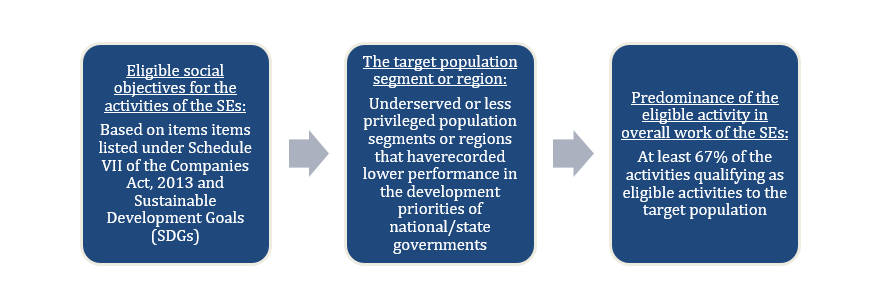
  • The report of the TG[11] has categorised social enterprises into For Profit Enterprise (FPEs) and Not for Profit Organisation (NPOs). In order to qualify as a social enterprise the entities shall establish primacy of social impact which shall be determined by application of the following 3 filters:

  • On establishment of the primacy of social impact through the three filters as stated above, the entity shall be eligible to qualify for on-boarding the SSE and access to the SSE for fund-raising upon submitting a declaration as prescribed.

Qualifying criteria and process for onboarding

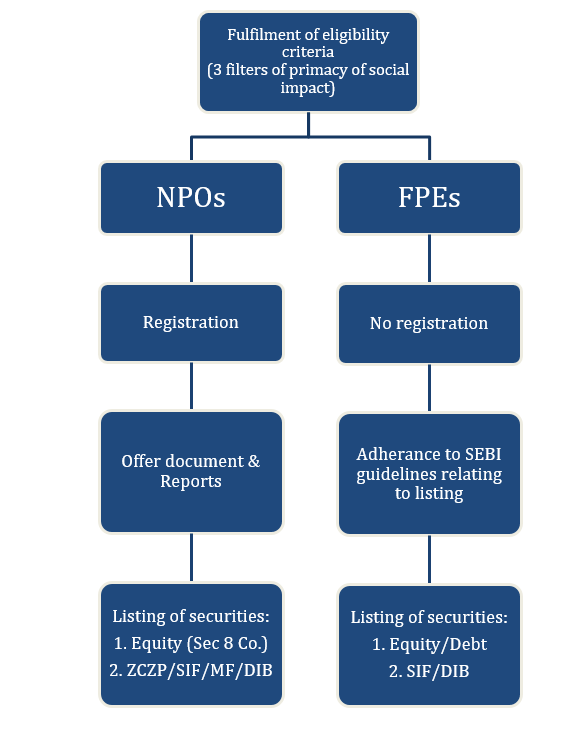
As per TG recommendation, an NPO is required to register on any of the Social Stock Exchange and thereafter, it may choose to list or not. However, an FPE can proceed directly for listing, provided it is a company registered under Companies Act and complies with the requirements in terms of SEBI Regulations for issuance and listing of equity or debt securities.

Further, the TG has recommended a set of mandatory criteria as mentioned below that NPOs shall meet in order to register.

A. Legal Requirements:

  • Entity is legally registered as an NPO (Charitable Trust/ Society/Section-8 Co’s).
  • Shall have governing documents (MoA & AoA/ Trust Deed/ Bye-laws/ Constitution) & Disclose whether owned and/or controlled by government or private.
  • Shall have Registration Certificate under 12A/12AA/12AB under Income Tax.
  • Shall have a valid IT PAN.
  • Shall have a Registration Certificate of minimum 3 years of its existence.
  • Shall have valid 80G registration under Income-Tax.

B. Minimum Fund Flows:

In order to ensure that the NPO wishing to register has an adequate track-record of operations.

  • Receipts or payments from Audited accounts/ Fund Flow Statement in the last financial year must be at least Rs. 50 lakhs.
  • Receipts from Audited accounts/ Fund Flow Statement in the last financial year must be at least Rs. 10 lakhs.

Framework for listing

Post establishment of the eligibility for listing and the additional registration criteria in case of NPOs, the social enterprises may list their securities in the manner discussed further. The listing procedures vary for NPOs and FPEs and is set forth as follows:

A. NPOs

  • NPO shall be required to provide audited financial statements for the previous 3 years and social impact statements in the format prescribed. Further the offer document shall comprise of ‘differentiators’ which shall help the potential investors to assess the NPOs being listed and form a sound and well-informed investment decision. A list of 11 such differentiators has been provided in the report of the TG.
  • Further in case of program-specific or project-specific listings, the NPO shall have to provide a greater level of detail in the listing document about its track record and impact created in the program target segment.
  • All the information submitted as part of pre-listing and post-listing requirements, shall be duly displayed on the website of the NPO.

B. FPEs

  • In case of an FPE, existing regulatory guidelines under various SEBI Regulations for listing securities such as equity, debt shall be complied with.
  • The differentiators will be in addition to requirements as mandated in SEBI Regulations in respect of raising funds through equity or debt.
  • Further, FPEs have been granted an option to list their securities on the appropriate existing boards. Thus the issuer may at their discretion list their debt securities on the main boards, while equity securities may be listed on the main boards, or on the SME or IGP.

Types of instruments 

Depending on the type of organisation, SSEs shall allow a variety of financing instruments for NPOs and FPEs. As FPEs have already well-established instruments, these securities are permitted to be listed on the Main Board/IGP/SME, however visibility shall be given to such entities by identifying them as For Profit Social Enterprise (FPSE) on the respective stock exchanges.

Modes available for fundraising for NPOs shall be Equity (Section 8 Co’s.), Zero Coupon Zero Principal (ZCZP) bonds [this will have to be notified as a security under Securities Contracts (Regulation) Act, 1956 (SCRA)], Development Impact Bonds (DIB), Social Impact Fund (SIF) (currently known as Social Venture Fund) with 100% grants-in grants out provision and funding by investors through Mutual Funds. On the other hand, FPEs shall be able to raise funds through equity, debt, DIBs and SIFs.

While SVF is an existing model for fund-raising, the TG has proposed various changes in order to incentivise investors and philanthropists to invest in such instruments. In addition to change in nomenclature from SVF to SIF, minimum corpus size is proposed to be reduced from Rs. 20 Cr to Rs. 5 Cr. Further, minimum subscription shall stand at Rs. 2L from the current Rs. 1 Cr. The amendments shall also allow corporates to invest CSR funds into SVFs with a 100% grants-in, grants out model.

Disclosure and Reporting norms

Once the FPE or the NPO (registered/listed) has been demarcated by the exchange to be an SE, it needs to comply with a set of minimum disclosure and reporting requirements to continue to remain listed/registered. The disclosure requirements can be enlisted as follows:

For NPO:

  • NPO’s (either registered or listed) will have to disclose on general, governance and financial aspects on an annual basis.
  • The disclosures will include vision, mission, activities, scale of operations, board and management, related party transactions, remuneration policies, stakeholder redressal, balance sheet, income statement, program-wise fund utilization for the year, auditors report etc.
  • NPO’s will have to report within 7 days any event that might have a material impact on the planned achievement of their outputs or outcomes, to the exchange in which they are registered/listed. This disclosure will include details of the event, the potential impact and what the NPO is doing to overcome the impact.
  • NPO”s that have listed its securities will have to disclose Social Impact Report covering aspects such as strategic intent and planning, approach, impact score card etc. on annual basis.

For FPE:

FPE’s having listed equity/debt will have to disclose Social Impact Report on annual basis and comply with the disclosure requirements as per the applicable segment such as main board, SME, IGP etc.

Other factors of the SSE ecosystem

a. Capacity Building Fund

As per the recommendation of the WG, constitution of a Capacity Building Fund (CBF) has been proposed. The said fund shall be housed under NABARD and funded by Stock Exchanges, other developmental agencies such as SIDBI, other financial institutions, and donors (CSRs). The fund shall have a corpus of Rs. 100 Cr and shall be an entity registered under 80G, which shall make it eligible for receiving CSR donations pursuant to changes to Section 135/Schedule VII of Companies Act 2013. The role of the fund shall encompass facilitating NPOs for registration and listing procedures as well as proper reporting framework. These functions shall be carried out in the form awareness programs.

b. Social Auditors

Social audit of the enterprises shall compose of two components – financial audit and non-financial audit, which shall be carried out by financial or non-financial auditors. In addition to holding a certificate of practice from the Institute of Chartered Accountants of India (ICAI), the auditors will be required to have attended a course at the National Institute of Securities Markets (NISM) and received a certificate of completion after successfully passing the course examination. The SRO shall prepare the criteria and list of firms/institutions for the first phase soon after the formation of SSEs, and those firms/institutions shall register with the SRO.

c. Information Repositories

The platform shall function as a research tool for the various social enterprises to be listed, thus Information Repository (IR) forms an important component of the framework. It functions as an aggregator of information on NGOs, and provides a searchable electronic database in a comparable form. Thus it shall provide accurate, timely, reliable information required by the potential investors to make well informed decisions.

Conclusion  

The social sector in India is getting increasingly powerful – this was evident during Covid-crisis based on the wonderful work done by several NGOs. Of course, all social work requires funding, and being able to crowd source funding in a legitimate and transparent manner is quintessential for the social sector. We find the report of the TG to be raising and addressing relevant issues. We are hoping that SEBI will now find it easy to come out with the needed regulatory platform to allow social enterprises to get funding through SSEs.

Our other article on the similar topic can be read here – https://vinodkothari.com/2019/09/social-stock-exchange-a-guide/

[1] https://www.sebi.gov.in/media/press-releases/sep-2019/sebi-constitutes-working-group-on-social-stock-exchanges-sse-_44311.html

[2] https://www.sebi.gov.in/media/press-releases/sep-2020/sebi-constitutes-technical-group-on-social-stock-exchange_47607.html

[3] https://www.sebi.gov.in/reports-and-statistics/reports/may-2021/technical-group-report-on-social-stock-exchange_50071.html

[4] https://www.sebi.gov.in/reports-and-statistics/reports/jun-2020/report-of-the-working-group-on-social-stock-exchange_46852.html

[5] https://scholarship.law.upenn.edu/cgi/viewcontent.cgi?article=1906&context=jil&httpsredir=1&referer=

[6] https://www.svx.ca/faq

[7] https://ssir.org/articles/entry/the_rise_of_social_stock_exchanges

[8] https://www.sasix.co.za/

[9] https://ssir.org/articles/entry/the_rise_of_social_stock_exchanges

[10] https://www.samhita.org/wp-content/uploads/2021/03/India-SSE-report-final.pdf

[11] https://www.sebi.gov.in/reports-and-statistics/reports/may-2021/technical-group-report-on-social-stock-exchange_50071.html


SEBI notifies substantial amendments in Listing Regulations

Proposals approved in SEBI BM of March, 2021 made effective

Payal Agarwal | Executive  ( corplaw@vinodkothari.com )                                                                                                      May 07, 2021

Introduction

SEBI, the capital market regulator of India, vide a gazette notification dated 06th May, 2021 notified Securities and Exchange Board of India (Listing Obligations and Disclosure Requirements) (Second Amendment) Regulations, 2021 [“the Amendment Regulations”] that were approved in SEBI’s Board Meeting held on March 25, 2021. Most of the amendments were already rolled out earlier as consultation papers in 2020. The amendments become effective from May 06, 2021.

This article discusses the major amendments carried out and the likely impact and actionable for the listed entities.

Brief of the amendments are as follows –

A gist of all the amendments under the Amendment Regulations have been captured in a snippet.

1.     Applicability of the Listing Regulations

In terms of Regulation 3 of SEBI (Listing Obligations and Disclosure Requirements) Regulations, 2013 (‘Listing Regulations’) the provisions of Listing Regulations are applicable to entities that list the designated securities on the stock exchange.

The Amendment Regulations clarify that the applicability of certain provisions of Listing Regulations based on market capitalisation will continue to apply even where the entities fall below the prescribed threshold.

While the market capitalisation may be derived for any day, the recognised stock exchanges viz. BSE Limited and National Stock Exchange of India Limited releases a list of listed entities based on market capitalisation periodically. However, the provisions under Listing Regulations become applicable based on market capitalisation as at the end of the immediate previous financial year.

The present amendment on the continuation of applicability of provisions even after the listed entity ceasing to be among the top 500, 1000, 2000 listed entities, as the case may be, seems inappropriate. The applicability of these provisions were originally introduced in view of the size of the listed entities that held major market cap. Indefinite applicability of the said provisions despite fall in the market capitalisation of the listed entity is more of a compliance burden. The provision should be amended by SEBI in line with the timeframe provided under Reg. 15 i.e. where a listed entity does not fall under the list of top 100, 500, 1000, 2000 for three consecutive financial years, the compliance requirement should cease to apply.

Therefore, a conjoint reading of both the provisions should be allowed to take a liberal interpretation in respect of the newly-inserted Regulation 3(2) as well, thereby relaxation of compliance requirements on completion of a look-back period of 3 consecutive financial years.

2.     Risk Management Committee

Regulation 21 of Listing Regulations requires the listed entities to constitute a Risk Management Committee (RMC).  A comparative study of the erstwhile and the amended provisions w.r.t RMC is given below –

Topic Erstwhile provisions Amended provisions
Applicability of RMC ·       On top 500 listed entities (Based on market capitalisation) ·       On top 1000 listed entities based on market capitalisation
Composition ·       Members of Board of Directors

·       Senior executives of listed entity

·       2/3rds IDs in case of SR Equity Shares

·       Minimum 3 members

·       Majority being members of board of directors

·       Atleast 1 Independent Director (ID)

·       2/3rds IDs in case of SR Equity Shares

Minimum no. of meetings One Two
Quorum Not specified ·    2 or 1/3rds of total members of RMC, whichever is higher

·       Including atleast 1 member of Board

Maximum gap between two meetings Not specified Not more than 180 days gap between two consecutive meetings
Roles and responsibilities The board of directors were to define the role and responsibility and delegate monitoring and reviewing of the risk management plan and such other functions, including cyber security. As provided under Part D of Schedule II, that inter alia  includes:

·       Formulating of risk management policy;

·       Oversee implementation of the same;

·       Monitor and evaluate risks basis appropriate methodology, processes and systems.

·       Appointment, removal and terms of remuneration of CRO.

Power to seek Information No such power. The same was only available with Audit Committee under Reg. 18 (2) (c). RMC has powers to seek information from any employee, obtain outside legal or other professional advice and secure attendance of outsiders with relevant expertise, if it considers necessary.

The roles and responsibilities of the RMC has now been specified in the Regulations itself, which were once left at the discretion of Board. The formulation of Risk Management Policy has also been delegated to the RMC, with particular contents of the policy being specified under the Schedule.

An important role of the RMC, among others, include review of the appointment, removal and terms of remuneration of Chief Risk Officer (CRO). The appointment of CRO is not a mandatory requirement under Listing Regulations. CRO is required to be appointed for all banking companies, and non-banking financial companies (NBFCs) having asset size of Rs. 50 billions or more, being registered as an Investment and Credit company, Infrastructure Finance Companies, Micro Finance Institutions, Factors, or Infrastructure Debt Funds. Further, the Insurance Regulatory and Development Authority of India (IRDAI) Corporate Governance Guidelines requires the insurance companies to appoint CRO.

The role of RMC further provides for co-ordination with other committees where the roles  overlap. It is seen that the risk management function is also laid upon the Audit Committee. Therefore, the roles of both the committees might be overlapping. In view of the same, some companies choose to constitute one joint committee combining the roles of both Audit Committee and RMC.  From the provisions providing for co-ordination of activities, it may also be taken as a clear indication that the committees cannot be merged into one, but co-ordinate where the activities require so.

Actionables –
  • Changes in the constitution of RMC / Constitution of RMC in case of first-time applicability;
  • Modification of the Risk Management Policy as per the Amendment Regulations;
  • Amending the existing charter of the Committee to align with the amendments.

While the Amendment Regulations are effective immediately, the changes cannot take place overnight. Therefore, it is advisable that the listed entities shall take the matter of constitution/ re-constitution of RMC in the ensuing Board Meeting.  The modification of Risk Management Policy will be then taken up by the RMC and can be done within a reasonable period of time.

What should be this period? A probable answer to this should lie in the proviso to clause (a) of Reg. 15 that permits a timeline of six months from the applicability to comply with corporate governance requirements as stipulated under regulations 17 to 27, clauses (b) to (i) and (t) of sub-regulation (2) of regulation 46 and para C, D and E of Schedule V. However, that is applicable only in case of companies covered in Reg. 15 (2) (a). Therefore, the time available is till June 30, 2021 as thereafter, the companies will be required to confirm on RMC composition in the quarterly filings done under Reg. 27.

3.     Overriding powers of LODR Regulations

Earlier, proviso to Regulation 15(2)(b) provided a clear stipulation of overriding effect of specific statute in case of conflicting provisions. The Amendment Regulations provides for deletion of the said proviso effective from September 1, 2021. No rationale seems to have been provided in the agenda[1] put up before SEBI at the board meeting for this major amendment.

Regulators viz. RBI, IRDA, PFRDA at times have specific corporate governance related compliances that are stricter and at times conflicting with the requirements of Listing Regulations. For eg. With respect to composition of Audit Committee for a public sector bank, RBI Circular of September, 1995 provides for following composition in case of public sector banks: (a) Executive Director of the Bank (Wholetime director in case of SBI) (b) two official directors (i.e. nominees of Government and RBI) and (c) Two non-official, non-executive directors (at least one of them should be a Chartered Accountant). Directors from staff will not be included in ACB. This is certainly conflicting with the composition provided in Reg. 18 of Listing Regulations.

Subsequent to September 1, 2021 these entities will be regarded as non-compliant of the provisions of Listing Regulations and may be subject to penalty in terms of SEBI Circular dated January, 2020.

4.     Reclassification of promoters into public – related exemptions and procedural changes

Regulation 31A of the LODR Regulations specifies the conditions and approvals post which the promoters can be re-classified into public shareholders. SEBI had proposed changes to the same in a consultation paper dated 23rd November, 2020. The consultation paper was critically analysed in our article. Amendments have been made on similar lines in Regulation 31A.

5.     Alignment with the provisions of the Companies Act, 2013

Certain amendments have been made to remove the gap between the provisions of LODR Regulations, with that of the Companies Act, 2013 as given below –

  • Separate meeting of independent directors – The requirement of conducting a separate meeting of the independent directors without the presence of any other member of the Board of the company is required under both the Companies Act, 2013 as well as the LODR Regulations. However, whereas the Companies Act requires one meeting in a financial year, the LODR Regulations required one meeting in a year (calendar year). Therefore, the same has been substituted with a “financial year” so as to align the requirements of both the governing laws.
  • Display of Annual Return on website – Section 92 read with allied rules requires the companies, having a website, to display its Annual Return on the website. New clause has been inserted under Regulation 46 of LODR Regulations that requires placing the Annual Return on the website of the company.
  • Changes in requirements pertaining to placing of financial statements on website – The audited financial statements of each of the subsidiaries was required to be  placed on the website prior to the Amendment Regulations. New provisos has been inserted under the same so as to avoid preparation of separate financial statements of the subsidiary company, where the requirements under the Companies Act, 2013 are met if the consolidated financial statements are placed instead of separate ones.

6.     Mandatory website disclosures

Regulation 46 of the LODR Regulations provides the mandatory contents to be placed on the website of a listed entity. Most of the disclosures were already existing under respective regulations viz. Reg 30, 43A etc. However, the same has been consolidated under regulation 46. This will now enable stock exchanges to levy penalty in terms of SEBI circular dated 22nd January, 2020.

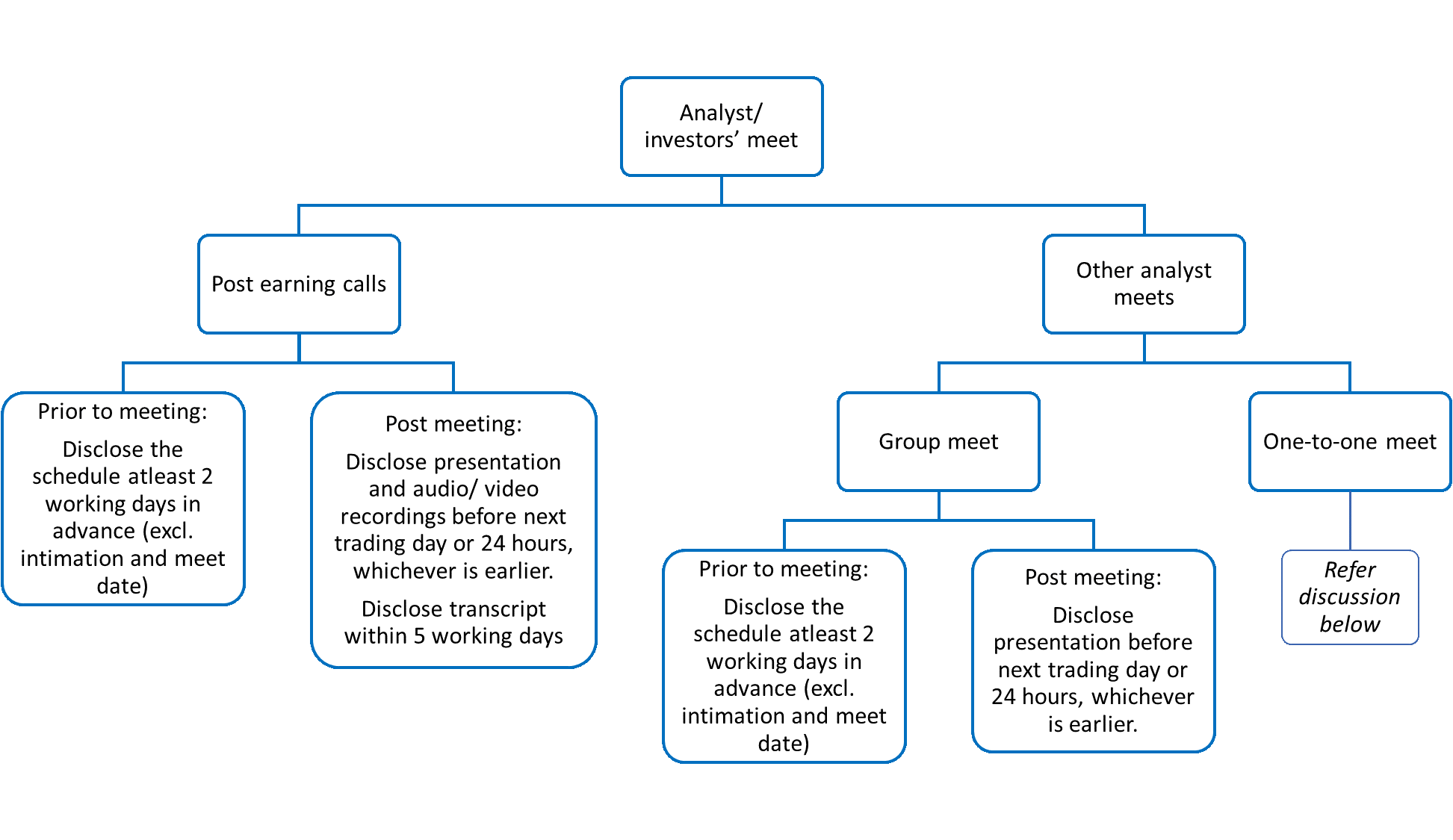
7.     Analyst meet

The listed entity is required to disclose the schedule of analyst or institutional investor meet and the presentations made to them on its website under regulation 46 and on the website of the stock exchange under Schedule III. The Amendment Regulations have explained the term ‘meet’ to mean the group meetings and calls, whether digitally or by physical means. The Amendment Regulations will require the listed entity to upload the audio/ video recordings and the transcripts within the prescribed timeframe. The same is in line with SEBI’s Report on disclosures pertaining to analyst meets, investor meets and conference calls. However, the amendment does not cover disclosure of one-to-one investor/ analyst meet conducted with select investors recommended in the said Report.

8.     Consolidation of various SEBI circulars

Certain circulars of SEBI lay down various requirements to be complied with in relation to the LODR Regulations. The Amendment Regulations have consolidated the requirements under the principal LODR Regulations.

  • Requirement of Secretarial Compliance Report – While the requirement of Annual Secretarial Compliance report were applicable on the listed entities and its material subsidiaries since a few years back, the same has now been specifically provided under newly inserted sub-regulation (2) of Regulation 24A. Earlier, the practice came pursuant to a SEBI circular.
  • Timeline for report of monitoring agency regarding deviation in use of proceeds – Pursuant to the requirements of Regulation 32 of the LODR Regulations, the monitoring agency is required to give a report on the utilisation of proceeds of issue on a quarterly basis. While timelines were not specified in the LODR Regulations, the report was required to be given within 45 days from the end of the quarter. This timeline was pursuant to the SEBI circular dated 24th December, 2019 . Now, with the Amendment regulations, the same is specified under regulation 32(6) of the LODR Regulations.
  • Requirement of Business responsibility and sustainability report (BRSR)- SEBI had proposed a new format to replace the existing Business Responsibility Report. The proposal was finalised and the BRSR format has been made mandatorily applicable from FY 2022-23 onwards, vide SEBI circular dated April, 2021 . The same has also been consolidated under Regulation 34 of the LODR Regulations. A detailed discussion on BRSR is covered in our article.

Conclusion

The Amendment Regulations are very crucial and significant in nature. While on one hand, certain provisions are aligned with the Companies Act, 2013, whereas on the other hand, overriding powers have been given to LODR Regulations which will require the listed entities formed under special statute to comply with the LODR Regulations in entirety. Uniformity in timelines and relaxation in certain disclosure requirements will encourage ease of doing business, and the coverage of certain provisions extended to listed entities based on market capitalisation will have a remarkable impact on the corporate governance of listed entities.

[1] https://www.sebi.gov.in/web/?file=https://www.sebi.gov.in/sebi_data/meetingfiles/apr-2021/1619067328922_1.pdf#page=18&zoom=page-width,-17,763

Our other materials on the relevant topic can be read here –

  1. https://vinodkothari.com/2021/06/presentation-on-lodr-amendments/
  2. https://vinodkothari.com/2020/09/companies-amendment-act-2020/
  3. https://vinodkothari.com/2019/07/sebi-amends-lodr-in-relation-to-equity-shares-with-superior-rights/
  4. https://vinodkothari.com/2019/02/overlap-in-reporting-of-secretarial-compliance/
  5. https://vinodkothari.com/2018/12/faqs-on-sebi-listing-obligations-and-disclosure-requirements-amendment-regulations-2018/
  6. https://vinodkothari.com/2016/01/sebi-faqs-on-listing-regulations-2015-brings-ambiguity-rather-than-clarity/

Law relating to collective investment schemes on shared ownership of real assets

-Vinod Kothari (finserv@vinodkothari.com)

The law relating to collective investment schemes has always been, and perhaps will remain, enigmatic, because these provisions were designed to ensure that enthusiastic operators do not source investors’ money with tall promises of profits or returns, and start running what is loosely referred to as Ponzi schemes of various shades. De facto collective investment schemes or schemes for raising money from investors may be run in elusive forms as well – as multi-level marketing schemes, schemes for shared ownership of property or resources, or in form of cancellable contracts for purchase of goods or services on a future date.

While regulations will always need to chase clever financial fraudsters, who are always a day ahead of the regulator, this article is focused on schemes of shared ownership of properties. Shared economy is the cult of the day; from houses to cars to other indivisible resources, the internet economy is making it possible for users to focus on experience and use rather than ownership and pride of possession. Our colleagues have written on the schemes for shared property ownership[1]. Our colleagues have also written about the law of collective investment schemes in relation to real estate financing[2]. Also, this author, along with a colleague, has written how the confusion among regulators continues to put investors in such schemes to prejudice and allows operators to make a fast buck[3].

This article focuses on the shared property devices and the sweep of the law relating to collective investment schemes in relation thereto.

Basis of the law relating to collective investment schemes

The legislative basis for collective investment scheme regulations is sec. 11AA (2) of the SEBI Act. The said section provides:

Any scheme or arrangement made or offered by any company under which,

  • the contributions, or payments made by the investors, by whatever name called, are pooled and utilized solely for the purposes of the scheme or arrangement;
  • the contributions or payments are made to such scheme or arrangement by the investors with a view to receive profits, income, produce or property, whether movable or immovable from such scheme or arrangement;
  • the property, contribution or investment forming part of scheme or arrangement, whether identifiable or not, is managed on behalf of the investors;
  • the investors do not have day to day control over the management and operation of the scheme or arrangement.

The major features of a CIS may be visible from the definition. These are:

  1. A schematic for the operator to collect investors’ money: There must be a scheme or an arrangement. A scheme implies a well-structured arrangement whereby money is collected under the scheme. Usually, every such scheme provides for the entry as well as exit, and the scheme typically offers some rate of return or profit. Whether the profit is guaranteed or not, does not matter, at least looking at the definition. Since there is a scheme, there must be some operator of the scheme, and there must be some persons who put in their money into the scheme. These are called “investors”.
  2. Pooling of contributions: The next important part of a CIS is the pooling of contributions. Pooling implies the contributions losing their individuality and becoming part of a single fungible hotchpot. If each investor’s money, and the investments therefrom, are identifiable and severable, there is no pooling. The whole stance of CIS is collective investment. If the investment is severable, then the scheme is no more a collective scheme.
  3. Intent of receiving profits, produce, income or property: The intent of the investors contributing money is to receive results of the collective investment. The results may be in form of profits, produce, income or property. The usual feature of CIS is the operator tempting investors with guaranteed rate of return; however, that is not an essential feature of CISs.
  4. Separation of management and investment: The management of the money is in the hands of a person, say, investment manager. If the investors manage their own investments, there is no question of a CIS. Typically, investor is someone who becomes a passive investor and does not have first level control (see next bullet). It does not matter whether the so-called manager is an investor himself, or may be the operator of the scheme as well. However, the essential feature is there being multiple “investors”, and one or some “manager”.
  5. Investors not having regular control over the investments: As discussed above, the hiving off of the ownership and management of funds is the very genesis of the regulatory concern in a CIS, and therefore, that is a key feature.

The definition may be compared with section 235 of the UK Financial Services and Markets Act, which provides as follows:

  • In this Part “collective investment scheme” means any arrangements with respect to property of any description, including money, the purpose or effect of which is to enable persons taking part in the arrangements (whether by becoming owners of the property or any part of it or otherwise) to participate in or receive profits or income arising from the acquisition, holding, management or disposal of the property or sums paid out of such profits or income.
  • The arrangements must be such that the persons who are to participate (“participants”) do not have day-to-day control over the management of the property, whether or not they have the right to be consulted or to give directions.
  • The arrangements must also have either or both of the following characteristics—
  • the contributions of the participants and the profits or income out of which payments are to be made to them are pooled;
  • the property is managed as a whole by or on behalf of the operator of the scheme.
    • If arrangements provide for such pooling as is mentioned in subsection (3)(a) in relation to separate parts of the property, the arrangements are not to be regarded as constituting a single collective investment scheme unless the participants are entitled to exchange rights in one part for rights in another.

It is conspicuous that all the features of the definition in the Indian law are present in the UK law as well.

Hong Kong Securities and Futures Ordinance [Schedule 1] defines a collective investment scheme as follows:

collective investment scheme means—

  • arrangements in respect of any property—
  • under which the participating persons do not have day-to-day control over the management of the property, whether or not they have the right to be consulted or to give directions in respect of such management;
  • under which—
  • the property is managed as a whole by or on behalf of the person operating the arrangements;
  • the contributions of the participating persons and the profits or income from which payments are made to them are pooled; or
  • the property is managed as a whole by or on behalf of the person operating the arrangements, and the contributions of the participating persons and the profits or income from which payments are made to them are pooled; and
  • the purpose or effect, or pretended purpose or effect, of which is to enable the participating persons, whether by acquiring any right, interest, title or benefit in the property or any part of the property or otherwise, to participate in or receive—
  • profits, income or other returns represented to arise or to be likely to arise from the acquisition, holding, management or disposal of the property or any part of the property, or sums represented to be paid or to be likely to be paid out of any such profits, income or other returns; or
  • a payment or other returns arising from the acquisition, holding or disposal of, the exercise of any right in, the redemption of, or the expiry of, any right, interest, title or benefit in the property or any part of the property; or
  • arrangements which are arrangements, or are of a class or description of arrangements, prescribed by notice under section 393 of this Ordinance as being regarded as collective investment schemes in accordance with the terms of the notice.

One may notice that this definition as well has substantially the same features as the definition in the UK law.

Judicial analysis of the definition

Part (iii) of the definition in Indian law refers to management of the contribution, property or investment on behalf of the investors, and part (iv) lays down that the investors do not have day to day control over the operation or management. The same features, in UK law, are stated in sec. 235 (2) and (3), emphasizing on the management of the contributions as a whole, on behalf of the investors, and investors not doing individual management of their own money or property. The question has been discussed in multiple UK rulings. In Financial Conduct Authority vs Capital Alternatives and others,  [2015] EWCA Civ 284, [2015] 2 BCLC 502[4], UK Court of Appeal, on the issue whether any extent of individual management by investors will take the scheme of the definition of CIS, held as follows:  “The phrase “the property is managed as a whole” uses words of ordinary language. I do not regard it as appropriate to attach to the words some form of exclusionary test based on whether the elements of individual management were “substantial” – an adjective of some elasticity. The critical question is whether a characteristic feature of the arrangements under the scheme is that the property to which those arrangements relate is managed as a whole. Whether that condition is satisfied requires an overall assessment and evaluation of the relevant facts. For that purpose it is necessary to identify (i) what is “the property”, and (ii) what is the management thereof which is directed towards achieving the contemplated income or profit. It is not necessary that there should be no individual management activity – only that the nature of the scheme is that, in essence, the property is managed as a whole, to which question the amount of individual management of the property will plainly be relevant”.

UK Supreme Court considered a common collective land-related venture, viz., land bank structure, in Asset Land Investment Plc vs Financial Conduct Authority, [2016] UKSC 17[5]. Once again, on the issue of whether the property is collective managed, or managed by respective investors, the following paras from UK Financial Conduct Authority were cited with approval:

The purpose of the ‘day-to-day control’ test is to try to draw an important distinction about the nature of the investment that each investor is making. If the substance is that each investor is investing in a property whose management will be under his control, the arrangements should not be regarded as a collective investment scheme. On the other hand, if the substance is that each investor is getting rights under a scheme that provides for someone else to manage the property, the arrangements would be regarded as a collective investment scheme.

Day-to-day control is not defined and so must be given its ordinary meaning. In our view, this means you have the power, from day-to-day, to decide how the property is managed. You can delegate actual management so long as you still have day-to-day control over it.[6]

The distancing of control over a real asset, even though owned by the investor, may put him in the position of a financial investor. This is a classic test used by US courts, in a test called Howey Test, coming from a 1946 ruling in SEC vs. Howey[7]. If an investment opportunity is open to many people, and if investors have little to no control or management of investment money or assets, then that investment is probably a security. If, on the other hand, an investment is made available only to a few close friends or associates, and if these investors have significant influence over how the investment is managed, then it is probably not a security.

The financial world and the real world

As is apparent, the definition in sec. 235 of the UK legislation has inspired the draft of the Indian law. It is intriguing to seek as to how the collective ownership or management of real properties has come within the sweep of the law. Evidently, CIS regulation is a part of regulation of financial services, whereas collective ownership or management of real assets is a part of the real world. There are myriad situations in real life where collective business pursuits,  or collective ownership or management of properties is done. A condominium is one of the commonest examples of shared residential space and services. People join together to own land, or build houses. In the good old traditional world, one would have expected people to come together based on some sort of “relationship” – families, friends, communities, joint venturers, or so on. In the interweb world, these relationships may be between people who are invisibly connected by technology. So the issue, why would a collective ownership or management of real assets be regarded as a financial instrument, to attract what is admittedly a  piece of financial law.

The origins of this lie in a 1984 Report[8] and a 1985 White Paper[9], by Prof LCB Gower, which eventually led to the enactment of the 1986 UK Financial Markets law. Gower has discussed the background as to why contracts for real assets may, in certain circumstances, be regarded as financial contracts. According to Gower, all forms of investment should be regulated “other than those in physical objects over which the investor will have exclusive control. That is to say, if there was investment in physical objects over which the investor had no exclusive control, it would be in the nature of an investment, and hence, ought to be regulated. However, the basis of regulating investment in real assets is the resemblance the same has with a financial instrument, as noted by UK Supreme Court in the Asset Land ruling: “..the draftsman resolved to deal with the regulation of collective investment schemes comprising physical assets as part of the broader system of statutory regulation governing unit trusts and open-ended investment companies, which they largely resembled.”

The wide sweep of the regulatory definition is obviously intended so as not to leave gaps open for hucksters to make the most. However, as the UK Supreme Court in Asset Land remarked: “The consequences of operating a collective investment scheme without authority are sufficiently grave to warrant a cautious approach to the construction of the extraordinarily vague concepts deployed in section 235.”

The intent of CIS regulation is to capture such real property ownership devices which are the functional equivalents of alternative investment funds or mutual funds. In essence, the scheme should be operating as a pooling of money, rather than pooling of physical assets. The following remarks in UK Asset Land ruling aptly capture the intent of CIS regulation: “The fundamental distinction which underlies the whole of section 235 is between (i) cases where the investor retains entire control of the property and simply employs the services of an investment professional (who may or may not be the person from whom he acquired it) to enhance value; and (ii) cases where he and other investors surrender control over their property to the operator of a scheme so that it can be either pooled or managed in common, in return for a share of the profits generated by the collective fund.”

Conclusion

While the intent and purport of CIS regulation world over is quite clear, but the provisions  have been described as “extraordinarily vague”. In the shared economy, there are numerous examples of ownership of property being given up for the right of enjoyment. As long as the intent is to enjoy the usufructs of a real property, there is evidently a pooling of resources, but the pooling is not to generate financial returns, but real returns. If the intent is not to create a functional equivalent of an investment fund, normally lure of a financial rate of return, the transaction should not be construed as a collective investment scheme.


[1] Vishes Kothari: Property Share Business Models in India, https://vinodkothari.com/blog/property-share-business-models-in-india/

[2] Nidhi Jain, Collective Investment Schemes for Real Estate Investments in India, at https://vinodkothari.com/blog/collective-investment-schemes-for-real-estate-investment-by-nidhi-jain/

[3] Vinod Kothari and Nidhi Jain article at: https://www.moneylife.in/article/collective-investment-schemes-how-gullible-investors-continue-to-lose-money/18018.html

[4] http://www.bailii.org/ew/cases/EWCA/Civ/2015/284.html

[5] https://www.supremecourt.uk/cases/docs/uksc-2014-0150-judgment.pdf

[6] https://www.handbook.fca.org.uk/handbook/PERG/11/2.html

[7] 328 U.S. 293 (1946), at https://supreme.justia.com/cases/federal/us/328/293/

[8] Review of Investor Protection, Part I, Cmnd 9215 (1984)

[9] Financial Services in the United Kingdom: A New Framework for Investor Protection (Cmnd 9432) 1985


Our Other Related Articles

Property Share Business Models in India,< https://vinodkothari.com/blog/property-share-business-models-in-india/>

Collective Investments Schemes: How gullible investors continue to lose money < https://www.moneylife.in/article/collective-investment-schemes-how-gullible-investors-continue-to-lose-money/18018.html>

Collective Investment Schemes for Real Estate Investments in India, < https://vinodkothari.com/blog/collective-investment-schemes-for-real-estate-investment-by-nidhi-jain/>