Posts

SEBI notifies stricter norms for RPTs

Presentation on Amended SEBI Framework on Related Party Transactions: https://vinodkothari.com/2021/11/presentation-on-amended-sebi-framework-on-related-party-transactions/

Detailed analysis of the amendments in RPT framework pursuant to SEBI LODR (6th Amendment) Regulations, 2021: https://vinodkothari.com/2021/11/sebi-widens-the-sweep-of-related-party-provisions-drastically/

Snapshot of SEBI LODR 6th Amendment Regulations 2021: https://vinodkothari.com/2021/11/snapshot-of-sebi-lodr-6th-amendment-regulations-2021/

Read our other articles on the subject: https://vinodkothari.com/article-corner-on-related-party-transactions/

Other Corporate Law articles: https://vinodkothari.com/corporate-laws/
Managing significant transactions & arrangements with subsidiaries

– Decoding Regulation 24 of Listing Regulations

By Payal Agarwal and Himanshu Dubey | corplaw@vinodkothari.com

Updated as on 27th October, 2021

The seamless flow of information between a holding company and its subsidiaries is imperative for effective governance on the level of a group. Since listed companies in India often function with complex structures having a lot of subsidiaries, it is not feasible for the holding company to deliberate upon all the matters of its subsidiary. Therefore, if not all, at least the significant transaction of the subsidiaries shall be placed on the board of the holding company. Regulation 24 of SEBI (Listing Obligations and Disclosure Requirements) Regulations, 2015 (‘Listing Regulations’) provide for the same. The same though sounds commendable but is also surrounded by various practical difficulties while its implementation. Sometimes the compliance with the aforesaid provision becomes merely perfunctory. If too much is reported to the holding company, the relevance is lost while if too less is reported then the materiality is lost.

Need of fostering corporate governance requirements with respect to subsidiaries

In the normal course of business, it is very common for companies to have subsidiaries. However, the significance of such subsidiaries on the overall performance of the holding company varies. In case of listed companies, since the interest of the public at large is at stake, it becomes imperative that such stakeholders shall not only be informed about the listed company but also its subsidiaries. Ofcourse, the level and depth of information shall vary depending upon the significance of the subsidiaries as well as the significance of transactions being undertaken by such subsidiaries. Considering the aforesaid, Regulation 24 of the Listing Regulations requires the listed holding company to ensure corporate governance in its unlisted subsidiaries in certain ways. One of such ways is provided under sub-regulation (4) of Regulation 24 (Regulation) which says that the management of the unlisted subsidiary shall periodically bring to the notice of the board of directors of the listed entity, a statement of all significant transactions and arrangements entered into by the unlisted subsidiary.

The above-mentioned requirement was earlier applicable only to material unlisted subsidiaries but pursuant to amendment applicable w.e.f. April 1, 2019, the requirement has now been made applicable to all the unlisted subsidiaries of the listed holding company. However, the requirement though seems unequivocal, it comes with certain anomalies and practical difficulties. The author tries to present an analysis of the Regulation so as to answer the anomalies coming in the way of its practical implementation.

Applicability to subsidiaries

It is very common for a large corporate group to have various subsidiaries which in turn have various subsidiaries under them i.e. step down subsidiaries, from the angle of the ultimate holding company. The possibility of the holding company being listed and the subsidiaries including step down subsidiaries being unlisted is very high. This kind of a structure is very common and can be seen in most of the major corporate groups in India. Since the Regulation talks about subsidiaries, a question might pop up whether it only includes the immediate subsidiaries or the step down subsidiaries as well.

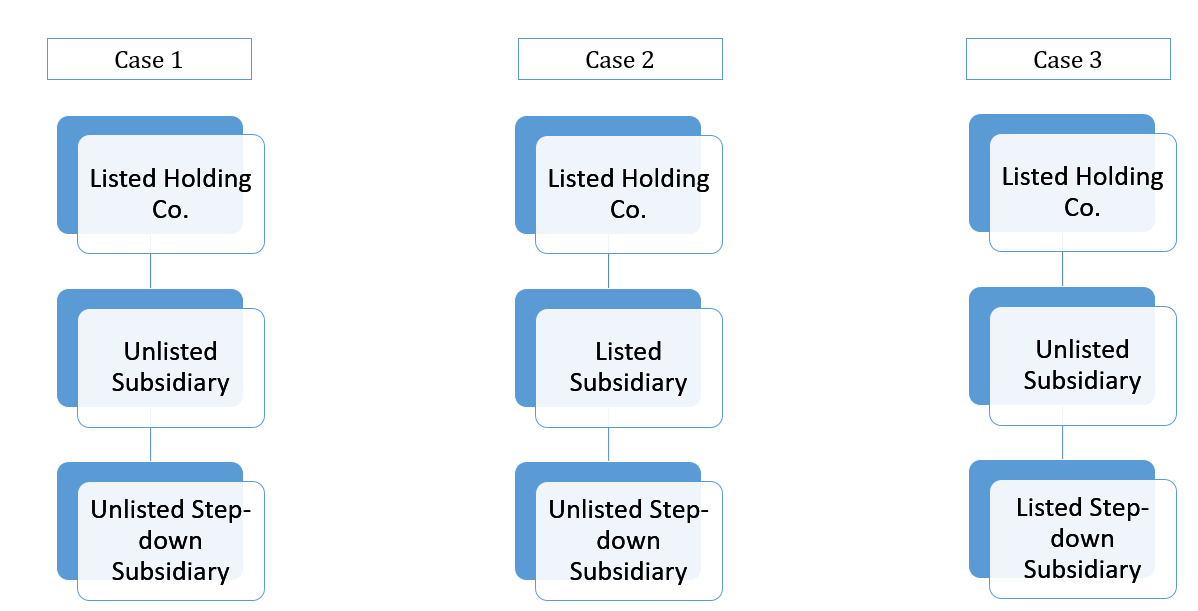
Given the purpose of the Regulation of enhancing corporate governance in the subsidiaries and also the fact that the shareholders interested in the listed company shall be aware of the business being undertaken by the subsidiaries as well. The principle behind this is that on the consolidated level, the performance of the holding company gets affected by the performance of its subsidiaries including its step down subsidiaries. Therefore it is pertinent to have some degree of supervision over them in terms of corporate governance though they are unlisted. Considering this rationale, there seems to be no purpose of excluding the step down subsidiaries from the purview of this Regulation. Hence, the Regulation will  be applicable to both immediate and step down unlisted subsidiaries. Let us understand the applicability of the Regulation under different cases enunciated below:


Case 1: since both the immediate subsidiary and the step down subsidiary are unlisted, the Regulation will apply to both of them and significant arrangements or transactions entered into by them will be reported to the ultimate holding company.

Case 2: since the subsidiary itself is a listed company and the Regulation clearly states that it applies to unlisted subsidiary. Therefore, the Regulation will not apply to the subsidiary. Going further, the step down subsidiary is unlisted, but the holding company just one level above is listed. Therefore, the Regulation will apply to unlisted step down subsidiary in relation to its immediate holding company. The ultimate holding company at the top will not be required to note or review the significant transactions or arrangements of the step down subsidiary under the Regulation.

Case 3: since the subsidiary is unlisted, the Regulation will have to be complied in relation to it. However, going forward to the listed step down subsidiary, since it is itself listed with the stock exchange, the Regulation will not apply as it is applicable only to unlisted subsidiaries.

Issues to address

Regulation 24(4) of the Listing Regulations reads as below –

“The management of the unlisted subsidiary shall periodically bring to the notice of the board of directors of the listed entity, a statement of all significant transactions and arrangements entered into by the unlisted subsidiary.”

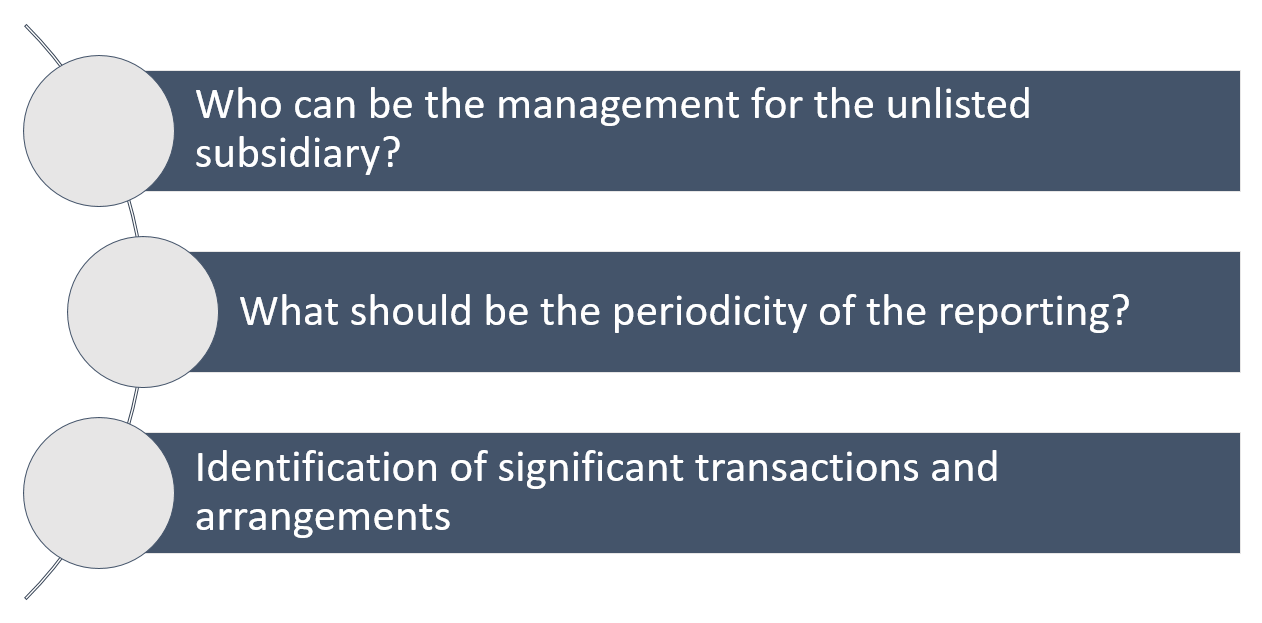
The following may be require to be identified –

While a plain reading entails the aforesaid questions, a deep analysis of the provisions and on consideration of the practical implications, further issues/questions may arise which have been dealt with at relevant places in this write-up.

Meaning of Transactions or Arrangements

The first question that arises while complying with the requirements of Regulation 24(4) is the identification as to what constitutes transaction or arrangement. While the term ‘transaction’ is not defined, the meaning of the same may be construed from Regulation 2(1)(zc) of the Listing Regulations and Indian Accounting Standard (Ind-AS) 24, defining the term “related party transaction” (RPT) .

The term has been defined as –

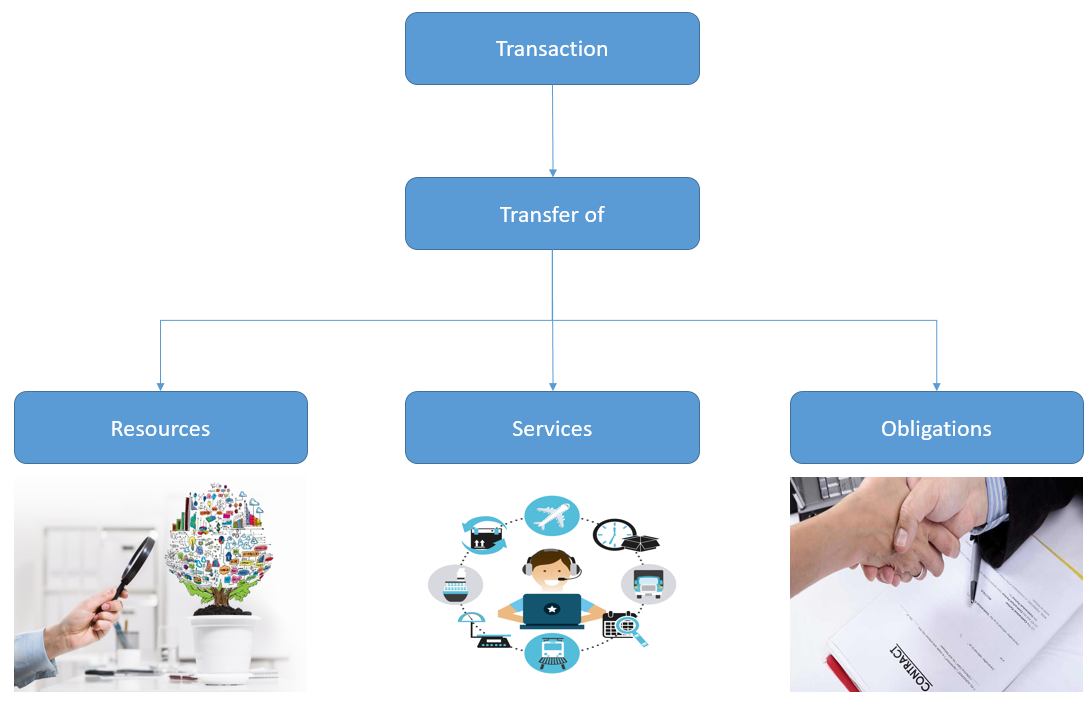
A related party transaction is a transfer of resources, services or obligations between a reporting entity and a related party, regardless of whether a price is charged.

Accordingly, the term transaction may be understood to be “a transfer of resources, services or obligations between two parties”. Similarly, arrangements shall mean a plan or programme for undertaking or understanding to undertake such transactions in future.


Items not considered as transaction/ arrangement

There are various line items in the financial statements which does not arise out of any transaction or arrangement but as a result of accounting entries. Such line items such as deferred tax expenditure, provisions for future liabilities, unrealised gains or losses, etc do not involve any contract, result into any transfer and does not involve two or more parties. Therefore, these fail to contain the basic features of transaction and should not require reporting.

On the other hand, there are certain off-balance sheet items such as guarantee, or derivative transactions. The component of “transfer” may not be present from the early stage but may arise in due course. Moreover, these arise out of contracts and constitute transactions. Therefore, the same should be reported at the values as recognised in the books of accounts.

Assessment of Significance

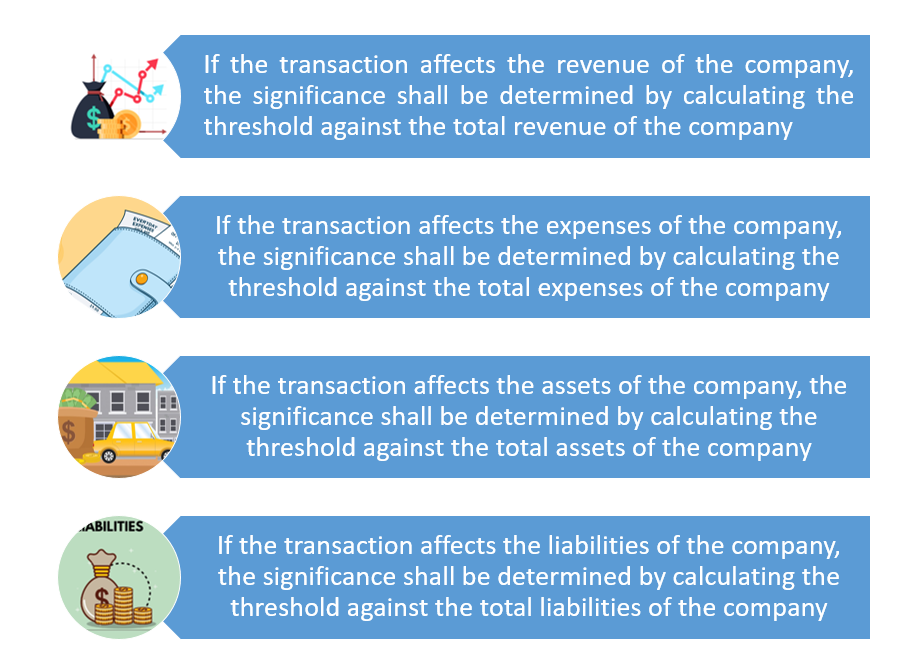
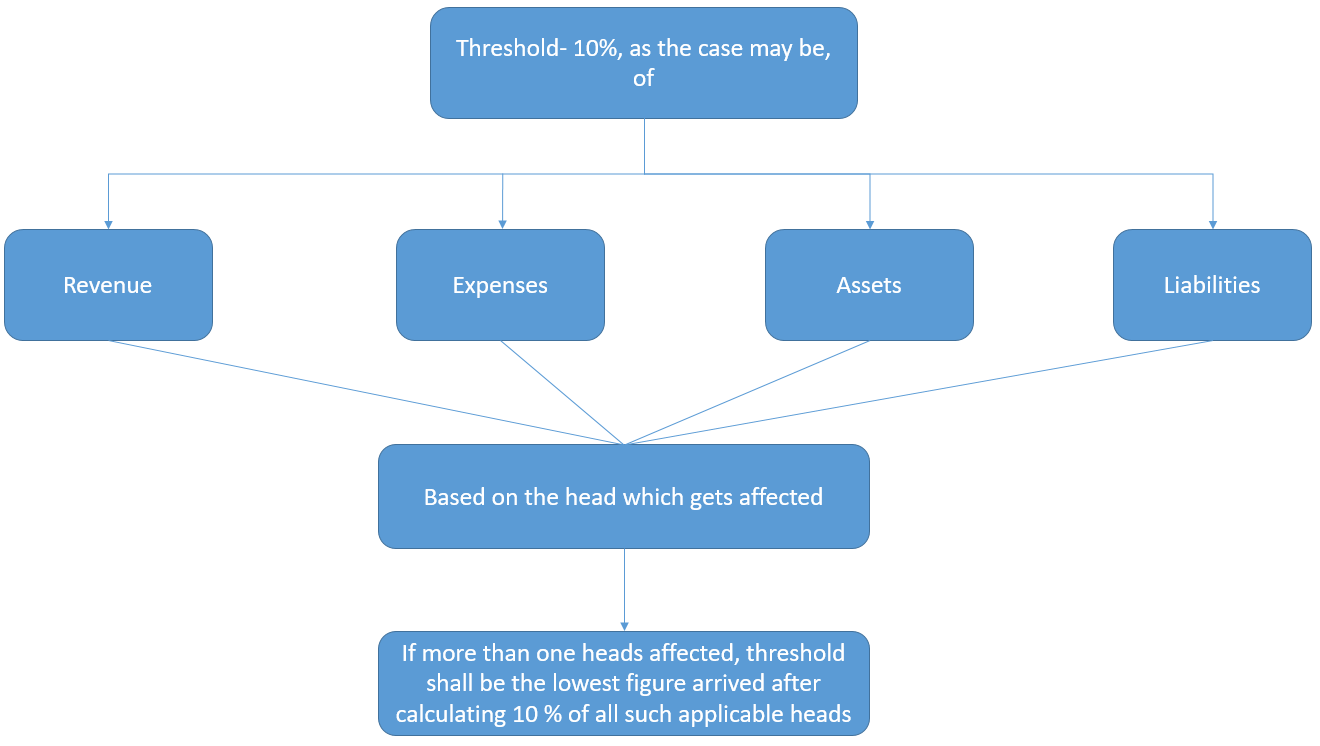
The second step that comes after identifying the transaction/arrangement is the assessment of significance. For the purpose of Regulation 24(4), a transaction or arrangement is significant if it individually exceeds or is likely to exceed ten percent of the total revenues or total expenses or total assets or total liabilities, as the case may be, of the unlisted subsidiary for the immediately preceding accounting year.

The criteria of significance as provided above requires that the threshold needs to be checked against different parameters “as the case may be”. The parameter to be checked will depend upon the nature of the transaction. Therefore, depending upon the nature of the transaction, the significance shall be assessed against the threshold determined on the basis of figures under relevant head as explained below:


There may be instances where the transaction does not affect any one parameter in isolation but  two or more of the parameters i.e. revenue, expenses, assets or liabilities together. In such cases, an issue may arise as to which parameter has to be considered. In such cases, all the parameters applicable to such a transaction shall be considered. 10% threshold of all such applicable parameters shall be determined and the lowest of such threshold shall be applied for assessment of significance of such transaction.

For example, S Ltd, the subsidiary of A Ltd, has entered into a transaction with Z Ltd, involving sale of goods. Such transaction involves revenue and therefore, significance of such transaction has to be assessed as a percentage keeping the total revenue of the preceding accounting period as the base for deriving such percentage. Say for example, the revenue of S Ltd is Rs. 100 crore in the preceding financial year. Therefore 10% of it will be Rs. 10 crores. Hence, if the value of the transaction being entered by  S Ltd with Z Ltd exceeds Rs. 10 crores, the same will qualify as a significant transaction for the purpose of the Regulation.

However, consider another example in which S Ltd has entered into an arrangement which impacts both the assets and expenses of the Company (creation of a new capital asset involving a huge outflow of cash). In such a case, both the assets and expenses being involved, the significance of the transaction has to be assessed for each of the bases individually and the one that hits the requirement at the lower end shall be taken for assessment of significance. Say for example, the assets and the expenses of S Ltd in the preceding financial year was Rs. 500 crores and Rs. 150 crores each. In such a case, thresholds shall be calculated based on both the figures and the lower of the two shall be the one that will determine the significance of the transaction. In the instant case, the thresholds are Rs. 50 crores and Rs. 15 crores, therefore the lower of the two i.e. Rs. 15 crores will be the one that will be considered. Hence, if the amount of transactions being undertaken exceeds Rs. 15 crores, it will qualify as a significant transaction.


Basis for assessment – standalone or consolidated?

Having settled with the parameter to be considered for various transactions, another question that may tweak our mind is whether the total revenues or expenses or assets or liabilities, as the case may be , has to be considered on a standalone basis or on a consolidated basis for the subsidiary. Here, one has to consider the fact that the compliance of the provision has to be ascertained by the listed holding company. Any company, which is a subsidiary of the subsidiary company, ultimately becomes the step-down subsidiary of the listed holding company thereby attracting Reg 24(4) of the Listing Regulations for reasons as discussed above and reporting its significant transactions or arrangements to the board of the listed company. In view of the same, an inference may be drawn that the aggregate figures for the preceding financial year shall be taken on a standalone basis, and not on a consolidated basis. This will also help in getting a clear picture and involving only those transactions that are actually significant for the subsidiary.

Determination of significance: Transactions/Arrangements based on contract

It is a very general phenomenon in companies to enter into contracts with different parties. Such contracts often extend to years and give rise to transactions. A common ambiguity that may arise in such cases is on determining the amount of such transaction for the purpose of the Regulation. Let us understand this scenario with some examples.

A Ltd., a subsidiary of B Ltd., enters into a rent agreement with X Ltd. The rent agreement extends to 5 years at a total value of Rs. 30 lakhs i.e. at a monthly rent of Rs. 50,000 per month. Now what shall be considered as the value of transaction for the purpose of the Regulation, Rs. 30 lakhs or Rs. 50 thousand? In our view, the total amount attributable to that particular financial year shall be considered for the purpose of the Regulation. In the instant case, assuming that the contract is effective from October 1, 2021, the amount shall be Rs 3 lakhs (rent during the FY 2020-21). Therefore, for assessing the significance of the transaction, the amount of Rs. 3 lakhs shall be compared against the threshold.

In the same case above, even if there has been no specific tenure of the contract but it rather would have only discussed monthly payment of Rs. 50 thousand as rent, still the amount payable in total throughout that financial year shall be taken and not the monthly rent.

The underlying principle is that the total amount of that transaction attributable to that financial year shall be considered as the amount of transaction for assessing significance under the Regulation.

Reporting: decoding the meaning of management and periodicity

Meaning of management

Regulation 24(4) says that “the management of the unlisted subsidiary shall periodically bring to the notice of the board of directors of the listed entity xxxxxxxxx”. This again comes up with two questions: who constitutes management and what shall be the periodicity for bringing significant transactions or arrangements to the notice of the board of the listed holding company.

Going by the general meaning as well as the intent and purpose of this requirement, the board of directors of the subsidiary as well as the KMPs/other senior executives just a level below the Board should be taken to constitute ‘management’.

Periodicity of reporting

Coming to the question of periodicity, the same has not been specified in the Listing Regulations itself, but left to the discretion of the board. However, the intent of the Regulation is to enhance corporate governance in the subsidiaries. Hence the periodicity should be reasonable enough to capture such a purpose.

Here, one may note that Regulation 17(2) of the Listing Regulations requires the board of the listed company to meet at least four times a year. Further, under Regulation 33, financial results are placed before the board quarterly which also includes results of its subsidiaries (since the results have to be submitted on both standalone and consolidated basis). Therefore, in consonance with the same, the list of significant transactions or arrangements of the subsidiaries should also be placed before the board of the listed company, if not more frequently, at least on a quarterly basis.

De-minimis exemptions – can a leeway be created?

Regulation 24(4) of the Listing Regulations, though very significant in terms of enforcing corporate governance requirements and ensuring transparency in respect of the unlisted subsidiaries of the listed company, may sometimes prove extraneous in the spirit of law. There may be cases where the subsidiary as a whole may be too small to have any significance on the accounts of the holding company.

A classic example of the same may be in case of a company, as a listed holding company, having a paid-up capital of Rs. 50 crores or above, having a subsidiary with total asset size of Rs. 1 crore. In this case, the total assets of the subsidiary amounts to mere 2% of the total asset size of the listed company. Here, a transaction involving purchase/ sale of an asset of Rs. 10 lacs will fall within the meaning of a significant transaction for the subsidiary company, however, will have a minimal impact on the listed holding company.

In such cases, going by the letter of the law, such transactions, even though having no significant impact on the listed entity as such, will have to be placed before the board thereby creating an unnecessary compliance burden producing no meaningful results.

A possible leeway that may be created as a make-through to provide certain de minimis exemptions on the basis of certain amounts or percentages. For example, a listed company may approve through its board and audit committee, that any transaction undertaken by a subsidiary, which amounts to not greater than 2% of the turnover or the paid-up capital or the networth of the listed company, will not be required to be reported to the board of the listed company.

However, while putting such de minimis exemptions, utmost care has to be taken to ensure that the self-approved exemptions do not turn out to completely erode the intentions of the law. Further, the requisite approvals have to be obtained and properly documented so as to avoid falling into a legal moss at a later stage.

Conclusion

The requirement under Regulation 24(4) enhances corporate governance standards in subsidiaries which were otherwise unlisted and exempted from such scrutiny. It allows the listed holding company to exercise due diligence in significant transactions entered by subsidiaries. However, in certain cases, the requirement becomes redundant due to absence of any material effect of subsidiary’s transactions on the overall performance of the holding company due to minimal asset size or revenue. Therefore, the idea of exempting subsidiaries below a certain threshold in terms of asset size or revenue of the listed company can be thought upon.The market regulator may also take a step to bring this as an amendment to the law, so as to ensure reduction of extra-compliance burden as recently suggested by FM Nirmala Sitharaman in her speech on the 53rd Foundation day of ICSI.


Read our other article on the subject –

‘Material Subsidiary’ under LODR Regulations: Understanding the metrics of materiality:

https://vinodkothari.com/2021/05/understanding-metrics-of-materiality/

Understanding the unification of SEBI’s share-based employee incentive schemes

– Highlights of the SEBI SBEB and Sweat Equity Regulations

– Corplaw Division, corplaw@vinodkothari.com

In order to consolidate SEBI (Share Based Employee Benefits) Regulations, 2014 (‘SBEB Regulations’) and SEBI (Issue of Sweat Equity) Regulations, 2002 (‘Sweat Equity Regulations’), SEBI had issued a discussion paper on July 8, 2021. The changes proposed in this discussion paper as well as incorporation of the previously issued SEBI Circulars in the context of SBEB Regulations have now been imbibed under the SEBI (Share Based Employee Benefits and Sweat Equity) Regulations, 2021 (‘New Regulations’) which are effective from August 13, 2021. The same aims at rationalization of the erstwhile provisions in order to make them more vigorous with best global practices and ease of doing business.

In this article, we have discussed the major highlights and actionable rolling out of the said New Regulations.


1. Enabling definition of employees

  1. Following the intent stated in the discussion paper issued in this regard, the New Regulations give a free hand to a company coming up with a share-based employee benefit scheme (SBEB Scheme). That is to say that as per the language used under the New Regulations under regulation 2(1)(i), the company can choose which employees can be included under any SBEB Scheme. Accordingly, from the date of enforcement of the said provisions, permanent as well contractual employees may be considered for the purpose of granting SBEB. Further, this change is applicable in reference to issuance of sweat equity shares as well.
  2. Furthermore, an employee, whether permanent or not, must be exclusively working for the company or its group companies. The word ‘exclusive’ is added by the New Regulations for ensuring that even though a non-permanent employee is also eligible for SBEB but he must be working on an exclusive basis either in India or outside. This exclusive working criteria is only applicable for SBEB and not for issuance of sweat equity.
  3. Also, as a matter of clarificatory change, the New Regulations specifically state that an NED is also included within the ambit of the term ‘employee’ who is not a promoter or a member of the promoter group. It is pertinent to note that the concerned provision was already present in the erstwhile SBEB Regulations [regulation 2(1)(f)(ii)]; however, an explicit provision in this connection has been made for the sake of avoiding any ambiguity or difference of interpretation.
  4. Lastly, the New Regulations have increased the ambit of the term ‘employee’ under regulation 2(1)(iii) in the context of by stipulating that an employee or director of a group company including holding, subsidiary or associate group shall also be eligible to be included under the purview of the term ‘employee’. Under the erstwhile SBEB Regulations [regulation 2(1)(f)(iii), only an employee or director of a holding or subsidiary company was included under the criteria.


The whys and wherefores: The new Regulations have increased the arena of the term ‘employee’ in order to provide flexibility to the companies so that they can cover more employees under the schemes offered for their benefit. Further, the New Regulations have permitted the designated employees of group companies to be qualified for the purpose of SBEB schemes.  


2. Cash-settled SARs fall outside the purview of the New Regulations

Explanation 2 as added under regulation 2(1)(qq) of the New Regulations explicitly state that any reference to stock appreciation right or SAR shall mean equity settled SARs and will not include any scheme which does not, directly or indirectly, involve dealing in or subscribing to or purchasing securities of the company. This gives an indication that any scheme which is settled only in cash and not involves equity will fall  outside the purview of the New Regulations.

As clearly specified under the New Regulations, the provisions shall be applicable in case of an equity settled SARs scheme as well as a scheme wherein the company has not stated upfront whether the same would be settled in cash or equity. However, in case of a scheme which is to be settled in cash only, the same has been seemingly made to fall outside the purview of the New Regulations.

The whys and wherefores: The rationale behind the present change is to make the provision related to SAR in line with the applicability criteria for an employee benefit scheme as covered under both the erstwhile SBEB Regulations and the New Regulations under regulation 1(4)(ii) which states that for application, a scheme should be for direct or indirect benefit of employees and involves dealing in or subscribing to or purchasing securities of the company directly or indirectly, Therefore, it is now cleared that cash settled SAR will not be governed by the New Regulations.

3.Applicability to equity listed companies

Regulation 1(4) of the New Regulations explicitly states that the provisions of the concerned regulations shall apply to any company whose equity shares are listed on a recognised stock exchange in India. The word ‘equity’ is specifically added by the New Regulation while in the erstwhile SBEB Regulations, the reference was made with respect to a company whose shares are listed on a recognised stock exchange [Regulation 1(4)].

The whys and wherefores: This change is put forth only for the purpose of clearing the language of the concerned provision although the intention was clear under the erstwhile SBEB Regulations as well.

4. NRC may act as Compensation Committee

As per the recommendations proposed in the consultation paper of the Expert Group, the New Regulations have enabled the NRC to act as compensation committee for the purpose of these regulations. The reference to Regulation 19 of the SEBI (Listing Obligations and Disclosure Requirements) Regulations, 2015 (‘LODR Regulations’) has been provided under the New Regulations under regulation 5(2).

The whys and wherefores: The Expert group asserted that a listed company already constitutes NRC as per the mandate and therefore, it could perform all the functions as are endowed on a compensation committee.

5. Switching of route of administration: Trust v/s Direct

Second proviso as added to Regulation 3(1) of the New Regulations stipulates that a company is allowed to change the mode of implementation of the scheme if the following conditions are satisfied:

  • Prevailing circumstances should warrant such change.
  • Fresh approval from shareholders via special resolution is obtained before affecting such change.
  • Such change should not be prejudicial to the interest of the employees.

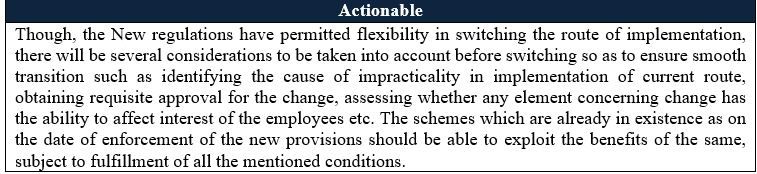
The whys and wherefores: This can be inferred as one of the most liberating changes introduced by the New Regulations. A company can now flexibly switch the administration of a SBEB scheme i.e. from direct route to trust or vice versa. This move will eliminate the difficulty being faced by the companies in deciding upfront whether a scheme is to be implemented through a trust or otherwise.

In order to avail the benefit of the amendment, the company will be required to state the circumstances warranting the change. As the trust can be used as a good device to fund the acquisition of the company’s own shares at an opportune price, thereby minimising the cost to the company, the same may constitute as a reason warranting the change in route of implementation.

6.Varying terms of scheme due to regulatory changes

A company is allowed to vary the terms of the scheme offered subject to shareholders approval via special resolution and ensuring that the intended variation is not in any way prejudicial to the employees. However, under the erstwhile SBEB Regulations, companies were dubious with respect to the applicability of the shareholder’s approval via special resolution for varying the terms of the scheme for the purpose of meeting any regulatory requirement. This issue was mainly on account of the language used which lacked clarity on the concerned subject. Therefore, in order to bring clarity, the New Regulations have amended the provision with respect to varying the terms of the scheme on account of any regulatory requirement which was earlier made part of the restrictive sub-regulation under the erstwhile SBEB Regulations [Regulation 7(1)]. Hence, any variation in the terms of the scheme on account of any regulatory requirement which is restrictive in nature and without changing which the scheme becomes inoperative can be made without shareholder’s approval.

The why and wherefores: Since regulatory changes, the periodicity of which is unpredictable, are not in the control of a company therefore, any SBEB scheme which warrants variation to be made on account of regulatory changes should be allowed to be undertaken by the company without any pre condition as to obtaining shareholder’s approval.

7. Repricing now only with help of a special resolution

Under the erstwhile provisions [Regulation 7(5)], re-pricing of options/SARs/shares required passing of an ordinary resolution. However, Regulation 7(5) of the New Regulations mandate for a special resolution to be obtained.

Any compliance which is being made pursuant to the amendment should abide by the same, however, acts of the past need not be re-done therefore, any options/SARs/shares which were repriced basis shareholders’ approval via ordinary resolution prior to the advent of the New Regulations, will not be affected with the new compliance requirement.

The whys and wherefores: Repricing decision, especially in the situation when the market is not doing good, can affect the wealth of the shareholders on account of the increased financial burden that a company would have to bear pursuant to heavy discounting in order to make the scheme attractive.

8. Determining total ceiling for secondary acquisition

Explanation 1 to Regulation 3(11) of the New Regulations stipulates that the reduction of share capital by virtue of a buy-back or scheme of arrangement, etc. should also be factored in the calculation of limits of shareholding of trusts under secondary acquisition.

The whys and wherefores: The erstwhile SBEB Regulations [Explanation 1 to regulation 3(11)] prescribed that where there is expansion of capital on account of corporate actions including issue of bonus shares, split or rights issue then such expansion shall be taken into account while reckoning the limits of shareholding of trusts under secondary acquisition. However, the Expert Group was of the view that similar to situations such as bonus issues, where the paid-up share capital (and accordingly the shareholding of the trust) of the company increases proportionately, the reduction of capital may also take place due to corporate actions such as buy-backs. Therefore, taking into account only expansion would not be feasible. When capital is reduced, the shareholding of the trust should also react accordingly and hence the present change is introduced.

9. Transfer of surplus on winding up of scheme

Regulation 8 of the New Regulations stipulates that the surplus money or shares remaining on winding up of the scheme, may be transferred to other existing schemes under the regulations, subject to approval obtained by shareholders on the recommendation of the compensation committee.

The whys and wherefores: The rationale behind the same is that the assets of the trust are acquired and earmarked for the benefit of the employees of the company, therefore, if any surplus remains with the trust upon winding up, an option has been provided for deferring the utilisation of such funds or using it for the benefit of employees through a different scheme under the regulations.

10. Certification by secretarial auditor

Annual Compliance Certificate

Regulation 13 of the New Regulations expressly envisages that board of directors are required to obtain compliance certificate on annual basis from secretarial auditors of the company. The words ‘secretarial auditors’ have been added in order to clear the ambiguity created by the erstwhile SBEB Regulations [regulation 13] where the only word mentioned was ‘auditors’. As a matter of practice, companies used to obtain the certificate from their statutory auditors.

Compliance certificate certifying administration and implementation of General Employee Benefit Scheme (‘GEBS’) as per the prescribed regulation

Further, Regulation 26(2) of the New Regulation dealing with administration and implementation of GEBS stipulates that  “the shares of the company or shares of its listed holding company shall not exceed ten per cent of the book value or market value or fair value of the total assets of the scheme, whichever is lower, as appearing in its latest balance sheet (whether audited or limited reviewed) for the purposes of GEBS”. As per the New Regulations, the threshold should be considered as on the date of balance sheet since the erstwhile approach of reckoning threshold not to exceed “at any point of time” was practically not feasible on account of fluctuating share prices.  Furthermore, a compliance certificate from the secretarial auditor in this regard at the time of adoption of such a balance sheet by the company is also introduced as a mandatory requirement.

Compliance certificate certifying administration and implementation of Retirement Benefit Scheme (‘RBS’) as per the prescribed regulation

Also, Regulation 27(3) of the New Regulation dealing with administration and implementation of RBS stipulates that “the shares of the company or shares of its listed holding company shall not exceed ten per cent of the book value or market value or fair value of the total assets of the scheme, whichever is lower, as appearing in its latest balance sheet (whether audited or limited reviewed) for the purposes of RBS”. Alike GEBS, similar change is introduced by the New Regulations under the RBS provision as well with the same intention challenging the erstwhile approach of reckoning. And again alike GEBS, a compliance certificate from the secretarial auditor to this effect is introduced as a mandatory requirement under RBS as well.

The whys and wherefores: As per the usual practice, it was statutory auditors who were issuing this compliance certificate however, it was perceived by the Expert Group, constituted by SEBI for recommendations with on the New Regulations, that the secretarial auditor was more conversant with these laws compared to other categories of persons, and it is the secretarial auditor that is required under Regulation 24A of the LODR Regulations, to furnish a secretarial audit report on an annual basis therefore, it would be more feasible if the concerned compliance certificate is issued by secretarial auditor and accordingly, the concerned change is introduced. Further, introduction of secretarial auditor certificate certifying compliance w.r.t implementation and administration of GEBS or RBS is to ensure due compliance under the New Regulations.

11.Extension of time period for appropriation of shares

Under regulation 3(12) of the New Regulations, the period of appropriation of shares acquired through secondary market acquisition, not backed by grants, has been extended from the current time period of 1 year to a period of 2 years, subject to the approval of the compensation committee.

The whys and wherefores: The idea behind the present change is to provide flexibility from the rigid time period. However, this may allow companies to use the provision for appropriation to support their own share prices by purchasing the same without any intention to make grants.

12. In-principle approval prior to grant of options

Regulation 12(3) of the New Regulations explicitly stipulates that for listing of shares issued pursuant to ESOS, ESPS or SAR, the company shall obtain the in-principle approval of the recognized stock exchanges where it proposes to list the said shares prior to the grant of options or SARs.

The why or wherefores: The words ‘prior to the grant of options or SARs’ are added in the New Regulations primarily to address the issue arising on account obtaining in-principle approval after grant and exercise. It was asserted by the Expert Group that this practice might cause delay in allotment because of non-receipt of such approval as the regulator may determine that the listed entities are non-compliant or the scheme is not in accordance with SBEB Regulations.

13. Role of compensation committee w.r.t. buy-back of options

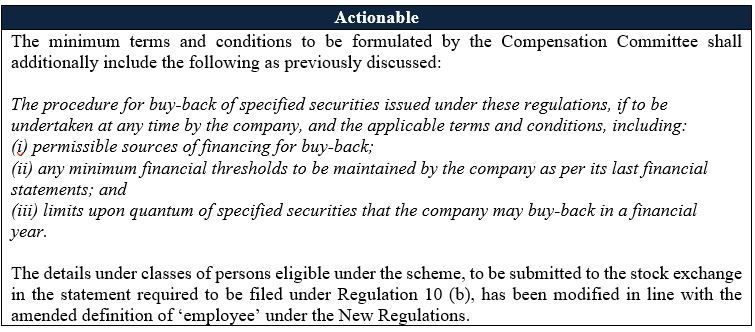
Part B to the Schedule-I of the New Regulations provides that the compensation committee shall prescribe the procedure for buy back of securities issued under SBEB scheme.

The whys and wherefores: Buy back of stock options have been mentioned under the Companies Act, 2013 as well as the SEBI Buyback Regulations, however, there is no standard procedure to implement the same. Before we first understand what is the amendment, we need to know the concept of buy back of stock options.

A situation for buyback of stock option is likely to occur when the option holder is not willing to exercise the said option for reasons like, fall in share prices leading to the exercise becoming unattractive, lack of funds in the hands of the option holder etc. Under such a situation, if the company wants to pay cash to the option holder instead of the shares, the same can be done by buying back the options held by the option holders. The Expert Group in the Consultation Paper has also mentioned about a situation where due to a regulatory requirement; issuance of shares is not possible and consequent to which the company decides to pay cash instead of issuing shares. While a practical case under the situation stated by the Expert Group may not be ascertained as of now, however, it has been thought of a probable situation for carrying out buy back of options. Further, buy back of options is likely to happen for those which have been vested.

The Expert Group was of the view that flexibility in formulating requisite terms and conditions and procedure for buy back of options would be more meaningful rather than setting out a framework requiring all listed companies to follow a standard procedure in this regard. The requirement for setting out the terms and conditions of schemes to be formulated by the compensation committee was provided under the circular issued previously in this regard. However, the same did not include an express provision relating to procedure and terms and conditions for buy-back including permissible sources for financing the buy-back, minimum financial threshold to be maintained, quantum of securities to be bought back etc.

14. Consolidation of SEBI Circulars

SEBI Circular dated July 15, 2021, provided for immediate vesting of options, SAR or any other benefits in the event of death of an employee. In the said circumstance the requirement of minimum vesting period of 1 year has been done away with. The same has been prescribed under regulation 9(4) of the New Regulations, which stipulates that the options shall vest immediately from the date of death in the legal heirs or nominees of the deceased employee, thus doing away with the minimum vesting requirement.

Further, various disclosure requirements had been prescribed under SEBI Circular dated June 16, 2015, relating to contents of the trust deed, terms and conditions to be formulated by the compensation committee, matters to be stated in the explanatory statement, disclosure to stock exchanges and by the board of directors, etc. The said disclosures have been incorporated under the New Regulations as part C to the Schedule-I with certain additional disclosures like period of lock-in and terms & conditions for buyback, if any, of specified securities covered under these regulations.


15.Vesting of benefits on retirement or superannuation

Explanation as added to the Regulation 9(6) under the New Regulations stipulates that where employment is ceased due to retirement or superannuation then options, SAR or any other benefits granted to an employee would continue to vest in accordance with their respective vesting schedules even after retirement or superannuation in accordance with company policies and applicable law.

The whys and wherefores: Regulation 9(6) of the erstwhile SBEB Regulations stipulated that in case of cessation of employment on account of resignation or termination, benefits which are granted and not vested as on that day shall expire. However, there was a confusion as to the applicability of the concerned provision in case of cessation due to other reasons. In order to bring clarity, the Expert Group recommended that cessation of employment on account of retirement or superannuation should be left out of the ambit of regulation 9(6). In order to provide leniency in special circumstances, it is now explicitly inculcated in the New Regulations that the options, SAR or any benefits granted to an employee and not yet vested would not expire on cessation of employment due to retirement or superannuation and the same will continue to vest in accordance with the vesting schedule.

16. Cashless Exercise

The New Regulations, like the erstwhile SBEB Regulations, do not specifically define the term ‘cashless exercise’ however, have prescribed certain transactions which shall be covered under the ambit of cashless exercise. Regulation 3(15)(a) of the New Regulations stipulate that following is the process pursuant to which cashless exercise may be undertaken:

  1. to enable the employee to fund the payment of the exercise price,
  2. To enable the employee to fund the payment of the amount necessary to meet his/her tax obligations and other related expenses pursuant to exercise of options granted under the ESOS.

The whys and wherefores: Since the term ‘cashless exercise’ was not defined under the erstwhile SBEB Regulations, the Expert Group was of the view that a clarity w.r.t the ambit of transactions that would be covered under the concerned term would be helpful and accordingly, the present change is introduced.

17. Changes pertaining to provisions of sweat equity shares

The New Regulations have combined the SBEB Regulations with the SEBI (Issue of Sweat Equity) Regulations, 2002. Under the New Regulations, there are certain changes introduced with respect to the provisions relating to sweat equity shares.

  1. Purpose of issuance of sweat equity shares: The purpose of issuance of sweat equity shares was not previously specified under the erstwhile regulations. Regulation 30 of the New Regulations provides for permitted purpose/objective for issuance of sweat equity shares which are in accordance with the current provisions of the Companies (Share Capital and Debentures) Rules, 2014.
  2. Maximum quantum of shares: Vide a newly inserted provision, the New Regulations under regulation 31 have prescribed for a maximum limit on the quantum of sweat equity shares that may be issued by a listed company. The regulations have prescribed a cap of 15% of the existing paid up capital on the issuance done in a year and further state that the total quantum of sweat equity shares issued by a company shall not exceed 25% of the paid up equity capital at any time. This is in line with the Companies (Share Capital and Debentures) Rules, 2014.

Further, the New Regulations provide for relaxation with respect to quantum of sweat equity to be issued by companies which are listed on Innovators Growth Platform i.e the overall limit of 50% of the paid-up equity share capital of the company at any time upto 10 (ten) years from the date of its incorporation or registration.

  1. Lock-in requirement: Regulation 38 of the New Regulations has made the lock-in period for equity shares issued under sweat equity consistent with the lock-in period prescribed in relation to preferential issue under the SEBI (Issue of Capital and Disclosure Requirements) Regulations, 2018 (‘ICDR Regulations’). The rationale for the change is to make sweat equity shares more attractive, by doing away with the lock-in period of 3 (three) years under the erstwhile regulations.
  2. Pricing: The erstwhile provisions prescribed for a specific mechanism for determination of price of sweat equity shares, which stated the higher amount of the average of weekly high and low prices of the period as specified was to be considered. However, the pricing mechanism of sweat equity shares has now been aligned with the provisions relating to preferential issues under ICDR Regulations by the New Regulations via Regulation 33.

The whys and wherefores: The new Regulations have now provided clarity that companies may issue sweat equity shares only for the prescribed purposes. Further, by specifying the quantum of sweat equity shares that can be issued, the New Regulations have inculcated a clarity and increased the scope of compliance.

18. Definition of “Promoter Group Company” and its impact throughout the Regulations

The erstwhile SBEB Regulations [regulation 2(1)(v)] while referring to the definition of promoter group under the ICDR Regulations, stated that in case the promoter or promoter group is a body corporate, the promoters of such body corporates shall also fall under the ambit of the definition. Regulation 2(1)(dd) of the New Regulations has omitted the said proviso, thus making it in line with the definition as stated under ICDR Regulations.

Recommendations that couldn’t form part of the New Regulations

There were certain recommendations of the Expert group that were discussed, however, the same were not made part of the New Regulations since majority of them did not stand the test of necessity for inclusion. These include:

  1. Inclusion of trust shareholding under the ambit of public shareholding.
  2. Explicit recognition of employee stock options under managerial remuneration under the New Regulations.
  3. Relaxation of compliances for trust under SEBI (Prohibition of Insider Trading) Regulations, 2015.
  4. Approval of stock exchange for acquisition by trust via secondary acquisition.
  5. Delegation of responsibilities by compensation committee pertaining to approval of schemes and other matters.
  6. Specification of pricing guidelines or disclosure requirements for determination of exercise price.


Minority shareholders under IBC

-Sikha Bansal

[resolution@vinodkothari.com]

Below we provide a quick snapshot of the extant provisions of the insolvency framework in India vis-a-vis Minority Shareholders, in light of related laws and judicial developments so as to assess their rights and standing in the current insolvency ecosystem –

Read more

Creating regulatory eco-system for SPACs in India

– Ajay Kumar KV, Manager & Himanshu Dubey, Executive

[corplaw@vinodothari.com]

From a little-known word and a preserve of a select few finance professionals, the term Special Purpose Acquisition Companies (SPACs) is today a buzzword. The regulators across the globe are taking necessary actions to enable SPACs to raise money from investors – jurisdictions like the US, UK and Malaysia lead from the front. Having a sound regulatory framework is important because if investors are keen towards SPACs, and the regulators do not enable it, it is quite likely that the country will not be a friendly destination for SPACs. Hence, India’s securities regulator SEBI has recently constituted an Expert Group for examining the feasibility of SPACs in India, and the International Financial Services Center Authority (IFSCA) has issued IFSCA (Issuance and Listing of Securities) Regulations, 2021[1] which provides a regulatory framework for listing of SPACs within its jurisdiction.

In this write up, the authors take a look at the global legislative measures, and also outline the various changes in the regulations that may be needed in India to enable to make India a SPAC-friendly jurisdiction.

Contents

Introduction. 2

Important regulatory concerns. 3

  1. Sponsor’s contribution. 4
  2. Safekeeping of IPO proceeds. 4
  3. Acquisition Process. 4
  4. Managing conflict of interest 5
  5. Exit mechanism… 5
  6. Speculation on shares. 5
  7. Celebrity endorsements. 6

Regulatory framework in India. 6

Issues under the Act 6

Regulatory framework for SPACs as per the IFSCA (Issuance and Listing of Securities) Regulations, 2021. 9

Exploring some scenarios and the concomitant regulatory ramifications. 13

Regulatory framework on SPACs abroad. 16

  1. Malaysia. 16
  2. Canada. 18
  3. United Kingdom (UK). 19
  4. United States of America (USA). 21

Conclusion. 24

Read more

Understanding Silent Period for listed entities

By CS Aisha Begum Ansari (aisha@vinodkothari.com)

Introduction

When you go silent, you may be doing a soul searching, as for example, in meditational techniques. However, in case of listed entities, silent period is a period just before declaration of financial results, to ensure that there is no accidental leakage of confidential information. Silent period is different from “trading window closure” that most corporate professionals in India are familiar with. However, this article discusses the relevance of silent period, as a subset of the trading window closure, and its relevance to listed entities in India. While exploring the topic, the author also makes a study of the global laws around silent period.

Why silent period?

Insider trading is a ‘white collar’ crime that seeks to exploit the unpublished, non-democratic information (that is, what is not available in public domain) to the advantage of a select few, and to the disadvantage of the market in general. Since, it is a fraud upon the market in general, it has always been a significant topic for the securities market regulators around the globe. In India, Securities and Exchange Board of India (‘SEBI’) has framed the regulatory framework to curb the insider trading called as SEBI (Prohibition of Insider Trading) Regulations, 2015 (‘PIT Regulations’).

The material inside information is generally accessed by the top executives and employees of the company. To avoid the exploitation of such information, the company prohibits them from trading in its securities while having access to such information.  The preventive framework of insider trading does not just end by prohibiting the employees from trading; it also needs to ensure that such material inside information is not leaked outside the organization. There are many ways used by the insiders to leak such information such as sharing the same on social media, sharing of information during analyst or institutional investor meets, etc.

Silent period is different from trading window closure. Silent period is when the company’s top executives, say that CEO, CFO etc. will refrain from doing public communications altogether. The intent is to ensure that there is no interaction with investors or public at large, so as to avoid unintended slippage of information. Currently, SEBI regulations do not require companies to mandatorily observe a silent period; therefore, companies may choose to adopt this practice by way of their Code of Fair Disclosure.

What is silent period?

A silent period (also known as quiet period) is a stipulated time during which a company’s senior management and investor relation officers do not interact with the institutional investors, analysts and the media. The purpose of the silent period is to preserve the objectivity and avoid the appearance of the company providing insider information to select investors. During the silent period, the company does not make any announcements that can cause a normal investor to change their position on the company’s securities.

Is it different from trading window closure?

Trading window closure period (also known as blackout period or closed period) refers to the period during which the employees of the company who have access to material inside information are prohibited from trading in the securities of the company. In some of the developed countries, the securities market regulators give a freehand to the companies to decide the period during which the trading window shall be closed. In India, the PIT Regulations provide that the companies shall close the trading window from the end of the closure of the financial period for which results are to be announced till 48 hours after the disclosure of financial results to the stock exchanges. For any other material inside information, SEBI has given the responsibility to the compliance officers of the companies to close the trading window when the employees can reasonably be expected to have possession of inside information.

Silent period differs from the trading window closure in such a way that trading window closure prohibits the employees to trade in the securities of the company while having access to material inside information and silent period prohibits or restricts the company’s spokespersons to interact with the institutional investors or analysts. The purpose of trading window closure is to prohibit trading on the basis of inside information and the purpose of silent period is to prohibit communication of inside information illegitimately.

Duration of silent period

The PIT Regulations or any other regulatory framework in India do not provide for the requirements of silent period. So, the duration of silent period differs from company to company. Some companies specify the silent period as 20-30 days before the declaration of financial results till the date of disclosure and some companies align the silent period with the trading window closure period. The following table gives the synopsis of the practice followed by the Indian listed entities regarding silent period:

Name of the Company Practice followed
Mahindra & Mahindra Limited Silent period commences from 20 days before the declaration of financial results till the date of disclosure of results
Tata Consultancy Services Limited Quiet period starts 20 days before the declaration of financial results till the date of disclosure of results
HCL Technologies Limited Silent period is same as trading window closure period
Asian Paints Limited Silent period is observed between the end of the period and the publishing of the stock exchange release for that period
Wipro Limited Quiet period commences from 16th day of the last month of the quarter and ends with 48 hours after earnings release.
Infosys Limited Silent period is observed between the 16th day prior to the last day of the financial period for which results are required to be announced till the earnings release day.

Thus, it can be concluded that the silent period is smaller than the trading window closure period.

Analysts/ investors meets during silent period

Analysts/ investors meets can be a medium of leak of material inside information, therefore, the companies avoid interaction with them during trading window closure period. So, does it mean that companies completely abstain from interacting with the analysts and investors? While the answer may differ from company to company and the policies adopted by them for communication with analysts and investors. Some companies completely refrain from the analysts/ investors meets while some companies interact with them and discuss the past and historical information which is already available in public domain and general future prospects of the company, dodging the specific questions relating to the material inside information.

Guidelines for Investor Relations for Listed Central Public Sector Enterprises[1]

While the regulations framed by SEBI are silent about the silent period, the Guidelines for Investor Relations for Listed Central Public Sector Enterprises issued by the Department of Disinvestment, Ministry of Finance, Government of India, provides for the duration of silent period and obligations of the public sector enterprises in this regard. The Guidelines advise that the silent period should commence 15 days prior to the date of Board meeting in which financial results are considered and end 24 hours after the financial results are made public. The Guidelines requires the companies to abstain from meeting the analysts and investors and not communicate with them unless such communication would relate to the factual clarifications of previously disclosed information.

International practice with respect to silent period

Country Trading window closure period Silent period Analyst meet during silent period
United States of America (USA)[2] USA laws do not provide any specific timeline for trading window closure period. Thus, the companies are free to determine it There are two types of silent period prevalent in USA:

1.    When the company makes an Initial Public Offering (‘IPO’) – the Securities Exchange Commission (‘SEC’) mandates such companies to maintain a silent period from the date of registration with SEC which lasts till 40 days after the securities begin to trade on the stock exchanges. Such silent period is heavily regulated by the SEC.

2.    During finalization of quarterly results – the silent period is not clearly defined by SEC.

During the silent period, the interaction with the analysts and investors is reduced. The companies either go completely silent or they speak about only past and historical information.
United Kingdom (UK)[3] Unlike USA, the UK laws prescribe the trading window closure period. Article 19.11 of Market Abuse Regulations specifies the period of trading window closure starting from 30 calendar days before the announcement of an interim financial report or a year-end report till the second trading day after announcement of financial report. UK laws do not comment anything about the silent period. Thus, the companies determine the silent period as per their own discretion.


Since UK laws do not provide for silent period, the companies, as per their discretion, avoid interactions with the analysts and investors during such period.


Canada[4] Para 6.10 of National Policy on Disclosure Standards (‘Policy’) discusses about blackout period. It states that the company’s insider trading policy should specify the period which may mirror the quiet period. Para 6.9 of the Policy talks about quiet period. While the Policy does not prescribe the duration of quiet period, it states that the period should run between the end of the quarter and the release of a quarterly earnings announcement. The Policy states that the company need not completely stop communicating with the analysts and investors during the quiet period, but the communication should be limited to responding to inquiries concerning publicly available or non-material information.

Conclusion

After discussing the practices followed by the Indian listed companies and the regulatory framework of other developed countries, it can be concluded that the concept of silent period is not something new, though unregulated. Some companies align the silent period with the trading window closure period while some provide for lesser duration for silent period. Some companies completely abstain from interacting with the analysts and the institutional investors during the silent period whereas some prefer discussing the generally available information only.

[1]https://www.dipam.gov.in/dipam/downloadFile?fileUrl=resources/pdf/capital-market-regulation/IR_Guidelines_website.doc

[2] https://www.irmagazine.com/reporting/six-commonly-asked-questions-and-answers-about-quiet-periods

[3] https://eur-lex.europa.eu/legal-content/EN/TXT/PDF/?uri=CELEX:32014R0596&from=EN

[4] http://ccmr-ocrmc.ca/wp-content/uploads/51-201_np_en.pdf

Other relevant materials of interest can be read here –

https://vinodkothari.com/2021/07/step-by-step-guide-for-disclosure-for-analysts-investors-meet/

https://vinodkothari.com/2021/05/sebi_defines_investors_meet/

https://vinodkothari.com/2020/11/sebi-proposes-enhanced-disclosures-for-meetings-with-analyst-investors-etc/

Independent Directors: The Global Perspective

Ajay Kumar KV, Manager and Himanshu Dubey, Executive  (corplaw@vinodkothari.com)

Introduction

The role or failure of independent directors in preventing corporate scandals became one of the central themes in corporate governance in India, and when SEBI issued a Consultation paper proposing a dual approval process for the appointment of independent directors, there was a substantial concern among leading companies in the country. Following discussions, the SEBI board has eventually decided to drop the proposal for dual approval, and instead, go for approval by a special majority. The decision of SEBI to not implement dual approval has not been appreciated by several commentators including Mr. Umakanth Varottil. Therefore, there is a sizzling controversy on the mode of appointment of independent directors.

In this article, we have made a comparison of the legislative framework for independent directors, especially the process of appointment, across various jurisdictions.  While we note that some countries have moved to a dual approval process, the concept such as a database of IDs and a proficiency test remains an Indian aberration.

Independent Directors – Evolution in India

In India, the idea, or rather the need of having Independent Directors on the board of companies (especially those involving public interest) was acknowledged in the early 2000s through the SEBI Listing Agreement. Therefrom, the concept found a concrete legislative recognition in late 2013 as the Companies Act, 2013 took shape and character covering unlisted companies as well.

A snapshot of the concept’s evolution through guidelines and report to the Companies Act and SEBI (Listing Obligations and Disclosure Requirements) Regulations, 2015 is given below –

As compared to India, the western world was way ahead in the race- the concept of Independent Directors traces its inception as long back as in the 1950s when the murmurs of representation of small shareholders surrounded the corporate world. However, like in India, it took a long time for countries in Europe and North America to bring the concept within the regulatory framework. In the USA, the concept of Independent Director received regulatory recognition under the Sarbanes-Oxley Act, 2002. Thereafter the regulations issued by various stock exchanges took the lead.

Who is an Independent Director – The Indian Viewpoint

With all the hullabaloo about Independent Director, the natural question was ‘who is an independent director’; while the terminology was largely suggestive of the answer – “someone who is capable of putting forth an independent view about the business of the company”, it was crucial to define the term.

The definition of Independent Director from Section 149 of the Companies Act, 2013 (‘Act’) and Regulation 16 of the SEBI (Listing Obligations and Disclosure Requirements) Regulations, 2015 (‘LODR’). While unlisted companies are required to adhere to the requirement under section 149 of the Act; listed companies or those intending to be listed are required to abide by LODR too.

On the same lines as discussed above, LODR identifies an independent director as someone who is not related to the company, either as a promoter or director of the company, its group companies, who do not have a material pecuniary relationship with the company or its group, as well as someone who does not or has not been related to the company in any manner in the recent position, such that s/he could influence the decisions/ business of the company.

The aforesaid is provided in Regulation 16 of LODR[1], which defines “Independent Director” as “a non-executive director, other than a nominee director of the listed entity, who:

  • who, in the opinion of the board of directors, is a person of integrity and possesses relevant expertise and experience;
  • who is or was not a promoter of the listed entity or its holding, subsidiary or associate company or member of the promoter group of the listed entity;
  • who is not related to promoters or directors in the listed entity, its holding, subsidiary, or associate company;
  • who, apart from receiving director’s remuneration, has or had no material pecuniary relationship with the listed entity, its holding, subsidiary or associate company, or their promoters, or directors, during the  [three]*  immediately preceding financial years or during the current financial year
  • none of whose relatives ;

[(A) is holding securities of or interest in the listed entity, its holding, subsidiary or associate company during the three immediately preceding financial years or during the current financial year of face value in excess of fifty lakh rupees or two percent of the paid-up capital of the listed entity, its holding, subsidiary or associate company, respectively, or such higher sum as may be specified;

(B) is indebted to the listed entity, its holding, subsidiary or associate company or their promoters or directors, in excess of such amount as may be specified during the three immediately preceding financial years or during the current financial year;

(C) has given a guarantee or provided any security in connection with the indebtedness of any third person to the listed entity, its holding, subsidiary or associate company or their promoters or directors, for such amount as may be specified during the three immediately preceding financial years or during the current financial year; or

(D) has any other pecuniary transaction or relationship with the listed entity, its holding, subsidiary or associate company amounting to two percent or more of its gross turnover or total income:

Provided that the pecuniary relationship or transaction with the listed entity, its holding, subsidiary or associate company or their promoters, or directors in relation to points (A) to (D) above shall not exceed two percent of its gross turnover or total income or fifty lakh rupees or such higher amount as may be specified from time to time, whichever is lower;]*

  • who, neither himself/herself nor whose relative(s) —
  • holds or has held the position of a key managerial personnel or is or has been an employee of the listed entity or its holding, subsidiary, or associate company [or any company belonging to the promoter group of the listed entity]* in any of the three financial years immediately preceding the financial year in which he is proposed to be appointed;

[Provided that in case of a relative, who is an employee other than key managerial personnel, the restriction under this clause shall not apply for his / her employment.]*

  • is or has been an employee or proprietor or a partner, in any of the three financial years immediately preceding the financial year in which he is proposed to be appointed, of —
    • a firm of auditors or company secretaries in practice or cost auditors of the listed entity or its holding, subsidiary, or associate company; or
    • any legal or a consulting firm that has or had any transaction with the listed entity, its holding, subsidiary, or associate company amounting to ten percent or more of the gross turnover of such firm;
    • holds together with his relatives two percent or more of the total voting power of the listed entity; or
    • is a chief executive or director, by whatever name called, of any non-profit organisation that receives twenty-five percent or more of its receipts or corpus from the listed entity, any of its promoters, directors or its holding, subsidiary or associate company or that holds two percent or more of the total voting power of the listed entity;
    • is a material supplier, service provider or customer or a lessor or lessee of the listed entity;
  • who is not less than 21 years of age.
  • who is not a non-independent director of another company on the board of which any non-independent director of the listed entity is an independent director

Evidently, the definition in India is very comprehensive compared to other major jurisdictions. Below we discuss and compare some major provisions in the definition of IDs in India, the USA and the UK –

Basis India USA[2] UK[3]
Material relationship The director shall, apart from receiving director’s remuneration, has or had no material pecuniary relationship with the listed entity, its holding, subsidiary or associate company, or their promoters, or directors, during the three immediately preceding financial years or during the current financial year;


None of the director’s relatives

[(A)is holding securities of or interest in the listed entity, its holding, subsidiary or associate company during the three immediately preceding financial years or during the current financial year of face value in excess of fifty lakh rupees or two percent of the paid-up capital of the listed entity, its holding, subsidiary or associate company, respectively, or such higher sum as may be specified;


(B) is indebted to the listed entity, its holding, subsidiary or associate company or their promoters or directors, in excess of such amount as may be specified during the three immediately preceding financial years or during the current financial year;


(C) has given a guarantee or provided any security in connection with the indebtedness of any third person to the listed entity, its holding, subsidiary or associate company or their promoters or directors, for such amount as may be specified during the three immediately preceding financial years or during the current financial year; or


(D) has any other pecuniary transaction or relationship with the listed entity, its holding, subsidiary or associate company amounting to two percent or more of its gross turnover or total income:


Provided that the pecuniary relationship or transaction with the listed entity, its holding, subsidiary or associate company or their promoters, or directors in relation to points (A) to (D) above shall not exceed two percent of its gross turnover or total income or fifty lakh rupees or such higher amount as may be specified from time to time, whichever is lower;]*

The director qualifies as “independent” unless the board of directors affirmatively determines that the director has no material relationship with the listed company (either directly or as a partner, shareholder, or officer of an organization that has a relationship with the company).

The references to “listed company” would include any parent or subsidiary in a consolidated group with the listed company

The director has, or had within the last three years, no material business relationship with the company, either directly or as a partner, shareholder, director or senior employee of a body that has such a relationship with the company;


The director has not received or receives additional remuneration from the company apart from a director’s fee, participates in the company’s share option or a performance-related pay scheme, or is a member of the company’s pension scheme

Employment The director neither himself/herself nor his relatives hold or has held the position of a key managerial personnel or is or has been an employee of the listed entity or its holding, subsidiary or associate company, [or any company belonging to the promoter group of the listed entity]* in any of the three financial years immediately preceding the financial year in which he is proposed to be appointed.


[Provided that in case of a relative, who is an employee other than key managerial personnel, the restriction under this clause shall not apply for his / her employment]*


The director is not independent if the director is, or has been within the last three years, an employee of the listed company or an immediate family member is, or has been within the last three years, an executive officer, of the listed company.

The director has received or has an immediate family member who has received, during any twelve-month period within the last three years, more than $120,000 indirect compensation from the listed company, other than director and committee fees and pension or other forms of deferred compensation for prior service (provided such compensation is not contingent in any way on continued service).

The director neither is or has been an employee of the company or group within the last five years
Promoter/director or related to them The director is or was not a promoter of the listed entity or its holding, subsidiary or associate company or member of the promoter group of the listed entity;


Who is not related to promoters or directors in the listed entity, its holding, subsidiary, or associate company;


No director qualifies as “independent” unless the board of directors affirmatively determines that the director has no material relationship with the listed company either directly or as a partner, shareholder, or officer of an organization that has a relationship with the company. The director has close family ties with any of the company’s advisers, directors, or senior employees.
Cross-directorship The director is not a non-independent director of another company on the board of which any non-independent director of the listed entity is an independent director


The director or an immediate family member is or has been with the last three years, employed as an executive officer of another company where any of the listed company’s present executive officers at the same time serves or served on that company’s compensation committee. The director holds cross-directorships or has significant links with other directors through involvement in other companies or bodies


One may find many similarities in the definition of IDs in foreign jurisdictions with that in India but as already mentioned above, the definition in India is one of the most comprehensive and meticulous ones.

Appointment/reappointment process of IDs in different jurisdictions

In India, the extant provisions require ordinary resolution to be passed by the shareholders for the appointment of IDs and a special resolution in case of re-appointment, based on the recommendation of the Nomination and Remuneration Committee (NRC) and the approval of the Board.

Earlier, SEBI had released a consultation paper w.r.t. regulatory provisions for Independent Directors which warranted a ‘dual approval’ for such appointment/ re-appointment as follows:

  • An ordinary resolution by shareholders (Special Resolution in case of re-appointment) and
  • A resolution by “majority of minority”

(Note: The Paper defined minority shareholders to mean shareholders other than the promoter and promoter group.)

However, owing to the response received thereafter, SEBI, in its Board Meeting held on June 29, 2021[4] (SEBI Board Meeting), disregarded the earlier proposal of a dual approval and instead decided that the approval of shareholders would be required by way of special resolution for both appointment and re-appointment

[SEBI, vide (Listing Obligations and Disclosure Requirements) (Third Amendment) Regulations, 2021 ( ‘Amendments’) notified on August 4, 2021, have amended the Regulation 25 providing that the appointment, re-appointment or removal of an independent director of a listed entity, shall be subject to the approval of shareholders by way of a special resolution. Thus, listed entities henceforth shall have to obtain the approval of members via a special resolution for the appointment as well.]*

In the USA, the NASDAQ Listing Rules provide that, where shareholders’ approval is required, the minimum vote that will constitute shareholder approval shall be a majority of the total votes cast on the proposal.

Akin to the NRC in India, the UK Corporate Governance Code of 2018 requires that the Board should establish a Nomination Committee, composed of majority independent non-executive directors, to lead the process for the appointment of all directors. Any appointment must be approved by the Board and shareholders of the company by way of an ordinary resolution.

However, as per the UK Listing Rules, the appointment of IDs is dependent on the existence of a controlling shareholding[5]. A snapshot of the manner of appointment is given below

Hence, approval is required from both the set of shareholders. If the company still proposes to appoint the same person as an independent director despite failing to receive the dual nod as discussed above, it can propose another resolution to elect the same person, but after 90 days from the date when the previous proposal was put to vote. This time the resolution will only require approval by the shareholders of the company[6].

Databank of Independent Directors & the Online Proficiency Test

One of the prerequisites to become an Independent Director in India is the inclusion of their name in the Databank of Independent Directors (‘Databank’) and passing an Online Proficiency Test (‘Test’) within a period of two years from the date of inclusion of name in the databank as per Section 150 of the Act, read with Rule 6 of the Companies (Appointment and Qualification of Directors) Rules, 2014. However, certain categories of persons have been exempted[7] from the requirement of passing the Test who possess requisite experience and expertise as prescribed;

The question, however, is whether such arduous and tedious criteria required for an appointment really ensure board independence and good governance practices. It is understood that the tenet behind such steps was quality control – it was to ensure that only persons with a certain minimum level of expertise & experience are appointed as Independent Directors.

Further, some previous instances of celebrity directorships were also to be discouraged since the role of IDs is to ensure good governance practices and upholding the interest of all the stakeholders as a whole including minority stakeholders. Therefore, it should not merely be used as a tool of publicity.

However, keeping in mind the seniority of the position of directors in companies as well as lack of precedent, the requirement of passing the test seems rather odd and brings anomalies in the IDs’ regulatory regime in India vis-à-vis the rest of the world.

Constituted Body for selection of candidates for the role of IDs

As per the extant laws in India, the NRC recommends the persons to be appointed as IDs on the board of the company. This committee oversees the functions of formulation and recommendation of remuneration of the directors and the senior management. It has been decided in the SEBI Board Meeting that the process to be followed by NRC while selecting candidates for appointment as IDs, shall be elaborated and be made more transparent including enhanced disclosures regarding the skills required for appointment as an ID and how the proposed candidate fits into that skillset.

[SEBI, via the Amendments, has added a new sub-clause after sub-clause (1) in Para A in Part D of Schedule II for implementing its decision on an elobaroted and transparent selection oricess of IDs.

The NRC of every listed entities shall, for every appointment of IDs,

  • evaluate the balance of skills, knowledge and experience on the Board and on the basis of such evaluation
  • prepare a description of the role and capabilities required of IDs.
  • ensure that the person recommended to the Board for appointment as an ID has the capabilities identified in such description.

For the purpose of identifying suitable candidates, the Committee may:

  1. use the services of an external agencies, if required;
  2. consider candidates from a wide range of backgrounds, having due regard to diversity; and
  3. consider the time commitments of the candidates

Thus, the NRCs of every listed company henceforth has to first formulate the description of the role of an ID after considering the skill sets and knowledge and experience required for acting as an ID of the company. This has also widened the scope of NRC as well as the responsibility for finding the right candidate for the position of an ID. The extant practice was to give disclosures in Corporate Governance Report and the Board report that forms part of the Annual Report of the Company.]*

Just like the NRC in India, companies in the USA have to constitute Compensation Committee as per the NASDAQ Stock Market LLC Rules [5605. Board of Directors and Committees] “Each Company must have, and certify that it has and will continue to have, a compensation committee of at least two members. Each committee member must be an Independent Director as defined under Rule 5605(a) (2).”

As per the NASDAQ Rules, director nominees must either be selected, or recommended for the Board’s selection, either by:

  1. Independent Directors constituting a majority of the Board’s Independent Directors in a vote in which only Independent Directors participate, or
  2. a nominations committee composed solely of Independent Directors.

The New York Stock Exchange Listed Company Manual (‘NYSE Manual’) vests on the nominating/corporate governance committee, the sole authority to retain and/or terminate any search firm to be used to identify director candidates, including sole authority to approve the search firm’s fees and other retention terms.

The UK Corporate Governance Code, 2018 states that the board should establish a remuneration committee of independent non-executive directors, with a minimum membership of three, or in the case of smaller companies, two. In addition, the chair of the board can only be a member if they were independent on appointment and cannot chair the committee. Before appointment as chair of the remuneration committee, the appointee should have served on a remuneration committee for at least 12 months.

Tenure and re-appointment of IDs

In India, one term of appointment of IDs is for a maximum of 5 years and can be re-appointed for another term. Such re-appointment has to be made by way of passing a special resolution. Further, the performance of Independent Directors is to be evaluated every year based on which the NRC recommends whether the said director shall be re-appointed or not. However, the question of such recommendation only comes when the tenure of the director comes to its end.

Furthermore, the UK Corporate Governance Code provides that all directors should be subject to annual re-election.  The code also considers the presence of an ID for more than nine years on the Board of a company as a threat to his independence.

In Singapore, Rule 720(5) of the SGX Listing Rules (Mainboard) / Rule 720(4) of the SGX Listing Rules (Catalist)[8] requires all directors to submit themselves for re-nomination and re-election at least once every three years.

The rule requires a re-nomination & re-election of all directors of the company at least once in 3 years and it helps to ensure that the assessment of independence happens once in every 3 years by members.

Cooling-off Period for appointment/reappointment of IDs

In India, a cooling-off period of 2 years is required in case of any material pecuniary transactions between a person or his/her relative and the listed entity or its holding, subsidiary, or associate company. The LODR has prescribed a cooling-off period of three years for Key Managerial Personnel (and their relatives) or employees of the promoter group companies, for appointment as an ID in the listed entity. However, relatives of employees of the company, its holding, subsidiary, or associate company have been permitted to become IDs, without the requirement of a cooling-off period, in line with the Companies Act, 2013.

[SEBI via Amendments has provided that an ID who resigns from a listed entity, shall not be appointed as an executive / whole time director  on the board of the listed entity, its holding, subsidiary or associate company or on the board of a company belonging to its promoter group, unless one year has elapsed from the date of resignation.]*

The NASDAQ Stock Market LLC Rules[9] (‘NASDAQ Rules’) have prescribed a cooling-off period of 3 years for the appointment of an independent director where such person has a relationship with the company as prescribed under the rule.

UK Corporate Governance Code, 2018[10] (‘UK Code’) provides that a person who has or had within the last three years, a material business relationship with the company, either directly or as a partner, shareholder, director, or senior employee of a body that has such a relationship with the company shall not be appointed as an Independent Director.

The Singapore Code of Corporate Governance, 2018[11] prescribes a cooling-off period of 3 years for the appointment of an independent director where such person has a relationship with the company.

Remuneration of Independent Directors

In India, offering stock options to Independent Directors is prohibited. On the contrary, as per the New York Stock Exchange Listed Company Manual (‘NYSE Manual’), Independent directors must not accept any consulting, advisory, or other compensatory fees from the Company other than for board service.

Further, the UK Corporate Governance Code 2018 provides that remuneration for all non-executive directors should not include share options or other performance-related elements. Independent directors shall not be a member of the company’s pension scheme.

The Singapore Code of Corporate Governance 2018 the Remuneration Committee should also consider implementing schemes to encourage non-executive directors (NEDs) to hold shares in the company so as to better align the interests of such NEDs with the interests of shareholders. However, NEDs should not be over-compensated to the extent that their independence may be compromised.

Fees payable to non-executive directors shall be by a fixed sum, and not by a commission on or a percentage of profits or turnover. (Appendix 2.2 Articles of Association)

Important determinants of Independence across jurisdictions

Determinants of Independence India USA UK Singapore
Present or past employment relationship Yes Yes Yes Yes
Relationship of close family members Yes Yes Yes Yes
Pecuniary relationship with company* Yes Yes Yes Yes
Cooling-off period Yes Yes Yes Yes
Restriction on Stock options Yes Yes Yes No
ID databank & Proficiency test Yes No No No

* Subject to specific monetary limits

Conclusion

The regulatory framework for Independent Directors in India has a lot of things in common with other jurisdictions around the world. However, the requirement of passing an online test for becoming eligible to be appointed as an Independent Director is something peculiar to India. The regulators across jurisdictions have been proactive in bringing changes to the Independent Director regime, to strengthen the corporate governance in listed companies. One may expect some of the above discussed benchmark practices in different foreign jurisdictions may soon be adopted in India as well.

Related presentation – https://vinodkothari.com/2021/08/ensuring-board-continuity-and-balance-of-capabilities/

[1] https://www.sebi.gov.in/legal/regulations/sep-2015/securities-and-exchange-board-of-india-listing-obligations-and-disclosure-requirement-regulations-2015-last-amended-on-may-5-2021-_37269.html

[2]  https://nyse.wolterskluwer.cloud/listed-company-manual

[3]https://www.frc.org.uk/getattachment/88bd8c45-50ea-4841-95b0-d2f4f48069a2/2018-UK-Corporate-Governance-Code-FINAL.PDF

[4] https://www.sebi.gov.in/media/press-releases/jun-2021/sebi-board-meeting_50771.html

[5] A company is said to have controlling shareholder(s) if a shareholder/ an entity/ a group holds more than 30% voting power in the company

[6] https://www.mondaq.com/uk/acquisition-financelbosmbos/315598/new-dual-process-for-appointing-independent-directors-amendments-to-articles-of-association

[7] https://www.independentdirectorsdatabank.in/pdf/databank-rules/FifthAmdtRules_18122020.pdf

[8] https://rulebook.sgx.com/rulebook/board-matters-1

[9] https://listingcenter.nasdaq.com/rulebook/nasdaq/rules

[10] https://www.frc.org.uk/getattachment/88bd8c45-50ea-4841-95b0-d2f4f48069a2/2018-UK-Corporate-Governance-Code-FINAL.PD

[11] https://www.mas.gov.sg/-/media/MAS/Regulations-and-Financial-Stability/Regulatory-and-Supervisory-Framework/Corporate-Governance-of-Listed-Companies/Code-of-Corporate-Governance-6-Aug-2018.pdf

*[ The changes are applicable with effect from 1st January, 2022].

Step-by-step guide for disclosure for Analysts/Investors Meet

Do’s and don’ts to be ensured by listed companies

Updated as on September 28, 2023 , pursuant to the SEBI LODR (Second Amendment) Regulations, 2023

Brief Background

In order to disseminate information regarding performance of the company, its future prospects etc. listed companies usually conduct gatherings of analysts/investors after dissemination of quarterly results or atleast once in a year. Such meets generally include conference calls or meeting with group of investors or one-to-one meet or calls with investors or analysts, including those in the nature of walk-in. The idea behind conducting such meets is to provide transparency for the company’s performance figures, to address the queries of the analysts/investors and to ensure that the company’s information is available to the stakeholders. However, the risk of information asymmetry in such meets or gatherings is very inherent.

While the regulatory framework of SEBI i.e. SEBI (Listing Obligations and Disclosure Requirements) Regulations, 2015 (‘Listing Regulations’) provided for disclosure of adequate and timely information to enable investors to track the performance of a company including the information pertaining to occurrence of investors meet/conference call with analysts, however, several inconsistencies were observed in the disclosures made by the companies. For instance, some entities were not divulging the details of what transpired in such investors’ meetings and were merely disclosing the limited presentations w.r.t. the meetings. As such, minority shareholders, who did not attend these meetings, were not privy to the information shared with a select group of investors, thereby creating information asymmetry among different classes of shareholders.

Realizing this, SEBI, on November 20, 2020, came up with the Consultation Paper and recommended enhanced disclosure requirements w.r.t. post earning calls and one-to-one meets. Our write-up analyzing the said consultation paper can be viewed here.

Later, vide notification dated May 05, 2021, SEBI enhanced the disclosure requirements w.r.t. Investors’/ Analysts’ meet. In this article, the author has made an attempt to discuss the changes made in the disclosure requirements w.r.t. analyst meet step by step.

Post amendment in Listing Regulations

On May 05, 2021, SEBI amended the Listing Regulations which inter alia, covered analyst meet. Pursuant to the said amendment, the companies are required to include enhanced disclosure requirements with respect to analyst/ investors meets so as to avoid selective disclosure and information asymmetry and to ensure market integrity and to safeguard the interest of investors. The said amendments were voluntary for FY 2021-22, and became mandatory from FY 2022-23. The synopsis of the amendment is provided below:

Figure 1: Disclosure requirement for analyst meet

Regulatory requirements in case of one-to-one meet

In respect of one-to-one meet, there are no explicit disclosure requirements as such. However, considering the intent of the Listing Regulations and SEBI (Prohibition of Insider Trading) Regulations, 2015 (‘PIT Regulations’), the following things are explicitly clear:

  • One-to-one meets, even though unregulated, should be discouraged looking at the high possibility of leakage of UPSI; and
  • Even if the entity has one-to-one meet, it cannot share any UPSI.

Regulation 8 of PIT Regulations mandates every listed company to frame a code of practices and procedures for fair disclosure of UPSI in line with the principles set out in Schedule A to PIT Regulations. Para 6 of Schedule A requires the company to ensure that information shared with analysts and research personnel is not UPSI. Para 7 provides for developing best practices to make transcripts or records of proceedings of meetings with analysts and other investor relations conferences on the official website to ensure official confirmation and documentation of disclosures made.

The PIT Regulations do not distinguish between group meets and one-to-one meets. It requires the company to record such meets and develop best practices to disclose the same on its website. The practice of recording the meet also safeguards the company officials participating in the meeting from any possible allegation of having divulged UPSI.

Whether sharing of UPSI is allowed in a group meet or one-to-one meet?

The PIT Regulations prohibit sharing of UPSI in any manner to any person including analysts/ investors and require the companies to take all required steps to ensure the same. Considering the same, the fact whether it is a group meet/ call or otherwise or whether such meet/ call was organized by the company itself or not, becomes irrelevant and the prohibition shall apply in all cases.

Therefore, there is a remote chance of sharing such UPSI until and unless the same is as per the provisions of code of fair disclosure framed by the company. Accordingly, if any UPSI is shared, legitimately in terms of the said code or otherwise, the entity will have to disclose the audio/ video recordings or the transcripts of such meeting to the stock exchange promptly.

Guidance Note of Analyst/ Institutional investors’ meet

The amendment in the Listing Regulations came up with various interpretations and ambiguities w.r.t. disclosure requirements. We have discussed such anomalies in our previous article which can be viewed here.

In order to clear the ambiguities w.r.t the disclosure requirements, BSE, vide circular dated 29th June, 2021 and July 29, 2022, provided further clarifications and recommendations. In this article, we have tried to provide step-by-step guide for disclosure on analyst meets and post earning calls. Further, we have also provided the do’s and don’ts to be ensured by the companies.

Disclosure requirements w.r.t. Analyst meets

In order to comply with the provisions of Listing Regulations in letter and spirit, the companies are required to ensure that it makes timely disclosure to stock exchanges and on their own website. The compliance requirement as per the amended provisions w.r.t. analysts/ investors meet are jotted down below:

Sr. No.CasesDisclose what?By When?Other Points to be ensured
 1.Post earning calls/ Quarterly calls, by whatever name called (after disclosure of quarterly financial results)Schedule of such meetingAtleast 2 working days in advance (excluding the date of intimation and date of the meet).Mandatory only for group meets.         
 Presentation and the audio/ video recordings of such meetingBefore the next trading day or within 24 hours from the conclusion of the meet, whichever is earlier.Mandatory for both group meets and one to one meets.To be disclosed whether conducted by a company or any other entity.To be hosted on the website of the company for minimum 5 years and thereafter as per the archival policy of the company. To be disclosed simultaneously to the stock exchange.          
 Transcripts of such meetingWithin 5 working days of conclusion of the meet.Mandatory for both group meets and one-to-one meets.To be disclosed whether conducted by a company or any other entity.To be hosted on the website of the company and preserved permanently.To be disclosed simultaneously to the stock exchange.
 2.Other Analysts/ Investors meetsSchedule of such meetingAtleast 2 working days in advance (excluding the date of intimation and date of the meet)Mandatory only for group meets.
 Presentation made in such meetingBefore the next trading day or within 24 hours from the conclusion of the meet, whichever is earlier..Mandatory only for group meets.To be disclosed on the website of the company, whether conducted by company or any other entity.To be disclosed simultaneously to the stock exchange.
 In case any UPSI is sharedAudio/video recordings or transcripts of such meetingPromptlyApplicable to both group as well as one-to-one meets.To be disclosed on the website of the company, whether conducted by a company or any other entity.To be disclosed simultaneously to the stock exchange. 

Best practices that may be adopted by companies

Disclosure of schedule of meet/ call

While making disclosure of schedules, the company may also provide the details pertaining to the meet/ call, mode of attending, details pertaining to registrations, disclaimers/ note to complete/ ease registration/ attending the call, details regarding specific platform requirements, if any, inclusions/ exclusions of audience/ participants if any, etc.

Further, a disclaimer or a confirmation may be added in the intimation stating that ‘Company will be referring to publicly available documents for discussions’ or ‘No UPSI is proposed to be shared during the meeting / call’. This will create confidence amongst the investors and will maintain sanctity of the meet / call.

Disclosure of transcripts of the meet/ call

While disclosing the transcripts of the meet/ call, the companies may also consider providing the list of attendees and record the dialogues, Q&As and assents and dissents of the analysts/ investors. Further, a confirmation may be added in the disclosure that no unpublished price sensitive information was shared/ discussed in the meeting / call.

Do’s and Don’ts to be ensured by the companies

The companies will be required to observe some crucial points while scheduling or attending analysts’/ investors’ meet, conference calls, post earning calls etc.  Briefly, the following are the do’s and don’ts:

Sr. No.Do’sDon’ts
 1.Always conduct scheduled meets.Avoid unscheduled meets.
 2.Always schedule group meets.Avoid scheduling one-to-one meet.
 3.Upload the schedule of group meets/ calls on the website atleast 2 working days in advance (excluding the date of intimation and date of the meet) and also simultaneously submit the same with the stock exchange.Do not forget to upload and send the schedule on the website and to the stock exchanges, respectively beyond the prescribed time.
 4.Upload the presentation made to analysts/ investors in the scheduled group meet on the website promptly before the next trading day or within 24 hours from the conclusion of the meet, whichever is earlier and also simultaneously submit the same with the stock exchange.Do not forget to upload and send the schedule on the website and to SE, respectively beyond the prescribed time.
 5.Ensure to make audio and video recording of the post earnings/ quarterly calls, whether conducted physically or through digital means, either conducted by company or any other entity including one- to-one meets.Do not avoid making audio/video recording of such calls irrespective the same was conducted by the company itself or by any other entity.
 6.Ensure transcripts of the post earnings/quarterly calls, whether conducted physically or through digital means, either conducted by company or any other entity including one-to-one meets.Do not avoid making transcripts of the proceedings of such calls irrespective the same was conducted by the company itself or by any other entity.
 7.Ensure that the information shared with the investors is already available in the public domain.Do not share UPSI with the investors.
 8.Maintain a silence period, if any, as provided in the code of fair disclosure framed by the entity.Discourage any sort of meets either group meet or one-to-one meets (including walk-in investors) during silence period.
 9.Upload all audio/video recordings and presentation of the post earning/ quarterly calls on the website of the company within 24 hours of conclusion of such calls or next trading day, whichever is earlier.Avoid uploading audio/video recording beyond the prescribed time.
 10.Upload all transcripts of the post earning/ quarterly calls on the website of the Company within 5 working days of conclusion of such calls.Avoid uploading transcripts of the post earning/ quarterly calls on the website of the company after 5 working days of conclusion of calls.
 11.Simultaneous to uploading audio/video recording and transcripts on the website of the company, submit the same to the recognized stock exchange.Do not forget to send audio/video recording and transcripts of the meets to the recognized stock exchange
 12.Preserve the disclosures made on the website of the Company (a)        Audio/video recording- for minimum 5 years and thereafter as per archival policy of the company; (b)   Transcripts: permanentlyDo not avoid preserving of audio/video recording and transcripts of the meets

Conclusion

The amendment in Listing Regulations and guidance note by the stock exchanges give us the clear view that the companies are required to make timely disclosure of audio/ video recordings, transcripts of post earning calls and only presentations of analyst meet to the stock exchange. Even though this seems to be the compliance burden on part of the listed companies which are already pressed with various disclosure requirements, this step is surely a welcome move as it will help the watchdog of capital markets to curb insider trading and information asymmetry.


Our other article on similar topics can be read here – https://vinodkothari.com/2020/11/sebi-proposes-enhanced-disclosures-for-meetings-with-analyst-investors-etc/

Our Podcast on the topic: https://open.spotify.com/episode/2oVRo2iEOV7cVVqYwcqb2c?si=b860b48d6f924ad6&nd=1

Our Resource Centre on LODR:

Case Study I – Related Party Transactions – [Case 1]

In our series of case studies on corporate laws, we present to you our first case study on Related Party Transactions. Readers and viewers are invited to share their views and solutions in the comment section below –

Case Study 1- Related Party Transactions

Dividend restrictions on NBFCs

– Financial Services Division (finserv@vinodkothari.com)

Background

The Reserve Bank of India (RBI) vide a notification dated 24th June, 2021[1] imposed restrictions on distribution of dividends by non-banking financial companies (‘Notification’). The restrictions cover both systemically important NBFCs as well non-systemically important ones. The guidelines have been issued in line with the draft guidelines for the declaration of dividends by NBFC issued in December 2020. Restrictions on dividend payout essentially force financial sector entities to plough back a minimal part of their profits, and therefore, result in creation of a profit conservation. Such restrictions are common in case of financial institutions world-over, and are also imbibed as a part of Basel III capital adequacy requirements. Similar restrictions exist in case of banking entities[2]. In case of NBFCs, such restrictions were proposed by the RBI vide Draft Circular on Declaration of Dividend by NBFCs dated December 9, 2020[3]. Dividend Payout Ratio (DP Ratio) is an important policy measure for companies for shareholder wealth maximisation. A conservative dividend distribution policy ensures churning of profits thereby ensuring organic growth of the net worth, and assisted by leverage, a return on shareholders’ funds higher than what the shareholders can fetch on distributed money. On the other hand, aggressive dividend distribution policy entails that profits be returned to the shareholders as there are less business investment opportunities, thus wealth of shareholders be returned. The foregoing arguments does not encompass stictict dividend payout criteria, but a broad policy objective which organisations seek to achieve. However, in the case of financial institutions like Banks and NBFCs  the motivation of regulators to limit the dividend payout is from the perspective of prudential regulation. The limit on dividend distribution allows regulators to ensure that adequate capital conservation buffers are maintained at all times by the financial institutions. Most NBFCs follow very conservative dividend policies, and based on publicly available data, the DP Ratios of some of the NBFCs for FY 2019-20 are as follows:
  1. Manappuram- 18.86%
  2. Cholamandalam- 12.78%
  3. Bajaj Finserv- 11.93%
  4. Muthoot Finance- 19.91%
  5. Tata Capital Financial Services- 32.96%
  6. DCM Shriram- 17.19%

Applicability

Who all are covered? The opening statement of the Notification provides that the Notification is applicable on all NBFCs regulated by RBI. Further, reference is made to the term ‘Applicable NBFCs’  as defined under the respective RBI Master Directions on NBFC-ND-SI and NBFC-ND-NSI. The concept of Applicable NBFC is relevant to determine the applicability of the provisions of the aforesaid RBI Master Directions. Accordingly, it can be understood that, along with the ‘Applicable NBFCs’, the following categories of NBFCs shall be covered under the ambit of the Notification-
  1. Housing Finance Companies (HFCs),
  2. Core Investment Companies (CICs),
  3. Government NBFCs,
  4. Mortgage Guarantee Companies,
  5. Standalone Primary Dealers (SPDs),
  6. NBFC-Peer to Peer Lending Platform (NBFC-P2P)
  7. NBFC- Account Aggregator (NBFC-AA).
  8. NBFC-D (deposit taking NBFCs)
  9. NBFCs-ND (non-deposit taking NBFCs) (both SI and NSI)
  10. NBFC-Factor (both SI and NSI)
  11. NBFC-MFI (both SI and NSI)
  12. NBFC-IFC (both SI and NSI)
  13. IDF-NBFC
However, it is to be noted that For NBFCs that do not accept public funds and do not have any customer interface no limit has been imposed with regards to the dividend payout ratio. Effective from which financial year? Effective for declaration of dividend from the profits of the financial year ending March 31, 2022 and onwards. Which all dividends are covered? Proposed dividend shall include both dividend on equity shares and compulsorily convertible preference shares. However, other than CCPS, dividends declared on preference shares are not included under the Notification. Note that the issue of bonus shares is, in essence, capitalisation of profits, and therefore, is not affected by the present requirement.

Computation of dividend payout ratio:

Besides the upfront conditionalities such as capital adequacy ratio, leverage ratio, etc., the stance of the present Notification is limitation on dividend payout ratio. Hence, the meaning of the DP ratio becomes important. The Notification defines the same as : ‘the ratio between the amount of the dividend payable in a year and the net profit as per the audited financial statements for the financial year for which the dividend is proposed.’ As we discussed elsewhere, the word “dividend” shall be restricted to only equity and CCPS dividend. Hence, dividend on redeemable preference shares shall be excluded. Also note that the word “profit for the year” refers to profits after tax. There is no question of adding the brought forward profits of earlier years, whether parked in reserves or retained as surplus in the profit and loss account. In case of companies adopting IndAS, there are always questions on what constitutes distributable profits – whether the gains or losses on fair valuation, taken to P/L are a part of the distributable profits or not. The relevant provisions of the Companies Act, viz., proviso to sec. 123 (1) shall have to be borne in mind.

Eligibility Requirement and Quantum Restrictions

Category Eligibility Requirement Quantum*
NBFCs (including SDPs) meeting prudential requirements ●  Complies with applicable regulatory capital adequacy requirements/leverage restrictions/Adjusted net-worth for each of the last three financial years including the financial year for which the dividend is proposed

○ For SPDs, minimum CRAR of 20% to be maintained for the financial year for which dividend is proposed.

● Net NPA ratio shall be less than 6% in each of the last three years, including as at the close of the financial year for which dividend is proposed to be declared.

○ Calculation of NNPA

● Complies with the provisions of Section 45 IC of the RBI Act/ Section 29 C of the NHB Act, as the case may be, that is to say, has transferred 20% of its net profits to the regulatory reserve fund ● No explicit restrictions placed by the regulator on declaration of dividend
●  Type I NBFCs- No limit●  CICs and SPDs- 60% ●  Other NBFCs- 50%
NBFCs (other than SPDs) not meeting prudential requirements ● Complies with the applicable capital adequacy requirements/ leverage restrictions in the financial year for which dividend is proposed to be paid● Has net NPA of less than 4% as at the close of the financial year. 10%
As regards NBFC-ND-NSI, the applicable regulatory capital requirement, as mentioned in Annex I[4] of the Notification,  seems to suggest that if there is a breach of leverage ratio at any time since 2015, the NBFC is disqualified. This however, does not seem to be the intent of the regulator. The meaning of the aforesaid restriction should be that the provision became applicable from 2015; however, it should not be leading to a conclusion that a dividend distribution will ensure that there is no breach of leverage ratio at any time in the history of the said NBFC. We are of the view that each of the ratios (CRAR or Leverage of Adjusted Net worth, as the case may be) need to be observed ideally at the time of distribution (last three FYs including the year for which dividend is declared), and even conservatively, during the year in question. *The Notification has prescribed the same limits on quantum for a certain class of NBFCs, however, the draft guidelines had prescribed the limits based on the CRAR or adjusted net-worth of the NBFCs. (Refer Annex I of draft guidelines)

Reporting Requirements

NBFC-D, NBFC-ND-SIs, HFCs & CICs declaring dividend shall report details of dividend declared during the financial year as per the prescribed format within a fortnight after declaration of dividend to the Regional Office of the RBI/Department of Supervision of NHB, as the case may be. There seems to be a lack of clarity w.r.t. the disclosure requirement for NBFC-MFIs and NBFC-IDFs. Though they are covered under the definition of ‘Applicable NBFCs’ under the RBI Master Directions, however, they are not generally classified as NBFC-ND-SI. Hence, whether the disclosure requirement is applicable to them or not seems to create confusion. In our view, going by prudence, this must be adhered to by such systemically important MFI and IDFs as well. Accordingly, it can be inferred that the disclosure requirements shall not be applicable to following:
  • Mortgage Guarantee Companies,
  • Standalone Primary Dealers (SPDs),
  • NBFC-Peer to Peer Lending Platform (NBFC-P2P)
  • NBFC- Account Aggregator (NBFC-AA).
  • NBFCs-ND-NSIs

Comparison with the dividend regulations on Banks

Criteria Bank NBFCs
Eligibility Only those banks would be eligible to declare dividends who have a CRAR of at least 9% for preceding two completed financial years and the accounting year for which it proposes to declare dividend and Net NPA less than 7% NBFC-ND-NSI with leverage upto 7 times and NBFC-ND-SI with a CRAR of not less than 15% for last three years (including the FY for which dividend is declared) and Net NPA less than 6% in each of the last three years
In case not meeting eligibility In case any bank does not meet the above CRAR norm, but has a CRAR of at least 9% for the accounting year for which it proposes to declare dividend, it would be eligible to declare dividend provided its Net NPA ratio is less than 5% In case any NBFC does not meet the above eligibility criteria for each of the previous three FY, but meets the capital adequacy for the accounting year, for which it proposes to declare dividend and has a Net NPA ratio of less than 4% at the close of the FY, it shall be allowed to declare dividend, subject to a maximum of 10% on the DP ratio.
Quantum Dividend payout ratio shall not exceed 40 % and shall be as per the prescribed matrix CIC’s and SPDs shall ensure the maximum dividend payout ratio does not exceed 60%, while the other NBFCs shall not exceed 50% of the DP ratio. For Type I NBFCs there is no limit.
Reporting All banks declaring dividends should report details of dividend declared during the accounting year as per the proforma furnished by RBI NBFC-Ds, NBFC-ND-SIs, HFCs & CICs declaring dividend should report the details of dividend within a fortnight after declaration of dividend to RBI/NHB, as may be applicable.

Immediate Actionables

NBFCs, who already have a Dividend Distribution Policy in place, may have to amend the policy in line with the Notification. As per SEBI LODR Regulations, top 1000 listed companies are mandatorily required to have a dividend distribution policy.  Further, NBFCs may also have voluntarily adopted a policy. The dividend distribution policy includes the following parameters:
  • the circumstances under which the shareholders may or may not expect dividend;
  • the financial parameters that shall be considered while declaring dividend;
  • internal and external factors that shall be considered for declaration of dividend;
  • policy as to how the retained earnings shall be utilized; and
  • parameters that shall be adopted with regard to various classes of shares
The eligibility requirements and limits on quantum of dividend, as provided in the Notification,  may be additional criterias for such NBFCs to declare dividend. In such a case, the existing dividend distribution policy shall be required to be amended in order to include the additional parameters. It is noteworthy here that, as per regulation 43A of the LODR, if a listed entity proposes to amend its dividend distribution policy, it shall disclose the changes along with the rationale for the same in its annual report and on its website. [1] https://www.rbi.org.in/Scripts/NotificationUser.aspx?Id=12118&Mode=0 [2] https://www.rbi.org.in/scripts/FS_Notification.aspx?Id=2240&fn=2&Mode=0 and other associated circulars [3] https://rbi.org.in/Scripts/BS_PressReleaseDisplay.aspx?prid=50777 [4] https://rbidocs.rbi.org.in/rdocs/content/pdfs/NBFCS24062021_A1.pdf Our related write-ups: Our presentation on dividends – https://vinodkothari.com/2021/09/an-overview-of-the-regulatory-framework-of-dividends/ Watch our YouTube video on Restrictions on dividend distribution on NBFCs