Posts

SEBI Settlement Scheme 2020

-by smriti@vinodkothari.com

SEBI during FY 2018-19 conducted an investigation into the trading activities in illiquid stock options at BSE for a period of 1st April, 2014 to 30th September, 2015. As a result of the investigation, SEBI observed that there were large scale reversal trades executed in stock options by various entities.

Reversal trades refers to trading i.e. buying and selling of stocks from and to the same counterparty during a day which creates artificial trade units of stocks in the question. In such trades one party suffer losses and buy stock at higher rate and within seconds execute reversal trade and sell these stocks to the same counter party at a relatively lower rate thereby resulting to gains for other party. Supreme Court in the appeal no. 1969 dated 8th February, 2018 quoted:

Trading is always with the aim to make profits. But if one party consistently makes loss and that too in pre-planned and rapid reverse trades, it is not genuine, it is an unfair trade practice.”

Such kind of transactions executed by entities were considered non-genuine by SEBI as they were not executed with the basic trading rationale. These transactions were prohibited pursuant to the provisions of section 4(2) of SEBI (Prohibition of Fraudulent and Unfair Trade Practices relating to Securities Market) Regulations, 2003 (‘PFUTP Regulations’) which provides:

“(2) Dealing in securities shall be deemed to be a fraudulent or an unfair trade practice if it involves fraud and may include all or any of the following, namely: —

(a) indulging in an act which creates false or misleading appearance of trading in the securities market;”

Pursuant to such restriction under the PFUTP Regulations, SEBI issued show cause notices to various entities (approximately 14000 entities) demanding justification for executing reversal trades at a loss. Entities who were involved in executing such trades were liable for penalty under section 15J of the SEBI Act.  Generally, SEBI has levied a fine of approximately Rs. 5 lakhs on entities i.e. the minimum under section 15J of SEBI Act, however, the parameter of determination of fine was subjective and hence even higher fine has been levied to some entities.

Rationale behind the scheme

SEBI was penalising entities for non-genuinely trading in illiquid stock options through price manipulation under the PFUTP Regulations and SEBI Act. However, tax evasion with respect to such trading activities were to be separately investigated and penalised by IT Authorities. Hence, most entities were contesting the SEBI order with higher authorities to avoid notice/regulatory action from the IT Authorities.

The Hon’ble SAT vide its order dated 14th October, 2019 in the matter of R S Ispat Ltd vs SEBI directed:

We are adjourning this matter today, so that SEBI may consider holding a Lok Adalat or adopting other alternative dispute resolution process with regard to the illiquid stock options”

Hence, to settle the proceedings initiated for such entities, SEBI introduced a scheme to settle the matter.

Scheme

Regulation 26 of SEBI (Settlement Proceedings) Regulations, 2018, empowers SEBI to specify settlement schemes as and when desirable for defaults conducted by entities. SEBI for the purpose of reducing the administrative burden of pending proceedings relating to trading in illiquid stock options, issued a public notice on 27th July, 2020 for introduction of Settlement Scheme, 2020.

Pursuant to the scheme a one-time settlement opportunity is being provided to entities involved in dealing of illiquid stock options during the period from 1st April, 2014 to 30th September, 2015. The validity of the scheme is for a period ranging from 1st August, 2020 to 31st October, 2020.

Settlement mechanism

The scheme provides an indicative criteria for determining the settlement amount on the basis of:

  1. Artificial volume created
  2. Number of non-genuine trades
  3. Numbers of contracts resulting in creation of artificial trades

Further, uniform consolidated settlement factor of 0.55 shall be applied to calculate the net settlement amount payable by entities. For the purpose of determination, SEBI has introduced a separate web page where settlement amount for the purpose of such orders can be calculated. This can be accessed at Link

Process of determination of settlement amount
1. Company has to provide two information:

a)     Category of payment i.e. for order or settlement

b)    PAN details of the entity

2. The following details gets auto filed by providing PAN details:
i)                Name of the entity
ii)              Entity type
iii)            Number of contracts reversed
iv)             Number of non-genuine trades
v)              Artificial volume of trades
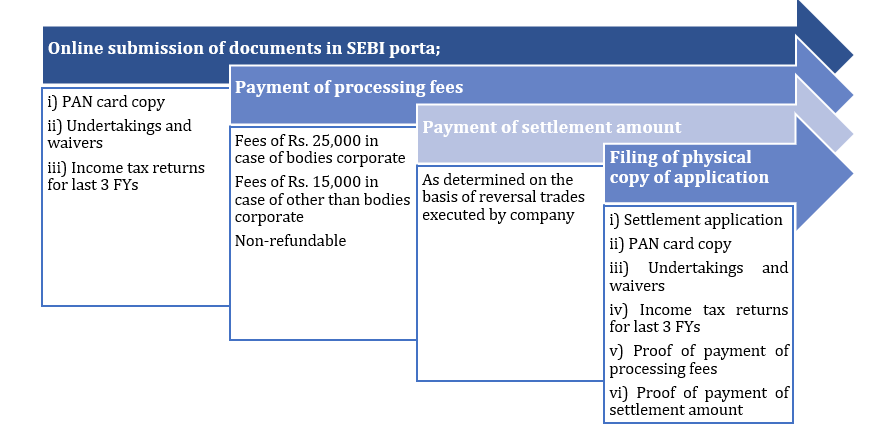
3. The settlement amount gets automatically calculated. The payment amount is segregated as follows:
a)     Settlement amount (as calculated using the 0.55 factor) b)    Registration fees

For bodies corporate: Rs. 25,000

For individuals: Rs. 15,000

5. Mandatory attachments:

1.     Income tax returns for last 3 years

2.     Copy of PAN card of the entity/individual

3.     Undertaking and waivers as required under the SEBI (Settlement Proceedings) Regulations, 2018

5. Payment process:

For the purpose of making payment under the settlement scheme, the entity has to withdraw any pending proceeding in the said matter. After withdrawal, entities can use this web page for payment of settlement amount.

The settlement amount is directly proportionate to the artificial volume of trades executed by the entities. We have obtained data of 15 entities on sample basis for analysis of settlement amount. The same is represented below:

Sl.No. No. of contracts reversed No. of non-genuine trades executed


Artificial volume of trades Settlement amount
1. 107 970 7,97,21,572 39,77,500
2. 85 750 2,76,68,000 35,12,500
3. 21 396 2,00,25,000 25,72,500
4. 83 492 2,75,50,000 33,57,500
5. 210 512 1,21,77,000 39,77,500
6. 165 612 2,55,25,750 39,77,500
7. 1672 4968 30,70,27,560 83,17,500
8. 191 526 2,91,34,000 39,77,500
9. 12 92 2,79,61,000 21,17,500
10. 252 666 7,17,69,750 42,87,500
11. 14 83 1,22,92,500 19,62,500
12. 682 1646 7,16,45,000 50,62,500
13. 9 194 81,29,000 21,07,500
14. 14 116 1,25,98,000 21,07,500
15. 61 332 3,37,92,000 30,47,500


Hence, basis the aforesaid table, we understand that higher the artificial trades executed, the higher will be the settlement amount. However, the point of focus here is where SEBI has levied fine of approximately Rs. 5 lakhs on entities, why will entities pay a higher settlement amount then the actual fine. Further, the whole intent of settling a proceeding is to settle it at a lower cost than actual fine. Here, the fine ranges around Rs. 5 lakhs, however, the settlement amount ranges from Rs. 20 lakhs and may go upto Rs, 83 lakhs or even higher.

Process of availing the settlement scheme

Whether settlement proceedings shall avoid scrutiny of IT department?

As regards penal provisions under IT provisions are concerned, the details of trading in illiquid stock options is linked to the PAN details of the entity. Further, the portal also requires to attach the ITR of last three years of the entity.

In this regard, whether the intent of the settlement proceeding is also to channelize information and link the proceedings with IT department, is still unknown. Further, the fate of intention of entities to delay/waive the IT proceedings by either challenging the SEBI order in higher court or settling the proceedings shall be seen only when IT departments start sending letters to such entities.

Generally, settlement refers to neither admitting nor denying any non-compliance. Therefore, entities opting for settlement scheme may have a better chance before the IT department. However, whether this can also safeguard entities them from being penalised by the IT authorities is uncertain.

Conclusion

The entities who opt for settlement scheme has to pay the settlement amount through the portal after withdrawing any pending proceedings. As regards, entities which do not opt for such schemes, the proceedings, as is, shall continue.


Our presentation can be viewed here: https://www.youtube.com/watch?v=CK6QOm4k8Rw 

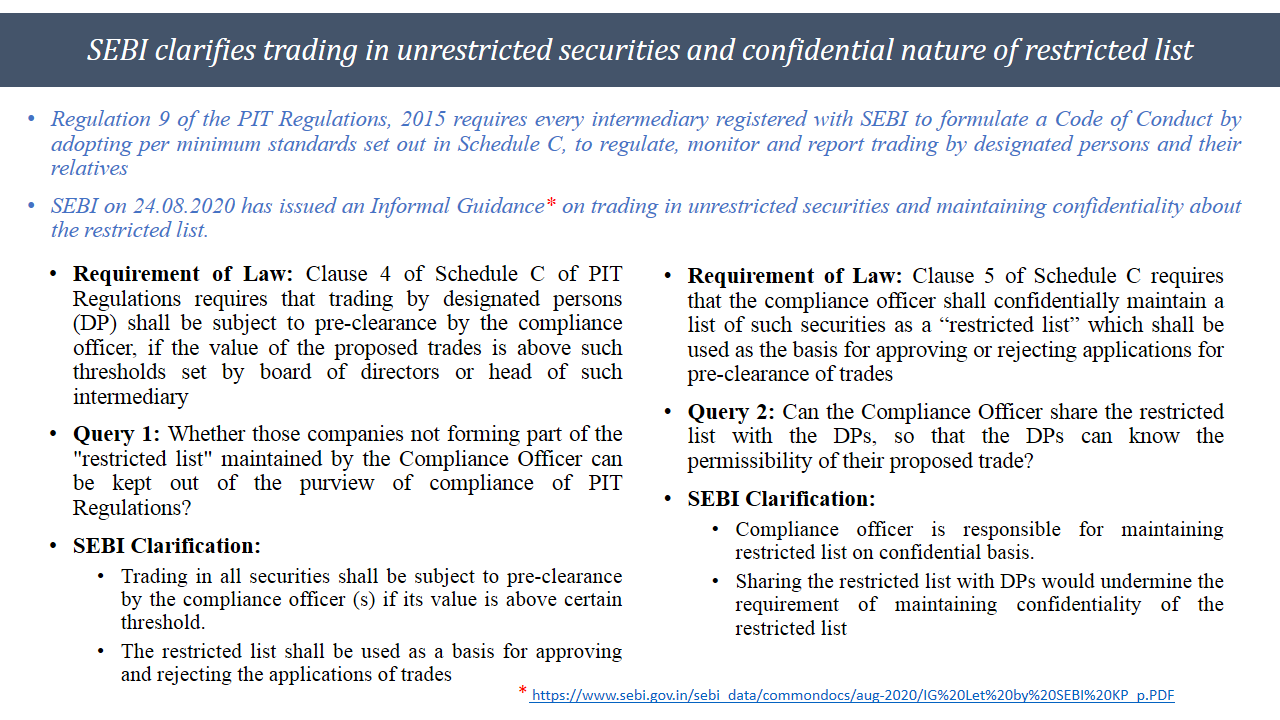
SEBI clarifies trading in unrestricted securities and confidential nature of restricted list

corplaw@vinodkothari.com

Link to Informal Guidance – https://www.sebi.gov.in/sebi_data/commondocs/aug-2020/IG%20Let%20by%20SEBI%20KP_p.PDF

SEBI prescribes stricter regime for Proxy advisors

corplaw@vinodkothari.com

SEBI has on 03rd August, 2020, issued procedural guidelines for Proxy Advisors nearly a year after the Report of the Working Group on Proxy Advisors was published. Read our analysis on the same below. Read more

Update: PSCs get another year to comply with MPS requirements

Ankit Vashishth, Executive

Vinod Kothari and Company; corplaw@vinodkothari.com

To prevent concentration of shares in the hands of a few market players and to ensure a sound and healthy public float to stave off any manipulation or perpetration of other unethical activities in the securities market, it is imperative that the shareholding of listed companies is not blocked by promoters and certain percentage of free float is available for trading by the public.  Regulation 19A of the Securities Contracts (Regulation) Rules, 1957 mandates all listed companies to maintain a Minimum Public Shareholding (‘MPS’) of 25%. Further, to comply with the said requirement, SEBI vide its circulars dated November 30, 2015[1] and February 22, 2018[2] prescribed the manner for achieving MPS.

The timeline for achieving MPS varies for listed public sector companies and listed companies. With regard to the listed public sector companies, the deadline to meet the MPS was 2 years from the commencement of the Securities Contracts (Regulation) (Second Amendment) Rules, 2018[3]  which expired on 2nd August, 2020.

Considering the unfavorable market conditions and difficulty in meeting the MPS requirement during the outbreak of the pandemic, the Ministry of Finance has vide its notification dated July 31, 2020[4] has extended the time period by 1 year i.e. till August 2, 2021 for listed public sector companies.

Initiation of MPS for PSCs

MPS requirements for listed public sector companies initiated in the year 2010[5], when these companies were given a timeline of 3 years to comply with 10% MPS requirements.

Later, as per prevalent market conditions the Central Govt. in August, 2014[6] increased this threshold to 25% and these companies were given a timeline of 3 years to comply with MPS requirement which was subsequently increased to 4 years in July, 2017[7]. Considering the difficulty faced by such companies in diluting their shareholding, the Central Govt. in August 2018[8], allowed a fresh timeline of 2 years i.e. upto August 2, 2020 to such companies to comply with such requirements.

Current Scenario

PSUs constitute around 7.22% of the capital market in India and according to the shareholding data provided by bsepsu.com[9] there are a total of 64 listed CPSEs in India out of which 26 of them have less than 25% public shareholding. This list is dominated by companies which include Hindustan Aeronautics Ltd, General Insurance Corporation of India, Indian Railway Catering & Tourism Corporation Ltd, New India Assurance Company Ltd and counting. There are even such companies in which more than 90% of the shareholding is alone held by the government.

Central Government in Dec, 2019[10] gave ‘in-principle’ approval for strategic disinvestment of 33 CPSEs including subsidiaries, units and Joint Ventures with sale of majority stake of Government of India and transfer of management control. Also, companies like Rites Limited[11] and Coal India Limited[12] in recent times have tried to meet MPS requirements via Offer for Sale.

Due to Covid-19 pandemic, the stock market has already crashed and is now showing small signs of revival. Where listed companies are unable to comply with normal regulatory requirements in this current environment which are constant and urgent in nature, the extension in its 4th attempt to the PSCs will save them from the badge of non-compliance.

Read our similar write ups:

https://vinodkothari.com/2017/09/sebis-yet-another-move-to-ensure-minimum-public-shareholding/

https://vinodkothari.com/2018/02/sebi-qualifies-qip-for-achieving-mps/

Read our other articles on Corplaw : https://vinodkothari.com/category/corporate-laws/

Link to our Youtube Channel : https://www.youtube.com/channel/UCgzB-ZviIMcuA_1uv6jATbg

[1] https://www.sebi.gov.in/legal/circulars/nov-2015/manner-of-achieving-minimum-public-shareholding_31141.html

[2] https://www.sebi.gov.in/legal/circulars/feb-2018/manner-of-achieving-minimum-public-shareholding_37953.html

[3] http://www.egazette.nic.in/WriteReadData/2018/188171.pdf

[4] http://egazette.nic.in/WriteReadData/2020/220809.pdf

[5] http://egazette.nic.in/WriteReadData/2010/E_440_2011_011.pdf

[6] https://www.sebi.gov.in/legal/rules/aug-2014/notification-securities-contracts-regulation-second-amendment-rules-2014_28373.html

[7]  https://www.sebi.gov.in/legal/rules/jul-2017/securities-contracts-regulation-third-amendment-rules-2017-w-e-f-july-3-2017-_35291.html

[8] http://www.egazette.nic.in/WriteReadData/2018/188171.pdf

[9] http://www.bsepsu.com/gov-policy-hp.asp

[10] https://pib.gov.in/Pressreleaseshare.aspx?PRID=1594731

[11] https://rites.com/upload/misc/Balancesheet/INTIMATION-FOR-RITES-EMPLOYEE-OFS.pdf

[12] https://www.coalindia.in/DesktopModules/DocumentList/documents/10112018182944.pdf

SEBI requires Mutual Funds to carry out 10% trades in Corporate Bonds through RFQ platform

-Mahesh Jethani (finserv@vinodkothari.com)

Background

SEBI on the recommendations of Mutual Fund Advisory Committee (MFAC) on July 22, 2020 has issued a circular with an intent to accelerate the transactions in Corporate Bonds and Commercial Papers and to enhance the transparency and disclosure pertaining to debt schemes. This move from the capital market regulator makes it mandatory for the mutual funds to undertake at least 10% (in value) of their secondary market trades in corporate bonds through the Request for Quote (RFQ) platform of stock exchanges from October. In this write-up we intend to explore the nitty-gritties of Request for Quote (RFQ) platform, how does it operate, how is it different from EBP, what are the requirements and the potential impact of these new requirements.

Request for Quote (RFQ) Platform of stock exchanges

Request for Quote (RFQ) platform is meant for execution and settlement of trades. It is a renowned mechanism and is used across the globe in premier stock exchanges like London Stock Exchange (LSE) and New York Stock Exchange (NYSE). This platform was launched by BSE and NSE on 4th February 2020, as a part of continuous measures taken for development of an online order matching platform for corporate bonds by exchanges or jointly by regulated institutions.

What is RFQ platform?

Request for Quote’ (RFQ) is a web based online trade execution and settlement platform which allows interaction amongst the market participants who intend to negotiate transactions amongst themselves. It is a part of existing reporting and settlement platform of NSE’s (CBRICS) and BSE’s (NDS-RST) for corporate debt securities. RFQ is a trading mechanism where a quote by participants is provided in response to a request for quote by initiator. The quote will be executable only by requesting member and is based on mutual agreement on deal parameters. It is a participant to participant model which enables dealing and execution in various debt securities such as corporate bonds, securitized debt instruments, municipal debt securities, Government securities, State development loans, treasury bills, commercial papers and certificates of deposit etc.

All regulated entities, listed corporates, Institutional Investors as defined under SEBI (Issue of Capital and Disclosure Requirements) Regulations, 2018, All India Financial Institutions and any other entity as allowed by Exchange from time to time will be eligible to participate on the RFQ platform. The initiators and responders will include any of the aforesaid entities.

How does RFQ operate?

What is Electronic Bidding Platform (EBP) and how is it different from RFQ?

EBP is a mechanism for issuance of debt securities on private placement basis. It helps to reduce the time and cost of new issue of securities. The circular dated January 05, 2018 issued by SEBI has mandated that every new issue of debt securities and non-convertible redeemable preference shares (NCRPS) on private placement basis with an issue size of INR 200 crores and above, inclusive of green shoe option (if any) shall use this platform. Our detailed analysis on the EBP Platform along with various parameters can be read here.

Automated order matching trading platform

EBP varies from RFQ in the sense that, in RFQ the participant-to-participant model is followed wherein the deal parameters are based on mutual consent and is not an automated order matching trading platform. EBP on the other hand is a bidding process which has prescribed requirements that are to be met after that, the auction is carried out and the initial cut-off rate is determined by the system which is computed on the base issue size However, the participants on RFQ platform can deal as per their best interests and the control is with the initiator or respondent.

Secondary market trading and primary market issuance:

It is to be noted that, RFQ is a secondary market trading mechanism and EBP platform is for primary issuance that was launched long back in 2016 and was modified in order to streamline procedures for primary issuance of debt securities on private placement basis. Earlier the new issue size was capped at INR 500 crores and above, which is now reduced to INR 200 crores and above to widen the coverage. However, issue sizes less than INR 200 crores can also utilise this platform voluntarily. On RFQ platform the trades which are to be executed have a requirement which prescribes that is minimum RFQ size should be in multiples of face value with minimum size to be accepted as Rs. 5 lac or face value, whichever is higher.

Compliance requirements:

The requirement of venturing to EBP route is to be complied by entities who have their ‘specified securities’ listed on any recognised stock exchanges as prescribed in SEBI (Issue and Listing of Debt Securities) Regulations, 2008 and SEBI (Issue and Listing of Non-Convertible Redeemable Preference Shares) Regulations 2013. Unlisted entities can follow the procedure specified under the Companies Act, 2013 and relevant rules made thereunder. In the HR Khan Committee Report on Development of Corporate Bonds, it was recommended to extend the applicability of EBP to all the primary market issues.

While RFQ platform is to be utilised by regulated entities, listed corporates, institutional investors as defined under SEBI ICDR Regulations, 2018, All India Financial Institutions, and any other entity as allowed by exchanges from time to time for trading in debt securities.

What are the new requirements?

SEBI in its circular dated July 22, 2020 has introduced some requirements that are some small steps towards enhancing the bandwidth of the debt market. There are two new measures introduced by the capital market regulator with an intent to increase the liquidity on exchange platform- 10% trades by MFs in Corporate Bonds, and to enhance transparency and disclosure pertaining to debt schemes and investments by mutual funds in Corporate Bonds and Commercial Papers- disclosure of debt schemes on fortnightly basis. These are the rules which were introduced and shall come into force with effect from October 1, 2020:
1. Mutual Funds shall undertake at least 10% of their total secondary market trades by value in the Corporate Bonds by placing/seeking quotes through one-to-many mode on the Request for Quote (RFQ) platform of stock exchanges. This will not include Inter Scheme Transfer (IST) which is the process of a mutual fund scheme selling specific securities to another scheme within the fund house. It is an alternative to otherwise selling the assets outside. This would have prevented increase in volume of real transactions.

2. 10% shall be reckoned on the average of secondary trades by value in immediately preceding 3 months on rolling basis. Let us understand this an example-

For instance, in the month of October 2020 to comply with the new requirement, following calculation will have to be done:

In October 2020, Mutual Funds shall undertake 10% (by value) of their average secondary market trades (excluding IST) done in immediately preceding three months i.e. July 2020, August 2020 and September 2020 for Corporate Bonds by placing/ seeking quotes through RFQ platform of stock exchanges.

Exposure required for the month of October 2020 (Amount in crores)
Month Secondary Market Trades IST Trades excluding IST Average of last 3 months Deals to be executed using RFQ platform

(10% of preceding 3 months)

July 1314332.71 22452.72 1291879.99 1385871.687 138587.1687
August 1353072 21814.93 1331257.07
September 1547560 13082 1534478

3. It is required to be noted that any transaction entered by mutual fund in Corporate Bonds in one-to-many mode that gets executed with another mutual fund, shall also be counted for another mutual fund for the aforesaid 10% requirement. The intent here is to encourage the participation by mutual funds when the quote is initiated for Corporate Bonds, as it will ensure compliance to the 10% requirement.

4. Also, SEBI has partially modified the circular dated September 13, 2012 which now makes it essential for debt schemes that the disclosures shall be done on fortnightly basis within 5 days of every fortnight. In addition to the current portfolio disclosure, yield of the instrument shall also be disclosed. Earlier, the part of circular which is modified, required disclosures monthly and no specific requirement was there to disclose yield of instrument. This move will ensure enhanced transparency.

Potential impact of the new requirements

It is well recognised now, that sophisticated corporate bond market accelerates the growth of economy by complementing the banking system to provide an alternative source of finance for investment needs. This is among one of the many initiatives such as EBP, information repositories that provide consolidated data, tri-party repo trading on exchanges etc. are taken by regulators that are crucial in building a vibrant Corporate Bond market.

This will enhance the liquidity to a certain extent in Corporate Debt securities. A mere 10% of total value of secondary market trades is an optimistic number as earlier there was no mandatory requirement at all. The recent statistics on SEBI website show that the total fund deployment of all Mutual Funds towards Corporate Debt securities was roughly around 30.32% in March 2020 and has in June 2020 reduced to 24.15%.

The RFQ platform provides users a range of options to seek a quote and to respond to a quote, while keeping an audit trail of all the interactions i.e. quoted yield, mutually agreed price, deal terms etc. This will bring pre-trade transparency and disclosures for over the counter transactions in Corporate Debt securities. The requirement of disclosure of schemes at a fortnightly basis will enable the investors to react as quickly as possible. Disclosure of reliable, timely information is a factor that contributes to liquid and efficient markets by enabling investors to make investment decisions based on all the available information that would be material to their decisions.

Concluding Remarks

The overall market of the corporate debt market in India is yet to evolve in terms of enabling vibrancy and depth as almost 90% of the issuances are privately placed. The new requirements are just another addition to the measures which regulators are constantly coming up which vary from introduction of Electronic Book Mechanism, we have separately covered this in a detailed write-up that can be found here to introducing the framework by SEBI which mandated Large Corporates to raise 25 per cent of their funding need from the bond market in Budget 2018-19, detailed write-up can be found here. The combined effect of all the untiring efforts of SEBI will go a long way for developing a vibrant and liquid corporate bond market in India.


Amendments in SEBI (PIT) Regulations, 2015: From April, 2019 to July, 2020

corplaw@vinodkothari.com

Watch our Youtube video for the subject: https://www.youtube.com/watch?v=Ly3KaQblJBE


Shareholder scrutiny for payout under Listing Regulations to directors

– Understanding the capping rationale

Pammy Jaiswal | Partner

Shaifali Sharma | Assistant Manager

Vinod Kothari and Company; corplaw@vinodkothari.com

Background

The remuneration payable to the directors of a public company is regulated by the provisions of Section 197 read with Schedule V of the Companies Act, 2013 (Act). It provides a ceiling on the maximum remuneration that can be paid to the directors both in aggregate as well categorically, including Whole-time Director, Managing Director and the Manager.

Any payment to such directors within the said limits has to be approved by the shareholders by way of an ordinary resolution. Payment of remuneration in excess of the limits requires approval of the shareholders by way of a special resolution.

There were no specific provisions prescribed under the SEBI (Listing Obligations and Disclosure Requirements) Regulations, 2015 (‘Listing Regulations’) on maximum remuneration payable to directors of listed entities until SEBI, on the basis of recommendation of Kotak Committee on Corporate Governance, amended the Listing Regulations to put a ceiling on remuneration payable to executive promoter directors and non-executive directors.

This article tries to critically analyze the intent and deduce the interpretation of the aforesaid capping under the Listing Regulations.

Absolute versus relative limits- reading between the lines

Regulation 17 (6) (e) of the Listing Regulations reads as under:

“The fees or compensation payable to executive directors who are promoters or members of the promoter group, shall be subject to the approval of the shareholders by special resolution in general meeting, if-

(i) the annual remuneration payable to such executive director exceeds rupees 5 crore or 2.5 per cent of the net profits of the listed entity, whichever is higher; or

(ii) where there is more than one such director, the aggregate annual remuneration to such directors exceeds 5 per cent of the net profits of the listed entity:

Provided that the approval of the shareholders under this provision shall be valid only till the expiry of the term of such director.

Explanation: For the purposes of this clause, net profits shall be calculated as per section 198 of the Companies Act, 2013.

On the very first reading of Regulation 17 (6) (e), we understand that in case the listed company has one executive promoter director, it can pay upto 2.5% of the net profits or INR 5 crore, whichever is higher, without passing a special resolution.

In case of more than one such director in the company, the relative limit of 2.5% is doubled to 5% of the net profits, however, the absolute limit of INR 5 crore has not been mentioned under sub-clause (ii) of the said sub-regulation.

This makes it all the more important for us to read between the lines and interpret the meaning as intended by the law-makers. As mentioned, the first sub-clause provides both a relative and an absolute limit for the purpose of securing shareholder scrutiny. In fact, the said clause clearly mentions that higher of the relative or absolute limit has to be considered while determining the need to approach the shareholders.

Accordingly, it may seem to be an incorrect reading if companies consider only the relative limit for the second sub-clause. In such a scenario, companies may end up considering a far lower limit than INR 5 crores which the law makers have already fixed for one promoter executive director in the first sub clause.

Approval requirements under the Act viz-a-viz requirements under Listing Regulations


A. Payment of remuneration to executive promoter directors of a listed public company

As per the Report[1] of the Kotak Committee constituted by SEBI, several cases of disproportionate payments made to executive promoter directors as compared to other executive directors were noted and therefore, the Committee with the view to improve the standards on Corporate Governance, suggested that this issue should be subjected to greater shareholder scrutiny. Accordingly, the amendment carved a parallel way for obtaining shareholder’s approval if the total remuneration paid to executive promoter director exceeds the prescribed limits.

The above recommendation has already come into effect from April 01, 2019 and therefore the listed entities, in addition to the threshold limits prescribed u/s 197 of the Act, have to adhere to the ceiling laid down u/r 17(6)(e) of the Listing Regulations.

Below is the comparison of the threshold limits prescribed under Act and Listing Regulations for payment of remuneration to executive promoter director, in excess of which shareholders’ approval by special resolution shall be required:

Special Resolution required if: Under the Companies Act, 2013 Under SEBI Listing Regulations
Remuneration payable to a single executive director* Exceeds 5% of the net profits of the company Exceeds Rs. 5 crore (absolute limit) or 2.5% of the net profit (relative limit), whichever is higher
Remuneration payable to all executive director* Exceeds 10% of the net profits of the company Exceeds 5% of the net profits of the company

* Listing Regulations caps the limit for executive directors who are promoters or members of promoter group

From above, it is evident that the Act allows public listed companies to pay remuneration to its executive directors upto 5% or 10% of its net profits, as the case may be, (without passing special resolution) which is double the relative thresholds prescribed under Listing Regulations i.e. 2.5% or 5% of the net profits.

Illustrations:

Illustration 1 –Payment within the limits laid down under the Act and also Listing Regulations

Type of shareholder approval required – Ordinary resolution under the Act

Illustration 2-Payment exceeds Listing Regulations limits but is within limits of the Act

Let us take a numerical example for this case:

Situation Permissible remuneration to a single executive promoter director Permissible aggregate remuneration to more than 1 executive promoter directors
Act LISTING REGULATIONS Act LISTING REGULATIONS
Company has profits of 10 crore


·    5% of NP


0.5 crore

Higher of

·    2.5% of NP; or

·    5 crore


5 crores

·    10% of NP


1 crore

·    5% of NP


0.5 crore


Remarks:

In case of single executive promoter director: 

  • Permissible remuneration under Listing Regulations  (5 crore) is much higher than amount (0.5 crores) under the Act. In such cases, there is a clear cut conflict between the two legislations. On one hand where Listing Regulations  allows payment upto INR 5 crores to one such director (which in this case constitutes 50% of the NP), the company in question will be required to pass SR under the Act.
  • Accordingly, providing for a higher payout amongst the relative and absolute limit, in the first sub-clause does not seem to achieve the intent of SEBI to increase the Corporate Governance standards by scrutinizing disproportionate payments to this category.

In case of more than 1 executive promoter director:

  • As soon as we move to second situation, the amount available for payment of remuneration stands reduced drastically. The permissible remuneration under Listing Regulations will be INR 0.5 crore whereas, the Act allows payment upto INR 1 crore.

Illustration 3 – Payment exceeds the limits under the Act and automatically exceeds the limits under Listing Regulations (not considering the absolute limit)

Here the case is simple, SR is required to be passed.

Illustration 4 – Company has inadequate profits for the purpose of section 197 read with Schedule V of the Act

In case the minimum remuneration approved falls within the limits provided against the effective capital – OR is sufficient, however, for the purpose of Listing Regulations, SR will be required. In this case, Listing Regulations are stricter as it does not envisage inadequacy of profits and amounts that can be paid in case inadequacy.

However, if the minimum remuneration approved exceeds the limits provided against the effective capital, SR is required under the Act and such payment can be made only for three financial years with certain other disclosure requirements.

Having said that, it is important to note that once SR under the Act has been passed for payment of remuneration either in cases of adequate or inadequateprofits, there does not seem to be any need to pass another SR under Listing Regulations  for breach of the limits set therein.


B. Payment of remuneration to non-executive directors of a listed public company

The Kotak Committee on corporate governance further observed that certain non-executive directors (NEDs) (generally promoter directors) are receiving disproportionate remuneration from the total pool available for all other NEDs and recommended that if remuneration of a single NED exceeds 50% of the pool being distributed to the NEDs as a whole, shareholder approval should be required.

SEBI, in line with the above proposal and the requirement for special resolution for executive promoter directors, amended Listing Regulations and inserted following clause (ca) to Regulation 17(6):

“The approval of shareholders by special resolution shall be obtained every year, in which the annual remuneration payable to a single non-executive director exceeds fifty per cent of the total annual remuneration payable to all non-executive directors, giving details of the remuneration thereof”

The above amendment has also come into effect from April 01, 2019 and therefore, requires an action on the part of the listed entities to pass SR for such disproportionate payment to any one of its NED.

Some companies have already passed an SR in the AGM held for the financial year 2018-19 while other companies are preparing to pass the same in this year. The reason behind such two school of thoughts is based on the following reasons:

  1. Remuneration to a single NED for the FY 2018-19, which is basically profit linked commission, has been paid after 1st April, 2019. Some companies which have already taken the SR in the AGM held for the FY 2018-2019 have done so considering the payment being done post the advent of the aforesaid amendment.
  2. Remuneration to a single NED for the FY 2019- 2020 will be taken to the shareholders if it exceeds the limits. Here the companies which did not approach its shareholders in the AGM held for the FY 2018-2019 is based on the understanding that this amendment has come into force from 1st April, 2019 which means the same is to be complied with for the remuneration payable for FY 2019-2020. Therefore, according to the second school of thought, no SR is required for the disproportionate payment made in FY 2019-2020 for the FY 2018-2019[2].

Concluding Remarks

While the amendment of capping the limits for payout to executive promoter directors does not seem to meet the intent of the law makers, the amendment for passing SR for disproportionate payout to a single NED seems to be much more justified.

It was rightly mentioned in the Kotak Committee report that in future SEBI could review the status of the amendment relating to payout to executive promoter directors based on experience gained. As per the discussions above, it is imperative to draw attention firstly to the absence of the absolute limits in the second sub-clause of this sub-Regulation and even though the same is read with by inserting the same, it may seem to be futile for sole reason of SRs already passed by the companies under the Act. Further, clarity is needed for requirement to seek approval for payment of minimum remuneration in case of inadequacy of profits.

Since, MCA had already prescribed the limits and procedures under the Act for managerial remuneration, SEBI may relook at the capping scrutinylaid down for executive promoter directors and possible could align the same with the provisions of the Act. The intent is not to simply seek special resolution for every item of managerial remuneration as abundant caution.

Other reading materials on the similar topic:

  1. ‘FAQs on SEBI (Listing Obligations and Disclosure Requirements) (Amendment) Regulations, 2018’ can be viewed here
  2. Presentation on ‘Appointment & Remuneration of Managerial Personnel & KMPs’ can be viewed here
  3. ‘Managerial Remuneration: A five decades old control cedes’ can be viewed here
  4. ‘Remunerating NEDs and IDs in low-profit or no-profit years’ can be viewed here
  5. Our other articles on various topics can be read at: https://vinodkothari.com/

Email id for further queries: corplaw@vinodkotahri.com

Our website: www.vinodkothari.com

Our Youtube Channel: https://www.youtube.com/channel/UCgzB-ZviIMcuA_1uv6jATbg


[1]https://www.sebi.gov.in/reports/reports/oct-2017/report-of-the-committee-on-corporate-governance_36177.html

[2]Read our related article on the topic, here

SEBI prescribes norms for structured digital database, system driven disclosures & CoC violations

CS Vinita Nair, Senior Partner | Vinod Kothari & Company

July 23, 2020

Link to gazette notification: http://egazette.nic.in/WriteReadData/2020/220574.pdf

Effective date: July 17, 2020

Background

SEBI in the Board meeting held on June 25, 2020 (‘SEBI BM’) discussed amendments in PIT Regulations on Structured Digital Database, continual disclosures and amendments in the Code of Conduct (CoC).

This article discusses the position prior to amendment, relevant discussion at SEBI BM and actionable post amendment.

Structured Digital Database (SDD-1)

Prior to the amendment

Reg 3(5) of the regulations provided maintenance of SDD-1 with names of persons with whom UPSI was shared and PAN/ any other identifier of the person (where PAN was not available). SDD was required to be maintained with adequate internal controls and checks such as time stamping and audit trails to ensure non-tampering of the database.

The regulation indicated that just the listed entity is required to maintain the same. However, SEBI clarified in the guidance note, pursuant to an insertion made on July 5, 2019, that the requirement to maintain SDD-1 was applicable to listed companies, and intermediaries and fiduciaries who handle UPSI of a listed company in the course of business operations.

Discussion in SEBI BM

As per the agenda of the SEBI BM It was proposed to specify following in relation to SDD:

  • Nature of UPSI;
  • Details of persons or entities who have shared;
  • Period of preservation of SDD-1;
  • Prohibiting entities from outsourcing the same.

Post amendment

  • SDD-1 is required to be maintained by the Board of directors or heads of organization of every person required to handle UPSI;
  • SDD-1 shall additionally contain the name of the person sharing the UPSI.
    • So the names of person sharing and the one with whom the same is shared will be recorded along with PAN/ any other identifier of the person (where PAN was not available).
  • SDD-1 shall be maintained internally and not be outsourced.
  • SDD-1 to be preserved for a period of 8 years after completion of relevant transactions or even longer in case of pending proceedings.

System Driven Disclosures (SDD-2)

Prior to the amendment

Continual disclosures under Reg 7 (2) (b) was required to be made by the promoters, member of promoter group and designated persons to the stock exchanges within two trading days of receipt of the disclosure or becoming aware of such information. System driven disclosure was implemented vide SEBI Circular dated May 28, 2018 only for The CEO and upto two levels below CEO of a company and all directors. The database was submitted to the depositories along with PAN of the individuals.

Discussion in SEBI BM

Investigation of delay or non-compliance due to manual submissions takes up considerable time and effort and clogs the system. In order to eliminate it was proposed to automate the process of filing such disclosures by way of SDD-2 thereby enabling timely and fair disclosure without intervention of entities involved. SEBI will be issued detailed circular on the same to the market participants.

Post amendment

Reg 7 (2) (c) inserted to provide enabling power for issue of format and manner of submitting SDD-2.

Exemption from trading window restrictions

Prior to the amendment

Trading window restriction was not applicable on transactions specified in proviso to Reg 4 (1), in respect of pledge for a bonafide purpose and transactions undertaken in accordance with respective SEBI Regulations such as acquisition by conversion of warrants or debentures, subscribing to rights issue, further public issue, preferential allotment or tendering of shares in a buy-back offer, open offer, delisting offer.

Discussion in SEBI BM

Offer for sale was not included in the said list despite SEBI having laid detailed procedure for the same.

Post amendment

Enabling clause inserted to include the transactions which are undertaken through such other mechanism as may be specified by the Board from time to time. SEBI vide Circular dated July 23, 2020 provided that trading window restriction shall not apply in case of rights entitlement and Offer for Sale.

Crediting the amount for CoC non-compliance to IPEF

Prior to the amendment

Only profits from contra trade were disgorged and credited to Investor Protection and Education Fund (IPEF) administered by SEBI. The listed entity had the option to take disciplinary action including by way of recovery, clawback.

Discussion in SEBI BM

The listed entity could take action against person violating the CoC by way of disciplinary actions viz. wage cut, collecting of certain amount etc. There was no uniform approach w.r.t. utilization of amounts levied by the listed entities/ intermediaries/ fiduciaries for other violations of CoC viz. trades during window closure, trade without pre-clearance etc.

Also, a clawback is generally a contractual agreement between the employee and the employer in which the employee agrees to return previously paid or vested remuneration to the employer under certain circumstances. However, every employment agreement may not have a “clawback” clause or provision. Whereas, disgorgement as an equitable remedy, aimed at depriving the wrongdoer of his ill-gotten gains. It was suggested to substitute ‘clawback’ with ‘disgorgement’.

Post amendment

Any amount collected for violation of CoC shall also be remitted to SEBI for credit to the IPEF. The word ‘clawback’ has been deleted in Schedule B and Schedule C. SEBI vide Circular dated July 23, 2020 has provided that such amounts shall be credited to the IPEF through the online mode or by way of a demand draft (DD) in favour of the Board (i.e. SEBI – IPEF) payable at Mumbai. The bank account details of SEBI – IPEF for online transfer is given below:

Informing violation of PIT Regulations to Stock Exchange

Prior to the amendment

Violation of PIT Regulations was required to be informed to SEBI. SEBI vide Circular dated July 19, 2019 prescribed format for standardized reporting of violations under CoC.

Discussion in SEBI BM

The intimations received from listed companies/ intermediaries/fiduciaries were maintained in non IT based environment. To ensure that such intimations were captured electronically in an IT based environment to create a data repository, which could be used for conducting examination of cases or for any other data analysis, in future, it was recommended to file intimations with the stock exchanges.

Post amendment

The violations will be required to be reported to the stock exchanges in the form and manner as may be prescribed by SEBI. SEBI vide Circular dated July 23, 2020 prescribed the format in supersession of July, 2019 circular.

Whether the intimations filed with the stock exchanges will be publicly available, is not clear.

Comparison of formats

The format is broadly similar to that prescribed in July, 2019, however, has following modifications:

Particulars

July, 2020 Circular July, 2019 Circular

Remarks 

Details of DP Whether the DP is promoter or belongs to promoter group Whether the DP is promoter /promoter group/ holding CXO level position (e.g. CEO, CFO, CTO etc). The details highlighted is anyways provided under Designation of DP and Functional role of DP. This seemed repetition.
Details of transaction No of shares traded and value (Rs.) (Date- wise) No of shares traded (which includes pledge) and value (Rs.) (Date- wise). The legislative note under definition of ‘trading’ in the Regulations clarify that trade includes pledge.
Details of violations Details of violations observed under Code of Conduct. Details of violations observed under SEBI (PIT) Regulations, 2015. Reference aligned with Para 12 of Schedule B of the Regulations.
Amount collected for CoC violation ·       Mode of transfer to IPEF (Online/ DD)

·       Details of the transfer.

No such field. It seems that the amount is to be first transferred and thereafter, reporting is to be done as payment details is required to be furnished.

Actionables for the listed entities/ intermediaries/fiduciaries

SDD-1

Maintenance of SDD-1 to be ensured with details of persons sharing the UPSI.  SDD to be preserved for minimum 8 years from completion of relevant transactions. Internal control manual/ SOP, if any, will be required to be updated to capture the amendment.

SDD-1 may be maintained by Compliance Officer or may be maintained by various functional heads who are in possession of UPSI and share the same for legitimate purpose. The Compliance Officer should have access to the same as that is required for deciding of pre-clearance for the trades by DPs.

SDD-2

Reporting continual disclosure in SDD-2 after the format is prescribed by SEBI. In case SEBI decides to implement SDD-2 in the manner it implemented in 2018, the listed entity will be required to furnish name and PAN details of promoter, member of promoter group and all designated persons to the depository.

CoC

The CoC will be required to be amended to capture the amendments by removing reference of clawback provision and specifying to deposit amounts collected for violation to IPEF.

Violation of the regulations and of CoC to be reported to the stock exchange instead of SEBI by listed entity/ intermediary/ fiduciary in the format provided by SEBI vide circulated dated July 23, 2020.