Digital lending Balloon: Navigating the path to growth

-Dayita Kanodia, Executive finserv@vinodkothari.com

“Ignoring technological change in a financial system based upon technology is like a mouse starving to death because someone moved their cheese.” – Chris Skinner[1]

Unprecedented growth of the sector

From pawnbrokers lending money in exchange for collateral to the use of sophisticated technologies to carry out credit underwriting, the landscape of lending business has evolved significantly in the last century. Today, it is hard to find a financial institution which is carrying on business without digitising any aspect of its lending process. With rapid advancements in cloud computing, artificial intelligence, and blockchain, as well as faster and more affordable internet connectivity, it is safe to say that the brick and mortar model for lending business will soon be a matter of the past.

The Global Digital Lending Market is valued at USD 11.33 Billion in the year 2022 and is anticipated to reach a value of USD 30.77 Billion by the year 2030. [2]

Read more

NCLAT gives a go signal to the Go Airlines insolvency application

– Neha Malu, Senior Executive & Tanay Dubey, Legal Intern | resolution@vinodkothari.com

Background

In India, airline companies prefer acquiring aircrafts through lease rather than buying them. According to a report released by PwC, as of 2018, around 80% of India’s commercial aircrafts are leased, much more than the global average of leased commercial aircrafts as compared to commercial aircrafts in use, 53%. According to the report, airlines prefer leasing aircrafts predominantly due to two reasons: first, the lower overall cost of leasing which allows the airlines company to spend available capital on giving price advantage to the price sensitive customers in India and; second, because of the shorter fleet replacement cycles, leasing aircrafts provides airlines an option to quickly increase or decrease the capacity, thereby keeping the fleet younger.

Go Airlines, an ultra-low-cost airline, possesses a fleet of 54 aircraft, with the majority obtained through leasing arrangements with different aircraft lessor companies. Unfortunately, the airline is currently facing financial difficulties caused by the non-delivery of engines from Pratt and Whitney (P&W), a US-based jet engine manufacturer. As a result, they have been compelled to ground over 50 planes. Due to concerns about the feasibility of the CIRP and the airline’s revival, the lessors want to recover their aircrafts from the airline.

Go Airlines (‘Corporate Applicant’) has been defaulting towards the aircrafts lessors, vendors, and financial creditors from 2022 onwards. In order to keep the company as a going concern and retain the possession of leased aircrafts, the Corporate Applicant filed an application under Section 10 of Insolvency and Bankruptcy Code, 2016 (‘IBC’). The umbrella of moratorium was opened for Go Airlines after its voluntary application for resolution under section 10 of IBC was admitted by the NCLT leading to a complete prohibition on transfer of any of the leased aircrafts which were in possession of Go Airlines as on the date of admission of the CIRP application. In the present case, though the lessors of the aircrafts had terminated the lease agreement days before the admission of the CIRP application by NCLT, the possession remained to be transferred to the lessor as on the date of admission.

An appeal was preferred by the lessors against the order of the NCLT contending that the said application was filed with fraudulent and malicious intent. Further, the lessors were not given the notice providing for an opportunity of hearing before admitting the application. In addition to this, given the fact that the lease agreement was cancelled by the lessor prior to the admission of CIRP application, the Corporate Applicant has no legal right to claim possession and moratorium under Section 14(1)(d) of IBC on the assets of the lessor.  

Read more

Succession planning: failing to plan is planning to fail

-Anushka Vohra | Manager | anushka@vinodkothari.com

The article was also published in the CRA E-Bulletin and can be viewed here

Background

Passing the torch, lighting the way – an expression that can be used to refer to succession planning. Be it a household, business organization or institution, succession planning is needed everywhere. In a household, as the family possessions and culture are passed on, it is simply termed as continuing the legacy. In an HUF, according to HUF laws, after the Karta (head of the HUF) dies, the senior most coparcener becomes the head of the HUF. In corporates, the larger the scale and complexity of business, the need for succession planning becomes much more important. Unlike in the case of a household, corporates involve the livelihood and interests of thousands of people,  i.e., the shareholders, vendors, customers and other stakeholders. The intent of succession planning is not to oust the leader from his / her position but to prepare the next generation to become the future leaders. Succession planning is required to ensure smooth running of business. The torch bearer (leader here), has to groom his / her successor to take over his role.

In an organization, succession planning is an important element of corporate governance. In this write-up, the author has tried to emphasize on the need and importance of succession planning.

Read more

Publications | 11th Securitisation Summit

11th Securitisation Summit, 2023 home page – https://vinodkothari.com/secsummit

Glimpses of the Summit can be viewed and downloaded from this link – https://drive.google.com/drive/folders/1bVJM8vqysqDtXqQhmSkIzWSdjCBFh5DD?usp=sharing
Loader Loading…
EAD Logo Taking too long?

Reload Reload document
| Open Open in new tab

Download as PDF [4.69 MB]

Whitepaper on Co-lending

Whitepaper on Green Securitisation in India

Whitepaper on Securitisation of Infrastructure Assets in India

Compendium of legal articles on Structured Finance

Presentation used by Mr. Mark Adelson during the Summit

Presentation used by Mr. RV Verma during the Summit

Profile of Speaker | 11th Securitisation Summit, 2023

Summit home page – https://vinodkothari.com/secsummit/

Loader Loading…
EAD Logo Taking too long?

Reload Reload document
| Open Open in new tab

Download as PDF [683.93 KB]

Fast Track Merger- finally on a faster track

– Barsha Dikshit, Partner | resolution@vinodkothari.com

The objective of promoting ‘ease of doing business in India’ had made the Ministries introduce some really momentous concepts and corresponding changes in law. One of such moves taken by the Ministry of Corporate affairs (‘MCA’), was introduction of section 233 of the Companies Act, 2013 (‘Act’) dealing with “Merger and amalgamation of certain types of companies” vide notification dated 7th December, 2016, [1] thereby offering an alternative mode to certain classes of companies for entering into scheme of merger or amalgamation. The idea was to process the scheme of arrangements involving wholly owned subsidiaries or small companies in a cost effective and comparatively swift way. However, upon the practical implementation of the provision, it was seen that the time taken by the authorities for disposal of such applications and issuing confirmation orders to the schemes was longer than expected and therefore, the provision was losing its relevance.

It is in the backdrop of such delays, MCA, vide notification dated 15th May, 2023 (yet to be published in e-gazette) has introduced certain amendments in the Companies (Compromise, Arrangements, and Amalgamations) Rules, 2015 (‘CAA Rules’) ensuring faster disposal of applications u/s 233 of the Act. The amendments shall be effective w.e.f. 15th June, 2023.

This article intends to discuss the amendments introduced by MCA and to gauge the effectiveness of the same.

Read more

Shorn of tax benefit, MLDs now face tax deduction on payouts

Dayita Kanodia | Executive

finserv@vinodkothari.com

Background

The Finance Bill, 2023[1], has quite nearly caused the demise of the so-called “Market-Linked Debentures” (MLDs)[2]. The changes made pursuant to the Finance Bill, 2023, took away what seemed to be a strong reason for popularity of MLDs, i.e., the tax arbitrage.

Prior to the change, listed MLDs had the advantage of being exempt from the withholding tax under section 193 of the Income Tax Act, 1961, as well as being taxed at 10% as Long Term Capital Gains (LTCG) tax, if held for at least 12 months.

Finance Bill, 2023 inserts a new section 50AA to the Income Tax Act, 1961, which makes MLDs to be taxed at slab rates as a short term capital asset in all cases at the time of  transfer or redemption on maturity, irrespective of the period of holding, therefore losing out on the earlier lower LTCG rate of 10%.

In addition, the earlier exemption from withholding tax on listed debentures has now been removed pursuant to an amendment in section 193, which means that interest paid on listed debentures would now be subject to withholding tax with effect from April 01, 2023[3].

Read more

A poem on the problem of climate change, environment and clean energy

किसी पेड़ ने उस पंछी को अब तक नहीं उड़ाया है
जिसने शाखें नहीं उजाड़ी केवल फल को खाया है

चिड़ी चोंच भर ले जाती है नदी नीर क्या कम होता?
प्यास बुझाकर प्यासे की कब कम होता जल का सोता
शिशु को दूध पिला कर किस माता की घटती काया है?

जब तक सीमाकरण न होगा पर्यावरण बचेगा क्या?
कोटि दुयोधन हाथ, द्रौपदी का आभरण बचेगा क्या?
मोह सँवरण नहीं, प्रकृति का कल्पवृक्ष बच पाया है ?

अगर प्रश्न है जठर अग्नि का जल के कितने स्रोत रखे
कोई ऐसा पेय नहीं जो काम अग्नि को बुझा सके
संयति के दृढ़ तीर न होंगे कब सागर रुक पाया है ?

प्रश्न यह नहीं इस वाहन को कैसी शक्ति चलायेगी
जब तक गति पर रोक न होगी बात वहीं रह जाएगी
सुविधा के गमले में कब शिव का बरगद उग पाया है

Agenda – 11th Securitisation Summit | May 19, 2023

Summit home page can be viewed here: https://vinodkothari.com/secsummit/

Loader Loading…
EAD Logo Taking too long?

Reload Reload document
| Open Open in new tab

Download as PDF [76.03 KB]

Need for strategic vision in CSR spending by companies

– Pammy Jaiswal, Partner | corplaw@vinodkothari.com

The article was also published in the CRA E-Bulletin and can be viewed here

Background

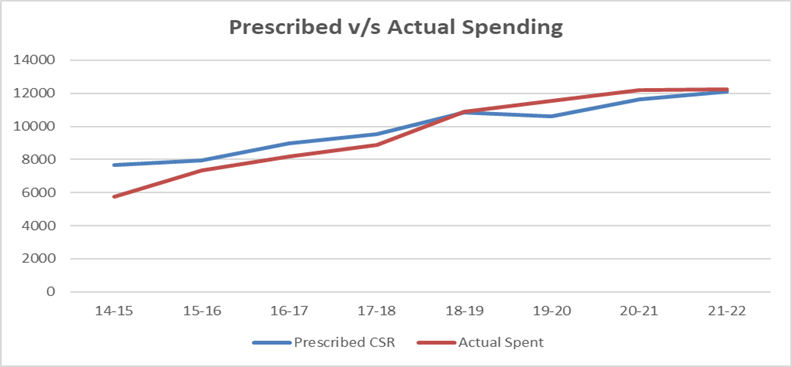
While the sense of ‘Corporate Social Responsibility’ (‘CSR’) might have been the result of the statute, first on a “comply or explain” basis, and later, as a mandate, it is heartening to note that companies are now not looking at CSR as a mere compulsion, but are seeing this as an instrument for social bridge-building. As is well known, the provisions were introduced, arguably as a unique case globally, in 2014 under the Companies Act, 2013 (‘Act’). From that year till FY 2021-2022, companies have spent approximately INR 1,39,202 crores[1] on CSR activities. In fact, it is pleasantly surprising to note that companies have been targeting to spend their minimum obligations; the gap between the prescribed spending and the actual spending has consistently been narrowing as can be seen from the graph given below.  With the introduction of the Companies Corporate Social Responsibility Policy (Amendment) Rules, 2021[2], read with the changes under section 135 of the Act pursuant to the Companies (Amendment) Act, 2019[3], an element of penalty for not doing the needful has been added, at the same time permitting companies to overspend their obligation and claim a set off within the next 3 years, there are several companies which are spending more than their targets.

   Data Source: India CSR Outlook Reports

Having said that, it will be important to discuss whether spending itself will help attain the motive for which the CSR framework was introduced? CSR is a part of a larger business responsibility and sustainability.  If companies confine their CSR ideologies to simply adding up to a requirement of spending amount, will the society get back what it ought to be getting back form a responsible business?  Should companies look at CSR beyond mere spending, and construct a CSR vision based on the negative footprints created by their activities, if any, or otherwise, create social impact relevant to their businesses?

Read more