Financing transition from “brown” to “green”

SEBI prescribes additional requirements for transition bonds

– Mahak Agarwal, Executive | corplaw@vinodkothari.com

Need for transition finance

As climate change and its impacts continue to remain one of the major concerns of any economy, transition finance is a step towards effectively transforming carbon emissions and combating climate change.

‘Transition Bonds’, as the word speaks for itself, are debt instruments that facilitate transition of a carbon-intensive business into decarbonizing business and eventually achieving the Net Zero emissions targets.

While it is true that change is the only constant, it cannot be denied that the same can often be challenging. Similar is the case with enterprises looking to metamorphosize their activities into a sustainable form. A huge amount of finance is required for carbon-intensive sectors to decarbonize and it is here that transition bonds find their application.

Read more

Amendments to KYC Directions including non- face-to-face KYC

Anita Baid in conversation with Vinod Kothari

Evince your interest here – https://forms.gle/JLaVk6n1mBHdsw4h9

Live on YouTube – https://www.youtube.com/channel/UCgzB-ZviIMcuA_1uv6jATbg/videos

Loader Loading…
EAD Logo Taking too long?

Reload Reload document
| Open Open in new tab

Download as PDF [745.13 KB]

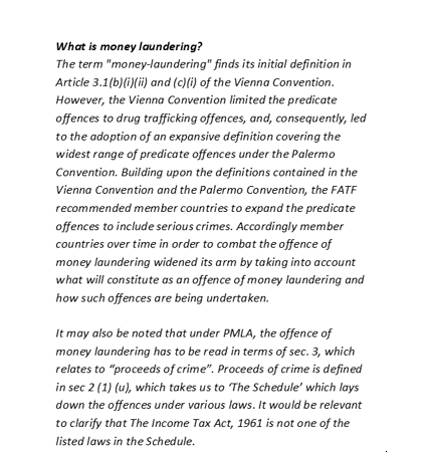
Practicing professionals as reporting entities under PMLA

Ministry of Finance notification notifies certain client transactions by CA, CS and CMAs for money laundering law

– Team Finserv | finserv@vinodkothari.com

Brief Background

The Ministry of Finance vide notification dated May 03, 2023 (‘Notification’) has widened the ambit of the term “Reporting Entity” as defined in Section 2(1)(wa), read with sec. 2 (1)(sa) of the Prevention of Money Laundering Act, 2002 (‘PMLA’). The Notification, which has already created a lot of flutter, seems to bring practising corporate professionals (CAs, CSs, CMAs), if the said corporate professionals are carrying certain “financial transactions” on behalf of their clients.

At its first reading, one may either take a very aggressive view, to regard all practising corporate  professionals as being “reporting entities”. However, a finer reading suggests that only such professionals, who are carrying specified financial transactions on behalf of their clients, are covered as reporting entities. We discuss this below.

Our YouTube video on the topic discussing the changes brought in by the said notification and its implications is available here – https://www.youtube.com/watch?v=hWdeFfVcnQM
Read more

Legal Entity Identifier Code now mandatory for bond issuers

Ajay Ramanathan, Executive | ajay@vinodkothari.com

Background

Legal Entity Identifier (LEI) Code is a unique 20-digit code used to identify legal entities that engage in financial transactions worldwide in order to improve the quality and accuracy of financial data systems for better risk management post the global financial crisis by establishing a global reference system.

Prior to the present SEBI Circular, all non-individual borrowers availing an aggregate exposure[1] of Rs. 5 crore and above from banks and financial institutions were mandated to obtain LEI Code over the prescribed timeline.

Read more

Security Interest: Meaning, forms, registration, enforcement, and effects of non-registration

-Team Vinod Kothari and Company | resolution@vinodkothari.com

Loader Loading…
EAD Logo Taking too long?

Reload Reload document
| Open Open in new tab

Download as PDF [901.29 KB]

Continuing Disclosures by listed entities: Regulation 30 of SEBI LODR

– Vinod Kothari | corplaw@vinodkothari.com

Loader Loading…
EAD Logo Taking too long?

Reload Reload document
| Open Open in new tab

Download as PDF [911.96 KB]

Our article on Reg 30 of LODR Regulations can be viewed here

Amended KYC norms: A move towards faceless KYC

RBI amends KYC norms to permit faceless KYC; beneficial owner of 10% or more to be subjected to KYC

– Anita Baid, Vice President | anita@vinodkothari.com

Recognising the increasing trend towards faceless lending, and the use of technology for customer due diligence, the RBI has made much-needed changes in the KYC process, permitting lenders to avoid any of physical interface with borrowers and rely on documents stored in Digilocker or other e-documents. Amendments, immediately effective, were made to the Master Direction – Know Your Customer (KYC) Direction, 2016 vide a notification dated April 28, 2023.

Watch our YouTube video on the topic here – https://www.youtube.com/live/Ewi4FW8G0xk?feature=share

The amendments in the KYC Directions are applicable to every entity regulated by the RBI, including but not limited to banks, cooperative banks, payment system providers, AIFIs  as well as NBFCs intend to achieve the following:

Read more

Income tax issues in IBC

-Vinod Kothari and Sikha Bansal | finserv@vinodkothari.com

Loader Loading…
EAD Logo Taking too long?

Reload Reload document
| Open Open in new tab

Download as PDF [1.99 MB]

Presentation on Annual Secretarial Compliance report

– Vinita Nair, Senior Partner | corplaw@vinodkothari.com

Loader Loading…
EAD Logo Taking too long?

Reload Reload document
| Open Open in new tab

Download as PDF [602.72 KB]