SEBI proposes enhanced disclosures for meetings with analyst, investors, etc.

– To curb information asymmetry and risk of divulging UPSI

 Shaifali Sharma | Vinod Kothari and Company

corplaw@vinodkothari.com

Introduction

Analyst and investor meets are one of the many ways of communicating and sharing information. Conducting periodical meetings, conferences, one-to-one meetings or con-calls with analysts or investors who wish to know more about the company, its historic performance, financial details, future prospects, etc. is a common practice for the listed entities.  The most common amongst these meetings are the earning calls which is called immediately following the release of the quarterly or annual financial results. Whereas, one-to-one meets or conference calls with selective investors/ analysts are also conducted in the normal course of business of the companies.

With the intent to rule out any information asymmetry in the market, the schedule, presentations or any information material used during such  analyst or institutional investor meetings are required to be disclosed by companies to stock exchange(s) and also hosted on the company’s website as required under the SEBI (Listing Obligations and Disclosure Requirements), Regulations, 2015 (‘Listing Regulations’).

Moreover, the SEBI (Prohibition of Insider Trading) Regulations, 2015 (‘PIT Regulations’) requires fair disclosure of material events and therefore, provides principles for fair disclosure which includes

  • publication of transcripts or recordings of analyst/ investor meetings on company’s website; and
  • ensuring information shared with analysts and research personnel is not an unpublished price sensitive information (‘UPSI’).

The governing Regulations are discussed in this article.

However, looking at the practice of most of the listed companies, it has been observed that such disclosures are simply box ticking exercise where disclosure of mere PowerPoint slides of presentation are given instead of what is discussed in the meeting to give an example.

The concerns relating to disclosures in respect of analyst meets/ institutional investors meet/ conference calls were discussed by Primary Market Advisory Committee (‘PMAC’) constituted by SEBI in July, 2020 which then formulated a Sub-Group to recommend specific disclosure requirements to strengthen analyst/ investor meets. In this regard, a ‘Report on disclosures pertaining to analyst meets, investor meets and conference calls[1]’ (‘Report’) has been issued on November 20, 2020 seeking public comments on or before December 21, 2020. The Sub-Group has recommended to make the disclosure requirements optional for the initial one year and mandatory thereafter for all the listed companies. This article attempts to analyse the recommendations and their probable impact on the current regime under the Listing Regulations and PIT Regulations.

Further, on perusing the Report it has been observed that it explicitly distinguishes between scheduled meeting with the analysts and investors and unscheduled one-to-one calls with them. This article discusses the intention behind such distinction recognised by SEBI itself.

Current Regulatory Framework in India governing Analyst/ Institutional Meets

Listing Regulations

Regulation 46(2)(o) of the Listing Regulations requires the listed entity to disseminate the schedule of analyst or institutional investor meet and presentations made by the listed entity to analysts or institutional investors simultaneously with submitting the same to the stock exchange. The aforesaid Regulation is reproduced below:

“46(2) The listed entity shall disseminate the following information under a separate section on its website:

xxx

(o) schedule of analyst or institutional investor meet and presentations made by the listed entity to analysts or institutional investors simultaneously with submission to stock exchange;”

Further, Part A(A)(15) of Schedule III of the Listing Regulations read with SEBI circular[2] dated September 09, 2015, requires the listed entity to disclose the schedule of analyst or institutional investor meet and presentations on financial results made to such analysts or institutional investors without any application of the guidelines for materiality as specified u/r 30(4) of the Listing Regulations.

Furthermore, Part C(8)(e) of Schedule V of the Listing Regulations requires the listed entity to disclose the presentations made to the institutional investors or analysts in the section on the Corporate Governance of the Annual Report under the head ‘Means of Communication’.

Apart from above requirements, principles governing disclosures and obligations of listed entity shall be simultaneously conformed viz.  to provide adequate and timely information to recognised stock exchange(s) and investors, provide adequate and timely information to shareholders, to ensure timely and accurate disclosure on all material matters including the financial situation, performance, ownership, and governance of the listed entity, etc. 

PIT Regulations

Pursuant to Regulation 8 of PIT Regulations, every listed company is required to formulate a Code of Fair Disclosure and Conduct for fair and timely disclosure of UPSI in compliance with the principles set out in Schedule A to the PIT Regulations. The principles of fair disclosure w.r.t analyst meet is as follows

  • to ensure that information shared with analysts and research personnel is not UPSI; and
  • to develop best practices to make transcripts or records of proceedings of meetings with analysts and other investor relations conferences on the official website to ensure official confirmation and documentation of disclosures made.

Regulatory Regime in other Countries

Country Name Disclosure Requirement


USA
  • The Regulation FD[3] (for “Fair Disclosure”) issued by the Securities and Exchange Commission provides that an issuer or his official while entering into a private discussion with an analyst who is seeking guidance about earnings estimates, shall not communicate any material non-public information (MNPI).
  • It does not prohibit from communicating material non-public information to an analyst, the company may do so after making public disclosure of such information.
  • No practice of recording or transcribing the investor meetings
UK
  • Market Abuse Regulations[4] prevents companies from making selective disclosure of MNPI.  If the company do so, an immediate announcement would be required but it would still be a breach of the regulations
  • No practice of recording or transcribing these investor meetings
Singapore
  • Rule 703(4)[5] of the Singapore Exchange Listing Rules requires the issuer to observe the Corporate Disclosure Policy[6] as provided under Appendix 7.1. of the Rules. Para 23 under PART VIII of the Policy recommends the issuer to observe an “open door” policy in dealing with analysts, journalists, stockholders and others.
  • Issuer is required to abstain from disseminating material information which has not been disclosed to the public before. However, if such material information is inadvertently disclosed at meetings with analysts or others, it must be publicly disseminated as promptly as possible by the means described in Part VIII.
Canada
  • The Canadian Securities Exchange specifies prescribes Policy on ‘Timely Disclosures’[7] to be complied by the issuer. Para 7.1 provides that disclosure of information shall not be on selective basis. The policy classifies private meetings with analysts, brokers and investors as a good corporate governance activity. However, the policy provides that no material unpublished information is disseminated in such meetings.

Extant gaps in disclosure requirements

Information Asymmetry

As discussed above, the Listing Regulations require the listed entities to disclose the schedules and presentations for analyst or institutional investor meetings on its website and to the stock exchange(s) with 24 hours of the event taking place. However, except for few top companies, majority of the listed companies treat this as a mere formality. They disclose only the occurrence of analyst/ investor meets and circumvent disclosure of significant details of the said event.

As per the Report, it has been observed that the reports shared by the listed entities have information that does not have its source from quarterly results or investor presentation and thereby lead to selective sharing of information. Therefore, it is seen that there exists information asymmetry due to following the Regulations in letter and not in spirit.

Selective disclosure and Risk of divulging UPSI

Selective disclosure occurs when a company releases UPSI about the company to an individual or selective group of persons (e.g., analysts or institutional investors) before disclosing the information to the general public. It creates an adverse impact on market integrity similar to that of insider trading. Selective disclosure lead to asymmetry information.

For example, analyst/ investors during a one-to-one meet are provided with such price sensitive information which may not be disclosed in presentation or the financial results and is not available in public domain.

Therefore, issues concerning selective sharing of information, disclosure of incomplete information, inconsistency in the disclosures made by different listed companies have made it essential for SEBI to review the current regulatory requirements and further strengthen the disclosure regime.

Conflicting views of Kotak Committee on Investor/ Analyst meets

The Committee on Corporate Governance constituted under the Chairmanship of Mr. Uday Kotak Committee (‘Kotak Committee’) by SEBI issued its ‘Report on Corporate Governance[8]’ in October, 2017 wherein it took a contrary view and stated that disclosure of schedule of investor/ analyst meetings does not serve any practical purpose and therefore may not be required. Relevant extract provided below:

“The Committee was of the view that the disclosure of schedules of analyst/institutional investor meetings does not serve any practical purpose, and there have been instances of its misuse. Hence, the Committee recommended that the disclosure of schedules of analyst/institutional investor meetings may not be required. To clarify, the information to be shared at such meetings has to be strictly in compliance with the SEBI PIT Regulations.”

On the other hand, the present Report has considered institutional investors meet or conference call with analysts/ shareholders as a material event and emphasis has been placed on strengthening the disclosure framework. It is significant to note that while the Kotak Committee was of the view that putting up the schedule for investors meeting have the potential of being misused, the Sub-Group constituted by the PMAC holds a completely contrary view and has not recommended to do away with the said practice.

The Recommendations:  Enhanced disclosures w.r.t analyst / investor meets/ conference calls

New disclosure requirements pertaining to post-earnings conference calls/quarterly calls

Listed companies generally organise analyst / investor meetings or conference calls after the release of quarterly financial results. To curb any information asymmetry among different class of stakeholders, the following recommendations are proposed:

  • audio/video recordings
    • host on the website and share with the stock exchange(s)
    • immediately after the earnings call/ con-call/ analysts meeting before the next trading day or within 24 hours from the occurrence of event or information, whichever is earlier;
  • written transcripts
    • host on the website of the listed entity and respective stock exchanges within 5 working days after the event;
  • make available audio/video recordings and the written transcripts on the website
    • for a period of atleast 8 years in addition to the details disseminated on respective stock exchanges.

The idea is to immediately disclose any UPSI shared at such conference calls. Some of the top listed companies like Tata Steel[9], Reliance Industries[10], Infosys[11], Pricol Ltd[12], Power Finance Corporation Ltd[13], have already adopted the above practices and upload the audio/video recordings, transcripts of analysts / investor conference calls on their respective websites. The recommendations will now require the other listed companies to put in place an effective disclosure mechanism in this regard.

Discretion of companies to limit attendees of conference calls

Unlike in US, Indian listed companies generally restrict the conference calls to their respective analysts / investors only to avoid any unnecessary disruption of call, presence of competitors, etc.

However, genuine institutional investor or analyst may get excluded from participating in the meeting and thus, Sub-Group suggested that companies should make the provision of inclusion of certain individuals based on their request and on verification of their credentials.

Accordingly, Sub-Group has recommended to leave the discretion with the listed companies for deciding the participants for such meetings.

One-to-one meetings – Selective or effective disclosures?

Listed companies in their course of business are often seen conducting one-to-one meetings/ con-calls with investors / analysts (‘private meets’). Such private discussions are more risky due to the following:

  • unscheduled and unplanned;
  • company officials not prepared;
  • no presentation/ information statement for discussion;
  • greater risk of disclosing UPSI

Even if a company wishes to make public the proceeding of such meeting/ call, the investor may not agree to share private call records in public domain.

However, by disclosing one-to-one affairs, chances of information asymmetry will reduce. Also, other investors, particularly the minority investors, who are generally not a part of such meets may be benefitted from effective price discovery. Besides investors, regulatory authorities and stock exchanges will also be able to track such meets for any future references.

In view of the above, Sub-Group has made following recommendations:

  • listed companies to provide number of one-to-one meetings with select investors as part of corporate governance report submitted by them to stock exchanges on a quarterly basis;
  • an affirmation that no UPSI was shared by any official of the company in such meetings shall also be provided along with the corporate governance report;
  • company shall maintain a record of all such one-to-one meetings. The data should be preserved for a period of atleast 8 years.

Unlike in case of post-earning calls, it seems recording and disclosure of private meets is not required. It is always better to look before you leap, hence companies must consider recording such private meets (written or audio) and making it public to avert possibility of selective disclosure and leak of material information.

Further, in addition to the affirmation by official of company involved, a confirmation from the concerned party (investor/ analyst) shall also be obtained confirming that no material public information was shared with the concerned analyst during such meeting, and that the information shared in the meeting was only clarification of facts/information already available in public domain.

Concluding Remarks

After the recommendations of Kotak Committee in the year 2017 to discard the requirements of disclosing the schedule of analyst / institutional investor, a new approach of SEBI to enhance transparency and strength disclosure framework of analyst/ investor meets is evident from the recommendations of the Sub-Group.

An effective disclosure mechanism will be required to be put in place by companies for adequate and timely disclosures. A measure of ‘silent or quiet period’ may be adopted where companies for a specified period (generally prior to release of financial results) refrain from interaction with the analyst/ investor/ media in order to avoid inadvertent disclosures of UPSI on selective basis. To conclude, the recommendations seems to promote a culture of corporate governance encouraging companies to follow the compliance in spirit of law.


 Other reading materials on the similar topic:

  1. ‘A date to remember: Ad-hoc Analyst/Investor meets become a passé affair’ can be viewed here
  2. SEBI eliminates one-to-one analyst meets from the purview of LODR can be read here
  3. SEBI’S STEWARDSHIP CODE FOR INSTITUTIONAL INVESTORS can be read here
  4. Our other articles on various topics can be read at: https://vinodkothari.com/

Our Youtube Channel: https://www.youtube.com/channel/UCgzB-ZviIMcuA_1uv6jATbg


[1] https://www.sebi.gov.in/reports-and-statistics/reports/nov-2020/report-on-disclosures-pertaining-to-analyst-meets-investor-meets-and-conference-calls_48208.html

[2] https://www.sebi.gov.in/legal/circulars/sep-2015/continuous-disclosure-requirements-for-listed-entities-regulation-30-of-securities-and-exchange-board-of-india-listing-obligations-and-disclosure-requirements-regulations-2015_30634.html

[3] https://www.sec.gov/rules/final/33-7881.htm

[4] https://eur-lex.europa.eu/legal-content/EN/TXT/?uri=celex%3A32014R0596

[5] http://rulebook.sgx.com/rulebook/703-0

[6] http://rulebook.sgx.com/rulebook/appendix-71-corporate-disclosure-policy

[7]https://webfiles.thecse.com/resource/CSE%20Policy%205%20%E2%80%93%20Timely%20Disclosure,%20Trading%20Halts%20and%20Posting%20Requirements.pdf

[8] https://www.sebi.gov.in/reports/reports/oct-2017/report-of-the-committee-on-corporate-governance_36177.html

[9] https://www.tatasteel.com/investors/financial-performance/analyst-call-recording/

[10] https://www.ril.com/InvestorRelations/FinancialReporting.aspx

[11] https://www.infosys.com/investors/news-events/analyst-meet/2020/india/main.html

[12] https://www.pricol.com/investor-call-transcripts.aspx

[13] https://www.pfcindia.com/Home/VS/109
SEBI revisits mode of bidding in public issue of debt securities

Permits submission through UPI mechanism and online interface

-CS Henil Shah & CS Burhanuddin Dohadwala

corplaw@vinodkothari.com

Introduction

In order to streamline the process in case of public issue of debt securities and to add an addition to the current Application Supported by Blocked Amount (‘ASBA’) facility. Securities and Exchange Board of India (‘SEBI’) vide its circular dated November 23, 2020[1] (‘November 23 Circular’) has introduction Unified Payments Interface (‘UPI’) mechanism for the process of public issues of securities under:

  • SEBI (Issue and Listing of Debt Securities) Regulations, 2008 (‘ILDS Regulations’);
  • SEBI (Issue and Listing of Non-Convertible Redeemable Preference Shares) Regulations, 2013 (‘NCRPS Regulations’);
  • SEBI (Issue and Listing of Securitised Debt Instruments and Security Receipts) Regulations, 2008 (‘SDI Regulations’) and
  • SEBI (Issue and Listing of Municipal Debt Securities) Regulations, 2015 (‘ILDM Regulations’).

The said circular shall be effective to a public issue of securities for the aforesaid captioned regulations which opens on or after January 01, 2021 (‘effective date’).  Earlier, SEBI Circular dated July 27, 2012[2] (‘Erstwhile Circular’) provided the system for making application to public issue of debt securities.  The Erstwhile Circular will stand repealed from the effective date. However, SEBI Circular dated October 29, 2013[3] w.r.t allotment of debt securities shall continue to remain in force.

Earlier in November, 2018[4] SEBI had introduced use of UPI as a payment mechanism with ASBA, to streamline the process of public issue of equity shares and convertibles and implemented the same in 3 phases.

The article below covers the role required to be done by the issuer in case of public issue of debt securities.

Background

UPI[5] is an instant payment system developed by the National Payments Corporation of India (‘NPCI’), an RBI regulated entity. UPI is built over the IMPS (‘Immediate Payment Service’) infrastructure and allows you to instantly transfer money between any two parties’ bank accounts.

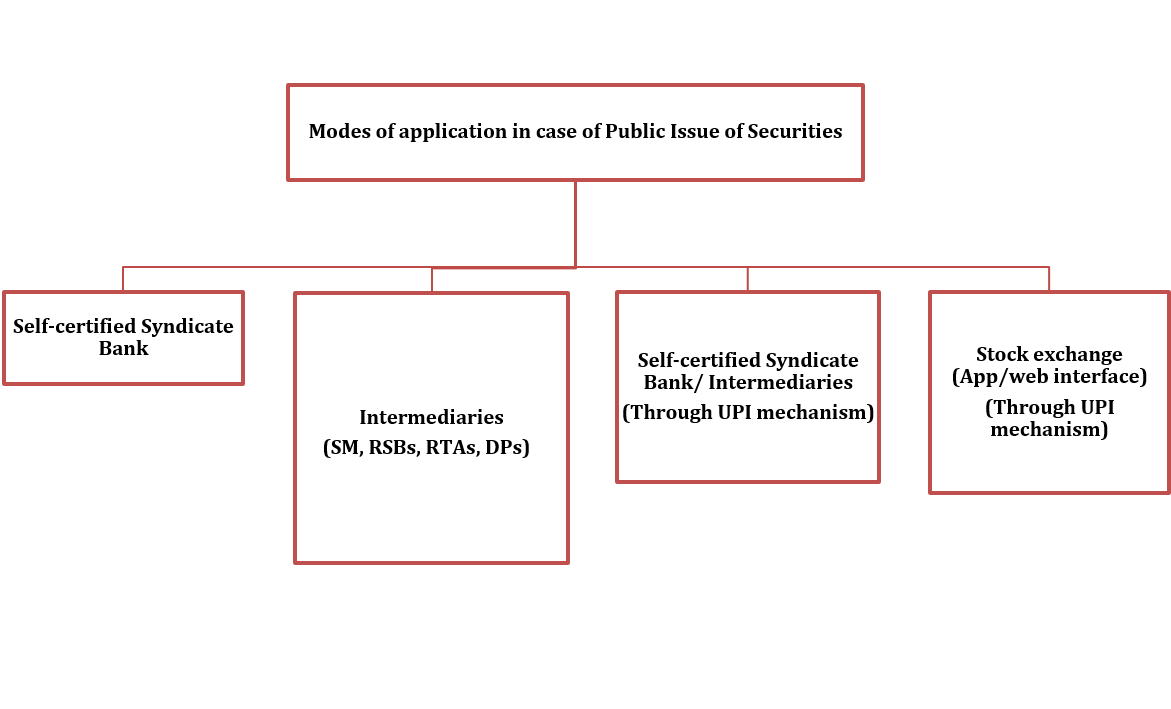
The facility to block funds through UPI mechanism whether applying through intermediaries (viz syndicate members, registered stock brokers, register and transfer agent and depository participants) or directly via Stock Exchange (‘SE’) app/ interface is set for upto and amount of Rs. 2 lakhs, which is the maximum limit approved by NPCI for capital markets vide its circular dated March 03, 2020[6].

Appointment of Sponsor Bank

Sponsor Bank as a term was introduced under the SEBI circular dated November 01, 2018 meaning a self-certified syndicate bank appointed by issuer to conduit/act as a channel with SE and NCPI to facilitate mandate collect requests and/or payment instructions of retail investors.

Comparison of mode of application under November 23 Circular and Erstwhile Circular

November 23 Circular Erstwhile Circular Remarks
Direct application through SE app/web-interface along with amount blocked via UPI mechanism. Direct application over the SE interface with online payment facility; Online payment facility stands replaced with UPI mechanism. However, it is not clear as to how the application to be submitted where amount to be invested is above 2 lac rupees.
Application through intermediaries along with details of his/her bank accounts for blocking funds Application through lead manager/syndicate member/sub-syndicate members/ trading members of SE using ASBA facility No change
Application through SCSBs with ASBA. Applications through banks using ASBA facility; No change
Application through SCSBs/intermediaries along with his/her bank account linked UPI ID for the purpose of blocking of funds, if the application value is Rs.2 lac or less.

New insertion.

Application through lead manager/syndicate member/sub-syndicate members/ trading members of SE without use of ASBA facility This was discontinued for all public issue of debt securities made on or after October 01, 2018 vide SEBI Circular dated August 16, 2018[7].

Application through lead manager/syndicate member/sub-syndicate members/ trading members of SE for applicants who intended to hold debt securities in physical form. No reference made in the present circular

Modes of submitting application as per November 23 Circular

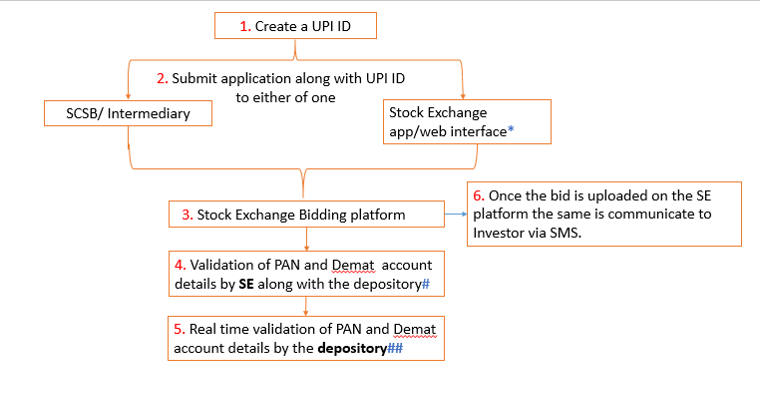
Process of the applying utilizing UPI mechanism is produced in a diagrammatic form as below:

* Application made on SE App/web interface shall automatically get updated on SE biding platform

# Upon bid being entered under the bidding platform SE shall undertake validation process of PAN and Demat account along with Depository.

## In case of any discrepancies the same are reported by depositories to SE which in turn relays the same to intermediaries for corrections.

Roles of issuer in case of public issue of debt securities

Apart from appointing a sponsor bank by the issuer the roles of issuer remain same as those already required under the SEBI circular dated July 27, 2012 i.e.:

  • Use of SE platform;
  • Entering to agreement with SE with respect to use of same;
  • Dispute resolution mechanism between the issuer and SE and maintenance of escrow account remain the same.

Only the aforesaid roles are aligned with newly introduced with UPI Mechanism.

Allotment of securities within 6 days

SEBI vide its circular dated November 10, 2015 had, in order to stream line the process of public issue of equity shares and convertibles issued a circular to reduce the timeline for issue from 12 working days to 6 working days and same was introduced for public issue of debt securities, NCRPS and SDI vide circular dated August 16, 2018[8]. The same has been re-iterated/repeated under the November 23 Circular. Indicative timelines for various activities are re-produced under Annexure-A.

Additional data details required to be mentioned under the Application and biding form relating to UPI

  1. Under Main Application form
  • Payment details –UPI ID with maximum length of 45 characters
  • Acknowledgement slip for SCSB/broker/RTA/DP
    • Payment details to include UPI
  • Acknowledgement slip for bidder
    • Payment details to include UPI ID
  1. Overleaf of Main Application form
  • UPI Mechanism for Blocking Fund would be available for Application value upto Rs. 2 Lakhs;
  • Bidder’s Undertaking and confirmation to include blocking of funds through UPI mode;
  • Instructions with respect to payment / payment instrument to include instructions for blocking of funds through UPI mode.

Conclusion

Public issue application using UPI is a step towards digitizing the offline processes involved in the application process by moving the same online. UPI mechanism in public issue process shall essentially bring in comfort, ease of use and reduce the listing time for public issues.

Annexure A:

Indicative timelines for various activities

Sr. No. Particulars Due Date (working day)
1. Issue Closes T (Issue closing date)
2.
  • SE(s) shall allow modification of selected fields (till 01:00 PM) in the bid details already uploaded.
  • Registrar to get the electronic bid details from the SE by end of the day.
  • SCSBs to continue / begin blocking of funds.
  • Designated    branches    of    SCSBs    may   not    accept    schedule    and applications after T+1 day.
  • Registrar to give bid file received from SE containing the application number and amount to all the SCSBs who may use this file for validation/ reconciliation at their end.
T+1
3.
  • Issuer, merchant banker and registrar to submit relevant documents to  the  SE(s)  except  listing  application,  allotment  details and   demat   credit   and   refund   details   for   the   purpose   of   listing permission.
  • SCSBs to send confirmation of funds blocked (Final Certificate) to the registrar by end of the day.
  • Registrar shall reconcile the compiled data received from the SE(s) and all SCSBs (hereinafter referred to as the “reconciled data”).
  • Registrar to undertake “Technical Rejection” test based on electronic bid details and prepare list of technical rejection cases.
T+2
4.
  • Finalization of technical rejection and minutes of the meeting between issuer, lead manager, registrar.
  • Registrar  shall  finalise  the  basis  of  allotment  and  submit  it  to  the designated SE for approval.
  • Designated SE to approve the basis of allotment.
  • Registrar to prepare funds transfer schedule based on approved basis of allotment.
  • Registrar and merchant banker to issue funds transfer instructions to SCSBs.
T+3
5.
  • SCSBs  to  credit  the  funds  in  public  issue  account  of  the  issuer  and confirm the same.
  • Issuer shall make the allotment.
  • Registrar/Issuer   to   initiate   corporate   action   for credit   of   debt securities, NCRPS, SDI to successful allottees.
  • Issuer  and  registrar  to  file  allotment  details  with  designated  stock exchange(s)  and  confirm  all  formalities  are  complete  except  demat credit.
  • Registrar  to  send  bank-wise  data  of  allottees, amount  due  on  debt securities,  NCRPS,  SDI allotted,  if  any,  and  balance  amount  to  be unblocked to SCSBs.
T+4
6.
  • Registrar to receive confirmation of demat credit from depositories.
  • Issuer and registrar to file confirmation of demat credit and issuance of instructions to unblock  ASBA  funds,  as  applicable,  with  SE(s).
  • The   lead   manager(s)   shall   ensure   that   the   allotment,   credit   of dematerialised debt securities, NCRPS, SDI and refund or unblocking of application monies, as may be applicable, are done electronically.
  • Issuer  to  make  a  listing  application  to  SE(s)  and  SE(s) to give listing and trading permission.
  • SE(s) to issue commencement of trading notice.
T+5
7. Trading commences; T+6

Our other materials on the topic can be read here –

[1] https://www.sebi.gov.in/legal/circulars/aug-2018/streamlining-the-process-of-public-issue-under-the-sebi-issue-and-listing-of-debt-securities-regulations-2008-sebi-issue-and-listing-of-non-convertible-redeemable-preference-shares-regulations-_40004.html

[2]https://www.sebi.gov.in/legal/circulars/jul-2012/system-for-making-application-to-public-issue-of-debt-securities_23166.html

[3]https://www.sebi.gov.in/legal/circulars/oct-2013/issues-pertaining-to-primary-issuance-of-debt-securities-amendment-to-simplified-debt-listing-agreement_25622.html

[4] https://www.sebi.gov.in/sebi_data/attachdocs/nov-2018/1541067380564.pdf

[5] https://www.sebi.gov.in/sebi_data/commondocs/mar-2019/useofunifiedpaymentinterfacefaq_p.pdf

[6] https://www.npci.org.in/PDF/npci/upi/circular/2020/UPI%20OC%2082%20-%20Implementation%20of%20Rs%20%202%20Lakh%20limit%20per%20transaction%20for%20specific%20categories%20in%20UPI.pdf

[7] https://www.sebi.gov.in/legal/circulars/aug-2018/streamlining-the-process-of-public-issue-under-the-sebi-issue-and-listing-of-debt-securities-regulations-2008-sebi-issue-and-listing-of-non-convertible-redeemable-preference-shares-regulations-_40004.html

[8]https://www.sebi.gov.in/legal/circulars/nov-2020/introduction-of-unified-payments-interface-upi-mechanism-and-application-through-online-interface-and-streamlining-the-process-of-public-issues-of-securities-under-sebi-issue-and-listing-of-debt-_48235.html

Dissolution without Resolution- A disguised Strike-off under IBC?

Megha Mittal

(resolution@vinodkothari.com)

In a first of its kind, the Hon’ble National Company Law Tribunal, Bengaluru Bench vide its order dated 16th November, 2020, in the matter of Synew Steel Private Limited[1], has ordered for direct dissolution from CIRP, thereby waiving off the mandatory requirement to undergo the liquidation process.

The said order was inspired by the fact that the corporate debtor had nil assets, which in turn made it certain that the liquidation process would not have been successful. Hence, to save the unfruitful costs that would have been incurred, the corporate debtor was allowed a direct dissolution.

In this article, the author makes a humble attempt to analyse this rather path-breaking order, and the implications it may carry.

Read more

2020 – Year of changes for AIFs

Timothy Lopes – Senior Executive                                                                             CS Harshil Matalia – Assistant Manager

finserv@vinodkothari.com

The year 2020 – ‘Year of pandemic’, rather we can say the year of astonishing events for everyone over the globe. Without any doubt, this year has also been a roller coaster ride for Alternative Investment Funds (‘AIFs’) with several changes in the regulatory framework governing AIFs in India.

Recent Regulatory Changes for AIFs

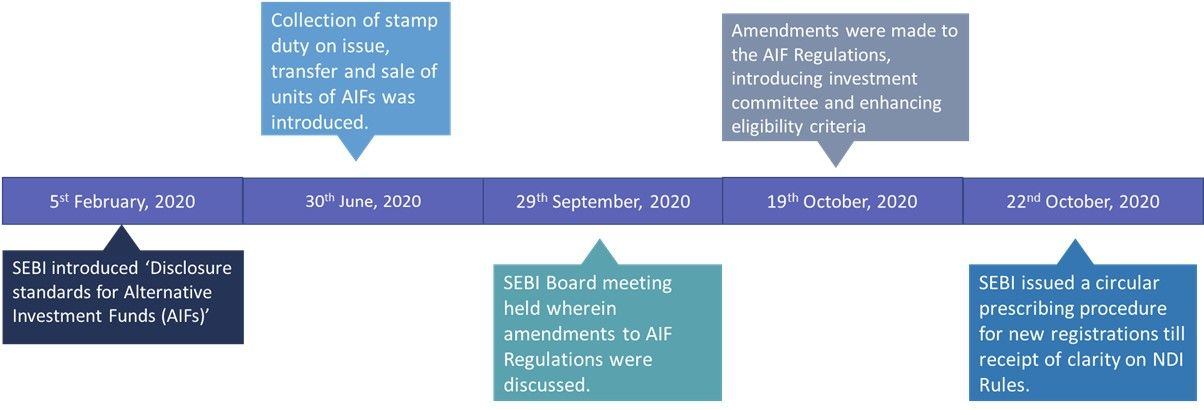
In continuation to the stream of changes, Securities Exchange Board of India (‘SEBI’), in its board meeting dated September 29, 2020, has approved certain amendments to the SEBI (Alternative Investment Funds) Regulations, 2012 (‘AIF Regulations’). The said amendments have been notified by the SEBI vide notification dated October 19, 2020. The following article throws some light on SEBI (AIFs) Amendment Regulations, 2020 (‘Amendment Regulations’) and tries to analyse its impact on AIFs.

Clarification on Eligibility Criteria

Regulation 4 of AIF Regulations prescribes eligibility criteria for obtaining registration as AIF with SEBI. Prior to the amendment,  Regulation 4(g), provided as follows:

“4 (g) the key investment team of the Manager of Alternative Investment Fund has adequate experience, with at least one key personnel having not less than five years experience in advising or managing pools of capital or in fund or asset or wealth or portfolio management or in the business of buying, selling and dealing of securities or other financial assets and has relevant professional qualification;”

The amended provision to 4 (g) extends the meaning of relevant professional qualification, the effect of which seems to add more qualitative criteria to the management team of the AIF, to be evaluated  at the time of grant of certification. The newly amended section 4(g) of the AIF Regulations reads as follow:

“(g) The key investment team of the Manager of Alternative Investment Fund has –

  • adequate experience, with at least one key personnel having not less than five years of experience in advising or managing pools of capital or in fund or asset or wealth or portfolio management or in the business of buying, selling and dealing of securities or other financial assets; and
  • at least one key personnel with professional qualification in finance, accountancy, business management, commerce, economics, capital market or banking from a university or an institution recognized by the Central Government or any State Government or a foreign university, or a CFA charter from the CFA institute or any other qualification as may be specified by the Board:

Provided that the requirements of experience and professional qualification as specified in regulation 4(g)(i) and 4(g)(ii) may also be fulfilled by the same key personnel.”

It is apparent from the prima facie comparison of language that the key investment team of the Manager may have one key person with five years of experience (quantitative) as well as a personnel holding professional qualification (qualitative) from institutions recognised under the regulation. Further, clarity has been appended in form of proviso to the section that quantitative and qualitative requirements could be met by either one person, or it could be achieved collectively by more than one person in the fund.

With this elaboration, SEBI has harmonized the qualification requirements as that with the requirement specified for other intermediaries such as Investment Advisers, Research Analysts etc. in their respective regulations. Detailed prescription on degrees and qualifications for AIF registration by SEBI is a conferring move and is expected to aid as a clear pre-requisite on expectations of SEBI from prospective applications for registration of the fund.

Formation of Investment Committee

Regulation 20 of AIF Regulations specifies general obligations of AIFs. Erstwhile, the responsibility of making investment decisions was upon the manager of AIFs. It has been noticed by the SEBI from the disclosures made in draft Private Placement Memorandums (‘PPMs’) filed by AIFs for launch of new schemes, that generally Managers prefer to constitute an Investment Committee to be involved in the process of taking investment decisions for the AIF. However, there was no corresponding obligation in the AIF Regulations explicitly recognizing the ‘Investment Committee’ to take investment decisions for AIFs. Such Investment Committees may comprise of internal or external members such as employees/directors/partners of the Manager, nominees of the Sponsor, employees of Group Companies of the Sponsor/ Manager, domain experts, investors or their nominees etc.

These  amendments are based on the recommendations to SEBI to recognize the practice followed by AIFs to delegate decision making to the Investment Committee.[1] The rationale behind amendments to AIF Regulations is based on the following merits as proposed in the recommendations::

  1. Presence of investors or Sponsors or their nominees in an Investment Committee which may serve to improve the due diligence carried out by the Manager, as they are stakeholders in the AIF’s investments.
  2. Presence of functional resources from affiliate/group companies of the Manager (legal advisor, compliance advisor, financial advisor etc.) in the Investment Committee may be useful to ensure compliance with all applicable laws.
  3. Presence of domain experts in the committee may provide comfort to the investors regarding suitability of the investment decisions, as the investment team of the Manager may not have domain expertise in all industries/ sectors where the fund proposes to invest.

Thus, the insertion was made, giving the option to the Manager to constitute an investment committee subject to the following conditions laid down in the newly inserted sub-regulation, i.e. Regulation 20(6) of the AIF Regulations given below –

  1. The members of the Investment Committee shall be equally responsible as the Manager for investment decisions of the AIF.
  2. The Manager and members of the Investment Committee shall jointly and severally ensure that the investments of the AIF comply with the provisions of AIF Regulations, the terms of the placement memorandum, agreement made with the investor, any other fund documents and any other applicable law.
  3. External members whose names are not disclosed in the placement memorandum or agreement made with the investor or any other fund documents at the time of on-boarding investors shall be appointed to the Investment Committee only with the consent of at least seventy five percent of the investors by value of their investment in the Alternative Investment Fund or scheme.
  4. Any other conditions as specified by the SEBI from time to time.

The constitution of investment committee is a global standard practice followed by the Funds. However, funds structure in India might be altered with the new defining role of investment committee under the AIF Regulations. The investment committee generally comprises of nominees of large investors in the fund and at times other external independent professional bodies that act as a consenting body towards prospective deals of the fund. The amendment will alter the role of investors holding positions at investment committee as the new defining role might deter them from taking underlying obligations. From the funds perspective seeking external independent professionals might get costly as there is an obligation introduced by way of this amendment regulation. Further, it casts an onus on the investment committee to be involved in day to day functioning of the fund, which used to be otherwise (where members were usually involved in mere finalising the deals).  Lateral entry of the members to investment committee post placement of memorandum with the consent of investors is aimed at greater transparency in funds functioning.

Test for indirect foreign investment by an AIF

As per Clause 4 of Schedule VIII of FEMA (Non-Debt Instrument) Rules, 2019 (‘NDI Rules’) any investment made by an Investment Vehicle into an Indian entity shall be reckoned as indirect foreign investment for the investee Indian entity if the Sponsor or the Manager or the Investment Manager –

(i) is not owned and not controlled by resident Indian citizens or;

(ii) is owned or controlled by persons resident outside India.

Therefore, in order to determine whether the investment made by AIFs in Indian entity is indirect foreign investment, it is essential to identify the nature of the Manager/Sponsor/investment manager, whether he is owned or controlled by a resident Indian citizen or person resident outside India.

RBI in its reply to SEBI’s query on downstream investment had clarified that since investment decisions of an AIF are taken by its Manager or Sponsor, the downstream investment guidelines for AIFs were focused on ownership and control of Manager or Sponsor. Thus, if the Manager or Sponsor is owned or controlled by a non-resident Indian citizen or by person resident outside India then investment made by such AIF shall be considered as indirect foreign investment.

Whether an investment decision made by the Investment Committee of AIF consisting of external members who are not Indian resident citizens would amount to indirect foreign investment?

In light of the above provisions of the NDI Rules and with the introduction of the concept of an “Investment Committee”, SEBI has sought clarification from the Government and RBI vide its letter dated September 07, 2020[2].

Conclusion

With the enhancement in eligibility criteria, SEBI has ensured that the investment management team of the AIF would have relevant expertise and required skill sets.

Further, giving recognition to the concept of an investment committee will cast an obligation on investment committee fiduciary like obligations towards all the investors in the fund. . However, there exists certain ambiguity under the NDI Rules, for applications wherein external members of investment committee who are not ‘resident Indian citizens’,   which is currently on hold and pending receipt of clarification.

[1] https://www.sebi.gov.in/sebi_data/meetingfiles/oct-2020/1602830063415_1.pdf

[2] https://www.sebi.gov.in/sebiweb/about/AboutAction.do?doBoardMeeting=yes

RBI aligns list of compoundable contraventions under FEMA with NDI Rules

‘Technical’ contravention subject to minimum compoundable amount, format for public disclosure of compounding orders revised.

– CS Burhanuddin Dohadwala | corplaw@vindkothari.com

Introduction

Compounding refers to the process of voluntarily admitting the contravention, pleading guilty and seeking redressal. It provides comfort to any person who contravenes any provisions of FEMA, 1999 [except section 3(a) of the Act] by minimizing transaction costs. Reserve Bank of India (‘RBI’) is empowered to compound any contraventions as defined under section 13 of FEMA, 1999 (‘the Act’) except the contravention under section 3(a) of the Act in the manner provided under Foreign Exchange (Compounding Proceedings) Rules, 2000. Provisions relating to compounding is updated in the RBI Master Direction-Compounding of Contraventions under FEMA, 1999[1].

Following are few advantages of compounding of offences:

  1. Short cut method to avoid litigation;
  2. No further proceeding will be initiated;
  3. Minimize litigation and reduces the burden of judiciary;

Present Circular

Pursuant to the supersession of FEM (Transfer or Issue of Security by a Person Resident Outside India) Regulations, 2017[2] (‘TISPRO”)and issuance of FEM (Non-Debt Instrument) Rules, 2019[3] [‘NDI Rules] and FEM (Mode of Payment and Reporting of Non-Debt Instruments) Regulations, 2019[4] [‘MPR Regulations’], RBI has updated the reference of the erstwhile regulations in line with the NDI Rules and MPR Regulations vide RBI Circular No.06 dated November 17, 2020[5] (‘Nov 2020 Circular’).

Additionally, the Nov 2020 Circular does away with the classification of a contravention as ‘technical’, as discussed later in the article.

Lastly, the Nov 2020 Circular modifies the format in which the compounding orders will be published on RBI’s website.

Compounding of contraventions relating to foreign investment

The power to compound contraventions under TISPRO delegated to the Regional Offices/ Sub Offices of the RBI has been aligned with corresponding provisions under NDI Rules and MPR Regulation as under:

Compounding of contraventions under NDI Rules
Rule No. Deals with Corresponding regulation under TISPRO Brief Description of Contravention
Rule 2(k) read with Rule 5 Permission for making investment by a person resident outside India; Regulation 5 Issue of ineligible instruments
Rule 21 Pricing guidelines; Paragraph 5 of Schedule I Violation of pricing guidelines for issue of shares.
Paragraph 3 (b) of Schedule I Sectoral Caps; Paragraph 2 or 3 of Schedule I Issue of shares without approval of RBI or Government respectively, wherever required.
Rule 4 Restriction on receiving investment; Regulation 4 Receiving investment in India from non-resident or taking on record transfer of shares by investee company.
Rule 9(4) Transfer by way of gift to PROI by PRII of equity instruments or units of an Indian company on a non- repatriation basis with the prior approval of the Reserve Bank. Regulation 10(5) Gift of capital instruments by a person resident in India to a person resident outside India without seeking prior approval of the Reserve Bank of India.
Rule 13(3) Transfer by way of gift to PROI by NRI or OCI of equity instruments or units of an Indian company on a non- repatriation basis with the prior approval of the Reserve Bank.


Compounding of contraventions under MPR Regulations
Regulation No. Deals With Corresponding regulation under TISPRO Brief Description of Contravention
Regulation 3.1(I)(A) Inward remittance from abroad through banking channels; Regulation 13.1(1) Delay in reporting inward remittance received for issue of shares.
Regulation 4(1) Form Foreign Currency-Gross Provisional Return (FC-GPR); Regulation 13.1(2) Delay in filing form FC (GPR) after issue of shares.
Regulation 4(2) Annual Return on Foreign Liabilities and Assets (FLA); Regulation 13.1(3) Delay in filing the Annual Return on Foreign Liabilities and Assets (FLA).
Regulation 4(3) Form Foreign Currency-Transfer of Shares (FC-TRS); Regulation 13.1(4) Delay in submission of form FC-TRS on transfer of shares from Resident to Non-Resident or from Non-resident to Resident.
Regulation 4(6) Form LLP (I); Regulations 13.1(7) and 13.1(8) Delay in reporting receipt of amount of consideration for capital contribution and acquisition of profit shares by Limited Liability Partnerships (LLPs)/ delay in reporting disinvestment / transfer of capital contribution or profit share between a resident and a non-resident (or vice-versa) in case of LLPs.
Regulation 4(7) Form LLP (II);
Regulation 4(11) Downstream Investment Regulation 13.1(11) Delay in reporting the downstream investment made by an Indian entity or an investment vehicle in another Indian entity (which is considered as indirect foreign investment for the investee Indian entity in terms of these regulations), to Secretariat for Industrial Assistance, DIPP.

Technical contraventions to be compounded with minimal compounding amount

As per RBI’s FAQs[1] whenever a contravention is identified by RBI or brought to its notice by the entity involved in contravention by way of a reference other than through the prescribed application for compounding, the Bank will continue to decide (i) whether a contravention is technical and/or minor in nature and, as such, can be dealt with by way of an administrative/ cautionary advice; (ii) whether it is material and, hence, is required to be compounded for which the necessary compounding procedure has to be followed or (iii) whether the issues involved are sensitive / serious in nature and, therefore, need to be referred to the Directorate of Enforcement (DOE). However, once a compounding application is filed by the concerned entity suo moto, admitting the contravention, the same will not be considered as ‘technical’ or ‘minor’ in nature and the compounding process shall be initiated in terms of section 15 (1) of Foreign Exchange Management Act, 1999 read with Rule 9 of Foreign Exchange (Compounding Proceedings) Rules, 2000.

Nov 2020 Circular provides for regularizing such ‘technical’ contraventions by imposing minimal compounding amount as per the compounding matrix[1] and discontinuing the practice of giving administrative/ cautionary advice.

Public disclosure of compounding order

Compounding order by RBI can be accessed at the RBI website-FEMA tab-compounding orders[1]. In partial modification of earlier instructions issued dated May 26, 2016[2] it has been decided that in respect of the Compounding Orders passed on or after March 01, 2020 a summary information, instead of the compounding orders, shall be published on the Bank’s website in the following format:

Sr. No. Name of the Applicant Details of contraventions (provisions of the Act/Regulation/Rules compounded)

(Newly inserted)

Date of compounding order

(Newly inserted)

Amount imposed for compounding of contraventions Download order

(Deleted)

It seems that the compounding order will not be available for download.

Conclusion:

The delegation of power is done for enhanced customer service and operational convenience. Revised format of disclosure of compounding orders will be more reader friendly. Delay in filing of forms under MPR Regulations on FIRMS portal is subject to payment of Late Submission Fees (LSF) as per Regulation 5. The payment of LSF is an additional option for regularising reporting delays without undergoing the compounding procedure.

Abbreviations used above:

  • PROI: Person Resident Outside India;
  • PRII: Person Resident In India;
  • NRI: Non-Resident Indian;
  • OCI: Overseas citizen of India;

FIRMS: Foreign Investment Reporting & Management System.

Our other articles/channel can be accessed below:

1. Compounding of Contraventions under FEMA, 1999- RBI delegates further power to Regional Offices:

https://vinodkothari.com/wp-content/uploads/2017/03/Compounding_of_Contraventions_under_FEMA_1999_-_RBI_delegates_further_power_to_Regional_Offices.pdf


2. Other articles on FEMA, ODI & ECB may be access below:

https://vinodkothari.com/category/corporate-laws/


3. You Tube Channel:

https://www.youtube.com/channel/UCgzB-ZviIMcuA_1uv6jATbg

[1] https://www.rbi.org.in/scripts/Compoundingorders.aspx

[2] https://www.rbi.org.in/Scripts/NotificationUser.aspx?Id=10424&Mode=0

[1] https://www.rbi.org.in/Scripts/NotificationUser.aspx?Id=10424&Mode=0

[1] https://m.rbi.org.in/Scripts/FAQView.aspx?Id=80 (Q. 12)

[1] https://www.rbi.org.in/Scripts/BS_ViewMasDirections.aspx?id=10190

[2] https://www.rbi.org.in/Scripts/NotificationUser.aspx?Id=11253&Mode=0

[3] http://egazette.nic.in/WriteReadData/2019/213332.pdf

[4] https://www.rbi.org.in/Scripts/BS_FemaNotifications.aspx?Id=11723

[5]https://rbidocs.rbi.org.in/rdocs/notification/PDFs/APDIRS62545AA7432734B31BD5B59601E49AA6C.PDF

FDI Policy consolidated after 3 years: mismatches with NDI Rules remain

FEMA (Non-Debt Instruments) Rules, 2019 requires to be aligned for few sectors.

Bunny Sehgal | Associate | Vinod Kothari and Company

corplaw@vinodkothari.com

Introduction

The Department for Promotion of Industry and Internal Trade (‘DPIIT’) issued the Consolidated FDI Policy, 2020 (‘FDI Policy, 2020’) on October 28, 2020[1] in supersession of all press notes/ press release/ clarifications/ circulars issued by DPIIT. The FDI Policy, 2020, issued after 3 years[2], is effective from October 15, 2020. In case of any inconsistency or conflict between the provisions of FDI Policy 2020 and FEMA (Non-Debt Instruments) Rules, 2019 (‘NDI Rules’), the relevant provisions of the NDI Rules will prevail.

FDI Policy is generally a compilation/ consolidation of all press notes/ press releases/ clarifications/ circulars issued by the DPIIT. The author has compared the FDI Policy, 2020 with the erstwhile policy, NDI Rules, and press notes issued by DPIIT in order to ascertain if there is any new insertion in the FDI Policy, 2020 or if the provisions deviate from NDI Rules and discussed the changes in this article.

1.   Definition of E-commerce entity

Under the NDI Rules, E-commerce entity means a company incorporated under Companies Act 1956, or the Companies Act, 2013.

However, under the FDI Policy, 2020, an E-commerce entity means the following:

  1. a company incorporated under Companies Act 1956, or the Companies Act, 2013;or
  2. foreign company under section 2 (42) of the Companies Act, 2013; or
  3. an office, branch or agency in India as provided in section 2 (v) (iii) of FEMA 1999, owned or controlled by a person resident outside India and conducting the e-commerce business.

The FDI Policy, 2020 elaborates the definition further to include foreign company and office, branch or agency in India owned or controlled by a person resident outside India. The changes have been brought in line with the definition of E-commerce entity provided in the Press Note 2 of 2018[3] issued by Department of Industrial Policy and Promotion effective from February 01, 2019.

2.     FDI in Defence Sector

The provisions of the NDI Rules and the FDI Policy, 2020 with regard to the FDI sectoral cap and the necessary approvals for FDI in Defence Sector, have been provided as follows:

Sr. No. NDI Rules FDI Policy, 2020
1. Defence Industry subject to Industrial license under the Industries (Development & Regulation) Act, 1951 and Manufacturing of small arms and ammunition under the Arms Act, 1959
Sectoral Cap- 100%

  • Automatic route– Upto 49%;
  • Government approval– Beyond 49%, wherever it is likely to result in access to modern technology or for other reasons to be recorded.
Sectoral Cap- 100%

  •  Automatic route– Upto 74%;
  • Government approval– Beyond 74%, wherever it is likely to result in access to modern technology or for other reasons to be recorded.
Other Conditions ( Relevant extract)
2.
  •  Fresh foreign investment within the permitted automatic route, in a company not seeking industrial license, resulting in change in the ownership pattern or transfer of stake by existing investor to new foreign investor, shall require Government approval.
  •  FDI up to 74% under automatic route shall be permitted for companies seeking new industrial licenses.
  • Infusion of fresh foreign investment up to 49%, in a company not seeking industrial license, or which already has Government approval for FDI in Defence, shall require mandatory submission of a declaration with the Ministry of Defence in case change in equity /shareholding pattern or transfer of stake by existing investor to new foreign investor for FDI up to 49%, within 30 days of such change.

The limits provided in the FDI Policy, 2020 and other conditions were proposed vide press note 4 of 2020[4], and it will take effect from the date of FEMA notification. The FEMA notification in this regard is awaited, therefore, the amendment is not effective as on date.

3.     FDI in Private Security Agencies

The provisions of the NDI Rules and the FDI Policy, 2020 with regard to the FDI sectoral cap and the necessary approvals for FDI in Private Security Agencies, have been provided as follows:

Sr. No. NDI Rules FDI Policy, 2020
1. Sectoral Cap- Upto 49% through Government approval only. Sectoral Cap-  Upto 74%

  • Upto 49%- Automatic route;
  • Beyond 49% and upto 74%- Government approval

The sectoral cap for FDI in Private Security Agencies was revised as per the aforesaid limits vide Press Note 5 of 2016[5] dated June 24, 2016 effective on immediate basis. However, the NDI Rules continue to refer to old limits. The same is required to be aligned with FDI Policy, 2020

4.     FDI in Asset Reconstruction Companies

The FDI Policy, 2020 provides following additional conditions for making foreign investment in Asset Reconstruction Companies (ARCs) as prescribed in Press Note 4 of 2016[6] dated May 6, 2016 effective on immediate basis:

  1. A person resident outside India can invest in the capital of ARCs registered with Reserve Bank of India, up to 100% on the automatic route.
  2. The total shareholding of an individual FPI shall be below 10% of the total paid-up capital.

However, the NDI Rules do not provide for the aforesaid conditions in this regard. While (i) above is self-explanatory and that express provision will not make much difference, the condition given in (ii) is crucial.

Conclusion

The intent and objective of the Government of India is to attract and promote FDI in order to supplement domestic capital, technology and skills for accelerated economic growth and development. With the enforcement of FDI Policy, 2020, some gaps have been observed in the provisions of NDI Rules and FDI Policy, 2020 which have been left over either inadvertently, or due to pending notification of the same. Although, the FDI Policy, 2020 itself provides for the superiority of the NDI Rules in case of any conflict between the provisions of the FDI Policy, 2020, and the NDI Rules, it is imperative for the authorities to look into to bring the uniformity in the provisions.

Other relevant material of interest –


[1] https://dipp.gov.in/sites/default/files/FDI-PolicyCircular-2020-29October2020_0.pdf

[2] The former Consolidated FDI Policy was issued in 2017.

[3] https://dipp.gov.in/sites/default/files/pn2_2018.pdf

[4] https://dipp.gov.in/sites/default/files/pn4-2020_0.PDF

[5] https://dipp.gov.in/sites/default/files/pn5_2016.pdf

[6] https://dipp.gov.in/sites/default/files/pn4_2016.pdf

Secured Creditors under Insolvency Code : Searching for Equilibrium

This article has been published in IBBI’s annual publication named Insolvency and Bankruptcy Board of India – A Narrative, (2020). See here

SEBI’s stringent norms for secured debentures

Will it lead to a paradigm shift to unsecured debentures?

Shaifali Sharma | Vinod Kothari and Company

corplaw@vinodkothari.com

Introduction

The debt market in India has seen significant growth over the years. Amongst the various debt instruments, debentures are one of the most widely used instruments for raising funds. In India, the regulatory framework for debt instruments is governed by multiple regulators through multiple regulations. As far as secured debentures are concerned, more stringent provisions have been prescribed by the respective regulators to protect the interest of investors. In theory, it seems that hard earned money invested by the investors in secured debentures are safe and secured against the assets of the company. However, some major defaults witnessed by debt market in the recent years depict a different reality.

Absence of identified security, delay in payment due to debenture holders and other increased events of defaults witnessed in recent years, has encouraged SEBI to revise the regulatory framework in relation to secured debentures and Debenture Trustees and thereby SEBI vide its circular[1] dated November 03, 2020 (‘November 03 Circular’), has issued norms with respect to the security creation and due diligence of asset cover in furtherance to the recent amendment made in ILDS Regulations[2] and DT Regulations[3] w.e.f. October 8, 2020. Subsequently, on November 13, 2020, SEBI issued circular on Monitoring and Disclosures by Debenture Trustee[4], effective from quarter ended on December 31, 2020 for listed debt securities dealing with various issues namely monitoring of ‘security created’ / ‘assets on which charge is created’, action to be taken in case of breach of covenants or terms of issue, disclosure on website by Debenture Trustee and reporting of regulatory compliance.

The revised framework may pose challenges for corporates to raise fund through secured debentures and may leave them relying on unsecured debentures. In this article we shall discuss and analyse the impact and consequences of these stricter norms on companies and the way forward.

Current Scenario of Corporate Bond Market in India

The RBI Bulletin January, 2019[5] provides that the “total resource mobilisation by Indian corporates through public/private/rights issues is dominated by debt while equity accounts for close to 38%”.

In India, the corporate bond market is dominated by private placements, a graphical trend comparing corporate debt issuance under two routes i.e. public issue and private placement has been given below (‘table 1’). As per the latest data available with SEBI, the total amount raised through corporate bonds by way of private placement has increased from 4,58,073 crores to 6,74,702 crores in the last 5 years.

Table on amount raised through public and private placement issuances of Corporate Bonds in Indian Debt Market (Listed Securities)

Financial Year No. of Public Issues Total amount raised through Public Issue (in crores) No. of Private Placement (in crores) Total amount raised through Private Placement (in crores)
2015-16 20 33811.92 2975 458073.48
2016-17 16 29547.15 3377 640715.51
2017-18 7 4953.05 2706 599147.08
2018-19 25 36679.36 2358 610317.61
2019-20 34 14984.02 1787 674702.88
2020-21 (till Oct) 5 881.82 1157 442526


Source: Compiled from data available at SEBI’s website[6]

Table 1: Corporate Debt Issuance under Private Placement and Public Issue

As regards the concentration of secured borrowing in comparison to the unsecured borrowing in private placement market, the RBI Bulletin January 2019 further provides that ‘secured lending accounted for close to half of the total amount raised even in the private placement market of corporate debt’. The same may be understood from a graphical presentation below:

Source: RBI Bulletin January 2019

This includes secured and unsecured borrowing raised in the private placement market of corporate debt

As also noted by SEBI in its consolidation paper[7] dated February 25, 2020, in last 5 Financial Years the bond issuances were largely secured (approximately 76%).

Therefore, the above figures indicate that the volume of corporate bonds, particularly in private placement market, is higher in secured borrowings.

Regulatory Framework for issuing Secured Debentures

SEBI’s stringent norms for issuance of secured debentures

A company may issue secured debentures after complying with the extensive provisions as prescribed under the Companies Act, 2013 and SEBI Regulations. Further SEBI, in view of the increased events of defaults, challenges in relation to creation of charge, enforcement of security, Inter-Creditor Agreement process and other related issues, has reviewed the regulatory framework for Corporate Bond and Debenture Trustee and revisited the manner of issue of secured debentures by introducing amendments in DT Regulations[8], ILDS Regulations[9] and Listing Regulations[10] w.e.f October 08, 2020.

In furtherance to the above amendments made in ILDS Regulations and DT Regulations, SEBI vide November 03 Circular issued norms applicable to secured debentures intended to be issued and listed on or after January 01, 2021.

While the amended provisions aim to secure the interest of debenture holders, the same has raised compliance burden on issuer of secured debentures and thereby corporates may be inclined towards unsecured borrowing facilities due to following reasons:

  1. Creation of Recovery Expense Fund (REF)

Issuers shall create a Recovery Expense Fund (‘REF’) towards the recovery of proceeding expenses in case of default. The manner of creation, operation and utilization of Fund is prescribed by SEBI vide circular[11] dated October 22, 2020. It requires the Issuer to deposit 0.1% of the issue subject to a maximum of 25 lakhs per issuer. This means that all issuers with an issue size above of 250 crores will be required to deposit 25 lakhs to the REF irrespective of the amount.

All the applications for listing of debt securities made on or after January 01, 2021 shall comply with the condition of creation of REF and the existing issuers whose debt securities are already listed on Stock Exchange(s) shall be given additional time period of 90 days to comply with creation of REF.

This fund is in addition to the requirement of creation of Debenture Redemption Reserve and Debenture Redemption Fund and therefore would entails additional compliance cost to the issuer.

  1. Due diligence by Debenture Trustee for creation of security

The Debenture Trustee is required to assess that the assets for creation of security are adequate for the proposed issue of debt securities. However, there is no clarity on who is to bear the cost of due diligence. In case the same is to be borne by the issuer, the issue expense will unnecessarily increase.

In case of creation of further charge on assets, the Debenture Trustee shall intimate the existing charge holders via email about the proposal to create further charge on assets by issuer seeking their comments/ objections, if any, to be communicated to the Debenture Trustee within next 5 working days.

In cases where issuers have common Debenture Trustee for all issuances and the charge is created in favour of Debenture Trustee, the requirement seems impracticable.

  1. Creation of security and strict time frame of listing debentures through private placement

The November 03 Circular mandates creation of charge and execution of Debenture Trust Deed with the Debenture Trustee before making the application for listing of debentures.

SEBI vide its circular[12] dated October 5, 2020, effective for issuance made on or after December 1, 2020, requires the listing of private placement to be completed within 4 trading days from the closure of the issue. Where the issuer fails to do so, he will not be able to utilize issue proceeds of its subsequent two privately placed issuance until final listing approval is received from stock exchanges and will also be liable to penalty as may be prescribed.

In such scenario, it would be arduous for issuers and Debenture Trustee to comply with the procedural requirements in such stringent timelines.

  1. Entering into Inter-Creditor Agreement (ICA)

An ICA is an agreement between all lenders of a borrower through which lenders collectively initiate the process of implementing a Resolution Plan as per RBI guidelines in case of default. These provisions are applicable to Scheduled Commercial Banks, All India Term Financial Institutions like NABARD, SIDBI etc., small finance banks and NBFC-D. Trustees may join the ICA subject to the approval of debenture holders and conditions prescribed. Debenture Trustee may subject to the approval of debenture holders enter into ICA as per the RBI framework.

  • While the ICA is entered with the approval of debenture holders, however, the debenture holders may not be familiar of the concept of ICA and consequences, positive / negative, of joining ICA resulting into uninformed decision.
  • RBI guidelines on ICA applies to institutional entities and it does not provide any rights for debenture holders.
  • While the Debenture Trustee is free to exit the ICA, it will be challenging to exit ICA and enforce security in case of pari-passu charge.

In addition to the reasons stated above, other stringent compliances as introduced by the SEBI may impose burden and encourage corporates to give a second thought on shifting to unsecured debentures.

Should issuers move towards unsecured debt raising?

While the amendments focus on secured debentures, yet one of the major points in the SEBI Consultation Paper was creation of an ‘identified charge’ on assets. The proposal was in the light of the fact that in case of issuers like NBFCs, the debentures are secured by way of floating charge on receivables. Now, as is known, floating charges are enterprise-wide charges hovering on general assets of the company, unlike fixed charges. Floating charges are subservient to fixed charges. Further, the extant provisions of the Insolvency and Bankruptcy Code are not clear on the treatment of floating charges vis-à-vis unsecured debt. Hence, the prevalence of floating charges on receivables is not of much relevance in the case of issuers like NBFCs. Therefore, ‘secured’ debentures, might actually be an illusion and may have no concrete effect. Hence, with more stringent conditions coming in, it might actually be a motivation to the issuers to move to unsecured debentures.

Fund raising via unsecured debentures and applicability of Deposit Rules

Given the stringent regulatory framework for issuance and listing of secured debentures as discussed above, corporates may start looking for other sources of raising funds, including unsecured debt issuances. In case of issue of unsecured debentures, one has to see the applicability of the Companies (Acceptance of Deposits) Rules, 2014 (‘Deposits Rules’) or Non-Banking Financial Companies Acceptance of Public Deposits (Reserve Bank) Directions, 2016[13] (‘NBFC Deposit Directions’), in case of NBFCs, in this regard.

Applicability of Deposit Rules / NBFC Deposit Directions for issuance of unsecured debentures

Applicability Whether deposits?
Secured debentures Unsecured debentures


For Companies


(on which Deposits Rules apply)

Secured debentures shall not be considered as deposits

Explanation:

Definition of ‘deposit’ under Rule 2 (1)(c)(ix) of the Companies (Acceptance of Deposits) Rules, 2014 excludes debentures which are secured by first charge or a charge ranking pari passu with the first charge on any assets referred to in Schedule III of the Companies Act, 2013 excluding intangible assets of the company or bonds or debentures compulsorily convertible into shares of the company within ten years.

Further, if such bonds or debentures are secured by the charge of any assets referred to in Schedule III of the Act, excluding intangible assets, the amount of such bonds or debentures cannot exceed the market value of such assets as assessed by a registered valuer.

Unsecured debentures shall be considered as deposits, unless listed on any recognized Stock Exchange.

Explanation:

Amount raised by issue of unsecured non-convertible debentures listed on a recognised stock exchange as per applicable regulations made by SEBI shall not be considered as deposits since exempted under Rule 2(1)(c)(ixa) of the Companies (Acceptance of Deposits) Rules, 2014.

For NBFCs


(on which NBFC Deposits Directions apply)

Secured debentures shall not be considered as public deposits

Explanation:

As per the definition of ‘public deposit’ under para 3(xiii)(f)  of the Master Direction – Non-Banking Financial Companies Acceptance of Public Deposits (Reserve Bank) Directions, 2016, any amount raised by the issue of bonds or debentures secured by the mortgage of any immovable property of the company; or by any other asset or which would be compulsorily convertible into equity in the company provided that in the case of such bonds or debentures secured by the mortgage of any immovable property or secured by other assets, the amount of such bonds or debentures shall not exceed the market value of such immovable property/other assets;

Unsecured debentures shall be considered as public deposits, except in case of issuance of non-convertible debentures with a maturity more than one year and having the minimum subscription per investor at Rs.1 crore and above

Explanation:

As per para 3(xiii)(fa) of said Master Directions, any amount raised by issuance of non-convertible debentures with a maturity more than one year and having the minimum subscription per investor at Rs.1 crore and above, provided that such debentures have been issued in accordance with the guidelines issued by the Bank as in force from time to time in respect of such non-convertible debentures shall not be treated as public deposits.

Thus, the debentures will either have to be secured, or will have to be listed in order to avail exemption from the Deposit Rules/ NBFC Deposit Directions.

Compliance Corner: How different is unsecured from secured debentures?

A brief comparison of the requirements of issuance of secured and unsecured debentures is summarized below:

Sr. No. Basis of Comparison Section/ Rule Secured Debentures Unsecured Debentures
1. Creation of security Section 71(3) of the Companies Act, 2013 read with Rule 18 of Companies (Share Capital and Debentures) Rules, 2014 (‘Debenture Rules, 2014’) Secured by the creation of a charge on the properties or assets of the company or its subsidiaries or its holding company or its associates companies, having a value which is sufficient for the due repayment of the amount of debentures and interest thereon.


Charge or mortgage shall be created in favour of the debenture trustee on:

  • any specific movable property of the company or its holding company or subsidiaries or associate companies or otherwise;
  • or any specific immovable property wherever situate, or any interest therein;
  • in case of a NBFCs, the charge or mortgage may be created on any movable property
No security created.
2. Registration of charge Section 77 of the Companies Act, 2013 Issuer shall register the charge within 30 days of its creation/ modification or such additional period as may be prescribed. Not Applicable
3. Redemption Period Rule 18(1)(a) of Debentures Rules, 2014 To be redeem within 10 years from the date of issue

Companies engaged in setting up infrastructure projects, infrastructure finance companies, infrastructure debt fund NBFCs and companies permitted by the CG, RBI or any other statutory authority may issue for a period exceeding 10 years but not exceeding 30 years.

No redemption time frame prescribed for unsecured debentures.
4. Voting Rights Section 71(2) the Companies Act, 2013 Does not carry voting rights Does not carry voting rights
5. Creation of Debenture Redemption Reserve (DRR) Section 71(4) read with Rule 18(7) of Debentures Rules, 2014 DRR/DRF requirement does not depend whether debentures are secured or unsecured, rather it depends on the type of company and the mode of issue i.e. public issue or private placement. Subject to same provisions


6. Appointment of Debenture Trustee Section 71(5) read with Rule 18(1)(c), (2) of Debenture Rules, 2014 Required in case the offer or invitation is made to the public or if the total number of members exceeds 500 for the subscription of debentures [Section 71(5)].

ILDS requires appointment of DT in case of every listed debentures.

Subject to same provisions
7. Duties of Debenture Trustee Section 71(6) read with Rule 18(3) & (4) of the Debenture Rules, 2014, SEBI (ILDS) Regulations, 2008 and SEBI (DT) Regulations, 1993 In accordance with provisions of Section 71(6) read with Rule 18(3) & (4) of the Debenture Rules, 2014

Other obligations as prescribed under SEBI (ILDS) Regulations, 2008 and SEBI (DT) Regulations, 1993

Subject to same provisions
8. Failure to redeem or pay interest on debentures Section 71(10), 164(2) of the Companies Act, 2013
  • In case of failure by the company to redeem the debentures on the date of their maturity or pay interest on the debentures when it is due, an application may be made by any or all of the debenture-holders, or debenture trustee to the Tribunal. The Tribunal can direct the company to redeem the debentures forthwith on payment of principal and interest due thereon.
  • If a company fails to pay interest on debentures, or redeem the same, and the failure continues for one year or more, all the directors of such delinquent company become disqualified.
Subject to same provisions
9. Listing of Debentures SEBI (ILDS) Regulations, 2008, SEBI (LODR) Regulations, 2015 Issuer to comply with the provisions of SEBI (ILDS) Regulations, 2008. Post listing, the issuer, in addition to SEBI (ILDS) Regulations, 2008, shall also comply with provisions of SEBI (LODR) Regulations, 2015 and SEBI (Prohibition of Insider Trading) Regulations, 2015. Subject to same provisions

Neither the Companies Act, 2013 nor the Debenture Rules, 2014 elaborate the manner of issue of unsecured debentures. However, the provisions for issue of unsecured debentures are almost the same as that for secured debentures except certain conditions such as redemption period, requirement of creation of charge on the assets of the issuer and filing charge with the Registrar of Companies.

Investors perspective may also prove the same stand –the unsecured debentures don’t carry securities against any assets of the company unlike in case of secured debenture, however the debenture-holder(s) or the Debenture Trustee may approach the Tribunal which may then direct the company to honour its debt obligations.

Concluding Remarks

From the issuer’s perspective, the debentures have to be secured so as to escape from the Deposit Rules. This is one of the main reasons why companies issue secured debentures.  While the issuer may be able to avoid the rigorous compliances of Deposits Rules, issuing secured debentures have apparently become very stringent.

From investor’s viewpoint, it may seem that the investment in secured debentures is safe as company has created charge on its assets sufficient to discharge the principle and interest amount. Yet some major defaults in past have made the investors more hesitant to invest in the secured debentures.

While at this stage it was important for SEBI to make the norms more stringent to safeguard the interest of the debenture holders, however, it will be challenging for the issuers to comply with such norms, failing which they may be inclined towards issuance of unsecured debt issuances.

Although unsecured debentures do not provide any security against investment, issuer may still rewards investors with higher yields which is a pay-off for increased risk taken by the investor.

Given the new compliance burden and their stringencies for issuance and listing of secured debentures, it will be interesting to see how the ratio of secured and unsecured borrowings changes in the coming years. For the sake of it, the upcoming trends, preferences and acceptability of stringencies by the corporates will be very vital for observation.

Other reading materials on the similar topic:

  1. ‘This New Year brings more complexity to bond issuance as SEBI makes it cumbersome’ can be viewed here
  2. ‘SEBI responds to payment defaults by empowering Debenture Trustees’ can be read here
  3. Our other articles on various topics can be read at: https://vinodkothari.com/

Email id for further queries: corplaw@vinodkothari.com

Our website: www.vinodkothari.com

Our Youtube Channel: https://www.youtube.com/channel/UCgzB-ZviIMcuA_1uv6jATbg

Our presentation on structures of debt securities can be viewed here – https://vinodkothari.com/2021/09/structuring-of-debt-instruments/

[1] https://www.sebi.gov.in/legal/circulars/nov-2020/creation-of-security-in-issuance-of-listed-debt-securities-and-due-diligence-by-debenture-trustee-s-_48074.html

[2] SEBI (Issue and Listing of Debt Securities) Regulations, 2008

[3] SEBI (Debenture Trustees) Regulations, 1993

[4] https://www.sebi.gov.in/legal/circulars/nov-2020/monitoring-and-disclosures-by-debenture-trustee-s-_48159.html

[5] https://rbidocs.rbi.org.in/rdocs/Bulletin/PDFs/2ICBMIMM141CFFF458BB4B3A9F4C006F4AE4897F.PDF

[6] https://www.sebi.gov.in/statistics/corporate-bonds/privateplacementdata.html

[7] https://www.sebi.gov.in/reports-and-statistics/reports/feb-2020/consultation-paper-on-review-of-the-regulatory-framework-for-corporate-bonds-and-debenture-trustees_46079.html

[8] http://egazette.nic.in/WriteReadData/2020/222323.pdf

[9] http://egazette.nic.in/WriteReadData/2020/222324.pdf

[10] SEBI (Listing Obligations and Disclosure Requirements) Regulations, 2015

[11] https://www.sebi.gov.in/legal/circulars/oct-2020/contribution-by-issuers-of-listed-or-proposed-to-be-listed-debt-securities-towards-creation-of-recovery-expense-fund-_47939.html

[12] https://www.sebi.gov.in/legal/circulars/oct-2020/standardization-of-timeline-for-listing-of-securities-issued-on-a-private-placement-basis_47790.html

[13] https://www.rbi.org.in/Scripts/NotificationUser.aspx?Id=10563&Mode=0#C2