FAQs on contra trade restrictions under PIT Regulations
Team Corplaw | corplaw@vinodkothari.com
Updated as on November 19, 2025
Also access our Resource Centre on PIT here:

Team Corplaw | corplaw@vinodkothari.com
Updated as on November 19, 2025
Also access our Resource Centre on PIT here:
– Vinod Kothari and Payal Agarwal | corplaw@vinodkothari.com

While equity is the “flavour of the season”, companies can produce efficient returns on equity only if they leverage it; therefore, companies are also reaching out to investors through debt issuance. Most of the bond issuance in India is privately placed; however, it is increasingly common for companies to reach out, mostly through intermediaries, to HNIs and other investors to invest in privately placed listed debt. While some of it happens through OBPPs (see an article on Regulatory framework for Online Bond Platform), much of it is simply distributed to investors by brokers, portfolio managers, distributors, investment advisers, and so on. Question is, if a privately placed bond issue is downsold, through intermediaries, to more than 200 investors, will the issue itself be regarded as a “deemed public offer” and therefore, require compliance with public offer norms as per Part I of Chapter III of the Companies Act, 2013 read with Chapter III of the SEBI (Issue and Listing of Non-Convertible Securities) Regulations, 2021.
If you cannot do something, you cannot employ someone to do it. In Sanskrit Nyayavali, there is a maxim that reads:
यः करोति स करोत्येवेति न्यायः
This maxim is used to denote that the responsibility of one who sets another to do a thing is quite equal to that of the doer himself. That is, what you cannot do, you cannot employ someone to do.
If a bond issuer engages an intermediary to downsell an issue to an undefined group of investors, it must be taken to be the act of the issuer itself. While mostly the focus is on the magical number 200, but 200 is only the “deeming line”. The real line of distinction is – did I reach out to a closed group of investors who were known to me, or did I make a wide and open offer to whoever might be interested. Even if one might contend that all the offerees were known to the offerers, the 200 lakshman rekha will still apply and will result in the so-called private placement being taken as a public offer.
This article discusses:
There have been various actions taken by ROC against use of crowdsourcing platforms for equity shares. Refer our article on Crowdsourcing funds faces stiff penal actions.
Section 25(2) of the Companies Act specifies cases that may be considered as a deemed public offer.
For the purposes of this Act, it shall, unless the contrary is proved, be evidence that an allotment of, or an agreement to allot, securities was made with a view to the securities being offered for sale to the public if it is shown—
(a) that an offer of the securities or of any of them for sale to the public was made within six months after the allotment or agreement to allot; or
(b) that at the date when the offer was made, the whole consideration to be received by the company in respect of the securities had not been received by it.
Additionally, in terms of section 42(11) of the Act, a private placement offer, non-compliant with the provisions of Section 42(2) shall be deemed to be a public offer and shall attract the provisions as applicable to any public offer. Section 42(2) requires that a private placement offer be made only to pre-identified investors and to not more than 200 persons in a financial year. Penalty for breach of section 42 may stretch to the amount of funding raised, capped at Rs 2 crores. Further, the issuer is also required to refund all monies with interest to subscribers within a period of 30 days of the order imposing the penalty. The interest is to be paid at the rate of 12% p.a. calculated from the expiry of the 60th day from the date of the receipt of application money for such securities till the time the money has been refunded.
Thus, downselling of bonds by the investor within 6 months of issuance by the bond issuer results in a deemed public offer. Further, in case of a public offer, section 40 mandates the listing of securities, in case of public offer of securities. In case of listed or proposed to be listed securities, Section 24 of the Act extends SEBI’s authority to administer the provisions of the Act (Chapter III and IV) in relation to the issue and transfer of such securities.
In an August 2025 order pertaining to downselling of privately placed unlisted NCDs to 699 investors, the issuer contended that the allotment of NCDs was made to a single investor on private placement basis, and any subsequent transfer of such securities within 6 months from its allotment is an independent action of the investor, with no direction or influence from the issuer. Here, SEBI referred to the legal maxim ‘acta exterior indicant interior secreta’ (external action reveals inner secrets) to rule out the aforesaid contention of the issuer.
In the facts of the said case, the investor (primary subscription) was referred to as Debenture Holder Representative (DHR), and the investor was identified as a depository account of such DHR. The issue related documents indicated the primary subscriber’s intention to downsell, and not to hold investments in the NCDs.
In the said case, while dealing with the concept of “deemed public offer”, SEBI also interpreted the construct of section 25, and observed:
The expression “with a view to” in section 25 indicates the reason or goal behind an action. It signifies the action being taken with a specific objective in mind and implies a forward-looking perspective, suggesting that the action is a means to an end. It is pertinent to mention that such intent, design or reason can be drawn from a mass of factual details and can be gleaned from the whole gamut of surrounding foundational facts and circumstances both poste and ante the typical gambit of allotment in this case.
SEBI also held that:
…(unless the contrary is proved) if it is shown that an offer of the securities allotted or of any of them, for sale to the public was made within six months after the allotment or agreement to allot, it is presumed that the allotment or an agreement to allot the securities was made with a view to the securities being offered to the public and the document whereby the offer for sale is made shall be deemed to be a prospectus under section 25(1).
The order also referred to another adjudication order of SEBI dated 20th September, 2023 (subsequently settled on 10th April, 2024). In the said case, the allotment of NCDs was made in the portfolio demat account of the primary investor, which were subsequently transferred to 355 investors. The application money was also received from the portfolio pool account of the investor, and not the proprietary account. In the facts of the case, the investor had also acted as a structurer of the deal and received an advisory fee from the issuer for the same.
Securities, once listed, are freely transferable. There is no lock-in period or transfer restrictions on the listed bonds. Therefore, a question arises on whether the downselling restrictions and deemed public issue implications arise in a case where the NCDs are issued through private placement, and listed on the stock exchanges?
In our view, if the bonds were privately placed, but have been downsold in a quick succession, it is implied that the downselling was a part of the primary issuance. In such cases, the issuer may be said to have violated public issue norms by calling what was really a public offer as a private placement. Thus, if the nexus between primary issuance through private placement and secondary transfer to retail investors is clear, it is substantively a public offer, being camouflaged as a private placement. The impugning issue here is not the sale of a listed security, but claiming the issue to be private placement, though with distribution nexus.
Had the securities been intended to be offered to the public, the same should have been done through “public issue” of such bonds, and not through the “private placement” route.
The trigger of deemed public issue norms is not based on the number of stopovers; what is relevant is the intent of downselling to the retail public. For instance, consider a case where the issuer issues bonds to XYZ Ltd, an investor. The investor, in turn, transfers the same to a market intermediary (portfolio manager/ stock broker etc). Now, the market intermediary downsells such bonds to a large number of investors. The proximity of each of the aforesaid events, viz., (a) primary issuance, (b) secondary transfer to intermediary and (c) downselling by intermediary to public – are itself suggestive of the ultimate intent of downselling. Therefore, in such cases as well, the provisions of deemed public issue should apply.
Further, where a registered market intermediary acts as a conduit investor to facilitate such transfers, SEBI may also take action against the same. For instance, In an adjudication order dated 25th April, 2023, SEBI has levied penalty on the registered intermediary (portfolio manager) for having facilitated downselling of privately placed securities in violation of the regulatory requirements. Similarly, in the August 2025 order referred above, while penalty has not been levied on the conduit investor, SEBI observed the following in relation to the role of the conduit investor:
Down-selling of the NCDs cannot entirely be a unilateral and independent act without the involvement of other parties and the entire scheme could not have been possible without the connivance of the parties involved.
Section 25(2) of the Act refers to a time gap of six months between primary issuance and secondary transfer for considering the same as a deemed public issuance. The time period of six months is for the purpose of reasonability of connection between the primary issuance and the secondary sale. Thus, proximity between primary issuance and secondary transfer is one of the factors to be considered.
Sometimes, attending circumstances make it clear that the intent of the intermediary was to downsell. For example, the intermediary may have reached out to the potential investors, sourced their intent to subscribe or actually procured their subscriptions, and then may have made the investment in the bonds. Or, as sometimes seen, there may be an irrevocable intent expressed by the ultimate investors to invest the subject bonds.
Charging of fees, by whatever name called, by the primary investor from the issuer may also indicate that the fees is being charged by the investor for acting as a conduit in the private placement offer of the issuer.
Because the substantive view of the arrangement in its entirety is by connecting the dots together, the view may be subjective, but mostly, it is not difficult to discern.
Section 42(2) r/w Rule 14 of the PAS Rules provides that an offer or invitation to subscribe securities under private placement should only be made upto 200 investors (excluding QIBs and employees under ESOP) in aggregate for a financial year. Further, an explanation to Rule 14(2) clarifies that the limit would be reckoned individually for each kind of security that is equity share, preference share or debenture. The same is based on the recommendations of the Report of the Companies Law Committee, 2016.
The term “securities” is defined to include “debentures”, however, different series of debentures having different terms of issue, inter alia, nature of security, nature of listing, terms of conversion (OCDs, NCDs etc) does not comprise a separate “kind” of security altogether. ISIN (International Securities Identification Number) of securities is a unique 12-character alphanumeric code that identifies a specific financial security, such as a stock, bond, or mutual fund unit. As such, it is merely a tool of identification of security rather than a determinant of the kind of security. Accordingly, the limit of 200 under the Rule should be reckoned at the issuer level for each type of security and not on ISIN basis.
Offer of NCDs in secondary market transactions are permitted through the registered Online Bond Platform Providers (OBPP), as per Reg 51A of NCS Regulations read with Chapter XXI of the Master Circular for issue and listing of Non-convertible Securities, Securitised Debt Instruments, Security Receipts, Municipal Debt Securities and Commercial Paper. However, the OBPP is required to be registered with SEBI and their services are restricted to only (a) listed bonds and (b) bonds that are proposed to be listed through a public offering.
In case of OBPPs, the concept itself was introduced to facilitate offering of listed debentures, in a controlled and compliant environment. That the lock-in restrictions of six months do not apply in case of sale of bonds through OBPP has been discussed by SEBI in its Board Meeting dated 30th Sep, 2022. Para 3.4.3. of the Board Note provides the rationale, as summarised below:
SEBI already has regulations on issue and listing of privately placed debt securities which inter-alia provides for furnishing of private placement memorandum (which itself is very elaborate), memorandum of association, articles of association, requisite resolutions from the board or committees authorizing such listing of securities on stock exchanges. Once listed, the issuer has to follow all the requirements including detailed disclosures at various intervals. Hence, once the securities are listed, there is not likely to be any circumvention of key public issue requirements. Lock-in requirements, if introduced, may rob the investors from liquidity and the opportunity to exit their investments, if so desired. Debt investors may involve mutual funds or other institutional investors. Restrictions on liquidity can have ramifications which could have large scale implications. Accordingly, the lock-in requirement for listed debts is not proceeded with.
However, it is to be noted that the registered OBPP can deal only in listed or to-be listed securities. The OBPP is not permitted to offer unlisted bonds/ other products either through the same platform or through a separate platform/ website. In this regard, SEBI, in its interim order dated 18th November, 2024, took action against three unregistered OBPPs that facilitated the offering of unlisted NCDs to retail investors.
We will want to conclude the write up with some thoughts.
The fact that an issuer cannot market debt instruments to over 200 investors surely cannot mean that at no point of time, the number of investors can exceed 200. While securities of a public company are freely transferable, even if the company is a private company, after listing of the debt securities, the transfers thereafter are largely beyond the control of the issuer. Therefore, the real issue is not the actual number of persons who have invested in the bonds: the real issue is, to how many persons was the issue offered?
Hence, if the nexus between the issuance, and the downselling, is not clear or unambiguous, secondary market transactions do not necessarily hint at the intent of offering to over 200 investors. Even the provision of sec. 25 (2) (a) of the Companies Act is a rebuttable inference – it is capable of being dismissed by contrary evidence. Below, we list out some illustrative situations where it may be possible to contend that the issuer did not make an offer to over 200 investors:
We do understand the growing debt market in India needs wider investor participation, but there have been instances in the past where the device of private placement was exploited to the hilt. Hence there has to be that delicate balance between regulatory concerns and the need for broadbasing of listed debt, which is why instrumentalities like OBPPs have been permitted.
Our other resources:
Crowdsourcing funds faces stiff penal actions
Resource Centre on Corporate Bonds
Introducing common offer document disclosures for Private Placement and Public Issue
– Payal Agarwal, Partner | payal@vinodkothari.com
Global/ Regional Corporate Treasury Centres (GRCTCs) set up in IFSCs, are recognised as Finance Companies under the IFSCA (Finance Company) Regulations, 2021. An updated Framework for Finance Company/Finance Unit undertaking the activity of Global/ Regional Corporate Treasury Centres was issued on 4th April, 2025 in order to encourage ease of doing business and in alignment with the international best practices, after a public consultation on the same.
The Union Budget 2025-26 also provided specific tax incentives for transactions involving GRCTC, exempting such transactions from the purview of deemed dividend under section 2(22)(e) of the Income Tax Act, 1961. Vide a recent amendment to Companies (Meetings of Board and its Powers) Rules, 2014, published on 6th November, 2025 in the Official Gazette, Finance Companies undertaking the activities of GRCTCs have been exempt from the application of section 186 of the Companies Act, 2013 with respect to compliances pertaining to granting of loans, making investments, providing security or guarantee.
Simply put, a treasury centre is supposed to be an in-house bank, managing funds and providing liquidity across different entities in the group. Thus, the main objective of a GCRTC is to manage funds centrally and optimise the use of funds within the various entities of the group. Key responsibilities include intra-group financing, managing cash and liquidity and providing financial advisory services to group entities.
| Service Recipients [Clause 12] | Permissible Activities [Clause 13] |
|
|
Compliance with FEMA Directions
Pursuant to the notification of the FEM (International Financial Services Centre) Regulations, 2015, any financial institution or branch of a financial institution set up in the IFSC and permitted/ recognised as such by the Government of India or a Regulatory Authority shall be treated as a person resident outside India. A Finance Company established in IFSC, including GRCTC, is recognised as a financial institution and hence, shall be treated as a person resident outside India (PROI) for the purpose of FEMA Directions.
Therefore, from compliance perspective, the applicability of FEMA Directions may be understood as follows:
| Lender | Borrower | Applicability of FEMA Directions |
| Person Resident Outside India | GRCTC | Not applicable |
| GRCTC | Person Resident Outside India | Not applicable |
| GRCTC | Person Resident in India | Applicable |
| Person Resident in India | GRCTC | Applicable |
Thus, the borrowing/ lending between a GRCTC and an Indian company will be governed by the FEM (Borrowing and Lending) Regulations, 2018. The Draft Foreign Exchange Management (Borrowing and Lending) (Fourth Amendment) Regulations, 2025, issued on 3rd October 2025 contains a proposal on explicit inclusion of entities in IFSC as a recognised lender for the purpose of External Commercial Borrowings (ECBs).
GRCTC is a Finance Company or Finance Unit, incorporated as a company under the Companies Act, 2013 or as a branch of such a company. Therefore, compliance with the provisions of the Companies Act, 2013 attract. Certain exemptions are also extended to IFSC entities from the provisions of the Companies Act. Refer to the table below:
| Activities by GRCTC | Applicable provisions | Relaxation to GRCTCs |
| Lending by GRCTC | Section 179 – Approval of Board | May be taken through circular resolution instead of board meeting |
| Section 186 – Limit on loans, investments, guarantee, security Unanimous approval of board Approval of shareholders Minimum rate of interest on loans Disclosure in financial statements Maintenance of registers | Does not apply, exemption granted to GRCTCs vide the Companies (Meetings of Board and its Powers) (Amendment) Rules, 2025 notified on 6th November, 2025 | |
| Borrowing by GRCTC | Section 179 – Approval of Board | May be taken through circular resolution instead of board meeting |
| Section 180 – Limits on borrowings and approval of shareholders | Does not apply in case of private companyIn case of public company, relaxations may be provided through the Articles |
The tax benefits available to IFSC units coupled with the exemption granted to GRCTC vide the Finance Act, 2025 incentivise fund raising from foreign sources in India. For instance, an Indian group incorporates a GRCTC in IFSC. The GRCTC may avail borrowings from non-residents, and lend the same to the Indian company. In such a case, the following tax benefits attract:
In terms of section 2(22)(e) of the IT Act, loans or advances by a closely held company to the following are taxable as “deemed dividend” under income from other sources:
Sub-clause (iia) of the said section read with Explanation 3 thereto, provides exemption from such treatment where one of the entity is a GRCTC for undertaking treasury activities/ services and the parent entity/ principal entity is listed on the stock exchange of a country or territory outside India (except for countries falling under the restricted list notified by CBDT, if any).
GRCTC seems to be an effective means of managing the finances of large groups, with an access to the world at large, towards the funding needs of the group. The non-resident status under FEMA coupled with the income tax exemptions and the exemptions from procedural compliances under the Companies Act makes it easier to manage the group wide funds, with more flexibility and lesser compliance burden.
– Team Finserv | finserv@vinodkothari.com
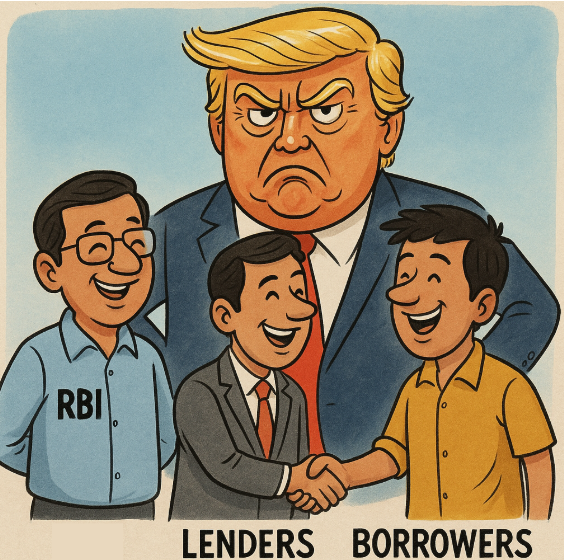
Call it Trump relief! The RBI announced relief measures on the 14th Nov to help the exporters of certain specified items, who may have availed export credit facilities from a regulated lender, whereby all regulated entities (REs) “may” provide a moratorium, from 1st September 2025 to 31st December, 2025. The grant of such a relief shall be based on a policy, consisting of the criteria for grant of the subject relief, and such criteria shall be disclosed publicly. Not only this, REs shall also make a fortnightly disclosure of the reliefs granted to eligible borrowers on a RBI format on Daksh portal.
The Reserve Bank of India (Trade Relief Measures) Directions, 2025 (‘Directions’) are applicable to NBFCs and HFCs as well. This is accompanied with amendment to Foreign Exchange Management (Export of Goods and Services) (Second Amendment) Regulations, 2025 for extension of the period for both realization/repatriation of export value (from 9 to 15 months) and the shipment of goods against advance payment (from 1 to 3 years).
To mitigate the disruptions caused by global headwinds, and to ensure the continuity of viable businesses.
Tariff impositions by the USA are likely to impact several exporters. There may be a ripple effect on penultimate sellers or other segments of the economy as well, but the intent of the Trade Relief Directions seems limited to the direct exporters only.
The Directions are applicable to following entities:
Does it matter whether the RE in question is giving export credit facilities or not? In our view, it does not matter. The intent of the Directions is to mitigate the impact of trade disruptions. Of course, the borrower in question must be an exporter, must have an export credit facility outstanding as on 31st Aug 2025, and the same must be standard.
If these conditions are met, then the RE which holds the export credit, as also other REs (of course, the nexus between the trade disruption and the servicing of the credit facility will have to be seen) should consider the borrower for the purpose of grant of relief.
Relief may or may not be granted.
The consideration of the grant of relief will be based on a policy.
Below are some of the brief pointers to be incorporated in the policy:
How is the assessment of eligible borrowers to be done?
In our view, the relevant information to be obtained from the candidates should be:
Please note the following from the preamble: “mitigating the burden of debt servicing brought about by trade disruptions caused by global headwinds and to ensure the continuity of viable businesses”. Therefore, clearly, the relief intended here is one where “trade disruptions” create such a burden on debt servicing, which may impact the viability of the business.
From this, it implies that the entity in question must be a business entity, and the loan in question should be a business loan.
In our thinking, the following facilities seem covered:
Eligible borrowers:
In our view, the following borrowers/ credit facilities are not eligible for the relief:
Consider a borrower who is not an exporter himself, but an ancillary supplier, supplying to a trading house. Will such a penultimate exporter be covered by the Relief Directions? In our view, the answer is negative, as the “eligible borrowers” are defined to mean an exporter.
The list of impacted items broadly covers a wide spectrum of manufacturing and export-oriented sectors, including marine products, chemicals, plastics, rubber, leather goods, textiles and apparel, footwear, stone and mineral-based articles, jewellery and precious metals, metal products, machinery, electrical and electronic equipment, automobiles and auto components, medical and precision instruments, and furniture and furnishing items.
Is it mandatory that the borrower shall be exporting to USA? While the Directions do not specifically mandate that the borrower shall be exporting to the USA, the concerned REs should, as part of their assessment, evaluate whether the borrower genuinely requires such relief measures and, in our view, should consider the extent to which the borrower depends on exports of the specified items to the USA.
Generally speaking, the servicing of home loans is not supposed to be based on business cashflows, and therefore, the impact of trade disruptions on servicing of a home loan does not seem easy to establish.
However, HFCs grant other credit facilities too, including LAP or business loans. Therefore, there is no carve out for HFCs as such. HFCs are also expected to prepare the policy referred to above and be sensitive to requests from impacted borrowers.
Yes, clearly, the moratorium is retrospective, as it covers the period from 1st September to 31st December. This is the range over which the moratorium may be granted; of course, the decision as to how much moratorium, within the above maximum range, is warranted in the particular case, is that of the lender. Let us call the agreed moratorium as the Moratorium Period.
If the moratorium is granted from 1st Sept., then any payments which were due for the period covered by the Moratorium Period will not be taken as having fallen due. This will have significant impact on the loan management systems:
The RBI Directions state that the days past due (DPD) count during the moratorium period will be excluded. However, this does not imply that a borrower who makes payments during this period should be denied the corresponding benefit. In our view, if a payment is received from the borrower, the DPD count should accordingly be reduced.
The RBI Directions do not mandate REs from granting such relief measures. Accordingly, the concerned RE will need to assess individual cases based on the sectors, the need for such relief and the extent to which such relief may be granted.
Lenders may grant full moratorium during the Moratorium Period, or may grant relief as may be considered appropriate.
The lenders must establish a policy for granting such relief measures prior to extending any relief, as the authority to do so will be derived from this policy. As discussed above, the discretion to grant relief rests with the concerned RE; therefore, each request submitted by a borrower must be evaluated on an individual basis.
For this purpose, the following information must be obtained from the borrowers seeking relief:
Para 9 (iii) provides that while interest will accrue during the Moratorium Period, but the interest shall be simple, that is, shall not be compounded.
This may require REs to tweak their loan management systems to stop the compounding of interest during the Moratorium Period.
However, the actual population of affected borrowers for a particular RE may be quite limited. Hence, REs may do manual or spreadsheet-based adjustments for affected borrowers, instead of making adjustments to their LMS itself.
During the moratorium period, as per the RBI directive, the lender can only accrue simple interest. Accordingly, the IRR of the credit facility will have a negative impact unlike the covid moratorium where the compound interest loss was compensated by the central government.
Further, it has also been provided that the accrued interest may be converted into a new term loan which shall however be repayable in one or more installments after March 31, 2026, but not later than September 30, 2026. Accordingly, the accrued interest should anyhow be received by September 30, 2026.
Our write-ups on similar topics:
Ankit Singh Mehar, Assistant Manager | corplaw@vinodkothari.com

Statutory provisions for mandatory CSR spending envisage that companies go out of their business models, and “give back to the society” at least to the extent of 2% of their net profits. The underlying principle is that before the profits are distributed to the stakeholders, companies should contribute a minimal amount on social engagement. However, how do we relate this requirement to a company which does not exist for profit-making? How do we relate it to a company which cannot distribute even one penny, in whatever form, to its shareholders? Or all the more importantly, how do we relate this to a company whose business model itself is for some social good? It is formed for, and exists for social good, and that is what it does. So how does the company spend that 2% on social good, if that is what the company does with all that it earns?
We are talking about section 8 companies, which are commonly referred to non-profit organizations (NPOs), or not-for-profit (NFP) companies. A lot of NPOs exist in non-corporate form – e.g. trusts, where the question of applying sec 8 of the Companies Act, 2013 (‘‘Act’’) will not arise. However, there is an increasing number of NPOs registering as sec 8 companies. As on October, 2024[1][2], there are 52000+ companies registered as sec 8 companies in India, of which nearly 40,000+ companies are registered on Darpan Portal.[3] These companies may not exist for profits, but of course, they may make profits. If they make profits, the question of applicability of sec. 135 of the Act comes – whether a 2% of the average profits needs to go “outside the business model” into activities that are listed in Schedule VII.
Before we delve any further, it is important to note that not every company licensed u/s 8 is engaged in activities listed in Schedule VII. To cite examples: a sec 8 co may be running a hospital or educational institution which serves the higher segments of the population pyramid. A sec 8 co may be running a microfinance business or be running as an industry association such as Association of Mutual Funds in India (AMFI) or Association of Registered Investment Advisers (ARIA). The key feature of a sec 8 is the bar on distribution of profits, whereas Schedule VII has a list of activities which are treated as CSR-eligible.
So, the questions that we are trying to answer in this write up are:
A company required to spend on CSR is inter-alia required to ensure two things while selecting for an activity / project to be undertaken:
Rule 2(1)(d) of CSR Rules inter-alia states that an activity undertaken in pursuance of normal course of business of the company cannot be undertaken as a CSR activity / project. Now, for a section 8 company which undertakes activities covered under Schedule VII of the Act in its normal course of business, complying with section 135 would become an impossibility. On one hand, such a company is obligated to spend 2% of its net profits on Schedule VII activities. On the other hand, if the company does so, one may also contend that such activity is in its normal course of business which is prohibited under the regulatory framework for CSR.
Further, Section 8 companies can also act as an ‘implementing agency’ for the companies covered u/s 135(1) of the Act. An implementing agency essentially undertakes CSR activities / Schedule VII activities on behalf of a company. Therefore, even for a section 8 company acting as an implementing agency, it is engaged in Schedule VII activities in its normal course and being as such it is likely to receive restricted funds specifically provided for implementing CSR projects. Accordingly, if a sec. 8 company undertakes any Schedule VII activity to fulfil its own CSR obligation, it may, in effect, be pursuing an activity that forms part of its normal course of business, thereby conflicting with the prohibition under the CSR regulatory framework.
Another interesting situation to be noted is a case where a sec 8 company being an implementing agency or a beneficiary receives restricted funds which could not be entirely spent in a particular financial year due to a number of reasons, say, disbursement by a company just before conclusion of the financial year. In such a case, it will be absolutely illogical to consider the increase in the net profit of the company to the extent attributable to unutilized restricted funds. The reasoning is simple – when the company does not have the discretion to use these funds freely and they are earmarked for a specific purpose, considering such amounts as income and hence, part of profits for the company in the context of CSR applicability or spending should be incorrect.
Now, coming back to the issue, even if one takes the view that such section 8 company may undertake, as a CSR activity / project, any Schedule VII activity other than those it already undertakes in its normal course of business, this contention would be counterintuitive, as it would essentially create no distinction between the activities such section 8 company is already undertaking and the ones it would otherwise be required to pursue.
The position discussed in the Report of the Companies Law Committee[5] is as follows:
XXX
The High level CSR Committee had recommended for Section 8 companies to be exempted from the provisions on CSR. It had been noted by the said Committee that “Section 8 companies are ‘not for profit’ companies registered under Section 8 of the Companies Act, 2013 (Section 25 of Companies Act, 1956) with the basic object of working in social and developmental sector. Their involvement in charitable and philanthropic activities is already 100 percent. These companies prepare income and expenditure statements which reflect the surplus/deficit of an organization and not the profit of the company. The surplus accrued to such company is not distributed amongst members, but is ploughed back to the expenditure of the company, that in turn is spent on social welfare activities already included in Schedule VII. Therefore, it may be not necessary for these companies to undertake CSR activities outside the ambit of their normal course of business.” The Committee, however, felt that it would not be appropriate to give differential treatment to section 8 companies in the matter of providing exemptions from compliance of CSR provisions, as there are certain areas where examples could be found of section 8 and other companies co-existing, for example, companies in microfinance business. Further, there should not be a difficulty in section 8 companies using the prescribed percentage of its surplus for CSR activities. Thus, it was decided not to recommend for exemption of Section 8 companies from the CSR provisions of the Act.
XXX
The recommendations of the High Level CSR Committee (’HLC’) were not accepted and no exemption was conferred upon section 8 companies from the CSR provisions. However, the views of the HLC are still relevant for a section 8 company which is otherwise engaged in Schedule VII activities in its normal course of business. Their contribution towards CSR activities is 100 percent (far beyond the regulatory threshold of 2% of networth). Therefore, requiring them to comply with the CSR provisions seems to be quite quixotic.
Worthwhile to note that even the FAQ of ICSI on section 8 company states that a section 8 Company would not be considered as compliant with CSR provision if it contributes the CSR amounts towards its own activities which may be charitable in nature and in line with the CSR approved.
7.2 Is Section 8 Company compliant if it contributes the CSR amounts towards its own activities which may be charitable in nature and in line with the CSR approved areas of spent?
No, spending by the company in its own activities will not qualify as CSR spend. The amount needs to be spend on activities other than normal activities of the company and not for the benefit of the company or its employees.
Seemingly, the FAQ confirms, to some extent, the paradox discussed above. However, we humbly hold a different view for the reasons discussed below.
To take a view on the subject matter, one may look into the basic intent of the CSR provisions. The idea behind CSR is to ensure that besides the business motive, companies should be doing ‘social spending’ so that it gives back to the society from where it is earning its bread and butter. In other words, the idea is that besides distributing the profits to the shareholders, a company is also expected to undertake certain activities for the welfare of the society by taking out certain portions of its profits. A section 8 company engaged in Schedule VII activities in its normal course of business is already fully engaged in social development and contributes significantly towards social causes. More so, their entire profits are applied towards social activities only. In this way, one can logically conclude that such a section 8 company is already compliant with the true spirit of CSR.
Therefore, for a section 8 company discussed above which is covered u/s 135(1) of the Act, the sensible interpretation would be to ignore the stipulation mentioned under rule 2(1)(d)(i) of CSR Rules which states that ‘activities undertaken in pursuance of normal course of business of the company’ are not in the nature of eligible CSR activities. To contend otherwise would be to fall squarely into the paradox discussed above. Accordingly, in our view, while all the other requirements envisaged in CSR provisions including constitution of CSR committee, formulating a CSR policy, preparing a CSR report etc., would require to be complied by a section 8 company, it may consider not to undertake a separate CSR activity/ project and spent 2% of its net profit thereon since the activities undertaken by its are eligible CSR activities itself. In this regard, the committee or similar body in a section 8 company should take note of such a situation and explicitly take note of the fact that since it is already pursuing CSR activities by the nature of activities, it need not spend funds additionally for some other project thereby putting its existing projects at stake.
Accordingly, in this case, the compliances that would be required to be observed in this case would be as follows:
For example: say a company is spending INR 15 lacs across three projects (Project 1: Healthcare – 10 lacs, Project 2: Education – 4 lacs and Project 3: Sports – 1 lac). Suppose the CSR obligation of the company comes to INR 1 lac. Now, for the purpose of compliance, the company may consider the expenditure towards Project 3 as its CSR expenditures. Accordingly, the following shall also ensue:
Unlike the views shared above, the same cannot be applied in cases where the sec 8 company is not serving the BoP segment of the society. For such entities, the intent is not to serve or reach out to the masses but to serve the privileged segment of the society. In doing so, the cost for the services offered is so high that a normal public cannot afford and therefore, even though the nature of service is that of a social good, it is limited to the privileged section of the society. In such cases, if the sec 8 company falls under the ambit of mandatory CSR spending, it needs to go out of its normal course of business and actually carry out CSR activities based on its CSR policy and comply with all other requirements as would have been made applicable to any other non-sec 8 company covered under section 135 of the Act. On the other hand, for sec 8 companies not pursuing CSR like activities (as in those falling under Sc VII), there also the need to comply with the CSR spending and other related provisions will be made applicable.
Read our other resource material on CSR here
[1] https://sansad.in/getFile/loksabhaquestions/annex/183/AU5_HFf4SO.pdf?source=pqals&utm
[2] https://cag.gov.in/webroot/uploads/download_audit_report/2021/Report%20No.%2016%20of%202021_E%26SM_English_PDF%20A-061c1b9cbe2d147.22751655.pdf?utm#page=34
[3] https://ngodarpan.gov.in/#/
[4] means Companies (Corporate Social Responsibility Policy) Rules, 2014
[5] https://prsindia.org/files/bills_acts/bills_parliament/2016/Report_of_the_Companies_Law_Committee_3.pdf#page=47
Ayush Kumar – Executive | corplaw@vinodkothari.com
With a view to promoting ease of doing business for Finance Companies (FCs) operating in the IFSC jurisdiction, the MCA, upon the request of the IFSCA, has vide its notification dated November 3, 2025, extended the exemptions available under section 186 of the Companies Act, 2013, to FCs registered with the IFSCA – similar to those already available to NBFCs registered with the RBI.
Under the existing framework, the following companies were exempted from section 186 (except sub section (1)), if loan given, guarantee made, security in connection with loan given, investment in securities done was in the ordinary course of business of:
Finance Companies are defined under Rule 2(1)(e) of IFSCA (Finance Company) Regulations, 2021.
FCs engaged in the following permitted activities (Eligible FCs) are exempted from the applicability of sec 186:
The condition for availing the exemption remains the same as that for NBFCs and other companies i.e the loan / guarantee / security in connection with loan should be extended in the ordinary course of its business.
Related articles:
Our resource centre on IFSCA – https://vinodkothari.com/resources-on-ifsca/
– Clarification provided in line with exemptions available to NBFCs
– Payal Agarwal, Partner | payal@vinodkothari.com
Section 186 of the Companies Act, 2013 specifies compliance requirements to be followed by a company in granting of loans, making investments, providing guarantee or security to any person or body corporate. For entities engaged in such activities in its “ordinary course of its business”, exemptions are provided through sub-regulation (11) of section 186.
Clause (a) of section 186(11) provides exemption for:
to any loan made, any guarantee given or any security provided or any investment made by a banking company, or an insurance company, or a housing finance company in the ordinary course of its business, or a company established with the object of and engaged in the business of financing industrial enterprises, or of providing infrastructural facilities;
The use of the expression “business of financing industrial enterprises” is explained to include:
This brief snapshot provides an overview of the amendment:

Our other resources on Section 186 include:
See our Resource Centre on IFSCA here – https://vinodkothari.com/resources-on-ifsca/


 Reload document
  Open in new tab