SEBI revisits RPT regime for subsidiaries

Changes proposed in manner of RP identification, threshold for significant RPTs 

– Avinash Shetty, Manager and Sourish Kundu, Executive | corplaw@vinodkothari.com

Background of CP

Related Party Transactions (“RPTs”) have been one such evergreen and ever-evolving aspect of corporate governance that has been put to guardrails on a frequent basis. SEBI, in its Consultation Paper dated 7th February, 2025 has again rolled out a new set of proposals, this time primarily centered around RPTs undertaken by subsidiaries of a listed entity, but nevertheless leaving listed entities pondering on what their actionables might be. In this article, we have analysed the  proposals in brief.  

Discussion on Proposals

LODR Definition of RP to be extended to subsidiaries

Proposal: Following SEBI’s Informal Guidance on the manner of identification of Related Parties (“RPs”), which opined that the subsidiaries of LEs should maintain a list of their RPs in accordance with the Listing Regulations, instead of maintaining the same as per their respective applicable/local laws, SEBI now proposed to effectuate the same by way of appending an explanation to Reg. 2(1)(zc) that RP of subsidiary to be identified as per Reg. 2(1)(zb) of the Listing Regulations. 

Although the proposed insertion does not differentiate between a listed and an unlisted subsidiary, it is clearly understood that a listed subsidiary shall, by default, be following the holistically covered definition of RP given under Reg. 2(1)(zb). On the other hand, an unlisted subsidiary which may so far been following the definition of RP as given under the Companies Act, 2013 (“the Act”) might be expected to buckle up to bring in a lot more persons under the purview of the RPT regime as per the LODR definition – for the purpose of facilitating the parent’s RPT compliances. 

Possible concerns: While the SEBI’s approach of applying an entity-agnostic definition may seem to bring consistency and ease of collation of information across the group, but may raise several issues:

  1. For the identification of RPs of unlisted entities in India, one will have to look at the residual definition given in Reg. 2(2) of the Listing Regulation, which in turn, refers to the CA 2013. Therefore, applying the definition of RP to unlisted entities would mean expanding the direct applicability of Listing Regulations.
  2. Further, while assessing a related party under “applicable accounting standards”, the question would be whether the subsidiary would follow the accounting standards applicable to the listed entity or that applicable to the subsidiary itself. If it is contended that the unlisted subsidiary will refer to accounting standards as applicable to the listed entity, it would again be considered as a superimposition of inapplicable laws. Besides, there would be multiple interpretational issues given that AS/IndAS are vastly different.
  3. Imposing Companies Act or Indian law definitions on overseas entities may raise concerns about extra-territorial jurisdiction.
  4. Further, this might increase the compliance burden on the unlisted entities, requiring them to assess RPs under multiple laws.

The issues in putting the said proposal in action have been discussed in  detail in our write up on SEBI’s IG on RP identification by unlisted subsidiaries

Actionables: If the proposals take the shape of law, the following actionables might arise: 

  1. Revamping the list of RPs: Given that a broader segment of persons are covered in terms of 2(1)(zb), whether pursuant to the applicable accounting standards, i.e. IndAS 24 in most cases or inclusion of promoter/promoter group persons, the list of RPs of subsidiaries needs to be updated and kept updated on a regular basis. 
  2. Enforcing the enhanced RPT controls: Given that cross RPTs across a group also are subject to approval and/or ratification requirements under Regulation 23 of the Listing Regulations, the role of Audit Committee (“AC”) will widen to approve a greater number of RPTs, that is to say, now that an increased number of persons would be  covered in the list of RPs of subsidiaries, the scope of review would enlarge. 
Revised Thresholds for Subsidiary’s Significant RPTs

Proposal: Moving on to thresholds for significant RPTs – an RPT of the subsidiary to which the holding LE is not a party requires prior approval of the AC of the holding LE before it can be entered into, if the value of such RPT exceeds 10% of annual standalone turnover, as per the latest audited financial statements of the subsidiary, taken together with all transactions during a FY. [Pursuant to Regulation 23(2)(c) of the Listing Regulations] (hereafter referred to as “significant RPTs”)

However, as discussed in the CP, there may be cases where a transaction by a subsidiary of a LE exceeds the material RPT threshold, requiring shareholder approval, but does not exceed 10% of the subsidiary’s standalone turnover, thus bypassing the AC approval. For example, if a subsidiary has a standalone turnover of ₹12,000 crore, a transaction of ₹1,100 crore would cross the material RPT threshold of ₹1,000 crore . This would require shareholder approval. However, since ₹1,100 crore is below 10% of the subsidiary’s standalone turnover (₹1,200 crore), AC’s approval would not be needed.

The proposal seeks to include the absolute threshold of Rs. 1,000 crores as well in determining significant RPTs. Significance would be determined on the basis of value of transaction being Rs. 1,000 crores or 10% of annual standalone turnover of the subsidiary, whichever is lower. In our view, however, this proposal is more clarificatory in nature as it is difficult to envisage that any RPT proposal going to shareholders of an LE can go directly without coming before the AC of the LE. We have covered this scenario in our FAQs on RPT as well.

A specific carve out from the above requirement has been set down in respect of listed subsidiaries on which corporate governance norms and RPT framework norms are applicable. 

Further, in order to impose RPT controls on SME listed entities, SEBI in its Board Meeting held on 18th December, 2024 approved, among other items, the materiality threshold of Rs. 50 crores or 10% of annual consolidated turnover, whichever is lower. Accordingly, for the purpose of determining significant RPTs of an unlisted subsidiary of SME LE, the threshold is Rs. 50 crores or 10% of annual consolidated turnover, whichever is lower. Note that the provision is applicable to a subsidiary of an SME LE – this is clear from para 5.3.1 of the CP.

The proposal as to thresholds is as tabulated below: 

Limits for Significant RPTs (whichever is lower)Having financial track record*Not having financial track record*
Subsidiaries of Main Board LEsRs. 1,000 crores or 10% of annual standalone turnoverRs. 1,000 crores or 10% of standalone net worth
Subsidiaries of SME LEsRs. 50 crores or 10% of annual standalone turnoverRs. 50 crores or 10% of standalone net worth

*Note:

  1. Here, the financial track record shall mean the entity has published financial statements for at least one year.
  2. In case the net worth is negative: Aggregate of share capital and share premium is to be considered. Basically, the negative P/L should be ignored.
  3. Computations as to Net worth or Share Capital plus Share Premium, as the case may be,  is to be certified  by a practicing chartered accountant less than 3 months prior to seeking of requisite approval. 

Actionables: Unlisted subsidiaries of listed entities will have to reassess their transactions falling under significant RPTs to be taken to the listed parent’s AC.

Insertion of the word “listed” in Regulation 23(5)(b)

Although the change is merely clarificatory in nature, it is pertinent to note that there has been some ambiguity for RPT approvals, when RPTs are  being entered into between a holding company and its wholly owned subsidiary (WoS). Given that applicability of the Listing Regulations encompasses only listed entities, it was implied that the holding company referred is a listed holding company whose accounts are consolidated and presented to shareholders at the general meeting, and not an unlisted one. 

This interpretive addition of the word “listed” aims to remove any ambiguity in respect of the exemptions granted for certain RPTs involving WoS. 

Conclusion: 

The impact of the changes, if and when notified, may be expected to be as far fetched and require a revised understanding of the RPT regime to some extent, even if not entirely, similar to the rippling effect of the SEBI (LODR) (3rd Amendment) Regulations, 2024 dated 12th December, 2024. Further, there are certain aspects such as revision in definition of RPs for subsidiaries, which would require an introspection not just on the part of the subsidiaries of LEs, but at the group level as well. Needless to say, RPT – regime and controls, has always been a trending topic and changes w.r.t the same, although the first of this year, can definitely not be expected to be the last.

The RPT framework under the Listing Regulations has already been amended 7 times, and every time, it becomes tougher, all in the name of “Ease of Doing Business”. A document collating the evolution of RPT framework over the years is here: https://lnkd.in/gZ3Ca5yQ

Read more on Related Party Transactions here.

SEBI’s Plethora of Proposals

– Sourish Kundu, Executive | corplaw@vinodkothari.com

Read More:

Subsidiaries to refer LODR definition of “related party” – going too far with relationships?

FAQs on Business Responsibility and Sustainability Report (BRSR)

Team Corplaw | corplaw@vinodkothari.com

Can NBFCs “outsource” internal audit functions to external auditors? 

– Anshika Agarwal (finserv@vinodkothari.com)

The Reserve Bank of India (RBI) has consistently emphasized the significance of robust internal control systems; where gaps are found by the supervisor, it has penalised  regulated entities for non-compliance. Recently, the RBI imposed a penalty on an NBFC for outsourcing one of its core management functions, i.e., internal audit to an external auditor, thereby raising doubts as to whether internal audit for NBFCs can be conducted by external auditors. Does the very fact that internal audit is being conducted not internally but by an external chartered accountancy firm amount to “outsourcing” of core management function?  This article examines outsourcing in the context of internal audit function,  and the conditions subject to which internal audit may be conducted by external agencies. 

Understanding the concept of ‘Outsourcing’

Outsourcing is defined under the Basel 2005 document1 as “a regulated entity’s use of a third party (either an affiliated entity within a corporate group or an entity that is external to the corporate group) to perform activities on a continuing basis that would normally be undertaken by the regulated entity, now or in the future.” Similarly, the IOSCO Consultation Paper2 refers to outsourcing as “a business practice in which a regulated entity uses a service provider to perform tasks, functions, processes, or activities that could otherwise be undertaken by the regulated entity itself.

NBFCs, especially those with asset-light models or limited resources, opt for outsourcing to manage financial as well as non-financial functions. Outsourcing by NBFCs typically involves delegating tasks such as loan application processing, collection of documents, data processing, IT support, customer service, and back-office operations to third-party providers. While outsourcing boosts operational efficiency, they also carry risks, particularly when core management functions are outsourced. Notably, outsourcing is distinct from availing professional services like legal, audit, consulting, or property management, which are ancillary to the NBFC’s core business. In case of outsourcing of financial functions by regulated entities, there are specific guidelines issued by the RBI to regulate the arrangements. Clear regulatory oversight is crucial to strike a balance between leveraging external expertise and maintaining ethical, efficient practices in the financial services sector.

Regulatory Framework: The RBI’s Perspective

The RBI guidelines are specifically aimed at managing risks related to outsourcing of financial services. Master Direction – Reserve Bank of India (Non-Banking Financial Company – Scale Based Regulation) Directions, 2023 (‘SBR Directions’)3, particularly Annexure 13 on Instructions on Managing Risks and Code of Conduct in Outsourcing of Financial Services by NBFCs (‘Outsourcing Guidelines’), Para 2 lays down stringent conditions for outsourcing to ensure compliance, accountability, and effective risk management. While outsourcing can support operational efficiency, core management functions must remain under the direct control of the regulated entity.

Core Management Functions: Non-Negotiable Responsibilities 

The Outsourcing Guidelines explicitly prohibits NBFCs from outsourcing core management functions vital to governance, decision-making, and risk management. The core management functions are those that are vital and crucial for the existence as well as operations of the entity. These have been defined to include:

These functions are critical for ensuring the organization’s stability and operational integrity. For example, internal audit functions identify risks, ensure regulatory compliance, and assess control effectiveness. Entrusting such functions to external entities could compromise decision-making and erode organizational trust.

Contractual Engagement for Internal Audit

While the internal audit function itself is a core management process, the Outsourcing Guidelines in the same lines allows regulated entities to engage internal auditors on a contractual basis. This means external professionals can be brought in to execute internal audits, provided their engagement adheres to regulatory standards, independence is maintained, and the entity retains oversight and control rather than putting all the responsibility on a third party. 

For example, an entity may handle several operational tasks related to an audit, such as preparing documentation, organizing records, or conducting initial reviews. However, the ultimate responsibility for decision-making, oversight, and ensuring compliance with regulations rests with the audit committee or the entity’s senior management. This approach ensures that the internal management retains control over key aspects of the audit process, even while delegating specific tasks or availing expertise support. In contrast, the action of outsourcing shifts the entire responsibility for the audit to a third-party. This means the external firm is accountable for managing and executing all aspects of the audit, from operational tasks to final implementation. Such an outsourcing may reduce the internal workload, however, it also transfers control and accountability to an external entity, which may not align entirely with the entity’s internal objectives and strategic priorities. 

In other words, what is permitted is to avail the expertise services of a third party for carrying out the internal audit function but not the transfer of the entire responsibility of carrying out internal audit to a third party.

ICAI Standards: Expertise and Independence in Internal Audits

The Institute of Chartered Accountants of India (ICAI) Standards on Internal Audit4 states that “Where the Internal Auditor lacks certain expertise, he shall procure the required skills either though in-house experts or through the services of an outside expert, provided independence is not compromised”. 

The aforesaid guidance from the ICAI emphasizes maintaining expertise and independence. While not explicitly addressing outsourcing, these standards recognize that internal auditors may lack certain specialized skills. In such scenarios, they encourage engaging in-house or external experts while safeguarding independence.

The standards indirectly allow for outsourcing when:

  • Specific expertise is unavailable in-house,
  • Independence remains uncompromised

By availing the services of experts ensures that internal audit teams possess the necessary skills to perform effective reviews, while the entity retains oversight and accountability.

Companies Act, 2013: Flexibility in Internal Audit Assignments

Section 138 of the Companies Act, 2013 (‘CA 2013’)5, specifies the requirement for internal audits for certain classes of companies. It allows the appointment of internal auditors, which may include chartered accountants, cost accountants, or other professionals, as decided by the Board. Explanation of Rule 13 of the Companies (Accounts) Rules, 2014, states that “the internal auditor may or may not be an employee of the company”.

The aforesaid provision also enables companies to engage external auditors to perform internal audits, even if they are not part of the organization. While the CA 2013 does not explicitly prohibit outsourcing of internal audit functions, it places the ultimate responsibility for conducting and reporting on internal audits with the Board. This also clarifies that companies may utilize external expertise while maintaining oversight and control of the audit process.

Conclusion

In conclusion, the RBI’s recent penalties underscore the importance for regulated entities to maintain strict compliance with outsourcing regulations, particularly regarding core management functions. While the Outsourcing Guidelines as well as the provisions of CA 2013 permit engaging external auditors on a contractual basis to perform operational tasks related to audits, accountability and strategic control such as having audit plan approved by the audit committee, regular reporting to the audit committee, discussion of the board and audit committee on the conduct of audit,implementing remedial measure on the oversight of the audit committee or senior management must remain firmly within the organization. Adherence to these principles will help maintain the fine distinction between outsourcing the internal audit function and appointing external auditors as internal auditors, specifically in the context of internal audits.

Read our other related resources –

  1. UNDERSTANDING THE CONCEPT OF OUTSOURCING- ENVISAGING A TOUGH ROAD AHEAD FOR THE SERVICE PROVIDERS
  2. Draft framework for Financial Services Outsourcing

  1.   https://www.bis.org/publ/joint12.pdf (last accessed in November 2024) ↩︎
  2.   https://www.iosco.org/library/pubdocs/pdf/IOSCOPD654.pdf (last accessed in November 2024) ↩︎
  3.  Reserve Bank of India, Master Direction – Scale Based Regulation (SBR): A Revised Regulatory Framework for NBFCs, October 22, 2021. Available at: https://rbi.org.in/Scripts/BS_ViewMasDirections.aspx?id=12550 ↩︎
  4.  Institute of Chartered Accountants of India, Standard on Internal Audit (SIA) 2: Basic Principles Governing Internal Audit. Available at: https://resource.cdn.icai.org/52727iasb-basicprinciples-3.pdf ↩︎
  5.  The Companies Act, 2013, Ministry of Corporate Affairs, Government of India. Available at: https://www.mca.gov.in/. ↩︎

Online workshop on SEBI LODR 3rd Amendment Regulations, 2024

Participation is free. Register here – https://forms.gle/HsahWP3YmWnVXmRL7

SEBI proposes to ease HVDLEs from equity linked CG norms 

Several proposals on the way to ease compliance

-Pammy Jaiswal, Partner & Sourish Kundu, Executive (corplaw@vinodkothari.com)

Introduction:-

The applicability of CG norms (on a COREX basis) was extended to HVDLEs i.e. entities having an outstanding value of listed non-convertible debt securities of Rs. 500 Crore and above, by SEBI vide its notification dated 7th September, 2021. Following the extension thread for mandatory applicability of Corporate Governance (CG) norms under SEBI Listing Regulations (LODR) on High-Value Debt Listed Entities (HVDLEs) from FY 23-24  to FY 24-25  and again postponing it from 1st April, 2025, SEBI released another Consultation Paper (CP) on 31st October, 2024 containing several proposals to ease the compliance burden of HVDLEs.  A similar CP was issued earlier on 8th October, 2024 to review the CG norms primarily focusing on related party transactions (RPTs) [Our analysis on the same can be read here].

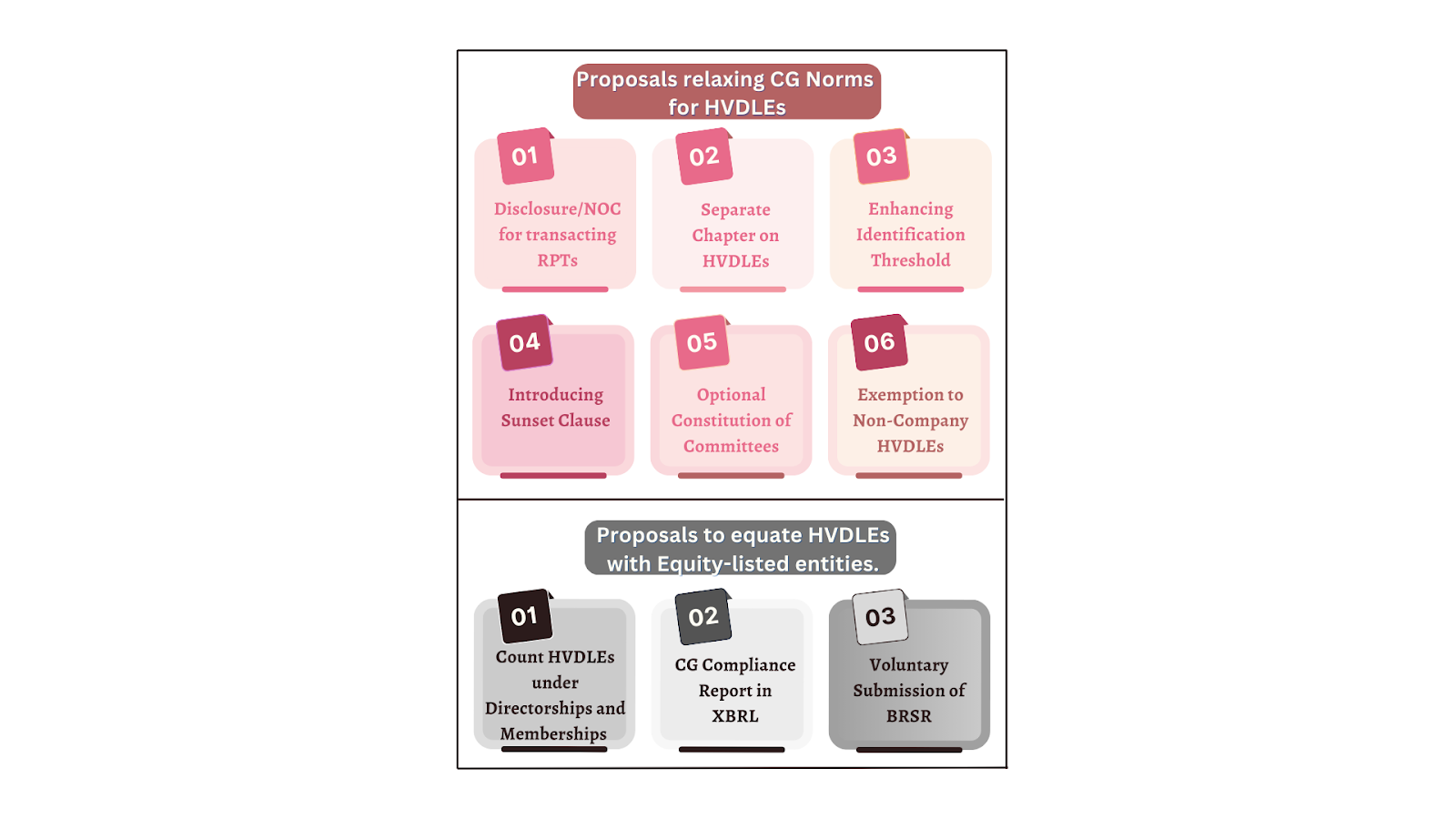
While the intent behind the CG norms being made applicable was to protect debenture holders and assimilate corporate governance amongst such issuer entities, the complexities associated with its implementation hindered the ease of doing business and increased the compliance burden manifold. The current CP delves into the comments received on the previous proposal as well as the issues that HVDLEs have been facing in practically implementing the CG norms (i.e. Regulations 16 to 27 of LODR, 2015). While it discusses the much needed and critical areas (CG chapter, mandatory committees, RPTs, etc.) where HVDLEs can be considered to be relieved and not be kept on the same pedestal as that of the equity listed entities, however, for some provisions (included for max no. of directorship, committee membership, XBRL filings, etc.), HVDLEs have been proposed to be roped in at par with entities with their specified securities listed. While each of the proposals have been discussed in detail below, a snapshot of the same can be seen in the diagram below:

Proposals relaxing CG Norms for HVDLEs 

  1. Providing In-Principle Declaration or obtaining No-Objection Certificate (NOC) from NCD holders in connection with RPTs:

One of the most crucial concerns for HVDLEs was the impossibility of compliance when it came to securing approvals for RPTs. The same was highlighted by SEBI in its earlier CP dated 8th February, 2023 wherein it was mentioned that 104 out of 138 HVDLEs as of 31st March, 2022,   comprised of shareholders with more than 90% of them being related parties (RPs). 

The current proposal is set against a reference to a banking transaction wherein the lender reserves the right to allow the borrower to enter into any transaction that might be unfavorable to the lender such as entering into RPTs. Thus, HVDLEs being of the nature of a borrower and the debenture holders being the lenders, it is paramount to protect the latter’s interests by enforcing such provisions as may be necessary and safeguarding them through a debenture trustee. 

In view of the same, the proposition has the following features:

  • Either provide an upfront declaration in the offer document with respect to the amount of RPTs proposed to be entered over the tenure of the NCDs along with the percentage of the same when compared with the issue size or obtain an NOC from the debenture trustee, who in turn needs to obtain it from the debenture holders (the majority not being related to the issuer) for all the material RPTs as and when they are required to be transacted;
    • VKCo Comments – Until the fine print of the regulations is rolled out, it is understood that only the broader limits of the estimated RPTs are required to be mentioned unless otherwise finer details are required which can become extremely difficult for these entities.Further, for the alternative requirement, there does not seem to be any incentive to first approach the debenture trustee and thereafter the trustee to approach the NCD holders, which can actually be done directly.
  • monitoring of the issue proceeds by a credit rating agency; and
  • declare the following in the offer document upfront and be maintained over the tenure of the NCDs:
    • debt-equity ratio, 
    • debt service coverage ratio; 
    • interest service coverage ratio and;
    • such other financial/ non-financial covenants 
  • VKCO Comments – Both the aforesaid proposals do not serve the exact purpose of maintaining controls over RPT. Also, these are also reflected in the financials to some extent.
  1. Introduction of a separate chapter for the governance of HVDLEs

LODR in its present form consists of 12 Chapters, each having its purpose and application. As far as the CG norms are concerned, HVDLEs are required to follow the provisions primarily centered around equity listed entities which, inter alia, relate to the composition of the Board of Directors, the constitution of various specialized committees, stipulations regarding RPTs and so on. Having said that, these provisions are not completely relatable to HVDLEs since the majority of these entities are purely debt listed without any other security being listed. Accordingly, it has been proposed to introduce a separate chapter on CG norms for HVDLEs distinct from the existing one for equity listed entities. 

VKCO Comments: While this proposal is noteworthy, however, instead of rolling out a new chapter, there could have been certain modifications in the existing regulations by way of a proviso to align with the needs of an HVDLE. Further, one also needs to wait to see the fine print of the provisions once the same is issued.

  1. Increase in threshold for being identified as an HVDLE 

Based on the data provided by NSDL as of 31st March, 2024, the number of pure debt listed entities with an outstanding of more than Rs. 500 crores is 166 (comprising of an aggregate outstanding of Rs. 13.54 lakh crores), of which 112 entities are those having an outstanding of more than Rs. 1,000 crores (comprising of an aggregate outstanding of Rs. 13.16 lakh crores). 

Further, referring to SEBI’s circular dated 19th October, 2023 in which the threshold limit of outstanding long-term borrowing was enhanced from  Rs.100  crore to Rs.1,000 Crore for the purpose of being identified as a Large Corporate called for introspection at the existing threshold of being identified as an HVDLE. Aligned with its objectives of tightening the regulatory regimes for debt listed entities and at the same time promoting ease of doing business in the corporate bond market, the proposal suggests doubling the limit from the present threshold of Rs. 500 crores to Rs. 1,000 crores.  

VKCo Comments: The proposal to enhance the extant threshold is encouraging in terms of governing the maximum value of outstanding debt while at the same time achieving the same without bearing the burden of compliance by an increased number of purely debt listed entities. Subsequently, effective implementation of such a proposal aligns it with the identification criteria of Large Corporates. 

  1. Introduction of “sunset provisions” for non-applicability of CG norms: 

The extant Regulation 3(3) of SEBI (LODR), 2015 provides for the applicability of the CG norms even when the value of the outstanding debt securities falls below the specified threshold forever. The same is in contradiction with respect to the period of applicability as compared to its equity counterpart wherein Regulation 15(2)(a) provides that the norms will have to be complied till such time that the equity share capital or net-worth of the listed entity falls and remains below the specified threshold for a period of three consecutive financial years. Accordingly, for the purpose of aligning the non-applicability, a similar sunset provision for HVDLEs too has been proposed. The proposal outlines that the CG norms shall continue to remain in force for HVDLEs till such time the value of outstanding debt listed securities (reviewed on the cutoff day being 31st March of every financial year) reduces and remains below the defined limits for a period of three consecutive financial years and further ensuring compliance within a period of six months from the date of a subsequent increase in the value above the trigger. The proposition also provides for disclosing such compliances in the Corporate Governance compliance report to be submitted on and following the third quarter of the trigger. 

VKCO Comments: The proposal is welcome since it clearly sets the HVDLEs free from the barrier of once an HVDLE so always an HVDLE. This proposal sets a clear nexus between the compliance and the size of the debt outstanding, for the protection of which in the very first place, the compliance triggered.

  1. Certain mandatory committees made optional

Regulations 19, 20 and 21 of LODR mandate the constitution of the Nomination and Remuneration Committee (NRC), Stakeholders Relationship Committee (SRC) and Risk Management Committee (RMC) respectively and provide for their composition, the number of meetings to be held, quorum, duties and responsibilities, among other things. The proposal recognises the difficulties of constituting multiple committees by HVDLEs and therefore, extends the option of either establishing such committees or ensuring delegation and discharge of their functions by the Audit Committee in the case of NRC and RMC and by the Board of Directors in case of SRC. 

VKCo Comments: Given the close construct of debt listed entities, it is often observed that the constitution of such committees becomes more of a hardship than in smoothening compliance and discussing specific matters. Accordingly, it looks appropriate to redirect the functions of NRC and RMC to the Audit Committee and that of the SRC to the Board. 

  1. Exemption to entities not being a Company

Several entities are not incorporated in the form of companies and therefore, are regulated by specific acts of the Parliament. The rationale behind this move lies in the fact that the administration of these entities is governed by such specific Acts subject to approval from the concerned Ministries. An exclusion on similar lines was granted to equity listed entities by way of Regulation 15(2)(b) which was later omitted w.e.f. 1s September, 2021 vide notification dated 5th May, 2021.

Further, it is awaited as to how effective and permanent such an exemption would be, but SEBI’s working group has proposed for dispensation of entities like NABARD, SIDBI, NHB, EXIM Bank and such other entities fulfilling the criteria as laid out above and application of CG norms to the extent that it does not violate their respective regulatory framework formulated by the concerned authorities. 

VKCo Comments: While SEBI refers to the introduction of similar exclusion for equity listed entities, however, it has also mentioned the subsequent amendment wherein the same was omitted. In any case, the instant proposal is a welcome change since it will help such entities to give preference to their principal statutes and not an ancillary one like LODR. 

Proposals to equate certain CG Norms for HVDLEs to that of equity listed entities: 

  1. Count HVDLEs under no. of directorships, and memberships of Committees:

    The extant provisions of Regulation 17A of LODR and Section 165 of the Companies Act, 2013 limit the number of directorship positions that a person can hold, with appropriate sub-limits being set out with respect to public companies and equity listed companies. Similarly, Regulation 26 of the SEBI (LODR), 2015 places ceiling limits on the number of memberships and chairmanships that a person can hold in committees across all listed entities, with explicit exclusion for such positions held in HVDLEs. 

    The instant proposal is for including the directors in HVDLEs as well as committee membership and chairpersonship positions held in HVDLE just as equity listed entities are included. 

    The same has been proposed in view of the fact that directorship is a significant position in any company and therefore, multiple directorships beyond a reasonable limit are likely to inhibit the ability of a person to allocate appropriate time to play an effective role in delivering its responsibilities including the timely repayment of debt.. 

    Further, the initial proposal for inclusion of HVDLEs in max no. of directorship allows a period of six months or till the next AGM to ensure compliance. 

    VKCO Comments: The rationale completely aligns with the proposal made and seems to be justified.

    1. Compulsory filing of CG Compliance Report in XBRL format:

    Pursuant to Regulation 27(2), which mandates the submission of a quarterly report on complying with CG norms by listed entities, the format of the report has been supervised by Annexure 3 under Section II-B of the Master Circular for compliance with the provisions of SEBI (LODR), 2015 by listed entities in case of equity listed entities and Annexure VII-A under Chapter VII of the Master Circular for listing obligations and disclosure requirements for Non-convertible Securities, Securitized Debt Instruments and/or Commercial Paper in case of HVDLEs. The issue arises from the practice adopted by HVDLEs in the instant case, where filings made on the website of the stock exchange have been made in PDF format thereby affecting the readability and clause-wise compliance monitoring. Unlike the above-mentioned proposals which aim at bringing about relaxations for HVDLEs, this particular proposal tightens the regime by binding the XBRL format that is consistent with what is being filed by equity listed entities, for the report to be submitted on a quarterly basis. 

    VKCo Comments: This proposal is with an objective to align and standardize the filing of quarterly CG compliance report for bringing parity as in the case of equity listed entities. 

    1. Voluntary submission of Business Responsibility and Sustainability Report (BRSR):

    This proposal originates from SEBI’s endeavour to inculcate good CG practices in HVDLEs, to be at par with equity listed entities. It is supported by Regulation 34(2)(f) which requires the top 1,000 listed entities (based on market capitalization) to include a BRSR in their annual report. It is pertinent to note in this respect that publishing of BRSR by HVDLEs is voluntary and not a mandatory requirement unless such an HVDLE also satisfies the criteria of the above-stated regulation. 

    VKCo Comments: The inclusion of a voluntary provision in the legislation with respect to a comprehensive report like BRSR is not likely to be submitted given the huge details under the BRSR. However, an opportunity to submit BRSR can be a game changer for an HVDLE from the perspective of being able to raise funds based on its reporting standards in this regard. 

    Concluding Remarks:

    The proposal under the CP provides hope for a breather when it comes to compliance with CG norms and at the same time introduces certain new requirements to maintain uniformity whether it is for the XBRL filing or inclusion of directorship and committee membership as well as chairmanship in an HVDLE for the max no. of such positions. It will also be interesting to see what is rolled out under the new chapter for HVDLEs as well as the fine print of provisions as far as RPT controls are concerned.

    Refer to our related resources below:

    SDD non-compliance to entail stringent action from exchanges

    Lavanya Tandon, Executive | corplaw@vinodkothari.com

    Our related resources on the topic-

    a. FAQs on Structured Digital Database

    Small by SAT: Smaller listed companies relieved from CG compliance burden

    SEBI cannot read “or” as “and”: holds appellate tribunal

    Simrat Singh, Executive | corplaw@vinodkothari.com

    “I decline to read into any enactment, words which are not to be found there and which would alter its operative effect because of provisions to be found in any proviso.”

    – Lord Herschell in West Darby Union vs. Metropolitan Life Assurance Society[1]

    Background

    Listed entities in India bear significant compliance obligations, including enhanced disclosure requirements and scrutiny by regulators, primarily due to the involvement of public funds and retail investors. To ensure market transparency and investor protection, several measures of ensuring a strong corporate governance (CG) culture have been provided by SEBI. Several of such requirements are enumerated under Regulations 17 to 27 of SEBI (LODR) Regulations, 2015[2] and are applicable on listed entities. However, all listed companies are not required to comply with these CG provisions, as Regulation 15(2)(a) provides certain exemptions for small size entities whose paid up equity capital and net worth do not exceed Rs. 10 Cr. and 25 Cr. respectively.

    There are 2 things about the carve out for small listed companies – (a) it is based on monetary limits which were prescribed 9 years ago, and never revised since then, though the official loss of value due to inflation itself would be approx 42.9%[3] (b) Though the Regulation provides a twin-test window for qualifying for the exemption – small capitalisation and small net worth, SEBI was reading these qualifying conditions as being cumulative, with the effect that unless a listed entity was small by both these tests, it will not qualify for the exemption.

    While the said Regulation provides for exempting specified classes of listed entities, however, the manner in which the amendment to the said exemption was framed raised two different views on availing the said exemption.

    Read more

    Major regulatory revamp at 30th Sept SEBI Board  meeting

    Team Corplaw | corplaw@vinodkothari.com 

    In terms of the scope and extent of amendments, the SEBI Board meeting of 30th Sept is certainly quite momentous. Major steps in ease of doing business were taken at the meeting, based on the proposals contained in various Consultation Papers floated by SEBI from time to time. The approvals bring about important changes to almost all major regulations of SEBI. While the fine text of the amendments are awaited, we present our brief understanding on the various approved amendments. 

    • Review of regulatory framework for Investment Advisors (IAs) and Research Analysts 
      • Relaxation in eligibility requirements for registration as an IA/ RA
        • Results in expanding the regulatory ambit 
        • With a view to bring more stock analysts, investment consultants and so-called finfluencers into the ambit 
        • Relaxing the entry point requirement may potentially motivate lot of capital market consultants to register and come within the regulatory framework
      • Clarity on activities of IA/ RA 
      • Permits registration as part-time RA, dual registration as IA and RA permitted
        • Blurs the line of distinction between IA and RA
      • See detailed discussion under Research Analysts v/s Investment Advisors – Is the Line Blurring ?
    • Faster rights issue with flexibility of selective allotment 
      • Requirement of filing draft letter of offer to SEBI removed
      • Promoters may renounce in favour of specific investors 
      • Undersubscribed portion can be allotted to specific investors
        • Requisite disclosures to be made through advertisement in this regard 
      • Monitoring agency mandatory for monitoring of issue proceeds 
    • Relaxed requirements under LODR and ICDR 
      • Certain disclosure requirements under Reg 30 of LODR linked with materiality/ absolute limits
        • Absolute thresholds brought for the purpose of fines/ penalties under Para A(20) 
        • Clarification that tax litigation is to be tested for materiality under Para B(8) before disclosure 
      • Relaxed timelines for making disclosures in some cases
        • 3 hours instead of 30 minutes, for board meeting conclusion post trading hours closure 
        • 72 hours instead of 24 hours for disclosure of material litigations or disputes against the listed entity 
      • Integration of stock exchange filings and disclosures
        • Single filing system for automatic dissemination to other stock exchanges 
        • System driven disclosures for shareholding pattern and credit ratings revision 
        • Periodic filings integrated into two broad categories: Governance and Filing 
      • See Making life easy for listed entities: SEBI proposes action on Expert Committee recommendations
      • Amendments under ICDR include harmonization of various provisions of with requirements under LODR, relaxation in documentation requirements etc
      • Issuers with outstanding SARs have been permitted to file DRHP, subject to some conditions
        • Under the existing regulatory framework, only outstanding ESOPs are permitted to continue
    • Enhanced scope of “Connected Persons” and “immediate relatives” under PIT Regulations
      • Inclusion of two additional relationships in list of deemed connected persons 
      • ‘Relative’ of  CP to be considered as deemed CP
        • Instead of immediate relative 
        • Proposed definition of relative approved
          • CP proposed wider definition of relative as per Income Tax Act omitted
      • No additional compliances on listed entity, does not impact monitoring of trades for Designated Persons
      • See SEBI proposes to widen the definition of ‘Connected Persons’ 
    • Amendment in NCS and LODR for debt-listed entities
    • Expanding the scope of Sustainable Finance Framework in Indian Securities Market 
      • NCS Regulations to apply to issuance of ESG Debt Securities (see Consultation Paper)
        • Includes green bonds, social bonds, sustainability bonds and sustainability-linked bonds (see an article here
        • Existing regulations cover only green debt securities (see here)
    • Buy-back Regulations aligned with Companies Act and market practice (see Consultation Paper)
      • Computation of entitlement ratio to exclude promoters’ shares if they opt out
        • Results in an increased entitlement ratio 
        • Regulations aligned with market practice 
      • Cover page of offer letter to include entitlement ratio
        • along with the link to RTA’s website to check entitlement 
      • Shares issued pursuant to exercise of ESOPs or conversion of convertible instruments permitted during Buyback Period
        • Aligned with Sec 68 of Companies Act read with Rule 17(10)(b) of SCD Rules
        • Details of outstanding ESOPs and convertible instruments to be disclosed in public announcement.
    • Amendments pertaining to Mutual Funds (MF) market 
      • Introduction of new investment product as a hybrid between MFs and PMS (see Consultation Paper), to be called as ‘investment strategies’
        • Intended to bridge the gap between MF and PMS to build a flexible portfolio 
        • Aims to curb the proliferation of unregistered/ unauthorised investment schemes which exploits the investors
        • Provides investors with professionally managed and regulated investment product:
          • With greater flexibility, higher risk taking capabilities, adequate risk safeguards such as no leverage, no investment in unlisted/ unrated instruments, limited derivative exposure (25% of AUM) for purposes other than hedging
        • Min investment: Rs. 10 lakhs per investor
      • Liberalised MF Lite Framework for passively managed schemes (See Consultation Paper)
        • in view of the negligible discretion involved in passive MF schemes due to rule based fund
        • Relaxed eligibility criteria for sponsors and trustee’s responsibilities 
        • Option with existing AMCs to hive-off passive schemes to another entity under same sponsor or continue under existing AMC
    • Clarification w.r.t. rights of investors in an Alternative Investment Fund (AIF) (see Consultation Paper)
      • Drawdown of funds from investors and distribution of returns on investment – pro-rata to the investors’ commitments.
      • Pari-passu rights in all other aspects (unless specifically exempt)
        • Exemption to Large Value Funds, subject to waiver provided by each investor 
        • Special/ differential rights may be granted to certain investors without impacting the rights of other investors, as per terms formulated by Standard Setting Forum for AIFs in consultation with SEBI
      • Govt-owned entities, Development Financial Institutions, other entities specified by SEBI etc may subscribe to junior classes of units of AIF (less than their pro rata rights) 
      • Existing AIFs with priority distribution (‘PD’) model (i.e. prioritize certain investors for returns) cannot accept new investments or make new investments in other companies.
        • Over concerns of using regulatory arbitrage for evergreening of loans 
        • RBI had also raised concerns around ever-greening and imposed certain prohibition w.r.t. investment in AIFs (see an article along with an update thereof)
          • SEBI Circular dated November 23, 2022, restricted AIFs with PD model from accepting fresh investments or making new commitments until SEBI had taken a view or whether to be allowed or not. 
          • Hence, vide this amendment, AIFs with PD models are disallowed.
    • Amendment in relation to FPIs for strengthening Beneficial Owner disclosure (see Consultation Paper)
    • Disclosure requirement as per SEBI Circular dated August 24, 2023 [August Circular], extended to Offshore Derivative Instruments (‘ODI’) subscribers and FPIs with segregated structures like, sub-fund structures, separate class of shares, etc.
    • Investor friendly and uniform norms in the Indian securities market (see Consultation Paper)
      • Nomination rights of investors with respect to own holdings
        • Maximum no. of nominees increased from 3 to 10;
        • Nominees to act on behalf of incapacitated investors
        • Simplifying transmission process to nominees, joint holders;
        • Requirement for unique identifiers for nominees i.e. Aadhar, PAN card;
      • Introduction of consistent nomination norms
        • Nominees to act as trustees for legal heirs
        • The rule of survivorship will apply in cases of joint holdings;
        • No rights for legal heirs of deceased nominees;
        • Precedence of creditors claims over transmitted assets 
        • Nomination to be optional for joint demat account and MF folios 
        • Guidelines for providing, changing, and ensuring the integrity, authenticity, and verifiability of nominations
        • No limit on changing the number of nominee investors 
        • Option to specify guardian for minors

    Class Action Suits in India: A Journey of Challenges and Potential

    Mahak Agarwal | corplaw@vinodkothari.com

    Background

    Investor protection provisions have been an inherent part of company laws in India. Whether it be S.34 of the Companies Act, 2013 (‘the Act’) imposing criminal liability on directors/ promoters in case of misrepresentation in prospectus, S.35 which imposes civil liability on persons involved in mis-statement of prospectus, S. 36 which imposes criminal liability on any person who fraudulently inducing persons to invest money and so on.

    Following the Satyam fiasco in India, investor protection gained further light and the Company Law Bills of 2009 as well as 2011 contained provisions for introducing class actions as a measure available to the members and depositors of the company if the affairs of the company are conducted in a manner prejudicial to the interest of the company, or its members and depositors. However, it was only in 2016 that the same was introduced under S.245 of the Act.

    Read more