Outbound Mergers – A path still less travelled by?

– Anushka Ganguly, Executive | corplaw@vinodkothari.com

BACKGROUND

Cross-border merger, specifically outbound merger, may be considered as a means of promoting cross-border investments by India. Outbound mergers involve transfer of the assets and liabilities of an Indian company into an overseas company, thus, leading to the resultant company being an overseas company, albeit, with shareholders of the transferor Indian company. Like a bird leaving its nest, an outbound merger denotes an Indian company’s departure from its domestic regulatory shelter to establish its identity under foreign skies.

While these act as growth levers allowing businesses to tap into new geographies, access global customers, and advanced technologies; from a regulatory standpoint, these are complex arrangements, governed simultaneously by corporate, foreign exchange, and tax laws, making them highly regulated corporate actions.

THE DAWN OF OUTBOUND MERGERS IN INDIA
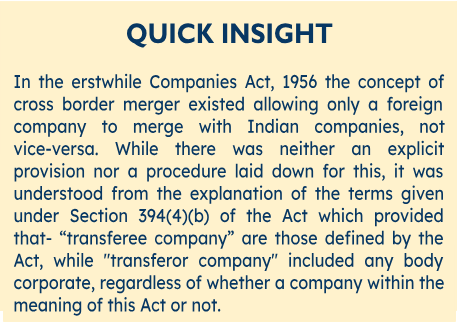
While the foreign giants were allowed to  touchdown the Indian market, India’s regulatory framework maintained a rather protective stance – securing homegrown businesses by keeping outbound mergers off the table while tightly managing foreign exchange. With time the laws evolved and the realization that further growth required a visa was acknowledged. In December 2017, notification of Section 234 in Companies Act 2013 gave due recognition to outbound mergers. This move was followed by the RBI’s introduction of FEMA Cross Border Merger Regulations 2018, a comprehensive set of rules which dealt with cross-border mergers holistically[1].

OUTBOUND MERGER vs OUTBOUND ACQUISITION  

In India, cross-border activity has been long dominated by inbound mergers and outbound acquisitions with outbound mergers continuing to be a rarity[2].

Even before 2017, when the Indian law did not permit outbound mergers– what was always possible was an outbound acquisition. Indian companies have often preferred outbound acquisitions over outbound mergers — a route that achieves similar strategic goals while bypassing the regulatory complexities of cross-border merger approvals. Media reports[3] indicate that in 2024, India saw about 120 outbound acquisition deals worth $17 billion. By August 2025, nearly 100 deals worth $11 billion have already been executed, showing strong momentum.

The difference lies in the fact that an outbound acquisition allows an Indian company to buy shares or assets of a foreign company under the FEMA ODI route, maintaining the foreign company’s legal status, only changing its ownership. In contrast, in case of an outbound merger, an Indian company merges into a foreign company, transferring all its assets and liabilities to such foreign entity, thereby losing its existence in India.

PROCEDURAL ASPECTS

Translating the legal permission into practice, the process demands navigation through a web of interlinked legal regimes. Outbound merger involves not just selecting a suitable foreign company for merger but exercising due care to understand the regulatory aspects, the political as well as tax scenarios of the jurisdictions involved.

1. Jurisdictional Eligibility

The first thing to be ascertained, in case of an outbound merger, is if the foreign Company is incorporated in an eligible jurisdiction. Annexure B to Rule 25A of the Companies (Compromises, Arrangements and Amalgamations) Rules, 2016 lays down the following jurisdictions as eligible:

  • whose securities market regulator is a signatory to International Organization of Securities   Commission’s Multilateral Memorandum of Understanding (Appendix A Signatories) or a signatory to bilateral Memorandum of Understanding with SEBI, or
  • whose central bank is a member of Bank for International Settlements (BIS), and
  • a jurisdiction, which is not identified in the public statement of Financial Action Task Force (FATF) as:
    • a jurisdiction having a strategic Anti-Money Laundering or Combating the Financing of Terrorism deficiencies to which counter measures apply; or
    • a jurisdiction that has not made sufficient progress in addressing the deficiencies or has not committed to an action plan developed with the Financial Action Task Force to address the deficiencies.

2. Valuation and Due Diligence

While the negotiations and dealings are underway, Rule 25A(2b) of the Companies (Compromises, Arrangements and Amalgamations) Rules, 2016 requires the transferee company to ensure that valuation is conducted by valuers who are members of a recognised professional body in the jurisdiction of the transferee company and further that such valuation is in accordance with internationally accepted principles on accounting and valuation. A declaration to this effect shall be attached with the application made to Reserve Bank of India for obtaining its approval under Rule 25A(2a)

3. Approvals – Scheme placed under the critical lenses of RBI, shareholders, creditors and ultimately NCLT

An ambition like an outbound merger requires not just a robust strategy but most importantly a positive nod from RBI, NCLT, shareholders and creditors of the entities involved in the scheme. Further, compliance with the approval requirements under the applicable laws in the jurisdiction of the foreign transferee company is also to be ensured.

A. RBI Approval:

Cross-border mergers are closely linked with foreign exchange management and capital movement. As the watchdog of the financial system, RBI ensures that these restructurings do not result in undue capital flight or financial instability. Rule 25A(2a) of the Companies (Compromises, Arrangements and Amalgamations) Rules, 2016 mandates that a company may merge with a foreign company incorporated in any of the jurisdictions specified in Annexure B, as discussed above, after obtaining prior approval of the Reserve Bank of India and after complying with provisions of sections 230 to 232 of the Act and these rules

FEMA (CROSS-BORDER MERGER) REGULATIONS, 2018– harbinger of cross-border business

Notified vide notification no. FEMA 389/ 2018-RB dated 20th March, 2018, these Regulations provide that if the merger transaction is in compliance with these Regulations, it shall be deemed to have been approved by RBI. In cases of deemed approval of RBI, the Regulations require a certificate from the Managing Director/Whole Time Director and Company Secretary, if available, of the company(ies) concerned ensuring compliance to these Regulations to be furnished along with the application made to the NCLT. However, on a practical front, in the author’s view, the avenue for deemed approval may not suffice and NCLT benches may require an explicit approval of RBI. 

Major provisions dealt with by the said Regulations-

  • Issue of Securities –  . For the securities being issued by the resultant foreign company to persons resident in India, the acquisition should be compliant with the FEMA (Overseas Investment) Rules & Regulations, 2022 .Where the ODI falls within the limits prescribed (currently up to 400% of net worth in most cases), it can be made under the automatic route. If limits are exceeded or the sector falls under the “prohibited” list, RBI approval is required. 

Now, in case of a shareholder being a resident individual, the fair market value of foreign securities should be within the limits prescribed under the Liberalized Remittance Scheme (which presently stands at USD 250,000 per financial year).

  • Principal/branch offices or manufacturing unit situated in India Any office of the transferring Indian company in India will be treated as a branch of the resulting foreign company and must comply with the Foreign Exchange Management (Establishment in India of a branch office or a liaison office or a project office or any other place of business) Regulations, 2016, including any applicable activity restrictions for branch offices.
  • Borrowings and Guarantees- Any guarantees and borrowings of the transferor Indian company to be repaid as per the terms of the scheme sanctioned by the NCLT.
  • Transfer of Assets – Any asset or security which is not permitted to be acquired or held under FEMA guidelines should be disposed of, repatriated, or dealt with as per the regulations within two years from the date of sanction by the NCLT.
  • Bank Account- The foreign resultant company can maintain a Special Non-Resident Rupee Account (SNRR Account) in accordance with the Foreign Exchange Management (Deposit) Regulations, 2016 for up to two years to settle Indian obligations.

B. Other Regulatory Approvals

Sector specific regulators like SEBI in case of listed companies are required to be sought. Notice of the merger along with the proposed scheme are served to these regulatory bodies and their representations/objections are given due consideration.

C. Approval of the Shareholders and Creditors of the parties to the scheme

The merger proposal requires approval of majority shareholders representing 3/4th in value as well as from the creditors of the parties to the scheme at their meetings held for this purpose. They are entitled to receive notices and provide their consent or object to the scheme as per provisions of the Companies Act.

D. NCLT Sanction

NCLT serves as the ultimate legal authority to ensure that the Indian company’s integration with a foreign entity is done in a manner consistent with national and international regulatory requirements and in the interests of all concerned.

Section 234 read with rule 25A(2)(a) gives recognition to cross-border mergers by extending the provisions of Sections 230 to 232 of the Companies Act tooutbound mergers.

E. Approval Requirements in the Foreign Jurisdiction

In addition to the approval requirements mentioned hereinabove, the approval requirements as per the laws of the foreign jurisdiction is also required to be ensured.

TAXATION IMPLICATION IN CASE OF OUTBOND MERGERS

In case of outbound merger, as discussed above, the assets and liabilities of an Indian amalgamating company will get transferred and vested into a foreign amalgamated company. A potential concern in such a scenario is whether at all such arrangements will also be treated as tax neutral under Income Tax Act, 1961?

Under the current provisions of the Income Tax Act, 1961, tax neutrality has been specifically provided only in respect of mergers where the amalgamated company is an Indian company. Section 47 of the Income Tax Act exempts certain transfers from capital gains tax, including transfers of capital assets in a scheme of amalgamation, provided that the amalgamated company is an Indian company. In the case of an outbound merger, this condition is not fulfilled since the amalgamated company is a foreign entity. Consequently, the transfer of assets by the Indian amalgamating company to the foreign amalgamated company may be treated as a taxable transfer, potentially attracting capital gains tax in India.

Further, the shareholders of the Indian amalgamating company who receive shares of the foreign amalgamated company in exchange for their Indian shareholding may also be subject to capital gains tax, since the exemption under section 47(vii) applies only where the amalgamated company is an Indian company.

Although the Companies Act, 2013 and FEMA regulations now facilitate outbound mergers (subject to RBI approval), the Income Tax Act has not yet been amended to provide explicit tax neutrality for such transactions. Therefore, unless specific exemptions are notified, outbound mergers may result in significant tax costs both for the amalgamating company and its shareholders.

CONCLUSION

While the regulatory framework under the Companies Act, 2013 and FEMA has paved the way for outbound mergers by providing legal recognition and procedural clarity, the absence of corresponding tax neutrality under the Income Tax Act, 1961 remains a significant bottleneck. Unless specific tax exemptions or clarificatory amendments are introduced, the potential incidence of capital gains tax on both the amalgamating company and its shareholders, coupled with other tax exposures, may act as a major deterrent for cross-border restructuring involving Indian entities. For outbound merger provisions to achieve their intended objective of facilitating global business integration and ease of doing business, a harmonized tax regime will be crucial. Addressing these tax hurdles will not only encourage Indian companies to pursue international expansion through mergers but also enhance India’s competitiveness as a jurisdiction supporting outward investments.


[1] https://vinodkothari.com/2017/04/companies-act-now-permits-cross-border-mergers-by-meenakshi-lakshmanan/

[2] https://bpasjournals.com/library-science/index.php/journal/article/view/1986/1280

[3] https://www.cnbctv18.com/business/indian-corporates-show-strategic-discipline-in-overseas-merger-and-acquisition-say-experts-alpha-article-19672069.htm

Defining Duty: Extent of Liability of a Compliance Officer under Insider Trading Regulations

– Darshan Rao, Executive | corplaw@vinodkothari.com

1. Introduction

The position of a compliance officer is a reflection of challenges. As much as the individual holding this position enjoys reputation and superintendence, there is a constant expectation from regulatory authorities of ensuring compliance and active enforcement of the law. In the context of PIT regulations, SEBI does not expressly specify the extent of a Compliance Officer’s role(hereinafter referred to as CO) in supervising a particular compliance; however, various adjudication orders throw light on the expectations from CO. In recent cases, the regulatory watchdog has held the CO, amongst others, liable for lapses in complying with the PIT regulations, whereas in some cases, it has exonerated the CO from any liability imposed by default, owing to its superlative position in the company. The article delves into the nuances of the role of a CO, aiming to propose a clear, definitive line of duty to be observed and appreciated by the SEBI during instances of violation of this law.

2. Identifying a CO- SEBI (PIT) Regulations 2015

Reg 2(1)(c) of the SEBI (PIT) Regulations defines a Compliance Officer as:
1. Any senior officer, designated so and reporting to the board of directors
2. A financially literate person capable of deciding compliance needs.
3. A person responsible for compliance with policies, procedures, maintenance of records, and monitoring adherence to the rules for the preservation of:

  • Unpublished price-sensitive information (hereinafter referred to as UPSI)
  • Monitoring of trades, and
  • The implementation of the codes specified in these regulations is under the supervision of the board of directors of the listed company.

It is to be noted that the definition gives way for any senior officer to be a compliance officer to perform obligations[1] stated in the following segment. The SEBI had also noted in a matter that the interim company secretary of a company who has not been appointed as the compliance officer under PIT during the UPSI period cannot be forthwith held liable.[2] The above duties (monitoring, implementation, maintenance, etc) are, though explanatory of the role of a compliance officer, not definitive or fenced in form and substance. The SAT held in a case that a CO cannot be blamed for disclosures under the above regulation, of board-approved misstatements.[3] Relevant extracts are given below:

The Compliance Officer works under the direction of the Board of Directors of the Company. It was not open to the Compliance Officer to comply with Clause 36 of the Listing Agreement. At the end of the day, the Compliance Officer is only an employee of the Company and works on the dictates and directions of the management of the Company. Thus, when the entire management is being penalised, it was not open to the AO to also book the Compliance Officer for the said fault.”

Now this brings us to the question as to the actual duties and obligations of a CO, and its viable extent to avoid stretched expectations. There cannot be a straight-jacket formula, as this depends on the nature of the violation of a particular category of regulations under SEBI PIT.

3. Responsibilities of a CO – SEBI (PIT) Regulations 2015

Before proceeding to the liabilities of a CO, it is important to delineate the main obligations of a CO as per SEBI (PIT) Regulations. These are given below:

  1. Every listed company, intermediary and other persons formulating a code of conduct shall identify and designate a compliance officer to administer the code of conduct and other requirements under these regulations [Reg 9(3)].
  2. The CO must review the trading plans submitted by designated persons. For doing so, he can ask them to declare that he does not have UPSI or that he must ensure that the UPSI in his possession becomes generally available before he commences his trades [Reg 9(3)].
    The CO shall report to the board and shall provide reports to the Chairman of the Audit Committee, or to the Chairman of the board at such frequency stipulated by the board, being not less than once a year [Reg 9(3)].
  3. All information shall be managed within the organisation on a need-to-know basis, and no UPSI shall be conveyed to any person except in furtherance of legal duties, subject to the Chinese wall procedures [Reg 9(3)].
  4. When the trading window is open, trading by designated persons shall be subject to pre-clearance by the compliance officer if the value of the proposed trades is above such thresholds [Reg 9(3)].
  5. The timing for re-opening of the trading window shall be determined by the CO, upon considering several factors, including the UPSI becoming generally available and being capable of assimilation by the market, which shall not be earlier than forty-eight hours after it becomes generally available [Reg 9(3)].
  6. Before approving any trades, the compliance officer shall seek declarations to the effect that the applicant for pre-clearance is not in possession of any UPSI. He shall also have regard to whether such a declaration is capable of being inaccurate. The compliance officer shall confidentially keep a list of certain securities as a “restricted list”, which shall be the basis for reviewing applications for pre-clearance of trades [Reg 9(3)].

These are some of the duties specified in the Regulations. However, the extent of liability of the CO arising from the aforesaid duties requires determination. 

4. Potential liabilities of CO:

To determine the extent of obligations of a CO with respect to disclosures, records, or any compliance, there is a need to segregate the duties of a CO into specific categories crafted according to the several aspects to be considered while ensuring adherence to the PIT regulations. In this direction, an effort has been made below:

  1. Closure of Trading window:

A CO cannot be held responsible for not closing the window for certain traders, if the UPSI was not disclosed by the designated person or if the person executed a trade much before the UPSI becomes generally available, in contravention of the trading plans approved or if the disclosure was concealed inadvertently by the board[4].

A CO can also not be held liable if an insider trades in the securities of the company with UPSI, without obtaining pre-clearance from him, even after asking the person to disclose UPSI. He cannot claim that he did not close the trading window on the grounds of lack of awareness of a demand notice received from an operational creditor, which was the start date of UPSI, upon being disclosed to the stock exchange.[5]

So, it is important to understand that a Compliance Officer is not expected to possess perfect foresight, but to exercise prudent diligence. When the trading window is closed in good faith, established procedures are adhered to, and no proof of negligence or systemic failure exists, regulatory liability cannot be imposed on a CO merely on the basis of retrospective evaluation of his inherent duty[6]. He must tend to certain nuances (such as whether the issue of ESOPs is permissible during the window closure)[7], and employ the best professional judgment to red-circle information as UPSI to ensure effective closure of the trading window without breaches.[8]

  1. Maintenance of structured digital database (SDD):

A CO can be held liable for not maintaining SDD as per Annexure 9 of the guidance note on insider trading. However, the SDD must be “real-time and tamper-proof”. The CO would not be held liable if no particular system/controls existed, such as an audit trail mechanism to secure the SDD and prevent leaks. However, citing delay in procurement of software, accidental omissions[9] or the lack of manpower to scrutinise bulky entries of transactions[10] cannot be regarded as valid arguments by a CO.

It is also pertinent that the CO of a listed company adheres to the standard operating procedure for filing the SDD certificate with the stock exchange within a particular deadline. Failure to do so shall attract the following actions by the exchange within 30 days from the due date of filing the SDD certificate:
a. Display the name of the company as “non-compliant with SDD” and the name of the compliance officer on the SE website;
b. No new listing approvals will be granted (except for bonus issue and stock split); among other actions.[11]

  1. Verifying documents given by the Board:

The SAT has held in the appellate order of V Shanker vs SEBI, taking reference from the case of Prakash Kanungo, that compliance officers are not responsible for re-auditing board-approved documents related to any information on securities, transactions, etc, to test their financial literacy[12]. As seen in the definition, a CO shall work under the supervision of the board and cannot question the decisions of the board. Ergo, he cannot be held liable for making invalid, board-approved disclosures per Reg 7 of the regulations.

  1. Trading by designated persons: Granting of Pre-Clearance and Contra trade restrictions

Pre-clearance becomes a mandatory action in cases where a trading plan has not been submitted/approved by him. The CO must ensure that no designated person executes a trade after expiry of 7 days from the date of granting pre-clearance [13] and must consider the possibility that the declaration given by the person may turn inaccurate.

Prima facie, it is important that the CO can effectively assess and discern a piece of information as UPSI, and the possibility of traders possessing UPSI, before giving a nod. The SEBI has held that a CO is expected to comprehend that the materiality of an event lies not only in its price tag but in its ability to shape market perception. He can be held liable if he limits his view to on-record numerical data, and not the quantum of the event.[14] For instance, the knowledge related to setting up a branch in a higher strategic area amounts to UPSI, and if clearance was granted to those in possession thereof, the CO will be penalised for lack of diligence.[15] Furthermore, his inaction is tagged as dereliction of duty when he couldn’t foresee a contra trade by a person who was granted pre-clearance for “dealing in the shares of the company”, on grounds of being “occupied with work”.[16]

However, a CO cannot be held liable for a bona fide lack of knowledge of the exposure of a Designated person to UPSI on the very date of granting pre-clearance to that person. In such a case, the CO cannot be held responsible for any trade executed by such a person while in possession of UPSI [17], but compelling evidence must be furnished by the CO to back his claim of genuine unawareness.

Finally, it is the core duty of the CO to promptly inform the same to the stock exchange(s) where the concerned securities are traded, in case any violation of Regulations is observed[18]. The CO can take assistance from the chief investor relations officer (CIRO) if it is the company’s discretion to designate two separate persons as CIRO and CO, respectively, for meeting specified responsibilities as to the dissemination of information or disclosure of UPSI[19].

5. Conclusion

A compliance officer is designated as a key managerial person. His role is not one of flawless foresight but of demonstrable diligence. As underscored in Rajendra Kumar Dabriwala v. SEBI[20], the responsibility for compliance must not be burdened on a single individual—it must be embedded within the organisational fabric in the backdrop of PIT regulations.  To that end, building a resilient compliance ecosystem can enable a CO to define its limitations effectively while ensuring that inherent obligations are fulfilled with efficiency. This requires adopting formalised Standard Operating Procedures (SOPs), automated monitoring tools, structured checklists[21] for promoters, directors, and intermediaries to map recurring corporate events, and AI-assisted detection of UPSI, among other measures.


[1]https://www.sebi.gov.in/enforcement/informal-guidance/oct-2015/informal-guidance-in-the-matter-of-mindtree-ltd-regarding-sebi-prohibition-of-insider-trading-regulations-2015_31580.html

[2]https://www.casemine.com/judgement/in/60226eb4342cca1da5046e4e

[3]https://taxguru.in/wp-content/uploads/2019/09/New-Delhi-Television-Limited-Vs-SEBI-SAT-Mumbai.pdf?utm

[4]https://www.sebi.gov.in/enforcement/orders/mar-2024/adjudication-order-in-the-matter-of-radico-khaitan-limited_82427.htmlappellate ?utm_

[5]https://www.sebi.gov.in/enforcement/orders/jul-2023/adjudication-order-in-the-matter-of-insider-trading-activities-in-the-scrip-of-shilpi-cable-technologies-ltd-_73848.htmisl

[6]https://www.sebi.gov.in/enforcement/orders/jun-2019/adjudicathe ,tion-order-in-respect-of-kemrock-industries-and-exports-limited-kalpesh-mahedrabhai-patel-navin-r-patel-mahendra-r-patel-and-n-k-jain-in-the-matter-of-kemrock-industries-and-exports-limited-_43396.html

[7] Yes it is permissible. Refer Guidance from SEBI (29th April, 2021)

https://www.icsi.edu/media/webmodules/GN7_Guidance_Note_on_Prevention_of_Insider_Trading.pdf

[8]https://www.livelaw.in/law-firms/law-firm-articles-/insider-trading-sebi-compliance-corporate-governance-upsi-market-integrity-securities-law-pit-regulations-compliance-abilitypre-clearanceofficer-key-managerial-personnel-sebi-corporate-professionals-advisers-advocates-lodr-293914

[9] Refer https://www.moneycontrol.com/news/business/markets/radico-khaitans-former-legal-head-and-compliance-officer-fined-rs-5-lakh-for-violating-insider-trading-norms-12497061.html

[10]https://www.taxmann.com/research/company-and-sebi/top-story/105010000000024040/the-compliance-officers-role-upholding-the-code-of-conduct%C2%A0under%C2%A0insider-trading-norms-experts-opinion

[11] https://vinodkothari.com/wp-content/uploads/2024/10/Snippet-_-SOP-on-SDD-compliance.pptx.pdf

[12] https://sngpartners.in/sng-newsletter/2025/may/16/Annexure-2.pdf

[13] SEBI (PIT) regulations, Sch B; Point 9

[14]https://www.sebi.gov.in/enforcement/orders/jul-2020/adjudication-order-in-respect-of-b-renganathan-in-the-matter-of-edelweiss-financial-services-ltd-_47075.html

[15]https://www.taxmann.com/research/company-and-sebi/top-story/105010000000024040/the-compliance-officers-role-upholding-the-code-of-conduct%C2%A0under%C2%A0insider-trading-norms-experts-opinion

[16]https://www.taxmann.com/research/company-and-sebi/top-story/105010000000024040/the-compliance-officers-role-upholding-the-code-of-conduct%C2%A0under%C2%A0insider-trading-norms-experts-opinion

[17]https://www.taxmann.com/research/company-and-sebi/top-story/105010000000024040/the-compliance-officers-role-upholding-the-code-of-conduct%C2%A0under%C2%A0insider-trading-norms-experts-opinion

[18] Refer Guidance note on insider trading  https://www.icsi.edu/media/webmodules/GN7_Guidance_Note_on_Prevention_of_Insider_Trading.pdf

[19] SEBI guidance (24 Aug 2015) Refer https://www.icsi.edu/media/webmodules/GN7_Guidance_Note_on_Prevention_of_Insider_Trading.pdf

[20] Refer https://www.sebi.gov.in/enforcement/orders/jul-2019/adjudication-order-against-mr-rajendra-kumar-dabriwala-in-the-matter-of-international-conveyers-ltd-_43765.html

[21] Refer chapter 13 https://www.icsi.edu/media/webmodules/GN7_Guidance_Note_on_Prevention_of_Insider_Trading.pdf

Read more:

Prohibition of Insider Trading – Resource Centre

Insider Trading Safeguards: Sensitising Fiduciaries

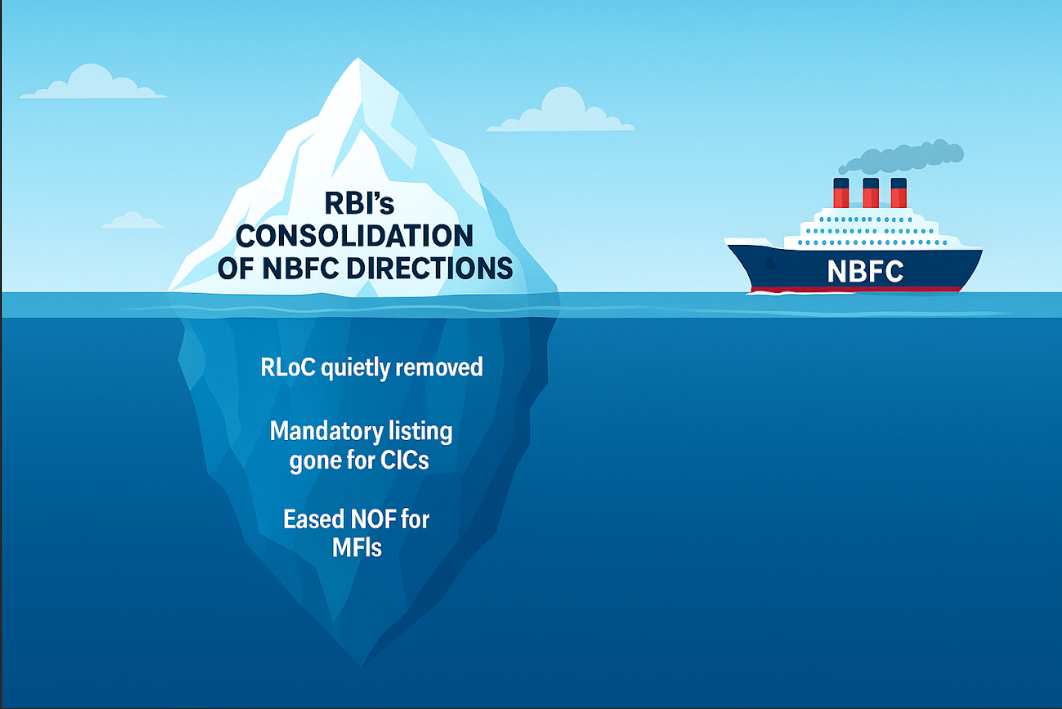
The Great Consolidation: RBI’s subtle shifts; big impacts on NBFCs

Team Finserv | finserv@vinodkothari.com

In its recent consolidation exercise of the Master Directions applicable to NBFCs, the RBI has done a lot of clause shifting, reshuffling, reorganisation, replication for different regulated entities, pruning of redundancies, etc. However, there are certain places where subtle changes or glimpses of mindset may have a lot of impact on NBFCs. Here are some:

Read more

Moderate Value RPTs : Interplay of disclosure norms and impracticalities

Pammy Jaiswal, Partner & Lavanya Tandon, Senior Executive | corplaw@vinodkothari.com

Preface

On October 13, 2025, SEBI vide its Circular has prescribed a set of disclosures required to be placed before the audit committee and shareholders for approval of RPTs, the value of which do not exceed 1% of annual consolidated turnover of the listed entity as per the last audited financial statements of the listed entity or Rupees Ten Crore, whichever is lower (‘Moderate value RPTs’).

This threshold has been introduced to facilitate ease of compliance with Industry Standards Note (‘ISN’) for RPTs over Rs 1 crore [para 5.3.2 of SEBI BM agenda dated September 12, 2025]. 

In this article, the author analyses the interplay of these distinct disclosure norms and also points out the impractical inclusion of shareholders for placing this information. 

Interplay with ISN on RPT dated July 26, 2025 

Since, the circular has been rolled out in furtherance of ISN, the RPTs can now be classified as follows for the purpose of checking their applicability under ISN- 

Particulars Threshold Applicability of ISNDisclosures 
Small value RPTs< INR 1 croreNAAs per rule 6A of the MBP Rules and Reg 23(3) of LODR 
Moderate RPTsLower of < 1% of annual consolidated turnover or 10 crores but exceeding 1Cr NAAs per SEBI Circular dated October 13, 2025
Other RPTs > 1% of annual consolidated turnover or 10 croresApplicableAs per para A, B, C of ISN, as may be applicable

Therefore, the minimum information required to be placed before the audit committee and shareholders (in case of material RPT) should be as per the disclosures stated above.

Effective date for compliance with the Circular

The Circular is effective from 13th October, 2025 (‘Effective Date’) and hence, any Moderate value RPTs placed for consideration on or after the effective date will require placing of the information provided in the Circular.

Further, it is also important to understand that this Circular applies for both approval as well as modification or ratification of Moderate Value RPTs, hence, in cases where the original transaction has already been approved and further modifications are intended, the instant Circular comes into action. 

Original Approved Transaction Value (INR in crs)Approved onValue of Modification post Effective Date(INR in crs)Applicability of ISNApplicability of Circular
500August, 2025100YesNo
100July, 20259NoYes*
70September, 20250.75NoNo
*Assuming the lower threshold being 1% of annual consolidated turnover of INR 9 crores.

Analysis w.r.t Material RPTs 

Pursuant to reg 23, a transaction with a related party is considered material, if the transaction(s) to be entered into individually or taken together with previous transactions during a financial year, exceeds rupees one thousand crore or ten per cent of the annual consolidated turnover of the listed entity. The identification of material RPTs is thus, based on all transactions, regardless of the nature of such transactions, taken together, for determining the value of transactions done with a related party, as material.

Similarly, in the present circular, the threshold for Moderate value RPTs is capped at lower of 1% of the annual consolidated turnover or 10 crores on an aggregate basis with the same related party in a financial year.

Provided that if a transaction with a related party, whether individually or taken together with previous transaction(s) during a financial year (including transaction(s) which are approved by way of ratification). 

Such aggregation and capping of transactions at 10 crores creates an impractical scenario of such RPTs crossing the materiality threshold (under Reg 23) and warranting disclosures under this Circular as far as information before shareholders are concerned. The following scenarios illustrate the impractability.

Case Consolidated Turnover Materiality threshold under Reg 23 Threshold for Moderate value RPTsValue of RPTs proposed to be undertaken on aggregate basisWhether shareholders approval is required? Applicability of Circular / ISN?
Company X500 crores 50 crores5 crores 4 croresNoCircular, but only limited to AC disclosures
15 crores No ISN (Part A & B)
60 crores Yes ISN (Part A & B); (Part C applies only if any particular transaction amongst the 6 items in itself is material)
Company Y1500 crores150 crores10 crores6 croresNo Circular, but only limited to AC disclosures
13 croresNo ISN (Part A & B)
170 croresYes ISN (Part A & B); (Part C applies only if any particular transaction amongst the 6 items in itself is material)
Company Z150 crores 15 crores 1.5 crores 1 croreNo No- small value RPT
3 crores No ISN (Part A & B)
18 crores Yes ISN (Part A & B); (Part C applies only if any particular transaction amongst the 6 items in itself is material)
Company Q50 crores5 crores0.50 crores2 croresNoISN (Part A & B)

It is imperative to highlight that while the Circular requires presenting information before the shareholders in case of material RPTs, given the ambit of transaction value for which this Circular has been rolled out i.e. lower of 1% of consolidated turnover or 10 crores, it will have no relevance as can also be seen from the table above. Therefore, it is an unlikely situation where the information prescribed under Para B of Annexure 13A of the Circular will be actually required to be placed before the shareholders.

Conclusion

SEBI, in its Board Meeting (para 5.4 of BM agenda), has indicated its intent to grant relaxation to entities with lower turnover in respect of the information to be furnished for approval of RPTs to the Audit Committee only. The Circular, however, prescribes the list for shareholder’s information also. As discussed above, given the threshold, the same becomes irrelevant. It is important to bring this to the knowledge of the regulators so that appropriate changes are carried out.  

Our RPT resource center may be accessed here- https://vinodkothari.com/article-corner-on-related-party-transactions/

FAQs on Industry Standards Note on RPTs: https://lnkd.in/gNER8UQD

Old Rules, New Book: RBI consolidates Regulatory Framework

Team Finserv | finserv@vinodkothari.com


Read our related resources:

RBI’s Regulatory Shelf gets a Pre-Diwali Dusting  

RBI releases plethora of draft regulations to consolidate existing regulations

Manisha Ghosh & Sakshi Patil | finserv@vinodkothari.com 

In 2021, RBI had set up an expert committee with the ideal objective of consolidating the multitude of separate notifications, Directions, circulars, and regulations applicable to various regulated entities. The aim was to create a comprehensive repository that such REs could easily refer to, streamlining compliance and reducing ambiguity.   

This consolidation exercise builds upon the groundwork laid by the Regulations Review Authority, which was tasked with reviewing regulations, circulars, and reporting requirements based on feedback from the public, banks and financial institutions, as highlighted in the press release dated April 15, 2021.

Ever since RBI was entrusted with the powers to regulate the financial sector entities, the RBI’s regulatory framework has steadily expanded, issuing numerous Directions under its statutory powers. While such evolution is natural, overlapping jurisdictions and a lack of clear supersession of older instructions have added complexity to the regulatory landscape.

In line with the above, the RBI has carried out a thorough consolidation of the regulatory instructions currently overseen by the Department of Regulation. On a prima facie review, it seems that this exercise has been carried out on an ‘as-is’ basis, with only minor editorial updates to clarify language or update terminology. There has been no substantive review of the instructions as such for any revisions or new additions. 

Under the consolidation exercise, more than 9000 circulars and Directions issued up to October 9, 2025, have been streamlined into 238 Master Directions, covering 11 specific categories of regulated entities across up to 30 functional areas. As a result, all these existing circulars, including various Master Circulars and Master Directions, administered by the Department of Regulation are proposed to be repealed.

Previously, a single circular often applied to multiple entities, with provisions scattered across different sections. This sometimes led to some confusion- for example, under the KYC Directions, 2016,  reference to “opening a small account” applied to banks, however, it created ambiguity about whether this shall be applicable to a borrower taking a loan in the case of NBFCs. 

It has been proposed that the regulatory framework shall be divided amongst regulated entities like commercial banks, payments banks, All India financial institutions, NBFCs, etc. Additionally, within each entity the provisions shall be separated into key areas such as, prudential requirements, interest on advances, asset liability management, valuation of investments, concentration risks, credit reporting, outsourcing, disclosures, etc. The aim is to ease out the compliance process by simplifying and arranging the regulations into identified key operational areas  applicable to a particular RE

While the intent of the consolidation exercise was refinement of the regulatory provisions and clarify any existing ambiguities, however, the segregation exercise requires a thorough review before being notified. Various provisions that were once uniformly applicable across all regulated entities have now been segregated based on the construct of respective REs, however, in ironing out one ambiguity, other creases may have surfaced! This underscores the need for a critical analysis of the implications of these provisions on individual regulated entities.

Drafts of these Master Directions have been circulated for comments to enable stakeholders to provide their views on this step taken towards ease of compliance. There could be uncertainties that would still persist post the streamlining process, and hence, warrants thorough review.

Read our detailed analysis of the consolidated regulations through here: Old Rules, New Book: RBI consolidates Regulatory Framework

For reference, RBI has made available on its website the following draft documents for public comments, with a focus on their completeness and accuracy:


Insure to Ensure Your Loan? 

Manisha Ghosh, Executive | finserv@vinodkothari.com

Introduction 

It is quite common that whenever a borrower wishes to apply for a loan, lenders require the borrower to purchase an insurance policy, as a pre-condition for sanction. One may wonder if availing insurance can be a mandatory requirement for availing any loan? Insurance is not a regulatory requirement that is needed in loans, however, lenders prefer the same to safeguard their interest in the event of default. 

Lending institutions such as banks and NBFCs may also enter into insurance business in line with the Master Circular – allied activities- entry into insurance business, issue of credit card and marketing and distribution of certain products for Banks and the “Guidelines for Entry of NBFCs into Insurance” (Annex XVI of SBR Directions) for NBFCs. Generally, lenders try to solicit customers by marketing insurance to the borrowers who have applied for a loan by acting as commissioned corporate agents of the insurance companies under the supervision of IRDAI. 

In this article, the author examines the prevalent practice of lenders requiring borrowers to obtain insurance as a prerequisite for loan sanction and evaluates its permissibility within the regulatory framework.

Read more

RBI’s Draft on Integrated and Internal Ombudsman

Team Finserv | finserv@vinodkothari.com

In the Monetary Policy Statement dated October 1, 2025, the RBI Governor announced several measures to strengthen consumer protection. Some of the measures introduced for enhancing consumer protection are as follows:

The Draft IOS Scheme has enhanced the scope of the grievance redressal mechanism and introduced a more structured procedural framework for complaint processing. The Draft Internal Ombudsman Directions further strengthen grievance redressal, enhance procedural clarity, and improve transparency through reporting requirements. This write-up analyses the proposed changes.

Reserve Bank – Integrated Ombudsman Scheme, 2021 (“RB-IOS, 2021”) and Reserve Bank – Ombudsman Scheme, 2025 (“Draft Scheme”)

HeadsCurrent RequirementProposed Requirement/ChangeImplication 
Definition of Customer The term “Customer” is not definedDefined under Para 3(1)(j) as:
“Customer” means any person who engages, in a financial service /product or activity related thereto with a Regulated Entity, irrespective of whether such person has an account-based relationship with the Regulated Entity;
The scope of financial services included within the ambit of the Scheme has been widened.
For eg:All types of credit facilities extended by the borrower to the customer;Guarantees or other non-fund based facilities offered by RE to customer;Demand Draft facilities offered by Banks; Services by RE, acting as an LSP, to other REs;
Compensation CeilingsUp to ₹20 lakh for consequential loss ₹1 lakh for consolatory damagesIncreased to ₹30 lakh for consequential loss &  ₹3 lakh for consolatory damagesThere was no cap on the value of dispute that can be brought before the Ombudsman. The same has been retained. Increment in the compensation limits 
“Advisory” MechanismNot providedPara 14(4) empowers the Ombudsman to encourage settlement between parties through a written agreement, subject to the fact that all communications are documented.
Para 14(6) allows the Ombudsman to issue advisory for settlement as a measure for the resolution of complaints.
RBI Ombudsman can now help parties resolve disputes by settlement.Draft IOS Scheme permits advisories i.e., communications from the Ombudsman advising REs to take actions for full or partial complaint resolution.Advisories are non-binding and serve as a pre-award tool to facilitate quicker settlements.
Change in the Appellate AuthorityExecutive Director in charge of the Department of the Reserve Bank administering the Scheme;The Draft IOS Scheme clearly mentions that the executive  director in charge  of the Consumer Education and Protection Department (CEPD) is the Appellate AuthorityExplicitly mentions the independent department under the RBI to act as the Appellate Authority.
Guidance on filing of the complaint formGuidance was provided under the Scheme at several places, but not at one place, along with the formAdded under Part A of Annexure, along with the Complaint FormMinor edits in the complaint form with guidance to clarify the process for filing complaints and reduce errors.It will enable quicker allocation and segregation of complaints.The clear filing mechanism will improve ease and understanding for customers.Improved accessibility by the Launch of a 24×7 Contact Centre (#14448) with multilingual IVRS support.
Ombudsman ReportEarlier, the Ombudsman was required to submit an annual report to the Deputy Manager of the RBI; however, the RBI was not obligated to publish itUnder the Draft IOS Scheme, it has now been made mandatory for the RBI to publish an annual report on the functioning and activities carried out under the Scheme.It will enable the regulator to understand the issues raised under the complaints and assess the effectiveness of the measures introduced.
Addition of an RE as third party to proceedingsNot providedThe Ombudsman can make any other RE as a party to the proceedings.Expands the powers of the ombudsman to include connected REs as well (for instance, in the case of co-lending or TLE transactions) 
Power of CRPC to classify and close complaintsNot explicitly mentioned RBI Ombudsman and CRPC remain responsible for receipt and examination of complaints.The Complaints shall be treated as follows:Complaints in the nature of suggestions or queries shall be treated as  non – valid at the stage of CRPFFurther, Para 10 specifies certain grounds for non maintainability of complaints for complaints to be rejected by the RBI Ombudsman.However the grounds of non-maintainability under Para 10 shall be specifically provided by the Competent Authority.This clarifies the hierarchy for complaint handling and enables early elimination of frivolous or ineligible complaints before they reach the RE.

It may also be noted that the RBI has, vide notification dated 07th October 2025, extended the applicability of the existing RBI-IOS to include State Co-operative Banks and Central Co-operative Banks. 

Draft Master Direction – Reserve Bank of India (Internal Ombudsman for Regulated Entities) Directions, 2023

Particulars of the ProvisionCurrent RequirementsNew RequirementsImplication
Eligibility of the IO (Para 5) No such requirement prescribedIf the person is a serving officer, he/she is required to relinquish the same before assuming charge as IO.
The IO shall previously not have been employed, nor presently be employed, by the RE or a holding, associate or subsidiary company of the RE.
To ensure the IO’s independence and impartiality, in case the proposed IO is a serving officer, he/she must relinquish the existing position before assuming charge, enabling objective and credible grievance redressal within the RE.
Further, conflict of interest positions clarified by specifically defining the scope of Related Parties of the RE.
Same IO appointment in a number of entities No such clause restricting the number of REs. The IO can work in more than one RE simultaneously, with specific approval from the CEPDSuch approval shall be obtained by the appointing RE.However, the deputy IO cannot be appointed in more than one RE simultaneously IO (but not deputy IO) has been permitted to be appointed in more than one RE simultaneously, subject to the approval from CEPD. Approval to be obtained by the appointing RE.
Impact:To allow efficient deployment of an experienced IO across multiple REs under CEPD oversight, while ensuring sufficient focus at each entity so that the role and effectiveness are not compromised.
Terms of Appointment of IO No clause that specifies the minimum no of IOs or the responsibility of the Board or its Committees w.r.t assessing the need for multiple IOs or the factors to be considered when doing so. Every RE shall appoint at least one IO.
The Board or its committees shall, at least annually, determine the number of IO/ Dy. IO to be appointed. This  must be determined with due regard to the volume and complexity of the complaints received.
To ensure effective grievance redressal, clarity has been provided on the minimum number of IOs to be appointed and the annual assessment of the need for IOs.
Actionables for the REs:All REs shall appoint at least one IO The Committee of the RE shall be required to assess the need of the no of IOs at least once in a yearFactors to be considered include complexity of complaints, sufficiency of the time, diversity of experience etc
Auto-escalation of complaintsAll complaints that are partly or wholly rejected by the RE’s internal grievance redress mechanism shall be auto-escalated to the IO within 20 days of receipt for a final decision.Auto-escalation of partly resolved or wholly rejected complaints to the office of the IO  has been specified to be 25 days in case of CICs (Credit Information Companies)To ensure timely escalation of unresolved complaints, the draft directions require auto-escalation to the IO within 20 days, with a relaxed timeline of 25 days for CICs, balancing prompt redressal with operational feasibility for CICs.
Board oversight – rotation of IOsNo such clause to ensure rotation of IOs in REs with multiple IOs exists in the current directions.In REs having multiple IOs, a view shall be taken by the Board or Customer Service Committee / Consumer Protection Committee of the Board to have representation of more than one IO or having a system of rotation.Actionables for REs:To ensure diversity in perspectives in grievance handling, REs with multiple IOs should consider Board-approved rotation or representation of more than one IO, enhancing fairness and effectiveness in complaint resolution.
Complaint Management System (CMS)Under the current directions, REs do not have to provide specific categories in the CMS.The REs shall provide only three categories i.e. ‘Fully Resolved’, ‘Partly Resolved’ and ‘Wholly Rejected’ in its CMS for recording the decision on the complaints before escalation to the office of IO. RE shall be required to have in place a fully automated  Complaint Management System.  To standardise complaint recording, REs must limit CMS decision categories to ‘Fully Resolved’, ‘Partly Resolved’, and ‘Wholly Rejected’ before escalation to the IO, ensuring consistency and clarity in complaint tracking.
Procedure for Complaint Redress by IO / Dy. IOThe current directions allow the IO to only rely on documents that are furnished to it by the RE.The IO / Dy. IO may, if they find it necessary, seek written or oral submission (including additional information and documents) from the complainant. Strengthening the principle of hearing, enhances procedural transparency, and facilitates effective complaint redressal.
Reporting to Reserve Bank The current directions have different disclosure requirements pertaining to categorisation of complaints and periodicity of reporting.In addition to the existing details to be provided to the CEPD, the draft directions have included the additional details to be included such as Date of Birth and the Date of intimation to the Reserve Bank in its intimation to the CEPD.
Further an additional periodic reporting requirement on quarterly basis instead of the previously annual requirement has been introduced for the REs. 
These additional details enable the regulator to verify that the eligibility of the IO, as prescribed in the regulations, is being complied with specifically, ensuring the age limit of 70 years based on the date of birth and that the intimation to the RBI is duly sent.
Further, the quarterly reporting requirement allows the CEPD to track the status of complaints and the IOs reported, enabling the regulator to assess implementation and the overall compliance position of the entity.

NHB’s PCE Scheme for HFCs

Sakshi Patil | finserv@vinodkothari.com


Read More:

  1. Bond Credit Enhancement Framework: Competitive, rational, reasonable
  2. Partial Credit Enhancement: A Catalyst for Boosting Infrastructure Bond Issuances?
  3. Partial Credit Enhancements

Expected to bleed: ECL framework to cause ₹60,000 Cr. hole to Bank Profits

Dayita Kanodia and Chirag Agarwal | finserv@vinodkothari.com

The proposed ECL framework marks a major regulatory shift for India’s banking sector; it is long overdue, and therefore, there is no case that the RBI should have deferred it further. However, it comes coupled with regulatory floors for provisions, which would cause a major increase in provisioning requirements over the present requirements. Our assessment, on a very conservative basis, is that the first hit to Bank P/Ls will be at least Rs 60000 crores in the aggregate. 

RBI came up with a draft framework on ECL pursuant to the Statement on Developmental and Regulatory Policies, wherein it indicated its intention to replace the extant framework based on incurred loss with an ECL approach. The highlights can be accessed here.

A major impact that the draft directions will have on the Banking sector is the need to maintain increased provisioning pursuant to a shift from an incurred loss framework to the ECL framework. Under the existing framework, banks make provisions only after a loss has been incurred, i.e., when loans actually turn non-performing. The proposed ECL model, however, requires banks to anticipate potential credit losses and set aside provisions for such anticipated losses. 

Banks presently classify an asset as SMA1 when it hits 30 DPD, and SMA2 when it turns 60. Both these, however, are standard assets, which currently call for 0.4% provision. Under ECL norms, both these will be treated as Stage 2 assets, which calls for a lifetime probability of loss, with a regulatory floor of 5%. Thus, the differential provision here becomes 4.6%.

Once an asset turns NPA, the present regulatory requirement is a 15% provision; the ECL framework puts these assets under Stage 3, where the regulatory minimum provision, depending on the collateral and ageing, may range from 25% to 100%. Our Table below gives more granular comparison.

Type of assetAsset classificationExisting requirement Proposed requirementDifference
Farm Credit, Loan to Small and Micro EnterprisesSMA 00.25%0.25%
SMA 10.25%5%4.75%
SMA 20.25%5%4.75%
NPA15%25%-100% based on Vintage10%-85% based on Vintage
Commercial real estate loansSMA 01%Construction Phase -1.25%

Operational Phase – 1%
Construction Phase -0.25%

Operational Phase – Nil
SMA 11%Construction Phase -1.8125%

Operational Phase – 1.5625%
Construction Phase -0.8125%

Operational Phase – 0.5625%
SMA 21%Construction Phase -1.8125%

Operational Phase – 1.5625%
Construction Phase -0.8125%

Operational Phase – 0.5625%
NPA15%25%-100% based on Vintage10%-85% based on Vintage
Secured retail loans, Corporate Loan, Loan to Medium EnterprisesSMA 00.4%0.4%
SMA 10.4%5%4.6%
SMA 20.4%5%4.6%
NPA15%25%-100% based on Vintage10%-85% based on Vintage
Home LoansSMA 00.25%0.40%0.15%
SMA 10.25%1.5%1.25%
SMA 20.25%1.5%1.25%
NPA15%10%-100% based on Vintage(-)5% – 85% based on Vintage
LAPSMA 00.4%0.4%
SMA 10.4%1.5%1.1%
SMA 20.4%1.5%1.1%
NPA15%10%-100% based on Vintage (-)5% – 85% based on Vintage
Unsecured Retail loanSMA 00.4%1%0.6%
SMA 10.4%5%4.6%
SMA 20.4%5%4.6%
NPA25%25%-100% based on Vintage0%-75% based on Vintage

The actual impact of such additional provisioning will be a hit of more than 3% to the profit of banks1. Based on the RBI Financial Stability Report of FY 24-252, the current level of SMA and NPA is estimated to be ₹3,78,000 crores (2%) and ₹4,28,000 crores (2.3%), respectively. 


Accordingly, an additional provision of approximately₹ 18,000 crores (4.6% of SMA volume) and ₹ 42,000 crores (10% of NPA volume) will be required for SMA and NPA respectively, leading to a total impact of at least ₹60,000 crores. This estimate has been arrived at by considering the % of NPAs and SMA-1 & SMA-2 portfolios of banks. The actual impact may be higher, as lot of loans may be unsecured, and may have ageing exceeding 1 year, in which case the differential provision may be higher.

It may be noted that while the draft directions allow Banks to add back the excess ECL provisioning to the CET 1 capital, it does not neutralize the immediate profitability impact, as the additional provisions would still flow through the profit and loss account.

How do we expect banks to smoothen this hit that may affect the FY 27-28 P/L statements? We hold the view that it will be prudent for banks, who have system capabilities, to estimate their ECL differential, and create an additional provision in FY 25-26, or do technical write-offs.

Other Resources

  1. The total Net profit of SCBs is ₹ 23.50 Lakh Crore for FY 24. (https://ddnews.gov.in/en/indian-scbs-post-record-net-profit-of-%E2%82%B923-50-lakh-crore-in-fy24-reduce-npas/ )
    ↩︎
  2.  Based on our rough estimate of the data available here: https://www.rbi.org.in/Scripts/PublicationReportDetails.aspx?UrlPage=&ID=1300 ↩︎