
Outbound Mergers – A path still less travelled by?
– Anushka Ganguly, Executive | corplaw@vinodkothari.com
BACKGROUND

Cross-border merger, specifically outbound merger, may be considered as a means of promoting cross-border investments by India. Outbound mergers involve transfer of the assets and liabilities of an Indian company into an overseas company, thus, leading to the resultant company being an overseas company, albeit, with shareholders of the transferor Indian company. Like a bird leaving its nest, an outbound merger denotes an Indian company’s departure from its domestic regulatory shelter to establish its identity under foreign skies.
While these act as growth levers allowing businesses to tap into new geographies, access global customers, and advanced technologies; from a regulatory standpoint, these are complex arrangements, governed simultaneously by corporate, foreign exchange, and tax laws, making them highly regulated corporate actions.
THE DAWN OF OUTBOUND MERGERS IN INDIA
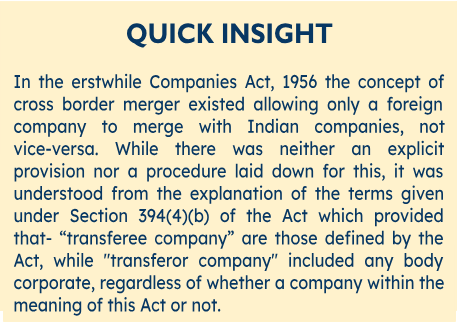
While the foreign giants were allowed to touchdown the Indian market, India’s regulatory framework maintained a rather protective stance – securing homegrown businesses by keeping outbound mergers off the table while tightly managing foreign exchange. With time the laws evolved and the realization that further growth required a visa was acknowledged. In December 2017, notification of Section 234 in Companies Act 2013 gave due recognition to outbound mergers. This move was followed by the RBI’s introduction of FEMA Cross Border Merger Regulations 2018, a comprehensive set of rules which dealt with cross-border mergers holistically[1].
OUTBOUND MERGER vs OUTBOUND ACQUISITION
In India, cross-border activity has been long dominated by inbound mergers and outbound acquisitions with outbound mergers continuing to be a rarity[2].

Even before 2017, when the Indian law did not permit outbound mergers– what was always possible was an outbound acquisition. Indian companies have often preferred outbound acquisitions over outbound mergers — a route that achieves similar strategic goals while bypassing the regulatory complexities of cross-border merger approvals. Media reports[3] indicate that in 2024, India saw about 120 outbound acquisition deals worth $17 billion. By August 2025, nearly 100 deals worth $11 billion have already been executed, showing strong momentum.
The difference lies in the fact that an outbound acquisition allows an Indian company to buy shares or assets of a foreign company under the FEMA ODI route, maintaining the foreign company’s legal status, only changing its ownership. In contrast, in case of an outbound merger, an Indian company merges into a foreign company, transferring all its assets and liabilities to such foreign entity, thereby losing its existence in India.
PROCEDURAL ASPECTS
Translating the legal permission into practice, the process demands navigation through a web of interlinked legal regimes. Outbound merger involves not just selecting a suitable foreign company for merger but exercising due care to understand the regulatory aspects, the political as well as tax scenarios of the jurisdictions involved.
1. Jurisdictional Eligibility
The first thing to be ascertained, in case of an outbound merger, is if the foreign Company is incorporated in an eligible jurisdiction. Annexure B to Rule 25A of the Companies (Compromises, Arrangements and Amalgamations) Rules, 2016 lays down the following jurisdictions as eligible:
- whose securities market regulator is a signatory to International Organization of Securities Commission’s Multilateral Memorandum of Understanding (Appendix A Signatories) or a signatory to bilateral Memorandum of Understanding with SEBI, or
- whose central bank is a member of Bank for International Settlements (BIS), and
- a jurisdiction, which is not identified in the public statement of Financial Action Task Force (FATF) as:
- a jurisdiction having a strategic Anti-Money Laundering or Combating the Financing of Terrorism deficiencies to which counter measures apply; or
- a jurisdiction that has not made sufficient progress in addressing the deficiencies or has not committed to an action plan developed with the Financial Action Task Force to address the deficiencies.
2. Valuation and Due Diligence
While the negotiations and dealings are underway, Rule 25A(2b) of the Companies (Compromises, Arrangements and Amalgamations) Rules, 2016 requires the transferee company to ensure that valuation is conducted by valuers who are members of a recognised professional body in the jurisdiction of the transferee company and further that such valuation is in accordance with internationally accepted principles on accounting and valuation. A declaration to this effect shall be attached with the application made to Reserve Bank of India for obtaining its approval under Rule 25A(2a)
3. Approvals – Scheme placed under the critical lenses of RBI, shareholders, creditors and ultimately NCLT
An ambition like an outbound merger requires not just a robust strategy but most importantly a positive nod from RBI, NCLT, shareholders and creditors of the entities involved in the scheme. Further, compliance with the approval requirements under the applicable laws in the jurisdiction of the foreign transferee company is also to be ensured.
A. RBI Approval:
Cross-border mergers are closely linked with foreign exchange management and capital movement. As the watchdog of the financial system, RBI ensures that these restructurings do not result in undue capital flight or financial instability. Rule 25A(2a) of the Companies (Compromises, Arrangements and Amalgamations) Rules, 2016 mandates that a company may merge with a foreign company incorporated in any of the jurisdictions specified in Annexure B, as discussed above, after obtaining prior approval of the Reserve Bank of India and after complying with provisions of sections 230 to 232 of the Act and these rules
FEMA (CROSS-BORDER MERGER) REGULATIONS, 2018– harbinger of cross-border business
Notified vide notification no. FEMA 389/ 2018-RB dated 20th March, 2018, these Regulations provide that if the merger transaction is in compliance with these Regulations, it shall be deemed to have been approved by RBI. In cases of deemed approval of RBI, the Regulations require a certificate from the Managing Director/Whole Time Director and Company Secretary, if available, of the company(ies) concerned ensuring compliance to these Regulations to be furnished along with the application made to the NCLT. However, on a practical front, in the author’s view, the avenue for deemed approval may not suffice and NCLT benches may require an explicit approval of RBI.
Major provisions dealt with by the said Regulations-
- Issue of Securities – . For the securities being issued by the resultant foreign company to persons resident in India, the acquisition should be compliant with the FEMA (Overseas Investment) Rules & Regulations, 2022 .Where the ODI falls within the limits prescribed (currently up to 400% of net worth in most cases), it can be made under the automatic route. If limits are exceeded or the sector falls under the “prohibited” list, RBI approval is required.
Now, in case of a shareholder being a resident individual, the fair market value of foreign securities should be within the limits prescribed under the Liberalized Remittance Scheme (which presently stands at USD 250,000 per financial year).
- Principal/branch offices or manufacturing unit situated in India– Any office of the transferring Indian company in India will be treated as a branch of the resulting foreign company and must comply with the Foreign Exchange Management (Establishment in India of a branch office or a liaison office or a project office or any other place of business) Regulations, 2016, including any applicable activity restrictions for branch offices.
- Borrowings and Guarantees- Any guarantees and borrowings of the transferor Indian company to be repaid as per the terms of the scheme sanctioned by the NCLT.
- Transfer of Assets – Any asset or security which is not permitted to be acquired or held under FEMA guidelines should be disposed of, repatriated, or dealt with as per the regulations within two years from the date of sanction by the NCLT.
- Bank Account- The foreign resultant company can maintain a Special Non-Resident Rupee Account (SNRR Account) in accordance with the Foreign Exchange Management (Deposit) Regulations, 2016 for up to two years to settle Indian obligations.
B. Other Regulatory Approvals
Sector specific regulators like SEBI in case of listed companies are required to be sought. Notice of the merger along with the proposed scheme are served to these regulatory bodies and their representations/objections are given due consideration.
C. Approval of the Shareholders and Creditors of the parties to the scheme
The merger proposal requires approval of majority shareholders representing 3/4th in value as well as from the creditors of the parties to the scheme at their meetings held for this purpose. They are entitled to receive notices and provide their consent or object to the scheme as per provisions of the Companies Act.
D. NCLT Sanction
NCLT serves as the ultimate legal authority to ensure that the Indian company’s integration with a foreign entity is done in a manner consistent with national and international regulatory requirements and in the interests of all concerned.
Section 234 read with rule 25A(2)(a) gives recognition to cross-border mergers by extending the provisions of Sections 230 to 232 of the Companies Act tooutbound mergers.
E. Approval Requirements in the Foreign Jurisdiction
In addition to the approval requirements mentioned hereinabove, the approval requirements as per the laws of the foreign jurisdiction is also required to be ensured.
TAXATION IMPLICATION IN CASE OF OUTBOND MERGERS
In case of outbound merger, as discussed above, the assets and liabilities of an Indian amalgamating company will get transferred and vested into a foreign amalgamated company. A potential concern in such a scenario is whether at all such arrangements will also be treated as tax neutral under Income Tax Act, 1961?
Under the current provisions of the Income Tax Act, 1961, tax neutrality has been specifically provided only in respect of mergers where the amalgamated company is an Indian company. Section 47 of the Income Tax Act exempts certain transfers from capital gains tax, including transfers of capital assets in a scheme of amalgamation, provided that the amalgamated company is an Indian company. In the case of an outbound merger, this condition is not fulfilled since the amalgamated company is a foreign entity. Consequently, the transfer of assets by the Indian amalgamating company to the foreign amalgamated company may be treated as a taxable transfer, potentially attracting capital gains tax in India.
Further, the shareholders of the Indian amalgamating company who receive shares of the foreign amalgamated company in exchange for their Indian shareholding may also be subject to capital gains tax, since the exemption under section 47(vii) applies only where the amalgamated company is an Indian company.
Although the Companies Act, 2013 and FEMA regulations now facilitate outbound mergers (subject to RBI approval), the Income Tax Act has not yet been amended to provide explicit tax neutrality for such transactions. Therefore, unless specific exemptions are notified, outbound mergers may result in significant tax costs both for the amalgamating company and its shareholders.
CONCLUSION
While the regulatory framework under the Companies Act, 2013 and FEMA has paved the way for outbound mergers by providing legal recognition and procedural clarity, the absence of corresponding tax neutrality under the Income Tax Act, 1961 remains a significant bottleneck. Unless specific tax exemptions or clarificatory amendments are introduced, the potential incidence of capital gains tax on both the amalgamating company and its shareholders, coupled with other tax exposures, may act as a major deterrent for cross-border restructuring involving Indian entities. For outbound merger provisions to achieve their intended objective of facilitating global business integration and ease of doing business, a harmonized tax regime will be crucial. Addressing these tax hurdles will not only encourage Indian companies to pursue international expansion through mergers but also enhance India’s competitiveness as a jurisdiction supporting outward investments.
[1] https://vinodkothari.com/2017/04/companies-act-now-permits-cross-border-mergers-by-meenakshi-lakshmanan/
[2] https://bpasjournals.com/library-science/index.php/journal/article/view/1986/1280
[3] https://www.cnbctv18.com/business/indian-corporates-show-strategic-discipline-in-overseas-merger-and-acquisition-say-experts-alpha-article-19672069.htm
Leave a Reply
Want to join the discussion?Feel free to contribute!