As a part of the governor’s statement dated October 1, 2025, it was highlighted that banks and NBFCs continue to exhibit financial stability, by way of strong liquidity positions, capital adequacy, and sustained profitability. Further, NBFCs have shown improvement with better asset quality and declining GNPA ratios. Against this backdrop, the RBI has maintained a cautious yet forward-looking stance, keeping policy rates unchanged while focusing on strengthening financial stability, enhancing risk management, and reinforcing consumer protection through regulatory measures affecting banks and NBFCs. Some of thedevelopmental and regulatory policy measures introduced by the RBI, which are expected to impact financial entities such as banks and NBFCs, have been discussed below:
Key Highlights:
Particular
Change and Impact
Expected Credit Loss (ECL) Framework
Applicability: Banks Impact/Change: RBI plans to implement an ECL-based provisioning framework for banks, effective from April 2027.Under this framework, banks will be required to make provisions upfront for potential losses based on expected credit deterioration, in alignment with that being followed by NBFCs under IndAS.The ECL approach is intended to strengthen credit risk management and promote more forward-looking provisioning practices.You can read our analysis on the same here.
Basel III Guidelines – Standardised Approach
Applicability: Scheduled Commercial Bank, excluding Small Finance Banks, Payments Banks, and Regional Rural Banks Impact/Change: RBI has proposed draft guidelines on the Revised Basel Framework – Standardised Approach for Credit Risk. Accordingly, the approach for arriving at risk weight for computation of capital ratios will be revisited. While guidelines are awaited, IIRB approach may be introduced for Indian Banks, in line with global practices. Guidelines are awaited.
Risk-Based Premium Framework for Deposit Insurance
Applicability: All Commercial Banks, All State, Central and Primary Cooperative Banks Impact/Change: At present, the Deposit Insurance and Credit Guarantee Corporation (DICGC) operates the deposit insurance scheme where each depositor in a bank is insured up to a maximum of ₹5,00,000. Currently, DIGC levies a uniform flat premium of 12 paise per ₹100 of deposits from all banks, irrespective of the financial strength of the bank. The RBI has now proposed a shift to a Risk-Based Premium Framework, which would reduce the premium payable by banks that are financially sound. Guidelines are awaited.
Risk Weights on Infrastructure Lending by NBFCs
Applicability: NBFCs engaged in project finance, HFCs with LAP exposure, and banks with large infrastructure portfolios Impact/Change: “Infrastructure lending” (as per para 5.1.14, SBR Master Directions) refers to credit extended by way of term loans, project loans, or investment in bonds/debentures/preference/equity shares of a project company, where the subscription is treated as an advance or other long-term funded facility in the sub-sectors as may be notified by the Ministry of Finance. Under SBR, provisioning norms did not differentiate between construction and operational phases, overlooking the higher risks during construction. The Project Finance Directions, 2025 addressed this by mandating higher provisioning for under-construction projects. Presently, NBFCs can apply lower risk weights to operational PPP projects (50% for operating vs. 100% for construction). RBI now proposes a principle-based framework to better align risk weights with the actual risk profile of operational projects. Guidelines are awaited.
Review of the External Commercial Borrowing Framework
Applicability: Entities intending to avail an External Commercial Borrowing. Impact/Change: RBI has proposed a review of the External Commercial Borrowing (ECB) framework to rationalise and simplify existing regulations. The proposed changes include Expanding eligible borrower and lender categories, Relaxing borrowing limits and maturity restrictions, Removing cost ceilings, Revising end-use conditions, Simplifying reporting requirements. Draft regulations are yet to be issued for the same.
Strengthening the Internal Ombudsman (IO) Mechanism
Applicability: NBFCs-NDs with an asset size of ₹5000 crore and above, and having public customer interface; Deposit-taking NBFCs with 10 or more branches. Impact/Change: The RBI intends to enhance the effectiveness of the IO framework introduced for the REs in 2018 (revised direction was introduced in 2023). As per the extant regulatory requirements, the IO serves as an independent authority within the applicable REs to review complaints that are rejected by the REs. The proposed revisions seek to strengthen this mechanism by: Empowering IOs with compensation powers and granting them the ability to directly interact with complainants, thereby aligning their role more closely with that of the RBI Ombudsman. Introducing a two-tier grievance redress structure within applicable REs, to ensure that complaints are first addressed at multiple levels internally before being escalated to the IO. The draft of the revised master direction on the internal ombudsman is yet to be released, which will then be open for wider analysis of the changes and their implication.
Review of Reserve Bank – Integrated Ombudsman Scheme, 2012
Applicability: The Scheme applies to services rendered by Regulated Entities in India to their customers under the RBI Act, 1934; Banking Regulation Act, 1949; Payment and Settlement Systems Act, 2007; and the Credit Information Companies (Regulation) Act, 2005. Impact/Change: The RBI has conducted a comprehensive review of the RBI – Integrated Ombudsman Scheme, and will be releasing the draft of the revised Scheme for stakeholder feedback. The revision of the scheme is related to the following: To extend its applicability to State Co-operative Banks and District Central Cooperative Banks (previously under NABARD), thereby the customers of these rural co-operative banks can now approach the RBI Ombudsman for complaints related to banking services instead of NABARD. To enhance clarity, simplify procedures and reduce timelines to ensure more effective handling of complaints. Considering the publications, there is expectation of cross reporting between RBI Ombudsman and Internal Ombudsman.
Consolidation of Regulatory Instructions
RBI is streamlining and consolidating its regulatory instructions into Master Directions for easier access and compliance. Around 250 draft Master Directions, covering 30 regulatory areas across 11 types of regulated entities, will be published on the RBI website, and stakeholders will be given an opportunity to review them and give feedback on their completeness and accuracy.
https://vinodkothari.com/wp-content/uploads/2023/06/vinod-kothari-logo.png00Team Finservhttps://vinodkothari.com/wp-content/uploads/2023/06/vinod-kothari-logo.pngTeam Finserv2025-10-01 18:27:512025-10-03 18:50:58RBI Monetary Policy Update: Enhancing Financial Stability for Banks and NBFCs
This was being deferred for quite some time, but now it is time to move to expected credit loss provisioning. In a spate of regulatory proposals on 1st October, as a part of Statement on Developmental and Regulatory Policies, the RBI has proposed to come with proposed implementation of ECL, requiring banks to provide for credit losses on the globally followed “expected loss”, rather than the current regulatory provisioning approach. Looking at the experience in case of NBFCs, this move may increase banks’ credit provisioning by multiples
Ind AS, the IFRS-convergent accounting standards, were adopted in India in a phased manner beginning April 2016. However, full implementation of IFRS for banks was deferred indefinitely in 2019[1].
It now seems that RBI intends to implement IFRS for banks in a phased manner, as accounting for investments by banks had already been aligned with Ind AS 109, and the next step would be adoption of Expected Credit Loss (ECL) provisioning for banks. Vide the Statement on Developmental and Regulatory Policies dated October 01, 2025, RBI has proposed to implement the ECL framework for banks as well.
Further, in the Governor’s Statement dated October 1st, it was provided that the requirements of ECL are proposed to be made applicable from 1st April 2027, additionally to abosorb the one-time impact a glide path till March 31st 2031 is proposed to be provided.
Over the years, there have been several discussions on bringing banks under the IFRS/Ind AS framework. RBI had even mandated banks to prepare parallel financial statements as per Ind AS and submit them, which was viewed as a pre-implementation monitoring exercise.
While never officially communicated, ECL was seen as the major hurdle for adoption of Ind AS by banks, as provisions under ECL are expected to be multifold of those required under the current provisioning norms of RBI[2]. The transition would therefore materially impact banks’ profitability and earnings ratios.
ECL provisions are forward looking provisions based on estimation of credit losses on financial assets. It provides for entities to provision based on their past experience and future expectations of recoveries from financial assets, other than those classified under FVTPL. The manner of computation of ECL is based on credit quality based classification.
A detailed analysis on computation of ECL can be read here.
While adoption of ECL is undoubtedly a step towards more prudent and forward-looking financial reporting, it also carries the risk of earnings volatility. For listed banks in particular, the resultant shocks to profitability could impair their market valuation and fund-raising capacity. Though ofcourse glide path would assist in absorbing the losses.
For next steps, we would need to await a detailed guidance circular by RBI on adoption of ECL. Though banks may have already debated their ECL policies while preparing Ind AS-compliant financials for reporting to RBI, the same would now require an even closer look considering the probable impact.
https://vinodkothari.com/wp-content/uploads/2023/06/vinod-kothari-logo.png00Staffhttps://vinodkothari.com/wp-content/uploads/2023/06/vinod-kothari-logo.pngStaff2025-10-01 16:17:532025-10-01 16:44:17Closing in on Implementation of IFRS for banks: RBI proposes expected loss write down for banks
The Reserve Bank of India issued amendment directions on September 29, 2025[1] that modify the extant guidelines that govern floating interest rate loans. They provide that:
Reduction in costs owing to reduction in components of spread (other than credit risk premium) can be passed to customers in a shorter time frame, that is, even before 3 years, and
that lenders are not obligated to offer fixed loan options to borrowers when floating rates are reset.
These amendments are poised to address the capabilities of lenders by improving transmission of low costs and reducing operational complexities. A brief overview of changes follows:
The old circular stated that REs had to compulsorily provide the option to borrowers to switch over to a fixed rate as per their Board approved policy. Even in cases when the RE did not have any fixed rate personal loan products, it was mandated to offer such an option, and thus mandated to offer fixed rate loan products.
The amended circular enables REs to optionally providea choice to borrowers to switch to fixed rate loans, but does not make it mandatory for them to do so. Thus, they do not need to offer fixed rate loan products, reducing the complexity of their operations.
In India, banks have traditionally extended floating-rate loans, particularly for long-tenure lending, without absorbing the underlying interest rate risk. The regulatory compulsion to provide borrowers with the option to convert to fixed rates placed lenders in a difficult position, as they were effectively pushed to offer a product they were neither structurally prepared for nor inclined to provide.
One could argue that banks, being better positioned to manage interest rate risk, might eventually have developed fixed-rate loan offerings for longer maturities, especially since India’s interest rate environment has historically been less volatile than economies where fixed-rate loans remain a norm. However, to avoid exposing banks to the embarrassment of being unable to practically deliver such products, the RBI appears to have stepped in, making the provision of this conversion option itself optional.
Under the old guidelines, the other components of the spread (other than credit risk premium) such as operating costs and liquidity costs could only be changed once every three years. Thus, any major changes to the bank’s costs, such as a reduction in operating costs, could not be easily passed on to its customers.
With the amendment, such costs may be reduced by banks earlier than three years for customer retention, ensuring that any benefit the bank gets in terms of lower cost is passed on effectively to customers. This must be included in the bank’s policy and must be non-discriminatory, ensuring transparency and fairness. A leaner performance by Banks now enables them to offer better rates sooner, of course supporting a better customer outreach.
[1] That will come into effect from October 01, 2025
The proceedings in Bhushan Steel now take a U-turn, as the SC ruling has upheld the resolution plan of SRA. Earlier, the SC had ordered liquidation of the CD.
Here is a quick round up of important takeaways from the verdict:
CoC has a vital interest in the resolution plan and that such an interest would continue till the Resolution Plan is actually implemented. If it is argued that the CoC cannot act in any manner after approval of resolution plan, then it can lead to a limbo or an anomalous situation where, say, the plan could not be implemented for any reason, leaving the creditors high and dry. Notably, the cloud of uncertainty exists until finality is given by the SC under section 62. Until then, CoC remains interested.
Appeal to SC can be made only if it was appealed against before the NCLAT. Also, appeal to SC is available only on questions of law pertaining to any of the five grounds specified in Section 61 of the IBC – and, for no other reason.
A clause in the resolution plan empowering the CoC to merely extend the implementation timeline by a specified majority and neither providing for withdrawal nor modification, cannot be stated to be an open ended or indeterminate plan solely at the discretion of the resolution applicant.
For issues like distribution of profits arising during CIRP, look at the RFRP and the resolution plan. Unless there is a specific provision with regard to such distribution to be made to creditors, the money shall remain with CD. Also, in this case, the resolution plan explicitly contemplated that SRA shall take over the assets and liabilities of the CD as a ‘going concern’, which would include the profits or losses that may be generated by the company during CIRP.
Where a creditor was classified as contingent creditor by SRA and the plan was approved by CoC; and ambivalent stance was taken by the concerned creditor, then the commercial wisdom of CoC cannot be challenged.
Payments to creditors against pre-CIRP dues must be done only in accordance with the resolution plan and with the express agreement of the CoC.
Decisions pertaining to the resolution plan and dues thereunder fall under the “commercial wisdom” of CoC. Where CoC exercises commercial wisdom, the decision is deemed to be non-justiciable by this Court in view of ruling in K. Sashidhar.
Once the resolution plan has been approved by the CoC and NCLT, permitting any claims to be reopened which were not a part of the RFRP/resolution plan will open Pandora’s box, and will do violence to the provisions of IBC. SRA cannot be forced to deal with claims that are not a part of the RfRP issued in terms of Section 25 of the IBC or a part of its Resolution Plan. Courtesy: SC ruling in Essar Steel and Ghanshyam Mishra.
Ruling available here: https://api.sci.gov.in/supremecourt/2020/7358/7358_2020_1_1501_64744_Judgement_26-Sep-2025.pdf
https://vinodkothari.com/wp-content/uploads/2023/06/vinod-kothari-logo.png00Staffhttps://vinodkothari.com/wp-content/uploads/2023/06/vinod-kothari-logo.pngStaff2025-09-26 14:05:002025-09-26 14:10:18Kabhi Naa, Kabhi Haan: Key Takeaways from the SC’s verdict in Bhushan Steel
Credit Factoring or simply factoring is an asset backed means of financing (tripartite agreement between the buyer, seller and the factor), whereby the account receivables are assigned to a third party called factor for a discount, releasing the tied-up capital and providing financial accommodation to the Company. The origin of factoring goes back to the 14th century in England. Earlier, factoring was confined to textile and garment industries, but later was spread across various industries and markets. Factoring has been defined as:
“Credit factoring may be defined as a continuing legal relationship between a financial institution (the “factor”) and a business concern (the “client”) selling goods or providing services to trade customers (the “customers”) whereby the factor purchases the client’s book debts either without or with recourse to the client, and in relation thereto controls the credit extended to customers and administers the sales ledger.”
UNIDROIT Convention on International Factoring, 1988 defines factoring as follows:
“Factoring contract” means a contract concluded between one party (the supplier) and another party (the factor) pursuant to which:
the supplier may or will assign to the factor receivables arising from contracts of sale of goods made between the supplier and its customers (debtors) other than those for the sale of goods bought primarily for their personal, family or household use;
the factor is to perform at least two of the following functions:
finance for the supplier, including loans and advance payments;
maintenance of accounts (ledgering) relating to the receivables;
collection of receivables;
protection against default in payment by debtors;
notice of the assignment of the receivables is to be given to debtors.
US accounting standard ASC 860-10-05-14 defines ‘factoring arrangements’ as:
Factoring arrangements are a means of discounting accounts receivable on a nonrecourse, notification basis. Accounts receivable in their entirety are sold outright, usually to a transferee (the factor) that assumes the full risk of collection, without recourse to the transferor in the event of a loss. Debtors are directed to send payments to the transferee
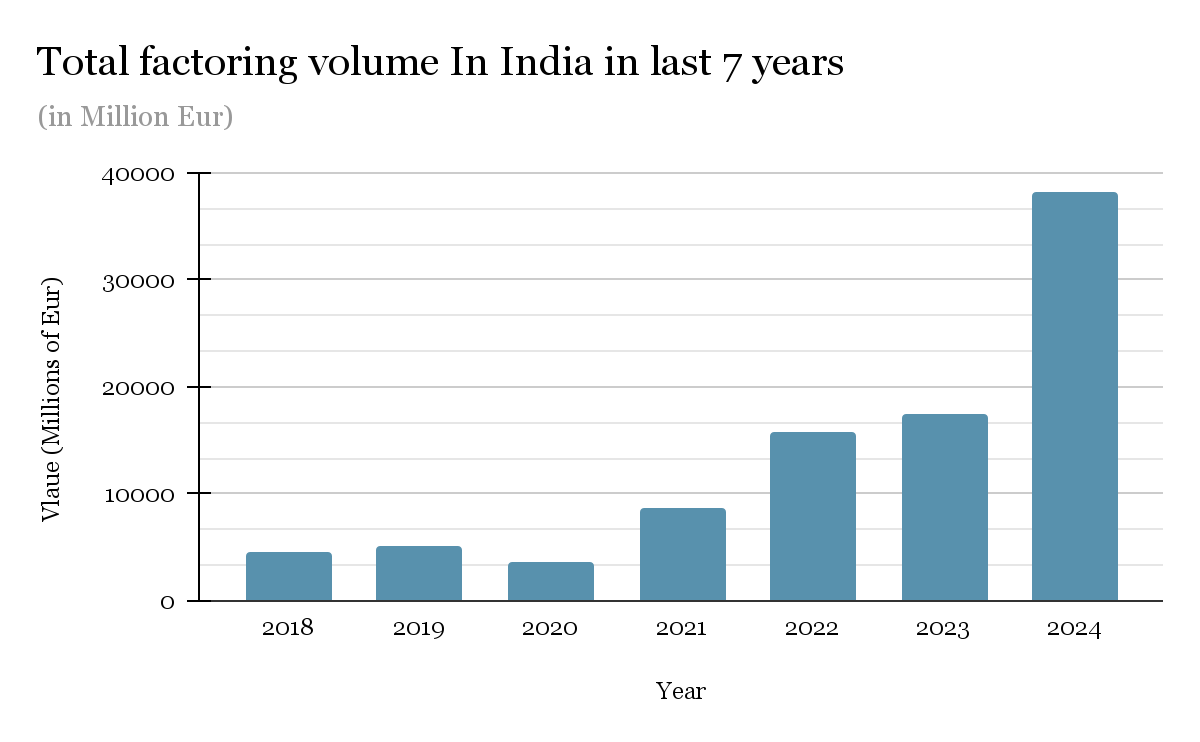
Though Europe provides largest volumes globally, factoring in Asia as well has been growing rapidly in the last few years. Global factoring volumes reached EURO 3.66 Trillion in 2024 (up 3.6% from the previous year)1. In Asia-Pacific, India was the fastest-growing market in the region, up 120% to EUR 38.2 billion.2
The purport of factoring is to assign the account receivables to be able to:
Instantly convert receivables into case, that enable the companies to have funds to finance the day to day operations of the company;
Helps in efficient collection of the receivables and protection against bad debts;
Outsourcing sales ledger administration and
Availing credit protection for receivables.
Typically in a factoring transaction, a seller gets a prepayment limit from the factor, then enters into a transaction with the buyer and submits the invoice; notice to pay etc to the factor. The factor makes upfront payment to the seller, as a percentage of invoice value based on criteria, such as, quality of receivables, number and quality of the buyers and seller’s requirements (80% – 95% of invoice value) and maintains the sales ledger of the seller and collects payment from buyer. The balance payment is made to the seller, net of charges. The seller is not required to open an LC or a bank guarantee.
The cost to the seller in factoring is the service fees, which is dependent on a) sales volume, b) number of customers, c) number of invoices and credit notes and d) degree of credit risk in the customer or the transaction.
Factoring and Bill Discounting
There is a very thin line of difference between factoring and bill discounting. Bill discounting unlike factoring is always with recourse to the client, whereas factoring may be with recourse or without. Generally there is no notice of assignment given to the customer in case of bill discounting and collections are done by the assignor , unlike factoring, where debt collection is done by the factor. Factoring can be called a financing and servicing function, whereas, bill discounting function is purely financial.
Types of Factoring
On the basis of geographical distribution
Domestic Factoring
Sales bill factoring
Purchase bill factoring
International Factoring – As international trade continues to increase, international factoring is being accepted as vital to the financial needs of the exporters and is getting the necessary support from the government, specifically in the developing countries to stimulate this mode of funding.
Export factoring – It is seen as an alternative to letter of credit, as the importers insist on trading in open account terms. Export factoring eases the credit and collection troubles in case of international sales and accelerates cashflows and provides liquidity in the business.
On the basis of credit risk protection
On recourse basis, wherein the factor can recover the amount from the seller, in case of non-payment of the amount to the factor. Thus, though the receivables have been assigned, the credit risk remains with the client.
On non-recourse basis also called old line factoring, wherein the risk of non-payment of invoices is borne by the factor. However, the factor only bears credit risk in such transactions. In case non-payment is due to any other reason other than financial incapacity, such as disputes over quality of goods, breach of contract, set-offs or fraud , the factor does not assume liability and the risk remains with the client.
Other types:
Advance factoring: In case of advance factoring, the factor provides financial accommodation and non-financial services. The factor keeps a margin while funding, which is called the client’s equity and is payable on actual collection.
Maturity factoring: Here, the factor makes payment on a due date. This sort of funding is resorted to by clients who are in need of non-financial services offered by the factors.
Supplier guarantee factoring: Also known as drop shipment factoring. This sort of factoring is common where the client acts as a mediator between the supplier and the customer.
Overview of factoring in India:
India’s factoring turnover in 2024 was around Euros 38,200 Million in total as compared to a total of Euros 3,894,631 million worldwide3 and the turnover over the last 7 years (2018-2024) has seen a tremendous growth; while that of Asia has risen 38% from 2018 to 2024 and is valued at Euros 3,894,631Million.
Some of the challenges faced by the factoring companies in India are a) there was no specific law for assignment of debt, b) there was no recovery forum available to the factoring NBFCs such as DRT or under Sarfaesi Act, c) Lack of access to information on credit worthiness and d) assignment of debt involves heavy stamp duty cost.
UNCITRAL laws on assignment
Article 2 of the United Nations Convention on the Assignment of Receivables in International Trade defines ‘Assignment’ as –
“Assignment” means the transfer by agreement from one person (“assignor”) to another person (“assignee”) of all or part of or an undivided interest in the assignor’s contractual right to payment of a monetary sum (“receivable”) from a third person (“the debtor”). The creation of rights in receivables as security for indebtedness or other obligation is deemed to be a transfer;
The Factoring Regulation Act, 2011
In order to revive the business and render liquidity specifically to the small and medium enterprises, the Finance Minister, in the Parliament session held in March, 2011 had tabled a pilot bill to bring the factoring business in India under regulation. The Bill was passed as the Factoring Regulation Act, 2011
While the intent of the Act may be to stimulate the growth of factoring business in India, but a close look at the Act does not enumerate so. The Act is a regulation Act, but the need was for an Act to promote factoring and not so much to regulate. Some of the highlights of the Act are as mentioned below:
The name makes it unclear whether the Act is for regulating assignment; factoring or both. Further it should have been a regulation of factor’s’ and nor factor, to be more appropriate.
Section 2 (a) of the Act defines means transfer by agreement to a factor of an undivided interest, in whole or in part, in the receivables of an assignor due from a debtor…The definition talks about undivided interest to be assigned only and does not consider assignment of fractional interest within its ambit. This would mean that any assignment of fractional interest would not be covered under this definition. Further whether the assignment could be in terms of money, in terms of time or rate of interest is not clear from the definition.
The definition of receivables, in Section 2(p) of the Act includes futures receivables as well, which is in line with international laws.
Section 3(1) of the Act says –
No Factor shall commence or carry on the factoring business unless it obtains a certificate of registration from the Reserve Bank to commence or carry on the factoring business under this Act.
The definition should have said no ‘person’ shall commence or carry on the factoring business rather than using the term factor. A person shall only become a factor after obtaining a certificate of registration from the Reserve Bank as the section suggests. However the section already terms such a person as a ‘factor’, making the definition circular.
Section 3(3) of the Act states every company carrying or commencing factoring business to be registered with RBI, and such companies would be classified as NBFCs and all the provisions applicable to NBFCs would be applicable here as well. Section 3(4) requires existing NBFCs to take a fresh certificate of registration, if they are principally engaged in the business of factoring. But the Act does not render clarity whether there would be a separate class of NBFCs carrying out factoring business.
Section 7(3) states that in case the receivables are encumbered to any creditor, the assignee shall pay the consideration for such assignment to the creditor to whom the receivables have been encumbered. In case of fixed charge created over assets, the provisions of this section are well thought, however in case of floating charges, this would render several difficulties for the assignor. Most companies have fixed and floating charges created over their assets, the assets on which floating charge is created are regularly rotated in business and are only crystallized in case of default or non-payment. If the company was to assign such assets it would be practically impossible for the assignee to identify which receivables are currently subject to the floating charge, and to whom the consideration ought to be paid. This uncertainty could discourage assignments, create disputes between secured creditors and assignees, and undermine the commercial utility of receivables financing.
Section 8 of the Act requires the notice of assignment to be given to the debtor, without which the assignee shall not be entitled to demand payment of the receivables from the debtor. However Section 7(2) of the Act, makes Section 8 redundant, as it states that on execution of agreement in writing for assignment of receivables, the assignee shall have ‘absolute right to recover such receivable and exercise all the rights and remedies of the assignor whether by way of damages or otherwise, or whether notice of assignment as provided in sub-section (1) of section 8 is given or not.’ This is not in line with the proviso to Section 130 (1) of the Transfer of Property Act, 1882 which mandates that the assignee will be able to recover or enforce the debt when the debtor is made party to the transfer or has received express notice of such an assignment.
Section 8, 9 and 10 provide for the requirements of notice of assignment. The intent of Section 11 seems that even in case notice of assignment is not provided the debtor would not be absolved from his duties to make payment. However the section is worded as ‘till notice is served on the debtor, the rights and obligations in its contract with the assignor, shall remain unchanged, excepting the change of the party to whom the receivables are assigned which may become entitled to receive the payment of the receivable from the debtor;’ this means whether or not notice for assignment is provided the rights and obligations of the debtor towards the assignee would remain unaffected. If so was the intent of the Section, then there was no need for any notice of assignment to be given to the debtor, as by the virtue of this section read with section 7(2), the assignee would have all the right on receivables as that of the assignor.
The UNCITRAL model law on assignment requires that notification of assignment of debt is to be given by either the assignor or the assignee, the assignee may not retain more than the value of its right in the receivable and notification of the assignment or a payment instruction is effective when received by the debtor. However, until the debtor receives notification of the assignment, the debtor is entitled to be discharged by paying in accordance with the original contract.
Import factoring is not permitted as per Section 31(1) of the Act.
Further recourse to the assignor is not permitted under the Act.
The proposed law provides for compulsory registration of every transaction of assignment of receivable with the Central Registry to be set up under the Sarfaesi Act within a period of 30 days.
Factoring or financing transaction?
In Major’s Furniture Mart, Inc v. Castle Credit Corporation4, the question in consideration in the case was whether the transaction was a true sale or mere financing. Major’s was into retail sale of furniture and Castle into the business of financing such dealers as Major’s. Under an agreement, Major’s had sold its receivables to Castle, with full recourse against Major’s. The Court held the assignment of receivables by the furniture seller to the factoring company a case of financing and not assignment, as the factor had full recourse on the seller and the factor only paid a part of the total debt factored by him.
In another case of Endico Potatoes Inc. and others vs. CIT Group/Factoring Inc.5, in case of a factoring transaction, the court opined:
“Resolution of whether the “contemporaneous transfer,” as CIT describes Merberg’s assignment of accounts receivable to CIT and CIT’s loan advances to Merberg, constitutes a purchase for value or whether the exchange provides CIT with no more than a security interest, depends on the substance of the relationship between CIT and Merberg, and not simply the label attached to the transaction. In determining the substance of the transaction, the Court may look to a number of factors, including the right of the creditor to recover from the debtor any deficiency if the assets assigned are not sufficient to satisfy the debt, the effect on the creditor’s right to the assets assigned if the debtor were to pay the debt from independent funds, whether the debtor has a right to any funds recovered from the sale of assets above that necessary to satisfy the debt, and whether the assignment itself reduces the debt.
Major’s Furniture Mart, Inc. v. Castle Credit Corp.6, Levin v. City Trust Co.7, Hassett v. Sprague Electric Co.8, In re Evergreen Valley Resort, Inc.9. The root of all of these factors is the transfer of risk. Where the lender has purchased the accounts receivable, the borrower’s debt is extinguished and the lender’s risk with regard to the performance of the accounts is direct, that is, the lender and not the borrower bears the risk of non-performance by the account debtor. If the lender holds only a security interest, however, the lender’s risk is derivative or secondary, that is, the borrower remains liable for the debt and bears the risk of non-payment by the account debtor, while the lender only bears the risk that the account debtor’s non-payment will leave the borrower unable to satisfy the loan.
In CF Motor Freight v. Schwartz10, the court recharacterized what was labeled a factoring arrangement as a secured loan. The agreement expressly stated it was a “Factoring Agreement,” and each receivable was stamped as “sold and assigned.” The court even acknowledged that factoring typically involves the purchase of accounts receivable. Under the arrangement, the transferee advanced 86% of the invoice value upfront, with an additional 10% payable if and when collections were made. However, if a receivable was not collected within 60 days, the transferee could demand repayment from the transferor. Because of this recourse provision, the court concluded that the transferee had not truly assumed the risks associated with ownership and therefore treated the arrangement as a secured loan.
In Home Bond Co. v. McChesney11, the US Supreme Court held that certain contracts labeled as “purchases” of receivables were in fact loans secured by receivables, because the transferor retained the risk of non-payment (through repurchase obligations and collection duties), and the transferee’s “service charges” were essentially disguised interest. The ratio being that a transaction is a loan, not a sale, when the transferor bears the risks and costs of collection, even if the contract is formally styled as a sale. In Taylor v. Daynes12, the Utah Supreme Court stated that whether a sale has occurred depends not on labels or form but on whether the risks and benefits of ownership have been transferred to the transferee.
Another aspect considered by courts to determine whether it is a case of sale of receivables is alienability i.e. ability to transfer/resell for a profit. When an account is transferred, if the transferee has a right to alienate the acquired account, it is a case of sale and not financing. In Nickey Gregory Co. v. AgriCap, LLC, the court treated the transaction as a secured loan, partly because the transferee’s rights were closer to a lender’s, it did not have full indicia of ownership, including unrestricted alienability.
In a more recent case of Re: Qualia Clinical Service, Inc v. Inova Capital Funding, LLC; Inova Capital Funding, Inc, the bankruptcy court found that the invoice purchase agreement was clearly and unambiguously a financing arrangement. The court made that finding on the terms of the agreement itself. In particular, the court noted that the recourse provisions contained in section 7.02 of the agreement, which shift all collection risks to Qualia.
“…..“The question for the court then is whether the Nature of the recourse, and the true nature of the transaction, are such that the legal rights and economic consequences of the agreement bear a greater similarity to a financing transaction or to a sale.”
This agreement, which shifts all risk to Qualia, is a disguised loan rather than a true sale. Where the “seller” retains “virtually all of the risk of noncollection,” the transaction cannot properly be considered a true sale.
If the assignment alone did not reduce the obligation of the assignor towards the assignee and the assignee at any given point of time, directly demand the money from the assignor, there is no transfer of risk. If the primary risk of customer’s non-payment remained with the assignor, then it cannot qualify as a true sale.
Credit insurance and factoring:
Insurers are allowed to offer Trade Credit Insurance which provides protection to suppliers against the risk of non-payment for goods and services by buyers. Typically, it covers a portfolio of buyers and indemnifies the insured for an agreed percentage of the invoice value that remains unpaid. As per IRDAI (Trade Credit Insurance) Guidelines, 2021(‘Guidelines’), the scope of cover may include commercial risks such as insolvency or protracted default of the buyer, as well as rejection of goods (either after delivery or before shipment, in cases where the goods were exclusively manufactured for the buyer). It may also extend to political risks, such as changes in law, war, or related disruptions; however, this protection is applicable only for buyers located outside India and in countries agreed upon under the policy.
The risks covered under the Guidelines are not exhaustive, and insurers may extend coverage to additional risks, provided these have a direct nexus with the delivery of goods or services. As per the Guidelines, Trade credit insurance policy may be issued to the following:
Seller / Supplier of goods or services;
Factoring company;
Bank / Financial Institution, engaged in Trade Finance
As per the Guidelines, insurers are permitted to extend coverage for transactions involving factoring, reverse factoring on the TreDS platform (as clarified under the IRDAI circular dated 9 October 2023), and bill discounting. Lastly, insurance is available only in case of non-recourse factoring.
https://vinodkothari.com/wp-content/uploads/2023/06/vinod-kothari-logo.png00Staffhttps://vinodkothari.com/wp-content/uploads/2023/06/vinod-kothari-logo.pngStaff2025-09-26 13:48:212025-09-26 14:34:02Legal issues in factoring business in India
The previous financial year witnessed Indian banks entering the securitisation market as originators, marking a positive step towards large-volume transactions. Their participation also raised expectations that non-lending institutions could increasingly come in as investors in such instruments.
Midway through this year, the Reliance group announced a landmark transaction, raising funds through securitisation of loan receivables of its group entities. These loans are proposed to be repaid from the receivables from usage of digital telecommunication infrastructure by Reliance group companies.
Issuances were made by three trusts: Radhakrishna Securitisation Trust, Shivshakti Securitisation Trust, and Siddhivinayak Securitisation Trust with maturities of approximately three, four and five years respectively, and carrying an average coupon of 7.75%.
This transaction represents the largest securitisation issuance in India to date. It is marked by a unique structure where the transaction is not supported by credit enhancements from the originator. Instead, the obligors’ rating, supported by a guarantee from Reliance Industries Ltd., enabled the securities to achieve a AAA rating.
This article discusses the structure of the transaction, its elements, and the flow of funds.
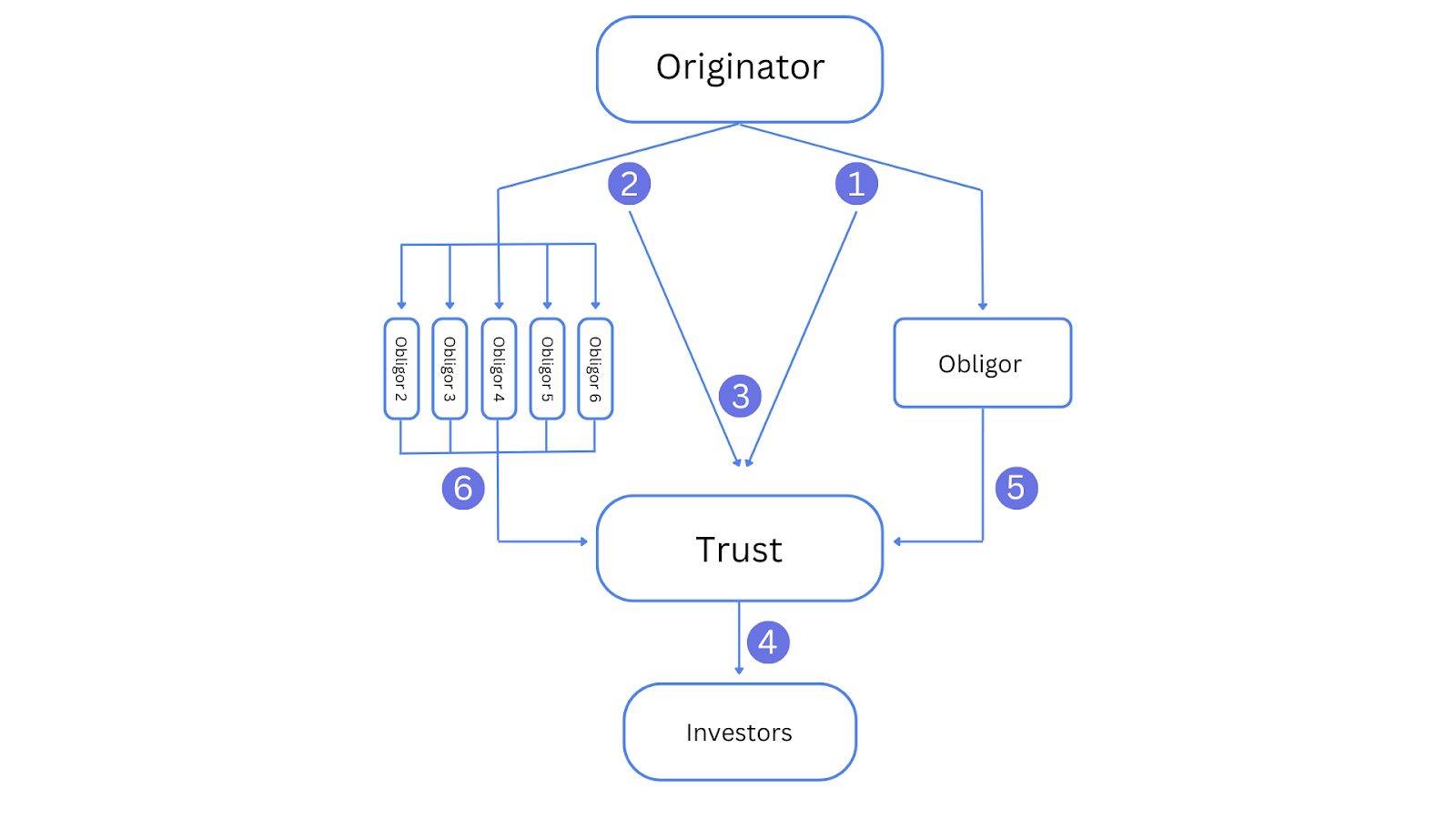
The originators, Sikka Ports & Terminals Limited (SPTL) and Jamnagar Utilities & Power Private Limited (JUPL), provided a long-tenure loan to the obligor, Digital Fibre Infrastructure Trust (DFIT).
However, the maturity of the loan’s principal extends far beyond the tenure of the pass-through certificates (PTCs) issued under the securitisation structure. Out of a total sanction amount of ₹33131 crore, ₹25000 crore was lent out by the originators for a period of 30 years. An additional loan amounting to ₹8131 crore was also extended, but is not being securitised in this transaction.
2. Put Option with Originator
Parallely, the originator entered into a put option agreement with five Reliance group entities, namely, Reliance Industries Holding Pvt. Ltd., Srichakra Commercials LLP, Karuna Commercials LLP, Devarshi Commercials LLP, and Tattvam Enterprises LLP. The put option gave the originator the right to sell the loan receivables to these entities. Since the maturity of the underlying loan is significantly longer than the tenure of PTCs, the trustee would exercise the put option with the group entities and proceeds from sale of the loan receivables would be used for principal repayment.
Section 19A of the SDI Regulations, which specifies the conditions governing securitisation, mandates that no obligor shall have more than 25% in the asset pool at the time of securitisation. This serves to reduce credit concentration by specifying a minimum number of obligors. Entering into an option agreement with five separate entities fulfills these diversification requirements, ensuring compliance with the SDI regulations.
3. Assignment of Receivables to the Securitisation Trust
The originator assigned the loan receivables, along with the receivables under the put option agreement, to the securitisation trusts. Three trusts were involved in this deal: Siddhivinayak, Shivshakti, and Radhakrishna. SPTL assigned its loans to the first two trusts, while JUPL assigned its loan to Radhakrishna. Reliance Industries Holding Pvt. Ltd., one of the option counterparties, is not a part of the structure of the first trust; Siddhivinayak only has four option counterparties.
(all values in ₹ crore)
Structure of the deal
Trusts
Siddhivinayak
Shivshakti
Radhakrishna
Value of Receivables
6780.34
6943.36
4461.71
Assignor of Receivables
STPL
JUPL
JUPL
Value of PTCs
8000.00
8000.00
5000.00
Value of Options
1615.93
1339.92
870.24
Number of Option Counterparties
4
5
5
Principal Repayment from Options
6463.72
6699.62
4351.22
Principal Repayment from DFIT
1536.28
1300.38
648.78
Yield on PTCs
7.80%
7.73%
7.66%
Tenure of PTCs in years
5
4
3
4. Issuance of Securitised Notes
The trusts issued securitised notes to investors, backed by loan receivables. These notes, or pass-through certificates (PTCs), have varying tenures of five, four, and three years respectively. They also have different yields, as the table above highlights. The notes were rated by two independent agencies, Crisil and Care Edge, and all three issuances were given a AAA rating.
5. Investor Participation
Roughly three-fourths of the issuance has been subscribed by the country’s leading asset managers, including Aditya Birla Sun Life AMC, HDFC AMC, ICICI Prudential AMC, Nippon Life India AMC, and SBI Funds Management Ltd.
6. Servicing of Securitised Notes
Interest payments: Serviced from the interest on the underlying loan by DFIT .
Principal repayments: Since the maturity of the underlying loan is significantly longer than the PTCs, the trustee would exercise the put option with the group entities. The proceeds from the sale of the loan under this option were then used to repay the principal to the securitised noteholders.
https://vinodkothari.com/wp-content/uploads/2023/06/vinod-kothari-logo.png00Team Finservhttps://vinodkothari.com/wp-content/uploads/2023/06/vinod-kothari-logo.pngTeam Finserv2025-09-24 15:40:192025-09-25 12:48:09A matter of scale in securitisation
https://vinodkothari.com/wp-content/uploads/2023/06/vinod-kothari-logo.png00Staffhttps://vinodkothari.com/wp-content/uploads/2023/06/vinod-kothari-logo.pngStaff2025-09-24 15:25:232025-09-24 15:25:24Webinar on Corporate Social Responsibility
https://vinodkothari.com/wp-content/uploads/2023/06/vinod-kothari-logo.png00Staffhttps://vinodkothari.com/wp-content/uploads/2023/06/vinod-kothari-logo.pngStaff2025-09-23 14:44:392025-09-23 14:44:40Presentation on Interest under IBC: Balancing Creditor Recovery and Resolution Viability
https://vinodkothari.com/wp-content/uploads/2023/06/vinod-kothari-logo.png00Staffhttps://vinodkothari.com/wp-content/uploads/2023/06/vinod-kothari-logo.pngStaff2025-09-23 11:09:162025-09-23 12:28:50Co-lending and Default Loss Guarantees




 Reload document
  Open in new tab