SC uses ‘smoke-test’

Classifies persons as ‘related parties’ on the basis of ‘intermingled transactions’ 

-Sikha Bansal & Megha Mittal

(resolution@vinodkothari.com)

While in general, in order to classify a transaction as a related party transaction, one needs to first determine whether the parties involved are ‘related parties’; however, in a recent case Phoenix Arc Private Limited v. Spade Financial Services Limited & Ors.[1] (‘Ruling’), the Hon’ble Supreme Court (‘SC’) has deduced ‘relationship’ between the parties on the basis of the underlying transactions.

The SC has read the definitions of ‘financial creditor’ and ‘related party’ (in relation to the corporate debtor) under sections 5(7) and section 5(24), respectively, of Insolvency and Bankruptcy Code, 2016 (‘Code’), in light of the ‘collusive arrangements’, ‘and ‘extensive history demonstrating interrelationship’ among the parties. Broadly put, it was held that the board/directors of these companies were ‘acting’ under the pervasive influence of common set of individuals, having ‘deeply entangled’ interrelationships. Besides, the SC refused to entertain the entities as financial creditors, as the debt was merely an eye-wash, arising out of sham and collusive transactions.

Therefore, the Ruling, in a way, uses ‘smoke’ to trace if there is a ‘fire’. The presence of collusion, entangled interrelationships, etc. have been seen as indicators suggesting that the parties were in fact ‘related’ and are thus ineligible to occupy seats in the committee of creditors.

This article touches upon the significant aspects of the Ruling, including how this ‘smoke-test’ used by the SC can act as a precedent in interpreting the provisions of the Code, specifically those relating to related parties.

Read more

Strategic Disinvestment in Public Sector

The Economic Survey 2020-21 had laid a significant emphasis on the importance of utilising private-industry expertise to its optimal level- the same has also been reflected in the Finance Bill, 2021. The Bill proposes to facilitate strategic disinvestment of public sector company by relaxing the provisions of section 2(19AA) and section 72A of the Income Tax Act, 1961 (‘Act’) for amalgamations and demergers by PSUs.

Extant Conditions under the IT Act, 1961

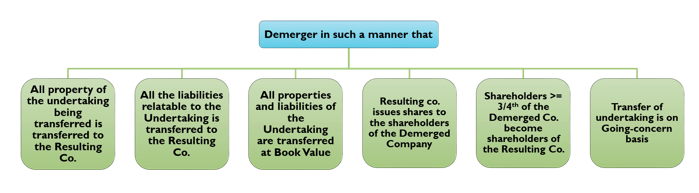
The extant provisions of section 2(19AA) of the Act defines that “demerger”, in relation to companies, means the transfer by a demerged company of its one or more undertakings to any resulting company. It further enlists certain conditions, which if fulfilled render the demerger as tax-neutral for all parties involved. It provides that an arrangement shall be termed as a “demerger” if:

Section 72A, on the other hand lays down conditions relating to carry forward and set off of accumulated loss and unabsorbed depreciation allowance in amalgamation or demerger. However, such exemption is subject to fulfilment of certain conditions, viz.

While tax neutrality and the carry forward of losses acts as a motivator of entering into such transactions, fulfilment of such conditions is not ensured in all cases. Hence, with a view to motivate PSUs to enter into such disinvestment arrangements, the Finance Bill, 2021 has introduced to bring certain relaxations to the table, discussed below-

Proposals under Budget 2021

The Union Budget, 2021 proposes the following relaxations to the PSUs-

  1. Change in the definition of demerger as provided u/s 2 (19AA) of the Income Tax Act, 1961

The Finance Bill, 2021 proposes to insert an explanation in the definition of demerger provided u/s 2 (19AA) to clarify that the reconstruction or splitting up of a PSU shall be deemed to be a demerger, if:

  • Such reconstruction or splitting up has been made to transfer an asset of the demerged company to the resultant company; and
  • the resultant company is a PSU on the appointed date[1] indicated in the scheme approved by the Government or any other body authorised under the provisions of the Companies Act, 2013 or any other Act governing such PSUs in this behalf; and
  • fulfils such other conditions as may be notified by the Central Government in the Official Gazette

As a result, PSUs shall not be required to follow the stringent conditions of section 2 (19AA), and be entitled to avail the benefit of tax-neutrality. Effective from 01.04.2021, this proposed amendment will be applicable to demergers effected on and from 01.04.2021.

  1. Proposed Amendments in section 72A of the IT Act

Amendments proposed in section 72A (1) propose to extend the benefit the extend the benefit of set off and carry forward of losses to PSUs and erstwhile PSUs. The Union Budget, 2021 proposes to-

  • Substitute clause (c) to provide that the provision of section 72(A) (1) shall also apply in case of amalgamation of one or more PSU, or companies with one or more PSUs;
  • To insert a clause (d) to provide that section 72A (1) shall also be applicable to amalgamation of an erstwhile PSU, if
  • the share purchase agreement entered into under strategic disinvestment restricted immediate amalgamation of the said public sector company;
  • the amalgamation is carried out within five year from the end of the previous year in which the restriction on amalgamation in the share purchase agreement ends
  • To insert a proviso to clause (d) to provide that in case of amalgamation involving an erstwhile PSU, allowance for unabsorbed depreciation of the amalgamated company shall not be more than the accumulated loss and unabsorbed depreciation of PSU as on the date on which the PSU ceases to be a public sector company as a result of strategic disinvestment.

Similar to amendments in section 2(19AA), These amendments will also take effect from 1st April, 2021 and will accordingly apply to the assessment year 2021-22 and subsequent assessment years.

Way Forward

It is likely that a significant number of PSUs will intend to opt for business arrangements, in view of the relaxations provided. With a view to encourage reorganisation and involvement of private-expertise,  the proposed amendments are expected to act as a catalyst to the disinvestment targets, to achieve optimal utilisation of resources.

[1] The date on which the Scheme shall be reflected in the books of the companies.

Corporate law reforms: Union Budget 2021-22

-Pammy Jaiswal and Abhishek Saraf (corplaw@vinodkothari.com)

Driving with the mantra of ease of doing business!

Introduction

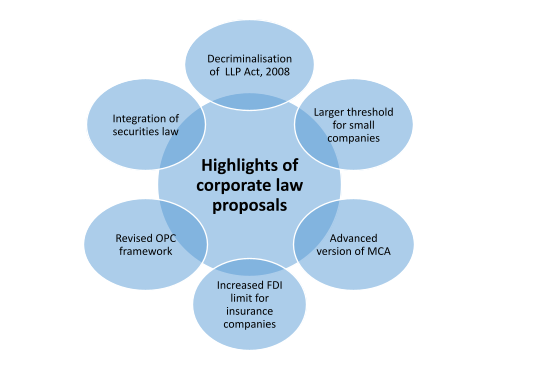
While the Union Budget for the FY 2021-2022 was focused on infrastructure development, the Hon. Finance Minister in her Budget Speech also mentioned about several significant changes in the area of corporate laws. Changes have been proposed to decriminalize the LLP Act, 2008, increase in the threshold of the definition for small companies, introduction of an updated version of the MCA, changes in the OPC framework, increase in the FDI limits in an insurance company, etc.

We have covered each one of these below for the sake of understanding the relevance of these proposals.

Decriminalization of offences under Limited Liability Act, 2008 (LLP Act)

Considering the fact that the Government has completed taking its steps for decriminalization of offences by amending the Companies Act, 2013, Finance Minister in her speech mentioned that it is now the time for decriminalization of the offences under the LLP Act. Having said that it is important to note that the Government has already started taking tangible steps for giving effect to this proposal. The Company Law Committee (CLC) has presented/issued its Report of the Company Law Committee on Decriminalization of the Limited Liability Partnership Act, 2008 to the Ministry of Corporate Affairs on 4th January, 2021 for decriminalization of certain compoundable offences and shifting them to the In-house Adjudication Mechanism. The said CLC Report is open for public recommendations till 2nd February, 2021.

The said Report proposes to decriminalize 12 offences and 1 penal provision has been proposed to be omitted. The motive behind the same is to de-clog the courts or the NCLTs thereby reducing their burden from non-serious matters. Further, the Report not only contains changes in the LLP Act for decriminalization of offences but also travels much beyond. Some of the other major changes in this regard consists of introduction of explicit provisions for issuance of secured NCDs by LLPs, restricting the merger of LLPs with companies, introduction of accounting standards for certain classes of LLPs, etc. Besides this, the Report also introduces changes in the definition of business of LLPS, alignment of the reference with that of the Companies Act, 2013 (CA, 2013) and much more.

Our detailed article on the same can be accessed from here

Revision in the definition of Small Company

Section 2(85) of the CA, 2013 defines the term ‘small company’ as any company other than public company having paid up share capital not exceeding fifty lakh rupees and turnover not exceeding two crore rupees. It has been proposed in the Budget, to revise the definition of Small Companies by increasing the thresholds for paid up share capital from “not exceeding fifty lakhs rupees” to “not exceeding two crore rupees” and turnover from “not exceeding two crore” to “not exceeding twenty crore rupees”.

Some of the relaxations to the small companies under the CA, 2013 include:
Cash Flow Statement not required to be given under the financial statements;
One board meeting in each half of calendar year is sufficient as compared to four board meetings in a financial year with a gap of not more than 120 days between two board meetings;
Abridged director’s report;
Statutory auditors are not required to report about adequacy of internal controls and their operational effectiveness.
Small Companies or any of their officer in default are subject to lesser penalties under section 446B of the CA, 2013 for non-compliance of any provisions of the CA, 2013.

The increase in thresholds will bring more than 2 lakh additional companies under the definition of ‘small company’ which can have a lower compliance burden including lower penalties for violations and lower filing requirements. Therefore, this proposal can surely be seen as an important drive for ease of doing business.

Changes in One Person Companies (OPC) regulatory framework

Currently, the CA, 2013 provides that an OPC cannot convert itself into any other kind of a company unless a period of 2 years have elapsed since the date of its incorporation. The only relaxation is that if during the said period of 2 years the threshold limits of paid-up share capital exceeds Rs. 50 lacs and the average annual turnover during the relevant period exceeds Rs. 2 crore then the conversion can take place before the expiry of 2 years.
Government has proposed to remove the monetary limit and convert itself into any other kind for the purpose of motivating the growth of OPCs which is mostly done by start-ups.
Further, for the purpose of relaxing the eligibility of persons for forming OPCs, the Government also proposes to ease the residential requirements for the person setting up an OPC from 182 days to 120 days in India. Furthermore, it has also been proposes to allow Non-Resident Indians to operate OPCs in India.

MCA21 Version 3.0

The Ministry has proposed to revamp the MCA portal by launching MCA21 Version 3.0 in the financial year 2021-22. The new version will be using data analytics, artificial intelligence and machine learning drive and will have additional modules for e-scrutiny, e-Adjudication, e-Consultation and Compliance Management.

Strengthening of NCLT framework

It has been proposed to strengthen the NCLT framework to ensure faster resolution of cases. In light of the new normal and increased emphasis on Digital India, e-Courts has been proposed to be implemented.

Further, with a similar intent and to further provide an alternate mode of debt resolution, a separate framework is also proposed for the cases involving the MSMEs.

Increased FDI in insurance companies

The main proposal for insurance companies in the Budget is to increase the permissible FDI limits such companies from the current 49% to 74%. Further, the said increased limit has been proposed with several safeguards with respect to ownership and control which includes:

majority of Directors on the Board and Key Managerial Persons (KMP) to be resident of India;
independent directors- atleast 50% of the directors to be independent directors; and
specified percentage of profits being retained as general reserve.

Further, it is also imperative to mention about the IRDA (Indian Owned and Controlled) Guidelines) which currently provides a limit of 49% of foreign shareholding in an Indian insurance company. Considering the aforesaid proposal, the said limit will be changed to reflect the increased limit. Further the said Guidelines also talks about various control safeguards by Indian promoters and provides the following modes of exercising control in an Indian insurance company:
Virtue of shareholding; (or)
Management rights; (or)
Shareholders agreements; (or)
Voting agreements; (or)
Any other manner as per the applicable laws.

Our article on FDI norms for insurance sector can be accessed from here
Our article on IRDA Guidelines on Indian owned and controlled can be viewed here

Securities Market Code

The Budget has proposed to consolidate the provisions of following laws relating to securities market into a rationalized single Code to be termed as “Securities Market Code”
SEBI Act 1992,
Depositories Act 1996,
Securities Contracts (Regulation) Act 1956, and
Government Securities Act 2007

Stamp duty proposed to be exempted on certain Govt. sale transactions

The Finance Bill has proposed to insert a new section 8G to the Indian Stamp Act, 1899 with respect to stamp duty exemption in case of strategic sale, disinvestment, etc., of an immovable property as discussed hereunder:
Transaction involving: Strategic sale or disinvestment or demerger or any other scheme of arrangement
Purpose of Transaction: Execution of any instrument for conveyance or transfer of a business or asset or right in any immovable property;
Transferor entities: Government Company, its subsidiaries, unit or joint venture
Transferee entities: Another Government Company or the Central Government or any State Government
Nature of benefit: Transaction shall be exemption from stamp duty if carried out with the approval of the Central Government.
Nature of Government companies covered: Those covered under Section 2(45) of the Companies Act, 2013.
Gap in the proposed amendment: The definition of a ‘Government Company’ under Companies Act, 2013 does not cover companies or body corporates established under a special statute such as SBI, LIC, UTI etc. These body corporates, like government companies, are public sector enterprises owned and controlled by the Government.

While the intention of the Government is to exempt stamp duty in case of exchange of assets between public sector enterprises, there still remains an anomaly whether the said exemption will be applicable in case of conveyance of property, by or to public sector enterprises that do not fall under the definition of Government Company.

Conclusion

Besides various proposals of the Union Budget for the FY 2021-2022, the corporate law proposals, as can be observed from aforesaid discussions, have been introduced to allow ease of doing business. While the changes have been proposed, the final set of changes once in place will allow witnessing the ease of doing mantra as intended by the Government.

RBI redefines the Grievance Redress Mechanism in Banks

To improve the efficacy and provide better customer service

– CS Burhanuddin Dohadwala | finserv@vinodkothari.com

What is Grievance Redress Mechanism (‘GRM’)

GRM means the receipt and processing of complaints from the customer and taking necessary actions to address the same. The GRM of any organization is the gauge to measure its efficiency and effectiveness and provides a picture on how the banks value its customer.

Background:

Banks are in service organization. Customer satisfaction and loyalty is prime focus of any bank. Customer complaints are the part and parcel of day to day functioning of banks in India. To address this Reserve Bank of India (‘RBI’) had taken various initiatives over the years for improving customer service and GRM in banks which are as follows:

  •          The Banking Ombudsman Scheme was introduced in 1995 to serve as an alternate GRM for customer complaints against banks;
  •       In 2019, RBI introduced the Complaint Management System (‘CMS’)[1], a fully automated process-flow based platform, available 24×7 for customers to lodge their complaints with the Banking Ombudsman (‘BO’);
  •          As a part of the disclosure initiative, banks were advised to disclose in their annual reports, summary information regarding the complaints handled by them and certain disclosures were also being made in the annual report of the Ombudsman Schemes published by the RBI;
  •       Banks were mandated to appoint an Internal Ombudsman (‘IO’) to function as an independent and objective authority at the apex of their GRM;

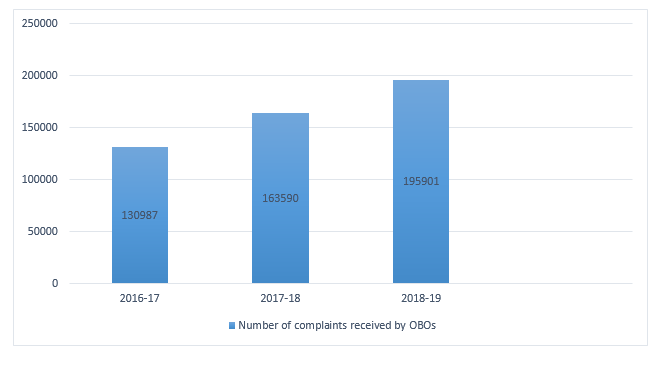
It is evident from the increasing number of complaints received in the Offices of Banking Ombudsman (‘OBOs’)[2] as per Annexure-1, that greater attention by banks to this area is warranted. More focused attention to customer service and grievance redress was required to ensure satisfactory customer outcomes and greater customer confidence.

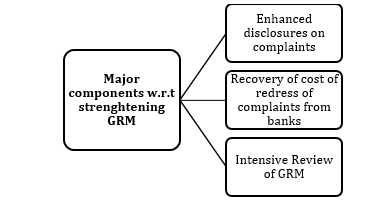
Hence, with a view to strengthen and improve the efficacy of the internal GRM of the banks and to provide better customer service RBI vide its press release dated December 04, 2020 w.r.t Statement on Developmental and Regulatory Policies[3] decided:

  •        To put in place a comprehensive framework comprising inter alia of enhanced disclosures on customer complaints by the banks;
  •       A monetary disincentive in the form of recovery of cost of redress of complaints from banks when maintainable complaints are comparatively high; and
  •          Undertaking intensive review of GRM and supervisory action against banks that fail to improve their redress mechanism in a time bound manner.

The aforesaid framework was introduced by RBI on January 27, 2021 vide its notification w.r.t Strengthening of GRM in Banks[4]. The same shall be effective from January 27, 2021 and applicable to all scheduled commercial banks (excluding regional rural banks).

 The write-up below shall discuss the framework introduced by RBI and actionables required at the end of the banks.

Framework for GRM:

RBI proposes to strengthen GRM in the following areas:

        I.         Enhanced disclosure on complaints:

Currently, banks were required to make disclosure regarding customer complaints and grievance redress in their annual report in terms of Para 16.4 w.r.t Analysis and Disclosure of complaints – Disclosure of complaints / unimplemented awards of Banking Ombudsmen along with Financial Results of the Master Circular on ‘Customer Service in Banks’ dated July 01, 2015[5] which are as follows:

A. Customer Complaints

(a) No. of complaints pending at the beginning of the year;

(b) No. of complaints received during the year;

(c) No. of complaints redressed during the year;

(d) No. of complaints pending at the end of the year;

B. Awards passed by the Banking Ombudsman

(a) No. of unimplemented Awards at the beginning of the year;

(b) No. of Awards passed by the Banking Ombudsmen during the year;

(c) No. of Awards implemented during the year;

(d) No. of unimplemented Awards at the end of the year.

The same is now replaced by the set of granular disclosures to be made by banks in their annual reports as per Annexure 2. These disclosures are intended to provide to the customers of banks and members of public greater insight into the volume and nature of complaints received by the banks from their customers and the complaints received by banks from the OBOs, as also the quality and turnaround time of redress. 

      II.         Recovery of cost of redress of complaints from banks

Presently, redress of complaints under BO Scheme, 2006[6] (‘BOS’) is cost-free for banks as well as their customers. With a view to ensure that banks discharge this responsibility effectively, the cost of redress of complaints will be recovered from those banks against whom the maintainable complaints[7] in the OBOs exceed their peer group average as provided below. However, grievance redressal under BOS for customers will continue to remain cost-free.

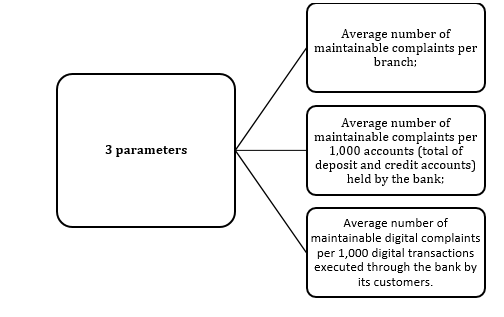
The cost-recovery framework for banks, peer groups based on the asset size of banks as on March 31 of the previous year will be identified, and peer group averages of maintainable complaints received in OBOs would be computed on the following three parameters: 

The cost of redressing complaints in excess of the peer group average will be recovered from the banks as follows:

·        Excess in any one parameter: 30% of the cost of redressing a complaint[8] (in the OBO) for the number of complaints in excess of the peer group average;

·        Excess in any two parameters: 60% of the cost of redressing a complaint for the number of complaints exceeding the peer group average in the parameter with the higher excess;

·       Excess in all the three parameters: 100% of the cost of redressing a complaint for the number of complaints exceeding the peer group average in the parameter with the highest excess.

   III.            Intensive Review of GRM

RBI will undertake, as a part of its supervisory mechanism, annual assessments of customer service and grievance redressal in banks based on the data and information available through the CMS, and other sources and interactions.

Banks who are identified as having persisting issues in grievance redress will be subjected to an intensive review of their GRM to better identify the underlying systemic issues and initiate corrective measures. The intensive review shall include but not limited to the following area:

  1.           Adequacy of the customer service and customer grievance redress related policies;
  2.              Functioning of the Customer Service Committee of the Board;
  3.         Level of involvement of the Top Management in customer service and customer grievance related issues;
  4.         Effectiveness of the GRM of banks.

Based on the review, a remedial action plan will be formulated and formally communicated to the banks for implementation within a specific time frame. In case no improvement is observed in the GRM within the prescribed timelines despite the measures undertaken, the banks will be subjected to corrective actions through appropriate regulatory and supervisory measures.

Actionable required at the end of the Banks:

To provide disclosure in the revised format on complaints received by the bank from customers and from the OBOs in the annual report from FY 20-21;

Conclusion:

RBI with a view to strengthen and protect the consumers has laid down the aforesaid framework. This will make banks more vigilant to avoid any levy of the cost and supervisory action by RBI.

Annexure A: Chart representing number of complaints received by OBOs

Annexure 2: Part A w.r.t Summary information on complaints received by the bank from customers and from the OBOs

Sr. No   Particulars Previous Year Current Year
  Complaints received by the bank from its customers    
1.           Number of complaints pending at beginning of the year;    
2.           Number of complaints received during the year;    
3.           Number of complaints disposed during the year;    
  3.1 Of which, number of complaints rejected by the bank; (Newly Inserted)    
4.           Number of complaints pending at the end of the year;    
  Maintainable complaints received by the bank from OBOs    
5.           Number of maintainable complaints received by the bank from OBOs; (Newly Inserted)    
  5.1 Of 5, number of complaints resolved in favour of the bank by BOs; (Newly Inserted)    
  5.2 Of 5, number of complaints resolved through conciliation/mediation/advisories issued by BOs; (Newly Inserted)    
  5.3 Of 5, number of complaints resolved after passing of Awards by BOs against the bank; (Newly Inserted)    
6.         Number of Awards unimplemented within the stipulated time (other than those appealed)    
Note: Maintainable complaints refer to complaints on the grounds specifically mentioned in BO Scheme 2006 and covered within the ambit of the Scheme.

Annexure 2: Part B w.r.t Top five grounds of complaints received by the bank from customers (Newly Inserted)

Grounds of complaints, (i.e. complaints relating to) Number of complaints pending at the beginning of the year Number of complaints received during the year % increase/ decrease in the number of complaints received over the previous year Number of complaints pending at the end of the year Of 5, number of complaints pending beyond 30 days
1. 2. 3. 4. 5. 6.
Current Year
Ground-1
Ground-2
Ground-3
Ground-4
Ground-5
Others
Total
Previous Year
Ground-1
Ground-2
Ground-3
Ground-4
Ground-5
Others
Total
Note: The master list for identifying the grounds of complaints is as follows:

·         ATM/Debit Cards;

·         Credit Cards;

·         Internet/Mobile/Electronic Banking;

·         Account opening/difficulty in operation of accounts;

·         Mis-selling/Para-banking;

·         Recovery Agents/Direct Sales Agents;

·         Pension and facilities for senior citizens/differently abled;

·         Loans and advances;

·         Levy of charges without prior notice/excessive charges/foreclosure charges;

·         Cheques/drafts/bills;

·         Non-observance of Fair Practices Code;

·         Exchange of coins, issuance/acceptance of small denomination notes and coins;

·         Bank Guarantees/Letter of Credit and documentary credits;

·         Staff behavior;

·         Facilities for customers visiting the branch/adherence to prescribed working hours by the branch, etc.;

·         Others.


Our link to YouTube video and other articles can be accessed below:

1. YouTube: https://www.youtube.com/channel/UCgzB-ZviIMcuA_1uv6jATbg;

2. Other articles w.r.t Financial Sector: https://vinodkothari.com/category/financial-services/


[2] As per RBI Annual Report of the Banking Ombudsman Scheme and Ombudsman Scheme for Non-Banking Financial Companies for the year 2018-19:

https://rbidocs.rbi.org.in/rdocs/Publications/PDFs/AR201820190FB8B9072F984910A9FC7BA568B634D8.PDF

[7] Maintainable complaints refer to complaints on the grounds specifically mentioned in BOS 2006 and are covered 1301within the ambit of the Scheme.

[8] Average cost of handling a complaint at the OBOs during the year.

About time to unfreeze NPA classification and reporting

-Siddarth Goel (finserv@vinodkothari.com)

Introduction

The COVID pandemic last year was surely one such rare occurrence that brought unimaginable suffering to all sections of the economy. Various relief measures granted or actions taken by the respective governments, across the globe, may not be adequate compensation against the actual misery suffered by the people. One of the earliest relief that was granted by the Indian government in the financial sector, sensing the urgency and nature of the pandemic, was the moratorium scheme, followed by Emergency Credit Line Guarantee Scheme (ECLGS). Another crucial move was the allowance of restructuring of stressed accounts due to covid related stress. However, every relief provided is not always considered as a blessing and is at times also cursed for its side effects.

Amid the various schemes, one of the controversial matter at the helm of the issue was charging of interest on interest on the accounts which have availed payment deferment under the moratorium scheme. The Supreme Court (SC) in the writ petition No 825/2020 (Gajendra Sharma Vs Union of India & Anr) took up this issue. In this regard, we have also earlier argued that government is in the best position to bear the burden of interest on interest on the accounts granted moratorium under the scheme owing to systemic risk implications.[1] The burden of the same was taken over by the government under its Ex-gratia payment on interest over interest scheme.[2]

However, there were several other issues about the adequacy of actions taken by the government and the RBI, filed through several writ petitions by different stakeholders. One of the most common concern was the reporting of the loan accounts as NPA, in case of non-payment post the moratorium period. The borrowers sought an extended relief in terms of relaxation in reporting the NPA status to the credit bureaus. Looking at the commonality, the SC took the issues collectively under various writ petitions with the petition of Gajendra Sharma Vs Union of India & Anr. While dealing with the writ petitions, the SC granted stay on NPA classification in its order dated September 03, 2020[3]. The said order stated that:

In view of the above, the accounts which were not declared NPA till 31.08.2020 shall not be declared NPA till further orders.”

The intent of granting such a stay was to provide interim relief to the borrowers who have been adversely affected by the pandemic, by not classifying and reporting their accounts as NA and thereby impacting their credit score.

The legal ambiguity

The aforesaid order dated September 03, 2020, has also led to the creation of certain ambiguities amongst banks and NBFCs. One of them being that whether post disposal of WP No. 825/2020 Gajendra Sharma (Supra), the order dated September 03, 2020, should also nullify. While another ambiguity being that whether the stay is only for those accounts that have availed the benefit under moratorium scheme or does it apply to all borrowers.

It is pertinent to note that the SC was dealing with the entire batch of writ petitions while it passed the common order dated September 03, 2020. Hence, the ‘stay on NPA classification’ by the SC was a common order in response to all the writ petitions jointly taken up by the court. Thus, the stay order on NPA classification has to be interpreted broadly and cannot be restricted to only accounts of the petitioners or the accounts that have availed the benefit under the moratorium scheme. As per the order, the SC held that accounts that have not been declared/classified NPA till August 31, 2020, shall not be downgraded further until further orders. This relaxation should not just be restricted to accounts that have availed moratorium benefit and must be applied across the entire borrower segment.

The WP No. 825/2020 Gajendra Sharma (Supra) was disposed of by the SC in its judgment dated November 27, 2020[4], whereby in the petition, the petitioner had prayed for direction like mandamus; to declare moratorium scheme notification dated 27.03.2020 issued by Respondent No.2 (RBI) as ultra vires to the extent it charges interest on the loan amount during the moratorium period and to direct the Respondents (UOI and RBI) to provide relief in repayment of the loan by not charging interest during the moratorium period.

The aforesaid contentions were resolved to the satisfaction of the petitioner vide the Ex-gratia Scheme dated October 23, 2020. However, there has been no express lifting of the stay on NPA classification by the SC in its judgment. Hence, there arose a concern relating to the nullity of the order dated September 03, 2020.

The other writ petitions were listed for hearing on December 02, 2020, by the SC via another order dated November 27, 2020[5]. Since then the case has been heard on dates 02, 03, 08, 09, 14, 16, and 17 of December 2020. The arguments were concluded and the judgment has been reserved by the SC (Order dated Dec 17, 2020[6]).

As per the live media coverage of the hearing by Bar and Bench on the subject matter, at the SC hearing dated December 16, 2020[7], the advocate on behalf of the Indian Bank Association had argued that:

It is undeniable that because of number of times Supreme Court has heard the matter things have progressed. But how far can we go?

I submit this matter must now be closed. Your directions have been followed. People who have no hope of restructuring are benefitting from your ‘ don’t declare NPA’ order.

Therefore, from the foregoing discussion, it could be understood that the final judgment of the SC is still awaited for lifting the stay on NPA classification order dated September 03, 2020.

Interim Dilemma

While the judgment of the SC is awaited, and various issues under the pending writ petitions are yet to be dealt with by the SC in its judgment, it must be reckoned that banking is a sensitive business since it is linked to the wider economic system. The delay in NPA classification of accounts intermittently owing to the SC order would mean less capital provisioning for banks. It may be argued that mere stopping of asset classification downgrade, neither helps a stressed borrower in any manner nor does it helps in presenting the true picture of a bank’s balance sheet. There is a risk of greater future NPA rebound on bank’s balance sheets if the NPA classification is deferred any further. It must be ensured that the cure to be granted by the court while dealing with the respective set of petitions cannot be worse than the disease itself.

The only benefit to the borrower whose account is not classified NPA is the temporary relief from its rating downgrade, while on the contrary, this creates opacity on the actual condition of banking assets. Therefore, it is expected that the SC would do away with the freeze on NPA classification through its pending judgment. Further, it is always open for the government to provide any benefits to the desired sector of the economy either through its upcoming budget or under a separate scheme or arrangement.

THE VERDICT

[Updated on March 24, 2021]

The SC puts the final nail to almost a ten months long legal tussle that started with the plea on waiver of interest on interest charged by the lenders from the borrowers, during the moratorium period under COVID 19 relief package.  From the misfortunes suffered by the people at the hands of the pandemic to economic strangulation of people- the battle with the pandemic is still ongoing and challenging. Nevertheless, the court realised the economic limitation of any Government, even in a welfare state. The apex court of the country acknowledged in the judgment dated March 23, 2020[8], that the economic and fiscal regulatory measures are fields where judges should encroach upon very warily as judges are not experts in these matters. What is best for the economy, and in what manner and to what extent the financial reliefs/packages be formulated, offered and implemented is ultimately to be decided by the Government and RBI on the aid and advice of the experts.

Thus, in concluding part of the judgment while dismissing all the petitions, the court lifted the interim relief granted earlier- not to declare the accounts of respective borrowers as NPA. The last slice of relief in the judgement came for the large borrowers that had loans outstanding/sanctioned as on 29.02.2020 greater than Rs.2 crores. The court did not find any rationale in the two crore limit imposed by the Government for eligibility of borrowers, while granting relief of interest-on-interest (under ex-gratia scheme) to the borrowers.[9] Thus, the court directed that there shall not be any charge of interest on interest/penal interest for the period during moratorium for any borrower, irrespective of the quantum of loan. Since the NPA stay has been uplifted by the SC, NBFCs/banks shall accordingly start classification and reporting of the defaulted loan accounts as NPA, as per the applicable asset classification norms and guidelines.

Henceforth, the CIC reporting of the defaulted loan accounts (NPA) must also be done. Surely, the said directions of the court would be applicable only to the loan accounts that were eligible and have availed moratorium under the COVID 19 package. [10]

The lenders should give credit/adjustment in the next instalment of the loan account or in case the account has been closed, return any amount already recovered, to the concerned borrowers.

Given that the timelines for filing claims under the ex-gratia scheme have expired, it is expected that the Government would be releasing extended/updated operational guidelines in this regard for adjustment/ refund of the interest in interest charged by the lenders from the borrowers.


[1] https://vinodkothari.com/2020/09/moratorium-scheme-conundrum-of-interest-on-interest/

[2] https://vinodkothari.com/2020/10/interest-on-interest-burden-taken-over-by-the-government/#:~:text=Blog%20%2D%20Latest%20News-,Compound%20interest%20burden%20taken%20over%20by%20the%20Central%20Government%3A%20Lenders,pass%20on%20benefit%20to%20borrowers&text=Of%20course%2C%20the%20scheme%2C%20called,2020%20to%2031.8.

[3] https://main.sci.gov.in/supremecourt/2020/11127/11127_2020_34_16_23763_Order_03-Sep-2020.pdf

[4] https://main.sci.gov.in/supremecourt/2020/11127/11127_2020_34_1_24859_Judgement_27-Nov-2020.pdf

[5] https://main.sci.gov.in/supremecourt/2020/11127/11127_2020_34_1_24859_Order_27-Nov-2020.pdf

[6] https://main.sci.gov.in/supremecourt/2020/11162/11162_2020_37_40_25111_Order_17-Dec-2020.pdf

[7] https://www.barandbench.com/news/litigation/rbi-loan-moratorium-hearings-live-from-supreme-court-december-16

[8] https://main.sci.gov.in/supremecourt/2020/11162/11162_2020_35_1501_27212_Judgement_23-Mar-2021.pdf

[9] Compound interest burden taken over by the Central Government: Lenders required to pass on benefit to borrowers – Vinod Kothari Consultants

[10] Moratorium on loans due to Covid-19 disruption – Vinod Kothari Consultants; also see Moratorium 2.0 on term loans and working capital – Vinod Kothari Consultants



Tailoring still to fit: CSR Law continues to evolve with contemporary needs

Vinod Kothari and Smriti Wadhera

corplaw@vinodkothari.com

As the CSR framework moves from ‘comply or explain’ principle to the rule of ‘comply or pay penalty’, we see how the CSR provisions in India have uniquely evolved over the years. On one side while there is penalty, on the other side, there is motivation – prominently in the form of an extended list of activities which can qualify for CSR. The article covering CSR in detail was published in the November 2020 edition of Chartered Secretary of the Institute of Company Secretaries of India.


Our other related material on CSR can be accessed through below link:


FAQs on CSR 2021 Amendments

FAQs on CSR 2021 Amendments

[These FAQs pertain to the amendments made vide the Companies (Amendment) Act, 2020 and the Companies (Corporate Social Responsibility Policy) Amendment Rules, 2021. These FAQs need to be read with our FAQs on CSR]

Read more

PPT on Corporate Social Responsibility 2021- Amendments

Updated as on 2nd May, 2022

Our other related content:

  1. CSR –“comply or suffer” provisions made effective:https://vinodkothari.com/2021/01/csr-comply-or-suffer-provisions-made-effective/
  2. Snapshot of CSR Amendment Rules, 2021:https://vinodkothari.com/2021/01/32315/
  3. Enforcement Status of Companies (Amendment) Act, 2020:https://vinodkothari.com/2020/12/enforcement-status-of-companies-amendment-act-2020/
  4. Presentation on Unspent CSR & role of implementing agencies:https://vinodkothari.com/2021/09/35882/