FAQs on refund of interest on interest

-Financial Services Division (finserv@vinodkothari.com)

The Supreme Court of India (‘SC’ or ‘Court’) had given its judgment in the matter of Small Scale Industrial Manufacturers Association vs UOI & Ors. and other connected matters on March 23, 2021. The said order of SC put an end to an almost ten months-long legal scuffle that started with the plea for a complete waiver of interest but edged towards waiver of interest on interest, that is, compound interest, charged by lenders during Covid moratorium.  While there is no clear sense of direction as to who shall bear the burden of interest on interest for the period commencing from 01 March 2020 till 31 August 2020. The Indian Bank’s Association (IBA) has made representation to the government to take on the burden of additional interest, as directed under the Supreme Court judgment. While there is currently no official response from the Government’s side in this regard, at least in the public domain in respect to who shall bear the interest on interest as directed by SC. Nevertheless, while the decision/official response from the Government is awaited, the RBI issued a circular dated April 07, 2021, directing lending institutions to abide by SC judgment.[1] Meanwhile, the IBA in consultation with banks, NBFCs, FICCI, ICAI, and other stakeholders have adopted a guideline with a uniform methodology for a refund of interest on interest/compound interest/penal interest.

We have earlier covered the ex-gratia scheme in detail in our FAQs titled ‘Compound interest burden taken over by the Central Government: Lenders required to pass on benefit to borrowers’ – Vinod Kothari Consultants>

In this write-up, we have aimed to briefly cover some of the salient aspects of the RBI circular in light of SC judgment and advisory issued by IBA.

Read more

Acknowledgement in Balance Sheet – A Fresh Limitation: The Final Word of Law

-Prachi Bhatia 

Legal Intern at Vinod Kothari & Company 

(resolution@vinodkothari.com)

The three-judge bench of the Hon’ble Supreme Court vide its order dated 14th April, 2021, in Asset Reconstruction Limited v. Bishal Jaiswal & Anr[1] (‘ARCIL v. Bishal) has settled the dust around acknowledgment of liability in books of corporate debtor for the purpose of section 18 of the Limitation Act; corollary to the applicability of the section to the Insolvency and Bankruptcy Code, 2016 (‘Code’). This comes in tandem with another recent order of the Hon’ble SC in LaxmiPat Surana v. Union Bank of India & Anr[2], wherein too the Apex Court upheld that acknowledgement of debt in the balance sheet would render initiation of the limitation period afresh for the purpose of filing an application under the Code.

In what seems to be the final word of law, the, vide the instant order, the Hon’ble SC further set aside the judgment set aside the Full Bench judgment of the Hon’ble NCLAT in V.Padmakumar v. Stressed Assets Stabilisation Fund[3], (‘V. Padmakumar’), wherein the Appellate Tribunal dismissed the benefit of extension of limitation to the creditors by virtue of the debt’s presentation in the books of the corporate debtor.

In this article, author humbly analyses the order of the Apex Court in ARCIL v. Bishal in light of the catena of preceding judgements both in favour and against the ratio-decidendi in ARCIL v. Bishal.

Read more

Payment and Settlement Systems: A Primer

– Siddarth Goel (finserv@vinodkothari.com)

Introduction

A payment denotes the performance or discharge of an obligation to pay, which may or may not involve money transfer. Payment is therefore a financial obligation in whatever parties have agreed constituting a payment. A payment and settlement system could be understood as a payments market infrastructure that facilitates the flow of funds in satisfaction of a financial obligation. The need for a payment system is an integral part of commerce. From the use of a payment system in an e-commerce purchase, a debit or credit card fund transfer, stock or share purchase. The payment obligation can also be settled without the presence of any financial intermediary (peer-to-peer). The payment transaction need not always be settled in money, it could be settled in security, commodity, or any other obligation as may be decided by payment system participants.

One of the earlier known payment mechanisms was the barter system. With the evolution of civilisation, the world moved to a system supported by tokens and coins that are still prevalent and are widely used as the mode of payment. The payment mechanism supported by physical currency notes or coins is simple, as it offers peer-to-peer, real-time settlement of obligation between the parties, by way of physical transfer of note or coin from one party to another.

In contemporary electronic payment systems, the manner of flow of funds from one payment system participant to another is central to the security, transparency, and stability of the payment system and financial system as a whole. The RBI’s main objective is to maintain public confidence in payment and settlement systems, while the other function being to upgrade and introduce safe and efficient modes of payment systems. The RBI is also the banker to all scheduled banks and maintains bank accounts on their behalf.  All the scheduled commercial banks have access to a central payment system operated by RBI. Thereby banks have access to liquidity funding line with RBI which have been discussed later in this chapter.

Electronic payments usually involve the transfer of funds via money in bank deposits. While securities settlement system involves trade in financial instruments namely; bonds, equities, and derivatives. The implementation of sound and efficient payment and securities settlement systems is essential for financial markets and the economy. The payment system provides money as a means of exchange, as central banks are in control of supplying money to the economy which cannot be achieved without public confidence in the systems used to transfer money. It is essential to maintain stability of the financial systems, as default under very large value transfers create the possibilities of failure that could cause broader systemic risk to other financial market participants. There is a presence of negative externality that can emanate from a failure of a key participant in the payment system.[1]

Read more

Prepack for MSMEs – A Vaccine that doesn’t Work?

– Megha Mittal

(resolution@vinodkothari.com)

The Insolvency and Bankruptcy (Amendment) Ordinance, 2021 (‘Ordinance’)[1] was promulgated on 5th April, 2021 to bring into force the prepackaged insolvency resolution framework for Micro, Small, Medium Enterprises (MSMEs). While the Ordinance put forth the structure of the prepack regime, a great deal was dependent upon the relevant rules and regulations. On 9th April, 2021, the Insolvency and Bankruptcy (Pre-packaged Insolvency Resolution Process) Regulations, 2021 (“Regulations”)[2] as well as the Insolvency and Bankruptcy (Pre-Packaged Insolvency Resolution Process) Rules, 2021 (“Rules”)[3] have been notified with immediate effect.

As one delves into the whole scheme of things, including the complicated provisions of the Ordinance and the even complication regulations, one gets to feel that the prepack framework will act only as a consolation for the MSMEs – while efforts aimed to increase the efficacy of insolvency resolution, the proposed Framework seems to do a little towards this end. In the author’s humble opinion, key elements of prepacks – cost and time efficiency and a Debtor-in-Possession approach, have been diluted amidst the micromanaged Rules and Regulations. In this article, we discuss how[4].

Read more

Whether expense towards Corporate Environment Responsibility (CER) be eligible as CSR spending?

Nitu Poddar, Senior Associate (corplaw@vinodkothari.com)

Introduction

Since the amendment in the CSR provisions on 22.01.2021, even the existing eight year old provision has gained substantial attention and deliberation by the stakeholders. This article is to discuss yet another topic on CSR which is “whether amount spend towards Corporate Environment Responsibility (CER[1]) stipulated as specific condition under Environment Clearance by the Ministry of Environment, Forest and Climate Change (MoEFCC) can be included as a CSR project?” In other words, whether CER obligations can be merged with CSR obligations or are these two mutually exclusive.

What is CER?

Industrial sectors (specified in the Environment Impact Assessment (EIA) Notification 2006 dated September 14, 2006[2]) which have direct environmental footprint are required to take prior Environment Clearance (EC) from the MoEFCC before setting up any new project / expansion / modernisation of an existing project / change in the product-mix.  While granting such EC, the Ministry puts certain conditions (requirements) on the applicant (referred as Project Proponent (PP) in two categories – specific conditions and general conditions – implementation of which, if unsatisfactory, the EC may be revoked. One of such specific condition imposed by the MoEFCC while granting EC is that the applicant should undertake CER / ESC which is to be based on the local needs and should be restricted to the affected areas around the proposed project.

As per Office Memorandum[3] (OM) No. F. No. 22-65 / 2017-IA.III of MoEFFC dated May 01, 2018,

Some of the activities which can be carried out in CER, are infrastructure creation for drinking water supply, sanitisation, health, education, skill development, roads, cross drains, electrification including solar power, solid waste management facilities, scientific support and awareness to local farmers to increase yield of crop and fodder, rain water harvesting, soil moisture conservation works, avenue plantation, plantation in community areas, etc.

Unlike CSR, CER is based on project cost and not profits made by the proposed project.  The obligation of CER is within the range of 2.5% – 5% of the project cost.

Why CER?

The MoEFCC, in its Office Memorandum (OM) No.J-11013/25/2014-IA.I dated August 11, 2014, discussed that since the CSR obligation is based on profits, there might be cases where the proposed project is yet to make profit. In such case, since the project will have already created impact on the society and environment, it is required to commit towards the same, irrespective of profits, through CER commitment. Further, as per the 2018 OM, all the activities proposed under CER is also required to be monitored and reported bi-annually and also posted on the website of the company.

Anomaly created by different OMs and correspondences of MoEFCC

Considering that the activities undertaken pursuant to CER are akin to the one of the activities prescribed under schedule VII of the Companies Act, 2013 – specifically “ensuring environmental sustainability” among others, it is intuitive to say that expenditure towards CER should be includes as compliance of CSR commitment.

However, on perusal of several OMs and summary record of meeting of the Expert Appraisal Committee (EAC), formed under MoEFFC, one may have to re-think on the above ratio. The relevant extracts of the OMs and summary record are reproduced below for perusal:

  1. [4]2014 OM:
  1. ….In case these activities (or some of these activities) are proposed to be covered by the project proponent under CSR activities, the project proponent should commit providing for the same. In either case, the position regarding the agreed activities, their funding mechanism and the phasing should be clearly reflected in the EC letter.

Author’s Comment: This indicates that overlap might be acceptable provided the commitment is clear from the beginning.

  1. [5]Summary record of 2nd meeting of EAC – 2015 –

The Member Secretary has informed the Committee that presently the Expert Appraisal Committee has been insisting for earmarking either 2.5% of the total cost of the project or 5% of the total cost of the project towards Enterprises Social Commitment / Corporate Social Responsibility, depending upon the size of the project. In this context, copy of Office Memorandum No. J-11013/25/2014-IA.I dated 11.08.2014 issued by the Ministry regarding guidelines on Environment Sustainability and CSR related issue was circulated. Deliberating on the issue, the Committee was of the view that the name of ‘Enterprises Social Commitment’ or ‘Corporate Social Responsibility’ in respect of environment clearance should be in the first place considered for replacement by the name ‘Environmental Conservation Support Activities’.

Author’s Comment: From this discussion, it seems that the terms ESC / now CER and CSR have been used interchangeably and therefore CER and CSR commitment can overlap.

However, in the same paragraph, the decision taken by the EAC has been recorded as follows:

The Committee unanimously agreed for uniform earmarking 2.5% of the capital cost of the project towards Environmental Conservation Support Activities, in addition to the committee’s  [this seems to be a typo error- should be “company”] commitment under the Companies Act.

Author’s Comment: This indicates that CER and CSR are two independent commitments and responsibility of the company and both have to be individually followed and fulfilled.

In one of the scrutiny and deliberation as discussed in the summary records, in the matter of Expansion of Cement Plant, Clinker (1.8 MTPA to 2.6 MTPA) at Village Rauri, Tehsil Arki, District Solan, Himachal Pradesh by M/s Ambuja Cement Ltd. [F. No. J-11011/986/2008-IA-II (I)], one the specific condition was as follows:

  1. At least 5 % of the total cost of the project shall be earmarked towards the Enterprise Social Commitment based on Public Hearing Issues and item-wise details along with time bound action plan shall be prepared and submitted to the Ministry’s Regional Office at Dehradun. Implementation of such program shall be ensured accordingly in a time bound manner.

The project proponent mentioned that they have already spent an amount of 3.01%, 4.06% and 2.57% of the net profit after tax (PAT) towards CSR activities in the year 2012, 2013 and 2014 respectively in compliance of the Companies Act 2013. It has been requested to consider the proposal to waive-off the Specific Condition No. XV, as mentioned above.

The Committee noted that the expenditure of 5% of the total cost of the project towards ESC was prescribed for a period of 5 years. Based on the discussions, held the Committee decided that instead of waiving off the specific condition, it is recommended to extend the implementation period of 5 years for implementing ESC activities to a period of 10 years, which the proponent had also agreed to.

Author’s Comment: This again seems to indicate that MoEFCC is not inclined to mix the CER commitment with the CSR commitment.

  1. [6]Summary record of 2nd meeting of EAC – 2016 –

In all the ECs being granted, as a part of specific condition, the CER commitment has been recorded as below:

At least 2.5% of the total cost of the project shall be earmarked towards the Enterprise Social Commitment based on Public Hearing issues, locals need and item-wise details along with time bound action plan shall be prepared and submitted to the Ministry’s Regional Office. Implementation of such program shall be ensured by constituting a Committee comprising of the proponent, representatives of village Panchayat and District Administration. Action taken report in this regard shall be submitted to the Ministry’s Regional Office.

In addition to the above provision of ESC, the proponent shall prepare a detailed CSR Plan for the next 5 years including annual physical and financial targets for the existing-cum-expansion project, which includes village-wise, sector-wise (Health, Education, Sanitation, Skill Development and infrastructure etc) activities in consultation with the local communities and administration. The CSR Plan will include the amount of 2% retain annual profits as provided for in Clause 135 of the Companies Act, 2013 which provides for 2% of the average net profits of previous 3 years towards CSR activities for life of the project. A separate budget head shall be created and the annual capital and revenue expenditure on various activities of the Plan shall be submitted as part of the Compliance Report to RO. The details of the CSR Plan shall also be uploaded on the company website and shall also be provided in the Annual Report of the company.

Author’s Comment: The view of keeping CER and CSR as two independent commitments seems to being continued.

  1. [7]2018 OM (supersedes 2014 OM) –. Relevant extracts have been reproduced:

(I) The cost of CER is to be in addition to the cost envisaged for the implementation of the EIA/EMP which includes the measures for the pollution control, environmental protection and conservation, R&R, wildlife and forest conservation/protection measures including the NPV and Compensatory Aforestation, required, if any, and any other activities, to be derived as part of the EIA process. 

XXX

(IV) The proposed activities shall be restricted to the affected area around the project.

(VI) The entire activities proposed under the CER shall be treated as project and shall be monitored. The monitoring report shall be submitted to the regional office as a part of half-yearly compliance report, and to the District Collector. It should be posted on the website of the project proponent.

XXX

Author’s Comment: The provision with respect to commitment of any particular CER activity as CSR, as was present in the 2014 OM, has been dropped.

  1. [8]Minutes of 53rd meeting of EAC (Infrastructure-2) held in 2020:

While presenting the parameters of the Project to obtain EC, Tamil Nadu Waste Management Limited, represented as follows:

(xi) The CER fund shall be allocated as per the MoEF&CC office memorandum F.no.22- 65/2017-IA.III dated, 1st May, 2018, which is around Rs. 0.48 Crores which shall be utilized over a period of 3 years. The CSR budget will be allocated as per rules prescribed by the Government of India / Companies Act 2013.

  1. [9]Standard EC Conditions – MoEFCC OM No. F.No. 22- 34/2018-IA.III dated 9th August 2018:

7. Corporate Environment Responsibility

XXX

  1. The company shall have a well laid down environmental policy duly approve by the Board of Directors. The environmental policy should prescribe for standard operating procedures to have proper checks and balances and to bring into focus any infringements/deviation/violation of the environmental / forest /wildlife norms/ conditions. The company shall have defined system of reporting infringements / deviation / violation of the environmental / forest / wildlife norms / conditions and / or shareholders / stake holders. The copy of the board resolution in this regard shall be submitted to the MoEF&CC as a part of six-monthly report.

iii. A separate Environmental Cell both at the project and company head quarter level, with qualified personnel shall be set up under the control of senior Executive, who will directly to the head of the organization.

  1. Action plan for implementing EMP and environmental conditions along with responsibility matrix of the company shall be prepared and shall be duly approved by competent authority. The year wise funds earmarked for environmental protection measures shall be kept in separate account and not to be diverted for any other purpose. Year wise progress of implementation of action plan shall be reported to the Ministry/Regional Office along with the Six Monthly Compliance Report.
  2. Self environmental audit shall be conducted annually. Every three years third party environmental audit shall be carried out.

Author’s Comment: Looking at the elaborative independent requirements / compliance in respect of CER, the view about the intent of the Ministry to keep CER independent of CSR gets stronger

Provisions of Companies Act, 2013

It is also pertinent to note that pursuant to Rule 2(d)(vi) of the Companies (Corporate Social Responsibility Policy) Rules, 2014 ,“activities carried out for fulfilment of any other statutory obligations under any law in force in India” is excluded from the definition of CSR. The idea behind this exclusion seems to be that what a company is obligated to spend as a part of its statutory obligation is anyway a mandatory condition. Such statutory compliance, even if it results into a spending, cannot be regarded as CSR spending. An example may be payment of taxes many of which are dedicated to infrastructure activities. Swachh Bharat Cess is specifically towards cleanliness. However, one cannot take such an expense as a spending towards CSR. Hence, (CSR) responsibility and statutory obligations cannot be inter-mixed.

Difference between CSR and CER

While already discussed above, the difference in CER and CSR is being highlighted:

  1. CSR spending is profit-linked whereas CER spending is project cost-linked. Hence, CER may, at times be applicable even before the company has started making profits.
  2. Another major difference between EC-triggered spending and CSR spending is that there is a wide range of activities which may qualify as CSR. However, the EC forces these activities to be focused and restricted around village/social development in the areas affected by the project only. In that sense, the EC forces the entity to give back to the local area where the company has an environment footprint.

Conclusion

While it would have been rational to include CER under CSR, but this seems to be grey in terms of clarity, both legally and practically. There are two school of thought that is being endorsed – one, that the CER and CSR are two different statutory obligation under two different ministries and therefore should be honoured independently; the other, and more logical argument is that both the commitment are meant to return back to the society and environment on which the company has left its footprint. Accordingly, taking a view that CER and CSR commitments are mutually independent would be putting the company to double compliance for a single objective. Considering that CER is applicable, irrespective of profit, the same should ideally be aligned with CSR plan of the company where section 135 of Companies Act, 2013 is applicable.

While this question may lurk until there is any explicit clarity from either of the ministries, from the bi-annual disclosure on compliance report being submitted by the companies, it seems that India Inc is divided on this matter.


[1] CER has also been termed as Enterprise Social Commitment (“ESC”) in several ECs granted to applicants. Later, in the Office Memorandum (OM) No. F. No. 22-65 / 2017-IA. .III of MoEFFC dated May 01, 2018, the terms CER was used.

[2] https://parivesh.nic.in/writereaddata/ENV/EnvironmentalClearance-General/18.pdf


[3] http://environmentclearance.nic.in/writereaddata/public_display/circulars/OIEBZXVJ_CER%20OM%2001052018.pdf


[4] http://environmentclearance.nic.in/writereaddata/OMs-2004-2021/158_OM_11_08_2014.pdf


[5] http://environmentclearance.nic.in/writereaddata/Form-1A/Minutes/0_0_21122122412101Final-MinutesoftheMeeting,2ndEAC,28th30thDecember2015EACmeeting.pdf


[6] https://environmentclearance.nic.in/writereaddata/Form-1A/Minutes/23062016PBRL5BUAMinutesofthe7thEAC30thMay-Final.pdf


[7] http://environmentclearance.nic.in/writereaddata/public_display/circulars/OIEBZXVJ_CER%20OM%2001052018.pdf


[8] http://www.environmentclearance.nic.in/writereaddata/Form-1A/Minutes/01082020DHCMPRSFFinalMinutes53rdEAC(Infra-2).pdf


[9] http://environmentclearance.nic.in/View.aspx?rid=30


Revision of criteria of non-company entities on which AS shall be applicable

CS Aisha Begum Ansari and Harsh Juneja (corplaw@vinodkothari.com )

Introduction

For the purpose of applicability of Accounting Standards (“AS”), The Institute of Chartered Accountants of India (“ICAI”) has classified the entities into two segments – company entities and non-company entities. Non-company entities such as sole proprietors, partnership firms, trusts, Hindu Undivided Families, association of persons and co-operative societies are further classified into various levels. Currently, the ICAI has categorized non-company entities into 3 levels.

With increasing number of non-company entities, the ICAI has, now, further classified them into 4 levels. The amendments have been brought to reduce stringency on non-company entities which were earlier required to comply with all AS in pursuance of being level I entities as the norms for the same have been revised.

Since most of the Special Purpose Vehicle(s) (“SPV”s) are in the form of non-company entities, they were required to comply with all accounting standards as most of these were covered under level I category. However, with the proposed changes, the burden of strict adherence to AS will be reduced for SPVs falling under level I category.

This Article is an attempt to cover the proposed revision criteria for application of AS on non-company entities.

Proposed applicability

It is proposed that this scheme be made effective in respect of accounting periods commencing on or after April 1, 2020. However, the same shall be effective once the required changes are incorporated in the AS while publishing the updated Compendium of AS.

Non-company entities[1] on which Ind AS is not applicable. It should be noted that such entities have been classified in 4 levels basis different criteria including turnover and borrowing and classified as large – medium – small and micro entities- last three referred to as MSMEs.

Entities belonging to level II, III, IV have been granted certain exemption. It is to be noted that the applicability of AS has been made milder as one goes down the four level of entities i.e to say, maximum relaxations / exemptions are given to level IV entities.

Disclosures

All non-company entities which are covered under this Proposal, are required to make following disclosures:

  1. That the AS has been complied by the entity;
  2. The level to which the entity belongs and whether it has availed exemptions granted to such level;
  3. Availing of partial exemption – It is to be noted that the entities are allowed to cherry-pick the exemptions they intend to avail. However, such partial availing of exemption should not be misleading. That the entity has cherry-picked the exemptions and not availed all the exemptions granted to such level should be disclosed as to which all exemptions it has availed;

 Transition

The Proposal also talks about disclosure / rules of transition from one level to another, which are as follows:

  1. From transition from a higher level to a lower level – relaxations / exemptions of the lower level may be availed only on staying at such level for two consecutive years.
  2. From transition from a lower level to higher level – while the disclosures pertaining to the higher level becomes applicable, however no change / revision is required to be made in the previous year [where the entity was classified as a lower level, and had availed exemptions / relaxation as such] is required to be made. However, disclosure of such fact is required to be made in the notes to financial statement.
Levels Existing criteria for classification [2019][2] New criteria for classification Applicability
I

[Large]

1.      Equity / Debt Listed / to be listed entity

a)     Entities listed on overseas exchanges also included

2.      Banks (including co-operative banks), FIs, Insurance entities

3.      Entities having [3]turnover in the (excluding other income) > 50 crores

4.      Borrowings (including public deposit) > 10 crores

5.      Holding and subsidiary entities of the above

1.     Listed / to be listed entity

a)     Entities listed on overseas exchanges also included

2.      Banks (including co-operative banks), FIs, Insurance entities

3.      Entities having turnover in the (excluding other income) > 250 crores

4.      Borrowings (including public deposit) > 50 crores

5.      Holding and subsidiary entities of the above

All 29 AS applicable in full.
II [Medium] 1.      Entities having turnover in the (excluding other income) > 40 lakhs ≤ 50 crores

2.      Borrowings (including public deposit) > 1 crores ≤ 5 crores

For turnover / borrowing criteria – only such entities shall be regarded which  are engaged in commercial, industrial or business activities

Holding and subsidiary entities of the above

1.      Entities having turnover in the (excluding other income) > 50 crores ≤ 250 crores

2.      Borrowings (including public deposit) > 10 crores ≤ 50 crores

For turnover / borrowing criteria – only such entities shall be regarded which  are engaged in commercial, industrial or business activities

3.      Holding and subsidiary entities of the above

A.      Accounting Standard(s) not applicable:

AS 3   – Cash Flow Statements

AS 17 – Segment Reporting

AS 20 – Earnings Per Share


B.      Accounting Standard(s) applicable with disclosure exemption:

AS 19 – Leases

AS 28 – Impairment of Assets

AS 29 – Provisions, Contingent Liabilities and Contingent Assets


C.      Accounting Standard(s) applicable with exemptions:

AS 15 – Employee Benefits


D.     Accounting Standard(s) applicable with Note: [following AS, being related to CFS, the same is not applicable to Level II, III, IV entities unless they voluntary decide to consolidate the financial statements]

AS 21 – Consolidated Financial Statements

AS 23 – Accounting for Investments in Associates in Consolidated Financial Statements

AS 25 – Interim Financial Reporting

AS 27 – Financial Reporting of Interests in Joint Ventures (to the extent of requirements relating to Consolidated Financial Statements)


III

[Small]

Remaining non corporate entities 1.      Entities having turnover in the (excluding other income) > 10 crores ≤ 50 crores

2.      Borrowings (including public deposit) > 2 crores ≤ 10 crores

For turnover / borrowing criteria – only such entities shall be regarded which are engaged in commercial, industrial or business activities

3.      Holding and subsidiary entities of the above

All exemptions provided to Level II shall be applicable. Further exemptions:


A.      In addition to full exemptions as given in Level II, further Accounting Standard(s) not applicable:


AS 18 – Related Party Disclosures

AS 24 – Discontinuing Operations


B.      In addition to disclosure exemption as given in Level II, further Accounting Standard(s) applicable with disclosure exemption:


AS 10 – Property, Plant and Equipment

AS 11 – The Effects of Changes in Foreign Exchange Rates

IV [Micro] There were only III levels Remaining non corporate entities All exemptions provided to Level III shall be applicable. Further exemptions:


A.      In addition to full exemptions as given in Level III, further Accounting Standard(s) not applicable:


AS 14 – Accounting for Amalgamations

AS 28 – Impairment of Assets

AS 22 is applicable only for current tax related provisions.


B.      In addition to disclosure exemption as given in Level III, further Accounting Standard(s) applicable with disclosure exemption:


AS 13 – Accounting for Investments


Conclusion

As discussed above, the intent to revise the criteria for classification of non-company entities is to provide exemptions/ relaxations from applicability of all AS to certain entities covered under level I as they will now be shifted to descending levels. These proposed amendments will also lessen the difficulties faced by non-company entities falling under the existing levels as they will be provided with partial or full exemptions by getting transferred to descending levels.


[1]This Announcement supersedes the earlier Announcement of the ICAI on ‘Harmonisation of various differences between the Accounting Standards issued by the ICAI and the Accounting Standards notified by the Central Government’ issued in February 2008, to the extent it prescribes the criteria for classification of Non-company entities (Non-corporate entities) and applicability of Accounting Standards to non-company entities, and the Announcement ‘Revision in the criteria for classifying Level II non-corporate entities’ issued in January 2013.

[2] https://resource.cdn.icai.org/56169asb45450.pdf

[3] For turnover / borrowing criteria – only such entities shall be regarded which  are engaged in commercial, industrial or business activities


Understanding regulatory intricacies of Payment Aggregator business

-Siddarth Goel (finserv@vinodkothari.com)

Abstract

The penetration of electronic retail payments has witnessed a steep surge in the overall payment volumes during the latter half of the last decade. One of the reasons accorded to this sharp rise in electronic payments is the exponential growth in online merchant acquisition space. An online merchant is involved in marketing and selling its goods and/or services through a web-based platform. The front-end transaction might seem like a simple buying-selling transaction of goods or services between a buyer (customer) and a seller (merchant). However, the essence of this buying-selling transaction lies in the payment mode or methodology of making/accepting payments adopted between the customer and the merchant. One of the most common ways of payment acceptance is that the merchant establishes its own payment integration mechanism with a bank such that customers are enabled to make payments through different payment instruments. In such cases, the banks are providing payment aggregator services, but the market is limited usually to the large merchants only. Alternatively, merchants can rely upon third-party service providers (intermediary) that facilitate payment collection from customers on behalf of the merchant and thereafter remittance services to the merchant at the subsequent stage – this is regarded as a payment aggregation business.

The first guidelines issued by the RBI governing the merchant and payment intermediary relationship was in the year 2009[1]. Over the years, the retail payment ecosystem has transformed and these intermediaries, participating in collection and remittance of payments have acquired the market-used terminology ‘Payment Aggregators’. In order to regulate the operations of such payment intermediaries, the RBI had issued detailed Guidelines on Regulation of Payment Aggregators and Payment Gateways, on March 17, 2020. (‘PA Guidelines’)

The payment aggregator business has become a forthcoming model in the online retail payments ecosystem. During an online retail payment by a customer, at the time of checkout vis-à-vis a payment aggregator, there are multiple parties involved. The contractual parties in one single payment transaction are buyer, payment aggregator, payment gateway, merchant’s bank, customer’s bank, and such other parties, depending on the payment mechanism in place. The rights and obligations amongst these parties are determined ex-ante, owing to the sensitivity of the payment transaction. Further, the participants forming part of the payment system chain are regulated owing to their systemic interconnectedness along with an element of consumer protection.

This write-up aims to discuss the intricacies of the regulatory framework under PA Guidelines adopted by the RBI to govern payment aggregators and payment gateways operating in India. The first part herein attempts to depict growth in electronic payments in India along with the turnover data by volumes of the basis of payment instruments used. The second part establishes a contrast between payment aggregator and payment gateway and gives a broad overview of a payment transaction flow vis-à-vis payment aggregator. The third part highlights the provisions of the PA Guidelines and establishes the underlying internationally accepted best principles forming the basis of the regulation. The principles are imperative to understand the scope of regulation under PA Guidelines and the contractual relationship between parties forming part of the payment chain.

Market Dynamics

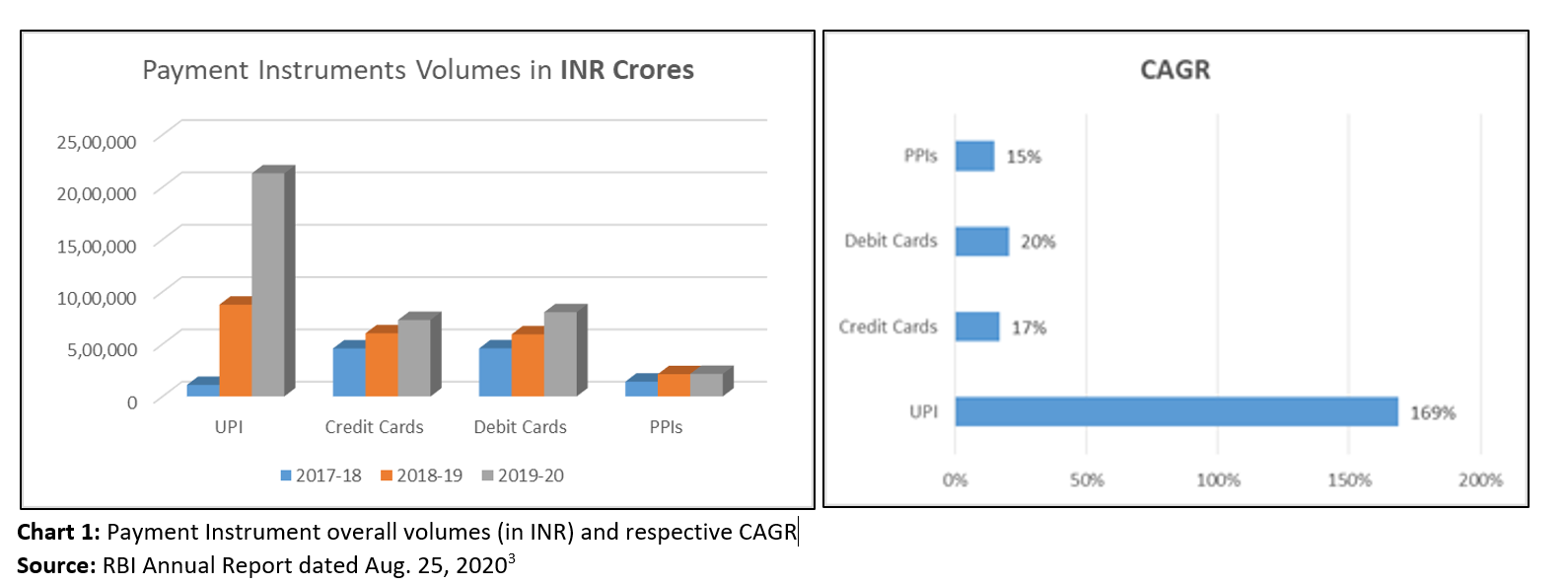
The RBI in its report stated that the leverage of technology through the use of mobile/internet electronic retail payment space constituted around 61% share in terms of volume and around 75% in share in terms of value during FY 19-20.[2] The innovative payment instruments in the retail payment space, have led to this surge in electronic payments. Out of all the payment instruments, the UPI is the most innovative payment instrument and is the spine for growth in electronic payments systems in India. Chart 1 below compares some of the prominent payment instruments in terms of their volumes and overall compounded annual growth rate (CAGR) over the period of three years.

The payment system data alone does not show the complete picture. In conformity with the rise in electronic payment volumes, as per the Government estimates the overall online retail market is set to cross the $ 200 bn figure by 2026 from $ 30 bn in 2019, at an expected CAGR of 30 %.[4] India ranks No. 2 in the Global Retail Development Index (GRDI) in 2019. It would not be wrong to say, the penetration of electronic payments could be due to the presence of more innovative products, or the growth of online retail has led to this surge in electronic payments.

What are Payment Aggregators and Payment Gateways?

The terms Payment Aggregator (‘PA’) and Payment Gateways (‘PG’) are at times used interchangeably, but there are differences on the basis of the function being performed. Payment Aggregator performs merchant on-boarding process and receives/collects funds from the customers on behalf of the merchant in an escrow account. While the payment gateways are the entities that provide technology infrastructure to route and/or facilitate the processing of online payment transactions. There is no actual handling of funds by the payment gateway, unlike payment aggregators. The payment aggregator is a front-end service, while the payment gateway is the back-end technology support. These front-end and back-end services are not mutually exclusive, as some payment aggregators offer both. But in cases where the payment aggregator engages a third-party service provider, the payment gateways are the ‘outsourcing partners’ of payment aggregators. Thereby such payments are subject to RBI’s outsourcing guidelines.

PA Transaction Flow

One of the most sought-after electronic payments in the online buying-selling marketplace is the payment systems supported by PAs. The PAs are payment intermediaries that facilitate e-commerce sites and merchants in accepting various payment instruments from their customers. A payment instrument is nothing but a means through which a payment order or an instruction is sent by a payer, instructing to pay the payee (payee’s bank). The familiar payment instruments through which a payment aggregator accepts payment orders could be credit cards, debit cards/PPIs, UPI, wallets, etc.

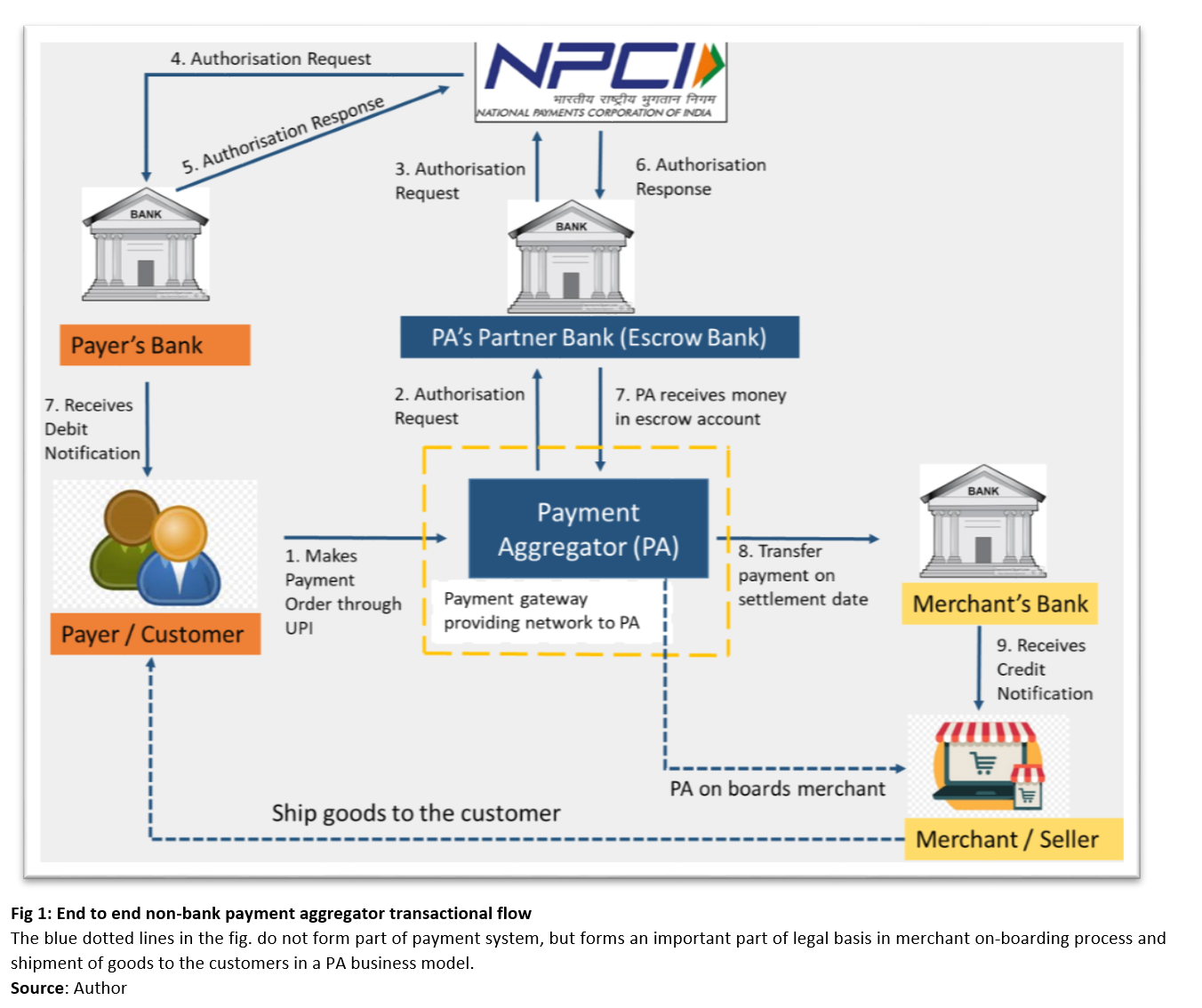
Payment aggregators are intermediaries that act as a bridge between the payer (customer) and the payee (merchant). The PAs enable a customer to pay directly to the merchant’s bank through various payment instruments. The process flow of each payment transaction between a customer and the merchant is dependent on the instrument used for making such payment order. Figure 1 below depicts the payment transaction flow of an end-to-end non-bank PA model, by way of Unified Payment Interface (UPI) as a payment instrument.

In an end-to-end model, the PA uses the clearing and settlement network of its partner bank. The clearing and settlement of the transaction are dependent on the payment instrument being used. The UPI is the product of the National Payments Corporation of India (NPCI), therefore the payment system established by NPCI is also quintessential in the transaction. The NPCI provides a clearing and settlement facility to the partner bank and payer’s bank through the deferred settlement process. Clearing of a payment order is transaction authorisation i.e., fund verification in the customer’s bank account with the payer’s bank. The customer/payer bank debits the customer’s account instantaneously, and PA’s bank transfers the funds to the PA’s account after receiving authorisation from NPCI. The PA intimates the merchant on receipt of payment and the merchant ships the goods to the customer. The inter-bank settlement (payer’s bank and PA’s partner bank) happens at a later stage via deferred net-settlement basis facility provided by the NPCI.

The first leg of the payment transaction is settled between the customer and PA once the PA receives the confirmation as to the availability of funds in the customer’s bank account. The partner bank of PA transfers the funds by debiting the account of PA maintained with it. The PA holds the exposure from its partner bank, and the merchant holds the exposure from the PA. This explains the logic of PA Guidelines, stressing on PAs to put in place an escrow mechanism and maintenance of ‘Core Portion’ with escrow bank. It is to safeguard the interest of the merchants onboarded by the PA. Nevertheless, in the second leg of the transaction, the merchant has its right to receive funds against the PA as per the pre-defined settlement cycle.

Regulatory approach towards PAs and PGs

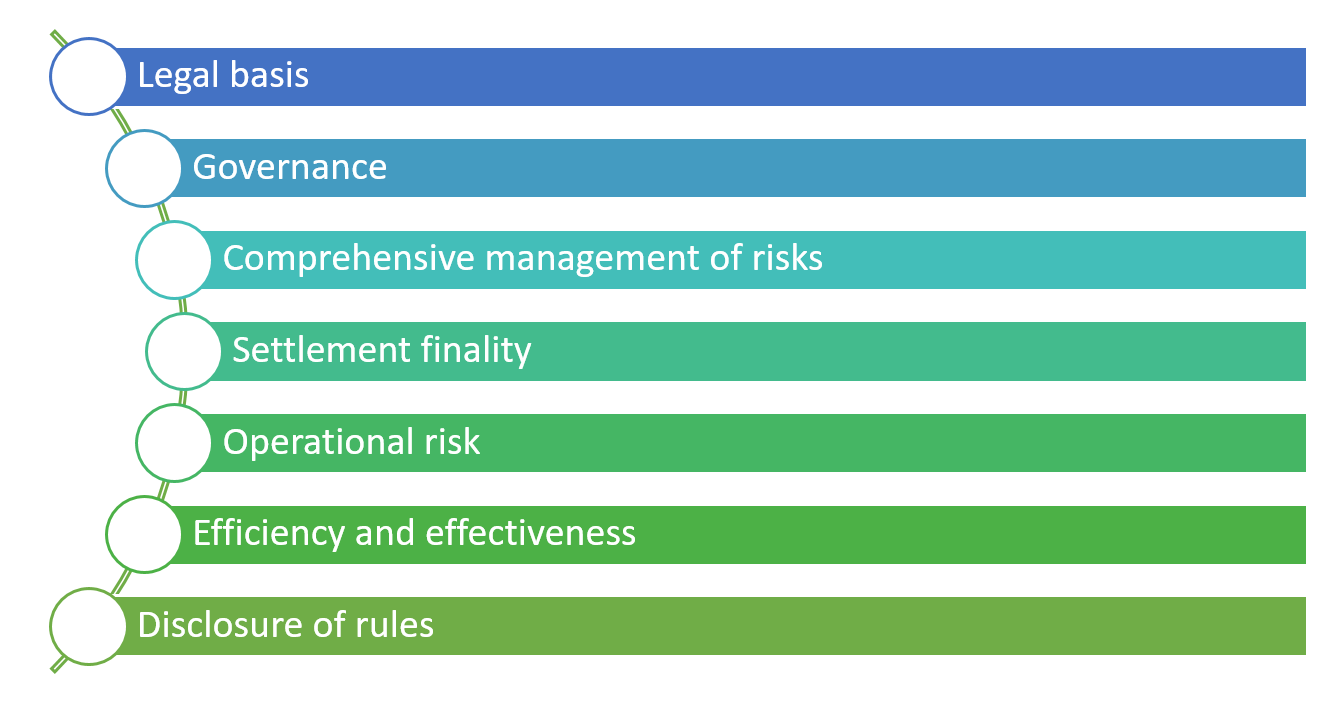
The international standards and best practices on regulating Financial Market Infrastructure (FMI) are set out in CPSS-IOSCO principles of FMI (PFMI).[5] A Financial Market Infrastructure (FMI) is a multilateral system among participating institutions, including the operator of the system. The consumer protection aspects emerging from the payment aggregation business model, are regulated by these principles. Based on CPSS-IOSCO principles of (PFMI), the RBI has described designated FMIs, and released a policy document on regulation and supervision of FMIs in India under its regulation on FMIs in 2013.[6] The PFMI stipulates public policy objectives, scope, and key risks in financial market infrastructures such as systemic risk, legal risk, credit risk, general business risks, and operational risk. The Important Retail Payment Systems (IRPS) are identified on the basis of the respective share of the participants in the payment landscape.  The RBI has further sub-categorised retail payments FMIs into Other Retail Payment Systems (ORPS). The IRPS are subjected to 12 PFMI while the ORPS have to comply with 7 PFMIs. The PAs and PGs fall into the category of ORPS, regulatory principles governing them are classified as follows:

These principles of regulation are neither exclusive nor can said to be having a clear distinction amongst them, rather they are integrated and interconnected with one another. The next part discusses the broad intention of the principles above and the supporting regulatory clauses in PA Guidelines covering the same.

Legal Basis and Governance framework

The legal basis principle lays the foundation for relevant parties, to define the rights and obligations of the financial market institutions, their participants, and other relevant parties such as customers, custodians, settlement banks, and service providers. Clause 3 of PA Guidelines provides that authorisation criteria are based primarily on the role of the intermediary in the handling of funds. PA shall be a company incorporated in India under the Companies Act, 1956 / 2013, and the Memorandum of Association (MoA) of the applicant entity must cover the proposed activity of operating as a PA forms the legal basis. Henceforth, it is quintessential that agreements between PA, merchants, acquiring banks (PA’s Partners Bank), and all other stakeholders to the payment chain, clearly delineate the roles and responsibilities of the parties involved. The agreement should define the rights and obligations of the parties involved, (especially the nodal/escrow agreement between partner bank and payment aggregator). Additionally, the agreements between the merchant and payment aggregator as discussed later herein are fundamental to payment aggregator business. The PA’s business rests on clear articulation of the legal basis of the activities being performed by the payment aggregator with respect to other participants in the payment system, such as a merchant, escrow banks, in a clear and understandable way.

Comprehensive Management of Risk

The framework for the comprehensive management of risks provides for integrated and comprehensive view of risks. Therefore, this principle broadly entails comprehensive risk policies, procedures/controls, and participants to have robust information and control systems. Another connecting aspect of this principle is operational risk, arising from internal processes, information systems and disruption caused due to IT systems failure. Thus there is a need for payment aggregator to have robust systems, policies to identify, monitor and manage operational risks. Further to ensure efficiency and effectiveness, the principle entails to maintain appropriate standards of safety and security while meeting the requirements of participants involved in the payment chain. Efficiency is resources required by such payment system participants (PAs/PGs herein) to perform its functions. The efficiency includes designs to meet needs of participants with respect to choice of clearing and settlement transactions and establishing mechanisms to review efficiency and effectiveness. The operational risk are comprehensively covered under Annex 2 (Baseline Technology-related Recommendation) of the PA Guidelines. The Annex 2, inter alia includes, security standards, cyber security audit reports security controls during merchant on-boarding. These recommendations and compliances under the PA Guidelines stipulates standard norms and compliances for managing operational risk, that an entity is exposed to while performing functions linked to financial markets.

KYC and Merchant On-boarding Process

An important aspect of payment aggregator business covers merchant on-boarding policies and anti-money laundering (AML) and counter-terrorist financing (CFT) compliance. The BIS-CPSS principles do not govern within its ambits certain aspects like AML/CFT, customer data privacy. However, this has a direct impact on the businesses of the merchants, and customer protection. Additionally, other areas of regulation being data privacy, promotion of competition policy, and specific types of investor and consumer protections, can also play important roles while designing the payment aggregator business model. Nevertheless, the PA Guidelines provide for PAs to undertake KYC / AML / CFT compliance issued by RBI, as per the “Master Direction – Know Your Customer (KYC) Directions” and compliance with provisions of PML Act and Rules. The archetypal procedure of document verification while customer on-boarding process could include:

  • PA’s to have Board approved policy for merchant on-boarding process that shall, inter-alia, provide for collection of incorporation certificates, constitutional document (MoA/AoA), PAN and financial statements, tax returns and other KYC documents from the merchant.
  • PA’s should take background and antecedent checks of the merchants, to ensure that such merchants do not have any malafide intention of duping customers, do not sell fake/counterfeit/prohibited products, etc.

PAs shall ensure that the merchant’s site shall not save customer’s sensitive personal data, like card data and such related data. Agreement with merchant shall have provision for security/privacy of customer data.

Settlement and Escrow

The other critical facet of PA business is the settlement cycle of the PA with the merchants and the escrow mechanism of the PA with its partner bank. Para 8 of PA Guidelines provide for non-bank PAs to have an escrow mechanism with a scheduled bank and also to have settlement finality. Before understanding the settlement finality, it is important to understand the relevance of such escrow mechanisms in the payment aggregator business.

Escrow Account

Surely there is a bankruptcy risk faced by the merchants owing to the default by the PA service provider. This default risk arises post completion of the first leg of the payment transaction. That is, after the receipt of funds by the PA from the customer into its bank account. There is an ultimate risk of default by PA till the time there is final settlement of amount with the merchant. Hence, there is a requirement to maintain the amount collected by PA in an escrow account with any scheduled commercial bank. All the amounts received from customers in partner bank’s account, are to be remitted to escrow account on the same day or within one day, from the date amount is debited from the customer’s account (Tp+0/Tp+1). Here Tp is the date on which funds are debited from the customer’s bank account.  At end of the day, the amount in escrow of the PA shall not be less than the amount already collected from customer as per date of debit/charge to the customer’s account and/ or the amount due to the merchant. The same rules shall apply to the non-bank entities where wallets are used as a payment instrument.[7] This essentially means that PA entities should remit the funds from the PPIs and wallets service provider within same day or within one day in their respective escrow accounts. The escrow banks have obligation to ensure that payments are made only to eligible merchants / purposes and not to allow loans on such escrow amounts. This ensures ring fencing of funds collected by the PAs, and act as a deterrent for PAs from syphoning/diverting the funds collected on behalf of merchants. The escrow agreement function is essentially to provide bankruptcy remoteness to the funds collected by PA’s on behalf of merchants.

Settlement Finality

Settlement finality is the end-goal of every payment transaction. Settlement in general terms, is a discharge of an obligation with reference of the underlying obligation (whatever parties agrees to pay, in PA business it is usually INR). The first leg of the transaction involves collection of funds by the PA from the customer’s bank (originating bank) to the PA escrow account. Settlement of the payment transaction between the PA and merchant, is the second leg of the same payment transaction and commences once funds are received in escrow account set up by the PA (second leg of the transaction).

Settlement finality is the final settlement of payment instruction, i.e. from the customer via PA to the merchant. Final settlement is where a transfer is irrevocable and unconditional. It is a legally defined moment, hence there shall be clear rules and procedures defining the point of settlement between the merchant and PA.

For the second leg of the transaction, the PA Guidelines provide for different settlement cycles:

  1. Payment Aggregator is responsible for the delivery of goods/service– The settlement cycle with the merchant shall not be later than one day from the date of intimation to PA of shipment of goods by the merchant.
  2. Merchant is responsible for delivery– The settlement cycle shall not be later than 1 day from the date of confirmation by the merchant to PA about delivery of goods to the customer.
  3. Keeping the amount by the PA till the expiry of refund period– The settlement cycle shall not be later than 1 day from the date of expiry of the refund period.

These settlement cycles are mutually exclusive and the PA business models and settlement structure cycle with the merchants could be developed by PAs on the basis of market dynamics in online selling space. Since the end-transaction between merchant and PA is settled on a contractually determined date, there is a deferred settlement, between PA and the merchant.  Owing to the rules and nature of the relationship (deferred settlement) is the primary differentiator from the merchants proving the Delivery vs. Payment (DvP) settlement process for goods and services.

Market Concerns

Banks operating as PAs do not need any authorisation, as they are already part of the the payment eco-system, and are also heavily regulated by RBI. However, owing to the sensitivity of payment business and consumer protection aspect non-bank PA’s have to seek RBI’s authorisation. This explains the logic of minimum net-worth requirement, and separation of payment aggregator business from e-commerce business, i.e. ring-fencing of assets, in cases where e-commerce players are also performing PA function. Non-bank entities are the ones that are involved in retail payment services and whose main business is not related to taking deposits from the public and using these deposits to make loans (See. Fn. 7 above).

However, one could always question the prudence of the short timelines given by the regulator to existing as well as new payment intermediaries in achieving the required capital limits for PA business. There might be a trade-off between innovations that fintech could bring to the table in PA space over the stringent absolute capital requirements. While for the completely new non-bank entity the higher capital requirement (irrespective of the size of business operations of PA entity) might itself pose a challenge. Whereas, for the other non-bank entities with existing business activities such as NBFCs, e-commerce platforms, and others, achieving ring-fencing of assets in itself would be cumbersome and could be in confrontation with the regulatory intention. It is unclear whether financial institutions carrying financial activities as defined under section 45 of the RBI Act, would be permitted by the regulator to carry out payment aggregator activities. However, in doing so, certain additional measures could be applicable to such financial entities.

Conclusion

The payment aggregator business models in India are typically based on front-end services, i.e. the non-bank entitles are aggressively entering into retail payment businesses by way of providing direct services to merchants. The ability of non-bank entitles to penetrate into merchant onboarding processes, has far overreaching growth potential than merchant on-boarding processes of traditional banks. While the market is at the developmental stage, nevertheless there has to be a clear definitive ex-ante system in place that shall provide certainty to the payment transactions. The CPSS-IOSCO, governing principles for FMIs lays down a good principle-based governing framework for lawyers/regulators and system participants to understand the regulatory landscape and objective behind the regulation of payment systems. PA Guidelines establishes a clear, definitive framework of rights between the participants in the payment system, and relies strongly on board policies and contractual arrangements amongst payment aggregators and other participants. Therefore, adequate care is necessitated while drafting escrow agreements, merchant-on boarding policies, and customer grievance redressal policies to abide by the global best practices and meet the objective of underlying regulation. In hindsight, it will be discovered only in time to come whether the one-size-fits-all approach in terms of capital requirement would prove to be beneficial for the overall growth of PA business or will cause a detrimental effect to the business space itself.


[1] RBI, Directions for opening and operation of Accounts and settlement of payments for electronic payment transactions involving intermediaries, November 24, 2009. https://www.rbi.org.in/scripts/NotificationUser.aspx?Mode=0&Id=5379

[2] Payment Systems in India – Booklet (rbi.org.in)

[3] https://m.rbi.org.in/Scripts/AnnualReportPublications.aspx?Id=1293

[4] https://www.investindia.gov.in/sector/retail-e-commerce

[5] The Bank for International Settlements (BIS), Committee on Payment and Settlement Systems (CPSS) and International Organisation of Securities Commissions (IOSCO) published 24 principles for financial market infrastructures and  and responsibilities of central banks, market regulators and other authorities. April 2012 <https://www.bis.org/cpmi/publ/d101a.pdf>

[6]Regulation and Supervision of Financial Market Infrastructures, June 26, 2013 https://www.rbi.org.in/scripts/bs_viewcontent.aspx?Id=2705

[7] CPMI defines non-banks as “any entity involved in the provision of retail payment services whose main business is not related to taking deposits from the public and using these deposits to make loans”  See, CPMI, ‘Non-banks in retail Payments’, September 2014, available at <https://www.bis.org/cpmi/publ/d118.pdf>


Our other related articles:

Overview of Regulatory Framework of Payment and Settlement Systems in India by Anita Baid – Vinod Kothari Consultants

RBI to regulate operation of payment intermediaries – Vinod Kothari Consultants

Major recommendations of the Committee on Payment Systems on Payment and Settlement System Bill, 2018 – Vinod Kothari Consultants

Samagrata – March 2021

No compound interest during moratorium: RBI directs lenders pursuant to SC order

Anita Baid | Vice President, Financial Services (anita@vinodkothari.com)

Overview

The Supreme Court of India (‘SC’ or ‘Court’) had given its judgement in the matter of Small Scale Industrial Manufacturers Association vs UOI & Ors. and other connected matters on March 23, 2021. The said order of SC put an end to an almost ten months-long legal scuffle that started with the plea for complete waiver of interest, but edged towards waiver of interest on interest, that is, compound interest, charged by lenders during Covid moratorium. From the miseries suffered by people due to the pandemic, to the economic strangulation of trade and activity – the unfinished battle with the pandemic continues. Nevertheless, the SC realised the economic limitation of any Government, even in a welfare state. The SC acknowledged that the economic and fiscal regulatory measures are fields where judges should encroach upon very warily as judges are not experts in these matters. What is best for the economy, and in what manner and to what extent the financial reliefs/ packages be formulated, offered and implemented is ultimately to be decided by the Government and RBI on the aid and advice of the experts.

Compound interest continues to elude judicial acceptance – there are several rulings against compound interest pertaining to arbitral awards, and a lot more for civil awards. In the present ruling as well, observations of the Apex court seem to be indicating that compound interest is penal in nature. This may be surprising to a person of finance, as in the financial world, compound interest is ubiquitous and unquestionable.

In the concluding part of the judgment while dismissing all the petitions, the Court lifted the interim relief granted earlier, pertaining to the NPA status of the borrowers. However, the last tranche of relief in the judgement came for the large borrowers that had loans outstanding/ sanctioned as on February 29, 2020 greater than Rs. 2 crores, and other borrowers who were not eligible to avail compound interest relief as per the Scheme for grant of ex-gratia payment of difference between compound interest and simple interest for six months to borrowers in specified loan accounts (1.3.2020 to 31.8.2020) dated October 23, 2020 (“Ex-Gratia Scheme”). The Court did not find any basis for the limit of Rs 2 crores while granting relief of interest-on-interest (under ex-gratia scheme) to the borrowers. Thus, the Court directed that there shall not be any charge of interest on interest/ penal interest for the period during moratorium for any borrower, irrespective of the quantum of loan, or the category of the borrowers.  The lenders should give credit/ adjustment in the next instalment of the loan account or in case the account has been closed, return any amount already recovered, to the concerned borrowers.

Given that the timelines for filing claims under the ex-gratia scheme have expired, it was expected that the Government would be releasing extended/ updated operational guidelines in this regard for adjustment/ refund of the interest on interest charged by the lenders from the borrowers. Further, it seemed that the said directions of the Court would be applicable only to the loan accounts that were eligible and have availed moratorium under the COVID 19 package.

However, as a consequence of the aforesaid ruling, the Reserve Bank of India (‘RBI’) has issued a circular on April 7, 2021 (‘RBI Circular’) instructing the financial institutions to take steps for refund/ adjustment of the interest on interest. While the SC order clearly pertains to the Ex-Gratia Scheme of MoF, the RBI does not talk anywhere about the burden being passed to the GoI.

The RBI Circular is applicable on all lending institutions, that is to say, (a) Commercial Banks (including Small Finance Banks, Local Area Banks and Regional Rural Banks), (b) Primary (Urban) Co-operative Banks/State Co-operative Banks/ District Central, Co-operative Banks, (c) All All-India Financial Institutions, (d) Non-Banking Financial Companies (including Housing Finance Companies).

Interest on Interest

More than 20 writ petitions were filed with the Supreme Court and the relief sought by them can broadly be classified in four parts – waiver of compound interest/ interest on interest during the moratorium period; waiver of total interest during the moratorium period; extension of moratorium period; and that the economic packages/ reliefs should sector specific. Our write on the issue can be read here.

The contention of the petitioners was that even charging interest on interest/compound interest can be said to be in the form of penal interest. Further, it was argued that the penal interest can be charged only in case of wilful default.  In view of the effect of pandemic due to Covid­19 and even otherwise, there was a deferment of payment of loan during the moratorium period as per RBI circulars, hence, it cannot be said that there is any wilful default which warrants interest on interest/penal interest/compound interest. The appeal was that there should not be any interest on interest/penal interest/compound interest charged for and during the moratorium period.

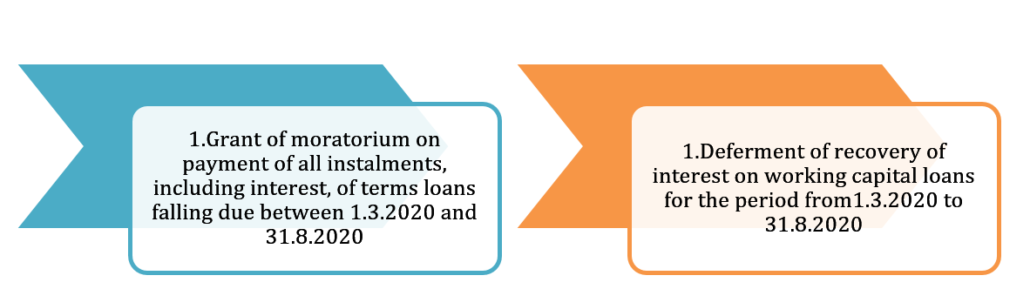
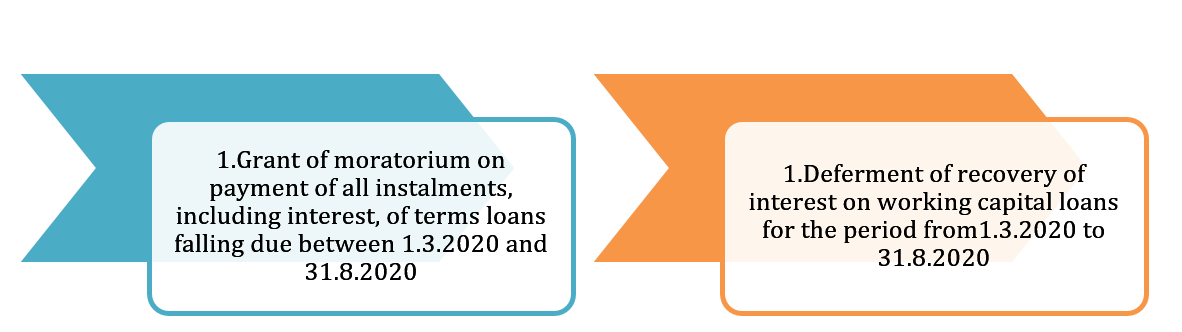
The Central Government and RBI had already provided the following reliefs to mitigate the burden of debt servicing brought about by disruptions on account of Covid­19 pandemic:

The nature of moratorium was to provide a temporary standstill on payment of both, principal and interest thereby providing relief to the borrowers in two ways, namely, the   account   does   not become NPA despite nonpayment of dues; and since there was no reporting to the Credit Information Companies, the moratorium did not adversely impact the credit history of the borrowers.

It is important to understand the concept of “moratorium”- the word “moratorium” is categorically defined by the RBI, while issuing various circulars. The relevant circulars of RBI show that “moratorium” was never intended to be “waiver of interest”, but “deferment of interest”. In other words, if a borrower takes the moratorium benefit, his liability to make payment of contractual interest (both normal interest and interest on interest) gets deferred for a period of three months and subsequently three months thereafter. After a very careful and major consideration of several fiscal and financial criteria, it’s inevitable effects and keeping the uncertainty of the existing situation in mind, the payment of interest and interest on interest was merely deferred and was never waived.

Further, it is to be noticed that while the standstill applicable to bank loans results in the bank not getting its funds back during the period of moratorium, the bank continues to incur cost on bank’s deposits and borrowings. Since a moratorium offers certain advantages to borrowers, there are costs associated with obtaining the benefit of a moratorium and placing the burden of the same on lenders might just shift the burden on the financial sector of the country. If the lenders were to bear this burden, it would necessarily wipe out a substantial and a major part of their net worth, rendering most of the banks unviable and raising a very serious question over their very survival. Even on the occurrence of other calamities like cyclone, earthquake, drought or flood,  lenders do not waive interest but provide necessary relief packages to the borrowers. A waiver   can only be granted by the Government out of the exchequer. It cannot come out of a system from banks, where credit is created out of the depositor’s funds alone. Any waiver will create a shortfall and a mismatch between the Bank’s assets and liabilities.

Considering the same, the Government had granted the relief of waiver of compound interest during the moratorium period, limited to the most vulnerable categories of borrowers, that is, MSME loans and personal loans up to Rs. 2 crores. Our write up on the same can be viewed here.

However, the SC felt that there is no justification to restrict the relief of not charging interest on interest with respect to the loans up to Rs. 2 crores only and that too restricted to certain categories. Accordingly, the SC had directed that directed that there shall not be any charge of interest on interest/compound interest/penal interest for the period during the moratorium and any amount already recovered under the same head, namely, interest on interest/penal interest/compound interest shall be refunded to the concerned borrowers and to be given credit/adjusted in the next instalment of the loan account.

The ruling however, did not clarify as to who shall bear the burden of the waiver of such interest on interest. Further, the RBI Circular seems to place the burden on the lenders and not wait for the Government to come up with a relief scheme or extend the existing ex-gratia scheme.

RBI Circular

Coverage of Lenders

All lending institutions are covered under the ambit of the RBI Circular. The coverage includes all HFCs and NBFCs, irrespective of the asset size. Clearly, non-banking non-financial entities, or unincorporated bodies are not covered by the Circular.

Coverage of Borrowers

The borrowers eligible as per March 27 Circular (COVID-19 – Regulatory Package) were those who have availed term loans (including agricultural term loans, retail and crop loans) and working capital financing in the form of cash credit/ overdraft. Certain categories of borrowers were ineligible under the March 27 Circular such as those which were not standard assets as on 1st March 2020. Hence, loans already classified as NPA  continued with further asset classification deterioration during the moratorium period in case of non-payment.

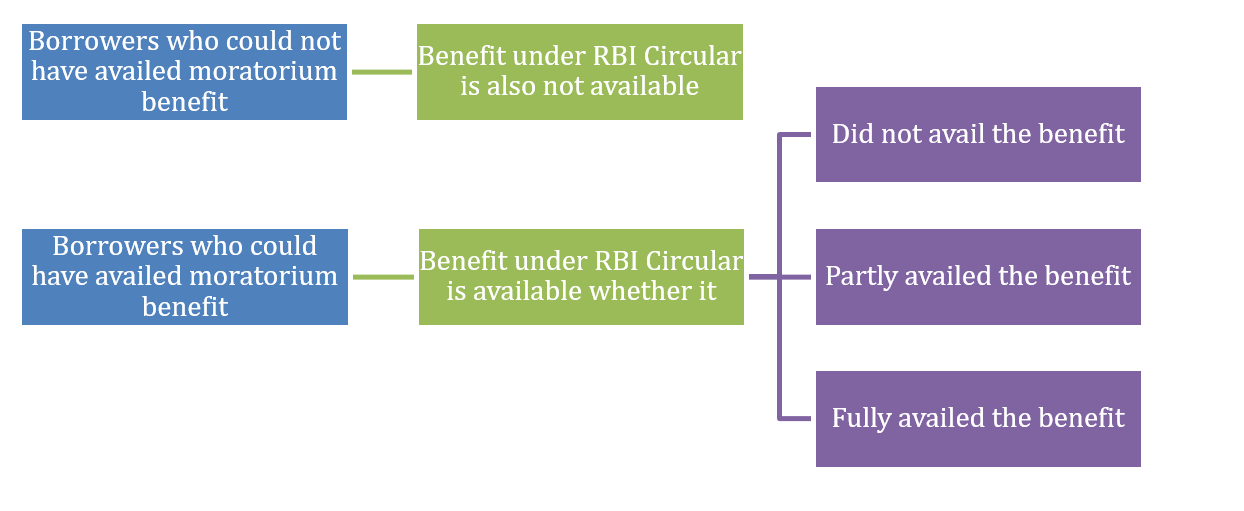
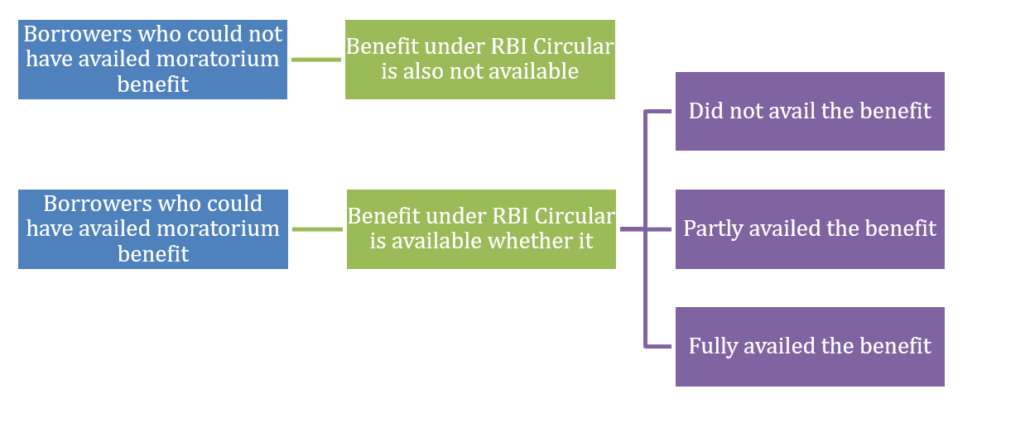
The question that arises is whether the benefit under the RBI Circular is limited to any particular type of facility? The benefit of the RBI Circular is to be provided to all borrowers, including those who had availed of working capital facilities during the moratorium period. Further, the benefit is irrespective of the amount sanctioned or outstanding and irrespective of whether moratorium had been fully or partially availed, or not availed. However, this should include only those loans that were originally eligible to claim the moratorium but did not claim it or claimed partially or fully.

Thus, all corporate borrowers, including NBFCs who may have borrowed from banks, are apparently eligible for the relief.

Another crucial aspect is whether the benefit is applicable to facilities which have been repaid, prepaid during the moratorium period? If so, upto what date? The benefit must be provided to all eligible loans existing at the time of moratorium but has been repaid as on date.

Coverage of facilities

Both term loans as well as working capital facilities are covered. Facilities which are not in the nature of loans do not seem to be covered.  Further, facilities for which the Covid moratorium was not applicable also do not seem to be covered. Examples are: unfunded facilities, loans against shares, invoice financing, factoring, financial leases, etc. In addition, borrowing by way of capital market instruments such as bonds, debentures, CP, etc are not covered by the RBI Circular.

Questions will also arise as to whether lenders will be liable to provide the relief in case of those loans which are securitised, assigned under DA transactions or transacted under co-lending arrangement? We have covered these questions in our detailed FAQs on the moratorium 1.0  and 2.0.

Since the moratorium benefit was to be extended only to such installments that were falling due during the said moratorium period. Hence, only those borrowers were eligible for availing moratorium who were standard as on February 29, 2020 and whose installments fell due during the moratorium period. Accordingly, there can be the following situations:
 

Burden of interest on interest

The SC order was with reference to the Central Govt decision vide Ex-Gratia Scheme. Among other things, the petitioners had challenged that there was no basis for limiting the amount of eligible facilities to Rs 2 crores, or limiting the facility only to categories of borrowers specified in the Ex-Gratia Scheme. As per the GoI decision, the benefit was to be granted by lending institutions to the borrowers, and correspondingly, there was a provision for making a claim against SBI, acting as the banker for the GoI.

The SC order is an order upon the UoI. Neither were individual banks/NBFCs parties to the writ petition, nor does it seem logical that the order of the Court may require parties to refund or adjust interest which they charged as per their lending contracts. The UoI may be required to extend a benefit by way of Covid relief, but it does not seem logical that the burden may be imposed on each of the lending institutions, who, incidentally, did not even have the chance to take part in the proceedings before the apex court.

Hence, it seems that the impact of the SC order is only to extend the benefit of the Ex-Gratia Scheme to all borrowers, but the mechanics of the original circular, viz., lending institutions to file a counterclaim against the UoI through SBI, should apply here too.

Accounting disclosure for FY 20-21

The RBI Circular talks about a disclosure for the adjustment or refund to be reflected in the financial statements for FY 20-21.

In terms of accounting standards, the question whether the liability for refund or adjustment of the compound interest is a liability or a provision will be answered with reference to Ind AS 37 Provisions, Contingent Liabilities and Contingent Assets. Since the RBI Circular may be seen as creating a liability as on 31st March, 2021, the lending institution may simply adjust the differential amount [that is, compound interest – simple interest on the Base Amount] into the ongoing account of the customer. If such a liability has been booked, there is no question of any provision.

The computation of the differential amount will have to be done for each borrower. Hence, any form of macro computation does not seem feasible. Therefore, there will not be much of a difference between a provision and a liability.

Accounting for the refund in FY 20-21 by the borrowers

If the lending institution makes a provision, can the borrower book a receivable by crediting interest paid or provided? The answer seems affirmative.

Mechanism of extending the benefit

Methodology for calculation is to be provided by IBA. In this regard, representation has been made to the Government to bear the burden.

Base amount: If the mode of computation as provided in the RBI Circular is to be followed [IBA’s methodology will be awaited], then the computation will be based on the amount outstanding as on 1st March 2020.

Computation: On the Base amount, the differential amount will be CI- SI.

If the facility has been fully repaid during the moratorium period, the Differential Amount will run upto the date of the repayment.

Actionables

A board approved policy is to be put in place immediately. In this regard, the concern is whether the lenders can modify existing moratorium policy or adopt a new policy altogether? In our opinion, the existing policy itself may be amended to give effect to the RBI Circular or alternatively a new policy may be adopted.

Also, there is no timeline prescribed as to by when are these actionables required. However, since there are certain disclosure requirements in the financials for the FY 2020-21, the policy must be in place before the financials are approved by the Board of the respective lenders.

The lender may await the instructions to be issued by the Government and the methodology to be prescribed by IBA. Logically, the same method as was provided under the Ex-Gratia Scheme should be applicable. Accordingly, lenders may create provisions for the refund of the excess interest charged and whether corresponding receivable will be shown would depend on whether the same is granted by the Government.

Asset Classification

The RBI moratorium notifications freezed the delinquency status of the loan accounts, which availed moratorium benefit under the scheme. It essentially meant that asset classification standstill was imposed for accounts where the benefit of moratorium was extended. A counter obligation on Credit Information Companies (CIC) was also imposed to ensure credit history of the borrowers is not impacted negatively, which are availing benefits under the scheme.

Various writ petitions were filed with the SC seeking an extended relief in terms of relaxation in reporting the NPA status to the credit bureaus. Hence, while hearing the petition of Gajendra Sharma Vs Union of India & Anr. and other writ petitions, the SC granted stay on NPA classification in its order dated September 03, 2020. The said order stated that:

“In view of the above, the accounts which were not declared NPA till 31.08.2020 shall not be declared NPA till further orders.”

The intent of granting such a stay was to provide interim relief to the borrowers who have been adversely affected by the pandemic, by not classifying and reporting their accounts as NA and thereby impacting their credit score.

In its latest judgment, the SC has directed that the interim relief granted earlier not to declare the accounts of respective borrowers as NPA stands vacated. We have also covered the same in our write up.

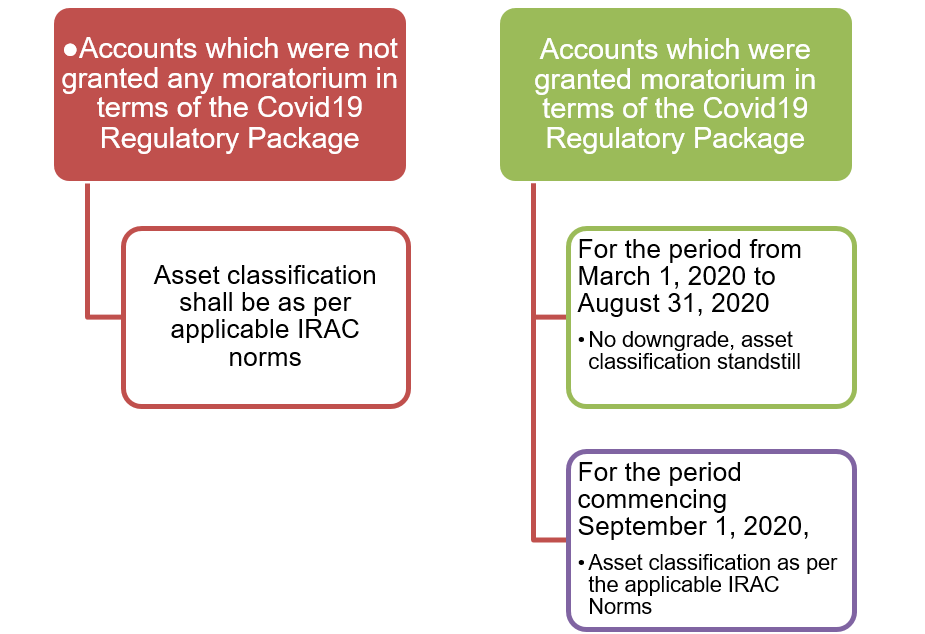
As a consequence of the SC order, the RBI Circular has clarified the asset classification as follows:
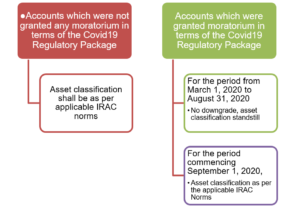
This would mean that after September 1, 2020 though there was a freeze on NPA classification, the same cannot be construed as a freeze on DPD counting. The DPD counting has to be in continuation from the due date of the EMI. The accounts classified as standard, but in default of more than 90 DPD may now be classified NPA, since the freeze on NPA classification is lifted by the SC and directed by the RBI as well.