SEBI further caps limit for ISINs to reduce fragmentation and boost liquidity
– Lovish Jain, Executive | lovish@vinodkothari.com
-Can surrogate means be used to relegate funds or benefits to shareholders
Pammy Jaiswal | Partner | Vinod Kothari and Company
Shraddha Shivani | Executive | Vinod Kothari and Company
Section 8 of the Companies Act, 2013 (‘CA’) provides for the formation of companies with specific objects. Since the section revolves around incorporation of companies with charitable or some other specified welfare objectives, it gives an impression that these companies do not work to earn financial gains for their shareholders. This impression becomes evident since Section 8 companies are commonly referred to as ‘not-for-profit’ companies which further substantiates this understanding and adds to the confusion. They may make profits, as indeed, they very often do; however, the profit necessarily gets redeployed to carry the very same objects for which the company was formed, and cannot be relegated to the shareholders.
In fact, earning profits is not just permitted but is also essential for their continued existence and organic growth of its affairs. Most such companies do not borrow; hence, they carry their activities either through corpus contributions or through retained profits. Thus, the restrictions under CA are not on earning profits but on the distribution of the same to its shareholders.
The most common way for a company to distribute profits to its shareholders is by way of payment of dividend. This is explicitly barred in case of a Section 8 company. Having said that, these companies may also come across a situation where they do not foresee any immediate application of their accumulated profits and therefore, may look out for ways to utilise it for some other purpose. The management running these companies, potentially representing shareholders, may not be necessarily driven by avarice when they intend to use the funds other than for the purpose for which the company was formed.
Read more →-Pammy Jaiswal and Neha Malu | corplaw@vinodkothari.com
Getting an investor for one’s business is a crucial stage for any company and so no company would want to lose the opportunity to crack a deal with the investor even if it has to give away certain rights and powers to the said investor. Looking at the Indian statistics, it has been observed that Private equity (PE) and venture capital (VC) investments have been on a growing trend and they stood at US$ 4.4 billion across 99 deals in December 2021. As the investors decide to put in funds, they look out for having such rights so that they are updated about every major decision being taken in the investee. Majority of the decisions affecting the day-to-day operations are usually taken at the board level. Therefore, it has been observed that generally to strengthen the investor’s confidence in the operations and decision making, a “Board Observer” is appointed by such investor pursuant to an agreement who carries certain rights and obligations.
The Board Observer is a representative of the investor who is expected to observe the board proceedings without being formally appointed as a director and has no voting rights in the board deliberations. Internationally, the said concept is much more popular and has also been a point of litigation to decide on the rights and obligations of such Board Observers.
In this write-up, we have tried to deal with the important aspects relating to the concept of Board Observer so as to determine whether he is just a “silent observer” on the board of the investee company or a “game changer” in the real sense.
Read more →Making sense of SEBI’s 8th April clarification
Vinod Kothari & Vinita Nair | corplaw@vinodkothari.com
It has been 5 months since notification of SEBI (Listing Obligations and Disclosure Requirements) (Sixth Amendment) Regulations, 2021 making major recast of the regulatory processes on related party transactions; the 8000 odd corporates consisting of the bulk of India’s financial as well as real sector continue to decode, interpret, and implement the revised framework. On the advocacy front, companies continue to make representations to, seek clarifications from SEBI ((including through stock exchanges). There is no doubt that SEBI, as a regulator, is open to interface with companies and is often receptive to useful suggestions.
Within a span of 10 days, the 8th April clarification is the second clarification on the approval for material related party transactions (‘material RPTs’). SEBI circular dated March 30, 2022 provided a one-time relaxation by allowing companies to seek prior approval for material RPTs at the first general meeting convened after April 1, 2022. This time the clarification vide SEBI circular dated April 8, 2022 pertains to the validity term of the prior approval of shareholders for material RPTs. The circular has been rolled out, clearly, in response to the representations made seeking clarity. The issue in hand is the insistence of the new RPT framework requiring prior approval of shareholders if the materiality threshold is crossed, which, now, has an absolute monetary frontier of Rs 1000 crores as well. So, when do companies seek shareholders’ approval, if they clearly estimate the value of the transactions with a related party crossing the frontier? The 30th March circular granted a time upto the first general meeting in FY 22-23, but what about the next financial year? Not to see their transaction volumes suddenly hitting the Rs 1000 crores limit, do companies necessarily have to get shareholders’ approval before the beginning of the financial year? For most companies, the usual routine process of shareholders’ approval is through the annual general meeting, which happens around the July-September period. But what about continuing transactions from April, till the AGM date?
It seems that the SEBI’s circular of 8th April was trying to answer this question. However, as companies try to decipher and knit-pick each word of the regulator, they may possibly be left with so many different questions after reading the 8th April circular.
We had, in our earlier write up titled ‘New Materiality Thresholds for RPTs: Nagging questions on shareholders’ approval’, done a detailed analysis of transactions and contracts and discussed various aspects of shareholders’ approval for material RPTs. In this article, we intend to help companies to avoid any “confusification”, and see the 8th April circular as SEBI’s attempt to help companies to implement the process of shareholders’ approval, without affecting business and commercial considerations.
Click here to access our article corner on Related Party Transactions
– Himanshu Dubey, Executive | corplaw@vinodkothari.com
The financial statements of a company are not merely meant to show the profit or loss and/or assets and liabilities of the company. The notes to such financial statements also disclose various nuances that the shareholders of the company shall be aware of. Such disclosures may vary from material transactions with related parties to the purpose of inter-corporate loans, guarantee or security. The financial statements are meant to be prepared in accordance with Schedule III (‘Schedule’) to the Companies Act, 2013 (‘Act’). On March 24, 2021, MCA introduced more elaborative disclosure requirements regarding financial statements of companies which are effective from April 1, 2021 i.e. for financial statements prepared for FY 2021-22. One such requirement is disclosure of transactions with companies struck off by Registrar of Companies (‘RoC’) under section 248 of the Act, or under section 560 of the Companies Act, 1956. The following particulars are to be disclosed in such case:
The transaction can be in the nature of investment in securities, receivables, payables, shareholding of the struck-off company in the company and any other outstanding balances.
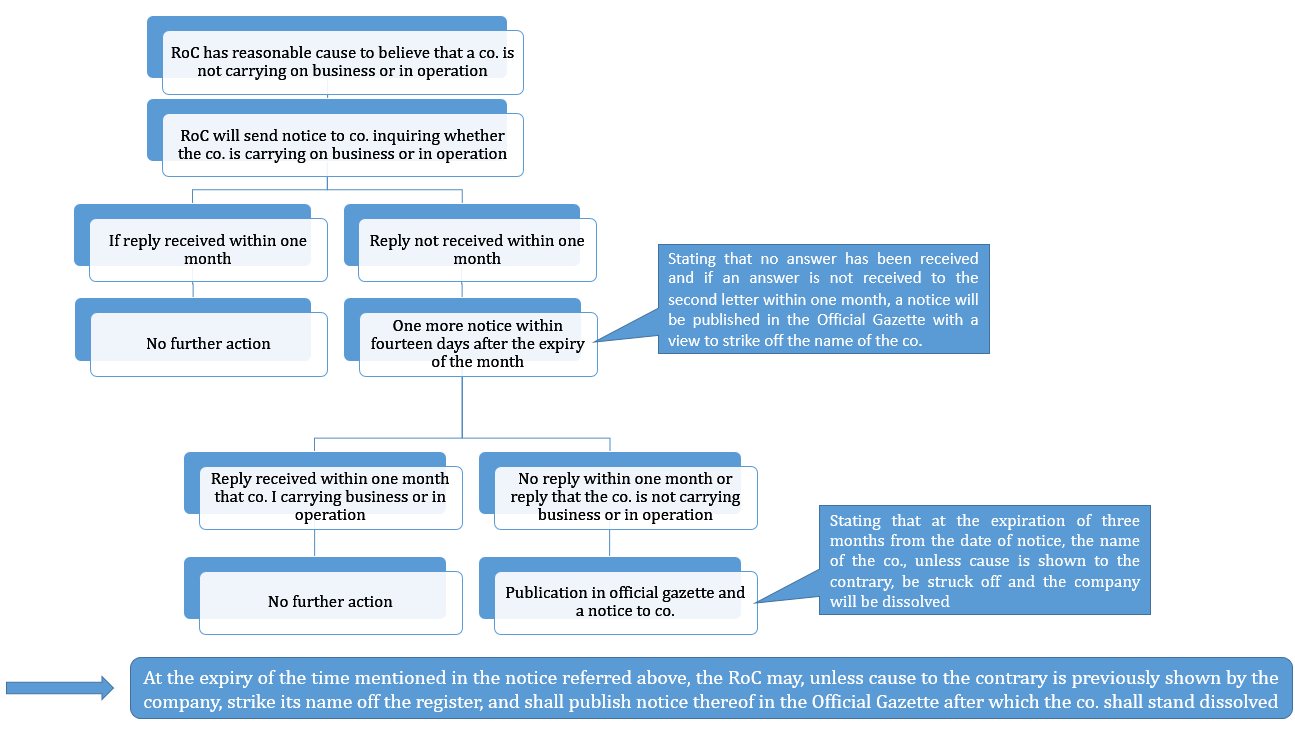
Before digging deep on the disclosure requirements, it is imperative to understand the provisions for striking off a company by RoC both under the Act as well as the Companies Act, 1956.
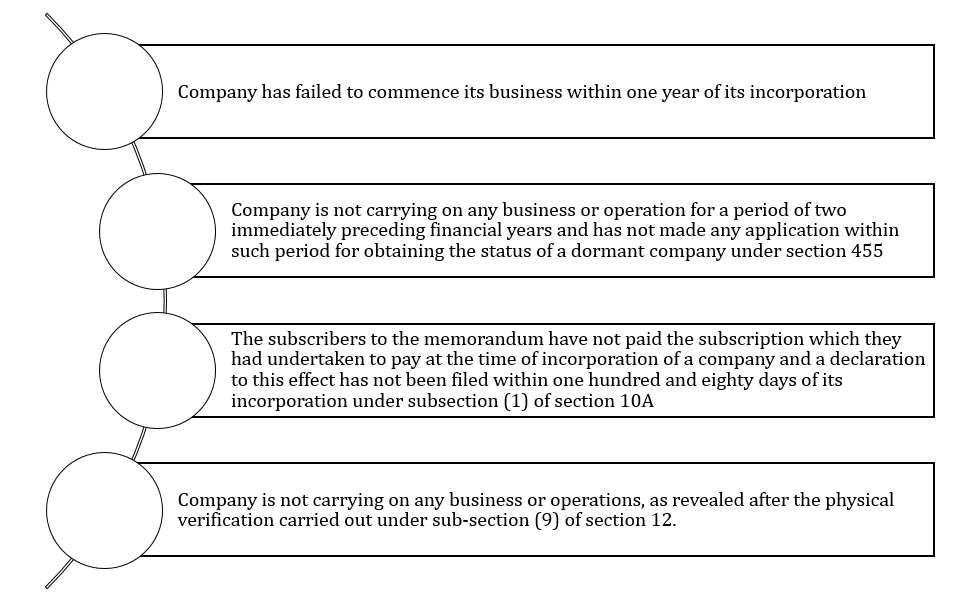
If the RoC has reasons to believe that:
A notice to the company and all the directors of the company, shall be sent by RoC articulating intention to strike off the name of the company and requesting them to send their representations within a period of thirty days from the date of the notice. At the expiry of the time, the RoC may, unless cause to the contrary is shown, strike off its name and shall publish notice thereof in the Official Gazette pursuant to which the company shall stand dissolved.
Further, a company may itself by passing a special resolution or consent of seventy-five per cent members after extinguishing all its liabilities, file an application to the RoC for removing its name on all or any of the grounds specified in the figure above.
The disclosure requirements of transactions with companies the name of which has been struck off is too vigorous since it requires too much background work to be done on the end of companies. Further, MCA has been issuing circulars containing names of companies which have been struck off. The companies will literally have to struggle through such a cumbersome and tedious task to find out one name among the thousands as issued by MCA.
There are some more practical complications that needs to be highlighted where the name of the company, that has been struck off, as available in records of the company may not match with the one mentioned in MCA’s list:
Going further, even in terms of volumes, there are a bunch of companies with whom a company transacts in its course of business. Tracing each one of them and identifying those which has been struck off seems to be a next to impossible task for a lot of companies.
The companies may opt for following systems and procedures depending upon the nature of transaction it has with a company the name of which has been struck off:
| Nature of relationship | Practical way of dealing |
| Debtor | The company might look through debtors periodically, especially those the receivables from whom are due for too longer than the usual time. |
| Creditor | If the payment made by the company has bounced for more than once, they may check if the aforesaid has been struck off. |
| Investment in securities | Unless a co. is an investment company or NBFC, it will not have several investments. Therefore, it will be comparatively easy to track such companies. |
| Shares held by stuck off company | This one might seem like a demon. There are listed companies with lakhs of shareholders. One more point to be noted in this regard is there might be cases of restructuring where a company might have merged or demerged. In such cases, the resulting company will have to carry the baggage of the transferor company (old company) as well in this regard. We might also take into account that there are certain benami shareholders in many companies for which IEPF rules are already in place. Tracking the names of such companies which have been struck off from such a large number of shareholders and collating data is a next to impossible task. |
| Other outstanding balances (to be specified) | This is a residuary field which requires any outstanding balance with a struck off company to be disclosed. Needless to say, this is an open-ended heading and includes in its ambit any transaction that is not covered above. Through this, the reporting company is expected to get into an exercise of identifying all transaction(s) with a struck off company with which the company has outstanding balance as on the last day of reporting period. |
Pursuant to the January 2022 edition of the ICAI Guidance Note on Division II – Ind AS Schedule III to the Companies Act, 2013 and Guidance Note on Division II – Non-Ind AS Schedule III to the Companies Act, 2013, the following guidance is provided with respect to disclosure of information regarding outstanding balances with struck off companies:
| Identification of struck-off company | The names of the companies are required to be searched / authenticated from public notice (STK-7) during the reporting period or any previous year(s), if balances with such companies are outstanding as on the last day of the reporting period.
Further, there should not have been any order for restoration of the name of such companies before the approval of the financial statement. It may be noted that this again is an task to track if the name of the companies have been restored vide order of any NCLT any other adjudicating authority as the orders remain scattered and at times not timely uploaded on the website. |
| Amount of balance outstanding | (1) The gross carrying amount is required to be disclosed without netting any provision for doubtful debts or impairment loss allowance.
(2) Infact the Guidance Note states that even such transaction which might have happened during a financial year and settled/reversed/squared off, etc., during the same financial year such that the balance outstanding is NIL as at the end of the reporting period, even such transactions are required to be disclosed. This adds up to the anyway unending disclosure in this context. There may be a situation where a company is not a struck off company at the time of transaction but eventually becomes one and is a struck off company as on the last day of the reporting period. With the point (2) above, one is left to an endless thought whether the reporting company is required to review all the transactions it had during the previous year(s)? because only then it may be able to track if there is any entry which might come under point (2) above. |
| Relationship with the struck-off company, if any, to be disclosed | In this field, the company is required to disclose its relationship, if any, with the corresponding struck-off companies as per section 2(76) of the Act, as on the balance sheet date. |
| Details not to be included | Companies whose names were struck off during the financial year but the order had been passed by any adjudicating authority (for e.g., NCLT) name before approval of the financial statements. |
In a nutshell, MCA is asking companies to search for the dead man but the dead man isn’t waking up. There might be cases where the name/identity of the dead man would have already been extinguished or changed during its lifetime. We understand that the intent of the Government is to read out all the struck off companies from the database of corporates. However, to effectively meet this purpose, MCA may opt to come out with a digital database of all companies which have been struck off either under the Act or the previous Act since it will facilitate companies to search data at one place. This might not be a complete way out but due to the practical hassles as discussed above in the article, MCA needs to review the requirement considering the practical issue being faced by the companies and introduce systems in place to enable compliance.
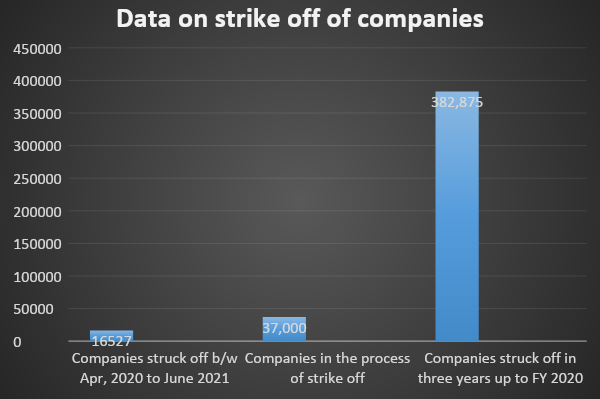
[1] https://economictimes.indiatimes.com/news/economy/policy/govt-says-16527-companies-struck-off-during-april-2020-june-2021-period/articleshow/84755626.cms?from=mdr
[2] https://www.livemint.com/news/india/37000-companies-getting-struck-off-from-records-mca-11632313659564.html
– Decoding Regulation 24 of Listing Regulations
By Payal Agarwal and Himanshu Dubey | corplaw@vinodkothari.com
Updated as on 27th October, 2021
The seamless flow of information between a holding company and its subsidiaries is imperative for effective governance on the level of a group. Since listed companies in India often function with complex structures having a lot of subsidiaries, it is not feasible for the holding company to deliberate upon all the matters of its subsidiary. Therefore, if not all, at least the significant transaction of the subsidiaries shall be placed on the board of the holding company. Regulation 24 of SEBI (Listing Obligations and Disclosure Requirements) Regulations, 2015 (‘Listing Regulations’) provide for the same. The same though sounds commendable but is also surrounded by various practical difficulties while its implementation. Sometimes the compliance with the aforesaid provision becomes merely perfunctory. If too much is reported to the holding company, the relevance is lost while if too less is reported then the materiality is lost.
In the normal course of business, it is very common for companies to have subsidiaries. However, the significance of such subsidiaries on the overall performance of the holding company varies. In case of listed companies, since the interest of the public at large is at stake, it becomes imperative that such stakeholders shall not only be informed about the listed company but also its subsidiaries. Ofcourse, the level and depth of information shall vary depending upon the significance of the subsidiaries as well as the significance of transactions being undertaken by such subsidiaries. Considering the aforesaid, Regulation 24 of the Listing Regulations requires the listed holding company to ensure corporate governance in its unlisted subsidiaries in certain ways. One of such ways is provided under sub-regulation (4) of Regulation 24 (Regulation) which says that the management of the unlisted subsidiary shall periodically bring to the notice of the board of directors of the listed entity, a statement of all significant transactions and arrangements entered into by the unlisted subsidiary.
The above-mentioned requirement was earlier applicable only to material unlisted subsidiaries but pursuant to amendment applicable w.e.f. April 1, 2019, the requirement has now been made applicable to all the unlisted subsidiaries of the listed holding company. However, the requirement though seems unequivocal, it comes with certain anomalies and practical difficulties. The author tries to present an analysis of the Regulation so as to answer the anomalies coming in the way of its practical implementation.
It is very common for a large corporate group to have various subsidiaries which in turn have various subsidiaries under them i.e. step down subsidiaries, from the angle of the ultimate holding company. The possibility of the holding company being listed and the subsidiaries including step down subsidiaries being unlisted is very high. This kind of a structure is very common and can be seen in most of the major corporate groups in India. Since the Regulation talks about subsidiaries, a question might pop up whether it only includes the immediate subsidiaries or the step down subsidiaries as well.
Given the purpose of the Regulation of enhancing corporate governance in the subsidiaries and also the fact that the shareholders interested in the listed company shall be aware of the business being undertaken by the subsidiaries as well. The principle behind this is that on the consolidated level, the performance of the holding company gets affected by the performance of its subsidiaries including its step down subsidiaries. Therefore it is pertinent to have some degree of supervision over them in terms of corporate governance though they are unlisted. Considering this rationale, there seems to be no purpose of excluding the step down subsidiaries from the purview of this Regulation. Hence, the Regulation will be applicable to both immediate and step down unlisted subsidiaries. Let us understand the applicability of the Regulation under different cases enunciated below:
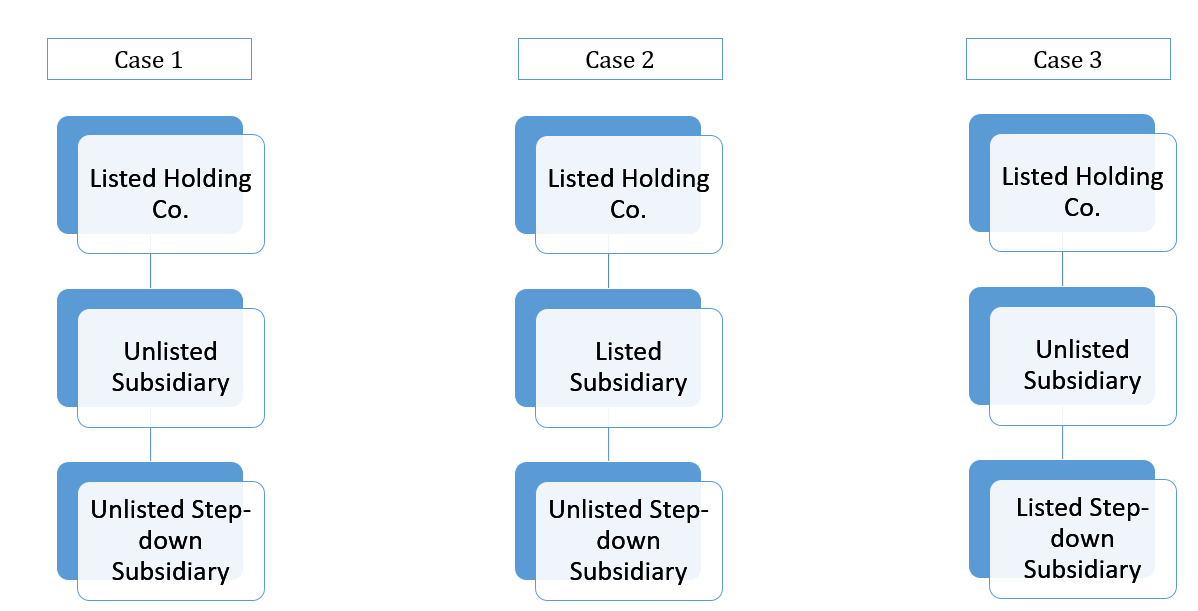
Case 1: since both the immediate subsidiary and the step down subsidiary are unlisted, the Regulation will apply to both of them and significant arrangements or transactions entered into by them will be reported to the ultimate holding company.
Case 2: since the subsidiary itself is a listed company and the Regulation clearly states that it applies to unlisted subsidiary. Therefore, the Regulation will not apply to the subsidiary. Going further, the step down subsidiary is unlisted, but the holding company just one level above is listed. Therefore, the Regulation will apply to unlisted step down subsidiary in relation to its immediate holding company. The ultimate holding company at the top will not be required to note or review the significant transactions or arrangements of the step down subsidiary under the Regulation.
Case 3: since the subsidiary is unlisted, the Regulation will have to be complied in relation to it. However, going forward to the listed step down subsidiary, since it is itself listed with the stock exchange, the Regulation will not apply as it is applicable only to unlisted subsidiaries.
Regulation 24(4) of the Listing Regulations reads as below –
“The management of the unlisted subsidiary shall periodically bring to the notice of the board of directors of the listed entity, a statement of all significant transactions and arrangements entered into by the unlisted subsidiary.”
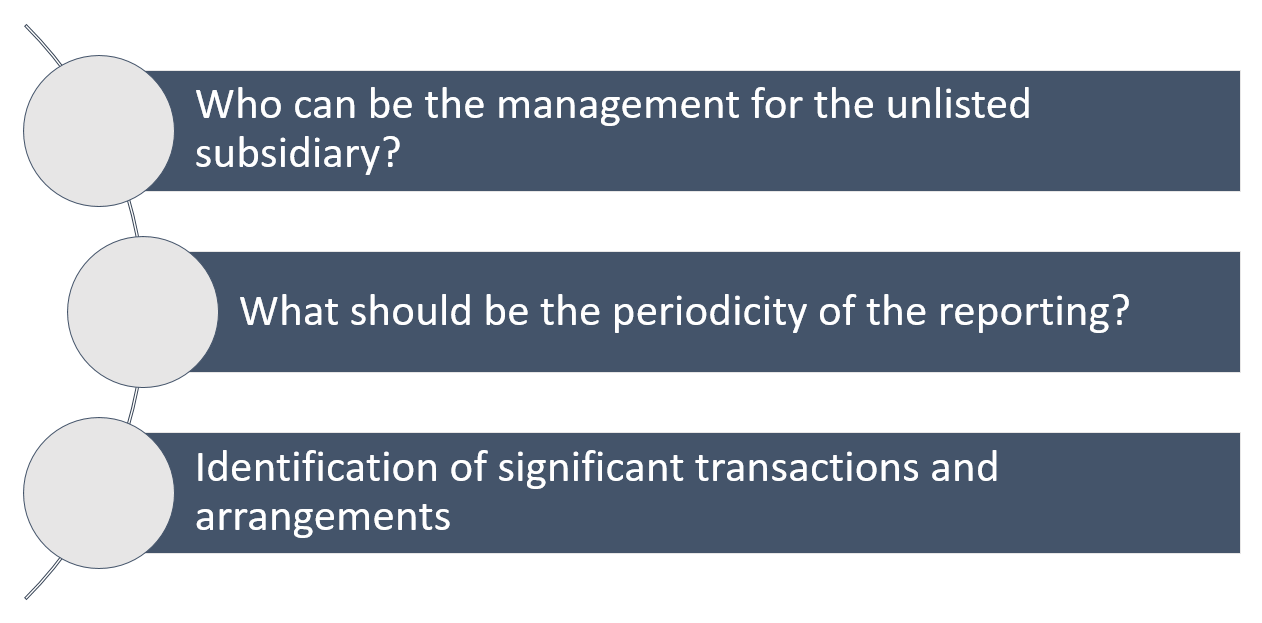
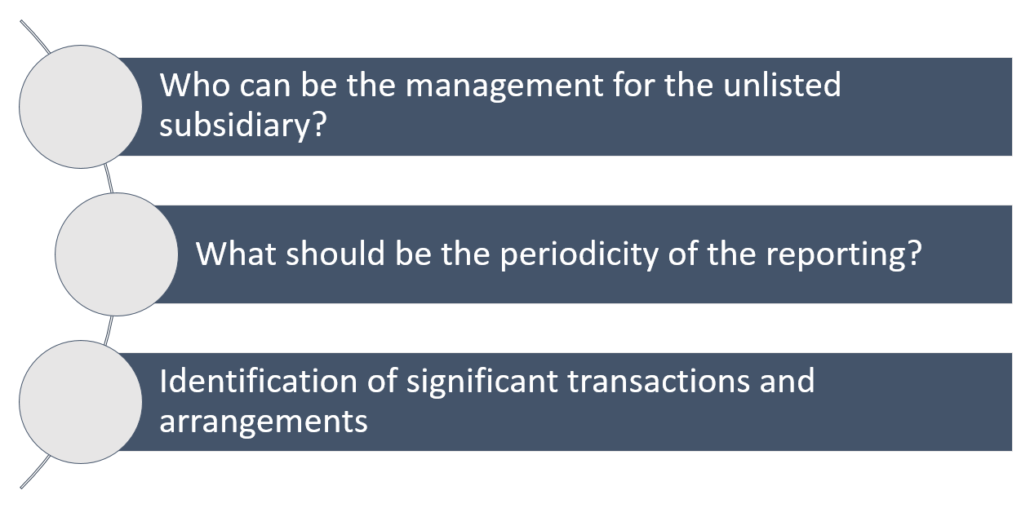
The following may be require to be identified –
While a plain reading entails the aforesaid questions, a deep analysis of the provisions and on consideration of the practical implications, further issues/questions may arise which have been dealt with at relevant places in this write-up.
The first question that arises while complying with the requirements of Regulation 24(4) is the identification as to what constitutes transaction or arrangement. While the term ‘transaction’ is not defined, the meaning of the same may be construed from Regulation 2(1)(zc) of the Listing Regulations and Indian Accounting Standard (Ind-AS) 24, defining the term “related party transaction” (RPT) .
The term has been defined as –
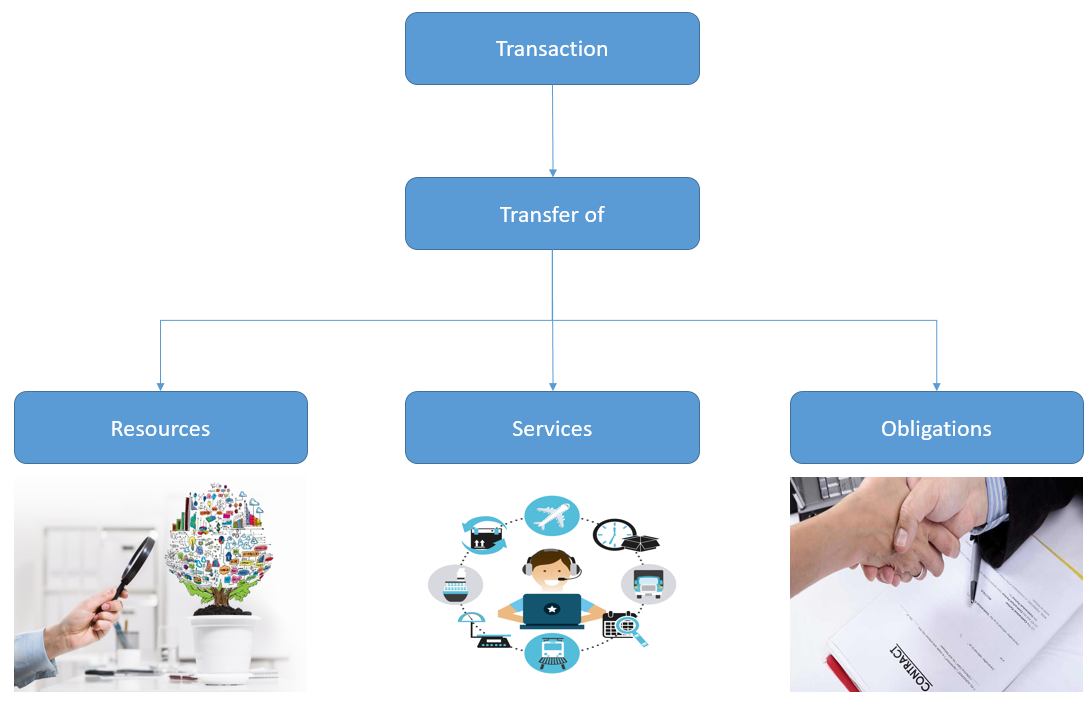
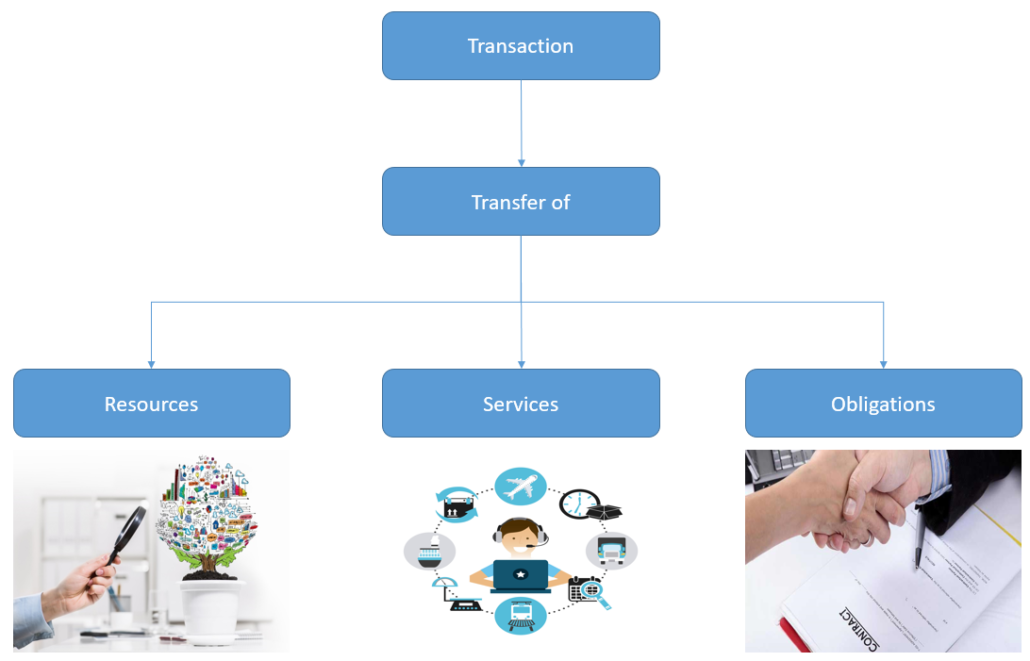
A related party transaction is a transfer of resources, services or obligations between a reporting entity and a related party, regardless of whether a price is charged.
Accordingly, the term transaction may be understood to be “a transfer of resources, services or obligations between two parties”. Similarly, arrangements shall mean a plan or programme for undertaking or understanding to undertake such transactions in future.
There are various line items in the financial statements which does not arise out of any transaction or arrangement but as a result of accounting entries. Such line items such as deferred tax expenditure, provisions for future liabilities, unrealised gains or losses, etc do not involve any contract, result into any transfer and does not involve two or more parties. Therefore, these fail to contain the basic features of transaction and should not require reporting.
On the other hand, there are certain off-balance sheet items such as guarantee, or derivative transactions. The component of “transfer” may not be present from the early stage but may arise in due course. Moreover, these arise out of contracts and constitute transactions. Therefore, the same should be reported at the values as recognised in the books of accounts.
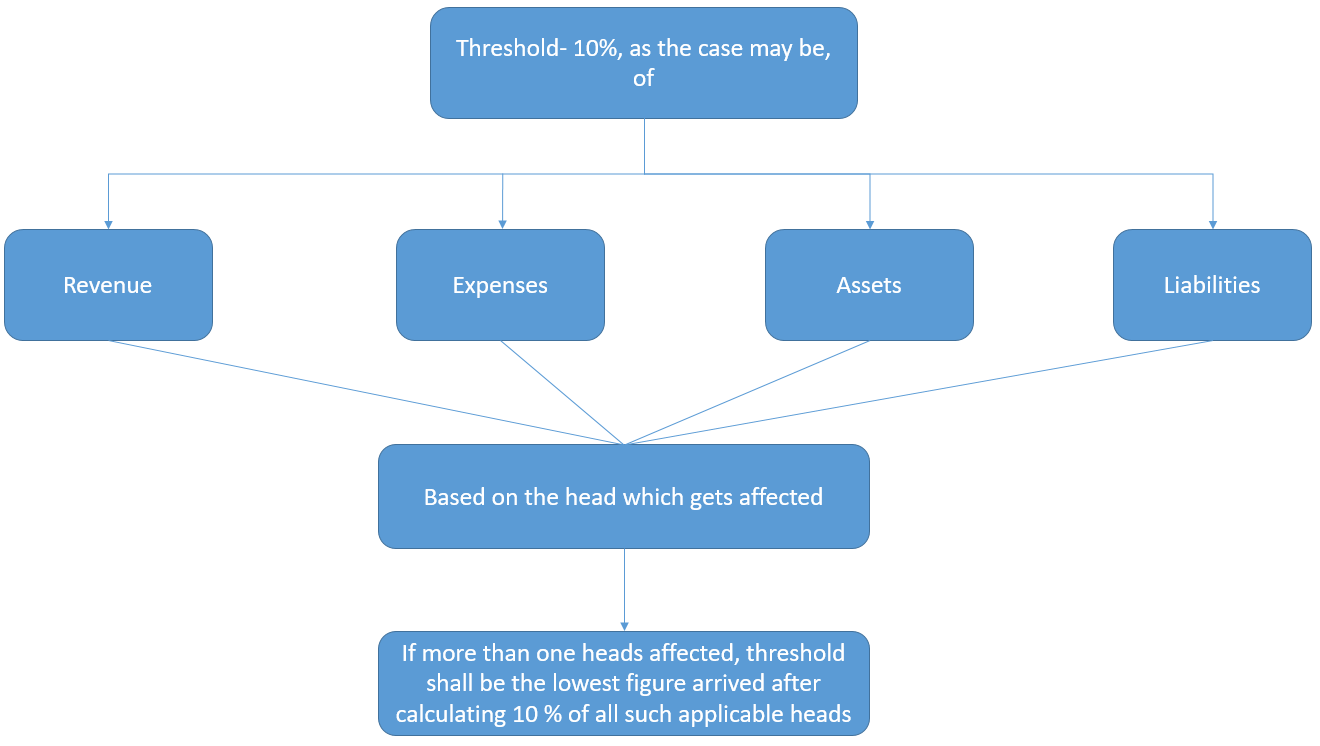
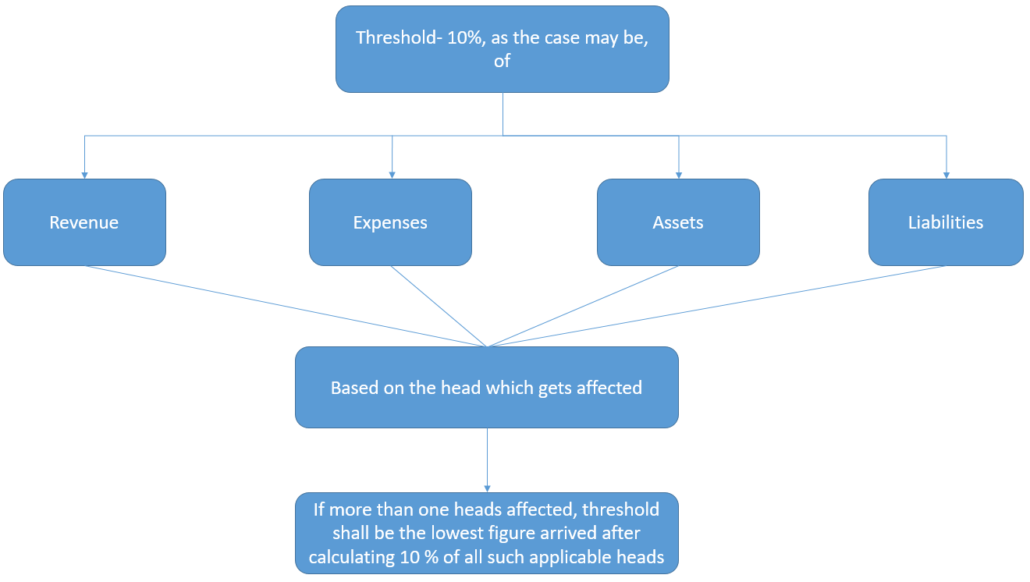
The second step that comes after identifying the transaction/arrangement is the assessment of significance. For the purpose of Regulation 24(4), a transaction or arrangement is significant if it individually exceeds or is likely to exceed ten percent of the total revenues or total expenses or total assets or total liabilities, as the case may be, of the unlisted subsidiary for the immediately preceding accounting year.
The criteria of significance as provided above requires that the threshold needs to be checked against different parameters “as the case may be”. The parameter to be checked will depend upon the nature of the transaction. Therefore, depending upon the nature of the transaction, the significance shall be assessed against the threshold determined on the basis of figures under relevant head as explained below:
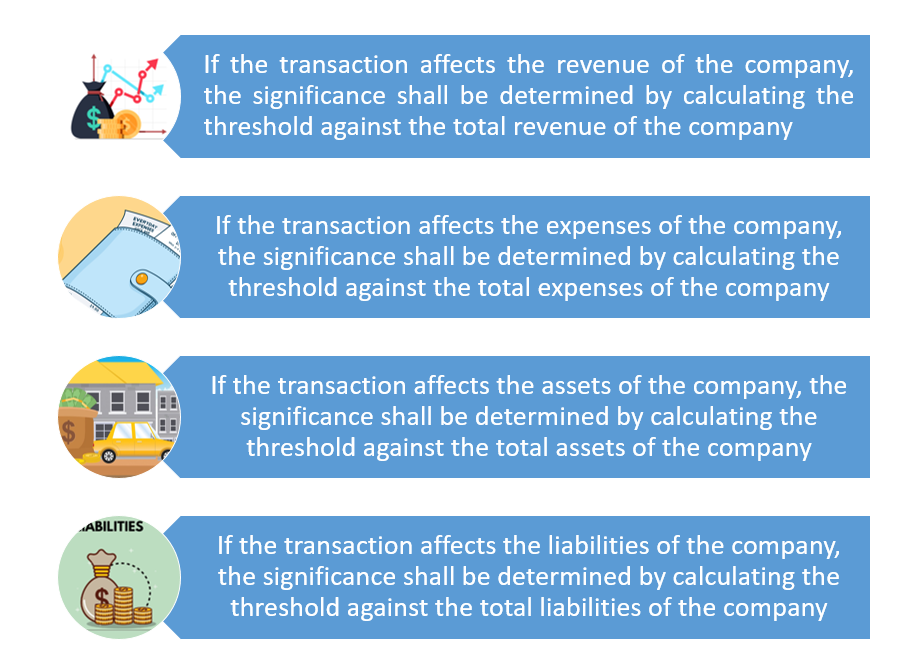
There may be instances where the transaction does not affect any one parameter in isolation but two or more of the parameters i.e. revenue, expenses, assets or liabilities together. In such cases, an issue may arise as to which parameter has to be considered. In such cases, all the parameters applicable to such a transaction shall be considered. 10% threshold of all such applicable parameters shall be determined and the lowest of such threshold shall be applied for assessment of significance of such transaction.
For example, S Ltd, the subsidiary of A Ltd, has entered into a transaction with Z Ltd, involving sale of goods. Such transaction involves revenue and therefore, significance of such transaction has to be assessed as a percentage keeping the total revenue of the preceding accounting period as the base for deriving such percentage. Say for example, the revenue of S Ltd is Rs. 100 crore in the preceding financial year. Therefore 10% of it will be Rs. 10 crores. Hence, if the value of the transaction being entered by S Ltd with Z Ltd exceeds Rs. 10 crores, the same will qualify as a significant transaction for the purpose of the Regulation.
However, consider another example in which S Ltd has entered into an arrangement which impacts both the assets and expenses of the Company (creation of a new capital asset involving a huge outflow of cash). In such a case, both the assets and expenses being involved, the significance of the transaction has to be assessed for each of the bases individually and the one that hits the requirement at the lower end shall be taken for assessment of significance. Say for example, the assets and the expenses of S Ltd in the preceding financial year was Rs. 500 crores and Rs. 150 crores each. In such a case, thresholds shall be calculated based on both the figures and the lower of the two shall be the one that will determine the significance of the transaction. In the instant case, the thresholds are Rs. 50 crores and Rs. 15 crores, therefore the lower of the two i.e. Rs. 15 crores will be the one that will be considered. Hence, if the amount of transactions being undertaken exceeds Rs. 15 crores, it will qualify as a significant transaction.
Having settled with the parameter to be considered for various transactions, another question that may tweak our mind is whether the total revenues or expenses or assets or liabilities, as the case may be , has to be considered on a standalone basis or on a consolidated basis for the subsidiary. Here, one has to consider the fact that the compliance of the provision has to be ascertained by the listed holding company. Any company, which is a subsidiary of the subsidiary company, ultimately becomes the step-down subsidiary of the listed holding company thereby attracting Reg 24(4) of the Listing Regulations for reasons as discussed above and reporting its significant transactions or arrangements to the board of the listed company. In view of the same, an inference may be drawn that the aggregate figures for the preceding financial year shall be taken on a standalone basis, and not on a consolidated basis. This will also help in getting a clear picture and involving only those transactions that are actually significant for the subsidiary.
It is a very general phenomenon in companies to enter into contracts with different parties. Such contracts often extend to years and give rise to transactions. A common ambiguity that may arise in such cases is on determining the amount of such transaction for the purpose of the Regulation. Let us understand this scenario with some examples.
A Ltd., a subsidiary of B Ltd., enters into a rent agreement with X Ltd. The rent agreement extends to 5 years at a total value of Rs. 30 lakhs i.e. at a monthly rent of Rs. 50,000 per month. Now what shall be considered as the value of transaction for the purpose of the Regulation, Rs. 30 lakhs or Rs. 50 thousand? In our view, the total amount attributable to that particular financial year shall be considered for the purpose of the Regulation. In the instant case, assuming that the contract is effective from October 1, 2021, the amount shall be Rs 3 lakhs (rent during the FY 2020-21). Therefore, for assessing the significance of the transaction, the amount of Rs. 3 lakhs shall be compared against the threshold.
In the same case above, even if there has been no specific tenure of the contract but it rather would have only discussed monthly payment of Rs. 50 thousand as rent, still the amount payable in total throughout that financial year shall be taken and not the monthly rent.
The underlying principle is that the total amount of that transaction attributable to that financial year shall be considered as the amount of transaction for assessing significance under the Regulation.
Regulation 24(4) says that “the management of the unlisted subsidiary shall periodically bring to the notice of the board of directors of the listed entity xxxxxxxxx”. This again comes up with two questions: who constitutes management and what shall be the periodicity for bringing significant transactions or arrangements to the notice of the board of the listed holding company.
Going by the general meaning as well as the intent and purpose of this requirement, the board of directors of the subsidiary as well as the KMPs/other senior executives just a level below the Board should be taken to constitute ‘management’.
Coming to the question of periodicity, the same has not been specified in the Listing Regulations itself, but left to the discretion of the board. However, the intent of the Regulation is to enhance corporate governance in the subsidiaries. Hence the periodicity should be reasonable enough to capture such a purpose.
Here, one may note that Regulation 17(2) of the Listing Regulations requires the board of the listed company to meet at least four times a year. Further, under Regulation 33, financial results are placed before the board quarterly which also includes results of its subsidiaries (since the results have to be submitted on both standalone and consolidated basis). Therefore, in consonance with the same, the list of significant transactions or arrangements of the subsidiaries should also be placed before the board of the listed company, if not more frequently, at least on a quarterly basis.
Regulation 24(4) of the Listing Regulations, though very significant in terms of enforcing corporate governance requirements and ensuring transparency in respect of the unlisted subsidiaries of the listed company, may sometimes prove extraneous in the spirit of law. There may be cases where the subsidiary as a whole may be too small to have any significance on the accounts of the holding company.
A classic example of the same may be in case of a company, as a listed holding company, having a paid-up capital of Rs. 50 crores or above, having a subsidiary with total asset size of Rs. 1 crore. In this case, the total assets of the subsidiary amounts to mere 2% of the total asset size of the listed company. Here, a transaction involving purchase/ sale of an asset of Rs. 10 lacs will fall within the meaning of a significant transaction for the subsidiary company, however, will have a minimal impact on the listed holding company.
In such cases, going by the letter of the law, such transactions, even though having no significant impact on the listed entity as such, will have to be placed before the board thereby creating an unnecessary compliance burden producing no meaningful results.
A possible leeway that may be created as a make-through to provide certain de minimis exemptions on the basis of certain amounts or percentages. For example, a listed company may approve through its board and audit committee, that any transaction undertaken by a subsidiary, which amounts to not greater than 2% of the turnover or the paid-up capital or the networth of the listed company, will not be required to be reported to the board of the listed company.
However, while putting such de minimis exemptions, utmost care has to be taken to ensure that the self-approved exemptions do not turn out to completely erode the intentions of the law. Further, the requisite approvals have to be obtained and properly documented so as to avoid falling into a legal moss at a later stage.
The requirement under Regulation 24(4) enhances corporate governance standards in subsidiaries which were otherwise unlisted and exempted from such scrutiny. It allows the listed holding company to exercise due diligence in significant transactions entered by subsidiaries. However, in certain cases, the requirement becomes redundant due to absence of any material effect of subsidiary’s transactions on the overall performance of the holding company due to minimal asset size or revenue. Therefore, the idea of exempting subsidiaries below a certain threshold in terms of asset size or revenue of the listed company can be thought upon.The market regulator may also take a step to bring this as an amendment to the law, so as to ensure reduction of extra-compliance burden as recently suggested by FM Nirmala Sitharaman in her speech on the 53rd Foundation day of ICSI.
Read our other article on the subject –
‘Material Subsidiary’ under LODR Regulations: Understanding the metrics of materiality:
https://vinodkothari.com/2021/05/understanding-metrics-of-materiality/

Sharon Pinto, Manager, corplaw@vinodkothari.com
The Board of directors of a Company typically comprises of executive and non-executive directors. The Board is supported by the Key Managerial Personnel (‘KMP’) and senior management i.e. personnel of the company who are members of its core management team excluding Board of Directors comprising all members of management one level below the executive directors, including the functional heads. KMPs have been defined under Section 2 (51) of Companies Act, 2013 (‘Act’/ ‘CA, 2013’) to include Chief Executive Officer (‘CEO’) or Managing Director (‘MD’) or Manager, thus placing them on the same pedestal while differentiating the said posts on the basis of mere nomenclature. Due to the said differentiation in nomenclature, it is often seen that companies have a practice of regarding the person designated as CEO different from Manager of the company. Thus, the person holding a position at the head of the organisational hierarchy, is interpreted to not be the Manager on account of only being designated as CEO of the company. The result of this rationale / categorisation results in avoidance of the restrictions and procedures for appointment and remuneration as enlisted under the Act under Section 196 and 197 which specifically prescribe that the terms of appointment shall be placed before the shareholders, for a Manager in case of appointment of a CEO.
The position of a ‘Manager’ in the corporate organisational structure has been around for decades. It has been defined under Companies Act, 1956 which can also be seen in the Companies Act, 2013. In recent times, corporates have developed a pattern of designating the head of the corporate organisation, with substantial powers of the management, as CEO who is often a professional, rather than designating the said person as Managing Director or Manager and appointing them on the Board. A few examples of such corporates which have the CEO as the head of the organisation include Microsoft, Pepsico, Google Inc, etc.
We have in our previous article[1] deliberated on the various combinations of KMP positions that can legally be held by two different individuals. In this article we shall discuss the concept of CEO and analyse whether the same is different from the positions of a Manager and MD.
The term CEO was not mentioned under Companies Act, 1956. It was included and defined under the Act, 2013 and formed part of the definition of KMP. As per the Report of JJ Irani Committee[2], as KMPs play a significant role of formulating and executing company policies. Thus, in order to provide a legal recognition to KMPs and also to define their liabilities arising out of such a position held, the committee recommended the following to be identified as KMP:
The committee further recommended key managerial personnel including WTDs and MDs shall not be in whole time employment of more than one company.
The report of the Company Law Committee[3] dated February 2016, recommended that a whole time KMP may hold more than one position in the company in order to reduce cost of compliance and to facilitate optimum utilisation of their skills and competencies. The committee further recommended flexibility in appointing other officers of the company in whole-time employment as KMP, pursuant to which the definition of KMP was expanded to include ‘such other officer, not more than one level below the directors who is in whole-time employment, designated as key managerial personnel by the Board’ under its ambit.
Section 2 (18) of the Act defines a CEO as ‘an officer of a company, who has been designated as such by it.’ Thus the position of CEO is designation oriented and the role is not specifically defined under the Act. Therefore, a person performing the role of any other KMP as specified under the Act, may be designated as a CEO.
Regulation 2 (1) (e) of SEBI (Listing Obligations and Disclosure Requirements) Regulations, 2015 (‘Listing Regulations’), have defined CEO as the person so appointed in terms of the Act. The erstwhile Listing Agreement vide Clause 49 (IX) stated as follows:
“The CEO, i.e. the Managing Director or Manager appointed in terms of the Companies Act, 1956 and the CFO i.e. the whole-time Finance Director or any other person heading the finance function discharging that function shall certify to the Board that:”
In order to harmonize the provision with the newly inserted definition of KMP under Companies Act, 2013, the said clause was amended[4] as follows:
“The CEO or the Managing Director or manager or in their absence, a Whole Time Director appointed in terms of Companies Act, 2013 and the CFO shall certify to the Board that :”
The above-mentioned provision also specifies that CEO shall be the officer so designated by the Company, who may have the role of a Manager or a Managing Director on line with the specification under the Act.
The Act under Section 2 (53), defines Manager as ‘an individual who, subject to the superintendence, control and direction of the Board of Directors, has the management of the whole, or substantially the whole, of the affairs of a company, and includes a director or any other person occupying the position of a manager, by whatever name called, whether under a contract of service or not’. Whereas an MD is defined under Section 2(54) as ‘a director who, by virtue of the articles of a company or an agreement with the company or a resolution passed in its general meeting, or by its Board of Directors, is entrusted with substantial powers of management of the affairs of the company and includes a director occupying the position of managing director, by whatever name called. In Regina v. Boal, (1992) BCLC 872 (CA[5]), it was held that assistant general manager of its bookshop, had responsibility for the day to day running of the shop but had been given no training in management, health and safety at work or fire precautions. Thus only those who were in a position of real authority, who had both the power and the responsibility to decide corporate policy would be construed to be ‘Manger’ for the purpose of the Act. It also needs to be noted that the person occupying the position of a ‘Manager’ should be under the superintendence of the Board.
Thus, the definition of Manager can be construed to be function based, irrespective of the designation of the individual. The same has been held in the SC judgment of Ramchandiram Mirchandani v. The India United Mills Ltd., AIR 1962[6] wherein the apex court held that the definition of the word “manager” is very wide, and whatever be the nomenclature employed by the parties, if large powers of management of substantially the whole business of the company are vested in a person then that person becomes the manger. In Basant Lal v. The Emperor[7] it was held that it was held that a person who is not in charge of the entire business of the company cannot be deemed to be a manager. In the case of Commissioner Of Income-Tax, Kerala Vs.Alagappa Textile (Cochin) Ltd. 1980[8], the Supreme Court held that Manager must be an individual, having the management of the whole or substantially the whole affairs of the company, subject to the superintendence, control and directions of the Board of Directors in the matter of managing the affairs of the Company. The key difference between a Manager and an MD is that an MD has substantial powers of management and is also on the Board of the company, while a Manager has the management of whole or substantially the whole of the business of the Company. There are judicial precedents that indicate that while both enjoy substantial powers of management, the source from which this power arises is different. In case of manager his power is natural and in case of an MD, it has to be entrusted by the Board in him.
On perusal of the above roles of the MD and Manager, basis the provisions, it is evident that an individual who has been entrusted with whole or substantial powers of management, shall be said to be performing the role of a Manager. Further, if the said individual is a director of the company he may be designated as the MD. However, companies may choose to designate the individual otherwise i.e. CEO of the company, if the said role and powers of management rest with the concerned officer. Thus, one can opine that the person who is at the top of the corporate hierarchy, with whole or substantially whole powers of the management and affairs of the company, in cases where not explicitly designated as ‘Manager’ shall be deemed to be a Manager of the company. CEO is a designation and the position of Manager is based on function. Merely, by not designating an individual as a Manager, compliance under the provisions of the Act cannot be avoided.
As per the analysis stated above, the procedure and restrictions relating to the appointment of a Manager shall be applicable to a CEO who holds such a position of a deemed Manager of a company. Thus, the company is required to comply with the provisions of Section 196 for appointment of such a person. The term of the deemed Manager shall not exceed 5 years at a time, wherein the re-appointment shall be done not less than 1 year before the end of the term. Further, the appointee shall have to satisfy the criteria and conditions specified in sub-section 3 of Section 196 in order to get appointed. As per the said provisions, the terms of the appointment and remuneration will be subject to approval of shareholders. Further, Part I of Schedule V has set forth certain conditions to be fulfilled in order to be appointed as a Manager. In case of appointment in variance of these conditions, the company in addition to approval by shareholders, is also required to obtain approval from the Central Government by stating the rationale of appointing such a person.
Similarly, the provisions relating to managerial remuneration specified in Section 197 read with Part II of Schedule V as applicable to a Manager shall be applicable to a deemed Manager. Thus the deemed Manager shall be entitled to remuneration as per the limits specified in this regard under Section 197 subject to approval of shareholders. Therefore, while determining the cap of total managerial remuneration i.e. 11% of the net profits of the company, the remuneration paid to CEO who plays the role of deemed Manager will also be required to be included. If there is an increase in the said cap, it will require approval from the shareholders of the company. Further, the said provisions also place a bar on the individual limits of remuneration paid to the Manager, which shall not exceed 5% of net profits of the company in case of not more than one MD/WTD/Manager and 10% of total remuneration payable to more than one MD/WTD/Manager. If the company wishes to pay in excess of the limits thus prescribed it may do so by obtaining approval of the shareholders in the form of a special resolution.
In case the company has inadequate or no profits, it is required to abide by the limits prescribed under Part II of Schedule V subject to approval of shareholders. Further, in case the company wishes to pay in excess of the said thresholds, the shareholders approval will be required to be obtained in the form of a special resolution.
The above-mentioned provisions of the Act do not cover the appointment and remuneration of KMPs other than MD, WTD and Manager. Since the CEO is considered to be different from Manager, their appointment and remuneration in many cases are not approved by the shareholders of the Company. However as per the analysis stated above, in case of a CEO having substantial powers of the management and being on the head of the organisational hierarchy, there is a need that their terms of appointment and remuneration to be paid is placed before the members of the company.
| Particulars of cases | Whether Manager under the Act | Rationale |
| Branch Manager | × | A Branch Manager does not have whole or substantial powers of the management of the company in addition to not being under the superintendence of the Board. |
| Factory Manager | × | Similar as in the case of a Branch Manager, a Factory Manager has limited powers relating to a specific unit of the company. |
| CEOs appointed for specific business verticals of the company | × | As the powers and responsibility of the said CEO would be limited to the specific business division of the company and would not entail overseeing the overall affairs of management. |
| CEO where the company has a separate MD or Manager | × | In case the company has an MD, the powers of the MD shall include substantial control over the management and affairs of the company as per Section 2 (54) of the Act. |
| CEO where the company does not have an MD or Manager | √ | In case of no MD/Manager, the CEO shall be the deemed Manager of the company on account of having whole or substantially whole powers over the affairs of the company. |
| Person designated as CEO and MD | √ | A Manager as defined under Section 2 (53) includes a director occupying the position of a Manager, by whatever name called. |
The intent of defining KMPs of the company separately under the Act was to ascertain the legal liability and to define their roles on account of them being the visionary and executive authority carrying out the policies and functions of the company. With power comes responsibility and it is lucid from the discussion above that the person having the requisite powers would be subject to the restrictions and procedures prescribed under the provisions in this regard, irrespective of the designation assigned to the post.
Kindly find below additional resources on the above-discussed topic:
[1]https://vinodkothari.com/wp-content/uploads/2017/03/The_Combinations_of_KMP_positions_in_a_Company_Unravelling_a_mystery.pdf
[2] https://www.mca.gov.in/bin/dms/getdocument?mds=TRnXREiyG027hEwjF77x3w%253D%253D&type=open
[3] https://www.mca.gov.in/Ministry/pdf/Report_Companies_Law_Committee_01022016.pdf
[4] https://www.sebi.gov.in/sebi_data/attachdocs/1410777212906.pdf
[5] http://www.uniset.ca/other/cs4/1992QB591.html
[6] https://indiankanoon.org/doc/106177/
[7] https://indiankanoon.org/doc/879077/
-CS Henil Shah & CS Burhanuddin Dohadwala
In order to streamline the process in case of public issue of debt securities and to add an addition to the current Application Supported by Blocked Amount (‘ASBA’) facility. Securities and Exchange Board of India (‘SEBI’) vide its circular dated November 23, 2020[1] (‘November 23 Circular’) has introduction Unified Payments Interface (‘UPI’) mechanism for the process of public issues of securities under:
The said circular shall be effective to a public issue of securities for the aforesaid captioned regulations which opens on or after January 01, 2021 (‘effective date’). Earlier, SEBI Circular dated July 27, 2012[2] (‘Erstwhile Circular’) provided the system for making application to public issue of debt securities. The Erstwhile Circular will stand repealed from the effective date. However, SEBI Circular dated October 29, 2013[3] w.r.t allotment of debt securities shall continue to remain in force.
Earlier in November, 2018[4] SEBI had introduced use of UPI as a payment mechanism with ASBA, to streamline the process of public issue of equity shares and convertibles and implemented the same in 3 phases.
The article below covers the role required to be done by the issuer in case of public issue of debt securities.
UPI[5] is an instant payment system developed by the National Payments Corporation of India (‘NPCI’), an RBI regulated entity. UPI is built over the IMPS (‘Immediate Payment Service’) infrastructure and allows you to instantly transfer money between any two parties’ bank accounts.
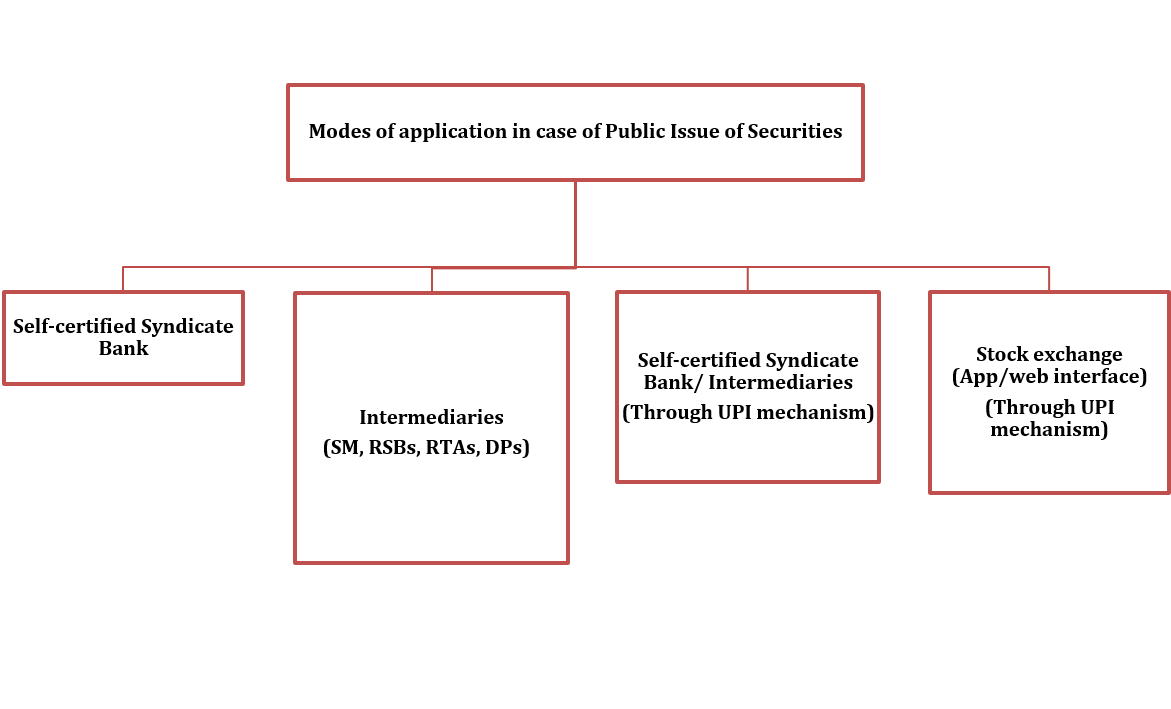
The facility to block funds through UPI mechanism whether applying through intermediaries (viz syndicate members, registered stock brokers, register and transfer agent and depository participants) or directly via Stock Exchange (‘SE’) app/ interface is set for upto and amount of Rs. 2 lakhs, which is the maximum limit approved by NPCI for capital markets vide its circular dated March 03, 2020[6].
Sponsor Bank as a term was introduced under the SEBI circular dated November 01, 2018 meaning a self-certified syndicate bank appointed by issuer to conduit/act as a channel with SE and NCPI to facilitate mandate collect requests and/or payment instructions of retail investors.
| November 23 Circular | Erstwhile Circular | Remarks |
| Direct application through SE app/web-interface along with amount blocked via UPI mechanism. | Direct application over the SE interface with online payment facility; | Online payment facility stands replaced with UPI mechanism. However, it is not clear as to how the application to be submitted where amount to be invested is above 2 lac rupees. |
| Application through intermediaries along with details of his/her bank accounts for blocking funds | Application through lead manager/syndicate member/sub-syndicate members/ trading members of SE using ASBA facility | No change |
| Application through SCSBs with ASBA. | Applications through banks using ASBA facility; | No change |
| Application through SCSBs/intermediaries along with his/her bank account linked UPI ID for the purpose of blocking of funds, if the application value is Rs.2 lac or less. |
– |
New insertion. |
|
– |
Application through lead manager/syndicate member/sub-syndicate members/ trading members of SE without use of ASBA facility | This was discontinued for all public issue of debt securities made on or after October 01, 2018 vide SEBI Circular dated August 16, 2018[7]. |
|
– |
Application through lead manager/syndicate member/sub-syndicate members/ trading members of SE for applicants who intended to hold debt securities in physical form. | No reference made in the present circular |
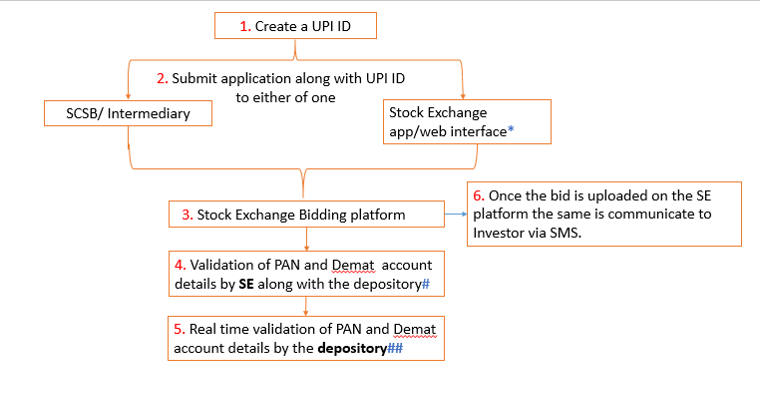
Process of the applying utilizing UPI mechanism is produced in a diagrammatic form as below:
* Application made on SE App/web interface shall automatically get updated on SE biding platform
# Upon bid being entered under the bidding platform SE shall undertake validation process of PAN and Demat account along with Depository.
## In case of any discrepancies the same are reported by depositories to SE which in turn relays the same to intermediaries for corrections.
Apart from appointing a sponsor bank by the issuer the roles of issuer remain same as those already required under the SEBI circular dated July 27, 2012 i.e.:
Only the aforesaid roles are aligned with newly introduced with UPI Mechanism.
SEBI vide its circular dated November 10, 2015 had, in order to stream line the process of public issue of equity shares and convertibles issued a circular to reduce the timeline for issue from 12 working days to 6 working days and same was introduced for public issue of debt securities, NCRPS and SDI vide circular dated August 16, 2018[8]. The same has been re-iterated/repeated under the November 23 Circular. Indicative timelines for various activities are re-produced under Annexure-A.
Conclusion
Public issue application using UPI is a step towards digitizing the offline processes involved in the application process by moving the same online. UPI mechanism in public issue process shall essentially bring in comfort, ease of use and reduce the listing time for public issues.
Annexure A:
Indicative timelines for various activities
| Sr. No. | Particulars | Due Date (working day) |
| 1. | Issue Closes | T (Issue closing date) |
| 2. |
|
T+1 |
| 3. |
|
T+2 |
| 4. |
|
T+3 |
| 5. |
|
T+4 |
| 6. |
|
T+5 |
| 7. | Trading commences; | T+6 |
Our other materials on the topic can be read here –
[1] https://www.sebi.gov.in/legal/circulars/aug-2018/streamlining-the-process-of-public-issue-under-the-sebi-issue-and-listing-of-debt-securities-regulations-2008-sebi-issue-and-listing-of-non-convertible-redeemable-preference-shares-regulations-_40004.html
[2]https://www.sebi.gov.in/legal/circulars/jul-2012/system-for-making-application-to-public-issue-of-debt-securities_23166.html
[3]https://www.sebi.gov.in/legal/circulars/oct-2013/issues-pertaining-to-primary-issuance-of-debt-securities-amendment-to-simplified-debt-listing-agreement_25622.html
[4] https://www.sebi.gov.in/sebi_data/attachdocs/nov-2018/1541067380564.pdf
[5] https://www.sebi.gov.in/sebi_data/commondocs/mar-2019/useofunifiedpaymentinterfacefaq_p.pdf
[6] https://www.npci.org.in/PDF/npci/upi/circular/2020/UPI%20OC%2082%20-%20Implementation%20of%20Rs%20%202%20Lakh%20limit%20per%20transaction%20for%20specific%20categories%20in%20UPI.pdf
[7] https://www.sebi.gov.in/legal/circulars/aug-2018/streamlining-the-process-of-public-issue-under-the-sebi-issue-and-listing-of-debt-securities-regulations-2008-sebi-issue-and-listing-of-non-convertible-redeemable-preference-shares-regulations-_40004.html
[8]https://www.sebi.gov.in/legal/circulars/nov-2020/introduction-of-unified-payments-interface-upi-mechanism-and-application-through-online-interface-and-streamlining-the-process-of-public-issues-of-securities-under-sebi-issue-and-listing-of-debt-_48235.html
‘Technical’ contravention subject to minimum compoundable amount, format for public disclosure of compounding orders revised.
– CS Burhanuddin Dohadwala | corplaw@vindkothari.com
Introduction
Compounding refers to the process of voluntarily admitting the contravention, pleading guilty and seeking redressal. It provides comfort to any person who contravenes any provisions of FEMA, 1999 [except section 3(a) of the Act] by minimizing transaction costs. Reserve Bank of India (‘RBI’) is empowered to compound any contraventions as defined under section 13 of FEMA, 1999 (‘the Act’) except the contravention under section 3(a) of the Act in the manner provided under Foreign Exchange (Compounding Proceedings) Rules, 2000. Provisions relating to compounding is updated in the RBI Master Direction-Compounding of Contraventions under FEMA, 1999[1].
Following are few advantages of compounding of offences:
Present Circular
Pursuant to the supersession of FEM (Transfer or Issue of Security by a Person Resident Outside India) Regulations, 2017[2] (‘TISPRO”)and issuance of FEM (Non-Debt Instrument) Rules, 2019[3] [‘NDI Rules] and FEM (Mode of Payment and Reporting of Non-Debt Instruments) Regulations, 2019[4] [‘MPR Regulations’], RBI has updated the reference of the erstwhile regulations in line with the NDI Rules and MPR Regulations vide RBI Circular No.06 dated November 17, 2020[5] (‘Nov 2020 Circular’).
Additionally, the Nov 2020 Circular does away with the classification of a contravention as ‘technical’, as discussed later in the article.
Lastly, the Nov 2020 Circular modifies the format in which the compounding orders will be published on RBI’s website.
Compounding of contraventions relating to foreign investment
The power to compound contraventions under TISPRO delegated to the Regional Offices/ Sub Offices of the RBI has been aligned with corresponding provisions under NDI Rules and MPR Regulation as under:
| Compounding of contraventions under NDI Rules | |||
| Rule No. | Deals with | Corresponding regulation under TISPRO | Brief Description of Contravention |
| Rule 2(k) read with Rule 5 | Permission for making investment by a person resident outside India; | Regulation 5 | Issue of ineligible instruments |
| Rule 21 | Pricing guidelines; | Paragraph 5 of Schedule I | Violation of pricing guidelines for issue of shares. |
| Paragraph 3 (b) of Schedule I | Sectoral Caps; | Paragraph 2 or 3 of Schedule I | Issue of shares without approval of RBI or Government respectively, wherever required. |
| Rule 4 | Restriction on receiving investment; | Regulation 4 | Receiving investment in India from non-resident or taking on record transfer of shares by investee company. |
| Rule 9(4) | Transfer by way of gift to PROI by PRII of equity instruments or units of an Indian company on a non- repatriation basis with the prior approval of the Reserve Bank. | Regulation 10(5) | Gift of capital instruments by a person resident in India to a person resident outside India without seeking prior approval of the Reserve Bank of India. |
| Rule 13(3) | Transfer by way of gift to PROI by NRI or OCI of equity instruments or units of an Indian company on a non- repatriation basis with the prior approval of the Reserve Bank. | ||
| Compounding of contraventions under MPR Regulations | |||
| Regulation No. | Deals With | Corresponding regulation under TISPRO | Brief Description of Contravention |
| Regulation 3.1(I)(A) | Inward remittance from abroad through banking channels; | Regulation 13.1(1) | Delay in reporting inward remittance received for issue of shares. |
| Regulation 4(1) | Form Foreign Currency-Gross Provisional Return (FC-GPR); | Regulation 13.1(2) | Delay in filing form FC (GPR) after issue of shares. |
| Regulation 4(2) | Annual Return on Foreign Liabilities and Assets (FLA); | Regulation 13.1(3) | Delay in filing the Annual Return on Foreign Liabilities and Assets (FLA). |
| Regulation 4(3) | Form Foreign Currency-Transfer of Shares (FC-TRS); | Regulation 13.1(4) | Delay in submission of form FC-TRS on transfer of shares from Resident to Non-Resident or from Non-resident to Resident. |
| Regulation 4(6) | Form LLP (I); | Regulations 13.1(7) and 13.1(8) | Delay in reporting receipt of amount of consideration for capital contribution and acquisition of profit shares by Limited Liability Partnerships (LLPs)/ delay in reporting disinvestment / transfer of capital contribution or profit share between a resident and a non-resident (or vice-versa) in case of LLPs. |
| Regulation 4(7) | Form LLP (II); | ||
| Regulation 4(11) | Downstream Investment | Regulation 13.1(11) | Delay in reporting the downstream investment made by an Indian entity or an investment vehicle in another Indian entity (which is considered as indirect foreign investment for the investee Indian entity in terms of these regulations), to Secretariat for Industrial Assistance, DIPP. |
Technical contraventions to be compounded with minimal compounding amount
As per RBI’s FAQs[1] whenever a contravention is identified by RBI or brought to its notice by the entity involved in contravention by way of a reference other than through the prescribed application for compounding, the Bank will continue to decide (i) whether a contravention is technical and/or minor in nature and, as such, can be dealt with by way of an administrative/ cautionary advice; (ii) whether it is material and, hence, is required to be compounded for which the necessary compounding procedure has to be followed or (iii) whether the issues involved are sensitive / serious in nature and, therefore, need to be referred to the Directorate of Enforcement (DOE). However, once a compounding application is filed by the concerned entity suo moto, admitting the contravention, the same will not be considered as ‘technical’ or ‘minor’ in nature and the compounding process shall be initiated in terms of section 15 (1) of Foreign Exchange Management Act, 1999 read with Rule 9 of Foreign Exchange (Compounding Proceedings) Rules, 2000.
Nov 2020 Circular provides for regularizing such ‘technical’ contraventions by imposing minimal compounding amount as per the compounding matrix[1] and discontinuing the practice of giving administrative/ cautionary advice.
Public disclosure of compounding order
Compounding order by RBI can be accessed at the RBI website-FEMA tab-compounding orders[1]. In partial modification of earlier instructions issued dated May 26, 2016[2] it has been decided that in respect of the Compounding Orders passed on or after March 01, 2020 a summary information, instead of the compounding orders, shall be published on the Bank’s website in the following format:
| Sr. No. | Name of the Applicant | Details of contraventions (provisions of the Act/Regulation/Rules compounded)
(Newly inserted) |
Date of compounding order
(Newly inserted) |
Amount imposed for compounding of contraventions | Download order
(Deleted) |
It seems that the compounding order will not be available for download.
Conclusion:
The delegation of power is done for enhanced customer service and operational convenience. Revised format of disclosure of compounding orders will be more reader friendly. Delay in filing of forms under MPR Regulations on FIRMS portal is subject to payment of Late Submission Fees (LSF) as per Regulation 5. The payment of LSF is an additional option for regularising reporting delays without undergoing the compounding procedure.
Abbreviations used above:
FIRMS: Foreign Investment Reporting & Management System.
| Our other articles/channel can be accessed below:
1. Compounding of Contraventions under FEMA, 1999- RBI delegates further power to Regional Offices:
2. Other articles on FEMA, ODI & ECB may be access below: https://vinodkothari.com/category/corporate-laws/
3. You Tube Channel: |
[1] https://www.rbi.org.in/scripts/Compoundingorders.aspx
[2] https://www.rbi.org.in/Scripts/NotificationUser.aspx?Id=10424&Mode=0
[1] https://www.rbi.org.in/Scripts/NotificationUser.aspx?Id=10424&Mode=0
[1] https://m.rbi.org.in/Scripts/FAQView.aspx?Id=80 (Q. 12)
[1] https://www.rbi.org.in/Scripts/BS_ViewMasDirections.aspx?id=10190
[2] https://www.rbi.org.in/Scripts/NotificationUser.aspx?Id=11253&Mode=0
[3] http://egazette.nic.in/WriteReadData/2019/213332.pdf
[4] https://www.rbi.org.in/Scripts/BS_FemaNotifications.aspx?Id=11723
[5]https://rbidocs.rbi.org.in/rdocs/notification/PDFs/APDIRS62545AA7432734B31BD5B59601E49AA6C.PDF