Chains of control: Change of control approval keeps NBFCs perplexed, often non-compliant 

– Vinod Kothari (vinod@vinodkothari.com)

Paragraph 42 of the Master Direction – Reserve Bank of India Non-Banking Financial Company – Scale Based Regulation) Directions, 2023 (‘SBR Directions’), mandates obtaining prior approval from the RBI for any change in shareholding of 26% or more or any change in management amounting to 30% or more. Before we get into details of the requirement, it is important to start with two observations. 

First, this regulation, requiring RBI’s approval for change of control, shareholding or management, applies to all NBFCs, large or small. Given the expanse of the definition, exacerbated by the lack of clarity, this regulation is a constant pain for most NBFCs, particularly the smaller ones.

The second point – the regulation is worded quite vaguely. As the discussion below will reveal, what is change in shareholding of 26% does not come clearly from the language at all. When the language is unclear, the subjects are exposed to erring on the safer side of the law, and end up doing superfluous compliances.

Language may not be clear, but the intent or object of the regulations is clear; one would wish the interpretation of the provision does justice to the intent.

NBFCs must seek the prior permission/ approval from the RBI before strategic changes such as takeovers, acquisition of major shareholding, or significant management changes from the viewpoint of entry of new persons on board. What is the intent of seeking this approval: the RBI granted registration to an NBFC after examination of its control, shareholding and management. The RBI had to satisfy itself that the persons behind the NBFC are “fit and proper”. In a manner of speaking, the RBI is handing the keys of an access to the financial system – therefore, it wanted to be fully sure of who the person taking the keys are.

It is a person acquiring control, coming into management, or building up a significant shareholding, who needs to be tested from the viewpoint of “fit and proper”. There is no question of the person, who is admittedly already in control, from earning that qualification. Also, there is no question of the person walking out of control or transferring out significant shareholding to need approval.

Regulatory carve outs

There are two exceptions, viz., if shares are bought back with court (now NCLT) approval, or, in case of change of management, if directors are re-elected on retirement by rotation. But even with exceptions, NBFCs still need to inform the regulator about any changes in their directors or management.

Note that the carve-out in case of buybacks is only for such buybacks as are coming for NCLT approval, which would mean reduction of capital u/s 66 of Companies Act 2013. As regards buybacks done with board or shareholders’ approval, in view of the limit of 10%/25% of the equity shares, usually a single buyback should not cause a change of control, but it may so happen that one significant shareholder stays back, and other takes a buyback and exits, causing the former’s shareholding to gain majority or significant shareholding (as discussed below). In such a case, exceptions from RBI approval will not be available.

And the other carve-out of reappointment of directors is not a change in management at all. If, at a general meeting, the existing director(s) is rotated out, and a new director comes in place, there is surely no exception in that case.

Three situations requiring approval

There are three situations requiring approval of the RBI; all of these have to be seen in light of the purpose of getting the supervisor’s sign off by way of a “fit and proper” person check. The three situations are:

  1. Takeover or acquisition of control

This is required to be read in light of the definition of “control” in SEBI (Substantial Acquisition of Shares and Takeovers) Regulations, 2011 (‘SAST regulations’) [by virtue of reg 5.1.5].  There is an inclusive definition of “control” in SAST Regulations, which is far from giving any bright-line test of when control is said to have been acquired[1]. There is no definition of “takeover” in the SAST Regulations, even though the title of the Regulations is “substantial acquisition of shares” and “takeovers”. A view might be that “substantial acquisition of shares” is a case of takeover. In that case too, there are two different situations covered by SAST Regulations – first time acquisition of 25% or more of the equity shares [Reg 3 (1), or a creeping acquisition of 5% or more in a financial year, by a person already holding 25% or more [Reg 3 (2)]. 

Acquisition of control is covered separately by Reg 4. The question, in the context of NBFCs is, whether “takeovers” and “change of control” are to be read as two separate situations, and if yes, what will be the meaning of “takeover”? Can it be said that every “substantial acquisition of shares” is a takeover, and if so, whether only the first-time acquisition or the creeping acquisition as well? First of all, there is no reason to include creeping acquisition here, as the relevance of the same is limited to equity listed companies. In fact, the way creeping acquisition is defined in SAST Regulations, there may actually be no change in shareholding at all, and still an acquirer may have hit the creeping acquisition limit.

Acquisition of “control”, though subjective, has been interpreted in several leading SC and SAT rulings. The definition of “control” in sec. 2 (27) of the Act and Reg. 2 (1) (e) of SAST Regulations is an inclusive one: it does not define control, but extends the meaning of the term to include management control or the right to appoint majority directors. The more common mode of control is voting control. The expression “control” has been subject matter of several leading rulings such as Arcelormittal India Private V.  Satish Kumar Gupta, in which the Supreme Court defined the expression “control” in 2 parts; de jure control or the right to appoint a majority of the directors of a company; and de facto control or the power of a person or persons acting in concert, directly or indirectly, in any manner, can positively influence management or policy decisions. In Shubhkam Ventures V. SEBI, the meaning of control was extensively discussed by the SAT, it was held that the test is to see who is in the driving seat, the question would be whether he controls the steering, the gears and the brakes. If the answer to this question is affirmative, then alone would he be in control of the company. In other words, the question to be asked in each case would be whether he is the driving force behind the company and whether he is the one providing motion to the organization. If yes, he is in control but not otherwise.

Note that control may be direct or indirect. Indirect control typically arises when the controlling person controls an intermediate entity or entities, which in turn have a control over the target entity. 

  1. Any change in shareholding resulting in acquisition/transfer of 26% shareholding

This clause may have a lot of interpretational difficulties. First question – is 26% the magnitude of change in shareholding, or is the threshold which cannot be crossed? For example, if a shareholder was holding 25% shares in the NBFC, and now proposes to acquire another 1%, is this subject to regulatory approval? The answer should be clearly yes, because the shareholder will now be having what is regarded by the regulation as significant shareholding. On the contrary, if the person is already holding 26%, he is a significant shareholder already, either by virtue of having such shareholding at the time of formation of the NBFC, or based on the acquisition approved by the RBI. So, what will be the next level that will require regulatory approval? Logically, it seems that the person has already been approved to come as a significant shareholder, and therefore, an increase in shareholding should not require any intervention. In other words, the regulatory approval is required for the first time acquisition and not for the creeping acquisition. It may, however, be argued that if the creeping acquisition makes the equity holding cross 50%, then it amounts to acquisition of control, and that falls under the first clause.

In short, regulatory approval is required for first time acquisition of 26% equity stake or higher, or 50% or higher.

There are many other points that arise in connection with the change in shareholding.

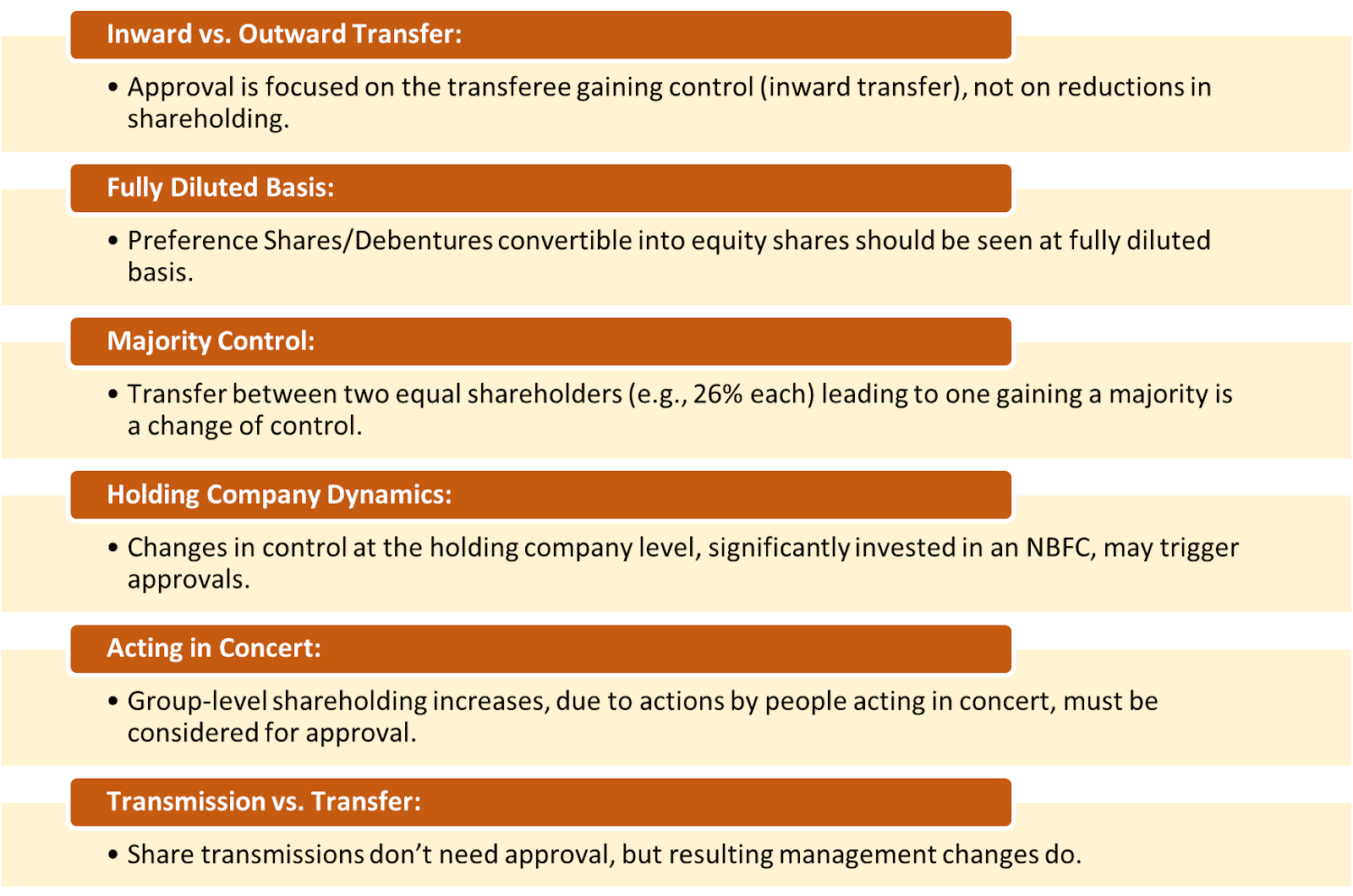
First, is the transfer in shareholding here inward transfer, or can it mean outward transfer as well? Every transfer has a transferor and a transferee, but it is logical to assume the context of the regulation requires the supervisor to approve the transferee. It is the transferee who is coming in control. This is also evident from the word of the proviso to reg 42.1.1 (ii), which is obviously an exception to the main clause, and uses the words “prior approval would not be required in case of any shareholding going beyond 26 percent”. It implies that the concern of the regulator can only be for shareholding going beyond 26% and not reduction of the level of shareholding. The same intent also becomes evident from use of the word “progressive increases over time”. Note that there is inclusivity in the regulation – evident from words like “including”. Further, someone may extract a meaning from the language “transfer” – saying even a transfer out is also a transfer. This is precisely the point we made earlier – that this provision, worded loosely and applied universally, gives a lot of scope for an ambitious regulator to ask for approvals where approvals may not have any relevance.

Secondly, the expression is transfer of “shareholding” – should it include preference shares and convertible debt instruments as well? On the face of it, a preference shareholder or debenture holder does not have control over the entity. If the shares or debentures are either compulsorily or optionally convertible, then the threshold of 26% should be computed by taking the post-dilution equity base. Also, sometimes, preference shares may come with terms which give the preference holders some degree of control. For example, several decisions may be made subject to preference holders’ okay. Or the preference shares may be participating preference shares. In these cases, excluding preference shares altogether may not be proper.

Third, if there are two shareholders, both holding 26% each, and now, one transfers the holding to the other, this may be a case of change of control, as the acquirer now will have 52% holding.

Fourth, when it comes to acquisition of control or significant shareholding, one must take a substantive view, and should not be hamstrung by literal interpretation. For example, if entity A is the NBFC, and entity B is the holding company whose business or assets, almost entirely, constitutes the holding of shares in the NBFC, then, one should apply the change of control at the holding company level as well. Note that even as per SAST Regulations, if a holding vehicle is, to the extent of 80% or above, invested in the target company, acquisition of stake in the holding vehicle will be taken as direct acquisition of stake in the target entity.

Fifth, if some shareholders are acting in concert, or are deemed to be acting in concert, the increase in shareholding should be seen at a group level. Whether certain persons are acting in concert is left to facts or the surrounding situations.

Sixth, transfers of shares may require approval, but if the vesting of shares happens due to a transmission, there is no question of approval for the acquisition. However, if this leads to a change in management, the same shall require approval.

Change in Control:
  1. Change in management

This clause is admittedly the most vague clause, and may result into situations which have no correlation with a change in control, yet coming for regulatory approval. The actual language says: “Any change in the management …which would result in change in more than 30 percent of the directors”. This should really mean a change in management or directorships, which is connected with or arising out of a change of control. If control changes or shifts, usually management also shifts. However, there may be a change in board positions irrespective of any change in control or real change of management at all. Appointment and removal of independent directors are not considered for this purpose. However, nominee directors have not been excluded. Therefore, any appointment or removal of nominee directors will require prior approval if such appointment breaches the limit of 30%.

In reality, the language rules the meaning, and the interpretation is that if there is a change in directorships to the extent of 30% or more, excluding independent directors, the same will require a change of control process, even though there is not even a slightest change in control. 

Here again, one may use literal interpretation and argue that “change in directorships” may include directors going out, or coming in. However, in the context, there can never be an intent to control the exit of directors. Exit may happen purely for involuntary or personal reasons – death, resignation, incapacity, etc. The supervisor is to be concerned with the directors who come in, who have to earn the label of being “fit and proper”.

In case of entities with smaller boards, say having 2 or 3 board members, change of even one director may cause change of 30% or more, though there is no real change of management or management control.

Another point to discuss here is, like in case of shareholding, does the change in directorships include progressive changes too? For example, if a company’s board consists of 6 directors, and one is rotated out or replaced in year 1, and the other one, say, after a year or two, without any concerted action, have we reached a change in directorships of 30% or more? In case of shareholding, progressive increases are specifically included; not so in case of change of directorships.

In the author’s view, the provisions of Reg 42 cannot be stretched to imply that every appointment of a director in an NBFC requires RBI’s approval – if such was the intent, the intent could have been spelt out. Neither is there a reason for such micro regulation, since the focus has to be on change of control. However, as a practical expedient, NBFCs are encouraged to intimate the periodic changes in board positions to the RBI by way of an intimation. Therefore, the regulator has an intimation of the changes that take place over time. If the changes in board positions are part of the same intent or design, and are merely phased over time, the same will usually also be associated with a change in shareholding. In any case, if even independent of a shareholding change, if the changes in management happening over time are mutually connected and a part of the attempt to gain management of the NBFC, the same will require regulatory approval. Given the subjectivity involved, NBFCs may want to play safe and place the facts before the RBI for its guidance.

Intra-group transfers

The meaning of “intra- group” transfers is the shareholding which is spread across members of a group. A group should mean here entities either have common control, or common significant influence, or those where persons have been disclosed as acting in concert for holding shares in the NBFC. The following is a question from the RBI’s FAQs relating to intra-group transfers. It is difficult to get the meaning of the response. Once again, the 26% is not the total magnitude of change, but crossing the threshold. Therefore, in the answer below, 26% cannot be read as the total shifting of shares within the group. The group is already above 26%, and now, there is movement of shares within the group. Is the regulator trying to say once the group is holding 26%, any realignment of shares within the group will require approval? Also, in most cases, the shifting of intra-group shareholding does not happen within a closed group. For example, if there are 4 entities of a group holding shares, one of the members of the group may transfer shares to a 5th entity. The lack of any basis for the response is evident from the approach – apply to us by way of a letter, and then we will let you know whether approval is needed or not. It is sad that a regulator/supervisor sits to decide whether the matter comes within the regulatory ambit.

Here is an excerpt from the RBI FAQs:

26. Whether acquisition/ transfer of shareholding of 26 per cent or more of the paid up equity capital of an NBFC within the same group i.e. intra group transfers require prior approval of the Bank?

Yes, prior approval would be required in all cases of acquisition/ transfer of shareholding of 26 per cent or more of the paid up equity capital of an NBFC. In case of intra-group transfers, NBFCs shall submit an application, on the company letter head, for obtaining prior approval of the Bank. Based on the application of the NBFC, it would be decided, on a case to case basis, whether the NBFC requires to submit the documents as prescribed at para 3 of DNBR (PD) CC.No. 065/03.10.001/2015-16 dated July 9, 2015 for processing the application of the company. In cases where approval is granted without the documents, the NBFC would be required to submit the same after the process of transfer is complete.

Corporate Restructuring

Corporate restructuring in the NBFC sector involves reorganizing the company’s structure, operations, or finances to improve efficiency, address financial distress, or comply with regulatory requirements. This process can include mergers, demergers, amalgamations, and such other changes in corporate structure.

Given that corporate restructuring is a strategic decision for the structure and existence of the NBFC, it becomes important to evaluate the need for regulatory approvals in this regard. The intent of the regulator, as discussed above, is to require the prior approval in case of substantial acquisitions and change in shareholding beyond the threshold of 26%, with the intent to acquire ‘control’. Hence, in case the corporate restructuring leads to such a change in control or shareholding, with or without the change in management, the same must be done with the consent of the RBI.

For instance, if ABC Ltd. is the holding company of an NBFC and the NBFC intends to merge with the holding company. There is no change in control as such pursuant to such merger. However, as per RBI FAQ No. 84, this shall require the prior approval from RBI.

Another instance could be that ABC Ltd (being non-NBFC) intends to merge with an NBFC. As per RBI FAQ No. 85, where a non-NBFC mergers with an NBFC, prior written approval of the RBI would be required if such a merger satisfies any one or both the conditions viz.,

  1. any change in the shareholding of the NBFC consequent on the merger which would result in a change in shareholding pattern of 26 per cent or more of the paid-up equity capital of the NBFC.
  2. any change in the management of the NBFC which would result in change in more than 30 per cent of the directors, excluding independent directors.

Even if an NBFC intends to amalgamate with another NBFC, as per FAQ No. 86, the NBFC being amalgamated will require prior written approval of the RBI.

It may be noted that the prior written approval of the RBI must be obtained before approaching any Court or Tribunal for seeking orders for merger/ amalgamation in all such cases which would ordinarily fall under the scenarios discussed above.

[1] Read our detailed analysis on the topic here- https://vinodkothari.com/2017/09/sebi-aborts-brightening-of-fine-lines-of-control/ (last accessed in November, 2024)

[2] Refer to our article on- https://indiacorplaw.in/2016/03/choosing-between-blurred-line-and.html

[3] Read Our FAQs on Change in Management and Control : https://vinodkothari.com/2016/06/faqs-on-change-in-control-or-management-of-an-nbfc/

Securitisation of MSME receivables in India

Vinod Kothari l finserv@vinodkothari.com

  1. Financing needs of MSMEs in India: Working capital constitutes a major part of SMEs’ funding requirements

There are considerable gaps in funding for SMEs: In India, the total addressable demand for external credit is estimated to be USD 173 billion[1] while the overall supply of finance from formal sources is estimated to be USD 441 trillion. The Expert Committee on Micro, Small and Medium Enterprises, constituted by Reserve Bank of India in December, 2018 has estimated the overall gap in India to be USD 238 – 298 billion[2].  

Read more: Securitisation of MSME receivables in India

Traditional sources of funding are working capital facilities with banks; however, given their unorganised nature, lack of formal financial statements, etc., many SMEs find it difficult to have formal lines of credit from banks.

The marketplace is trying alternative sources of working capital for SME. The avenues tried based on the different components of the working capital:
Accounts receivablesInventory
Trade Receivables Discounting System (TREDS) Factoring/ supply chain financingCredit period for accounts payable, funded by way of reverse factoring/ supply chain financing
  1. Trade Receivables Discounting System (TReDS/TREDS)

TREDS is almost India’s own innovation, though it was inspired by Mexico’s NAFIN Cadenas Productivas Program. TREDS as a mechanism for discounting and unitisation of trade receivables was launched in 2014. Currently, there are 4 of them – RXIL, M3, InvoiceMart and C2FO Factoring Solutions Private Limited. The first one is the largest.

Limited number of funding participants. However, given that there are quite a limited number of funding participants in the TREDS ecosystem currently (as informed by some of the participants in the TREDS platform(s), only 5-6 banks are currently actively bidding), there is very little competitive bidding for invoices currently. The cost of funding, we were given to understand, is about 0.25% – 0.40%  higher than bank finance, if the buyer happens to be a BBB rated entity.

Figure: Trend in TREDS over 3 years[3]

  1. Supply chain financing

Supply chain financing is growing, as present-day trade needs to move fast; working capital availability is key to achieving turnover with low spreads, to service the ultimate consumer affordably and efficiently.  Supply chain finance is a key mode of financing for upstream procurements as well as downstream supplies by an entity with a good credit standing, say Anchor. Usually, the financing is done by setting a limit based on the Anchor’s credit standing, with a bank or NBFC. Both banks and NBFCs are active in the space. Financing may be done by discounting of supply bills, either accepted by the Anchor as due for payment, or drawn by the Anchor on the dealers/ customers of the Anchor.

Most supply chain financing programs work on first loss guarantee by the Anchor. For the downstream supplies, Anchor usually has to provide a first loss guarantee support, to the extent of 5% to 10% of the pool of receivables funded by a lender under the facility.

  1. Factoring

Factoring law, intended to encourage factoring, has not lived to its purpose due to regulatory overtone. The Factoring Regulation Act was enacted to facilitate and encourage factoring; however, its regulatory stance has served to stifle factoring. Only a handful of NBFCs are currently registered as factors, while banks are not required to register[4]. As a result, the volume of factoring in India is trivial, as compared to global jurisdictions.

  1. Potential for securitisation of SME receivables

Direct securitisation by SMEs is not feasible. There are 2 ways in which securitisation of MSME receivables can take place: securitisation of trade receivables by SME itself; and secondly, receivables are funded by intermediaries (banks, NBFCs), aggregated by intermediaries, and securitised by them.

Securitisation by SMEs directly is not feasible, as volumes are not sufficient. Plus, it requires direct access to investors, which is unviable. Hence, the discussion below focuses on securitisation of receivables funded by intermediaries.

Intermediated securitisation is the way the world does it. However, regulations in India have scuttled the possibility. Acquisition of receivables by intermediaries (either on their balance sheet, or in the balance sheets of trade finance conduits) is quite common world-over[5]. However, this activity has not picked up in India, for several reasons:

  • There is a bar on securitisation of revolving credit facilities in the RBI SSA Directions. Naturally, a trade receivable funding program has to be structured as a revolving facility, to allow the SME continued and assured access to working capital. Issuance of asset backed commercial paper is also barred under the same Directions.
  • Regulated financial lenders cannot do a securitisation transaction outside of SSA Directions. If unregulated entities (not regulated by the RBI, say, a conduit vehicle) does a securitisation outside of SSA Directions, no regulated lender can invest in such a transaction, as any investment so made will be a full charge against regulatory capital.

As a result, securitisation of trade receivables is currently a near impossibility under the regulatory regime.

Will trade receivables securitisation help?

Table below compares securitisation with TREDS, supply chain financing and securitisation:

 TREDSSupply Chain FinancingSecuritisation
Consistent availability of fundingWhile the funding limits are established based on the rating and credit of the buyer, the funding happens on invoice-by-invoice basis. There is no assurance as to either availability or the cost of fundingAs limits are assigned for each vendor/ dealer, there is an assured availability at a pre-agreed cost of fundingAs limits are assigned for each vendor/ dealer, there is an assured availability at a pre-agreed cost of funding by the intermediary, who, in turn may take receivables to capital markets
DisintermediationInvolves financial intermediariesInvolves financial intermediariesInvolves intermediaries at the inception, but eventually, the intermediaries offload the receivables to capital market
Burden on banks’ balance sheetsReceivables are on the balance sheet of the lenderReceivables are on the balance sheet of the lenderReceivables are off the balance sheet for regulatory capital purposes
PricingWhile pricing is primarily done on the strength of the Anchor, at times, SME gets good pricing based on the liquidity in the banking systemPricing is done based on the FLDG support provided by the Anchor; hence, priced based on achor’s credit ratingAvailability of capital market access, coupled with credit enhancements may bring down the cost of funding

Policymakers need to enable alternative instruments, and leave the choice to the marketplace. The Table above makes a case for securitisation of trade receivables. Such securitisation does not conflict with TREDS; TREDS may continue as an option, leaving the choice to SMEs /lenders the benefit of choice.

Role of credit enhancements in trade receivables securitisation

The potential structure of securitisation of trade receivables, as it commonly works in global jurisdictions, is as follows:

Figure: Structure of Trade Receivable Securitisation

In essence, there are two levels of credit support – one, at the level of each SME (seller), which sells receivables to the Intermediary/conduit. This is typically by way of over-collateralisation or a first loss facility.

Having thus acquired credit enhanced receivables from the SMEs, the intermediary arranges a program-wide credit enhancement. This enhancement essentially becomes a mezzanine support.

The entire program works as a revolving facility, such that the SME sellers continue to sell receivables on an ongoing basis. On the other hand, the securised paper has a fixed maturity, subject to roll-over at the discretion of the paper holders. Hence, there needs to be liquidity support provided to the conduit, typically by a bank.

Providers of credit enhancement:

  • SIDBI, as credit enhancer for SME funding, may provide the program credit support.
  • SIDBI, in turn, may be counter-guaranteed by MDBs

Policy/regulatory changes required:

The bar on securitisation of revolving credit facilities, introduced looking at the experience during GFC, needs to be withdrawn. There is an inherent liquidity risk on the part of the intermediary that does securitisation (the risk that early amortisation triggers may cause the facility to wind down, while the committed funding still will have to be continued by the intermediary), but this may be addressed by appropriate capital charge. Note that there is no bar on revolving credit securitisation either in the EU Capital Directions, or in Basel Securitisation Framework.

Likewise, the bar on issuance of asset backed commercial paper needs to be removed. The provider of liquidity facility needs an appropriate capital charge for the maximum value of the facility.


[1]https://www.ifc.org/content/dam/ifc/doc/mgrt/financing-india-s-msmes-estimation-of-debt-requirement-of-msmes-in-india.pdf

[2]https://dcmsme.gov.in/Report%20of%20Expert%20Committee%20on%20MSMEs%20-%20The%20U%20K%20Sinha%20Committee%20constitutes%20by%20RBI.pdf

[3] Source: RBI Statistics on TREDS: https://www.rbi.org.in/Scripts/TREDSStatisticsView.aspx?TREDSid=8, and VKC Analysis

[4] See blog by Vinod Kothari: https://www.linkedin.com/pulse/factoring-india-fractured-opportunity-vinod-kothari/

[5]https://www.euromoney.com/article/2cs68xnhl90cxtg3n64n4/treasury/trade-receivables-deals-buck-broader-market-slump


Read our other articles:

  1. Simple, Transparent and Comparable (STC) securitisation: Discrepancy in risk weights needing urgent remedy
  2. Indian securitisation enters a new phase: Banks originate with a bang
  3. Sustainable Securitisation – the next in filling sustainable finance gap in India

Stamp duty on amalgamation with subsidiaries: Clash of court rulings

– Payal Agarwal, Associate (payal@vinodkothari.com)

The confusion around stamp duty implications arise time and again on account of the same being a ‘state’ subject. In the context of amalgamation, the complexity is  heightened due to the presence of certain notifications issued by the Central Government in the pre-independence era, the validity of which is ambiguous as on date. There have been a plethora of judgements, including, by the Apex Court, to clarify that an order of amalgamation is an instrument of conveyance, and hence, covered by Article 23 of Schedule I under the Indian Stamp Act, 1899 (such other Article as may be relevant as per the respective State laws on stamp duty). 

However, vide the two notifications issued by the Central Government in 1937 (hereinafter referred to as the “1937 Circulars”), certain exemptions were  extended on the stamp duty implications on amalgamation upon satisfaction of certain conditions. Here, it is to be noted that the first notification dated 16th January, 1937 has been withdrawn w.e.f. 1st June, 2011 by the Lieutenant Governor of Delhi NCT. The second notification dated 25th December, 1937 applies only to the province of Delhi. No official notification has been issued w.r.t. the repeal of the second notification. However, the exemptions provided under the said notification has also not been made a part of the amended Schedule I issued to the Indian Stamp Act, 1899 as also, the Schedule w.r.t. stamp duty as adopted by various states. In view of the same, a question exists on the validity of the exemptions given under the 1937 Circular. 

The matter has also been made a part of certain judicial pronouncements. In this article, we attempt to discuss the same. 

Exemptions provided under the 1937 Circular

The first 1937 Circular provides an exemption from stamp duty implications in the following manner (text extracted from the rulings discussed below): 

“To remit the stamp duty chargeable under Article 23 and 62 of Schedule 1 to the said Act on instruments evidencing transfer of property between companies limited by shares as defined in the Indian Companies Act, 1913 in cases –

(i) Where at least 90 per cent of the issued share capital of the transferee company is in the beneficial ownership of the transferor company, or

(ii) Where the transfer takes place between a parent company and a subsidiary company one of which is the beneficial owner of not less than 90 per cent of the issued share capital of the order, or

(iii) Where the transfer takes place between two subsidiary companies in each of which not less than 90 per cent of the share capital is in the beneficial ownership of a common parent company:

Provided that in each case a certificate is obtained by the parties from the officers appointed in this behalf by the Local Government concerned that the conditions above prescribed are fulfilled.”

In the context of Delhi, the said circular was withdrawn, although exemption was provided on similar lines, except that the reference to “stamp duty chargeable under Article 23 and 62 of Schedule 1 to the said Act” is not included in the said second 1937 Circular. The second 1937 Circular reads as below:

Instrument evidencing transfer of property between companies limited by shares as defined in the Indian Companies Act, 1913, in a case where:

(i) at least 90 per cent of the issued share capital of the transferee company is in the beneficial ownership of the transferor company, or

(ii) where the transfer takes place between a parent company and a subsidiary company one of which is the beneficial owner of not less than 90 per cent of the issued share capital of the other, or

(iii) where the transfer takes place between two subsidiary companies of each of which not less than 90 per cent of the share capital is in the beneficial ownership of a common parent company:

Provided that a certificate is obtained by the parties to the instrument from the officer appointed in this behalf by the Chief Commissioner of Delhi that the conditions above prescribed are fulfilled.”

Validity of the exemptions provided under the 1937 Circulars 

The question w.r.t. the validity of the 1937 Circulars, in the state of Delhi, was examined by the Delhi High Court in the matter of Delhi Towers Limited vs GNCT of Delhi, 2009 SCC OnLine Del 3959. In this regard, reference is made to Article 372 of the Constitution of India, which provides that “….all laws in force in the territory of India, immediately after the commencement of the Constitution shall continue to be in force therein, until altered or repealed or amended by a competent legislature or any other competent authority.” 

The principle as stated in the said ruling is based on various authoritative pronouncements of the Apex Court on the effect of Article 372 of the Constitution. Based on the same, the following principle can be drawn w.r.t. the validity and continuance of a pre-independence existing law: 

“The binding legal principle laid down in the above precedents thus is that applicability of a pre-constitution law is not conditional upon the making of an adaptation or a modification in the post-constitution law for its continued applicability. A pre- constitution law also does not require a specific adoption as has been urged on behalf of the respondent herein. Repeal thereof however has to be specific.”

The Delhi High Court, thus, concluded that the notification dated 25th of December, 1937 is applicable and binding. Reference was also made to a previous judgment of the Delhi High Court in the context of January 1937 Circular in the matter of Sandy Estates Ltd. vs. Landbase India Ltd., 1997 VI AD (Delhi) 981, wherein the validity of said circular was upheld.   

Recently, in Ambuja Cement Ltd. vs Collector of Stamps, Delhi, decided on 6th November, 2024, the validity of the 1937 Circular has been upheld with reference to the decision of the High Court in Delhi Towers Ltd (supra).  

Whether the 1937 Circular is valid only in Delhi or applies to other states as well? 

It is to be noted that the second 1937 Circular explicitly applies to the province of Delhi and has no relevance for other states. However, the explicit withdrawal of the first 1937 Circular vide the 2011 notification was also limited to the province of Delhi, therefore, going by the principles laid down in Delhi Towers Ltd (supra) w.r.t. pre-constitution laws, the same cannot be considered to have been withdrawn, without any express stipulation in this regard. 

In Gemini Silk Limited vs Gemini Overseas Limited, (2003)114 CompCas92, the validity of the 1937 Circular was upheld by the Calcutta High Court. However, post the passage of a decade from the above order, in another ruling by the same Court, in the matter of Emami Biotech Limited, (2012)170 CompCas212 (Cal), it was held that the benefit under the 1937 Circular is no longer available.  This was based on the premise that the 1937 Circular pertained to Article 23 of Schedule I, however, vide a state amendment, the said Article, pertaining to ‘conveyance’ has been shifted to Schedule IA. 

“The State says that Article 23, which applies to a conveyance, does not figure in Schedule I to the Stamp Act applicable in this State (West Bengal). Indeed, Article 23 which is relevant for the present purpose, falls under Schedule IA as relevant in this State. There can be no manner of doubt that in Article 23 no longer forming a part of Schedule I to the Stamp Act as applicable in this State and being included in Schedule IA thereto, the benefit under the 1937 notification is no longer available as the State Legislature by an overt act has taken it outside the purview of Schedule I without the State Government having extended the remission under the 1937 notification.” 

Rationale behind exemptions under 1937 Circular

The exemptions under the 1937 Circular pertain to such business restructuring where at least 90% of the shareholding remains common, that is, the companies are under the same ownership and control. Such arrangements, in effect, do not result in any “conveyance”, since there is no movement of property from one person to another, rather, the transfer rather results in changing the indirect ownership of assets into a direct ownership in most cases. 

There are a number of exemptions under other applicable laws for transactions between a holding company and its wholly owned subsidiary. For instance, a fast-track approval process is specified for mergers between holding and wholly-owned subsidiary under the Companies Act; related party transactions between holding and wholly-owned subsidiaries are exempt from approval requirements; 

In Associated Clothiers Ltd. vs Union of India, AIR 1957 P&H 261, the intent of the 1937 Circular has been expressed in the following manner: 

“The notification of 1937 is designed to facilitate reconstruction of a company or amalga-mation of two companies which are more or less under the same ownership so that they should be able to re-arrange their affairs without being saddled with liability for payment of stamp duties…”

Therefore, in view of the intention of the exemptions covered under the 1937 Circular, there does not seem to be a reason to withdraw the exemptions through specific State amendments or otherwise. 

SEBI proposals to ease overheated SME IPO market

SEBI proposes amendments in ICDR and LODR Regulations owing to recent concerns around SME listing 

– Sakshi Patil, Executive and Sourish Kundu, Executive| corplaw@vinodkothari.com 

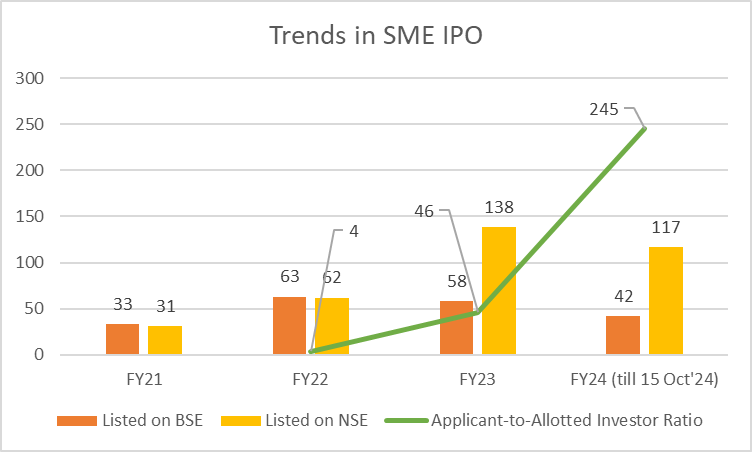
SME IPOs are constantly increasing at an evergrowing rate, with 31 companies listed on SME in FY 21-22 to a total of 138 companies listed in FY 23-24, and 117 companies already listed on SME as of the current FY (till 15th October, 2024) on NSE alone. Not only the number of SME IPOs, the investor participation in such IPOs has also increased substantially, with the applicant to allotted investor ratio from 4X in FY 22 to 46X in FY23 and 245X in FY24. A data on the SME listings during the current and previous FY suggests that, while majority of listed SMEs have booked listing gains, approx 20-30% of such entities have subsequently witnessed a price drop (39 out of 224 companies listed on NSE, 26 out of 91 companies listed on BSE1).

The recent surge in SME IPOs over the last few years, including substantial investor participation in such IPOs, coupled with the recent regulatory concerns w.r.t. diversion of issue proceeds, funding to shell companies, misinflation of revenues etc. has required a re-look into the existing regulatory universe under which SMEs are listed and operate post listing. In August 2024, an advisory was also issued by SEBI regarding investment in the securities of entities listed on SMEs. NSE rolled out stricter eligibility criteria effective September 1, 2024. Greater emphasis on positive cashflow pre listing (w.e.f. Sept 1), capping of 90% over issue price during special pre-open session for SME IPO (w.e.f. July 4) signal the emphasis for investor protection. Following the same, a Consultation Paper has been issued by SEBI, proposing amendments to the provisions of ICDR and LODR Regulations, with a view to strengthen the pre and post-listing requirements for SMEs. Key proposals include restricting the access of SME Exchange to informed investors, and ensuring such IPOs serve the original purpose of making finance available to SMEs for their business growth, and not for funding the promoters’ requirements. 

A brief of the 27 proposals, as against the existing requirements and our comments are presented below: 

Particulars Existing requirementProposal under CPRationale and Our Comments
Stricter eligibility conditions for SME IPO
Ineligibility conditions for IPO (Proposal 8)Currently based on PromotersDirectors Selling shareholders in some cases.To be extended to promoter group as well. SME companies are closely held by promoter and promoter groups. Hence, any action against the promoter group may also have a significant bearing on the issuer.
Additional eligibility requirements for SME IPO(Proposal 9A & 9B)Firm/ LLP converted into company can apply for IPO without any cooling period – track record requirements are considered on a combined basis.Co. which has been converted from LLP or partnership firm, shall be in existence for at least 2 yrs, with restated financial statements post conversion drawn in accordance with Schedule III of CA, 2013.Cooling off of 2 years in case of change of promoter, or introduction of new promoter acquiring 50% or more shareholding prior to filing of DRHP. Helps in bringing a clearer picture of financial position post conversion. Cooling period in case of change in promoter is to bring steadiness in IPO.Track record should be based on the effective management of new promoter(s) and not past promoter(s).
Operating profits (EBIDTA)(Proposal 11)Positive.Rs. 3 cr for at least 2 out of 3 immediately preceding FYs.To ensure financial viability of the company. 
Our Comments: NSE additionally mandates  positive Free cash flow to Equity (FCFE) for at least 2 out of 3 financial years preceding the application.
Conversion of Pre-IPO outstanding convertible securities before IPO(Proposal 20)Conversion not mandatory Conversion mandatory In line with the requirement for Main Board IPO. Provides clarity to investors on the company’s capital structure before they invest.
Structure of IPO and allotment
Minimum issue size(Proposal 10)Not specified Rs. 10 crTo ensure companies with significant growth potential access the market.Loans and alternative funding sources typically cater to smaller amounts.Is aligned with BSE’s and NSE’s requirement for Main Board listing.
Offer for sale(Proposal 4A & 4B)No restriction Dual limits proposedOFS restricted upto 20% of issue size and for selling shareholders, OFS shall not exceed 20% of pre-issue shareholding on a fully diluted basis.To prevent use of SME listing for dilution of promoter stake. 
Face value(Proposal 12)Not Specified Rs. 10/- per share for existing issued capital and proposed new shares to be issued. To enable better comparison amongst various issuers. 
Minimum application size (Proposal 1)Rs. 1 lakh Rs. 2 lakh with existing minimum allocation of 35% (book-build issue)/ 50% (fixed price issue) to RIIs, ORRs. 4 lakh (resulting in deletion of RII category for minimum allocation requirements).Limit participation of retail investors (bidding for upto Rs. 2 lakhs) to protect interest of smaller retail investors;Attract investors with  risk taking appetite; Enhance the overall credibility of the SME segment.
Minimum no. of allottees (Proposal 3)50 200To ensure sizeable no. of investors Provide liquidity 
Allotment methodology for Non – institutional investors (NII) category (Proposal 2)Proportional allotment for NIIsDraw of lots for minimum bid lot to NIIs divided into 2 categories: 
⅓ rd of allocation for application size upto 10L⅔ rd of allocation for application size exceeding 10L 
Align allocation methodology with Main Board IPO; Proportional allotment may encourage over-leveraging, over statement of interest and thus at times encourage mispricing.
Objects of issue & utilisation of proceeds
Raising funds for General corporate purpose (GCP) and unidentified acquisition (Proposal 7A & 7B)GCP < – 25% of issue sizeGCP + unidentified acquisition < – should not exceed 35% of issue sizeGCP restricted to  lower of 10% of issue size or Rs. 10 cr;Prohibition on raising funds for unidentified acquisition To reduce the risk of misuse of issue proceeds 
Repayment of loan of promoter/ promoter group as an object of issue(Proposal 14)No express prohibition.Not allowedTo ensure that funds raised through IPO are used for business growth, not for repayment of promoters’ liabilities 
Funding for working capital (Proposal 15)No specific requirementMandatory statutory auditor certificate on a half-yearly basis for use of working capital funds raised exceeding Rs. 5 Crore, with disclosure of the same in financial statements.Ensures that working capital funds are appropriately used 
Our Comments: The requirement of statutory auditor’s certificate is proposed to be made mandatory for all SME IPOs where a monitoring agency is not required to be appointed (see below). A specific mandate for working capital monitoring may not serve any additional purpose. 
Monitoring of issue proceeds (Proposal 5A, 5B & 5C)Monitoring agency mandatory if issue size >100 crMonitoring agency mandatory if: Issue size >20 cr ORObject of issue includes:funding subsidiary, repay loans/ borrowing of the subsidiary investment in JV/ subsidiaryacquisition
In other cases, utilization certificate from statutory auditor on half-yearly basisPlace before AC and board Submit to stock exchange
Reduce risk of misuse or diversionBring more transparency for investors and accountability for issuer 
Our Comments: Presently, Reg 32(5) of LODR requires statutory auditors to certify the statement w.r.t. Utilisation of funds on an annual basis. The proposal will additionally require the same to be done on a half-yearly basis, in cases where a monitoring agency is not required to be appointed. 
Disclosure of sources in case of requirement of having firm arrangement of finance for a project(Proposal 16) No such requirement Sanction letter to be disclosed in draft offer document and offer document where partial funding is by bank/NBFCs.Additional diligence and disclosure for investors w.r.t. project appraisal by financial institutions. 
Exit opportunity for dissenting shareholders in case of change in objects(Proposal 23)No specific provision Post-listing exit opportunity for dissenting shareholders in case of changes in the objects or terms, in line with Main Board provisionsProtects the interests of dissenting shareholders, ensuring they have an exit option in case of significant changes post-listing.
Promoter contribution and lock-in requirements
Lock-in of promoter holding(Proposal 6A & 6B)Minimum Promoter Contribution (MPC) – 3 yrs Excess holding – 1 yrMPC – 5 yrsExcess –  Lock in on 50% to be released after 1 yr and;For remaining 50% to be released after 2 yrs.To ensure that entire holding is not diluted post the lock in periodTo ensure promoter continues to have skin in game till company is on SME Exchange 
Securities ineligible for MPC(Proposal 24)No clarification w.r.t. adjustment of price for corporate action Price per share for determining MPC eligibility should be adjusted for corporate actions (e.g., bonus, stock split)Clarifies the pricing mechanism and ensures fairness in determining MPC eligibility, preventing manipulation through corporate actions.
Other additional disclosures
Disclosure of senior level management(Proposal 17)KMP and SMP details are required to be disclosed in offer documentDisclosure of senior-level employees (e.g., head of sales, plant head, etc.), with their experiencesAdditional disclosure on ESIC/EPF detailsSite visit by merchant banker to form part of DD report and included in material inspection documents in offer document.Better disclosure w.r.t. Employee strength of the company 
Merchant banker fees(Proposal 18)No requirement to disclose issue related fees Merchant banker fees, by any name, to be disclosed in RHPIncreased transparency – presently such costs exceeds 30-40% of issue size, defeating the primary purpose of fundraising  
Public comments on DRHP (Proposal 19)No requirement. At least 21 days’ for public comments; Disclose on website of SEs and lead managers;Public announcement in 3 newspapers – English, Hindi and regional. Allows the public to provide feedback during draft offer document stage instead of opening of offer
Due diligence certificate by merchant banker(Proposal 21)Required at the time of submission of offer document to SEs. Mandatory submission to SE at the time of filing draft offer document.Ensures that the due diligence process is completed and certified before the public sees the draft offer document.
Migration to Main Board
Migration from SME to Main Board(Proposal 13)Post-issue face value of capital > Rs. 25 crores pursuant to fresh issue. Where listed SME is not eligible to migrate, fund raising to be still permitted beyond Rs. 25 crores, subject to compliance with corporate governance norms and disclosure requirements under LODR. Ensures that company can remain listed on SME platform having post issue face value  more than 25cr with light touch of regulations applicable to them related to LODR
Corporate Governance Requirements
Related Party Transactions(Proposal 25)Exempt from Reg 23 pursuant to Reg 15(2)(b).
Compliance as per Companies Act applicable: Meaning of RP [as per section 2(76)]Approval of AC (for all RPTs)Approval of Board (for specified transactions if not in ordinary course or arm’s length)Approval of shareholders (for material RPTs requiring board approval as above)
Reg 23 to be made applicable to SME listed entities.De minimis exemption continues for smaller listed entities [Reg 15(2)(a)]Material RPTs based on turnover thresholds (10% of annual consolidated turnover)Absolute limits of Rs. 1000 crores not applicable.Enhanced requirements to mitigate risk of circular transactions and abusive RPTs
Quarterly corporate governance report [Reg 27](Proposal 26)Not applicableQuarterly disclosure w.r.t. composition and meetings of the board and its committees to the stock exchange(s) Harmonize  disclosure requirements for SME and Main Board entitiesEnhancing transparency on functioning of board and committee Our comments: The CP mentions about disclosure of board and committees, however, it is not clear as to whether the other disclosures as are applicable to Main Board entities under the corporate governance report, is also proposed to be extended to SMEs
Periodic filings to stock exchanges(Proposal 27Half yearly filing of:: Shareholding pattern [Reg 31], Statement of deviation(s) or variation(s) [Reg 32],Financial Results [Reg 33]To be made on a quarterly basis, at par with Main Board listed entities. Reflects the financial health and fund utilization by companies;
Aligned with requirements applicable to the Main Board.

Our related resources:

  1. NSE tightens eligibility criteria for SME listing on NSE Emerge
  2. BSE and NSE SME Exchange Platforms: Big Opportunities for Small Companies and growing India
  3. The basics of bringing an IPO
  1.  Based on market data as on 15th October, 2024. Taken from SEBI CP
    ↩︎

Enhanced role of CRAs in technical defaults by issuers

– Palak Jaiswani, Manager & Simrat Singh, Executive | corplaw@vinodkothari.com


Read more

Compliance-o-meter: From abstraction to structured granular assessment

– Vinod Kothari and Payal Agarwal | corplaw@vinodkothari.com 

In risk assessment, effectiveness testing, compliance management, or other areas where qualitative assessment is required, one may be making abstract statements like: we have very effective controls; we have strong risk management practices; we have the best of the practices in compliance management, etc. However, very often, these may be pure abstractions. How do we use a structured approach which may allow us to give a more granular, methodical approach to benchmark ourselves?

Unlike quantitative parameters, there are no set methods or approaches to qualitative assessment. However, every qualitative assessment is also backed by identifying the elements that need to be studied, the ingredients or the check points in each of these elements, the weights of the respective elements in the overall assessment framework, assignment of scores based on the weights and observations for each of the checkpoints, eventually coming to an aggregate score. That is, a purely qualitative assessment may be converted into a score sheet.

One may create one’s own methodology; here is a suggested one. Before proceeding with the methodology, one may submit that the same methodology that may be used for effectiveness assessment may also be used for risk assessment. A good score in effectiveness is a positive indicator; a high score in risk assessment is a threat.

The suggested assessment methodology involves:

  1. Identification of elements: Every assessment can be decomposed into the elements underlie it. Take a very easy example of, say, quality of board minutes prepared in a large company. The quality is purely an abstraction, which can be granularly split into, at the least, the timeliness of minuting, the comprehensiveness, ease of understanding, compliance with the law and standards, etc. Similarly, if one refers to the effectiveness of controls on insider trading, one may decompose the overall control into several elements such as identification of UPSI, sharing of UPSI, management of Designated Persons, codes and policies etc. Note that the more granular the elements are, the better is it for the final result.
  2. Weights of the elements: The next point to understand is whether each of the elements are equally weighted, or do they have differential relevance or importance in the overall matter being assessed. For example, if the subject matter of assessment is “quality of minuting”, compliance with law and standards may be perceived as having a higher weight than, say, comprehensiveness or ease of understanding. The task of assigning weights may, once again, become qualitative – therefore, it is necessary to have a methodical approach towards the weights as well. The weights may be determined based on, in descending order, whether the element may result in penal consequence or reputational loss, whether it may undermine controls or the correctness or reliability of the subject matter, whether it is good to have but not must to have, etc.
  3. Ingredients or check points for each element: The check-points for each element need to be an even more granular list of activities, processes, policies, etc that make up the respective element. For instance, in the context of PIT controls, the check points under DP management may include the manner of categorizing DPs, periodicity of updating the list of DPs, maintenance of DP database etc. 
  4. Scores: Once the base work w.r.t. creation of the assessment list is done, actual scores are required to be assigned based on the level of performance of the company on the given check-point. Depending on whether the assessment is a risk assessment, compliance assessment or process review, a scoring parameter may be created, for instance: 
Scoring Parameter
Not compliant/ no practice exists for the same0
Meeting minimum compliance/ practice1
Good Practices (indicates industry practice)2
Gold Practices (indicates leadership practices)3
  1. Weighted score: The scores allotted to each check-point has to be multiplied with the weights assigned to each check point, to arrive at the weighted score of the respective checkpoint. For instance, assume there are five checkpoints in an element, the weighted score can be derived as below:
Check-points Weights ScoresWeighted Score 
A13 (maximum)13
A220 (minimum)0
A333 (maximum)9
A4 326
A51 (minimum)22
Total 1220
  1. Maximum score and actual score: The weighted score obtained against each checkpoint of an assessment element sums up to form the actual score of such element. The same is to be compared against the maximum score for such an element, and expressed as a percentage. For instance, in the aforesaid table, the actual score of the element, let’s say ‘A’, that is made up of ‘A1’ to ‘A5’ sums up to 20. The maximum score that can be obtained for the said element ‘A’ is maximum score for a check-point (3) multiplied by the maximum weight (3), i.e., 9 multiplied by the total number of checkpoints (5), i.e. 45. Based on the aforesaid, the percentage score of the element can be calculated as = (Actual score/ Maximum score)*100. 
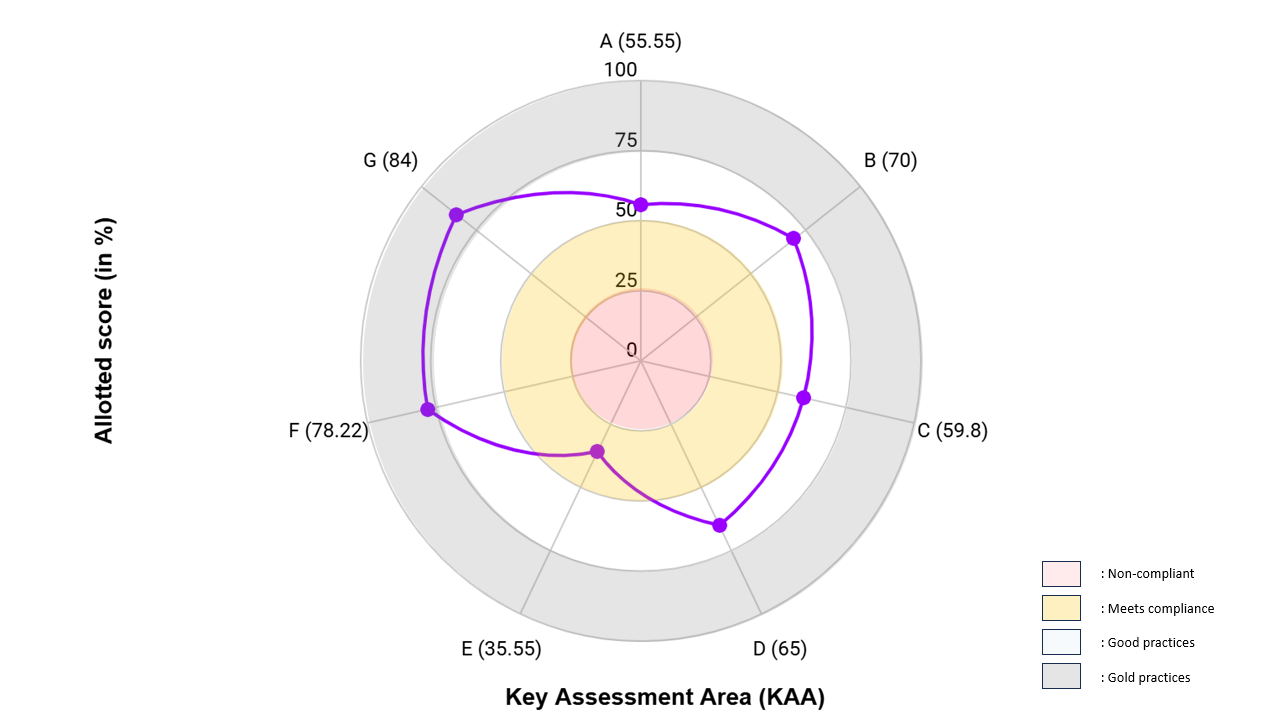
  1. Radar chart: Once the scores are assigned, and the percentage score for each element has been calculated, the same can be expressed in the form of a radar chart. Below is an example of a compliance radar: 

In the picture above, (0-25) is the area of non-compliance, depicting lapses in meeting the minimum legal requirements. (26-50) is the area of meeting the minimum compliance with law, (51-75) indicates that the company is moving towards the general industry practices, and a score beyond 75 shows that the company is adopting leadership practices in the respective compliance area. 

A risk assessment chart may be similarly formed, wherein, a higher score indicates a higher level of risk. Also see an article on Compliance Risk Assessment

Other Related Resources –
  1. Compliance Risk Assessment – Guidance for implementation by NBFCs
  2. Risk Management Function of NBFCs – A Need to Integrate Operational Risk Management & Resilience

RBI & SEBI roll out process for reclassification of FPI’s holding to FDI

– Vinita Nair, Senior Partner & Prapti Kanakia, Manager | corplaw@vinodkothari.com | November 15, 2024

Classification of foreign investments as Foreign Direct Investment (‘FDI’) or foreign portfolio investment is critical for determining the compliance applicable. A person resident outside India may hold foreign investment either as FDI or as foreign portfolio investment in any particular Indian company. Investments by Foreign Portfolio Investors (‘FPIs’) registered with SEBI is mainly governed by the investment restrictions and thresholds provided in SEBI (FPIs) Regulations, 2019 and Part C of SEBI Master Circular for FPIs. Pursuant to Reg. 20 (7) of SEBI regulations, a single FPI (including its investor group[1]) can invest upto 10% of the total paid- up equity capital on a fully diluted basis of the company. In case of breach of this threshold, the FPIs get 5 trading days from the date of settlement of the trades resulting in the breach to correct the position, in terms of the SEBI Regulations as well as Rule 10(1) of FEM (Non-Debt Instruments) Rules, 2019 (‘NDI Rules’), failing which the entire investment is considered as FDI and procedure prescribed by SEBI in Para 17 of Part C of the SEBI Master Circular is required to be followed i.e.:

  • Follow extant FEMA rules & RBI prescribed norms in this regard;
  • No further foreign portfolio investment in that company;
  • FPI to inform respective custodians of the choice who in turn will report this to SEBI, depositories and the issuer;
  • Sale of these securities permitted only through the route they were acquired & LEC reporting by custodian.
Read more

Omnibus use vs know-its-use: Is Supply Chain Financing a revolving line of credit?

Vinod Kothari and Dayita Kanodia | finserv@vinodkothari.com

There have been recent concerns that the RBI is not happy with NBFCs extending revolving credit facilities; there are also some reports to suggest that the supervisor has shown opposition to supply chain funding.

This write up delves into what could be the objections of the regulator in NBFCs extending revolving lines of credit, and why supply chain funding, if properly structured, is not a revolving credit facility that the regulator may be objecting to. It is a credit facility for sure, like every other credit facility, but it is way different from a revolving credit facility such as a cash credit, overdraft, or a credit card.

What could be the objection to revolving lines of credit by NBFCs ?

One of the traditional functions of a bank is credit creation, which, in essence, is the multiplied availability of money supply in an economy. For example, a bank accepts a demand deposit of Rs 100 from customer X, keeps 10% of the money as cash, and lends Rs 90 to customer Y, X still has a spending power of Rs 100, and Y has a spending power of Rs 90, though the system has a total cash of only Rs 100. The bank does it on the basis that X or similar depositors do not withdraw all their deposits at a time; therefore, the bank may keep liquidity as a part of its demand liabilities, and deploy the rest.  It is a different issue that Basel requirements of LCR require banks to keep liquid resources, not necessarily in hard cash.

In another way, banks may create liquidity by granting overdraft or cash credit facilities. That is, customer, customer X who has deposited Rs 100 may be permitted to draw upto Rs 200. As the bank estimates that not every customer who has overdraft sanctions will fully use the same, each such customer has a spending power, without the need to have actual cash. 

This is, of course, different from an actual loan, where the money would have moved from the lender to the borrower.

A revolving line of credit is a flexible credit facility that offers borrowers access to a pre-approved amount of funds, which they can draw upon, repay, and redraw as needed. 

Credit card is another classic case of a revolving line of credit – the card company creates spending power, equal to the available credit on each card. If, on an average, every card is drawn to the extent of, say, 33%, a card issuer may create spending ability equal to 3X the money the issuer has.

Credit creation has macroeconomic implications; central bankers use expansion of credit and contraction of credit as tools of achieving macroeconomic objectives.

Since NBFCs are not banks, if NBFCs start creating credit, without actual funding, there may be an exception to the central bank’s powers to control credit in the economy. 

In case of credit cards, the revolving line of credit is also used as a payment instrument. In essence, the card is used to settle payment obligations – therefore, the one who accepts a payment by use of a credit card is acquiring the right to receive money from the card issuer. The card issuer is, in that sense, making an obligation to pay money represented by the card to anyone accepting the card. Such a privilege can only be given to authorised entities. Banks are, by their very nature, authorised entities for the payment system; NBFCs need specific authorisation.

The key features of a revolving line of credit, which may have the regulator’s disapproval, are as follows:

  1. It is a line of credit and not a funding attached to a specific usage. The grantor of the facility approving any particular drawdown or usage of the line of credit does not arise.
  2. The line of credit may be tapped any time, and does not have any major end-use restrictions, except, may be a negative list. 
  3. It may be paid back any time.
  4. Once paid back, it will auto replenish -that is, it will be available for withdrawal again. Even though a revolving facility may have a sunset, but until it lives, it continues to revolve.
  5. Given the fact that there is no specific time for repayment of any particular usage, a revolving facility is considered to be out of order only when it breaches some of the triggers – may be set with respect to the asset-liability cover, or otherwise.

For further details on revolving line of credit – See Lend, Recover, Replenish: A guide to revolving lines of credit

Why is supply chain financing important ?

Supply chains have become extremely important as manufacturing has moved to aggregation. Any large manufacturing operation today is, indeed, a substantial extent of assembly and aggregation of the components made at different places by different suppliers. Thereby, the dependence of a business on upstream vendors has increased. In the same vein, the ability of a business to enable supplies to the end user  with minimum time has become very important. All these factors make effective supply chain management a very important function for most businesses. 

Meaning of SCF

SCF, also known as channel finance or reverse factoring, is a financial arrangement that helps companies optimize their working capital and improve the efficiency of their supply chain operations. It involves the use of financial instruments and techniques to facilitate the smooth flow of funds between buyers, suppliers, and financial institutions.

The Global Supply Chain Finance Forum defines Supply Chain Finance as, 

“the use of financing and risk mitigation practices and techniques to optimize the management of the working capital and liquidity invested in supply chain processes and transactions. SCF is typically applied to open account trade and is triggered by supply chain events. Visibility of underlying trade flows by the finance provider(s) is a necessary component of such financing arrangements which can be enabled by a technology platform.

In a SCF arrangement, the buyer procures goods or services from a supplier and receives an invoice for the transaction. The supplier receives upfront payment based on the invoice amount, improving their cash flow. This arrangement provides the buyer with the flexibility to settle the payment by the invoice’s due date, optimizing working capital for both parties.

Importance of SCF

  1. Working Capital Optimization: Buyers can extend their payment terms, which can free up cash for other investments, while suppliers can access early payments to meet their financial obligations.
  2. Increased chances that the buyer will pay on the due date: Due to the presence of a financial institution, it is more likely that the buyer will pay on the due date. 
  3. Improved Supplier Relationship: Due to SCF, the supplier receives early payment while the buyer has the flexibility to pay on the due date. This also improves the buyer-supplier relationship.

Various modes of SCF

The following are some of the SCF product types:

  1. Receivables discounting: Sellers of goods and services sell individual or multiple receivables to a finance provider at a discount.
  2. Factoring: Sellers of goods and services sell their receivables at a discount to a ‘factor’. Typically, the factor becomes responsible for managing the debtor portfolio and collecting the payment of the underlying receivables.
  3. Reverse factoring (Payables finance): It is a buyer-led program within which sellers in the buyer’s supply chain are able to access finance by means of receivables purchase.
  4. Purchase-order finance: Pre-shipment or purchase-order finance is a loan provided by a finance provider to a seller of goods and/or services for the sourcing, manufacture, or conversion of raw materials or semifinished goods into finished goods and/or services, which are then delivered to a buyer.

The Global Supply Chain Finance Market has increased by 7% to USD 2,347bn in the year 2023

For further details on Supply Chain Finance – see Unlocking Working Capital: An Overview of Supply Chain Finance

Credit with a purpose vs Credit on demand

The key defining features of revolving line of credit will help us to differentiate the same from SCF. In fact, SCF emerged as an alternative to the traditional mode of working capital finance – viz., overdraft or cash credit. SCF reduces the need for revolving facilities for working capital – hence, it is referred to as an alternative working capital financing product.

The table below distinguishes between SCF and RLOC. 

Points of DistinctionSCF RLOC
Purpose and End-Use RestrictionsIn SCF, each drawdown is made against a specific purchase or sale transaction. Therefore, it is transactional funding – funding of a specific transaction. In case of purchase financing, it becomes funding for the purpose of enabling a purchase, and in case of sales financing, it becomes a mode of releasing funding locked in a specific sale. Once again, what sales will qualify for funding are clearly defined by the grantor of the facility. Typically, the grantor may approve every specific sale or purchase invoice.RLOC offers unrestricted use, giving borrowers the flexibility to allocate the funds as needed. In other words, revolving facilities can be used for any spending.  
Structure and RepaymentIn SCF, each transaction is treated as a unique drawdown, meaning repayment is generally linked to the cash flow generated from the sale or purchase for which the funds were advanced. Further, further disbursal may also be restricted in case the amount pertaining to the earlier facility is overdue. A revolving credit structure where the borrower can repay and re-borrow funds multiple times during the term of the facility, providing continuous liquidity regardless of specific transactions.
Annualised Percentage RateCredit is advanced against a specific invoice with a defined repayment period, APR calculation is possible.Calculating APR for RLOCs may not be feasible, as the exact dates of repayments and future disbursements are unknown at the time of sanction.

It is important to note that in SCF like in case of a RLOC, there can be a sanctioned credit limit within which the drawdowns can be made. However, the setting of a credit limit is common for any credit facility. However, in SCF unlike RLOC, the drawdown would depend upon the availability of an invoice pertaining to a specific sale or a purchase, of goods or services which are either approved by qualifying criteria, or are approved specifically by the facility provider. 

RBI’s Concerns About Evergreening

The RBI has raised concerns about the practice of “evergreening” in financial arrangements, particularly when it comes to credit facilities such as RLOCs. Evergreening occurs when additional funds are borrowed to pay off existing debt, creating a cycle of borrowing without actual repayment, often concealing the true creditworthiness or financial health of the borrower. This practice poses systemic risks, as it may lead to artificially inflated financial statements and delayed recognition of bad debts.

Why RBI’s Concerns Do Not Apply to Supply Chain Financing:
The structural design of SCF mitigates the risk of evergreening. Since each drawdown in SCF is linked to a specific, commercial transaction, further financing is typically contingent on the timely settlement of previous advances. If a borrower fails to repay a previous drawdown on schedule, additional financing for new transactions is withheld, preventing the borrower from obtaining funds solely to meet previous obligations. This transaction-based financing model ensures transparency and aligns with RBI’s efforts to curb evergreening practices, as each drawdown must have a legitimate underlying trade transaction.

RLOC and Evergreening Risks:
In contrast, an RLOC does not impose restrictions on the use of funds or require them to be linked to specific transactions. Borrowers may potentially use an RLOC to repay prior debts, thus getting their line of credit reinstated and then further borrowing.

Kshanikaa: Quick bytes

Mahak Agarwal | corplaw@vinodkothari.com

Kshanikaa is a concise video series covering key corporate law topics. Each episode offers a 2-3 minute snapshot on intriguing subjects. Watch them here:

  1. Introduction: https://youtu.be/MveX7UcZEL0?feature=shared
  2. Interim Dividend: https://youtu.be/dOt_Whl02RE?feature=shared
  3. Senior Management: https://youtu.be/8wsZ29ZNfu8?feature=shared
  4. Sale/disposal of undertaking: https://youtu.be/jUuaBanHOUw?feature=shared
  5. Loans and Investments under S.186: https://youtu.be/JdIXXWH0fyo
  6. Loan to Directors under S.185: https://www.youtube.com/watch?v=9vavmOF8KnY

Link to playlist: https://www.youtube.com/watch?v=MveX7UcZEL0

SEBI unveils new reforms for Debenture Trustees

– Palak Jaiswani, Manager | corplaw@vinodkothari.com

Loader Loading…
EAD Logo Taking too long?

Reload Reload document
| Open Open in new tab

Download as PDF [173.26 KB]


Other Related Resources:

  1. LODR norms of equity extended to debt listed entities; Disclosure of DT Agreement
  2. SEBI rationalises offer document contents and certain timelines for NCD public issuance
  3. Disclosure requirements w.r.t. debt securities | Amendments in LODR & NCS Regulations