SEBI proposes to ease HVDLEs from equity linked CG norms 

Several proposals on the way to ease compliance

-Pammy Jaiswal, Partner & Sourish Kundu, Executive (corplaw@vinodkothari.com)

Introduction:-

The applicability of CG norms (on a COREX basis) was extended to HVDLEs i.e. entities having an outstanding value of listed non-convertible debt securities of Rs. 500 Crore and above, by SEBI vide its notification dated 7th September, 2021. Following the extension thread for mandatory applicability of Corporate Governance (CG) norms under SEBI Listing Regulations (LODR) on High-Value Debt Listed Entities (HVDLEs) from FY 23-24  to FY 24-25  and again postponing it from 1st April, 2025, SEBI released another Consultation Paper (CP) on 31st October, 2024 containing several proposals to ease the compliance burden of HVDLEs.  A similar CP was issued earlier on 8th October, 2024 to review the CG norms primarily focusing on related party transactions (RPTs) [Our analysis on the same can be read here].

While the intent behind the CG norms being made applicable was to protect debenture holders and assimilate corporate governance amongst such issuer entities, the complexities associated with its implementation hindered the ease of doing business and increased the compliance burden manifold. The current CP delves into the comments received on the previous proposal as well as the issues that HVDLEs have been facing in practically implementing the CG norms (i.e. Regulations 16 to 27 of LODR, 2015). While it discusses the much needed and critical areas (CG chapter, mandatory committees, RPTs, etc.) where HVDLEs can be considered to be relieved and not be kept on the same pedestal as that of the equity listed entities, however, for some provisions (included for max no. of directorship, committee membership, XBRL filings, etc.), HVDLEs have been proposed to be roped in at par with entities with their specified securities listed. While each of the proposals have been discussed in detail below, a snapshot of the same can be seen in the diagram below:
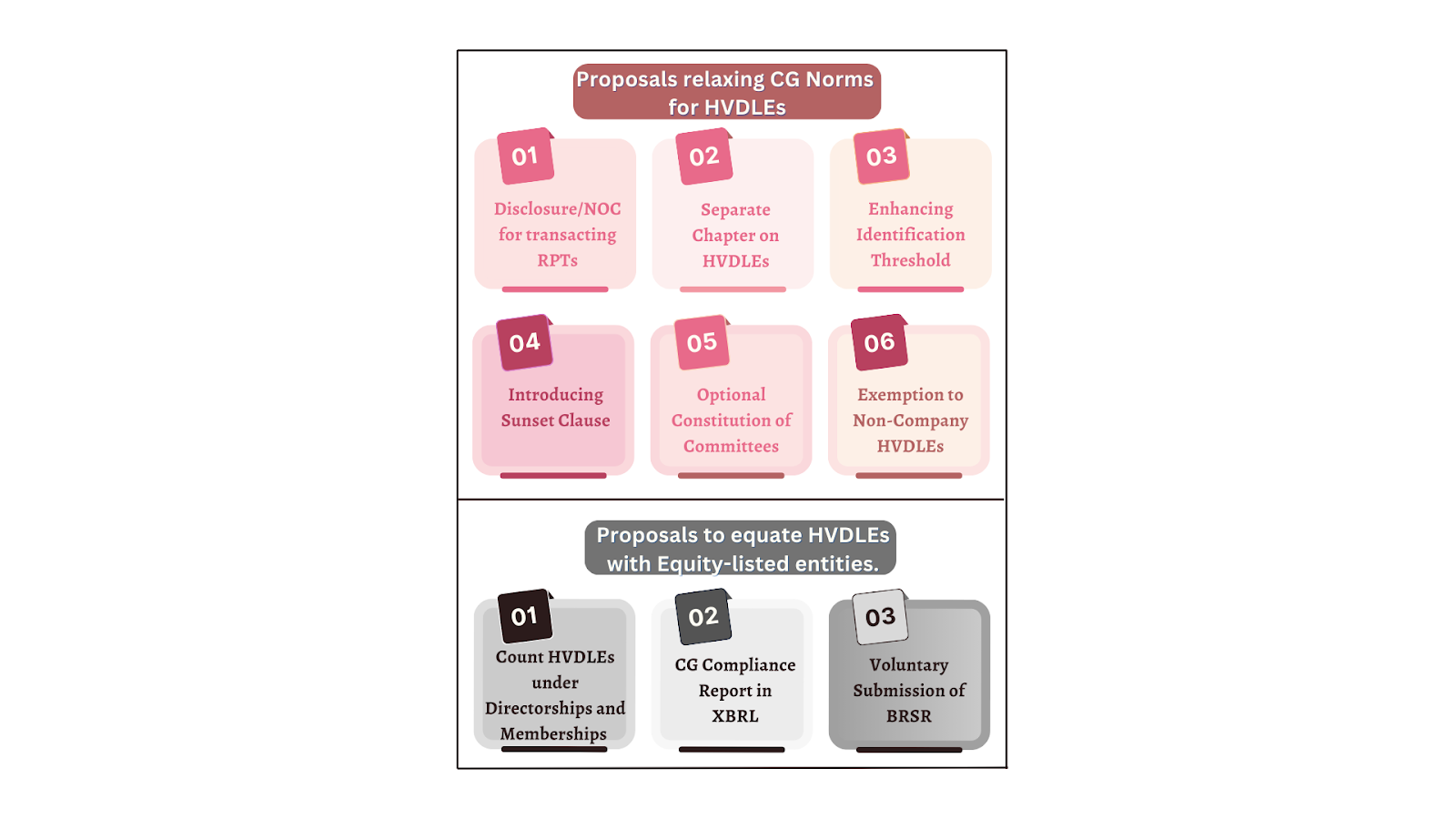
Proposals relaxing CG Norms for HVDLEs 

  1. Providing In-Principle Declaration or obtaining No-Objection Certificate (NOC) from NCD holders in connection with RPTs:

One of the most crucial concerns for HVDLEs was the impossibility of compliance when it came to securing approvals for RPTs. The same was highlighted by SEBI in its earlier CP dated 8th February, 2023 wherein it was mentioned that 104 out of 138 HVDLEs as of 31st March, 2022,   comprised of shareholders with more than 90% of them being related parties (RPs). 

The current proposal is set against a reference to a banking transaction wherein the lender reserves the right to allow the borrower to enter into any transaction that might be unfavorable to the lender such as entering into RPTs. Thus, HVDLEs being of the nature of a borrower and the debenture holders being the lenders, it is paramount to protect the latter’s interests by enforcing such provisions as may be necessary and safeguarding them through a debenture trustee. 

In view of the same, the proposition has the following features:

  • Either provide an upfront declaration in the offer document with respect to the amount of RPTs proposed to be entered over the tenure of the NCDs along with the percentage of the same when compared with the issue size or obtain an NOC from the debenture trustee, who in turn needs to obtain it from the debenture holders (the majority not being related to the issuer) for all the material RPTs as and when they are required to be transacted;
    • VKCo Comments – Until the fine print of the regulations is rolled out, it is understood that only the broader limits of the estimated RPTs are required to be mentioned unless otherwise finer details are required which can become extremely difficult for these entities.Further, for the alternative requirement, there does not seem to be any incentive to first approach the debenture trustee and thereafter the trustee to approach the NCD holders, which can actually be done directly.
  • monitoring of the issue proceeds by a credit rating agency; and
  • declare the following in the offer document upfront and be maintained over the tenure of the NCDs:
    • debt-equity ratio, 
    • debt service coverage ratio; 
    • interest service coverage ratio and;
    • such other financial/ non-financial covenants 
  • VKCO Comments – Both the aforesaid proposals do not serve the exact purpose of maintaining controls over RPT. Also, these are also reflected in the financials to some extent.
  1. Introduction of a separate chapter for the governance of HVDLEs

LODR in its present form consists of 12 Chapters, each having its purpose and application. As far as the CG norms are concerned, HVDLEs are required to follow the provisions primarily centered around equity listed entities which, inter alia, relate to the composition of the Board of Directors, the constitution of various specialized committees, stipulations regarding RPTs and so on. Having said that, these provisions are not completely relatable to HVDLEs since the majority of these entities are purely debt listed without any other security being listed. Accordingly, it has been proposed to introduce a separate chapter on CG norms for HVDLEs distinct from the existing one for equity listed entities. 

VKCO Comments: While this proposal is noteworthy, however, instead of rolling out a new chapter, there could have been certain modifications in the existing regulations by way of a proviso to align with the needs of an HVDLE. Further, one also needs to wait to see the fine print of the provisions once the same is issued.

  1. Increase in threshold for being identified as an HVDLE 

Based on the data provided by NSDL as of 31st March, 2024, the number of pure debt listed entities with an outstanding of more than Rs. 500 crores is 166 (comprising of an aggregate outstanding of Rs. 13.54 lakh crores), of which 112 entities are those having an outstanding of more than Rs. 1,000 crores (comprising of an aggregate outstanding of Rs. 13.16 lakh crores). 

Further, referring to SEBI’s circular dated 19th October, 2023 in which the threshold limit of outstanding long-term borrowing was enhanced from  Rs.100  crore to Rs.1,000 Crore for the purpose of being identified as a Large Corporate called for introspection at the existing threshold of being identified as an HVDLE. Aligned with its objectives of tightening the regulatory regimes for debt listed entities and at the same time promoting ease of doing business in the corporate bond market, the proposal suggests doubling the limit from the present threshold of Rs. 500 crores to Rs. 1,000 crores.  

VKCo Comments: The proposal to enhance the extant threshold is encouraging in terms of governing the maximum value of outstanding debt while at the same time achieving the same without bearing the burden of compliance by an increased number of purely debt listed entities. Subsequently, effective implementation of such a proposal aligns it with the identification criteria of Large Corporates. 

  1. Introduction of “sunset provisions” for non-applicability of CG norms: 

The extant Regulation 3(3) of SEBI (LODR), 2015 provides for the applicability of the CG norms even when the value of the outstanding debt securities falls below the specified threshold forever. The same is in contradiction with respect to the period of applicability as compared to its equity counterpart wherein Regulation 15(2)(a) provides that the norms will have to be complied till such time that the equity share capital or net-worth of the listed entity falls and remains below the specified threshold for a period of three consecutive financial years. Accordingly, for the purpose of aligning the non-applicability, a similar sunset provision for HVDLEs too has been proposed. The proposal outlines that the CG norms shall continue to remain in force for HVDLEs till such time the value of outstanding debt listed securities (reviewed on the cutoff day being 31st March of every financial year) reduces and remains below the defined limits for a period of three consecutive financial years and further ensuring compliance within a period of six months from the date of a subsequent increase in the value above the trigger. The proposition also provides for disclosing such compliances in the Corporate Governance compliance report to be submitted on and following the third quarter of the trigger. 

VKCO Comments: The proposal is welcome since it clearly sets the HVDLEs free from the barrier of once an HVDLE so always an HVDLE. This proposal sets a clear nexus between the compliance and the size of the debt outstanding, for the protection of which in the very first place, the compliance triggered.

  1. Certain mandatory committees made optional

Regulations 19, 20 and 21 of LODR mandate the constitution of the Nomination and Remuneration Committee (NRC), Stakeholders Relationship Committee (SRC) and Risk Management Committee (RMC) respectively and provide for their composition, the number of meetings to be held, quorum, duties and responsibilities, among other things. The proposal recognises the difficulties of constituting multiple committees by HVDLEs and therefore, extends the option of either establishing such committees or ensuring delegation and discharge of their functions by the Audit Committee in the case of NRC and RMC and by the Board of Directors in case of SRC. 

VKCo Comments: Given the close construct of debt listed entities, it is often observed that the constitution of such committees becomes more of a hardship than in smoothening compliance and discussing specific matters. Accordingly, it looks appropriate to redirect the functions of NRC and RMC to the Audit Committee and that of the SRC to the Board. 

  1. Exemption to entities not being a Company

Several entities are not incorporated in the form of companies and therefore, are regulated by specific acts of the Parliament. The rationale behind this move lies in the fact that the administration of these entities is governed by such specific Acts subject to approval from the concerned Ministries. An exclusion on similar lines was granted to equity listed entities by way of Regulation 15(2)(b) which was later omitted w.e.f. 1s September, 2021 vide notification dated 5th May, 2021.

Further, it is awaited as to how effective and permanent such an exemption would be, but SEBI’s working group has proposed for dispensation of entities like NABARD, SIDBI, NHB, EXIM Bank and such other entities fulfilling the criteria as laid out above and application of CG norms to the extent that it does not violate their respective regulatory framework formulated by the concerned authorities. 

VKCo Comments: While SEBI refers to the introduction of similar exclusion for equity listed entities, however, it has also mentioned the subsequent amendment wherein the same was omitted. In any case, the instant proposal is a welcome change since it will help such entities to give preference to their principal statutes and not an ancillary one like LODR. 

Proposals to equate certain CG Norms for HVDLEs to that of equity listed entities: 

  1. Count HVDLEs under no. of directorships, and memberships of Committees:

    The extant provisions of Regulation 17A of LODR and Section 165 of the Companies Act, 2013 limit the number of directorship positions that a person can hold, with appropriate sub-limits being set out with respect to public companies and equity listed companies. Similarly, Regulation 26 of the SEBI (LODR), 2015 places ceiling limits on the number of memberships and chairmanships that a person can hold in committees across all listed entities, with explicit exclusion for such positions held in HVDLEs. 

    The instant proposal is for including the directors in HVDLEs as well as committee membership and chairpersonship positions held in HVDLE just as equity listed entities are included. 

    The same has been proposed in view of the fact that directorship is a significant position in any company and therefore, multiple directorships beyond a reasonable limit are likely to inhibit the ability of a person to allocate appropriate time to play an effective role in delivering its responsibilities including the timely repayment of debt.. 

    Further, the initial proposal for inclusion of HVDLEs in max no. of directorship allows a period of six months or till the next AGM to ensure compliance. 

    VKCO Comments: The rationale completely aligns with the proposal made and seems to be justified.

    1. Compulsory filing of CG Compliance Report in XBRL format:

    Pursuant to Regulation 27(2), which mandates the submission of a quarterly report on complying with CG norms by listed entities, the format of the report has been supervised by Annexure 3 under Section II-B of the Master Circular for compliance with the provisions of SEBI (LODR), 2015 by listed entities in case of equity listed entities and Annexure VII-A under Chapter VII of the Master Circular for listing obligations and disclosure requirements for Non-convertible Securities, Securitized Debt Instruments and/or Commercial Paper in case of HVDLEs. The issue arises from the practice adopted by HVDLEs in the instant case, where filings made on the website of the stock exchange have been made in PDF format thereby affecting the readability and clause-wise compliance monitoring. Unlike the above-mentioned proposals which aim at bringing about relaxations for HVDLEs, this particular proposal tightens the regime by binding the XBRL format that is consistent with what is being filed by equity listed entities, for the report to be submitted on a quarterly basis. 

    VKCo Comments: This proposal is with an objective to align and standardize the filing of quarterly CG compliance report for bringing parity as in the case of equity listed entities. 

    1. Voluntary submission of Business Responsibility and Sustainability Report (BRSR):

    This proposal originates from SEBI’s endeavour to inculcate good CG practices in HVDLEs, to be at par with equity listed entities. It is supported by Regulation 34(2)(f) which requires the top 1,000 listed entities (based on market capitalization) to include a BRSR in their annual report. It is pertinent to note in this respect that publishing of BRSR by HVDLEs is voluntary and not a mandatory requirement unless such an HVDLE also satisfies the criteria of the above-stated regulation. 

    VKCo Comments: The inclusion of a voluntary provision in the legislation with respect to a comprehensive report like BRSR is not likely to be submitted given the huge details under the BRSR. However, an opportunity to submit BRSR can be a game changer for an HVDLE from the perspective of being able to raise funds based on its reporting standards in this regard. 

    Concluding Remarks:

    The proposal under the CP provides hope for a breather when it comes to compliance with CG norms and at the same time introduces certain new requirements to maintain uniformity whether it is for the XBRL filing or inclusion of directorship and committee membership as well as chairmanship in an HVDLE for the max no. of such positions. It will also be interesting to see what is rolled out under the new chapter for HVDLEs as well as the fine print of provisions as far as RPT controls are concerned.

    Refer to our related resources below:

    KYC Amendments clarify on one customer one KYC, among others

    – Aanchal Kaur Nagpal, Senior Manager & Harshita Malik, Executive | finserv@vinodkothari.com

    The KYC Directions are one of the most operationally detailed and challenging guidelines issued by RBI and quite notably, a significant area where financial entities face RBI penalties and action. One of the major pain points for these institutions is repetitive KYC of customers which increases not only the costs associated with customer onboarding but also the timeline and complexity in such processes, leading to potential customer attrition. The amendments in the KYC Directions dated November 06, 2024 (‘Amendments’) provide clarity on the issue of repetitive KYC processes, alignment with the recent updates to the PMLA laws and other related changes.

    This article covers the major changes brought by the said Amendments.

    Applicability: Immediate

    Read more

    SEBI proposes “ease of compliances” for HVDLEs

    Team Corplaw | corplaw@vinodkothari.com

    Also refer to our other resources on HVDLEs here:

    1. SEBI rationalizes the framework for Large Corporates
    2. FAQs on LODR amendment on ‘High Value’ debt listed entities

    Navigating the Complexity of ‘Contingent Claims’ in IBC: a call for clarity

    – Barsha Dikshit & Archana Kejriwal (resolution@vinodkothari.com)

    The Insolvency and Bankruptcy Code, 2016 (‘Code’) provides a unified and collective resolution mechanism aimed at resolving the claims of multiple creditors against a corporate debtor. In this process, creditors who may have varying claims based on the nature of their financial or operational relationship with the debtor, submit their claims, which are collated either by the resolution professional (in the case of a resolution process) or the liquidator (in the event of liquidation) and ultimately these claims are satisfied from the recoveries made through either an approved resolution plan or by way of realization during the liquidation process in terms of section 53 of the Code.

    At the core of this framework lies a critical question- What constitutes a legitimate “claim” as per the Code, and how does one qualify as a “creditor” eligible for repayment? 

    While claims that are clearly defined or crystallized are relatively easy to account for, the matter becomes complex when dealing with contingent or unascertainable claims. Although there have been judicial interpretations addressing this concern, the law is still evolving and lacks clarity on certain aspects. 

    In this write up, the author seeks to analyze the validity of ‘contingent claims’ under the Code in light of the recent judgement passed by Hon’ble NCLAT in the matter of SBS Holdings v Mohan Lal Jain, whereby NCLAT had held that claims arising from an arbitral award issued after the liquidation commencement date, even if the liquidator has participated in the arbitration process, cannot be entertained during the liquidation process of the corporate debtor.

    Validity of contingent claims under the Code

    A contingent claim, by its nature, is dependent upon the occurrence or non-occurrence of an uncertain future event. Such claims, although not crystallized at the time of insolvency initiation may have significant implications for creditors and the corporate debtor. While the term ‘contingent claim’ is not explicitly defined in the Code, Section 3(6) of the Code defines a “claim” as:

    “(a) a right to payment, whether or not such right is reduced to judgment, fixed, disputed, undisputed, legal, equitable, secured, or unsecured.

    (b) right to remedy for breach of contract under any law for the time being in force, if such breach gives rise to a right to payment, whether or not such right is reduced to judgment, fixed, matured, unmatured, disputed, undisputed, secured or unsecured;”

    While the definition does not explicitly distinguish between crystallized claims and contingent claims. However, the inclusive nature of the definition has led to the interpretation that contingent claims fall within the ambit of ‘claims’ that can be admitted during the CIRP or liquidation process, as the case may be. 

    Status of ‘Contingent claim’ during CIRP

    In CIRP, Regulation 13 of the Insolvency and Bankruptcy Board of India (IBBI) (Insolvency Resolution Process for Corporate Persons) Regulations, 2016 (hereinafter, ‘CIRP Regulations’), provides that the Resolution Professional (RP) shall verify every claim submitted under the CIRP and may either admit or reject such claims based on the available evidence and records, and Regulation 14 acknowledges the possibility of contingent claims by allowing the RP to “estimate” claims that are not fully crystallized. This estimation is critical as it permits contingent claims to be included within the broader claim pool, ensuring that such claims are not ignored merely because they have not yet matured.

    Status of ‘Contingent claim’ during Liquidation

    In case of liquidation, Section 38 of the Code read with Regulation 16 of the Insolvency and Bankruptcy Board of India (Liquidation Process) Regulations, 2016 (hereinafter, ‘Liquidation Regulations’) provides for submission of claims by creditors in the liquidation process. Further, Reg. 25 of the Liquidation Regulations empowers the liquidator to “make an estimate of the value of the claim” when a claim cannot be ascertained precisely, thereby allowing the liquidator to admit contingent claims in estimated value for distribution purpose. 

    Thus, CIRP Regulations and Liquidation Regulations both recognize the existence of contingent claims, thereby imposing a duty on the IRP/RP or the Liquidator, as the case may be, to exercise due diligence and make reasonable estimates regarding such claims, admitting them accordingly. Notwithstanding the common duty to estimate and admit contingent claims, the roles, responsibilities, and rights of the RP and the Liquidator are distinct and operate within the separate frameworks of the CIRP and liquidation proceedings, respectively.

    Judicial precedents relating to treatment of ‘contingent claims’ under the Code

    The judicial precedents relating to ‘contingent claims’ under the Code emphasize an inclusive approach to recognise claims that could become liabilities in the future. While recognizing contingent claims, courts have upheld the need for fair and equitable treatment, balancing creditor interests with the efficiency of the insolvency process. Moreover, some of the judgments have underscored the importance of valuation methods that reflect the realistic likelihood of contingent events, ensuring that contingent claims do not unduly burden the resolution process or impair creditor interests. The treatment of contingent claims, while still evolving, is guided by the principles of fairness.

    For instance, in the matter of Essar Steels Limited, Committee of Creditors v. Satish Kumar Gupta & Ors (2020), Hon’ble Supreme Court has held that the resolution professional can admit a contingent claim at the notional value of INR1 if there are pending disputes regarding the claims in question.

    In the matter of Innoventive Industries Ltd. v. ICICI Bank and Anr. (2018), the Hon’ble Supreme Court has emphasized the inclusive definition of “claim” under the Code. The Court held that the term “claim” includes a right to payment, even if it is disputed i.e. whether or not such right is reduced to judgment, fixed, disputed, undisputed, legal, equitable, secured, or unsecured. This broad definition extends to contingent claims, allowing them to be admitted in insolvency proceedings, provided they can be substantiated as potential liabilities.

    In Phoenix ARC Private Limited v Spade Financial Services Limited & Ors.(2021), Hon’ble SC has addressed the treatment of certain financial claims that had characteristics similar to contingent claims. The Court held that contingent claims, when verified and valued, must be recognized appropriately in the resolution process. However, their priority in distribution must align with established principles of fairness, prioritizing claims based on certainty and enforceability over those based on speculative or highly conditional events.

    Thus it is clear that the existence of ‘contingent claim’ as on the CIRP commencement/ liquidation commencement cannot be denied. Infact, it is the IRP/RP or the Liquidator who are entrusted with the duty to make best estimates for such claims.

    [May also read Global scenario on treatment of ‘Contingent claim’ in our related article here].

    Views of NCLAT in the matter of SBS Holdings v. Mohanlal  Jain

    In the instant case, an appeal was submitted before Hon’ble NCLAT , wherein the appellant contested the decision of the Liquidator. The appellant argued that a claim arising from an arbitration award, issued after the liquidation commencement date in ongoing arbitration proceedings in which the Liquidator participated on behalf of the CD), had not been considered by the Liquidator. The Liquidator had declined to admit the claim on the grounds that it was submitted after the deadline for claim submission as stipulated under Regulation 16 of the Liquidation Regulations.

    Upon review, the Hon’ble NCLAT upheld the decisions of both the Liquidator and the National Company Law Tribunal (NCLT), dismissing the appeal. The Hon’ble NCLAT held that claims based on an arbitration award issued after the liquidation commencement date are inadmissible, even where the Liquidator has participated in the arbitration proceedings during the liquidation process. The Hon’ble NCLAT stated- “When a statute provides for liquidation commencement date as a date up to which claims can be filed and proved, no claim thereafter can be entertained by the Liquidator.

    Conclusion

    The treatment of contingent claims under the Code remains an evolving and intricate area of law. It is important to understand that contingent claims are not ‘unknown’, but rather ‘uncertain’ at the time of the insolvency proceedings, While the Code includes contingent claims within its broad definition of “claim,” their admission and valuation during the CIRP and liquidation processes necessitate careful assessment and estimation by IRP/RP/Liquidator, as the case may be. While there may be instances of delayed filing by claimants, such procedural delays are typically technical in nature, and the Code  also permits the late submission of claims under certain circumstances.

    There are many judicial precedents that have supported the inclusion of contingent claims in insolvency proceedings. However, the recent ruling by NCLAT in SBS Holdings v. Mohanlal Jain, in the humble view of the author, tends to have added complexity by presenting divergent views. 

    In the humble view of the author, the Code’s principal objective is to enable the swift revival of distressed companies and ensure equitable repayment to creditors. The exclusion of valid contingent claims would undermine this goal, potentially leaving creditors without recourse. As such, it is imperative that the legal framework surrounding contingent claims be clarified and refined to provide fair treatment to creditors with contingent liabilities, thus strengthening the overall integrity of the insolvency process.

    Supreme Court clarifies the boundaries of “Inherent Powers” of NCLAT

    CIRP Withdrawal in GLAS Trust Company LLC v BYJU Raveendran & Ors

    – Barsha Dikshit, Partner | resolution@vinodkothari.com

    It is a well-established principle that the exercise of inherent powers is permissible only in the absence of an express provision within the statutory framework. Also, that the Insolvency and Bankruptcy Code, 2016 (IBC) is not to be used as a mechanism for mere debt recovery.

    In a recent ruling in GLAS Trust Company LLC vs. BYJU Raveendran & Ors[1]., the Hon’ble Supreme Court set aside the order of the National Company Law Appellate Tribunal (NCLAT) [2]that permitted withdrawal of CIRP post admission by NCLT, by exercising inherent powers under Rule 11 of the NCLAT Rules, 2016, despite existing statutory procedures for CIRP withdrawal. The matter arose from a dispute concerning the validity of a settlement, wherein a financial creditor objected to the source of settlement funds, asserting that it constituted preferential payment or amounted to round-tripping, thereby warranting judicial scrutiny under the insolvency framework.

    The article analyses the impact of the ruling on the jurisdiction of NCLAT to deal with various matters related to the corporate debtor under insolvency or liquidation.

    Read more

    RBEye: Red-eyed RBI wants lenders to revisit interest rate policies

    -Vinod Kothari (vinod@vinodkothari.com)

    Against the backdrop the action against 4 specific lender, RBI now expects all NBFCs to appraise their boards of the action taken by the regulator, and in specific terms, have the interest rate policy examined with respect to, at least, the following, in “unambiguous terms”:

    • The Board of each NBFC shall adopt an interest rate model taking into account relevant factors such as cost of funds, margin and risk premium and determine the rate of interest to be charged for loans and advances
    • The rate of interest must be annualised rate so that the borrower is aware of the exact rates that would be charged to the account.

    Usually, it is believed that if a penal or disciplinary action is taken against some, it is in relation to aberrations by the respective entities. While others need to sit up and take notice it is but natural, but it is a bit different this time – the regulator itself is expecting that all NBFCs need to sensitise their boards on the action taken. The action taken by the RBI is hardly a surprise and therefore, all boards of all NBFCs know it for sure – however, what is not known is what was the background for the action taken. Generic expressions such as “fair, reasonable and transparent pricing, especially for small value loans” have been used in the press release, but these have always been there and have always been the abstractions that everyone talks about, and tried to walk. But what boards of every NBFC will need to know is the nature of the aberrations. Other than just expressing concerns and sending alert signals, NBFCs may need to do self introspection and course correction, for which they would have expected granular observations, as in the case of gold lending vide circular dated September 30, 2024

    It may be the expectation of the regulator that interest rate models, based on which the actual setting of interest rates by business is done, are not vague or subjective, and leave room for opportunistic pricing. For example, the risk premium on loan is imposed on the price: this should be a reflection of the expected loss models. There may be loan acquisition costs and servicing costs – which may be either fixed, variable or semi variable. These may be translated into a mark-up based on appropriate pricing models. The most important component of loan pricing, of course, is the cost of capital – including the cost of equity, which may be priced on the basis of actual (in case of equity, expected) costs of each of the sources of capital. In essence, there is entity-wide or product-wide pricing, such as cost of capital and servicing, and loan-specific pricing, such as cost of acquisition and credit risk premium.

    These models may be granularly put before the Boards of NBFCs. Boards do not get into pricing, but with the kind of shocks that RBI has given to some lenders, boardrooms rather get into details of pricing being charged.

    Another very important factor in pricing are the “extras”, which have become increasingly important over time. These may be fees that NBFCs get from allied services, or subventions from vendors, etc. These constitute part of the returns, but are not shown as cost to the borrower. These may also eventually be a matter of concern. 

    Vinod Kothari Consultants did a webinar recently on the RBI crackdown – here is the link to the recording of the webinar: https://youtu.be/poy6_HehPgU?feature=shared.

    Other related resources:

    1. Is half-truth a lie: Hidden Costs in zero-interest loans
    2. Fair Lending: RBI bars several practices
    3. FAQs on Penal Charges in Loan Accounts

    SDD non-compliance to entail stringent action from exchanges

    Lavanya Tandon, Executive | corplaw@vinodkothari.com

    Our related resources on the topic-

    a. FAQs on Structured Digital Database

    DPs to furnish periodic & continual disclosures for units of its own mutual fund to AMC

    Shaivi Bhamaria, Associate & Sakshi Patil, Executive | corplaw@vinodkothari.com

    Loader Loading…
    EAD Logo Taking too long?

    Reload Reload document
    | Open Open in new tab

    Download as PDF [226.03 KB]


    Refer to our related resources below:

    1. Mutual Fund units now under the net of insider trading regulations (Updated as on October 23, 2024)
    2. FAQs on Insider Trading Framework for Mutual Funds
    3. Prohibition of Insider Trading – Resource Centre