The Rise of Stablecoins amidst Instability

-Megha Mittal

(mittal@vinodkothari.com

The past few years have witnessed an array of technological developments and innovations, especially in Fintech; and while the world focused on Bitcoins and other cryptos, a new entrant ‘Stablecoin’ slowly crept its way into the limelight. With the primary motive of shielding its users from the high volatility associated with cryptos, and promises of boosting cross-border payments and remittance, ‘Stablecoins’ emerged in 2018, and now have become the focal point of discussion of several international bodies including the Financial Standards Board (FSB), G20, Financial Action Task Force (FATF) and International Organization of Securities Commission (IOSCO).

Additionally, the widespread notion that the desperate need of cross-border payments and remittances during the ongoing COVID-crisis may prove to be a defining moment for stablecoins, has drawn all the more attention towards the need of establishing regulations and legal framework pertaining to Stablecoins.

In this article, we shall have an insight as to what Stablecoins, (Global Stable Coinss) are, its modality, its current status of acceptance by the international bodies, and how the ongoing COVID crisis, may act as a catalyst for its rise.

Read more

US Federal Reserve provides support to senior ABS securities

Timothy Lopes, Executive, Vinod Kothari Consultants

finserv@vinodkothari.com

Measures to maintain and strengthen credit flow to consumers is an important part of regulatory initiatives to contain the effects of the COVID crisis. Asset-backed securities and structured finance instrument are recognised as important instruments that connect capital market resources with the market for loans and financial assets. Underscoring the relevance of securitization to the flow of credit to consumers, the US Federal Reserve has set up a USD 100 billion loan facility, called Term Asset-backed Securities Loan Facility, 2020 [TALF] for lending against asset backed securities, issued on or after 23rd March, 2020.

Note that equivalent of TALF 2020 was set up post the Global Financial Crisis (GFC) as well, in 2008[1].

It is also notable that global financial supervisors have attempted to help financial intermediaries stay firm, partly by helping structured finance transactions. The example of the Australian regulators setting up a Structured Finance Support Fund (SFSF)[2] is one such regulatory measure. Another example is the Canada Mortgage Bond Purchase Program initiated by the Bank of Canada[3].

Read more

MCA extends timeline for companies following calendar year

– by Megha Saraf

megha@vinodkothari.com

Updated as on 24th April, 2020

While currently the world is suffering due to the pandemic COVID-19, our regulatory authorities have been continuously providing reliefs/ relaxations to all corporate houses from making various compliances required under the statutory laws. While some of the major relaxations such as conducting extraordinary general meeting of shareholders through VC, making contribution to PM-CARES Fund as a notified CSR expenditure or making compliances under Listing Regulations have already been notified, MCA has come up with yet another Circular[1] granting relaxation from holding AGMs to such companies that follows calendar year as their financial year.

Can there be a different financial year apart from April-March?

Section 2(41) of the Companies Act, 2013 (“Act, 2013”) lays down the definition of “financial year” as, “in relation to any company or body corporate, means the period ending on the 31st day of March every year, and where it has been incorporated on or after the 1st day of January of a year, the period ending on the 31st day of March of the following year, in respect whereof financial statement of the company or body corporate is made up:

Provided that where a company or body corporate, which is a holding company or a subsidiary or associate company of a company incorporated outside India and is required to follow a different financial year for consolidation of its accounts outside India, the Central Government may, on an application made by that company or body corporate in such form and manner as may be prescribed, allow any period as its financial year, whether or not that period is a year:”

XX

There are corporate groups where the structure of shareholding is such, that the holding company is situated outside India and is having Indian subsidiaries. The provisions of law provide that where the relationship between the group is such, that it requires the Indian company to follow a different financial year for the purpose of consolidation of its accounts with the accounts of the company situated outside India, such Indian company can have a different financial year. However, such company needs to apply to the Tribunal for the same.

What is the timeline for holding AGMs?

Section 96 of the Act, 2013 provides that a company is required to hold an AGM within 6 months from the date of closing of the financial year. However, a newly incorporated company can have its first AGM within 9 months of the closure of the financial year.

Are there such companies following a different financial year?

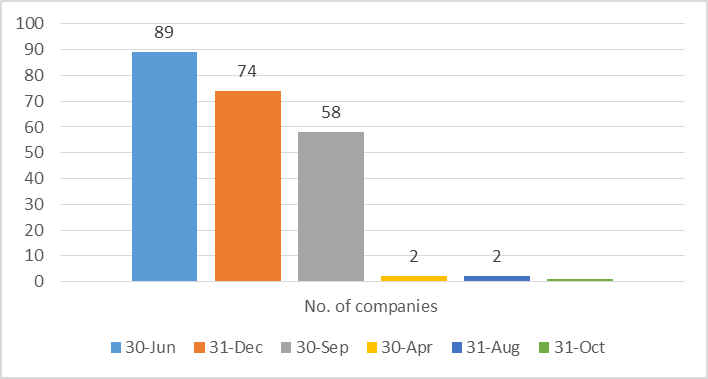
Source[2]: Business Standard: 226 firms to march to a new accounting year

Yes. As per the above graph, there are nearly 226 companies in India that follow a different financial year. Out of the 226 companies, 74 are such companies whose calendar year is the financial year i.e. January- December.

What is the relaxation?

Currently, only companies that follows calendar year as financial year have been granted a 3-months relaxation from holding their AGMs i.e. such companies are allowed to hold their AGMs till 30th September, 2020 instead of June, 2020. Further, the due dates of all other related compliances such as filing of annual returns or financial statements which are required to be done within 60 days/ 30 days as applicable shall be construed accordingly.

What if the company is a listed entity?

Regulation 44(5) of the SEBI (LODR) Regulations, 2015 provides that where the listed entity is within top 100 listed entities based on market capitalization, they have to hold their AGM within 5 months from the closure of the financial year i.e. by August 31, 2020. However, considering the present situation and the need for social distancing, conducting AGMs within such time was becoming a challenge for large corporates. Keeping this in mind, SEBI has granted relief to such entities by extending the requirement by 1 month i.e. till September 30, 2020. However, there was no clarity on what if such entity is a listed entity and follows calendar year as their financial year and is among the top 100 listed entities.

SEBI has now also clarified the same vide its Circular[3] dated 23rd April, 2020 and the present timeline may be summarized as follows:

Sl. No. Type of company Time line under the Companies Act, 2013 Time line under the  SEBI (LODR) Regulations, 2015 Extended timeline
1 Listed company following Apr- Mar as F.Y. Within 6 months from end of FY i.e. 30th September, 2020 Does not provide No extension
2 Listed company following Jan-Dec as F.Y. Within 6 months from end of FY i.e. till 30th June, 2020 Does not provide Extended by 3 months i.e. till 30th September, 2020
3 Listed company following Apr- Mar as F.Y. and amongst top 100 listed entities General provision- Within 6 months from end of FY i.e. 30th September, 2020 Within 5 months from end of FY i.e. till 31st August, 2020 Extended by 1 month i.e. till 30th September, 2020
4 Listed company following Jan- Dec as F.Y. and amongst top 100 listed entities General provision- Within 6 months from end of FY i.e. 30th September, 2020 Within 5 months from end of FY i.e. till 31st May, 2020 Extended till 30th September, 2020 under both laws


Therefore, all types of companies can conduct their AGMs till 30th September, 2020.

Our other articles on related subject may be found here.

[1] http://www.mca.gov.in/Ministry/pdf/Circular18_21042020.pdf

[2] https://www.business-standard.com/article/companies/226-firms-to-march-to-a-new-accounting-year-113100300666_1.html

[3] https://www.sebi.gov.in/legal/circulars/apr-2020/relaxation-in-relation-to-regulation-44-5-of-the-sebi-listing-obligations-and-disclosure-requirements-regulations-2015-lodr-on-holding-of-annual-general-meeting-agm-by-top-100-listed-entitie-_46552.html

SEBI regards maintenance of ‘cover ratio’ & ‘borrowing cap’ as ‘encumbrance’

Penalises promoter entities for non-disclosure under SAST

Ambika Mehrotra & Smriti Wadhera

corplaw@vinodkothari.com

Introduction

The term ‘encumbrance’ as referred to in various court rulings is not a novel term used in law. Although defined in various rulings, in its generic sense, encumbrance means to specify any burden, obstruction, or impediment on an asset, that lessens its value or makes it less marketable. The Securities and Exchange Board of India (Substantial Acquisition of Shares and Takeovers) Regulations, 2011 (SAST Regulations) prior to the amendment introduced vide SEBI (Substantial Acquisition of Shares and Takeovers) (Second Amendment) Regulations, 2019, w.e.f. 29-07-2019[1], defined encumbrance under Regulation 28(3) as

“a pledge, lien or any such transaction, by whatever name called

However, SEBI had further widened the scope of encumbrance vide the said regulation. Though, the earlier interpretation as was clear enough to say that the definition was an inclusive explanation and not an exhaustive one. In order to provide a simplistic explanation/clarification of terms/concepts related to SAST Regulations, SEBI has also come with its FAQs on SAST Regulations[2] to setting various interpretational issues in this regard. The above regulations provide that the shares taken by way of an encumbrance shall be treated as an acquisition and its release shall be treated as disposal under the said Regulations. Accordingly, the disclosures w.r.t acquisition or disposal of shares in any manner, as such, shall mutatis mutandis apply in the case of such transactions. Having said that SEBI has also clarified this requirement in its recent order dated March 31, 2020[3].

In this article, we intend to cover various points of law discussed by SEBI while clarifying the ambit of encumbrance.

Read more

India seals its borders to corporate acquisitions

– Moves FDI from countries sharing land border with India under approval route

Australia’s unique Structured Finance Support Fund (SFSF)

– A $15 billion stimulus package for securitisation transactions

Timothy Lopes, Executive, Vinod Kothari Consultants

finserv@vinodkothari.com

Background

COVID-19 has pushed the global economy into recession. Many countries have made several policy reforms to address and mitigate the impact of the pandemic. Several countries have provided ‘moratorium’, ‘loan modification’ or ‘forbearance’ on scheduled loan obligations of borrowers.

There is no doubt that this deferment of payment by borrowers of principal and interest cause by moratorium in several countries, will have an impact on the cash flows in securitisation transactions.

Australia is one of the major economies that has provided relief to borrowers in the form of a six month moratorium for small business. Due to the relief provided, the country has also recognized the need for providing support to securitisation transactions which will be affected by the moratorium and has enacted a new legislation, thereby constituting a fund for structured finance.

In this write up we discuss the details of this seemingly new and innovative support mechanism for securitisation transactions.

Moratorium on loans in Australia

The Australian Banking Association (ABA)[1] has provided a moratorium package which extends to all small business loans as well as mortgages. There will be deferment of principal as well as interest for a period of six months. Interest will continue to be accrued, it can then be paid off over the life of the loan once repayments begin again, or the length of the loan can be extended.

In order to be eligible for the same, one must have less than $10 million total debt to all credit providers and needs to be current, and not in arrears as of 1 January 2020.

The Australian Structured Finance Support Fund (SFSF)

On 24th March, 2020, Australia enacted a new law called the Structured Finance Support (Coronavirus Economic Response Package) Act 2020[2] (‘Act’). The Act was supported with the Structured Finance Support (Coronavirus Economic Response Package) Rules 2020[3] (‘Rules’) as well as the Structured Finance Support (Coronavirus Economic Response Package) (Delegation) Direction 2020[4] (‘Delegation’).

The move was part of an announcement made by the Australian Government in this regard to provide continued access to funding markets for small and medium enterprises (SMEs) impacted by the economic effects of the Coronavirus, and to mitigate impacts on competition in consumer and business lending markets.

Pursuant to the Act, a Structured Finance Support Fund has been established with an initial corpus of A$15 billion. The said fund is managed by the Australian Office of Financial Management (AOFM)[5].

Purpose of the Fund

The fund is set up with the purpose of making investment in RMBS, ABS and warehousing facilities to compensate for cashflows deferred as a result of COVID-19 hardship payment holidays being granted to borrowers.

The idea is to invest in securities issued by SPVs who wish to be compensated for the missed interest component of scheduled payments not received from the borrower as a result of the payment holiday granted due to the impact of COVID-19.

This will provide a source of liquidity to securitisation transactions to mitigate the impact of non-payment of interest on account of the moratorium.

Inner mechanics of the fund

Eligible lenders who can access the fund are the following –

  1. A non-ADI lender, (regardless of size); or
  2. An ADI (Authorised Deposit-taking Institution) that does not have the capacity to provide the collateral that is acceptable to the Reserve Bank of Australia (RBA) under a term funding facility (and is not a subsidiary of another ADI that does have access to such a facility).

Authorised Debt Securities –

As per the Act, the fund is permitted to invest in only in ‘authorised debt securities’. As per Section 12 of the Act, –

An authorised debt security is a debt security that:

  • is issued by:
  • a trustee of a trust; or
  • a body corporate that is a special purpose vehicle; and
  • is expressed in Australian dollars; and
  • relates to one or more amounts of credit; and
  • complies with the requirements or restrictions (if any) prescribed by the rules.

The Rules go on to prescribe that for the purpose of Section 12, an authorised debt security must not be a first loss security.

Thus, we are looking at investments made by the fund in the senior most securities issued by an SPV or other securities, which must not be a first loss security.

Investment priority/ decision making –

The Delegation issued, sets out the investment strategies/policies, decision-making criteria and appetite for risk and return for the SFSF. These are designed to assist the fund to prioritise between investments.

As per the Delegation, priority must be given to investments which provide support to smaller lenders.

Setting up a “Forbearance” SPV

The Australian Securitisation Forum (ASF) and AOFM are developing a structure that will enable the SFSF to invest in new senior ranking debt securities issued by a newly constituted “Forbearance” SPV.

That SPV will then advance funds to securitisation trusts and warehouses who wish to draw liquidity advances to compensate for the missed interest component of scheduled payments not received as a result of the borrower being granted a payment holiday or moratorium due to the impact of COVID-19.

The plan of the ASF is to appoint legal counsel to develop a detailed term sheet to describe how an industry wide “Forbearance” SPV can operate subject to the terms of the SFSF legislation and the operational guidelines of the SFSF.  Once established eligible issuers and lenders can be registered to access the “Forbearance” SPV.  It is expected that eligible participants will need to subscribe for junior notes in the “Forbearance” SPV in proportion to their participation and these notes will not cross collateralise the obligations of the other participants.

The ASF expects that the “Forbearance” SPV will appoint an independent party to verify the transfer of eligible COVID-19 receivables to the SPV and reconcile drawdowns and repayments under the liquidity facility, amongst other things.

This is an innovative structure which would identify lenders in need, particularly small lenders and provide the required liquidity by advancing funds to compensate for the impact of the moratorium.

Conclusion

The structured finance industry world over is seen to impacted by payment holidays provided. While in most cases, there would have to be modification in the pay-outs of the securitisation transaction, Australia has recognised the need to support securitisation structures by setting up a Fund with a seemingly large corpus to deal with the issue of moratorium.

So far, the SFSF has announced two investments to date, the first in Firstmac’s 2019-1 RMBS and the second in a Judo Bank warehouse facility. This move along with several other policy measures taken by the Reserve Bank of Australia can only help mitigate the impact of COVID-19 on securitisation structures.

[1] https://www.ausbanking.org.au/covid-19/the-business-relief-package/

[2] https://www.legislation.gov.au/Details/C2020A00027

[3] https://www.legislation.gov.au/Details/F2020L00309

[4] https://www.legislation.gov.au/Details/F2020N00034

[5] https://www.aofm.gov.au/

Slew of measures from SEBI in response to COVID-19

List of reliefs summarized

Shaifali Sharma

corplaw@vinodkothari.com

While ensuring that companies remain compliant during the current battle with COVID-19, several temporary measures are being provided by various regulators every other day since lockdown. The measures announced would support companies and other industrial bodies to function and meet the timelines in the period of lockdown.

The Capital Market Regulator SEBI has also lined up a slew of relaxations for the listed entities amid COVID-19 crises. The list of all the relevant circulars in this regard, recapitulating the requirement of law, original timelines and the relaxations granted by the SEBI are summarized in this article, pertaining to the following Regulations:

  1. SEBI (Listing Obligations and Disclosure Requirements) Regulations, 2015
  2. SEBI SEBI (Substantial Acquisition of Shares and Takeovers) Regulations, 2011
  3. SEBI (Depository and Participants) Regulations, 2018
  4. SEBI (Issue of Capital and Disclosure Requirements) Regulations, 2009
  5. SEBI (Buy-back of Securities) Regulations, 2018

I. SEBI (Listing Obligations and Disclosure Requirements) Regulations, 2015[1]

Sr.

No.

Regulation /Circular Particulars Requirement/Frequency of filing Original Due Date Extended Date Relaxation period
Relaxations on holding AGM by top 100 listed entities vide circular dated April 23, 2020
1 44(5) Holding AGM within a period of five months Top 100 listed entities by market capitalization, (determined as on 31st March of every FY), shall hold their AGMs within a period of 5 months from the date of closing of the FY For companies whose FY ends on March 31, 2020 –  31-Aug-20 30-Sep-20 1 month
For companies whose FY ends on December 31, 2020 – 31-May-20 30-Sep-20 4 months
Relaxations/Clarification vide circular dated April 17, 2020
2 29(2) Prior Intimations Prior intimation about meetings of the board (excluding the date of the intimation and date of the meeting):
a. at least 5 days before the meeting if financial results are to be considered;
b. 2 working days in other cases
Prior intimation of 5 days / 2 working days reduced to 2 days, for board meetings held till July 31, 2020
3 39(3) Intimation to Stock Exchanges regarding loss of share certificates and issue of the duplicate certificates Within 2 days of its getting information Any delay beyond the stipulated time will not attract penal provisions laid down vide SEBI circular dated May 03, 2018 wrt Non-Compliance with provisions of SEBI LODR Relaxation is for intimations to be made between March 1, 2020 to May 31, 2020
4 52(8) Newspaper publication of financial results Within 2 calendar days of the conclusion of the meeting of the board of directors No advertisement publication in newspaper required for events taking place up to May 15, 2020
5 Clarification regarding the use of digital signatures Authentication /certification of any filing /submission made to stock exchanges under LODR may be done using digital signature certifications until June 30, 2020
Relaxations vide SEBI circular dated March 26, 2020
6 40(9) Certificate from Practicing Company Secretary on timely issue of share certificates. Half Yearly(1 month of the end of each half of the financial year) 30-Apr-20 31-May-20 1 month
7 44(5) Holding of AGM by top 100 listed entities by market capitalization for FY 19-20. Annual (Within a period of 5 months from the date of closing of the financial year) 31-Aug-20 30-Sep-20 1 month
8 19(3A) The Nomination and Remuneration Committee shall meet at least once in a year. Yearly 31-Mar-20 30-Jun-20 3 months
9 20(3A) The Stakeholders’ Relationship Committee shall meet at least once in a year.
10 21(3A) The Risk Management Committee shall meet at least once in a year.
11 SEBI circular dated January 22, 2020 Relaxation of the operation of the SEBI circular on Standard Operating Procedure dated January 22, 2020 For compliance periods ending on or after March 31, 2020. For compliance periods ending on or after June 30, 2020. 3 months
12 47 Publication of advertisements in the newspaper.

Exemption from publication of advertisements in newspapers as required under regulation 47 for all events scheduled till May 15, 2020.

As provided under Regulation 47 No advertisement publication in newspaper required for events taking place up to May 15, 2020
Relaxations vide SEBI circular dated March 23, 2020
13 SEBI circular dated October 29, 2013, October 22, 2019 and December 24, 2019 Public issue of debt securities/ preference shares or listing of commercial papers Companies proposing public issue of debt securities/ preference shares or listing of commercial papers are required to submit audited financial statements which are not older than 6 months.

Relaxation -Companies can issue debt securities or preference shares/ list commercial papers based on the financials as on September 30, 2019 up to the extended date.

31-Mar-20 31-May-20 60 days
14 SEBI circular dated 26.11.2018 Disclosure of Large Corporate entities

a. Initial disclosure

Initial Disclosure – within 30 days from the beginning of financial year 30-Apr-20 30-Jun-20 45 days
b. Annual disclosure Annual Disclosure – within 45 days from the end of financial year 15-May-20 30-Jun-20 60 days
15 52 (1) & (2)

Financial results

Submission of financial results in case of listed commercial papers.

Half yearly – 45 days from the end of half year 15-May-20 30-Jun-20 45 days
Annual – 60 days from the end of financial year for annual financial statements 30-May-20 30-Jun-20 30 days
Relaxation from compliance with certain provisions of SEBI (LODR) Regulations, 2015
16 7(3) Compliance certificate on share transfer facility Half yearly (one month of end of each half of the financial year) 30-Apr-20 31-May-20 1 month
17 13(3) Statement of investor complaints Quarterly (21 days from the end of each quarter) 21-Apr-20 15-May-20 3 weeks (approx)
18 24A read with circular dated February 8, 2019 Annual Secretarial Compliance Report Yearly (60 days from the end of financial year) 30-May-20 30-Jun-20 1 month
19 27(2) Corporate Governance Report Quarterly (15 days from the end of the quarter) 15-Apr-20 15-May-20 1 month
20 31 Shareholding pattern Quarterly (21 days from the end of the quarter) 21-Apr-20 15-May-20 3 weeks (approx)
21 33 Financial results 45 days from the end of the quarter for quarterly results 15-May-20 30-Jun-20 45 days
60 days from the end of Financial Year for Annual Financial Results 30-May-20 30-Jun-20 1 month
22 17(2) & 18(2)(a) Meeting of Board of Directors and Audit Committee Board of Directors and Audit Committee shall meet at least 4 times in a year and not more than 120 days shall elapse between two meetings. The board of directors and Audit Committee of the listed entity are exempted from observing the maximum stipulated time gap between two meetings for the meetings held or proposed to be held between the period December 1, 2019 and June 30, 2020

II. SEBI (Substantial Acquisition of Shares and Takeovers) Regulations, 2011[2]

Sr. No. Regulation Particulars Requirement/Frequency of filing Original Due Date Extended Date Relaxation period
Relaxation from compliance with certain provisions of SEBI (SAST) Regulations, 2011 vide circular dated March 27, 2020
1 30(1) & 30(2) Continual Disclosures Every person, who together with persons acting in concert with him, holds shares /voting rights entitling him to exercise 25% or more of the voting rights in a target company, shall disclose their aggregate shareholding and voting rights as of the 31st March, in such target company in such form as may be specified. Within 7 working days from the end of the financial year March 31, 2020. 1-Jun-20 3 months (approx)
 2 31(4) Disclosure of encumbered shares Promoter of every target company shall together with persons acting in concert with him, disclose their aggregate shareholding and voting rights as of the 31st March, in such target company in such form as may be specified

III. SEBI (Depository and Participants) Regulations, 2018[3]

Sr.

No.

Regulation Particulars Requirement/Frequency of filing Original Due Date Extended Date Relaxation period
Relaxation in time period for certain activities carried out by depository participants, RTAs / issuers, KRAs, stock brokers vide circular dated April 16, 2020
1 74(5) of SEBI (Depositories and Participants) Regulation, 2018 Processing of the demat  request form by Issuer/ RTA Submission of certificate with Depository and stock exchange where securities are listed for following:

a. Confirming that the certificate of security received from the DP in the course of processing a dematerialization request of a beneficial owner have been listed on the stock exchange where the earlier issued securities are listed; and

b. To the effect that the Company has, after due verification immediately mutilated and canceled the certificate of security and substituted in its record the name of the Depository as the registered owner.

Within 15 days of receipt of information from participant Period beginning from March 23, 2020 till May 17, 2020 shall be excluded for computing the existing timelines

Further, 15 day time period after May 17, 2020 is allowed to the SEBI registered intermediary, to clear the back log.

2 74(5) of SEBI (Depositories and Participants) Regulation, 2018 Processing of the demat request form by the Participants. The participant shall furnish to the issuer details specified in sub-regulation (2) of Regulation 74 along with the certificate of security Within 7 days of the receipt of certificate of security
3 SEBI  circular  no.  MIRSD/Cir-26/2011  dated  December  23, 2011 Uploading KYC application form and supporting documents on KRA system KYC application form and supporting documents of the clients to be uploaded on system of KRA within 10 working days Within 10 working days
Relaxation in adherence to prescribed timelines relating to SEBI (Depositories and Participants) Regulation, 2018 vide circular dated April 13, 2020
4 74(5) of SEBI (Depositories and Participants) Regulation, 2018 Submission of certificate with Depository and stock exchange Submission of certificate with Depository and stock exchange where securities are listed for following:

a. Confirming that the certificate of security received from the DP in the course of processing a dematerialization request of a beneficial owner have been listed on the stock exchange where the earlier issued securities are listed; and

b. To the effect that the Company has, after due verification immediately mutilated and canceled the certificate of security and substituted in its record the name of the Depository as the registered owner.

Within 15 days of receipt of information from participant Within 15+21+19 days of receipt of information from participant i.e. within 55 days 40 days
5 76(1) of SEBI (Depositories and Participants) Regulation, 2018 Submission of audit report to stock exchange Submission of audit report to stock exchange for the purpose of reconciliation of total issued capital, listed capital and capital held by depositories in demat form within 30 days of the end of each quarter 30-Apr-20 10-Jun-20 40 days
(21+19 days)
6 76(3) of SEBI (Depositories and Participants) Regulation, 2018 Intimation of any difference observed in its issued, listed, and the capital held in demat The company to bring to the notice of the Depositories and the Stock Exchanges, any difference observed in its issued, listed, and the capital held by the depositories in dematerialised form. Immediately within 21 + 19 days i.e. within 40 days 40 days
BSE circular dated April 14, 2020 for extension of Submission Date of Share Capital Audit Report for the quarter ended March 31, 2020
7 76(1) of SEBI (Depositories and Participants) Regulation, 2018 Submission of audit report to stock exchange Submission of audit report to stock exchange for the purpose of reconciliation of total issued capital, listed capital and capital held by depositories in demat form within 30 days of the end of each quarter 30-Apr-20 31-May-20 31 days

IV. SEBI (Issue of Capital and Disclosure Requirements) Regulations, 2009[4]

Sr. No. ICDR Regulation Particulars Requirement/Frequency of filing Relaxation granted Relaxation period
One-time relaxation with respect to validity of SEBI observations vide circular dated April 21, 2020
1 44(1) Opening of issue in case of IPO Within 12 months from the date of issuance of the observations by the Board


Where the SEBI observations have expired/will expire between March 1, 2020 and September 30, 2020, its validty is extended by  6  months,  from  the  date  of  expiry  of  such  observation, subject to an undertaking from lead manager of the issue confirming compliance with Schedule XVI of the ICDR Regulations 6 months
2 85 Opening of issue in case of Right Issue Within 12  months from the date of issuance of the observations

In case of a fast track issue, within 12 months from the record date.

3 140 Opening of issue in case of FPO Within 12 months from the date of issuance of the observations by the Board

In case of a fast track issue, within the period stipulated under the Companies Act, 2013.

In case of shelf prospectus, within 3 months of issuance of observations

4 Schedule XVI Filing fresh offer document for increase/decrease in fresh issue size In case of fresh issue any increase/decrease in estimated issue size by more than 20% of the estimated issue size requires fresh filing of offer document For IPO/ Rights Issues/ FPO opening before 31.12.2020, issuer shall be permitted to increase/decrease the fresh issue size up to 50% of the estimated issue size without requiring to file fresh draft offer document subject to following conditions:


·         there has been no change in the objects of the issue

·         the lead manager undertakes that the  draft offer document is in compliance with provisions of Reg 7(1)(e)

·         the lead manager shall ensure that all appropriate changes are made to the  relevant section of DRHP and an  addendum, in this regard, shall be made public.

Relaxation from certain provisions of ICDR in respect of right issue vide circular dated April 21, 2020
Applicable for Right Issues open on or before 31.03.2021 (not applicable for issuance of warrants)
5 99(1)(a) Eligibility conditions related to Fast Track Rights Issue Equity shares of the issuer have been listed on any stock exchange for a period of at least 3 years immediately preceding the reference date Period relaxed from ‘3 years’ to ‘18 months’
6 99(1)(c) Average market capitalisation of public shareholding of the issuer is at least Rs. 250 crores Limit reduced from ‘Rs. 250 crores’ to ‘Rs. 100 crores’
7 99(1)(f) Issuer has been in compliance with the equity listing agreement or LODR Regulations for a period of at least 3 years immediately preceding the reference date


Period relaxed from ‘3 years’ to ‘18 months’
8 99(1)(h) No show-cause notices issued or prosecution proceedings initiated and pending against the issuer/ its promoters/ whole-time directors as on the reference date Issuer is eligible even if any adjudication proceedings initiated/pending against the issuer/ its promoters/ whole-time directors.  However, in case a SCN issued or prosecution proceeding initiated against issuer  or  its  promoters/  directors/group companies, necessary disclosures in respect of such action(s) along-with its potential adverse impact on the issuer shall be made in the letter of offer.


9 99(1)(i) Issuer or promoter or promoter group or director of the issuer has not settled any alleged violation of securities laws through the consent or settlement mechanism with the Board during 3 years immediately preceding the reference date


In case settled  any  alleged  violation  of  securities  laws, issuer is eligible if issuer/promoter/promoter group/ director of the issuer fulfill the  settlement  terms  or  adhered  to directions  of  the  settlement  order(s)


10 99(1)(j) Equity shares of the issuer have not been suspended from trading as a disciplinary measure during last 3 years immediately preceding the reference date


Period relaxed from ‘3 years’ to ‘18 months’
11 99(1)(m) There are no audit qualifications on the audited accounts of the issuer w.r.t financial years for which such accounts are disclosed in the letter of offer


If there are any audit qualifications, issuer is eligible if:

·         Issuer provide the restated  financial  statements adjusting for the impact of the audit qualifications

·         or the qualifications wherein impact on the financials cannot be  ascertained  the  same  shall  be  disclosed  appropriately  in  the  letter of offer


12 86 Minimum Subscription for Right Issue Minimum subscription to be received shall be at least 90% of the offer through the offer document Minimum subscription percentage reduced from 90% to 75% and if the issue is subscribed between 75% to 90%, issue will be considered successful subject to the condition that out of the funds raised atleast 75% of the issue size shall be utilized for the objects of the issue other than general corporate purpose


13 3(b), proviso to Reg 3, Reg 60(1) Minimum threshold  required for  not  filing  draft letter of offer with SEBI


ICDR Regulations shall apply to right issue by listed issuer where the aggregate value of the issue is Rs. 10 crore or more


ICDR Regulations will become applicable where the aggregate value of the issue is Rs. 25 crore or more instead of Rs. 10 crores.

V. SEBI (Buy-back of Securities) Regulations, 2018[5]

Sr. No. Regulation Particulars Requirement/Frequency of filing Relaxation granted Relaxation period
Relaxation in the SEBI (Buy-back of Securities) Regulations, 2018 vide circular dated April 23, 2020
 1  24(i)(f) Obligation of the company for buy-back procedure The company shall not raise further capital for a period of 1 year from the expiry  of  buyback period, except in discharge of its subsisting obligations


Period of restriction relaxed by reducing term of ‘1 year’ to ‘6 months’.


Relaxation applicable till 31.12.2020

 6 months


[1] https://www.sebi.gov.in/legal/regulations/jan-2020/securities-and-exchange-board-of-india-listing-obligations-and-disclosure-requirements-regulations-2015-last-amended-on-january-10-2020-_37269.html

[2] https://www.sebi.gov.in/legal/regulations/apr-2019/securities-and-exchange-board-of-india-substantial-acquisition-of-shares-and-takeovers-regulations-2011-last-amended-on-july-29-2019-_40714.html

[3] https://www.sebi.gov.in/legal/regulations/feb-2020/securities-and-exchange-board-of-india-depositories-and-participants-regulations-2018-last-amended-on-february-21-2020-_40622.html

[4] https://www.sebi.gov.in/legal/regulations/jun-2018/securities-and-exchange-board-of-india-issue-of-capital-and-disclosure-requirements-regulations-2009-last-amended-on-february-12-2018-_39242.html

[5] https://www.sebi.gov.in/legal/regulations/jul-2019/securities-and-exchange-board-of-india-buy-back-of-securities-regulations-2018-last-amended-on-july-29-2019-_40327.html