Scalar regulatory framework for the NBFC sector

-Financial Services Division (finserv@vinodkothari.com)

RBI has issued the Revised Regulatory Framework for NBFCs, effective from October 1, 2022. Highlights of prescribed framework can be accessed at this link.

Introduction

Systemic risk of NBFCs has been an issue for discussion, specifically in India as there have been some major NBFC failures, and the issue of inter-connectivity between NBFCs and the rest of the financial sector became clearly evident[1]. The issue is not limited to India -globally, an annual publication of the Financial Stability Board, called Global Monitoring Report on Non-banking Financial Intermediation[2] has been drawing attention to the increasing relevance of non-banking financial intermediaries and the risk they pose.

The RBI had, in its Statement on Development and Regulatory Policies dated December 4, 2020[3], highlighted a need to review the regulatory framework in line with the changing risk profile of NBFCs. The NBFC sector has witnessed various changes in the regulatory framework in the past few years, making it more comprehensive. However, the tremendous growth in the sector combined with regulatory arbitrage enjoyed by the NBFCs is now leading to a systemic risk. Hence, the regulators have thought it necessary to tighten the regulatory norms for NBFCs holding a major chunk of market share.

In line with the aforesaid announcement, the RBI released a Discussion Paper on January 22, 2021[4] seeking inputs from industry participants. The following write-up analyses the major propositions made by the RBI.

Highlights of the New Regulatory Framework

  • 4 layers of regulatory intensity – progressively from bottom – BL, ML, UL, and TL, Base layer (BL) to be systematically non-significant entities, with light touch regulation. Some entities like Type 1 NBFCs (those without public interface or public funds) will always remain in the Base layer, seemingly irrespective of size. ML to consist of the systemically important NBFCs. From ML, 20-25 entities to be selected for tighter supervision, based on indicia of higher systematic risk. TL is empty by default, but to be populated only on exercise of supervisory discretion for extreme risks.
  • Monetary threshold for systematic significance to be revised upwards from Rs 500 crores to Rs 1000 crores
  • Aims at eliminating regulatory arbitrage at Layer 2 (ML) and above; seeks to align regulatory framework at ML with banks.
  • Layer 3 (UL) is a new regulatory layer; regulations expected to be at par with banks.
  • UL classification is not something that would take the NBFC by surprise; the decision to be put into the category will be communicated in advance with an opportunity to manoeuvre and come out the classification
  • Entry-point requirement for new NBFC registrations to be increased 10 times, from Rs 2 crores to Rs 20 crores. Existing NBFCs to be given a timeframe, say, 5 years to measure up.
  • NPA norms for BL NBFCs (currently, the NSI category) to be made 90 days instead of 180 days as of now
  • At least one of the directors of the NBFCs to be a person with retail lending experience.
  • ICAAP to be applicable to NBFC-ML and above.
  • Auditor rotation after 3 years, appointment of a Chief Compliance Officer, managerial compensation controls, and several disclosure requirements to be imposed on ML entities.
  • Concentration limits: Board-imposed caps on sectoral exposure; IPO financing limits, self-imposed real estate exposure – proposed for ML entities
  • Core Banking Solution be adopted by NBFCs with 10 or more branches
  • Upper Layer to consist of 25-30 entities selected from a sample of about 50 entities, based on scoring methodology, indicating distinctive systemic risk. 9% Common Equity Tier to be prescribed for these entities. Additionally, leverage limits may also be imposed.
  • Differential provision for standard assets to prescribed for UL entities
  • Mandatory listing, managerial remuneration controls, etc to be prescribed for UL entities
  • Top layer to be similar to protective framework in case of banks: Higher capital charge, capital conservation buffer

Regulatory arbitrage: The concern behind present regulatory proposal

The operational flexibility provided to NBFCs has enabled them to assume a scale that would potentially impact systemic stability. In recent years, the regulator has identified structural arbitrage and prudential arbitrage between banks and NBFCs. While the former emanates from differences in legislative and licensing framework like net owned funds, branch approval requirements etc., the latter is concerning CRAR, prescribed leverage, liquidity guidelines etc.

There also exists some relaxation in corporate governance and disclosure norms for NBFCs in comparison to banks such as instructions on compensation policy for WTD/CEOs/Risk Control Staff and most of SCB being listed and thus abiding by the listing requirement.

NBFCs have become more interconnected with the financial system. Linkages are due to the substantial exposure that banks have in NBFCs. As per the Financial Stability Report of January 2021, NBFCs were the largest net borrowers of funds from the financial system. The  gross payables and receivables stood around ₹9.37 lakh crore and ₹0.93 lakh crore as at end-September 2020.[5] More than half of this funding was supported by scheduled commercial banks (SCBs) followed by Asset Management Companies-Mutual Funds (AMC-MF) and Insurance Companies. Further the Discussion Paper noted that there are seven NBFCs (including HFCs) each having asset size exceeding 1 lakh crore and above.

The unconstrained growth of the NBFC sector in addition to the lenient regulatory framework within an interconnected financial system may sow the seeds of systemic risk. In the present scenario, failure of any large and deeply interconnected NBFC is capable of transmitting shocks into the entire financial sector and causing disruption even to the operations of the small and mid-sized NBFCs.

Classification of NBFCs by scale of activities, risks and size

The proposed framework provides for the regulation on scale based approach. This essentially means that regulatory and supervisory resources are to be more focused on the entities which have become too-big-to-fail (TBTF) owing to their systemic interconnectedness with other financial market participants. The degree of regulation is to be based on ‘principle of proportionality’. The three triggers of scale based regulation are:

  • Risk perception: This parameter is based on size, leverage and interconnectedness of the NBFC with market participants in terms of prescribed threshold.
  • Size of operations: The size of the balance sheet of an NBFC beyond a certain prescribed high threshold would be an important independent factor in determination of regulation.
  • Nature of activity – Just by performing financial activity cannot give rise to systemic risk. Like Type 1 NBFCs which do not access public deposits and neither have customer interfaces are to be regulated with light touch. The essence of such form of NBFCs is that the financial activity is being carried out by net-owned funds. However some activities are regarded as high risk owing to their systemic connectivity and business model. The draft paper categorises NBFC-HFC, IFC, IDF, SPD and CIC as they are interconnected with other financial institutions while performing credit intermediation.

The RBI has proposed a scale-based four-layered structure regulatory framework–viz. Base Layer (NBFC-BL), Middle Layer (NBFC-ML), Upper Layer (NBFC-UL) and Top Layer. The classification of layers is made commensurate to the regulatory intervention required- i.e. the base layer having the least regulatory intervention and the intervention increasing as the one moves up the pyramid. The proposed categorisation/classification as provided in the discussion paper is summarized in the fig below.
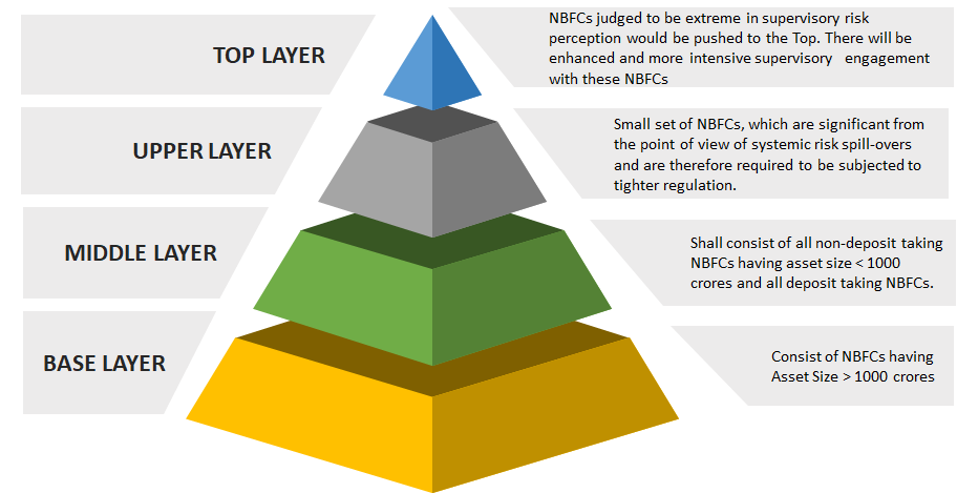
 

Interestingly, CICs are poised to be put under greater scrutiny- this is possibly the regulatory reaction to a recent NBFC default. CICs are proposed to be regarded as Middle Layer NBFC (NBFC-ML) along with NBFCs currently classified as systemically important NBFCs (NBFC-ND-SI), deposit-taking NBFCs (NBFC-D), HFCs, IFCs, IDFs, SPDs. Though CICs and SPDs will fall in the Middle Layer of the regulatory pyramid, the existing regulations specifically applicable to them, will continue to apply. However, a pertinent question for discussion would be whether the activity-based classification of NBFC-AA, P2P, NOFHC in Lower Layer and NBFC-HFC, IFC, IDF, CIC and Standalone Primary Dealers in Middle Layer justified.

Increased NOF & harmonisation of NPA recognition

Further, NOF is proposed to be raised to Rs. 20 crores. Further, in order to ensure a smooth transition, a well-defined timeline will be prescribed by the RBI for existing NBFCs, spanning over a period of, say, five years. For new registrations, the higher NOF norms will get implemented immediately on the issue of instructions.

NPA recognition based on 90 DPD will be extended to all NBFCs including those which are not systemically important.

Recognition of NBFCs in Upper Layer

NBFC categorisation is based on annual review. The paper recognises two parameters; quantitative and qualitative:

  • The quantitative parameters will have 70% weightage.
  • The qualitative parameters will have 30% weightage.

The table below represents quantitative and qualitative parameters as proposed:

Parameter Sub-parameter Sub weight Weights
Quantitative Parameters (70%)
Size & Leverage Size: Total exposure (on-and off-balance sheet)


Leverage: total debt to total equity

20+15 35
Interconnectedness i) Intra-financial system assets:

–        Lending to FIs

–        Securities of other FIs

–        Mark to market REPO

–        OTC derivatives


ii) Intra-financial system liabilities


–        Borrowings from FIs

–        Marketable securities issued by finance company to FI

–        Mark to market OTC derivative with FIs

iii) Securities outstanding (issued by NBFC)

10


10


5

25


Complexity i) Notional amount of OTC derivatives

–        CCP centrally

–        Bilateral OTC


ii) Trading and available for sale securities

5


5

10
Qualitative Parameters/Supervisory inputs (30%)
Nature and type of liabilities –        Degree of reliance on short term funding

–        Liquid asset ratios

–        Callable debts

–        Asset backed funding Vs. other funding

–        Asset liability duration and gap analysis

–        Borrowing split (secured debt, CCPS, CPs, unsecured debt)

10 30


Group Structure –        Total number of entities

–        Total number of layers

–        Total intra-group exposure

10
Segment Penetration Importance of NBFC as a source of credit in a specific segment or area 10

The scoring will be done on a sample basis, by dividing the individual NBFCs amount by the aggregate sum of all the indicators in the sample. The score for each category will be converted into basis points and the overall systemic significance score will be based on the relative importance of the NBFC compared with other NBFCs in the sample.

The sample criteria for the purpose of above parameter based measurement is to be as follows:

  • Excluding the top 10 NBFCs (based on asset size) as they will automatically fall in upper layer regulation.
  • The sample will include next 50 NBFCs based on total exposure (including off balance sheet)
  • NBFCs designated as NBFC-UL in previous year
  • NBFCs added to sample by supervisors judgement

For leverage calculation the individual score of NBFC is to be divided by average leverage of the sample. A NBFC-UL will be subjected to enhanced regulatory requirements similar to that of banks at least for a period of four years from its last appearance in the category, even where it does not meet the parametric criteria in the subsequent year.

NBFCs in Base Layer

The base layer would cover NBFCs with asset size upto Rs 1000 crores. The major propositions for this layer are provided in the table below:

Proposals for NBFCs in Base Layer
1. The current regulations require NPA classification of the asset having more than 180 DPDs the same is proposed to be reduced to 90 DPDs in order to bring it in sync with the regulatory guidelines for other classes of NBFCs
2. The board shall be required to have –

(i)  Adequate experience and educational qualification

(ii) At least one of the directors should have experience in retail lending in a bank/NBFC

3. For the Risk Management Committee-

(i)  Overall role and responsibilities to be laid out, and

(ii) Composition could be Board or Executive level as to be decided by the Board

4. The regulations for sale of stressed assets shall be made  at par with banks once guidelines are finalized
5. Additional disclosures on type of exposures, related party transactions, customer complaints shall be prescribed


NBFCs in Middle Layer

Several new regulatory requirements are proposed for this category in addition to the proposals for the base layer. There are no changes proposed in capital requirements for NBFC-ML.

Proposals for NBFCs in Middle Layer
1. Board approved policy taking into account all risks for Internal Capital Adequacy Assessment shall be required.
2. The extant credit concentration limits prescribed for NBFCs for lending and investment is proposed to be merged into a single exposure limit of 25% for single borrower and 40% for group of borrowers anchored to Tier 1 capital instead of Owned Funds
3. Compulsory Rotation of auditors shall be applicable- After completion of continuous audit tenure of three years, Auditors shall not be eligible for re-appointment for a period of six years (two tenures)
4. i) Appointment of a functionally independent Chief Compliance Officer.

ii) Additional Corporate Governance and Disclosure Requirements, including requirement for Secretarial Audit.

5. It has been proposed that no KMP of an NBFC shall be allowed  hold office in any other NBFC-ML or NBFC-UL or subsidiaries, further, an Independent Director cannot be director in more than two NBFCs (NBFC-ML and NBFC-UL) at the same time
6. Board approved internal limits and adequate disclosures would be required for exposure to sensitive exposures and Dynamic vulnerability assessment by NBFCs shall be required. Sub-limit within the commercial real estate exposure ceiling should be fixed internally for financing land acquisition


7. Restrictions on grant of loans and advances for/to the following:

(a)  buy back of shares/ securities

(b)  activities leading to Ozone Depleting Substances

(c)  Directors and relatives of directors

(d)  Officers and relatives of Senior Officers

(e) Real Estate – only where project approvals other permissions are in place.

8. The IPO financing by NBFCs shall be capped at Rs.1 crore. There is no limit prescribed for NBFCs at present, while there is a limit of Ts. 10 lakh for banks for IPO financing.
9. Mandatory for NBFCs with more than 10 branches to have Core Banking Solution for NBFCs

NBFCs in Upper layer

In addition to the regulations applicable to NBFC-ML, a set of additional regulations will apply to NBFC-UL, they are:

Proposals for NBFCs in Upper Layer
1. CET 1 may be prescribed at 9% within the Tier I capital

In addition to the CRAR requirements, NBFCs will also be subjected to a leverage requirement

2. Differential Provisioning being similar as banks for standard assets to be made applicable
3. For Concentration norms-

(i)   Large Exposure Framework (LEF) as applicable to banks with suitable modification will apply

(ii)  Transition time for implementation

4. Corporate Governance norms to be similar lines as applicable for Private Sector Banks. Additional governance regulations such as specifying qualification of board members, providing detailed disclosure on group companies including consolidated financial position and details of related party transactions.
5. Adequate phase-in-time for mandatory listing to be provided. However, disclosure requirements will kick in earlier than actual listing within the broad implementation plan for NBFC-UL
6. Removal of Independent Director shall require supervisory approval


NBFCs in Top Layer

The top layer is currently empty and will get populated in case RBI takes a view that there has been an unsustainable increase in the systemic risk spill-overs from specific NBFCs in the Upper Layer. NBFCs in this Layer will be subject to higher capital charge, including Capital Conservation Buffers. There will be enhanced and more intensive supervisory engagement with these NBFCs.

Monetary threshold for systemically important NBFCs

Asset size of Rs 500 crores was stipulated a long time back for distinguishing between SI and NSI NBFCs, that is on November 10, 2014. The limits were in line with recommendations made by the Working Group on Issues and Concerns in the NBFC Sector, chaired by Smt. Usha Thorat.

After more than 6 years, the RBI proposes to increase the threshold from Rs 500 crores to Rs 1000 crores.

The inherent sense of reservation in this measure is itself evident from the data that the RBI has shared – that the number of NSI companies will go up from 9133 to 9209. That is, merely 76 companies will be taken out of the SI classification and put into BL category.

10-fold jump in entry point net worth requirement

If some people familiar with the evolution of regulatory framework for NBFCs may recall, the NOF requirement for NBFCs was Rs 25 lacs in 1990s. Then, it was increased to Rs 2 crores. The regulator is now proposing to increase the same to Rs 20 crores – a 10 fold increase. The underlying rationale is to have a stronger entry barrier, and to ensure that NBFCs have the initial capital for investing in technology, manpower and establishment. However, this sharp hike in entry point requirement will keep smaller NBFCs out of the fray. Smaller NBFCs, particularly those with geographical or sectoral focus, have been doing a useful job in financial inclusion.

Conclusion

The regulatory frame is going for a complete overhaul. While the new regulatory framework should have been expected to to smaller NBFCs out of regulatory glare, it is notable that only 76 companies are sliding down from SI status to NSI status due to the proposed change. The whole principle of scalar regulation should have been lesser entities to regulate, so that there is more attention where attention is needed. Further, the principle of scalar regulation would intuitively have more regulation at higher levels, but lesser regulation at the bottom of the pyramid. There are no apparent signals of reduced regulation at the base level. On an overall assessment, the scalar regulatory frame is a new thought process, and should be appreciated.

The video on  “Round table discussion on RBI’s proposed regulatory framework for NBFCs” can be viewed here 


Our Presentation on the topic can be viewed here


[1] See an article by Vinod Kothari, tilted Shadow Banking in India – Creating an Opportunity out of a Crisis, at https://vinodkothari.com/2020/01/shadow-banking-in-india/

[2] The 2020 Report is here: https://www.fsb.org/wp-content/uploads/P161220.pdf

[3] https://www.rbi.org.in/Scripts/BS_PressReleaseDisplay.aspx?prid=50748

[4] https://rbidocs.rbi.org.in/rdocs/Publications/PDFs/DP220121630D1F9A2A51415B98D92B8CF4A54185.PDF
[5] Reserve Bank of India – Reports (rbi.org.in)

Snapshot of CSR Amendment Rules, 2021

Vinod Kothari & Company

corplaw@vinodkothari.com

Below is a short snippet of the Companies (Corporate Social Responsibility Policy) Amendment Rules, 2021

Proposed changes under the LLP Act are much more than decriminalisation

More regulation for LLPs including business limitation, accounting standards and more!

By Pammy Jaiswal and Megha Saraf

corplaw@vinodkothari.com

Background

A Limited Liability Partnership (LLP) being a hybrid form of an entity has always been seen with lesser regulatory burden as compared to a company and is regulated by the Limited Liability Partnership Act, 2008 (LLP Act). Having said that, it is imperative to note that currently there are various provisions under the LLP Act that provide for levying penalty, fine and also imprisonment. The offences have been bifurcated into compoundable and non-compoundable offences as in the case of companies under the Companies Act, 2013 (CA, 2013/Act).

Further, the fact that an LLP in the course of its business can undertake debt obligations cannot be argued, however, the mode of undertaking debt obligations in the case of instruments has not been dealt with under the Act.

Continuing with the policy and intent of the Government of India to decriminalise minor and procedural non-compliances, the Ministry of Corporate Affairs (MCA) has constituted a Company Law Committee (CLC/Committee) on 18th September, 2019 with a view to revamp the LLP Act, 2008 (LLP Act) and bring necessary amendments in line with the economic scenario. The Committee was chaired by Mr. Rajesh Verma and had eminent personalities from regulatory bodies like SEBI etc.

While the main agenda for the constitution of the CLC was decriminalisation, however, when we look at the Report[1] which has been presented on 18th January, 2021 and is open for public comments till 2nd February, 2021, it is seen that it is much more than just decriminalisation.

Highlights of the Report

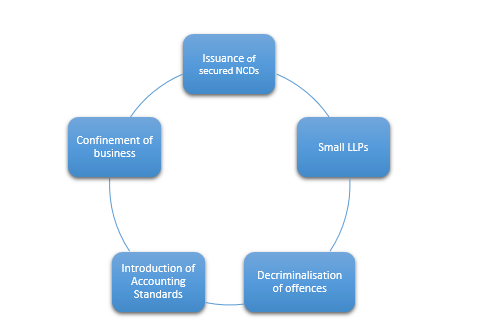
The proposed reforms go wide enough to confining the business of LLPs to non-financial business, creating a structure for issuance of non-convertible debentures by LLPs, having a separate classification called small LLPs with lower filing or additional fees, extending accounting standards for LLPs and decriminalisation of offences.

We shall now critically discuss the proposed reforms in detail.


Raising of funds through issuance of secured Non-Convertible Debentures (NCDs)

Debentures are one of the widely used instruments for raising funds. It is not only a structured mode of raising funds as it is in form of a security but also more flexible as compared to loans. As per the Act, a company can raise borrowed funds both by way of loan or issuance of debentures. However, the LLP Act has always been silent on the same.

Having said that, it is observed that the Report recommends issuance of secured NCDs only to bodies corporate and trusts which are regulated by SEBI or RBI with certain fetters as given below:

  • The LLP agreement shall have a provision in this regard and the same should have been registered with the Registrar;
  • Maintain a register of NCDs so issued in such form and manner as may be prescribed;
  • Creation of debenture redemption reserve (DRR) out of the profits of the LLP for such quantum and in such manner as may be prescribed;
  • Offer or invitation to subscribe to the secured NCDs to not more than 200 person in a financial year;
  • Payment of interest and redemption to be made in accordance with the terms of issue;
  • Filing of prescribed details about the secured NCDs so issued with the Registrar;
  • In case of failure on the part of the LLP to pay interest or redeem the NCDs, the Tribunal may direct for doing so on the basis of the application made by any or all of the NCD holders;
  • Issuance shall be made on such terms and conditions as may be prescribed;
  • Any LLP who makes a default in compliance with the provisions of the proposed insertion of section 33A, will make the partners liable for punishment with imprisonment for a term which may extend to one year or with fine which shall not be less than Rs. 2 lacs and may extend upto Rs. 5 lacs or both.

International scenario

  1. United Kingdom

The Limited Liability Partnerships (Application of Companies Act 2006) Regulations, 2009[2] specifically lays down the provisions for issuance of debentures. The provisions broadly say the following:

  • Provision to issue perpetual debentures;
  • Registration of the allotment of debentures within 2 months after the date of allotment;
  • Debentures to bearer issued in Scotland are valid and binding according to the statue of Scots Parliament Act, 1696;
  • Maintenance of register of debenture holders;
  • Right to inspect register of debenture holders and take extracts of the same;
  • Time limit for claims arising from entry in register;
  • Providing for right to debenture holder to copy of deed;
  • Providing for the liability of trustees of debentures;
  • Power to re-issue redeemed debentures;
  • Priorities where debentures secured by floating charge;
  • Deposit of debentures to secure advances

FAQs on LLPs by United Kingdom[3]

As per the FAQs, LLPs can create a charge on its assets and issue debentures. Further, para 53A.80 of the same provides that “An LLP, as it has a separate legal identity, is able to create and issue debentures to secure its borrowing”. 

Hence, the LLP Act of United Kingdom provides for issuance of Debentures by an LLP.

  1. Singapore

As per para 11 of the Fourth Schedule of the Singapore LLP Act, 2005[4], “Where a receiver is appointed on behalf of the holders of any debentures of a limited liability partnership secured by a floating charge or possession is taken by or on behalf of debenture holders of any property comprised in or subject to a floating charge, then, if the limited liability partnership is not at the time in the course of being wound up, debts which in every winding up are preferential debts and are due by way of wages, salary, retrenchment benefit or ex gratia payment, vacation leave or superannuation or provident fund payments and any amount which in a winding up is payable in pursuance of paragraph 76(6) or (8) of the Fifth Schedule shall be paid out of any assets coming to the hands of the receiver or other person taking possession in priority to any claim for principal or interest in respect of the debentures and shall be paid in the same order of priority as is prescribed by that paragraph in respect of those debts and amounts.” 

This implies that the Singapore LLP Act also allows raising of funds by way of debentures.

Related Indian laws and guidance

  1. Banning of Unregulated Deposit Schemes Act, 2019 (BUDS Act)

The Ministry of Law and Justice has laid a comprehensive mechanism to ban any unregulated deposit schemes by introducing Banning of Unregulated Deposit Schemes Act 2019 (BUDS Act). Section 2(4)(e) of the said Act stated that where a capital contribution is received by an LLP, the same is an exempt deposit.

Further, the introductory paragraph as well as Section 41 of the BUDS Act states that the said Act shall not apply to deposits taken in the ‘ordinary course of business’. While ‘ordinary course of business’ has not been defined, however, the same should be construed as  funding raised in order to carry out business operations for which the LLP has been formed since every business requires funding to operate.

  1. SEBI’s Informal Guidance[5] in the matter of Vijay Suraksha Realty LLP

In the said case, the LLP intended to raise funds through listed NCDs under the SEBI (Issue and Listing of Debt Securities) Regulations, 2008 (ILDS Regulations) and list them in the wholesale debt market. While the definition of ‘debt securities’ as per ILDS Regulations covered such securities issued by an LLP by virtue of it being a body corporate, however, the definition of ‘Issuer’ specifically covered company, public sector undertaking or any statutory corporation.

While the said informal guidance discussed on the issue of listed NCDs, it nowhere discussed or stated regarding any restriction in the LLP Act to issue NCDs.

VKC Comments

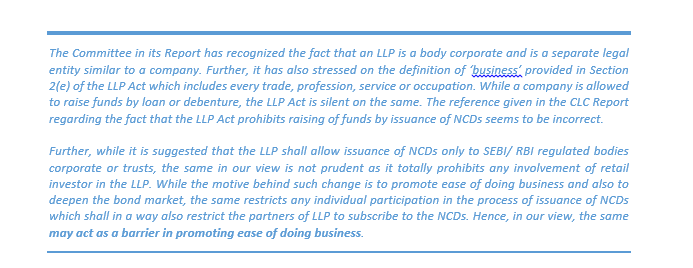
The Report states that an LLP Act can contract debt, however, the LLP Act along with the allied Rules do not permit the LLPs to raise funds. While the Report talks about the restriction on issuance of NCDs, however, it is significant to note that the LLP Act and the rules are silent on the same. Accordingly, in the absence of any express restriction for the said matter, construing that the same tantamount to a restriction is not correct in our view.

The Report also focuses on the fact that it is important to boost the debt market in India and allow LLPs to raise funds by issuance of NCDs. Further, in order to protect investors’ interests and to prevent any fraudulent misuse of funds, such issuance will be allowed to be made only to SEBI or RBI regulated entities thereby prohibiting any issuance to retail investors. While this is a welcome move to insert an express provisions for enabling and at the same time regulating the issuance of NCDs by an LLP, however, the following things should also be considered at the time of bringing the final changes in the law:

  • Change to be prospective – This change in law is expected to be prospective and not retrospective considering the fact that the existing set of laws was silent on the same. If the same is made retrospective, it may have serious consequences to those LLPs which have actually raised funds in the form of NCDs based on the existing text of the LLP Act and allied rules.
  • Allowing issuance of NCDs to individuals – The intent of proposed change is very clear to allow issuance of NCDs by LLPs and at the same time protect the interest of the investors. Having said that, it can be noted that the Act allows issuance of NCDs to all categories of investors including the individuals along with certain conditions or fetters. Similarly, allowing LLPs to issue NCDs to retail investors with several safeguards should also be allowed considering that an LLP may not always have the outreach to the regulated investors. In the absence of such outreach, the proposed change may fall short of meeting its intent.


Introduction of Small LLPs

The CA, 2013 provides for the concept of small companies. Such small companies enjoy several privileges under the CA, 2013 such as reduced no. of board meetings, preparation of concise board’s report, lesser penalties, concise financial statements etc. The rationale behind such relaxations/ privileges is to promote ease of operations by small companies or MSMEs.

With similar intent, the CLC Report has proposed the introduction of small LLPs. Such a provision will facilitate lesser compliances, lesser fee or additional fees for small LLPs.

The proposed definition of small LLPs will be based on contribution and turnover not exceeding 25 lacs or 40 lacs respectively, or such higher amount as may be prescribed. Such small LLPs will be able to enjoy several privileges such as:

  • Reduced filing fees;
  • Lesser compliances;
  • Lesser additional fees;
  • Lesser penalties;
  • Accounting Standards for only certain class of LLPs mainly engaged in manufacturing LLPs

The same will reduce cost of compliances and will facilitate business by MSMEs/ small LLPs.

Confinement of business activities

The LLP Act does not prohibit an LLP from carrying out a particular business activity. However, it has been seen that RBI has raised concerns on an LLP carrying out non-banking financial activities. The Report has discussed that RBI is not the regulator of LLPs and hence, should not be regulating non-banking financial activities of an LLP.

Considering the same, the Report has proposed insertion of a new proviso wherein the definition of ‘business’ comes with a proviso. This proviso gives the power to the Central Government to include or exclude any business activities by way of a Notification.

Express restriction proposed for merger of LLPs with a company

The CLC Report has also placed a proposal to restrict any amalgamation of an LLP with a company by amending Section 62 of the LLP Act.

Since, an LLP is also a body corporate hence, putting such restriction on amalgamation of a body corporate with another body corporate does not seem to be a welcome move.

Decriminalisation of offences

The CLC has recommended various offences to be decriminalized and to be shifted to the In-house Adjudication Mechanism. Similar to the CA, 2013, where several provisions have been decriminalized both either by amending the CA, 2013 or by Companies (Amendment) Act, 2020. The motive behind the same is to de-clog the courts or the NCLTs thereby reducing their burden from non-serious matters. A list of the offences decriminalized are as follows:

  1. Section 9- Changes in Designated Partners
  2. Section 10- Punishment for contravention of section 7,8 and 9
  3. Section 13- Registered office of limited liability partnership and change therein
  4. Section 21- Publication of name and limited liability
  5. Section 25- Registration of changes in partners
  6. Section 34- Maintenance of books of account, other records and audit, etc.
  7. Section 35- Annual Return
  8. Section 60- Compromise, or arrangement or limited liability partnerships
  9. Section 62- Provisions for facilitating reconstruction or amalgamation of limited liability partnerships
  10. Section 74- General penalties


Introduction of In-house Adjudication Mechanism (IAM)

In order to ease out and de-clog the Courts, various offences have been proposed to be decriminalized and brought under the In-house Adjudication Mechanism (IAM), similar to the CA, 2013. The CLC Report has introduced Section 77A in the LLP Act thereby enabling the Central Government to appoint officers for adjudging penalty under the provisions of the LLP Act.

Reduction in filing fees

Section 69 of the LLP Act deals with the provisions of additional fee on delayed filings of documents/ returns of the LLPs. There are situations when the returns/ documents are not filed timely due to technical glitches. The Report also proposes reduced additional fees in cases of delayed filings which will facilitate ease of doing business. Further, the introduction of reduced additional fees in case of small LLPs will incentivize the operations of such LLPs.

Introduction of accounting standards

As per the extant provisions in the law, in absence of any specific provision, LLPs are required to comply with the Generally Accepted Accounting Principles (GAAP). It has been discussed that it is important to make accounting standards applicable on certain class of LLPs particularly LLPs engaged in manufacturing activities. Further, it is also proposed to lay down standards for auditing to certain classes of LLPs. Accordingly, it has been recommended to insert new sections 34A and 34AA in the LLP Act in respect of the same.


Alignment with the provisions of CA, 2013

Considering the enactment of the CA, 2013, it was prudent to align the references of the Companies Act, 1956 provided in the LLP Act with that of the CA, 2013. A list of the sections where the alignment of the sections has been made is as follows:

  1. Section 2(1)(c)- Definition of ‘Appellate Tribunal’
  2. Section 2(1)(d)- Definition of ‘’Body corporate’
  3. Section 2(1)(e)- Definition of ‘Business’
  4. Section 2(1)(s)- Definition of ‘Registrar’
  5. Section 2(1)(u)- Definition of ‘Tribunal’
  6. Section 2(2)- General definition of words and expressions under the CA, 2013
  7. Section 7(6)- Designated Partners
  8. Section 58- Registration and effect of conversion
  9. Section 59- Foreign limited liability partnerships
  10. Section 67(1)- Application of the provisions of the Companies Act

Introduction of a new Section 68A- Registration Offices

In alignment with the provisions of Section 396 of the CA, 2013, which enables Central Government to appoint officers to carry out or discharge functions bestowed upon the Central Government, the CLC Report has also proposed similar provisions by introduction of Section 68A in the LLP Act.

Conclusion

With the plethora of changes proposed, it seems that the LLP Act is set to be amended significantly. While the title of the Report suggested that decriminalisation is the main agenda, however, after looking into the same, we understand that the proposed changes are deep and wide.

Some of the proposed changes related to the issuance of NCDs and restriction on amalgamation with a company will surely attract market reaction. Since the Report is currently open for public comments, it will be interesting to see the final set of changes proposed.

Our other related material:

To read our Articles on corporate laws, click here

To read our Articles on other matters, click here


[1] http://www.mca.gov.in/Ministry/pdf/Report%20of%20the%20Company%20Law%20Committee%20on%20Decriminalization%20of%20The%20Limited%20Liability%20Partnership%20Act,%202008.pdf

[2] https://www.legislation.gov.uk/ukdsi/2009/9780111479612/part/6

[3] https://www.insolvencydirect.bis.gov.uk/technicalmanual/Ch49-60/Chapter%2053A/Ch53A%20FAQs.htm

[4] https://sso.agc.gov.sg/Act/LLPA2005?ProvIds=Sc4-#Sc4- 

[5] https://www.sebi.gov.in/sebi_data/commondocs/VijaySuraksha-SEBIRep_p.pdf

Comments on Proposed Framework for Prepacks

-Sikha Bansal & Megha Mittal

(resolution@vinodkothari.com)

While there had been murmurs of a prepack insolvency resolution framework, the Report of the Sub-Committee of the Insolvency Law Committee, on Pre-packaged Insolvency Resolution Process[1] issued on 8th January, 2021 (“Sub-Committee Report”/ “Report”) comes as the first concrete step in bringing prepacks to India. In an earlier write-up, we have discussed possible framework for bringing pre-packs in India; see here- Bringing Pre-Packs to India

Below we discuss the various facets of the Report in terms of application and feasibility, both legal and practical.

Read more

SEBI amends ICDR Regulations to relax certain FPO norms

Amendment of lock in requirements for excess promoter’s contribution seems unclear.

-By Aisha Begum Ansari, Assistant Manager,

Vinod Kothari & Company aisha@vinodkothari.com

Introduction 

SEBI (Issue of Capital and Disclosure Requirements) Regulations, 2018 (“ICDR Regulations”) mandates that the promoters of the issuer company shall maintain ‘Minimum Promoters’ Contribution’ (“MPC”) which shall be locked-in for a stipulated period of time. However, the requirements of MPC and lock-in is not applicable if the funds are raised through following modes:

  1. Rights issue
  2. in case of a IPO/FPO – where the issuer does not have any identifiable promoter;
  3. in case of a FPO – on a condition that the equity shares of the issuer are frequently traded for a period of atleast three years and the issuer is dividend paying company.

SEBI, in its agenda of Board Meeting dated 16th December, 2020 to discuss amendment in ICDR Regulations[1] proposed to do away with the MPC and lock-in requirements for a listed company making an FPO, where shares are listed for past three years, without linking it to its dividend paying capacity.

The rationale for the proposed amendment was that an issuer raising funds through an FPO, is already a listed company and has fulfilled the obligation of MPC at the IPO stage. Further, all the information/ disclosures about the issuer is available in the public domain and the investors willing to subscribe in the FPO have sufficient knowledge to take an informed decision.

Thus, SEBI vide notification dated 8th January, 2021[2] issued SEBI (Issue of Capital and Disclosure Requirements) (Amendment) Regulations, 2021 (“Amendment Regulations”).

De-coding the Amendment Regulations:

  1. Non-applicability of MPC requirement

SEBI substituted the existing clause (b) of regulation 112 of the ICDR Regulations, wherein it removed the criterion of dividend paying capacity as a determining factor for MPC and the subsequent lock-in requirements. It further inserted the additional compliance of SEBI (Listing Obligations and Disclosure Requirements) Regulations, 2015 (hereinafter referred to as “LODR Regulations”) and that the issuer should have redressed at least 95% of the complaints received from the investors.

The said amendment can be understood with the help of following diagram:

  1. Non-applicability of lock-in requirement

Regulation 115 of ICDR Regulations mandates that the certain portion of specified securities held by the promoters shall be locked-in for the periods stipulated in the said regulation.

SEBI, in its Board meeting, considered that if the MPC is done away with, the lock-in requirements may not arise. Therefore, SEBI deleted the existing proviso after clause (c) of regulation 115 of ICDR Regulations. However, deleting the said proviso has brought ambiguity in compliance with the lock-in requirements which is explained as under:

  • The existing proviso after regulation 115(c) states that the excess promoters’ contribution as provided in the proviso to regulation 112(b) shall not be subject to lock-in.
  • Clause (a) of sub-regulation (1) of regulation 113 which deals with MPC states that the promoters shall contribute either
  1. upto 20% of the proposed issue size; or
  2. upto 20% of the post-issue capital
  • The existing proviso to regulation 112(b) states that if the promoters subscribe in excess of the higher of the two options mentioned above, then the price for such excess subscription shall be determined in terms of pricing guidelines for preferential issue under regulation 164 or the issue price, whichever is higher.

Since, the promoters were contributing in excess of the option given to them, SEBI exempted the lock-in requirements for such excess subscription.

Now suppose, if the promoters subscribe to 5% of the issue size, even if the MPC requirement is not applicable to them, whether such contribution shall be subject to lock-in? And if yes, the lock-in shall be applicable for what period?

Pursuant to the proviso after regulation 115(c) being deleted, following interpretations arise:

Interpretation 1: Such subscription shall not be required to be locked-in at all, since the intention of SEBI, as mentioned in the agenda of Board Meeting, was to do away with the lock-in requirement.

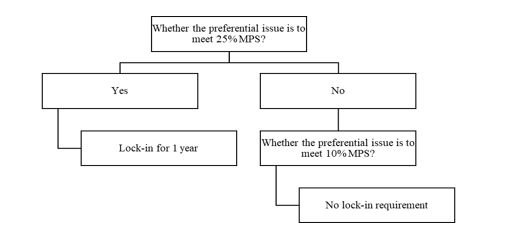
Interpretation 2: Such subscription shall be required to be locked-in for a period of 1 year, because such subscription is in excess of MPC i.e. it is in excess of zero contribution required and as per regulation 115(b), the excess promoters’ contribution shall be under lock-in for a period of 1 year.

This can be understood with the following diagram:

  1. Non-applicability of lock-in requirements in case of equity shares issued on a preferential basis pursuant to any resolution of stressed assets or a resolution plan.

SEBI, in its agenda of Board Meeting dated 16th December, 2020 to discuss recalibration of threshold for Minimum Public Shareholding norms, enhanced disclosures in Companies which undergo CIRP[3], proposed to do away with the lock-in requirements of equity shares issued on a preferential basis pursuant to any resolution of stressed assets under a framework specified by RBI or a resolution plan approved under IBC, 2016.

The rationale for the proposed amendment was that as per rule 19A(5) of Securities Contracts (Regulations) Rules, 1957[4], if the minimum public shareholding (hereinafter referred to as “MPS”) falls below 10% due to CIRP, such listed companies are required to bring MPS to at least 10% within a period of 18 months and to 25% within 3 years from the date of such fall.

As per regulation 167(4), the equity shares issued on a preferential basis pursuant to any resolution of stressed assets or a resolution plan, shall be locked-in for a period of one year. Thus, any allotment to the Resolution Applicant (RA) is locked in for a period of one year. Such lock-in of shares does not facilitate dilution of promoter shareholding to achieve MPS requirement.

Therefore, SEBI inserted the new proviso after regulation 167(4) whereby it relaxed the lock-in requirement of specified securities to the extent to achieve 10% public shareholding. This can be understood with the following diagram:

Conclusion:

Even though SEBI has tried to relax the MPC and lock-in requirements in case of issue of specified securities pursuant to FPO and resolution of stressed assets or a resolution plan, it has created ambiguity in the relaxation of lock-requirements in case of excess promoters’ contribution in case of FPO. SEBI should review the Amendment Regulations and undo the deletion of existing proviso after regulation 115(c) of ICDR Regulations to retain the exemption.

Table containing the relevant provisions of ICDR Regulations before and after the amendment.

Before Amendment After Amendment
Chapter IV: Further Public Offer, Part III: Promoters’ Contribution
Regulation 112: Requirement of minimum promoters’ contribution not applicable in certain cases
The requirements of minimum promoters’ contribution shall not apply in case of:

a)   an issuer which does not have any identifiable promoter;

b)   where the equity shares of the issuer are frequently traded on a stock exchange for a period of at least three years and the issuer has a track record of dividend payment for at least three immediately preceding years:

Provided that where the promoters propose to subscribe to the specified securities offered to the extent greater than higher of the two options available in clause (a) of sub-regulation (1) of regulation 113, the subscription in excess of such percentage shall be made at a price determined in terms of the provisions of regulation 164 or the issue price, whichever is higher.

Explanation: The reference date for the purpose of computing the annualised trading turnover referred to in the said Explanation shall be the date of filing the draft offer document with the Board and in case of a fast track issue, the date of filing the offer document with the Registrar of Companies, and before opening of the issue.

The requirements of minimum promoters’ contribution shall not apply in case of:

a)     an issuer which does not have any identifiable promoter;

b)    where the equity shares of the issuer are frequently traded on a stock exchange for a period of at least three years immediately preceding the reference date, and the issuer has a track record of dividend payment for at least three immediately preceding years:

(i)     the issuer has redressed at least ninety five per cent of the complaints received from the investors till the end of the quarter immediately preceding the month of the reference date, and;

(ii)   the issuer has been in compliance with the SEBI (LODR) Regulations, 2015 for a minimum period of three years immediately preceding the reference date:

(iii) Provided that if the issuer has not complied with the provisions of the SEBI (LODR) Regulations, 2015, relating to composition of board of directors, for any quarter during the last three years immediately preceding the date of filing of draft offer document/ offer document, but is compliant with such provisions at the time of filing of draft offer document/ offer document, and adequate disclosures are made in the offer document about such non-compliances during the three years immediately preceding the date of filing the draft offer document/ offer document, it shall be deemed as compliance with the condition:

Provided further that where the promoters propose to subscribe to the specified securities offered to the extent greater than higher of the two options available in clause (a) of sub-regulation (1) of regulation 113, the subscription in excess of such percentage shall be made at a price determined in terms of the provisions of regulation 164 or the issue price, whichever is higher.

Explanation: The reference date for the purpose of computing the annualised trading turnover referred to in the said Explanation shall be the date of filing the draft offer document with the Board and in case of a fast track issue, the date of filing the offer document with the Registrar of Companies, and before opening of the issue.

Regulation 115: Lock-in of specified securities held by promoters
The specified securities held by the promoters shall not be transferable (hereinafter referred to as “locked-in”) for the periods as stipulated hereunder:

a)  minimum promoters’ contribution including contribution made by alternative investment funds, or foreign venture capital investors, as applicable, shall be locked-in for a period of three years from the date of commencement of commercial production or from the date of allotment in the further public offer, whichever is later;

b)  promoters’ holding in excess of minimum promoters’ contribution shall be locked-in for a period of one year:

c)  The SR equity shares shall be under lock-in until their conversion to equity shares having voting rights same as that of ordinary shares, provided they are in compliance with the other provisions of these regulations.

Provided that the excess promoters’ contribution as provided in the proviso to clause (b) of regulation 112 shall not be subject to lock-in.

The specified securities held by the promoters shall not be transferable (hereinafter referred to as “locked-in”) for the periods as stipulated hereunder:

a)   minimum promoters’ contribution including contribution made by alternative investment funds, or foreign venture capital investors, as applicable, shall be locked-in for a period of three years from the date of commencement of commercial production or from the date of allotment in the further public offer, whichever is later;

b)  promoters’ holding in excess of minimum promoters’ contribution shall be locked-in for a period of one year:

c)  The SR equity shares shall be under lock-in until their conversion to equity shares having voting rights same as that of ordinary shares, provided they are in compliance with the other provisions of these regulations.

Provided that the excess promoters’ contribution as provided in the proviso to clause (b) of regulation 112 shall not be subject to lock-in.

Chapter V: Preferential issue, Part V: Lock-in and Restrictions on Transferability
Regulation 167: Lock-in
(4) The equity shares issued on a preferential basis pursuant to any resolution of stressed assets under a framework specified by the Reserve Bank of India or a resolution plan approved by the National Company Law Tribunal under the Insolvency and Bankruptcy Code 2016, shall be locked-in for a period of one year from the trading approval (4) The equity shares issued on a preferential basis pursuant to any resolution of stressed assets under a framework specified by the Reserve Bank of India or a resolution plan approved by the National Company Law Tribunal under the Insolvency and Bankruptcy Code 2016, shall be locked-in for a period of one year from the trading approval.

Provided that the lock-in provision shall not be applicable to the specified securities to the extent to achieve 10% public shareholding.

Our other related material:

  1. https://vinodkothari.com/2020/10/eligibility-and-disclosures-under-rights-issue-rationalized/
  2. https://vinodkothari.com/2020/06/sebis-measures-towards-resuscitation-of-financially-stressed-companies/
  3. https://vinodkothari.com/2018/09/key-amendments-sebi-icdr-reg-2018/
  4. https://vinodkothari.com/2019/01/sebi-amends-icdr-regulations-2018/https://vinodkothari.com/2019/01/sebi-amends-icdr-regulations-2018/
  5. https://vinodkothari.com/2018/09/sebi-icdr-regulations-2018-key-amendments/


[1] https://www.sebi.gov.in/web/?file=https://www.sebi.gov.in/sebi_data/meetingfiles/dec-2020/1608617470064_1.pdf#page=1&zoom=page-width,-18,797

[2] https://www.sebi.gov.in/legal/regulations/jan-2021/securities-and-exchange-board-of-india-issue-of-capital-and-disclosure-requirements-amendment-regulations-2021_48704.html

[3] https://www.sebi.gov.in/web/?file=https://www.sebi.gov.in/sebi_data/meetingfiles/dec-2020/1608621922552_1.pdf#page=1&zoom=page-width,-18,801

[4] https://www.sebi.gov.in/legal/rules/feb-1957/securities-contracts-regulations-rules-1957_34671.html


Law relating to collective investment schemes on shared ownership of real assets

-Vinod Kothari (finserv@vinodkothari.com)

The law relating to collective investment schemes has always been, and perhaps will remain, enigmatic, because these provisions were designed to ensure that enthusiastic operators do not source investors’ money with tall promises of profits or returns, and start running what is loosely referred to as Ponzi schemes of various shades. De facto collective investment schemes or schemes for raising money from investors may be run in elusive forms as well – as multi-level marketing schemes, schemes for shared ownership of property or resources, or in form of cancellable contracts for purchase of goods or services on a future date.

While regulations will always need to chase clever financial fraudsters, who are always a day ahead of the regulator, this article is focused on schemes of shared ownership of properties. Shared economy is the cult of the day; from houses to cars to other indivisible resources, the internet economy is making it possible for users to focus on experience and use rather than ownership and pride of possession. Our colleagues have written on the schemes for shared property ownership[1]. Our colleagues have also written about the law of collective investment schemes in relation to real estate financing[2]. Also, this author, along with a colleague, has written how the confusion among regulators continues to put investors in such schemes to prejudice and allows operators to make a fast buck[3].

This article focuses on the shared property devices and the sweep of the law relating to collective investment schemes in relation thereto.

Basis of the law relating to collective investment schemes

The legislative basis for collective investment scheme regulations is sec. 11AA (2) of the SEBI Act. The said section provides:

Any scheme or arrangement made or offered by any company under which,

  • the contributions, or payments made by the investors, by whatever name called, are pooled and utilized solely for the purposes of the scheme or arrangement;
  • the contributions or payments are made to such scheme or arrangement by the investors with a view to receive profits, income, produce or property, whether movable or immovable from such scheme or arrangement;
  • the property, contribution or investment forming part of scheme or arrangement, whether identifiable or not, is managed on behalf of the investors;
  • the investors do not have day to day control over the management and operation of the scheme or arrangement.

The major features of a CIS may be visible from the definition. These are:

  1. A schematic for the operator to collect investors’ money: There must be a scheme or an arrangement. A scheme implies a well-structured arrangement whereby money is collected under the scheme. Usually, every such scheme provides for the entry as well as exit, and the scheme typically offers some rate of return or profit. Whether the profit is guaranteed or not, does not matter, at least looking at the definition. Since there is a scheme, there must be some operator of the scheme, and there must be some persons who put in their money into the scheme. These are called “investors”.
  2. Pooling of contributions: The next important part of a CIS is the pooling of contributions. Pooling implies the contributions losing their individuality and becoming part of a single fungible hotchpot. If each investor’s money, and the investments therefrom, are identifiable and severable, there is no pooling. The whole stance of CIS is collective investment. If the investment is severable, then the scheme is no more a collective scheme.
  3. Intent of receiving profits, produce, income or property: The intent of the investors contributing money is to receive results of the collective investment. The results may be in form of profits, produce, income or property. The usual feature of CIS is the operator tempting investors with guaranteed rate of return; however, that is not an essential feature of CISs.
  4. Separation of management and investment: The management of the money is in the hands of a person, say, investment manager. If the investors manage their own investments, there is no question of a CIS. Typically, investor is someone who becomes a passive investor and does not have first level control (see next bullet). It does not matter whether the so-called manager is an investor himself, or may be the operator of the scheme as well. However, the essential feature is there being multiple “investors”, and one or some “manager”.
  5. Investors not having regular control over the investments: As discussed above, the hiving off of the ownership and management of funds is the very genesis of the regulatory concern in a CIS, and therefore, that is a key feature.

The definition may be compared with section 235 of the UK Financial Services and Markets Act, which provides as follows:

  • In this Part “collective investment scheme” means any arrangements with respect to property of any description, including money, the purpose or effect of which is to enable persons taking part in the arrangements (whether by becoming owners of the property or any part of it or otherwise) to participate in or receive profits or income arising from the acquisition, holding, management or disposal of the property or sums paid out of such profits or income.
  • The arrangements must be such that the persons who are to participate (“participants”) do not have day-to-day control over the management of the property, whether or not they have the right to be consulted or to give directions.
  • The arrangements must also have either or both of the following characteristics—
  • the contributions of the participants and the profits or income out of which payments are to be made to them are pooled;
  • the property is managed as a whole by or on behalf of the operator of the scheme.
    • If arrangements provide for such pooling as is mentioned in subsection (3)(a) in relation to separate parts of the property, the arrangements are not to be regarded as constituting a single collective investment scheme unless the participants are entitled to exchange rights in one part for rights in another.

It is conspicuous that all the features of the definition in the Indian law are present in the UK law as well.

Hong Kong Securities and Futures Ordinance [Schedule 1] defines a collective investment scheme as follows:

collective investment scheme means—

  • arrangements in respect of any property—
  • under which the participating persons do not have day-to-day control over the management of the property, whether or not they have the right to be consulted or to give directions in respect of such management;
  • under which—
  • the property is managed as a whole by or on behalf of the person operating the arrangements;
  • the contributions of the participating persons and the profits or income from which payments are made to them are pooled; or
  • the property is managed as a whole by or on behalf of the person operating the arrangements, and the contributions of the participating persons and the profits or income from which payments are made to them are pooled; and
  • the purpose or effect, or pretended purpose or effect, of which is to enable the participating persons, whether by acquiring any right, interest, title or benefit in the property or any part of the property or otherwise, to participate in or receive—
  • profits, income or other returns represented to arise or to be likely to arise from the acquisition, holding, management or disposal of the property or any part of the property, or sums represented to be paid or to be likely to be paid out of any such profits, income or other returns; or
  • a payment or other returns arising from the acquisition, holding or disposal of, the exercise of any right in, the redemption of, or the expiry of, any right, interest, title or benefit in the property or any part of the property; or
  • arrangements which are arrangements, or are of a class or description of arrangements, prescribed by notice under section 393 of this Ordinance as being regarded as collective investment schemes in accordance with the terms of the notice.

One may notice that this definition as well has substantially the same features as the definition in the UK law.

Judicial analysis of the definition

Part (iii) of the definition in Indian law refers to management of the contribution, property or investment on behalf of the investors, and part (iv) lays down that the investors do not have day to day control over the operation or management. The same features, in UK law, are stated in sec. 235 (2) and (3), emphasizing on the management of the contributions as a whole, on behalf of the investors, and investors not doing individual management of their own money or property. The question has been discussed in multiple UK rulings. In Financial Conduct Authority vs Capital Alternatives and others,  [2015] EWCA Civ 284, [2015] 2 BCLC 502[4], UK Court of Appeal, on the issue whether any extent of individual management by investors will take the scheme of the definition of CIS, held as follows:  “The phrase “the property is managed as a whole” uses words of ordinary language. I do not regard it as appropriate to attach to the words some form of exclusionary test based on whether the elements of individual management were “substantial” – an adjective of some elasticity. The critical question is whether a characteristic feature of the arrangements under the scheme is that the property to which those arrangements relate is managed as a whole. Whether that condition is satisfied requires an overall assessment and evaluation of the relevant facts. For that purpose it is necessary to identify (i) what is “the property”, and (ii) what is the management thereof which is directed towards achieving the contemplated income or profit. It is not necessary that there should be no individual management activity – only that the nature of the scheme is that, in essence, the property is managed as a whole, to which question the amount of individual management of the property will plainly be relevant”.

UK Supreme Court considered a common collective land-related venture, viz., land bank structure, in Asset Land Investment Plc vs Financial Conduct Authority, [2016] UKSC 17[5]. Once again, on the issue of whether the property is collective managed, or managed by respective investors, the following paras from UK Financial Conduct Authority were cited with approval:

The purpose of the ‘day-to-day control’ test is to try to draw an important distinction about the nature of the investment that each investor is making. If the substance is that each investor is investing in a property whose management will be under his control, the arrangements should not be regarded as a collective investment scheme. On the other hand, if the substance is that each investor is getting rights under a scheme that provides for someone else to manage the property, the arrangements would be regarded as a collective investment scheme.

Day-to-day control is not defined and so must be given its ordinary meaning. In our view, this means you have the power, from day-to-day, to decide how the property is managed. You can delegate actual management so long as you still have day-to-day control over it.[6]

The distancing of control over a real asset, even though owned by the investor, may put him in the position of a financial investor. This is a classic test used by US courts, in a test called Howey Test, coming from a 1946 ruling in SEC vs. Howey[7]. If an investment opportunity is open to many people, and if investors have little to no control or management of investment money or assets, then that investment is probably a security. If, on the other hand, an investment is made available only to a few close friends or associates, and if these investors have significant influence over how the investment is managed, then it is probably not a security.

The financial world and the real world

As is apparent, the definition in sec. 235 of the UK legislation has inspired the draft of the Indian law. It is intriguing to seek as to how the collective ownership or management of real properties has come within the sweep of the law. Evidently, CIS regulation is a part of regulation of financial services, whereas collective ownership or management of real assets is a part of the real world. There are myriad situations in real life where collective business pursuits,  or collective ownership or management of properties is done. A condominium is one of the commonest examples of shared residential space and services. People join together to own land, or build houses. In the good old traditional world, one would have expected people to come together based on some sort of “relationship” – families, friends, communities, joint venturers, or so on. In the interweb world, these relationships may be between people who are invisibly connected by technology. So the issue, why would a collective ownership or management of real assets be regarded as a financial instrument, to attract what is admittedly a  piece of financial law.

The origins of this lie in a 1984 Report[8] and a 1985 White Paper[9], by Prof LCB Gower, which eventually led to the enactment of the 1986 UK Financial Markets law. Gower has discussed the background as to why contracts for real assets may, in certain circumstances, be regarded as financial contracts. According to Gower, all forms of investment should be regulated “other than those in physical objects over which the investor will have exclusive control. That is to say, if there was investment in physical objects over which the investor had no exclusive control, it would be in the nature of an investment, and hence, ought to be regulated. However, the basis of regulating investment in real assets is the resemblance the same has with a financial instrument, as noted by UK Supreme Court in the Asset Land ruling: “..the draftsman resolved to deal with the regulation of collective investment schemes comprising physical assets as part of the broader system of statutory regulation governing unit trusts and open-ended investment companies, which they largely resembled.”

The wide sweep of the regulatory definition is obviously intended so as not to leave gaps open for hucksters to make the most. However, as the UK Supreme Court in Asset Land remarked: “The consequences of operating a collective investment scheme without authority are sufficiently grave to warrant a cautious approach to the construction of the extraordinarily vague concepts deployed in section 235.”

The intent of CIS regulation is to capture such real property ownership devices which are the functional equivalents of alternative investment funds or mutual funds. In essence, the scheme should be operating as a pooling of money, rather than pooling of physical assets. The following remarks in UK Asset Land ruling aptly capture the intent of CIS regulation: “The fundamental distinction which underlies the whole of section 235 is between (i) cases where the investor retains entire control of the property and simply employs the services of an investment professional (who may or may not be the person from whom he acquired it) to enhance value; and (ii) cases where he and other investors surrender control over their property to the operator of a scheme so that it can be either pooled or managed in common, in return for a share of the profits generated by the collective fund.”

Conclusion

While the intent and purport of CIS regulation world over is quite clear, but the provisions  have been described as “extraordinarily vague”. In the shared economy, there are numerous examples of ownership of property being given up for the right of enjoyment. As long as the intent is to enjoy the usufructs of a real property, there is evidently a pooling of resources, but the pooling is not to generate financial returns, but real returns. If the intent is not to create a functional equivalent of an investment fund, normally lure of a financial rate of return, the transaction should not be construed as a collective investment scheme.


[1] Vishes Kothari: Property Share Business Models in India, https://vinodkothari.com/blog/property-share-business-models-in-india/

[2] Nidhi Jain, Collective Investment Schemes for Real Estate Investments in India, at https://vinodkothari.com/blog/collective-investment-schemes-for-real-estate-investment-by-nidhi-jain/

[3] Vinod Kothari and Nidhi Jain article at: https://www.moneylife.in/article/collective-investment-schemes-how-gullible-investors-continue-to-lose-money/18018.html

[4] http://www.bailii.org/ew/cases/EWCA/Civ/2015/284.html

[5] https://www.supremecourt.uk/cases/docs/uksc-2014-0150-judgment.pdf

[6] https://www.handbook.fca.org.uk/handbook/PERG/11/2.html

[7] 328 U.S. 293 (1946), at https://supreme.justia.com/cases/federal/us/328/293/

[8] Review of Investor Protection, Part I, Cmnd 9215 (1984)

[9] Financial Services in the United Kingdom: A New Framework for Investor Protection (Cmnd 9432) 1985


Our Other Related Articles

Property Share Business Models in India,< https://vinodkothari.com/blog/property-share-business-models-in-india/>

Collective Investments Schemes: How gullible investors continue to lose money < https://www.moneylife.in/article/collective-investment-schemes-how-gullible-investors-continue-to-lose-money/18018.html>

Collective Investment Schemes for Real Estate Investments in India, < https://vinodkothari.com/blog/collective-investment-schemes-for-real-estate-investment-by-nidhi-jain/>


Market-Linked Debentures – Real or Illusory?

Aanchal Kaur Nagpal and Shreya Masalia

Vinod Kothari and Company | corplaw@vinodkothari.com  

Introduction

Market linked debentures (MLDs) are a type of debt security that provides returns based on the performance of an underlying index/security. When the underlying security does well, the return on MLDs will be high and vice-versa. While the underlying security to which the MLDs are linked is at the discretion of the issuer, the same, however, needs to be related to the market, e.g. indices such as Nifty 50, SENSEX etc., or securities like equity, debt securities, government securities etc. For an in-depth understanding of the concept and the regulatory framework of MLDs, read our article here.

The previous article touched upon the concern of MLDs being used for the purpose of regulatory arbitrage, without being truly market-linked. The regulatory arbitrage may come in the form of additional ISINs, exemption from EBP mechanism, etc. The same has been discussed in detail in the previous article.

In this article, we shall examine various case studies (picked from various information memorandum available on the stock exchange and websites of companies) to prove the point.

The case studies are tabulated below:

S. No. Underlying The basis for coupon payoff Likely/unlikely conditions
1. NIFTY 50 If final fixing level > 25% of initial level, coupon – 8.1767% (XIRR 8.000%)

Suppose,
Initial level (NIFTY 50) index = 11400
25% of initial level (NIFTY 50) = 2850

So, if the final fixing level is above a value of 2850, then coupon pay off will be 8%.
If the final fixing level is below 2850, the coupon will be 0%.

Conclusion –

This condition is highly unlikely to happen. Looking at past trends, the probability that NIFTY 50 would fall below the level of 2850 is very low.

2. NIFTY 50 If Final >= Initial, Principal Amount * 20.50%
If Final < Initial, Principal Amount * 19.65%
Conclusion-
This is a likely condition. However, in all cases, the investor is going to receive coupon payoff, even if the underlying performs negatively, there is a payoff.The level of rise in Nifty is not related to the return that the investor will receive. i.e. if the initial level is 10,000 and nifty either rises to 20,000 or 10, 200, the return will be the same.

Difference between coupon payoffs in both the scenarios i.e. whether the underlying performs or not is less than 1%.

3. G-sec The initial fixing level is 105.94 (which is the price of G-sec on the initial fixing date)

Suppose,
If the final fixing level is >=79.455 – then the coupon will be 8%
If the final fixing level is <79.455 but >= 26.485 then the coupon will be 7.95%
If the final fixing level is <26.485 then the coupon will be 0%.


Conclusion –

The downside condition is highly unlikely to happen. The probability that the price of the G-sec on the final fixing date will fall below 26.485 from a level of 105.94 is very low. In fact, on the final fixing date, the price of the G-sec was 108.17 which is higher than the initial fixing level.

4. NIFTY 50 Initial level – an average of 6 observations
Final level – an average of 6 observations
Nifty performance- final level/initial level – 1
Fixed coupon- 26.70%
Participation rate (variable component)- 85%Coupon payoff –
If Final Level >= Initial Level, Principal + Max Fixed-Coupon, Participation rate * Nifty Performance)
Else, If Final Level < Initial Level; Principal + Fixed-Coupon.
Conclusion –

This is a likely condition. Here the coupon payoff is a combination of the fixed and variable part (Directly depending on the performance of nifty)
Even if the underlying performs negatively, the investor will still earn the fixed component along with the principal.

5. NIFTY 50 If Final Fixing Level <= 25% of Initial Fixing Level: 0.000%
If Final Fixing Level > 25% of Initial Fixing Level: 7.4273% p.a.
(XIRR 6.95% p.a.)Suppose,
Initial level (NIFTY 50) index = 9106.25
25% of initial level (NIFTY 50) = 2276.56

So, if the final fixing level is above a value of 2276.56, then coupon pay off will be 6.95%.
If the final fixing level is below 2276.56, the coupon will be 0%.

Conclusion –

This condition is highly unlikely to happen. Looking at past trends, the probability that NIFTY 50 would fall below the level of 2376.56 is very low.

6. G-sec If Final Fixing Level >=25% of the Initial Fixing level, then coupon+ principal
If Final Fixing Level < 25% of the Initial Fixing level, then only principal.
Conclusion –

This condition is highly unlikely to happen. Looking at past trends, the probability that G-sec would fall below 25% of the initial level is low.

7. 10-year G-sec Underlying performance- Final level/ Initial level * 100
Coupon payoff-
If UP >= 75% of initial level- 8.45%
If UP < 75% but >= 25% of initial level, then 8.40%
If UP < 25%, then 0.
Conclusion-
This condition is highly unlikely to happen. Looking at past trends, the probability that G-sec would fall below 25% of the initial level is low.
Also, the difference between the two coupon rates is 0.5%
8. NIFTY 50 Reference Index-Linked Return=
Debenture Face Value* Reference Index Return FactorFactor = Max [0%, 115%* {(Observation Value of the Reference Index / Start Reference Index Value) – 100%}]

115% is the participation rate

Observation Value of the Reference Index shall Mean Closing Value of CNX Nifty on the scheduled valuation date for redemption.

Conclusion
This condition is likely to happen- since the return is directly dependent on the performance of the index.Here, the value of Nifty for example is 5700, if nifty falls below 5700, there will be 0% pay off, if nifty rises above 5700, then the payoff would be 115% of the performance of NIFTY,

For example, if Nifty is 5700 and it rises to 6000- rise is 5%- coupon payoff shall be 115% of 5% = 6.05%.

9. G-sec If the performance of underlying final fixing date –

greater than 50% of digital level : Coupon= 8.6819 p.a.
less than or equal to 50% of digital level: Coupon = 0%

*Digital level: 100% of the Closing price of the reference security, of 7.17 G-Sec 2028 as on Initial Fixing Date.

Conclusion
The condition is unlikely to happen.
E.g. The Value of G-sec on the initial date is 97. 72- The chances that the same will fall below 48.86 is very low.
10. NIFTY 50 If Final Fixing Level <= 25% of Initial Fixing Level: 0.000%
If Final Fixing Level > 25% of Initial Fixing Level: 8.70% p.a. (XIRR 8.35% p.a.)Suppose,
Initial level (NIFTY 50) index = 9106.25
25% of initial level (NIFTY 50) = 2276.56

So, if the final fixing level is above a value of 2276.56, then coupon pay off will be 6.95%.
If the final fixing level is below 2276.56, the coupon will be 0%.

Conclusion –

This condition is highly unlikely to happen. Looking at past trends, the probability that Nifty 50 would fall below the level of 2376.56 is very low.

Further, put option is given- participation rate is lower i.e. 65%.

11. NIFTY 50 Coupon amount –

A) If Final > 140% of Initial, then coupon rate =Performance% of the initial principal amount
Or
B) If Final <= 140% of Initial, then coupon rate = 40% of the initial principal amount.

Conclusion –

This condition is highly unlikely to happen as the possibility of Nifty falling to 40% is rare.

12. NIFTY 50 Coupon = Max(Underlying Performance, Min(48.85%,Max(4.885*Underlying
Performance,0)))Underlying performance – (Final Fixing Level / Initial Fixing Level) – 1
Conclusion –

The condition is likely to happen.
Here, if the initial level is 11404.80 and Nifty is below 11404.80 (negative or 0% performance), then the coupon rate is 0%.
Here, if the Nifty rises above 11404.80 till 12431.23 (up to 9% rise), then the coupon rate shall be as per the formula.
If Nifty rises above 12545.28 till 16977.19 (above 9% up to 48.86% rise), then coupon shall be 48.86%)
If Nifty rises above 16993.15 (above 48.86% rise), then the coupon shall be equal to the underlying performance.

13. G-sec If Final Fixing Level <= 25% of Initial Fixing Level: 0.000%
If Final Fixing Level > 25% of Initial Fixing Level: 6.80% p.a.Suppose,
The initial level of g-sec is 100
25% of initial level (G Sec) = 25
So, if the final fixing level is above a value of 25 then the coupon payoff will be 6.80%.
If the final fixing level is below 25, the coupon will be 0%.
Conclusion –

The condition is highly unlikely. Looking at past trends, the probability that g-sec will fall to 25% is very low.

14. Nifty 10 YR Benchmark G-Sec (Clean Price) index 100% of Principal Amount * (Coupon A + Coupon B) Where,

“Coupon A” shall mean:
A) If Final Level >= 30% of Initial Level (i.e. 0.30 * Initial Level),
Coupon shall mean Rebate i.e. 21%

Or

B) If Final Level < 30% of Initial Level (i.e. 0.30 * Initial Level),
Coupon shall be Nil

“Coupon B” shall mean:

(1 + Coupon A) * 10.50% * (Day-Count/365)

Suppose,
The initial level of g-sec is 925
30% of initial level (G Sec) = 277.5

So, if the final fixing level is above a value of 277.5 then coupon pay off will be 21%.
If the final fixing level is below 25, the coupon will be 0%.

Conclusion –

The condition is highly unlikely. Looking at past trends, the probability that g-sec will fall to 30% is very low.

15. NIFTY 50 If Final Fixing Level >=25% of the Initial Fixing level = 36.405%
If Final Fixing Level < 25% of the Initial Fixing level = 0%Suppose,
Initial level 10710.45
final below 2677.61 only then will the coupon be 0%.
Conclusion –

The condition is highly unlikely. Looking at past trends, the probability that Nifty 50 will fall to 25% is very low.

16. CNX Nifty Here, the entry NIFTY is calculated as average for 3 dates in 3 months.

For the final level- NIFTY on 11 observation dates is calculated.

Increases have been divided into levels – and for each level, there is a percentage for coupon rate.

The highest coupon rate out of all the 11 levels will be taken for the final coupon rate.

The minimum level is 115% of the entry Nifty.

Below that- no level and no coupon.

Conclusion –
The coupon is based on the performance of Nifty and hence is likely to happen.
17. 10 year Government security price (a) if IGB 5.79 05/11/30 Corp Price => 75% of *Digital Level the Coupon rate shall be at 11% p.a. (Maximum)

b) if IGB 5.79 05/11/30 Corp Price is less than 75% but equal to or greater than 25% of *Digital Level the Coupon rate shall be at 10.95% p.a. (Minimum)

(c) if IGB 5.79 05/11/30 Corp Price < 25% of *Digital Level then no Coupon shall be
payable.

*Digital Level – 100% of IGB 5.79 11/05/2020 Corp price at Initial Observation Date.

Conclusion –

As such it’s highly unlikely to receive no coupon at all as the probability of the g-sec falling to 75% is negligible looking at the past trends. Even the probability of the G-sec value falling between 25 – 75 % is unusual, but even if it does, the difference is the coupon rate is merely that of .05% which is negligible.

18. CNX Nifty If Final Fixing Level >=25% of the Initial Fixing level = 32.143%
If Final Fixing Level < 25% of the Initial Fixing level = 0%Suppose,
The initial level is 10252.10
If the final level falls below 2563.03 then the coupon rate will 0 and above that coupon rate will be 9.25%.
Conclusion –

The condition is highly unlikely. Looking at past trends, the probability that Nifty 50 will fall to 25% is very low.

Analysis of the MLD market in India

On an analysis of the cases given above, one can clearly observe that the conditions on which the performance of the underlying is based, are highly unrealistic. An instance where the value of Nifty or a G-sec would fall by 50-75% seems quite impossible where even ‘The Great Depression of 2008’ caused a fall of only 40% in stock indices. Hence in almost all conditions, the investor will always be receiving a coupon and thus the hedging shown is more of a hoax. The MLDs are, thus, not market-linked at all thereby defeating the purpose of introducing MLDs. On lifting the veil of the underlying condition used, it reveals that the MLDs are in fact equivalent to plain vanilla debentures.

Conclusion

The true intent and spirit of introducing the concept of MLDs can be seen missing from a lot of the issuances by the companies. Instead, MLDs, are being issued, rather in some of the most farcical avatars, to gain regulatory arbitrage otherwise not available to plain vanilla debentures. This is indicative of what the market perceives as a bottleneck or a disadvantage, and what the market desires.

This, in itself, may call for a relook at the extant regulatory framework. Relaxations or exemptions should be considered where laws are not meeting the requisite purpose or are harsher than required, except where such relaxations become unconscionable or go against the basic tenets of policy-making.


Recent trends in IBC

Resolution Division

(resolution@vinodkothari.com)

The field of Insolvency in India has of late seen constant change in order to adapt the ever moving global scenario. Being one of the topics that has been trending ever since its inception and with the possible introduction of several new concepts including subjects like pre pack insolvency and some recent amendments due to the pandemic, a compilation on the following topics in our presentation providing a brief glance through on the same has been made-

  1. Amendments due to COVID 19
  2. Separate Insolvency process for MSME’s
  3. Expected introduction of pre pack insolvency framework
  4. Assignment of NRRA
  5. Group Insolvency
  6. Developments in Going Concern Sale

https://vinodkothari.com/wp-content/uploads/2021/01/Recent-trends-in-IBC.pdf


Digital Consumer Lending: Need for prudential measures and addressing consumer protection

-Siddarth Goel (finserv@vinodkothari.com)

Introduction

“If it looks like a duck, swims like a duck, and quacks like a duck, then it probably is a duck”

The above phrase is the popular duck test which implies abductive reasoning to identify an unknown subject by observing its habitual characteristics. The idea of using this duck test phraseology is to determine the role and function performed by the digital lending platforms in consumer credit.

Recently the Reserve Bank of India (RBI) has constituted a working group to study how to make access to financial products and services more fair, efficient, and inclusive.[1]  With many news instances lately surrounding the series of unfortunate events on charging of usurious interest rate by certain online lenders and misery surrounding the threats and public shaming of some of the borrowers by these lenders. The RBI issued a caution statement through its press release dated December 23, 2020, against unauthorised digital lending platforms/mobile applications. The RBI reiterated that the legitimate public lending activities can be undertaken by Banks, Non-Banking Financial Companies (NBFCs) registered with RBI, and other entities who are regulated by the State Governments under statutory provisions, such as the money lending acts of the concerned states. The circular further mandates disclosure of banks/NBFCs upfront by the digital lender to customers upfront.

There is no denying the fact that these digital lending platforms have benefits over traditional banks in form of lower transaction costs and credit integration of the unbanked or people not having any recourse to traditional bank lending. Further, there are some self-regulatory initiatives from the digital lending industry itself.[2] However, there is a regulatory tradeoff in the lender’s interest and over-regulation to protect consumers when dealing with large digital lending service providers. A recent judgment by the Bombay High Court ruled that:

“The demand of outstanding loan amount from the person who was in default in payment of loan amount, during the course of employment as a duty, at any stretch of imagination cannot be said to be any intention to aid or to instigate or to abet the deceased to commit the suicide,”[3]

This pronouncement of the court is not under criticism here and is right in its all sense given the facts of the case being dealt with. The fact there needs to be a recovery process in place and fair terms to be followed by banks/NBFCs and especially by the digital lending platforms while dealing with customers. There is a need to achieve a middle ground on prudential regulation of these digital lending platforms and addressing consumer protection issues emanating from such online lending. The regulator’s job is not only to oversee the prudential regulation of the financial products and services being offered to the consumers but has to protect the interest of customers attached to such products and services. It is argued through this paper that there is a need to put in place a better governing system for digital lending platforms to address the systemic as well as consumer protection concerns. Therefore, the onus of consumer protection is on the regulator (RBI) since the current legislative framework or guidelines do not provide adequate consumer protection, especially in digital consumer credit lending.

Global Regulatory Approaches

US

The Office of the Comptroller of the Currency (OCC) has laid a Special Purpose National Bank (SPNV) charters for fintech companies.[4] The OCC charter begins reviewing applications, whereby SPNV are held to the same rigorous standards of safety and soundness, fair access, and fair treatment of customers that apply to all national banks and federal savings associations.

The SPNV that engages in federal consumer financial law, i.e. in provides ‘financial products and services to the consumer’ is regulated by the ‘Consumer Financial Protection Bureau (CFPB)’. The other factors involved in application assessment are business plans that should articulate a clear path and timeline to profitability. While the applicant should have adequate capital and liquidity to support the projected volume. Other relevant considerations considered by OCC are organizers and management with appropriate skills and experience.

The key element of a business plan is the proposed applicant’s risk management framework i.e. the ability of the applicant to identify, measure, monitor, and control risks. The business plan should also describe the bank’s proposed internal system of controls to monitor and mitigate risk, including management information systems. There is a need to provide a risk assessment with the business plan. A realistic understanding of risk and there should be management’s assessment of all risks inherent in the proposed business model needs to be shown.

The charter guides that the ongoing capital levels of the applicant should commensurate with risk and complexity as proposed in the activity. There is minimum leverage that an SPNV can undertake and regulatory capital is required for measuring capital levels relative to the applicant’s assets and off-balance sheet exposures.

The scope and purpose of CFPB are very broad and covers:

“scope of coverage” set forth in subsection (a) includes specified activities (e.g., offering or providing: origination, brokerage, or servicing of consumer mortgage loans; payday loans; or private education loans) as well as a means for the CFPB to expand the coverage through specified actions (e.g., a rulemaking to designate “larger market participants”).[5]

CFPB is established through the enactment of Dood-Frank Wall Street Reform and Consumer Protection Act. The primary function of CFPB is to enforce consumer protection laws and supervise regulated entities that provide consumer financial products and services.

“(5)CONSUMER FINANCIAL PRODUCT OR SERVICES  The term “consumer financial product or service” means any financial product or service that is described in one or more categories under—paragraph (15) and is offered or provided for use by consumers primarily for personal, family, or household purposes; or **

“(15)Financial product or service-

(A)In general The term “financial product or service” means—(i)extending credit and servicing loans, including acquiring, purchasing, selling, brokering, or other extensions of credit (other than solely extending commercial credit to a person who originates consumer credit transactions);”

Thus CFPB is well placed as a separate institution to protect consumer interest and covers a wide range of financial products and services including extending credit, servicing, selling, brokering, and others. The regulatory environment has been put in place by the OCC to check the viability of fintech business models and there are adequate consumer protection laws.

EU

EU’s technologically neutral regulatory and supervisory systems intend to capture not only traditional financial services but also innovative business models. The current dealing with the credit agreements is EU directive 2008/48/EC of on credit agreements for consumers (Consumer Credit Directive – ‘Directive’). While the process of harmonising the legislative framework is under process as the report of the commission to the EU parliament raised some serious concerns.[6] The commission report identified that the directive has been partially effective in ensuring high standards of consumer protection. Despite the directive focussing on disclosure of annual percentage rate of charge to the customers, early payment, and credit databases. The report cited that the primary reason for the directive being impractical is because of the exclusion of the consumer credit market from the scope of the directive.

The report recognised the increase and future of consumer credit through digitisation. Further the rigid prescriptions of formats for information disclosure which is viable in pre-contractual stages, i.e. where a contract is to be subsequently entered in a paper format. There is no consumer benefit in an increasingly digital environment, especially in situations where consumers prefer a fast and smooth credit-granting process. The report highlighted the need to review certain provisions of the directive, particularly on the scope and the credit-granting process (including the pre-contractual information and creditworthiness assessment).

China

China has one of the biggest markets for online mico-lending business. The unique partnership of banks and online lending platforms using innovative technologies has been the prime reason for the surge in the market. However, recently the People’s Bank of China (PBOC) and China Banking and Insurance Regulatory Commission (CBIRC) issued draft rules to regulate online mico-lending business. Under the draft rules, there is a requirement for online underwriting consumer loans fintech platform to have a minimum fund contribution of at least 30 % in a loan originated for banks. Further mico-lenders sourcing customer data from e-commerce have to share information with the central bank.

Australia

The main legislation that governs the consumer credit industry is the National Consumer Credit Protection Act (“National Credit Act”) and the National Credit Code. Australian Securities & Investments Commission (ASIC) is Australia’s integrated authority for corporate, markets, financial services, and consumer credit regulator. ASIC is a consumer credit regulator that administers the National Credit Act and regulates businesses engaging in consumer credit activities including banks, credit unions, finance companies, along with others. The ASIC has issued guidelines to obtain licensing for credit activities such as money lenders and financial intermediaries.[7] Credit licensing is needed for three sorts of entities.

  • engage in credit activities as a credit provider or lessor
  • engage in credit activities other than as a credit provider or lessor (e.g. as a credit representative or broker)
  • engage in all credit activities

The applicants of credit licensing are obligated to have adequate financial resources and have to ensure compliance with other supervisory arrangements to engage in credit activates.

UK

Financial Conduct Authority (FCA) is the regulator for consumer credit firms in the UK. The primary objective of FCA ensues; a secure and appropriate degree of protection for consumers, protect and enhance the integrity of the UK financial system, promote effective competition in the interest of consumers.[8] The consumer credit firms have to obtain authorisation from FCA before carrying on consumer credit activities. The consumer credit activities include a plethora of credit functions including entering into a credit agreement as a lender, credit broking, debt adjusting, debt collection, debt counselling, credit information companies, debt administration, providing credit references, and others. FCA has been successful in laying down detailed rules for the price cap on high-cost short-term credit.[9] The price total cost cap on high-cost short-term credit (HCSTC loans) including payday loans, the borrowers must never have to pay more in fees and interest than 100% of what they borrowed. Further, there are rules on credit broking that provides brokers from charging fees to customers or requesting payment details unless authorised by FCA.[10] The fee charged from customers is to be reported quarterly and all brokers (including online credit broking) need to make clear that they are advertising as a credit broker and not a lender. There are no fixed capital requirements for the credit firms, however, adequate financial resources need to be maintained and there is a need to have a business plan all the time for authorisation purposes.

Digital lending models and concerns in India

Countries across the globe have taken different approaches to regulate consumer lending and digital lending platforms. They have addressed prudential regulation concerns of these credit institutions along with consumer protection being the top priority under their respective framework and legislations. However, these lending platforms need to be looked at through the current governing regulatory framework from an Indian perspective.

The typical credit intermediation could be performed by way of; peer to peer (P2P) lending model, notary model (bank-based) guaranteed return model, balance sheet model, and others. P2P lending platforms are heavily regulated and hence are not of primary concern herein. Online digital lending platforms engaged in consumer lending are of significance as they affect investor’s and borrowers’ interests and series of legal complexions arise owing to their agency lending models.[11] Therefore careful anatomy of these models is important for investors and consumer protection in India.

Should digital lending be regulated?

Under the current system, only banks, NBFCs, and money lenders can undertake lending activities. The regulated banks and NBFCs also undertake online consumer lending either through their website/platforms or through third-party lending platforms. These unregulated third-party digital lending platforms count on their sophisticated credit underwriting analytics software and engage in consumer lending services. Under the simplest version of the bank-based lending model, the fintech lending platform offers loan matching services but the loan is originated in books of a partnering bank or NBFC. Thus the platform serves as an agent that brings lenders (Financial institutions) and borrowers (customers) together. Therefore RBI has mandated fintech platforms has to abide by certain roles and responsibilities of Direct Selling Agent (DSA) as under Fair Practice Code ‘FPC’ and partner banks/NBFCs have to ensure Guidelines on Managing Risks and Code of Conduct in Outsourcing of Financial Service (‘outsourcing code’).[12] In the simplest of bank-based models, the banks bear the credit risk of the borrowers and the platform earns their revenues by way of fees and service charges on the transaction. Since banks and NBFCs are prudentially regulated and have to comply with Basel capital norms, there are not real systemic concerns.

However, the situation alters materially when such a third-party lending platform adopts balance sheet lending or guaranteed return models. In the former, the servicer platform retains part of the credit risk on its book and could also give some sort of loss support in form of a guarantee to its originating partner NBFC or bank.[13] While in the latter case it a pure guarantee where the third-party lending platform contractually promises returns on funds lent through their platforms. There is a devil in detailed scrutiny of these business models. We have earlier highlighted the regulatory issues in detail around fintech practices and app-based lending in our write up titled ‘Lender’s piggybacking: NBFCs lending on Fintech platforms’ gurantees’.

From the prudential regulation perspective in hindsight, banks, and NBFCs originating through these third-party lending platforms are not aware of the overall exposure of the platforms to the banking system. Hence there is a presence of counterparty default risk of the platform itself from the perspective of originating banks and NBFCs. In a real sense, there is a kind of tri-party arrangement where funds flow from ‘originator’ (regulated bank/NBFC) to the ‘platform’ (digital service provider) and ultimately to the ‘borrower'(Customer). The unregulated platform assumes the credit risk of the borrower, and the originating bank (or NBFC) assumes the risk of the unregulated lending platform.

Curbing unregulated lending

In the balance sheet and guaranteed return models, an undercapitalized entity takes credit risk. In the balance sheet model, the lending platform is directly taking the credit risk and may or may not have to get itself registered as NBFC with RBI. The registration requirement as an NBFC emanates if the financial assets and financial income of the platform is more than 50 % of its total asset and income of such business (‘principal business criteria’ see footnote 12). While in the guaranteed return model there is a form of synthetic lending and there is absolutely no legal requirement for the lending platform to get themselves registered as NBFC. The online lending platform in the guaranteed return model serves as a loan facilitator from origination to credit absorption. There is a regulatory arbitrage in this activity. Since technically this activity is not covered under the “financial activity” and the spread earned in not “financial income” therefore there is no requirement for these entities to get registered as NBFCs.[14]

Any sort of guarantee or loss support provided by the third-party lending platform to its partner bank/NBFC is a synthetic exposure. In synthetic lending, the digital lending platform is taking a risk on the underlying borrower without actually taking direct credit risk. Additionally, there are financial reporting issues and conflict of interest or misalignment of incentives, i.e. the entities do not have to abide by IND AS and can show these guarantees as contingent liabilities. On the contrary, they charge heavy interest rates from customers to earn a higher spread. Hence synthetic lending provides all the incentives for these third-party lending platforms to enter into risky lending which leads to the generation of sub-prime assets. The originating banks and NBFCs have to abide by minimum capital requirements and other regulatory norms. Hence the sub-prime generation of consumer credit loans is supplemented by heavy returns offered to the banks. It is argued that the guaranteed returns function as a Credit Default Swap ‘CDS’ which is not regulated as CDS. Thus the online lending platform escapes the regulatory purview and it is shown in the latter part this leads to poor credit discipline in consumer lending and consumer protection is often put on the back burner.

From the prudential regulation perspective restricting banks/NBFCs from undertaking any sort of guaranteed return or loss support protection, can curb the underlying emergence of systemic risk from counterparty default. While a legal stipulation to the effect that NBFCs/Banks lending through the third-party unregulated platform, to strictly lend independently i.e. on a non-risk sharing basis of the credit risk. Counterintuitively, the unregulated online lending platforms have to seek registration as an NBFC if they want to have direct exposure to the underlying borrower, subject to fulfillment of ‘principal business criteria’.[15] Such a governing framework will reduce the incentives for banks and NBFCs to exploit excessive risk-taking through this regulatory arbitrage opportunity.

Ensuring Fairness and Consumer Protection

There are serious concerns of fair dealing and consumer protection aspects that have arisen lately from digital online lending platforms. The loans outsourced by Banks and NBFCs over digital lending platforms have to adhere to the FPC and Outsourcing code.

The fairness in a loan transaction calls for transparent disclosure to the borrower all information about fees/charges payable for processing the loan application, disbursed, pre-payment options and charges, the penalty for delayed repayments, and such other information at the time of disbursal of the loan. Such information should also be displayed on the website of the banks for all categories of loan products. It may be mentioned that levying such charges subsequently without disclosing the same to the borrower is an unfair practice.[16]

Such a legal requirement gives rise to the age-old question of consumer law, yet the most debatable aspect. That mere disclosure to the borrower of the loan terms in an agreement even though the customer did not understand the underlying obligations is a fair contract (?) It is argued that let alone the disclosures of obligations in digital lending transactions, customers are not even aware of their remedies. Under the current RBI regulatory framework, they have the remedy to approach grievance redressal authorities of the originating bank/NBFC or may approach the banking ombudsman. However, things become even more peculiar in cases where loans are being sourced or processed through third-party digital platforms. The customers in the majority of the cases are unaware of the fact that the ultimate originator of the loan is a bank/NBFC. The only remedy for such a customer is to seek refuge under the Consumer Protection Act 2019 by way of proving the loan agreement is the one as ‘unfair contract’.

“2(46) “unfair contract” means a contract between a manufacturer or trader or service provider on one hand, and a consumer on the other, having such terms which cause significant change in the rights of such consumer, including the following, namely:— (i) requiring manifestly excessive security deposits to be given by a consumer for the performance of contractual obligations; or (ii) imposing any penalty on the consumer, for the breach of contract thereof which is wholly disproportionate to the loss occurred due to such breach to the other party to the contract; or (iii) refusing to accept early repayment of debts on payment of applicable penalty; or (iv) entitling a party to the contract to terminate such contract unilaterally, without reasonable cause; or (v) permitting or has the effect of permitting one party to assign the contract to the detriment of the other party who is a consumer, without his consent; or (vi) imposing on the consumer any unreasonable charge, obligation or condition which puts such consumer to disadvantage;

It is pertinent to note that neither the scope of consumer financial agreements is regulated in India, nor are the third-party digital lending platforms required to obtain authorisation from RBI. There are instances of high-interest rates and exorbitant fees charged by the online consumer lending platforms which are unfair and detrimental to customers’ interests. The current legislative framework provides that the NBFCs shall furnish a copy of the loan agreement as understood by the borrower along with a copy of each of all enclosures quoted in the loan agreement to all the borrowers at the time of sanction/disbursement of loans.[17] However, like the persisting problem in the EU 2008/48/EC directive, even FPC is not well placed to govern digital lending agreements and disclosures. Taking a queue from the problems recognised by the EU parliamentary committee report. There is no consumer benefit in an increasingly digital environment, especially in situations where there are fast and smooth credit-granting processes. The pre-contractual information on the disclosure of annualised interest rate and capping of the total cost to a customer in consumer credit loans is central to consumer protection.

The UK legislation has been pro-active in addressing the underlying unfair contractual concerns, by fixation of maximum daily interest rates and maximum default fees with an overall cost cap of 100% that could be charged in short-term high-interest rates loan agreements. It is argued that in this Laissez-faire world the financial services business models which are based on imposing an unreasonable charge, obligations that could put consumers to disadvantage should anyways be curbed. Therefore a legal certainty in this regard would save vulnerable customers to seek the consumer court’s remedy in case of usurious and unfair lending.

The master circular on loan and advances provide for disclosure of the details of recovery agency firms/companies to the borrower by the originating bank/NBFC.[18] Further, there is a requirement for such recovery agent to disclose to the borrower about the antecedents of the bank/NBFC they are recovering for.  However, this condition is barely even followed or adhered to and the vulnerable consumers are exposed to all sorts of threats and forceful tactics. As one could appreciate in jurisdictions of the US, UK, Australia discussed above, consumer lending and ancillary services are under the purview of concerned regulators. From the customer protection perspective, at least some sort of authorization or registration requirement with the RBI to keep the check and balances system in place is important for consumer protection. The loan recovery business is sensitive hence there is a need for a proper guiding framework and/or registration requirement of the agents acting as recovery agents on behalf of banks/NBFCs. The mere registration requirement and revocation of same in case of unprofessional activities will serve as a stick to check their consumer dealing practices.

The financial services intermediaries (other than Banks/NBFCs) providing services like credit broking, debt adjusting, debt collection, debt counselling, credit information, debt administration, credit referencing to be licensed by the regulator. The banks/NBFCs dealing with the licensed market intermediaries would go much farther in the successful implementation of FPC and addressing consumer protection concerns from the current system.

Conclusion

From the perspective of sound financial markets and fair consumer practices, it is always prudent to allow only those entities in credit lending businesses that are best placed to bear the credit risk and losses emanating from them. Thus, there is a dearth of a comprehensive legislative framework in consumer lending from origination to debt collection and its administration including the business of providing credit references through digital lending platforms. There may not be a material foreseeable requirement for regulating digital lending platforms completely. However, there is a need to curb synthetic lending by third-party digital lending platforms. Since a risk-taking entity without adequate capitalization will tend to get into generating risky assets with high returns. The off-balance sheet guarantee commitments of these entities force them to be aggressive towards their customers to sustain their businesses. This write-up has explored various regulatory approaches, where jurisdictions like the US and UK, and Australia being the good comparable in addressing consumer protection concerns emanating from online digital lending platforms. Henceforth, a well-framed consumer protection system especially in financial products and services would go much farther in the development and integration of credit through digital lending platforms in the economy.


[1] Reserve Bank of India – Press Releases (rbi.org.in), dated January 13, 2020

[2] Digital lending Association of India, Code of Conduct available at https://www.dlai.in/dlai-code-of-conduct/

[3] Rohit Nalawade Vs. State of Maharashtra High Court of Bombay Criminal Application (APL) NO. 1052 OF 2018 < https://images.assettype.com/barandbench/2021-01/cf03e52e-fedd-4a34-baf6-25dbb55dbf29/Rohit_Nalawade_v__State_of_Maharashtra___Anr.pdf>

[4] https://www.occ.gov/topics/supervision-and-examination/responsible-innovation/comments/pub-special-purpose-nat-bank-charters-fintech.pdf

[5]  12 USC 5514(a); Pay day loans are the short term, high interest bearing loans that are generally due on the consumer’s next payday after the loan is taken.

[6] EU, ‘Report from the Commission to the European Parliament and the Council: on the implementation of Directive 2008/48/EC on credit agreement for consumers’, dated November, 05, 2020, available at < https://ec.europa.eu/transparency/regdoc/rep/1/2020/EN/COM-2020-963-F1-EN-MAIN-PART-1.PDF>

[7] https://asic.gov.au/for-finance-professionals/credit-licensees/applying-for-and-managing-your-credit-licence/faqs-getting-a-credit-licence/

[8] FCA guide to consumer credit firms, available at < https://www.fca.org.uk/publication/finalised-guidance/consumer-credit-being-regulated-guide.pdf>

[9] FCA, ‘Detailed rules for price cap on high-cost short-term credit’, available at < https://www.fca.org.uk/publication/policy/ps14-16.pdf>

[10] FCA, Credit Broking and fees, available at < https://www.fca.org.uk/publication/policy/ps14-18.pdf>

[11] Bank of International Settlements ‘FinTech Credit : Market structure, business models and financial stability implications’, 22 May 2017, FSB Report

[12] See our write up on ‘ Extension of FPC on lending through digital platforms’ , available at < https://vinodkothari.com/2020/06/extension-of-fpc-on-lending-through-digital-platforms/>

[13] Where the unregulated platform assumes the complete credit risk of the borrower there is no interlinkage with the partner bank and NBFC. The only issue that arises is from the registration requirement as NBFC which we have discussed in the next section. Also see our write up titled ‘Question of Definition: What Exactly is an NBFC’ available at https://vinodkothari.com/nbfcs/definition-of-nbfcs-concept-of-principality-of-business/

[14] The qualifying criteria to register as an NBFC has been discussed in our write up titled ‘Question of Definition: What Exactly is an NBFC’ available at https://vinodkothari.com/nbfcs/definition-of-nbfcs-concept-of-principality-of-business/

[15] see our write up titled ‘Question of Definition: What Exactly is an NBFC’ available at https://vinodkothari.com/nbfcs/definition-of-nbfcs-concept-of-principality-of-business/

[16] Para 2.5.2, RBI Guidelines on Fair Practices Code for Lender

[17] Para 29 of the guidelines on Fair Practices Code, Master Direction on systemically/non-systemically important NBFCs.

[18] Para 2.6, Master Circular on ‘Loans and Advances – Statutory and Other Restrictions’ dated July 01, 2015;


Our Other Related Write-Ups

Lenders’ piggybacking: NBFCs lending on Fintech platforms’ guarantees – Vinod Kothari Consultants

Extension of FPC on lending through digital platforms – Vinod Kothari Consultants

Fintech Framework: Regulatory responses to financial innovation – Vinod Kothari Consultants

One-stop guide for all Regulatory Sandbox Frameworks – Vinod Kothari Consultants