Can companies avail GST benefits on CSR spending?

– By Harsh Juneja | Executive (corplaw@vinodkothari.com)

(Updated as on February 03, 2023 by Lovish Jain | Executive)

Background

Section 135(5) of the Companies Act, 2013 (‘the Act’) requires every eligible company [as per section 135(1)] to spend at least 2% of the average of net profits of immediately preceding 3 financial years towards Corporate Social Responsibilities(‘CSR’) activities. The CSR spending may sometimes include contributions made to NGOs or other beneficiaries, or money paid to implementing agencies. However, quite often, the expense may relate to procurement of goods or services which are applied to one or more CSR activities. This procurement of goods or services comes with the tax cost, viz., GST. So the question is, does this GST paid, while acquiring goods or services, give rise to an input tax credit, such that the same may be claimed as a set off? A related, and more important question is, whether CSR expense for the purpose of sec. 135 (5) be the amount net of the ITC, if the ITC is claimable, or the gross amount paid?

Input Tax Credit

Eligibility

Section 16(1) of the Central Goods and Service Tax (‘CGST Act, 2017’) prescribes the eligibility criteria for taking Input Tax Credit. It states that “Every registered person shall, subject to such conditions and restrictions as may be prescribed and in the manner specified in section 49, be entitled to take credit of input tax charged on any supply of goods or services or both to him which are used or intended to be used in the course or furtherance of his business and the said amount shall be credited to the electronic credit ledger of such person.”

Until the Budget 2023 announcement, there was no explicit provision clarifying the position whether input tax credit would be available for acquiring goods or services for carrying out CSR activities. In the Finance Bill, 2023, a proposal has been made for amendment in section 17 of the CGST Act, 2017 to disallow the availability of input tax credit for expenditure made towards CSR activities. Please refer to our article on the same

There have been rulings by Appellate Tribunal and Advance Rulings under GST w.r.t. the same.

Hon’ble CESTAT Mumbai, in the case of M/s Essel Propack Ltd. vs Commissioner of CGST, Bhiwandi, gave a view that the CSR gives a company an economically, socially and environment sustainability in the society in the long run, as a company can not operate without providing benefits to its stakeholders. Therefore, it held that if companies are unable to claim input services in respect of activities relating to business, production and sustainability of the companies themselves would be at stake.

Hon’ble High Court of Karnataka, in its judgement, in the case of M/s Commissioner of Central Excise, Bangalore vs. Millipore India (P) Ltd., also was of view that CSR Expenses are mandatorily incurred by employers towards benefit of the society and “to maintain their factory premises in an eco-friendly manner”. Therefore, the tax paid on such services shall form part of the costs of the final products and thus, the company can claim these taxes paid as input services.

Uttar Pradesh Authority for Advance Ruling (‘AAR’) in the matter of M/s Dwarikesh Sugar Industries Ltd held that a company is mandatorily required to undertake CSR activities and thus, forms a core part of its business process. Hence, the CSR activities are to be treated as incurred in “the course of business”.

Telangana State AAR in the matter of M/s. Bambino Pasta Food Industries Private Limited has clearly held that expenditure made towards CSR, is an expenditure made in the furtherance of the business. Hence the tax paid on purchases made to meet the obligations under CSR will be eligible for ITC. 

Section 135(7) is a penal provision under the Act which deals with penalty on non-compliance of section 135(5)  and (6). It was observed by the AAR that a Company fulfilling eligibility criteria under section 135(1) of the Act is required to mandatorily spend towards CSR and thus, must comply with these provisions to ensure smooth run of business.

Thus, Uttar Pradesh AAR held that the expenses incurred by the Company in order to comply with requirements of CSR under the Act qualify as being incurred in the course of business and are eligible for ITC in terms of the Section 16 of the CGST Act, 2017.

Contrary ruling: Free Supply of Goods

Section 17(5)(h) of the CGST Act excludes “goods lost, stolen, destroyed, written off or disposed of by way of gift or free samples” for the purpose of availing ITC on payment of GST. The term ‘gift’ is not defined anywhere in the CGST Act. However, in layman’s language, gift means a thing given willingly to someone without payment.

In the matter of M/s. Polycab Wires Private Limited, Kerala AAR held that distribution of necessaries to calamity affected people under CSR expenses shall be treated as is if they are given on free basis and without collecting any money. Hence, for these transactions, it was held that ITC shall not be available as per section 17(5)(h).

However, a contrast has been drawn in the Uttar Pradesh AAR Ruling towards goods given as ‘gift’ and given as a part of CSR activities. Gifts are voluntary and occasional in nature whereas CSR expenses are obligatory and regular in nature. AAR held that since CSR expenses are not incurred voluntarily and have to be incurred regularly, they are not to be treated as ‘gift’ and thus, should not be restricted under section 17(5)(h) for claiming ITC.

One may also refer to explanation 2 to Section 37(1) of Income Tax Act, 1961, as also cited by Hon’ble High Court of Delhi in the matter of Pr. Commissioner of Income Tax vs. M/s Steel Authority of India Ltd which provides that, any expenditure incurred by an assessee on the activities relating to CSR referred to in section 135 of the Companies Act, 2013 shall not be deemed to be an expenditure incurred for the purposes of the business or profession.

Availing Benefit through Beneficiary

A company contributes a sum towards a beneficial organisation such as NGOs, Charitable Trusts and Section 8 Companies (‘implementing agencies’) towards fulfillment of CSR activities. However, these implementing agencies also need to hire services of vendors to complete these activities. These vendors charge GST on the services rendered by them. Since these implementing agencies often do not generate any output, the question raises can these organizations also claim ITC on the services rendered by them?

There is a concept of ‘pure agent’ in GST. Explanation to Rule 33 of CGST Rules, 2017 prescribes that a pure agent means a person who –

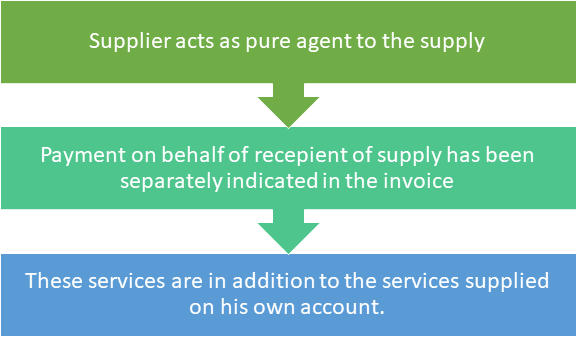
The implementing agencies fulfill this eligibility criteria of being a ‘pure agent’. Rule 33 also contains some conditions on the fulfilment of which, expenses incurred by the supplier as a pure agent of the recipient of the supplier of goods or services, are excluded from the value of supply-

In our case, if an implementing agency avails any goods or services from a vendor to fulfil the CSR activities for a company, then the payment of any such amount to the vendor shall be treated as a supply made as a pure agent by the implementing agency on behalf of recipient of supply, i.e., the company. Thus, these expenses incurred by the implementing agencies shall be excluded from the value of supply and therefore, are not liable for payment of GST.

CSR Contribution: Pre-GST or Post-GST?

The Act does not clarify that the amount to be contributed towards CSR activities should be inclusive or exclusive of taxes. However, it seems that since GST is charged on supply of goods and services, irrespective of the intention of social benefit, the amount contributed towards CSR can be both inclusive and exclusive of GST. Having said that, the question still pertains on the inclusivity of the amount of GST paid towards the amount of CSR expenditure for the purpose of section 135(5) of the Companies Act, 2013.

Conclusion

While the rational view would be, expenses incurred on GST for fulfilment of CSR activities should be eligible for claiming input tax credit, however, the Finance Bill, 2023 proposes otherwise. The effective date of the amendment will be 1st April 2023. Hence, once the Budget proposals are passed, any acquisition of goods or services for CSR purposes will be denied the benefit of GST set off. So the next question is whether the CSR expenditure would be inclusive of GST. We deal with the same citing illustrations in our article.

Workshop on RBI Master Directions on Securitisation and Transfer of loans

We invite you all to join us at the 10th Securitisation Summit, 2022 on 27th May 2022. You are sure to meet the who’s-who of the Indian structured finance space – the originators, investors, rating agencies, legal counsels, accounting experts, global experts, and of course, regulators. The details can be accessed here.

Read more

Master Direction on presentation and disclosures in financial statements

– Parth Ved, Executive | parth@vinodkothari.com

Loader Loading…
EAD Logo Taking too long?

Reload Reload document
| Open Open in new tab

Download as PDF [489.51 KB]

OCI and its treatment in law

OCI-and-its-treatment-in-law

Other ‘I am the best’ presentations can be viewed here

Our other resources on related topics –

  1. https://vinodkothari.com/2018/11/comprehending-other-comprehensive-income-oci-from-nbfcs-perspective/

Complete Guide to Sale and Leaseback Transactions

A guide to concepts, taxation, and accounting aspects of sale and leaseback transactions.


– Qasim Saif (finserv@vinodkothari.com)


Contents

Sale and Leaseback transaction. 2

Advantages to the Lessee. 2

Unlocking value, the hidden value of asset 2

Tax Benefits. 2

Legal issues in SLB: 3

Taxation of SLB transactions. 3

Direct Tax Aspect 3

Goods & Service Tax. 5

The Sale. 5

The Lease. 5

Place of supply. 6

Disposal of Capital Asset 6

Example of GST Calculations on Sale and Leasebacks. 6

Sale of Asset 7

Leasing of asset 7

Accounting of Sale and leasebacks. 7

Criteria for Sale. 8

Transfer of asset does not qualify as sale. 10

Transfer of asset qualifies as sale. 10

Sale at Fair Value. 10

Sale at a discount or premium.. 10

Example of Sale and Leaseback Accounting under Ind AS 109. 11

Calculations. 11

Rental Schedule. 11

Accounting Entries at Inception. 12


Sale and Leaseback transaction

A Sale and Leaseback (SLB) is a special case of application of leasing technique. Lease is a preferred mode of using the asset without having to own it. In case of leases, the lessee does not own the asset but acquires the right to use the asset for a specified period of time and pays for the usage.

SLB is a simple financial transaction which allows selling an asset and then taking it back on lease. The transaction thus allows a seller to be able to use the asset and not own it, at the same time releasing the capital blocked by the asset.
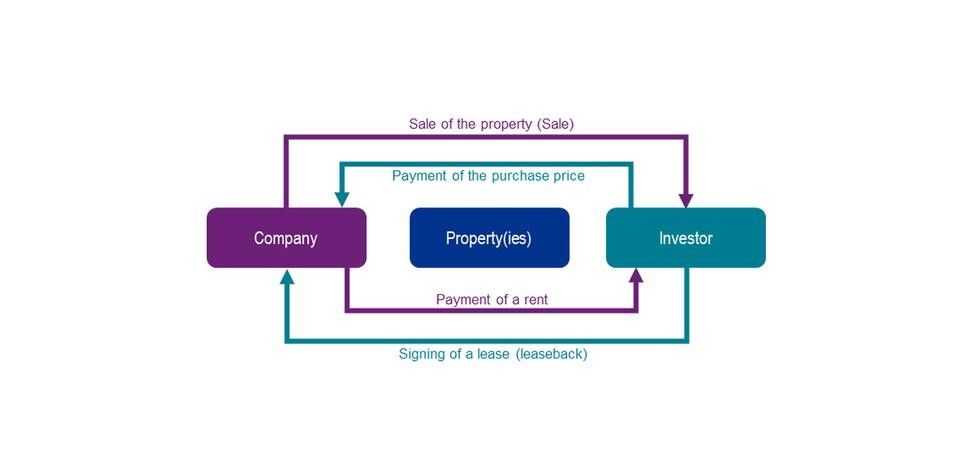
SLB allows the lessee to detach itself with legal ownership yet continuing to use the asset as well. In effect there is no movement of asset however on paper there is a change in the title of the asset.

Sale and Leaseback transactions are globally common in the Real estate investment trusts (REITs) and Aviation industry.

Advantages to the Lessee

Unlocking value, the hidden value of asset

As is evident from the mechanics of SLB above, SLB results in taking the asset off the books of the lessee and results in upfront cash which could be used for paying off existing liabilities. Hence this does not impact the existing lines of credit the lessee may be availing.

SLB can help entities raise finance for an amount equal to fair market value of the asset which may be significantly higher than its book value. Though there might be taxation challenges attached to it in Indian context. Nevertheless, SLB may bring about a financial advantage as well wherein a high-cost debt can be substituted with a low-cost lease liability.

Most of the assets considered for SLB have been used by the lessee for a substantial period of time and the value of the physical assets may be insignificant. Hence SLB is sometimes referred to as junk financing.

Tax Benefits

SLB may sometimes lead to tax benefits as well (we shall see this in detail in the sections below). This has been one of the major drivers of SLB transactions in India and has its own downsides as well. One of the major pitfalls to SLB is the danger of excess leveraging; the lessee may tend to overvalue the asset. Considering that SLB is a mode of asset-backed lending but the asset has may not have much value and the lessee may exercise discretion on the application of funds poses threat of misuse of the product.

Legal issues in SLB:

The legal validity of SLB was discussed by the U.S Supreme Court in the landmark ruling of Frank Lyon and Company[1]. In Frank Lyon’s case the bank took the building on SLB. Under the lease terms the bank was liable to pay rentals periodically and had the option to purchase the building at various times at a consideration based on its outstanding balance. The bank took possession of the building in the year it was completed and the lessor claimed deductions on depreciation, interest on construction loan, expenses related to sale and lease back and accrued the rent from the bank.

The Commissioner of Internal Revenue denied the claims of the petitioner on the grounds that the petitioner was not the owner of the building and the sale and leaseback was a mere financing transaction. The Hon’ble Court held that –

Where, as here, there is a genuine multiple-party transaction with economic substance that is compelled or encouraged by business or regulatory realities, that is imbued with tax-independent considerations, and that is not shaped solely by tax-avoidance features to which meaningless labels are attached, the Government should honor the allocation of rights and duties effectuated by the parties; so long as the lessor retains significant and genuine attributes of the traditional lessor status, the form of the transaction adopted by the parties governs for tax purposes.

The fundamental principle is that the Court should be concerned with the real substance of the transaction rather than the form of the same. If there are reasons to believe that the form of the transaction and its real substance are not aligned, the Court must not be simply concerned by the form of the transaction nor by the nomenclature that the parties have given to it.

In India too, the legality of SLB transactions have been questioned in several cases; sometimes the transactions have come out clean while in some cases, SLBs were considered an accounting gimmick.

The legality of SLB transactions and analysis of various judicial pronouncements on the same, have been discussed in detail in our write up “Understanding Sale and leaseback

Taxation of SLB transactions

Tax aspects specifically direct tax acts as a major motivation behind such transactions, SLB provides a creative playground for finance professionals to structure transactions in a manner that can lead to substantial benefit to the entity, and taxation acts as a major tool at their disposal.

Direct Tax Aspect

Though tax benefits have been a motivator for SLB transaction, the same has also been the reason for near wipe-out of SLB from Indian markets.

During the 1996-98 period one of the most infamous cases was the sale and leaseback of electric meters by state electricity boards (SEBs). For SEBs it made perfect sense as it amounted to cheap borrowing by the cash starved SEBs who had practically no other source of borrowing.

For leasing companies and others looking for a tax break, it was a perfect deal as there was 100% write off in case of assets costing Rs 5000 or less. Thus, an electric meter will qualify for 100% deduction. Several SEBs had undertaken such transactions in those days. Obvious enough the sole motive was tax deduction no one would care about the value, quality, existence etc of the meters. In some cases, the asset was bought on 30th March to be used only for a day, assets revalued heavily at the time of sale to leasing companies etc. Lease of non-existing assets such as electric meters, computers, glass bottles, tools, etc, lure of depreciation allowances caused the tax authorities to come down hard on sale and leaseback transactions calling them tax evading transactions. The whole fiasco of such sham transactions resulted in leasing going off the market completely. The burns of the past continue to linger even after a decade and half since SLB transactions were completely written off.

The most significant consideration in lease transactions is the depreciation claim. For tax purposes, depreciation is calculated on the block of the assets and not on the written down value of each asset separately.

Section 2(11) of the Income Tax Act, 1961 (IT Act) defines block of assets to mean

“”block of assets” means a group of assets falling within a class of assets comprising—

(a) tangible assets, being buildings, machinery, plant or furniture;

(b) intangible assets, being know-how, patents, copyrights, trade-marks, licences, franchises or any other business or commercial rights of similar nature, in respect of which the same percentage of depreciation is prescribed.”

The sale proceeds of the assets sold are deducted from the written down value of the block. In case of SLB transaction, assets are sold at higher than written down value, and the gain made on such a sale results in reduction in depreciable value of the block of assets. The reduction in depreciation will be allowed over a number of years. Similar would be the case in case the asset was sold at less than written down value, sale consideration would be reduced from the block of the assets.

Once the asset is sold and taken off the books of the lessee, the lessee is able to account for an immediate accounting profit without having to pay tax on it instantly. As under the block concept of depreciation, when the lessee sells the capital assets, the sale proceeds including the profits on sale are allowed to be deducted from the block of assets and hence there is no immediate tax on the accounting profits.

Also, typically the asset is recorded on historical costs which may be lower than the intrinsic value of the asset. SLB sometimes allows the entities to unlock the appreciation in value. However, it is not always necessary that the asset would have appreciated value. In some cases, the asset may have become junk completely.

To avoid the same revenue has introduced following provisions in the IT act, in order to restrict undue benefits being passed by use of sham SLB transactions:

Section 43 (1) provides for treatment of sale and lease back transactions for tax purposes, the relevant extracts are reproduced below –

“Explanation 3.—Where, before the date of acquisition by the assessee, the assets were at any time used by any other person for the purposes of his business or profession and the Assessing Officer is satisfied that the main purpose of the transfer of such assets, directly or indirectly to the assessee, was the reduction of a liability to income-tax (by claiming depreciation with reference to an enhanced cost), the actual cost to the assessee shall be such an amount as the Assessing Officer may, with the previous approval of the Joint Commissioner, determine having regard to all the circumstances of the case.”

“Explanation 4A.—Where before the date of acquisition by the assessee (hereinafter referred to as the first mentioned person), the assets were at any time used by any other person (hereinafter referred to as the second mentioned person) for the purposes of his business or profession and depreciation allowance has been claimed in respect of such assets in the case of the second mentioned person and such person acquires on lease, hire or otherwise assets from the first mentioned person, then, notwithstanding anything contained in Explanation 3, the actual cost of the transferred assets, in the case of first mentioned person, shall be the same as the written down value of the said assets at the time of transfer thereof by the second mentioned person.

Explanation 3 and 4A of Section 43 (1) restricts the consideration at which the lessor purchases the assets to written down value of the asset as appearing in the books of the lessee before it was sold and taken back on lease. The explanation explicitly states that the sale value for such sale and lease back transactions will be ignored and depreciation will be allowed on the first seller’s depreciated value. Take, for instance, A purchased machinery for Rs. 10 crores from B, though the WDV in the books of B is Rs. 2 crores. A can claim depreciation on Rs. 2 crores and not on Rs. 10 crores.

The said provisions removes any motivation for the lessor to carryout transactions at inflated values. Hence preventing junk financing to enter into SLB transactions.

Goods & Service Tax

Pre-GST indirect taxation regime acted as a major road block in the development of leasing industry as a whole, the legal differentiation as well as non-availability of credit among central and state taxes made leasing transactions costly.

Introduction of GST is playing a key role in development of leasing industry, from a stage where it had nearly become extinct. We have further discussed GST implications on leasing.

The Sale

The first leg of the transaction would involve sale of Assets by lessee to lessor.

In terms of section 7(1)(a) “all forms of supply of goods or services or both such as sale, transfer, barter, exchange, licence, rental, lease or disposal made or agreed to be made for a consideration by a person in the course or furtherance of business;”

The taxability under GST arises on the event of supply accordingly the sale of capital assets for a consideration would fall under the ambit of supply and accordingly GST shall be levied.

The Lease

The second part of transaction would lease back that is when the asset is leased back from buyer -lessor to seller lessee. The leaseback would be subject to GST like any other lease transaction.

The term lease has not been defined anywhere in GST Act or Rules. To classify a lease transaction as either supply of goods or supply of service, we have to refer Schedule II of the CGST Act, 2017 where in clear guidelines for classification of a transaction as either “supply of goods” or “supply of services” has been enumerated, based on certain parameters: –

  • Any transfer of the title in goods is a supply of goods;
  • Any transfer of right in goods or of undivided share in goods without the transfer of title thereof, is a supply of services;
  • Any transfer of title in goods under an agreement which stipulates that property in goods shall pass at a future date upon payment of full consideration as agreed, is a supply of goods.
  • Any lease, tenancy, easement, licence to occupy land is a supply of services;
  • Any lease or letting out of the building including a commercial, industrial or residential complex for business or commerce, either wholly or partly, is a supply of services.

Place of supply

Undoubtedly, the SLBs do not involve movement of goods, the seller lessee continuous to be in possession of leased asset even after the sale. Hence, In the case of such sale, there is no physical movement of the asset from the premises of the lessee to the premises of the lessor. The ownership gets transferred in the premise of the lessee.

In terms of Section 10(1)(c) of the IGST Act, the place of supply of goods where the supply does not involve movement of the said goods whether by the supplier or the recipient shall be the location of such goods at the time of delivery to the recipient. Accordingly, the place of supply in this case will be same as the location of the supplier. Accordingly, the sale of the asset will be considered as an intra-state supply as per Section 8 of the IGST Act and will be subjected to CGST + SGST.

Disposal of Capital Asset

Applications of GST on disposal of capital assets is one of the major deterring factors of in SLBs. Section 18(6) of the CGST Act,2017 state that:

In case of supply of capital goods or plant and machinery, on which input tax credit has been taken, the registered person shall pay an amount equal to the input tax credit taken on the said capital goods or plant and machinery reduced by such percentage points as may be prescribed or the tax on the transaction value of such capital goods or plant and machinery determined under section 15, whichever is higher:”

Entry no. (6) Of Rule 44 of CGST Rules, 2017: Manner of Reversal of ITC under Special Circumstances which reads as under: –

“The amount of input tax credit for the purposes of sub-section (6) of section 18 relating to capital goods shall be determined in the same manner as specified in clause (b) of sub-rule (1) and the amount shall be determined separately for input tax credit of central tax, State tax, Union territory tax and integrated tax:”         

“……………..Clause (b) of sub rule 1 of same rules states that :

(b) for capital goods held in stock, the input tax credit involved in the remaining useful life in months shall be computed on pro-rata basis, taking the useful life as five years………….”

Generally, the lessor procures the capital Assets at WDV due to Income tax Act implication. In that case WDV as per Income tax act would be the transaction value.

Example of GST Calculations on Sale and Leasebacks

Let’s consider a numerical example: an Entity A enters into SLB arrangement with an Entity B. A sells its machinery to B for Rs. 5,00,000/- as on 31st May 2021. The entity had purchased the asset for Rs. 6,00,000/- as on 31st March 2019.

B then leases back the asset to A for a yearly rental of Rs, 1,00,000/- for 3 years term with a purchase option at the end of 4th year at Rs. 2,50,000. (Assumed to be exercised)

(GST @ 18%)

Sale of Asset
Disposal of assets

On disposal asset, GST will be charged on the selling price of the asset. However, the amount to be deposited to the government with respect to this sale transaction shall be higher of the following:

  1. GST on the sale consideration;
  2. ITC reversed on transfer of capital asset or plant and machinery based on the prescribed formula

Portion of ITC availed on the asset, attributable to the period during which the transferor used the asset:

6,00,000 * 18% * (5% * 8) = 43200

Remaining ITC = (6,00,000 * 18%) – 43200 = 64800

GST on the selling price = 500000 * 18% = 90000

Therefore, GST to be paid to the government is 90000, that is higher of the two amounts discussed above.

Leasing of asset

As mentioned above GST shall be chargeable to lease rental, at the rate similar to that charged on acquisition of leased asset. Accordingly, Entity B shall charge GST on rentals for an amount of Rs. 18,000/- (Rs. 1,00,000/- * 18%).

Further GST shall also be charged on sale of asset at the end of lease tenure for an amount of Rs. 45,000/-(2,50,000*18%).

Accounting of Sale and leasebacks

IAS 17 covered the accounting for a sale and leaseback transaction in considerable detail but only from the perspective of the seller-lessee.

As Ind AS 116/IFRS 16 has withdrawn the concepts of operating leases and finance leases from lessee accounting, the accounting requirement that the seller-lessee must apply to a sale and leaseback is more straight forward.

The graphic below shows how SLB transactions should be accounted for:

Criteria for Sale

IFRS 16/Ind AS 116 state that

“ An entity shall apply the requirements for determining when a performance obligation is satisfied in Ind AS 115 to determine whether the transfer of an asset is accounted for as a sale of that asset.”

Accordingly, when a seller-lessee has undertaken a sale and lease back transaction with a buyer-lessor, both the seller-lessee and the buyer-lessor must first determine whether the transfer qualifies as a sale. This determination is based on the requirements for satisfying a performance obligation in IFRS 15/Ind AS 115 – “Revenue from Contracts with Customers”.

The accounting treatment will vary depending on whether or not the transfer qualifies as a sale.

The para 38 of Ind AS 115/IFRS 15- Performance obligations satisfied at a point in time, provides ample guidance on determining whether the performance obligation is satisfied.

The para states that:

“If a performance obligation is not satisfied over time in accordance with paragraphs 35– 37, an entity satisfies the performance obligation at a point in time. To determine the point in time at which a customer obtains control of a promised asset and the entity satisfies a performance obligation, the entity shall consider the requirements for control in paragraphs 31–34. In addition, an entity shall consider indicators of the transfer of control, which include, but are not limited to, the following:

(a) The entity has a present right to payment for the asset—if a customer is presently obliged to pay for an asset, then that may indicate that the customer has obtained the ability to direct the use of, and obtain substantially all of the remaining benefits from, the asset in exchange.

(b) The customer has legal title to the asset—legal title may indicate which party to a contract has the ability to direct the use of, and obtain substantially all of the remaining benefits from, an asset or to restrict the access of other entities to those benefits. Therefore, the transfer of legal title of an asset may indicate that the customer has obtained control of the asset. If an entity retains legal title solely as protection against the customer’s failure to pay, those rights of the entity would not preclude the customer from obtaining control of an asset.

(c) The entity has transferred physical possession of the asset—the customer’s physical possession of an asset may indicate that the customer has the ability to direct the use of, and obtain substantially all of the remaining benefits from, the asset or to restrict the access of other entities to those benefits. However, physical possession may not coincide with control of an asset. For example, in some repurchase agreements and in some consignment arrangements, a customer or consignee may have physical possession of an asset that the entity controls. Conversely, in some bill-and-hold arrangements, the entity may have physical possession of an asset that the customer controls. Paragraphs B64–B76, B77–B78 and B79–B82 provide guidance on accounting for repurchase agreements, consignment arrangements and bill-and-hold arrangements, respectively.

(d) The customer has the significant risks and rewards of ownership of the asset—the transfer of the significant risks and rewards of ownership of an asset to the customer may indicate that the customer has obtained the ability to direct the use of, and obtain substantially all of the remaining benefits from, the asset. However, when evaluating the risks and rewards of ownership of a promised asset, an entity shall exclude any risks that give rise to a separate performance obligation in addition to the performance obligation to transfer the asset. For example, an entity may have transferred control of an asset to a customer but not yet satisfied an additional performance obligation to provide maintenance services related to the transferred asset.

(e) The customer has accepted the asset—the customer’s acceptance of an asset may indicate that it has obtained the ability to direct the use of, and obtain substantially all of the remaining benefits from, the asset. To evaluate the effect of a contractual customer acceptance clause on when control of an asset is transferred, an entity shall consider the guidance in paragraphs B83–B86.”

It shall be noted that no single criteria can be taken as a determining factor for concluding that sale has taken place. Each criterion should be individually assessed every case. Needless to say, substance of the transaction should be adjudge based on principles set.

The criteria set out in the para 38 specified above can be summarised as follows:

  • There is a present right to payment has been established.
  • The legal tittle of the asset is transferred. It shall be noted that this shall not conclusively determine sale, rather a to be considered in consonance with another criterion.
  • Physical possession of the asset has been transferred. Now this is a matter of discussion, as under SLB, the possession never leaves the seller. However, in our view even in case of symbolic transfer of possession the criterion can be said to be satisfied subject to the condition that buyer-lessor has an ability to direct the use of asset. Hence, an entity should ensure that the buyer-lessor is not bound by sale agreement or otherwise to leaseback the asset.
  • Significant risk and reward attached to ownership are transferred to the buyer
  • The buyer has accepted the asset

Transfer of asset does not qualify as sale

If the transfer does not qualify as a sale the parties account for it as a financing transaction. This means that:

  • The seller-lessee continues to recognise the asset on its balance sheet as there is no sale. The seller-lessee accounts for proceeds from the sale and leaseback as a financial liability in accordance with Ind AS 109/IFRS 9. This arrangement is similar to a loan secured over the underlying asset – in other words a financing transaction
  • The buyer-lessor has not purchased the underlying asset and therefore does not recognise the transferred asset on its balance sheet. Instead, the buyer-lessor accounts for the amounts paid to the seller-lessee as a financial asset in accordance with Ind AS 109/IFRS 9. From the perspective of the buyer-lessor also, this arrangement is a financing transaction.

Transfer of asset qualifies as sale

Where the transfer qualifies as sale, there can be further two situations:

  1. Sale at Fair value
  2. Sale at discount or premium.
Sale at Fair Value

If the transfer qualifies as a sale and is on fair value basis the seller-lessee effectively splits the previous carrying amount of the underlying asset into:

  • a right-of-use asset arising from the leaseback, and
  • the rights in the underlying asset retained by the buyer-lessor at the end of the leaseback.

The seller-lessee recognises a portion of the total gain or loss on the sale. The amount recognised is calculated by splitting the total gain or loss into:

  • an unrecognised amount relating to the rights retained by the seller-lessee, and
  • a recognised amount relating to the buyer-lessor’s rights in the underlying asset at the end of the leaseback.

The leaseback itself is then accounted for under the lessee accounting model.

The buyer-lessor accounts for the purchase in accordance with the applicable standards (eg IAS 16 ‘Property, Plant and Equipment’ if the asset is property, plant or equipment or IAS 40 ‘Investment Property’ if the property is investment property). The lease is then accounted for as either a finance lease or an operating lease using IFRS 16’s lessor accounting requirements.

Sale at a discount or premium

The accounting methodology shall remain the same, However, Adjustments would be required to provide for the discounted or premium price.

These adjustments would be as follows:

  1. a prepayment would be recorded in order to provide for adjustment in regard to sale at a discount
  2. Any amount paid in excess of fair value would be recorded as an additional financing facility and accounted for under Ind AS 109.

Example of Sale and Leaseback Accounting under Ind AS 109

A sample spreadsheet calculations for the below example can be accessed here

Calculations


Particular Amount Remarks
Sale considerations ₹ 10,00,000.00
Carrying Amount ₹ 5,00,000.00
Term 15 year
Rentals/year ₹ 80,000.00 year
Fair Value of Building ₹ 9,00,000.00
Incremental borrowing rate 10%
PV of rentals ₹ 6,08,486.36
Additional Financing ₹ 1,00,000.00 Sale Consideration
– Fair Value
Payments towards Lease Rentals ₹ 5,08,486.36 PV of Rentals
– Additional Financing
Ratio of PV of rentals and
Payment towards lease Rentals
16%
Yearly payments towards Add. Financing ₹ 13,147.38 Rental X Ratio
Yearly payments towards Lease Rental ₹ 66,852.62 Rental – Payment toward Add. Fin.
ROU of Asset ₹ 2,82,492.42 Carrying Amount X
[Payments towards Lease Rentals/Fair Value of Building]
Total Gain on sale ₹ 4,00,000.00 Fair Value – Carrying Amount
Gain recognised Upfront ₹ 1,74,006.06 Total Gain X [(Fair Value of Building-Payments towards Lease Rentals)
/Fair Value of Building]


Rental Schedule


NPV NPV
₹ 5,08,486.36 ₹ 1,00,000.00
Year Lease Rentals Additional Financing
0
1  ₹ 66,852.62  ₹ 13,147.38
2  ₹ 66,852.62  ₹ 13,147.38
3  ₹ 66,852.62  ₹ 13,147.38
4  ₹ 66,852.62  ₹ 13,147.38
5  ₹ 66,852.62  ₹ 13,147.38
6  ₹ 66,852.62  ₹ 13,147.38
7  ₹ 66,852.62  ₹ 13,147.38
8  ₹ 66,852.62  ₹ 13,147.38
9  ₹ 66,852.62  ₹ 13,147.38
10  ₹ 66,852.62  ₹ 13,147.38
11  ₹ 66,852.62  ₹ 13,147.38
12  ₹ 66,852.62  ₹ 13,147.38
13  ₹ 66,852.62  ₹ 13,147.38
14  ₹ 66,852.62  ₹ 13,147.38
15  ₹ 66,852.62  ₹ 13,147.38


Accounting Entries at Inception


Buyer-Lessor
Building  ₹            9,00,000.00
Financial Asset  ₹            1,00,000.00
       Bank  ₹         10,00,000.00
*Lease accounted as per Finance or operating lease accounting
Seller-Lessee
Bank  ₹          10,00,000.00
ROU  ₹            2,82,492.42
          Building  ₹            5,00,000.00
          Financial Liability  ₹            6,08,486.36
         Gains on Asset Transfer  ₹            1,74,006.06


[1] 435 U.S. 561 (1978)

Gov’s Attempt to Make Slump Sale ‘Fair’

-Yutika Lohia ( finserv@vinodkothari.com )

Introduction

The income tax laws of the country has been witnessing dynamic changes over the years. The tax authorities are understanding the bottlenecks within their current tax system and proposing changes to mobilize revenue, promote investments and also to cope up with the present gaps.

On the other hand, with such dynamicity in laws, income tax or otherwise, companies often find themselves struggling to keep at par with the economy, and hence taking the restructuring route – slump sale being one option. The authorities are identifying the areas where there has been loss of revenue to the government and accordingly making changes in the tax laws.

Slump sale is one of the modes of business restructuring process and attracts capital gain under section 50B of the IT Act. Prior to Finance Act 2021, full value of consideration was the lumpsum value agreed between the buyer and seller considered while computing capital gains.  Post Finance Act 2021, a new clause was inserted in sub section 2 of section 50B of the IT Act, where “Fair market value of the capital assets as on the date of transfer, calculated in the prescribed manner, shall be deemed to be the full value of the consideration received or accruing as a result of the transfer of such capital asset.”

The IT Department has introduced new rule for computation of fair market value of capital assets which shall be the full value of consideration while computing capital gains in case of a slump sale. The rules are an anti abuse measures to restrict the practice of sale of business at under value.

In this write up, we shall discuss the changes made by Finance Act 2021 in case of a slump sale, new rule for computation of fair market value of capital asset and its implications.

Widening the scope of slump sale by Finance Act 2021

Definition of slump sale

Prior to Finance Act 2021, the Indian Tax Law defined slump sale as transfer of one or more undertaking as a result of sale for a lump sum consideration without values being assigned to individual assets and liabilities.

However, the Finance Act 2021, extended the scope of “slump sale” under section 2(42C) of the IT Act and inserted an Explanation to the said section so as to provide that the word “transfer” shall have the same meaning assigned to in section 2(47) of the IT Act.

Earlier the definition of “slump sale” considered only those transfer where there was monetary consideration and transfer like exchange with property or shares were not covered under the scope of slump sale. Therefore, to widen the definition, the Finance Act 2021 covered those transactions which were just not restricted to sale and but also covered all kinds of transfer.

Fair Market value Computation

Earlier for computing capital gains in case of a slump sale, net worth of the undertaking was reduced from full value of consideration. The Finance Act 2021, amended the capital gain computation provision and introduced the Fair Market Value approach. To say, full value of consideration shall be replaced by the fair market value of the undertaking.

Net worth Computation

For computation of net worth, a new clause has been added where cost of goodwill which has not been acquired by the taxpayer by purchase from previous owner has to be taken at NIL

Notification issued by CBDT

The Central Board of Direct Taxes vide its Notification dated 24th May, 2021 has notified a new rule i.e., Rule 11UAE of the Income Tax Rules 1962, for computation of fair market of capital assets in case of a slump sale.

Rule 11UAE has introduced two methods of fair market value calculation i.e., FMV1 and FMV2 and higher among the two shall be considered while computing capital gains for slump sale transaction.

  • FMV1 shall be the fair market value of the capital assets transferred by way of slump sale
  • FMV2 shall be the fair market value of the consideration received or accruing as a result of transfer by way of slump sale

The fair market value of the capital assets under sub-rule (2) and sub-rule (3) shall be determined on the date of slump sale and for this purpose valuation date referred to in rule 11UA shall also mean the date of slump sale

The two FMVs shall be determined in accordance with the formula discussed below.

FMV1 approach

As per sub rule (2) of Rule 11UAE, we may call it adjusted NAV approach where book value of all assets other than jewellery, artistic work, shares, securities and immovable property shall be considered.

FMV1 = A+B+C+D-L, where,

A= book value of all the assets (other than jewellery, artistic work, shares, securities and immovable property) as appearing in the books of accounts of the undertaking or the division transferred by way of slump sale as reduced by the following amount which relate to such undertaking or the division, —

  • any amount of income-tax paid, if any, less the amount of income-tax refund claimed, if any; and
  • any amount shown as asset including the unamortised amount of deferred expenditure which does not represent the value of any asset;

B = the price which the jewellery and artistic work would fetch if sold in the open market on the basis of the valuation report obtained from a registered valuer;

 C = fair market value of shares and securities as determined in the manner provided in sub-rule (1) of rule 11UA;

 D = the value adopted or assessed or assessable by any authority of the Government for the purpose of payment of stamp duty in respect of the immovable property; L= book value of liabilities as appearing in the books of accounts of the undertaking or the division transferred by way of slump sale, but not including the following amounts which relates to such undertaking or division, namely: —

  • the paid-up capital in respect of equity shares;
  • the amount set apart for payment of dividends on preference shares and equity shares where such dividends have not been declared before the date of transfer at a general body meeting of the company;
  • reserves and surplus, by whatever name called, even if the resulting figure is negative, other than those set apart towards depreciation;
  • any amount representing provision for taxation, other than amount of income-tax paid, if any, less the amount of income-tax claimed as refund, if any, to the extent of the excess over the tax payable with reference to the book profits in accordance with the law applicable thereto;
  • any amount representing provisions made for meeting liabilities, other than ascertained liabilities;
  • any amount representing contingent liabilities other than arrears of dividends payable in respect of cumulative preference shares.

FMV2 approach

As per sub rule (3) of Rule 11UAE, FMV2 i.e.  shall be the fair market value of the consideration received or accruing as a result of transfer by way of slump sale determined in accordance with the formula-

FMV2 = E+F+G+H, where,

E = value of the monetary consideration received or accruing as a result of the transfer;

F = fair market value of non-monetary consideration received or accruing as a result of the transfer represented by property referred to in sub-rule (1) of rule 11UA determined in the manner provided in sub-rule (1) of rule 11UA for the property covered in that sub-rule;

G = the price which the non-monetary consideration received or accruing as a result of the transfer represented by property, other than immovable property, which is not referred to in sub-rule (1) of rule 11UA would fetch if sold in the open market on the basis of the valuation report obtained from a registered valuer, in respect of property;

H = the value adopted or assessed or assessable by any authority of the Government for the purpose of payment of stamp duty in respect of the immovable property in case the non-monetary consideration received or accruing as a result of the transfer is represented by the immovable property.

Further the expression “registered valuer” and “securities” shall have the same meaning as per Rule 11U of the Income Tax Rules.

Conclusion

This new Rule 11UAE will not only capture monetary consideration but also non-monetary consideration received for transfer of undertaking. Also, the new rule considers revaluation of assets and liabilities made in the books.

Prior to Finance Act 2021, the consideration of slump sale was the amount agreed between the buyer and the seller. Since the consideration was not based on any mechanism, the transfer would take place at a lower price and this often resulted in tax leakage.

To curb all the tax loop holes and prevent tax leakage in merger and acquisition transactions, the income tax laws has been modified and a new concept has been introduced where fair market value for capital assets shall computed as per Rule 11UAE for consideration value in case of a slump sale.

Now the seller will have to pay tax on the fair market value as computed as per Rule 11UAE even if the actual consideration received is less than the fair market value of capital assets. Also, this rule will put a challenge where the undertaking is transferred at a true sale value.


Impairment in case of Lease Transactions

– Abhirup Ghosh (abhirup@vinodkothari.com)

Background

Like all assets, leased assets also undergo impairment. IAS 36 is the relevant standard for impairment of assets, however, IFRS 9 deals with impairment of financial assets, as well as lease receivables.

Therefore, even though lease transactions are governed by IFRS 16, for impairment of leased assets, one has to refer either of aforesaid standards.

In this article, we will focus on the manner in which leased assets are impaired, especially the way expected credit losses (ECL) could be calculated for lease transactions.

Approach

In the books of the Lessor

The approach of impairment differs with the nature of lease. In case of an operating lease, the lessor recognizes the asset under Property, Plant and Equipment. Therefore, the lease asset capitalized in the books of the lessor has to undergo impairment testing under IAS 36. In addition to that, the lease receivables that fall under the purview of IFRS 9 also have to be tested for impairment. In case of operating leases, only those rentals which are overdue shall undergo impairment testing under IFRS 9.

In case of financial leases, the lessor recognizes only lease receivables in its books. Therefore, there is no question of assessing impairment on the fixed asset in such case; only ECL has to be provided on the lease rentals.

In the books of the Lessee

Unlike the erstwhile standards on leasing, IFRS 16 provides for recognition of Right of Use (ROU) Asset in the books of the lessee, and a corresponding lease liability.

The ROU asset will also have to undergo impairment testing under IAS 36.

Impairment under IAS 36

The requirement to impair an asset under IAS 36 gets triggered only when any of the following indicators are noticed:

a.) External indicators:

  1. Significant decline in market value
  2. Change in technology, market, economic or legal environment
  3. Change in interest rate.
  4. Where the carrying amount is more than the market capitalization

b.) Internal indicators:

  1. Asset’s performance is declining
  2. Discontinuance or restructuring plan
  3. Evidence of physical obsolescence

The standard looks at assets Cash Generating Units, in case of lease transactions, each asset on lease would be treated as CGU for the purpose of this standard.

The impairment loss is calculated based on the carrying value of the asset and the recoverable value.

Recoverable value is the higher of the following:

a.) Fair value of the asset, less cost of disposal

b.) Value in use

Fair value of the asset is arrived at based on the valuation of the asset using appropriate valuation methodologies. From the fair value, cost of disposal has to be reduced, which includes:

  1. Legal costs
  2. Stamp duty and similar taxes
  3. Costs of removing the assets
  4. Incremental costs for bringing the assets into the conditions for its sale
  5. Other costs

The value in use computed based on the present value of all the future cash flows from the asset, discounted at rate which truly reflects the time value of money and the risks specific to the asset. To compute value in use, a risk weighted cash flows approach must be adopted.

There are two ways in which this approach can be adopted – a) by adjusting the cashflows, b) by adjusting the discounting rate.

In the first one, the future cash expected cash flows must be assigned different probabilities of recovery which would corroborate with the risk associated with the asset, and then discount the cash flows at the agreed yield of the transaction.

Alternatively, the instead of assigning probabilities of recovery on the cash flows, the original expected cash flows may be considered, however, the discounting rate may be adjusted to corroborate with the risks associated with the assets.

If the recoverable value of the asset is lower than the carrying amount, then the difference has to be booked as an impairment loss and the carrying amount has to be brought down to that extent.

Impairment under IFRS 9

There are two approaches for computing ECL:

  1. General Approach
  2. Simplified Approach

In the general approach, ECL is computed based on 12-months losses for instruments not showing significant increase in credit risk, and lifetime losses for instruments showing significant increase in credit risk.

In the simplified approach, ECL is computed based on lifetime losses on financial instruments, irrespective of whether it is showing significant increase in credit risk or not. This approach is mandatory for trade receivables not having a significant financing component. This approach is option for lease receivables and trade receivables having a significant financing component.

Therefore, for lease transactions, a reporting entity can opt for either of the two approaches.

General approach

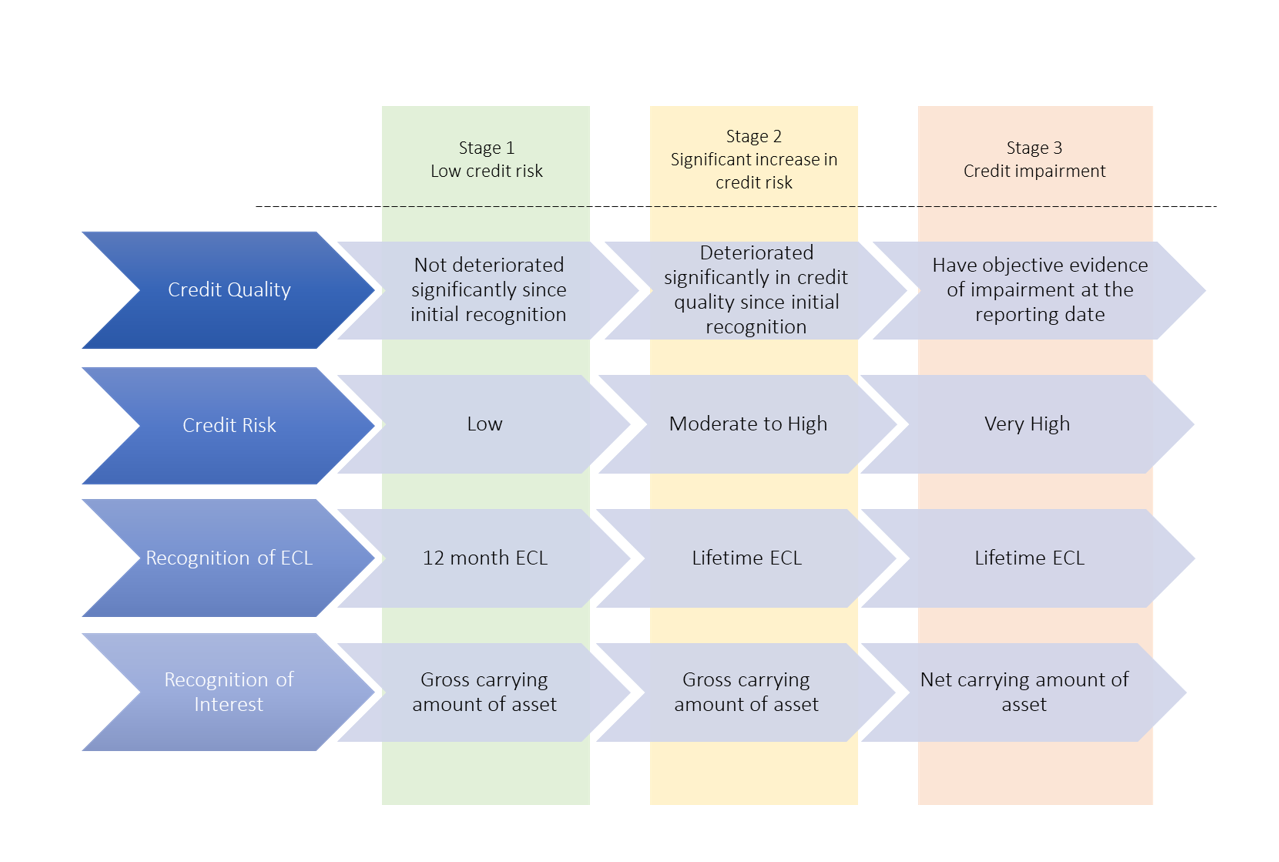
Staging of financial instruments based on different risk categories is one of the key aspects of the general approach. There are three stages:

a) Stage 1 – A financial instrument is classified under Stage 1 at the inception of the transaction, unless the asset is credit impaired at the time of purchase. Subsequently, if the assets do not show significant increase in credit risk, they are classified under Stage 1.

b) Stage 2 – A financial instrument is classified under Stage 2, when it shows significant increase in credit risk. The credit risk on the reporting date is compared with the credit risk at the time of initial recognition.

c) Stage 3 – Lastly, if the financial asset shows objective evidence of impairment, the asset is credit impaired and classified as Stage 3.

For the purpose staging, the following considerations may be taken care of:

  1. Transition – In natural course, before a financial instrument becomes credit impaired or an actual default occurs, it should first show signs of significant increase in credit risk.
  2. Time to maturity – Time to maturity is an important indication of credit risk. For instance, a AAA bond has far more credit risk if the maturity is 10 years as compared 5 years. Therefore, while assessing the credit risk, the shortened remaining time to maturity must be considered. This logic however, may not hold good in case of transactions involving a balloon payment structure or a bullet payment structure, where the major part of the cashflows is concentrated towards the end of the tenure.
  3. What constitutes to be significant increase in credit risk – Usually the assessment of credit risk is left on the risk management division of the reporting entity, however, the standard states that if reasonable and supportable forward-looking information is available without undue cost or effort, an entity cannot rely solely on past due information when determining the credit risk. However, when information that is more forward-looking than past due status is not available without undue cost or effort, an entity may use past due information to determine the credit risk. There is a rebuttable presumption that the credit risk on a financial asset has increased significantly since initial recognition when contractual payments are more than 30 days past due.

An entity can rebut this presumption if it has reasonable and supportable information that is available without undue cost or effort, that demonstrates that the credit risk has not increased significantly since initial recognition even though the contractual payments are more than 30 days past due. However, the Reserve Bank of India in its notification on Implementation of Indian Accounting Standards for NBFCs[1], has stated that in case, the reporting entity wishes to rebut the presumption, then clear justification must be documented, and such shall be placed before the Audit Committee of the Board. However, in any event the recognition of significant increase in credit risk should not be deferred beyond 60 days past due.

Further, when an entity determines that there have been significant increases in credit risk before contractual payments are more than 30 days past due, the rebuttable presumption does not apply.

Once the staging is complete the expected credit losses on the assets depending on their stage.

In case of Stage 1 assets, 12-months credit losses are provided. In case of Stage 2 and Stage 3 assets, lifetime credit losses are provided.

The difference between a Stage 2 and Stage 3 asset is that for the latter, the asset has to be impaired to the extent of the expected credit losses and the showed at net amount.

The graphic below summarises the general approach of ECL.

Simplified approach

In the simplified approach, the concept of staging does not apply. There is no requirement of assessment of significant increase in credit risk. Lifetime credit losses have to be provided.

This is optional for lease transactions, however, if the reporting entity wishes to adopt this approach, it has to be implemented separately on operating and financial leases.

Method of computing ECL on lease transactions

While computing ECL, operating lease and financial leases must be considered separately. While financial leases are financial transactions, hence, akin to loan transactions, operating leases are operating/ rental contracts. However, ECL, in the both cases, are done based on the future expected cash flows from the contract, that is the lease rentals.

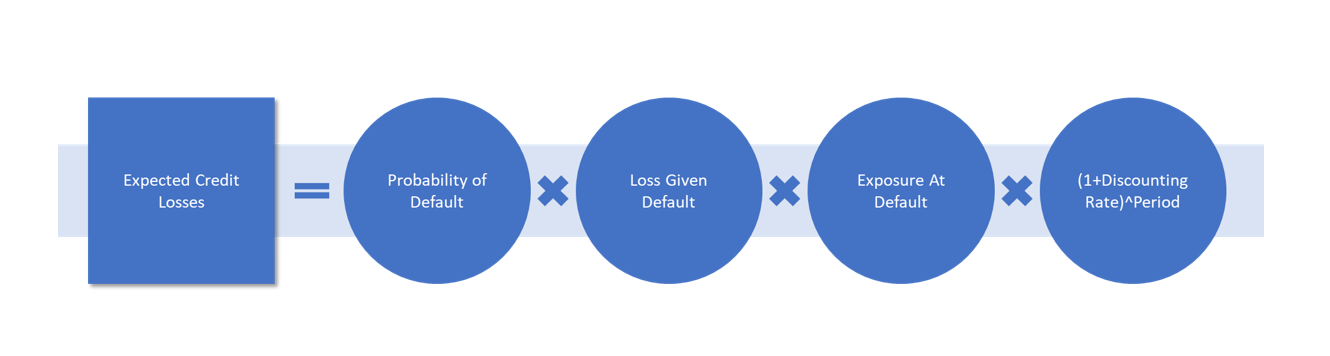
The most appropriate approach of computing ECL in case of lease transactions in the “Loss Rate Approach”. In this approach, the ECL is computed based on the Probability of Defaults and Loss Given Defaults. The PD and LGD rates are applied on the Exposure at Default, and subsequently, discounted at the effective interest rate or the yield of the transaction.

Probability of Default

One of the most important components of computing ECL. For entities which follow Internal Risk Based Approach, this is usually an outcome of the IRB. However, where the reporting entity does not follow an IRB approach, a scorecard approach may be adopted for the same.

In a scorecard approach, various factors specific to the asset and the borrower are weighted to assess the credit risk and produce a PD level.

In case of lease transactions, besides the borrower specific factors, the experience in the asset class also must be given sufficient weightage. For example, personal use assets like cars, two-wheelers etc. may be assigned to a lower risk weight, whereas, for assets such as construction equipments, farming equipments, etc. where repayment of rentals depend on the generation of cash flows from the asset, may be assigned a higher risk weight.

Once the credit risk is assessed, the PD level has to be produced through:

  1. Vintage analysis of the assets to understand how default rates change over a period of time;
  2. Extrapolation of the trends, where the default information is not available for the maximum tenure of the exposure.

Usually, PD levels are representation of the performance of similar assets in the past, however, for ECL, a forward-looking approach has to be adopted, and accordingly the PD levels have to be calibrated to give a forward-looking effect.

Alternatively, a simpler approach may be adopted where the reporting entities may rely on internal benchmarking and external ratings to predict a PD level.

Loss Given Default

The loss given default signifies what proportion of the exposure, will actually be lost, should there be a default. The LGD rate is a function of the past trends of recovery of cash flows organically, and also the recovery from the underlying asset.

Therefore, LGD can be denoted as 1 – Recovery Rate.

For determining the LGD of a lease, the following may be considered:

  1. Forecasts of future cash flow recoveries,
  2. Forecasts of future valuation of the leased asset,
  3. Time to realization of the leased asset,
  4. Cure rates,
  5. External costs of realization of the leased asset.

The estimation of the aforementioned may be influenced by several factors, namely, the sector in which the asset is deployed, the geography, nature of asset etc.

Macroeconomic factors and the dependence of the aforesaid factors on the same must also be considered. For examples, situations like flood or drought would impact the recoverability of tractors. Similarly, situations like the pandemic COVID-19, would impact all of the aforesaid factors.

Exposure at Default

This reflects the exposure outstanding periodically for the entire tenure of the loan.

Discounting Rate

Usually, the effective interest rate of the transaction is used for discounting the cash flows and the credit losses.

Period

This refers to the contractual tenure of the facility. While determining the period, the ability of the customer to cancel or prepay, or the lessor’s ability to call the facility must also be considered.

The utilization of each of the factors for computation of ECL has been illustrated with the following numerical example:

Scheduled Cashflows Amort Schedule
Period Cash flows Interest Principal Closing POS
0  ₹ -1,00,000.00  ₹                       –  ₹                –  ₹ -1,00,000.00
1  ₹      25,000.00  ₹           7,930.83  ₹ 17,069.17  ₹     -82,930.83
2  ₹      25,000.00  ₹           6,577.10  ₹ 18,422.90  ₹     -64,507.93
3  ₹      25,000.00  ₹           5,116.01  ₹ 19,883.99  ₹     -44,623.94
4  ₹      25,000.00  ₹           3,539.05  ₹ 21,460.95  ₹     -23,162.98
5  ₹      25,000.00  ₹           1,837.02  ₹ 23,162.98  ₹                0.00
EIR 8%
Computation of ECL
Period EAD PD (Marginal) PD (Cumulative) LGD EIR Marginal ECL
0
1  ₹   1,00,000.00 3% 3% 20% 8%  ₹        555.91
2  ₹      82,930.83 3% 6% 20% 8%  ₹        427.15
3  ₹      64,507.93 3% 9% 20% 8%  ₹        307.84
4  ₹      44,623.94 4% 13% 20% 8%  ₹        263.07
5  ₹      23,162.98 4% 17% 20% 8%  ₹        126.52
12 Month’s ECL  ₹             555.91
Lifetime ECL  ₹          1,680.49


EIR Computed using IRR formula
PD and LGD Assumed numbers
Marginal ECL (PD*LGD*EAD)/(1+EIR)^Period

Conclusion

This article only tries to discuss one of the most commonly adopted approach for ECL computation. There could be several variations made to the aforementioned, or different approaches may be adopted. Ultimately, it is the management’s call to decide the approach which best suits the nature of the assets and the customers the entity is the dealing with.

Related articles on the Topic:

  1. Accounting for Lease Transactions
  2. New lease accounting standard kicks off from 1st April, 2019
  3. IMPLEMENTATION OF IFRS-16 IN VARIOUS COUNTRIES
  4. Lease accounting: Operating & Financial Lease distinction set to go from financial year 2019-20
  5. Comparative Analysis of changes in Standards on Leasing over time
  6. FAQs on Ind AS 116: The New Lease Accounting Standard

References:

  1. IFRS 9
  2. IFRS 16
  3. IAS 36
  4. Potential Impairments of Leased Assets and the Right-of-Use Asset under ASC 842 and IFRS 16
  5. Have lease assets become impaired?
  6. Leased Assets: Ongoing impairment considerations
  7. How does impairment look under IFRS 16?

[1] https://www.rbi.org.in/scripts/FS_Notification.aspx?Id=11818&fn=14&Mode=0

A Guide to Accounting of Collateral and Repossessed Assets

-Financial Services Team ( finserv@vinodkothari.com )

The purpose of reporting in accordance with International Financial Reporting Standards (IFRS) is to provide financial information about the reporting entity that is useful to various stakeholders in making decisions about providing resources to the entity.

To satisfy the objective of IFRS/Ind AS reporting, to a large extent, based on estimates, judgements and models rather than exact depictions. In other words, the use of reasonable estimates is an essential part of the preparation of financial statements and does not undermine their reliability.

Understanding Collateral

Collateral is one or more assets that a borrower offers to a lender as security for a loan, with the intent that if the borrower defaults in making the promised loan payments, the lender has the right to seize the collateral, sell the same and realise the amounts due. Since collateral offers   a security to the lender should the borrower default, loans that are secured by collateral typically carry lower interest rates than unsecured loans.

Needless to say, secured lending forms a very important segment of the world of finance.

Although the legal rights that flow from collateral are typically specified in the loan agreement, law in some jurisdictions might specify particular overriding rights, obligations, restrictions, etc. In some cases, at the commencement of the loan, collateral is physically transferred from the borrower to the lender. These security interests are called possessory security interests – a pledge is an example of a possessory security interest. There are other types of security interests which are non-possessory, which are known as hypothecation, lien or charge in different jurisdictions. A mortgage in English and Indian law has a different connotation – it creates a property right in favour of the lender to secure the loan; hence, it results into transfer of specific title[1].

Irrespective of the form of collateral, it is clear that collateral is merely security interest, and not property interest. While covenants of security documentation may differ, the most common security document allows the lender to sell or cause the sale of the collateral upon default of the borrower.

Accounting of Collateral

Secured Loans:

When a financial institution (FI) extends a secured facility, it recognises  loan as its asset, as the benefits accruing to the entity would be on account of loan provided. The security would only act as backstop measure in case the performance of the loan deteriorates.  Further, the entity’s interest lies in the loan not in the charged asset.

However, this does not imply that security on a loan would go unnoticed while accounting for the loan asset. Collateral and other credit risk mitigants are important factors in an entity’s estimate of Expected credit losses (ECL).

Consequently, IFRS 7 Financial Instruments: Disclosures specifies that an entity must disclose information that enables users of its financial statements to evaluate the nature and extent of risks arising from financial instruments to which the entity is exposed at the end of the reporting period and how those risks have been managed by the entity (paragraphs 31 and 32). When relevant, an entity’s risk management disclosure would include its policies and procedures for taking collateral and for monitoring the continuing effectiveness of collateral in mitigating counterparty credit risk. Paragraph 35K of IFRS 7 requires information that will enable users of financial statements to understand the effect of collateral and other credit enhancements on the amount of expected credit losses.

The Division III of Schedule III to the Companies Act, 2013 prescribes a separate disclosure for secured and unsecured advances. Further the impairment loss allowance for both asset categories is also presented along with the specific asset  .

In short, disclosure of the collateral and credit enhancements is an important disclosure. The existence of the collateral itself may not change the carrying value of the loan, but it may have repercussions on the value of the ECL, as also, in case of fair-valued loans, on the risk-adjusted value by impacting the credit spread that is deployed as a part of the discounting rate.

Collateral and SPPI test

Simply payment of principal and interest (SPPI) test is one of the two tests that are required to be passed for a financial asset to be classified either as subsequently measured at Amortised Cost or at FVOCI. The test says that the contractual cash flows from the asset, on specified dates, should comprise only of principal payments and interest payments on the principal amount outstanding.

Paragraph BC4.206(b) of the Basis for Conclusions on IFRS 9 explains the IASB’s view that financial assets can still      meeting the SPPI test, i.e., the contractual cash flows may consist solely payments of principal and interest, even though they are collateralised by assets.     . Consequently, in performing the SPPI test an entity disregards the possibility that the collateral might be foreclosed in the future unless the entity acquired the instrument with the intention of controlling the collateral.

Accounting of Repossessed Assets

Assume the following facts: FI had a loan of Rs 1000 outstanding, which was in default. FI forecloses and repossesses the collateral, say a machinery, which is valued Rs 700 on the date of repossession. FI keeps the machinery pending disposal, and on the reporting date, the machinery is still in stock. Eventually, in the next reporting period, the machinery is sold, say for a net realisation of Rs 600.

Several questions arise – on the date of repossession, can FI remove loan to the extent of Rs 700 and debit it to machinery held for sale? What happens to the loss of Rs 100 on the sale – is it loss related to the loan, or loss related to disposal of machinery?

Questions like this are faced by financial institutions all the time.

Though accounting standards provide ample guidance on taking cognizance of collateral, specifically for credit risk assessment and asset recognition, the clarity is lost at the issue of accounting for repossessed assets. Accounting standards do not provide a clear view on how an asset should be treated when the entity enforces its right to foreclose and repossess the asset, and the asset is pending disposal. If the disposal of the asset has already been done, then the question of any accounting for collateral does not arise, as the collateral has already      been disposed off. However, the accounting for the collateral itself, as discussed below, will affect the accounting for the disposal as well.

As regards accounting for the repossession of the collateral, some guidance comes from the Para B5.5.55 of IFRS 9/Ind AS 109 :

“…….Any collateral obtained as a result of foreclosure is not recognised as an asset that is separate from the collateralised financial instrument unless it meets the relevant recognition criteria for an asset in this or other Standards.”

The extract clarifies that mere fact that the asset is repossessed would not make it eligible for being recognised as an asset on the books, as the entity’s interest still lies in recovery loan, the entity would have no interest in the asset if not for dues under the loan.

Further, Para 7 of IAS 16 / Ind AS 16 states that

“The cost of an item of property, plant and equipment shall be recognised as an asset if, and only if:

(a) it is probable that future economic benefits associated with the item will flow to the entity; and

(b) the cost of the item can be measured reliably”

Hence, the FI can capitalise and record only such assets whose future economic benefits would accrure to the financial institution in question, that is, the lender. PPE classification is possible  It may also be possible for an entity to hold the asset as an investment property, for disposal. There may be cases where the collateral may consist of shares, securities or other financial assets, or may consist of stock in trade or receivables.

Irrespective of the type of asset, the key question would be – has the lender acquired a property interest in the collateral, so as to have risks and rewards in the same, or the lender has simply acquired possession over the collateral for causing disposal?

Legal rights in case of collateral

The accounting here is impacted by the legal rights in case of collateral. To  reiterate, we are stating here generic legal position, and it is possible that collateral documents bring rights of the lender which are differential. Further, the legal rights may vary depending upon the kind of security interest being created on the assets, e.g. a pledge would differ from a mortgage.

In the case of Balkrishan Gupta And Ors vs Swadeshi Polytex Ltd[2] the Supreme Court, while also indicating the very distinction between a pawn and a mortgage, observed that even after a pledge is enforced, the  legal title to the goods pledged  would not  vest in the pawnee. the pawnee has only a special  property. A pawnee has no right of foreclosure since he never had absolute ownership at law and his equitable title cannot exceed what  is specifically granted by  law. The right  to property vests in the pledged only so far as is necessary  to secure the debt.[3]

Although, pledge has to be differentiated from a mortgage which wholly passes the thing in the property conveyed[4] However, as noted in     , Narandas Karsondas vs. S.A Kamtam and Anr[5] it is important to note that the mortgagor does not lose the right of redemption until the sale is complete by registration. In selling the property, the mortgagee is not acting as the agent of the mortgagor but under a different (read: superior) claim. No equity or right in property is created in favour of the purchaser by the contract between the mortgagee and the proposed purchaser.

We have mentioned above that the legal rights of a lender differ (a) based on the law of the jurisdiction, as also consistent practices; (b) legal documentation. For instance, in case of mortgage, the common law provides two different rights of a mortgagee – the decree of sale and the decree of foreclosure [Section 67 of Transfer of Property Act, 1882]      Decree of sale implies that the mortgagee may simply cause the sale of the mortgaged property. Decree of foreclosure is foreclosure of the mortgagor’s      right of redemption, and the mortgagee, therefore, becoming absolute owner of the property. There are exceptional circumstances when this is possible, for example, in case of a mortgage by conditional sale.

In case of pledges too, while the general rule as set out in Lallan Prasad vs Rahmat Ali[6]  and GTL Textiles vs IFCI Ltd.[7] is that the pledgee only has the right to cause sale.

In case of US practices, it is quite a common practice of mortgage lenders to hold the foreclosed property as Real Estate Owned.

Thus, there can be two situations:

  • Case 1 – Lender acquires the asset as means of recovery and does not acquire  any risk and reward in the property;
  • Case 2 – Lender acquirers the property in the full and final settlement of the loan.

Our analysis of broad principles is as follows:

Acquisition as means of recovery

The lender could repossess the property as a result of the borrower’s default with the intention securing the possession of the collateral. The seeking of possession of the collateral is simply seeking the custody of the collateral. This is preventive – to ensure that the asset or its value is not  prejudiced. This is intent when a court, receiver, arbitrator or similar agency seeks control over the collateral. The intent is custodial and not proprietary. The actual sale proceeds of the asset, as and when disposed of by the lender, will go to the credit of the borrower; any amounts received in excess of the mortgage balance will be refunded to the borrower; and any shortfall remains the obligation of the borrower.

The FI may continue to charge interest on the outstanding balance. The lender remains exposed to interest rate risk on the  collateral but is not exposed directly to property price risk.

In such cases, there is no question of the loan being set off against the value of the collateral, until the collateral is actually disposed off. While giving the particulars  of the collateral, the lender may separately classify collateral in possession of the lender, as distinct from collateral which is in possession of the borrower or third parties. However, the classification of the loan remains unchanged.

Acquisition of proprietary interest in the collateral:

The lender could repossess the property, which in terms of the law or contract, gives the lender absolute rights in the property. The lender may have the right to collect the unrealised amount from the borrower, or the obligation to refund the excess, if any,  realised, but the issue is, does the lender acquire proprietary interest in the collateral, and whether the lender now is exposed to the risks and rewards, or the variability in the value of the collateral?

However, FASB has prescribed following guidelines to determine whether the charged asset would replace the loan asset. The FASB guidance on Reclassification of Residential Real Estate Collateralized Consumer Mortgage Loans upon Foreclosure[8]  provides that “a creditor is considered to have received physical possession of residential real estate property collateralizing a consumer mortgage loan, upon either upon

(1) the creditor obtaining legal title to the residential real estate property upon completion of a foreclosure or

(2) the borrower conveying all interest in the residential real estate property to the creditor to satisfy that loan through completion of a deed in lieu of foreclosure or through a similar legal agreement. “

In line with above, where the entity has acquired complete right over the asset there is no doubt that the loan account is closed, and the entity now hold interest entirely in the repossessed asset. Hence the company shall derecognise the loan asset and recognise the charged asset in their books. Whether the asset will be a real asset, financial asset, stock in trade, receivables, PPE or other investment property, will depend on the asset and the intent of the entity in holding it till disposal.

Accounting for repossession of the collateral:

In the above case, the entity should fair value the collateral on the date of seeking repossession, and to the extent of the fair value, the asset should be debited, crediting the loan. Whether the asset will continue to be subjected to fair valuation, or historical cost valuation, will depend on the applicable accounting standard for the type of asset in question.

any subsequent movement in the value of the collateral will affect the entity, and not the borrower.

Conclusion

Given the current stress in the economy, the rates of default on loans collateralized by all kinds of properties – residential real estate, commercial real estate, vehicles, consumer durables, etc., have zoomed up. There will be substantial collateral calls in time to come, and therefore, the need to have clarity on accounting for collateral is more today than ever before.

This article has tried to fill an apparent gap in literature on accounting for collateral. We will want to develop this article further, with numerical examples, by way of further updates.

[1] Different forms of security interests are discussed at length in Vinod Kothari: Securitisation, Asset Reconstruction and Enforcement of Security Interests. Lexis Nexis publication

[2] Balkrishan Gupta And Ors vs Swadeshi Polytex Ltd

[3] Gtl Limited vs Ifci Ltd

[4] Lallan Prasad vs Rahmat Ali

[5] Narandas Karsondas vs. S.A Kamtam and Anr

[6] Lallan Prasad vs Rahmat Ali

[7] GTL Textiles vs IFCI Ltd

[8] FASB guidance on Reclassification of Residential Real Estate Collateralized Consumer Mortgage Loans upon Foreclosure


Revision of criteria of non-company entities on which AS shall be applicable

CS Aisha Begum Ansari and Harsh Juneja (corplaw@vinodkothari.com )

Introduction

For the purpose of applicability of Accounting Standards (“AS”), The Institute of Chartered Accountants of India (“ICAI”) has classified the entities into two segments – company entities and non-company entities. Non-company entities such as sole proprietors, partnership firms, trusts, Hindu Undivided Families, association of persons and co-operative societies are further classified into various levels. Currently, the ICAI has categorized non-company entities into 3 levels.

With increasing number of non-company entities, the ICAI has, now, further classified them into 4 levels. The amendments have been brought to reduce stringency on non-company entities which were earlier required to comply with all AS in pursuance of being level I entities as the norms for the same have been revised.

Since most of the Special Purpose Vehicle(s) (“SPV”s) are in the form of non-company entities, they were required to comply with all accounting standards as most of these were covered under level I category. However, with the proposed changes, the burden of strict adherence to AS will be reduced for SPVs falling under level I category.

This Article is an attempt to cover the proposed revision criteria for application of AS on non-company entities.

Proposed applicability

It is proposed that this scheme be made effective in respect of accounting periods commencing on or after April 1, 2020. However, the same shall be effective once the required changes are incorporated in the AS while publishing the updated Compendium of AS.

Non-company entities[1] on which Ind AS is not applicable. It should be noted that such entities have been classified in 4 levels basis different criteria including turnover and borrowing and classified as large – medium – small and micro entities- last three referred to as MSMEs.

Entities belonging to level II, III, IV have been granted certain exemption. It is to be noted that the applicability of AS has been made milder as one goes down the four level of entities i.e to say, maximum relaxations / exemptions are given to level IV entities.

Disclosures

All non-company entities which are covered under this Proposal, are required to make following disclosures:

  1. That the AS has been complied by the entity;
  2. The level to which the entity belongs and whether it has availed exemptions granted to such level;
  3. Availing of partial exemption – It is to be noted that the entities are allowed to cherry-pick the exemptions they intend to avail. However, such partial availing of exemption should not be misleading. That the entity has cherry-picked the exemptions and not availed all the exemptions granted to such level should be disclosed as to which all exemptions it has availed;

 Transition

The Proposal also talks about disclosure / rules of transition from one level to another, which are as follows:

  1. From transition from a higher level to a lower level – relaxations / exemptions of the lower level may be availed only on staying at such level for two consecutive years.
  2. From transition from a lower level to higher level – while the disclosures pertaining to the higher level becomes applicable, however no change / revision is required to be made in the previous year [where the entity was classified as a lower level, and had availed exemptions / relaxation as such] is required to be made. However, disclosure of such fact is required to be made in the notes to financial statement.
Levels Existing criteria for classification [2019][2] New criteria for classification Applicability
I

[Large]

1.      Equity / Debt Listed / to be listed entity

a)     Entities listed on overseas exchanges also included

2.      Banks (including co-operative banks), FIs, Insurance entities

3.      Entities having [3]turnover in the (excluding other income) > 50 crores

4.      Borrowings (including public deposit) > 10 crores

5.      Holding and subsidiary entities of the above

1.     Listed / to be listed entity

a)     Entities listed on overseas exchanges also included

2.      Banks (including co-operative banks), FIs, Insurance entities

3.      Entities having turnover in the (excluding other income) > 250 crores

4.      Borrowings (including public deposit) > 50 crores

5.      Holding and subsidiary entities of the above

All 29 AS applicable in full.
II [Medium] 1.      Entities having turnover in the (excluding other income) > 40 lakhs ≤ 50 crores

2.      Borrowings (including public deposit) > 1 crores ≤ 5 crores

For turnover / borrowing criteria – only such entities shall be regarded which  are engaged in commercial, industrial or business activities

Holding and subsidiary entities of the above

1.      Entities having turnover in the (excluding other income) > 50 crores ≤ 250 crores

2.      Borrowings (including public deposit) > 10 crores ≤ 50 crores

For turnover / borrowing criteria – only such entities shall be regarded which  are engaged in commercial, industrial or business activities

3.      Holding and subsidiary entities of the above

A.      Accounting Standard(s) not applicable:

AS 3   – Cash Flow Statements

AS 17 – Segment Reporting

AS 20 – Earnings Per Share


B.      Accounting Standard(s) applicable with disclosure exemption:

AS 19 – Leases

AS 28 – Impairment of Assets

AS 29 – Provisions, Contingent Liabilities and Contingent Assets


C.      Accounting Standard(s) applicable with exemptions:

AS 15 – Employee Benefits


D.     Accounting Standard(s) applicable with Note: [following AS, being related to CFS, the same is not applicable to Level II, III, IV entities unless they voluntary decide to consolidate the financial statements]

AS 21 – Consolidated Financial Statements

AS 23 – Accounting for Investments in Associates in Consolidated Financial Statements

AS 25 – Interim Financial Reporting

AS 27 – Financial Reporting of Interests in Joint Ventures (to the extent of requirements relating to Consolidated Financial Statements)


III

[Small]

Remaining non corporate entities 1.      Entities having turnover in the (excluding other income) > 10 crores ≤ 50 crores

2.      Borrowings (including public deposit) > 2 crores ≤ 10 crores

For turnover / borrowing criteria – only such entities shall be regarded which are engaged in commercial, industrial or business activities

3.      Holding and subsidiary entities of the above

All exemptions provided to Level II shall be applicable. Further exemptions:


A.      In addition to full exemptions as given in Level II, further Accounting Standard(s) not applicable:


AS 18 – Related Party Disclosures

AS 24 – Discontinuing Operations


B.      In addition to disclosure exemption as given in Level II, further Accounting Standard(s) applicable with disclosure exemption:


AS 10 – Property, Plant and Equipment

AS 11 – The Effects of Changes in Foreign Exchange Rates

IV [Micro] There were only III levels Remaining non corporate entities All exemptions provided to Level III shall be applicable. Further exemptions:


A.      In addition to full exemptions as given in Level III, further Accounting Standard(s) not applicable:


AS 14 – Accounting for Amalgamations

AS 28 – Impairment of Assets

AS 22 is applicable only for current tax related provisions.


B.      In addition to disclosure exemption as given in Level III, further Accounting Standard(s) applicable with disclosure exemption:


AS 13 – Accounting for Investments


Conclusion

As discussed above, the intent to revise the criteria for classification of non-company entities is to provide exemptions/ relaxations from applicability of all AS to certain entities covered under level I as they will now be shifted to descending levels. These proposed amendments will also lessen the difficulties faced by non-company entities falling under the existing levels as they will be provided with partial or full exemptions by getting transferred to descending levels.


[1]This Announcement supersedes the earlier Announcement of the ICAI on ‘Harmonisation of various differences between the Accounting Standards issued by the ICAI and the Accounting Standards notified by the Central Government’ issued in February 2008, to the extent it prescribes the criteria for classification of Non-company entities (Non-corporate entities) and applicability of Accounting Standards to non-company entities, and the Announcement ‘Revision in the criteria for classifying Level II non-corporate entities’ issued in January 2013.

[2] https://resource.cdn.icai.org/56169asb45450.pdf

[3] For turnover / borrowing criteria – only such entities shall be regarded which  are engaged in commercial, industrial or business activities


About time to unfreeze NPA classification and reporting

-Siddarth Goel (finserv@vinodkothari.com)

Introduction

The COVID pandemic last year was surely one such rare occurrence that brought unimaginable suffering to all sections of the economy. Various relief measures granted or actions taken by the respective governments, across the globe, may not be adequate compensation against the actual misery suffered by the people. One of the earliest relief that was granted by the Indian government in the financial sector, sensing the urgency and nature of the pandemic, was the moratorium scheme, followed by Emergency Credit Line Guarantee Scheme (ECLGS). Another crucial move was the allowance of restructuring of stressed accounts due to covid related stress. However, every relief provided is not always considered as a blessing and is at times also cursed for its side effects.

Amid the various schemes, one of the controversial matter at the helm of the issue was charging of interest on interest on the accounts which have availed payment deferment under the moratorium scheme. The Supreme Court (SC) in the writ petition No 825/2020 (Gajendra Sharma Vs Union of India & Anr) took up this issue. In this regard, we have also earlier argued that government is in the best position to bear the burden of interest on interest on the accounts granted moratorium under the scheme owing to systemic risk implications.[1] The burden of the same was taken over by the government under its Ex-gratia payment on interest over interest scheme.[2]

However, there were several other issues about the adequacy of actions taken by the government and the RBI, filed through several writ petitions by different stakeholders. One of the most common concern was the reporting of the loan accounts as NPA, in case of non-payment post the moratorium period. The borrowers sought an extended relief in terms of relaxation in reporting the NPA status to the credit bureaus. Looking at the commonality, the SC took the issues collectively under various writ petitions with the petition of Gajendra Sharma Vs Union of India & Anr. While dealing with the writ petitions, the SC granted stay on NPA classification in its order dated September 03, 2020[3]. The said order stated that:

In view of the above, the accounts which were not declared NPA till 31.08.2020 shall not be declared NPA till further orders.”

The intent of granting such a stay was to provide interim relief to the borrowers who have been adversely affected by the pandemic, by not classifying and reporting their accounts as NA and thereby impacting their credit score.

The legal ambiguity

The aforesaid order dated September 03, 2020, has also led to the creation of certain ambiguities amongst banks and NBFCs. One of them being that whether post disposal of WP No. 825/2020 Gajendra Sharma (Supra), the order dated September 03, 2020, should also nullify. While another ambiguity being that whether the stay is only for those accounts that have availed the benefit under moratorium scheme or does it apply to all borrowers.

It is pertinent to note that the SC was dealing with the entire batch of writ petitions while it passed the common order dated September 03, 2020. Hence, the ‘stay on NPA classification’ by the SC was a common order in response to all the writ petitions jointly taken up by the court. Thus, the stay order on NPA classification has to be interpreted broadly and cannot be restricted to only accounts of the petitioners or the accounts that have availed the benefit under the moratorium scheme. As per the order, the SC held that accounts that have not been declared/classified NPA till August 31, 2020, shall not be downgraded further until further orders. This relaxation should not just be restricted to accounts that have availed moratorium benefit and must be applied across the entire borrower segment.

The WP No. 825/2020 Gajendra Sharma (Supra) was disposed of by the SC in its judgment dated November 27, 2020[4], whereby in the petition, the petitioner had prayed for direction like mandamus; to declare moratorium scheme notification dated 27.03.2020 issued by Respondent No.2 (RBI) as ultra vires to the extent it charges interest on the loan amount during the moratorium period and to direct the Respondents (UOI and RBI) to provide relief in repayment of the loan by not charging interest during the moratorium period.

The aforesaid contentions were resolved to the satisfaction of the petitioner vide the Ex-gratia Scheme dated October 23, 2020. However, there has been no express lifting of the stay on NPA classification by the SC in its judgment. Hence, there arose a concern relating to the nullity of the order dated September 03, 2020.

The other writ petitions were listed for hearing on December 02, 2020, by the SC via another order dated November 27, 2020[5]. Since then the case has been heard on dates 02, 03, 08, 09, 14, 16, and 17 of December 2020. The arguments were concluded and the judgment has been reserved by the SC (Order dated Dec 17, 2020[6]).

As per the live media coverage of the hearing by Bar and Bench on the subject matter, at the SC hearing dated December 16, 2020[7], the advocate on behalf of the Indian Bank Association had argued that:

It is undeniable that because of number of times Supreme Court has heard the matter things have progressed. But how far can we go?

I submit this matter must now be closed. Your directions have been followed. People who have no hope of restructuring are benefitting from your ‘ don’t declare NPA’ order.

Therefore, from the foregoing discussion, it could be understood that the final judgment of the SC is still awaited for lifting the stay on NPA classification order dated September 03, 2020.

Interim Dilemma

While the judgment of the SC is awaited, and various issues under the pending writ petitions are yet to be dealt with by the SC in its judgment, it must be reckoned that banking is a sensitive business since it is linked to the wider economic system. The delay in NPA classification of accounts intermittently owing to the SC order would mean less capital provisioning for banks. It may be argued that mere stopping of asset classification downgrade, neither helps a stressed borrower in any manner nor does it helps in presenting the true picture of a bank’s balance sheet. There is a risk of greater future NPA rebound on bank’s balance sheets if the NPA classification is deferred any further. It must be ensured that the cure to be granted by the court while dealing with the respective set of petitions cannot be worse than the disease itself.

The only benefit to the borrower whose account is not classified NPA is the temporary relief from its rating downgrade, while on the contrary, this creates opacity on the actual condition of banking assets. Therefore, it is expected that the SC would do away with the freeze on NPA classification through its pending judgment. Further, it is always open for the government to provide any benefits to the desired sector of the economy either through its upcoming budget or under a separate scheme or arrangement.

THE VERDICT

[Updated on March 24, 2021]

The SC puts the final nail to almost a ten months long legal tussle that started with the plea on waiver of interest on interest charged by the lenders from the borrowers, during the moratorium period under COVID 19 relief package.  From the misfortunes suffered by the people at the hands of the pandemic to economic strangulation of people- the battle with the pandemic is still ongoing and challenging. Nevertheless, the court realised the economic limitation of any Government, even in a welfare state. The apex court of the country acknowledged in the judgment dated March 23, 2020[8], that the economic and fiscal regulatory measures are fields where judges should encroach upon very warily as judges are not experts in these matters. What is best for the economy, and in what manner and to what extent the financial reliefs/packages be formulated, offered and implemented is ultimately to be decided by the Government and RBI on the aid and advice of the experts.

Thus, in concluding part of the judgment while dismissing all the petitions, the court lifted the interim relief granted earlier- not to declare the accounts of respective borrowers as NPA. The last slice of relief in the judgement came for the large borrowers that had loans outstanding/sanctioned as on 29.02.2020 greater than Rs.2 crores. The court did not find any rationale in the two crore limit imposed by the Government for eligibility of borrowers, while granting relief of interest-on-interest (under ex-gratia scheme) to the borrowers.[9] Thus, the court directed that there shall not be any charge of interest on interest/penal interest for the period during moratorium for any borrower, irrespective of the quantum of loan. Since the NPA stay has been uplifted by the SC, NBFCs/banks shall accordingly start classification and reporting of the defaulted loan accounts as NPA, as per the applicable asset classification norms and guidelines.

Henceforth, the CIC reporting of the defaulted loan accounts (NPA) must also be done. Surely, the said directions of the court would be applicable only to the loan accounts that were eligible and have availed moratorium under the COVID 19 package. [10]

The lenders should give credit/adjustment in the next instalment of the loan account or in case the account has been closed, return any amount already recovered, to the concerned borrowers.

Given that the timelines for filing claims under the ex-gratia scheme have expired, it is expected that the Government would be releasing extended/updated operational guidelines in this regard for adjustment/ refund of the interest in interest charged by the lenders from the borrowers.


[1] https://vinodkothari.com/2020/09/moratorium-scheme-conundrum-of-interest-on-interest/

[2] https://vinodkothari.com/2020/10/interest-on-interest-burden-taken-over-by-the-government/#:~:text=Blog%20%2D%20Latest%20News-,Compound%20interest%20burden%20taken%20over%20by%20the%20Central%20Government%3A%20Lenders,pass%20on%20benefit%20to%20borrowers&text=Of%20course%2C%20the%20scheme%2C%20called,2020%20to%2031.8.

[3] https://main.sci.gov.in/supremecourt/2020/11127/11127_2020_34_16_23763_Order_03-Sep-2020.pdf

[4] https://main.sci.gov.in/supremecourt/2020/11127/11127_2020_34_1_24859_Judgement_27-Nov-2020.pdf

[5] https://main.sci.gov.in/supremecourt/2020/11127/11127_2020_34_1_24859_Order_27-Nov-2020.pdf

[6] https://main.sci.gov.in/supremecourt/2020/11162/11162_2020_37_40_25111_Order_17-Dec-2020.pdf

[7] https://www.barandbench.com/news/litigation/rbi-loan-moratorium-hearings-live-from-supreme-court-december-16

[8] https://main.sci.gov.in/supremecourt/2020/11162/11162_2020_35_1501_27212_Judgement_23-Mar-2021.pdf

[9] Compound interest burden taken over by the Central Government: Lenders required to pass on benefit to borrowers – Vinod Kothari Consultants

[10] Moratorium on loans due to Covid-19 disruption – Vinod Kothari Consultants; also see Moratorium 2.0 on term loans and working capital – Vinod Kothari Consultants