SEBI Consultation Paper on NCS regulations: Changes in Offer Doc. | Mandatory Listing | Disclosure of Issue expense
– Sharon Pinto & Ajay Ramanathan | corplaw@vinodkothari.com
 Loading…

– Sharon Pinto & Ajay Ramanathan | corplaw@vinodkothari.com
Loading…
– Alignment with international standards and avoidance of greenwashing
– Payal Agarwal and Shreya Salampuria | corplaw@vinodkothari.com
Sustainability labeled bonds, more popularly known as GSS+ bonds, are looked upon as one of the primary means of raising funds towards sustainable development. The same has been discussed in Sustainable finance and GSS+ bonds: State of the Market and Developments. India is also not oblivious to the concept of GSS+ bonds, and companies in India have also been issuing such bonds, in one or more forms.
The issuance of green debt securities (“GDS”) in India was initially formalized through a circular issued by SEBI in 2017 in this regard, later absorbed under the SEBI (Issue and Listing of Non-Convertible Securities) Regulations, 2021 (“ILNCS Regulations”) read with Chapter IX of the Operational Circular on the same. The regulatory framework for GDS in India has since been reviewed, and following a Consultation Paper on Green and Blue Bonds as a mode of Sustainable Finance (“Consultation Paper”) dated 4th August, 2022, SEBI, in its meeting dated 20th December, 2022 (“Board Meeting”) has approved amendments to the existing regulatory framework for GDS issuance. The press release of the Board Meeting reads as “in the backdrop of increasing interest in sustainable finance in India as well as around the globe, and with a view to align the extant framework for green debt securities with the updated Green Bond Principles (GBP) recognised by IOSCO, SEBI undertook a review of the regulatory framework for green debt securities.”
Pursuant to the review of the regulatory framework for GDS, the following has been notified –
In this write-up, we intend to discuss the revised regulatory framework for GDS issuance in India.
Read more →| Register here – https://forms.gle/bcRnzVN92CouE7F49 |
Loading…
– Sanya Agrawal, Executive | executive@vinodkothari.com
Loading…
– Shreya Salampuria, Executive | corplaw@vinodkothari.com
Loading…
Read our comments to SEBI on the said consultation paper:
– Vinita Nair, Senior Partner | vinita@vinodkothari.com
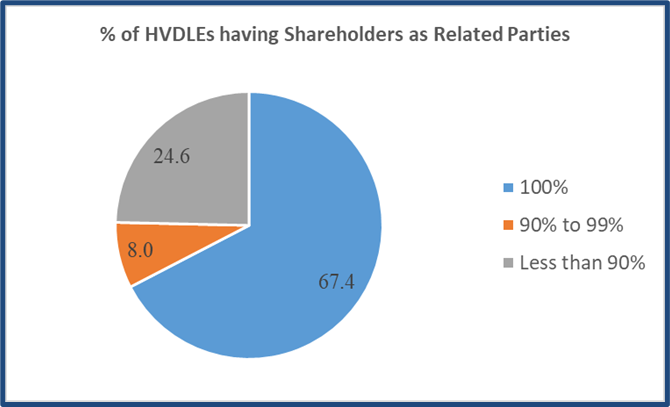
SEBI continues to tighten the regulatory regime for debt listed entities as it aims to promote corporate bond market. After equating debt listed entities with outstanding value of listed non-convertible debt securities of Rs. 500 crore and above with equity listed entities for the purpose of corporate governance norms, SEBI proposes a stricter approval regime for Related Party Transactions (‘RPTs’) under Reg. 23 of SEBI (Listing Obligations and Disclosure Requirements) Regulations, 2015 (‘LODR’) vide Consultation paper on review of Corporate Governance norms for a High Value Debt Listed Entity (‘HVDLE’)[1]. This has been rolled out just before the corporate governance provisions become applicable on a mandatory basis effective from April 1, 2023. The composition of 138 HVDLEs, in terms of shareholding pattern, as on March 31, 2022 was as under:
Click here to register for the workshop: https://forms.gle/V8SRUpDpsSMYraBx9
Loading…
– Team Resolution, Vinod Kothari and Company | resolution@vinodkothari.com
The Ministry of Corporate Affairs (‘MCA’) issued a Discussion Paper on 18th January, 2023 on changes being considered to the Insolvency and Bankruptcy Code, 2016 (‘Discussion Paper’). Since the very inception of the Insolvency and Bankruptcy Code, 2016 (‘IBC’), it has undergone six amendments besides, several amendments in the respective regulations. However, the proposals in this Discussion Paper seem to be the most comprehensive one – covering all major aspects of the law.
Broadly speaking, the amendments proposed in the Discussion Paper can be categorized as follows:
Register to our premium section to access the full Report

Sample Report
Loading…
Team Finserv | finserv@vinodkothari.com
Which law to follow? – Listing Regulations or laws applicable to subsidiaries?
– Aisha Begum Ansari, Manager | aisha@vinodkothari.com
The RPT provisions under the SEBI Listing Regulations were substantially amended by SEBI on November 9, 2021. Pursuant to the amendment, the definitions of related party, RPT, material RPT, requirements of obtaining audit committee, and shareholders’ approval were changed.
The definition of ‘RPT’ was amended to include cross RPTs. Earlier, only transactions between the listed entity and its related parties were covered, but now, the following transactions are also covered:

 Reload document
  Open in new tab