Posts

Japanese Capital Takes Flight in Indian Skies: India’s First JOLCO Leasing Deal 

Simrat Singh | Finserv@vinodkothari.com 

IndiGo has reportedly entered into a transaction to lease two aircraft through a Japanese Operating Lease with Call Option (JOLCO) structure, marking the first instance of an Indian airline accessing Japanese equity-backed aircraft financing. The structure involves Japanese investors and banks funding the acquisition of the aircraft through a leasing special purpose vehicle (SPV), which then leases the aircraft to the airline through a GIFT City based entity. This development comes barely a month after India notified the Protection of Interests in Aircraft Objects Rules, 2026, in January 2026 under an Act having the same name. The statute was itself notified in April 2025. Separately, India had made amendments to insolvency laws to fall in line with the Cape Town Convention [see MCA Notification dated 03.10.2023]. Notably, India had signed the Convention in the year 2008. 

The Cape Town Convention is all about creditor protection by providing clear and swift remedies to secure their interests in high value mobile equipment such as aircrafts. These legislations gave domestic legal effect to Cape Town Convention and its Aircraft Protocol Rules (discussed below). Aircraft lessors globally value their ability to repossess an aircraft if the airline in a domestic jurisdiction has suffered an insolvency event. The legal certainty of lessor’s rights is a major factor in international leasing transactions. This legal certainty, though already vindicated in  rulings such as Kingfisher1 could have been a major factor in consummation of this deal.

In this write-up, we briefly examine the JOLCO structure, the rationale for structuring the arrangement as an operating lease to enable depreciation benefits for the lessor and the importance of the Cape Town Convention in facilitating such cross-border aircraft leasing transactions. 

Introduction

Leasing is one of the most common ways of financing acquisition of aircraft by the global aviation sector. The share of leased aircraft has increased significantly over time, rising from around 10% of the global fleet in the 1970s to nearly 58% by the end of 2023. Against this global average, India exhibits an even higher reliance on leasing, with approximately 80% of its commercial aircraft fleet being leased.

India’s aviation sector has witnessed rapid growth in recent years. The country has emerged as one of the fastest-growing aviation markets in the world, recording around 241 million air passengers in 2024, making it the fifth-largest aviation market globally. Not only has air travel become a very commonly used mode of travel in a prosperous country, the Country has also enabled major infrastructural facilities by adding new airports, expanding existing ones, etc. The number of operational airports in India has increased from 74 in 2014 to about 163 by 2025.

Thus, leasing plays a dominant role in India’s aviation sector, with the majority of airline fleets being leased rather than owned. Historically, this market has been heavily reliant on overseas leasing hubs such as Ireland, with aircraft acquisitions commonly financed through structures such as export credit supported Loan Covered Risk Amount (LCRA) financing. Recognising this dependence, the Government of India launched Project RAFTAAR under the Ministry of Civil Aviation to develop an aircraft leasing ecosystem at GIFT City, with a working group of industry experts that included Mr. Vinod Kothari, which gave various proposals aimed at promoting aircraft leasing from India. (The report can be read here). The green shoots from this strategic initiative have now clearly started growing and blooming, with the number of registered aircraft lessors in IFSC growing to 33, which has leased 242 aviation assets including 90 aircrafts and 67 engines as on March 2025.

The JOLCO structure

A JOLCO transaction involves Japanese equity investors (institutions, HNIs etc.) and banks financing the acquisition of an aircraft through a SPV. The investors invest in the SPV through a Tokumei Kumiai structure which essentially grants a tax-pass through to the SPV, allowing the investors to claim income/losses of the SPV and depreciation on the SPV assets. The SPV uses the equity and bank debt to purchase the aircraft from the manufacturer and subsequently leases the aircraft to the airline (in the present case to the GIFT City WOS of the airline which will then sub-lease it to the airline) under a long-term operating lease arrangement with tenure of 8-10 years.

The airline pays periodic lease rentals to the SPV (in present case to GIFT City WOS which then in turn pays to the SPV) [see Fig 2 below], which are applied towards servicing the bank debt and providing returns to the equity investors. The structure includes a call option in favour of the airline, allowing it to purchase the aircraft at a pre-agreed price at the end of the lease term. The main advantage of this structure for the lessor-investors is the tax relief availed by them under Japanese tax laws (discussed below) and for the lessee, the reduced lease rentals as compared to other models. 

While the structure includes a call option in favour of the airline, this does not necessarily convert the lease into a finance lease. The call option is not a bargain purchase option, but is exercisable at a pre-agreed price that reflects the expected fair value of the aircraft at the end of the lease term. Since ownership does not automatically transfer and the option price is not nominal, the residual value risk/asset based risk remains with the lessor during the lease term. Accordingly, the arrangement continues to be characterised as an operating lease, allowing the lessor to retain tax ownership and claim depreciation under Japanese tax laws. Another reason for incorporating a call option is that the investors typically have no operational capability or commercial intent to take delivery of the aircraft at the end of the lease term. Since the aircraft is owned purely as a financial investment, the investors generally prefer that the airline either extend the lease or exercise the purchase option. The call option therefore provides a practical exit mechanism for the investors at the end of the lease period. The other conditions of the lease agreement, such as redelivery, are also designed so as to ensure that the call-option is exercised.

Rationale for selecting it as operating lease

JOLCO is an operating lease, which means the lessor SPV retains the risks and rewards of the asset. This retention is critical from a tax perspective, as it enables the Japanese investors to claim depreciation on the aircraft under Japanese tax rules. Japanese tax rules permit a declining balance depreciation method that front-loads expense recognition. For aircraft assets, the rates enable up to 20% depreciation2 annually which means that in the initial years the investors can claim a substantial amount of depreciation. This is contrasted with the typical tenure of the lease period which is around 10 years. For instance, if an aircraft costing USD 100 million allows depreciation deductions of USD 40 million over the initial 3 years, the rentals during the corresponding period will be much lesser, leaving the difference as a tax shelter. This depreciation expense, net of the lease rentals,  will be offsetted against the investors’ taxable domestic income in Japan, generating tax benefits that form a significant component of the investors’ overall return. Since part of the return in JOLCO is derived from these tax claims, the investors are able to accept relatively lower lease rentals, reducing the effective financing cost for the airline. Interest payments on the loan are also tax deductible for the investors. 
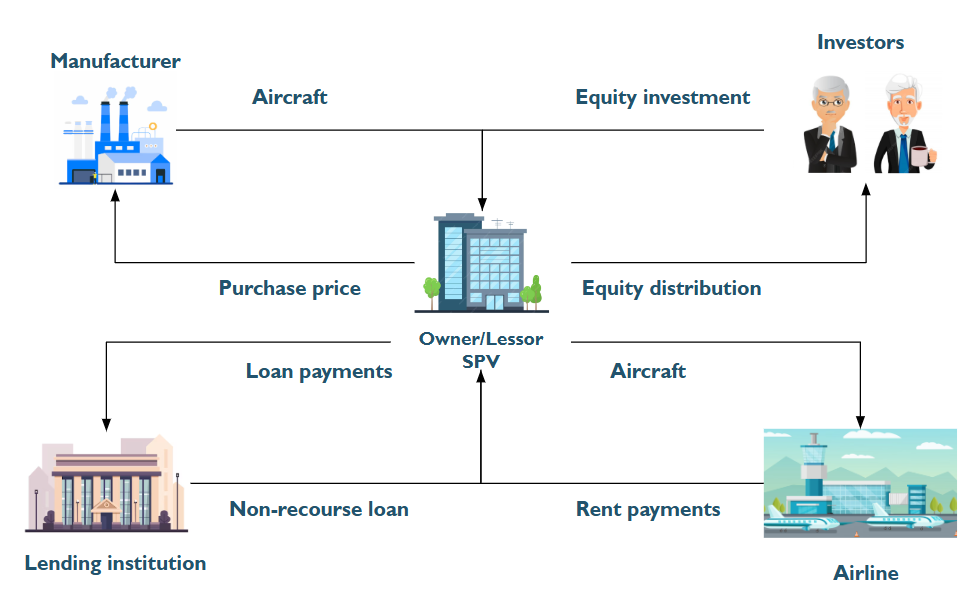
Fig 1: Structure of a JOLCO deal

A finance lease structure would not achieve the same outcome, as it transfers the risks and rewards of ownership to the lessee and may be characterised as a financing arrangement rather than a true lease. In such cases, the economic ownership of the asset may be regarded as residing with the user of the asset i.e. the airline, which could disallow the ability of the lessor investors to claim depreciation on the aircraft.

Role of GIFT CITY 

In the present JOLCO deal, the aircraft is expected to be leased by the Japanese SPV to the airline’s IFSC-based wholly owned subsidiary at GIFT City, which will then sub-lease it to the airline. Routing the transaction through GIFT City instead of a direct transaction between the Indian airline and foreign lessor ensures no tax leakage. The same is explained below:

  1. If the aircraft were leased directly by the Japanese SPV to IndiGo, the lease rentals would be characterised as ‘royalty’ for the use of industrial equipment under Section 9(1)(vi) of the Income Tax Act, 1961. Since the payer is an Indian resident and the aircraft is used in India, such royalty is deemed to accrue or arise in India, triggering withholding tax of 10% under Section 195;
  2. The insertion of an IFSC leasing entity at GIFT City helps mitigate this tax friction through provisions introduced specifically to develop India as an aircraft leasing hub:
    1. First, when the Indian airline pays lease rentals to the IFSC leasing entity, those payments do not attract withholding tax where the IFSC unit is availing the tax holiday under Section 80LA;
    2. Second, royalty income received by a non-resident lessor from the IFSC unit engaged in aircraft leasing is exempt from tax in India [see section 10(4F)]. As a result, lease rentals paid by the IFSC entity to the Japanese SPV would not be taxable in India;
    3. Third, the IFSC also provides capital gains relief for transfer of aircraft leased by IFSC units, enabling tax-efficient exit of the asset at the end of the lease cycle. In addition, the Government of Gujarat has waived stamp duty on aircraft leasing and financing transactions executed in IFSC, reducing transaction costs at the state level.

See more on aircraft leasing in GIFT IFSC here.
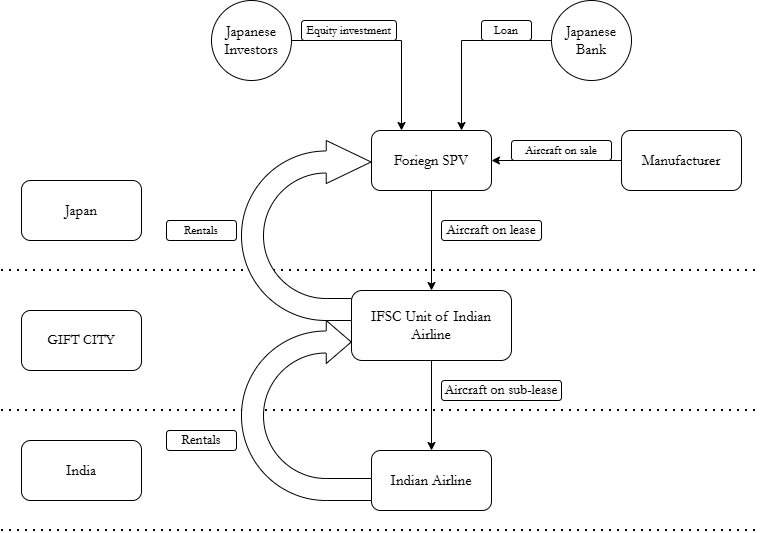
Fig 2: Deal structure

Significance of Cape Town Convention and IBC

For cross-border aircraft leasing transactions, lenders and lessors place much weightage on their ability to repossess the aircraft in the event of airline default. Financers require legal certainty that their ownership or security interests can be quickly enforced if payments stop. The Cape Town Convention on International Interests in Mobile Equipment establishes a uniform framework for registering and enforcing such interests including mechanisms such as time-bound possession. The importance of such protections became evident during the Go Air Insolvency where aircraft lessors faced significant difficulty repossessing aircraft due to the moratorium under the IBC (See our article on Go Air insolvency and Cape Town Convention here). 

In April 2025, India enacted the Protection of Interests in Aircraft Objects Act, 2025 and notified its rules in January 2026, giving domestic legal effect to the Cape Town Convention and its Aircraft Protocol Rules. The legislation is intended to align India’s aviation financing framework with global standards and facilitate quicker repossession and enforcement of lessor rights, improving investor confidence in leasing transactions involving Indian airlines. Upon a combined reading of the 2023 notification and the Protection of Interests in Aircraft Objects Act, 2025, the moratorium under Section 14 of the IBC will not prevent enforcement of rights in respect of aircraft objects covered under the Cape Town framework. Consequently, upon default by the lessee, creditors and lessors may exercise the remedies available under Articles 8 to 10 of the Cape Town Convention, including repossession, deregistration and export of the aircraft. This was important specially since the NCLAT ruling of Go Air3 upheld the moratorium on Go Air, which left international lessors in a limbo. 

  1.  DVB Aviation Finance Asia PTE Ltd. v. Directorate General of Civil Aviation, WP (C) 7661/2012 ↩︎
  2. Tegwan, 2025, Indian Journal of Law and Legal Research – ISSN: 2582-8878 ↩︎
  3. SMBC Aviation Capital Ltd. v. Interim Resolution Professional of Go Airlines (India) Ltd., (2023 SCC OnLine NCLAT 230) ↩︎

Draft Income-tax Rules deal a tax blow on CTC Car leases

– Chirag Agarwal, Assistant Manager | finserv@vinodkothari.com

Draft Income-tax Rules, 2026 (“Draft Rules”), intended to be applicable from 1st April, 2026, have increased the perquisite value for cars used for a mix of personal and official use, by Rs 3200 per month  and Rs 4600 per month (where the expenses for running and maintenance are borne by the employer) and by Rs 1400 per month and Rs 2100 per month (where the expenses for running and maintenance are borne by the employee), respectively for upto 1.6 litre engine cars and above 1.6 litre engine cars. This, in our reading, will be applicable even for existing car lease transactions, increasing employees’ tax burden by Rs 5,040 to Rs 16,560 per car per annum. In addition, going forward, the tax attraction of CTC car leases comes down.

The Income Tax Department has issued the Draft Rules pursuant to the already-enacted rewrite of income tax law in form of Income Tax Act, 2025, replacing the 1961 Act. Accordingly, the 1962 Rules are to be replaced by Draft Rules, to apply from 1st April, 2026. The Draft Rules are mostly the same as the extant rules; however, monetary value of perquisites, covered by Rule 15 [corresponding to Rule 3(2) of existing Rules] is proposed to be enhanced significantly. Thus, there is a significant change in the valuation of perquisites relating to motor cars. 

As per the Income-tax Act, the value of perquisites provided by an employer (such as the use of a motor car provided by the employer) is added to the employee’s taxable income under the head “Salaries”. The Draft Rules propose an increase in the perquisite value attributable to the use of a motor car.

The proposed increase in perquisite valuation would result in a higher taxable perquisite value in the hands of employees, thereby increasing their taxable income. The CTC-based car leasing model, which is a distinctive feature of the Indian tax framework and has been widely used for several decades, derives its attractiveness from the favourable rules governing the valuation of perquisites, which reduce the employee’s taxable income. Any upward revision in such perquisite valuation is therefore likely to reduce the tax benefits associated with this structure and may adversely impact the overall attractiveness of CTC-based car leasing arrangements.

CTC leasing of passenger cars alone is nearly Rs 9000 crores annual volume business in India, constituting roughly 1.5% of passenger vehicles sold in the country. If the Draft Rules are notified in their current form, the revised valuation norms will take effect from April 1, 2026 and will apply not only to new arrangements but also to all existing CTC car leasing arrangements. Based on a broad estimate, this change could result in an additional tax outflow of approximately ₹36 crores to ₹81 crores annually for employees under the existing CTC leasing arrangements. 

This article explains the proposed changes and what they could mean for CTC-leasing going forward.

Taxability benefit under the CTC leasing structure

The tax benefit under the CTC car leasing structure arises from the differential treatment between 

  1. the lease rentals forming part of the employee’s CTC, and
  2. the valuation of the perquisite in respect of the use of the motor car under the Income-tax Rules. 

While the employer pays the lease rentals to the lessor as part of the employee’s CTC, the employee is not taxed on the actual lease rental amount. Instead, the employee is taxed only on the prescribed perquisite value of the car as determined under Rule 3(2) of the Income-tax Rules, 1962. This prescribed value is typically lower than the actual lease rentals, resulting in a reduction in the employee’s taxable income.

To illustrate: Assume an employee’s agreed CTC is ₹1,00,000 per month. The employer arranges a car on lease and pays lease rentals of ₹25,000 per month to the lessor, which forms part of the employee’s CTC. Accordingly, the employee’s cash salary reduces to ₹75,000 per month. For tax purposes, however, the employee is not taxed on the full ₹25,000. Instead, only the notional perquisite value of the car (as prescribed under Rule 3(2)) is added to his taxable income. The difference between the actual lease rentals and the lower perquisite valuation results in a tax arbitrage, which forms the economic rationale for the popularity of the CTC car leasing model.

Proposed Changes and Impact

The Draft Rules prescribe a higher perquisite value for the use of a motor car owned by an employer to be included in the taxable income of employees where it is used partly in the performance of duties and partly for private or personal purposes of the employees or their household members. The proposed revisions are summarised in the table below:

Expenses on maintenance and running met byCubic capacity of engine does not exceed 1.6 litresCubic capacity of engine exceeds 1.6 litres
ExistingProposedExistingProposed
Case I
Employer
₹1,800 + ₹900*₹5,000 + ₹3,000*₹2,400 + ₹900*₹7,000 + ₹3,000*
Case II
Employee
₹600 + ₹900*₹2,000 + ₹3,000*₹900 + ₹900*₹3,000 + ₹3,000*

*In case chauffeur is provided to run the motor car by the employer.

The proposed increase in the perquisite valuation of motor cars under the Draft Rules is likely to have a direct impact on the economics of the CTC car leasing model.

From the employee’s perspective, the proposed increase would result in a higher taxable perquisite being added to taxable income. The tax arbitrage that makes CTC car leasing attractive, i.e., the gap between the actual lease rentals and the lower notional perquisite value, is expected to narrow. As a result, the net tax savings available to employees under this model will be reduced. Below we have presented the likely impact with the help of two examples:

Example 1: 

  • Lease rental: ₹25,000 per month
  • Engine capacity: 1.7 litres
  • Mixed use
  • Expenses on maintenance and running are met/ reimbursed by the employer
  • Tenure: 1 year
ParticularsExisting RulesDraft RulesImpact (Increase)
Annual CTC₹12,00,000₹12,00,000
Lease Rental (part of CTC)₹3,00,000₹3,00,000
Cash Salary Paid₹9,00,000₹9,00,000
Perquisite Value Taxable₹28,800₹84,000₹55,200
Total Taxable Income ₹9,28,800₹9,84,000₹55,200
Tax @ 30% slab (excluding cess)₹2,78,640₹2,95,200₹16,560

Example 2: 

  • Lease rental: ₹25,000 per month
  • Engine capacity: 1.5 litres
  • Mixed use
  • Expenses on maintenance and running are met/ reimbursed by the employee
  • Tenure: 1 year
ParticularsExisting RulesDraft RulesImpact (Increase)
Annual CTC₹12,00,000₹12,00,000
Lease Rental (part of CTC)₹3,00,000₹3,00,000
Cash Salary Paid₹9,00,000₹9,00,000
Perquisite Value Taxable₹7,200₹24,000₹16,800
Total Taxable Income ₹9,07,200₹9,24,000₹16,800
Tax @ 30% slab (excluding cess)₹2,72,160₹2,77,200₹5,040

It shall be noted that employers would not incur any additional tax cost on account of the proposed changes, as the CTC paid to employees, including the lease rentals, would continue to be allowable as a deductible business expense. 

Conclusion

The Draft Rules materially raise the perquisite valuation of employer-provided cars, pushing up the tax outflow for employees opting for CTC-based car leasing. Since the revised valuation (if notified) will apply even to existing leases from 1 April 2026, the tax efficiency of the CTC car lease model would stand materially reduced, impacting both the attractiveness and economics of such arrangements going forward.
 

Our Other Resources:

12-Hour Certificate Course on Leasing

Register: https://forms.gle/VBeA2EmkC92QUmK79

Loader Loading…
EAD Logo Taking too long?

Reload Reload document
| Open Open in new tab

Download as PDF [617.45 KB]

GST changes: Double dhamaka for car lessees; lessors to have elongated input tax recovery

– Vinod Kothari & Jigisha Aggarwal | finserv@vinodkothari.com

GST changes announced vide 56th meeting of the GST Council dated Sept 03, 2025 have brought cheers to the entire country; however, for lessees of motor vehicles where rates of GST have been reduced (the extent of reduction being from 5% to 10% in most of the cases – reduction of rate from 28% to 18%, and the doing-away of the compensatory cess in others), the lessees of motor vehicles have unusual reasons to be cheered. At the same time, lessors who have existing leases of motor vehicles will have some present value losses. This article explains.

Futuristically, this reduction in GST rates on automobiles can benefit both lessor and lessees, as hopefully, the demand for motor vehicles will increase, and so will opportunities of leasing. However, there is a surprise bumper for the lessees who have currently on-the-run leases of vehicles – their rates of GST, going forward, will come down, even though the vehicle may have been acquired prior to the 22th September, 2025. Thus, while for the rest of the country, one has to buy a car to enjoy the rate reduction, lessees of existing motor vehicles also stand benefitted. Our article explains how.

On the other hand, for lessors, there will be a present value loss. With reduced GST rates, the initial outlay for the lessor, paid at the time of acquisition of the vehicles, will take longer to be recovered in the form of lease rentals – hence, the lessors will suffer a present value loss.

On an estimate, roughly Rs 6000 crores to Rs 8000 crores of car leases are done by lessors in the country; the outstanding volume of leases may be almost Rs 20000 crores. 

Post-22 Sept benefit for others; lessees of existing leases also stand benefited

For anyone else to take the benefit of the rate drop, you need to buy a vehicle on and from 22 Sept. 2025. However, for lessess of  existing lease transactions, the reduction in GST rates from 28% to 18% translates into a financial benefit and they clearly stand benefitted from the reduced GST rates. Lease rentals billed on/ after Sept 22nd, will attract lower GST rates which implies total periodic payment by the lessee reduces. 

Wondering why is it so? This is because while a lease is regarded as a “supply of service”, however, the rate of GST on leases of goods are aligned with the rate of tax on the sale of the respective goods. Hence, if the GST on cars is currently 28%, the rate of tax on lease of the car is also 28%, payable periodically as the rentals accrue. Thus, irrespective of the original purchase date of the vehicle, post 22nd September, the GST on existing leases will drop down, giving an unequalled bounty to the existing lessees.

Present value loss for lessors

When a lessor purchases a vehicle, he pays GST upfront at the time of purchase, on the entire purchase price of the vehicle. This GST paid becomes input tax credit for the lessor. On each periodic lease rental, he collects GST from the lessee. Lessor offsets this output GST collected from the lessor against the input tax credit. In case of lease transactions entered into before Sept 22, 2025, reduction in rates of GST would mean that lessor will need longer time to recover his input tax from the lessor. 

The reason being the vehicle was purchased at the higher GST rate (for instance 28%) and the lessor could avail ITC accordingly. However, Sept 22, 2025 onwards, the output GST collected periodically would reduce, for instance, would be collected at the reduced rate of 18%.

Therefore, the lessor will now take longer to fully recover the input tax credit by offsetting it against a lower input tax.

The same can be understood with the help of below mentioned illustration. Let us assume that the lessor had purchased a vehicle before Sept 22, 2025 and paid GST @28%.

ParticularsLease arrangement before Sept 22, 2025Lease arrangement on/ after Sept 22, 2025Impact
Cost of vehicle11,40,00011,40,000No change
GST= 1140000*28% = 319200= 1140000*18% = 205200Reduced by 1,14,000
Monthly lease rental30,00030,000No change
Monthly GST collected8,400 (28%)5,400 (18%)Reduced by 10%
Total GST collected in 12 months1,00,80064,800Reduced by 36,000
Total lease revenue (incl GST)4,60,8004,24,800Reduced by 36,000
Number of months taken to recover ITC319200/8400= 38 months205200/5400 = 38 months

In case of lease arrangement before Sept 22, the lessor was able to recover input tax of Rs 319200 in 38 months. Under the revised rates, the rate of GST on the existing leases will come down and will be Rs 5400 per month. Therefore, it will take almost 59 months to recover the ITC originally paid. Therefore, there will be a present value loss for existing leases, which would not have been priced by the lessors at the time of the original contract.

Changes under the automobile sector at a Glance

The supply of services involving the leasing, renting, or transfer of the right to use goods is liable to attract the same rate of GST and compensation cess (which is now removed) as applicable to the supply of similar goods involving transfer of title, i.e., a supply of goods. This provision forms the basis for applying goods-equivalent tax rates to leasing transactions, despite their classification as services under GST. For a detailed understanding of GST implications on lease transactions, you may refer to our article here.

Since it has been decided to end the compensation cess levy, the compensation cess rate is being merged with the GST so as to maintain tax incidence.

As per FAQ No. 35 of the FAQs on the decisions of the 56th GST Council held in New Delhi issued by the Ministry of Finance, currently mid-size and big cars attract 28% GST and compensation cess ranging from 17-22% which makes the overall tax incidence ranging from 45-50%. Since the new GST rate on mid-size and big cars will be 40% with no compensation cess, the overall tax incidence has reduced by 5%-10%.

S. No.DescriptionEarlier rateNew rate
Rates reduced
1.
Petrol, LPG or CNG driven motor vehicles of engine capacity not exceeding 1200cc and of length not exceeding 4000 mm.28%18%
2.Diesel driven motor vehicles of engine capacity not exceeding 1500 cc and of length not exceeding 4000 mm.28%18%
3.Three wheeled vehicles28%18%
4.Fuel Cell Motor Vehicles including hydrogen vehicles based on fuel cell technology12%5%
5.Tractors (except road tractors for semi-trailers of engine capacity more than 1800 cc)12%5%
6.Road tractors for semi-trailers of engine capacity more than 1800 cc28%18%
7.Motor vehicles for the transport of ten or more persons, including the driver [other than buses for use in public transport, which exclusively run on Bio-fuels which is already at 18%]28%18%
8.Motor cycles of engine capacity upto 350 cc28%18%
9.Specified solar assets12%5%
Rates increased
10.Station wagons, racing cars, petrol, LPG and CNG cars of engine capacity exceeding 1200 cc or length exceeding 4000 mm28%40%
11.Diesel cars of either engine capacity exceeding 1200 cc or length exceeding 4000 mm28%40%
12.Motor vehicles with both spark-ignition internal combustion reciprocating piston engine and electric motor as motors for propulsion, of engine capacity exceeding 1200cc  or of length exceeding 4000 mm28%40%
13.Motor cycles of engine capacity exceeding 350 cc28%40%

Read More:

  1. Rentals on finance leases: To deduct it all or just the interest slice? 
  2. An Overview of GST Implications on Lease Transactions

Rentals on finance leases: To deduct it all or just the interest slice? 

Tax accounting standard ICDS IX raises an unanswered question

– Chirag Agarwal | Assistant Manager (finserv@vinodkothari.com)

While leasing in India has developed much lesser as compared to other countries12, there is an interesting and growing line of business in India – CTC leasing, that is, lease of assets offered to employees of large companies with the rentals forming part of the employee’s CTC. The key to the tax neutrality of a CTC lease to the employer is the full deductibility of the lease rentals, as the rentals replace what would otherwise have been the employment benefit expense. But if the lease is intrinsically a financial lease, is it that the employer will still be able to expense the rentals, particularly after tax accounting standard ICDS IX, providing that the interest component of a financial lease will be treated as a cost of borrowing? CTC leasing practices in the past may have depended on some tax rulings, which pertain to the period before the applicability of the ICDS  – hence, the question is still an open one.

CTC leasing of passenger cars alone is nearly Rs 6000 crores annual volume business in India, constituting roughly 1% of passenger vehicles sold in the country.

In this article, we explore:

  • What is a financial lease? Is there a concept of financial lease, from the lessee perspective, now that accounting standards have eliminated the distinction from the lessee perspective?
  • Why is a financial lease equivalent to a borrowing transaction?
  • Why is the tax neutrality of a CTC lease to an employer important? 
  • Past rulings that may or may not hold the answer?
  • So, is ICDS IX decisive?
  • So, if ICDS IX does not apply, does ICDS I (substance over form) apply?

What is a Financial Lease and its accounting from the perspective of a lessee?

Finance Lease is an alternative to taking a loan. In this type of lease, all major risks and benefits of owning the asset are passed from the lessor to the lessee. The lessor only provides finance and keeps the legal ownership. At the end of the lease, the ownership of the equipment usually gets transferred to the lessee.

In Asea Brown Boveri vs IFCI, the Supreme Court quoted the following para from Vinod Kothari’s book Lease Financing and Hire Purchase, with approval specifying the features of a financial lease: 

“1. The asset is use-specific and is selected for the lessee specifically. Usually, the lessee is allowed to select it himself.

2. The risks and rewards incident to ownership are passed on to the lessee. The lessor only remains the legal owner of the asset.

3. Therefore, the lessee bears the risk of obsolescence.

4. The lessor is interested in his rentals and not in the asset. He must get his principal back along with interest. Therefore, the lease is non- cancellable by either party.

5. The lease period usually coincides with the economic life of the asset and may be broken into primary and secondary period.

6. The lessor enters into the transaction only as a financier. He does not bear the costs of repairs, maintenance or operation.

7. The lessor is typically a financial institution and cannot render specialized service in connection with the asset.

8. The lease is usually full-pay-out, that is, the single lease repays the cost of the asset together with the interest.”

As per AS 19, in a financial lease, the rent paid is divided into two parts, i.e., finance charges and capital recovery. 

With Ind AS 116, this changed. Under Ind AS 116, the lessee will need to show all leases as a “right of use asset” (ROU Asset) along with a liability to pay rent over time.

In this case, only the lessor needs to classify leases as financial or operating. For the lessee, there is no such difference and the asset will simply be recorded as a ROU asset. This position is supported by Para 61 of Ind AS 116 which states “A lessor shall classify each of its leases as either an operating lease or a finance lease.”. Further, Paras 22 to 60A, which deal specifically with lessee accounting, do not mention any requirement for classifying leases into finance or operating categories.

Why is a financial lease equivalent to a borrowing transaction?

A financial lease is considered similar to a borrowing transaction because, in substance, it functions like a loan. The lessor recovers the full cost of the asset along with a financing return through lease rentals, while the lessee gains the right to use the asset and repays the cost over time. The lessor’s primary risk relates to the lessee’s repayment capacity rather than the asset’s residual value, making it economically similar to a borrowing arrangement rather than a traditional lease.

Why is the tax neutrality of a CTC lease to an employer important? 

The entire CTC leasing model is based on the taxation benefit, where the employer claims the entire lease rental as a deduction while computing income under “Profits and Gains from Business or Profession.” This also benefits the employee since the taxable value under perquisites is comparatively lower than if the same amount were paid as direct salary. 

However, if we were to say that the employer, as the lessee, cannot claim full deduction for the lease rental, the employer would likely prefer paying the equivalent amount directly as salary. This is because salary expenses are fully deductible, making direct salary payments more tax-efficient in such a scenario for the employer.

There is yet another way the neutrality to the employer is impacted: the employer books an ROU assset and a related OTP liability; however, that may still be okay considering the employees’ interest. However, losing a tax benefit may be an added cost.

So, is ICDS IX decisive?

ICDS IX deals with borrowing costs, which defines the same as, 

are interest and other costs incurred by a person in connection with the borrowing of funds and include:

(iv) finance charges in respect of assets acquired under finance leases or under other similar arrangements.

Hence, as per ICDS IX, the interest component of a financial lease will be treated as a cost of borrowing, and the deduction can be claimed only for the interest portion which is relevant only for the lessee.

However, as discussed above, under Ind AS 116, there is no difference between FL/OL for the lessee.  Accordingly, ICDS IX should not apply here. 

So, if ICDS IX does not apply, does ICDS I (substance over form) apply?

It may be noted that the ICAI Technical Guide on ICDS warrants that substance should prevail over the form (ICDS I). 

Hence, if we say that ICDS IX does not apply whether ICDS I should also not apply in case of financial lease? In our view, the substance of the lease would definitely matter. Even if the accounting distinction does not matter, if the transaction of lease is so structured so as to be equivalent to a loan, the deductibility of entire lease rentals would not be allowed. 

Hence, to get the benefit of deductibility, the lease shall be a true lease. The following may be considered as essential features of a true lease:

Past rulings that may or may not hold the answer?

The Supreme Court in its decision in the case of ICDS Limited Vs CIT (350 ITR 527) held that in a leasing transaction, the lessor would be entitled to claim depreciation under section 32 of the IT Act on the leased assets. On the other hand, the lessee would be entitled to claim the entire lease rentals as a deduction while computing its total income.

Similarly, in the case of Wipro Ge Healthcare Private Limited vs Assistant Commissioner Of Income Tax, 2023, it was held that the assessee is entitled to claim a deduction on account of lease rentals paid as it is a revenue expenditure on the ground that the assessee is only a lessee and the lessor is the owner of the assets leased.

A similar judgment was passed in the case of Tesco Bangalore Private Limited vs Deputy Commissioner Of Income Tax, on 23 May, 2022.

However, the case laws relate to the assessment year before the introduction of ICDS IX and hence the same cannot be relied upon now.

Thus, tax treatment of leases for lessees is still a grey area. While Ind AS 116 has made accounting simple by removing the difference between operating and finance leases, the taxability of leases still remains a question because of ICDS IX. 

Therefore, there is a need for a clear guideline by the IT dept that finally settles this question. 

Footnotes:

  1. We have discussed the evolution of leasing in India in this publication: https://www.ifc.org/content/dam/ifc/doc/mgrt/evolution-of-leasing-in-india-aug-30-2019.pdf ↩︎
  2. See India chapter in WLY 2023 volume: https://www.world-leasing-yearbook.com/wp-content/uploads/2023/12/India_WLY.pdf ↩︎

Full Day Workshop On Leasing and Asset Backed Finance

Register Here: https://docs.google.com/forms/d/e/1FAIpQLSfJYbSJBs53XGLp1mpqx_QKJSkPrU4eXC13dRfiljspEDXGWw/viewform

Loader Loading…
EAD Logo Taking too long?

Reload Reload document
| Open Open in new tab

Download as PDF [878.18 KB]

Aircraft leasing in IFSC

Team Finserv | finserv@vinodkothari.com

Loader Loading…
EAD Logo Taking too long?

Reload Reload document
| Open Open in new tab

Download as PDF [1.16 MB]

Our other resources on IFSC

  1. Ship leasing from IFSC: A new business takes shape
  2. Financial entities in IFSC: A primer
  3. Finance Companies / Units in International Financial Services Centre (IFSC)
  4. Budget 2023 and Gift IFSC: Making Things Happen
  5. Consultation paper on the proposed IFSCA (Payment Services) Regulations, 20XX: An Analysis
  6. IFSC Banking Units allowed to deal in Structured Finance Products
  7. Banking & Finance units in IFSC- A regulatory overview

GoAir Insolvency: Lessors’ rights gone in thin air?

– Financial Services Division, finserv@vinodkothari.com

A Special Bench of NCLT,  New Delhi admitted the insolvency of Go Airlines (India) Ltd, popularly known as GoAir, on the 10th May 2023. The insolvency was admitted on an application of the company itself, on the ground of a self-admitted default of Rs. 11.03 crores towards interest to financial creditors, out of a pile of debt, that is, Rs. 2660 cr towards aircraft lessors and Rs. 1202 cr towards its vendors. The application was admitted in the face of strong opposition by the financial creditors and the lessors of aircrafts taken on lease by the company.

Subsequently, on an appeal before the NCLAT, the appellate forum affirmed the order of the NCLT, rejecting the contention that the filing of the insolvency application was malicious. The matter may still be taken up to higher or other forums, but in the meantime, there are question marks on India as a favoured jurisdiction for aircraft leasing. Aircraft lessors need certainty as to the exercise of their rights over the leased aircraft in the event of a lessee default, and the Cape Town Convention (CTC), signed under the auspices of UNIDROIT way back in 2021, is a set of minimum assurances that the countries signing that convention have provided to aircraft lessors. The question is, India having actually been a signatory to the Convention, is it okay to have stayed the rights of the lessors by way of a moratorium during the entire period of insolvency resolution?

Read more

Guide to Structured Finance

Get your copy now!

Order here – https://rzp.io/l/R2RRY0P

A comprehensive treatise, running over 1000 pages, on four contemporary topics in structured finance.

Key highlights of the book:

– Delves deep to create fundamental understanding of the topic, evolving conceptual clarity.
– Discusses global practices, along with specific focus on Indian market.
– Blend of legal, accounting and regulatory discussions, while fully explaining the underlying financial structures.
– Evolution as well as temporal developments discussed, to allow readers to understand the trajectory and future path of the instruments.
– Sufficient discussion on structuring. Use of spreadsheet-based examples to provide practical understanding. Spreadsheets underlying the computations can be accessed on a URL.
Loader Loading…
EAD Logo Taking too long?

Reload Reload document
| Open Open in new tab

Download as PDF [311.65 KB]

Financing electric mobility: Evaluating BaaS structures

  • Qasim Saif | finserv@vinodkothari.com

The penetration of EVs in Indian vehicle market have gone up from 0.01% to 1.66% from FY 15 to September, 2021[1]. However, the growth of EVs faces several resistances in form of high upfront cost, the lack of public charging infrastructure, and travel range. In order to catapult the growth of EVs in India, there is need to increase infrastructural support to the industry in the form of charging stations, battery units etc.

The dire need of financing is felt in the entire supply chain of EVs beginning from the speciality chemicals used in batteries to the finished vehicle purchased by the end user. Read more