Legal Entity Identifier Code now mandatory for bond issuers

Ajay Ramanathan, Executive | ajay@vinodkothari.com

Background

Legal Entity Identifier (LEI) Code is a unique 20-digit code used to identify legal entities that engage in financial transactions worldwide in order to improve the quality and accuracy of financial data systems for better risk management post the global financial crisis by establishing a global reference system.

Prior to the present SEBI Circular, all non-individual borrowers availing an aggregate exposure[1] of Rs. 5 crore and above from banks and financial institutions were mandated to obtain LEI Code over the prescribed timeline.

Read more

Security Interest: Meaning, forms, registration, enforcement, and effects of non-registration

-Team Vinod Kothari and Company | resolution@vinodkothari.com

Loader Loading…
EAD Logo Taking too long?

Reload Reload document
| Open Open in new tab

Download as PDF [901.29 KB]

Continuing Disclosures by listed entities: Regulation 30 of SEBI LODR

– Vinod Kothari | corplaw@vinodkothari.com

Loader Loading…
EAD Logo Taking too long?

Reload Reload document
| Open Open in new tab

Download as PDF [911.96 KB]

Our article on Reg 30 of LODR Regulations can be viewed here

Amended KYC norms: A move towards faceless KYC

RBI amends KYC norms to permit faceless KYC; beneficial owner of 10% or more to be subjected to KYC

– Anita Baid, Vice President | anita@vinodkothari.com

Recognising the increasing trend towards faceless lending, and the use of technology for customer due diligence, the RBI has made much-needed changes in the KYC process, permitting lenders to avoid any of physical interface with borrowers and rely on documents stored in Digilocker or other e-documents. Amendments, immediately effective, were made to the Master Direction – Know Your Customer (KYC) Direction, 2016 vide a notification dated April 28, 2023.

Watch our YouTube video on the topic here – https://www.youtube.com/live/Ewi4FW8G0xk?feature=share

The amendments in the KYC Directions are applicable to every entity regulated by the RBI, including but not limited to banks, cooperative banks, payment system providers, AIFIs  as well as NBFCs intend to achieve the following:

Read more

Income tax issues in IBC

-Vinod Kothari and Sikha Bansal | finserv@vinodkothari.com

Loader Loading…
EAD Logo Taking too long?

Reload Reload document
| Open Open in new tab

Download as PDF [1.99 MB]

Presentation on Annual Secretarial Compliance report

– Vinita Nair, Senior Partner | corplaw@vinodkothari.com

Loader Loading…
EAD Logo Taking too long?

Reload Reload document
| Open Open in new tab

Download as PDF [602.72 KB]

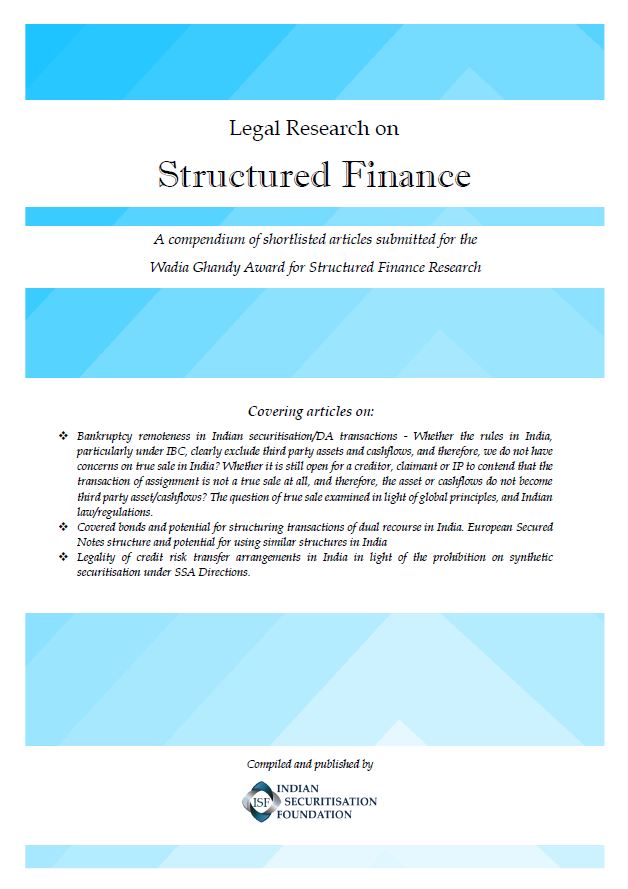
Call for papers – Wadia Ghandy Award for Structured Finance Research

Out of the 49 entries received, top 10 selected entries were published as a part of a compendium at the 11th Securitisation Summit, 2023 held on 19th May at Novotel – Mumbai Int’l Airport in front of 240+ professionals from the structured finance industry. The top 3 winners were invited to the event and were felicitated with a certificate of merit and a cash prize.

Winners of the Wadia Ghandy Award for Structured Finance Research:

1st position: Mr. Aditya Sushant Jain (BALLB, Jindal Global Law School)
Topic: Squinting on the true sale doctrine in Indian securitization transactions through a US-India analysis

2nd position: Ms. Gunjan Modi (BALLB, National Law School of India University, Bangalore) and Mr. Ashwin Arun (BALLB, NLU, Delhi)
Topic: Bankruptcy Remoteness in Indian Securitisation Transactions

3rd position: Ms. Niyati Prabhu (BALLB (Hons.), NUALS, Kochi)
Topic: Covered Bonds and the Potential for Structuring Dual Recourse Transactions in India: The Possibility of Implementing European Secured Notes in Indian Context

Compendium of top 10 selected articles published
at the 11th Securitisation Summit:

Loader Loading…
EAD Logo Taking too long?

Reload Reload document
| Open Open in new tab

Download as PDF [567.42 KB]

Indian Securitisation Awards 2023

Details of the 11th Securitisation Summit: https://vinodkothari.com/secsummit
Loader Loading…
EAD Logo Taking too long?

Reload Reload document
| Open Open in new tab

Download as PDF [299.86 KB]

Taxation in Securitisation: A judicial overview

-Anirudh Grover, Executive | finserv@vinodkothari.com

Introduction

Securitization transactions in India post the pandemic has seen significant improvement with volumes growing by 70% to Rs. 73000 crores in FY 2023 compared to Rs. 43000 crores in FY 2022.[1] This growth was also highlighted in one of our recent write up wherein it can be seen from the data laid down that despite the global slowdown in the world economy on account of the pandemic, the volume of securitization transactions in India gained a lot of popularity. Given the impetus of this fundraising mode, it is important to have a vibrant securitization market. This can be only achieved if the governing framework with respect to taxation does not impose an additional taxation burden on the parties. Through this article, the writer will be reviewing the stance of various courts by highlighting the principles with respect to the taxation of the parties involved in a securitization framework i.e. Originator, Special Purpose Vehicle(‘SPV’), and the Investors. For a better understanding of the framework of securitization, the readers can also refer to our Article on Securitization: A Primer.

Read more