Trust, but verify: AIFs cannot be used as regulatory arbitrage

SEBI mandates ongoing due diligence for investors and investments made by AIFs

-Vinita Nair, Senior Partner and Lavanya Tandon, Executive | corplaw@vinodkothari.com

May 03, 2024 (updated on October 9, 2024)

Background

SEBI had raised concerns relating to evergreening of loans, circumvention of FEMA norms, QIB regulations and other concerns on regulatory arbitrage by Alternative Investment Funds (‘AIFs’) in its Consultation Paper issued in January, 2024. SEBI also recorded 40+ cases wherein the structure of AIF had been abused and used to circumvent extant financial sector regulations. Read our analysis in the article ‘AIFs ail SEBI: Cannot be used for regulatory breach’ dated January 31, 2024. Further, RBI had also barred all regulated entities (REs) with respect to their investments in AIFs, discussed in our article.

Subsequent to receipt of public comments, the proposal to mandate due-diligence (‘DD’) of investors and each of the investments made by the AIF was approved in the SEBI Board meeting held on March 15, 2024. SEBI notified SEBI (Alternative Investment Funds) (Second Amendment) Regulations, 2024 effective from April 25, 2024 amending Reg. 20 of the SEBI (Alternative Investment Funds) Regulations, 2012 (‘AIF Regulations’) dealing with general obligations thereby requiring every a. AIF, b. investment manager of the AIF, c. KMP of the AIF, and d. KMP of the investment manager, to exercise specific DD with respect to their investors and investments in order to prevent facilitation of circumvention of such laws as may be specified by SEBI from time to time. 

The list of laws, thresholds and conditions for DD, reporting requirements etc. has been provided in  SEBI circular dated Oct 8, 2024 (‘SEBI Circular’). DD is required to be carried out prior to making of investments as per implementation standards formulated by Standard Setting Forum for AIFs (‘SFA’)  and published on websites of the industry associations which are part of the SFA, i.e., Indian Venture  and  Alternate  Capital  Association (‘IVCA’), PE VC CFO Association and Trustee Association of India. 

Scope of laws covered under the ambit of due diligence

The list of laws provided in the SEBI Circular comprises of the following: 

  • Provisions of SEBI (Issue of Capital and Disclosure Requirements) Regulations, 2018 (‘ICDR Regulations’), and other regulations of SEBI wherein benefits or relaxations have been provided to entities designated as Qualified Institutional Buyers (‘QIBs’).
  • Provisions of the Securitisation and Reconstruction of Financial Assets and Enforcement of Security Interest Act, 2002 (‘SARFAESI Act’) wherein benefits are provided to entities designated as Qualified Buyers (‘QBs’).
  • Prudential norms specified by RBI for regulated lenders with respect to Income Recognition, Asset Classification, Provisioning and restructuring of stressed assets;
  • Rule 6 of FEMA (Non-Debt Instruments) Rules, 2019 (NDI Rules) for investment from countries sharing land border with India ( read with Press Note 3 dated April 17, 2020 of FDI Policy 2020)

Timing, thresholds for DD, reporting requirements

Pursuant to the SEBI Circular, the due diligence for various investors and investments is required to be carried out by a. AIF, b. investment manager of the AIF, c. KMP of the AIF, and d. KMP of the investment manager in accordance with the Implementation Standards. The table below indicates in brief the criteria, checkpoints and timelines for conducting due diligence along with the consequences of the outcome. 

Sr. NoObjective intended to be achieved by investors  through investments in AIF schemeRegulations/ Directions/ Norms applicableApplicability of requirement of DD for every scheme of AIF (refer Note 1)Checkpoints for manager for specific DD Timing of DD Consequence of outcome of DD & reporting requirements, if any
1Benefits designated for QIBs ICDR and other SEBI RegulationsIf an investor, or investors belonging  to the same group, contribute(s)50% or more to the corpus of the scheme.Manager to check if such if investor/ investors of the same group is/are:(i) QIBs themselves or,(ii) Entities established, owned or controlled by the Central Government or a State Government or the Government of a foreign country, including central banks and sovereign wealth funds.Note: Where such investor is an AIF or fund set up in IFSC or outside India, above check to be carried out on a look through basis.Prior to availing benefits available to QIBs 
Refer Note 2 below for existing investments & Note 3 for proposed investments.Manager to provide confirmation to SE or lead manager or merchant banker on this.
2Benefits designated for QBsUnder SARFAESI ActIf an investor, or investors belonging  to the same group, contribute(s)50% or more to the corpus of the scheme.Same as abovePrior to making any investments or availing benefits Refer Note 2 below for existing investments & Note 3 for proposed investments.
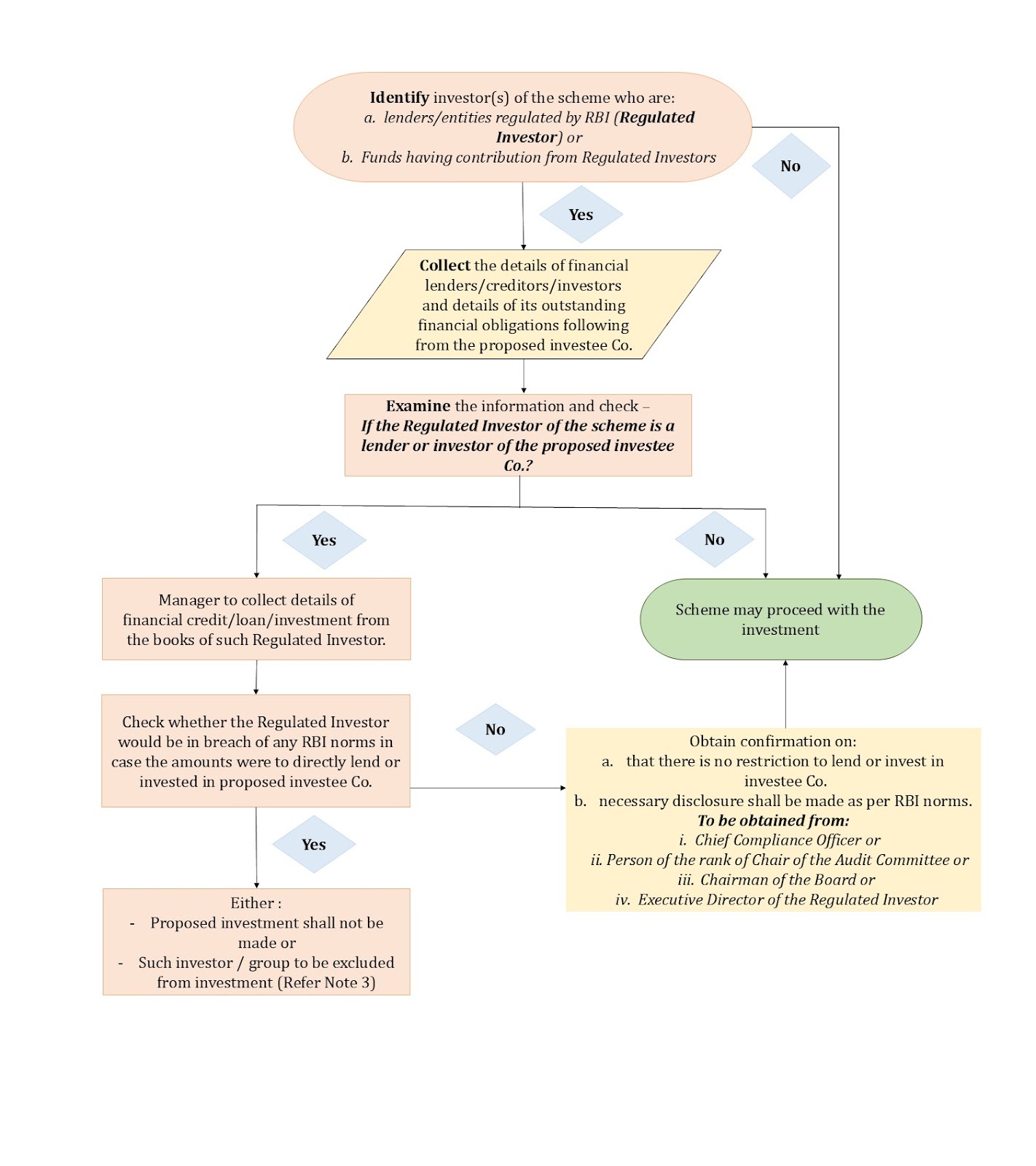
3RBI regulated lenders/ entities ever-greening their stressed loans/ assets & circumventing RBI normsRBI norms on Income    Recognition,    Asset    Classification, Provisioning and Restructuring of stressed loans/ assets(a)whose manager or sponsor is an entity regulated by RBI; or,(b)that has investor(s)regulated by RBI who:(i)individually or   along   with   investors   of the same   group contribute(s) 25% or more to the corpus of the scheme; or(ii) is an associate of the manager/ sponsor of the AIF;(iii) has majority or veto power [by itself, or through its representatives/ nominees] in voting over  decisions of the investment  committee  set up  by   the manager to approve investment decisions of the scheme.Note: where investor is an AIF or fund set up in IFSC or outside India, criteria check to be carried out on a look through basis.Refer Note 4.Prior to making any investments, to avoid indirect investment by RBI regulated lender/ entity.Refer Note 2 below for existing investments & Note 3 for proposed investments.
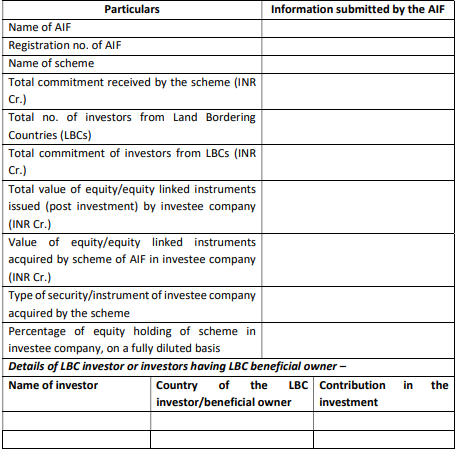
4Investment from countries sharing land border with IndiaFEMA (NDI) Rules, 2019Where 50% or more of the corpus of the scheme is contributed by investors (a)who are citizens of/are from/are situated in a country which shares land border with India; or(b)whose beneficial owners, as determined  in  terms  of  Rule  9 (3)  of  the  PMLA (Maintenance  of Records)  Rules,  2005, are citizens  of/are from/are situated in a country which shares a land border with India.If the proposed investment would result in the scheme holding           10 % or more of equity/equity-linked securities issued by the company (on a fully-diluted basis), the manager to check details stated in the previous column, by collecting information on the country of investors and their beneficial owners.Prior to making any investmentRefer Note 2 below for existing investments & Note 5 for proposed investments.

Note 1: same group’ shall mean ‘related parties’  and  ‘relatives’ as  defined  in  SEBI  (Listing  Obligations  and  Disclosure Requirements) Regulations, 2015.

Note 2

For Sr nos 1 to 3: DD requirement is applicable for existing investments too, held by AIF schemes as on October 8, 2024:

  • If DD check not satisfactory – details of investment to be reported to AIF’s custodian on or before April 07, 2025, in the format as per Annexure 1 of the circular;
  • If DD check satisfactory – AIF manager to submit an undertaking to AIF’s custodian on or before April 07, 2025.

For Sr no. 4: Reporting is required to be made for existing investments held by AIF schemes as on October 8, 2024 if the scheme holds 10% or more of equity/ equity-linked securities on a fully-diluted basis,  to AIF’s custodian on or before April 07, 2025 in the format prescribed by SFA.

Note 3

Consequence of not satisfying requirements of DD checks specified by SFA for proposed investments in case of Sr nos 1 to 3:

  • Such investor or investor group to be excluded along with necessary disclosure in the private placement memorandum (PPM); or 
  • Investment cannot be made.

Note 4: 

Note 5: Details of investment, which would result in the scheme holding 10% or more of equity/ equity-linked securities on a fully-diluted basis, to be reported to the custodian within 30 days of investment, in the below format specified by SFA.
DD requirement – one-time or ongoing?

As discussed in the SEBI BM Agenda, the  purpose  of  the  due-diligence  check  is  to  prevent  facilitation of any circumvention of provisions of financial sector regulators, which cannot be a time specific check. An entity who intends to circumvent can design the structure in such a way that, at a later date post investment, it acquires the units  of  AIFs  post  investment,  such  as  buying  the  units  of  an  existing investor or by acquiring control over the existing investor entity, as per prior arrangement.  Accordingly, it has been indicated that due diligence around investors and investments will be an ongoing one.

Applicability of DD – prospective or retrospective?

As per the SEBI circular this is applicable for existing and prospective investments. Refer Note 2 above.

Obligations of Custodian to the AIF

  • Information received from AIFs under Note 2 to be furnished to SEBI on or before May 7, 2025.
  • Information received from AIFs in terms of Note 4 above on a monthly basis to be compiled and reported to SEBI within 10 working days from month end.

Power of AIF to exclude an investor

As per SEBI Circular, in cases where the outcome of DD is not satisfactory, in that case the AIF will either have to exclude the investor or investor group or abstain from making the proposed investment. 

Dealing with power to exclude an investor, in April  2023 SEBI had issued ‘Guidelines with respect to excusing or excluding an investor from an investment of AIF that empowered an AIF to excuse its investor from participating in a particular investment in the following circumstances:

Figure 1: Circumstances to excuse an investor of AIF

Conclusion

The present amendment and SEBI Circular lays an onerous burden on the AIF, manager and KMP of the AIF and the manager. The DD requirement has become effective from October 8, 2024 and applies to existing investments as well. The AIFs have an actionable of evaluating the existing investments in the scheme in the light of the present amendment and ensure reporting in next 6 months. The obligation of on-going due diligence will result in a compliance burden, but is justified given the intent of law as “quando aliquid prohibetur ex directo, prohibetur et per obliquum” i.e. things that cannot be done directly should not be done indirectly either. AIFs will continue ‘trust, but verify’ using the DD standards for due diligence. The trustee/ sponsor of the AIF is required to ensure that compliance status of this amendment is reported to SEBI in the ‘Compliance Test Report’ prepared by the manager in terms of Chapter 15 of Master Circular for AIFs.

Our other resources:

  1. FAQs on Specific Due Diligence of investors & investments of AIFs
  2. AIFs ail SEBI: Cannot be used for regulatory breach
  3. RBI bars lenders’ investments in AIFs investing in their borrowers
  4. Some relief in RBI stance on lenders’ round tripping investments in AIFs

Proposals approved in SEBI Board Meeting held on April 30, 2024

– Laveena Gajwani and Garima Chugh | corplaw@vinodkothari.com

Loader Loading…
EAD Logo Taking too long?

Reload Reload document
| Open Open in new tab

Download as PDF [149.20 KB]

Lend, Recover, Replenish: A guide to revolving lines of credit

“Chivalry is like a line of credit. You can get plenty of it when you do not need it.”

— Nellie L. McClung

Dayita Kanodia | Finserv@vinodkothari.com

In the realm of financial management, having access to a flexible and readily available source of funds can be a game-changer for individuals and businesses alike. One such financial tool that offers this flexibility is a revolving line of credit. Often misunderstood or overlooked, revolving lines of credit are versatile financial instruments that can provide quick access to funds when needed.

A revolving line of credit is a type of loan arrangement that provides borrowers with access to a predetermined amount of funds, which they can borrow, repay, and borrow again as needed. Unlike traditional term loans, where you receive a lump sum upfront and repay it over a set period with fixed payments, a revolving line of credit offers ongoing access to funds that can be drawn upon at any time, up to the credit limit.

Revolving line of credits has been defined as a committed loan facility allowing a borrower to borrow (up to a limit), repay, and re-borrow loans.These are also known as revolving credit facilities, replenshing loans, revolving loans,  or just revolver. 

How Does it Work?

When one opens a revolving line of credit, there is an approval for a certain credit limit based on factors such as creditworthiness, income, and other financial obligations. Once approved, funds can be accessed from the credit line as needed, either by writing checks, using a debit card, making online transfers, or withdrawing cash, depending on the terms of the agreement.

The line of credit is drawn down as disbursements occur. However, the limit is reinstated to the extent repayment is made by the borrower. Obviously, the borrower is free to repay the whole or a part of the limit anytime, and there is no question of any prepayment charge. 

It is not as though a revolving line of credit will continue to revolve all the time – the lender may set a renewal date, and if the facility is not renewed, the lender may convert it into either an instalment credit, or one payable in one or more tranches at a defined time. During the period the facility remains revolving, the borrower services interest.

It is also important to note that during such time, and for such amount, the facility is not used not used fully, the lender still keeps a commitment to lend alive, which has both liquidity burden as well as regulatory capital charge for the lender. Therefore, it is perfectly okay for a lender to provide for a commitment charge for the unutilised facility amount. 

Features of Revolving Lines of Credit

  • Revolving Nature: Unlike traditional term loans, revolving lines of credit allow borrowers to repeatedly borrow and repay funds without the need to reapply for a new loan each time.
  • Interest on Utilized Amount: Interest is typically charged only on the amount of credit actually used, rather than on the entire credit limit. This can result in lower interest costs for borrowers who do not fully utilize their credit line.
  • Variable Interest Rates: Interest rates on revolving lines of credit may be variable, meaning they can fluctuate over time based on market conditions. This can be advantageous if rates decrease but may pose risks if rates rise.
  • No Fixed Repayment Schedule: Unlike term loans with fixed monthly payments, revolving lines of credit typically have no fixed repayment schedule. Borrowers can repay the borrowed amount on their own timeline, as long as they make at least the minimum required payments.
  • Credit Renewal: As long as the borrower meets the terms and conditions of the credit agreement, revolving lines of credit can be renewed indefinitely, providing ongoing access to funds.

Lines of credit and its types

The US Federal Reserve has distinguished between revolving and non-revolving lines of credit. It says, 

“Revolving credit plans may be unsecured or secured by collateral and allow a consumer to borrow up to a prearranged limit and repay the debt in one or more installments. Credit card loans comprise most of revolving consumer credit measured in the G.19, but other types, such as prearranged overdraft plans, are also included. Nonrevolving credit is closed-end credit extended to consumers that is repaid on a prearranged repayment schedule and may be secured or unsecured. To borrow additional funds, the consumer must enter into an additional contract with the lender.”

Credit can be classified as:

Revolving Credit: A fixed line of credit is determined from where draw down take place. The line of credit then gets reinstated on repayment by the borrower.

Non-Revolving Credit: They provide borrowers with access to funds up to a predetermined credit limit which does not get reinstated on repayments being made. To borrow additional funds, a new contract has to be entered into.

Installment Credit: Installment credit involves borrowing a specific amount of money upfront and repaying it over a set period in equal installments, typically including both principal and interest.

Non-installment Credit: In case of non-installment credit, repayment does not happen in equal installments over a period of time but there is generally a bullet repayment made by the borrower.

Types of revolving lines of credit

Revolving lines of credit come in various types, each tailored to meet specific needs and circumstances:

Personal Revolving Line of Credit: 

This type of credit is designed for individual consumers and can be used for various personal expenses, such as home renovations, unexpected medical bills, or debt consolidation. Personal revolving lines of credit offer flexibility in borrowing and repayment, allowing individuals to access funds as needed.

Working Capital Revolving Line of Credit: 

Businesses often use this type of credit to manage cash flow, finance day-to-day operations, purchase inventory, or cover short-term expenses. Working capital revolving lines of credit provide flexibility for businesses to access funds when needed and repay them as cash flow allows, helping to smooth out fluctuations in revenue and expenses.

Secured and Unsecured Revolving Line of Credit: 

Secured lines of credit require collateral, such as real estate, inventory, or equipment, to secure the credit line. Because the lender has the security of collateral, secured lines of credit typically offer lower interest rates and higher credit limits compared to unsecured lines of credit.

Unsecured lines of credit do not require collateral. Instead, the creditworthiness of the borrower determines the credit limit and terms of the line of credit. Interest rates for unsecured lines of credit may be higher, and credit limits lower, compared to secured lines, but they offer the advantage of not requiring collateral.

Home Equity Line of Credit (HELOC): 

A HELOC is a revolving line of credit that is secured by the equity in a borrower’s home. Homeowners can borrow against the equity in their home up to a certain limit, using the home as collateral. HELOCs often have lower interest rates compared to other forms of credit and may offer tax benefits, but they carry the risk of foreclosure if payments are not made.

Revolving Credit Cards: 

Credit cards are a common form of revolving line of credit. They allow cardholders to make purchases up to a certain credit limit, repay the balance, and then borrow again up to the credit limit. Revolving credit cards typically have variable interest rates and may offer rewards or cashback incentives.

Maintenance of Regulatory Capital

According to para 5.9.3 of the Basel III Master Circular, revolving lines of credit can be considered as retail claims for regulatory capital purposes and included in a regulatory retail portfolio if they meet certain conditions. :

However, it is important to understand that a revolving facitliy has a drawn amount (and therefore, on-balance sheet exposure), and the undrawn amount (which is off balance sheet exposure). 

Para 5.15.2 (iv) of the Basel III Circular states that, 

“Where the non-market related off-balance sheet item is an undrawn or partially undrawn fund-based facility, the amount of undrawn commitment to be included in calculating the off-balance sheet non-market related credit exposures is the maximum unused portion of the commitment that could be drawn during the remaining period to maturity. Any drawn portion of a commitment forms a part of bank’s on-balance sheet credit exposure.”

Accordingly, say there is a credit facility for Rs.100 lakh (which is not unconditionally cancellable) where the drawn portion is Rs. 60 lakh, the undrawn portion of Rs. 40 lakh will attract a Credit Conversion Factor of 20 per cent. 

The credit equivalent amount of Rs. 8 lakh (20% of Rs.40 lakh) will be assigned the appropriate risk weight as applicable to the counterparty/rating to arrive at the risk weighted asset for the undrawn portion. The drawn portion (Rs. 60 lakh) which forms a part of the bank’s on-balance sheet credit exposure will attract a risk weight as applicable to the counterparty/rating.

Liquidity Risk 

According to para 131 of the Basel III: The Liquidity Coverage Ratio and liquidity risk monitoring

tools any contractual loan drawdowns from committed facilities and estimated drawdowns from revocable facilities within the 30-day period should be fully reflected as outflows. 

In case of committed credit facilities to retail and small business customers, banks have to assume a 5% drawdown of the undrawn portion whereas in case of non-financial corporates, drawdown has to be assumed for 10% of the undrawn amount.

Can revolving lines of credit be Transferred or Securitised ?

Transfer of Revolving Lines of Credit:

In case of a revolving line of credit, there is typically an undrawn amount. Accordingly, the transfer can only happen for the amount already drawn. However, in terms of the RBI Master Direction – Reserve Bank of India (Transfer of Loan Exposures) Directions, 2021 (‘TLE Directions’), the requirement of Minimum Holding Period (‘MHP’) needs to be fulfilled. This MHP requirement is of 3 months for loans having tenure of upto 2 years. Therefore, for loans having very short tenure, it may not be possible to fullfill the same. 

Accordingly, although there is no express prohibition from transferring the line of credit exposure, it may not be practical to do so. 

Securitisation of revolving lines of credit:

As per para 6(d) of the Master Direction – Reserve Bank of India (Securitisation of Standard Assets) Directions, 2021 (‘SSA Directions’) securitisation of revolving credit facilities is not permitted. Accordingly, revolving lines of credit cannot be securitised. 

Obtaining Default Loss Guarantee for Revolving Lines of Credit

Default Loss Guarantee(DLG) can only be obtained for digital loans. Since, revolving credit facilities (say, credit cards) may be offered through digital means it is important to discuss if DLG can be obtained for revolving lines of credit. The RBI FAQs (FAQ No.10) on Default Loss Guarantee (‘DLG FAQs) have prohibited REs from entering into DLG arrangements with respect to revolving lines of credit. 

For other non-digital revolving lines of credit provided, the bar on synthetic securitisation continues to apply and therefore, no default loss guarantee can be obtained. 

Conclusion

In a world where financial needs can arise unexpectedly, having access to a revolving line of credit can be invaluable. However, it’s essential for lenders to understand the regulatory requirements and implications associated with these credit facilities to ensure compliance and mitigate risks effectively.

Related Articles – 

Personal revolving lines of credit by NBFCs: nuances and issues

The Credit Card Business for NBFCs

FAQs on Default Loss Guarantee in Digital Lending

Fair Lending: RBI bars several practices

Lenders asked to mend ways immediately

Team Finserv | finserv@vinodkothari.com

Introduction

If fairness lies in the eyes of the beholder, the RBI’s eye is getting increasingly customer-centric. This fiscal year, the RBI has issued circulars aimed at fostering fairness and transparency in lending practices; these come at the backdrop of circulars last year on penal interest, adjustable rates of interest, release of security interests, strengthening customer service by Credit Information Companies and Credit Institutions, and establishing a framework for compensating customers for delayed updation or rectification of credit information. Recently on April 15, 2024, the RBI introduced a circular on Key Facts Statement (KFS) for Loans & Advances, with the goal of enhancing transparency and reducing information asymmetry regarding financial products offered by various regulated entities. This initiative aims to empower borrowers to make well-informed financial decisions. 

A new Circular, dated 29th April 2024 Fair Practices Code for Lenders – Charging of Interest comes down on some of the practices related to computation of rates of interest by lenders. . This Circular is all about stopping lenders from doing things that aren’t fair when it comes to charging interest. 

Applicability

The Circular applies to a wide range of financial institutions including Banks, Co-operative Banks, NBFCs, and HFCs. It is worth noting that this Circular comes into effect immediately upon its issuance.

Practices observedRegulatory stipulation
Lenders charge interest from the date of execution of the loan, or the date of sanction, even though disbursement has not taken place as yetInterest may be charged only from the date of disbursement
Interest is charged from a particular date, even though it is clear that the cheque was handed over to the borrower several days after the said dateInterest may be charged from the date when the cheque is handed over to the borrower
In some cases, one or more EMIs were received in advance; however, the interest was computed on the loan amount, without considering the advance paymentInterest shall be charged after netting off the advance EMI from the disbursement amount

Our analysis:

  • Loan agreement in place, but disbursement has not happened:
    • If the lender has sanctioned a loan, but the disbursement has not happened, can the lender charge a commitment charge for the period upto disbursement?
      • In our view, the sanction amounts to a committed lending. Committed lending has liquidity implications for the lender, and also eats up regulatory capital. Therefore, it is quite okay for a lender to start charging commitment charge from the date of sanction till the date of disbursement, provided the same is clear in the KFS/terms of the loan.
    • If the disbursement does not happen for a particular period of time, can the lender revoke the sanction?
      • Yes, if the same is clear in the terms of the loan
  • Interest to commence from the date of the disbursement:
    • What is the meaning of the date of disbursement? The funds actually leaving the bank account of the lender, or the cheque handed over?
      • Usually, handing over of a cheque is a common mode of making payments (unless the payments are being made in online mode – see below). Therefore, if there is an evidence of the cheque being handed over, the lender accounts for the disbursement from that date. If the cheque is not encashed, it appears as a reconciliation item. In our view it is okay to relate the date of handing over a cheque to the date of disbursement (assuming the cheque is good for immediate banking; it is not post-dated and subsequently does not bounce).
    • The RBI expects lenders to move to online modes of disbursement. What are the online modes of disbursement that are acceptable?
      • Disbursement through UPI
      • Disbursement to the bank account
      • Electronic Clearing System
      • Lender cannot transfer to a PPI wallet
  • Advance EMIs to be considered while computing interest:
    • Advance EMIs should be captured while computing EMIs. If the EMIs are being collected in “advance” mode, rather than arrears, standard worksheet formulae (PMT) allows for advance EMIs to be considered. There is no further need to net off the advance EMI from the disbursement. For computing amortisation, the interest will be computed on the loan amount, minus the EMI
    • Does the advance EMI also have an interest component?
      • Yes. EMIs is an equated amount, payable through the term of the loan. Each EMI consists of interest and principal. The only difference is that while computing the EMIs, the disbursement was taken as net of the first EMI. That is to say, there is an interest component in the first EMI, but the interest is on the amount remaining after the first EMI. 

Applicability date and scope

  • The circular as above is immediately applicable. Does it apply to existing loans too?
    • Each of the practices referred to above are treated by the regulator as unfair. It is not as if these were fair all this while and become unfair from a particular date. In fact, the Circular also says that the regulator during supervisory inspections has directed lenders to refund the excess interest if collected. Therefore, in our view, each of the above stipulations are applicable on all loans.
  • Is the circular applicable only on “retail loans” as covered by Key Facts Statement (KFS) for Loans & Advances circular, or does it apply to all loans?
    • Coming from basic considerations of fairness, in our view, the Circular is applicable to all loans.

Actionables 

  • REs to check whether the interest is being calculated from the date of actual disbursement rather than from the date of sanction of loan.
  • REs to review their modes of disbursal of loans and to use online account transfers in lieu of cheques. In cases where loan is disbursed through cheques, we recommend REs take an acknowledgement when the cheque is handed over to the borrower
  • REs to check whether they have received any intimation from RBI regarding the refund of any excess interest charged.

Related articles

  1. The Key to Loan Transparency : RBI frames KFS norms for all retail and MSME loans
  2. FAQs on Digital Lending Regulations 
  3. FAQs on Penal Charges in Loan Accounts 
  4. RBI streamlines floating rate reset for EMI-based personal loans

Allow borrowers to make free choice: RBI draft rules for digital loan aggregators

Manisha Ghosh l manisha.ghosh@vinodkothari.com

In a move aimed at fostering transparency and consumer-centric practices in digital lending, the Reserve Bank of India (RBI) issued draft guidelines for digital loan aggregators on 26th April, 2024  titled ‘Digital Lending – Transparency in Aggregation of Loan Products from Multiple Lenders’. Comments are due on the same.  This regulatory framework underscores the importance of empowering borrowers with complete information during the credit process to make an informed decision.

Read more

IRDAI is a step closer to the vision of Insurance for All by 2047

– Surabhi Chura | corplaw@vinodkothari.com

The Insurance Regulatory and Development Authority of India (IRDAI) has been committed to nurturing a regulatory environment to accomplish its vision, undertaking significant steps towards ensuring that insurance products and services are accessible to all segments of society. At the 125th meeting held on March 19, 2024, the Authority approved the consolidation of 34 regulations into 6 and 2 new regulations after reviewing the existing regulatory framework in the insurance sector. These regulations span crucial areas such as the protection of policyholders’ interests, responsibilities towards rural and social sectors, the establishment of an electronic insurance marketplace, regulation of insurance products, and the operation of foreign reinsurance branches. Additionally, they cover aspects related to registration, actuarial practices, finance, investment, and corporate governance highlighting IRDAI’s focus on making regulations clearer and more effective.

These regulations result from consultations with a diverse range of stakeholders, including experts in the insurance industry, representatives, and the general public. The new regulations have been notified vide separate gazette notifications on 22nd  March 2024 and onwards.

More: IRDAI is a step closer to the vision of Insurance for All by 2047

Outlined below are the key highlights of the regulations approved:

Erstwhile Regulations New Regulations 
IRDAI (Obligation of Insurers to Rural and Social Sectors) Regulations, 2015IRDAI (Rural, Social Sector and Motor Third Party Obligations) Regulations, 2024
IRDAI (Obligation of Insurer in Respect of Motor Third Party Insurance Business) Regulations, 2015.
IRDAI (Registration of Indian Insurance Companies) Regulations, 2022IRDAI (Registration, Capital Structure, Transfer of Shares and Amalgamation of Insurers) Regulations, 2024
IRDAI (Other Forms of Capital) Regulations, 2022
IRDAI (Manner of Assessment of Compensation to Shareholders or Members on Amalgamation) Regulations, 2021
IRDAI (Issuance of Capital by Indian Insurance Companies transacting other than Life Insurance business) Regulations, 2015
IRDAI (Issuance of Capital by Indian Insurance Companies transacting Life Insurance Business) Regulations, 2015
IRDAI (Scheme of Amalgamation and Transfer of Life Insurance Business) Regulations,2013
IRDA (Scheme of Amalgamation and Transfer of General Insurance Business)Regulations, 2011
IRDAI (Micro Insurance) Regulations, 2015IRDAI (Insurance Products) Regulations, 2024
IRDAI (Minimum Limits for Annuities and other benefits) Regulations, 2015
IRDAI (Acquisition of Surrender and Paid up values) Regulations, 2015
IRDAI (Health Insurance) Regulations, 2016
IRDAI (Unit Linked Insurance Products) Regulations, 2019
IRDAI (Non-Linked Insurance Products) Regulations, 2019
IRDAI (Lloyd’s India) Regulations, 2016IRDAI (Registration and Operations of Foreign Reinsurers Branches & Lloyd’s India) Regulations, 2024
IRDAI (Registration and Operations of Branch Offices of Foreign Reinsurers other than Lloyd’s) Regulations, 2015
IRDAI (Actuarial Report and Abstract for LifeInsurance Business) Regulations, 2016IRDAI (Actuarial, Finance and Investment Functions of Insurers) Regulations, 2024
IRDAI(Distributions of Surplus) Regulations,2002
IRDAI (Assets, Liabilities and Solvency Margin of Life Insurance Business) Regulations, 2016
IRDAI (Assets, Liabilities and Solvency Margin of General Insurance Business) Regulations, 2016
IRDAI (Appointed Actuary) Regulations,2022
IRDAI(Investment) Regulations, 2016
IRDAI (Preparation of Financial Statements and Auditors’ Report of Insurance Companies) Regulations, 2002 
IRDAI (Inspection and Fee for Supply of Copies of Returns) Regulations, 2015
IRDAI (Loans or Temporary Advances to Full Time Employees of the Insurers) Regulations, 2016
IRDAI (Manner of Receipt of Premium) Regulations, 2002IRDAI (Protection of Policyholders’ Interests and Allied Matters of Insurers) Regulations, 2024
IRDAI  (Places of Business) Regulations, 2015
IRDAI (Fee for registering cancellation or change of nomination) Regulations 2015
IRDAI  (Fee for granting written acknowledgment of receipt of Notice of Assignment or Transfer) Regulations, 2015
IRDAI (Issuance of e-Insurance Policies) Regulations, 2016
IRDAI (Outsourcing of Activities by Indian Insurers) Regulations, 2017
IRDAI (Protection of Policyholders’ Interests) Regulations, 2017
IRDAI (Insurance Advertisements and Disclosure) Regulations, 2021

Further, 2 new Regulations have been notified namely – 

While the new Regulations primarily consolidate the existing Regulations as stated above, these also bring in certain new requirements and relaxations for the insurers. In this article, we attempt to discuss the changes brought by the IRDAI (Registration, Capital Structure, Transfer of Shares and Amalgamation of Insurers) Regulations, 2024 (“Registration Regulations, 2024”), and the implications thereof. The amendments in the new regulation are as follows:

  • Insertion of the definition of Competent Authority
  • Withdrawal of application of registration as insurer
  • Non-applicability of lock-in for listed insurers 
  • Issuance of shares at face value and in the same proportion 
  • Temporary relaxation from restrictions on investment by the promoter of the insurer
  • Fit and Proper Criteria
  • Basis of valuation of equity shares of promoter SPV of insurer
  • Relaxation in lock-in requirements
  • Reduction in lock-in requirements for shareholding in the insurer
  • Nomination of Director
  • Prior approval of IRDA for the listing of the insurer

Effective date 

The effective date of the Registration Regulations, 2024 shall be the date of publication in the official gazette, i.e., 20th of March 2024.

New requirements introduced vide the Registration Regulations, 2024

Regulation No.Topic Text of the Regulation Our Remarks 
2 (g) Competent AuthorityCompetent Authority means Chairperson or Whole-Time Member or Committee of the Whole-Time Members or Officer(s) of the Authority, as may be determined by the Chairperson. The concept of “Competent Authority” has been introduced, vide which the recognition of delegated authority has been made explicit in the Regulations. 

In the Registration Regulations, 2024, the reference to the “Authority”, i.e., IRDAI has been substituted with “Competent Authority” in a few matters like approval for the R1 stage, extension for commencement of business, withdrawal of application, etc. where powers have been delegated to the Competent Authority. 
6(7)Withdrawal of application of registration as insurer(a) Any applicant may apply to the Competent Authority for withdrawal of the application for registration at any stage of application, along with reasons.  

(b) The Competent Authority may approve or reject the said request for withdrawal for the reasons to be recorded in writing. 

(c) In case of rejection of request for withdrawal of application, the R1 application or R2 application, as the case may be, may be rejected in accordance with Regulation 6(6)
The Erstwhile Regulations did not contain express provisions with respect to the withdrawal of registration by a proposed insurer, however, the conditions for disqualification of an applicant included a case of withdrawal of the former application by the applicant.The manner in which an application may be withdrawn by an issuer has been specifically provided for under the Registration Regulations 2024. 
12(3)Issuance of shares at face value and in the same proportion Till the time of commencement of insurance business:(i)The equity shares of the Applicant and SPV shall be issued at its face value; 

(ii)The infusion of funds in the Applicant and SPV, by its shareholders, shall be commensurate with the percentage of their equity stake in the Applicant and SPV:

Provided that the issuance of equity shares of insurer or SPV may be permitted to be issued at premium, after the commencement of business.
Till the commencement of business of the insurer, shares are to be issued at face value only and to the existing shareholders in proportion to their existing holding indicating maintenance of a similar shareholding pattern from application till actual commencement of business.This should ideally mean the commencement of business operations as an insurer, and not obtaining the certificate of commencement as under Section 10A of the Companies Act, 2013.
Proviso to Reg 13(1)Temporary relaxation from restrictions on investment by the promoter of an insurerProvided that the Competent Authority may permit a person to be promoter of more than one insurer engaged in the same class of insurance business on a temporary basis if the same is part of the Scheme filed with the Authority under section 35 of the Act. The new proviso facilitates the provision of temporary relaxation by the Competent Authority for a person to act as a promoter in more than one insurer of the same if it is a part of the scheme of amalgamation or transfer filed with the Authority. 
Schedule 1Fit and Proper Criteria(c) Compliance with all applicable laws in India including Prevention of Money Laundering Act, FEMA and taxation law.
Specific reference to the Prevention of Money Laundering Act has been introduced.

Express mention of the term “individual” to signify applicability to individuals along with entities. The Erstwhile Regulations referred to “entity” only. However, even before the insertion, the insurer and the promoters were required to ensure compliance with the criteria. The interpretation before the insertion was the same.  

Amendments to existing requirements under Erstwhile Regulations 

Regulation No.Topic Provisions under Registration Regulations, 2024 vis-a-vis Erstwhile RegulationOur Remarks 
8Relaxation in lock-in requirements Provided that the Competent Authority may relax the lock-in period in following circumstances:
i.(i) To enable the insurer to list its shares on the stock exchange(s) in India.; or
(ii) Under circumstances of distressed financial position or, amalgamation or reorganization pursuant to change in applicable law of the any insurer or the its shareholder(s):

Provided further that the lock-in period shall not be applicable in case of equity shares allotted to employees or directors of the insurer pursuant to any scheme formed for the benefit of the employees or directors of the insurer: 

Provided further that the lock-in period shall not be applicable in case of investor holding not more than one percent of the equity shares of the insurer.
Exemption at the discretion of the Competent Authority:

The new Registration Regulations, 2024 contain enabling powers with the Competent Authority to provide relaxation from lock-in in case of circumstances of distressed financial position or amalgamation/ re-organisation pursuant to legal requirements. 

Absolute exemptions: 
Exemption is given from the applicability of lock-in period for: a. investor holding less than 1% of insurer’s equity; or b.  Shares are held under employee benefit scheme. 
8Reduction in lock-in requirements for shareholding in insurerInvestment after 10 years but before 15 years post grant of R3:

In case of change in shareholding pattern:
Promoter: 2 years from the date of investment
Investor: 1 year from the date of investment

Investment after 15 years post grant of R3
Promoter: 1 year from the date of investment
Investor: Nil
The Erstwhile Regulations required prior approval of IRDAI before listing of shares of the insurer. Under the new Regulations, 2024, only prior intimation is required subject to satisfaction of the following conditions:
I. Listing of equity shares is in the interests of policyholders;
II. The insurer shall comply with the regulatory framework. 
III. The listing of equity shares shall not be used as a medium to raise capital or transfer shares which would be in contravention of the applicable regulatory provisions.
IV. The insurer shall seek approval for the transfer of shares. 
V. The insurers specified under section 10A of the General Insurance Business (Nationalization) Act, 1972 shall ensure compliance with the provisions of section 10B of the said Act.
VI. Such other conditions as may be specified.
10Basis of valuation of equity shares of promoter SPV of insurerThe equity shares to be issued by the SPV shall be valued at a price determined on the basis of valuation certificate issued by two one SEBI Registered Category-I Merchant Banker.Valuation of shares of the SPV can be determined based on a valuation certificate issued by one SEBI Registered Category-I Merchant Banker instead of two as required under the Erstwhile Regulations
16Nomination of DirectorProvided that the investor may nominate a director on the Board of the insurer if its investment exceeds 10 percent of the paid up capital of the respective insurer.

New Regulations
1.The investors may nominate not more than one director on the Board of the insurer if its investment exceeds 10 percent of the paid-up capital of the respective insurer.
2. If the investment in the insurer does not exceed ten percent of the paid-up capital of the respective insurer. The investor shall not nominate any director on the Board
3. No shareholder shall nominate any director on the board of any insurer if it has already nominated a director on the board of any other insurer engaged in the same class of insurance business.
The 2024 Regulations provide stringent requirements with respect to the appointment of a nominee director, allowing only 1 nominee director to be appointed. 
Further, the restriction of appointing only one nominee director is across insurers. 

Will this mean that an investor and the insurer can not mutually agree to have representation on the insurer’s Board or, seek express permission from the Authority for such representation?


29Prior approval of IRDA for listing of insurer No Indian insurance company transacting the General insurance or Health insurance or Reinsurance business shall approach the SEBI for public issue of shares and for any subsequent issue, by whatsoever name called, under the ICDR Regulations without the specific previous approval of the Authority in writing under these Regulations.

New Regulations:
An insurer may approach the appropriate financial sector regulator for listing of its equity shares, by way ofdivestment of equity shares by existing shareholders or fresh issue of equity shares by the insurer or both, on thestock exchange(s) recognized under Securities Contracts (Regulation) Act, 1956 upon fulfilment of following conditions:
(1) The Board of the insurer resolves that such listing of equity shares is in the interests of policyholders.
(2) The Board of the insurer resolves that the insurer shall be able to comply with the regulatory stipulations of the said financial sector regulator(s).
(3) The listing of equity shares on stock exchange(s) shall not be used as medium to raise capital or transfershares which would otherwise be in contravention to the applicable regulatory provisions.
(4) All the regulatory provisions stipulated by the Authority shall be complied with scrupulously.(5) The insurer shall have obtained prior approval for transfer of shares for offer for sale and/or fresh issuanceof shares, as may be required vide section 6A of the Act read with Regulation 21 of these regulations:Provided that the submission of the details of transferee shall not be mandatory.
(6) The insurers specified under section 10A of the General Insurance Business (Nationalization) Act, 1972shall ensure compliance with the provisions of section 10B of the said Act.
(7) The insurer shall file an intimation with the Authority at least 15 days before it approaches the appropriate financial sector regulator for listing of its equity shares. The insurer shall also keep the Authority informed regarding the subsequent developments in the said matter.
(8) Any documents filed by the insurer under this chapter or any communications between insurer and the Authority with regard to proposed listing of equity shares shall not in any manner be deemed to be orserve as a validation by the Authority of the facts, representations, assertions or anything written in theoffer documents. This fact shall be disclosed in bold letters in the offer document.
(9) Such other conditions as may be specified.
The Erstwhile Regulations required prior approval of IRDAI before listing of shares of the insurer. Under the new Regulations, 2024, only prior intimation is required subject to satisfaction of the following conditions:
I. Listing of equity shares is in the interests of policyholders;
II. The insurer shall comply with the regulatory framework. 
III. The listing of equity shares shall not be used as a medium to raise capital or transfer shares which would be in contravention to the applicable regulatory provisions.
IV. The insurer shall seek approval for the transfer of shares. 
V. The insurers specified under section 10A of the General Insurance Business (Nationalization) Act, 1972 shall ensure compliance with the provisions of section 10B of the said Act.
VI. Such other conditions as may be specified.

Conclusion

One of the key objectives of the IRDAI includes the promotion of competition to enhance customer satisfaction through increased consumer choice and fair premiums while ensuring the financial security of the Insurance market. The Registration Regulations, 2024 largely revolve around encouraging and providing flexibility to the insurers in notable areas like registration, lock-in relaxations, and listing of the insurers.  By consolidating regulations, the process of starting and operating an insurance company is expected to become more efficient, having a single regulation may improve clarity and transparency for insurers regarding these processes, and a simplified procedure would encourage investment and participation in the Insurance Sector. The consolidation of various regulations is a step to pave the way for a more inclusive insurance sector, attracting new insurers, and ultimately achieving IRDAI’s vision of ‘Insurance for All’ by 2047.

Our resource centre on Insurance Law can be accessed here.

Webinar on KFS & APR – New Rules by RBI on Retail & MSME Lending

-Vinod Kothari and Anita Baid | finserv@vinodkothari.com

Loader Loading…
EAD Logo Taking too long?

Reload Reload document
| Open Open in new tab

Download as PDF [1.31 MB]

Our related resources on the topic:

  1. The Key to Loan Transparency : RBI frames KFS norms for all retail and MSME loans
  2. Transparency in lending: RBI Mandates KFS for Retail and MSME Loans
  3. RBI Regulations on Digital Lending

Is half-truth a lie: Hidden Costs in zero-interest loans

-Chirag Agarwal & Archisman Bhattacharjee I finserv@vinodkothari.com

In the realm of personal finance, the attraction of borrowing money without incurring interest charges is an enticing prospect. Zero percent interest rate loans, often advertised as promotional offers by retail financing companies, credit card companies, retailers, and financial institutions, have garnered significant attention in recent years. But what exactly are these loans? Are they really zero-interest loans? No one would believe that the lender is getting zero income on the loans. And if the lender is indeed getting some income, even if not from the borrower, that income is not completely disconnected with the loan. Therefore, are there fair disclosure requirements that may require the lender to disclose his yield on the so-called zero interest loans?

Zero percent financing refers to a loan where no interest is applied, either throughout its duration or for a set period.

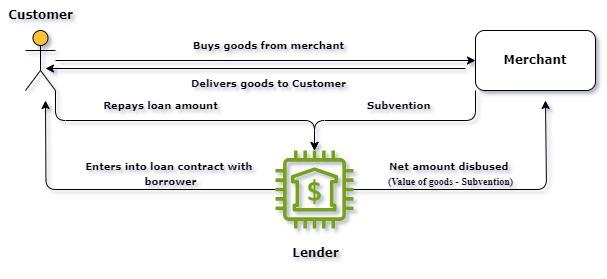
One form of zero percent interest rate loans is known as merchant subvention. In this model, the seller or manufacturer of the product assumes responsibility for paying the interest to the lender. This arrangement allows the merchant to effectively market and sell the product, attracting more customers to  the merchant’s  business. Meanwhile, the customer gets the perceived  “feel good” benefit of obtaining the product at a zero percent interest rate. If happiness is all about feeling good and not necessarily being good, it is  a mutually beneficial situation for the buyer, seller and the lender.

Another form of zero percent loan may be where lenders load additional charges in some form other than interest, and pretend to provide an interest-free loan. These could comprise of of a one-time high processing fees, or similar other charges, which disguise the  interest component . This practice, we understand,  is deceptive and is against the concept of fair lending. Hence, if the lender is charging interest in form of the so-called “other charges”,  and claims to be providing interest-free loan, that is a case of lie. However, in this article, we are not dealing with a lie – we are dealing with a half-truth. .

And what is that half truth? , If the lender is making his target yield by way of third party cashflows, such as merchant subvention, product discount, etc., is it fair for the lender to demonstrate that he is lending free of interest? .

Understanding the mechanism of merchant subvention

It is a well-established practice among dealers or manufacturers to offer subventions or discounts on products to customers availing loans from financial institutions. In such instances, banks/NBFCs, leverage their volumes and vendor relationships to secure favourable terms. Here, it becomes imperative that these benefits are passed on to customers without altering the applicable rate of interest (RoI) of the product. Furthermore, the actual discount is not provided by the bank/NBFC, but by the merchant as a part of the merchant’s customer acquisition strategy. As a regulated entity, the lender is expected to ensure full and transparent disclosure of these benefits to customers

Hence, the lender showing the loan as 0% is essentially passing the discount or benefits   provided by the merchant to the lender. It cannot be contended that the lender would have bought the product or service but for the purpose of the loan. In fact, the lender is not the actual purchaser; the lender is simply aiding or pushing the sales of the merchant by offering credit. It is the credit facility that triggers the purchase; it is the purchase that triggers the discount. Hence, there is a clear nexus between the grant of the merchant’s benefits to the lender.

Quite often, the issue is – will the customer be able to get the same discount, subvention or benefits if the customer was to make a direct purchase from the vendor? The answer will mostly be negative. The lender has a relationship with the vendor, whereby the lender gives volumes as well as regular business. But no lender will obviously do a loan without a threshold rate of return. There is absolutely nothing wrong in saying that the interest charged to the customer is zero, but at the same time, to not make basic disclosure about the extent of discount or benefits that the lender gets from the merchant will be a case of half truth.

The following is a diagrammatic illustration of how the concept of merchant subvention works

The concept of annualised percentage rate (APR) has also been introduced to enhance transparency and reduce information asymmetry on financial products being offered by different regulated entities, thereby empowering borrowers to make informed financial decisions. Accordingly, discussion on what is APR and how merchant subvention should be disclosed holds precedence.

Definition of APR

In India, as per Key Facts Statement (KFS) for Loans & Advances the term APR ”is the annual cost of credit to the borrower which includes interest rate and all other charges associated with the credit facility”. The said circular covers retail loans, MSME term loans, digital loans, MFI loans, and all loans extended by banks to individuals. Our FAQs on the said circular can be read here.

Further, as per Para 2(a)(iii) of the Display of information by banks APR allows customers to compare the costs associated with borrowing across products and/ or lenders. Further, through the circular dated September 17, 2013 the RBI emphasised that it is important to ensure that the borrowers are fully aware of associated benefits, with emphasis on indiscriminately passing on such benefits without altering the Rate of Interest (RoI). To address this, the RBI directed that when discounts are provided on product prices, the loan amount sanctioned should reflect the discounted price, rather than adjusting the RoI to incorporate the benefit.

The Consumer Credit (Disclosure of Information) Regulations 2010, which is a UK regulation defines the term APR as “annual percentage rate of charge for credit xx…. and the total charge for credit rules”. Further, as per the regulation, APR helps the borrowers compare different offers.

The Truth in Lending (Regulation Z) defines APR  in the case of closed-end credit as a “measure of the cost of credit, expressed as a yearly rate, that relates the amount and timing of value received by the consumer to the amount and timing of payments made”.

Components of APR

       I.            India

In accordance with the definition as provided under the Key Facts Statement (KFS) for Loans & Advances APR includes the following:

  1. Rate of interest
  2. Associated charges
  1. Processing fee
  2. Valuation fee
  3. Other non-contingent charges

c. Third-party service provider fees/charges (if collected by lender on behalf of third-party)

  1. Insurance charges
  2. Legal charges
  3. Other charges of similar nature

However, excluding contingent charges like penal charges, foreclosure charges, etc.

The intent is to have simple transparent, and comparable (STC) terms of the loan communicated to the customer upfront and hence, an illustrative example for the computation is provided. The illustration includes all charges that the RE levies.

     II.            United Kingdom

In accordance with the definition provided, APR refers to the annual percentage rate of charge for credit along with the total charge for credit as provided under credit rule  As per FCA handbook, the total charge for credit, applicable to an existing or potential loan agreement, encompasses the “comprehensive cost” incurred by the borrower.

“Comprehensive cost” includes all pertinent expenses such as interest, commissions, taxes, and any other associated fees that are obligatory for the borrower to be paid in conjunction with the loan agreement.

The FCA handbook further specifies that the total cost of credit includes fees to credit brokers, account maintenance expenses, payment method costs, and ancillary service fees. However, the total cost of credit to the borrower must not take account of any discount, reward (including ‘cash back’) or other benefit to which the borrower might be entitled, whether such an entitlement is subject to conditions or otherwise.

To summarise, the components of APR as per UK regulations are:

  1. Rate of Interest
  2. Commission and taxes
  3. Fees/Charges payable by borrower to agents
  4. Expenses associated with maintaining loan account
  5. Costs linked with means of payment
  6. Costs associated with ancillary services

Further, the following shall not be considered while computing the APR and hence, will be disclosed separately:

  1. Discounts, cashback incentives;
  2. Contingent charges

  III.            USA

Section 107(a)(1)(A) of the Consumer Credit Protection Act outlines how to calculate the annual percentage rate (APR) for credit facilities other than open-ended ones. The APR is the rate that, when applied to the unpaid balance of the loan, equals the total finance charge spread out over the loan’s term. This means that the APR represents the finance charge stretched over the entire duration of the loan. Finance charges, as defined by the Act, include various fees like interest, service charges, origination fees, credit investigation fees, insurance premiums, and other related charges.

Hence, the components of APR as per USA include:

  1. Rate of interest;
  2. Discounts;
  3. Associated charges
  1. Service fees;
  2. Fees associated with loan origination
  3. Charges for credit investigation or reports

d. Third-party service provider charges (such as insurance charges)

Comparative analysis

Upon examining international practices, it becomes evident that the APR encompasses more than just the rate of return; it also incorporates additional charges, often in the form of finance charges, which are annualised over the tenure of the loan. To summarise and consolidate the various laws discussed above, the following factors are considered in determining the APR:

  1. Rate of Interest;
  2. Service charges;
  3. Fees associated with loan origination;
  4. Charges for credit investigation and reports;
  5. Charges for mandatory credit-related insurances, when not separately disclosed in the Key Facts Statement (KFS);
  6. Expenses related to maintaining the account

However, certain elements which are not included in the calculation of APR:

  1. Contingent charges;
  2. Discounts applied to the interest rate.

While US law suggests factoring in discounts when calculating the APR, the stance established by the RBI is clear that: discounts cannot be incorporated when declaring the APR- as the same would be deceptive and shall not disclose the actual bifurcation of cost. Similarly, the perspective under UK law aligns with this stance to separately disclose the merchant discount and deduct it from the APR.

Regulatory concerns

The RBI addressed regulatory concerns pertaining to zero percent loans facilitated by merchant subvention through its circular dated September 17, 2013. A key focus was ensuring borrowers full awareness of associated benefits, with emphasis on indiscriminately passing on such benefits without altering the Rate of Interest (RoI). To address this, the RBI directed that when discounts are provided on product prices, the loan amount sanctioned should reflect the discounted price, rather than adjusting the RoI to incorporate the benefit.

Disclosure of merchant subvention by lenders

As discussed, the rate of interest is a part of the Annual Percentage Rate (APR), which is a measure used by borrowers to compare similar products from different lenders. If the lender changes the rate of interest, it affects the entire APR, making it difficult for customers to compare different loan products. It is important to understand that whether or not there’s a merchant subvention, the rate of return for the lender remains unchanged, hence the APR irrespective of there being any merchant subvention should also remain unaltered.

The RBI through its circular dated September 17, 2013 notified certain “pernicious” practices being followed by banks regarding merchant subvention, whereunder it had provided a specific way of disclosing the discount, which directed that when discounts are provided on product prices, the loan amount sanctioned should reflect the discounted price, rather than adjusting the RoI to incorporate the benefit. We have aimed to understand the requirement of by RBI via an example below:

Assume a lender offers a loan of Rs. 100,000 for 6 months to someone without charging any interest. However, the lender only gives Rs. 95,000 to the merchant, and the remaining Rs. 5,000 is covered by the merchant i.e., the interest component of the loan is recovered from the merchant. The lender still expects the borrower to repay Rs. 100,000. So, to show the true cost in the APR, the lender should disclose the actual amount lent, which is Rs. 95,000, instead of the full Rs. 100,000. Additionally, the lender should include the interest rate the lender is effectively earning, on Rs 95000.  This transparency helps customers understand exactly what they’re paying, making it easier to compare different loan options and lenders.

The circular as mentioned above was directed specifically for banks, however, NBFCs should also be guided by the same principles. There could be another method of disclosing the discount provided by the merchant. For instance, considering the above scenario, let say, the lender provides a loan of Rs. 1,00,000 and the merchant provides a subvention of Rs. 5,000. In this case, the APR is disclosed considering the subvention received from the merchant. Accordingly, the lender shows the loan to be Rs.1,00,000 and the interest of Rs.5000 is shown as a discount to the borrower, which has been recovered from the merchant. Even though the disclosure is being done for the subvention amount, this method does not depict the actual IRR of the lender.  .

Note, however, that the APR computation in the two approaches will be different. The Table below shows the two APRs:

ParticularsFirst optionSecond option
Cost of the asset100000100000
Less: Discount5000 
Net cashflow of the lender95000100000
Interest on the cashflow for 6 months(IRR computed on monthly intervals)10.30%10%
Amount of interest50005000
Less: Discount -5000
Amount paid by the borrower100000100000

As may be noted from the above computation, the first option, computing the APR on a loan size of Rs 95000 shows the APR as 10.30%, while the second approach makes a simple interest computation for 6 months @ 10%. The second approach shows a lower APR than the actual yield.

Accounting

As per IND AS 109 Effective Interest Rate (EIR) has been defined as “The rate that exactly discounts estimated future cash payments or receipts through the expected life of the financial asset or financial liability to the gross carrying amount of a financial asset or to the amortised cost of a financial liability. When calculating the effective interest rate, an entity shall estimate the expected cash flows by considering all the contractual terms of the financial instrument (for example, prepayment, extension, call and similar options) but shall not consider the expected credit losses. The calculation includes all fees and points paid or received between parties to the contract that are an integral part of the effective interest rate,transaction costs, and all other premiums or discounts”.

The definition states that the calculation of EIR will include fees and points paid or received between the parties to the contract that are an integral part of the effective interest. While in normal course, this should refer to the cashflows emanating from the contract between the lender and the borrower. But in the present case, if only the cash flows between the lender and borrower is considered, it will give an EIR of 0%, indicating that the lender is not earning from the transaction, which is not the true picture. The subvention from the third party is an essential element in the entire scheme of things, it is through this the lender is recovering its income. Therefore, in the present context, a wider meaning should be ascribed to  expression parties to the contract that are an integral part of the effective interest; and subvention received from third parties should also be considered for the purpose of determining the effective interest rate and the gross carrying amount of the loan.

The essence of the accounting definition is that cashflows that are “integral part” of the credit facility are included in EIR computation. While the subvention is paid by a third party and not a party to the contract, but it cannot be contended that the subvention is not an integral part of the loan. Taking such a view would lead to an impracticality showing the loan as having zero EIR.

Conclusion

The lure of zero percent interest rate loans is increasingly being used by vendors and lenders, in the realm of personal finance. However, it is crucial to understand the nuances and implications associated with such loans, particularly those facilitated through merchant subvention arrangements. Regulatory concerns have arisen regarding the transparency and fair disclosure of these loans, particularly in ensuring that the actual cost of credit is accurately represented to consumers. Distorting the interest rate structure compromises transparency and hampers informed decision-making by borrowers.

The components of the APR vary across different jurisdictions but universally include factors such as the rate of interest, associated charges, fees, and expenses related to the loan. However, discounts and contingent charges are typically excluded from the APR calculation. To uphold fair lending practices and ensure transparency, lenders must disclose the true cost of credit, including any merchant subvention arrangements, without altering the APR. This transparency empowers consumers to make informed choices and fosters trust in the financial system. A half truth reminds one of the Mahabharat anecdote of “Ashwatthama is dead”, suppressing whether it was elephant or man.

Webinar on KFS and APR– New RBI rules on Retail & MSME Lending

Watch our Webinar here: https://youtu.be/DBCROyxRJEY

Loader Loading…
EAD Logo Taking too long?

Reload Reload document
| Open Open in new tab

Download as PDF [216.65 KB]

Offline Payment aggregators to be under regulatory scheme: RBI proposes amendments to PA regime

Archisman Bhattacharjee and Manisha Ghosh I finserv@vinodkothari.com

Introduction

On April 16, 2024, the Reserve Bank of India (RBI) issued Draft Directions on the Regulation of Payment Aggregators (PAs) (‘Draft PA Directions’) serving two primary purposes:

  1. Regulating Offline PAs i.e. PAs operating at physical points of sale, an area previously not covered by existing regulations.
  2.  Amendments to the current guidelines concerning Payment Aggregators, primarily intended to extend the scope of the extant regulations to offline PAs; however, having several additionalities such as PA’s due diligence on the merchants, ongoing merchant monitoring based on business profile, disallowing payment to any other account on specific directions from the merchant etc.
Read more