Draft Income-tax Rules deal a tax blow on CTC Car leases

– Chirag Agarwal, Assistant Manager | finserv@vinodkothari.com

Draft Income-tax Rules, 2026 (“Draft Rules”), intended to be applicable from 1st April, 2026, have increased the perquisite value for cars used for a mix of personal and official use, by Rs 3200 per month  and Rs 4600 per month (where the expenses for running and maintenance are borne by the employer) and by Rs 1400 per month and Rs 2100 per month (where the expenses for running and maintenance are borne by the employee), respectively for upto 1.6 litre engine cars and above 1.6 litre engine cars. This, in our reading, will be applicable even for existing car lease transactions, increasing employees’ tax burden by Rs 5,040 to Rs 16,560 per car per annum. In addition, going forward, the tax attraction of CTC car leases comes down.

The Income Tax Department has issued the Draft Rules pursuant to the already-enacted rewrite of income tax law in form of Income Tax Act, 2025, replacing the 1961 Act. Accordingly, the 1962 Rules are to be replaced by Draft Rules, to apply from 1st April, 2026. The Draft Rules are mostly the same as the extant rules; however, monetary value of perquisites, covered by Rule 15 [corresponding to Rule 3(2) of existing Rules] is proposed to be enhanced significantly. Thus, there is a significant change in the valuation of perquisites relating to motor cars. 

As per the Income-tax Act, the value of perquisites provided by an employer (such as the use of a motor car provided by the employer) is added to the employee’s taxable income under the head “Salaries”. The Draft Rules propose an increase in the perquisite value attributable to the use of a motor car.

The proposed increase in perquisite valuation would result in a higher taxable perquisite value in the hands of employees, thereby increasing their taxable income. The CTC-based car leasing model, which is a distinctive feature of the Indian tax framework and has been widely used for several decades, derives its attractiveness from the favourable rules governing the valuation of perquisites, which reduce the employee’s taxable income. Any upward revision in such perquisite valuation is therefore likely to reduce the tax benefits associated with this structure and may adversely impact the overall attractiveness of CTC-based car leasing arrangements.

CTC leasing of passenger cars alone is nearly Rs 9000 crores annual volume business in India, constituting roughly 1.5% of passenger vehicles sold in the country. If the Draft Rules are notified in their current form, the revised valuation norms will take effect from April 1, 2026 and will apply not only to new arrangements but also to all existing CTC car leasing arrangements. Based on a broad estimate, this change could result in an additional tax outflow of approximately ₹36 crores to ₹81 crores annually for employees under the existing CTC leasing arrangements. 

This article explains the proposed changes and what they could mean for CTC-leasing going forward.

Taxability benefit under the CTC leasing structure

The tax benefit under the CTC car leasing structure arises from the differential treatment between 

  1. the lease rentals forming part of the employee’s CTC, and
  2. the valuation of the perquisite in respect of the use of the motor car under the Income-tax Rules. 

While the employer pays the lease rentals to the lessor as part of the employee’s CTC, the employee is not taxed on the actual lease rental amount. Instead, the employee is taxed only on the prescribed perquisite value of the car as determined under Rule 3(2) of the Income-tax Rules, 1962. This prescribed value is typically lower than the actual lease rentals, resulting in a reduction in the employee’s taxable income.

To illustrate: Assume an employee’s agreed CTC is ₹1,00,000 per month. The employer arranges a car on lease and pays lease rentals of ₹25,000 per month to the lessor, which forms part of the employee’s CTC. Accordingly, the employee’s cash salary reduces to ₹75,000 per month. For tax purposes, however, the employee is not taxed on the full ₹25,000. Instead, only the notional perquisite value of the car (as prescribed under Rule 3(2)) is added to his taxable income. The difference between the actual lease rentals and the lower perquisite valuation results in a tax arbitrage, which forms the economic rationale for the popularity of the CTC car leasing model.

Proposed Changes and Impact

The Draft Rules prescribe a higher perquisite value for the use of a motor car owned by an employer to be included in the taxable income of employees where it is used partly in the performance of duties and partly for private or personal purposes of the employees or their household members. The proposed revisions are summarised in the table below:

Expenses on maintenance and running met byCubic capacity of engine does not exceed 1.6 litresCubic capacity of engine exceeds 1.6 litres
ExistingProposedExistingProposed
Case I
Employer
₹1,800 + ₹900*₹5,000 + ₹3,000*₹2,400 + ₹900*₹7,000 + ₹3,000*
Case II
Employee
₹600 + ₹900*₹2,000 + ₹3,000*₹900 + ₹900*₹3,000 + ₹3,000*

*In case chauffeur is provided to run the motor car by the employer.

The proposed increase in the perquisite valuation of motor cars under the Draft Rules is likely to have a direct impact on the economics of the CTC car leasing model.

From the employee’s perspective, the proposed increase would result in a higher taxable perquisite being added to taxable income. The tax arbitrage that makes CTC car leasing attractive, i.e., the gap between the actual lease rentals and the lower notional perquisite value, is expected to narrow. As a result, the net tax savings available to employees under this model will be reduced. Below we have presented the likely impact with the help of two examples:

Example 1: 

  • Lease rental: ₹25,000 per month
  • Engine capacity: 1.7 litres
  • Mixed use
  • Expenses on maintenance and running are met/ reimbursed by the employer
  • Tenure: 1 year
ParticularsExisting RulesDraft RulesImpact (Increase)
Annual CTC₹12,00,000₹12,00,000
Lease Rental (part of CTC)₹3,00,000₹3,00,000
Cash Salary Paid₹9,00,000₹9,00,000
Perquisite Value Taxable₹28,800₹84,000₹55,200
Total Taxable Income ₹9,28,800₹9,84,000₹55,200
Tax @ 30% slab (excluding cess)₹2,78,640₹2,95,200₹16,560

Example 2: 

  • Lease rental: ₹25,000 per month
  • Engine capacity: 1.5 litres
  • Mixed use
  • Expenses on maintenance and running are met/ reimbursed by the employee
  • Tenure: 1 year
ParticularsExisting RulesDraft RulesImpact (Increase)
Annual CTC₹12,00,000₹12,00,000
Lease Rental (part of CTC)₹3,00,000₹3,00,000
Cash Salary Paid₹9,00,000₹9,00,000
Perquisite Value Taxable₹7,200₹24,000₹16,800
Total Taxable Income ₹9,07,200₹9,24,000₹16,800
Tax @ 30% slab (excluding cess)₹2,72,160₹2,77,200₹5,040

It shall be noted that employers would not incur any additional tax cost on account of the proposed changes, as the CTC paid to employees, including the lease rentals, would continue to be allowable as a deductible business expense. 

Conclusion

The Draft Rules materially raise the perquisite valuation of employer-provided cars, pushing up the tax outflow for employees opting for CTC-based car leasing. Since the revised valuation (if notified) will apply even to existing leases from 1 April 2026, the tax efficiency of the CTC car lease model would stand materially reduced, impacting both the attractiveness and economics of such arrangements going forward.
 

Our Other Resources:

Quick Bytes on Union Budget 2026

Loader Loading…
EAD Logo Taking too long?

Reload Reload document
| Open Open in new tab

Download as PDF [430.99 KB]


Our Resources

  1. Buyback taxation rationalised with limited relief to promoter shareholders
  2. State of Climate Finance: Domestic Resources Insufficient to Bridge Funding Gaps 
  3. Microfinance and NBFC-MFIs in Economic Survey 2026
  4. Economic Survey 2026: Key Insights on Infrastructure Financing

From Capital Assets to Stock-in-Trade: Taxing “Notional” Gains in Amalgamations

Decoding Supreme Court ruling in Jindal Equipment Leasing Consultancy Services Ltd. v. Commissioner of Income Tax Delhi-II, New Delhi

– Sourish Kundu | corplaw@vinodkothari.com

One of the most common modes of corporate restructuring is merger, and one of the most crucial aspects in assessing the commercial viability of a proposed merger is its tax implications. Typically, in a merger, the shareholders of the transferor company are issued shares of the transferee company in order to avail the exemption under section 70(1)(f) of the IT Act, 2025 [corresponding to section 47(vii) of the IT Act, 1961]. The said provision grants exemption in case of scheme of amalgamation in respect of the transfer of a capital asset, being shares held by a shareholder in the transferor company, where (i) the transfer is made in consideration of the allotment of shares in the transferee company (other than where the shareholder itself is the transferee company) and (ii) the amalgamated company is an Indian company.

However, a recent Supreme Court ruling in the matter of Jindal Equipment Leasing Consultancy Services Ltd. v. Commissioner of Income Tax Delhi-II, New Delhi [2026 INSC 46] has opened a new avenue for debate w.r.t the taxation on receipt of shares of the transferee company in a scheme of amalgamation. In this case, the Supreme Court ruled that the exemption as provided under section 47(vii) of the IT Act, 1961 [corresponding to section 70(1)(f) of the IT Act, 2025] shall not be available to shareholders of the transferor company who are not perceived as “investors”, that is to say long term investors as opposed to traders, in the transferor company. And accordingly, any notional gain in a share swap deal pursuant to an amalgamation shall be taxed u/2 28 of the IT Act, 1961 [corresponding to section 26 of the IT Act, 2025].

In this article, we decode the nuances of the ruling, the impact it is expected to have in the sphere of merger deals and other related concerns.

Difference between capital and business assets

So far, the common understanding of consideration in case of amalgamations was that an amalgamation is merely a statutory replacement of one scrip for another, with no real “transfer” or “income” until the new shares are actually sold for cash, or in other words, mere substitution of shares in the books of the involved entities. However, the Apex Court in the instant judgement has now effectively set a different precedent for those holding shares as stock-in-trade, i.e. current investments.

The Court clarified that while Section 47(vii) provides a safe harbor for investors (treating mergers as tax-neutral corporate restructuring), this exemption does not extend to “business assets”, a.k.a. stock in trade. For a trader and investment houses, shares held in stock-in-trade represent “circulating capital”, and the objective of holding them is not capital appreciation, but conversion into money in the ordinary course of business. Therefore, replacing shares of an amalgamating company with those of an amalgamated company of a higher, ascertainable value constitutes a “commercial realisation in kind”.

The 3 pillar test for taxability

The SC applying the doctrine of real income emphasised in Commissioner of Income-Tax v. Excel Industries Ltd. and Anr. [(2013) 358 ITR 295 (SC)], established a three-pillar test, which is to be applied on a case to case basis to determine if allotment of shares pursuant to a merger triggers taxation of business income u/s 28 of the IT Act, 1961: 

  1. Cessation of the Old Asset: The original shares must be extinguished in the books of the assessee.
  2. Definite Valuation: The new shares must have an ascertainable market value.
  3. Present Realisability: The shareholder must be in a position to immediately dispose of the shares and realise money.

This test was further elaborated by two situations viz. allotted shares being subject to a statutory lock-in, which hinders the disposability of the asset, and allotted shares being unlisted, which cannot be said to be realisable, since no open market exists to ascribe a fair disposal value.

Additionally, the SC also held that the trigger is the date of allotment of the shares of the amalgamated entity, and neither the “appointed date” nor the “date of court sanction” or what is called as “effective date” in the general parlance, as no tradable asset exists in the shareholder’s hands until the scrips are actually issued.

Critical Concerns

While the ruling provides reasonable clarity on the treatment of shares received as a result of amalgamation, when the same is held in inventory, it leaves several operational questions unanswered, leaving a gap to determine the commercial feasibility of these deals.

  1. Treatment of profits and losses alike

If the Revenue can tax “notional” gains arising from a higher market value at allotment, correspondingly assessees should be allowed to book notional losses, if any on such deals as well. In cases where a merger swap ratio or a market dip results in the new shares being worth less than the cost of the original holding, the taxpayer should, by the same logic, be entitled to claim a business loss u/s 28 of the IT Act, 1961, or in other words, if the substitution is a “realisation” for profit, it must be a “realisation” for loss as well.

  1. Increase in cost of acquisition

A major concern is the potential for double taxation. If the assessee is taxed on notional gain, being the difference between the cost of acquisition of the original shares and the FMV of the shares of the transferee company on the date of allotment, such FMV should logically become the new cost of acquisition. If an assessee is taxed on the difference between the book value and the FMV at the time of allotment, but the increased cost of acquisition is not allowed, the same appreciation gets taxed twice. It is first taxed as business income at the time of allotment and again at the time of the actual sale.  

  1. Determination of the nature of shares as “stock in trade” vs “capital asset”

This issue remains prone to litigation, that is, who determines the nature of the investment, whether it is current or non-current? Will it be determined basis the books of account of the investor? 

A CBDT circular lays down certain principles along with some case laws to distinguish between shares held as stock-in-trade and shares held as investments, and decide the treatment of shares held by the investing company. Further, factors such as intention of the party purchasing the shares, [discussed by Lord Reid in J. Harrison (Watford) Ltd. v. Griffiths (H.M. Inspector of Taxes); (1962) 40 TC 281 (HL)], and method of recording the investments [highlighted in CIT v. Associated Industrial Development Co (P) Ltd (AIR1972SC445)], are considered as the deciding factors for making a demarcation between treating an asset as capital asset or stock-in-trade.

As highlighted in the instant case, while the initial classification is made by the companies in the financial statements, the AO is empowered to overlook the same, and determine whether the shares were held as stock-in-trade or as capital assets, as without that determination, the taxability or eligibility for exemption u/s 47 could not be ascertained.

It should be noted that the line between a long-term strategic investment and a trading asset is often thin, and the Jindal ruling places the burden on the Revenue to prove the stock status and the “present realisability” of the shares.

Conclusion

Proving by contradiction, the Apex Court has added that: “If amalgamations involving trading stock were insulated from tax by judicial interpretation, it would open a ready avenue for tax evasion. Enterprises could create shell entities, warehouse trading stock or unrealised profits therein, and then amalgamate so as to convert them into new shares without ever subjecting the commercial gain to tax. Equally, losses could be engineered and shifted across entities to depress taxable income. Unlike genuine investors who merely restructure their holdings, traders deal with stock-in-trade as part of their profit-making apparatus; to exempt them from charge at the point of substitution would undermine the integrity of the tax base”

Discussing the concept of “transfer”, “exchange” and “realisability”, the SC has affirmed that mergers do not entail a mere replacement of shares of one company with that of another, as for persons holding the same as stock-in-trade cannot be said to be a continue their investment, instead the new shares being capable of commercial realisation gives rise to taxable business income. The Jindal Equipment ruling seems to effectively end the assumption of automatic tax neutrality for all merger participants, subject to fulfillment of applicable conditions prescribed in the IT Act. As a result, if the tax officers believe that the shareholders hold the shares as stock in trade, and could cash out the same at the next possible instance, the assessee shall be under the obligation to pay tax even without encashing any gain in actuals. Further, the tax implications in such cases shall not be at the special rates prescribed for capital gains.

Read more:

Understanding “Undertaking” in the Context of Investment Demergers

Budget 2025: Mergers not to be used for evergreening of losses

Cross Border Mergers

– Neha Malu, Associate | corplaw@vinodkothari.com

Refer to our other resources:

  1. Presentation on Cross Border Mergers
  2. Guide to Cross Border Mergers
  3. Outbound Mergers – A path still less travelled by?

Understanding “Undertaking” in the Context of Investment Demergers

– Barsha Dikshit and Sourish Kundu | corplaw@vinodkothari.com

The meaning of “undertaking” has been one of the most debated issues under Indian company law and tax law, particularly when it comes to shares/investments to be treated as an “undertaking”. While the term intuitively refers to a business or division carried on as a going concern, its application becomes complex when the company’s business primarily consists of holding investments in shares of other entities. This complexity raises important questions about whether such passive investment portfolios can be considered independent undertakings capable of being demerged under Section 2(19AA) of the Income-tax Act, 1961 (now section 2(35) of the Income-tax Act, 2025). 

This article examines  the statutory framework, relevant judicial precedents, and the practical implications of treating investment division as “undertaking” for companies with diverse investment portfolios.

Meaning of ‘Undertaking’

Section 180(1)(a) of the Companies Act, 2013 restricts the Board of a company from selling, leasing, or otherwise disposing of the whole or substantially the whole of an undertaking without shareholders’ approval by way of special resolution. While the provision does not offer a definitional explanation of what constitutes an “undertaking,” it does lay down quantitative thresholds: 

  • An undertaking is one where investment exceeds 20% of net worth or contributes 20% of total income in the preceding financial year.
  • Disposal of “substantially the whole” of such undertaking means disposal of 20% or more of its value.

This numerical test, merely sets quantitative thresholds to determine when shareholders’ approval is required for the disposal of such an asset. 

To understand what constitutes an “undertaking” and, in particular, whether a passive investment division, essentially a portfolio of shares, can independently qualify as an undertaking, reference can be drawn to the definition of “undertaking” provided under the Income-tax Act, 1961 as well as relevant judicial precedents. 

Under the Income-tax Act, 1961, Section 2(19AA) defines the term “demerger”, which requires the transfer of one or more undertakings from the demerged company to the resulting company, such that at least one undertaking remains with the demerged company. The meaning of “undertaking” for this purpose is explained in the Explanation to Section 2(19AA) (now renumbered as Section 2(35) under the Income-tax Act, 2025), as–

“Explanation-1: For the purposes of this clause, “undertaking” shall include any part of an undertaking, or a unit or division of an undertaking or a business activity taken as a whole, but does not include individual assets or liabilities or any combination thereof not constituting a business activity.”

This definition emphasizes the need for functional and operational coherence in what is considered an undertaking, ruling out passive asset transfers that lack an identifiable business character. 

The meaning of the term ‘undertaking’ has also been clarified in several judicial precedents. For instance, in the landmark decision of Rustom Cavasjee Cooper v. Union of India [[1970] AIR 564], Hon’ble Supreme Court explained that “‘undertaking’ clearly means a going concern with all its rights, liabilities and assets as distinct from the various rights and assets which compose it… is an amalgam of all ingredients of property and are not capable of being dismembered. That would destroy the essence and innate character of the undertaking. In reality the undertaking is a complete and complex weft and the various types of business and assets are threads which cannot be taken apart from the weft.” 

The Court thus highlighted the holistic nature of an undertaking that it is not a disjointed collection of parts, but a complete and functional enterprise. [See also, P.S. Offshore Inter Land Services Pvt. Ltd. v. Bombay Offshore Suppliers and Services Ltd. [[1992] 75 Comp Cas 583 (Bom)].

This brings us to a significant  question: Can a portfolio of shares, held in a company’s books, be regarded as a separate segment or ‘undertaking’? 

This question assumes particular relevance in the context of schemes of arrangement, particularly those involving demergers, where a portfolio of investments is proposed to be transferred to a resulting company. In such schemes, the tax neutrality of the transaction often hinges on whether the transferred segment qualifies as an “undertaking” under the applicable tax laws.

For a unit to be regarded as an undertaking, and for the demerger to be treated as tax-neutral, both the demerged and remaining undertaking must possess the characteristics of a going concern, i.e., each must be capable of independent and sustainable commercial operations with the objective of earning profits. [See: Yallamma Cotton, Woollen and Silk Mills Co. Ltd., In re [[1970] 40 Comp Cas 466]]

This criteria becomes particularly nuanced when the subject of demerger is a mere pool of passive investments, rather than an operational business unit. The key consideration is whether such a portfolio, in itself, demonstrates the organisational integrity, continuity of activity, and profit-making intent sufficient to satisfy the definition of an “undertaking”.

One of the most notable rulings on this issue is the decision of the Income Tax Appellate Tribunal (ITAT) in the case of Grasim Investments Ltd. v. ACIT, wherein the Tribunal was called upon to examine whether a division engaged primarily in holding and managing investments in shares could be treated as an undertaking for the purposes of a tax-neutral demerger under Section 2(19AA) of the Income-tax Act, 1961.

The ITAT held that a mere pool of passive investments does not, by itself, constitute an undertaking. To qualify as an undertaking, the investment division must be more than a collection of financial assets; it must constitute a distinct business activity carried on with a certain degree of autonomy. The Tribunal emphasized factors such as, presence of separate books of account, an identifiable organizational structure, and the existence of management and decision-making functions related specifically to the investment activity and the capability of generating independent business income, to consider a division as an ‘undertaking.

In one of the recent rulings in the matter of Reckitt Benckiser Healthcare India Private Limited v DCIT, 2025 171, dated 18th February, 2025, Ahmedabad ITAT reiterated the principles governing tax neutral merger. 

In this case, the assessee transferred only a portfolio of investments (constituting the so-called “Treasury Segment”) to the resulting company, while retaining the associated liabilities. The assessee attempted to justify this by arguing that the liabilities pertained to other business divisions and not to the Treasury Segment. However, the Tribunal rejected this explanation, holding that such selective transfer is contrary to the statutory mandate. The Tribunal emphasized that for a transaction to qualify as a tax-neutral demerger, it must strictly comply with the conditions prescribed under Section 2(19AA) of the Act. One of the key requirements of which is that all the assets and liabilities pertaining to the transferred undertaking must be transferred to the resulting company.

Treating block of investments as separate undertakings

The real difficulty lies in the case of investment companies, or companies holding multiple blocks of shares in different entities. Can each such block of investments be regarded as a separate undertaking for purposes of demerger?

Here it becomes important to differentiate between active investments and passive investments. For instance, holdings in group companies, such as subsidiaries or associates, may be classified as active investments, given the element of strategic control or influence. On the other hand, investments in mutual funds, debt instruments, or derivatives are typically treated as passive investments, lacking operational involvement.

While judicial decisions have considered active investments as a separate undertaking, investment in mutual funds, securities, or similar financial instruments, when held passively, are typically regarded as individual assets forming part of a company’s investment portfolio , majorly on the ground that they do not, by themselves, represent a business or functional unit capable of independent operation. 

In CIT v. UTV Software Communication Ltd. the Bombay High Court drew a sharp distinction between transfer of shares and transfer of an undertaking. The Court held that a mere transfer of shareholding, even to the extent of 49%, does not amount to a transfer of an “undertaking” under Section 2(42C) of the Income-tax Act, 1961 (now Section 2(103) of the 2025 Act). Relying on the Supreme Court’s rulings in Vodafone International Holdings and Bacha F. Guzdar, it concluded that passive shareholding does not confer ownership of the underlying business and cannot constitute an undertaking for tax or restructuring purposes.

However, the author humbly differs from the view expressed by the Bombay High Court. In the author’s opinion, such matters must be examined in light of the prevailing corporate structures wherein large business groups operate distinct business verticals through separate legal entities, including subsidiaries, joint ventures, and associates. In such cases, transfer of shares in a subsidiary or associate company may, in substance, result in divestment of an entire business segment.

Moreover, as discussed above, section 180(1)(a) of the Companies Act, 2013 provides a quantitative definition of ‘undertaking’ and mandates shareholders’ approval by special resolution for the sale, lease, or disposal of a company’s undertaking. In this context, treating the transfer of shareholding, as a mere transfer of shares and not an undertaking, may arguably be a  narrow interpretation, particularly when the transaction has the effect of transferring operational control and revenue-generating capabilities.

The author’s view also finds support in jurisprudence such as the Grasim Industries Ltd. ruling (Supra), where a financial services division, primarily holding investments in shares and securities, was accepted as a valid “undertaking” for the purposes of demerger under Section 2(19AA) of the Act. 

Conclusion

The concept of “undertaking” in Indian law is broader than a mere division of physical assets; it captures the idea of a self-sustaining business activity. In the context of investments, while passive shareholding may not qualify, an organised investment division with identifiable assets, liabilities, and management can constitute an undertaking capable of demerger. Thus, companies holding multiple investment portfolios may, subject to careful structuring, demerge them into resulting companies under sections 230-232 of the Companies Act and section 2(19AA) of the Income-tax Act.

Read More:

Stricter framework for sale, lease or disposal of undertaking by a listed entity

Can companies donate out all their assets?

Budget 2025: Mergers not to be used for evergreening of losses

– Barsha Dikshit and Neha Malu | resolution@vinodkothari.com

The provisions related to the carry forward and set-off of business losses in the context of corporate restructuring have been a critical aspect of corporate taxation. The Budget 2025[1] proposes certain amendments concerning carry forward of losses in cases of amalgamation, pursuant to which mergers shall not be used for evergreening of losses. That is to say, the benefit of carry forward shall be limited to eight years from the onset of losses, and not eight years from the merger.

Read more

Co-Lending and GST: Does the relationship between co-lenders constitute a supply that may be subject to GST?

Team Finserv (finserv@vinodkothari.com)

Introduction 

Banks and Non Banking Financial Companies (‘NBFCs’) have been receiving notices from statutory authorities stating the occurrence of evasion of goods and services tax (‘GST’) in respect of co-lending arrangements. At present, the GST laws do not address the implications of GST on co-lending transactions. In response to the investigations carried out Central Board of Indirect Taxes and Customs (‘CBIC’) on various banks and financial institutions, industry participants had requested for clarification on the matter in 2023 on whether GST is applicable on colending transactions.  However, the issue still remains unaddressed.

While multiple theories go around in the market on the subject, this article aims to discuss the theories and examine them in light of applicable laws. 

The issue

It is common knowledge that, for GST to be applicable, there needs to be a supply of goods or services. Therefore, the primary question to be answered here is whether the originating or servicing co-lender (‘OC’) provides any services to the arrangement? Can it be argued that the OC who is retaining a higher proportion of interest as compared to its proportion of funding of the principal amount of loan is actually providing services to the arrangement, and therefore, should be paying GST on the services to the other lenders?

The analysis

It is crucial to understand the nature of the relationship between the lenders involved. A co-lending arrangement is essentially a collaborative partnership between two lenders. To the extent two lenders agree to originate and partake in lending jointly, it is a limited purpose partnership or a joint venture. To the extent the two co-lenders extend a lending facility, the relation between the two of them together on one side, and the borrower on the other, amounts to a loan agreement. However, as there are two lenders together on the lender side, the borrower makes promises to two of them together, and therefore, the rights of any one of them is governed by the law relating to “joint promisees”. Given this framework, co-lending arrangements cannot simply be viewed as service agreements between the parties involved. Instead, they represent a distinct legal relationship characterized by shared responsibilities, rights, and risks associated with the lending process.

Does it qualify as a Supply?

The interest rates expected by the two co-lenders may vary due to the differing roles they play in the co-lending arrangement. It may be agreed that the funding co-lender receives a specific percentage of the interest charged to the borrower, while any excess interest earned beyond this hurdle rate shall be retained by the OC. Since the OC is performing services in the co-lending arrangement, would this excess spread be considered as consideration for supply of service under GST laws?

As discussed earlier, co-lending is inherently a partnership between two entities where each party’s contributions, functions, and responsibilities can vary. This results in a differential sharing of both risks and rewards, which means that the income earned from the loan may not necessarily be distributed in the same ratio as the principal loan amount.

The sharing of interest in co-lending arrangements is typically determined by each co-lender’s involvement in managing the loan’s overall risk—covering both pre and post-disbursement activities. Consequently, the excess interest earned by one co-lender over another is not reflective of a supply of a service provided by one entity to the other. Instead, this excess interest is merely a differential income that retains its original characteristic as interest income.

In a co-lending arrangement,  the co-lenders split their mutual roles i.e the co-lender performs various services pursuant to the co-lending arrangement, the same cannot be constituted as a separate supply provided to the other co-lender. For example if the borrower interface is being done by OC, it would be wrong to regard the OC as an agent for the Funding Co-lender. Both of them are acting for their mutual arrangement, sharing their responsibilities as agreed. Neither is providing any service to  the other. The co-lenders are effectively splitting the functionalities to the best of their capacity and expertise under their co-lending arrangement, which does not tantamount to any additional services being provided by one co-lender to the other. 

This view can be further strengthened by the ITAT ruling of May 7, 2024 which confirmed that the excess interest allowed to be retained with the NBFC was not a consideration for rendering professional/ technical services by the transferor NBFC to the transferee bank and neither would it fall within the ambit of commission or brokerage. 

ITAT examined some major points for characterisation of the excess interest spread retained by the NBFC analyzing mainly:

Excess interest retained not in the nature of professional/technical fees

The ruling examined whether the retained interest could be classified as fees for professional or technical services under Section 194J. The ITAT noted that while the NBFC had a service agreement with the bank, wherein it was responsible for managing and collecting payments, the agreed-upon service fee of Rs. 1 lakh was clearly defined and separate from the excess interest. The court dismissed the revenue department’s argument that the service fee of Rs 1 lakh was inadequate and the excess interest be considered as fee for rendering the services by the transferor NBFC, stating that the NBFC’s role was not as an agent acting on behalf of the bank.

Excess interest retained not in the nature of commission or brokerage 

The ITAT ruling clarified that the excess interest retained by the NBFC does not qualify as commission or brokerage under Section 194H of the Income Tax Act. The tribunal determined that the loans originated by the NBFC were not on behalf of the bank, but rather as independent transactions governed by a separate service agreement. This agreement stipulated distinct service fees for the NBFC’s management of the loans, emphasizing that the NBFC was not acting as an agent for the bank.

By making this distinction, the ITAT characterized the excess spread as a financial outcome of the contractual arrangement rather than a commission for services rendered. Consequently, the tribunal concluded that there was no obligation to deduct TDS on the excess interest retained by the NBFC, reinforcing the understanding that such retained interest is not subject to typical taxation associated with agent-like relationships. You may refer to our article on the ruling here

Conclusion

Therefore, taking into consideration the structure of the co-lending arrangement it can be concluded that the differential or higher interest rate retained by the OC shall not be treated as consideration for performing the agreed-upon role between the co-lenders. The recent ITAT ruling provides crucial clarity regarding the treatment of excess spreads in co-lending arrangements, affirming that such retained interest does not constitute a supply of services or a fees for professional services, commission, or brokerage. By highlighting the distinct nature of the contractual relationship between co-lenders, the ruling reinforces the idea that excess interest is a product of shared risk and reward rather than compensation for services rendered. Consequently, applying GST to a transaction that does not constitute a service would be inappropriate and misaligned with the tax framework.

Workshop on Co-lending and Loan Partnering – For registration click here: https://forms.gle/bq18tHgQb618jAcb9

Our other resources on this topic:

  1. White-paper-on-Co-lending
  2. The Law of Co-lending
  3. Shashtrarth 10: Cool with Co-lending – Analysing Scenario after RBI FAQs on PSL
  4. FAQs on Co-lending
  5. Vikas Path: The Securitised Path to Financial Inclusion

Scope of partial business exit as a mode of scaling down a company

Mahak Agarwal | corplaw@vinodkothari.com

After the recent Finance Act of 2024 shifts the incidence of tax in case of buyback from the company to the shareholders, a pertinent question that arises is what could be the next best mode for a company which is looking to partially exit from business and scale itself down.

Here is a quick 5 min video analyzing the above: https://lnkd.in/gK6878qg

Also watch our video on the tax regime on buyback proposed by the Finance Bill, 2024 (now enacted as the Finance Act) here: https://lnkd.in/gu7NrbeM

Read our FAQs on Buyback here: https://lnkd.in/gTZx838x

GST on Corporate Guarantees: Understanding the new regime

–  Payal Agarwal, Associate | corplaw@vinodkothari.com


The debate around levy of GST on corporate guarantee extended without or with inadequate consideration has been settled with the insertion of sub-rule (2) to Rule 28 of the Determination of Value of Supply Rules (“Valuation Rules”), effective from 26th October, 2023. Sub-rule (2) of Rule 28 specifies a deemed value for provisions of corporate guarantee to a related person subject to certain conditions. Now, vide another notification dated 10th July, 2024, amendments have been made to the said sub-rule, to ease out the provisions with respect to value of corporate guarantee given to a related person.


Effective date of the amendment


Sub-rule (2) of Rule 28 has been notified and made applicable w.e.f. 26th October, 2023. The amendments made under sub-rule (2), vide the July 2024 notification, has also been made applicable retrospectively, i.e., w.e.f. 26th October, 2023. Hence, sub-rule (2) of rule 28 applies to a corporate guarantee issued or renewed on or after 26th October, 2023.


Understanding the terminology


In usual financial parlance, the guarantor provides a guarantee to a lender (or other person to whom certain obligations or performance is owed), in favour of a borrower (or obligant, owing performance obligations). The guarantor is the giver of the guarantee, the lender is the receiver of the guarantee and the person for whom the guarantee is given is the beneficiary of the guarantee.


However, in GST parlance, it is important to understand that the language is from the viewpoint of “supply of services”. Hence, the guarantor is the supplier of the service, the borrower or beneficiary is the recipient of the service, and the lender is actually not a party to the supply, but has a relevance as the rules relate to who the guarantee is given.


Hence, importantly, the receiver of the supply in GST parlance is not the lender, but the borrower.


Value of supply of corporate guarantee for related persons


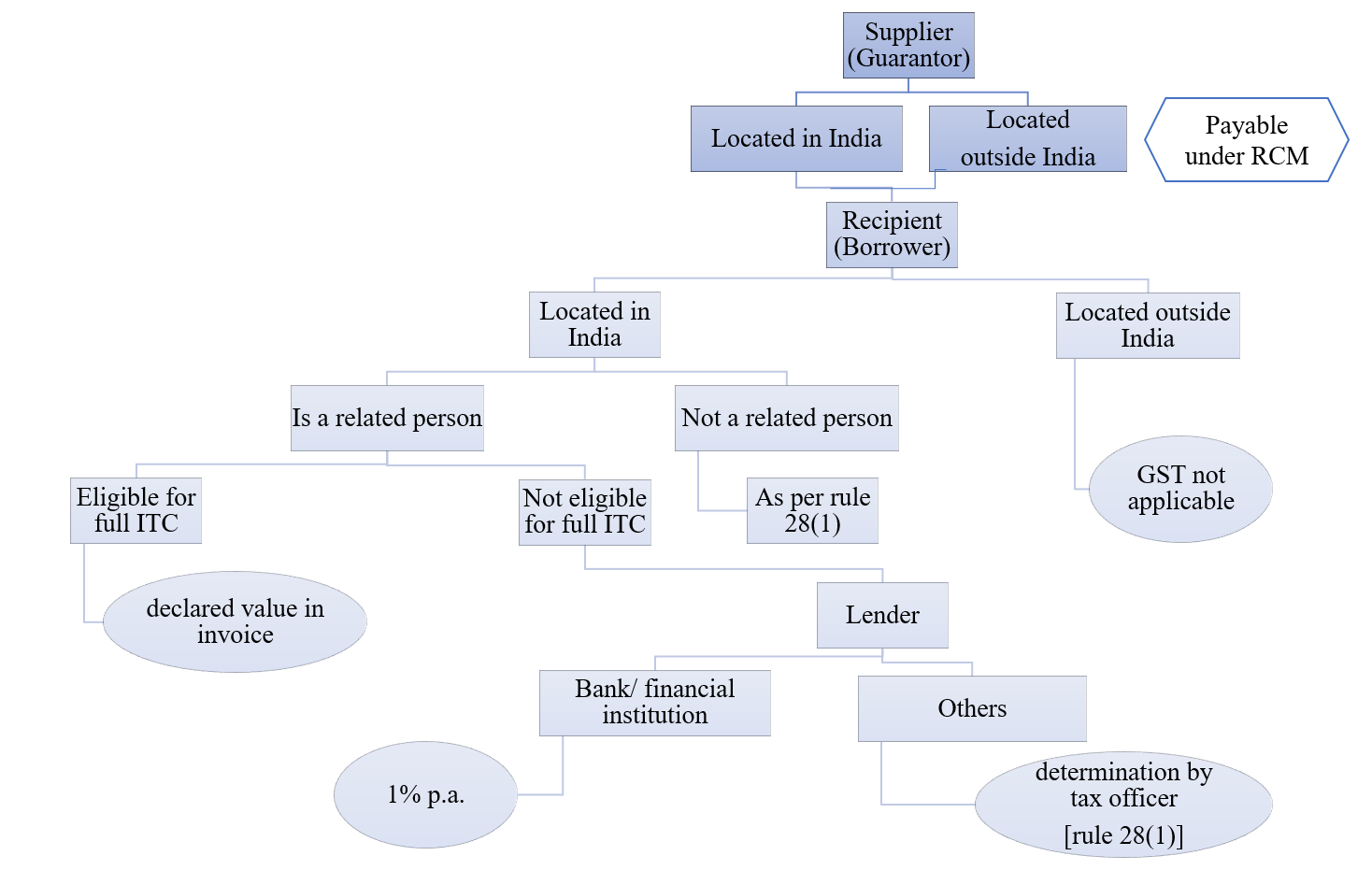
With the amendments coming into force, there are three ways the value of supply of service, i.e., issue of corporate guarantee, is to be determined, based on the nature of the recipient and the lender:


  • As per the deemed value of the supply

  • As per invoice value of the supply

  • As per determination by the tax officer

The below chart summarises the same:


(a)   Value of corporate guarantee as per deemed value under rule 28(2)


Rule 28 prescribes the value for supply of goods and services between distinct persons or related persons. In view of the common practice among related persons to provide corporate guarantee at nil consideration, sub-rule (2) was inserted under rule 28 to explicitly provide for a deemed value of consideration in case of supply of corporate guarantee. The same has been further amended vide the July amendment.


Sub-rule (2), as amended, reads as below:


Notwithstanding anything contained in sub-rule (1), the value of supply of services by a supplier to a recipient  who  is  a  related  personlocated in India, by  way  of  providing  corporate  guarantee  to  any  banking  company  or financial institution on behalf of the said recipient, shall be deemed to be one per cent of the amount of such guarantee offered per annum, or the actual consideration, whichever is higher.”


The deemed value provided under the said rule is 1% p.a. of the amount of guarantee offered, where no consideration is charged, or the actual consideration is lower than the aforesaid threshold. However, the said deemed value is applicable only where the following conditions are met:


  • Recipient of the service (i.e., the borrower) is a related person of the supplier (i.e., the guarantor),

  • Recipient of the service is located in India (since GST is not levied on export of services),

  • Recipient of the service is not eligible for full ITC, and

  • Corporate guarantee has been provided to a banking company or financial institution[1]


(b)  Value of corporate guarantee as per declared value in the invoice


A new proviso has also been inserted to sub-rule (2) of rule 28 vide the July amendment to ease out the GST implications on corporate guarantees. Pursuant to the said amendment, the deemed value of corporate guarantee will not apply, and the declared value in the invoice is taken as the value of the corporate guarantee, where the recipient of the service, i.e., the borrower is eligible for full ITC.


A similar proviso exists under sub-rule (1) of rule 28 as well. However, sub-rule (2) begins with a non-obstante clause, and thus, sub-rule (1) becomes non-existent for corporate guarantees between related persons to the banks/ financial institutions.


Hence, prior to the present amendment, for corporate guarantee between related persons, the relief with respect to invoice value was not available, and hence, GST was leviable on the basis of the deemed value. However, the amendments being applicable retrospectively, for recipients eligible for full ITC, benefit of invoice value will be available for corporate guarantees issued or renewed on or after 26th October, 2023.


Persons eligible for full ITC

Section 16 of the CGST Act specifies the eligibility and conditions for availing ITC. Where a person is eligible for a claim of full ITC, the value of supply of corporate guarantee will be based on the invoice value instead of the deemed value.


Here, it is important to note that the proviso refers to “full ITC”, and hence, eligibility for availing ITC u/s 16 is not enough, the recipient should be eligible for “full ITC”. The meaning of eligibility for full ITC is controversial, with some advance rulings on the subject[2]. In view of the aforesaid, it appears that the benefit of the proviso may not be available for a banking company or financial institution availing the option of 50% ITC as per sub-section (4) of section 17 of the CGST Act, as well as other persons providing exempt supplies. In essence, if the borrower (note, borrower is the recipient of the service) is a bank or financial institution or an entity providing exempt supplies, for whose borrowings a guarantor, being a related person, has given a guarantee, the deemed value will be applicable.


(c)   Value of corporate guarantee determined by tax officers under rule 28(1)


Rule 28(2) being a specific provision for value of corporate guarantee between related persons, valuation as per sub-rule (1) will apply only in cases where sub-rule (2) is not applicable. Sub-rule (1) is a general provision, applicable to supply for any goods or services between distinct or related persons. Under the said sub-rule, the value of corporate guarantee will be based on the determination by the tax officer (refer our article on the same here).


Hence, the same will be applicable only in cases where value of supply as per (a) and (b) above does not apply.


Applicability of deemed value on FLDG arrangements


First Loss Default Guarantee or FLDGs[3] are arrangements that do not involve the borrower, the guarantee is usually given by the supplier (i.e., the DLG provider) to the lender. As such, unlike guarantee which is a tripartite contract between the guarantor, borrower and the lender, FLDG is more like an indemnity, involving only two parties – the indemnifier (i.e., the guarantor) and the indemnified (i.e., the lender). The borrower being out of the picture, the applicability of deemed value of corporate guarantee, if at all, would arise if the guarantor and the lender are related persons. However, going by the nature of FLDG – being an indemnity rather than a guarantee – sub-rule (2) of rule 28 does not seem to be applicable. However, if the transaction is between related persons, the recipient of the service being an NBFC, it is important to ensure that the terms of the service are based on arms’ length consideration.


Conclusion


With the recent amendments in the GST regime applicable on corporate guarantees to related persons, the deemed value of supply for levying GST on corporate guarantee does not apply, if consideration is being charged by the guarantor and the recipient is eligible to claim full ITC. Market valuation principles do not apply, and hence, one may further want to circumvent the provisions by charging guarantee commission at negligible value, thereby, avoiding a higher GST charge. However, that does not preclude the RPT consideration under corporate laws, that require at least companies to ensure that any related party transaction is undertaken at arm’s length terms including pricing, and hence, the guarantee commission charged from a related party should also be based on the same principle.


[1] The meaning of financial institution is to be taken from section 45-I(c) of RBI Act, 1934.


[2] See a few advance rulings on the subject by West Bengal AAR, Tamil Nadu AAR


Also see a few articles on the subject: https://www.livelaw.in/law-firms/law-firm-articles-/input-tax-credit-central-goods-services-tax-rules-cgst-act-itc-tlc-legal-243111


https://taxguru.in/goods-and-service-tax/meaning-full-input-tax-credit-2nd-proviso-rule-28.html


[3]Structured Default Guarantees – https://vinodkothari.com/2022/09/structured-default-guarantees/


See our FAQs on default loss guarantee here – https://vinodkothari.com/2023/06/faqs-on-default-loss-guarantee-in-digital-lending/