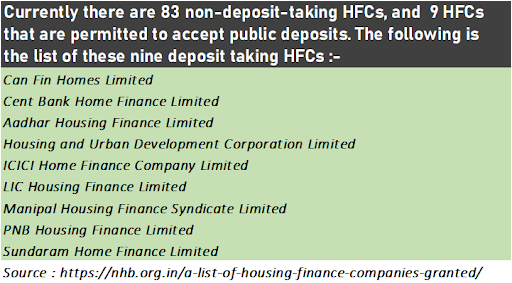
The RBI has proposed changes in the regulations applicable to housing finance companies (HFCs). While larger part of these proposed changes will impact deposit-taking HFCs, there are some provisions and privileges, currently applicable to NBFCs only, which are being extended to HFCs as well.
It may be recalled that the Finance Act, 2019 had moved the regulatory powers over HFCs to the RBI, whereas supervision remains with the NHB. Accordingly, RBI vide its Press release dated August 13,2019 issued direction that HFCs will henceforth be treated as Non-Banking Financial Companies (NBFCs) for regulatory purposes and RBI will carry out review of extant regulatory framework applicable to HFCs and come out with new revised regulations in due course. On October 22, 2020, the RBI issued a circular titled “Review of regulatory framework for Housing Finance Companies (HFCs)”, introducing a revised regulatory framework for HFCs. The circular emphasized the need for further harmonization between the regulations of HFCs and NBFCs over the next two years to ensure a smooth transition with minimal disruption. As part of this initiative, the RBI has released, on 15th January, 2024, a draft circular titled “Draft circular on Review of regulatory framework for HFCs and harmonisation of regulations applicable to HFCs and NBFCs” for public comments. The objective is to streamline the regulations governing HFCs, aligning them more closely with the regulatory framework applicable to NBFCs.
The proposed changes relate to both acceptance of deposits, and otherwise. Some of the proposed changes will be applicable to all HFCs. Below, we have provided a table comparing the guidelines applicable to NBFCs with the modifications proposed for HFCs to align them with the guidelines for NBFCs. Our point-wise analysis on the proposed changes is provided below:
Discover a comprehensive guide to Corporate Governance, offering an insightful journey through its evolution and key concepts. This book provides in-depth coverage across various areas, making it an essential read for professionals. Key highlights include:
Covers the complete ecosystem of corporate governance – board and its committees, independent directors, auditors, proxy advisors and shareholders
Extensive coverage on significant aspects such as conflicts of interest, information symmetry and corporate transparency
Futuristic focus: covers use of technology in corporate governance like the use of AI boardroom decisions
Sustainability and business responsibility covering directors’ liability for climate change, sustainability financing, reporting and CSR.
Substantial coverage on insider trading and related party transactions with guidance to practical implementation of complex provisions
Global coverage to understand international best practices with focus on Indian legislation so as to make a wider context for the readers.
Several chapters are supported by extensive, well-classified FAQs
Regulatory information updated till 30th June, 2024; Registered readers will be provided updates upto a limited time [check inside the Book for google form link]
https://vinodkothari.com/wp-content/uploads/2023/06/vinod-kothari-logo.png00Team Corplawhttps://vinodkothari.com/wp-content/uploads/2023/06/vinod-kothari-logo.pngTeam Corplaw2024-01-16 15:54:272024-09-13 15:01:44Corporate Governance: Miles Travelled and Miles to go
Insolvency law has always to be aligned to economic realities; when it comes to solving the problem of corporate insolvencies, an economy cannot disregard the prevalent corporate structures. The design which corporates adopt to conduct business must, in fact, be one of the most critical factors while designing the insolvency laws. Thus, if group assets, contracts, technological assets, investments or intellectual or other business rights remain scattered across a complicated group of intertwined entities, an insolvency law framework that remains constrained by the bounds of “legal entity” is unlikely to achieve the objective of ensuring preservation and, in case of liquidation, equitable distribution of corporate value for the benefit of stakeholders.
Propagation of group structures in India
Therefore, the key question to start is: do Indian businesses have complex group structures, involving layers of entities, whether legally structured as subsidiaries or not? An OECD report, prepared with significant inputs from SEBI[2], citing data collected from 4100 listed companies as of December 2020, says that there are on an average 50 subsidiaries for listed companies forming part of NIFTY-50, a number which has tripled over the last 15 years. It goes further to say that there are 15 listed companies which have more than 100 subsidiaries, whereas there are some which have over 200. Further, out of the 100 largest listed companies by market capitalization, approximately 40 India listed companies had three or more layers of subsidiaries/step-down subsidiaries, surpassed only by Singapore and Malaysia among OECD countries.
If the numbers stated in the above survey are surprising, it must be submitted that these numbers do not incorporate (a) number of layers on the top of the listed entity, that is, the chain of holding companies or companies; (b) associates, as quite often, the shareholding may be split across several group entities with none of them having sufficient holding to be termed as holding company; (c) the chain of companies above or below a listed company where the chain is snapped by use of a chain-breaker, that is, an entity which itself is not a subsidiary of the listed entity, but owns or is owned by a vertical chain of entities. The plausible economic reasons for existence of group structures are: efficiencies in operations, reduced dependence on external finances, and economies of scale. And as such, one would often see overlaps in asset use (e.g. asset of one entity being shared across group entities, or used as security against borrowings of entities), liabilities (group entities being joint obligors, third party security providers), common stakeholders (shareholders, directors, lenders, etc.) across group entities. However, such complex group structures have the potential to house complex web of transactions, thereby increasing the opacity of such structures and chances of wrongdoings, misconduct and lawlessness. Holding entities are most commonly employed to raise finance for group holdings, using pledge of operating companies’ shares, and use such borrowings to finance the operating companies. It is also commonplace practice to have a group’s brand or intellectual property owned by a promoter group entity. As there were many cases where group transactions were involved and/or put to question by the courts during insolvency proceedings[3].
The complete article has been published in the “Annual Publication 2023: IBC – Evolution, Learnings and Innovation” and can be accessed on the link here, from Page 281 onwards.
[1] With research support and assistance, gratefully acknowledged, by Neha Malu
[3] Yadubir Singh Sajwan & Ors. Vs. M/s. Som Resorts Private Limited [Company Petition No. (IB)-67(ND)/2022], ArcelorMittal India Pvt. Ltd. v. Satish Kumar Gupta [Civil Appeal nos.9402-9405 OF 2018] etc.
https://vinodkothari.com/wp-content/uploads/2023/06/vinod-kothari-logo.png00Vinod Kotharihttps://vinodkothari.com/wp-content/uploads/2023/06/vinod-kothari-logo.pngVinod Kothari2024-01-10 01:58:252024-01-10 02:07:16Group Insolvency: Relevance of Substantive Consolidation in Indian Context
https://vinodkothari.com/wp-content/uploads/2023/06/vinod-kothari-logo.png00Team Finservhttps://vinodkothari.com/wp-content/uploads/2023/06/vinod-kothari-logo.pngTeam Finserv2024-01-01 20:39:172024-01-04 13:42:46RBI mandates appointment of an Internal Ombudsman by NBFCs
The Reserve Bank of India (RBI) on 28th December, 2023 issued a circular amending the Master Direction on Transfer of Loan Exposures (MD-TLE) to exempt the Minimum Holding Period (MHP) requirement in case of transfer of receivables arising from factoring business.
The circular further prescribes eligibility for exemption, providing that:
The residual maturity of the receivables at the time of transfer should not exceed 90 days; and
Proper credit appraisal of the drawee should have been conducted by the transferee as provided under clause 10 and 35 of MD-TLE
It shall further be noted that, factoring business, can only be undertaken by eligible regulated entities, hence the transferee’s in case of transfer of factoring receivables can be only be entities eligible for factoring business which are:
NBFC-Factors
NBFC-ICC having specific licence for carrying out factoring business; and
Entities identified under section 5 of the Factoring Regulation Act, 2011, viz. banks, and body corporates established under an Act of Parliament or State Legislature, or a Government Company
Before the specific amendment, a view could have been taken that factoring of receivables not being a loan, did not fall within the ambit of MD-TLE. The amendment has in a way clarified two things:
Transfer of factoring receivables shall be covered under the MD-TLE;
The MHP requirement shall not be applicable in case the residual maturity of receivables is less than 90 days.
In case the residual maturity is more than 90 days, the MHP shall be applicable along with all other provisions of the MD-TLE
Intent behind exemption from Minimum Holding Period requirement
In accordance with MD-TLE any transfer of economic interest in a loan account/pool by regulated entities could only be undertaken after a prescribed period of 3 months in case of loans with tenure less than 2 years and 6 months in case of other loans has elapsed. The intent being to restrict REs from originating loans with the sole intent to transfer the same.
The primary intent behind this amendment is to foster and enhance the secondary market operations associated with receivables acquired through ‘factoring business’. By exempting the MHP requirement for eligible transferors, RBI aims to encourage greater liquidity within the factoring industry.
Anticipated impact of the amendment
Promoting an active secondary market would attract more participants, specifically the secondary market would help REs to work on their core competencies, such as eligible NBFCs may be able to originate assets in their specific niche which can be then transferred to banks or other large NBFCss for utilising their low-cost pool of funds.
Factoring business in India has been an underperformer, removal of such bottlenecks shall help REs optimising their business and in turn facilitating easier working capital finance for MSMEs.
Conclusion
To provide a little thrust to lagging factoring business in India, RBI has exempted transfer of factoring receivables from the requirement of MHP under the MD-TLE
The said move can assist in larger participation and increased liquidity in the factoring industry.
https://vinodkothari.com/wp-content/uploads/2023/06/vinod-kothari-logo.png00Qasim Saifhttps://vinodkothari.com/wp-content/uploads/2023/06/vinod-kothari-logo.pngQasim Saif2023-12-29 16:59:282023-12-29 16:59:29Transfer of factoring receivables exempted from MHP
https://vinodkothari.com/wp-content/uploads/2023/06/vinod-kothari-logo.png00Team Corplawhttps://vinodkothari.com/wp-content/uploads/2023/06/vinod-kothari-logo.pngTeam Corplaw2023-12-29 14:47:222024-01-03 11:04:51Regulatory round up: Corporate Law updates for the year 2023
https://vinodkothari.com/wp-content/uploads/2023/06/vinod-kothari-logo.png00Staffhttps://vinodkothari.com/wp-content/uploads/2023/06/vinod-kothari-logo.pngStaff2023-12-25 14:10:342024-01-24 11:57:31Felicitation Meet and Panel Discussion on Corporate Governance - from 1988 to Now
The Reserve Bank of India on 19th December 2023 issued a notification imposing a bar on all regulated entities (REs) with respect to their investments in AIFs. Highlights of the notification are as below –
What has the RBI done?
Prohibited all regulated entities (REs), including banks, cooperative banks, NBFCs and All India Financial Institutions from making investments in Alternative Investment funds (AIFs), if the AIF has made any investment into a “debtor company”.
Debtor company means a company in which the RE currently has or previously had a loan or investment exposure anytime during the preceding 12 months
The bar applies immediately, that is, effective 19th Dec 2023. No further investments to be made.
If investments already exist, the RE shall exit within 30 days, that is, by 18th Jan 2024
Further, if an RE has made an investment in an AIF, and the AIF invests in a debtor company, the RE shall make an exit within 30 days.
Investment by REs in the subordinated units of any AIF scheme with a ‘priority distribution model’ subject to full deduction from RE’s capital funds.
https://vinodkothari.com/wp-content/uploads/2023/06/vinod-kothari-logo.png00Team Finservhttps://vinodkothari.com/wp-content/uploads/2023/06/vinod-kothari-logo.pngTeam Finserv2023-12-22 10:57:512024-10-22 15:49:25RBI bars lenders’ investments in AIFs investing in their borrowers




 Reload document
  Open in new tab