SEBI proposes revival of open market buy-backs through stock exchange 

– Abhishek Kumar Namdev, Assistant Manager | corplaw@vinodkothari.com 

Introduction

Open-market buyback through stock exchanges, earlier discontinued by SEBI in a phased manner based on a 2023 amendment (see an article here), is proposed to be brought back in the buy-back regime. SEBI has released two consultation papers, on April 02, 2026 and May, 08, 2026 proposing to re-introduce open market buy-back of shares through stock exchanges. 

Buyback through the SE route would usually be preferred for the ease of compliances and flexibility available with the listed entity. The process is rather simple and cost-effective, as compared to the lengthy process of tender offer or reverse book-building. 

Reasons for phasing out this method in 2023? 

Historically, buy-back through the stock exchange route was one of the recognized modes under the regulations, which was subsequently phased out pursuant to the 2023 amendments and discontinued w.e.f April 01, 2025. Reasons involved: 

  1. Tax inequalities: Under the old taxation system companies were required to pay the buy-back tax under Section 115QA of the Income tax Act, 1961. Shareholders participating in the buy-back were not under any obligation to pay any tax on capital gains. This resulted in the shareholders availing a tax-free exit, while effectively, such tax burden was put on the remaining shareholders, through taxing the company that bought back the shares. 
  1. Inequitable shareholder participation: The price-time order matching system meant that only a few shareholders could end up selling their entire shareholding by participating in the buy back, while others despite willingness may be excluded, making the process chance-based rather than offering equitable participation.
  1. Artificial demand: In addition to the issues of participation inequality and tax inequalities, the lengthy time frame of buy-back via the stock market route also generated fears of price manipulation as well as price distortions since continuous purchase by the company would have an impact on the market prices over time.

Reverting back to the SE route: what changed? 

The primary rationale for bringing back buybacks through SE route is on account of the tax inefficiencies being resolved pursuant to the Finance Act, 2026.  The taxation of buy-back proceeds has been rationalised, putting the tax burden on those shareholders whose shares are being bought back. 

Additionally, to ensure that there is no misuse of the buyback provisions by the promoters or promoter group members, the new taxation regime imposes additional tax-rates on buyback by such shareholders. See an article on the changes in relation to  buy-back taxation.

On the other hand, open-market buyback through the SE route is also recognized for enabling efficient price discovery, improved liquidity, and flexible capital management for companies. Thus, the balance is in favour of enabling buybacks through the SE route again. 

Is it a revert or a new framework? 

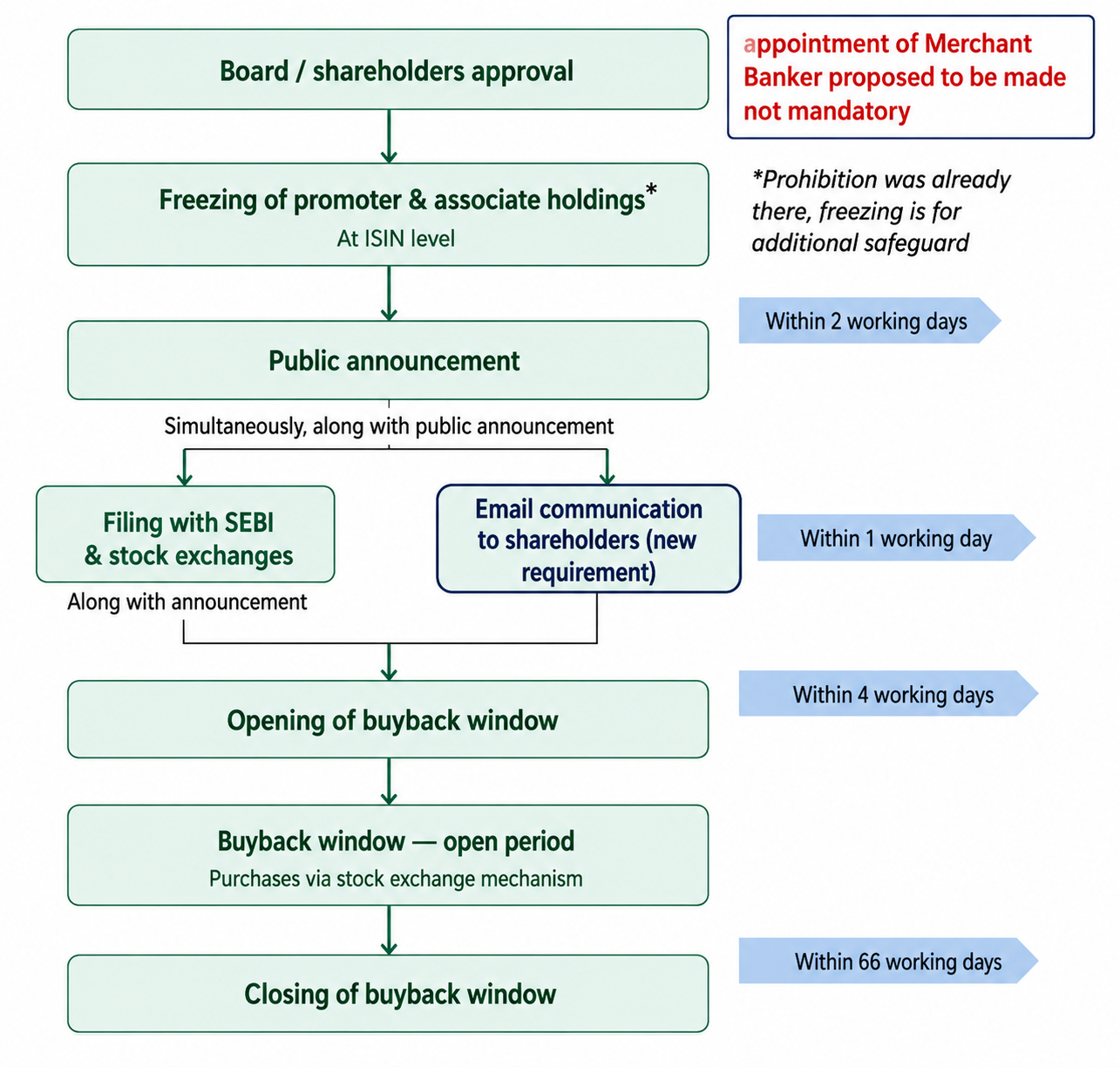
The proposal is neither a “revert”, nor a completely new framework. See figure below for proposed changes in the process of buyback through SE route: 

The 8th May CP proposes certain modifications to the erstwhile provisions of the Buyback Regulations for ease of doing business and further strengthening the buyback framework, as tabulated below: 

ProvisionExtant requirementsProposed changes Remarks
Public announcement (Reg. 16(iv)(b)Newspaper publication within 2 working days of board/postal ballot resolution;also placed on the website of SE, merchant banker  and company Additional mandatory electronic intimation (including email communication) to shareholders as on the date of public announcement, within one working day from the date of such public announcement. To ensure due information to shareholders in a timely manner. 
Duration (Reg. 17(ii))6 months – prior to 2023 amendment Reduced to 66 and thereafter 22 working days pursuant to 2023 amendments66 working days 

To ensure timely execution while providing adequate flexibility to the issuers 
Separate Trading Window (Explanation to reg. 16)Through a separate trading window provided by the stock exchange.To be done under the normal trading window A separate trading window is not required in view of the uniformity in tax treatment. Accordingly, this is not required. 
Disclosure of Company Identity in Buy-back Orders (Reg. 17)The company’s identity as purchaser was required to be displayed on the electronic screen at the time of placing the order. NA 

Proposals applicable to all forms of buyback 

While the CP is primarily focussed on bringing back SE mechanism for buybacks, some proposals have been made for amendments in the existing regulations w.r.t. all forms of buyback: 

ProvisionExtant requirementsProposed changes Remarks
Prohibition on trading by promoters and associates (Reg. 24(i)(e)From buyback approval till offer closure – prohibition on promoters and their associates, including inter-se transfersPromoters’ shareholding to remain frozen at an ISIN level during the buy-back period,
Exception: for tendering shares in a tender offer buy-back
Freezing of PAN at an ISIN level provides an additional safeguard against use of buyback by promoters for market manipulation. 
Tendering of shares during tender offer is permitted, in view of the additional tax-rates imposed on promoters pursuant to the Finance Act.  
Minimum public shareholding complianceNo explicit provisions Buyback not to be announced in breach of MPS requirementsThis is a clarificatory change; even though the Regulations did not explicitly mention about MPS requirements, the issuer is required to ensure compliance will all applicable laws at  all times.
Interval between two Buy-Back offers (Reg. 4(vii))Lock-in of 1 year from expiry of the buy-back period Reference to CA, 2013 instead of explicit provisionsThe CLAB, 2026 proposes various amendments in relation to the buyback framework; this will ensure alignment between the SEBI Regulations and CA, 2013. See an article here
Appointment of Merchant Banker (“MB”)Mandatory Functions of merchant banker to be re-distributed to LE, SEs and Secretarial auditor.For reducing the procedural and compliance costs

Our Remarks

Overall, the proposal reflects a shift from prohibition to reinstatement of an earlier permitted mechanism of buyback through the SE route, with additional safeguards to ensure there are no regulatory loopholes. With changes proposed in CA, 2013 under the Corporate Laws Amendment Bill, and a favourable tax regime pursuant to the Finance Act, 2026,  this seems to be an opportune time to revisit and revise the buyback framework applicable to the listed entities. 

The rebirth of buyback through SE mechanism is expected to  provide companies with greater flexibility in structuring buy-backs, while also ensuring a more equitable framework for shareholder participation and taxation outcomes. The proposal, therefore, seeks to strike a balanced approach between market efficiency and fairness, addressing past issues without dispensing with the benefits of the mechanism.

FAQs on Type-I NBFC Registration Exemption

– Anita Baid, Dayita Kanodia & Chirag Agarwal | finserv@vinodkothari.com

Loader Loading…
EAD Logo Taking too long?

Reload Reload document
| Open Open in new tab

Download as PDF [259.61 KB]

Repossessed, Revalued, Regulated: RBI’s framework for treatment of repossessed property

-Anita Baid & Dayita Kanodia | finserv@vinodkothari.com

RBI, on May 5, 2026, came out with the draft directions on Specified Non-financial Assets (SNFA). These directions have been introduced with the intent of specifying the treatment of non-financial and non-banking assets, particularly immovable property, acquired by the lender in satisfaction of their claims on the borrower. 

It is relevant to note that a common framework has been introduced for banks and NBFC, which is in contradiction to the recent consolidation approach adopted by the Department of Regulations. This could possibly also create confusion as to the treatment of non-banking assets relevant for banks, being referred to under the common framework, to be also made applicable on NBFC. In case of banks, the Banking Regulations Act prohibits banks from holding such non-banking assets (NBAs) beyond a period of 7 years, except for property acquired for own use.

Key Highlights of the Proposal:

Our comments on the key proposals have been provided below:

  1. SNFA would include those immovable assets which are acquired by a RE in satisfaction or part satisfaction of its claims on the borrower along with the non-banking assets as per Section 9 of the BR Act. 

VKC comment: This would mean that movable property, like vehicles, equipment, is not being covered under the purview of these regulations. Further, the restriction on banks as provided under the BR Act to acquire any immovable assets other than assets put to its own use should not apply to NBFCs. 

  1. The SNFA can only be acquired by the RE concerned when
    1. The RE’s exposure to a borrower is classified as non-performing, and 
    2. Where other means of recovery have been explored and deemed unviable.

VKC comment: This could be practically challenging since in certain adverse situations (like fraud classification) the RE may not want to wait for the asset to turn into an NPA before repossession is done. However, practically, evaluation and classification as fraud would easily take 90 days.

Further, the fact that all other means of recovery has been explored and deemed unviable would be very subjective to establish. 

  1. Acquisition will result in proportionate extinguishment of the exposure in lieu of which the SNFA is being acquired. Any part extinguishment of claims by the RE concerned would be deemed as restructuring

VKC comment: It is understood that any compromise settlement of the dues would be done as per the extant regulations for banks and NBFCs (as the case may be) and the amount outstanding post such settlement shall be considered to determine the remaining claims, if any.

  1. Upon acquisition, the SNFA shall be recorded in the balance sheet at the lower of-
    1. The NBV of the extinguished exposure or 
    2. The distress sale value of the SNFA arrived at by at least two independent external valuers.

At each subsequent reporting date, the SNFA shall be carried on the balance sheet at the lower of the last available distress sale value, or the revised NBV (value of extinguished exposure, net of the notional provisions applicable had the exposure continued on the books of the RE).

VKC Comment: The accounting treatment of the SNFA should have been governed as per the provisions of the accounting standards (para 3.2.23 of Ind AS 109). There could be a possible conflict since the accounting standards require the asset to be recognised on fair value. 

  1. Post-acquisition, the SNFA will be revalued at least once every two years on a distress sale basis. The reasons for failure to dispose of the asset earlier shall also be recorded. Valuation gains should be ignored and any diminution in value should be recognised in profit and loss statement immediately.
  1. Any accrued interest or charges with respect to the exposure shall not be recognised till the SNFA is actually disposed off and such interest or charges are received by the RE.

VKC Comment: This is consistent with the IRAC provisions which requires the RE to shift from accrual accounting to cash basis accounting upon the asset turning into an NPA. 

  1. Any expense/income incurred for the SNFA should be recognised in the P/L account for the year in which the same is incurred/earned.
  1. Disposal of such SNFA shall be by way of a public auction following the SARFAESI procedures

VKC Comment: SARFAESI is applicable to NBFCs having an asset size of more than 100 crore and where the outstanding amount is a minimum of ₹20 L. Accordingly, in some cases, SARFAESI may not be applicable at all. In such cases, following SARFAESI procedures should ideally not be made mandatory. 

  1. SNFA cannot be sold back to the borrower or its RPs (as defined under the IBC, 2016)

VKC Comments: Even under IBC, 29A bars the borrower and its connected persons from bidding on the repossessed assets (except for certain exemptions in case of MSME borrowers). 

  1. In case of failure to dispose the SNFA within earlier of:
    1. 7 years from the date of acquisition or 
    2. The carrying value becoming zero

the asset shall be deemed to have been employed for its own use by the RE and will be recorded as a fixed asset.

VKC Comments: It seems unclear if the RE concerned can put the assets to its own use immediately on the acquisition of such assets. 

  1. Specific disclosure to be made as a part of the financial statements as per the format prescribed by RBI. 

Also, read our article,

Repricing of ESOPs on account of market price crash

Abhishek Kumar Namdev, Assistant Manager | corplaw@vinodkothari.com 

Background

The basic intent of any company to bring out an ESOP Scheme is to incentivize its employees. Such incentives are basically in the nature of appreciation in the prices of shares. To explain this by way of an illustration, the following may be considered:

Grant price/ Exercise Price at the time of grant – INR 200 per share

Vesting – 1 year from date of grant

Market price at the time of exercise = INR 280 per share

Incentive / gain – INR (280 – 200) = INR 80 per share

This simply means that the usual expectation of any company is that the profits will increase because of which the share prices will also shoot up.  In such a scenario, if instead of an increase in the share prices, the same falls so sharply that it even falls below the exercise price, there is no motivation or reason for any employee to exercise their vested options as it has no relevance from being economically beneficial. Those employees holding “underwater options” find no incentive to exercise the same.

Therefore, the next logical question is: Can the exercise price be decreased? Such adjustment is generally termed as repricing of ESOPs. In this write up, we have discussed the legal permissibility of repricing the options and the different scenarios in which the same can be given effect to.

Does Indian law permit repricing?

The answer is yes, and it finds regulatory support under the SEBI (Share Based Employee Benefits and Sweat Equity) Regulations, 2021 (“SBEB Regulations”).

Regulation 7(5) of the SBEB Regulations states that the price of options that have not been exercised may be changed irrespective of whether they have been vested or unvested if the option is rendered unattractive due to a fall in the price of shares in the market. Having said that, such repricing should  not be detrimental to the interest of employees and will be subject to shareholder approval.The trigger is specific, a fall in market price rendering the option unattractive. 

Also, the conditions are clear, such repricing should not be prejudicial to the interest of employees, and secondly, shareholders must approve it by way of a special resolution. Given the scenario where the market price has fallen, the repricing will be done downward so as to make the options attractive again. 

For pricing of the ESOPs, following provisions become particularly relevant:

Indian law prescribes specific guidelines for the determination and disclosure of the exercise price. The relevant provisions are discussed below.

  1. Determination of Pricing of ESOPs: The SBEB Regulations provide the responsibility for determining exercise price solely to the compensation committee (NRC), with the sole condition that the committee shall follow the relevant accounting policies. Moreover, Regulation 17 does not mandate any minimum floor or prescribe any formula for setting the exercise price. 

However, SBEB Regulations do provide a benchmark for listed companies to follow while determining the exercise price. More specifically, regulation 2(1)(x) read with regulation 2(1)(hh)(i) indicate that for listed entities, the benchmark for the purpose of determining exercise price would be the latest closing price at a recognized stock exchange, where the higher trading volume in the shares of the Company is recorded, on the date prior to the date on which the compensation committee considers granting of ESOP. 

What practices do listed entities typically adopt in structuring their ESOP schemes? 

While most ESOP schemes provide that the exercise price shall be determined by the compensation committee at the time of grant, the manner in which such discretion is exercised varies across entities. In practice, a few broad approaches were observed which have been discussed below. 

The most common approach, particularly among listed companies, is to set the exercise price at exactly the market price as defined under Regulation 2(1)(x), that is to say, the closing price on the exchange with higher trading volume on the day preceding the grant date, with no discount applied. An example of this approach is set out in one of a company’s grant disclosures.

The second approach is where the ESOPs are granted at a discount to market price, with the discount range varying widely. An example of such an approach is reflected in an ESOP scheme that permits pricing at a discount of up to 50% to the closing market price on the stock exchange with higher trading volume.

The third approach is setting the exercise price at face value. While uncommon among established listed companies, has been adopted by several new-age, recently-listed companies. This practice is largely a carry-forward of pre-IPO ESOP structures where options were originally granted before listing, at a time when face value was the only viable pricing anchor.

A Company, in its Scheme, fixed the exercise price at Rs. 1 per option, equal to the face value of its equity share. Similarly, another Company, across itsseveral Schemes, consistently grants options at an exercise price of Rs. 1 per share which is equal to face value even as the market price at the time of grant has ranged about Rs. 230 per share, making the spread between exercise price and market price substantial. 

Another practice found is  to obtain prior shareholder approval for granting options within a specified discount range, for instance at 20–25% on the last closing price before the day of grant and granting the authority to fix the actual discount to either the Board / Committee within the approved range. 

  1. Section 62(1)(b) read with Rule 12 of the Companies (Share Capital and Debentures) Rules, 2014 requires every company to make certain disclosures in the explanatory statement annexed to the notice for passing the special resolution, including disclosure with respect to the exercise price or the formula for determining the same. 

Why not just cancel and regrant?

Can some companies prefer the option of  cancelling the existing options and issue fresh ones at the current market price? This looks cleaner apparently but technically two problems.

First, under Ind AS 102, cancellation during the vesting period other than on account of cancellation due to forfeiture for non fulfilment of vesting conditions, is treated as accelerated vesting. As a result, all unrecognised compensation cost gets recognised immediately, hitting the P&L upfront. Second, a fresh grant resets the vesting clock, meaning the minimum one-year vesting period under Regulation 18 of the SBEB Regulations starts afresh. Employees may end up waiting longer than they originally required.

Global scenarios

In US, listed companies are  required to follow ‘The Nasdaq Stock Market LLC Rules’1, which requires every company to take the shareholders’ approval unless the original plan expressly permits repricing. The SEC treats exchange programmes where employees voluntarily swap underwater options for new ones as the company gives a tender offer, triggering Schedule to filing requirements. The market-accepted approach has evolved toward “value-for-value” exchanges, where employees receive fewer new options calibrated to the fair value of the surrendered ones, limiting dilution and accounting impact. 

The Singapore Mainboard Rules mandate that the scheme itself provide for adjustments to the subscription or option price. Consequently, adjustments implemented strictly in accordance with the scheme may not necessitate separate shareholder approval. That being said, such adjustments are subject to an important safeguard, namely, that participants must be placed in a position economically equivalent to that of shareholders, thereby preventing any undue advantage. However, where the adjustment pertains to the option price, the manner in which such adjustments can ensure economic equivalence with shareholders remains a question.

The Toronto Stock Exchange (‘TSX’) through its Policy on Security Based Compensation requires a shareholder approval of any repricing of options if the participant is an Insider of the issuer, regardless of the terms of the plan. If a company’s option plan contains amendment provisions approved by shareholders that permit repricing of outstanding options held by non-insiders, then the TSX will not require shareholder approval for the repricing of such options. 

The common principle across jurisdictions is shareholder primacy & full transparency.

Need for Shareholder’s approval  for repricing

One of the major tasks before the Company is to approach the shareholders for repricing the options. However, the first question that comes to mind is can there be a situation where repricing can be done without the approval of the shareholders. Ordinarily, repricing requires the nod from the members, but such cases would be where the members fixed the grant price under the scheme. Where the authority to fix the grant price has been bestowed upon the NRC / Board, then any changes in the same should also be ideally decided by them. For example, the Scheme defines that the exercise price shall be at a discount of up to 25% or Rs. 20 (discount in terms of the percentage or absolute number) on the closing market price prior to the date of grant, in this case the NRC / Board should be having the power to determine the exercise price without have a recourse to shareholders as long as the fixation as well as repricing conditions align with the legislation as well as shareholders approval originally granted. Alternatively, the Scheme may provide that the exercise price shall be such price as may be determined by the NRC at the time of each grant, in accordance with the applicable provisions of the SBEB Regulations, 2021.   Governance concern

The governance concern with repricing is straightforward. Shareholders who bought shares at the market price have no mechanism to reprice their investment when prices fall. Extending a repricing benefit to employees, particularly those in senior management, without strong justification may create an asymmetry that institutional investors and proxy advisors may become reluctant to accept. However, on the other hand, it is important to accept that it is these very employees that put in their efforts to push up the performance as well as share prices. It might also be imperative to note that where the market prices decline on account of external factors or global factors, repricing becomes all the more significant.

Among listed companies, there have been a few companies which sought shareholder’s approval for repricing There is no SEBI informal guidance on repricing, a gap that itself reflects how underexplored this area remains.

Conclusion

Where the shareholders have not accorded the power to the NRC /Board to reprice the ESOPs,  it is legally required for the companies to take the approval route under the SBEB Regulations but comes with clear conditions, which include: 

  • NRC rationale on record;
  • shareholder approval by special resolution;
  • no dip below face value;
  • accounting impact; and 
  • Corresponding disclosures where the exercise price was earlier disclosed. 

See our other resources on ESOPs

  1. https://vinodkothari.com/2025/06/esops-for-founders-well-intended-relief-garbled-by-language/
  2. https://vinodkothari.com/2022/04/esops-as-part-of-managerial-remuneration/  
  3. https://vinodkothari.com/2023/09/stock-options-entail-multi-stage-disclosure-to-stock-exchanges/

  1. Rule 5635(c) of the Nasdaq Stock Market LLC Rules ↩︎

Option to exit: Type 1 NBFCs get continuing deregistration option

– Team Finserv | finserv@vinodkothari.com

Existing companies may apply within 6 months of 1st July; new companies may avoid registration on satisfying Type 1 and asset size conditions

The RBI’s relief to exempt pure investment companies from exemption from regulation, is now in final shape. We have earlier commented on the draft  Amendment Directions. The final amendments in Directions, notified on 29th April, 2026, accept some of the public feedback. However, the condition that the NBFC seeking exemption should not have any debt on the liability, nor any debt on the asset side, even if from/to group entities, remains.

The exemption window opens on 1st July,  based on asset size, no customer interface, no public funds and some other conditions (discussed below). The window remains till 31st Dec., 2026; however, even in future, it will be open for NBFCs to opt to exit from registration.

Read more

ECL Framework for Banks: Key Highlights

See our article A[U]n Expected Injury: ECL is here, likely to hurt bank profits and retained earnings in FY28 for an in-depth analysis.

A[U]n Expected Injury: ECL is here, likely to hurt bank profits and retained earnings in FY28

Team Finserv | finserv@vinodkothari.com

Additionally, upfront fair valuation may also deplete retained earnings

The new ECL framework marks a major regulatory shift for India’s banking sector; it has been long overdue, and therefore, there was no case that the RBI could have deferred it further; pleadings to defer the implementation were rejected by the regulator. It comes coupled with regulatory floors for provisions, which would cause a major increase in provisioning requirements over the earlier requirements. Our assessment, on a very conservative basis, is that the first hit to Bank P/Ls will be at least Rs 60000 crores in the aggregate. 

This is in addition to fair valuation requirement on upfront adoption, as on 1st April, 2027. While a vaguely worded part in para 19 was inserted on suggestions of the stakeholders, if interest rates have moved up since the date of the original loan, there will be almost a sure case of upfront valuation loss, which will eat up retained earnings.

RBI had come up with a draft framework on ECL pursuant to the Statement on Developmental and Regulatory Policies, wherein it indicated its intention to replace the extant framework based on incurred loss with an ECL approach. The final regulations were notified on 26th April and are applicable w.e.f 1.04.2027 i.e., for FY 27-28. The manner of implementation will be that all loans as on 1st April 2027 will be fair valued, and all new loans/financial instruments originated or acquired on or after 1st April 2027 will be subject to ECL provisions. See the highlights of the final regulations here.

A major impact that the directions will have on the Banking sector is the need to maintain increased provisioning pursuant to a shift from an incurred loss framework to the ECL framework. Under the earlier framework, banks made provisions only after a loss has incurred, i.e., when loans actually turn non-performing. The newECL model, however, requires banks to anticipate potential credit losses and set aside provisions for such anticipated losses. 

Banks presently classify an asset as SMA1 when it hits 30 DPD, and SMA2 when it turns 60. Both these, however, are standard assets, which currently call for 0.4% provision. Under ECL norms, both these will be treated as Stage 2 assets, which calls for a lifetime probability of loss, with a regulatory floor of 5%. Thus, the differential provision here becomes 4.6%.  

Once an asset turns NPA, the present regulatory requirement is a 15% provision; the ECL framework puts these assets under Stage 3, where the regulatory minimum provision, depending on the collateral and ageing, may range from 25% to 100%. Our Table below gives a more granular comparison.

Type of assetAsset classificationExisting requirement New requirement w.e.f 1.04.2027Difference
Farm Credit, Loan to Small and Micro EnterprisesSMA 00.25%0.25%
SMA 10.25%5%4.75%
SMA 20.25%5%4.75%
NPA15%25%-100% based on Vintage10%-85% based on Vintage
Commercial real estate loansSMA 01%Construction Phase -1.25%

Operational Phase – 1%
Construction Phase -0.25%

Operational Phase – Nil
SMA 11%Construction Phase -1.8125%

Operational Phase – 1.5625%
Construction Phase -0.8125%

Operational Phase – 0.5625%
SMA 21%Construction Phase -1.8125%

Operational Phase – 1.5625%
Construction Phase -0.8125%

Operational Phase – 0.5625%
NPA15%25%-100% based on Vintage10%-85% based on Vintage
Secured retail loans, Corporate Loan, Loan to Medium EnterprisesSMA 00.4%0.4%
SMA 10.4%5% (0.4% for loans against FD, NSC, LIC and KVP)

(2.5% for direct exposures to/guaranteed by State Governments)
4.6%

No change for loans against FD, NSC, LIC and KVP
SMA 20.4%5%(0.4% for loans against FD, NSC, LIC and KVP)

(2.5% for direct exposures to/guaranteed by State Governments)
4.6%

No change for loans against FD, NSC, LIC and KVP
NPA15%25%-100% based on Vintage

10%-100% for loans against FD, NSC, LIC and KVP and for direct exposures to/guaranteed by State Government)
10%-85% based on Vintage
Exposures under various schemes of Credit Guarantee Fund Trust for Micro andSmall Enterprises (CGTMSE), Credit Risk Guarantee Fund Trust for Low IncomeHousing (CRGFTLIH) and National Credit Guarantee Trustee Company Ltd  (NCGTC)SMA 00.4%0.25%0.15%
SMA 10.4%0.25%0.15%
SMA 20.4%0.25%0.15%
NPANo provision for the guaranteed portion. 

NPA provisioning as per extant guidelines for the portion outstanding in excess of the guarantee

(Only when the Governmentrepudiates its guarantee when invoked)
10%-100% based on vintage for secured and guaranteed portion

25%-100% based on vintage for unsecured and unguaranteed portion

(Only if the claims are not settled with ninety datesfrom the due date of the loan)
Home LoansSMA 00.25%0.25%0.15%
SMA 10.25%1.5%1.25%
SMA 20.25%1.5%1.25%
NPA15%10%-100% based on Vintage(-)5% – 85% based on Vintage
LAPSMA 00.4%0.4%
SMA 10.4%1.5%1.1%
SMA 20.4%1.5%1.1%
NPA15%10%-100% based on Vintage (-)5% – 85% based on Vintage
Unsecured Retail loanSMA 00.4%1%0.6%
SMA 10.4%5%4.6%
SMA 20.4%5%4.6%
NPA25%25%-100% based on Vintage0%-75% based on Vintage

The actual impact of such additional provisioning will be a hit of more than 3% to the profit of banks. Based on the RBI Financial Stability Report of FY 24-25, the current level of SMA and NPA is estimated to be ₹3,78,000 crores (2%) and ₹4,28,000 crores (2.3%), respectively. 
Accordingly, an additional provision of approximately ₹ 18,000 crores (4.6% of SMA volume) and ₹ 42,000 crores (10% of NPA volume) will be required for SMA and NPA respectively, leading to a total impact of at least ₹60,000 crores. This estimate has been arrived at by considering the % of NPAs and SMA-1 & SMA-2 portfolios of banks. The actual impact may be higher, as lot of loans may be unsecured, and may have ageing exceeding 1 year, in which case the differential provision may be higher.

It may be noted that while the draft directions allow Banks to add back the excess ECL provisioning to the CET 1 capital, it does not neutralize the immediate profitability impact, as the additional provisions would still flow through the profit and loss account.

How do we expect banks to smoothen this hit that may affect the FY 27-28 P/L statements? We hold the view that it will be prudent for banks, who have system capabilities, to estimate their ECL differential, and create an additional provision in FY 25-26, or do technical write-offs.

Effective Interest Rate requirement applies to all loans effective 1st April, 2027

ECL does not come alone; it comes along with the Ind AS 109 companion – the requirement to compute effective interest rate (EIR) for all financial assets and financial instruments. How does EIR requirement differ from the existing rate of interest/internal rate of return approach? Because EIR has the impact of amortising loan acquisition costs or upfront fees. Currently, banks could have taken the upfront earnings such as processing or origination fees/costs directly to revenue – these will now have to part of the EIR computation. More than impacting the profit number, EIR creates a significant impact on loan management systems, as it results in dual computations – the accounting balances and the customer LMS balances are likely to be different.

Upfront recognition of fair value changes

Para 19 requires that on 1st April, 2027, that is, the date of first adoption, all financial assets and instruments will be fair valued, and the fair value changes (gains or losses) will be adjusted against retained earnings. This is consistent with the principles of first time adoption of Ind AS.

On stakeholder representation, the RBI added this part to Para 19:

Where facts and circumstances indicate that the transaction has been undertaken on terms such that the fair value of the financial asset is not materially different from its carrying cost, the same shall be presumed to be the best evidence of fair value.

What does this imply? If the terms of the financial facility have remained the same, does it mean no fair valuation has to be done? Surely no, at least in our opinion. Any fair value change in fixed rate instruments happens for two reasons: change in credit spreads (rating changes, credit quality changes, etc), or change in rate of interest. If there is a facility extended, say at a rate of interest of 8%, whereas the prevailing rate of interest for a borrower of similar credit standing has moved up to 10%, will there be a fair value decrease? Surely yes.

There are lots of loans which were extended during Covid or periods of low interest rates, which are still continuing. In all such cases, fair value losses are imminent. 

The meaning of the para above can only be that if the terms of the original facility are similar to what they would currently be, then the fair value will not have to be computed.

See our other resources:

  1. Expected credit losses on loans: Guide for NBFCs
  2. Impact of restructuring on ECL computation

Virtual Certificate Course on Grooming of Chief Compliance Officers of NBFCs

Register your interest here: https://forms.gle/dBgva39FYWpBGDP4A

Loader Loading…
EAD Logo Taking too long?

Reload Reload document
| Open Open in new tab

Download as PDF [2.12 MB]

Dividends Denied: Why InvIT SPV CashFlows Don’t Flow Up

Simrat Singh | Finserv@vinodkothari.com

REITs and InvITs are often discussed together as parallel innovations in India’s capital markets, reflecting a push towards deploying capital in real estate and infrastructure. Both frameworks were introduced in 2014, share a trust-based structure and are subject to broadly similar regulatory principles, including mandatory cash distribution requirements and both also have a common tax provision in section 115UA of Income Tax Act, 1961 (section 223 in the 2025 Tax Act). Comparatively, InvITs have witnessed a significantly stronger growth, largely driven by the government’s sustained push towards infrastructure development. The data clearly reflects this divergence. As of April, 2026, there are 6 registered REITs and 28 InvITs in India, managing an AUM of ₹2,50,000 Crores and ₹6,20,000 Crores respectively. Among the InvITs, Road sector InvITs dominate the total AUM. (see our write-up on distribution of AUM of InvITs here). Notable, the national monetisation pipeline 2.0 proposed monetization of approx ₹3,35,000 Crores worth of highway assets under InvIT/TOT models (see our write-up on this here). 

While InvITs are required to distribute 90% of their cash flows, the underlying SPVs, mandated to be in company form, are constrained by dividend distribution rules that rely on accounting profits rather than actual cash generation. In sectors such as roads and power, where assets are finite-life concession rights or long term power purchase agreements, such assets are subject to heavy amortisation which leads to SPVs report book losses despite generating steady cash flows. As a result, cash exists within the SPV but cannot be upstreamed efficiently as dividends. This issue stems from treating InvITs on par with REITs despite differences in investments and nature of assets and from disallowing flexibility in the legal form of SPVs.

Industry workaround has been towards debt-heavy (thin capitalisation) structures, enabling distributions through interest and loan repayments, though these might raise tax issues (discussed below). Beyond such workarounds, more durable solutions are explored in line with international models like US Master Limited Partnerships and Singapore Business Trusts such as permitting dividend declarations based on cash flows rather than accounting profits, reconsidering the mandated company form of SPVs to allow more flexible structures such as trusts or LLPs etc.

Nature of investments by REITs and InvITs

REITs and InvITs are different in the sense that one invests in a property and looks at long term appreciation/rentals. The other looks at an infra asset which gives cash flows only for a certain period

REITs hold income-generating real estate assets with no fixed economic life. These assets can be retained, redeveloped/renovated or replaced over time. At the SPV level, there is no restriction on holding multiple assets and the portfolio of assets can be managed through acquisitions and divestments.

In contrast, InvITs, particularly in the road sector, hold assets that are inherently finite. These assets are in the form of concession rights and are intangible assets where the concessioning authority (usually NHAI) grants a right to operate and collect revenue for a defined period, say 15 to 20 years. Note that the road asset is not the asset that is taken on the balance sheet of the SPV, rather it is the intangible right to collect revenue on the road that is capitalised. At the end of the concession period, the asset reverts back to the concessioning authority, leaving no residual economic value. At this stage, the SPV merely becomes a shell entity, holding in itself only residual litigations or tax demands awaiting its eventual outcome of being wound-up.

Moreover, there are certain constraints imposed by the concession agreement entered into between the SPV and NHAI. Under standard concession agreements, each road project is required to be housed in a separate SPV. Which is why the name of the SPVs are in the style “[Name of Road Stretch] Tollway/Toll Road Private Limited”. The “one project, one SPV” model prevents aggregation of road assets within the same SPV and keeps the rights, obligations and risk allocation clearly demarcated. While this mandatory housing of each project in a separate private limited entity has its advantages, such as lender protection, bankruptcy remoteness and clarity in enforcement of contractual rights, it also creates rigidity for the InvIT. 

The inability to pool assets or recycle assets within the SPVs prevents capital recycling. Unlike REIT SPVs, InvIT SPVs cannot recycle capital either by selling assets or acquiring new ones within the same entity. As a result, while REITs can operate vehicles with a perpetual asset base, InvITs function as portfolios of wasting assets that are depleted over time and cannot be replaced within the same SPV. 

Distribution requirement and the dividend constraint

Both REITs and InvITs (and their SPVs/HoldCos) are required to distribute at least 90% of their net distributable cash flows. This distribution can occur through interest on loan, loan repayment or dividends from the SPVs. The challenge for InvITs arises at the SPV level, in the case of dividend distribution. Under Section 123 of the Companies Act, a company can declare dividends only out of distributable profits or accumulated reserves. The books of such SPVs are loaded with high upfront capitalisation of construction costs and subsequent recognition of a concession asset. This asset is depreciated (or amortised in case of intangible assets such as concession right) over the concession period along with the amortization of the earlier capitalised expenditure, leading to significant non-cash expenses in the profit and loss account which continues to hit the Profit and Loss account even when the SPV starts collecting cash. As a result, even when the SPV generates operating cash flows from toll collections, it remains in ‘book losses’ for a portion of the concession life. The consequence is that such SPV is unable to declare dividend distribution to the InvIT despite the availability of cash.

Depreciation on a non-replaceable asset?

Accounting principles require allocation of asset cost over its useful life. This is conceptually sound for assets that are expected to be replaced or reinvested in. A machinery may be required to be replaced once its useful life is over, therefore, it is only prudent to set aside a part of the cost so there is enough cushion when the entity goes to replace the machinery. 

In the case of REITs, this logic holds good. Depreciation reflects the wear and tear of the replaceable asset and the entity has the ability to reinvest/replace the asset over time (i.e. purchase a new rent yielding building in the same SPV). The economic cycle supports the accounting treatment.

For InvIT SPVs especially in the road sector, the asset is not replaced at the end of its life; it is handed back to the concessioning authority. The SPV has no ability to deploy accumulated depreciation (or amortization in case of an intangible asset) towards acquisition of a new asset. Its economic life is co-terminus with the concession period. This creates a disconnect between accounting profits and economic cash flows. Depreciation suppresses book profits without corresponding economic relevance in terms of asset replacement within the SPV.

International comparisons 

Singapore’s Business Trusts

Singapore offers the clearest analogy to and resolution of this problem. The Business Trusts Act 2004 (BTA), administered by the Monetary Authority of Singapore (MAS), created a hybrid structure that combines features of a company (separate legal personality, professional management) with features of a trust (cash-based distributions). The defining advantage of the Singapore Business Trust (BT) is stated explicitly in the legislation and was articulated in the MAS’s explanatory brief for the Business Trusts (Amendment) Bill 2022:

“A key advantage of a BT structure is the ability of a trust to pay dividends to unitholders out of its cash profits. In contrast, a company can only pay dividends out of its accounting profits (i.e. after deducting non-cash expenses such as depreciation). The BT structure is thus particularly suited to businesses with stable growth and high cash flow.”

Singapore listed 15 Business Trusts as of 2026, covering assets including power generation, toll roads, and shipping. For infrastructure BTs, the cash-based distribution right is central to the investment proposition. Critically, the BT does not interpose a company-form SPV between the trust and the infrastructure asset; the trust itself holds the operational assets. This avoids the Section 123-equivalent constraint that would arise if a company-form subsidiary were the operating entity.

The Singapore model, however, is not directly transplantable to the Indian road sector context for the reason explained above ie NHAI’s requirement for a company-form concessionaire. 

The US Master Limited Partnership Model

In the United States, the Master Limited Partnership (MLP) structure, originally developed for oil and gas pipelines and subsequently applied to other infrastructure sectors, avoids the dividend constraint through the partnership form. Partnerships are not subject to corporate dividend restrictions; distributions to limited partners (akin to unitholders in InvITs) are made based on cash available for distribution, a metric that is equivalent to NDCF and adds back non-cash charges including depreciation and amortisation. Interestingly, MLPs typically grant the General Partner (GP is somewhat analogous to the investment manager in an InvIT), a share in the distributable cash flows through Incentive Distribution Rights (IDRs). These rights are structured on a tiered basis, such that as distributions to Limited Partners increase, the GP becomes entitled to a progressively larger share of incremental cash flows. This creates a performance-linked incentive for the GP to enhance distributable cash. At the same time, the GP retains discretion over the quantum of cash to be distributed versus retained.

Possible approaches

In the original consultation process leading to the introduction of InvITs, SEBI did take note of international structures such as the Master Limited Partnerships in the United States, which allow cash-based distributions without being constrained by law dividend rules. However, there was no discussion on the legal form of the SPV and the final regulations settled on a company structure for underlying entities. Had there been flexibility to allow SPVs to be structured as trusts and/or LLPs, the present issue may not have arisen in the first place.

Thin capitalisation

A commonly adopted workaround is to maintain a thinly capitalised SPV, with the bulk of funding structured as loans from the InvIT rather than equity investment. In such cases, distributions are routed primarily through interest payments and loan repayments instead of dividends, a structure widely used in InvIT arrangements. However, this approach may attract limitations under Section 94B of the Income Tax Act, 1961 (section 177 in the 2025 Act), which operates as a Specific Anti-Avoidance Rule (SAAR) on excessive interest deductions. The provision applies where an Indian borrower incurs interest expenditure exceeding ₹1 crore in respect of debt from a non-resident associated enterprise (or even third-party debt backed by such an enterprise). In such cases, the deduction for interest is restricted to 30% of EBITDA or the actual interest payable to associated enterprises, whichever is lower and any excess interest is disallowed. Accordingly, in InvITs where non-residents usually hold the majority of the units, thin capitalisation may lead to disallowance of interest deductions for SPVs.

Allowing Dividend Declaration Based on NDCF

A more targeted solution would be a targeted regulatory relaxation by the Ministry of Corporate Affairs, permitting dividend declaration by InvIT SPVs based on NDCF rather than accounting profits. This would essentially create a sector-specific carve-out from Section 123’s profit test for companies that are 100% subsidiaries of registered InvITs or HoldCos of InvITs. 

Tweaking the legal form of the SPV

One possible approach is to reconsider the legal form of SPVs. Allowing SPVs to be structured as trusts could align the distribution framework more closely with cash flows rather than accounting profits. However, this would require a shift in regulatory and contractual frameworks as SEBI and NHAI both need to be onboarded on this. This solution seems far-fetched as Road assets vesting in a trust is a scenario which NHAI will not be comfortable with.

Conclusion

The principle is clear: regulation must follow the nature of the asset, not force the asset into an ill-fitting form. To mandate distribution without enabling it is, as in the tale of King Canute, to command the tide to rise while forbidding it a shore. An instruction complete in form, but wanting in effect. India’s InvIT framework is, without a doubt, a notable financial innovation, a bridge that has opened public infrastructure to private capital and supported the National Monetisation Pipeline. But the task is not merely to invite capital but to also ensure that the channels through which it flows are kosher. The present framework, in treating REITs and InvITs as parallel structures, overlooks divergence. While REITs rest on perpetuity of assets, InvITs are built on finite-life concessions that steadily deplete. This mismatch, compounded by accounting norms, contractual structures of NHAI and the Companies Act, creates a distribution bottleneck, where cash is generated but cannot be cleanly upstreamed. Industry has found workarounds, principally by way of intercompany loans. But the issue warrants policy attention. We can take guidance from comparative regimes, such as the Singapore Business Trust framework and U.S. MLPs and recognise infrastructure as a cash-flow distribution business and permit distribution mechanisms that reflect this reality. It is therefore imperative that SEBI, MCA, and NHAI act in concert to resolve this misalignment. Only then can InvITs evolve from a promising innovation into a durable pillar of India’s infrastructure architecture.

See our other resources on InvITs:

  1. InvITs and REITs: Regulatory actions for more enabling environment
  2. PPT on InvITs
  3. Roads to Riches: A snapshot of InvITs in India
  4. CG norms for REITs and InvITs aligned with equity-listed entity

RBI’s Draft PPI Norms: Stricter Cash Rules, Simplified Categories, No Cross Border Payments and More

Simrat Singh and Jeel Ranavat | Finserv@vinodkothari.com

The RBI has proposed an overhaul of the existing prepaid payment instruments (PPI) framework through its draft Master Direction, 2026. The changes aim to, inter-alia, simplify classification, tighten cash usage, restrict cross border payments etc. In this note, we discuss some of the key proposals of the draft master directions.

Simpler classification

Two overarching categories are proposed: 

  1. General Purpose PPI: Comprising Full-KYC PPI and Small PPI (single type, no further sub-types); 
  2. Special Purpose PPI: comprising Gift PPI, Transit PPI, PPI for Foreign Nationals/NRIs (UPI One World) and any other with prior RBI approval. PPI-MTS renamed into Transit PPI

Credit card loading restricted

With a view to curb ‘loan-loaded PPIs’, it is proposed that credit cards can now be used only for Special Purpose PPIs, while General Purpose PPIs are limited to bank account debit, cash or another PPI. This signals a clear intent to ring-fence credit-backed spending to specific use cases. See our resource around loan loaded PPIs here.

Statutory auditor certification for net worth compliance

The draft introduces a procedural clarification by requiring non-bank PPI applicants to submit a certificate from their statutory auditor confirming compliance with the minimum net worth criteria of ₹5 Crores. While the threshold itself remains unchanged, earlier a CA certificate was required; the draft now specifically mandates certification by the statutory auditor in a prescribed format..

Sharp cut in cash usage

Cash usage sees the biggest tightening. Cash loading for Full-KYC PPIs is reduced from ₹50,000 to ₹10,000 per month, pushing higher-value transactions towards bank-linked digital modes. The move appears designed to curb anonymity and improve traceability.

P2P transfers also curtailed

Peer-to-peer transfer (i.e. transfer to another person’s bank account or PPI) limits have been standardised. Instead of differentiated limits based on beneficiary registration, a flat cap of ₹25,000 per month is now proposed.

Monthly usage cap formalised

While earlier regulations relied on outstanding balance caps, the draft introduces an explicit ₹2 lakh monthly debit limit for Full-KYC PPIs. In substance, this aligns with the existing ceiling but adds clarity on usage.

Banks get faster go-live

Banks issuing PPIs will no longer require prior approval if they are already qualified to issue debit cards. A prior intimation to RBI will be sufficient, allowing faster product launches. This acknowledges that regulated banks already meet baseline prudential standards.

This significantly reduces time-to-market and reflects regulatory reliance on the existing prudential and compliance standards applicable to banks. The change is expected to enhance agility, support faster product innovation, and strengthen banks’ participation in the digital payments ecosystem.

Non-bank approvals streamlined

For non-bank issuers, the process is simplified with perpetual authorisation and removal of the explicit in-principle approval stage. The timeline for submission post-regulatory NOC is also relaxed to 45 days from the earlier requirement of 30 days. The draft is silent on the earlier requirement of submitting a System Audit Report (SAR) at the time of authorisation. However, an IS Audit report is proposed to be submitted annually by the issuer.

Core portion interest computation shifts to monthly basis

The draft revises the methodology for computing interest on the core portion by moving from a fortnightly to a monthly calculation framework. Instead of averaging 26 lowest fortnightly balances, issuers will now compute the average of 12 lowest monthly outstanding balances, with the minimum one-year operational requirement continuing. This change appears to be a pragmatic step towards operational simplification, reducing computational intensity while aligning the framework with more conventional monthly cycles. While the earlier explicit restriction on availing loans against such deposits is not reiterated, the fiduciary nature of PPI funds implies that pledging or leveraging customer balances would, in our view, remain impermissible.

Foreign wallet norms liberalised; A push for UPI One World

In contrast to tightening elsewhere, the framework for foreign users is expanded. The UPI One World wallet will now be available to all foreign nationals and NRIs, with a higher ₹5 lakh monthly usage limit.

This step is aimed at making UPI more accessible to international users, especially inbound travellers who often face challenges in using domestic payment systems. By enabling seamless, wallet-based access to UPI, the framework improves convenience and enhances the overall payment experience in India.

Cross-border usage removed

A key change is the blanket removal of cross-border transaction capability for PPIs. Earlier, AD-1 bank issued PPIs could be used for limited overseas transactions. The draft eliminates this entirely, narrowing the scope of PPIs.

Other notable changes

Closed system PPIs continue to remain outside regulation but marketplaces are explicitly excluded from claiming this status. The definition of “merchant” has been broadened, removing the requirement of contractual acceptance. Small PPIs will now expire after 24 months with mandatory balance transfer in case the same has not been converted into Full-KYC PPI, instead of merely restricting further credits.

See our existing resources on PPI:

  1. Checklist on PPI
  2. The future of loan loaded prepaid instruments
  3. The law of prepaid instruments
  4. PPT on Prepaid Instruments
  5. De novo master directions on PPIs
  6. Mobile Wallets