Home-buyers provisions in IBC: Putting square peg in round holes?

 Sikha Bansal

(resolution@vinodkothari.com)

The ruling of the Apex Court in Pioneer Urban Land and Infrastructure vs. Union of India[1], comes as a breather for home-buyers (all and sundry), upholding the constitutional validity of the amendments brought out in section 5(8) of the Insolvency and Bankruptcy Code, 2016 (“IBC”).

Section 5(8) defines ‘financial debt’ as a debt alongwith interest, if any, which is disbursed against the consideration for the time value of money and includes “any amount raised under any other transaction, including any forward sale or purchase agreement, having the commercial effect of borrowing” [clause (f)]. An explanation was inserted[2], wherein “any amount raised from an allottee under a real estate project shall be deemed to be an amount having the commercial effect of a borrowing”. Read more

FAQs: NBFCs not to charge foreclosure / pre-payment penalties on floating rate term loans for Individual borrowers

-Kanakprabha Jethani and Julie Mehta

finserv@vinodkothari.com


RBI has vide notification[1] dated August 02, 2019 issued a clarification regarding waiver of foreclosure charges/ prepayment penalty on all floating rate term loans sanctioned to individual borrowers, as referred to in paragraph 30(4) of Chapter VI of Master Direction – Non-Banking Financial Company – Systemically Important Non-Deposit taking Company and Deposit taking Company (Reserve Bank) Directions, 2016 and paragraph 30(4) of Chapter V of Master Direction – Non-Banking Financial Company – Non-Systemically Important Non-Deposit taking Company (Reserve Bank) Directions, 2016.

As per the fair practice code, NBFCs cannot charge foreclosure charges/ pre-payment penalties on all floating rate term loans sanctioned to individual borrowers

RBI has further clarified that NBFCs shall not charge foreclosure charges/ pre-payment penalties on any floating rate term loan sanctioned for purposes other than business to individual borrowers, with or without co-obligant(s).

To understand its implication and for further understanding, please refer to the list of ‘frequently asked questions’ listed below:

Basic understanding

  1. What is pre-payment or foreclosure?

 Ans. Prepayment or foreclosure is the repayment of a loan by a borrower, in part or in full ahead of the pre-determined payment schedule.

However, the distinguishing factor is that pre-payment means early payment of scheduled instalments, while foreclosure means early payment of the entire outstanding amount leading to early closure of the loan term. To extend, pre-payment is partial in nature whereas foreclosure is the closure of the loan account before the due-date.

  1. How do foreclosure charges and pre-payment penalties differ?

Ans. Conceptually, both have the same meaning. The only difference is in the terminology as the charges levied at the time of foreclosure are termed as foreclosure charges and charges levied at the time of pre-payment of an instalment are termed as pre-payment penalties.

  1. What is a term loan?

Ans. A term loan means a loan for which the term for repayment is pre-determined. This is unlike a demand loan in which the borrower has to repay on demand of repayment by the lender.

  1. How is a floating rate term loan different from a fixed rate term loan?

Ans. A fixed-rate term loan refers to interest rates that remain locked throughout the loan period, while floating-rate term loan refers to interest rates that are subject to fluctuate owing to certain factors.

  1. How is floating rate determined?

Ans. Lenders determine the floating rate on the basis of certain base rate. Usually, the floating rate is some percentage points more than the base rate. Base rate is determined by taking into account the cost of funds of the lender.

  1. Where do we find such floating rate term loans?

Ans. Floating rates are generally found in loans of long-term as the cost of funds is likely to fluctuate in the long run. However, certain medium term loans also have floating interest rate depending upon the agreement between the lender and borrower.

  1. Can a borrower make pre-payment of a term loan?

 Ans. Courts have, in many cases, given judgements stating that in the absence of specific provision in the agreement between the lender and the borrower (Loan Agreement), the borrower has the inherent right to make pre-payment of a loan. This puts light on the principle that ‘every borrower has an inherent right to free himself from the loan’.[2]

In case a lender requires that the loan amount should not be prepaid, such a restriction must be expressly mentioned in the Loan Agreement.

  1. Can a lender levy foreclosure charges/pre-payment penalty?

Ans. Unlike the provisions relating to pre-payment of loan by the borrower, the provisions for levy of foreclosure charges/pre-payment penalties are largely governed by the terms of the Loan Agreement. A lender can levy only those charges which form part of the Loan Agreement.

If provisions for levy of foreclosure charges/pre-payment penalties are expressly mentioned in the Loan Agreement, the lender can levy such charges/penalty. In absence of such provision, the lender does not have the right to levy such charges/penalty.

Further, for entities regulated by RBI, it is mandatory to mention all kinds of charges and penalties applicable to a loan transaction in the loan application form.

  1. What happens on prepayment of loan?

 Ans. Pre-payment of loan amount by the borrower has dual-impact. One is saving of interest cost and the other is reduction in the loan period. When a borrower pre-pays the loan, huge interest cost is saved, specifically in case of personal loans, where the interest rates are quite high.

  1. Why are borrowers charged in event of pre-payment?

Ans. Lenders pre-determine a schedule in terms of the specified term of a loan, including the repayment schedule, and the interest expectation. An early prepayment disrupts this schedule and also means that the borrower has to pay lesser interest (since interest is calculated from the time the loan is disbursed, till it is repaid).

Pre-payment charges are used as a client retention tool to discourage borrowers to move to other lenders, who may offer better interest for transferring the outstanding amount. It puts a limitation to the number of choices a customer can have due to market competition.

To compensate for such loss, pre-payment charges exist.

  1. What is the rate at which pre-payment charges are imposed?

Ans. The rate is determined by the opportunity cost foregone due to pre-payment/foreclosure. The future cash flows are discounted at a relatively lower rate and accordingly imposed. The rate differs from bank to bank depending on their relevant factors and policies. For example: several banks charge early repayment penalties up to 2-3% of the principal amount outstanding.

  1. How do banks benefit from the pre-payment penalties?

Ans. The prepayment penalty is not charged with the motive to generate revenue, but to recover costs incurred due to mismatch in assets and liabilities. It is believed that when long-term loans are offered to borrowers, lending facility raises long-term deposits to match their assets and liabilities on their balance sheet. So when the loans are pre-paid with respect to their scheduled payments, lenders continue to have long-term deposits on their books, leading to a mismatch

  1. What are the other factors that need to be kept in mind for pre-payment or foreclosure of loan?

Ans. The applicable rate at which penalty shall be charged is a major factor as it should not result in higher cost to the borrower. Other factors include the process of undergoing pre-payment/foreclosure, lock-in period associated with the option, documentation etc.

  1. What has been clarified?

Ans. Earlier, the FPC provided that NBFCs shall not charge foreclosure charges/prepayment penalties from individuals on floating rate term loans.

The clarification that has been provided by the RBI is that the foreclosure charges/prepayment penalties shall not be charged floating rate term loans, provided to individuals for purposes other than business i.e. personal purposes loans

Applicability

  1. On whom will this restriction be applicable?

Ans. The change shall be applicable to all kinds of NBFCs, including systemically important as well as non-systemically important NBFCs who are into business of lending to individuals. However, NBFCs engaged in lending to non-individuals only are not required to comply with this requirement.

  1. What kinds of loans will be covered?

Ans. All floating rate term loans provided to individuals for purposes other than business shall be covered under the said restriction.

  1. How will the lender define that loan is for purposes other than business?

 Ans. Before extending loans, documentation and background checks are performed. This process includes specification of the purpose for which the loan is taken. This gives a clear picture of the nature of the agreement and helps distinguish between business purpose and personal purposes.

  1. Why is this restriction on floating rate term loans only and not on fixed rate terms loans?

 Ans. Fixed rate loans involve no fluctuations in interest rates in the entire loan term. Thus in case of pre-payment, the interest foregone can be computed and realised to evaluate pre-payment penalties to be imposed.

While floating rate loans involve fluctuations based on the underlying benchmark and thus interest foregone cannot be estimated. There lies no confirmation of the lender being in the loss position. There is no way to realise interest rate sulking or hiking. Thus there is no basis on which overall loss might be estimated. In response to this situation, restrictions are on floating rate term loans and not on fixed rate term loans.

  1. Are there any other entities under similar restriction?

 Ans. RBI has put restrictions, similar to this, on banks and Housing Finance Companies as well. Banks are not permitted to charge foreclosure charges / pre-payment penalties on home loans / all floating rate term loans, for purposes other than business, sanctioned to individual borrowers. HFCs are not permitted to charge foreclosure charges/ pre-payment penalties in case of foreclosure of floating interest rate housing loans or housing loans on fixed interest rate basis which are pre-closed by the borrowers out of their own sources.

  1. When does this clarification come to effect?

Ans. It is noteworthy that this is a clarification (and not a separate provision) issued by the RBI in respect of a provision which is already a part of RBI Master Directions for NBFCs. Therefore, this clarification is deemed to be in effect from the date the corresponding provision was issued by the RBI by way of a notification[3] i.e. August 01, 2014.

Implication

  1. What is the borrower’s perspective?

Ans. Borrower’s may choose to pre-pay due to their personal obligations/burden, or if they obtain their funds which were earlier stuck, or by borrowing from a cheaper source to repay. This waive off of penalty charges, might be a sign of relief to them as they would get out of the obligation of an existing loan arrangement by paying off early and save the compounding interests and explore from the other options available in the market.

  1. What will happen after such clarification?

Ans. Prior to this clarification, the provision seemed to be providing a safe shelter to individual borrowers where they could foreclose or pre-pay any loan taken by them. Sometimes, the borrowers misused this facility by availing funds at a lower cost from some other lender to pre-pay the loans of higher interest rate. This resulted in disruptions in the forecasts of lenders, sometimes also resulting in loss to the lender.

This clarification limits the benefit of pre-payment to loans of personal nature only which are not availed very frequently by a borrower and are generally prepaid when borrowers have genuine savings or capital inflows.


[1] https://www.rbi.org.in/Scripts/NotificationUser.aspx?Id=11647&Mode=0

[2] https://indiankanoon.org/doc/417200/

[3] http://pib.nic.in/newsite/PrintRelease.aspx?relid=107879

Analysis of Companies (Amendment) Act, 2019

SEBI amends LODR in relation to equity shares with superior rights

Manoj Kumar Tiwari, Executive, Vinod Kothari & Company

SEBI has vide notification published in the Official Gazette dated July 29, 2019 notified the SEBI (Listing Obligations and Disclosure Requirements) (Fourth Amendment) Regulations, 2019 (‘Amendment Regulations’). The said Amendment Regulations shall come into force from the date of publication in the Official Gazette i.e. July 29, 2019.

The amendments pertain to compliances in relation to corporate governance provisions for listed entities which have issued shares with Superior Rights (SRs). SEBI has issued a framework for issuance of DVR as an outcome of SEBI Board Meeting held on June 27, 2019 some of which have been included in the Amendment Regulations.

Brief of the changes made in line with the framework are as under:

Regulation 17(1) w.r.t. Board Composition

  • Atleast half of the board of directors of the listed company which has outstanding SR equity shares shall comprise of independent directors;

Regulation 18(1)(b) w.r.t. Audit Committee Composition

  • The audit committee of a listed entity having outstanding SR equity shares shall comprise only of independent directors;

Regulation 19(1)(c) w.r.t. Nomination and Remuneration Committee (NRC) Composition

  • Two third of the NRC of a listed entity having outstanding SR equity shares shall comprise of independent directors;

Regulation 20(2A) w.r.t. Stakeholders Relationship Committee (SRC) Composition

  • Two third of the SRC of a listed entity having outstanding SR equity shares shall comprise of independent directors;

Regulation 21(2) w.r.t Risk Management Committee (RMC) Composition

  • Two third of the RMC of a listed entity having outstanding SR equity shares shall comprise of independent directors;

Regulation 41(3) w.r.t prohibition on issue of shares with SR substituted with the following

  • The listed entity shall not issue shares in any manner that may confer on any person;
    1. superior or inferior rights as to dividend vis-à-vis the rights on equity shares that are already listed; or
    2. inferior voting rights vis-à-vis the rights on equity shares that are already listed:
  • a listed entity having SR equity shares issued to its promoters/ founders, may issue SR equity shares to its SR shareholders only through a bonus, split or rights issue in accordance with the provisions of the SEBI (ICDR) Regulations, 2018.

Regulation 41A – Other provisions relating to outstanding SR equity shares

A new regulation has been inserted w.r.t SR equity shares

  • The SR equity shares shall be treated at par with the ordinary equity shares in every respect, including dividends, except in the case of voting on resolutions.
  • The total voting rights of SR shareholders (including ordinary shares) in the issuer upon listing, pursuant to an initial public offer, shall not at any point of time exceed seventy four per cent.
  • List of Circumstances in which SR equity shares shall be treated as ordinary equity shares in terms of voting rights viz. appointment/ removal of IDs, RPTs involving SR shareholder, Voluntary winding up, Voluntary resolution process under IBC, changes in AOA/ MOA except change affecting SR equity share, delisting of equity shares etc.
  • Conversion of SR equity shares into ordinary shares w.e.f. 5 years after listing of the ordinary shares. The same can be extended for further 5 years after passing a resolution to that effect, with the SR shareholders abstaining from voting.
  • Circumstances when SR equity shares shall be mandatorily converted into ordinary shares viz. demise of promoter holding such shares, SR shareholder resigning from executive position, merger or acquisition of listed entity resulting in SR shareholders cease to have control etc;

The notification in the Official Gazette can be accessed here: http://egazette.nic.in/WriteReadData/2019/209215.pdf

The outcome of the SEBI Board Meeting held on June 27, 2019 can be accessed here: https://www.sebi.gov.in/media/press-releases/jun-2019/sebi-board-meeting_43417.html

The following Regulations have also been amended to include shares with superior voting rights.

SEBI (Delisting of Equity Shares) Regulations, 2009

Regulation 3 w.r.t applicability of the regulation

The term ‘shares’ shall include equity shares having superior voting rights.

The said amendment can be accessed here: http://egazette.nic.in/WriteReadData/2019/209243.pdf

SEBI (Buy-Back of Securities) Regulations, 2018

Regulation 3 w.r.t applicability of the regulation

The term ‘shares’ shall include equity shares having superior voting rights.

The said amendment can be accessed here: http://egazette.nic.in/WriteReadData/2019/209214.pdf

RBI eases end-use ECB norms for Corporates and NBFCs

Timothy Lopes, Executive, Vinod Kothari & Company

Introduction

The Reserve Bank of India (RBI) has wide press release[1] dated 30. 07. 2019 revised the framework for External Commercial Borrowings based on feedback from stakeholders, and in consultation with the Government of India, by relaxing the end-use restrictions with a view to ease the norms for Corporates and NBFC’s. The changes brought about can be found in the RBI Circular[2] on External Commercial Borrowings (ECB) Policy – Rationalisation of End-use Provisions dated 30. 07. 2019

Corporate sector continue to face liquidity crunch and this move from RBI is certainly a welcome move.

ECB are commercial loans raised by eligible borrowers from the recognised lenders for the permitted end use prescribed by RBI.

The ECB framework in India is mainly governed by the Foreign Exchange Management Act, 1999 (FEMA). Various provisions in respect of this type of borrowing are also included in the Foreign Exchange Management (Borrowing and Lending) Regulations, 2018[3] framed under FEMA.

The RBI has also issued directions and instructions to Authorised Persons, which are compiled and contained in the Master Direction – External Commercial Borrowings, Trade Credit, and Structured Obligations[4].

Relaxation granted in end-use restrictions


In the earlier framework as covered in the Master Direction – External Commercial Borrowings, Trade Credit, and Structured Obligations (Master Directions), ECB proceeds could not be utilized for working capital purposes, general corporate purposes and repayment of Rupee loans except when the ECB was availed from foreign equity holder for a minimum average maturity period (MAMP) of 5 years.

Further on-lending out of ECB proceeds for real estate activities, investment in capital market, Equity investment, working capital purposes, general corporate purposes, repayment of rupee loans was also prohibited. These restrictions were made under the end-uses (Negative list) of the Master Direction.

With a view to further liberalize the ECB Framework in view of current hardship being faced by corporate sector; RBI has decided to relax these end-use restrictions.

Accordingly the said relaxations by RBI reflect as under:

Revised ECB Framework
Particulars ECBs Availed from By Permitted End-uses MAMP
Erstwhile Provision Foreign Equity Holder Eligible Borrower ·         Working capital purposes

·         General corporate purposes or,

·         Repayment of Rupee loans

5 Years
Amended Provision Recognised Lenders* Eligible Borrower ·         Working capital purposes and,

·         General corporate purposes

10 Years
Recognised Lenders* NBFC’s ·         On-lending for:

o   Working Capital purposes and,

o   General Corporate Purpose

10 Years
Recognised Lenders* Eligible Borrowers including NBFC’s ·         Repayment of Rupee loans availed domestically for capital expenditure and,

·         On-lending for above purpose by NBFC’s

7 Years
Recognised Lenders* Eligible Borrowers including NBFC’s ·         Repayment of Rupee loans availed domestically for purposes other than capital expenditure and,

·         On-lending for above purpose by NBFC’s

10 Years
*ECBs will be permitted to be raised for above purposes from recognised lenders except foreign branches/ overseas subsidiaries of Indian Banks and subject to Para 2.2 of the Master Direction dealing with limit and leverage.


Relaxation for Corporate borrowers classified as SMA-2 or NPA


Further, Eligible Corporate Borrowers are now permitted to avail ECB for repayment of Rupee loans availed domestically for capital expenditure in manufacturing and infrastructure sector if classified as Special Mention Account (SMA-2) or Non-Performing Assets (NPA), under any one time settlement with lenders.

Permission to Lender Banks to assign loans to ECB lenders

Lender banks are also permitted to sell, through assignment, such loans to eligible ECB lenders, except foreign branches/ overseas subsidiaries of Indian banks, provided, the resultant ECB complies with all-in-cost, minimum average maturity period and other relevant norms of the ECB framework.

These permissions would reduce the burden of the lender banks who classified borrower’s account as SMA-2 or NPA.

Conclusion

Liberalization of the ECB policy by RBI acts as a step toward increased access to global markets by eligible Indian borrowers. In the current scenario of an economic slowdown, these changes come as a push upwards for the Indian economy.

Besides the above-mentioned changes in the Master Direction, all other provisions of the ECB policy remain unchanged.

[1] https://www.rbi.org.in/Scripts/BS_PressReleaseDisplay.aspx?prid=47736

[2] https://www.rbi.org.in/Scripts/NotificationUser.aspx?Id=11636&Mode=0

[3] https://www.rbi.org.in/Scripts/NotificationUser.aspx?Id=11441&Mode=0

[4] https://www.rbi.org.in/Scripts/BS_ViewMasDirections.aspx?id=11510#1

Other relevant articles of interest can be read here –

  1. https://vinodkothari.com/wp-content/uploads/2018/05/Revised-Article-on-revised-ECB-framework-2.pdf
  2. https://vinodkothari.com/2019/03/consolidation-of-new-ecb-and-trade-credit-framework/
  3. https://vinodkothari.com/2019/02/rbi-revises-ecb-framework-aligns-with-fema-borrowing-and-lending-regulations-2018/

Indian Securitisation Market opens big in FY 20 – A performance review and a diagnosis of the inherent problems in the market

By Abhirup Ghosh , (abhirup@vinodkothari.com)(finserv@vinodkothari.com)

Ever since the liquidity crisis crept in the financial sector, securitisation and direct assignment transactions have become the main stay fund raising methods for the financial sector entities. This is mainly because of the growing reluctance of the banks in taking direct exposure on the NBFCs, especially after the episodes of IL&FS, DHFL etc.

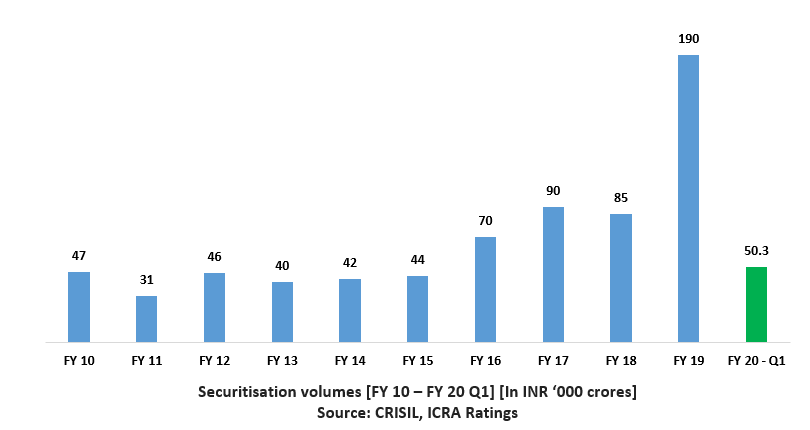
Resultantly, the transactions have witnessed unprecedented growth. For instance, the volume of transactions in the first quarter of the current financial year stood at a record ₹ 50,300 crores[1] which grew at 56% on y-o-y basis from ₹ 32,300 crores. Segment-wise, the securitisation transactions grew by whooping 95% to ₹ 22,000 crores as against ₹ 11,300 crores a year back. The volume of direct assignments also grew by 35% to ₹ 28,300 crores as against ₹ 21,000 crores a year back.

The chart below show the performance of the industry in the past few years:

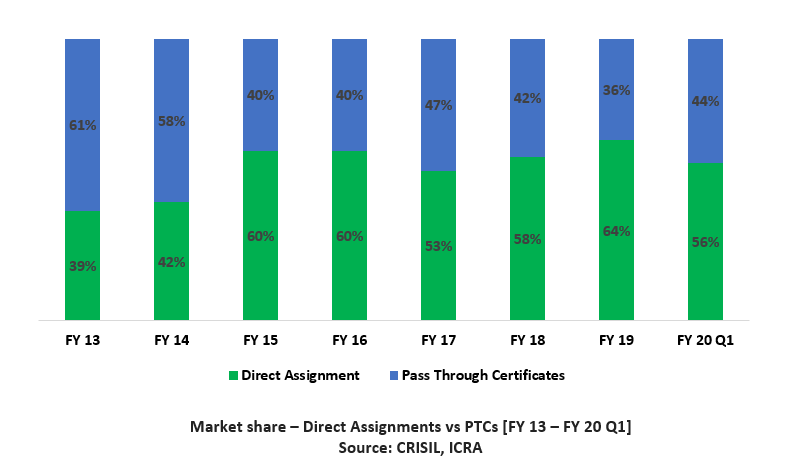
Direct Assignments have been dominating market with the majority share. During Q1 FY 20, DAs constituted roughly 56% of the total market and PTCs filled up the rest. The chart below shows historical statistics about the share of DA and PTCs:

In terms of asset classes, non-mortgage asset classes continue to dominate the market, especially vehicle loans. The table below shows the share of the different asset classes of PTCs:

Asset class

Q1 FY 20 share Q1 FY 19 share FY 19 share
Vehicle (CV, CE, Car) 51% 57% 49%
Mortgages (Home Loan & LAP) 20% 0% 10%
Tractor 6% 0% 10%
MSME 5% 1% 4%
Micro Loans 4% 23% 16%
Lease Rentals 0% 13% 17%
Others 14% 6% 1%

Asset class wise share of PTCs

Source: ICRA

Shortcomings in the current securitisation structures

Having talked about the exemplary performance, let us now focus on the potential threats in the market. A securitisation transaction becomes fool proof only when the transaction achieves bankruptcy-remoteness, that is, when all the originator’s bankruptcy related risks are detached from the securitised assets. However, the way the current transactions are structured, the very bankruptcy-remoteness of the transactions has become questionable. Each of the problems have been discussed separately below:

Commingling risk

In most of the current structures, the servicing of the cash flows is carried out of the originator itself. The collections are made as per either of the following methods:

  1. Cash Collection – This is the most common method of repayment in case of micro finance and small ticket size loans, where the instalments are paid in cash. Either the collection agent of the lender goes to the borrower for collecting the cash repayments or the borrower deposits the cash directly into the bank account of the lender or at the registered office or branch of the lender.
  2. Encashment of post-dated cheques (PDCs) – The PDCs are taken from the borrower at the inception of the credit facility for the EMIs and as security.
  3. Transfer through RTGS/NEFT by the customer to the originator’s bank account.
  4. NACH debit mandate or standing instructions.


In all of the aforesaid cases, the payment flows into the current/ business account of the originator. The moment the cash flows fall in the originator’s current account, they get exposed to commingling risk. In such a case, if the originator goes into bankruptcy, there could be serious concerns regarding the recoverability of the cash flows collected by the originator but not paid to the investors. Also, because redirection of cash flows upon such an event will be extremely difficult to implement. Therefore, in case of exigencies like the bankruptcy of the originator, even an AAA-rated security can become trash overnight. This brings up a very important question on whether AAA-PTCs are truly AAA or not.


This issue can be addressed if, going forward, the originators originate only such transactions in which repayments are to happen through NACH mandates. NACH mandates are executed in favour of third party service providers which triggers direct debit from the bank account of the customers every month against the instalments due. Upon receipt of the money from the customer, the third party service providers then transfer the amount received to the originators. Since, the mandates are originally executed in the name of the third party service providers and not on the originators, the payments can easily be redirected in favour of the securitisation trusts in case the originator goes into bankruptcy. The ease of redirection of cash flows NACH mechanism provides is not available in any other ways of fund transfer, referred above.

Will the assets form part of the liquidation estate of the lessor, since under IndAS the assets continue to get reflected on Balance Sheet of the originator?

With the implementation of Ind AS in financial sector, most of the securitisation transactions are failing to fulfil the complex de-recognition criteria laid down in Ind AS 109. Resultantly, the receivables continue to stay on the books of the originator despite a legal true sale of the same. Due to this a new concern has surfaced in the industry that is, whether the assets, despite being on the books of the originator, be absolved from the liquidation estate of the originator in case the same goes into liquidation.

Under the current framework for bankruptcy of corporates in India, the confines of liquidation estate are laid in section 36 of the IBC. Section 36 (3) lays what all will be included therein. Primarily, section 36 (3) (a) is the relevant provision, saying “any assets over which the corporate debtor has ownership rights” will be included in the estate. There is a reference to the balance sheet, but the balance sheet is merely an evidence of the ownership rights. The ownership rights are a matter of contract and in case of receivables securitised, the ownership is transferred to the SPV.

The bounds of liquidation estate are fixed by the contractual rights over the asset. Contractually, the originator has transferred, by way of true sale, the receivables. The continuing balance sheet recognition has no bearing on the transfer of the receivables. Therefore, even if the originator goes into liquidation, the securitised assets will remain unaffected.

Conclusion

Despite the shortcomings in the current structures, the Indian market has opened big. After the market posted its highest volumes in the year before, several industry experts doubted whether the market will be able to out-do its previous record or for that matter even reach closer to what it has achieved. But after a brilliant start this year, it seems the dream run of the Indian securitisation industry has not ended yet.


[1] https://www.icra.in/Media/OpenMedia?Key=94261612-a1ce-467b-9e5d-4bc758367220

Highlights of 2nd Amendment to PIT Regulations

-by Dibisha Mishra

(dibisha@vinodkothari.com ; corplaw@vinodkothari.com)


SEBI vide Notification dated 25th July, 2019 further amended the Securities and Exchange Board of India (Prohibition of Insider Trading) Regulations, 2015. The major part of this amendment is to make curative changes in the Regulations, in response to difficulties expressed by the stakeholders. In this regard, VK&Co. also had occasion to make representation to SEBI, a few of which have been brought in via this amendment.


Highlights of the SEBI (PIT) (Second Amendment) Regulations, 2019.are as follows:


  1. Employees having access to unpublished price sensitive information are to be identified as ‘designated persons’ [DPs]: Keeping the intent of regulating and monitoring trading by such employees, the earlier provision of identifying them as ‘designated employees’ was merely a laxity in drafting since no corresponding duties/obligations were put upon ‘designated employees’ anywhere in the PIT Regulations.
  2. Mandatory closure of trading window from the end of every quarter till 48 hours after the declaration of financial results [the word ‘can’ substituted by ‘shall’]
  3. Permitted transactions by DPs while trading window is closed:

a. off-market inter-se transfer between DPs having possession of the same unpublished price sensitive information where both parties have made informed trade decision;

b. transaction through block-deal mechanism between persons having possession of the same unpublished price sensitive information where both parties have made informed trade decision;

c. arising out of a statutory or regulatory obligation to carry out a bona fide transaction;

d. exercise of stock options in respect of which the exercise price was pre-determined;

e. pursuant to a trading plan;

f. pledge of shares for a bonafide purpose like raising of funds subject to pre-clearance by the compliance office

g. acquisition by conversion of warrants or debentures, subscribing to rights issue, further public issue, preferential allotment or tendering of shares in a buyback offer, open offer, delisting offer: Difficulties were frequently being faced by companies as to whether the trading window bar will apply to corporate actions involving transaction in shares. This amendment makes a clear way out for the same. While only a few corporate actions are listed in the amendment, these should be taken as illustrative rather than exhaustive.

4. In order to qualify as a “material financial relationship”, payment by way of loan or gift should flow from a designated person equivalent to at least 25% of his annual income [excluding payment is based on arm’s length transactions] in last twelve months.

5. Educational institutions from which designated persons have graduated, is to be disclosed to the intermediary or fiduciary on an annual basis and as and when the information changes.