RBI issues draft framework to strengthen liquidity of NBFCs

Abhirup Ghosh

abhirup@vinodkothari.com

Financial year 2019 has been a year to remember, as the NBFC sector, which caters to a significant portion of the financial needs in the economy, almost choked due to lack of liquidity. While there was an undercurrent already, but the fall of the mammoth ILFS group, ignited the crisis. Resultantly, the banks stopped taking fresh exposures on the NBFCs, the mutual funds pulled out plug, and other investors also became wary of the financial services sector. Businesses of all almost of all the NBFCs came to a standstill.

Considering the sensitivity of the situation, the RBI had to step in and take initiatives to address the concerns. Relaxations with respect to minimum holding period, for direct assignments and securitisation transactions, was one of them. This measure was however, temporary in nature.

In order to address the issues that pop up in the longer run, the RBI has framed a draft framework, which is now open for comments, to deal with liquidity risk. The draft framework was placed on the RBI’s website on 24th May, 2019[1] and is open for comments till 14th June, 2019.

The framework is divided into two parts – a) liquidity risk management framework; and b) liquidity coverage ratio. While the first part is a mix of new and existing provisions of asset liability management; the latter is a new requirement altogether.

In this write-up we intend to discuss about this framework.

Applicability

The first part of the framework, that is the liquidity risk management framework, shall be applicable to the following classes of NBFCs:

  1. Non-deposit taking NBFCs with asset size of ₹ 1 billion or above (₹ 100 crores or above);
  2. Systemically important core investment companies (CICs with asset size of more than ₹ 100 crores and having public funds)
  3. Deposit taking NBFCs

The second part of the framework, which introduces the concept of liquidity coverage ratio among NBFCs shall be applicable to the following classes of NBFCs:

  1. Non-deposit taking NBFCs with asset size of ₹ 50 billion or above (₹ 5000 crores or above);
  2. Deposit taking NBFCs

Liquidity risk management framework

The liquidity risk management framework is divided into the following parts –

a. Liquidity risk management policy, strategies and practices:

This requires formulation of risk management framework, which should be much more comprehensive than the existing one, and should address the following:

  1. Governance related issues –
  • The Board of Directors of the NBFC must retain the overall responsibility of liquidity risk management and the same shall also be responsible of laying down policies, strategies and practices to be followed by the company.
  • The Risk Management Committee shall report to the Board of Directors of the Company. The Committee must be constituted with CEO/ MD and the heads of the various risk verticals of the company. The existing Corporate Governance framework requires formation of RMC, however, the same does not specify desired constitution of the Committee. In fact, companies which have Chief Risk Officer, should also appoint CROs as a part of the RMC[2].
  • Asset Liability Management Committee – There is a slight change in the composition proposed under this framework against the existing provisions relating to formation of ALCO. As per the existing regulations, the ALCO must consist of senior management including CEO. However, this framework states that the committee must be headed by CEO/ MD or Executive Director and may have the Chiefs of Investment, Credit, Resource Management or Planning, Funds Management / Treasury (forex and domestic), International Banking and Economic Research as members. Also, the scope of ALCO has also been modified to include – taking decisions on desired maturity profile and mix of incremental assets and liabilities, sale of assets as a source of funding, the structure, responsibilities and controls for managing liquidity risk, and overseeing the liquidity positions of all branches.
  • Asset Liability Management Support Group – Formation of this group is a new requirement. The group should be consisted of operating staff of the organisation and shall be responsible for analysing, monitoring and reporting the liquidity risk profile to the ALCO.2. Off balance sheet exposures and contingent liabilities must be given desired level of attention so that risks arising from all off-balance sheet exposures, be it securitisation, financial derivatives, guarantees or other commitments. The focus should be on assessment of inherent risks that can cause problems at times of stress.

    3. Diversification of funding sources must be achieved by the NBFCs. This is a qualitative requirement where RBI has urged the NBFCs to establish strong connection with each of its funding sources and to keep itself active in the funding market. Over reliance on a particular source has been condemned.

    4. The NBFCs must have a proper collateral management system where it should be in a position to distinguish between encumbered and unencumbered assets.

    5.Stress testing must be inculcated as an important exercise in the overall governance and risk management culture in the NBFC. Stress testing must be conducted on a regular basis for a variety of short term, entity specific and market specific situations. The various activities of the business and their vulnerabilities must be taken into consideration so that the stress testing scenarios can cover every aspect of market risk and major funding risks that the NBFC is exposed to.

    6. A contingency funding plan must be formulated which can be followed while responding to severe disruptions in the funding abilities of the NBFCs. It should contain the available r potential contingency funding sources and the estimated amount which can be drawn from these sources, clear escalation or prioritisation procedures detailing when and how each of the actions can and should be activated, and the lead time needed to tap funds from each of these sources.

    7. Intra group transactions and exposures must be under special supervision and the Group CFO should develop and maintain liquidity management process and funding programs that are consistent with the activities of the group.

    8. Other issues like liquidity risk tolerance, liquidity costs, internal pricing must be properly framed by the senior management.

    9. Public disclosure on liquidity risk, the NBFC is exposed has to be made on regular basis. The disclosure should include –

    • Funding concentration based on significant counterparty,
    • Top 20 large deposits,
    • Top 10 borrowings,
    • Funding concentration based on significant products/ instruments,
    • Stock ratios with respect to commercials, NCDs and other short term liabilities each as a percentage of total assets, total liabilities and total public funds
    • State of the institutional setup for liquidity risk management

b. The Management Information System (MIS) should be structured in a manner that is capable of generating information both in normal and stress scenarios.

c. Internal controls of the NBFCs must be strong enough which can ensure adherence to policies and procedures with respect to liquidity risk management. The internal controls must be independently reviewed on a regular basis.

d. The assets and liabilities must be monitored based on the time buckets they fall in. As against the existing framework, the framework requires micro monitoring, that is, the time brackets have been broken further. The proposed time brackets as well as the current set of time brackets have been provided below:


Time brackets as provided in the existing guidelines Time brackets proposed in the framework
1 day to 30/ 31 days  1 day to 7 days
Over one month and upto 2 months  8 day to 14 days
Over two months and upto 3 months 15 days to 30/31 days (One month)
Over 3 months and upto 6 months  Over one month and upto 2 months
Over 6 months and upto 1 year  Over two months and upto 3 months
Over 1 year and upto 3 years  Over 3 months and upto 6 months
Over 3 years and upto 5 years  Over 1 year and upto 3 years
Over 5 years  Over 3 years and upto 5 years
 Over 6 months and upto 1 year
 Over 1 year and upto 3 years
Over 3 years and upto 5 years
Over 5 years


The maximum mismatches allowed in the 1-7 days, 8-14 days and 15-30/31 days bracket are 10%, 10% and 20% of the cumulative cash flows in the respective time brackets.


The investments in securities must be classified into “mandatory” and “non-mandatory” categories. Mandatory category is that where the securities acquired under legal obligation must be classified and anything apart from these must be classified under non-mandatory category.

 e. Stock approach must be adopted in the NBFCs’ liquidity risk management. Certain critical ratios must be monitored in this regard by putting in place internally defined limits as approved by their Board. The ratios and the internal limits shall be based on an NBFC’s liquidity risk management capabilities, experience and profile.
f. Liquidity risks arising out of other risks like currency risk and interest rate risk must also be managed.
g. Monitory tools like statement of structural liquidity and others, prescribed by the RBI should be used.

Liquidity coverage ratio

The concept of liquidity coverage ratio adopted here is similar to this concept under Basel III: International framework for liquidity risk measurement, standards and monitoring[3]. This requires NBFCs with specified asset size, to maintain specified level of LCR. The framework currently proposes following levels of LCR:

From 01.04.2020 01.04.2021 01.04.2022 01.04.2023 01.04.2024
Minimum LCR 60% 70% 80% 90% 100%
 

The formula of LCR has been defined in the framework to mean:

Stock of High Quality Liquid Assets(HQLAs) / Total Net Cash Outflows over the next 30 calendar years

In simple terms, LCR represents the readily available cashflows/ cash equivalents as a proportion of the total net cash outflows over the next 30 calendar days. Ideally, the LCR should be more than 100%. The manner of computation of each of these have been elaborately discussed in the framework.

While calculating the stock of HQLA, certain items like cash, government securities and certain specified marketable securities without any haircut. However, other assets, including corporate bonds, equity shares etc. are to be considered after considering haircuts ranging from 15% – 50%.

In the denominator, the net of cash outflows are to be considered, that is total cash outflows minus the specified cash inflows.

As per the RBI framework, “Liquidity Coverage Ratio (LCR) which will promote resilience of NBFCs to potential liquidity disruptions by ensuring that they have sufficient High Quality Liquid Asset (HQLA) to survive any acute liquidity stress scenario lasting for 30 days”.

Conclusion

This framework was a much awaited piece of legislation and the industry felt the dire need of such a guided document on the liquidity risk management. With the growing importance of this industry and amount of exposure they have on the economy, a strong liquidity management is the need of the hour. The nation certainly doesn’t want another ILFS or a similar crisis to happen.

[1] https://www.rbi.org.in/Scripts/bs_viewcontent.aspx?Id=3678

[2] The RBI on 16th May, 209 required mandatory appointment of CRO by NBFCs having assets of ₹ 50 billion or above.
[3] https://www.bis.org/publ/bcbs188.pdf


Comments on draft Insolvency and Bankruptcy Board of India (Bankruptcy Process for Personal Guarantors to Corporate Debtors) Regulations

Comments on Draft Insolvency and Bankruptcy Board of India (Liquidation Process) Amendment Regulations, 2019

NBFCs in troubled waters as Madras Court Bench rules in favour of RBI

The latest judgement by the Madras HC as on 22nd April, 2019 has set aside an earlier single judge order in January this year, and ruled in favour of RBI. RBI argued that there was an appeal remedy available and the companies instead of filing writ petitions with the court could have approached the appellate authority.

However before citing the details of the present judgement, this writer believes a firm background is required to grasp the gravity of the present situation. The reader may feel free to scroll further down, if acquainted with the January single-judge decision beforehand.

Background

Since the Sarada scam in 2015, the Reserve Bank of India (RBI) had been on high alert and had been subsequently tightening regulations for NBFCs, micro-finance firms and such other companies which provide informal banking services. As of December 2015, over 56 NBFC licenses were cancelled[1]. However, recently in light of the uncertain credit environment (recall DHFL and IF&LS) among other reasons, RBI has cancelled around 400 licenses [2]in 2018 primarily due to a shortfall in Net Owned Funds (NOF)[3] among other reasons. The joint entry of the Central Govt. regulators and RBI to calm the volatility in the markets on September 21st, 2018 after an intra-day fall of over 1000 points amid default concerns of DHFL, warranted concern. Had it been two isolated incidents the regulators and Union government would have been unlikely to step in. The RBI & SEBI issued a joint statement on September saying they were prepared to step in if market volatility demanded such a situation. This suggests a situation which is more than what meets the eye.

Coming back to NBFCs, over half of the cancelled NBFC licenses in 2018 could be attributed to shortfall in NOFs. NOF is described in Section 45 IA of the RBI Act, 1934. It defines NOF as:

1) “Net owned fund” means–
(a) The aggregate of the paid-up equity capital and free reserves as disclosed in the latest
Balance sheet of the company after deducting therefrom–
(i) Accumulated balance of loss;
(ii) Deferred revenue expenditure; and

(iii) Other intangible assets; and
(b) Further reduced by the amounts representing–
(1) Investments of such company in shares of–
(i) Its subsidiaries;
(ii) Companies in the same group;
(iii) All other non-banking financial companies; and
(2) The book value of debentures, bonds, outstanding loans and advances
(including hire-purchase and lease finance) made to, and deposits with,–
(i) Subsidiaries of such company; and
(ii) Companies in the same group, to the extent such amount exceeds ten per cent of (a) above.

At present, the threshold amount that has to be maintained is stipulated at 2 crore, from the previous minimum of 25 lakhs. Previously, to meet this requirement of Rs. 25 lakh a time period of three years was given. During this tenure, NBFCs were allowed to carry on business irrespective of them not meeting business conditions. Moreover, this period could be extended by a further 3 years, which should not exceed 6 years in aggregate. However, this can only be done after stating the reason in writing and this extension is in complete discretion of the RBI. The failure to maintain this threshold amount within the stipulated time had led to this spurge of license cancellations in 2018.

However, the Madras High Court judgement dated 29-1-2019 came as a big relief to over 2000 NBFCs whose license had been cancelled due a delay in fulfilling the shortfall.


THE JUDGEMENT

The regulations

On 27-3-2015 the RBI by notification No. DNBR.007/CGM(CDS)-2015 specified two hundred lakhs rupees as the NOF required for an NBFC to commence or carry on the business. It further stated that an NBFC holding a CoR and having less than two hundred lakh rupees may continue to carry on the business, if such a company achieves the NOF of one hundred lakh rupees before 1-04-2016 and two hundred lakhs of rupees before 1-04-2017.

The Petitioner’s claim

The petition was filed by 4 NBFCs namely Nahar Finance & Leasing Ltd., Lodha Finance India Ltd., Valluvar Development Finance Pvt. Ltd. and Senthil Finance Pvt. Ltd. for the cancellation of Certificate of Registration (CoR) against the RBI. The petitioners claim that they had been complying with all the statutory regulations and regularly filing various returns and furnishing the required information to the Registrar of Companies. These petitions were in response to the RBI issued Show Cause Notices to the petitioners proposing to cancel the CoR and initiate penal action. The said SCNs were responded to by the petitioners contending that they had NOF of Rs.104.50 lakhs, Rs.34.19 lakhs, Rs.79.50 lakhs and Rs.135 lakhs respectively, as on 31.03.2017.

Valluvar Development Finance also sent a reply stating that they had achieved the required NOF on 23-10-2017, attaching a certificate from the Statutory Auditor to support its claim. The other petitioners however submitted that due to significant change in the economy including the policies of the Govt. of India during the fiscal years 2016-17 and 2017-18 like de-monetization and implementation of Goods & Services Tax, the entire working of the finance sector was impaired and as such sought extension of time till 31-03-2019 to comply with the requirements.

Now despite seeking extension of time, having given explanations to the SCNs, the CoRs were cancelled without an opportunity for the NBFCs to be heard.


The Decision

It was argued that there is a remedy provided against the cancellation of the CoRs, the petitioners had chosen to invoke Article 226 contending violation of the principles of justice. The proviso to Section 45-IA(6) relates to the contentions in regards to cancellation of the CoRs.

“45-IA. Requirement of registration and net owned fund –

(3) Notwithstanding anything contained in sub-section (1), a non-banking financial company in existence on the commencement of the Reserve Bank of India (Amendment) Act, 1997 and having a net owned fund of less than twenty five lakh rupees may, for the purpose of enabling such company to fulfil the requirement of the net owned fund, continue to carry on the business of a nonbanking financial institution–

(i) for a period of three years from such commencement; or

(ii) for such further period as the Bank may, after recording the reasons in writing for so doing, extend,

subject to the condition that such company shall, within three months of fulfilling the requirement of the net owned fund, inform the Bank about such fulfilment:

Provided further that before making any order of cancellation of certificate of registration, such company shall be given a reasonable opportunity of being heard.

(7) A company aggrieved by the order of rejection of application for registration or cancellation of certificate of registration may prefer an appeal, within a period of thirty days from the date on which such order of rejection or cancellation is communicated to it, to the Central Government and the decision of the Central Government where an appeal has been preferred to it, or of the Bank where no appeal has been preferred, shall be final:

Provided that before making any order of rejection of appeal, such company shall be given a reasonable opportunity of being heard.

The decision was taken on two grounds. First, the statute specifically provides for an opportunity of personal hearing besides calling for an explanation. The amended provision is very particular that opportunity of being personally heard is mandatory, as the very amendment relates to finance companies, which are already carrying on business also. Not affording this opportunity would cripple the business of the petitioners.

Second, the amended section provides NBFCs sufficient time to enhance their NOF by carrying on business and comply with the notifications. For the aforesaid reasons, the orders by the RBI requires interference. Resultantly, the respondents (RBI authorities) are directed to restore the CoR of the petitioners and also extend the time given to the petitioners.


The Latest Judgement

The judgement pronounced as on 22nd April, 2019 was an appeal by the RBI to the aforementioned writ petitions. This latest decision which ruled in favour of the RBI had contentions on several grounds. However, all of them stem (invocation of sub-clauses) from the following four.

First, the RBI against the order in the writ petitions submitted that there is an appeal remedy available and the petitioners without availing such remedy have filed the petitions and as such petitions ought not to have been entertained.

Second that there were only four such companies (the ones above) who sought writ petitions and the remaining numbering more than 40 Non-Banking Financial Companies (NBFCs) have filed statutory appeals and therefore, the petitioners should be relegated to avail the appeal remedy.

Third, the present cancellation is owed to the petitioners’ failure to comply with the NOF conditions issued by the RBI. The notification dated 27.03.2015 specifying 200 lakhs as NOF for NBFCs to carry or commence operations has not been challenged by the petitioners. Therefore, if they do not achieved the said conditions, they cannot to continue to remain in business.

Fourth, it was submitted that the reasons assigned by the petitioners in the reply to the show cause notice were considered and the reasons not being sustainable were thus rejected.


Conclusion

This was a landmark hearing in the case of NBFCs with increasing pressure as of recent times. Many NBFCs may now apply for restoration of their licenses as per the present laws or file for statutory appeals. The case stands as an indication of the firm regulatory policies of the RBI amidst the environment of credit uncertainty. The last statement of the judgement also stands apt here. The brief sentence read, “Consequently connected miscellaneous petitions are closed.”

[1] https://economictimes.indiatimes.com/news/economy/finance/rbi-cancels-license-of-56-nbfcs-bajaj-finserv-gives-away-license/articleshow/50045835.cms?from=mdr

[2] https://www.businessinsider.in/indias-central-bank-has-scrapped-the-licenses-of-nearly-400-nbfcs-so-far-this-year/articleshow/65698193.cms

[3] https://www.firstpost.com/business/ilfs-dhfl-shocks-may-be-temporary-triggers-but-the-bad-news-for-indian-financial-markets-do-not-end-there-5248071.html

[4] https://enterslice.com/learning/wp-content/uploads/2019/02/Madras-high-court-Judgement-on-NBFC-License-Cancellation.pdf

[5] https://indiankanoon.org/doc/91785347/

2019 Securitisation volumes in India reach record high

By Falak Dutta (finserv@vinodkothari.com)

Up, Up & Above!

Yet another year went by and Indian securitization market certainly had a year to rejoice. Starting from the volume of transactions to innovative structures, the market has everything to boast about. Before we discuss each of these at length, let us take stock of the highlights first:

  • The securitization volumes doubled during the year, as securitization in India became a trillion rupee market.
  • DAs continued to be the preferred mode of transaction with Mortgages as the dominant asset class.
  • Clarity on Goods & Services Tax, increased participation of private banks, NBFCs and mutual funds along with healthy demand for non-priority sector loan were primary reasons for this sharp growth.
  • DHFL & IL&FS rushed to securitize as traditional sources of funding dried up due to concerns of debt servicing in the 2nd half of 2018.
  • The country witnessed the first issuance of covered bonds during year.
  • Several new structures were tried, namely, lease receivables securitization, corporate loan securitization, revolving structures etc.

Securitization volumes reaching all time high

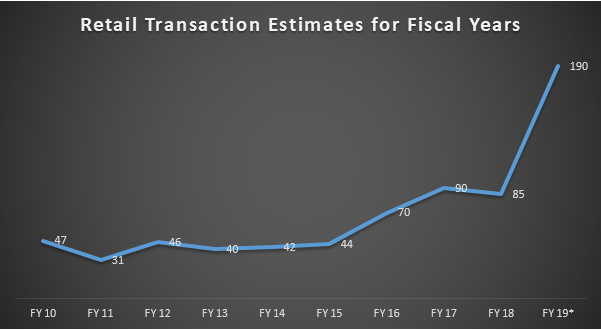
The volume of retail securitization grew by 123% as figures soared to ₹1.9 lakh crore compared to ₹85,000 crore in fiscal ’18. Mortgages, vehicle loans and microfinance loans constituted the three major asset classes comprising of 84% of the total volume. The growth was primarily propelled by a combination of three factors.

First, a few big players who stayed away from the market returned after the GST Council clarified that securitized assets are not subject to GST.

Second, Two non-banking companies (DHFL& IL&FS) rushed to securitize their receivables as traditional sources of financing dried up after September 2018. After this, banks started preferring portfolio buyouts over taking credit exposure on the NBFCs.

Third, subsequent to the liquidity crisis faced by several NBFCs, RBI relaxed guidelines of minimum holding period requirement for securitization transactions backed by long duration loans leading to greater number of eligible securitized assets.

The graph below shows the performance of the Indian securitization market over the years:

Source: CRISIL Estimates. Figures in ₹10 Billions

Traditionally the bulk of securitization transactions have been driven by Priority Sector Lending (PSL) from banks. At present though, securitization transactions are being increasingly backed by non PSL assets that are making their presence felt as they gain market traction. The trend has been clear. The share of non-PSL assets as a part of total transaction rose to a record of 42% in 2018, up from 33% in 2017 and a relatively moderate share of 26% in 2016. Banks are focusing on securing long term assets such as mortgages that have displayed fairly stable asset quality to expand their retail asset portfolio.

The case for PSLCs

An additional recurring theme is the growing popularity in PSLCs which serves as a direct alternative to securitization. The volume of transactions have skyrocketed to ₹ 3.3 lakh crore in fiscal ’19 up from ₹ 1.9 lakh crore in fiscal ‘18 and ₹ 49,000 crore in fiscal ‘17. PSLCs which were introduced in 2015, was an idea which appeared in the report of a Dr. Raghu Ram Rajan led Committee- A Hundred Small Steps. Out of the four kinds of PSLCs, the PLSC- General and PSLC- Small and Marginal Farmers remain the highest traded segments. The supply side consists of private sector banks with excess PSL in the general PSLCs category and Regional Rural Banks in SFMF category.

PTCs vs. DAs

Another point of note is the increasing share of the DA’s in the securitization market. The move from PTCs to DA isn’t surprising given the absence of credit enhancements, amount of capital requirements and relatively less regulatory due diligence in DAs. The fact that the share of PTC transaction fell from 47% in fiscal ‘17 to 42% in fiscal ’18 and further to 36% in fiscal ’19 serves as a case in point. However, one hasn’t impeded the growth for the other. DA transactions soared a record 146%. Whereas PTCs soared 95% reaching a volume of ₹69,000 crore. Also, mortgages still remain the preferred asset class, accounting for almost 74% of DA volumes and 46% of total securitization volumes.

Source: CRISIL1 Estimates

Source: CRISIL[1]

India on the Global Map

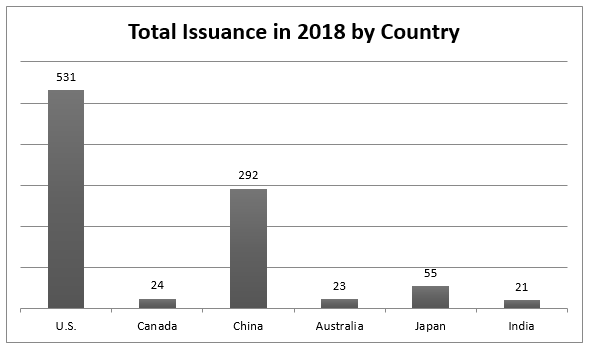
2018 was a landmark year for global securitization with over a trillion dollars’ worth of issue, as the memories of the 2008 crisis gradually fade into oblivion. The U.S has been the major player in the global market, issuing over half of the total transactions by volume. Europe recorded a surge in volume clocking $106 billion against $82 billion in 2017. In Asia, China both grew and remained the dominant player in Asia at $310 billion, followed by Japan at $58 billion. Elsewhere issuance in Australia and Latin America declined. Some potential factors that could affect the global markets in the coming future include the Brexit uncertainty, market volatility, rising interest rates, renegotiations of existing trade agreements and liquidity. Some of these are contentious issues, the effects of which could sustain beyond the near future.


Source: SP Global[2], Values in $US Billion

Conclusion

Heading into the next fiscal year, some of the tailwinds that propelled the market in fiscal 2019 are fading gradually. Pent-up supply following the implementation of the Goods and Services Tax (GST) has almost exhausted, the funding environment for non-banks have been steadily stabilizing and the relaxation on the minimum holding period will be only available till May 2019. The entry of a new segment of investors- NBFC treasuries, foreign portfolio investors, mutual funds and others such brought about differing risk appetites and return aspirations which paved the way for newer asset classes. The trend for education loan receivables and consumer durables loan receivables accelerated in fiscal 2019. Although, the overall volumes of these unconventional asset classes are relatively small at present, investor presence in these non-AAA rated papers is a good sign for the long term prospects of the securitization markets.

“The Indian securitization market in 2018 have attained several significant milestones: from significant growth in non-PSL volumes, to asset class diversity, to attracting new investor base, to innovative structures, the market seems ready to launch into a new trajectory.”, stated Mr. Vinod Kothari, Director at Vinod Kothari Consultants.

He added, “It is only in stressful times that securitization has shone globally– the Indian financial sector has gone through some stress scenarios in the recent past, and securitization has been able to sustain the growth of the financial sector.”


Sources:

1) https://www.crisil.com/content/dam/crisil/our-analysis/reports/Ratings/documents/2018/june/securitization-resilient-despite-roadblocks.pdf

6) https://www.spglobal.com/en/research-insights/articles/global-structured-finance-outlook-2019-securitization-continues-to-be-energized-with-potential-1-trillion-in-volume-expected-ag

[1] https://www.crisil.com/content/dam/crisil/pr/press-release/2017/12/retail-securitization-volume-doubles-to-rs-1point9-lakh-crore.pdf

[2] https://www.spglobal.com/en/research-insights/articles/global-structured-finance-outlook-2019-securitization-continues-to-be-energized-with-potential-1-trillion-in-volume-expected-ag

Concerns on Going Concern: Proposed amendments in Liquidation Regulations need relook

–  Vinod Kothari


The possibility of going concern sales in liquidations, visualised by Adjudicating Authorities in several early cases, got a regulatory recognition vide IBBI (Liquidation Process) (Second Amendment) Regulations, 2018. Since then, there has been a lot of work on how exactly will going concern sale work in liquidation. Our previous write- ups on going concern sale are Liquidation sale as going concern: The concern is dead, long live the concern! and Enabling Going Concern Sale in Liquidation. IBBI itself has organised several meetings around this; there have been meetings organised by other groups such as Society of Insolvency Practitioners of India (SIPI).


Recently, the IBBI released a draft of the amendments to the Liquidation Regulations[1], which includes regulatory amendments pertaining to going concern sale as well.


This Note highlights the need to have a relook at these proposed amendments, in context of going concern sale.

Read more

Anomaly relating to much awaited e-form DPT-3

By CS Smriti Wadehra | corplaw@vinodkothari.com


Introduction

MCA on January 22, 2019 had issued a Notification[1] prescribing certain amendments in the Companies (Acceptance of Deposits) Rules, 2014 (‘Rules’) requiring every company (except government companies) to file:

  • a return of deposit;
  • particulars of transaction not considered as deposit; or
  • both

It is a one-time filing return, specifying the details of outstanding receipt of money or loan which have not been considered as deposits under the Rules. For filing the said dorm, the Rules specified that the reporting should be of receipt of money or loan from April 1, 2014 till January 22, 2019 and which are outstanding as on the date of filing. Further, the reporting should be done within 90 days from January 22, 2019. However, the e-form for such filing was not released by MCA.

Thereafter, on April 30, 2019, MCA vide its Notification[2] dated April 30, 2019 notified the Companies (Acceptance of Deposits) Second Amendment Rules, 2019, according to which the reporting in the one-time return (i.e., e-form DPT-3) has to be done for receipt of money or loan from April 1, 2014 till March 31, 2019. Also, the filing due-date has been extended to ninety days from March 31, 2019.

This extension was much required as the electronic version of the said form was not released by MCA. However, MCA has on the same day released the e-form as well and hence, we shall now discuss the requirements of the said form.

Requirement of Law

Referring to the erstwhile notification read with the recent general circular of MCA dated April 13, 2019, we may summarise the reporting requirement of e-Form DPT-3 as under:

  1. One time return giving the details of the outstanding receipt of money or loan which have not been considered as deposits as per Rule 2(1)(c) of the Rules for the period from 1st April, 2014 till 31st March, 2019;
  2. Periodic return which will give the details of particulars of transactions which are not considered as deposits as per Rule 2(1)(c) of the Rules within 30th June of every year containing details as on 31st March;
  3. Return for deposit which is to be filed within 30th June of every year.

At the advent of notification of the Rules, companies were under ambiguity as to how the reporting of such one-time return shall be done. Further, the e-Form also required auditor’s certificate as an attachment, but it was unclear that whether companies whwich have not received any amount as deposit were also required to provide an auditor’s certificate in this regard. Moreover, there were confusion as whether companies have to provide audited figures in the said form or otherwise. However, the e-Form was expected to clear these confusions.

Anomaly in e-Form

Even after the release of the much awaited form, the anomaly still exists. Following are the certain ambiguities in the e-Form, for which MCA’s clarification shall be awaited:

a)    Whether DPT-3 required to be filed twice?

Rule 16 of Companies (Acceptance of Deposits) Rules, 2014 provides:

“Explanation.- It is hereby clarified that Form DPT-3 shall be used for filing return of deposit or particulars of transaction not considered as deposit or both by every company other than Government company.”

Further, the provisions of Rule 16A of Companies (Acceptance of Deposits) Rules, 2014 provides:

“Every company other than Government company shall file a onetime return of outstanding receipt of money or loan by a company but not considered as deposits, in terms of clause (c) of sub-rule 1 of rule 2 from the 01st April, 2014 to the date of publication of this notification in the Official Gazette, as specified in Form DPT-3 within ninety days from the date of said publication of this notification along with fee as provided in the Companies (Registration Offices and Fees) Rules, 2014.”

On the combined reading of the aforesaid provisions, we understand that companies have to file e-Form DPT-3 as an annual requirement only, as  a return of deposit of transactions not considered as deposits every year by 30th June and also as a one-time return of outstanding money not considered deposits from 01.04.2014 to 31.03.2019. However, the e-Form as well as the Rules does not specify any such requirement. Accordingly,  companies are still under the ambiguity as – whether  filing of only  one-time return shall suffice for this financial year or two separate filing has to be done.

b)    Requirement of attaching auditor’s certificate

The e-Form DPT-3 requires companies to attach auditor’s certificate. Though not mandatory attachment, the companies are unclear as to whether the amount to be mentioned in the return has to be audited by a statutory auditor and a certificate of auditor has to be attached in each case or management certified accounts shall suffice? The e-Form does not clarify the instance.

Further, companies which shall be filing that they have not accepted any deposit or the money accepted does not qualifies to be a deposit – in such case, it is still unclear whether the auditor’s certificate certifying the company’s declaration is required or not.

Conclusion

Despite the time taken by the Ministry for coming up with the e-Form, we understand that there are still many irregularities in the e-Form as discussed briefly in our note and which has to be addressed by the Ministry. Meanwhile, considering the first day of deployment of this e-Form, we assume that there will be certain revision in the said form which might address the ambiguities.

You may also read our article on “MCA requires reporting of ‘what is not a deposit’ here- Link to the article


[2]
http://www.mca.gov.in/Ministry/pdf/CompaniesAcceptanceDepositsSecAmendRules_01052019.pdf[1] http://www.mca.gov.in/Ministry/pdf/AcceptanceDepositsAmendmentRule_22012019.pdf