
Banking group NBFCs:  Need to map businesses to avoid overlaps with the parent banks

– Vinod Kothari | finserv@vinodkothari.com

The new dispensation implemented from 5th December 2025 implies that lending business, obviously carried in the parent bank, needs to be allocated between the bank and the group entities so as to avoid overlaps. The bank will have to take its business allocation plan, at a group level, to its board, by 31st March 2026.

The RBI’s present move has certain global precedents. Singapore passed an anti-commingling rule applicable to banking groups way back in 2004, but has subsequently relaxed the rule by a provision referred to as section 23G of the Banking Regulations. However, the approach is not uniformly shared across jurisdictions.

We are of the view that as the decision works both at the bank as well as the NBFC/HFC level, the same has to be taken to the boards of the respective NBFCs/HFCs too.

Businesses which currently overlap include the following:

  1. Loans against properties
  2. Housing finance
  3. Loans against shares
  4. Trade finance
  5. Personal loans
  6. Digital lending
  7. Small business loans
  8. Gold loans
  9. Loans against vehicles  – passenger and commercial, or loans against construction equipment

In our view, banks will have serious concerns in meeting their priority sector lending targets, unless they decide to keep priority sector lending business in the bank’s books. Priority sector lending is quite often much less profitable, and the NBFCs in the group are able to create such loans at much higher rates of return due to their delivery strengths or customer franchise. As to how the banks will be able to originate such loans departmentally, will remain a big question.

There are other implications of the above restrictions too:

  1. If a bank is engaged, for example, in MSME lending, but auto loans are done at the group entity, the bank cannot be a co-lender with its group entity, nor can it acquire auto loans originated by its group entity.
  2. Extending the same argument, if the banking group is carrying auto loan activity in its group NBFC, it cannot buy auto loans either by way of a direct assignment or co-lending, originated by other banks or other independent NBFCs. The reason for this is obvious – if the bank has decided to carry auto lending activity in its group entity, it should stay away from that exposure, even if originated by other entities.
  3. The decision to keep particular loan products with group entities – can it be stretched to the extent that bank will not have indirect exposure in such products, for example, by way of giving a loan to its group entity for on-lending for a product which the bank does not undertake departmentally? One of the reasons that may have prompted the Mohanty Group report in 2020 to segregate products between the bank and its group entities was contagion risk. If contagion is at the core of the present restriction, then that risk is still there even if the bank lends to a group entity for on-lending for a product. However, in our view, the present restriction is primarily aimed at avoiding regulatory arbitrages, and cannot be expected to require a completely independent financing of the loan products that a subsidiary finances, and not the bank.
  4. Therefore, in our view, a bank may not only on-lend to its group entities (of course, on the basis of an arm’s length lending approach), but it may also buy the asset-backed securities arising from such loan portfolios as sit with its group entities.

Factors to decide loan product allocation

In case of several non-lending products such as securities trading, demat services, etc., the approach may be easier. However, lending services constitute the bulk of any bank’s financial business, and group NBFCs and HFCs are also evidently engaged in lending. Hence, there may be a delicate decisioning by each of the boards on who does what. Note that this choice is not spasmodic – it is a strategic decision that will bind the entities for several years.

The factors based on which banks will have to decide on their business allocation may include:

  1. Delivery mechanisms – Mostly, branch and team strengths are sitting in group entities. Therefore, the loan products that entail last mile customer outreach, geographical access, etc are naturally housed in entities which possess those abilities.
  2. Technology strength: Some of the products are based on fintech or similar technology strength, which may be sitting with respective entities.
  3. Recovery mechanisms – Group entities are typically more nimble than banks. Hence, while banks may keep loans on their books, but they may engage group entities for recovery purposes.
  4. Priority sector requirements-:  This will be a very important factor in deciding business allocation. Banks are mandated to invest 40% of their ANBC in qualifying priority sector loans – not NBFCs. Hence, for such loans as qualify as priority sector, the option may be to house the portfolios with the bank, or to invest in pass through certificates.

Securitised notes: whether investment in group entities?

Talking about pass through certificates, there is a complicated question as to whether the investment limits imposed by the 5th Dec. 2025 amendment on aggregate investments in group entities will include investment in pass through certificates arising out of pools originated by group entities. In our view, the answer is in the negative, as the investment is not originator, but in the asset pools. However, if the bank makes investment in the equity tranche or credit enhancing unrated tranches, the view may be different.

Conclusion

Banks are heading shortly in the last quarter of a year which is laden with strong headwinds. In this scenario, facing business allocation decisions, rather than business expansion or risk management, may be more challenging than it may seem to the regulators.

Other resources:

Banks’ exposure to AIFs: Group-wide limits introduced

– Simrat Singh | Finserv@vinodkothari.com

The RBI has long been stitching up the seams where AIF structures threatened to pull at the fabric of Banking regulation. The latest amendment to the Reserve Bank of India (Commercial Banks – Undertaking of Financial Services) Directions, 2025 is another careful thread in that ongoing work. The provisions apply not only to banks directly but also to exposures routed through their group entities (meaning subsidiary, JV or associate of the bank). Banks (and their group entities) may still participate in AIFs but only within closely drawn boundaries. The message is unambiguous: the AIF route cannot be used to skirt evergreen exposures or manufacture regulatory arbitrage. 

Limits on investment in AIF schemes

For Category I and Category II AIFs, limits apply at both the individual bank level and at the group level.

  • At the bank level, no bank may contribute more than 10% of the corpus of any AIF scheme;
  • At the bank group level, investments are permitted within a corridor:
    • Less than 20% of the corpus of Cat I or Cat II AIFs may be invested without prior approval, provided the parent bank continues to meet minimum capital requirements and has reported net profit in each of the preceding two financial years. This means even the AMC along with the bank cannot hold more than 20%;
    • Between 20% and 30% of the corpus may be invested with prior RBI approval.

A systemic cap overlays this: contributions from all regulated entities  – banks, NBFCs, co-operative banks and AIFIs etc. – cannot collectively exceed 20% of any AIF corpus. Similarly investment in the unit capital of REITs and InvITs is capped at 10%, within the overall ceiling of 20% of net worth for equity, convertible instruments and AIF exposures. 

A question may arise on whether such limits, as applicable to investments in AIFs, would also be applicable to making investments in FMEs operating in IFSC? Practically, Indian banks are unlikely to invest in FMEs, because such investments would cause the FME to lose its tax benefits. For an FME to qualify as a “specified fund”, all its units must be held by non-residents, except those held by the sponsor. When this condition is met, the income of the fund is exempt under Section 10(4D) and the income received by non-resident investors is exempt under Section 10(23FBC) of the Income Tax Act. 

No circumvention of regulations through investments in AIFs 

Banks shall ensure that their exposure in an investee company through their investments in AIF schemes does not result in circumvention of any regulations applicable to banks. (see para 38D). This would mean that where a bank is restricted from having any exposure in an investee company (this may include restrictions on account of the end-use of funds, or restrictions in terms of limits to exposures etc), such exposures cannot be made indirectly through making investments in AIF schemes, which, in turn, leads to the bank’s exposures to such investee companies. 

Prohibition on Category III AIFs

The clearest prohibition concerns Category III AIFs. Banks are not permitted to invest in their corpus at all. If a subsidiary is a sponsor, it may hold only the minimum contribution required under SEBI’s regulations (which currently is lower of 5% of the corpus or ₹10 Crore as per proviso to Regulation 10(d) of the SEBI AIF Regulations, 2012). Highly traded, leveraged or long-short strategies are thus kept outside the perimeter of bank funding in a deliberate effort to insulate bank balance sheets from hedge-fund-type risk.

Globally, regulators have taken a different, more permissive route. In the United States, banks are not barred from investing in hedge-fund-type vehicles. Instead, the Volcker Rule restricts ownership to de-minimis levels, generally up to 3% of a fund and 3% of Tier 1 capital in aggregate.1

Under Basel’s CRE 60 framework, investments in funds are permitted, however, discipline lies in capital treatment:

  • If the bank can look-through to underlying exposures, risk weights are based on the underlying assets2;
  • Where transparency is not available, risk weights can rise to punitive levels, up to 1,250% –  making opaque fund exposures extremely capital-intensive.

Recently, IMF in its October 2025 Financial Stability Report has highlighted that banks’ exposures to non-banks, including private-credit and private-equity funds, have grown materially, raising concerns about concentration and potential spill-over risks.

India therefore stands apart. Where other jurisdictions rely on expensive capital and other constraints to manage hedge-fund-type exposures, the RBI has chosen to keep such structures outside the banking perimeter altogether. 

Provisioning and Capital Treatment

Capital consequences have also been tightened. Where a bank holds more than 5% of the corpus of an AIF that subsequently invests – other than in equity instruments3 – into a debtor company of the bank, a 100% provision must be created for the bank’s proportionate exposure (See our write-up on the same here). This directly addresses the risk that AIFs could become conduits for evergreening or indirect refinancing of stressed loans.

Overall Perspective

The Amendment Directions extend the guardrails on AIF participation to the bank group, as against the previous approach of regulating only the bank’s exposures. Guardrails are numerical and backed by provisioning and capital consequences. Any breach in the limits require reporting to RBI, with clear reasons and plan for corrective actions. For existing investments, banks are required to provide an action plan by 31st March, 2026 – ensuring the compliances within a maximum of 2 years, viz., 31st March 2028. 

RBI’s stance is more conservative than many international regimes, but the regulatory intent is unmistakable: prudential norms are not to be diluted simply because exposure is packaged through an AIF.

  1. See Section 619 of Dodd-Frank Wall Street Reform and Consumer Protection Act, 2010 ↩︎
  2.  CRE 60 offers three routes for capital treatment – look-through, mandate-based and fall-back – chosen according to how much visibility the bank has into the fund’s underlying assets. ↩︎
  3. Equity instruments means equity shares, compulsorily convertible preference shares (CCPS) and compulsorily convertible debentures (CCDs) ↩︎

See our other relevant resources:

  1. Bank group NBFCs fall in Upper Layer without RBI identification
  2. Group-level regulation: RBI brings major regulatory restrictions on banks and group entities
  3. RBI norms on intra-group exposures amended
  4. New NBFC Regulations: A ready reckoner guide

Bank group NBFCs fall in Upper Layer without RBI identification

– Dayita Kanodia | finserv@vinodkothari.com

RBI on December 5, 2025 issued RBI (Commercial Banks – Undertaking of Financial Services) (Amendment) Directions, 2025 (‘UFS Directions’) in terms of which NBFCs and HFCs, which are group entities of Banks and are therefore undertaking lending activities, will be required to comply with the following additional conditions:

  1. Follow the regulations as applicable in case of NBFC-UL (except the listing requirement)
  2. Adhere to certain stipulations as provided under RBI (Commercial Banks – Credit Risk Management) Directions, 2025 and RBI (Commercial Banks – Credit Facilities) Directions, 2025

The requirements become applicable from the date of notification itself that is December 5, 2025. Further, it may be noted that the applicability would be on fresh loans as well as renewals and not on existing loans. The following table gives an overview of the compliances that NBFCs/HFCs, which are a part of the banking group will be required to adhere to:

Common Equity Tier 1RBI (Non-Banking Financial Companies – Prudential Norms on Capital Adequacy) Directions, 2025Entities shall be required to maintain Common Equity Tier 1 capital of at least 9% of Risk Weighted Assets.
Differential standard asset provisioning RBI (Non-Banking Financial Companies – IncomeRecognition, Asset Classification and Provisioning) Directions, 2025Entities shall be required to hold differential provisioning towards different classes of standard assets.
Large Exposure FrameworkRBI (Non-Banking Financial Companies – Concentration Risk Management) Directions, 2025NBFCs/HFCs which are group entities of banks would have to adhere to the Large Exposures Framework issued by RBI.
Internal Exposure LimitsIn addition to the limits on internal SSE exposures, the Board of such bank-group NBFCs/HFCs shall determine internal exposure limits on other important sectors to which credit is extended. Further, an internal Board approved limit for exposure to the NBFC sector is also required to be put in place.
Qualification of Board MembersRBI (Non-Banking Financial Companies – Governance)Directions, 2025NBFC in the banking group shall be required to undertake a review of its Board composition to ensure the same is competent to manage the affairs of the entity. The composition of the Board should ensure a mix of educational qualification and experience within the Board. Specific expertise of Board members will be a prerequisite depending on the type of business pursued by the NBFC.
Removal of Independent DirectorThe NBFCs belonging to a banking group shall be required to report to the supervisors in case any Independent Director is removed/ resigns before completion of his normal tenure.
Restriction on granting a loan against the parent Bank’s sharesRBI (Commercial Banks – Credit Risk Management) Directions, 2025NBFCs/HFCs which are group entities of banks will not be able to grant a loan against the parent Bank’s shares. 
Prohibition to grant loans to the directors/relatives of directors of the parent BankNBFCs/HFCs will not be able to grant loans to the directors or relatives of such directors of the parent bank. 
Loans against promoters’ contributionRBI (Commercial Banks – Credit Facilities) Directions,2025Conditions w.r.t financing promoters’ contributions towards equity capital apply in terms of Para 166 of the Credit Facilities Directions. Such financing is permitted only to meet promoters’ contribution requirements in anticipation of raising resources, in accordance with the board-approved policy and treated as the bank’s investment in shares, thus, subject to the aggregate Capital Market Exposure (CME) of 40% of the bank’s net worth.  
Prohibition on Loans for financing land acquisitionGroup NBFCs shall not grant loans to private builders for acquisition and development of land. Further, in case of public agencies as borrowers, such loans can be sanctioned only by way of term loans, and the project shall be completed within a maximum of 3 years. Valuation of such land for collateral purpose shall be done at current market value only.
Loan against securities, IPO and ESOP financingChapter XIII of the Credit Facilities Directions prescribes limits on the loans against financial assets, including for IPO and ESOP financing. Such restrictions shall also apply to Group NBFCs. The limits are proposed to be amended vide the Draft Reserve Bank of India (Commercial Banks – Capital Market Exposure) Directions, 2025. See our article on the same here
Undertaking Agency BusinessReserve Bank of India (Commercial Banks – Undertaking of Financial Services) Directions, 2025 NBFCs/HFCs, which are group entities of Banks can only undertake agency business for financial products which a bank is permitted to undertake in terms of the Banking Regulations Act, 1949. 
Undertaking of the same form of business by more than one entity in the bank groupUFS DirectionsThere should only be one entity in a bank group undertaking a certain form of business unless there is proper rationale and justification for undertaking of such business by more than one entities. 
Investment RestrictionsRestrictions on investments made by the banking group entities  (at a group level) must be adhered to. 

Read our write-up on other amendments introduced for banks and their group entities here.

Other resources:

  1. FAQs on Large Exposures Framework (‘LEF’) for NBFCs under Scale Based Regulatory Framework
  2. New NBFC Regulations: A ready reckoner guide
  3. New Commercial Bank Regulations: A ready reckoner guide
Group-level regulation: RBI brings major regulatory restrictions on banks and group entities

– Team Vinod Kothari Consultants, finserv@vinodkothari.com

Basis a proposal made vide proposed regulation circulated on 4th October, 2024, (“Draft Proposal”), the RBI has released Reserve Bank of India (Commercial Banks – Undertaking of Financial Services) (Amendment) Directions, 2025, which put several significant restrictions on group entities of commercial banks, eventually leading to a group-wide regulation.

Veteran bankers are not surprised by the RBI’s move, though, with proposed introduction of expected losses, related party transactions and a lot more in the offing, this seems too much over too short a time.

In fact, when the non-operating financial holding company (NOFHC) model was recommended in 2013 by the Parliamentary Standing Committee on Finance, it was laid there that “(T)he general principle is that no financial services entity held by the NOFHC would be allowed to engage in any activity that a bank is permitted to undertake departmentally”. The idea of ring fencing of diverse activities was inspired by the need for controlling contagion, alleviation of regulatory arbitrage, etc. The RBI’s Internal Committee named P K Mohanty Working Group in 2020 also made similar recommendations.

The amendments are clearly aimed at curbing any possibility of regulatory arbitrage, which are currently observed. Loans against shares or acquisition finance (for which RBI’s proposals at bank level are still in draft stage), currently restricted for banks, are routed through group entities. Banks cannot fund land acquisition – the practice of general purpose corporate loans or privately placed debentures for construction companies is quite common. The extent of shareholding in entities is limited by the Banking Regulation Act, but not for group entities; therefore, private equity holdings are also funded through group companies. Most of the banking groups in the country have NBFCs and HFCs, as also several entities which have entangled operational and referral business with their parent banks.

The overall result is a complex network of activities with business and operational dependencies. A lot of rethink will be forced at group strategy level pursuant to the Directions, which, of course, were on the anvil for over 2 years now.

Read more

NBFCs shift to 4-snapshots a month for quicker credit reporting

Simrat Singh | finserv@vinodkothari.com

Similar amendments have been made for Commercial Banks, Local Area Banks, Small Finance Banks, Rural and Urban Co-operative Banks, RRBs, ARCs and AIFIs.

New Commercial Bank Regulations: A ready reckoner guide
– Team Corplaw | corplaw@vinodkothari.com

Under the consolidation exercise, more than 9,000 circulars and directions, issued up to October 9, 2025 have now been streamlined into 238 Master Directions, drafts for which were notified on October 10, 2025, covering 11 categories of regulated entities across 30 functional areas.

From November 28, 2025, all RBI-regulated entities are now governed by a completely new set of regulations.

We have prepared a complete comparative snapshot of the familiar regulations and their new avatars for commercial banks. Further, wherever applicable, we have highlighted the changes from the notified drafts, and added comfort comments where the regulations remain unchanged from the drafts.

See our other resources:

  1. RBI Master Directions 2025: Consolidated Regulatory Framework for NBFCs
  2. RBI norms on intra-group exposures amended
  3. 2025 RBI (Commercial Banks – Governance) Directions – Guide to Understanding and Implementation

RBI norms on intra-group exposures amended

– Payal Agarwal | payal@vinodkothari.com

Aligns intra group exposure norms with Large Exposure Framework; junks a 2016 framework for “large borrowers”

On 4th December, 2025,  less than a week after the massive consolidation exercise of RBI regulations, the RBI carried out amendments vide Reserve Bank of India (Commercial Banks – Concentration Risk Management) Amendment Directions, 2025, thus amending the recently consolidated Reserve Bank of India (Commercial Banks – Concentration Risk Management) Directions, 2025

Applicability of the Amendment Directions 

  • 1st January, 2026 – for Repeal of provisions on Enhancing Credit Supply for Large Borrowers through Market Mechanism. 
  • 1st April, 2026 – for other amendments
    • Banks may decide to implement such amendments from an earlier date
    • In case of any breach in exposure limits pursuant to the Amendment Directions, the exposures to be brought down within 6 months from the date of issuance of the Amendment Directions, i.e., 3rd June, 2026. 

Intent behind the Amendments and Key changes 

  • Repeal of requirements pertaining to credit supply to Large Borrowers through Market Mechanism (draft Circular proposing such repeal can be accessed here)
    • This is based on the Statement on Developmental and Regulatory Policies dated 1st October, 2025, wherein the extant guidelines pertaining to Large Borrowers were proposed to be withdrawn, in view of the reduced share of credit from the banking system to such large borrowers, and existence of LEF to address the concentration risks at an individual bank level. 
    • The repeal relates to a 2016 Notification (forming part of Chapter IV of the existing Concentration Risk Management Directions), whereby certain “specified borrowers” were identified, meaning those entities which had borrowed, on an aggregate from the banking system, including by way of private placed debt instruments, in excess of Rs 10000 crores.
    • There is a notable difference between LEF and the “specified borrowers” as covered by the 2016 Notification – the latter relates to large borrowers on an aggregate basis, whereas LEF still looks at the size of exposure relative to the Tier 1 capital of a single lender. However, the “specified borrower” regime is said to have lost its relevance. 
  • Alignment of requirements w.r.t. Intra-group transactions and exposures (ITEs) with the Large Exposure Framework (LEF) [see press release on the proposed amendments here]
    • Computation of exposure under ITEs to be made consistent with that under LEF 
    • Linking exposure thresholds for ITEs with Tier 1 capital instead of existing paid-up capital and reserves. 
  • Clarifications w.r.t. prudential treatment of exposures of foreign bank branches operating in India to their group entities

A track change version of the Reserve Bank of India (Commercial Banks – Concentration Risk Management) Directions, 2025, as amended vide the present Amendment Directions can be accessed here. 

Refer to our other resources here:

  1. 2025 RBI (Commercial Banks – Governance) Directions – Guide to Understanding and Implementation
  2. RBI Master Directions 2025:Consolidated RegulatoryFramework for NBFCs
  3. New NBFC Regulations: A ready reckoner guide

RBI Master Directions 2025:Consolidated RegulatoryFramework for NBFCs

– Team Finserv | finserv@vinodkothari.com

Read our articles on the topic here:

  • https://vinodkothari.com/2025/12/the-will-of-the-borrower-do-balance-transfers-count-as-loan-transfers/
  • https://vinodkothari.com/2025/12/rbi-consolidation-of-circulars/

Failure to disclose price sensitive information: SC upholds penalties

– Team Corplaw | corplaw@vinodkothari.com

When it comes to insider trading regulation breaches, it is the adverse headline value which is far more punitive than the amount of penalties. 

Bhagavad Gita says:

अकीर्तिं चापि भूतानि

कथयिष्यन्ति तेऽव्ययाम् |

सम्भावितस्य चाकीर्ति

र्मरणादतिरिच्यते  2/34

Reputation damage (अकीर्तिं ) for reputed people (सम्भावित ) is worse than death. That is to say, the more reputed one is, the more is the risk to reputational capital.

Therefore, every precedent teaches a lesson to all insiders and compliance officers to take calculated and conservative views,  when it comes to timely disclosure of price sensitive information.

A recent order of the Supreme Court (dated December 2, 2025) dismissed an appeal against SAT on a matter involving selective dissemination of an unpublished price sensitive information, thereby, affirming the penalty of Rs. 30 lakh levied by SAT. The issue revolved around whether or not a media report, resulting into a selective, inadvertent dissemination of unpublished price sensitive information, requires prompt public disclosure by the listed entity. 

The whole idea of fair disclosure of inside information is that there is no information asymmetry, as the same kills meaningful price discovery in the market. If there is a leakage of information, before any information is released by the company, that creates an asymmetry and non-democratic spreading of unconfirmed information or so-called rumour. In such a situation, the listed entity has to act and either confirm what is being rumoured, or deny, and it cannot remain silent. There, a stance that the information is not ripe for disclosure, does not work, as the information is already spreading. See our presentation on Verification of Market Rumour by listed entities & other related amendments and FAQs on Verification of Market rumour by Listed Entities.

With the recent amendments in the PIT Regulations clarifying that unverified events or information reported in print or electronic media cannot be considered as “generally available information”, this is no longer a question as to whether such information can escape the ambit of UPSI. In fact, regulations along with the stock exchange guidance have gone a long way in quantifying the market impact.

Prompt dissemination of selectively available information 

Reg 8(1) of PIT Regulations requires companies to put in place a Code for Fair Disclosure of Information, in accordance with the model Code provided under Schedule A. Para 1 of Schedule A requires prompt public disclosure of UPSI as soon as credible and concrete information comes into being in order to make such information generally available.This coincides with the requirement of disclosure of material events and information to the stock exchanges under Reg 30 of LODR. 

 Also, Para 4 of the Schedule 1  requires: Prompt dissemination of unpublished price sensitive information that gets disclosed selectively, inadvertently or otherwise to make such information generally available

While Principle 1 pertains to a general principle of making material information available to the public, Principle 4 seeks to fill the information asymmetry in case of an inadvertent leak of UPSI. 

In a May 2025 order, SAT has discussed the distinction between the application of disclosure requirements in the aforesaid principles: 

“Principle-1 requires it to ipso facto make prompt disclosure, as and when a credible and concrete information comes into being in order to make it ‘generally available’. Thus, if the UPSI is concrete and credible, the company would have already made its disclosure to make it generally available. But before such a stage is reached, and the UPSI gets disclosed selectively, then in such a scenario, even though the company was not required to make disclosure in accordance with Principle-1, Principle-4 makes it obligatory to make prompt disclosure to make information generally available to ensure compliance with general Principle–2.”

In the said ruling, one of the contentions of the Appellants was that the material information, on account of being published in media sources, becomes generally available. However, SAT observed that, “Till the information is disclosed by the company, it remains unauthenticated.”. In the absence of a clarity on the matter by the company to the investors and public at large, speculative information will keep floating around. As such, “selective leakage of the information, howsoever accurate or otherwise or complete or in bits and pieces, does not discharge the company from its responsibility of making prompt disclosure to make it generally available, moreso when such information has been classified by company as UPSI.”

Thus, while Reg 30(11) of LODR provides discretion to the listed entities (except top 250 listed entities based on market capitalisation) w.r.t. responding to market rumours, such discretion cannot override the requirements of the PIT Regulations. Also see our FAQs on Verification of Market rumour by Listed Entities

When does an internal development become good for sharing?

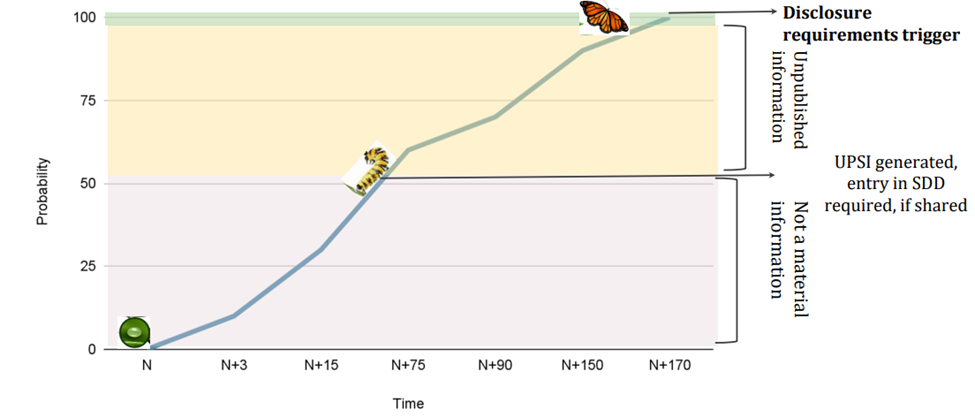
The metamorphosis of an internal development into UPSI and ultimately a disclosable event is based on its probability of occurrence, over that of non-occurrence. Generally speaking, once the probability of occurrence of an event is more than the probability of its non-occurence, UPSI may be said to have been germinated, thus, requiring preservation of such information and all related controls. 

See our presentation on verification of market rumour by listed entities & other related amendments.

Conclusion

While the SEBI Listing Regulations appear to grant leeway to listed entities to remain silent on rumours floating in the market, such leeway is not absolute and the PIT Regulations still require the listed entities to ensure public dissemination of information, where a leak of UPSI has occurred. While the Supreme Court dismissed the appeal, citing that the same has been comprehensively dealt with by SEBI and SAT on the basis of the factual matrix, the proceedings signal the SC’s stand that the principles underlying the PIT Regulations have to be upheld at all times, and if going by the principles, it is essential for the listed entity to speak, it cannot remain silent. 

In view of the significance of the subject, we are conducting a 12 hours Certificate Course on Insider Trading for Compliance Officers, see details here – https://vinodkothari.com/2025/11/12-hours-certificate-course-on-insider-trading-for-compliance-officers/

Our other resources:

  1. Presentation on verification of market rumour by listed entities & other related amendments
  2. FAQs on Verification of Market rumour by Listed Entities
  3. Verification of Market Rumour by listed entities & other related amendments
  4. FAQs on Verification of Market rumour by Listed Entities
  5. Prohibition of Insider Trading – Resource Centre