NBFC NPA characterisation: A reprieve a day too late?

– Vinod Kothari, Director (Vinod Kothari Consultants P. Ltd.) | finserv@vinodkothari.com

The RBI, vide a so-called “clarification” dated February 15, 2022[1], relating to what itself was termed as a “clarification”, dated November 12, 2021[2], has effectively provided a reprieve to NBFCs for treating those assets as NPAs, which have historically had a default of 90 days or more, but are currently trailing by less than 90 days. Unfortunately however, the clarification comes on the 45th day of the end of 3rd quarter, by which all listed NBFCs, and debt-listed entities, would have already prepared and published their financial results for the quarter, which would have implemented the November 12 Clarification. Read more

Form CSR-2: overlap in CSR reporting

corplaw@vinodkothari.com

MCA notification dated Feb 11, 2022 – https://www.mca.gov.in/bin/ebook/dms/getdocument?doc=MTE3OTE2OTE=&docCategory=Notifications&type=open

Our resources on the topic:

FAQs on CSR 2021 Amendments

Knowledge Centre for Corporate Social Responsibility (CSR)

CBDCs in India – Another step towards Digitalisation

finserv@vinodkothari.com

Related write-ups:

  1. CBDCs in India – A Leap of Faith?
  2. Untangling the Mystery of Virtual Digital Assets
  3. The Rise of Stablecoins amidst Instability
  4. Recent Trends in Crypto-Industry: India & Abroad

Special Situation Funds: Funds into asset reconstruction business

Aanchal Kaur Nagpal (Assistant Manager) | Parth Ved (Executive)

finserv@vinodkothari.com

Introduction

The intent behind asset reconstruction is not merely concerned with realisation of bad loans but also ‘reconstruction’, that is, to try and resurrect bad loans or bad borrowers into good ones. This almost always leads us to one name i.e. Asset Reconstruction Companies (‘ARCs’). Today, financial institutions are eager to sell their non-performing assets to clean-up their books while stressed companies find ways to get access to capital to anchor themselves. The Indian financial sector is known to be laden financial entities struggling to survive with their mammoth stressed assets. The COVID-19 pandemic has only added fuel to the fire. As at September, 2021, GNPA of banks was at INR 4,53,145 crore and that of the top 30 NBFCs, including HFCs stood at around INR 84,000 crore. Out of these loans, In 2019-20, the amount recovered as per cent of the amount involved under IBC was 45.5 per cent, followed by 26.7 per cent for ARCs. While the amount recovered through ARCs as per cent of amount involved was significantly higher in the initial years of their inception, in the recent years, it has dipped below 30 per cent except for a spurt in 2017-18.

Securities and Exchange Board of India (‘SEBI’) on January 24, 2022[1] along with its circular dated January 27, 2022[2], has further widened the NPA market to a specifically dedicated class of AIFs called Special Situation Funds (‘SSFs’), that shall exclusively invest in the distressed asset market. The intent behind the same is to use these cash-filled alternative funds to supplement ARCs in acquiring such stressed assets and aid banks and other financial institutions to release critical money choked up in such assets. AIFs are currently already permitted to invest in security receipts of ARCs and/ or invest in securities of distressed companies, however, SSFs will be additionally permitted to even acquire stressed loans. These SSFs also have been granted additional exemptions/ benefits over and above regular AIFs to facilitate stressed asset resolution.

This article attempts to cover the adoption of the concept of SSF from the global markets, and the characteristics of this peculiar kind of investing. Read more

Takeaways from Budget 2022-23 – Fast Track Exit for Companies

By Shaivi Bhamaria – Associate, [shaivi@vinodkothari.com]

Introduction

Over the past few years the Government of India has been increasingly focusing on ‘ease of doing business’ by corporates, and has taken several initiatives towards the same, such as exemption to private companies from the requirement of minimum paid up capital by way of the Companies (Amendment) Act, 2015; establishment to the Central Registration Centre (‘CRC’) under section 396 of the Companies Act, 2013 (‘CA, 2013’) for providing speedy incorporation related services; launch of the integrated web form SPICe+ and integration of the MCA21 system with the CBDT for issue of PAN and TAN to a company incorporated using SPICe+; launch of  web based service R.U.N. (Reserve Unique Name) for reserving a name for a new company, etc..

However, the term ‘ease of doing business’ includes not only a seamless start to a business or making the journey less cumbersome, but also involves the ease of exit. While there are various modes of exit available to corporates,  such as winding up, summary liquidation, mergers and amalgamations etc[1], given that in voluntary modes of exit like striking off or voluntary liquidation under IBC, the company is either solvent enough to meet its liabilities or holds nil assets and liabilities, ideally, the closure processes is expected to be fast and simple, However, it has been observed that these voluntary modes have not been essentially ‘easy’ given the significant delays associated with them.

It is in the backdrop of such delays, the Union Budget, 2022-23[2] has proposed certain reforms, specifically for speeding up the striking off process under section 248 (2) of the Companies Act. Further, the Insolvency and Bankruptcy Board of India (‘IBBI’) has issued a Discussion Paper dated 1st February, 2022[3] proposing amendments in the IBBI (Voluntary Liquidation) Regulations, 2016, for ensuring a faster closure of voluntary liquidation processes.

In this write up, the author discusses the two sets of proposed reforms as mentioned above, and attempts to gauge their effectiveness at present and post implementation of the proposed amendments. Read more

Untangling the Mystery of Virtual Digital Assets

– Shreyan Srivastava (finserv@vinodkothari.com)

An Insight into Crypto, Tokens and NFTs

Background

The Union Budget Speech 2022-23 created quite a stir in the cryptocurrency industry once again, as the Hon’ble Finance Minister proposed a 30% blanket taxation on virtual digital assets (“VDAs”). Given the plethora of terms existing such as ‘virtual currencies’, ‘digital currencies’, ‘cryptocurrencies’, ‘NFTs’, ‘altcoins’ and so on, the question arises as to what these individual terms entail and which ones fall under the category of ‘VDAs’ and where does the Central Bank Digital Currency (“CBDC”) fall under the maze of these new terms.

The Finance Bill, 2022 appears to provide some clarity through the proposed clause 2(47A) of the Income Tax Act by defining VDAs. To that effect, the current article is dedicated to clearing the confusion with respect to CBDCs and VDAs, arguing that for anything to qualify as a VDA it needs to progressively fulfil the criteria of asset → digital → virtual. Read more

Feasibility of Islamic Finance in India

Is change in the Indian regulatory framework inevitable for the development of Islamic Finance? or can there be structures worked around existing laws?

– Qasim Saif I Manager (qasim@vinodkothari.com

Islamic Finance, also referred to as sharia compliant finance or interest-free financing, has always been a topic of discussion in the world of finance. Development of Islamic finance has been viewed as a tool for promotion of inclusive growth by way of financial inclusion as faith plays a major role in inclusive growth.

Islam is the second most followed religion globally, and hence, Islamic finance can stimulate the growth of business sector by proving much needed financing, while also release the untapped sources of capital as some investors may only be willing to invest in products that are permissible under their faith.

Importantly, the application of interest free banking can not be said to be limited to a particular faith. The nuances caused by unchecked interest rates, and the exploitation of the poor by debt trap of the high interest loans has its impact across geographies and religion. As the Islamic finance majorly focuses on asset backed financing and principles of sharing of risk and reward, the same can also be viewed as a solution to the centuries-old problem of exploitation of the poor by way of high interest loans.

In this write-up, after discussing the basics of Islamic finance, we get into the interplay of Islamic finance products with the regulatory framework in India. Towards the end, we discuss a model that can be worked out for the development of Islamic finance products in India.

Read more

Budget 2022: Government to roll out battery swapping policy for EVs

Electric Vehicles slowly getting into priority list of the Government

Qasim Saif | Manager <finserv@vinodkothari.com>

­­­With a growth of more than 100% in sales of Electric vehicles (EVs) from FY21 to FY22 and 9,13,532 EVs currently registered since FY12 and expected sales of 14.8 million EVs by FY30, a comprehensive framework and government support to the industry is no longer an option rather a necessity.

Read more

Non-Performing Assets: A Solution at Last?

– Shreyan Srivastava (resolution@vinodkothari.com)

Background

In India, Non-Performing Assets (“NPAs”) have been a chronic plaque in the economy for decades. Although recent reports indicate that the Gross NPA (“GNPA”) and Net NPA (“NNPA”) have been systematically declining, in comparison to other economies, the country still faces a high volume of NPAs. For this reason, for the last several budgets, economic policies in India have been tailored to provide relief from the existing NPAs and to provide mitigatory steps to reduce the rate of such NPAs.

In this article, we discuss the current situation of NPAs in the country and assess the feasibility of the steps taken by the Government to mitigate, control and resolve the same, specifically through measures introduced by the Union Budget 2021-22[1] leading upto the Union Budget 2022-23[2] and the extent of the reliefs they provide.

A Two-Decade History

As illustrated in Figure 1, from the fiscal year of 2008-09, both Gross NPA (“GNPA”) and Net NPA (“NNPA”) for Scheduled Commercial Banks (“SCBs”) were following an upward trend with a slight dip in 2010-11. The highest NPA was recorded for the financial year of 2017-18, following which a structural decline was observed despite the overwhelming impact of the pandemic on all economic sectors in 2020.[3]
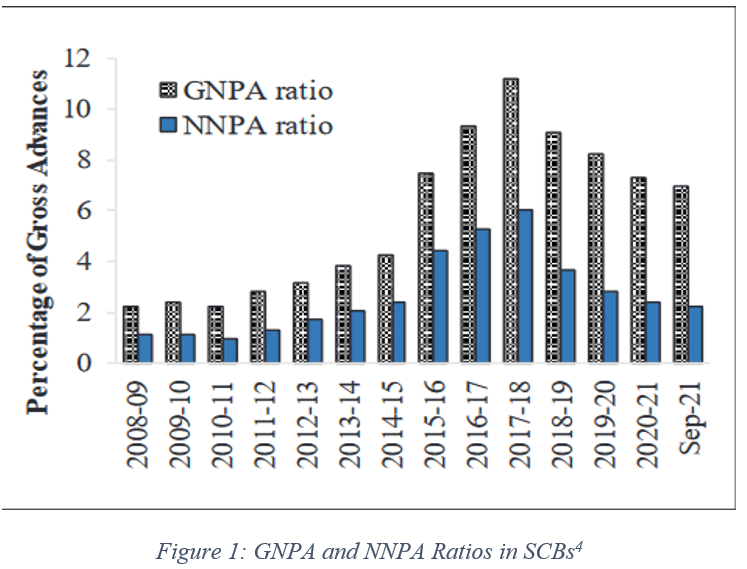
As per data provided by the RBI, there has been a constant decline of Net and Gross NPA Ratios in Scheduled Commercial Bank ever since the fiscal year of 2018-19:-

  • As of September-end 2021, the NNPA ratio sits at 2.2% compared to 6% in 2017-18.
  • As of September-end 2021, the GNPA ratio sits at 6.9% compared to 11.2% in 2017-18.

Similarly, the NNPA and GNPA ratios for NBFCs stood at 6.55% and 2.93% and 6.55% for September-end 2021.

A large portion of this declining rates of GNPA and NNPA ratios can be attributed to various available resolution mechanisms, including the Insolvency and Bankruptcy Code (IBC), SARFAESI Act, Debt Recovery Tribunals, etc, which have proved to be useful to certain extent. However, there still remains a large stock of legacy NPAs which are yet to be resolved. As per a report issued by RBI[5], in F.Y. 2019-20, the total amount of NPAs recovered was merely 23% of the total NPAs worth a whopping Rs. 7,42,431 crores.

The Indian Council for Research on International Economic Relations (“ICRIER”) studied Asset Management in various foreign jurisdictions such as the United States, Sweden, Italy and Indonesia all of which had instituted a centrally owned Asset Management Company (“AMC”) during a financial crisis with a sunset clause. Thus, once the financial crises had been lifted the AMC would be dissolved via its sunset clause.

Union Budget 2021-22: Creation of the Bad Bank

The need for a government owned ARC to manage the NPA problem on a large scale was identified as early as 2017 by the ICRIER and recognising the same the Governor of the RBI: Shri Shaktikanta Das observed: “If there is a proposal to set up a bad bank, the RBI will look at it”.[6] Subsequently, the Finance Minister of India during the Union Budget Speech of 2021-22 stated:

“An Asset Reconstruction Company Limited and Asset Management Company would be set up to consolidate and take over the existing stressed debt and then manage and dispose of the assets to Alternate Investment Funds and other potential investors for eventual value realization”.[7]

Soon after the Union Budget of 2021-22, the Government incorporated the National Asset Reconstruction Company Limited (“NARCL”) under the Companies Act, 2013 and registered the same with the RBI. The NARCL is essentially the first government owned ARC in India, set up in a manner similar to Asset Management Companies in the foreign jurisdiction, and is owned primarily by public sector banks.

As provided in its mandate, the Indian Debt Resolution Company Limited (“IDRLC”) was set up to act as the operational entity designed to manage the NARCL such that while the latter would offer the purchase stressed assets of the lead bank and acquire them, the IDRLC would engage with the management (market professionals and turnaround experts) and value addition of such assets. Thus, what was born was a unique Public-Private Partnership of NARCL-IDRLC with the mandate to mitigate the NPA problem in the economy.

The NARCL had proposed to acquire stressed assets worth Rs 2 lakh crore in a phased manner in the proportion of 15% Cash and 85% in Security Receipts (SRs), all the while operating within the existing framework for ARCs as issued by the RBI.[8]In fact, the NARCL had already planned for Phase I with fully provisioned assets of about Rs. 90,000 crores expected to be transferred to NARCL before the end of the current financial year of 2021-22.[9] From what is understood, NARCL shall focus on the legacy assets, worth Rs. 500 crores or more, which are generally not targeted by the privately owned ARCs.

However, despite being proposed a year back, NARCL was only made live on 27th January, 2022, merely 4 days prior to the Union Budget 2022-23. Hence, we are currently in a very nascent and premature stage to gauge if at all the public-private relationship would give the expected results.

The National Bank for Financing Infrastructure and Development

With the NARCL due to begin their operations of Phase I, the Ministry of Finance issued a notification on 28th January 2022 (close to the Union Budget Speech of 2022-23) which formally established the National Bank for Financing Infrastructure and Development (“NBFID”).[10]As elaborated by the PRS India, the NBFID is to operate as a corporate body with authorised share capital of one lakh crore rupees which can only be held by selected public sector enterprises.[11] Its mandate would be to directly or indirectly lend, invest, or attract investments for infrastructure projects as selected by the Central Government located entirely or partly in India. The various sectors have been identified in Figure 2 below: –
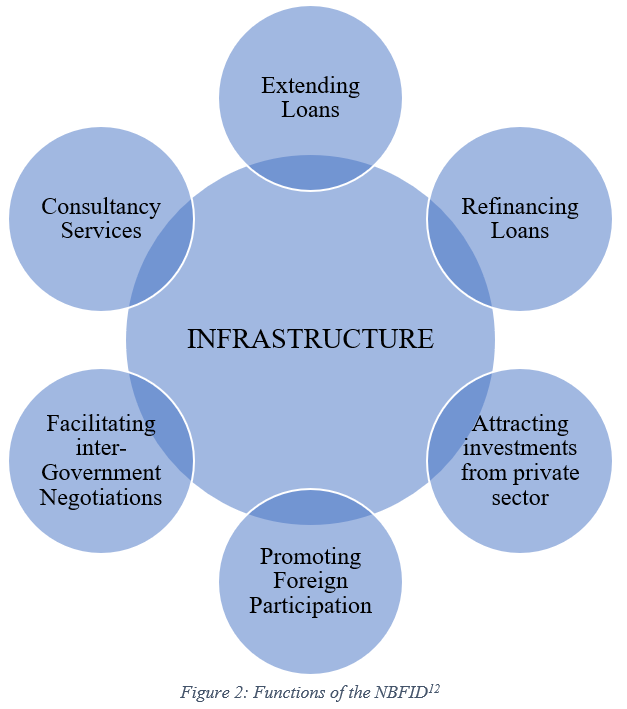
Thus, unlike any other jurisdictions, India appears to adopt a three-fold sectoral approach to rectify their NPA problem:

  • Private Sector: Private ARCs registered with the RBI.
  • Public-Private: The NARCL-IDRLC
  • Public: The NBFID.

Concluding Remarks

While the Union Budget 2021-22 had formally recognised the commencement of the NBFID and NARCIL, its performance and efficacy is yet to be investigated. Moreover, what makes the NBFID stand out from its government owned AMC counterparts in foreign jurisdictions is the lack of a sunset clause given that it targets the Infrastructure Sector. Similarly, not much can be said about the NARCL-IDRLC which is also due to begin its Phase I sometime before 31st March 2022.

[1] https://www.indiabudget.gov.in/budget2021-22/doc/Budget_Speech.pdf

[2] https://www.indiabudget.gov.in/doc/Budget_Speech.pdf

[3] https://www.indiabudget.gov.in/economicsurvey/doc/echapter.pdf#page=55

[4] https://www.indiabudget.gov.in/economicsurvey/doc/echapter.pdf#page=55

[5] https://rbi.org.in/Scripts/PublicationReportDetails.aspx?UrlPage=&ID=1188

[6] 39th Palkhivala Memorial Lecture

[7] https://www.indiabudget.gov.in/budget2021-22/doc/Budget_Speech.pdf

[8] https://pib.gov.in/PressReleseDetailm.aspx?PRID=1755466

[9] https://pib.gov.in/PressReleseDetailm.aspx?PRID=1755466

[10] https://egazette.nic.in/WriteReadData/2021/226210.pdf

[11] As per PRS India: the shares may be held by: (i) central government, (ii) multilateral institutions, (iii) sovereign wealth funds, (iv) pension funds, (v) insurers, (vi) financial institutions, (vii) banks, and (viii) any other institution prescribed by the central government.

[12] https://prsindia.org/billtrack/the-national-bank-for-financing-infrastructure-and-development-bill-2021

CBDCs in India – A Leap of Faith?

Introduction

Right from RBI’s (in)famous March 2018 Circular (‘Circular’) banning all operations by virtual currency exchanges (VCEs) to the Hon’ble Supreme Court’s verdict upholding the constitutionality of cryptocurrency and its exchanges, the debate over the adaptability of cryptos has led to a demographic split in India.

Read more